EP0283809A2 - Verfahren und Vorrichtung zur Herstellung von holzmaserstrukturähnlichen dünnen Schichten durch Coextrusion - Google Patents
Verfahren und Vorrichtung zur Herstellung von holzmaserstrukturähnlichen dünnen Schichten durch Coextrusion Download PDFInfo
- Publication number
- EP0283809A2 EP0283809A2 EP88103473A EP88103473A EP0283809A2 EP 0283809 A2 EP0283809 A2 EP 0283809A2 EP 88103473 A EP88103473 A EP 88103473A EP 88103473 A EP88103473 A EP 88103473A EP 0283809 A2 EP0283809 A2 EP 0283809A2
- Authority
- EP
- European Patent Office
- Prior art keywords
- melt flow
- melt
- thermoplastic
- wood grain
- plasticizing device
- Prior art date
- Legal status (The legal status is an assumption and is not a legal conclusion. Google has not performed a legal analysis and makes no representation as to the accuracy of the status listed.)
- Withdrawn
Links
Images

Classifications
-
- B—PERFORMING OPERATIONS; TRANSPORTING
- B29—WORKING OF PLASTICS; WORKING OF SUBSTANCES IN A PLASTIC STATE IN GENERAL
- B29C—SHAPING OR JOINING OF PLASTICS; SHAPING OF MATERIAL IN A PLASTIC STATE, NOT OTHERWISE PROVIDED FOR; AFTER-TREATMENT OF THE SHAPED PRODUCTS, e.g. REPAIRING
- B29C48/00—Extrusion moulding, i.e. expressing the moulding material through a die or nozzle which imparts the desired form; Apparatus therefor
- B29C48/25—Component parts, details or accessories; Auxiliary operations
- B29C48/30—Extrusion nozzles or dies
- B29C48/304—Extrusion nozzles or dies specially adapted for bringing together components, e.g. melts within the die
-
- B—PERFORMING OPERATIONS; TRANSPORTING
- B29—WORKING OF PLASTICS; WORKING OF SUBSTANCES IN A PLASTIC STATE IN GENERAL
- B29C—SHAPING OR JOINING OF PLASTICS; SHAPING OF MATERIAL IN A PLASTIC STATE, NOT OTHERWISE PROVIDED FOR; AFTER-TREATMENT OF THE SHAPED PRODUCTS, e.g. REPAIRING
- B29C48/00—Extrusion moulding, i.e. expressing the moulding material through a die or nozzle which imparts the desired form; Apparatus therefor
- B29C48/03—Extrusion moulding, i.e. expressing the moulding material through a die or nozzle which imparts the desired form; Apparatus therefor characterised by the shape of the extruded material at extrusion
- B29C48/06—Rod-shaped
-
- B—PERFORMING OPERATIONS; TRANSPORTING
- B29—WORKING OF PLASTICS; WORKING OF SUBSTANCES IN A PLASTIC STATE IN GENERAL
- B29C—SHAPING OR JOINING OF PLASTICS; SHAPING OF MATERIAL IN A PLASTIC STATE, NOT OTHERWISE PROVIDED FOR; AFTER-TREATMENT OF THE SHAPED PRODUCTS, e.g. REPAIRING
- B29C48/00—Extrusion moulding, i.e. expressing the moulding material through a die or nozzle which imparts the desired form; Apparatus therefor
- B29C48/03—Extrusion moulding, i.e. expressing the moulding material through a die or nozzle which imparts the desired form; Apparatus therefor characterised by the shape of the extruded material at extrusion
- B29C48/09—Articles with cross-sections having partially or fully enclosed cavities, e.g. pipes or channels
- B29C48/11—Articles with cross-sections having partially or fully enclosed cavities, e.g. pipes or channels comprising two or more partially or fully enclosed cavities, e.g. honeycomb-shaped
-
- B—PERFORMING OPERATIONS; TRANSPORTING
- B29—WORKING OF PLASTICS; WORKING OF SUBSTANCES IN A PLASTIC STATE IN GENERAL
- B29C—SHAPING OR JOINING OF PLASTICS; SHAPING OF MATERIAL IN A PLASTIC STATE, NOT OTHERWISE PROVIDED FOR; AFTER-TREATMENT OF THE SHAPED PRODUCTS, e.g. REPAIRING
- B29C48/00—Extrusion moulding, i.e. expressing the moulding material through a die or nozzle which imparts the desired form; Apparatus therefor
- B29C48/03—Extrusion moulding, i.e. expressing the moulding material through a die or nozzle which imparts the desired form; Apparatus therefor characterised by the shape of the extruded material at extrusion
- B29C48/12—Articles with an irregular circumference when viewed in cross-section, e.g. window profiles
-
- B—PERFORMING OPERATIONS; TRANSPORTING
- B29—WORKING OF PLASTICS; WORKING OF SUBSTANCES IN A PLASTIC STATE IN GENERAL
- B29C—SHAPING OR JOINING OF PLASTICS; SHAPING OF MATERIAL IN A PLASTIC STATE, NOT OTHERWISE PROVIDED FOR; AFTER-TREATMENT OF THE SHAPED PRODUCTS, e.g. REPAIRING
- B29C48/00—Extrusion moulding, i.e. expressing the moulding material through a die or nozzle which imparts the desired form; Apparatus therefor
- B29C48/16—Articles comprising two or more components, e.g. co-extruded layers
- B29C48/17—Articles comprising two or more components, e.g. co-extruded layers the components having different colours
- B29C48/175—Articles comprising two or more components, e.g. co-extruded layers the components having different colours comprising a multi-coloured single component, e.g. striated, marbled or wood-like patterned
-
- B—PERFORMING OPERATIONS; TRANSPORTING
- B29—WORKING OF PLASTICS; WORKING OF SUBSTANCES IN A PLASTIC STATE IN GENERAL
- B29C—SHAPING OR JOINING OF PLASTICS; SHAPING OF MATERIAL IN A PLASTIC STATE, NOT OTHERWISE PROVIDED FOR; AFTER-TREATMENT OF THE SHAPED PRODUCTS, e.g. REPAIRING
- B29C48/00—Extrusion moulding, i.e. expressing the moulding material through a die or nozzle which imparts the desired form; Apparatus therefor
- B29C48/03—Extrusion moulding, i.e. expressing the moulding material through a die or nozzle which imparts the desired form; Apparatus therefor characterised by the shape of the extruded material at extrusion
- B29C48/07—Flat, e.g. panels
- B29C48/08—Flat, e.g. panels flexible, e.g. films
-
- B—PERFORMING OPERATIONS; TRANSPORTING
- B29—WORKING OF PLASTICS; WORKING OF SUBSTANCES IN A PLASTIC STATE IN GENERAL
- B29C—SHAPING OR JOINING OF PLASTICS; SHAPING OF MATERIAL IN A PLASTIC STATE, NOT OTHERWISE PROVIDED FOR; AFTER-TREATMENT OF THE SHAPED PRODUCTS, e.g. REPAIRING
- B29C48/00—Extrusion moulding, i.e. expressing the moulding material through a die or nozzle which imparts the desired form; Apparatus therefor
- B29C48/15—Extrusion moulding, i.e. expressing the moulding material through a die or nozzle which imparts the desired form; Apparatus therefor incorporating preformed parts or layers, e.g. extrusion moulding around inserts
- B29C48/151—Coating hollow articles
-
- B—PERFORMING OPERATIONS; TRANSPORTING
- B29—WORKING OF PLASTICS; WORKING OF SUBSTANCES IN A PLASTIC STATE IN GENERAL
- B29C—SHAPING OR JOINING OF PLASTICS; SHAPING OF MATERIAL IN A PLASTIC STATE, NOT OTHERWISE PROVIDED FOR; AFTER-TREATMENT OF THE SHAPED PRODUCTS, e.g. REPAIRING
- B29C48/00—Extrusion moulding, i.e. expressing the moulding material through a die or nozzle which imparts the desired form; Apparatus therefor
- B29C48/16—Articles comprising two or more components, e.g. co-extruded layers
-
- B—PERFORMING OPERATIONS; TRANSPORTING
- B29—WORKING OF PLASTICS; WORKING OF SUBSTANCES IN A PLASTIC STATE IN GENERAL
- B29C—SHAPING OR JOINING OF PLASTICS; SHAPING OF MATERIAL IN A PLASTIC STATE, NOT OTHERWISE PROVIDED FOR; AFTER-TREATMENT OF THE SHAPED PRODUCTS, e.g. REPAIRING
- B29C48/00—Extrusion moulding, i.e. expressing the moulding material through a die or nozzle which imparts the desired form; Apparatus therefor
- B29C48/16—Articles comprising two or more components, e.g. co-extruded layers
- B29C48/17—Articles comprising two or more components, e.g. co-extruded layers the components having different colours
-
- B—PERFORMING OPERATIONS; TRANSPORTING
- B29—WORKING OF PLASTICS; WORKING OF SUBSTANCES IN A PLASTIC STATE IN GENERAL
- B29C—SHAPING OR JOINING OF PLASTICS; SHAPING OF MATERIAL IN A PLASTIC STATE, NOT OTHERWISE PROVIDED FOR; AFTER-TREATMENT OF THE SHAPED PRODUCTS, e.g. REPAIRING
- B29C48/00—Extrusion moulding, i.e. expressing the moulding material through a die or nozzle which imparts the desired form; Apparatus therefor
- B29C48/16—Articles comprising two or more components, e.g. co-extruded layers
- B29C48/18—Articles comprising two or more components, e.g. co-extruded layers the components being layers
- B29C48/21—Articles comprising two or more components, e.g. co-extruded layers the components being layers the layers being joined at their surfaces
Definitions
- the invention relates to a method for producing thin layers similar to wood grain structure by coextrusion according to the preamble of claim 1 and a device for carrying out this method according to the preamble of claim 8.
- the preferred field of application of the invention is the production of surface-coated profiles such as window profiles or the like, the surface coating having a wood-like appearance.
- a generic method is known from DE-OS 35 17 779-A 1.
- two differently colored melt streams are combined in a merging region which runs unevenly over the width of the layer in order to produce marbled layers.
- the degree of mixing is changed over time by changing the pressure of the individual mass flows.
- the object of the invention is to provide a method and an apparatus for producing thin layers similar to wood grain structure by coextrusion.
- the invention achieves the object by a method according to claim 1 and by a device according to claim 8.
- the first melt stream has already been largely spread in the direction transverse to the conveying direction - that is, in the width direction - before it is combined with the second thermoplastic plastic, which is divided into a plurality of individual melt streams, and mixed inhomogeneously.
- the inhomogeneous mixing is achieved according to the invention in that distribution channels and / or distribution webs start from the confluence areas and are arranged within the flow channel of the combined melt flow.
- These distribution channels or webs preferably have a length that is a multiple of their width. They are arranged obliquely or curling in the flow channel.
- a thin layer is understood to be a layer whose extent in the direction of the thickness is many times smaller than in the direction of the width.
- the thickness of the layer is approximately 0.1 to 2 mm, the extent in the width direction is more than 20 mm.
- the width of the layer is fundamentally arbitrary, in particular the layer can also be 200 mm or more in width.
- the layer can be a surface layer of a profile coextruded with the thin layer similar to the wood grain structure, e.g. a window profile.
- the thin layer according to the invention can also be produced individually and coextruded as a film or thin plate.
- the second melt flow is promoted swelling and / or intermittently.
- a light to dark brown colored polymethyl methacrylate (PMMA) is preferably used for the first thermoplastic and a black colored PMMA for the second thermoplastic, the proportion of the black colored PMMA - averaged over a longer period - preferably between 0.5 and 10 %, in particular 1 to 2%.
- the PMMA used is preferably one with a melt index MFI 230 / 3.8 of 0.6 to 11 g / 10 min (DIN 53 735), in particular of 2.5 to 3.5 g / 10 min.
- the melt indices of the differently colored PMMA types should preferably match, but PMMA types with different melt indices can also be used to achieve special effects.
- the preferred area of application of the method according to the invention is the production of solid or hollow profiles, for example window profiles, with a surface coating, the surface coating having a pattern similar to a wood grain structure.
- the wood-fiber structure-like thin layer formed from two differently colored PMMA melt streams is connected to the basic profile by coextrusion.
- Hard PVC or PVC impact resistance is preferably used as the thermoplastic for the basic profile.
- the device provided according to the invention for producing the thin, wood-fiber structure-like layers has at least two plasticizing devices for melting and conveying the first and second thermoplastic materials; Furthermore, a wide slot tool or the like. provided with a distribution channel with which the first melt flow is spread out in the width direction to the thin layer, and a mold with which the second melt flow is divided into a plurality of melt flows, the mold opening into the slot die through a plurality of channels and in which the wide slot tool, starting from the channels, starts with a plurality of distributor channels and / or distributor webs, so that the split second melt flow is mixed inhomogeneously with the first melt flow.
- An extruder which produces a largely constant melt flow is preferably used as the first plasticizing device for the first melt flow, while an injection molding tool is preferably used as the second plasticizing device for the second melt flow. This ensures that the second melt flow is injected intermittently or swelling into the first melt flow. Possibly. an extruder with a correspondingly adjustable conveying behavior can also be used for the two plasticizing devices.
- the device according to the invention furthermore has a third extruder with a molding tool, with which a third thermoplastic material forms a solid or hollow profile, e.g. a window profile.
- a third thermoplastic material forms a solid or hollow profile, e.g. a window profile.
- the (PMMA) melt streams formed into the thin, wood-fiber structure-like layer are combined in a manner known to those skilled in the art (DE-AS 22 65 035) with the basic profile, in particular made of rigid PVC, to form a profile having a surface coating with a wood-like appearance.
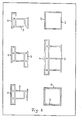
- a window profile 3 made of hard PVC according to FIG. 6 is coextruded with a surface coating 4 similar to a wood grain structure.
- the surface coating 4 made of polymethyl methacrylate (PMMA) has a thickness of approximately 0.5 mm and a width of approximately 100 mm.
- the method according to the invention is not limited to these geometric values, but is suitable for all thin layers whose width dimension is a multiple of their thickness.
- a first melt stream A made of dark brown colored PMMA with a melt index MFI 230 / 3.8 of 3 g / 10 min (DIN 53 735) is melted and in the clothes hanger tool 2 transversely to the conveying direction, i.e. in the width direction.
- a black-colored PMMA with the same melt index is melted in parallel by an injection molding machine (not shown).
- This melt flow B is spread in the distribution channel 5 in the width direction and combined with the first melt flow A through the connection channels 6.
- the connecting channels 6 open into the tool 2 at the outlet points 7; distribution channels 8 or distribution webs 9 extend from these outlet points 7. These distribution channels or webs have the effect that the black-colored melt B is distributed inhomogeneously in the brown melt A with the formation of streaks. It is essential to the invention that the inhomogeneous distribution of the melts takes place on the later visible surface of the melt stream that has already spread at least largely in the width direction.
- the proportion of black melt B - averaged over time - is approximately 1.5% of the total melt flow A + B, the throughput of the melt flow B, controlled by a random control, fluctuating between 0 and 3% of the total PMMA melt flow .
- the combined melt stream is coextruded with the PVC melt stream C in a manner known per se and cooled and calibrated in subsequent stages.
- FIG. 6 shows some profiles 3 with a co-extruded wood surface structure-like thin surface coating 4 according to the exemplary embodiment. Possibly. Following the coextrusion, the profiles 3 can be further finished on their surface by an embossing process.
Landscapes
- Engineering & Computer Science (AREA)
- Mechanical Engineering (AREA)
- Manufacturing & Machinery (AREA)
- Extrusion Moulding Of Plastics Or The Like (AREA)
Abstract
Description
-
- Die Erfindung betrifft ein Verfahren zur Herstellung von holzmaserstrukturähnlichen dünnen Schichten durch Coextrusion gemäß dem Oberbegriff des Anspruchs 1 und eine Vorrichtung zur Durchführung dieses Verfahrens gemäß dem Oberbegriff des Anspruchs 8.
- Bevorzugtes Anwendungsgebiet der Erfindung ist die Herstellung von oberflächenbeschichteten Profilen wie Fensterprofilen o.dgl., wobei die Oberflächenbeschichtung ein holzähnliches Aussehen aufweist.
- Ein gattungsgemäßes Verfahren ist aus der DE-OS 35 17 779-A 1 bekannt. Bei diesem bekannten Verfahren werden zur Erzeugung marmorierter Schichten zwei unterschiedlich eingefärbte Schmelzeströme in einem über die Breite der Schicht ungleichmäßig verlaufenden Zusammenführungsbereich vereinigt. Dabei wird der Grad der Vermischung durch Änderung des Drucks der einzelnen Masseströme zeitlich verändert.
- Es hat sich herausgestellt, daß dieses Verfahren zur Erzeugung von der natürlichen Holzmaserung ähnlichen Schichten nicht geeignet ist, da an der Oberfläche der Schicht keine Marmorierung eintritt.
- Es sind auch weitere Verfahren bekannt geworden zur Erzeugung diverser Musterungen, bei denen zwei oder mehr unterschiedlich eingefärbte Schmelzeströme vereinigt und inhomogen vermischt werden (DE-OS 21 17 045-A 1, DE-OS 25 23 836-A 1, US-PS 3,405,425). Diese Verfahren eignen sich jedoch nicht zur Erzeugung holzmaserstrukturähnlicher dünner Schichten durch Coextrusion.
- Aufgabe der Erfindung ist es, ein Verfahren und eine Vorrichtung zur Erzeugung holzmaserstrukturähnlicher dünner Schichten durch Coextrusion zur Verfügung zu stellen.
- Die Erfindung löst die Aufgabe durch ein Verfahren gemäß dem Anspruch 1 sowie durch eine Vorrichtung gemäß Anspruch 8.
- Wesentliches Merkmal der Erfindung ist es, daß der erste Schmelzestrom bereits weitgehend in Richtung quer zur Förderrichtung - also in Breitenrichtung - ausgebreitet wurde, bevor er mit dem in einer Mehrzahl einzelner Schmelzeströme aufgeteilten zweiten thermoplastischem Kunststoff vereinigt und inhomogen vermischt wird. Die inhomogene Vermischung wird erfindungsgemäß dadurch erreicht, daß von den Zusammenflußbereichen Verteilerkanäle und/oder Verteilerstege ausgehen, die innerhalb des Fließkanals des vereinigten Schmelzestromes angeordnet sind. Diese Verteilerkanäle bzw. -stege haben bevorzugt eine Länge, die ein Mehrfaches ihrer Breite beträgt. Sie sind schräg oder sich windend in dem Fließkanal angeordnet.
- Unter einer dünnen Schicht im Sinne dieser Erfindung wird eine Schicht verstanden, deren Ausdehnung in Dickenrichtung um ein Vielfaches kleiner ist als in Breitenrichtung. Insbesondere beträgt die Dicke der Schicht etwa 0,1 bis 2 mm, die Ausdehnung in Breitenrichtung mehr als 20 mm. Die Breite der Schicht ist grundsätzlich beliebig, insbesondere kann die Schicht auch 200 mm oder mehr in der Breite betragen.
- Insbesondere kann die Schicht eine Oberflächenschicht eines mit der holzmaserstrukturähnlichen dünnen Schicht coextrudierten Profils sein, z.B. eines Fensterprofils. Ggf. kann die erfindungsgemäße dünne Schicht aber auch einzeln hergestellt und als Folie oder dünne Platte coextrudiert werden.
- Um eine zeitlich variierende, inhomogene Vermischung und damit ein der natürlichen Holzmaserung entsprechendes Dekor zu erzeugen, wird in einer vorteilhaften Fortbildung der Erfindung vorgeschlagen, daß der zweite Schmelzestrom schwellend und/oder intermittierend gefördert wird.
- Auf diese Weise werden in überraschend einfacher Weise sehr natürliche Holzmaserungen erzeugt.
- Bevorzugt wird für den ersten thermoplastischen Kunststoff ein hell- bis dunkelbraun eingefärbtes Polymethylmethacrylat (PMMA) und für den zweiten thermoplastischen Kunststoff ein schwarz eingefärbtes PMMA eingesetzt, wobei der Mengenanteil des schwarz eingefärbten PMMA's - über einen längeren Zeitraum gemittelt - bevorzugt zwischen 0,5 und 10 %, insbesondere 1 bis 2 % beträgt.
- Als PMMA wird bevorzugt ein solches mit einem Schmelzindex MFI 230/3,8 von 0,6 bis 11 g/10 Min (DIN 53 735), insbesondere von 2,5 bis 3,5 g/10 Min eingesetzt. Die Schmelzindizes der unterschiedlich eingefärbten PMMA-Typen sollen bevorzugt übereinstimmen, zur Erzielung besonderer Effekte können jedoch auch PMMA-Typen mit unterschiedlichen Schmelzindizes verwendet werden.
- Bevorzugtes Einsatzgebiet des erfindungsgemäßen Verfahrens ist die Herstellung von Voll- oder Hohlprofilen, z.B. Fensterprofilen, mit einer Oberflächenbeschichtung, wobei die Oberflächenbeschichtung eine holzmaserstrukturähnliche Musterung aufweist.
- Nach einer bevorzugten Ausgestaltung des erfindungsgemäßen Verfahrens wird dabei die aus zwei unterschiedlich eingefärbten PMMA-Schmelzeströmen gebildete holzmaserstrukturähnliche dünne Schicht durch Coextrusion mit dem Grundprofil verbunden. Als thermoplastischer Kunststoff für das Grundprofil wird bevorzugt Hart-PVC oder PVC-Schlagzäh eingesetzt.
- Die gemäß der Erfindung vorgesehene Vorrichtung zur Herstellung der holzmaserstrukturähnlichen dünnen Schichten weist wenigstens zwei Plastifiziereinrichtungen auf zum Aufschmelzen und Fördern des ersten und des zweiten thermoplastischen Kunststoffs; weiterhin ist ein Breitschlitzwerkzeug o.dgl. mit Verteilerkanal vorgesehen, mit dem der erste Schmelzestrom in Breitenrichtung zu der dünnen Schicht ausgebreitet wird, sowie ein Formwerkzeug, mit dem der zweite Schmelzestrom aufgeteilt wird zu einer Mehrzahl von Schmelzeströmen, wobei das Formwerkzeug durch eine Mehrzahl von Kanälen in das Breitschlitzwerkzeug mündet und wobei in dem Breitschlitzwerkzeug, ausgehend von den Kanälen, eine Mehrzahl von Verteilerkanälen und/oder Verteilerstegen ausgeht, so daß der aufgeteilte zweite Schmelzestrom inhomogen mit dem ersten Schmelzestrom vermischt wird.
- Bevorzugt wird als erste Plastifiziereinrichtung für den ersten Schmelzestrom ein Extruder eingesetzt, der einen weitgehend konstanten Schmelzefluß erzeugt, während als zweite Plastifiziereinrichtung für den zweiten Schmelzeflüß bevorzugt ein Spritzgießwerkzeug eingesetzt wird. Hierdurch wird erreicht, daß der zweite Schmelzestrom intermittierend oder schwellend in den ersten Schmelzestrom eingespritzt wird. Ggf. kann für die zwei Plastifiziereinrichtung auch ein Extruder mit entsprechend regelbarem Förderverhalten eingesetzt werden.
- Die erfindungsgemäße Vorrichtung weist weiterhin nach einer bevorzugten Ausführung der Erfindung einen dritten Extruder mit Formwerkzeug auf, mit dem ein dritter thermoplastischer Kunststoff zu einem Voll- oder Hohlprofil, z.B. einem Fensterprofil, geformt wird. Die zu der holzmaserstrukturähnlichen dünnen Schicht geformten (PMMA-)Schmelzeströme werden dabei in dem Fachmann bekannter Weise (DE-AS 22 65 035) mit dem Grundprofil, insbesondere aus Hart-PVC, vereinigt zu einem eine Oberflächenbeschichtung mit holzähnlichem Aussehen aufweisenden Profil.
- Im folgenden wird die Erfindung anhand eines Ausführungsbeispiels und der Zeichnung näher erläutert.
- Es zeigen dabei
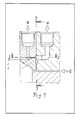
- Figur 1 einen Vertikalschnitt durch eine Vorrichtung zur Herstellung von holzmaserstrukturähnlichen dünnen Schichten,
- Figur 2 einen Horizontalschnitt durch die Vorrichtung gemäß Figur 1,
- Figur 3 einen Vertikalschnitt durch die Vorrichtung gemäß Figur 1,
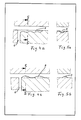
- Figur 4 einen Längsschnitt durch einen Verteilerkanal bzw. Verteilersteg gemäß Figur 3,
- Figur 5 einen Querschnitt durch einen Verteilerkanal bzw. Verteilersteg gemäß Figur 4,
- Figur 6 einige Profile mit holzmaserstrukturähnlicher Oberflächenbeschichtung.
- Gemäß dem Ausführungsbeispiel wird ein Fensterprofil 3 aus Hart-PVC gemäß der Figur 6 mit einer holzmaserstrukturähnlichen Oberflächenbeschichtung 4 coextrudiert. Gemäß dem Ausführungsbeispiel weist die Oberflächenbeschichtung 4 aus Polymethylmethacrylat (PMMA) eine Dicke von ca. 0,5 mm und eine Breite von ca. 100 mm auf.
- Das erfindungsgemäße Verfahren ist jedoch nicht auf diese geometrischen Werte beschränkt, sondern es eignet sich für alle dünnen Schichten, deren Breitenausdehnung ein Mehrfaches ihrer Dicke beträgt.
- In einem ersten Extruder (nicht dargestellt) wird ein erster Schmelzestrom A aus dunkelbraun eingefärbtem PMMA mit einem Schmelzindex MFI 230/3,8 von 3 g/10 Min (DIN 53 735) aufgeschmolzen und in dem Kleiderbügel-Werkzeug 2 quer zur Förderrichtung, d.h. in Breitenrichtung, ausgebreitet.
- Durch eine nicht dargestellte Spritzgießmaschine wird parallel hierzu ein schwarz eingefärbtes PMMA mit gleichem Schmelzindex aufgeschmolzen. Dieser Schmelzestrom B wird in dem Verteilerkanal 5 in Breitenrichtung ausgebreitet und durch die Verbindungskanäle 6 mit dem ersten Schmelzestrom A vereinigt.
- Die Verbindungskanäle 6 münden in Mündungsstellen 7 in das Werkzeug 2; von diesen Mündungsstellen 7 gehen Verteilerkanäle 8 bzw. Verteilerstege 9 aus. Diese Verteilerkanäle bzw. -stege bewirken, daß die schwarz eingefärbte Schmelze B unter Schlierenbildung inhomogen in der braunen Schmelze A verteilt wird. Erfindungswesentlich ist dabei, daß die inhomogene Verteilung der Schmelzen auf der später sichtbaren Oberfläche des bereits zumindest weitgehend in Breitenrichtung ausgebreiteten Schmelzestromes erfolgt.
- In dem dargestellten Ausführungsbeispiel beträgt der Anteil der schwarzen Schmelze B - zeitlich gemittelt - etwa 1,5% des Gesamtschmelzestromes A + B, wobei der Durchsatz des Schmelzestromes B, durch eine Zufallssteuerung gesteuert, zwischen 0 und 3 % des Gesamt-PMMA-Schmelzestromes schwankt.
- Nach der inhomogenen Vermischung der Schmelzeströme A und B wird der vereinigte Schmelzestrom mit dem PVC-Schmelzestrom C in an sich bekannter Weise coextrudiert und in nachfolgenden Stufen abgekühlt und kalibriert.
- Figur 6 zeigt einige Profile 3 mit coextrudierter holzmaserstrukturähnlicher dünner Oberflächenbeschichtung 4 gemäß dem Ausführungsbeispiel. Ggf. können im Anschluß an die Coextrusion die Profile 3 an ihrer Oberfläche durch einen Prägeprozeß weiter veredelt werden.
Claims (10)
- wobei ein erster thermoplastischer Kunststoff mittels einer Plastifiziereinrichtung aufgeschmolzen wird zu einem ersten Schmelzestrom
-- und in Richtung quer zur Förderrichtung (Breitenrichtung) ausgebreitet wird,
- wobei ein zweiter thermoplastischer Kunststoff mittels einer zweiten Plastifiziereinrichtung aufgeschmolzen wird zu einem zweiten Schmelzestrom,
-- wobei der zweite Schmelzestrom eine andere Einfärbung aufweist als der erste Schmelzestrom,
- und wobei die beiden Schmelzeströme vereinigt und inhomogen vermischt werden,
dadurch gekennzeichnet, daß
- der zweite Schmelzestrom vor der Vereinigung mit dem ersten Schmelzestrom aufgeteilt wird in eine Mehrzahl einzelner Schmelzeströme,
- und daß unmittelbar nach der Vereinigung des aufgeteilten zweiten Schmelzestromes mit dem ersten Schmelzestrom durch von den Zusammenflußbereichen ausgehende Verteilerkanäle und/oder Verteilerstege eine inhomogene Vermischung der unterschiedlich eingefärbten Schmelzen an der Oberfläche des vereinigten Schmelzestromes erfolgt.
- mit einer ersten Plastifiziereinrichtung zum Aufschmelzen und Fördern eines ersten thermoplastischen Kunststoffs zu einem ersten Schmelzestrom (A),
- mit einer zweiten Plastifiziereinrichtung zum Aufschmelzen und Fördern eines zweiten thermoplastischen Kunststoffs zu einem zweiten Schmelzestrom (B),
- mit einem Breitschlitzwerkzeug oder dgl. mit Verteilerkanal (2), mit dem der erste Schmelzestrom (A) in Breitenrichtung zu der dünnen Schicht (4) ausgebreitet wird,
gekennzeichnet durch
- ein Formwerkzeug (5) mit dem der zweite Schmelzestrom (B) aufgeteilt wird zu einer Mehrzahl von Schmelzeströmen,
-- wobei das Formwerkzeug (5) durch eine Mehrzahl von Kanälen (6) in das Breitschlitzwerkzeug (2) mündet,
- und wobei in dem Breitschlitzwerkzeug (2), ausgehend von den Kanälen (6) eine Mehrzahl von Verteilerkanälen (8) oder Verteilerstegen (9) ausgeht, so daß der aufgeteilte zweite Schmelzestrom inhomogen mit dem ersten Schmelzestrom (A) vermischt wird.
Applications Claiming Priority (2)
| Application Number | Priority Date | Filing Date | Title |
|---|---|---|---|
| DE3709411 | 1987-03-21 | ||
| DE19873709411 DE3709411A1 (de) | 1987-03-21 | 1987-03-21 | Verfahren und vorrichtung zur herstellung von holzmaserstrukturaehnlichen duennen schichten durch coextrusion |
Publications (2)
| Publication Number | Publication Date |
|---|---|
| EP0283809A2 true EP0283809A2 (de) | 1988-09-28 |
| EP0283809A3 EP0283809A3 (de) | 1989-11-02 |
Family
ID=6323734
Family Applications (1)
| Application Number | Title | Priority Date | Filing Date |
|---|---|---|---|
| EP88103473A Withdrawn EP0283809A3 (de) | 1987-03-21 | 1988-03-05 | Verfahren und Vorrichtung zur Herstellung von holzmaserstrukturähnlichen dünnen Schichten durch Coextrusion |
Country Status (2)
| Country | Link |
|---|---|
| EP (1) | EP0283809A3 (de) |
| DE (1) | DE3709411A1 (de) |
Cited By (3)
| Publication number | Priority date | Publication date | Assignee | Title |
|---|---|---|---|---|
| FR2653377A1 (fr) * | 1989-10-19 | 1991-04-26 | Aeroquip Corp | Procede et dispositif pour former une bande allongee de decoration en materiau plastique et bande de decoration pour automobile, ainsi obtenue par extrusion. |
| WO1998058787A1 (en) * | 1997-06-24 | 1998-12-30 | Misawa Homes Co., Ltd. | Method for producing a wood-like molded resin product |
| GB2354966A (en) * | 1999-08-06 | 2001-04-11 | Xylo Ltd | Recycling plastic waste |
Families Citing this family (2)
| Publication number | Priority date | Publication date | Assignee | Title |
|---|---|---|---|---|
| DE19643799A1 (de) * | 1996-10-30 | 1997-08-07 | Roehm Gmbh | Koextrusionsadapter |
| DE102017115380A1 (de) * | 2017-07-10 | 2019-01-10 | Klöckner Pentaplast Gmbh | Folie mit Inlaydekor |
Family Cites Families (17)
| Publication number | Priority date | Publication date | Assignee | Title |
|---|---|---|---|---|
| US2632204A (en) * | 1951-02-14 | 1953-03-24 | Eastman Kodak Co | Apparatus for the continuous extrusion of decorative thermoplastic sheets |
| DE1776209U (de) * | 1957-11-05 | 1958-10-23 | Werner Battenfeld Extruderwerk | Anordnung an kunststoffverarbeitungsmaschinen. |
| NL127899C (de) * | 1964-01-14 | 1900-01-01 | ||
| US3485912A (en) * | 1965-02-09 | 1969-12-23 | Dow Chemical Co | Composite article formation |
| DE1729142A1 (de) * | 1966-12-22 | 1971-06-03 | Dow Chemical Co | Verfahren und Vorrichtung zum Strangpressen von aus vielen Komponenten bestehenden synthetischen harzartigen Koerpern |
| US3770357A (en) * | 1971-11-15 | 1973-11-06 | American Optical Corp | Extrusion die |
| CH565031A5 (de) * | 1972-09-22 | 1975-08-15 | Dynamit Nobel Ag | |
| US4189520A (en) * | 1972-09-22 | 1980-02-19 | Dynamit Nobel Aktiengesellschaft | Shaped structural members having improved lightfastness and weatherproofness |
| FR2257407B1 (de) * | 1973-09-21 | 1976-05-14 | Billion Sa | |
| JPS5269967A (en) * | 1975-12-10 | 1977-06-10 | Hiroyasu Ichimura | Method of producing straight grain pattern plate via extruder |
| JPS5922666B2 (ja) * | 1977-01-19 | 1984-05-28 | 三菱樹脂株式会社 | 柾目模様を有する押出成形品の製造法 |
| JPS57152933A (en) * | 1981-03-18 | 1982-09-21 | Kazuhiko Okada | Manufacture of molded item with transversally and/or longitudinally flown pattern |
| DE3122043C2 (de) * | 1981-05-29 | 1984-06-14 | Mannesmann AG, 4000 Düsseldorf | Verfahren zum Ummanteln eines Stahlrohres |
| DE3239782C2 (de) * | 1982-10-27 | 1985-01-31 | Dynamit Nobel Ag, 5210 Troisdorf | Vorrichtung zum Coextrudieren einer einen Farbkeil aufweisenden Folie aus einem ungefärbten thermoplastischen Kunststoff |
| JPS5948137A (ja) * | 1982-09-10 | 1984-03-19 | Toyoda Gosei Co Ltd | 二色押出ヘツド |
| DE3517779A1 (de) * | 1985-05-17 | 1986-11-20 | Dynamit Nobel Ag, 5210 Troisdorf | Verfahren und vorrichtung zur erzeugung von gemusterten bzw. marmorierten schichten |
| US4677006A (en) * | 1985-05-29 | 1987-06-30 | E. I. Du Pont De Nemours And Company | Seamless laminar article |
-
1987
- 1987-03-21 DE DE19873709411 patent/DE3709411A1/de not_active Withdrawn
-
1988
- 1988-03-05 EP EP88103473A patent/EP0283809A3/de not_active Withdrawn
Cited By (6)
| Publication number | Priority date | Publication date | Assignee | Title |
|---|---|---|---|---|
| FR2653377A1 (fr) * | 1989-10-19 | 1991-04-26 | Aeroquip Corp | Procede et dispositif pour former une bande allongee de decoration en materiau plastique et bande de decoration pour automobile, ainsi obtenue par extrusion. |
| BE1003157A5 (nl) * | 1989-10-19 | 1991-12-10 | Aeroquip Corp | Werkwijze en apparaat voor het vormen van een kunststofvoorwerp met een bekleding van varierende dikte, die een schaduwkleuruiterlijk heeft. |
| WO1998058787A1 (en) * | 1997-06-24 | 1998-12-30 | Misawa Homes Co., Ltd. | Method for producing a wood-like molded resin product |
| US6464911B1 (en) | 1997-06-24 | 2002-10-15 | Misawa Homes Co., Ltd | Method for producing a wood-like molded resin product |
| GB2354966A (en) * | 1999-08-06 | 2001-04-11 | Xylo Ltd | Recycling plastic waste |
| GB2354966B (en) * | 1999-08-06 | 2003-12-31 | Xylo Ltd | Recycling plastic waste |
Also Published As
| Publication number | Publication date |
|---|---|
| EP0283809A3 (de) | 1989-11-02 |
| DE3709411A1 (de) | 1988-09-29 |
Similar Documents
| Publication | Publication Date | Title |
|---|---|---|
| EP0043951B1 (de) | Verfahren und Vorrichtung zur Herstellung mehrschichtiger Flachfolien aus thermoplastischen Kunststoffen durch Coextrusion | |
| DE3508941C2 (de) | ||
| DE2246679C3 (de) | Vorrichtung zum Extrudieren eines aus thermoplastischen Kunststoffen bestehenden Strangprofils mit einem Kernprofil und einer Deckschicht | |
| DE2622289C3 (de) | Vorrichtung zum Extrudieren einer gemusterten Bahn aus thermoplastischen Kunststoffen | |
| DE3312568C2 (de) | Breitschlitzdüse für das Extrudieren von Kunststoffmassen in Mehrfachkomponentenfolien für die Herstellung von Fäden und Garnen | |
| DE69006115T2 (de) | Vorrichtung zur Herstellung von durchsichtigen Kunststoffschichten, welche ein eingefärbtes filtrierendes Band in der Masse aufweisen. | |
| DE4032160A1 (de) | Vorrichtung zum aufbringen eines kunststoffueberzuges | |
| DE2835139A1 (de) | Strangpressverfahren und vorrichtung zur durchfuehrung des verfahrens | |
| CH658624A5 (de) | Verfahren und vorrichtung zur herstellung von mehrschicht-platten. | |
| DE2639512A1 (de) | Vorrichtung zur herstellung von dicken tafeln aus thermoplastischem kunststoff | |
| DE2830882C3 (de) | Breitschlitzdüse zum Strangpressen von Folien aus öl enthaltenden thermoplastischen Kunststoffen | |
| DE2938781C2 (de) | Extruderkopf zum Koextrudieren eines wenigstens zwei Schichten aufweisenden Verbundrohres | |
| DE10221100C1 (de) | Elektrisch leitfähige Dichtung sowie Verfahren und Vorrichtung zu deren Herstellung | |
| DE69616729T2 (de) | Verfahren zur Herstellung von Mehrschichtbahn oder Folie | |
| DE3010691A1 (de) | Verfahren und vorrichtung zur herstellung von mehrschichtigen flachfolien aus thermoplatischen kunststoffen mittels coextrusion | |
| DE3122043C2 (de) | Verfahren zum Ummanteln eines Stahlrohres | |
| DE3503200A1 (de) | Verfahren zur herstellung einer spritzgiessvorrichtung | |
| DE3709411A1 (de) | Verfahren und vorrichtung zur herstellung von holzmaserstrukturaehnlichen duennen schichten durch coextrusion | |
| EP0111678B1 (de) | Verfahren und Vorrichtung zum Herstellen einer einen Farbstreifen mit unterschiedlicher Farbintensität aufweisenden Kunststoffolie | |
| DE2137057C3 (de) | Extrudierwerkzeug zum Herstellen einer dreischichtigen Verbundplatte | |
| DE3517779A1 (de) | Verfahren und vorrichtung zur erzeugung von gemusterten bzw. marmorierten schichten | |
| DE2924472C2 (de) | Verfahren zum Herstellen eines koextrudierten Gegenstandes | |
| DE1948442C3 (de) | Verfahren und Vorrichtung zum Strangpressen einer Verbundfolie aus thermoplastischen Kunststoffen | |
| DE4235101C2 (de) | Verfahren und Spritzkopf zum Herstellen und/oder Umhüllen von Strangprofilen | |
| DE2425655A1 (de) | Verfahren und vorrichtung zur herstellung geschichteter bahnen |
Legal Events
| Date | Code | Title | Description |
|---|---|---|---|
| PUAI | Public reference made under article 153(3) epc to a published international application that has entered the european phase |
Free format text: ORIGINAL CODE: 0009012 |
|
| AK | Designated contracting states |
Kind code of ref document: A2 Designated state(s): AT BE CH DE ES FR GB GR IT LI LU NL SE |
|
| PUAL | Search report despatched |
Free format text: ORIGINAL CODE: 0009013 |
|
| AK | Designated contracting states |
Kind code of ref document: A3 Designated state(s): AT BE CH DE ES FR GB GR IT LI LU NL SE |
|
| STAA | Information on the status of an ep patent application or granted ep patent |
Free format text: STATUS: THE APPLICATION IS DEEMED TO BE WITHDRAWN |
|
| 18D | Application deemed to be withdrawn |
Effective date: 19900503 |
|
| REG | Reference to a national code |
Ref country code: GB Ref legal event code: 732E |