EP0283948B1 - Polymères modifiés aux groupements acides terminaux, leur préparation et leur application - Google Patents
Polymères modifiés aux groupements acides terminaux, leur préparation et leur application Download PDFInfo
- Publication number
- EP0283948B1 EP0283948B1 EP88104327A EP88104327A EP0283948B1 EP 0283948 B1 EP0283948 B1 EP 0283948B1 EP 88104327 A EP88104327 A EP 88104327A EP 88104327 A EP88104327 A EP 88104327A EP 0283948 B1 EP0283948 B1 EP 0283948B1
- Authority
- EP
- European Patent Office
- Prior art keywords
- groups
- polymer
- polymers
- radicals
- dienes
- Prior art date
- Legal status (The legal status is an assumption and is not a legal conclusion. Google has not performed a legal analysis and makes no representation as to the accuracy of the status listed.)
- Expired - Lifetime
Links
- 229920000642 polymer Polymers 0.000 title claims description 54
- 239000002253 acid Substances 0.000 title claims description 7
- 238000004519 manufacturing process Methods 0.000 title description 2
- 229920001400 block copolymer Polymers 0.000 claims description 18
- 150000003839 salts Chemical class 0.000 claims description 14
- -1 cyclic anhydride Chemical class 0.000 claims description 13
- IJGRMHOSHXDMSA-UHFFFAOYSA-N Atomic nitrogen Chemical compound N#N IJGRMHOSHXDMSA-UHFFFAOYSA-N 0.000 claims description 10
- 150000001993 dienes Chemical class 0.000 claims description 10
- 239000000203 mixture Substances 0.000 claims description 10
- 125000003178 carboxy group Chemical group [H]OC(*)=O 0.000 claims description 8
- 238000000034 method Methods 0.000 claims description 8
- RTZKZFJDLAIYFH-UHFFFAOYSA-N Diethyl ether Chemical compound CCOCC RTZKZFJDLAIYFH-UHFFFAOYSA-N 0.000 claims description 7
- 125000000217 alkyl group Chemical group 0.000 claims description 7
- 229920001577 copolymer Polymers 0.000 claims description 7
- 229910052751 metal Inorganic materials 0.000 claims description 7
- 239000002184 metal Substances 0.000 claims description 7
- 239000004793 Polystyrene Substances 0.000 claims description 6
- 125000003277 amino group Chemical group 0.000 claims description 6
- 150000002739 metals Chemical group 0.000 claims description 6
- 230000000737 periodic effect Effects 0.000 claims description 6
- 229920002223 polystyrene Polymers 0.000 claims description 6
- 238000002360 preparation method Methods 0.000 claims description 6
- 229920001519 homopolymer Polymers 0.000 claims description 5
- 238000005984 hydrogenation reaction Methods 0.000 claims description 5
- 229910052757 nitrogen Inorganic materials 0.000 claims description 5
- 239000000047 product Substances 0.000 claims description 5
- 150000008064 anhydrides Chemical group 0.000 claims description 4
- 125000003118 aryl group Chemical group 0.000 claims description 4
- 229910052739 hydrogen Inorganic materials 0.000 claims description 4
- 239000001257 hydrogen Substances 0.000 claims description 4
- 125000004433 nitrogen atom Chemical group N* 0.000 claims description 4
- UFHFLCQGNIYNRP-UHFFFAOYSA-N Hydrogen Chemical compound [H][H] UFHFLCQGNIYNRP-UHFFFAOYSA-N 0.000 claims description 3
- 150000001450 anions Chemical class 0.000 claims description 3
- 239000004831 Hot glue Substances 0.000 claims description 2
- 239000004721 Polyphenylene oxide Substances 0.000 claims description 2
- OFOBLEOULBTSOW-UHFFFAOYSA-N Propanedioic acid Natural products OC(=O)CC(O)=O OFOBLEOULBTSOW-UHFFFAOYSA-N 0.000 claims description 2
- 229910052782 aluminium Inorganic materials 0.000 claims description 2
- XAGFODPZIPBFFR-UHFFFAOYSA-N aluminium Chemical compound [Al] XAGFODPZIPBFFR-UHFFFAOYSA-N 0.000 claims description 2
- 238000010539 anionic addition polymerization reaction Methods 0.000 claims description 2
- 150000001768 cations Chemical class 0.000 claims description 2
- 125000000753 cycloalkyl group Chemical group 0.000 claims description 2
- 229910052736 halogen Chemical group 0.000 claims description 2
- 150000002367 halogens Chemical group 0.000 claims description 2
- 150000002431 hydrogen Chemical class 0.000 claims description 2
- 239000010687 lubricating oil Substances 0.000 claims description 2
- 229920006380 polyphenylene oxide Polymers 0.000 claims description 2
- 229920002635 polyurethane Polymers 0.000 claims description 2
- 239000004814 polyurethane Substances 0.000 claims description 2
- KDYFGRWQOYBRFD-UHFFFAOYSA-N succinic acid Chemical compound OC(=O)CCC(O)=O KDYFGRWQOYBRFD-UHFFFAOYSA-N 0.000 claims 2
- 125000002877 alkyl aryl group Chemical group 0.000 claims 1
- 125000003368 amide group Chemical group 0.000 claims 1
- 239000007795 chemical reaction product Substances 0.000 claims 1
- 150000003972 cyclic carboxylic anhydrides Chemical class 0.000 claims 1
- 125000000524 functional group Chemical group 0.000 claims 1
- VZCYOOQTPOCHFL-UPHRSURJSA-N maleic acid Chemical compound OC(=O)\C=C/C(O)=O VZCYOOQTPOCHFL-UPHRSURJSA-N 0.000 claims 1
- 239000011976 maleic acid Substances 0.000 claims 1
- ORTFAQDWJHRMNX-UHFFFAOYSA-M oxidooxomethyl Chemical compound [O-][C]=O ORTFAQDWJHRMNX-UHFFFAOYSA-M 0.000 claims 1
- 239000001384 succinic acid Substances 0.000 claims 1
- 239000012815 thermoplastic material Substances 0.000 claims 1
- VZCYOOQTPOCHFL-UHFFFAOYSA-N trans-butenedioic acid Natural products OC(=O)C=CC(O)=O VZCYOOQTPOCHFL-UHFFFAOYSA-N 0.000 claims 1
- YXFVVABEGXRONW-UHFFFAOYSA-N Toluene Chemical compound CC1=CC=CC=C1 YXFVVABEGXRONW-UHFFFAOYSA-N 0.000 description 21
- 239000000243 solution Substances 0.000 description 19
- PPBRXRYQALVLMV-UHFFFAOYSA-N Styrene Chemical compound C=CC1=CC=CC=C1 PPBRXRYQALVLMV-UHFFFAOYSA-N 0.000 description 16
- KAKZBPTYRLMSJV-UHFFFAOYSA-N Butadiene Chemical compound C=CC=C KAKZBPTYRLMSJV-UHFFFAOYSA-N 0.000 description 15
- 238000006243 chemical reaction Methods 0.000 description 12
- 150000001244 carboxylic acid anhydrides Chemical class 0.000 description 9
- XDTMQSROBMDMFD-UHFFFAOYSA-N Cyclohexane Chemical compound C1CCCCC1 XDTMQSROBMDMFD-UHFFFAOYSA-N 0.000 description 8
- WYURNTSHIVDZCO-UHFFFAOYSA-N Tetrahydrofuran Chemical compound C1CCOC1 WYURNTSHIVDZCO-UHFFFAOYSA-N 0.000 description 8
- 239000002904 solvent Substances 0.000 description 7
- 229940014800 succinic anhydride Drugs 0.000 description 7
- FALRKNHUBBKYCC-UHFFFAOYSA-N 2-(chloromethyl)pyridine-3-carbonitrile Chemical compound ClCC1=NC=CC=C1C#N FALRKNHUBBKYCC-UHFFFAOYSA-N 0.000 description 6
- RRHGJUQNOFWUDK-UHFFFAOYSA-N Isoprene Chemical compound CC(=C)C=C RRHGJUQNOFWUDK-UHFFFAOYSA-N 0.000 description 6
- 238000006116 polymerization reaction Methods 0.000 description 6
- 150000003254 radicals Chemical class 0.000 description 6
- 0 CC1*CCCC1 Chemical compound CC1*CCCC1 0.000 description 5
- LFQSCWFLJHTTHZ-UHFFFAOYSA-N Ethanol Chemical compound CCO LFQSCWFLJHTTHZ-UHFFFAOYSA-N 0.000 description 5
- 229920001971 elastomer Polymers 0.000 description 5
- FPYJFEHAWHCUMM-UHFFFAOYSA-N maleic anhydride Chemical compound O=C1OC(=O)C=C1 FPYJFEHAWHCUMM-UHFFFAOYSA-N 0.000 description 5
- 239000005060 rubber Substances 0.000 description 5
- 230000000694 effects Effects 0.000 description 4
- YLQBMQCUIZJEEH-UHFFFAOYSA-N tetrahydrofuran Natural products C=1C=COC=1 YLQBMQCUIZJEEH-UHFFFAOYSA-N 0.000 description 4
- RZIHIJJOVJRDTA-UHFFFAOYSA-N 1,5-diazabicyclo[3.1.0]hexane Chemical compound C1CCN2CN21 RZIHIJJOVJRDTA-UHFFFAOYSA-N 0.000 description 3
- IMNFDUFMRHMDMM-UHFFFAOYSA-N N-Heptane Chemical compound CCCCCCC IMNFDUFMRHMDMM-UHFFFAOYSA-N 0.000 description 3
- 150000001412 amines Chemical group 0.000 description 3
- 150000005840 aryl radicals Chemical class 0.000 description 3
- 238000005227 gel permeation chromatography Methods 0.000 description 3
- 239000000178 monomer Substances 0.000 description 3
- QJGQUHMNIGDVPM-UHFFFAOYSA-N nitrogen group Chemical group [N] QJGQUHMNIGDVPM-UHFFFAOYSA-N 0.000 description 3
- 238000001556 precipitation Methods 0.000 description 3
- 239000000523 sample Substances 0.000 description 3
- 239000000725 suspension Substances 0.000 description 3
- SDJHPPZKZZWAKF-UHFFFAOYSA-N 2,3-dimethylbuta-1,3-diene Chemical compound CC(=C)C(C)=C SDJHPPZKZZWAKF-UHFFFAOYSA-N 0.000 description 2
- QTBSBXVTEAMEQO-UHFFFAOYSA-N Acetic acid Chemical compound CC(O)=O QTBSBXVTEAMEQO-UHFFFAOYSA-N 0.000 description 2
- MZRVEZGGRBJDDB-UHFFFAOYSA-N N-Butyllithium Chemical compound [Li]CCCC MZRVEZGGRBJDDB-UHFFFAOYSA-N 0.000 description 2
- 150000008065 acid anhydrides Chemical class 0.000 description 2
- 125000001931 aliphatic group Chemical group 0.000 description 2
- SMZOGRDCAXLAAR-UHFFFAOYSA-N aluminium isopropoxide Chemical compound [Al+3].CC(C)[O-].CC(C)[O-].CC(C)[O-] SMZOGRDCAXLAAR-UHFFFAOYSA-N 0.000 description 2
- 125000000129 anionic group Chemical group 0.000 description 2
- 239000002585 base Substances 0.000 description 2
- 150000001732 carboxylic acid derivatives Chemical class 0.000 description 2
- 239000003054 catalyst Substances 0.000 description 2
- MVPPADPHJFYWMZ-UHFFFAOYSA-N chlorobenzene Chemical compound ClC1=CC=CC=C1 MVPPADPHJFYWMZ-UHFFFAOYSA-N 0.000 description 2
- 125000004122 cyclic group Chemical group 0.000 description 2
- WGOPGODQLGJZGL-UHFFFAOYSA-N lithium;butane Chemical compound [Li+].CC[CH-]C WGOPGODQLGJZGL-UHFFFAOYSA-N 0.000 description 2
- 239000012528 membrane Substances 0.000 description 2
- 238000012986 modification Methods 0.000 description 2
- 230000004048 modification Effects 0.000 description 2
- VLKZOEOYAKHREP-UHFFFAOYSA-N n-Hexane Chemical compound CCCCCC VLKZOEOYAKHREP-UHFFFAOYSA-N 0.000 description 2
- VLTRZXGMWDSKGL-UHFFFAOYSA-N perchloric acid Chemical compound OCl(=O)(=O)=O VLTRZXGMWDSKGL-UHFFFAOYSA-N 0.000 description 2
- 229920001169 thermoplastic Polymers 0.000 description 2
- 239000004416 thermosoftening plastic Substances 0.000 description 2
- 125000000391 vinyl group Chemical group [H]C([*])=C([H])[H] 0.000 description 2
- 229920002554 vinyl polymer Polymers 0.000 description 2
- XLYOFNOQVPJJNP-UHFFFAOYSA-N water Substances O XLYOFNOQVPJJNP-UHFFFAOYSA-N 0.000 description 2
- NWZSZGALRFJKBT-KNIFDHDWSA-N (2s)-2,6-diaminohexanoic acid;(2s)-2-hydroxybutanedioic acid Chemical compound OC(=O)[C@@H](O)CC(O)=O.NCCCC[C@H](N)C(O)=O NWZSZGALRFJKBT-KNIFDHDWSA-N 0.000 description 1
- PMJHHCWVYXUKFD-SNAWJCMRSA-N (E)-1,3-pentadiene Chemical group C\C=C\C=C PMJHHCWVYXUKFD-SNAWJCMRSA-N 0.000 description 1
- NCYNKWQXFADUOZ-UHFFFAOYSA-N 1,1-dioxo-2,1$l^{6}-benzoxathiol-3-one Chemical compound C1=CC=C2C(=O)OS(=O)(=O)C2=C1 NCYNKWQXFADUOZ-UHFFFAOYSA-N 0.000 description 1
- IGGDKDTUCAWDAN-UHFFFAOYSA-N 1-vinylnaphthalene Chemical compound C1=CC=C2C(C=C)=CC=CC2=C1 IGGDKDTUCAWDAN-UHFFFAOYSA-N 0.000 description 1
- USHZWSBEBPOGAM-UHFFFAOYSA-N 3-oxo-3-(3-sulfopropanoyloxy)propane-1-sulfonic acid Chemical compound OS(=O)(=O)CCC(=O)OC(=O)CCS(O)(=O)=O USHZWSBEBPOGAM-UHFFFAOYSA-N 0.000 description 1
- UHMARZNHEMRXQH-UHFFFAOYSA-N 3a,4,5,7a-tetrahydro-2-benzofuran-1,3-dione Chemical class C1=CCCC2C(=O)OC(=O)C21 UHMARZNHEMRXQH-UHFFFAOYSA-N 0.000 description 1
- IAYPIBMASNFSPL-UHFFFAOYSA-N Ethylene oxide Chemical compound C1CO1 IAYPIBMASNFSPL-UHFFFAOYSA-N 0.000 description 1
- KRHYYFGTRYWZRS-UHFFFAOYSA-N Fluorane Chemical compound F KRHYYFGTRYWZRS-UHFFFAOYSA-N 0.000 description 1
- DFPAKSUCGFBDDF-UHFFFAOYSA-N Nicotinamide Chemical group NC(=O)C1=CC=CN=C1 DFPAKSUCGFBDDF-UHFFFAOYSA-N 0.000 description 1
- LGRFSURHDFAFJT-UHFFFAOYSA-N Phthalic anhydride Natural products C1=CC=C2C(=O)OC(=O)C2=C1 LGRFSURHDFAFJT-UHFFFAOYSA-N 0.000 description 1
- 239000002262 Schiff base Substances 0.000 description 1
- 150000004753 Schiff bases Chemical class 0.000 description 1
- 229910000831 Steel Inorganic materials 0.000 description 1
- 229920006362 Teflon® Polymers 0.000 description 1
- HCHKCACWOHOZIP-UHFFFAOYSA-N Zinc Chemical compound [Zn] HCHKCACWOHOZIP-UHFFFAOYSA-N 0.000 description 1
- 229960000583 acetic acid Drugs 0.000 description 1
- 150000001299 aldehydes Chemical class 0.000 description 1
- AZDRQVAHHNSJOQ-UHFFFAOYSA-N alumane Chemical class [AlH3] AZDRQVAHHNSJOQ-UHFFFAOYSA-N 0.000 description 1
- 150000001408 amides Chemical group 0.000 description 1
- 150000004982 aromatic amines Chemical class 0.000 description 1
- 150000004945 aromatic hydrocarbons Chemical class 0.000 description 1
- 238000009835 boiling Methods 0.000 description 1
- XZKRXPZXQLARHH-UHFFFAOYSA-N buta-1,3-dienylbenzene Chemical compound C=CC=CC1=CC=CC=C1 XZKRXPZXQLARHH-UHFFFAOYSA-N 0.000 description 1
- JHIWVOJDXOSYLW-UHFFFAOYSA-N butyl 2,2-difluorocyclopropane-1-carboxylate Chemical compound CCCCOC(=O)C1CC1(F)F JHIWVOJDXOSYLW-UHFFFAOYSA-N 0.000 description 1
- 238000012512 characterization method Methods 0.000 description 1
- 238000002485 combustion reaction Methods 0.000 description 1
- 230000000536 complexating effect Effects 0.000 description 1
- 239000008139 complexing agent Substances 0.000 description 1
- 150000001875 compounds Chemical class 0.000 description 1
- 238000007872 degassing Methods 0.000 description 1
- 239000006185 dispersion Substances 0.000 description 1
- 238000009826 distribution Methods 0.000 description 1
- 238000001704 evaporation Methods 0.000 description 1
- 230000008020 evaporation Effects 0.000 description 1
- 238000000605 extraction Methods 0.000 description 1
- 239000012362 glacial acetic acid Substances 0.000 description 1
- VANNPISTIUFMLH-UHFFFAOYSA-N glutaric anhydride Chemical compound O=C1CCCC(=O)O1 VANNPISTIUFMLH-UHFFFAOYSA-N 0.000 description 1
- 238000000227 grinding Methods 0.000 description 1
- MUTGBJKUEZFXGO-UHFFFAOYSA-N hexahydrophthalic anhydride Chemical compound C1CCCC2C(=O)OC(=O)C21 MUTGBJKUEZFXGO-UHFFFAOYSA-N 0.000 description 1
- IKDUDTNKRLTJSI-UHFFFAOYSA-N hydrazine monohydrate Substances O.NN IKDUDTNKRLTJSI-UHFFFAOYSA-N 0.000 description 1
- 229910000040 hydrogen fluoride Inorganic materials 0.000 description 1
- 150000004679 hydroxides Chemical class 0.000 description 1
- 239000012442 inert solvent Substances 0.000 description 1
- 239000003999 initiator Substances 0.000 description 1
- 238000002347 injection Methods 0.000 description 1
- 239000007924 injection Substances 0.000 description 1
- 238000002955 isolation Methods 0.000 description 1
- 238000004811 liquid chromatography Methods 0.000 description 1
- AFRJJFRNGGLMDW-UHFFFAOYSA-N lithium amide Chemical class [Li+].[NH2-] AFRJJFRNGGLMDW-UHFFFAOYSA-N 0.000 description 1
- 239000000314 lubricant Substances 0.000 description 1
- 238000005259 measurement Methods 0.000 description 1
- 125000001570 methylene group Chemical group [H]C([H])([*:1])[*:2] 0.000 description 1
- 238000000465 moulding Methods 0.000 description 1
- KYTZHLUVELPASH-UHFFFAOYSA-N naphthalene-1,2-dicarboxylic acid Chemical compound C1=CC=CC2=C(C(O)=O)C(C(=O)O)=CC=C21 KYTZHLUVELPASH-UHFFFAOYSA-N 0.000 description 1
- SSDSCDGVMJFTEQ-UHFFFAOYSA-N octadecyl 3-(3,5-ditert-butyl-4-hydroxyphenyl)propanoate Chemical compound CCCCCCCCCCCCCCCCCCOC(=O)CCC1=CC(C(C)(C)C)=C(O)C(C(C)(C)C)=C1 SSDSCDGVMJFTEQ-UHFFFAOYSA-N 0.000 description 1
- 125000002524 organometallic group Chemical group 0.000 description 1
- 150000004965 peroxy acids Chemical group 0.000 description 1
- PMJHHCWVYXUKFD-UHFFFAOYSA-N piperylene Natural products CC=CC=C PMJHHCWVYXUKFD-UHFFFAOYSA-N 0.000 description 1
- 229920000098 polyolefin Polymers 0.000 description 1
- LMHHRCOWPQNFTF-UHFFFAOYSA-N s-propan-2-yl azepane-1-carbothioate Chemical compound CC(C)SC(=O)N1CCCCCC1 LMHHRCOWPQNFTF-UHFFFAOYSA-N 0.000 description 1
- 150000003335 secondary amines Chemical class 0.000 description 1
- 238000007086 side reaction Methods 0.000 description 1
- 239000007787 solid Substances 0.000 description 1
- 239000004071 soot Substances 0.000 description 1
- 125000006850 spacer group Chemical group 0.000 description 1
- 239000007858 starting material Substances 0.000 description 1
- 238000001256 steam distillation Methods 0.000 description 1
- 239000010959 steel Substances 0.000 description 1
- 238000003756 stirring Methods 0.000 description 1
- 125000001424 substituent group Chemical group 0.000 description 1
- 150000003512 tertiary amines Chemical group 0.000 description 1
- 238000009757 thermoplastic moulding Methods 0.000 description 1
- 238000004448 titration Methods 0.000 description 1
- 229910052725 zinc Inorganic materials 0.000 description 1
- 239000011701 zinc Substances 0.000 description 1
Classifications
-
- C—CHEMISTRY; METALLURGY
- C08—ORGANIC MACROMOLECULAR COMPOUNDS; THEIR PREPARATION OR CHEMICAL WORKING-UP; COMPOSITIONS BASED THEREON
- C08F—MACROMOLECULAR COMPOUNDS OBTAINED BY REACTIONS ONLY INVOLVING CARBON-TO-CARBON UNSATURATED BONDS
- C08F8/00—Chemical modification by after-treatment
- C08F8/30—Introducing nitrogen atoms or nitrogen-containing groups
-
- C—CHEMISTRY; METALLURGY
- C08—ORGANIC MACROMOLECULAR COMPOUNDS; THEIR PREPARATION OR CHEMICAL WORKING-UP; COMPOSITIONS BASED THEREON
- C08C—TREATMENT OR CHEMICAL MODIFICATION OF RUBBERS
- C08C19/00—Chemical modification of rubber
- C08C19/30—Addition of a reagent which reacts with a hetero atom or a group containing hetero atoms of the macromolecule
- C08C19/42—Addition of a reagent which reacts with a hetero atom or a group containing hetero atoms of the macromolecule reacting with metals or metal-containing groups
- C08C19/44—Addition of a reagent which reacts with a hetero atom or a group containing hetero atoms of the macromolecule reacting with metals or metal-containing groups of polymers containing metal atoms exclusively at one or both ends of the skeleton
-
- C—CHEMISTRY; METALLURGY
- C08—ORGANIC MACROMOLECULAR COMPOUNDS; THEIR PREPARATION OR CHEMICAL WORKING-UP; COMPOSITIONS BASED THEREON
- C08F—MACROMOLECULAR COMPOUNDS OBTAINED BY REACTIONS ONLY INVOLVING CARBON-TO-CARBON UNSATURATED BONDS
- C08F8/00—Chemical modification by after-treatment
- C08F8/44—Preparation of metal salts or ammonium salts
Definitions
- the invention relates at the chain end via acid amide groups with acid end groups or their salts to functionally modified homo-, co- or block copolymers of vinyl aromatics and / or conjugated dienes and their hydrogenation products.
- EP-A 22 06 02, 22 06 12 and 21 97 28 describe anionically prepared polymers of all types with acid end groups or their salts, which are prepared by successive reaction first with ethylene oxide, then with acid anhydride and finally complexing the anionic end groups will.
- the polymers can be used as rubbers, thermoplastic molding compositions or for modifying other polymers.
- the properties are in need of improvement for some applications.
- the object of the invention is therefore to provide polymers with acid end groups or their salts, which have improved properties compared to the known polymers, can be produced in a more reproducible manner and the properties of which can be variably adjusted to a greater extent.
- equimolar amounts of anhydride should suffice when introducing the end groups. It should also be possible to introduce two carboxyl groups at each chain end.
- the starting polymers used can be those which contain at least one, preferably two or more primary and / or secondary or one secondary and tertiary amine end group, preferably in the form of a lithium amide, at the chain end.
- degrees of conversion of more than 80% can be achieved with little or no excess of cyclic acid anhydrides. If these have two or more amine end groups per chain end, a corresponding number of acid end groups can be introduced into the molecule, the anions of which have a correspondingly increased activity. If necessary, fewer cations or complexing agents per acid group are sufficient than in known processes to achieve the desired properties.
- homopolymers, copolymers or block copolymers of vinylaromatics and / or conjugated dienes which are functionally modified with amino groups and their hydrogenation products having amine end groups of the formulas VI, VII, VIII and IX in which the hydrogen on the nitrogen atoms is partially or completely replaced by metals of the 1st or 2nd group of the periodic system, reacted with cyclic acid anhydrides.
- functionally modified polymers with the end group with 2 moles of succinic or maleic anhydride per end group.
- the polymerization is so well known that it need not be discussed further here. It is not the subject of this application. It is described in detail in European patent application EP-A 21 13 95 and in European patent applications 87103893 (EP-A-0 244 603) and 87118011 (EP-A 0 273 237).
- Particularly suitable connections are e.g. 1,5-diaza-bicyclo [3,1,0] hexane and its derivatives, as well as Schiff bases made from aliphatic or aromatic amines and aldehydes.
- Particularly suitable vinyl aromatics are styrene, the various alkylstyrenes or vinylnaphthalene, butadiene, isoprene, 2,3-dimethylbutadiene, piperylene, phenylbutadiene or other anionically polymerizable conjugated C 4 -C 12 -dienes are suitable as dienes.
- the copolymers and the known block copolymers of vinylaromatics and dienes are also suitable, depending on the choice of initiator and solvent, block copolymers or copolymers with a statistical distribution of the monomers can be obtained.
- the polymers generally have average molecular weights (weight average M w ) between 500 and 500,000, determined by gel permeation chromatography (GPC) and comparison with standardized polymers suitable for calibration (cf. G. Glöckner, "Polymer Characterization by Liquid Chromatography", Verlag A. Wilsonhig, Heidelberg, 1982. Measurement is usually carried out in 0.25% strength by weight tetrahydrofuran solution at 23 ° C. and a flow rate of 1.2 ml / min).
- GPC gel permeation chromatography
- the concentration in the solvent during the preparation of the polymers can vary within wide limits. It is technically limited only by the ability to dissipate the heat of reaction and to sufficiently mix the viscous solution formed during the polymerization. For these reasons, concentrations between 5 and 35% by weight of solid are generally used.
- the solvents include suitable aliphatic, cycloaliphatic and aromatic hydrocarbons, such as n-hexane, n-heptane, cyclohexane, toluene etc.
- suitable aliphatic, cycloaliphatic and aromatic hydrocarbons such as n-hexane, n-heptane, cyclohexane, toluene etc.
- other inert solvents can also be used, such as e.g. Tetrahydrofuran, diethyl ether etc.
- the polymerization temperature depends on the monomer, but in general the polymerization is carried out between -1000 C and + 100 ° C, preferably between -10 ° C and + 90 ° C. At these temperatures, the polymerization generally proceeds at a sufficient rate.
- the hydrogenation optionally takes place after the introduction of the amine groups required according to the invention. It is usually carried out with the help of molecular hydrogen and catalysts based on metals or metal salts of group 8 of the periodic table, either in a homogeneous or heterogeneous phase.
- the methods are known and are e.g. in US-A 3 113 986, DE-B 1 222 266, DE-A 2 132 263, DE-B 1 116 961 or DE-A 1 595 345.
- more than 80% of the polymer molecules should carry terminal base nitrogen groups, as described above.
- Polymers which contain two basic nitrogen groups per chain end, as formulated above, are particularly suitable.
- N nitrogen
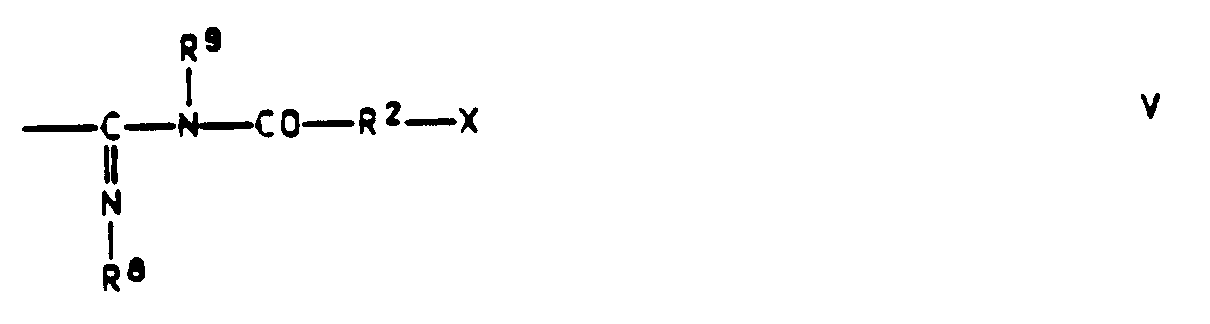
- R 1 is an alkyl or aryl radical
- R 3 is a 2-20-membered bridge, of which at least the members closest to the nitrogen atoms consist of -C (R 6 , R 7 ) radicals, where R 6 and R 7 Are hydrogen, alkyl, cycloalkyl or aryl radicals and the more distant members apart from —C (R 6 , R 7 ) radicals can also be ether or N-alkyl or N-arylimino groups
- R 2 is a divalent organic radical
- R 4 , R 5 , R 8 and R 9 are alkyl or aryl radicals or together form a ring bridge
- X is a COOH or S0 3 H group or its salts or complexes with mono-, di- and / or trivalent anions from the 1st, 2nd, 3rd and 8th group of the periodic system.
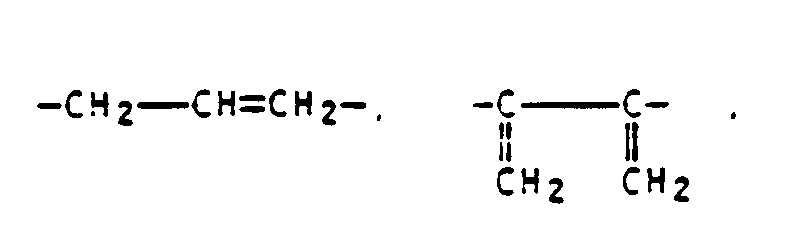
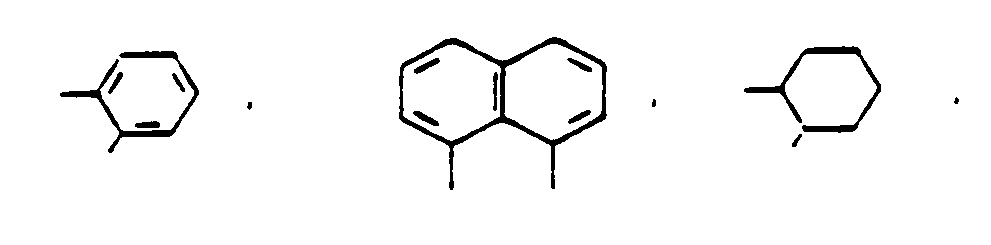
- Divalent organic radicals R 2 can be: these radicals can be substituted by alkyl, aryl and / or halogen. In general, all divalent radicals R 2 are suitable in which the substituents X and COOH can form cyclic acid anhydrides. This is particularly easy if 5- or 6-membered cyclic anhydride rings can form.
- Examples are, for example, succinic anhydride, ⁇ -sulfopropionic anhydride, maleic anhydride, glutaric anhydride, phthalic anhydride, the isomeric di- and tetrahydrophthalic anhydrides, cyclohexane-1,2-dicarboxylic acid anhydride, the various isomeric naphthalenedicarboxylic acid or carboxylic acid anhydrides, in each of which the amorphous ring-amide or carboxylic acid anhydride groups are those in which the amine ring-containing carboxylic acid or carboxylic acid anhydrides are those in which the amorphous carboxylic acid or carboxylic acid anhydride groups are adjacent, in which the amine carboxylic acid or carboxylic acid anhydride groups are adjacent, in which the amine carboxylic acid or carboxylic acid anhydride groups, in each of which the amine carboxylic acid or carboxylic acid anhydride groups, adjacent to which the amine carboxylic acid or carb
- the anhydrides are added, preferably in solution, for example in cyclohexane, toluene or tetrahydrofuran, to the solution of the polymers. If they are sparingly soluble, they can also be added in the form of a suspension, in which case they should be very finely divided in order to ensure an adequate reaction rate to guarantee.
- the dispersion can take place, for example, with a turbine mixer, such as Ultraturrax.
- the reaction is generally carried out at temperatures between -10 ° C and 70 ° C, preferably between 0 ° C and 50 ° C. Below this, the reaction proceeds very slowly, and undesirable side reactions increase above it.
- the Li salts of the polymers functionalized according to the invention quickly form at the temperatures mentioned. These already have properties that lie between those of 2-block and 3-block copolymers.
- the ionic binding of the chain ends can be increased if the hydroxides, alcoholates or other suitable derivatives of polyvalent metals are added.
- the organically readily soluble Al alcoholates, but also the alcoholates of zinc, can be used. The effect is e.g. strongest with Al alcoholate if about one mole of AI per mole of carboxyl group is contained in the polymer.
- polymers with free amino groups are used for the reaction with the cyclic dicarboxylic acid anhydrides, it may be expedient to raise the reaction temperature to 70-100 ° C., especially if two amino groups are to be reacted at each chain end. If one wishes to convert the carboxyl groups formed into salts, compounds of polyvalent metals, in particular aluminum, are preferably used after the reaction, as described above.
- the polymers according to the invention can be separated from the solvent in which they were produced by any known methods, such as precipitation with non-solvents, evaporation of the solvent in evaporators or degassing devices, such as extruders or by steam distillation.
- the isolation and extraction is not the subject of the invention.
- the polymers of the invention are suitable for many uses. Molding compositions composed of two-block copolymers styrene-butadiene-end groups according to the invention behave mechanically similarly to styrene-butadiene-styrene-3 block copolymers as an AI complex. They show e.g. Rubber elasticity and elongation at break up to 1000% and above, however, have a better processability than three-block copolymers. They are suitable as thermoplastics, and also for impact modification of thermoplastic compositions based on polystyrene or polymers compatible with polystyrene, such as polyphenylene oxide or mixtures thereof with polystyrene.
- Polymers or block copolymers according to the invention with a free carboxyl group are also suitable for the modification of polyurethanes, and in the form of their salts as a component of hotmelt adhesives. The latter then have particularly good adhesion both to polar and metallic surfaces and to polymers, such as polystyrene or polyolefins.
- hydrogenated polymers according to the invention with proportions of at least 40% butadiene or isoprene are also suitable for improving the properties of lubricating oils. These then have as lubricants, among other things. an improved dispersing effect for soot and deposits, such as those that result from the operation of internal combustion engines.
- a potentiometric test is carried out on a sample cleaned by precipitation with alcohol, dissolving in toluene and repeated precipitation with alcohol and dried in vacuo at 70 ° C.
- Titration with perchloric acid in a mixture of chlorobenzene / glacial acetic acid determined a base nitrogen content of 0.045%.
- the main amount of the solution is now mixed with a finely divided suspension of 10 mmol of succinic anhydride in cyclohexane.
- the suspension was prepared by grinding 10 g of succinic anhydride in 100 cm 3 of cyclohexane with an Ultraturrax stirrer. After one hour at 40 ° C., 10 mmol of hydrogen fluoride, dissolved in 10 cm of tetrahydrofuran, are added.
- Block copolymer 9% styrene - 91% butadiene - propylene diaziridine - succinic anhydride - Al salt
- the preparation is carried out analogously to Example 2, but isoprene is used instead of butadiene and maleic anhydride is used instead of succinic anhydride.
- the following properties are measured on the polymers:
- the solution viscosity rises sharply from the unmodified polymer to the Al salts up to the ratio polymer: Al 1: 1.33, but no more.
- the polymers 5 to 8 are rubber-elastic and show high elongation at break (> 300%).
Landscapes
- Chemical & Material Sciences (AREA)
- General Chemical & Material Sciences (AREA)
- Health & Medical Sciences (AREA)
- Chemical Kinetics & Catalysis (AREA)
- Medicinal Chemistry (AREA)
- Polymers & Plastics (AREA)
- Organic Chemistry (AREA)
- Addition Polymer Or Copolymer, Post-Treatments, Or Chemical Modifications (AREA)
- Compositions Of Macromolecular Compounds (AREA)
- Lubricants (AREA)
- Adhesives Or Adhesive Processes (AREA)
- Manufacture Of Macromolecular Shaped Articles (AREA)
Claims (8)





Applications Claiming Priority (2)
| Application Number | Priority Date | Filing Date | Title |
|---|---|---|---|
| DE19873709807 DE3709807A1 (de) | 1987-03-25 | 1987-03-25 | Mit saeureendgruppen modifizierte polymerisate, deren herstellung und verwendung |
| DE3709807 | 1987-03-25 |
Publications (3)
| Publication Number | Publication Date |
|---|---|
| EP0283948A2 EP0283948A2 (fr) | 1988-09-28 |
| EP0283948A3 EP0283948A3 (en) | 1990-11-07 |
| EP0283948B1 true EP0283948B1 (fr) | 1992-11-19 |
Family
ID=6323945
Family Applications (1)
| Application Number | Title | Priority Date | Filing Date |
|---|---|---|---|
| EP88104327A Expired - Lifetime EP0283948B1 (fr) | 1987-03-25 | 1988-03-18 | Polymères modifiés aux groupements acides terminaux, leur préparation et leur application |
Country Status (4)
| Country | Link |
|---|---|
| US (1) | US4972023A (fr) |
| EP (1) | EP0283948B1 (fr) |
| JP (1) | JPS63238107A (fr) |
| DE (2) | DE3709807A1 (fr) |
Families Citing this family (6)
| Publication number | Priority date | Publication date | Assignee | Title |
|---|---|---|---|---|
| DE4015533A1 (de) * | 1990-05-15 | 1991-11-21 | Basf Ag | Thermoplastische formmassen auf der basis von polyestern und polyphenylenethern |
| ES2307678T3 (es) * | 2001-03-26 | 2008-12-01 | Jsr Corporation | Polimero modificado hidrogenado, procedimiento para producir el mismo y composicion que contiene el mismo. |
| WO2003008466A1 (fr) * | 2001-07-18 | 2003-01-30 | Asahi Kasei Chemicals Corporation | Copolymere sequence modifie |
| CN101696249B (zh) * | 2002-04-10 | 2012-08-29 | 旭化成化学株式会社 | 改性聚合物及包含所述改性聚合物的组合物 |
| JP5079294B2 (ja) * | 2005-10-04 | 2012-11-21 | 株式会社ブリヂストン | アミンで官能化されたポリマー |
| ES2356474T3 (es) * | 2006-10-26 | 2011-04-08 | Bridgestone Corporation | Polimero funcionalizado con hidrazina. |
Family Cites Families (9)
| Publication number | Priority date | Publication date | Assignee | Title |
|---|---|---|---|---|
| US3251812A (en) * | 1961-06-15 | 1966-05-17 | Phillips Petroleum Co | Terminally reactive polymers |
| US4157429A (en) * | 1975-05-05 | 1979-06-05 | The Firestone Tire & Rubber Company | Amine terminated polymers and the formation of block copolymers |
| FR2416940A1 (fr) * | 1978-02-08 | 1979-09-07 | Rhone Poulenc Ind | Nouveaux additifs pour huiles lubrifiantes a base de polymeres termines par des groupements azotes et huiles lubrifiantes ameliorees ainsi obtenues |
| US4465809A (en) * | 1982-11-05 | 1984-08-14 | Phillips Petroleum Company | Conversion of polymer lithium to polymer carboxylate |
| DE3482472D1 (de) * | 1983-12-26 | 1990-07-19 | Nippon Zeon Co | Verfahren zur modifizierung von polymeren von konjugierten dienen. |
| DE3527909A1 (de) * | 1985-08-03 | 1987-02-12 | Basf Ag | Polymerisate mit aminogruppen, deren herstellung und verwendung |
| US4670173A (en) * | 1985-12-19 | 1987-06-02 | The Lubrizol Corporation | Oil-soluble reaction products of an acylated reaction product, a polyamine, and mono-functional acid |
| GB2184732B (en) * | 1985-12-26 | 1990-07-11 | Showa Denko Kk | Active support substance and adsorbent for chromatography |
| DE3639569A1 (de) * | 1986-11-20 | 1988-06-01 | Basf Ag | Am kettenende funktionalisierte polymere und verfahren zu ihrer herstellung |
-
1987
- 1987-03-25 DE DE19873709807 patent/DE3709807A1/de not_active Withdrawn
-
1988
- 1988-03-16 JP JP63060671A patent/JPS63238107A/ja active Pending
- 1988-03-18 US US07/170,244 patent/US4972023A/en not_active Expired - Fee Related
- 1988-03-18 DE DE8888104327T patent/DE3875989D1/de not_active Expired - Lifetime
- 1988-03-18 EP EP88104327A patent/EP0283948B1/fr not_active Expired - Lifetime
Also Published As
| Publication number | Publication date |
|---|---|
| EP0283948A3 (en) | 1990-11-07 |
| JPS63238107A (ja) | 1988-10-04 |
| DE3709807A1 (de) | 1988-10-06 |
| US4972023A (en) | 1990-11-20 |
| EP0283948A2 (fr) | 1988-09-28 |
| DE3875989D1 (de) | 1992-12-24 |
Similar Documents
| Publication | Publication Date | Title |
|---|---|---|
| DE69005683T2 (de) | Verfahren zur Herstellung von konjugierten Dien-(Co)Polymeren mit hohem Transgehalt und niedrigem Vinylgehalt. | |
| EP0211395B1 (fr) | Polymères contenant des groupes aminés, leur préparation et leur application | |
| EP0274021B1 (fr) | Polymères terminés par des groupements fonctionnels et leur procédé de préparation | |
| DE3611421A1 (de) | Polymerisate mit aminogruppen, deren herstellung und verwendung | |
| EP0026916B1 (fr) | Procédé de préparation de mélanges de copolymères triséquencés linéaires et corps formés obtenus à partir de ceux-ci | |
| DE3514063C2 (fr) | ||
| DE69600746T2 (de) | Herstellung von telechelen Kohlenwasserstoffpolymeren mit Siloxangruppen | |
| DE3247597C2 (fr) | ||
| DE69601704T2 (de) | Kupplung von anionischen polymeren mit trialkoxysilanen, die silizium-wasserstoff-bindungen enthalten | |
| DE69115193T2 (de) | Ölgestreckte Elastomere mit ultrahohem Molekulargewicht. | |
| EP0288761B1 (fr) | Procédé de préparation d'initiateurs multifonctionnels pour la polymérisation anionique, initiateurs oligomères multifonctionnels, application des polymères obtenus à la préparation de polymères fonctionnalisés et comme prépolymères pour d'autres résines | |
| EP0312928A1 (fr) | Copolymères ramifiés et leur procédé de préparation | |
| EP0289917B1 (fr) | Polymères séquencés butadiène-styrène de construction asymétrique, leur préparation et leur utilisation comme masse à mouler | |
| EP0283948A2 (fr) | Polymères modifiés aux groupements acides terminaux, leur préparation et leur application | |
| EP0220602A1 (fr) | Copolymérisats en blocs de styrène transparents et résistants au choc et leur préparation | |
| EP0303177B1 (fr) | Polymères aux groupements fonctionnels | |
| EP0363659A1 (fr) | Utilisation de dérivés du stilbène dans la polymérisation anionique | |
| DE68901873T2 (de) | Schmiermittelzusammensetzung, die einen viskositaetsindexverbesserer mit dispergierenden eigenschaften enthaelt. | |
| EP0318848B1 (fr) | Huile lubrifiante contenant des polymères-bloc hydrogénés de polydioléfines | |
| DE1302734B (de) | Verfahren zur Herstellung eines gehärteten Produkts aus einem Polymerisat auf Basis von vinylgruppenhaltigen Monomeren | |
| EP0423571B1 (fr) | Copolymères ramifiés | |
| DD236321A1 (de) | Verfahren zur selektiven butadienpolymerisation aus c tief 4 fraktion | |
| DE2338627C2 (de) | Verfahren zur Herstellung von modifizierten Dienpolymeren | |
| EP0219809A1 (fr) | Sels de cations polyvalents de polymères de diènes conjugués | |
| DE2358764A1 (de) | Mineralschmieroeladditive |
Legal Events
| Date | Code | Title | Description |
|---|---|---|---|
| PUAI | Public reference made under article 153(3) epc to a published international application that has entered the european phase |
Free format text: ORIGINAL CODE: 0009012 |
|
| AK | Designated contracting states |
Kind code of ref document: A2 Designated state(s): BE DE FR GB IT NL |
|
| PUAL | Search report despatched |
Free format text: ORIGINAL CODE: 0009013 |
|
| AK | Designated contracting states |
Kind code of ref document: A3 Designated state(s): BE DE FR GB IT NL |
|
| 17P | Request for examination filed |
Effective date: 19901016 |
|
| 17Q | First examination report despatched |
Effective date: 19910710 |
|
| GRAA | (expected) grant |
Free format text: ORIGINAL CODE: 0009210 |
|
| AK | Designated contracting states |
Kind code of ref document: B1 Designated state(s): BE DE FR GB IT NL |
|
| ITF | It: translation for a ep patent filed | ||
| REF | Corresponds to: |
Ref document number: 3875989 Country of ref document: DE Date of ref document: 19921224 |
|
| GBT | Gb: translation of ep patent filed (gb section 77(6)(a)/1977) |
Effective date: 19921201 |
|
| ET | Fr: translation filed | ||
| PLBE | No opposition filed within time limit |
Free format text: ORIGINAL CODE: 0009261 |
|
| STAA | Information on the status of an ep patent application or granted ep patent |
Free format text: STATUS: NO OPPOSITION FILED WITHIN TIME LIMIT |
|
| 26N | No opposition filed | ||
| PGFP | Annual fee paid to national office [announced via postgrant information from national office to epo] |
Ref country code: FR Payment date: 19980226 Year of fee payment: 11 |
|
| PGFP | Annual fee paid to national office [announced via postgrant information from national office to epo] |
Ref country code: NL Payment date: 19980312 Year of fee payment: 11 |
|
| PGFP | Annual fee paid to national office [announced via postgrant information from national office to epo] |
Ref country code: DE Payment date: 19980313 Year of fee payment: 11 |
|
| PGFP | Annual fee paid to national office [announced via postgrant information from national office to epo] |
Ref country code: GB Payment date: 19980316 Year of fee payment: 11 |
|
| PGFP | Annual fee paid to national office [announced via postgrant information from national office to epo] |
Ref country code: BE Payment date: 19980320 Year of fee payment: 11 |
|
| PG25 | Lapsed in a contracting state [announced via postgrant information from national office to epo] |
Ref country code: DE Free format text: LAPSE BECAUSE OF THE APPLICANT RENOUNCES Effective date: 19990316 |
|
| PG25 | Lapsed in a contracting state [announced via postgrant information from national office to epo] |
Ref country code: GB Free format text: LAPSE BECAUSE OF NON-PAYMENT OF DUE FEES Effective date: 19990318 |
|
| PG25 | Lapsed in a contracting state [announced via postgrant information from national office to epo] |
Ref country code: BE Free format text: LAPSE BECAUSE OF NON-PAYMENT OF DUE FEES Effective date: 19990331 |
|
| BERE | Be: lapsed |
Owner name: BASF A.G. Effective date: 19990331 |
|
| PG25 | Lapsed in a contracting state [announced via postgrant information from national office to epo] |
Ref country code: NL Free format text: LAPSE BECAUSE OF NON-PAYMENT OF DUE FEES Effective date: 19991001 |
|
| GBPC | Gb: european patent ceased through non-payment of renewal fee |
Effective date: 19990318 |
|
| PG25 | Lapsed in a contracting state [announced via postgrant information from national office to epo] |
Ref country code: FR Free format text: LAPSE BECAUSE OF NON-PAYMENT OF DUE FEES Effective date: 19991130 |
|
| NLV4 | Nl: lapsed or anulled due to non-payment of the annual fee |
Effective date: 19991001 |
|
| REG | Reference to a national code |
Ref country code: FR Ref legal event code: ST |
|
| PG25 | Lapsed in a contracting state [announced via postgrant information from national office to epo] |
Ref country code: IT Free format text: LAPSE BECAUSE OF NON-PAYMENT OF DUE FEES Effective date: 20050318 |