EP0284511A2 - Bildinformationscodeverarbeitungssystem - Google Patents
Bildinformationscodeverarbeitungssystem Download PDFInfo
- Publication number
- EP0284511A2 EP0284511A2 EP88400713A EP88400713A EP0284511A2 EP 0284511 A2 EP0284511 A2 EP 0284511A2 EP 88400713 A EP88400713 A EP 88400713A EP 88400713 A EP88400713 A EP 88400713A EP 0284511 A2 EP0284511 A2 EP 0284511A2
- Authority
- EP
- European Patent Office
- Prior art keywords
- pattern
- bit
- predetermined
- component
- block
- Prior art date
- Legal status (The legal status is an assumption and is not a legal conclusion. Google has not performed a legal analysis and makes no representation as to the accuracy of the status listed.)
- Granted
Links
Images







Classifications
-
- H—ELECTRICITY
- H04—ELECTRIC COMMUNICATION TECHNIQUE
- H04N—PICTORIAL COMMUNICATION, e.g. TELEVISION
- H04N1/00—Scanning, transmission or reproduction of documents or the like, e.g. facsimile transmission; Details thereof
- H04N1/41—Bandwidth or redundancy reduction
- H04N1/411—Bandwidth or redundancy reduction for the transmission or storage or reproduction of two-tone pictures, e.g. black and white pictures
- H04N1/413—Systems or arrangements allowing the picture to be reproduced without loss or modification of picture-information
- H04N1/417—Systems or arrangements allowing the picture to be reproduced without loss or modification of picture-information using predictive or differential encoding
-
- G—PHYSICS
- G06—COMPUTING OR CALCULATING; COUNTING
- G06T—IMAGE DATA PROCESSING OR GENERATION, IN GENERAL
- G06T9/00—Image coding
- G06T9/004—Predictors, e.g. intraframe, interframe coding
-
- H—ELECTRICITY
- H04—ELECTRIC COMMUNICATION TECHNIQUE
- H04N—PICTORIAL COMMUNICATION, e.g. TELEVISION
- H04N1/00—Scanning, transmission or reproduction of documents or the like, e.g. facsimile transmission; Details thereof
- H04N1/40—Picture signal circuits
- H04N1/409—Edge or detail enhancement; Noise or error suppression
-
- H—ELECTRICITY
- H04—ELECTRIC COMMUNICATION TECHNIQUE
- H04N—PICTORIAL COMMUNICATION, e.g. TELEVISION
- H04N1/00—Scanning, transmission or reproduction of documents or the like, e.g. facsimile transmission; Details thereof
- H04N1/41—Bandwidth or redundancy reduction
- H04N1/411—Bandwidth or redundancy reduction for the transmission or storage or reproduction of two-tone pictures, e.g. black and white pictures
- H04N1/413—Systems or arrangements allowing the picture to be reproduced without loss or modification of picture-information
- H04N1/415—Systems or arrangements allowing the picture to be reproduced without loss or modification of picture-information in which the picture-elements are subdivided or grouped into fixed one-dimensional [1D] or two-dimensional [2D] blocks
Definitions
- the present invention relates to an image information code processing system wherein bit pattern information expressing a 2-valued picture is compressed and coded in a facsimile application and so on.
- one page of a document is sent under optical scanning by, e.g., 8 lines/mm and sampling intervals of 8 pixels/mm, to the scanning line in a facsimile and, therefore, a large amount of digital image information included in a bit pattern obtained by the above scanning is set or stored.
- the recommendation shows an MH one dimensional coding system and an MR two dimensional sequential coding system.
- a run-length coding for a bit pattern of 2-valued image information obtained along a scanning line compresses the information by conversion into a comparatively short codeword, combining continued bits having a same value.
- a bit pattern along a scanning line is compared with a bit pattern along the adjacent next scanning line, and a difference bit pattern is obtained.
- the difference bit pattern is coded using the principle of the run-length coding, and by sequentially applying the same process, generally a higher information compression is obtained than with the MH system.
- These compression coding systems can compress information to a certain degree of satisfaction as a general purpose system applied to various image information. However, these systems do not utilize a feature of the figure of the object image, and if the features of the figure are considered, a higher compression of the information is possible, and a coding system by which the above compression can be performed is desired.
- An object of the present invention is to provide an image information code processing system wherein a compression rate in a coding process of a 2-valued image information can be decreased by using the geometrical features of the information.
- an image information code processing system comprising a component pattern supply means, a component pattern processor means, and a code processor means.
- the system receives bit pattern information as an input signal and outputs a coded output.
- the component pattern supply means generates or stores a plurality of component patterns determined to constitute a bit pattern of each expanded block, and the bit pattern of the 2-valued image information is divided into rectangular blocks having a predetermined dimension and rectangular expanded blocks comprising at least one of the rectangular blocks.
- the component pattern processor means receives the bit pattern information, assuming that one of the blocks located at a predetermined position in the expanded block is an object block, and selects the component pattern so that a set of the component pattern belongs to a set of bits having a predetermined value (logical "1" (black) or "0" (white)) in the bit pattern of the expanded block, and a set of bits not expressed by the codeword determined for other blocks in the bit pattern of the object block belongs to the set of the component pattern.
- the code processor means obtains a codeword train comprising predetermined codewords for identifying the selected component patterns and encodes the bit pattern of the object block.
- an image information codeword processor system further comprising a division mark processor means in addition to the element of the first aspect of the invention.
- the code processor means arranges predetermined codewords in a predetermined order, which codewords identify the component patterns expressing a bit pattern, and inserts a predetermined division mark between adjacent codewords.
- the division mark processor means detects whether a head mark of the codeword satisfies predetermined conditions for the preceding arranged codeword, and suppresses an insertion of the division mark between the codewords.
- an image information code processor system comprising a prediction pattern supply means, for example, a prediction processor means, a component pattern supply means, a component pattern processor means, and a code processor means as a code forming means.
- the system receives bit pattern information, determines a predetermined codeword expressing bit pattern of a rectangular block having a predetermined dimension to which 2-valued image information expressed by the bit pattern is divided, and outputs the coded outputs.
- the prediction pattern supply means generates a prediction pattern from bit patterns of at least one block.
- the code forming means forms an object block codeword using a predetermined mark indicating a coinci dence between a bit pattern of the object block and a prediction pattern determined by bit patterns of blocks in contact with the object block at predetermined sides, and in the case of a non-coincidence, using the necessary predetermined codeword expressing a predetermined bit pattern.
- Figure 1 shows a block diagram of a first embodiment
- Fig. 2 is a detailed view of Fig. 1.
- a system of the first embodiment comprises a component pattern processor (COMP. PAT. PROC.) 10, a component pattern supply section (COMP. PAT. SUPPLY) 6, and a code processor (CODE PR0C.) 11.
- a bit pattern information (BIT PAT. INF.) 1 is applied to the component pattern processor 10 as an input signal.
- An output of the code processor 11 is a coded output 7.
- the component pattern processor 10 is supplied with component patterns necessary for constituting a bit pattern from the component pattern supply section 6 and determines a matched codeword of the component pattern.
- the code processor 11 combines a codeword for a bit pattern of a block included in a 2-valued image information.
- the bit pattern information 1 is a 2-valued image information to be processed.
- the 2-valued image is divided into rectangular blocks or square blocks having a predetermined dimension and rectangular expanded blocks having a predetermined number of blocks.
- the component pattern supply section 6 stores or generates a plurality of kinds of component patterns necessary for constituting the bit pattern of each of the expanded blocks.
- the component pattern is made to express the requested bit pattern only by itself or by more than two logical summations, and is given a matched codeword for distinction.
- the component pattern processor 10 receives the expanded block information in the bit pattern information 1, and a block located at a predetermined position in the blocks included in the expanded block is determined as an object block.
- the object block is processed as follows.
- bit pattern of the expanded block is collated with the component pattern in the component pattern supply section 6, a set of the component pattern belonging to, for example, the set of "1" bits in the object bit pattern is obtained, and then the component patterns necessary for completing the bit pattern of the object block are selected.
- the code processor 11 receives a matched codeword of each component pattern which is selected in the above process, and then a codeword train which is an arrangement of one or a plurality of matched codewords is constituted as a codeword of the current object block. Then, the code processor 11 generates a coded output, in which the borders of the codeword are shown by division marks.
- the bit pattern information 1 is a 2-valued image information for an object signal to be processed.
- the bit pattern information is utilized in a facsimile apparatus.
- the types of stroke appearing in the block are generally limited to a small number.
- the object pattern is divided into as few component strokes as possible, the number of necessary component stroke types for constituting all the patterns is determined to be as low as possible, and if the codeword which expresses the bit pattern of each block by a matched codeword for the component stroke is obtained, compression of an image information can be carried out.
- bit pattern information exists in the bit pattern information after immediate pick up from an original image, and thus such bit patterns are prefer strictlyably eliminated.
- a preprocessing for simplifying the bit pattern appearing in the above blocks is carried out, so that the image reproduced from the bit pattern is not degraded.
- Three adjacent bits having the same color (white or black) as an object bit exist in the upper, lower, left, or right directions of the object bit.
- Two bits which are the same color as the object bit and are adjacent in the upper, lower, left, or right directions, are diagonally adjacent to each other.
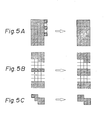
- Figs. 5A, 5B, and 5C examples of the illegal bits are shown by a circle at the left side of the figure.
- the illegal bits are processed as at the right side of the figures.
- Fig. 5A the border line between white and black is smoothed out, and in Fig. 5B, the fine line is emphasized.
- the illegal bit remaining after the process is processed to simplify the image, for example, as shown in Fig. 5C.
- an expression system by a prime implicant is utilized to encode the above preprocessed bit pattern information.
- This system is a preferred means for obtaining an appropriate component pattern.
- a 4 ⁇ 4 bits block pattern is expressed by the above-mentioned component pattern set.
- the above-mentioned block is made to correspond to Karnaugh's map, well known in switching circuit theory (McCluskey, E.J.: Introduction to the Theory of Switching Circuits, McGrow Hill (1965)), and the values ("0 ⁇ and "1") expressing white and black shades in a bit pattern are allotted to a block of the Karnaugh map, and then the black pattern expressed by "1" can be thought of as a set of points satisfying a logical equation.
- the Karnaugh map is a diagram for showing a state of a logical equation consisting of four logical variables X1 , X2 , X3 , and X4 , as shown in Fig. 6B. Sixteen blocks correspond to combinations having a special value of logical variables which are indicated at the upper side and left side.
- logical values are allotted as in Fig. 6B.
- the set having a minimum numbers of variables is selected, so that one prime implicant can cover as wide an area of the pattern as possible.
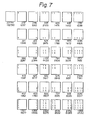
- the prime implicants obtained by the above process are expressed as 37 examples by the Karnaugh map notation as shown in Fig. 7.
- the figures under each prime implicant are the frequencies of appearance of bit patterns obtained from two test charts for facsimile as defined in CCITT, as a reference.
- the upper figures show one test chart and lower figures show the other test chart.
- the component pattern supply section 6 stores the bit pattern corresponding to each of the above prime implicants as a component pattern.
- Each component pattern is given a matched codeword which is, for example, a number, to distinguish the component pattern.
- the component pattern stored in the component pattern supply section 6 expresses a bit pattern appearing in a block by one or over two logical summation(s), as clear in correspondence to the Karnaugh map.
- the component pattern supply section 6 may be formed to generate the above-mentioned necessary component pattern receiving a bit pattern in response to the request from the component pattern processor 10.
- the component pattern processor 10 comprises an extraction of prime implicant section 101, an extraction of component patterns section 102, and an arrangement for component patterns section 103; receives information of one block as bit pattern information 1 through a block extraction section 5; compares the information with the component patterns; and selects the set of the minimum number of a component pattern or component patterns identical with the set of bits of the block, by selection from, e.g., as small number of component patterns as possible belonging to black bit set.
- the code processor 11 comprises a component pattern code storage section 111 and a matched pattern encoder 112, and arranges matched codewords in an appropriate order after receiving the matched codewords of the component patterns selected in each block by the component pattern processor 10. Then, the code processor 11 determines the codeword to be an expression codeword for the block and inserts a predetermined mark which can be distinguished from the pattern matched codeword as a division mark, i.e., segmentation codeword, between the matched codewords.
- the division mark is generally necessary because the bit length of the codeword is variable, however, as mentioned later, an abbreviation of the division mark is possible between the codewords having special relationships so that the coded output can be further shortened.
- Figure 3 shows the process steps of the component pattern processor 10 in Fig. 2.
- step 31 after extraction of the prime implicant, one extracted prime implicant is selected.
- step 32 if a selection is not made, the process proceeds to step 34 (S34).
- step 33 it is determined whether the component pattern is a match or mismatch with the prime implicant. If the selected pattern match the prime implicant, the process proceeds to step 34 and if not, the process returns to step 32.
- step 34 the matched component pattern is arranged and output to a matched pattern encoder 112.
- the coding is performed for each 4 ⁇ 4 bits block.
- an expanded block coding comprising 4 blocks of square domain can obtain a higher coding compression.
- the block coding is a special example in which the expanded block coding is degenerated to one block and the process thereof simplified.
- a block is 4 ⁇ 4 bits
- an expanded block is defined to have 4 adjacent blocks in the upper, lower, left, and right directions.
- the component patterns to the expanded block are formed and prepared.
- an 8 ⁇ 8 Karnaugh map having 6 variables of X1 to X6 is used (conf. Fig. 8), and in the map, the bit pattern is applied and a prime implicant obtained.
- prime implicants which cover the patterns of object blocks are expanded prime implicants.
- the component pattern is constituted by the expanded prime implicants.
- the block A is the object block
- blocks A, B, C, and D constitute an expanded block
- X2 X 5 X 6 , X1 X 6 , X1 X 5 , and X1 X 2 which are encompassed by broken lines, are the expanded prime implicants.
- the component pattern corresponding to the expanded prime implicant obtained by the above way is formed and stored in the component pattern supply section 6 and given a matched codeword.
- the component pattern processor 10 receives an expanded block information wherein a block to be processed is the object block, to sequentially process each block of the bit pattern information 1.
- the expanded block information is compared with the component pattern from the component pattern supply section 6, and a set of the minimum number of component patterns is selected, which set is a set of component patterns belonging to a set of black bits and is necessary to complete the bit pattern of the object block.
- each block is processed at least once as a member other than the object block of the expanded block until each block is processed as an object block.
- bits included in the component pattern determining another block as an object block are included as a part thereof.
- the component pattern processor 10 memorizes the above-mentioned processed bits for each block of the processed expanded block.
- the bits are "don't care" bits in the switching circuit theory.
- the component pattern processor 10 selects the component pattern, the set of which belongs to the set of black bits of the expanded block. At that time, the set of the above-mentioned processed bits may or may not belong to the set of black bits.
- the minimum component pattern set is selected from the set of the component pattern so that the set of the not processed bit in the set of the black bits belongs to the set of the component pattern.
- X1 X 6 , X1 X 5 , and X1 X 2 may be the component pattern. If in blocks B, C, and D, the processed bits are not included, the component pattern corresponding to X1 X 2 is selected so that the most not processed black bits are covered.
- the code processor 11 receives the matched codeword of component patterns which are selected by the component pattern processor 10, as mentioned above, in each object block and sequentially generates a coded output 7 as in the case of the block coding.
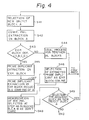
- FIG. 4 shows process steps using the expanded block.
- step 41 S41
- a new object block A is selected.
- step 42 S42
- the component pattern is extracted in block A
- step 43 S43
- an expanded block definition EXP. BLOCK DEF.
- step 45 S45
- step 44 S44
- step 45 the prime implicant is extracted
- step 47 the prime implicant in the expanded block including a component pattern of block A is extracted.
- step 46 proceeds to step 46 (S46).
- step 44 the usual process is performed as for peripheral blocks.
- step 46 the extracted prime implicant is selected as an expanded block component pattern.
- step 48 the bit pattern selected in step 46 in the blocks B, C, and D, is marked as "don't care”.
- step 49 the adjacent block is selected as a new object block A. If selection is possible, the process returns to step 41, and if selection is not possible, the process ends.
- a second embodiment of the invention is explained below with reference to Fig. 9.
- This embodiment is provided with a division mark processor 12 in addition to components described in the first embodiment.
- the division mark processor 12 receives an output of the code processor 11 and suppresses a division mark output between the codewords which satisfies predetermined conditions.
- the condition in which the head mark of a codeword is not included in the preceding codewords is adopted.
- the division mark processor 12 examines the relationship between each codeword and the next head mark, and if the condition is satisfied, the insertion of the division mark at a point preceding the codeword is suppressed, and as a result, the coded output 8 can be shortened.
- the division mark abbreviation process is now explained.
- a predetermined division mark must be inserted between codewords of the coded output 7 to show a border of codewords.
- the division mark processor 12 in Fig. 9 compares a codeword on the coded output and the following head mark of the next codeword (component pattern matched codeword), and if the head mark is not included in the preceding codeword, the division mark which should be located before the head mark can be omitted and thus a shorter coded output 8 is obtained.
- the signal of the coded output 8 is taken out from the head, and if the next signal of the codeword train followed by the codeword determined hereinafter or the division mark is a division mark or a codeword satisfying the preceding conditions, the codeword train is considered as one code.
- the matched codeword of the component patterns are added in a predetermined order.
- the code processor 11 arranges the matched codewords of the selected component pattern in one block to a codeword train, in the predetermined order.
- the division mark processor 12 compares the last mark of a codeword and the head mark of the next codeword, when the two marks are only in the predetermined order, the division mark is left as it is, and when the two marks are the same or are not in the predetermined order, the division mark is eliminated.
- the division mark processor 12 detects whether the component pattern distinguished by the head mark of the codeword belongs to the set of the component pattern distinguished by the mark of the preceding codeword (i.e., included completely in the bit pattern of the set), or conversely, the former belongs to the latter, and under such conditions, the division mark is eliminated.
- the division mark processor 12 temporarily makes a bit pattern combining component pattern distinguished by head mark of the codeword and the preceding codeword mark, and if the temporarily made bit pattern includes the bit pattern which is eliminated by the preprocessing, the division mark is abbreviated.
- the division mark processor 12 carries out the abbreviation of the division mark by applying one or a combination of more than two conditions.
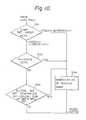
- Fig. 10 a flow chart in the division mark processor in the second embodiment is shown.
- step 51 the signal from the code processor determine the order of the component patterns. If the order of the preceding component pattern is higher than or equal to the order of the next component pattern, the process proceeds to step 54 (S54). If the order of the component pattern is lower than the order of the next component pattern, the process proceeds to step 52 (S52). In step 52, inclusion between the component patterns is determined. If one is included in the other, the process proceeds to step 54. If not, the process proceeds to step 53 (S53). In step 53, by the logical sum of the preceding (or before) and the next (or behind) patterns, the generation of the illegal bit pattern is detected. If the generation occurs, the process proceeds to step 54. If the generation does not occur, the process ends and the system outputs the coded output. In step 54, the abbreviation of the division mark is processed, and the process after step 54 is the same as that of step 53.
- reference numeral 13 denotes a prediction processor which supplies a coincidence state, etc., between a prediction pattern from a prediction pattern supply section 9 and an image bit pattern, to a component pattern processor 14, and 15 is a code processor generating a coded output 16 from the coincidence state mark supplied from the component pattern processor 14 and the matched codeword of the component pattern.
- the prediction pattern supply section 9 generates a prediction pattern to predict a bit pattern of block after processed from a bit pattern of the block located at a predetermined related position, for a sequentially processed block.
- the prediction processor 13 in each object block, compares the bit pattern of the block with prediction pattern taken out from the prediction pattern supply section 9 based on the bit pattern of the block having a predetermined adjacent relationship, and forms a predetermined mark showing a coincidence state of both patterns and a necessary bit pattern in each state other than the coincidence state.
- the formed patterns are supplied to the component pattern processor 14.
- the component pattern processor 14 encodes the supplied bit pattern with reference to the component pattern supply section 6 only in a case except for the coincidence state, supplies the codeword of the selected component pattern and the mark of the coincidence state to the code processor 15, and the code processor 15 outputs the coded output 16.
- the prediction pattern belongs to the real bit pattern
- the expression "partial success" is made, and a codeword expressing the bit set out of the prediction pattern is added to the expression.
- a codeword expressing the bit set out of the prediction pattern is added to the expression.
- the prediction processor 13 in Fig. 13 applies the above prediction to, e.g., the bit pattern of the block supplied from the bit pattern information 1, and the results are sent to the component pattern processor 14.
- the prediction pattern supply section 9 picks up or calculates a prediction pattern from the bit pattern which is the base of the prediction pattern to be predicted, and supplies the same to the prediction processor 13.
- the bit pattern of block D is predicted by the bit patterns of columns of block C and rows of block B in contact with the upper and left side of block D.
- the prediction pattern is formed by a logical summation of two bit patterns so that the upper column bit pattern and the left row bit pattern move to all the columns and rows of block D as is.
- the prediction pattern is expressed by the logical summation of each logical equation in only the portions expressing the characters X3 and X4 in the logical equation expressing the fourth row pattern of block B and characters X1 and X2 in the logical equation expressing the fourth column pattern of block C.
- the prediction processor 13 for the object block D, supplies a bit pattern of the fourth row in block B adjacent to the left of and the fourth column in block C adjacent above the prediction pattern portion 9. Then, the prediction processor 13 receives a prediction pattern D ⁇ and compares the same with the real bit pattern of block D.
- a predetermined mark "success”, which expresses a successful coincidence is supplied to the component pattern processor 14.
- the code processor 15 determines the "success" mark as a codeword of the block and outputs a coded output 16.
- a portion of the pattern of the block D coincides with a prediction pattern D ⁇ , that is, in the case that, in the example of Fig. 15, the prediction pattern is all black in the D ⁇ portion and the other is all white, while in the real pattern D ⁇ is black and D ⁇ in Fig. 15 is partially black, i.e., a partial coincidence is achieved; the prediction processor 13 removes the portion which coincides with the prediction pattern, makes a partial pattern which is D ⁇ pattern, and supplies the partial pattern and the predetermined "partial success" mark to the component pattern processor 14.
- the component pattern processor 14 selects a set of the component pattern constituting the supplied partial pattern from the component pattern supply section 6 and supplies the set together with a "partial success" mark to the code processor 15. Therefore, the code processor 15, for example, pre-locates the "partial success” mark to the codeword train of the matched codeword of the component pattern.
- the prediction processor 13 supplies a predetermined "failure" mark and the bit pattern of the block D to the component pattern processor 14.
- the component pattern processor 14 selects a set of the component pattern constituting the supplied bit pattern from the component pattern supply section 6, and supplies the set together with a "failure" mark to the code processor 15.
- the code processor 15 pre-locates the "failure” mark to the codeword train of the matched codeword of the component pattern.
- Figure 14 shows a flow chart of the prediction process.
- step 61 an object block D is selected, and in step 62 (S62), the upper adjacent block B and the left adjacent block C are selected. Then, in step 63 (S63), the bit pattern of the fourth row in the block B is extracted. On the other hand, after step 62, the process also proceeds to step 64 (S64). In step 64, the bit pattern of the fourth column in the block C is extracted. After steps 63 and 64, the process proceeds to step 65 (S65). In step 65, the prediction pattern in the block D is taken out or calculated. The patterns from steps 61 and 65 are compared in step 66 (S66). If the coincidence of the two patterns is obtained, the process is handled as a "success".
- step 67 inclusion between the two patterns is determined. If one pattern is included in the other, the process is handled as a "partial success”. If one pattern is not included in the other, the process is handled as a "failure” and proceeds to step 68 (S68).
- step 68 the bit pattern of the block D is left as it is and the process proceeds to that of the component pattern processor.
- the process is a "partial success”
- step 69 the included pattern in the bit pattern of the object block D is made to the "don't care" state in step 69 (S69). After step 69, the process proceeds as for step 68.
- this invention can be applied to an image information code processing system and a 2-valued image information compressed and encoded with a higher code compression rate.
Landscapes
- Engineering & Computer Science (AREA)
- Multimedia (AREA)
- Signal Processing (AREA)
- Physics & Mathematics (AREA)
- General Physics & Mathematics (AREA)
- Theoretical Computer Science (AREA)
- Compression, Expansion, Code Conversion, And Decoders (AREA)
- Image Processing (AREA)
Applications Claiming Priority (2)
| Application Number | Priority Date | Filing Date | Title |
|---|---|---|---|
| JP62070727A JPS63236472A (ja) | 1987-03-25 | 1987-03-25 | 画像情報符号化処理装置 |
| JP70727/87 | 1987-03-25 |
Publications (3)
| Publication Number | Publication Date |
|---|---|
| EP0284511A2 true EP0284511A2 (de) | 1988-09-28 |
| EP0284511A3 EP0284511A3 (de) | 1991-01-16 |
| EP0284511B1 EP0284511B1 (de) | 1995-08-30 |
Family
ID=13439861
Family Applications (1)
| Application Number | Title | Priority Date | Filing Date |
|---|---|---|---|
| EP88400713A Expired - Lifetime EP0284511B1 (de) | 1987-03-25 | 1988-03-23 | Bildinformationscodeverarbeitungssystem |
Country Status (4)
| Country | Link |
|---|---|
| US (1) | US5113457A (de) |
| EP (1) | EP0284511B1 (de) |
| JP (1) | JPS63236472A (de) |
| DE (1) | DE3854360T2 (de) |
Cited By (5)
| Publication number | Priority date | Publication date | Assignee | Title |
|---|---|---|---|---|
| WO1992009437A1 (en) * | 1990-11-21 | 1992-06-11 | Polaroid Corporation | Printing apparatus |
| WO1992010054A1 (en) * | 1990-11-21 | 1992-06-11 | Polaroid Corporation | Printing method |
| EP0582331A1 (de) * | 1992-08-06 | 1994-02-09 | Océ-Nederland B.V. | Verfahren und Gerät zum Kodieren und Dekodieren digitaler Bilddaten |
| FR2751773A1 (fr) * | 1996-07-23 | 1998-01-30 | France Telecom | Procede de compression d'images binaires |
| GB2362055A (en) * | 2000-05-03 | 2001-11-07 | Clearstream Tech Ltd | Image compression using a codebook |
Families Citing this family (17)
| Publication number | Priority date | Publication date | Assignee | Title |
|---|---|---|---|---|
| US5282256A (en) * | 1988-05-13 | 1994-01-25 | Canon Kabushiki Kaisha | Binary image data coding method having the function of correcting errors derived from coding |
| US5818970A (en) * | 1991-04-26 | 1998-10-06 | Canon Kabushiki Kaisha | Image encoding apparatus |
| US5262878A (en) * | 1991-06-14 | 1993-11-16 | General Instrument Corporation | Method and apparatus for compressing digital still picture signals |
| WO1993021603A1 (en) * | 1992-04-22 | 1993-10-28 | Microsoft Corporation | Method and system for transferring a bit-mapped image using vertical and horizontal rules |
| US5367385A (en) * | 1992-05-07 | 1994-11-22 | Picturetel Corporation | Method and apparatus for processing block coded image data to reduce boundary artifacts between adjacent image blocks |
| US5634079A (en) * | 1992-05-15 | 1997-05-27 | Zenith Data Systems Corporation | System for providing for a parallel port with standard signals and a flash recovery mode with second predetermined signals redefining parallel port with alternate functions |
| JP2575595B2 (ja) * | 1992-10-20 | 1997-01-29 | インターナショナル・ビジネス・マシーンズ・コーポレイション | イメージフレームの圧縮方法及びデータ処理システム |
| JPH0681826U (ja) * | 1993-05-11 | 1994-11-22 | 日本フルハーフ株式会社 | 荷物運搬具用案内レ−ル |
| US5610657A (en) * | 1993-09-14 | 1997-03-11 | Envistech Inc. | Video compression using an iterative error data coding method |
| JPH07170521A (ja) * | 1993-12-15 | 1995-07-04 | Canon Inc | 画像処理装置 |
| US5742346A (en) * | 1994-08-09 | 1998-04-21 | Picture Tel Corporation | Spatially adaptive blur filter |
| US5883678A (en) | 1995-09-29 | 1999-03-16 | Kabushiki Kaisha Toshiba | Video coding and video decoding apparatus for reducing an alpha-map signal at a controlled reduction ratio |
| US6754268B1 (en) | 1995-09-29 | 2004-06-22 | Kabushiki Kaisha Toshiba | Video coding and video decoding apparatus |
| US6307967B1 (en) | 1995-09-29 | 2001-10-23 | Kabushiki Kaisha Toshiba | Video coding and video decoding apparatus |
| JP2004280157A (ja) * | 2003-03-12 | 2004-10-07 | Toshiba Corp | 画像処理装置 |
| US8473428B2 (en) * | 2008-12-18 | 2013-06-25 | Cisco Technology, Inc. | Generation and use of specific probability tables for arithmetic coding in data compression systems |
| CN109963175B (zh) * | 2019-01-29 | 2020-12-15 | 中国人民解放军战略支援部队信息工程大学 | 基于显隐性潜在因子模型的电视产品精准推荐方法及系统 |
Family Cites Families (15)
| Publication number | Priority date | Publication date | Assignee | Title |
|---|---|---|---|---|
| US3726993A (en) * | 1971-12-10 | 1973-04-10 | Xerox Corp | Data compression methods and apparatus |
| US3980809A (en) * | 1973-07-16 | 1976-09-14 | International Business Machines Corporation | Encoding logic for reduced bandwidth pictorial data transmission system |
| FR2257183B1 (fr) * | 1974-01-04 | 1976-11-26 | Cit Alcatel | Systeme de transmission fac-simile d'une image |
| US4028731A (en) * | 1975-09-29 | 1977-06-07 | International Business Machines Corporation | Apparatus for compression coding using cross-array correlation between two-dimensional matrices derived from two-valued digital images |
| GB2038142B (en) * | 1978-12-15 | 1982-11-24 | Ibm | Image data compression |
| JPS5583373A (en) * | 1978-12-20 | 1980-06-23 | Matsushita Electric Ind Co Ltd | Signal suppressing transmission system |
| US4261018A (en) * | 1979-06-18 | 1981-04-07 | Bell Telephone Laboratories, Incorporated | Progressive image transmission |
| US4325085A (en) * | 1980-06-09 | 1982-04-13 | Digital Communications Corporation | Method and apparatus for adaptive facsimile compression using a two dimensional maximum likelihood predictor |
| US4409623A (en) * | 1981-01-31 | 1983-10-11 | Nippon Telegraph & Telephone Public Corporation | Method and equipment for processing gray scale facsimile signal |
| US4555802A (en) * | 1983-01-10 | 1985-11-26 | International Business Machines Corporation | Compaction and decompaction of non-coded information bearing signals |
| US4606069A (en) * | 1983-06-10 | 1986-08-12 | At&T Bell Laboratories | Apparatus and method for compression of facsimile information by pattern matching |
| US4577227A (en) * | 1983-10-18 | 1986-03-18 | Rca Corporation | Teletext framing code detector |
| US4593374A (en) * | 1983-10-18 | 1986-06-03 | Rca Corporation | Teletext magazine code detector |
| JPS61123279A (ja) * | 1984-11-20 | 1986-06-11 | Fujitsu Ltd | 画像デ−タ復元回路 |
| EP0241576B1 (de) * | 1986-03-14 | 1992-07-01 | ANT Nachrichtentechnik GmbH | Verfahren zur Verringerung der Datenmenge bei der Bildkodierung |
-
1987
- 1987-03-25 JP JP62070727A patent/JPS63236472A/ja active Granted
-
1988
- 1988-03-23 DE DE3854360T patent/DE3854360T2/de not_active Expired - Lifetime
- 1988-03-23 EP EP88400713A patent/EP0284511B1/de not_active Expired - Lifetime
- 1988-03-25 US US07/173,726 patent/US5113457A/en not_active Expired - Lifetime
Cited By (7)
| Publication number | Priority date | Publication date | Assignee | Title |
|---|---|---|---|---|
| WO1992009437A1 (en) * | 1990-11-21 | 1992-06-11 | Polaroid Corporation | Printing apparatus |
| WO1992010054A1 (en) * | 1990-11-21 | 1992-06-11 | Polaroid Corporation | Printing method |
| US5355303A (en) * | 1990-11-21 | 1994-10-11 | Polaroid Corporation | Printing apparatus |
| EP0582331A1 (de) * | 1992-08-06 | 1994-02-09 | Océ-Nederland B.V. | Verfahren und Gerät zum Kodieren und Dekodieren digitaler Bilddaten |
| US5592297A (en) * | 1992-08-06 | 1997-01-07 | Oce-Nederland B.V. | Method and apparatus for encoding and decoding digital image data |
| FR2751773A1 (fr) * | 1996-07-23 | 1998-01-30 | France Telecom | Procede de compression d'images binaires |
| GB2362055A (en) * | 2000-05-03 | 2001-11-07 | Clearstream Tech Ltd | Image compression using a codebook |
Also Published As
| Publication number | Publication date |
|---|---|
| JPS63236472A (ja) | 1988-10-03 |
| EP0284511A3 (de) | 1991-01-16 |
| DE3854360T2 (de) | 1996-02-08 |
| DE3854360D1 (de) | 1995-10-05 |
| EP0284511B1 (de) | 1995-08-30 |
| JPH053184B2 (de) | 1993-01-14 |
| US5113457A (en) | 1992-05-12 |
Similar Documents
| Publication | Publication Date | Title |
|---|---|---|
| EP0284511A2 (de) | Bildinformationscodeverarbeitungssystem | |
| KR100196271B1 (ko) | 화상부호화복호화 장치 및 방법 | |
| EP0750426B1 (de) | Bildverarbeitungsgerät, Datenverarbeitungsgerät und Verfahren | |
| EP0253326B1 (de) | Verfahren und Vorrichtung zum Kodieren und Dekodieren von Zittersignalen für die Halbtonreproduktion | |
| EP0613290B1 (de) | Verfahren und Gerät zur Kompression binärer Bilddaten | |
| US4866534A (en) | Image processing apparatus | |
| US6728412B1 (en) | Method and apparatus for on-the-fly image coding | |
| EP0890921B1 (de) | Interpolationsverfahren von Binärbildern | |
| EP0205751B1 (de) | Verfahren und Vorrichtung zur Bilddatenkompression | |
| JP2836681B2 (ja) | パタンマッチング符号化方法及び符号化装置 | |
| EP0675460A2 (de) | Verfahren und Vorrichtung zur Kodierung von einem Bild ohne Informationsverlust | |
| US7710605B2 (en) | Print system and printer | |
| EP0278548B1 (de) | Verfahren und Vorrichtung zur Kodierung von Bilddaten | |
| US5684603A (en) | Coding apparatus for bi-level images halftoned with error diffusion algorithm | |
| AU686356B2 (en) | Lossy compression land expansion algorithm for image representative data | |
| JPH0789618B2 (ja) | 画像符号化方法 | |
| US5978098A (en) | Image compression method | |
| US6553144B1 (en) | Coding method and coding apparatus for bi-level document image | |
| JPH0261832B2 (de) | ||
| US6298168B1 (en) | Image coding apparatus | |
| JP3249647B2 (ja) | 画像処理装置 | |
| JP3732329B2 (ja) | 疑似中間調画像の符号化装置及び符号化方法 | |
| JPH08194824A (ja) | 画像符号化装置及び画像復号化装置 | |
| JPH08186717A (ja) | 通信装置 | |
| JPH0352392A (ja) | 多値画像データ符号化方式 |
Legal Events
| Date | Code | Title | Description |
|---|---|---|---|
| PUAI | Public reference made under article 153(3) epc to a published international application that has entered the european phase |
Free format text: ORIGINAL CODE: 0009012 |
|
| AK | Designated contracting states |
Kind code of ref document: A2 Designated state(s): DE FR GB |
|
| PUAL | Search report despatched |
Free format text: ORIGINAL CODE: 0009013 |
|
| AK | Designated contracting states |
Kind code of ref document: A3 Designated state(s): DE FR GB |
|
| 17P | Request for examination filed |
Effective date: 19910627 |
|
| 17Q | First examination report despatched |
Effective date: 19930615 |
|
| GRAA | (expected) grant |
Free format text: ORIGINAL CODE: 0009210 |
|
| AK | Designated contracting states |
Kind code of ref document: B1 Designated state(s): DE FR GB |
|
| REF | Corresponds to: |
Ref document number: 3854360 Country of ref document: DE Date of ref document: 19951005 |
|
| ET | Fr: translation filed | ||
| PLBE | No opposition filed within time limit |
Free format text: ORIGINAL CODE: 0009261 |
|
| STAA | Information on the status of an ep patent application or granted ep patent |
Free format text: STATUS: NO OPPOSITION FILED WITHIN TIME LIMIT |
|
| 26N | No opposition filed | ||
| REG | Reference to a national code |
Ref country code: GB Ref legal event code: IF02 |
|
| PGFP | Annual fee paid to national office [announced via postgrant information from national office to epo] |
Ref country code: DE Payment date: 20070315 Year of fee payment: 20 |
|
| PGFP | Annual fee paid to national office [announced via postgrant information from national office to epo] |
Ref country code: GB Payment date: 20070321 Year of fee payment: 20 |
|
| PGFP | Annual fee paid to national office [announced via postgrant information from national office to epo] |
Ref country code: FR Payment date: 20070308 Year of fee payment: 20 |
|
| PG25 | Lapsed in a contracting state [announced via postgrant information from national office to epo] |
Ref country code: GB Free format text: LAPSE BECAUSE OF EXPIRATION OF PROTECTION Effective date: 20080322 |