EP0284520B1 - Hitzebeständige Polymere auf Basis von Maleimiden, darunter ein Bis-maleimid-Siloxan, sowie Verfahren zur Herstellung - Google Patents
Hitzebeständige Polymere auf Basis von Maleimiden, darunter ein Bis-maleimid-Siloxan, sowie Verfahren zur Herstellung Download PDFInfo
- Publication number
- EP0284520B1 EP0284520B1 EP88420060A EP88420060A EP0284520B1 EP 0284520 B1 EP0284520 B1 EP 0284520B1 EP 88420060 A EP88420060 A EP 88420060A EP 88420060 A EP88420060 A EP 88420060A EP 0284520 B1 EP0284520 B1 EP 0284520B1
- Authority
- EP
- European Patent Office
- Prior art keywords
- formula
- radical
- bis
- maleimide
- denotes
- Prior art date
- Legal status (The legal status is an assumption and is not a legal conclusion. Google has not performed a legal analysis and makes no representation as to the accuracy of the status listed.)
- Expired - Lifetime
Links
- 0 CCC(*(C)N)(*(*)=C)O Chemical compound CCC(*(C)N)(*(*)=C)O 0.000 description 4
- VWSYLIDRSOEKQI-UHFFFAOYSA-N C(C1NC1)C1(C2)C2=C1 Chemical compound C(C1NC1)C1(C2)C2=C1 VWSYLIDRSOEKQI-UHFFFAOYSA-N 0.000 description 1
- WRBFLTICCDPRKH-UHFFFAOYSA-N CC(CCC1)CCC1(C)C1(C)CCCCC1 Chemical compound CC(CCC1)CCC1(C)C1(C)CCCCC1 WRBFLTICCDPRKH-UHFFFAOYSA-N 0.000 description 1
- WUBHUNOXBWLQNE-UHFFFAOYSA-N CCC(CC=C1)=CC1=C Chemical compound CCC(CC=C1)=CC1=C WUBHUNOXBWLQNE-UHFFFAOYSA-N 0.000 description 1
- YNQLUTRBYVCPMQ-UHFFFAOYSA-N CCc1ccccc1 Chemical compound CCc1ccccc1 YNQLUTRBYVCPMQ-UHFFFAOYSA-N 0.000 description 1
- TZKVKXUZHBTVFU-UHFFFAOYSA-N CN(C1)C1N1CC1 Chemical compound CN(C1)C1N1CC1 TZKVKXUZHBTVFU-UHFFFAOYSA-N 0.000 description 1
- RIOSDPIZGIWNMS-UHFFFAOYSA-N COc(cc1)ccc1N=O Chemical compound COc(cc1)ccc1N=O RIOSDPIZGIWNMS-UHFFFAOYSA-N 0.000 description 1
Classifications
-
- C—CHEMISTRY; METALLURGY
- C08—ORGANIC MACROMOLECULAR COMPOUNDS; THEIR PREPARATION OR CHEMICAL WORKING-UP; COMPOSITIONS BASED THEREON
- C08G—MACROMOLECULAR COMPOUNDS OBTAINED OTHERWISE THAN BY REACTIONS ONLY INVOLVING UNSATURATED CARBON-TO-CARBON BONDS
- C08G73/00—Macromolecular compounds obtained by reactions forming a linkage containing nitrogen with or without oxygen or carbon in the main chain of the macromolecule, not provided for in groups C08G12/00 - C08G71/00
- C08G73/06—Polycondensates having nitrogen-containing heterocyclic rings in the main chain of the macromolecule
- C08G73/10—Polyimides; Polyester-imides; Polyamide-imides; Polyamide acids or similar polyimide precursors
- C08G73/12—Unsaturated polyimide precursors
Definitions
- the present invention relates to new thermostable polymers, the production of which involves, alongside possible other reactants, bis-maleimides including a bis-maleimide containing in its structure a diorganopolysiloxane group. It also relates to processes for the preparation of these polymers.
- N, N'-bis-imides of unsaturated carboxylic acids such as for example an N, N'-bis-maleimide are already known (cf. French patent FR-A-1,455,514). . These polymers, which have remarkable thermal stability, can be used for the manufacture of molded parts for the most diverse applications.
- polymers having, among other properties, a high impact resistance can be obtained by reacting an N, N'-bis-maleimide containing in its structure a diorganopolysiloxane group with one or more N, N'-bis-maleimides of the type described in the aforementioned patent and optionally a copolymerizable reagent.
- any of the compounds of formula (I) can be used.
- the bis-maleimides of formula (I) are original compounds which are obtained by reacting maleic anhydride, in the presence of a dehydrating agent, a tertiary amine, an organic diluent and a catalyst, on a diamine containing a diorganopolysiloxane group of formula: in which X, R 1 , R 2 , R 3 , R 4 , R 5 , x, y and z have the meanings given above for formula (I).
- diamines (III) containing a diorganopolysiloxane group are compounds which are well known in the prior art. They are for example described in the British patent GB-B-1,062,418 and in the American patent US-A-4,395,527.
- a second preparation method taught by these documents consists in copolymerizing a mole of diamine with a diorganodisiloxane group, prepared as indicated above, with an amount of one or more cyclic diorganopolysiloxanes capable of giving y moles of siloxy groups of formula: and / or z moles of siloxy groups of formula:
- reaction takes place at a temperature between 80 ° and 250 ° C in the presence also of a solvent and optionally a suitable catalyst.
- Another way of preparing the diamines of formula (III), with y and / or z being equal to zero or different from zero, is to react on an ethylenically unsaturated compound of formula: in which X, which is in ortho, meta or para position with respect to the carbon atom of the benzene ring linked to nitrogen, and x have the meanings given above, an alpha, omega-bis (hydrogen) diorganopolysiloxane of formula: in which R 1 , R 2 , R 3 , R 4 , R 6 , y and z have the meanings given above.
- This hydrosilylation reaction is carried out by operating in bulk in the absence of solvent and using a platinum-based catalyst.
- alpha, omega-bis (hydrogen) diorganopolysiloxanes used are products well known in the silicone industry and are, for some, commercially available. They are for example described in French patents FR-A-2,486,952 and FR-A5-2,058,988.
- the amino substrate with ethylenic unsaturation which is well adapted to react with alpha, omega-bis (hydro-geno) diorganopolysiloxane consists in particular in an allyloxyaniline of formula:
- Maleic anhydride is used in amounts at least equal to one mole per NH 2 function available; larger quantities are generally used, which are of the order of 1.01 to 1.5 moles per available NH 2 function.
- a lower carboxylic acid anhydride such as acetic anhydride is advantageously used in an amount at least equal to one mole per available NH 2 function present in the diamine molecule of formula (III) used. Larger quantities are generally used which are of the order of 1.05 to 1.5 moles per available NH 2 function.
- tertiary amines include trialkylamines as well as N, N-dialkylanilines in which the alkyl radicals have from 1 to 12 carbon atoms. Triethylamine and N, N-dimethylaniline are of advantageous use.
- the amounts of tertiary amine are generally between 0.05 and 0.8 moles per available NH 2 function.
- the reaction is carried out in a liquid organic diluent under the operating conditions, practically between 20 ° and 100 ° at atmospheric pressure.
- a liquid organic diluent under the operating conditions, practically between 20 ° and 100 ° at atmospheric pressure.
- preference will be given to those which dissolve, under the temperature conditions adopted for the reaction and in the presence of the other constituents of the reaction mixture, the starting maleic anhydride.
- catalysts use may be made of a nickel derivative which is soluble in the liquid phase of the reaction mixture such as, for example, nickel salts of carboxylic acids, optionally hydrated, as well as the chelated forms of this metal. Acetate and acetylacetonate are particularly suitable. These catalysts are employed in very small amounts, of the order of 5.10 s 0,5.10- 3 mole per mole available NH 2.
- one begins by reacting maleic anhydride and the diamine of formula (III) by operating in the diluent chosen at a temperature ranging from 30 ° to 100 ° C for depending on the temperature, a period ranging from a few minutes to 1 hour. Then the dehydrating agent, the tertiary amine and finally the catalyst are added to the reaction medium, then the mixture is left to react under the temperature conditions adopted previously for a period ranging, depending on the temperature, from 1 hour to 3 hours. Generally, the reaction is terminated by addition of a non-solvent such as water, then the bis-maleimide of formula (I) prepared is isolated according to the usual methods.
- a non-solvent such as water
- N, N'-4,4'diphenylmethane-bis-maleimide taken alone is mixed with N, N ' -methyl-2-phenylene-1,3 -bis-maleimide, N, N'-methyl-4-phenylene-1,3-bis-maleimide and / or N, N'-methyl-5-phenylene-1,3-bis-maleimide.
- the maleimides of formula (IV) are known products which are described in European patent application EP-A1-0208.634.
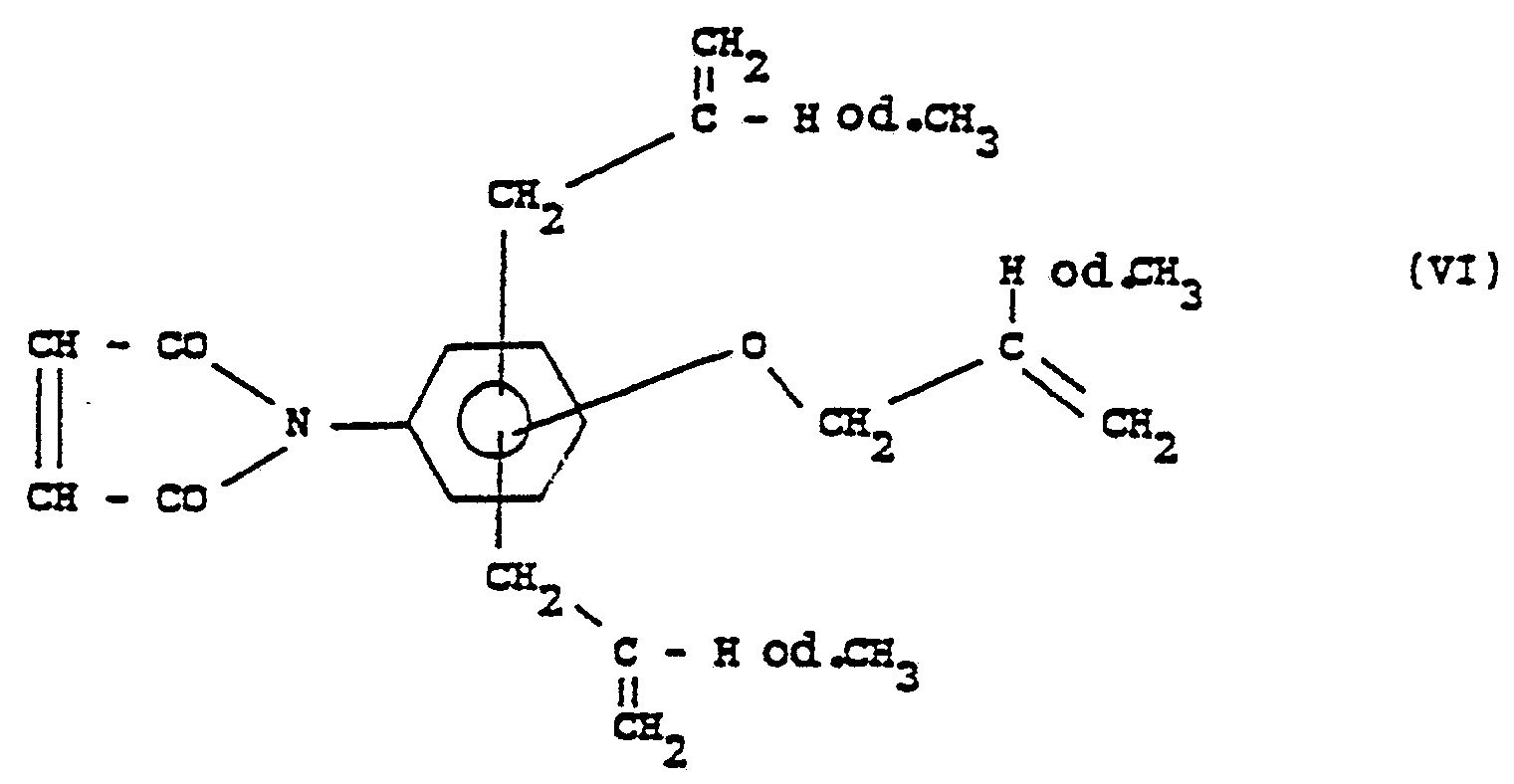
- optional reagent (c 2 ) preferably used as compound comprising a mixture of N- (meth) allyloxyphenylmaleimide of formula (IV) with one or more substitution derivatives (meth) allylés of formula (s) (V ) and optionally (VI), the crude product obtained by implementing the process defined below.
- solvents there may be mentioned, for example: alcohols (such as, for example: methanol, ethanol, butanol); ketones (such as, for example: acetone, methyl ethyl ketone, methyl isobutyl ketone); nitriles (such as, for example: benzonitrile, propionitrile, acetonitrile); esters (such as, for example, ethyl acetate, butyl acetate); aromatic solvents (such as: anisole, chlorobenzene); halogenated hydrocarbons (such as: chloroform, dichloromethane, dichloroethane).
- alcohols such as, for example: methanol, ethanol, butanol
- ketones such as, for example: acetone, methyl ethyl ketone, methyl isobutyl ketone
- nitriles such as, for example: benzonitrile, propionitrile, acetonitrile
- the concentration of the starting reactants in the solvent used is not critical. There is, however, no point in diluting too much for productivity reasons, nor in concentrating too much to have good agitation.
- maleic anhydride is used in amounts at least equal to one mole per mole of aminophenol; larger amounts are generally used which are of the order of 1.01 to 1.5 moles per mole of aminophenol.
- the temperature is preferably between 40 ° C and 60 ° C.
- the reaction medium we start by adding to the reaction medium the amount of an alkaline aqueous solution, for example an aqueous solution of NaOH, necessary on the one hand to salify the N- (hydroxyphenyl) acid maléamic and on the other hand to obtain the desired pH.
- the pH will be kept constant throughout the reaction by adding sodium hydroxide; preferably, the pH is adjusted and maintained at a constant value of between 10 and 12.
- the allylation reaction is preferably carried out with bromide or (meth) allyl chloride.
- the amount of (meth) allyl halide is of the order of 1.5 to 10 moles per molar group of phenolic OH and, preferably, of the order of 2 to 4.
- the excess of this reagent can be recovered at the end of the operation and recycled in a following operation.
- the casting time of the (meth) allyl halide is not critical and it can be in the range from 1 hour to 5 hours, and preferably from 2 hours to 4 hours.
- the temperature is preferably between 60 ° C and 100 ° C.
- the aqueous phase is acidified to a pH approximately equal to 1 by usual acids, preferably oxyacids or mineral hydracids. The aqueous layer is removed and the organic layer is left in the reactor.
- tertiary amines examples include trialkylamines as well as N, N-dialkylanilines in which the alkyl radicals have from 1 to 12 carbon atoms. Triethylamine and N, N-dimethylaniline are of advantageous use.
- the temperature is not critical and only affects the kinetics of the reaction.
- This temperature can be for example between 40 ° C and 150 ° C and, preferably, between 60 ° C and 80 ° C.
- the solvent is removed by vacuum distillation and the crude reaction product having the appearance of an oil is obtained.
- the aforementioned method applies well, starting from metaaminophenol, to the preparation of the compounds comprising mixtures based on: N - [(meth) 3-allyloxyphenyl] maleimide + N - [(meth) allyloxy-3 (meth) allyl-4 phenyl] maleimide + N - [(meth) allyloxy-3 (meth) allyl-6 phenyl] maleimide + optionally N - [(meth) allyloxy-3 di (meth ) allyl-4,6 phenyl] maleimide.
- optional reagent (c 3 ) is chosen from: vinylpyridines, N-vinylpryrrolidone, allyl isocyanurate, triallylisocyanurate, vinyltetrahydrofuran.
- the reactivity of the constituents (a), (b) and possibly (c) of the polymerization medium according to the invention can be increased, for example when the applications envisaged require carrying out injection molding operations on a machine, by adding a catalyst (d) which can be either (d 1 ) a radical polymerization initiator such as for example, dicumyl peroxide, lauroyl peroxide, azobisisobutyronitrile, or (d 2 ) an imidazole compound.
- a catalyst (d) which can be either (d 1 ) a radical polymerization initiator such as for example, dicumyl peroxide, lauroyl peroxide, azobisisobutyronitrile, or (d 2 ) an imidazole compound.
- Said imidazole compound (d 2 ) corresponds to the general formula: in which R e , R 7 , R 8 and R 8 , identical or different, each represent: a hydrogen atom, an alkyl or alkoxy radical having from 1 to 20 carbon atoms, vinyl, phenyl, nitro, R 8 can form with Rg and the carbon atoms to which these radicals are linked a single cycle such as for example a benzene ring, R e can also represent a carbonyl group linked to a second imidazole ring.
- imidazole compounds (d 2 ) mention may be made in particular of: imidazole or glyoxaline, 1-methylimidazole, 2-vinylimidazole, 1,2-dimethylimidazole, 1-vinylididole, vinyl-1 methyl-2 imidazole, benzimidazole, carbonyldiimidazole.
- the quantity of the optional reagent (c) generally represents less than 60% and, preferably between 5% and 50% of the total weight of the reactants (a) + (b).
- the catalyst (d) depending on its nature and according to the desired polymerization speed at the stage of implementation, it is used at a rate lying in the range ranging from 0.01 to 1% by weight relative to all the reagents (a) + (b) + optionally (c) and, preferably, ranging from 0.05 to 0.5%.
- the polymers according to the invention can be prepared by direct heating of the reagent (a), the reagent (b) and optionally the reagent (c) with, if necessary, the catalyst (d) at least until a mixture is obtained. homogeneous liquid.
- the temperature can vary depending on the physical state of the compounds present, but it is generally between 50 ° C and 300 ° C. It is advantageous to bring and maintain the starting compounds in a state of intimate mixing before and during the heating using for example good agitation.
- the compound (d) is used, it is preferably added at the start to the well-stirred reaction mixture containing the reagents (a) and / or (b).
- this compound is particularly active, to avoid its encapsulation in the polymer network generated, it is desirable to add it in a solvent or diluent compatible with the reaction medium; it has been found that it could be advantageous to use as a solvent or diluent one of the polar organic liquids which is discussed below.
- the preparation of the polymers according to the invention can also be carried out by heating the mixture of reactants within an organic diluent which is liquid in at least part of the range 50 ° C-250 ° C.
- organic diluent which is liquid in at least part of the range 50 ° C-250 ° C.
- aromatic hydrocarbons such as xylenes and toluene
- halogenated hydrocarbons such as chlorobenzenes
- polar solvents such as dioxane, tetrahydrofuran and dibutyl oxide, dimethylformamide, dimethylsulfoxide, N -methylpyrrolidone, dimethylacetamide, methylglycol and ethyl-ethyl-ketone.
- Polymer solutions or suspensions can be used as they are for many uses; the polymers can also be isolated, for example by filtration, optionally after precipitation using an organic diluent miscible with the solvent used. In this context, it is advantageous to use a hydrocarbon whose boiling point does not notably exceed 120 ° C.
- the properties of the polymers according to the invention can vary to a large extent depending in particular on the exact nature of the reagents used, the proportions of reagents chosen and the precise temperature conditions adopted in the range mentioned above.
- these can be hardened polymers, insoluble in the usual solvents such as for example the compounds mentioned in the preceding paragraph and which do not exhibit any significant softening below the temperature at which they begin to degrade.
- these polymers can also be in the form of prepolymers (P) which are soluble in polar organic solvents and which have a softening point at a temperature below 200 ° C. (in general this softening point is between 50 ° and 150 ° C).
- P prepolymers
- These prepolymers can be obtained in bulk by heating the mixture of reactants until a homogeneous or pasty product is obtained at a temperature generally between 50 ° and 180 ° C. for a period which can range from a few minutes to a few hours. , this duration being all the shorter the higher the temperature adopted.
- these prepolymers (P) can also be obtained by forming, from the reagent (a) and the reagent (c), a prepolymer (PP) which is then reacted with the reagent (b) and, if necessary, the compound (d).
- a prepolymer (P'P ') can also be prepared beforehand by heating the mixture of reagent (b), reagent (c) and, if necessary, compound (d), then reacting it with reagent (a) to obtain the prepolymer (P).
- the temperature and time conditions used for the preparation of the prepolymers (PP) or (P'P ') and for their transformation into prepolymers (P) are those indicated above with regard to the preparation of the prepolymers (P) by mixing direct reagents (a), (b) and optionally (c) with, if necessary, the compound (d).
- the prepolymers (P) can be used in the liquid mass state, a simple hot casting sufficient for the shaping and the production of molded objects. It is also possible, after cooling and grinding, to use them in the form of powders which lend themselves remarkably to compression molding operations, possibly in the presence of fillers in the form of powders, spheres, granules, fibers or flakes. . In the form of suspensions or solutions, the prepolymers (P) can be used for the production of coatings and intermediate prepreg articles, the reinforcement of which can be constituted by fibrous materials based on silicate or aluminum oxide. or zirconium, carbon, graphite, boron, asbestos or glass. These prepolymers (P) can also be used for the production of cellular materials after incorporation of a blowing agent such as for example azodicarbonamide.
- a blowing agent such as for example azodicarbonamide.
- the prepolymers (P) can be hardened by heating to temperatures of the order of 300 ° C, generally between 150 ° and 250 ° C; additional shaping can be carried out during hardening, possibly under vacuum or under super-atmospheric pressure, these operations can also be consecutive.
- the optional reagent (c) it does not depart from the scope of the invention if the polymers according to the invention are prepared, which are not in the form of prepolymers ( P), using an intimate mixture of prepolymer (PP), reagent (b) and, if necessary, compound (d) or an intimate mixture of prepolymer (P'P ') and reagent (a) which is heated en masse under the conditions described above.
- the polymers according to the invention interest the fields of industry which require materials endowed with good mechanical and electrical properties as well as a great chemical inertness at temperatures of 200 ° to 300 ° C.
- they are suitable for the manufacture of insulators in plates or tubulars for electric transformers, supports for printed circuits, pinions, rings, etc.
- the prepreg articles can be used for the production of parts having shapes. and various functions in numerous industries such as for example in aeronautics. These pieces, called laminates, which can be pieces of revolution, are obtained by plating several layers of prepregs on a form or a support. Prepregs can also be used as reinforcements or as a means of repairing damaged parts.
- the reactor is then introduced into an oil bath preheated to 55 ° C., then the catalyst is added.
- the latter is the Karsted catalyst (complex based on elementary platinum and 1,3-divinyl tetramethyl-1,1,3,3 disiloxane ligands): it is in solution in toluene (concentration of 3.5% by weight) and 1.49 cm 3 of this catalyst solution are introduced with a syringe; the ratio r (weight of elementary platinum engaged in weight of the reaction mass) is equal to 91.10 -8 .
- the product obtained weighing 448.9 g, is a clear viscous oil, brown-orange in color, having a NMR spectrum of the proton in accordance with the structure:
- the molecular mass is of the order of 976 g. Under these conditions, the conversion rate of the reactants used is 100% (by NMR and infrared analysis, neither amine nor hydrogenated siloxane oligomer is detected) and the desired yield by weight of diamine is 100 %.
- each vial is rinsed with 5 cm 3 of acetone, which are then added to the reaction mass, kept stirring for another 15 minutes.
- reaction mixture is maintained at reflux with stirring for 2 hours 30 minutes. The temperature is then lowered to 20 ° C.
- the reaction mixture is diluted with 80 cm 3 of ice water (5 ° C) with vigorous stirring and the oily product present is then extracted with 80 cm 3 of ethyl acetate.
- the organic phase obtained is washed with three times 80 cm 3 of water to arrive at pH6 in the washing waters, then dried for 2 hours over sodium sulfate. anhydrous sodium.
- the ethyl acetate is evaporated off from the organic phase by completing this operation under reduced pressure (about 70 Pa) at 60 ° C and 27.3 g are collected (ie a yield by weight of 96% by theory) of a viscous, brown-orange product, the NMR spectrum of which is in agreement with the structure of the desired bis-maleimide which was defined at the start of this example.
- thermostable polymer in accordance with the present invention
- the plates After demoulding, the plates, based on hardened, brown and translucent polymer, are cut so as to obtain test pieces of dimensions 60 x 10 x 4 mm on which CHARPY impact tests are not cut according to NFT 51035 standard. at 25 ° C thus obtained is 3.4 kJ / m 2 .
- the resilience at 25 ° C, measured on the test pieces, is 1.7 kJ / m 2 .
- the mixture is homogenized by stirring and 10.8 g of the bis-maleimide containing a dirganopolysiloxane group which is described above in Example 1 are added.
- the reactor is then immersed in an oil bath heated to 160 ° C. .
- 61.2 g of N, N'-4,4'-diphenylmethane-bis-maleimody (0.171 mole) are then added over 3 minutes to the stirred medium.
- the reaction mass is left to react for 6 minutes.
- the temperature is then lowered to 150 ° C. in 5 minutes and a reduced pressure of approximately 1.33 ⁇ 10 2 Pa is applied for 2 minutes, then it is returned to atmospheric pressure under which the reaction mass is stirred again for 3 minutes.
Landscapes
- Chemical & Material Sciences (AREA)
- Health & Medical Sciences (AREA)
- Chemical Kinetics & Catalysis (AREA)
- Medicinal Chemistry (AREA)
- Polymers & Plastics (AREA)
- Organic Chemistry (AREA)
- Addition Polymer Or Copolymer, Post-Treatments, Or Chemical Modifications (AREA)
- Macromolecular Compounds Obtained By Forming Nitrogen-Containing Linkages In General (AREA)
- Polymers With Sulfur, Phosphorus Or Metals In The Main Chain (AREA)
- Macromonomer-Based Addition Polymer (AREA)
- Silicon Polymers (AREA)
- Pyrrole Compounds (AREA)
- Other Resins Obtained By Reactions Not Involving Carbon-To-Carbon Unsaturated Bonds (AREA)
- Color Television Image Signal Generators (AREA)
Claims (20)




Priority Applications (1)
| Application Number | Priority Date | Filing Date | Title |
|---|---|---|---|
| AT88420060T ATE70288T1 (de) | 1987-02-24 | 1988-02-22 | Hitzebestaendige polymere auf basis von maleimiden, darunter ein bis-maleimid-siloxan, sowie verfahren zur herstellung. |
Applications Claiming Priority (2)
| Application Number | Priority Date | Filing Date | Title |
|---|---|---|---|
| FR8702616A FR2611724B1 (fr) | 1987-02-24 | 1987-02-24 | Polymeres thermostables a base de maleimides dont un bismaleimide siloxane et leurs procedes de preparation |
| FR8702616 | 1987-02-24 |
Publications (2)
| Publication Number | Publication Date |
|---|---|
| EP0284520A1 EP0284520A1 (de) | 1988-09-28 |
| EP0284520B1 true EP0284520B1 (de) | 1991-12-11 |
Family
ID=9348388
Family Applications (1)
| Application Number | Title | Priority Date | Filing Date |
|---|---|---|---|
| EP88420060A Expired - Lifetime EP0284520B1 (de) | 1987-02-24 | 1988-02-22 | Hitzebeständige Polymere auf Basis von Maleimiden, darunter ein Bis-maleimid-Siloxan, sowie Verfahren zur Herstellung |
Country Status (15)
| Country | Link |
|---|---|
| US (1) | US4829138A (de) |
| EP (1) | EP0284520B1 (de) |
| JP (1) | JP2719787B2 (de) |
| KR (1) | KR950000704B1 (de) |
| AT (1) | ATE70288T1 (de) |
| BR (1) | BR8800716A (de) |
| CA (1) | CA1334461C (de) |
| DE (1) | DE3866745D1 (de) |
| DK (1) | DK92488A (de) |
| ES (1) | ES2027029T3 (de) |
| FI (1) | FI880850A7 (de) |
| FR (1) | FR2611724B1 (de) |
| HK (1) | HK10895A (de) |
| NO (1) | NO168833C (de) |
| PT (1) | PT86809B (de) |
Families Citing this family (14)
| Publication number | Priority date | Publication date | Assignee | Title |
|---|---|---|---|---|
| US5210213A (en) | 1983-06-17 | 1993-05-11 | The Boeing Company | Dimensional, crosslinkable oligomers |
| US5714566A (en) | 1981-11-13 | 1998-02-03 | The Boeing Company | Method for making multiple chemically functional oligomers |
| US5969079A (en) | 1985-09-05 | 1999-10-19 | The Boeing Company | Oligomers with multiple chemically functional end caps |
| US5516876A (en) | 1983-09-27 | 1996-05-14 | The Boeing Company | Polyimide oligomers and blends |
| US5705598A (en) | 1985-04-23 | 1998-01-06 | The Boeing Company | Polyester sulfone oligomers and blends |
| US5693741A (en) | 1988-03-15 | 1997-12-02 | The Boeing Company | Liquid molding compounds |
| US5512676A (en) | 1987-09-03 | 1996-04-30 | The Boeing Company | Extended amideimide hub for multidimensional oligomers |
| US5618907A (en) | 1985-04-23 | 1997-04-08 | The Boeing Company | Thallium catalyzed multidimensional ester oligomers |
| US5817744A (en) | 1988-03-14 | 1998-10-06 | The Boeing Company | Phenylethynyl capped imides |
| US5195127A (en) * | 1988-09-19 | 1993-03-16 | Kabushiki Kaisha Toshiba | Radio telephone system and its control method |
| FR2666586A1 (fr) * | 1990-09-07 | 1992-03-13 | Rhone Poulenc Chimie | Compositions thermodurcissables a base de composes cyanate ester et de composes polyimide a groupement(s) diorganopolysiloxane. |
| JP4639546B2 (ja) * | 2001-07-26 | 2011-02-23 | 東亞合成株式会社 | 硬化性樹脂組成物 |
| CN104356388B (zh) * | 2014-11-25 | 2017-03-29 | 苏州大学 | 一种阻燃双马来酰亚胺树脂及其制备方法 |
| CN118974121A (zh) * | 2022-03-17 | 2024-11-15 | 陶氏环球技术有限责任公司 | 聚合物溴化阻燃剂、具有该聚合物溴化阻燃剂的组合物和电缆 |
Family Cites Families (3)
| Publication number | Priority date | Publication date | Assignee | Title |
|---|---|---|---|---|
| FR2259833B1 (de) * | 1974-02-05 | 1978-03-10 | Rhone Poulenc Ind | |
| US4581461A (en) * | 1983-04-07 | 1986-04-08 | National Starch And Chemical Corporation | Maleated siloxane derivatives |
| JP7119265B2 (ja) | 2018-01-18 | 2022-08-17 | 三菱マテリアル株式会社 | 誘電体膜の製造方法 |
-
1987
- 1987-02-24 FR FR8702616A patent/FR2611724B1/fr not_active Expired
-
1988
- 1988-02-17 CA CA000559128A patent/CA1334461C/fr not_active Expired - Fee Related
- 1988-02-22 DE DE8888420060T patent/DE3866745D1/de not_active Expired - Lifetime
- 1988-02-22 JP JP63037672A patent/JP2719787B2/ja not_active Expired - Fee Related
- 1988-02-22 BR BR8800716A patent/BR8800716A/pt unknown
- 1988-02-22 AT AT88420060T patent/ATE70288T1/de active
- 1988-02-22 NO NO880754A patent/NO168833C/no unknown
- 1988-02-22 ES ES198888420060T patent/ES2027029T3/es not_active Expired - Lifetime
- 1988-02-22 EP EP88420060A patent/EP0284520B1/de not_active Expired - Lifetime
- 1988-02-23 FI FI880850A patent/FI880850A7/fi not_active IP Right Cessation
- 1988-02-23 PT PT86809A patent/PT86809B/pt not_active IP Right Cessation
- 1988-02-23 DK DK092488A patent/DK92488A/da not_active Application Discontinuation
- 1988-02-24 US US07/159,907 patent/US4829138A/en not_active Expired - Lifetime
- 1988-02-24 KR KR1019880001948A patent/KR950000704B1/ko not_active Expired - Fee Related
-
1995
- 1995-01-26 HK HK10895A patent/HK10895A/xx not_active IP Right Cessation
Also Published As
| Publication number | Publication date |
|---|---|
| DK92488A (da) | 1988-10-31 |
| BR8800716A (pt) | 1988-10-04 |
| ATE70288T1 (de) | 1991-12-15 |
| HK10895A (en) | 1995-02-03 |
| KR950000704B1 (ko) | 1995-01-27 |
| FR2611724A1 (fr) | 1988-09-09 |
| KR880010004A (ko) | 1988-10-06 |
| JPS63234029A (ja) | 1988-09-29 |
| FI880850L (fi) | 1988-08-25 |
| FR2611724B1 (fr) | 1989-06-16 |
| EP0284520A1 (de) | 1988-09-28 |
| FI880850A7 (fi) | 1988-08-25 |
| ES2027029T3 (es) | 1992-05-16 |
| DE3866745D1 (de) | 1992-01-23 |
| NO880754D0 (no) | 1988-02-22 |
| FI880850A0 (fi) | 1988-02-23 |
| CA1334461C (fr) | 1995-02-14 |
| PT86809A (pt) | 1988-03-01 |
| NO168833C (no) | 1992-04-08 |
| PT86809B (pt) | 1992-05-29 |
| DK92488D0 (da) | 1988-02-23 |
| JP2719787B2 (ja) | 1998-02-25 |
| NO168833B (no) | 1991-12-30 |
| NO880754L (no) | 1988-08-25 |
| US4829138A (en) | 1989-05-09 |
Similar Documents
| Publication | Publication Date | Title |
|---|---|---|
| CA1334461C (fr) | Polymeres thermostables a base de maleimides dont un bismaleimide siloxane et leurs procedes de preparation | |
| EP0287479B1 (de) | Hitzestabile Polymere auf Basis von Maleimiden und Diamin-Siloxanen, und Verfahren zu ihrer Herstellung | |
| EP0233435B1 (de) | Imidgruppen enthaltende Polymere und Verfahren zu deren Herstellung | |
| EP0284519B1 (de) | Bismaleimid-Siloxane und Verfahren zu deren Herstellung | |
| EP0284524B1 (de) | Hitzestabile Polymere auf der Basis von Maleimiden, wovon eins ein Bismaleimid-Siloxan ist, und aromatischen Diaminen, Verfahren zu ihrer Herstellung | |
| EP0397581B1 (de) | Imidgruppen enthaltende Polymere, die aus Maleimiden, von denen eines ein Bismaleimidsiloxan ist, und aromatischen Diaminen hergestellt werden und Herstellungsverfahren | |
| EP0231712B1 (de) | Polymere mit Imidgruppen und Verfahren zu deren Herstellung | |
| CA1333119C (fr) | Polymeres a groupements imides faits a partir de diamines encombrees | |
| EP0274968B1 (de) | Polyimide aus sterisch gehinderten Diaminen und Verfahren zu ihrer Herstellung | |
| CA1294730C (fr) | Polymeres a groupements imides a partir de bis-imides et d'alkenyloxyanilines | |
| EP0397582B1 (de) | Polymere mit Imidgruppen, ausgehend von gehinderten Diaminen | |
| CA2088672A1 (fr) | Compositions thermodurcissables a base de composes cyanate ester et de composes polyimide a groupement (s) diorganopolysiloxane | |
| EP0296994B1 (de) | Polymere mit Imid-Gruppen ohne Diamin und Verfahren zu deren Herstellung | |
| EP0273839B1 (de) | Polyimide aus Bis-Imiden und Alkenyloxyanilinen | |
| EP0274967A2 (de) | Maleimidderivate und thermohärtbare Zusammenstellungen, die sie enthalten | |
| EP0467796B1 (de) | Imidgruppe enthaltende Polymere und Verfahren zur Herstellung |
Legal Events
| Date | Code | Title | Description |
|---|---|---|---|
| PUAI | Public reference made under article 153(3) epc to a published international application that has entered the european phase |
Free format text: ORIGINAL CODE: 0009012 |
|
| AK | Designated contracting states |
Kind code of ref document: A1 Designated state(s): AT BE CH DE ES FR GB IT LI LU NL SE |
|
| 17P | Request for examination filed |
Effective date: 19890209 |
|
| 17Q | First examination report despatched |
Effective date: 19910507 |
|
| GRAA | (expected) grant |
Free format text: ORIGINAL CODE: 0009210 |
|
| AK | Designated contracting states |
Kind code of ref document: B1 Designated state(s): AT BE CH DE ES FR GB IT LI LU NL SE |
|
| REF | Corresponds to: |
Ref document number: 70288 Country of ref document: AT Date of ref document: 19911215 Kind code of ref document: T |
|
| REF | Corresponds to: |
Ref document number: 3866745 Country of ref document: DE Date of ref document: 19920123 |
|
| GBT | Gb: translation of ep patent filed (gb section 77(6)(a)/1977) | ||
| ITF | It: translation for a ep patent filed | ||
| PGFP | Annual fee paid to national office [announced via postgrant information from national office to epo] |
Ref country code: AT Payment date: 19920227 Year of fee payment: 5 |
|
| PGFP | Annual fee paid to national office [announced via postgrant information from national office to epo] |
Ref country code: LU Payment date: 19920416 Year of fee payment: 5 |
|
| REG | Reference to a national code |
Ref country code: ES Ref legal event code: FG2A Ref document number: 2027029 Country of ref document: ES Kind code of ref document: T3 |
|
| PLBE | No opposition filed within time limit |
Free format text: ORIGINAL CODE: 0009261 |
|
| STAA | Information on the status of an ep patent application or granted ep patent |
Free format text: STATUS: NO OPPOSITION FILED WITHIN TIME LIMIT |
|
| EPTA | Lu: last paid annual fee | ||
| 26N | No opposition filed | ||
| PG25 | Lapsed in a contracting state [announced via postgrant information from national office to epo] |
Ref country code: LU Free format text: LAPSE BECAUSE OF NON-PAYMENT OF DUE FEES Effective date: 19930222 Ref country code: AT Effective date: 19930222 |
|
| REG | Reference to a national code |
Ref country code: FR Ref legal event code: TP |
|
| PGFP | Annual fee paid to national office [announced via postgrant information from national office to epo] |
Ref country code: SE Payment date: 19940225 Year of fee payment: 7 |
|
| PGFP | Annual fee paid to national office [announced via postgrant information from national office to epo] |
Ref country code: BE Payment date: 19940309 Year of fee payment: 7 |
|
| REG | Reference to a national code |
Ref country code: GB Ref legal event code: 732E |
|
| EAL | Se: european patent in force in sweden |
Ref document number: 88420060.1 |
|
| PG25 | Lapsed in a contracting state [announced via postgrant information from national office to epo] |
Ref country code: SE Effective date: 19950223 |
|
| PG25 | Lapsed in a contracting state [announced via postgrant information from national office to epo] |
Ref country code: BE Effective date: 19950228 |
|
| PGFP | Annual fee paid to national office [announced via postgrant information from national office to epo] |
Ref country code: CH Payment date: 19950511 Year of fee payment: 8 |
|
| BERE | Be: lapsed |
Owner name: RHONE-POULENC CHIMIE Effective date: 19950228 |
|
| EUG | Se: european patent has lapsed |
Ref document number: 88420060.1 |
|
| PGFP | Annual fee paid to national office [announced via postgrant information from national office to epo] |
Ref country code: NL Payment date: 19951220 Year of fee payment: 9 |
|
| PG25 | Lapsed in a contracting state [announced via postgrant information from national office to epo] |
Ref country code: LI Effective date: 19960229 Ref country code: CH Effective date: 19960229 |
|
| REG | Reference to a national code |
Ref country code: CH Ref legal event code: PL |
|
| REG | Reference to a national code |
Ref country code: ES Ref legal event code: PC2A Owner name: CIBA-GEIGY AG |
|
| REG | Reference to a national code |
Ref country code: GB Ref legal event code: 732E |
|
| PG25 | Lapsed in a contracting state [announced via postgrant information from national office to epo] |
Ref country code: NL Effective date: 19970901 |
|
| NLV4 | Nl: lapsed or anulled due to non-payment of the annual fee |
Effective date: 19970901 |
|
| REG | Reference to a national code |
Ref country code: FR Ref legal event code: TP |
|
| REG | Reference to a national code |
Ref country code: ES Ref legal event code: PC2A |
|
| REG | Reference to a national code |
Ref country code: GB Ref legal event code: 732E |
|
| REG | Reference to a national code |
Ref country code: GB Ref legal event code: IF02 |
|
| REG | Reference to a national code |
Ref country code: FR Ref legal event code: TP |
|
| PGFP | Annual fee paid to national office [announced via postgrant information from national office to epo] |
Ref country code: GB Payment date: 20030130 Year of fee payment: 16 |
|
| PGFP | Annual fee paid to national office [announced via postgrant information from national office to epo] |
Ref country code: FR Payment date: 20030206 Year of fee payment: 16 |
|
| PGFP | Annual fee paid to national office [announced via postgrant information from national office to epo] |
Ref country code: DE Payment date: 20030208 Year of fee payment: 16 |
|
| PGFP | Annual fee paid to national office [announced via postgrant information from national office to epo] |
Ref country code: ES Payment date: 20030217 Year of fee payment: 16 |
|
| PG25 | Lapsed in a contracting state [announced via postgrant information from national office to epo] |
Ref country code: GB Free format text: LAPSE BECAUSE OF NON-PAYMENT OF DUE FEES Effective date: 20040222 |
|
| PG25 | Lapsed in a contracting state [announced via postgrant information from national office to epo] |
Ref country code: ES Free format text: LAPSE BECAUSE OF NON-PAYMENT OF DUE FEES Effective date: 20040223 |
|
| PG25 | Lapsed in a contracting state [announced via postgrant information from national office to epo] |
Ref country code: DE Free format text: LAPSE BECAUSE OF NON-PAYMENT OF DUE FEES Effective date: 20040901 |
|
| GBPC | Gb: european patent ceased through non-payment of renewal fee |
Effective date: 20040222 |
|
| PG25 | Lapsed in a contracting state [announced via postgrant information from national office to epo] |
Ref country code: FR Free format text: LAPSE BECAUSE OF NON-PAYMENT OF DUE FEES Effective date: 20041029 |
|
| REG | Reference to a national code |
Ref country code: FR Ref legal event code: ST |
|
| PG25 | Lapsed in a contracting state [announced via postgrant information from national office to epo] |
Ref country code: IT Free format text: LAPSE BECAUSE OF NON-PAYMENT OF DUE FEES;WARNING: LAPSES OF ITALIAN PATENTS WITH EFFECTIVE DATE BEFORE 2007 MAY HAVE OCCURRED AT ANY TIME BEFORE 2007. THE CORRECT EFFECTIVE DATE MAY BE DIFFERENT FROM THE ONE RECORDED. Effective date: 20050222 |
|
| REG | Reference to a national code |
Ref country code: ES Ref legal event code: FD2A Effective date: 20040223 |