EP0285128B1 - Verfahren zur Herstellung eines harten metallischen Gegenstandes - Google Patents
Verfahren zur Herstellung eines harten metallischen Gegenstandes Download PDFInfo
- Publication number
- EP0285128B1 EP0285128B1 EP88105175A EP88105175A EP0285128B1 EP 0285128 B1 EP0285128 B1 EP 0285128B1 EP 88105175 A EP88105175 A EP 88105175A EP 88105175 A EP88105175 A EP 88105175A EP 0285128 B1 EP0285128 B1 EP 0285128B1
- Authority
- EP
- European Patent Office
- Prior art keywords
- high hardness
- manganese
- alloy member
- easy
- carbon
- Prior art date
- Legal status (The legal status is an assumption and is not a legal conclusion. Google has not performed a legal analysis and makes no representation as to the accuracy of the status listed.)
- Expired - Lifetime
Links
- 238000004519 manufacturing process Methods 0.000 title claims description 15
- 229910045601 alloy Inorganic materials 0.000 claims description 30
- 239000000956 alloy Substances 0.000 claims description 30
- 239000002344 surface layer Substances 0.000 claims description 23
- XEEYBQQBJWHFJM-UHFFFAOYSA-N Iron Chemical compound [Fe] XEEYBQQBJWHFJM-UHFFFAOYSA-N 0.000 claims description 22
- 238000010438 heat treatment Methods 0.000 claims description 20
- 229910052799 carbon Inorganic materials 0.000 claims description 16
- OKTJSMMVPCPJKN-UHFFFAOYSA-N Carbon Chemical compound [C] OKTJSMMVPCPJKN-UHFFFAOYSA-N 0.000 claims description 15
- 239000000203 mixture Substances 0.000 claims description 14
- 239000011572 manganese Substances 0.000 claims description 12
- 238000000034 method Methods 0.000 claims description 12
- PWHULOQIROXLJO-UHFFFAOYSA-N Manganese Chemical compound [Mn] PWHULOQIROXLJO-UHFFFAOYSA-N 0.000 claims description 11
- PXHVJJICTQNCMI-UHFFFAOYSA-N Nickel Chemical compound [Ni] PXHVJJICTQNCMI-UHFFFAOYSA-N 0.000 claims description 11
- 229910052742 iron Inorganic materials 0.000 claims description 11
- 229910052748 manganese Inorganic materials 0.000 claims description 11
- 239000011651 chromium Substances 0.000 claims description 10
- VYZAMTAEIAYCRO-UHFFFAOYSA-N Chromium Chemical compound [Cr] VYZAMTAEIAYCRO-UHFFFAOYSA-N 0.000 claims description 9
- 229910052804 chromium Inorganic materials 0.000 claims description 8
- 229910052751 metal Inorganic materials 0.000 claims description 7
- 239000002184 metal Substances 0.000 claims description 7
- RYGMFSIKBFXOCR-UHFFFAOYSA-N Copper Chemical compound [Cu] RYGMFSIKBFXOCR-UHFFFAOYSA-N 0.000 claims description 5
- 229910052802 copper Inorganic materials 0.000 claims description 5
- 239000010949 copper Substances 0.000 claims description 5
- WPBNNNQJVZRUHP-UHFFFAOYSA-L manganese(2+);methyl n-[[2-(methoxycarbonylcarbamothioylamino)phenyl]carbamothioyl]carbamate;n-[2-(sulfidocarbothioylamino)ethyl]carbamodithioate Chemical compound [Mn+2].[S-]C(=S)NCCNC([S-])=S.COC(=O)NC(=S)NC1=CC=CC=C1NC(=S)NC(=O)OC WPBNNNQJVZRUHP-UHFFFAOYSA-L 0.000 claims description 5
- 229910052759 nickel Inorganic materials 0.000 claims description 5
- 229910052720 vanadium Inorganic materials 0.000 claims description 5
- 239000012535 impurity Substances 0.000 claims description 2
- LEONUFNNVUYDNQ-UHFFFAOYSA-N vanadium atom Chemical compound [V] LEONUFNNVUYDNQ-UHFFFAOYSA-N 0.000 claims 1
- 235000019589 hardness Nutrition 0.000 description 48
- 229910000997 High-speed steel Inorganic materials 0.000 description 7
- 239000000463 material Substances 0.000 description 6
- 239000010410 layer Substances 0.000 description 5
- 238000005242 forging Methods 0.000 description 4
- 238000003754 machining Methods 0.000 description 4
- GPPXJZIENCGNKB-UHFFFAOYSA-N vanadium Chemical compound [V]#[V] GPPXJZIENCGNKB-UHFFFAOYSA-N 0.000 description 4
- 229910001566 austenite Inorganic materials 0.000 description 3
- 238000005520 cutting process Methods 0.000 description 3
- 230000001771 impaired effect Effects 0.000 description 3
- 238000007747 plating Methods 0.000 description 3
- 238000004663 powder metallurgy Methods 0.000 description 3
- IJGRMHOSHXDMSA-UHFFFAOYSA-N Atomic nitrogen Chemical compound N#N IJGRMHOSHXDMSA-UHFFFAOYSA-N 0.000 description 2
- 229910000963 austenitic stainless steel Inorganic materials 0.000 description 2
- 238000005266 casting Methods 0.000 description 2
- 238000013329 compounding Methods 0.000 description 2
- 230000000694 effects Effects 0.000 description 2
- 238000005468 ion implantation Methods 0.000 description 2
- 150000002739 metals Chemical class 0.000 description 2
- 229910052757 nitrogen Inorganic materials 0.000 description 2
- 238000002360 preparation method Methods 0.000 description 2
- 238000004381 surface treatment Methods 0.000 description 2
- 229910001339 C alloy Inorganic materials 0.000 description 1
- 229910000599 Cr alloy Inorganic materials 0.000 description 1
- ZOKXTWBITQBERF-UHFFFAOYSA-N Molybdenum Chemical compound [Mo] ZOKXTWBITQBERF-UHFFFAOYSA-N 0.000 description 1
- 101100256875 Schizosaccharomyces pombe (strain 972 / ATCC 24843) shk2 gene Proteins 0.000 description 1
- NINIDFKCEFEMDL-UHFFFAOYSA-N Sulfur Chemical compound [S] NINIDFKCEFEMDL-UHFFFAOYSA-N 0.000 description 1
- 239000005864 Sulphur Substances 0.000 description 1
- 229910009043 WC-Co Inorganic materials 0.000 description 1
- 238000005299 abrasion Methods 0.000 description 1
- 230000002411 adverse Effects 0.000 description 1
- BCDWXIPZSYBYCG-UHFFFAOYSA-N chromium iron manganese Chemical compound [Mn][Cr][Fe] BCDWXIPZSYBYCG-UHFFFAOYSA-N 0.000 description 1
- BIJOYKCOMBZXAE-UHFFFAOYSA-N chromium iron nickel Chemical compound [Cr].[Fe].[Ni] BIJOYKCOMBZXAE-UHFFFAOYSA-N 0.000 description 1
- 238000005260 corrosion Methods 0.000 description 1
- 230000007797 corrosion Effects 0.000 description 1
- 230000007423 decrease Effects 0.000 description 1
- 230000003247 decreasing effect Effects 0.000 description 1
- 238000000227 grinding Methods 0.000 description 1
- BHEPBYXIRTUNPN-UHFFFAOYSA-N hydridophosphorus(.) (triplet) Chemical compound [PH] BHEPBYXIRTUNPN-UHFFFAOYSA-N 0.000 description 1
- 230000006698 induction Effects 0.000 description 1
- 239000011261 inert gas Substances 0.000 description 1
- 229910000765 intermetallic Inorganic materials 0.000 description 1
- 150000002500 ions Chemical class 0.000 description 1
- 238000005259 measurement Methods 0.000 description 1
- 239000000155 melt Substances 0.000 description 1
- 238000002844 melting Methods 0.000 description 1
- 230000008018 melting Effects 0.000 description 1
- 238000005272 metallurgy Methods 0.000 description 1
- 229910052750 molybdenum Inorganic materials 0.000 description 1
- 239000011733 molybdenum Substances 0.000 description 1
- 239000002245 particle Substances 0.000 description 1
- 238000007517 polishing process Methods 0.000 description 1
- 239000000843 powder Substances 0.000 description 1
- 239000002994 raw material Substances 0.000 description 1
- 238000002407 reforming Methods 0.000 description 1
- 229920006395 saturated elastomer Polymers 0.000 description 1
- 229910052710 silicon Inorganic materials 0.000 description 1
- 239000010703 silicon Substances 0.000 description 1
- 238000010583 slow cooling Methods 0.000 description 1
- 230000000087 stabilizing effect Effects 0.000 description 1
- 238000007669 thermal treatment Methods 0.000 description 1
- 230000008016 vaporization Effects 0.000 description 1
Images
Classifications
-
- C—CHEMISTRY; METALLURGY
- C21—METALLURGY OF IRON
- C21D—MODIFYING THE PHYSICAL STRUCTURE OF FERROUS METALS; GENERAL DEVICES FOR HEAT TREATMENT OF FERROUS OR NON-FERROUS METALS OR ALLOYS; MAKING METAL MALLEABLE, e.g. BY DECARBURISATION OR TEMPERING
- C21D3/00—Diffusion processes for extraction of non-metals; Furnaces therefor
-
- C—CHEMISTRY; METALLURGY
- C21—METALLURGY OF IRON
- C21D—MODIFYING THE PHYSICAL STRUCTURE OF FERROUS METALS; GENERAL DEVICES FOR HEAT TREATMENT OF FERROUS OR NON-FERROUS METALS OR ALLOYS; MAKING METAL MALLEABLE, e.g. BY DECARBURISATION OR TEMPERING
- C21D6/00—Heat treatment of ferrous alloys
- C21D6/002—Heat treatment of ferrous alloys containing Cr
-
- C—CHEMISTRY; METALLURGY
- C21—METALLURGY OF IRON
- C21D—MODIFYING THE PHYSICAL STRUCTURE OF FERROUS METALS; GENERAL DEVICES FOR HEAT TREATMENT OF FERROUS OR NON-FERROUS METALS OR ALLOYS; MAKING METAL MALLEABLE, e.g. BY DECARBURISATION OR TEMPERING
- C21D6/00—Heat treatment of ferrous alloys
- C21D6/005—Heat treatment of ferrous alloys containing Mn
Definitions
- the present invention relates to a method of manufacturing of high hardness members which may be used for various kinds of tools, machines, and the like.
- high hardness iron-based alloy high speed steel, which is machine workable, has been in existence for some time.
- high speed steel has a lower hardness which is less than about one-half of that of hard metals, so an iron-based alloy with a higher hardness has been desired.
- Intermetallic compounds have also been known as high hardness materials, but they have a problem in that they are extremely difficult to work elastically because of their brittleness.
- a method in which a high hardness member is obtained by subjecting an easy to work alloy to a surface treatment after forming has been known.
- a surface treatment two methods are known: ion implantation and plating.
- the ion implantation method has a disadvantage in that sufficient hardness cannot be obtained because the ion implanted layer tends to be broken under loading due to the very small thickness of the layer.
- the plating method has a problem in that the plating of a high hardness alloy tends to peel off under loading.
- EP-A-0 280 996 discloses a method of manufacturing drill collars from ingots or billets by forging an austenitic stainless steel with a composition including 0.05 % to about 0.10 % carbon, greater than 14 % to about 18 % manganese, about 15 % to about 20 % chromium, about 1 % to about 3.5 % nickel, about 0.3 % to about 0.55 % nitrogen, about 0.01 % to about 0.5 % vanadium, about 1.0 % maximum copper, about 1.0 % maximum molybdenum, about 1.0 % maximum silicon, about 0.05 % maximum phosphorous, about 0.03 % maximum sulphur, and the balance being essentially iron.
- EP-A-0 174 418 reveals a method of manufacturing an austenitic stainless steel including the composition (in weight %): 20 to 40 Mn; 0 to 15 Cr; 0.4 to 3.0 Si; an austenite stabilizing element selected from C and N, alone or in combination with each other, and in an amount effective to substantially stabilize the austenite phase, but less than 0.7 C, and less than 0.3 N; 0 to 2.5 V; 0 to 0.1 P; 0 to 0.01 B; 0 to 3.0 Al; 0 to 0.5 Ni; 0 to 2.0 W; 0 to 1.0 Ti; 0 to 1.0 Ta; and with the remainder of the alloy being essentially iron.
- the melt is firstly formed into buttons and then heat treated at about 1250°C in an inert gas for about 2 hours.
- EP-A-0 181 570 refers to the preparation of a valve having excellent galling-resistant and cavitation-erosion-resistant properties.
- a chromium-manganese-iron system or a chromium-nickel-iron system is used as an alloy which forms the surface of the valve.
- the alloy is heat treated at 950 to 1150 °C.
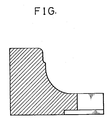
- the drawing is a sectional view of a mold to which is applied the present invention.
- the feature of the present invention is to propose a method of manufacturing a high hardness member, obtained by forming a high hardness surface layer that is hard to work. This is accomplished by changing the composition of the member surface through volatilization of elements with high vapor pressure, carried out by subjecting the easy to work alloy member worked into a desired form to a heat treatment at high temperature.
- This invention is directed to a method of manufacturing a high hardness product from an easy to work alloy member comprising less than 2 wt.% carbon, 10 to 30 wt.% manganese, 10 to 30 wt.% chromium, optionally less than 10 wt.% of nickel, less than 5 wt.% of vanadium, and less than 5 wt.% of copper, the remaining iron and unavoidable impurities, comprising the steps of:
- Carbon is an important element for obtaining the easy to work of the member and is volatilized for forming the high hardness surface layer. If the amount of carbon with such properties exceeds 2 weight%, there arises that the hardness of the surface layer, which is formed by hish temperature heating, may not be raised to a sufficiently high level.
- the preferred amount of carbon is 0.01 weight% - 1 weight%.
- Manganese is an important element which is for obtaining the easy working of the member and is volatilized for forming the high hardness surface layer.
- the compounding ratio of manganese with such properties is less than 10 weight%, the high hardness surface layer is not obtained, thereby reducing the strength and hardness of the member, whereas if the compounding ratio exceeds 30 weight%, there arises that the workability of the austenite might be impaired to work easily.
- the preferred range for manganese is 15 weight% - 25 weight%.
- At least one of the carbon and manganese which have high vapor pressures, are volatilized off the surface of the easy to work member, reducing the contents of carbon and manganese in the surface, and surface layer with high hardness is formed.
- Chromium is an element, which along with manganese is volatilized, which is necessary for forming the high hardness surface layer to improve strength and hardness.
- the amount of chromium is less than 10 weight%, the workability of the member is impaired and strength, hardness and corrosion resist are reduced, whereas if the amount of chromium exceeds 30 weight%, the hardness layer can not obtain and the member decreases the toughness.
- the preferred range is 15 weight% - 25 weight%.
- An easy to work member may be formed from an iron-based alloy with the composition mentioned before, to which is added less than 10 weight% of nickel, less than 5 weight% of vanadium, and less than 5 weight% of copper.
- the limitation of these components is described as follows.
- Nickel is an element which improves toughness. If it exceeds 10 weight%, not only does its effect becomes saturated, but it also makes it difficult to manufacture a member with satisfactorily high hardness due to undesirable composition balance with other components.
- Vanadium is an element which improves strength and hardness of the member, but if it exceeds 5 weight%, workability is impaired.
- Copper is an element which improves toughness. If it exceeds 5 weight%, the hardness of the surface layer formed by high temperature heating may not be enhanced to a sufficiently high level.
- heat treatment it is desirable to carry out such vaporizing heating within the temperature range of 900°C - 1300°C.
- the reasons for this are that if the temperature is below 900°C, it becomes difficult to form a layer of high hardness on the surface of the easy to work alloy member without enough volatilization, whereas if the temperature exceeds 1300°C, it may adversely thermally affect the easy to work alloy itself. Thereby the thermal treatment is effected in a vacuum.
- the composition (more specifically, in the case of the previously mentioned alloy of carbon, manganese, chromium, and the remainder iron, the amounts of carbon and manganese are decreased and amounts of chromium and iron are relatively increased) of the surface of the member, after machining into a desired shape and subsequent heat treatment at a prescribed temperature, it is possible to form a hard to work surface layer with a high hardness. Accordingly, a member of arbitrary shape can be formed simply by carrying out a machining process or by casting and forging or cutting and grinding, without employing powder metallurgy, which is complicated to control as was mentioned in the case of hard metals. Moreover, a surface layer with a hardness higher than that of existing high speed steel can be formed by heat treatment in a vacuum, so that it is possible to manufacture a high hardness member of an arbitrary shape in an extremely easy manner.
- the present invention it is possible to reform a high hardness surface layer on the member with a heat treatment in a vacuum after the member is used as a high strength member. More particularly, there are three methods of the reforming as follow. In a first method, the used high strength member with a deteriorated high hardness surface layer is subjected to a heat treatment being in a range of 900°C - 1300°C in a vacuum to reform a high hardness surface layer on the member. In a second method, a deteriorated high hardness surface layer of the used high strength member is removed by a machining.
- the member is subjected to a heat treatment being in a range of 900°C - 1300°C in a vacuum to reform a high hardness surface layer on the member.
- the used high strength member is subjected to a heat treatment in a vacuum at a temperature lower than 900°C to obtain a new easy to work member.
- the member is subjected to a heat treatment being in a range of 900°C - 1300°C in a vacuum to reform a high hardness surface layer on the member.
- the present invention it is possible to freely control the thickness of the surface layer that has high hardness, simply by adjusting the temperature and the duration of the heat treatment.
- the surface layers formed had hardness higher than that of the high speed steel.
Landscapes
- Chemical & Material Sciences (AREA)
- Engineering & Computer Science (AREA)
- Materials Engineering (AREA)
- Thermal Sciences (AREA)
- Crystallography & Structural Chemistry (AREA)
- Mechanical Engineering (AREA)
- Physics & Mathematics (AREA)
- Metallurgy (AREA)
- Organic Chemistry (AREA)
- Forging (AREA)
- Heat Treatments In General, Especially Conveying And Cooling (AREA)
- Heat Treatment Of Articles (AREA)
- Mounting, Exchange, And Manufacturing Of Dies (AREA)
Claims (5)
- Verfahren zur Herstellung eines Produktes hoher Härte aus einem leicht zu bearbeitenden Legierungsteil, umfassend weniger als weniger als 2 Gew.% Kohlenstoff, 10 bis 30 Gew.% Mangan, 10 bis 30 Gew.% Chrom, wahlweise weniger als 10 Gew.% Nickel, weniger als 5 Gew.% Vanadium und weniger als 5 Gew.% Kupfer, wobei der Rest Eisen und unvermeidbare Verunreinigungen sind, umfassend die Schritte:a) Bilden einer vorbestimmten Form aus dem leicht zu bearbeitenden Legierungsteil; undb) Durchführen einer Wärmebehandlung in einem Vakuum mit dem gebildeten Legierungsteil, um Elemente mit hohem Dampfdruck, umfassend zumindest eines von Kohlenstoff und Mangan, in dem Legierungsteil zu verflüchtigen und eine Oberflächenschicht hoher Härte zu bilden, indem die Oberflächenzusammensetzung des Legierungsteils geändert wird.
- Verfahren zur Herstellung eines Produktes hoher Härte nach Anspruch 1, worin die Oberflächenschicht hoher Härte durch Durchführen einer Wärmebehandlung mit dem gebildeten Legierungsteil bei einer hohen Tempratur gebildet wird, um Elemente mit hohem Dampfdruck, umfassend zumindest eines von Kohlenstoff und Mangan, zu verflüchtigen, unter Erhalt einer Zusammensetzung an der Oberfläche, die verhältnismäßig wenig Kohlenstoff und Mangan im Vergleich zu dem Rest des Teils aufweist.
- Verfahren zur Herstellung eines Produktes hoher Härte nach Anspruch 1 oder 2, worin die Temperatur der Wärmebehandlung in einem Bereich von 900 bis 1300°C ist.
- Verfahren zur Herstellung eines Produktes hoher Härte nach einem der Ansprüche 1 bis 3, worin das leicht zu bearbeitende Legierungsteil zu einer Metallform gebildet wird.
- Verfahren nach einem der Ansprüche 1 bis 4, worin das leicht zu bearbeitende Legierungsteil 0,01 bis 1 Gew.% Kohlenstoff, 10 bis 25 Gew.% Mangan und 15 bis 25 Gew.% Chrom umfaßt.
Applications Claiming Priority (2)
| Application Number | Priority Date | Filing Date | Title |
|---|---|---|---|
| JP76630/87 | 1987-03-30 | ||
| JP62076630A JP2642347B2 (ja) | 1987-03-30 | 1987-03-30 | 高硬度部材の製造方法 |
Publications (3)
| Publication Number | Publication Date |
|---|---|
| EP0285128A2 EP0285128A2 (de) | 1988-10-05 |
| EP0285128A3 EP0285128A3 (en) | 1989-10-25 |
| EP0285128B1 true EP0285128B1 (de) | 1994-10-19 |
Family
ID=13610689
Family Applications (1)
| Application Number | Title | Priority Date | Filing Date |
|---|---|---|---|
| EP88105175A Expired - Lifetime EP0285128B1 (de) | 1987-03-30 | 1988-03-30 | Verfahren zur Herstellung eines harten metallischen Gegenstandes |
Country Status (4)
| Country | Link |
|---|---|
| US (1) | US4854978A (de) |
| EP (1) | EP0285128B1 (de) |
| JP (1) | JP2642347B2 (de) |
| DE (1) | DE3851850T2 (de) |
Families Citing this family (1)
| Publication number | Priority date | Publication date | Assignee | Title |
|---|---|---|---|---|
| GB9024419D0 (en) * | 1990-11-09 | 1991-01-02 | Ist Lab Ltd | Heating apparatus |
Family Cites Families (10)
| Publication number | Priority date | Publication date | Assignee | Title |
|---|---|---|---|---|
| BE440697A (de) * | ||||
| US3277149A (en) * | 1963-10-07 | 1966-10-04 | United States Steel Corp | Method of treating stainless steel for removal of carbon and nitrogen |
| US3966509A (en) * | 1975-01-22 | 1976-06-29 | United States Steel Corporation | Method for reducing carbon deposits during box annealing |
| BG29797A1 (en) * | 1979-06-27 | 1981-02-16 | Rashev | Austenite corrosion resistant steel |
| US4249963A (en) * | 1979-07-23 | 1981-02-10 | General Electric Company | Method for improving a property of an alloy |
| JPS57110656A (en) * | 1980-12-29 | 1982-07-09 | Daido Steel Co Ltd | Free cutting austenite stainless steel |
| JPS6117884A (ja) * | 1984-07-03 | 1986-01-25 | 井関農機株式会社 | 穀粒乾燥機の通風乾燥装置 |
| JPS6151027A (ja) * | 1984-08-20 | 1986-03-13 | Kao Corp | 新規ポリエステル樹脂の製造方法 |
| US4822556A (en) * | 1987-02-26 | 1989-04-18 | Baltimore Specialty Steels Corporation | Austenitic stainless steel combining strength and resistance to intergranular corrosion |
| JP3200988B2 (ja) * | 1992-07-20 | 2001-08-20 | ブラザー工業株式会社 | 長尺キーの支持構造 |
-
1987
- 1987-03-30 JP JP62076630A patent/JP2642347B2/ja not_active Expired - Fee Related
-
1988
- 1988-03-29 US US07/174,910 patent/US4854978A/en not_active Expired - Fee Related
- 1988-03-30 DE DE3851850T patent/DE3851850T2/de not_active Expired - Fee Related
- 1988-03-30 EP EP88105175A patent/EP0285128B1/de not_active Expired - Lifetime
Non-Patent Citations (1)
| Title |
|---|
| Emsworth, Hampshire, GB; "Vaporize anneal for free-machining material" * |
Also Published As
| Publication number | Publication date |
|---|---|
| EP0285128A2 (de) | 1988-10-05 |
| DE3851850T2 (de) | 1995-03-16 |
| JPS63241111A (ja) | 1988-10-06 |
| US4854978A (en) | 1989-08-08 |
| EP0285128A3 (en) | 1989-10-25 |
| JP2642347B2 (ja) | 1997-08-20 |
| DE3851850D1 (de) | 1994-11-24 |
Similar Documents
| Publication | Publication Date | Title |
|---|---|---|
| US4249945A (en) | Powder-metallurgy steel article with high vanadium-carbide content | |
| EP1511873B1 (de) | Kaltarbeitsstahl und kaltarbeitswerkzeug | |
| CN101426944A (zh) | 用于锯片的高速钢 | |
| US4224060A (en) | Hard alloys | |
| EP1024917B1 (de) | Stahl und wärmebehandeltes werkzeug, hergestellt in einem integrierten pulvermetallurgischem prozess und die nutzung eines solchen stahles für werkzeuge | |
| KR100474117B1 (ko) | 고속도 강 제품 및 그 제조 방법 | |
| KR100562759B1 (ko) | 냉간 가공 공구용, 및 양호한 내마모성, 인성 및 열처리 특성을 갖는 부품용 강 재료와 그의 제조방법 | |
| KR100909922B1 (ko) | 냉간 가공 강 | |
| US4121929A (en) | Nitrogen containing high speed steel obtained by powder metallurgical process | |
| JP2004501276A (ja) | 溶射成形された窒素添加鋼、該鋼を製造する方法、および該鋼から製造された複合材料 | |
| US5021085A (en) | High speed tool steel produced by powder metallurgy | |
| CN103305658B (zh) | 热加工性优异的高速工具钢原料的制造方法 | |
| JP6345945B2 (ja) | 耐摩耗性に優れた粉末高速度工具鋼およびその製造方法 | |
| JPH02175846A (ja) | 粉末高速度工具鋼 | |
| JP3616204B2 (ja) | 表面処理に適した冷間工具鋼及びその金型並びに工具 | |
| EP0285128B1 (de) | Verfahren zur Herstellung eines harten metallischen Gegenstandes | |
| JPS5844734B2 (ja) | 硬質合金およびその製造方法 | |
| JPH02182867A (ja) | 粒末工具鋼 | |
| JP2745646B2 (ja) | 熱間加工性のすぐれた高温耐摩耗性Co基合金の製造法 | |
| JP2001214238A (ja) | 耐ヒートクラック性、耐摩耗性に優れる粉末熱間工具鋼および熱間金型 | |
| TW574382B (en) | Steel article | |
| EP0378925A1 (de) | Stahlpulver für Kaltarbeitswerkzeug | |
| JPH0143017B2 (de) | ||
| CN101517110B (zh) | 冶金粉末组合物及其制造方法 | |
| JP3894373B2 (ja) | 高硬度高耐食性刃物用鋼 |
Legal Events
| Date | Code | Title | Description |
|---|---|---|---|
| PUAI | Public reference made under article 153(3) epc to a published international application that has entered the european phase |
Free format text: ORIGINAL CODE: 0009012 |
|
| AK | Designated contracting states |
Kind code of ref document: A2 Designated state(s): DE FR GB |
|
| PUAL | Search report despatched |
Free format text: ORIGINAL CODE: 0009013 |
|
| AK | Designated contracting states |
Kind code of ref document: A3 Designated state(s): DE FR GB |
|
| 17P | Request for examination filed |
Effective date: 19900419 |
|
| 17Q | First examination report despatched |
Effective date: 19910820 |
|
| GRAA | (expected) grant |
Free format text: ORIGINAL CODE: 0009210 |
|
| AK | Designated contracting states |
Kind code of ref document: B1 Designated state(s): DE FR GB |
|
| REF | Corresponds to: |
Ref document number: 3851850 Country of ref document: DE Date of ref document: 19941124 |
|
| ET | Fr: translation filed | ||
| PLBE | No opposition filed within time limit |
Free format text: ORIGINAL CODE: 0009261 |
|
| STAA | Information on the status of an ep patent application or granted ep patent |
Free format text: STATUS: NO OPPOSITION FILED WITHIN TIME LIMIT |
|
| 26N | No opposition filed | ||
| PGFP | Annual fee paid to national office [announced via postgrant information from national office to epo] |
Ref country code: FR Payment date: 19990309 Year of fee payment: 12 |
|
| PGFP | Annual fee paid to national office [announced via postgrant information from national office to epo] |
Ref country code: GB Payment date: 19990401 Year of fee payment: 12 |
|
| PGFP | Annual fee paid to national office [announced via postgrant information from national office to epo] |
Ref country code: DE Payment date: 19990406 Year of fee payment: 12 |
|
| PG25 | Lapsed in a contracting state [announced via postgrant information from national office to epo] |
Ref country code: GB Free format text: LAPSE BECAUSE OF NON-PAYMENT OF DUE FEES Effective date: 20000330 |
|
| GBPC | Gb: european patent ceased through non-payment of renewal fee |
Effective date: 20000330 |
|
| PG25 | Lapsed in a contracting state [announced via postgrant information from national office to epo] |
Ref country code: FR Free format text: LAPSE BECAUSE OF NON-PAYMENT OF DUE FEES Effective date: 20001130 |
|
| REG | Reference to a national code |
Ref country code: FR Ref legal event code: ST |
|
| PG25 | Lapsed in a contracting state [announced via postgrant information from national office to epo] |
Ref country code: DE Free format text: LAPSE BECAUSE OF NON-PAYMENT OF DUE FEES Effective date: 20010103 |