EP0285736A2 - Verfahren und Vorrichtung zur Herstellung von Polypropylenfäden - Google Patents
Verfahren und Vorrichtung zur Herstellung von Polypropylenfäden Download PDFInfo
- Publication number
- EP0285736A2 EP0285736A2 EP87810568A EP87810568A EP0285736A2 EP 0285736 A2 EP0285736 A2 EP 0285736A2 EP 87810568 A EP87810568 A EP 87810568A EP 87810568 A EP87810568 A EP 87810568A EP 0285736 A2 EP0285736 A2 EP 0285736A2
- Authority
- EP
- European Patent Office
- Prior art keywords
- cylinders
- filaments
- yarn
- stretching
- yarns
- Prior art date
- Legal status (The legal status is an assumption and is not a legal conclusion. Google has not performed a legal analysis and makes no representation as to the accuracy of the status listed.)
- Granted
Links
Images


Classifications
-
- D—TEXTILES; PAPER
- D01—NATURAL OR MAN-MADE THREADS OR FIBRES; SPINNING
- D01F—CHEMICAL FEATURES IN THE MANUFACTURE OF ARTIFICIAL FILAMENTS, THREADS, FIBRES, BRISTLES OR RIBBONS; APPARATUS SPECIALLY ADAPTED FOR THE MANUFACTURE OF CARBON FILAMENTS
- D01F6/00—Monocomponent artificial filaments or the like of synthetic polymers; Manufacture thereof
- D01F6/02—Monocomponent artificial filaments or the like of synthetic polymers; Manufacture thereof from homopolymers obtained by reactions only involving carbon-to-carbon unsaturated bonds
- D01F6/04—Monocomponent artificial filaments or the like of synthetic polymers; Manufacture thereof from homopolymers obtained by reactions only involving carbon-to-carbon unsaturated bonds from polyolefins
- D01F6/06—Monocomponent artificial filaments or the like of synthetic polymers; Manufacture thereof from homopolymers obtained by reactions only involving carbon-to-carbon unsaturated bonds from polyolefins from polypropylene
-
- D—TEXTILES; PAPER
- D01—NATURAL OR MAN-MADE THREADS OR FIBRES; SPINNING
- D01D—MECHANICAL METHODS OR APPARATUS IN THE MANUFACTURE OF ARTIFICIAL FILAMENTS, THREADS, FIBRES, BRISTLES OR RIBBONS
- D01D13/00—Complete machines for producing artificial threads
-
- D—TEXTILES; PAPER
- D01—NATURAL OR MAN-MADE THREADS OR FIBRES; SPINNING
- D01D—MECHANICAL METHODS OR APPARATUS IN THE MANUFACTURE OF ARTIFICIAL FILAMENTS, THREADS, FIBRES, BRISTLES OR RIBBONS
- D01D5/00—Formation of filaments, threads, or the like
- D01D5/08—Melt spinning methods
-
- D—TEXTILES; PAPER
- D01—NATURAL OR MAN-MADE THREADS OR FIBRES; SPINNING
- D01D—MECHANICAL METHODS OR APPARATUS IN THE MANUFACTURE OF ARTIFICIAL FILAMENTS, THREADS, FIBRES, BRISTLES OR RIBBONS
- D01D5/00—Formation of filaments, threads, or the like
- D01D5/12—Stretch-spinning methods
- D01D5/16—Stretch-spinning methods using rollers, or like mechanical devices, e.g. snubbing pins
Definitions
- the invention generally relates to the production of polypropylene yarns and specifically to a method of making such yarns by melt spinning.
- polypropylene not only exhibits dye-swelling upon extrusion but upon drawing-down from the swellings formed at the underside of the spinneret produces a filament with a non-uniform thickness in the manner of a string of linked sausages.
- Various prior art methods have been aimed either at modifying the polypropylene material or at specific methods (e.g. FR Patent No.
- a multitude of yarns say 8 to 16 or more
- a further object of the invention is an apparatus for carrying out the novel method.
- the apparatus for use in this method comprises a number of conventional elements i.e.
- the invention combines the element of rapid spinning of a sufficient number of filaments for a large number of yarns with the element of stretching the resulting yarn-forming groups of filaments together, i.e. in common, on a small number of large cylinders along parallel and discrete or individual pathways in which the length of frictional contact is within specified limits and provided, at least predominantly, by the large cylinders.
- the cylinders When operating the inventive method, the cylinders will generally be maintained at a predetermined and generally elevated temperature as is conventional per se; also in a manner known per se, the cylinders provide for incrementation of speed as needed for a particular draw ratio.
- An additional advantage of the large-cylinder-stretching approach with a plurality of yarn strands is that if yarn rupture does occur its control, removal and repair can be achieved in a relatively simple manner as long as reasonable distances are provided between adjacent cylinders.
- a total number of 4 cylinders for stretching according to the invention is preferred for reasons of simplicity of construction and operation.
- the first cylinder "upstream" i.e.
- the subsequent or second cylinder will be rotated by a conventional drive at a relatively "low" peripheral speed which depends, of course, upon the extrusion speed but may typically be within the range of from 600 to 1000 m/min; while the first two cylinders have a common speed, this does not necessarily imply identical speeds; for example, it may be advantageous to operate the second cylinder of the low-speed first group at a peripheral speed that is somewhat higher than that of the first cylinder, e.g. by 5 to 15 %.
- the second cylinder group in the preferred arrangement just mentioned operates at a common "high" peripheral speed, e.g. 1200 to 2200 m/min depending upon the peripheral speed of the first cylinder group and the desired draw ratio that, typically, may be in the range of from 1 ⁇ 1 to 1 ⁇ 3.
- a "common" speed of the second cylinder group does not mean identical speeds, and the second cylinder of the second group (i.e. the last cylinder of the preferred stretching embodiment just mentioned) may have a somewhat higher peripheral speed than the immediately preceding first cylinder of the second group.
- a texturizing and/or entangling stage may be provided and conventional methods or devices for use in processing of polypropylene filament yarns can be used; in this embodiment additional cylinders will generally be required before and after the texturizing and/or entangling step, notably for bringing the textured and/or entangled yarn from a holding position, such as in the groove of a perforated suction drum, to the speed of the winders.
- the winding speed will be at least 1200 m/min but higher winding speeds, say 2000 m/min or more, will be used for many purposes of the invention.
- the invention provides a new aspect thereof as regards stretching of a large number of yarns on a single stretching device at speeds of substantially above 500 m/min. Specifically, since yarn ruptures can never be totally exluded, simple and effective rupture control and repair is an important additional aspect of the invention.
- the inventive concept of large-cylinder-stretching of a yarn array, i.e. 8 or more yarns, along discrete pathways that are parallel with each other and perpendicular relative to the rotation axes of all stretching cylinders is based upon large cylinder surfaces provided essentially on but a few large cylinders.
- the stretching device is easily accessible to the operator in charge of yarn rupture control so that repair and re-feeding of a broken strand presents no problems.
- first and second rupture control means are provided near the start (e.g. between the first large diameter cylinder, i.e. that next to the spinneret, and the second large diameter cylinder), as well as near the end (e.g. after the last large diameter cylinder of the stretching means) of said path length of frictional contact for each of said yarn strands.
- Additional smaller cylinders may be provided for the stretching stage, e.g. between the large diameter cylinders, but this is not preferred; in gener al, the large diameter cylinders alone are sufficient for yarn path deflection within the stretching stage.
- the second rupture control typically a yarn detector, would sense a discontinuity or absence of yarn passage and activate a small cutter provided for this and any strand in the first rupture control means.
- a suction opening associated with each yarn cutter would now receive the freshly cut leading edge of the broken strand.
- a signal means coordinated with the second and/or the first rupture control means will be triggered upon rupture of any given strand, of course, to inform the operator of a strand rupture and of the position of the strand.
- the operator will activate a mobile aspirator, direct it to the suction opening into which the broken strand passes after operation of the cutter, and manually cut the strand so that the new leading edge of the broken strand will be sucked into the mobile aspirator. Then, without stopping production of the unbroken strands, the operator can easily re-insert the line of the previously broken strand into the corresponding pathway that is recognizable because of the incompleteness of the array and is accessible on the large cylinder surfaces.
- the re-fed yarn is passed from the mobile aspirator to the winder and/or a yarn-mending device cooperating therewith.
- Yarn rupture control of this type including various forms of yarn aspirators, yarn detectors etc. are commercially available and need no further explanation except as regards the number of strands. Since at least 8 and typically 16 strands per stretching device may require individual control in the inventive method, combinations of a sufficient number of modular units, e.g. one cutter/aspirator and yarn detector module for each yarn, are required.
- a preferred embodiment of the first and/or second rupture control means provides for automatic strand feeding and includes a number of yarn guide slots substantially corresponding with the array of strands and arranged in an elongated bar extending over the width of the yarn array.
- An elongated and displacable slide bar is provided for guiding some or all strands of the array along a path portion that does not pass through the slots but beyond them. The slide bar will be in this position only for start-up or yarn repair and is withdrawn when the complete array passes on top of the slide bar so that all strands will again be put into the slots of the slide bar.
- Polypropylene suitable for use in the present method is obtainable commercially for melt spinning of continuous multifilament yarns, e.g. the products sold by Himont, Italy, under the registered trademark MOPLEN; commercial spinning grade pellet products containing or not the usual additives are preferred or, in other words, neither particularly critical substance parameters nor special formulations are generally required for practicing the inventive method; typical examples are polypropylene homopolymers having a melt index (cf. ASTM D 1238/L) of at least about 10 dg/min, e.g. from 10 to 12 dg/min or more, e.g.
- a melt index cf. ASTM D 1238/L
- Molecular weight distribution values i.e. the ratio of the weight average molecular weight to the number average weight of from about 5 to 6 have been found to be suitable for the subject method. Colored master batch materials can be used and/or pigments and other additives can be added prior to use herein.
- polypropylenes for use in the present invention should be capable of being melt spun with commercially available extruders and spinning pumps at extrusion speeds of at least 400 m/min through the holes of a spinning plate or spinneret having diameters required for spinning multifilaments in the typical denier range of from 1 to 15 den per filament, typical yarn deniers being in the range of from 40 to 800 den.
- suitable polypropylenes must be capable of "substantial orientation" in the sense that filaments obtained by extrusion and drawing-down are capable to achieve molecular orientation by stretching to near the limit of plastic flow.
- filaments that have been substantially oriented will show a substantially reduced or "low” elong ation if compared with the "drawn-down" filaments obtained after solidification of the melt spun filaments prior to the application of substantial stretching.
- substantially oriented filaments will have an individual elongation at room temperature of less than about 250 %; frequently, the final yarn obtained according to the inventive method will have even less elongation, depending, however, whether FOY or BCY products are made, i.e. whether or not a texturizing and/or entangling step is applied to the yarns after stretching.
- substantially orientation includes “substantially full orientation” as well as an approximation thereto that is sufficient for normal end uses of the yarns.
- a first essential feature of the inventive method relates to the number of yarns being produced simultaneously with a single stretching means, or the number of "yarn strands" that are being processed according to the invention; in this context, a “filament” is a "fiber” of infinite length, and "individual filament” refers to one of a plurality of filaments forming a yarn or "yarn strand” which latter term refers to a group of individual filaments which are stretched as a single group or unit; such strands may be identified when practising the invention by a consecutive number of from 1 to 8, 10, 12, 14 or 16 depending upon the actual number of strands or yarns actually run in the inventive method per each stretching unit.
- each yarn or strand of a multifilament yarn will include a multiplicity of typically about 30, 60 or even about 120 individual filaments per yarn and it is assumed herein that when referring to a multifilament yarn, at least 10 filaments are assumed to be present in the yarn. This is a matter of practice rather then theory since normal yarns will contain substantially more than 10 filaments.
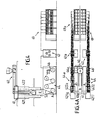
- the first essential portion of an apparatus for carrying out the inventive method such as depicted in Fig. 1 will comprise a spinneret means 11 that may be a fixed spinning plate or, preferably (cf. Fig. 1A), is formed by one or more frame plates 113, 114 each comprising a number of exchangeable, e.g. circular spinneret inserts 111, 112 in line with the filament denier and/or the number of filaments per yarn and/or the cross-section of the filaments desired for the final yarn.
- a spinneret means 11 that may be a fixed spinning plate or, preferably (cf. Fig. 1A)
- frame plates 113, 114 each comprising a number of exchangeable, e.g. circular spinneret inserts 111, 112 in line with the filament denier and/or the number of filaments per yarn and/or the cross-section of the filaments desired for the final yarn.
- the "extrusion speed” is another essential feature of the invention insofar as it determines the minimum production speed which, according to the invention, is at least 1000 meters per minute.
- the term “extrusion speed” is used synonymously with “melt spinning speed” and does not necessarily refer to the speed of the molten mass upon emergence from the spinneret but rather to the speed of formation of solidified but essentially non-oriented filaments.
- the inventive method operates with an extrusion speed of at least about 400 m/min.
- the shaft means 12 or the shaft portions 121, 122 together form the essentially vertical "air quenching zone" in the sense that the heat exchange medium is gaseous rather than liquid, and that the temperature of the gaseous quenching medium is substantially lower than the temperature of the molten mass that emerges from the spinning holes of the spinneret; hence, the term "air” is intended to include any practical gas or gaseous mixture that can be maintained without undue problems at a quenching temperature of typically in the range of from about 0 to about 50°C with a preferred temperature in the range of from about 10 to about 30°C. Forced, i.e. accelerated yet essentially laminar, passage of air through shaft 12 or its portions is generally preferred, as is temperature control. Whether or not artificial cooling is needed may depend upon the ambient climate.
- conventional extruder means 10 can be used.
- an extruder 100 of 1 ⁇ 75 mm screw diameter can be used for production of yarns of 40 to 250 den while a screw diameter of 1 ⁇ 90 mm would be suitable for yarns in the 150 to 800 den range when a total of 16 to 32 yarns is produced from the output of extruder 100.
- a spinning pump 101 and a heating means 102 are generally used to ascertain a sufficient and suitably heat controlled supply of molten polypropylene to the spinneret means 11.
- Fig. 1A is a semi-diagrammatic plane view of the spinneret end as viewed from a shaft 12 which in its upper part is formed by a pair of parallel cooling chambers 121, 122 encompassed by air-permeable inner and outer wall pairs 123, 125 and 124, 126, respectively, and supplied with a substantially laminar stream of cold or cooled air via conduit 129.
- Side walls 127, 128 need not be permeable to air but its preferred that the front walls 125, 126 can be removed easily for access to the spinneret ends 111, 112.
- the intensity of cooling or quenching of the at least 8 strands to be formed at the spinneret or, in any case, when forming the strand array on the first cylinder 141 as explained in more detail below will depend upon the passage of molten polypropylene mass per time unit into and through the air quenching zone formed by or in shaft means 12.
- the vertical length or "height" H of the shaft means as measured from the lower end of the spinnerets 111, 112 to the first point of contact with a mechanical yarn contacting means should be at least 2.5 meters, e.g. about 3 to 6 meters, but essentially for practical reasons not substantially above about 7.5 meters.
- a next essential step of the inventive method is formation of a "planar array" A of the yarn strands S; to this effect, filaments F are collected or assembled to form strands which, norm strictlyally, are formed by filaments in equal numbers, e.g. each strand containing 64 filaments; such groups may be preformed by the spinneret openings 111, 112 but "hooks” or “ears” arranged in the form of transverse guide bars 131, 132 for the strands from each shaft portion 121 122 are preferred.
- the collected strands in which the filaments are densely packed close to each other are now directed onto the surface of the first cylinder 141 of stretching means 14 according to the invention to form the "strand array".
- Such an array is characterized by common parallel alignment of all strands that are to be stretched in a stretching unit according to the invention; each strand runs along an individual path since the strands are distanced from each other, e.g. by distances of from 0.5 to 50 mm or more depending upon the number of strands and the axial length of the cylinders; a generally equidistanced array may be preferable but equidistance is not a critical requirement as long as all paths are parallel and substantially maintained in this array during the stretching operation, i.e. until substantial orientation of the filaments has been achieved.
- the length of frictional contact of each strand with the parallel stretching cylinders is within the range of from 1000-6500 mm, preferably 1500 to 4000 mm and notably between 2000 and 3000 mm, but that this frictional contact length also should be provided at least predominantly (i.e. more than 50 %) and preferably essentially (i.e. from 75 to 100 %) on a small total number of cylinders which number is between 2 and 6; a total of 3 to 5 cylinders may be used but an even number of cylinders is preferred.
- a total number of 4 cylinders is suitable and preferred as shown in Fig. 1 where the cylinders 141, 142, 154, 144 contribute substantially equal portions a, b, c and d of the total frictional contact length.
- the first cylinder 141 will rotate at a lower peripheral speed than the last cylinder 144 and the difference of peripheral speeds will be commensurate with the required or desired draw ratio; each of the cylinders is connected with a drive (not shown) and provided with heat control or heating means such that a predetermined and substantially constant surface temperature in the range of from 80 to 130°C can be- maintained on each cylinder.
- Peripheral speeds of the first cylinder 141 or the first cylinder pair 141, 142 of from 600 to 1000 m/min are typical while peripheral speeds of from 1200 to 2000 m/min or more would be typical for cylinders 143, 144. Small differences of peripheral speeds, say about 10 % between cylinders 141 and 142, on the one hand, and between 143 and 144, on the other hand, may be advantageous.
- "frictional contact” is assumed to exist if the amount of "slippage" (i.e. yarn speed is smaller than the speed of the contacting cylinder) should be lower than 20 %, preferably not substantially more than 10 %.
- a first yarn rupture control means 151 is provided between the first and the second cylinder, i.e. near the start of the stretching stage, while a second rupture control means 152 is provided near the end of the stretching stage, e.g. down-stream of cylinder 144.
- a sliding rod or bar 153 may be used on either or both yarn rupture control(s) as shown diagrammatically in Fig. 1C. Slot bar 153 is shown for simplicity with but three slots 156, 157, 158 for passage of three strands S-1, S-2 and S-3. When in normal operation, each strand passes through its proper slot provided, for example, with conventional yarn detecting means (not shown).
- slide bar 153 is moved from below into the position shown in full lines in 153b. After placement of all strands in accordance with the array used in a given apparatus and with a given strand number so that the strands pass above the slots as indicated by S-1b, S-2b and S-3b, the slide bar is now withdrawn or moved into position 153a (broken lines) and all strands will then be guided into and through their corresponding slots automatically along the normal pathways S-1a, S-2a, S-3a.
- a texturizing and/or entangling device 16 e.g. a number of hot air texturizing jets 164,onto a collector drum 163 from which they are drawn off via auxiliary rollers 17.
- auxiliary rollers 160 and 161 may be used to guide the strands into device 164.
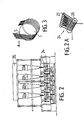
- Fig. 2 illustrates a prior art integral production apparatus for melt spinning and drawing polypropylene multifilament yarns.
- a large number of shafts 22a to 22d is needed since prior art stretching devices 24 of the spiral path type consisting of two rollers with small diameters and an angular arrangement of the axes of rotation of the two rollers relative to each other were believed to be the best for high speed integral operation.
- prior art stretching devices 24 of the spiral path type consisting of two rollers with small diameters and an angular arrangement of the axes of rotation of the two rollers relative to each other were believed to be the best for high speed integral operation.
- at least two such or similar stretching devices with small dieameter cylinders of typically 200 mm or less were needed for each shaft, and parallel pathways of a multiplicity of yarn strands were impossible to achieve on such prior art machines.
- An enlarged view of a spiral-path stretching device is shown in Fig. 2A.
- Figs. 4 and 4A show a semi-diagrammatic presentation of an apparatus according to the invention in side view and top view.
- the side view shows essentially the same elements as Fig. 1, namely a pair of shaft portions 421, 422 supplied from an ex truder 40 via spinneret 41 to produce filaments F that are collected to form strands S and are stretched in the form of a planar array A by means of a stretching unit 44 composed of 4 substantially equal stretching cylinders of at least about 400 mm diameter as explained above; the oriented yarn strands are then passed through a texturizing and entangling device 46 and via auxiliary rollers 47 fed into a winding apparatus 49.
- a single extruder 40 supplies a pair of spinnerets 41, 41a, a pair of double shafts 421, 422, 421a, 422a, a pair of stretching units 44, 44a, a pair of auxiliary rollers 47, 47a and also a pair 49, 49a so as to produce typically 30 continuous filament yarns or more at speeds of typically at least about 2000 m/min as a continuous product stream in an integral operation from the common extruder 40.
- Yarn rupture control means as explained above in connection with Fig. 1 have been omitted in Fig. 4 but for simplicity of presentation and will, of course, be used in practice to provide optimum yarn rupture control at high speed multistrand production of polypropylene yarns according to the invention.
- the invention provides for extremely effective and compact means for economic production of high quality polypropylene continuous filament yarn products including those suitable for garment use.
Landscapes
- Engineering & Computer Science (AREA)
- Textile Engineering (AREA)
- Mechanical Engineering (AREA)
- Chemical & Material Sciences (AREA)
- Chemical Kinetics & Catalysis (AREA)
- General Chemical & Material Sciences (AREA)
- Spinning Methods And Devices For Manufacturing Artificial Fibers (AREA)
- Yarns And Mechanical Finishing Of Yarns Or Ropes (AREA)
Priority Applications (7)
| Application Number | Priority Date | Filing Date | Title |
|---|---|---|---|
| AT87810568T ATE83269T1 (de) | 1987-04-06 | 1987-10-02 | Verfahren und vorrichtung zur herstellung von polypropylenfaeden. |
| IE92988A IE61581B1 (en) | 1987-04-06 | 1988-03-28 | Method of producing polypropylene yarns and apparatus for carrying out the method |
| CA000563264A CA1284567C (en) | 1987-04-06 | 1988-04-05 | Method of producing polypropylene yarns and apparatus for carrying out the method |
| BR8801592A BR8801592A (pt) | 1987-04-06 | 1988-04-05 | Processo de produzir fios de polipropileno e aparelho para a realizacao do processo |
| AU14172/88A AU606669B2 (en) | 1987-04-06 | 1988-04-05 | Method of producing polypropylene yarns and apparatus for carrying out the method |
| CN 88102349 CN1009465B (zh) | 1987-04-06 | 1988-04-06 | 生产聚丙烯纱的方法及其装置 |
| JP8621888A JP2619680B2 (ja) | 1987-04-06 | 1988-04-06 | ポリプロピレンヤーンの製造方法及び製造装置 |
Applications Claiming Priority (2)
| Application Number | Priority Date | Filing Date | Title |
|---|---|---|---|
| IT1999087 | 1987-04-06 | ||
| IT19990/87A IT1203862B (it) | 1987-04-06 | 1987-04-06 | Procedimento di filatura e stiro in continuo di filati sintetici e relativo impianto di produzione |
Publications (3)
| Publication Number | Publication Date |
|---|---|
| EP0285736A2 true EP0285736A2 (de) | 1988-10-12 |
| EP0285736A3 EP0285736A3 (en) | 1990-03-28 |
| EP0285736B1 EP0285736B1 (de) | 1992-12-09 |
Family
ID=11162900
Family Applications (1)
| Application Number | Title | Priority Date | Filing Date |
|---|---|---|---|
| EP87810568A Expired - Lifetime EP0285736B1 (de) | 1987-04-06 | 1987-10-02 | Verfahren und Vorrichtung zur Herstellung von Polypropylenfäden |
Country Status (4)
| Country | Link |
|---|---|
| US (2) | US4902462A (de) |
| EP (1) | EP0285736B1 (de) |
| DE (1) | DE3783030T2 (de) |
| IT (1) | IT1203862B (de) |
Cited By (10)
| Publication number | Priority date | Publication date | Assignee | Title |
|---|---|---|---|---|
| EP0363317A3 (de) * | 1988-10-03 | 1990-09-05 | FILTECO S.p.A. | Schmelzspinnvorrichtung und -verfahren |
| EP0551131A3 (de) * | 1992-01-09 | 1994-03-09 | Showa Denko Kk | |
| WO1996017116A1 (de) * | 1994-12-02 | 1996-06-06 | Barmag Ag | Spinnbalken zum spinnen einer mehrzahl von synthetischen fäden und spinnanlage mit einem derartigen spinnbalken |
| US5935512A (en) * | 1996-12-30 | 1999-08-10 | Kimberly-Clark Worldwide, Inc. | Nonwoven process and apparatus |
| EP0691424B1 (de) * | 1994-06-08 | 1999-12-08 | FILTECO S.p.A. | Verfahren und Vorrichtung zur Herstellung von verstreckten Garnen |
| EP0995823A1 (de) * | 1998-10-20 | 2000-04-26 | SML Maschinengesellschaft m.b.H. | Einrichtung zur Herstellung von Multifilamenten |
| WO2001088245A3 (en) * | 2000-05-15 | 2002-03-14 | Kimberly Clark Co | Method and apparatus for producing laminated articles |
| WO2003064743A1 (en) * | 2002-01-29 | 2003-08-07 | Tecnofil Srl | Yarn-production apparatus and method |
| WO2005052225A1 (de) * | 2003-11-27 | 2005-06-09 | Saurer Gmbh & Co. Kg | Vorrichtung zum schmelzspinnen einer vielzahl von fäden |
| WO2011138302A1 (de) * | 2010-05-07 | 2011-11-10 | Oerlikon Textile Gmbh & Co. Kg | Verfahren und vorrichtung zum schmelzspinnen, verstrecken und aufwickeln mehrerer synthetischer fäden |
Families Citing this family (12)
| Publication number | Priority date | Publication date | Assignee | Title |
|---|---|---|---|---|
| CA2071083A1 (en) * | 1991-06-14 | 1992-12-15 | Matthew E. Hain | Dynamic treatment of suture strand |
| US5287634A (en) * | 1992-02-07 | 1994-02-22 | United States Surgical Corporation | Removal of vaporizable components from polymeric products |
| TW275076B (de) * | 1992-12-02 | 1996-05-01 | Hoechst Ag | |
| US5840233A (en) | 1997-09-16 | 1998-11-24 | Optimer, Inc. | Process of making melt-spun elastomeric fibers |
| JP2000285479A (ja) * | 1999-03-31 | 2000-10-13 | Fujitsu Ltd | 情報記憶装置 |
| US6866807B2 (en) * | 2001-09-21 | 2005-03-15 | Stratasys, Inc. | High-precision modeling filament |
| CN101959415B (zh) * | 2007-05-23 | 2014-07-09 | 巴塞尔聚烯烃股份有限公司 | 杀虫组合物以及由其获得的物品 |
| US20100119567A1 (en) * | 2007-05-23 | 2010-05-13 | Basell Polyolefine Gmbh | Insecticidal composition and articles obtained thereof |
| ITMI20081482A1 (it) * | 2008-08-06 | 2010-02-06 | Marti S R L | Metodo ed apparecchiatura per fabbricare un tessuto non tessuto costituito da filamenti polimerici continui sostanzialmente orientati |
| EP2456912A1 (de) * | 2009-07-22 | 2012-05-30 | Oerlikon Textile GmbH & Co. KG | Verfahren zum abziehen und zum verstrecken eines synthetischen fadens sowie eine vorrichtung zur durchführung des verfahrens |
| TWI668341B (zh) * | 2018-11-30 | 2019-08-11 | 萬核應用材料有限公司 | Adhesive wire drawing process |
| US11292171B2 (en) * | 2019-09-04 | 2022-04-05 | Winn Applied Material Inc. | Thread drawing processes |
Family Cites Families (35)
| Publication number | Priority date | Publication date | Assignee | Title |
|---|---|---|---|---|
| CA694324A (en) * | 1964-09-15 | Yates Reginald | Cooling propylene filaments in liquid bath | |
| DE330734C (de) * | 1915-09-12 | 1920-12-21 | Schubert & Salzer Maschinen | Regulaere Wirkware |
| US3077004A (en) * | 1956-03-23 | 1963-02-12 | Du Pont | Filament drawing |
| NL127318C (de) * | 1958-09-24 | |||
| NL257951A (de) * | 1960-06-10 | 1900-01-01 | ||
| DE1248855C2 (de) * | 1960-08-13 | 1973-10-18 | Verfahren zur herstellung von fasern oder faeden aus linearen polyestern | |
| US3099064A (en) * | 1961-04-13 | 1963-07-30 | Eastman Kodak Co | Method and apparatus for making rug yarn |
| BE631629A (de) * | 1962-04-27 | |||
| US3175029A (en) * | 1963-09-09 | 1965-03-23 | Hale Mfg Company | Method of treating thermoplastic synthetic filaments |
| US3295170A (en) * | 1963-12-06 | 1967-01-03 | Ideal Ind | Drive for textile machines having coilers |
| DE1301019B (de) * | 1963-12-06 | 1969-08-14 | Schuller Werner H W | Anordnung von Duesenroehrchen an einer Vorrichtung zur gleichzeitigen kontinuierlichen Erzeugung einer Vielzahl von Faeden aus in der Hitze plastischen, mineralischen Stoffen, insbesondere Glas |
| US3457338A (en) * | 1964-09-21 | 1969-07-22 | Dow Chemical Co | Process for crimping polypropylene filaments |
| US3621088A (en) * | 1968-08-09 | 1971-11-16 | Phillips Petroleum Co | High production of water-quenched filaments |
| US4044189A (en) * | 1969-11-20 | 1977-08-23 | Fiber Industries, Inc. | Surface treated polyester substrates |
| DE1959034B2 (de) * | 1969-11-25 | 1976-08-19 | Barmag Barmer Maschinenfabrik Ag, 5600 Wuppertal | Anlage zum kontinuierlichen herstellen und aufwickeln von endlosen synethetischen faeden |
| DE2032950A1 (de) * | 1970-07-03 | 1972-01-05 | Farbwerke Hoechst AG, vorm. Meister Lucius & Brüning, 6000 Frankfurt | Verfahren und Vorrichtung zur Herstellung latent dreidimensional gekräuselter Fasern und Fäden aus linearen Hochpolymeren |
| GB1362793A (en) * | 1970-10-22 | 1974-08-07 | Ici Ltd | Process for drawing synthetic filaments |
| US3790655A (en) * | 1971-03-02 | 1974-02-05 | E B & A C Whiting Co | Method for commingling and orienting colored sets of thermoplastic filaments |
| JPS59604B2 (ja) * | 1974-11-14 | 1984-01-07 | 東洋紡績株式会社 | ポリエステルセンイトウノ セイゾウホウホウ |
| JPS5227817A (en) * | 1975-08-25 | 1977-03-02 | Teijin Ltd | Spin-draw of synthetic fibers |
| US4225299A (en) * | 1978-04-04 | 1980-09-30 | Kling-Tecs, Inc. | Apparatus for extruding yarn |
| US4193961A (en) * | 1978-04-04 | 1980-03-18 | Kling-Tecs, Inc. | Method of extruding polypropylene yarn |
| US4265849A (en) * | 1979-05-29 | 1981-05-05 | Phillips Petroleum Company | Method for producing multifilament thermoplastic yarn having latent crimp |
| DE2925006C2 (de) * | 1979-06-21 | 1983-06-30 | Akzo Gmbh, 5600 Wuppertal | Verfahren zur Herstellung schmelzgesponnener und molekularorientierend verstreckter, kristalliner Filamente |
| JPS5685417A (en) * | 1979-11-13 | 1981-07-11 | Phillips Petroleum Co | Polyolefin product and method |
| US4347206A (en) * | 1980-03-15 | 1982-08-31 | Kling-Tecs, Inc. | Method of extruding polypropylene yarn |
| US4530809A (en) * | 1980-10-14 | 1985-07-23 | Mitsubishi Rayon Co., Ltd. | Process for making microporous polyethylene hollow fibers |
| JPS5841908A (ja) * | 1981-09-04 | 1983-03-11 | Showa Denko Kk | 高強力モノフイラメントの製造方法 |
| GB2105641B (en) * | 1981-08-08 | 1985-06-26 | Bridon Int Finance | Manufacture of filamentary polymer tow |
| DE3304491A1 (de) * | 1982-02-15 | 1983-11-03 | Barmag Barmer Maschinenfabrik Ag, 5630 Remscheid | Verfahren zur erzeugung ultrafeiner spinnfasern und vorrichtung zur ausuebung des verfahrens |
| DE3323202A1 (de) * | 1982-06-29 | 1983-12-29 | Barmag Barmer Maschinenfabrik Ag, 5630 Remscheid | Schmelzspinn- und streckverfahren zur herstellung von polypropylenfaeden |
| JPS59116405A (ja) * | 1982-12-21 | 1984-07-05 | Teijin Ltd | 分繊用合成繊維マルチフイラメントの製造方法 |
| US4740339A (en) * | 1983-04-11 | 1988-04-26 | Monsanto Company | Process for producing conjugate filaments |
| DE3508955C2 (de) * | 1985-03-13 | 1987-05-14 | Davy McKee AG, 6000 Frankfurt | Verfahren zum Schnellspinnstrecken synthetischer Garne |
| US4702871A (en) * | 1985-06-20 | 1987-10-27 | Toray Industries, Inc. | Method for melt-spinning thermoplastic polymer fibers |
-
1987
- 1987-04-06 IT IT19990/87A patent/IT1203862B/it active
- 1987-10-02 EP EP87810568A patent/EP0285736B1/de not_active Expired - Lifetime
- 1987-10-02 DE DE8787810568T patent/DE3783030T2/de not_active Expired - Fee Related
-
1988
- 1988-04-05 US US07/177,775 patent/US4902462A/en not_active Expired - Lifetime
-
1989
- 1989-11-28 US US07/442,509 patent/US5076773A/en not_active Expired - Lifetime
Cited By (14)
| Publication number | Priority date | Publication date | Assignee | Title |
|---|---|---|---|---|
| EP0363317A3 (de) * | 1988-10-03 | 1990-09-05 | FILTECO S.p.A. | Schmelzspinnvorrichtung und -verfahren |
| US5609888A (en) * | 1992-01-09 | 1997-03-11 | Showa Denko Kabushiki Kaisha | Apparatus for producing multifilaments |
| EP0551131A3 (de) * | 1992-01-09 | 1994-03-09 | Showa Denko Kk | |
| EP0691424B1 (de) * | 1994-06-08 | 1999-12-08 | FILTECO S.p.A. | Verfahren und Vorrichtung zur Herstellung von verstreckten Garnen |
| US5922362A (en) * | 1994-12-02 | 1999-07-13 | Barmag Ag | Spin beam for spinning a plurality of synthetic filament yarns and spinning machine comprising such a spin beam |
| WO1996017116A1 (de) * | 1994-12-02 | 1996-06-06 | Barmag Ag | Spinnbalken zum spinnen einer mehrzahl von synthetischen fäden und spinnanlage mit einem derartigen spinnbalken |
| US5935512A (en) * | 1996-12-30 | 1999-08-10 | Kimberly-Clark Worldwide, Inc. | Nonwoven process and apparatus |
| EP0995823A1 (de) * | 1998-10-20 | 2000-04-26 | SML Maschinengesellschaft m.b.H. | Einrichtung zur Herstellung von Multifilamenten |
| WO2001088245A3 (en) * | 2000-05-15 | 2002-03-14 | Kimberly Clark Co | Method and apparatus for producing laminated articles |
| US6969441B2 (en) | 2000-05-15 | 2005-11-29 | Kimberly-Clark Worldwide, Inc. | Method and apparatus for producing laminated articles |
| WO2003064743A1 (en) * | 2002-01-29 | 2003-08-07 | Tecnofil Srl | Yarn-production apparatus and method |
| WO2005052225A1 (de) * | 2003-11-27 | 2005-06-09 | Saurer Gmbh & Co. Kg | Vorrichtung zum schmelzspinnen einer vielzahl von fäden |
| WO2011138302A1 (de) * | 2010-05-07 | 2011-11-10 | Oerlikon Textile Gmbh & Co. Kg | Verfahren und vorrichtung zum schmelzspinnen, verstrecken und aufwickeln mehrerer synthetischer fäden |
| US9243348B2 (en) | 2010-05-07 | 2016-01-26 | Oerlikon Textile Gmbh & Co., Kg | Apparatus for melt-spinning, drawing and winding multiple synthetic threads |
Also Published As
| Publication number | Publication date |
|---|---|
| US4902462A (en) | 1990-02-20 |
| US5076773A (en) | 1991-12-31 |
| EP0285736A3 (en) | 1990-03-28 |
| DE3783030D1 (de) | 1993-01-21 |
| IT1203862B (it) | 1989-02-23 |
| EP0285736B1 (de) | 1992-12-09 |
| DE3783030T2 (de) | 1993-04-15 |
| IT8719990A0 (it) | 1987-04-06 |
Similar Documents
| Publication | Publication Date | Title |
|---|---|---|
| US4902462A (en) | Method of producing polypropylene yarns | |
| CA1284567C (en) | Method of producing polypropylene yarns and apparatus for carrying out the method | |
| JP4341095B2 (ja) | 熱可塑性合成繊維の高速製造装置及び方法 | |
| US4456575A (en) | Process for forming a continuous filament yarn from a melt spinnable synthetic polymer | |
| JP3271975B2 (ja) | 微細デニールのステープルファイバー | |
| US6090485A (en) | Continuous filament yarns | |
| US5824248A (en) | Spinning polymeric filaments | |
| JP2002529614A (ja) | 高度に整向された糸を製作する方法及び装置 | |
| US5059104A (en) | Melt spinning apparatus | |
| US4461740A (en) | Process for spin-stretching of high strength technical yarns | |
| JP2918332B2 (ja) | マイクロフィラメントの製造の為の方法および紡糸装置 | |
| US5362430A (en) | Aqueous-quench spinning of polyamides | |
| US4185064A (en) | Process for high speed production of filament cables | |
| CN217459689U (zh) | 一种新型复合纤维纺丝系统 | |
| US4145869A (en) | Slub yarn and method of forming same | |
| KR950001648B1 (ko) | 중합체로 구성된 합성사 또는 합성 섬유의 제조방법 및 이를 위한 제조장치 | |
| US5219506A (en) | Preparing fine denier staple fibers | |
| CN114635196A (zh) | 一种新型复合纤维纺丝系统 | |
| GB2031334A (en) | Melt spinning monofilaments | |
| US5277859A (en) | Method for the production of polypropylene yarn | |
| GB2053791A (en) | Apparatus for use in the solidification of melt-spun polymer threads | |
| CN210237899U (zh) | 一种pla聚乳酸异收缩复合纤维的生产装置 | |
| WO2003064743A1 (en) | Yarn-production apparatus and method | |
| CA1152273A (en) | Process for forming a continuous filament yarn from a melt spinnable synthetic polymer and novel polyester yarns produced by the process | |
| HK1018293A1 (en) | Process and apparatus for making spun-bonded web |
Legal Events
| Date | Code | Title | Description |
|---|---|---|---|
| PUAI | Public reference made under article 153(3) epc to a published international application that has entered the european phase |
Free format text: ORIGINAL CODE: 0009012 |
|
| AK | Designated contracting states |
Kind code of ref document: A2 Designated state(s): AT BE CH DE FR GB IT LI NL SE |
|
| PUAL | Search report despatched |
Free format text: ORIGINAL CODE: 0009013 |
|
| AK | Designated contracting states |
Kind code of ref document: A3 Designated state(s): AT BE CH DE FR GB IT LI NL SE |
|
| 17P | Request for examination filed |
Effective date: 19900216 |
|
| 17Q | First examination report despatched |
Effective date: 19920207 |
|
| GRAA | (expected) grant |
Free format text: ORIGINAL CODE: 0009210 |
|
| AK | Designated contracting states |
Kind code of ref document: B1 Designated state(s): AT BE CH DE FR GB IT LI NL SE |
|
| REF | Corresponds to: |
Ref document number: 83269 Country of ref document: AT Date of ref document: 19921215 Kind code of ref document: T |
|
| REF | Corresponds to: |
Ref document number: 3783030 Country of ref document: DE Date of ref document: 19930121 |
|
| ITF | It: translation for a ep patent filed | ||
| RAP2 | Party data changed (patent owner data changed or rights of a patent transferred) |
Owner name: FILTECO S.P.A. |
|
| ET | Fr: translation filed | ||
| REG | Reference to a national code |
Ref country code: CH Ref legal event code: PFA Free format text: FILTECO S.P.A. |
|
| NLT2 | Nl: modifications (of names), taken from the european patent patent bulletin |
Owner name: FILTECO S.P.A. TE GALLARATE, ITALIE. |
|
| PLBE | No opposition filed within time limit |
Free format text: ORIGINAL CODE: 0009261 |
|
| 26N | No opposition filed | ||
| EAL | Se: european patent in force in sweden |
Ref document number: 87810568.3 |
|
| PGFP | Annual fee paid to national office [announced via postgrant information from national office to epo] |
Ref country code: SE Payment date: 19950925 Year of fee payment: 9 |
|
| PG25 | Lapsed in a contracting state [announced via postgrant information from national office to epo] |
Ref country code: SE Effective date: 19961003 |
|
| EUG | Se: european patent has lapsed |
Ref document number: 87810568.3 |
|
| PGFP | Annual fee paid to national office [announced via postgrant information from national office to epo] |
Ref country code: GB Payment date: 19981030 Year of fee payment: 12 |
|
| PG25 | Lapsed in a contracting state [announced via postgrant information from national office to epo] |
Ref country code: GB Free format text: LAPSE BECAUSE OF NON-PAYMENT OF DUE FEES Effective date: 19991002 |
|
| GBPC | Gb: european patent ceased through non-payment of renewal fee |
Effective date: 19991002 |
|
| PGFP | Annual fee paid to national office [announced via postgrant information from national office to epo] |
Ref country code: AT Payment date: 20041004 Year of fee payment: 18 |
|
| PGFP | Annual fee paid to national office [announced via postgrant information from national office to epo] |
Ref country code: BE Payment date: 20041015 Year of fee payment: 18 |
|
| PGFP | Annual fee paid to national office [announced via postgrant information from national office to epo] |
Ref country code: FR Payment date: 20041021 Year of fee payment: 18 |
|
| PGFP | Annual fee paid to national office [announced via postgrant information from national office to epo] |
Ref country code: CH Payment date: 20041028 Year of fee payment: 18 |
|
| PGFP | Annual fee paid to national office [announced via postgrant information from national office to epo] |
Ref country code: NL Payment date: 20041031 Year of fee payment: 18 |
|
| PGFP | Annual fee paid to national office [announced via postgrant information from national office to epo] |
Ref country code: DE Payment date: 20041104 Year of fee payment: 18 |
|
| PG25 | Lapsed in a contracting state [announced via postgrant information from national office to epo] |
Ref country code: IT Free format text: LAPSE BECAUSE OF NON-PAYMENT OF DUE FEES;WARNING: LAPSES OF ITALIAN PATENTS WITH EFFECTIVE DATE BEFORE 2007 MAY HAVE OCCURRED AT ANY TIME BEFORE 2007. THE CORRECT EFFECTIVE DATE MAY BE DIFFERENT FROM THE ONE RECORDED. Effective date: 20051002 Ref country code: AT Free format text: LAPSE BECAUSE OF NON-PAYMENT OF DUE FEES Effective date: 20051002 |
|
| PG25 | Lapsed in a contracting state [announced via postgrant information from national office to epo] |
Ref country code: LI Free format text: LAPSE BECAUSE OF NON-PAYMENT OF DUE FEES Effective date: 20051031 Ref country code: CH Free format text: LAPSE BECAUSE OF NON-PAYMENT OF DUE FEES Effective date: 20051031 Ref country code: BE Free format text: LAPSE BECAUSE OF NON-PAYMENT OF DUE FEES Effective date: 20051031 |
|
| PG25 | Lapsed in a contracting state [announced via postgrant information from national office to epo] |
Ref country code: NL Free format text: LAPSE BECAUSE OF NON-PAYMENT OF DUE FEES Effective date: 20060501 |
|
| PG25 | Lapsed in a contracting state [announced via postgrant information from national office to epo] |
Ref country code: DE Free format text: LAPSE BECAUSE OF NON-PAYMENT OF DUE FEES Effective date: 20060503 |
|
| REG | Reference to a national code |
Ref country code: CH Ref legal event code: PL |
|
| PG25 | Lapsed in a contracting state [announced via postgrant information from national office to epo] |
Ref country code: FR Free format text: LAPSE BECAUSE OF NON-PAYMENT OF DUE FEES Effective date: 20060630 |
|
| NLV4 | Nl: lapsed or anulled due to non-payment of the annual fee |
Effective date: 20060501 |
|
| REG | Reference to a national code |
Ref country code: FR Ref legal event code: ST Effective date: 20060630 |
|
| BERE | Be: lapsed |
Owner name: *FILTECO S.P.A. Effective date: 20051031 |