EP0285975A2 - Thermoplastische Formmassen auf Basis von Polyphenylenether - Google Patents
Thermoplastische Formmassen auf Basis von Polyphenylenether Download PDFInfo
- Publication number
- EP0285975A2 EP0285975A2 EP88105035A EP88105035A EP0285975A2 EP 0285975 A2 EP0285975 A2 EP 0285975A2 EP 88105035 A EP88105035 A EP 88105035A EP 88105035 A EP88105035 A EP 88105035A EP 0285975 A2 EP0285975 A2 EP 0285975A2
- Authority
- EP
- European Patent Office
- Prior art keywords
- weight
- bis
- gew
- groups
- eines
- Prior art date
- Legal status (The legal status is an assumption and is not a legal conclusion. Google has not performed a legal analysis and makes no representation as to the accuracy of the status listed.)
- Withdrawn
Links
- 0 CC(CCC*(C)CCC(C)=O)CCN Chemical compound CC(CCC*(C)CCC(C)=O)CCN 0.000 description 2
Classifications
-
- C—CHEMISTRY; METALLURGY
- C08—ORGANIC MACROMOLECULAR COMPOUNDS; THEIR PREPARATION OR CHEMICAL WORKING-UP; COMPOSITIONS BASED THEREON
- C08L—COMPOSITIONS OF MACROMOLECULAR COMPOUNDS
- C08L71/00—Compositions of polyethers obtained by reactions forming an ether link in the main chain; Compositions of derivatives of such polymers
- C08L71/08—Polyethers derived from hydroxy compounds or from their metallic derivatives
- C08L71/10—Polyethers derived from hydroxy compounds or from their metallic derivatives from phenols
- C08L71/12—Polyphenylene oxides
- C08L71/126—Polyphenylene oxides modified by chemical after-treatment
-
- C—CHEMISTRY; METALLURGY
- C08—ORGANIC MACROMOLECULAR COMPOUNDS; THEIR PREPARATION OR CHEMICAL WORKING-UP; COMPOSITIONS BASED THEREON
- C08G—MACROMOLECULAR COMPOUNDS OBTAINED OTHERWISE THAN BY REACTIONS ONLY INVOLVING UNSATURATED CARBON-TO-CARBON BONDS
- C08G65/00—Macromolecular compounds obtained by reactions forming an ether link in the main chain of the macromolecule
- C08G65/34—Macromolecular compounds obtained by reactions forming an ether link in the main chain of the macromolecule from hydroxy compounds or their metallic derivatives
- C08G65/48—Polymers modified by chemical after-treatment
- C08G65/485—Polyphenylene oxides
-
- C—CHEMISTRY; METALLURGY
- C08—ORGANIC MACROMOLECULAR COMPOUNDS; THEIR PREPARATION OR CHEMICAL WORKING-UP; COMPOSITIONS BASED THEREON
- C08L—COMPOSITIONS OF MACROMOLECULAR COMPOUNDS
- C08L51/00—Compositions of graft polymers in which the grafted component is obtained by reactions only involving carbon-to-carbon unsaturated bonds; Compositions of derivatives of such polymers
- C08L51/08—Compositions of graft polymers in which the grafted component is obtained by reactions only involving carbon-to-carbon unsaturated bonds; Compositions of derivatives of such polymers grafted on to macromolecular compounds obtained otherwise than by reactions only involving unsaturated carbon-to-carbon bonds
-
- C—CHEMISTRY; METALLURGY
- C08—ORGANIC MACROMOLECULAR COMPOUNDS; THEIR PREPARATION OR CHEMICAL WORKING-UP; COMPOSITIONS BASED THEREON
- C08L—COMPOSITIONS OF MACROMOLECULAR COMPOUNDS
- C08L63/00—Compositions of epoxy resins; Compositions of derivatives of epoxy resins
Definitions
- This invention further relates to the production of these molding compositions.
- Thermoplastic molding compositions containing styrene polymers and polyphenylene ether (PPE) are e.g. known from U.S. Patent Nos. 3,383,435, 4,128,602 and 4,128,603. Such molding compositions are suitable for the production of moldings which have better heat resistance than moldings which do not contain polyphenylene ether.
- EP-B 156 990, EP-A-170 946 and EP-A-200 185 describe special graft copolymers which have been obtained from PPE and styrene-acrylonitrile copolymers with special monomer units with the aid of special coupling agents and have improved mechanical properties.
- the unsatisfactory mechanical properties of the molding compositions and of those produced from them are disadvantageous Molded parts or the technically complex production of the molding compositions via the production of the special copolymers and the subsequent coupling reaction in organic solvents.
- thermoplastic materials are from Vogel, "Flame-proofing of plastics", Wilsonhig-Verlag, Heidelberg (1966), pages 94 to 102 Troitzsch, “Branding of plastics”, Hanser-Verlag, Kunststoff (1982), pages 1 to 65 Hirschler, “Developments in Polymer Stabilization", Volume 5, Editor G. Scott, Applied Science Publishers, London (1982), pages 107 to 151.
- halogen-containing flame retardants When using relatively large amounts of halogen-containing flame retardants and with the simultaneous use of synergists, thermoplastics do not burn off after being flamed with a hot flame and extinguish on their own.
- thermoplastics Without the use of synergists, the amount of flame retardant must be increased, which leads to a severe impairment of the thermoplastics equipped with it and, due to a significant reduction in the heat resistance, to burning drops. These problems can therefore only be solved by reducing the amount of halogen-containing flame retardants. However, the thermoplastics often no longer achieve the UL 94 V0 or UL 94 V1 rating.
- DE-A-3 432 749, DE-A-3 432 750 and DE-A-3 526 549 disclose self-extinguishing, halogen-free molding compositions based on PPE and styrene-acrylonitrile polymers.
- the unsatisfactory mechanical properties of the molding compositions and the moldings produced therefrom or the technically complex production of the molding compositions via the production of the special copolymers and the subsequent coupling reaction in organic solvents are disadvantageous.
- the present invention was therefore based on the object of providing, on the basis of polyphenylene ether, thermoplastic molding compositions which avoid the disadvantages described, are simple to manufacture and can be processed to give moldings with good mechanical properties.
- thermoplastic molding compositions defined at the outset This object was achieved according to the invention by the thermoplastic molding compositions defined at the outset.
- thermoplastic molding compositions are suitable for those components which are halogen-free, i.e. are free of halogen except for traces.
- the molding compositions according to the invention contain 3 to 97, preferably 10 to 90, in particular 40 to 90 parts by weight, based on 100 parts by weight of the sum of components A and B, of at least one modified polyphenylene ether which is used using the components a1, a2 and optionally a3 is produced.
- Modified is understood to mean a change in a 1 caused by the reaction of components a 1 with a 2 or a 3.
- Component a 1 is a polymer component which has at least 30, preferably more than 50, in particular more than 60% by weight, based on a 1, polyphenylene ether and at most 70, preferably less than 50, in particular less than 40% by weight, based on a1, contains a vinyl aromatic polymer.
- PPE polyphenylene ether
- the polyphenylene ethers in question are known per se; they are prepared by oxidative coupling using conventional processes from phenols disubstituted in the ortho position by alkyl groups, alkoxy groups, and in the case of halogen-containing molding compositions also by chlorine or bromine (cf. US Pat. No. 3,661,848, 3 378 505, 3 306 874, 3 306 875 and 3 639 656).
- the alkyl or alkoxy groups which preferably have 1 to 4 carbon atoms, but do not contain an ⁇ -containing tertiary hydrogen atom, can in turn be substituted by chlorine or bromine in the case of halogen-containing molding compositions.
- Suitable polyphenylene ethers are, for example, poly-2,6-diethyl-1,4-phenylene ether, poly-2-methyl-6-ethyl-1,4-phenylene ether, poly-2-methyl-6-propyl-1,4- phenylene ether, poly-2,6-dipropyl-1,4-phenylene ether, poly-2-ethyl-6-propyl-1,4-phenylene ether, in the case of halogen-containing molding compositions also poly-2,6-dichloro-1,4- phenylene ether and poly-2,6-dibromo-1,4-phenylene ether or copolymers, such as those containing 2,3,6-trimethylphenol, also polymer mixtures.
- Poly-2,6-dimethyl-1,4-phenylene ether is preferred.
- the polyphenylene ethers produced in such a process generally have a relative viscosity of 0.3 to 0.7 dl / g, measured in 1% by weight solution in chloroform at 30 ° C.
- the vinyl aromatic polymer is preferably compatible with the polyphenylene ether used, i.e. completely or largely soluble in these polymers (cf. A. Noshay, Block Copolymers, pp. 8 to 10, Academic Press, 1977 and O. Olabisi, Polymer-Polymer Miscibility, 1979, pp. 117 to 189).
- the vinyl aromatic polymers generally have a melt index (MFI (200 ° C / 5 kg), measured according to DIN 53 735) of 1 to 30, in particular 15 to 25 g / 10 min.
- MFI melt index
- vinyl aromatic polymers compatible with polyphenylene ethers can be found in the already mentioned monograph by Olabisi, pp. 224 to 230 and 245.
- Vinyl aromatic polymers made from styrene, ⁇ -methylstyrene or p-methylstyrene are only representative here; In minor proportions (preferably not more than 20, in particular not more than 8% by weight, based on the polymers), comonomers such as (meth) acrylonitrile or (meth) acrylic acid esters can also be involved in the structure.
- a particularly preferred vinyl aromatic polymer is polystyrene. It is understood that mixtures of these polymers can also be used.
- the proportion of component a 1 in component A is in the range from 70 to 99.95, preferably 82 to 99.9 and in particular 85 to 99.8% by weight, based on A.
- the modified polyphenylene ether A contains at least one of the compounds a21 to a23.
- the compounds a21 to a23 can be used, but the use of only one of these types of compounds is generally advantageous.
- the proportion of component a2 is 0.05 to 10, preferably 0.1 to 8, in particular 0.2 to 5% by weight, based on component A.
- Suitable as component a2 are at least one amide group-containing monomers with at least one polymerizable double bond (a21), preferably those of the general formulas I or II where R1, R2, R3, R4, R5 and R6 are hydrogen, alkyl or cycloalkyl groups with up to 12 C atoms or aryl groups and Z alkylene groups with 1 to 12 C atoms and R1 and R4 additionally alkoxy groups with 1 to 12 C atoms represent and n has the value 0 or 1, preferably 0.
- R1, R2, R3, R4, R5 and R6 are hydrogen, alkyl groups with 1 to 10 C atoms, cycloalkyl groups with up to 8 C atoms or aryl groups, e.g. Phenyl.
- R1 and R4 are especially H or methyl.
- Examples include acrylamide, N-methyl, N-ethyl, N-propyl, N-butyl, N-pentyl, N-hexyl, N-heptyl, N-octyl, N-nonyl, N- (2-ethylhexyl) acrylamide, N-cyclohexylacrylamide, N-phenylacrylamide, the corresponding N, N derivatives such as N, N-dimethylacrylamide and the corresponding methacrylamides and mixtures thereof.
- Acrylamide, methacrylamide, N-phenylacrylamide and N-phenylmethacrylamide are preferably used.
- a monomer containing at least one lactam group and having a polymerizable double bond (a22) can also be used as component a2 be used.
- Preferred substituents Y are very generally vinyl, acryloyl, methacryloyl or radicals with basic styrene structures, in particular the acryloyl and methacryloyl radical.
- Lactam units which are polymerizable or copolymerizable to polyamides are preferred, as described in Houben-Weyl, Methods of Organ. Chemie, Volume XI / 2, pp. 511 to 587, (1958) and Volume XIV / 2, pp. 111 to 131, (1963).
- Examples include ⁇ -propiolactams such as 3,3 ⁇ -dimethyl-3-propiolactam.
- lactam units are pyrrolidone and ⁇ -caprolactam, also 7-enantholactam, 8-capryllactam and 12-laurolactam, as described by K. Dachs, Angewandte Chemie, 74, 540 to 545, (1962). Mixtures of these compounds can also be used.
- N- (meth) acryloyl- ⁇ -caprolactam called, where R15 can be a hydrogen atom or a methyl group.
- Component a23 is ⁇ , ⁇ -unsaturated dicarbonyl compounds, preferably those of the general formula IV in which R9 and R12 hydroxyl groups, aroxy, alkoxy, aralkoxy or cycloalkoxy groups with up to 12 carbon atoms, -NR13R14 or together -O-or -NR13, R10 and R11 are hydrogen or, if R10 or R11 is hydrogen, an alkyl or cycloalkyl group with up to 12 C atoms, an aryl group, together an alkylene group with 4 C atoms or, in the case of halogen-containing molding compositions, also chlorine, R13 and R14 are hydrogen, alkyl or cycloalkyl groups, aralkyl or aryl groups with up to 12 C atoms, which in turn can be substituted by C1-C4 alkyl or alkoxy groups.
- the substituents must, of course, be such that they do not prevent the modification reaction. They are therefore generally ⁇ , ⁇ -unsaturated dicarboxylic acids, their anhydrides, imides, monoesters or monoamides of these dicarboxylic acids, their diesters or diamides.
- dicarboxylic acids are maleic acid, fumaric acid, methylmaleic acid, butenylsuccinic acid, tetrahydrophthalic acid and, in the case of halogen-containing molding compositions, also chloromaleic acid, of which maleic acid and fumaric acid are particularly preferred.
- anhydrides are maleic anhydride, methyl maleic anhydride and, in the case of halogen-containing molding compositions, also chloromaleic anhydride.
- Preferred imides are derived from maleic acid.
- the substituents R10, R11 and R13 are alkyl groups with 1 to 4 carbon atoms, for example methyl, ethyl or n-, i- or t-butyl or cycloalkyl groups with up to 8 carbon atoms or phenyl groups, which in the case of R13 may be alkyl or alkoxy substituted.
- maleimides N-methylmaleinimide, N-butylmaleinimide, N-cyclohexylmaleinimide, N-phenylmaleinimide, N- (p-methylphenyl) maleinimide, N- (3,5-dimethylphenyl) maleinimide, N- (p-methoxyphenyl) maleinimide, N-benzyl maleimide, N- (1-naphthyl) maleimide or mixtures thereof called. Of these, N-phenylmaleimide is particularly preferred.
- Preferred half esters and half amides are derived from maleic acid.
- the half esters are preferably derived from primary and secondary monoalcohols, such as methanol, ethanol, n- and i-propanol, n- and i-butanol, pentanols, hexanols, heptanols, octanols, e.g. 2-ethylhexyl alcohol and higher alcohols such as dodecanols and cycloaliphatic alcohols, e.g. Cyclohexanol. Alcohols with aromatic structural units such as e.g. Benzyl alcohol. However, alkanols having 1 to 6 carbon atoms are preferred.
- primary and secondary monoalcohols such as methanol, ethanol, n- and i-propanol, n- and i-butanol, pentanols, hexanols, heptanols, octanols, e.g. 2-eth
- N-alkylanilines are very generally mentioned as amines for producing the half-amides used according to the invention. Examples include N-methyl- or N-ethylalkylamines or N-methylaniline. In general, half-esters are preferred to half-amides.
- Molding compositions which contain a half ester or a half amide of maleic acid as component a23 often have particularly good flow properties, i.e. particularly high melt index values (MFI).
- MFI melt index values
- non-vinyl aromatic comonomers come into question, which react with the component a1 under the production conditions or graft onto them.
- acrylic acid, methacrylic acid, acrylates, methacrylates and also vinyl aromatic monomers such as styrene, ⁇ -methylstyrene and vinyl toluene may be mentioned here, to name just a few.
- the proportion of component a3 is 0 to 20, preferably 0 to 10% by weight, based on component A.
- particular preference is given to molding compositions in which none of these other comonomers were used in the preparation.
- radical initiators can be used in the production of the modified polyphenylene ether A.
- radical initiators is generally less than the sum of the monomeric compounds used a2. Generally, it is an organic peroxide or an azo compound. Organic peroxides with a half-life in the range of 0.1 to 3000 seconds at 200 ° C can be used.
- the choice of radical initiator depends on the desired reaction temperature. For example, tert-butyl peroxide and dicumyl peroxide may be mentioned as radical initiators.
- radical initiators i.e. to work in the absence or practical absence of radical starters. This is particularly true when fumaric acid is used as component a2, since undesired side reactions can occur under certain circumstances when using radical initiators.
- the components used can be reacted with one another in the melt at 250 to 350 ° C., preferably 265 to 295 ° C.
- Extruders are particularly suitable for this, since they generally also mix the components well.
- the residence times are generally in the range from 0.5 to 30 minutes, preferably from 1 to 3 minutes.
- Twin-screw extruders are particularly suitable.
- the components are preferably metered in together and melted in a melting part.
- the extruder screw in the melting part preferably contains kneading elements.
- the melting zone is adjoined by the reaction zone, which preferably contains kneading elements and additionally kneading elements with a downstream, backward-conveying thread.
- the reaction zone which preferably contains kneading elements and additionally kneading elements with a downstream, backward-conveying thread.
- a degassing zone for removing the volatile constituents.
- the melt discharged is generally granulated and the granulate is used to produce the molding compositions according to the invention.
- the production of the modified polyphenylene ether can also be carried out in any reaction vessel which enables the components to react with one another.
- the molding compositions according to the invention contain component B in amounts of 3 to 97, preferably 10 to 90, in particular 10 to 60 parts by weight, based on the sum of A and B.
- Component B is a thermoplastic copolymer of 30 to 90.9, preferably 52 to 79.6% by weight b1, 40 to 9, preferably 38 to 20% by weight b2, 30 to 0.1, preferably 10 to 0 , 4 wt .-% b3, b4 or b5 or a mixture of at least two of these compounds, and 0 to 30, preferably 0 to 20 wt .-%, each based on B, b6 used.
- b1 is e.g. ⁇ -methylstyrene, p-methylstyrene or in particular styrene.
- Examples of b2 are methacrylonitrile or, in particular, acrylonitrile or C1-C3 alkyl methacrylates, in particular methyl methacrylate.
- any epoxy group-containing ethylenically unsaturated monomer b3 is suitable with b1 and b2 copolymerizable compound that has an epoxy group wherein R22 and R23 are hydrogen or C1-C12 alkyl groups in the molecule.
- Monomers which carry glycidyl groups in particular glycidyl acrylate and glycidyl methacrylate, are preferably used.
- glycidyl derivatives of other acids and glycidylallyl and vinyl ethers are also suitable.
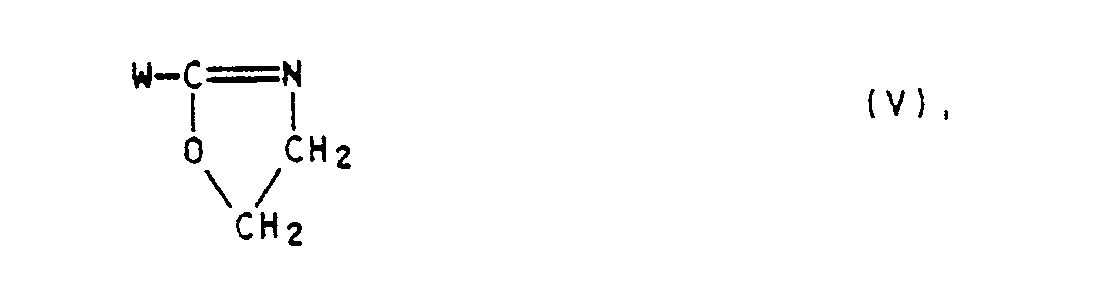
- the copolymer B can contain at least one copolymerized with b1 and b2 copolymerizable ethylenically unsaturated monomer which carries at least one oxazoline group.
- These monomers preferably have the general formula V. where W contains a double bond copolymerizable with b1 and b2.
- W contains a double bond copolymerizable with b1 and b2.
- Preferred substituents W are where R21 can be a hydrogen atom or an alkyl or alkoxy group having 1 to 6 carbon atoms, for example methyl, i- and n-propyl or butyl, to name just a few.
- Particularly preferred monomers b4 are vinyl oxazolines of the general formula VI wherein R21 has the meaning given above and is preferably a hydrogen atom or a methyl group.
- b5 are copolymerizable ethylenically unsaturated monomers that contain at least one thiol or hydroxyl group.
- C1-C4-alkylene but also C5-C25-alkylene, C6-C12-cycloalkylene, comes in particular as bridge member L.
- Particularly preferred compounds are hydroxyethyl acrylate, hydroxypropyl acrylate, butanediol monoacrylate or vinylbenzyl alcohol.
- Mixtures of the monomers bearing thiol or hydroxyl groups can also be used.
- b6 come from b1 to b5 different, copolymerizable with b1 and b2, ethylenically unsaturated monomers such as vinyl esters and vinyl ethers, each derived from C1-C12 alcohols, (meth) acrylamides, which can be substituted on the N by C1-C12 alkyl radicals, or methacrylic acid, preferably vinyl acetate or a mixture of these monomers.
- ethylenically unsaturated monomers such as vinyl esters and vinyl ethers, each derived from C1-C12 alcohols, (meth) acrylamides, which can be substituted on the N by C1-C12 alkyl radicals, or methacrylic acid, preferably vinyl acetate or a mixture of these monomers.
- b2 does not contain a monomer containing nitrile groups, then (meth) acrylonitrile can also be used as b6. If b2 is free from monomers containing (meth) acrylate groups, then (meth) acrylic acid esters derived from C1-C12 alcohols, in particular from methanol, can also be used as b6.
- the copolymer B generally has viscosity numbers, determined in 0.5% strength solution in dimethylformamide at 25 ° C. according to DIN 53 726, from 0.5 to 1.5 dl / g. It can be prepared continuously or batchwise in a known manner in solution, emulsion or mass.
- the molding compositions according to the invention can contain 1 to 40, in particular 5 to 20, particularly preferably 10 to 20% by weight, based on the molding composition, of a compound C containing phosphorus in addition to A and B.
- Phosphorus compounds of valence levels -3 to +5 are derived from phoshin (-3), diphosphine (-2), phosphine oxide (-1), elemental phosphorus ( ⁇ 0), hypophosphorous acid (+1), phosphorous acid (+3), Hypodiphosphoric acid (+4) and phosphoric acid (+5).
- phosphorus compounds of the phosphine class which have the valence level -3 are aromatic phosphines, such as triphenylphosphine, tritolylphosphine, trinonylphosphine, trinaphthylphosphine and others. Triphenylphosphine is particularly suitable.
- Examples of phosphorus compounds of the diphosphine class which have the valence level -2 are tetraphenyldiphosphine, tetranaphthyldiphosphine and others. Tetranaphthyldiphosphine is particularly suitable.
- Phosphorus compounds of valence level -1 are derived from phosphine oxide. Examples are triphenylphosphine oxide, tritolylphosphine oxide, trinonylphosphine oxide, trinaphthylphosphine oxide. Triphenylphosphine oxide is preferred.
- Grade 0 phosphorus is the elemental phosphorus. Red and black phosphorus are possible. Red phosphorus is preferred.
- Phosphorus compounds of the "oxidation level" +1 are e.g. Hypophosphites. They can have a salt character or be purely organic in nature.
- Examples are calcium hypophosphite and magnesium hypophosphite, as well as complex hypophosphites or double hypophosphites, or organic hypophosphites such as cellulose hypophosphite esters or esters of hypophosphorous acids with diols, e.g. of 1,10-dodecyldiol.
- Substituted phosphinic acids and their anhyrides e.g. Diphenylphosphinic acid can be used.
- Melamine hypophosphite is also suitable.
- Diphenylphosphinic acid, di-p-tolylphosphinic acid and di-cresylphosphinic anhydride are also suitable.
- hydroquinone ethylene glycol
- propylene glycol bis (diphenylphosphinic acid) esters and others.
- Aryl (alkyl) phosphinamides such as e.g. Diphenylphosphinic acid dimethylamide and sulfonamidoaryl (alkyl) phosphinic acid derivatives, e.g. p-tolylsulfonamidodiphenylphosphinic acid.
- Hydroquinone and ethylene glycol bis (diphenylphosphinic acid) esters are preferably used.
- Phosphorus compounds of oxidation level +3 are derived from the phosphorous acid. Cyclic phosphonates derived from pentaerythritol, neopentyl glycol or pyrocatechol are suitable. In addition, phosphorus is of grade +3 in triaryl (alkyl) phosphites, e.g. Triphenyl phosphite, tris (4-decylphenyl) phosphite, tris (2,4-di-tert-butylphenyl) phosphite or phenyldidecyl phosphite and others. contain. However, diphosphites, e.g. Propylene glycol-1,2-bis (diphosphite) or cyclic phosphites derived from pentaerythritol, neopentylglycol or pyrocatechol are suitable.
- Methylneopentylphosphonate methyl methanephosphonate
- phosphite and dimethylpentaerythritol diphosphonate and phosphite are particularly preferred.
- Hypodiphosphates such as, for example, tetraphenyl hypodiphosphate or bisneopentyl hypodiphosphate, are particularly suitable as phosphorus compounds of oxidation state +4.
- Alkyl and aryl-substituted phosphates are particularly suitable as phosphorus compounds of oxidation state +5.
- Examples are phenylbisdodecyl phosphate, phenylethyl hydrogen phosphate, phenyl bis (3,5,5-trimethylhexyl) phosphate, ethyl diphenyl phosphate, 2-ethylhexyl di (tolyl) phosphate, diphenyl hydrogen phosphate, bis (2-ethylhexyl) p-tolyl phosphate, tritolyl phosphate, bis (2-ethylphosphate) ) -phenyl phosphate, di (nonyl) phenyl phosphate, phenylmethyl hydrogen phosphate, di (dodecyl) p-tolyl phosphate, p-tolyl-bis (2,5,5-trimethylhexyl) phosphate, 2-ethylhexyldip
- Cyclic phosphates can also be used. Diphenylpentaerythritol diphosphate and phenylneopentyl phosphate are particularly suitable.
- oligomeric and polymeric phosphorus compounds are also suitable.
- Such polymeric, halogen-free organic phosphorus compounds with phosphorus in the polymer chain arise, for example, in the production of pentacyclic, unsaturated phosphine dihalides, as described, for example, in DE-A 20 36 173.
- the molecular weight, measured by vapor pressure osmometry in dimethylformamide, of the polyphospholine oxides should be in the range from 500 to 7,000, preferably in the range from 700 to 2,000.
- the phosphorus has the oxidation state -1.
- Inorganic coordination polymers of aryl (alkyl) phosphinic acids can also be used. Their manufacture is specified in DE-A 31 40 520. The phosphorus has the oxidation number +1.
- halogen-free polymeric phosphorus compounds which can be used by the reaction of a phosphonic acid chloride, e.g. Phenyl, methyl, propylphosphonic dichloride with bifunctional phenols, such as e.g. Hydroquinone, resorcinol, 2,3,5-trimethylhydroquinone, bisphenol-A, tetramethylbisphenol-A arise.
- a phosphonic acid chloride e.g. Phenyl, methyl, propylphosphonic dichloride
- bifunctional phenols such as e.g. Hydroquinone, resorcinol, 2,3,5-trimethylhydroquinone, bisphenol-A, tetramethylbisphenol-A
- polymeric phosphorus compounds which can be contained in the molding compositions according to the invention are prepared by reacting phosphorus oxide trichloride or phosphoric acid ester dichlorides with a mixture of mono-, bi- and trifunctional phenols and other compounds bearing hydroxyl groups (cf. Houben-Weyl-Müller, Thieme-Verlag Stuttgart, Organic Phosphorus Compounds Part II (1963)).
- Polymeric phosphonates can also be prepared by transesterification reactions of phosphonic acid esters with bifunctional phenols (cf. DE-A 29 25 208) or by reactions of phosphonic acid esters with diamines or diamides or hydrazides (cf. US Pat. No. 4,403,075).
- the inorganic poly (ammonium phosphate) is also suitable.
- Oligomeric pentaerythritol phosphites, phosphates and phosphonates according to EP-B 8 486, e.g. Mobil Antiblaze®19 (registered trademark of Mobil Oil) can be used.
- Triphenylphosphine oxide Triphenylphosphine oxide, triphenylphosphate, hydroquinone-bis- (diphenylphosphinic acid) ester and methylneopentylphosphate (methanephosphonic acid neopentyl ester) and Mobil Antiblaze 19 are very particularly preferably used.
- the molding compositions according to the invention can additionally contain at least one of components D, E or F.
- component D is an unmodified polyphenylene ether. This preferably corresponds to the polyphenylene ether used in component a 1, which is why reference is made here to the comments there on suitable compounds.
- the proportion of component D, if present, can be from 0.1 times to 4.0 times, preferably up to 2.0 times, in particular up to 1.0 times the amount by weight in which component A is present in the molding composition according to the invention.
- Component E is vinyl aromatic polymers. Suitable as E are those polymers as have already been described in component a 1. For more details, please refer to the comments on component a1.
- the vinyl aromatic polymers can also be impact modified. Such polymers are known to the person skilled in the art as impact-resistant polystyrene (HIPS).
- HIPS impact-resistant polystyrene
- the vinyl aromatic polymers are produced in the presence of a rubber-like polymer. Examples of rubber-like polymers are polybutadiene and polyisoprene rubber.
- the processes usually used for producing impact-modified styrene polymers are polymerization in bulk or solution, as described, for example, in US Pat. No. 2,694,692.
- the impact modified styrene polymers have generally a melt index (MFI (200 ° C / 5 kg), measured according to DIN 53 735) from 2 to 30, in particular from 2.5 to 20 g / 10 min.
- the proportion of E can be from 0.1 times to 4.0 times, preferably up to 2.0 times the amount by weight of the sum of the components A and, if present, D in the molding composition.
- F is a styrene-acrylonitrile copolymer different from E. It consists of at least 50% by weight, based on F, of a vinyl aromatic monomer with 8 to 12 C atoms, such as ⁇ -methylstyrene, para-methylstyrene or in particular styrene itself, and of a nitrile group-containing, ethylenically unsaturated monomer with 3 to 6 C- Atoms, especially acrylonitrile or methacrylonitrile. It preferably contains 15 to 40, in particular 20 to 38% by weight, based on F, of the copolymerized nitrile monomers.
- Up to 10% by weight of the vinyl aromatic monomer, based on F, can be obtained from monomers such as methacrylic acid esters, acrylic acid esters e.g. Methyl methacrylate or ethyl methacrylate, butyl acrylate or 2 ethylhexyl acrylate and methacrylamide or mixtures of these compounds can be replaced.
- monomers such as methacrylic acid esters, acrylic acid esters e.g. Methyl methacrylate or ethyl methacrylate, butyl acrylate or 2 ethylhexyl acrylate and methacrylamide or mixtures of these compounds can be replaced.
- SAN copolymers are known per se and are commercially available. They are produced in the usual way in solution, emulsion or mass continuously or batchwise.
- the proportion of F in the molding composition can be from 0.1 times to 4.0 times, preferably up to 2.0 times the amount by weight in which component B is present in the molding composition according to the invention.
- the molding compositions contain the impact-modifying component G.
- It is generally a graft copolymer which contains a monomer containing a vinyl aromatic compound containing compounds containing nitrile groups mixture grafted butadiene or acrylate rubber, as they are generally known as ABS or ASA polymers from Ullmanns Encyclopedia of Industrial Chemistry, 4th edition 1980, vol. 19, pp. 277 to 295.
- the butadiene rubber known per se (EP-A-199 334), which can form the graft base, should have a glass transition temperature [according to K.H. Illers and H. Breuer, Kolloid-Zeitschrift 176, (1961) page 110], which is below 0 ° C.
- suitable rubber are: polybutadiene (cf. DE-A 14 20 775 and DE-A 14 95 089), and also copolymers of predominantly butadiene and styrene with comonomers such as isoprene, acrylonitrile or vinyl methyl ether.
- acrylic ester polymer known per se from EP-A-201 763 whose glass transition temperature is below 0 ° C., preferably below -30 ° C., can also be used as the grafting base.
- the main part of these polymers can be composed of alkyl acrylates with 1 to 8 carbon atoms in the alkyl radical, such as n-butyl acrylate or 2-ethylhexyl acrylate, and also up to 50, in particular 10 to 20,% by weight, based on the polymer , further copolymerizable monomers such as butadiene, isoprene, styrene, acrylonitrile or vinyl methyl ether or mixtures thereof.
- These acrylic ester polymers are preferably crosslinked. In this case, they contain 0.1 to 5, preferably 1 to 4% by weight, based on the polymer, of a multifunctional monomer, such as divinylbenzene or di-hydro-di-cyclopentadienyl acrylate
- the graft copolymer G is generally composed of 30 to 90, preferably 40 to 85, in particular 55 to 78% by weight of the graft base and 10 to 70, preferably 15 to 60, in particular 22 to 45% by weight, in each case based on the Graft copolymer, the graft shell.
- a monomer mixture of 60 to 90, preferably 60 to 80 wt .-%, based on the mixture, of a monomer b1, in particular styrene, 10 to 40, preferably 20 to 40 wt .-%, based on the mixture, methyl methacrylate and / or in particular acrylonitrile and optionally from up to 30, preferably up to 20% by weight, based on the mixture, of further monomers by polymerization in the presence of the graft base.
- monomers come ethylenically unsaturated monomers such as vinyl esters and vinyl ethers, each derived from C1-C12 alcohols, (meth) acrylamides, which may be substituted on the N by C1-C12 alkyl radicals, methacrylonitrile or methacrylic acid, preferably vinyl acetate or a mixture of these monomers into consideration.
- ethylenically unsaturated monomers such as vinyl esters and vinyl ethers, each derived from C1-C12 alcohols, (meth) acrylamides, which may be substituted on the N by C1-C12 alkyl radicals, methacrylonitrile or methacrylic acid, preferably vinyl acetate or a mixture of these monomers into consideration.
- Both the rubbers and the graft copolymers are prepared in a known manner in emulsion or solution, and the grafting can also be carried out in a conventional manner in several stages. Graft copolymers are formed in which the graft shell is grafted onto the elastomeric base within the limits known to those skilled in the art.
- the particle sizes of the graft copolymers can be determined and adjusted according to requirements according to known methods, e.g. in emulsion polymerization with the help of a seed latex or through a subsequent agglomeration step.
- the average particle size (d50 value of the integral mass distribution, determined by the method described in DE-B 24 27 960, should be between 0.1 and 1 ⁇ m in the case of graft copolymers which were prepared in a known manner in emulsion, or between 0.5 and 10 microns for products that were made in solution in a known manner.
- the proportion of G in the molding composition can be from 0.1 times to 4.0 times, preferably up to 2.0 times, in particular up to 1.0 times the amount by weight in which components A and B are present together in the molding composition according to the invention.
- G halogen-free, self-extinguishing molding compositions
- Components F and G can also be used as commercially available mixtures or premixed before the molding compositions according to the invention are prepared.
- grafted rubbers which may be present in components E and G, such as polybutadiene, acrylate, styrene-butadiene, polybutene rubber, hydrogenated styrene-butadiene, acrylonitrile-butadiene, ethylene-propylene and polyisoprene rubber, these can also be added without grafting as component H. .
- Rubbers H styrene-grafted ethylene-propylene rubbers, thermoplastic ethylene-propylene rubbers, thermoplastic polyester elastomers, ethylene rubbers and ionomers, styrene-butadiene block copolymers including AB-, ABA-, ABA-smeared- (taper) -, ABAB- , ABAB-smeared block copolymers, star block copolymers and similar, analog isoprene block polymers and in particular (partially) hydrogenated block copolymers.
- Component H can be present in the molding compositions according to the invention in amounts of up to 80, preferably up to 40, in particular 1 to 25 parts by weight, based on 100 parts by weight of the sum of components A and B.
- thermoplastic molding compositions according to the invention can also contain conventional additives and processing aids.
- the proportion of these additives is generally not more than 40, in particular not more than 20 parts by weight, based on 100 parts by weight of the sum of A and B.
- additives The usual heat and light stabilizers, lubricants and mold release agents, colorants such as dyes and pigments in customary amounts may be mentioned as additives.
- Other additives are reinforcing agents such as glass fibers, carbon fibers, aromatic polyamide fibers and / or fillers, gypsum fibers, synthetic calcium silicates, kaolin, calcined kaolin, wollastonite, talc, chalk, and also flame retardants in the case of halogen-containing molding compositions, e.g. brominated or chlorinated organic compounds, optionally in a mixture with antimony compounds.
- thermoplastic molding compositions according to the invention are expediently produced by mixing the components at temperatures in the range from 200 to 320 ° C., preferably 250 to 300 ° C. in conventional mixing devices, such as, for example, Kneaders, Banbury mixers and single-screw extruders, preferably in a twin-screw extruder.
- conventional mixing devices such as, for example, Kneaders, Banbury mixers and single-screw extruders, preferably in a twin-screw extruder.
- intensive mixing is necessary, which can be achieved in a known manner.
- the average residence times during mixing are in the range from 0.5 to 30 minutes, preferably from 1 to 5 minutes.
- the order of mixing the components can be varied, two or optionally three components can be premixed or all components can also be mixed together.
- Moldings with advantageous properties can be produced from the molding compositions according to the invention by injection molding or extrusion.
- a self-extinguishing molding compound in the sense of this invention is understood to mean a flame-resistant molding compound which can be classified into the fire classes UL 94 V0, V1 or 5V described below.
- thermoplastic molding compositions according to the invention are notable for good processability and heat resistance. Further advantages lie in the good mechanical properties of the molding compound and the moldings produced therefrom, and also in its surface gloss.
- a (1): 9.4 kg of poly (2,6-dimethyl) -1,4-phenylene ether with a relative viscosity of 0.61 (measured in 1% by weight solution in CHCl3 at 25 ° C), 0 , 5 kg of polystyrene (PS 144 C, melt flow index MFI at 200 ° C / 5 kg load (measured according to DIN 53 735) 24 g / 10 min) and 0.1 kg of maleic acid monoethyl ester were in a twin-screw extruder (ZSK 53; Werner 6 Pfleiderer ) dosed, melted in a first part using kneading elements at 280 ° C, implemented in a second part using kneading and using kneading elements at 280 ° C and then degassed in a degassing zone at 280 ° C by vacuum systems.
- ZSK 53 twin-screw extruder
- a (2) 9.45 kg of the polyphenylene ether used in A (1) were reacted with 0.5 kg of the polystyrene used in A (1) with 0.05 kg of fumaric acid as described in A (1).
- a (V) For comparison, a graft copolymer according to EP-A-170 946 was made from PPE and a styrene-acrylonitrile polymer. 100 g of the PPE used in A (1) were reacted with dimethyldichlorosilane in toluene using tributylamine as an acid scavenger.
- the reaction product was then metered into 100 g of a styrene-acrylonitrile polymer (consisting of 62% by weight of styrene, 35% by weight of acrylonitrile and 3% by weight of hydroxybutyl acrylate, with a weight-average molecular weight of 65,000, produced by continuous polymerization) using tributylamine as an acid scavenger . It was worked up as usual.
- triphenylphosphine oxide C (1) triphenylphosphine oxide C (2) triphenyl phosphate
- Poly-2,6-dimethyl-1,4-phenylene ether with a relative viscosity of 0.61 (measured in 1% by weight solution in CHCl3 at 25 ° C).
- Emulsion graft copolymer from 60% by weight polybutadiene with a glass transition temperature of below 0 ° C. and 40% by weight, based in each case on the graft copolymer, a graft shell composed of 75% by weight styrene and 25% by weight acrylonitrile, based in each case on the Graft cover.
- Table 1 shows examples and comparative tests of thermoplastic molding compositions.
- the molding compositions were obtained by melting and mixing the specified components in the specified amounts in a twin-screw extruder at 280 ° C. and a residence time of 3 minutes and then granulating.
Landscapes
- Chemical & Material Sciences (AREA)
- Health & Medical Sciences (AREA)
- Chemical Kinetics & Catalysis (AREA)
- Medicinal Chemistry (AREA)
- Polymers & Plastics (AREA)
- Organic Chemistry (AREA)
- General Chemical & Material Sciences (AREA)
- Compositions Of Macromolecular Compounds (AREA)
Abstract
- A) 3 bis 97 Gew.-Teile, bezogen auf die Summe der Komponenten A und B, eines modifizierten Polyphenylenethers, hergestellt aus
- a₁) 70 bis 99,95 Gew.-%, bezogen auf A, eines Polymeranteils, der mindestens 30 Gew.-%, bezogen auf a₁, Polyphenylenether und höchstens 70 Gew.-%, bezogen auf a₁, eines vinylaromatischen Polymeren enthält,
- a₂) 0,05 bis 10 Gew.-%, bezogen auf A,
a₂₁) eines amidgruppenhaltigen Monomeren mit einer polymerisierbaren Doppelbindung,
a₂₂) eines lactamgruppenhaltigen Monomeren mit einer polymerisierbaren Doppelbindung und/oder
a₂₃) einer α,β-ungesättigten Dicarbonylverbindung und - a₃) 0 bis 20 Gew.-%, bezogen auf A, eines weiteren Comonomeren, das unter den Herstellungsbedingungen mit a₁ reagieren kann,
- und
- B) 3 bis 97 Gew.-Teile, bezogen auf die Summe der Komponenten A und B, eines thermoplastischen Copolymerisates aus
- 30 bis 90,9 Gew.-%, bezogen auf B, eines vinylaromatischen Kohlenwasserstoffes mit 8 bis 12 C-Atomen (b₁),
- 9 bis 40 Gew.-%, bezogen auf B, eines nitrilgruppen- und/oder acrylat- oder methacrylatgruppenhaltigen ethylenisch ungesättigten Monomeren mit bis zu 9 C-Atomen (b₂),
- 0,1 bis 30 Gew.-%, bezogen auf B, eines mindestens eine Epoxidgruppe (b₃), Oxazolingruppe (b₄) oder Thiol- oder Hydroxylgruppe (b₅) tragenden copolymerisierbaren ethylenisch ungesättigten Monomeren oder eines Gemisches von mindestens zwei der Verbindungen b₃ bis b₅ und
- 0 bis 30 Gew.-%, bezogen auf B, mindestens eines von b₁ bis b₅ verschiedenen, copolymerisierbaren, ethylenisch ungesättigten Monomeren b₆,
Description
- Die Erfindung betrifft thermoplastische Formmassen, enthaltend als wesentliche Komponenten
- A) 3 bis 97 Gew.-Teile, bezogen auf die Summe der Komponenten A und B, eines modifizierten Polyphenylenethers, hergestellt aus
- a₁) 70 bis 99,95 Gew.-%, bezogen auf A, eines Polymeranteils, der mindestens 30 Gew.-%, bezogen auf a₁, Polyphenylenether und höchstens 70 Gew.-%, bezogen auf a₁, eines vinylaromatischen Polymeren enthält,
- a₂) 0,05 bis 10 Gew.-%, bezogen auf A,
a₂₁) eines amidgruppenhaltigen Monomeren mit einer polymerisierbaren Doppelbindung,
a₂₂) eines lactamgruppenhaltigen Monomeren mit einer polymerisierbaren Doppelbindung und/oder
a₂₃) einer α,β-ungesättigten Dicarbonylverbindung und - a₃) 0 bis 20 Gew.-%, bezogen auf A, eines weiteren Comonomeren, das unter den Herstellungsbedingungen mit a₁ reagieren kann,
- und
- B) 3 bis 97 Gew.-Teile, bezogen auf die Summe der Komponenten A und B, eines thermoplastischen Copolymerisates aus
- 30 bis 90,9 Gew.-%, bezogen auf B, eines vinylaromatischen Kohlenwasserstoffes mit 8 bis 12 C-Atomen (b₁),
- 9 bis 40 Gew.-%, bezogen auf B, eines nitrilgruppen- und/oder acrylat- oder methacrylatgruppenhaltigen ethylenisch ungesättigten Monomeren mit bis zu 9 C-Atomen (b₂),
- 0,1 bis 30 Gew.-%, bezogen auf B, eines mindestens eine Epoxidgruppe (b₃), Oxazolingruppe (b₄) oder Thiol- oder Hydroxylgruppe (b₅) tragenden copolymerisierbaren ethylenisch ungesättigten Monomeren oder eines Gemisches von mindestens zwei der Verbindungen b₃ bis b₅ und
- 0 bis 30 Gew.-%, bezogen auf B, mindestens eines von b₁ bis b₅ verschiedenen, copolymerisierbaren, ethylenisch ungesättigten Monomeren b₆, - Weiterhin betrifft diese Erfindung die Herstellung dieser Formmassen.
- Thermoplastische Formmassen, die Styrolpolymerisate und Polyphenylenether (PPE) enthalten, sind z.B. aus den US-Patentschriften 3 383 435, 4 128 602 sowie 4 128 603 bekannt. Solche Formmassen eignen sich zur Herstellung von Formteilen, die eine bessere Wärmeformbeständigkeit haben als solche Formteile, die kein Polyphenylenether enthalten.
- Es ist in der US-Patentschrift 4 360 618 vorgeschlagen worden, Styrolpolymerisate, die 2 bis 8 Gew.% Acrylnitril einpolymerisiert enthalten, zur Herstellung von Formteilen zu verwenden. Es zeigte sich jedoch, daß schon bei höheren Acrylnitrilgehalten, die über 8,5 Gew.% liegen, eine Unverträglichkeit mit dem Polyphenylenether (PPE) auftritt, so daß Formkörper mit schlechten mechanischen Werten aus derartigen Mischungen erhalten werden. Formmassen, die PPE und Styrolacrylnitrilcopolymerisate mit höheren Gehalten an Acrylnitril (SAN), die gegebenenfalls schlagzäh modifiziert sind, haben sich daher bislang nicht eingeführt.
- In der US-Patentschrift 4 387 189 werden Copolymerisate aus Styrol und Säure-, Säureanhydrid- oder Säurechlorid-Comonomeren, die gegebenenfalls Acrylnitril enthalten können, mit PPE umgesetzt. Nachteilig ist die nichtausreichende mechanische Stabilität der Formkörper, besonders wenn die Copolymeren Acrylnitril enthalten, was vermutlich in der geringen Reaktivität der Comonomeren zum PPE bei Anwesenheit von Acrylnitril begründet ist. Dies gilt insbesondere dann, wenn das Copolymere durch gepfropfte Butadien- oder Acrylatkautschuke schlagzäh modifiziert ist.
- In den EP-B 156 990, EP-A-170 946 und EP-A-200 185 werden spezielle Pfropfcopolymerisate, die aus PPE und Styrolacrylnitril-Copolymerisaten mit besonderen Monomerbausteinen unter Zuhilfenahme spezieller Kopplungsmittel erhalten wurden, mit verbesserten mechanischen Eigenschaften beschrieben. Ungünstig sind dabei jedoch die noch nicht befriedigenden mechanischen Eigenschaften der Formmassen und der daraus hergestellten Formteile bzw. die technisch aufwendige Produktion der Formmassen über die Herstellung der speziellen Copolymerisate und die anschließende Kopplungsreaktion in organischen Lösungsmitteln.
- Die Flammfestausrüstung von thermoplastischen Kunststoffen ist aus Vogel, "Flammfestmachen von Kunststoffen", Hüthig-Verlag, Heidelberg (1966), Seiten 94 bis 102
Troitzsch, "Brandverfahren von Kunststoffen", Hanser-Verlag, München (1982), Seiten 1 bis 65
Hirschler, "Developments in Polymer Stabilization", Band 5, Editor G. Scott, Applied Science Publishers, London (1982), Seiten 107 bis 151 bekannt. Bei Anwendung verhältnismäßig großer Mengen an Halogen enthaltenden Flammschutzmitteln und unter gleichzeitiger Anwendung von Synergisten, tropfen Thermoplaste nach dem Beflammen mit einer heißen Flamme nichtbrennend ab und verlöschen von selbst. Dieser Effekt des Selbstverlöschens tritt ohne die Anwendung eines Synergisten erst nach Zugabe einer weitaus größeren Menge an Halogen enthaltenden Flammschutzmitteln ein. So ausgerüstete Formmassen zeigen Nachteile, die vom Verarbeiter meist nicht toleriert werden. Charakteristisch sind z.B. die Verfärbung der Formmassen sowie die Korrosion von Verarbeitungsmaschinen. - Ohne Verwendung von Synergisten muß die Flammschutzmittelmenge erhöht werden, was zu einer starken Beeinträchtigung der damit ausgerüsteten Thermoplaste und aufgrund einer deutlichen Absenkung der Wärmeformbeständigkeit zu brennendem Abtropfen führt. Diese Probleme können mithin nur durch eine Senkung der Menge an halogenhaltigen Flammschutzmitteln gelöst werden. Häufig erreichen die Thermoplaste dann jedoch nicht mehr die Einstufung UL 94 V0 oder UL 94 V1.
- Außer der vorstehend angeführten Möglichkeit, thermoplastische Kunststoffe mit Halogen enthaltenden Flammschutzmitteln auszurüsten, gibt es auch die Möglichkeit eines halogenfreien Flammschutzes. So sind aus der DE-A-3 432 749, der DE-A-3 432 750 und der DE-A-3 526 549 selbstverlöschende, halogenfreie Formmassen auf Basis von PPE und Styrol-Acrylnitrilpolymerisaten bekannt. Ungünstig sind dabei jedoch die noch nicht befriedigenden mechanischen Eigenschaften der Formmassen und der daraus hergestellten Formteile bzw. die technisch aufwendige Produktion der Formmassen über die Herstellung der speziellen Copolymerisate und die anschließende Kopplungsreaktion in organischen Lösungsmitteln.
- Der vorliegenden Erfindung lag daher die Aufgabe zugrunde, auf Basis von Polyphenylenether thermoplastische Formmassen bereitzustellen, die die geschilderten Nachteile vermeiden, einfach herzustellen sind und zu Formkörpern mit guten mechanischen Eigenschaften verarbeitet werden können.
- Diese Aufgabe wurde erfindungsgemäß gelöst durch die eingangs definierten thermoplastischen Formmassen.
- Außerdem wurden spezielle Ausgestaltungen der Formmassen gemäß der Unteransprüche und ein Verfahren zu ihrer Herstellung gefunden.
- Im folgenden werden die Formmassen im Einzelnen beschrieben.
- Es versteht sich dabei von selbst, daß für selbstverlöschende halogenfreie thermoplastische Formmassen nur solche Komponenten in Frage kommen, die ihrerseits halogenfrei, d.h. bis auf Spuren frei von Halogen sind.
- Als Komponente A enthalten die erfindungsgemäßen Formmassen 3 bis 97, vorzugsweise 10 bis 90, insbesondere 40 bis 90 Gew.-Teile, bezogen auf 100 Gew.-Teile der Summe der Komponenten A und B, mindestens eines modifizierten Polyphenylenethers, der unter Verwendung der Komponenten a₁, a₂ und gegebenenfalls a₃ hergestellt wird. Unter "modifiziert" soll dabei eine durch die Umsetzung der Komponenten a₁ mit a₂ bzw. a₃ hervorgerufene Veränderung von a₁ verstanden werden.
- Bei der Komponente a₁ handelt es sich um einen Polymeranteil, der mindestens 30, bevorzugt mehr als 50, insbesondere mehr als 60 Gew.%, bezogen auf a₁, Polyphenylenether und höchstens 70, bevorzugt weniger als 50, insbesondere weniger als 40 Gew.%, bezogen auf a₁, eines vinylaromatischen Polymeren enthält. Für halogenfreie, selbstverlöschende Formmassen ist es insbesondere von Vorteil, mehr als 90 Gew.-% PPE und weniger als 10 Gew.-%, jeweils bezogen auf a₁, des vinylaromatischen Polymeren zu verwenden.
- Die in Frage kommenden Polyphenylenether sind an sich bekannt, sie werden nach üblichen Verfahren aus in ortho-Position durch Alkylgruppen, Alkoxygruppen, bei halogenhaltigen Formmassen auch durch Chlor oder Brom disubstituierten Phenolen, durch oxidative Kopplung hergestellt (vgl. US-Patent 3 661 848, 3 378 505, 3 306 874, 3 306 875 und 3 639 656). Die Alkyl- oder Alkoxygruppen, die bevorzugt 1 bis 4 C-Atome, aber kein α-ständiges tertiäres Wasserstoffatom enthalten, können bei halogenhaltigen Formmassen auch ihrerseits durch Chlor oder Brom substituiert sein. Geeignete Polyphenylenether sind beispielsweise Poly-2,6-diethyl-1,4-phenylenether, Poly-2-methyl-6-ethyl-1,4-phenylen-ether, Poly-2-methyl-6-propyl-1,4-phenylenether, Poly-2,6-dipropyl-1,4-phenylen-ether, Poly-2-ethyl-6-propyl-1,4-phenylenether, bei halogenhaltigen Formmassen auch Poly-2,6-dichlor-1,4-phenylenether und Poly-2,6-dibrom-1,4-phenylen-ether oder Copolymere, wie solche, die 2,3,6-Trimethylphenol enthalten, außerdem Polymermischungen. Bevorzugt ist Poly-2,6-dimethyl-1,4-phenylenether. Die in einem solchen Verfahren hergestellten Polyphenylenether weisen im allgemeinen eine relative Viskosität von 0,3 bis 0,7 dl/g, gemessen in 1-gew.-%iger Lösung in Chloroform bei 30°C auf.
- Das vinylaromatische Polymer ist vorzugsweise mit dem eingesetzten Polyphenylenether verträglich, d.h. ganz oder weitgehend in diesen Polymeren löslich (vgl. A. Noshay, Block Copolymers, S. 8 bis 10, Academic Press, 1977 und O. Olabisi, Polymer-Polymer Miscibility, 1979, S. 117 bis 189).
- Die vinylaromatischen Polymeren weisen im allgemeinen einen Schmelzindex (MFI (200°C/5 kg), gemessen nach DIN 53 735) von 1 bis 30, insbesondere von 15 bis 25 g/10 min auf.
- Beispiele für bevorzugte, mit Polyphenylenethern verträgliche vinylaromatische Polymere sind der bereits erwähnten Monographie von Olabisi, S. 224 bis 230 und 245 zu entnehmen. Nur stellvertretend seien hier vinylaromatische Polymere aus Styrol, α-Methylstyrol oder p-Methylstyrol, genannt; in untergeordneten Anteilen (vorzugsweise nicht mehr als 20, insbesondere nicht mehr als 8 Gew.%, bezogen auf die Polymeren), können auch Comonomere wie (Meth)acrylnitril oder (Meth)acrylsäureester im Aufbau beteiligt sein. Ein besonders bevorzugtes vinylaromatisches Polymeres ist Polystyrol. Es versteht sich, daß auch Mischungen dieser Polymeren eingesetzt werden können.
- Verfahren zur Herstellung solcher vinylaromatischer Polymerer sind an sich bekannt und in der Literatur beschrieben, so daß sich hier nähere Angaben erübrigen. Nur beispielsweise seien hier als geeignete Polymerisationsverfahren die Masse-, Suspensions-, Emulsions- oder Lösungspolymerisation erwähnt.
- Der Anteil der Komponente a₁ an der Komponente A liegt im Bereich von 70 bis 99,95, vorzugsweise 82 bis 99,9 und insbesondere 85 bis 99,8 Gew.%, bezogen auf A.
- Als wesentliche Komponente a₂ enthält der modifizierte Polyphenylenether A mindestens eine der Verbindungen a₂₁ bis a₂₃. Prinzipiell können auch Mischungen verschiedener Verbindungen a₂₁ bis a₂₃ eingesetzt werden, doch ist im allgemeinen die Verwendung nur einer dieser Verbindungsarten vorteilhaft.
- Der Anteil der Komponente a₂ beträgt 0,05 bis 10, vorzugsweise 0,1 bis 8, insbesondere 0,2 bis 5 Gew.%, bezogen auf die Komponente A.
- Als Komponente a₂ sind mindestens eine Amidgruppe enthaltende Monomere mit mindestens einer polymerisierbaren Doppelbindung (a₂₁) geeignet, vorzugsweise solche der allgemeinen Formeln I oder II

- Bevorzugte Substituenten R¹, R², R³, R⁴, R⁵ und R⁶ sind Wasserstoff, Alkylgruppen mit 1 bis 10 C-Atomen, Cycloalkylgruppen mit bis zu 8 C-Atomen oder Arylgruppen, z.B. Phenyl. R¹ und R⁴ sind insbesondere H oder Methyl.
- Beispielhaft seien hier Acrylamid, N-Methyl-, N-Ethyl-, N-Propyl-, N-Butyl-, N-Pentyl-, N-Hexyl-, N-Heptyl-, N-Octyl-, N-Nonyl-, N-(2-ethylhexyl)-acrylamid, N-Cyclohexylacrylamid, N-Phenylacrylamid, die entsprechenden N,N-Derivate wie N,N-Dimethylacrylamid und die entsprechenden Methacrylamide sowie deren Mischungen genannt. Bevorzugt werden Acrylamid, Methacrylamid, N-Phenylacrylamid und N-Phenylmethacrylamid verwendet.
- Als Komponente a₂ kann auch ein mindestens eine Lactam-Gruppe enthaltendes Monomer mit einer polymerisierbaren Doppelbindung (a₂₂) eingesetzt werden. Vorzugsweise werden Lactame der allgemeinen Struktur III


wobei R⁷ ein Wasserstoffatom, eine Alkyl- oder Alkoxygruppe mit 1 bis 4 C-Atomen und R⁸ einen zweibindigen Substituenten
- Bevorzugt sind Lactameinheiten, die zu Polyamiden polymerisierbar oder copolymerisierbar sind, wie dies in Houben-Weyl, Methoden der organ. Chemie, Band XI/2, S. 511 bis 587, (1958) und Band XIV/2, S. 111 bis 131, (1963) beschrieben wird. Beispielsweise seien β-Propiolactame wie 3,3ʹ-Dimethyl-3-propiolactam, genannt. Ebenfalls bevorzugte Lactam-Einheiten sind Pyrrolidon und ε-Caprolactam, außerdem 7-Önantholactam, 8-Capryllactam und 12-Laurinlactam, wie sie bei K. Dachs, Angewandte Chemie, 74, 540 bis 545, (1962) beschrieben werden. Es können auch Mischungen dieser Verbindungen eingesetzt werden.
- Als besonders bevorzugtes Beispiel einer Komponente a₂₂ sei hier nur N-(Meth)acryloyl-ε-caprolactam

wobei R¹⁵ ein Wasserstoffatom oder eine Methylgruppe sein kann. - Bei der Komponente a₂₃ handelt es sich um α,β-ungesättigte Dicarbonylverbindungen, bevorzugt solche der allgemeinen Formel IV

R⁹ und R¹² Hydroxylgruppen, Aroxy-, Alkoxy-, Aralkoxy- oder Cycloalkoxygruppen mit bis zu 12 C-Atomen, -NR¹³R¹⁴ oder gemeinsam -O-oder -NR¹³,
R¹⁰ und R¹¹ Wasserstoff oder, wenn R¹⁰ oder R¹¹ Wasserstoff ist, eine Alkyl- oder Cycloalkylgruppe mit bis zu 12 C-Atomen, eine Arylgruppe, gemeinsam eine Alkylengruppe mit 4 C-Atomen oder bei halogenhaltigen Formmassen auch Chlor,
R¹³ und R¹⁴ Wasserstoff, Alkyl- oder Cycloalkylgruppen, Aralkyl- oder Arylgruppen mit bis zu 12 C-Atomen, die ihrerseits durch C₁-C₄-Alkyl- oder -Alkoxygruppen substituiert sein können, darstellen. - Die Substituenten müssen, was sich allerdings von selbst versteht, so beschaffen sein, daß sie die Modifizierungsreaktion nicht verhindern. Es handelt sich daher im allgemeinen um α,β-ungesättigte Dicarbonsäuren, deren Anhydride, Imide, um Monoester oder Monoamide dieser Dicarbonsäuren, ihre Diester oder Diamide.
- Als Beispiele für Dicarbonsäuren seien Maleinsäure, Fumarsäure Methylmaleinsäure, Butenylbernsteinsäure, Tetrahydrophthalsäure und bei halogenhaltigen Formmassen auch Chlormaleinsäure genannt, von denen Maleinsäure und Fumarsäure besonders bevorzugt werden.
- Als Anhydride seien beispielhaft erwähnt Maleinsäureanhydrid, Methylmaleinsäureanhydrid und bei halogenhaltigen Formmassen auch Chlormaleinsäureanhydrid.
- Bevorzugte Imide leiten sich von der Maleinsäure ab. Die Substituenten R¹⁰, R¹¹ und R¹³ sind dabei Alkylgruppen mit 1 bis 4 C-Atomen, beispielsweise Methyl-, Ethyl- oder n-, i- oder t-Butyl oder Cycloakylgruppen mit bis zu 8 C-Atomen oder Phenylgruppen, die im Falle von R¹³ alkyl- oder alkoxysubstituiert sein können. Nur beispielhaft seien als Maleinimide N-Methylmaleinimid, N-Butylmaleinimid, N-Cyclohexylmaleinimid, N-Phenylmaleinimid, N-(p-Methylphenyl)maleinimid, N-(3,5-Dimethylphenyl)maleinimid, N-(p-Methoxyphenyl)maleinimid, N-Benzylmaleinimid, N-(1-Naphthyl)maleinimid oder deren Mischungen genannt. Von diesen wird N-Phenylmaleinimid besonders bevorzugt.
- Bevorzugte Halbester und Halbamide leiten sich von der Maleinsäure ab.
- Die Halbester leiten sich bevorzugt von primären und sekundären Monoalkoholen, wie Methanol, Ethanol, n- und i-Propanol, n- und i-Butanol, Pentanole, Hexanole, Heptanole, Octanole, z.B. 2-Ethylhexylalkohol und von höheren Alkoholen wie Dodecanolen und cycloaliphatischen Alkoholen, z.B. Cyclohexanol ab. Weiter eignen sich auch Alkohole mit aromatischen Struktureinheiten wie z.B. Benzylalkohol. Bevorzugt werden jedoch Alkanole mit 1 bis 6 C-Atomen. Als Amine zur Herstellung der erfindungsgemäß eingesetzten Halbamide seien ganz allgemein sekundäre Amine und N-Alkylaniline genannt. Beispiele hierfür sind N-Methyl- oder N-Ethylalkylamine oder N-Methylanilin. Ganz allgemein werden Halbester den Halbamiden vorgezogen.
- Formmassen, die als Komponente a₂₃ einen Halbester oder ein Halbamid der Maleinsäure enthalten, weisen häufig besonders gute Fließeigenschaften, d.h. besonders hohe Schmelzindex-Werte (MFI) auf.
- Als a₃ kommen weitere, bevorzugt nicht vinylaromatische Comonomere in Frage, die unter den Herstellungsbedingungen mit der Komponente a₁ reagieren bzw. auf diese aufpfropfen. Beispielsweise seien hier Acrylsäure, Methacrylsäure, Acrylate, Methacrylate und daneben auch vinylaromatische Monomere wie Styrol, α-Methylstyrol und Vinyltoluol genannt, um nur einige aufzuführen. Der Anteil der Komponente a₃ beträgt 0 bis 20, vorzugsweise 0 bis 10 Gew.-%, bezogen auf die Komponente A. Besonders bevorzugt werden jedoch Formmassen, bei deren Herstellung keine dieser weiteren Comonomeren verwendet wurden.
- Bei der Herstellung der modifizierten Polyphenylenether A können bis zu 20 Gew.-%, bezogen auf A, an Radikalstartern eingesetzt werden.
- Der Anteil der Radikalstarter ist in der Regel geringer als die Summe der verwendeten monomeren Verbindungen a₂. Im allgemeinen handelt es sich dabei um ein organisches Peroxid oder eine Azo-Verbindung. Verwendet werden können organische Peroxide mit einer Halbwertzeit im Bereich von 0,1 bis 3000 Sekunden bei 200°C. Die Wahl des Radikalstarters richtet sich nach der gewünschten Reaktionstemperatur. Beispielsweise seien als Radikalstarter tert.-Butylperoxid und Dicumylperoxid genannt.
- Häufig,insbesondere bei Temperaturen über 265°C, hat es sich als vorteilhaft erwiesen, ohne Zugabe von Radikalstartern, d.h. in Abwesenheit oder praktischer Abwesenheit von Radikalstartern zu arbeiten. Dies gilt insbesondere dann, wenn als Komponente a₂ Fumarsäure eingesetzt wird, da hier bei der Verwendung von Radikalstartern unter Umständen unerwünschte Nebenreaktionen auftreten können.
- Zur Herstellung des modifizierten Polyphenylenethers A können die eingesetzten Komponenten in der Schmelze bei 250 bis 350°C, vorzugsweise 265 bis 295°C, miteinander umgesetzt werden. Hierzu eignen sich besonders Extruder, da in diesen im allgemeinen auch eine gute Durchmischung der Komponenten erzielt wird. Die Verweilzeiten liegen im allgemeinen im Bereich von 0,5 bis 30 min., vorzugsweise von 1 bis 3 min. Besonders gut eignen sich Zweischneckenextruder.
- Nachstehend wird eine besonders bevorzugte Verfahrensvariante beschrieben.
- Die Komponenten werden vorzugsweise gemeinsam eindosiert und in einem Aufschmelzteil aufgeschmolzen. Die Extruderschnecke im Aufschmelzteil enthält bevorzugt Knetelemente. An die Aufschmelzzone schließt sich die Reaktionszone an, die bevorzugt Knetelemente und zusätzlich Knetelemente mit nachgeschaltetem rückwärts förderndem Gewinde enthält. Vor dem Produktaustrag befindet sich bevorzugt eine Entgasungszone zur Entfernung der flüchtigen Bestandteile. Die ausgetragene Schmelze wird im allgemeinen granuliert und das Granulat wird zur Herstellung der erfindungsgemäßen Formmassen eingesetzt.
- Prinzipiell ist die Herstellung des modifizierten Polyphenylenethers auch in jedem Reaktionsgefäß, welches eine Reaktion der Komponenten miteinander ermöglicht, durchführbar.
- Die erfindungsgemäßen Formmassen enthalten die Komponente B in Mengen von 3 bis 97, bevorzugt 10 bis 90, insbesondere 10 bis 60 Gew.-Teilen, bezogen auf die Summe aus A und B.
- Als Komponente B wird ein thermoplastisches Copolymerisat aus 30 bis 90,9, vorzugsweise 52 bis 79,6 Gew.-% b₁, 40 bis 9, bevorzugt 38 bis 20 Gew.-% b₂, 30 bis 0,1, bevorzugt 10 bis 0,4 Gew.-% b₃, b₄ oder b₅ oder eines Gemisches von mindestens zwei dieser Verbindungen, und 0 bis 30, bevorzugt 0 bis 20 Gew.-%, jeweils bezogen auf B, b₆ verwendet.
- b₁ ist z.B. α-Methylstyrol, p-Methylstyrol oder insbesondere Styrol.
- Als Beispiele für b₂ seien Methacrylnitril oder insbesondere Acrylnitril bzw. C₁-C₃-Alkylmethacrylate, insbesondere Methylmethacrylat genannt.
- Als epoxygruppenhaltiges ethylenisch ungesättigtes Monomeres b₃ ist prinzipiell jede mit b₁ und b₂ copolymerisierbare Verbindung geeignet, die eine Epoxidgruppe

- Als b₄ kann das Copolymerisat B mindestens ein mit b₁ und b₂ copolymerisierbares ethylenisch ungesättigtes Monomeres einpolymerisiert enthalten, das mindestens eine Oxazolingruppe trägt.
- Diese Monomeren haben vorzugsweise die allgemeine Formel V


- Als b₅ kommen copolymerisierbare ethylenisch ungesättigte Monomere in Betracht, die mindestens eine Thiol- oder Hydroxylgruppe enthalten. Es kann sich dabei um Verbindungen der allgemeinen Formel VII
CH₂=CR¹⁶-K-Y (VII)
handeln, wobei
R¹⁶ insbesondere Wasserstoff, daneben aber auch C₁-C₂₅-Alkyl, -NR¹⁶-L-, daneben auch
-CH₂-CH-CH₂-
oder bei halogenhaltigen Formmassen auch -CH₂--CH₂-,
R¹⁷ bis R²⁰ Wasserstoff oder Methyl, daneben auch C₂-C₈-Alkyl, -NO₂ oder bei halogenhaltigen Formmassen auch Halogen oder -CN,
S eine ganze Zahl von 0 bis 6, insbesondere 0 bis 2, und
L ein Brückenglied und
Y -OH oder -SH ist. - Als Brückenglied L kommt insbesondere C₁-C₄-Alkylen, aber auch C₅-C₂₅-Alkylen, C₆-C₁₂-Cycloalkylen,


- Besonders bevorzugte Verbindungen sind Hydroxyethylacrylat, Hydroxypropylacrylat, Butandiolmonoacrylat oder Vinylbenzylalkohol.
- Es können auch Gemische der Thiol- oder Hydroxylgruppen tragenden Monomeren verwendet werden.
- Als b₆ kommen von b₁ bis b₅ verschiedene, mit b₁ und b₂ copolymerisierbare, ethylenisch ungesättigte Monomere wie Vinylester und Vinylether, jeweils abgeleitet von C₁-C₁₂-Alkoholen, (Meth)acrylamide, die am N durch C₁-C₁₂-Alkylreste substituiert sein können, oder Methacrylsäure, bevorzugt Vinylacetat oder eine Mischung dieser Monomeren in Betracht.
- Enthält b₂ kein nitrilgruppenhaltiges Monomeres, so kann als b₆ auch (Meth)acrylnitril verwendet werden. Ist b₂ frei von (meth)acrylatgruppenhaltigen Monomeren, so sind als b₆ auch (Meth)acrylsäureester, abgeleitet von C₁-C₁₂-Alkoholen, insbesondere von Methanol, einsetzbar.
- Das Copolymerisat B weist im allgemeinen Viskositätszahlen, bestimmt in 0,5 %-iger Lösung in Dimethylformamid bei 25°C nach DIN 53 726, von 0,5 bis 1,5 dl/g auf. Es kann in bekannter Weise in Lösung, Emulsion oder Masse kontinuierlich oder diskontinuierlich hergestellt werden.
- Zur Flammfestausrüstung können die erfindungsgemäßen Formmassen, wenn sie halogenfrei sind, zusätzlich zu A und B 1 bis 40, insbesondere 5 bis 20, besonders bevorzugt 10 bis 20 Gew.%, bezogen auf die Formmasse, einer Phosphor enthaltenden Verbindung C enthalten.
- Es handelt sich dabei um organische und anorganische Phosphor enthaltende Verbindungen, in denen der Phosphor die Wertigkeitsstufe -3 bis +5 besitzt. Unter der Wertigkeitsstufe soll der Begriff "Oxidationsstufe" verstanden werden, wie er im Lehrbuch der Anorganischen Chemie von A.F. Hollemann und E. Wiberg, Walter de Gruyter und Co. (1964, 57. bis 70. Auflage), Seite 166 bis 177, wiedergegeben ist. Phosphorverbindungen der Wertigkeitsstufen -3 bis +5 leiten sich von Phoshin (-3), Diphosphin (-2), Phosphinoxid (-1), elementarem Phosphor (±0), hypophosphoriger Säure (+1), phosphoriger Säure (+3), Hypodiphosphorsäure (+4) und Phosphorsäure (+5) ab.
- Aus der großen Zahl von geeigneten phosphorhaltigen Verbindungen seien nur einige Beispiele erwähnt.
- Beispiele für Phosphorverbindungen der Phosphin-Klasse, die die Wertigkeitsstufe -3 aufweisen, sind aromatische Phosphine, wie Triphenylphosphin, Tritolylphosphin, Trinonylphosphin, Trinaphthylphosphin u.a. Besonders geeignet ist Triphenylphosphin.
- Beispiele für Phosphorverbindungen der Diphosphinklasse, die die Wertigkeitsstufe -2 aufweisen, sind Tetraphenyldiphosphin, Tetranaphthyldiphosphin u.a. Besonders geeignet ist Tetranaphthyldiphosphin.
- Phosphorverbindungen der Wertigkeitsstufe -1 leiten sich vom Phosphinoxid ab. Beispiele sind Triphenylphosphinoxid, Tritolylphosphinoxid, Trinonylphosphinoxid, Trinaphthylphosphinoxid. Bevorzugt ist Triphenylphosphinoxid.
- Phosphor der Wertigkeitsstufe ±0 ist der elementare Phosphor. In Frage kommen roter und schwarzer Phosphor. Bevorzugt ist roter Phosphor.
- Phosphorverbindungen der "Oxidationsstufe" +1 sind z.B. Hypophosphite. Sie können Salzcharakter haben oder rein organischer Natur sein.
- Beispiele sind Calciumhypophosphit und Magnesiumhypophosphit, danben auch komplexe Hypophosphite oder Doppelhypophosphite, oder organische Hypophosphite wie Cellulosehypophosphitester oder Ester der hypophosphorigen Säuren mit Diolen, wie z.B. von 1,10-Dodecyldiol. Auch substituierte Phosphinsäuren und deren Anhyride, wie z.B. Diphenylphosphinsäure, können eingesetzt werden. Auch Melaminhypophosphit ist geeignet. Des weiteren kommen in Frage Diphenylphosphinsäure, Di-p-Tolylphosphinsäure, Di-Kresylphosphinsäureanhydrid. Es kommen aber auch Verbindungen wie Hydrochinon-, Ethylenglykol-, Propylenglykol-bis(diphenylphosphinsäure)ester u.a. in Frage. Ferner sind geeignet Aryl(Alkyl)phosphinsäureamide, wie z.B. Diphenylphosphinäsure-dimethylamid und Sulfonamidoaryl(alkyl)phosphinsäurederivate, wie z.B. p-Tolylsulfonamidodiphenylphosphinsäure. Bevorzugt eingesetzt werden Hydrochinon- und Ethylenglykol-bis-(diphenylphosphinsäure)ester.
- Phosphorverbindungen der Oxidationsstufe +3 leiten sich von der phosphorigen Säure ab. Geeignet sind cyclische Phosphonate, die sich vom Pentaerythrit, Neopentylglykol oder Brenzkatechin ableiten. Ferner ist Phosphor der Wertigkeitsstufe +3 in Triaryl(alkyl)phosphiten, wie z.B. Triphenylphosphit, Tris-(4-decylphenyl)phosphit, Tris(2,4-di-tert.-butylphenyl)phosphit oder Phenyldidecylphosphit u.a. enthalten. Es können aber auch Diphosphite, wie z.B. Propylenglykol-1,2-bis(diphosphit) oder cyclische Phosphite, die sich vom Pentaerythrit, Neopentylglykol oder Brenzkatechin ableiten, in Frage.
- Besonders bevorzugt werden Methylneopentylphosphonat (Methanphosphonsäuremethylester) und -phosphit sowie Dimethylpentaerythritdiphosphonat und -phosphit.
- Als Phosphorverbindungen der Oxidationsstufe +4 kommen vor allem Hypo diphosphate, wie z.B. Tetraphenylhypodiphosphat oder Bisneopentylhypodiphosphat in Betracht.
- Als Phosphorverbindungen der Oxidationsstufe +5 kommen vor allem alkyl-und arylsubstituierte Phosphate in Betracht. Beispiele sind Phenylbisdodecylphosphat, Phenylethylhydrogenphosphat, Phenyl-bis(3,5,5-trimethylhexyl)phosphat, Ethyldiphenylphosphat, 2-Ethylhexyldi(tolyl)phosphat, Diphenylhydrogenphosphat, Bis(2-ethylhexyl)-p-tolylphosphat, Tritolylphosphat, Bis(2-ethylhexyl)-phenylphosphat, Di(nonyl)phenylphosphat, Phenylmethylhydrogenphosphat, Di(dodecyl)-p-tolylphosphat, p-Tolyl-bis(2,5,5-trimethylhexyl)phosphat, 2-Ethylhexyldiphenylphosphat. Besonders geeignet sind Phosphorverbindungen, bei denen jeder Rest ein Aryloxi-Rest ist. Ganz besonders geeignet ist Triphenylphosphat.
- Des weiteren können auch cyclische Phosphate eingesetzt werden. Besonders geeignet ist hierbei Diphenylpentaerythritdiphosphat und Phenylneopentylphosphat.
- Außer den oben angeführten niedermolekularen Phosphorverbindungen kommen noch oligomere und polymere Phosphorverbindungen in Frage.
- Solche polymeren, halogenfreien organischen Phosphorverbindungen mit Phosphor in der Polymerkette entstehen beispielsweise bei der Herstellung von pentacyclischen, ungesättigten Phosphindihalogeniden, wie es beispielsweise in der DE-A 20 36 173 beschrieben ist. Das Molekulargewicht, gemessen durch Dampfdruckosmometrie in Dimethylformamid, der Polyphospholinoxide soll im Bereich von 500 bis 7.000, vorzugsweise im Bereich von 700 bis 2.000 liegen.
- Der Phosphor besitzt hierbei die Oxidationsstufe -1.
- Ferner können anorganische Koordinationspolymere von Aryl(Alkyl)-phosphinsäuren, eingesetzt werden. Ihre Herstellung wird in DE-A 31 40 520 angegeben. Der Phosphor besitzt diie Oxidationszahl +1.
- Weiterhin können solche halogenfreien polymeren Phosphorverbindungen eingesetzt werden, die durch die Reaktion eines Phosphonsäurechlorids, wie z.B. Phenyl-, Methyl-, Propylphosphonsäuredichlorid mit bifunktionellen Phenolen, wie z.B. Hydrochinon, Resorcin, 2,3,5-Trimethylhydrochinon, Bisphenol-A, Tetramethylbisphenol-A entstehen.
- Weitere halogenfreie polymere Phosphorverbindungen, die in den erfindungsgemäßen Formmassen enthalten sein können, werden durch Reaktion von Phosphoroxidtrichlorid oder Phosphorsäureesterdichloriden mit einem Gemisch aus mono-, bi- und trifunktionellen Phenolen und anderen Hydroxylgruppen tragenden Verbindungen hergestellt (vgl. Houben-Weyl-Müller, Thieme-Verlag Stuttgart, Organische Phosphorverbindungen Teil II (1963)). Ferner können polymere Phosphonate durch Umesterungsreaktionen von Phosphonsäureestern mit bifunktionellen Phenolen (vgl. DE-A 29 25 208) oder durch Reaktionen von Phosphonsäureestern mit Diaminen oder Diamiden oder Hydraziden (vgl. US-PS 4 403 075) hergestellt werden. In Frage kommt aber auch das anorganische Poly(ammoniumphosphat).
- Es können auch oligomere Pentaerythritphosphite, -phosphate und -phosphonate gemäß EP-B 8 486, z.B. Mobil Antiblaze®19 (eingetragenes Warenzeichen der Firma Mobil Oil) verwendet werden.
- Ganz besonders bevorzugt zum Einsatz gelangen Triphenylphosphinoxid, Triphenylphosphat, Hydrochinon-bis-(diphenylphosphinsäure)ester und Methylneopentylphosphat (Methanphosphonsäureneopentylester) und Mobil Antiblaze 19.
- Die erfindungsgemäßen Formmassen können zusätzlich mindestens eine der Komponenten D, E oder F enthalten.
- D ist ein nichtmodifizierter Polyphenylenether. Dieser entspricht bevorzugt dem in Komponente a₁ eingesetzten Polyphenylenether, weshalb hier auf die dortigen Ausführungen zu geeigneten Verbindungen verwiesen wird. Der Anteil der Komponente D kann, falls vorhanden, vom 0,1fachen bis zum 4,0fachen, bevorzugt bis zum 2,0fachen, insbesondere bis zum 1,0fachen der Gewichtsmenge betragen, in der die Komponente A in der erfindungsgemäßen Formmasse vorliegt.
- Beim Bestandteil E handelt es sich um vinylaromatische Polymere. Geeignet als E sind solche Polymere, wie sie bereits in Komponente a₁ beschrieben wurden. Für nähere Einzelheiten sei deshalb auf die Ausführungen zur Komonente a₁ verwiesen.
- Die vinylaromatischen Polymere können auch schlagzäh modifiziert sein. Solche Polymere sind dem Fachmann als schlagzähes Polystyrol (HIPS) bekannt. Dabei werden die vinylaromatischen Polymeren in Gegenwart eines kautschukartigen Polymeren hergestellt. Als kautschukartige Polymere seien beispielsweise Polybutadien und Polyisopren-Kautschuk genannt.
- Die üblicherweise zur Herstellung schlagzähmodifizierter Styrolpolymerisate angewandten Verfahren sind die Polymerisation in Masse oder Lösung, wie beispielsweise in der US-Patentschrift 2 694 692 beschrieben. Die schlagzäh modifizierten Styrolpolymerisate (HIPS) weisen im allgemeinen einen Schmelzindex (MFI (200°C/5 kg), gemessen nach DIN 53 735) von 2 bis 30, insbesondere von 2,5 bis 20 g/10 min auf.
- Der Anteil an E kann vom 0,1fachen bis zum 4,0fachen, bevorzugt bis zum 2,0fachen der Gewichtsmenge der Summe der in der Formmasse vorliegenden Komponenten A und, falls vorhanden, D betragen. Bei halogenfreien, selbstverlöschenden Formmassen ist es insbesondere günstig, geringere Mengen an E, nämlich bis zum 0,5fachen der Gewichtsmenge der Summe der in der Formmasse vorliegenden Komponenten A und, falls vorhanden, D zu verwenden.
- F ist ein von E verschiedenes Styrolacrylnitrilcopolymerisat. Es besteht aus mindestens 50 Gew.%, bezogen auf F, eines vinylaromatischen Monomeren mit 8 bis 12 C-Atomen, wie α-Methylstyrol, para-Methylstyrol oder insbesondere Styrol selbst und aus einem nitrilgruppenhaltigen, ethylenisch ungesättigten Monomeren mit 3 bis 6 C-Atomen, insbesondere Acrylnitril oder Methacrylnitril. Es enthält bevorzugt 15 bis 40, insbesondere 20 bis 38 Gew.%, bezogen auf F, der einpolymerisierten Nitrilmonomeren. Von dem vinylaromatischen Monomeren können bis zu 10 Gew.%, bezogen auf F, durch Monomere wie Methacrylsäureester, Acrylsäureester z.B. Methylmethacrylat oder Ethylmethacrylat, Butylacrylat oder 2 Ethylhexylacrylat sowie Methacrylamid oder Gemische dieser Verbindungen ersetzt sein.
- Diese SAN-Copolymerisate sind an sich bekannt und im Handel erhältlich. Sie werden in üblicher Weise in Lösung, Emulsion oder Masse kontinuierlich oder diskontinuierlich hergestellt. Die Durchschnittsmolekulargewichte (Gewichtsmittel
M w), bestimmt durch Gelpermeationschromatographie, liegen im allgemeinen zwischen 10.000 und 1 Million. - Der Anteil an F in der Formmasse kann vom 0,1fachen bis zum 4,0fachen, bevorzugt bis zum 2,0fachen der Gewichtsmenge betragen, in der die Komponente B in der erfindungsgemäßen Formmasse vorliegt. Bei halogenfreien, selbstverlöschenden Formmassen ist es insbesondere günstig, geringere Mengen an F, nämlich bis zum 0,6fachen der Gewichtsmenge der in der Formmasse vorliegenden Komponente B zu verwenden.
- In einigen Fällen hat es sich als vorteilhaft herausgestellt, wenn die Formmassen die schlagzäh modifizierende Komponente G enthalten. Es handelt allgemeinen um ein Pfropfmischpolymerisat, das einen mit einer vinylaromatische und nitrilgruppenhaltige Verbindungen enthaltenden Monomer mischung gepfropften Butadien- oder Acrylatkautschuk darstellt, wie sie allgemein als ABS- oder ASA-Polymerisate aus Ullmanns Encyclopädie der technischen Chemie, 4. Auflage 1980, Bd. 19, S. 277 bis 295 bekannt sind.
- Der an sich bekannte Butadienkautschuk (EP-A-199 334), der die Pfropfgrundlage bilden kann, sollte eine Glastemperatur [nach K.H. Illers und H. Breuer, Kolloid-Zeitschrift 176, (1961) Seite 110] haben, die unter 0°C liegt. Als Kautschuk kommen beispielsweise in Frage: Polybutadien (vgl. DE-A 14 20 775 und DE-A 14 95 089), daneben auch Copolymerisate aus überwiegend Butadien und Styrol mit Comonomeren wie Isopren, Acrylnitril oder Vinylmethylether.
- Als Pfropfgrundlage kommt auch ein an sich aus der EP-A-201 763 bekanntes Acrylesterpolymerisat in Frage, dessen Glastemperatur unter 0°C, bevorzugt unter -30°C, liegt. Diese Polymerisate können in der Hauptsache aufgebaut sein aus Alkylacrylaten mit 1 bis 8 C-Atomen im Alkylrest wie n-Butylacrylat oder 2-Ethyl-hexylacrylat, daneben auch aus bis zu 50, insbesondere 10 bis 20 Gew.-%, bezogen auf das Polymerisat, weiterer copolymerisierbarer Monomerer wie Butadien, Isopren, Styrol, Acrylnitril oder Vinylmethylether oder Mischungen davon. Bevorzugt sind diese Acrylesterpolymerisate vernetzt. In diesem Fall enthalten sie 0,1 bis 5, bevorzugt 1 bis 4 Gew.-%, bezogen auf das Polymerisat, eines mehrfunktionellen Monomeren, wie Divinylbenzol oder Di-hydro-di-cyclo-pentadienylacrylat.
- Das Pfropfmischpolymerisat G ist im allgemeinen aufgebaut aus 30 bis 90, bevorzugt 40 bis 85, insbesondere 55 bis 78 Gew.-% der Pfropfgrundlage und 10 bis 70, bevorzugt 15 bis 60, insbesondere 22 bis 45 Gew.-%, jeweils bezogen auf das Pfropfmischpolymerisat, der Pfropfhülle.
- Diese ist aus einem Monomerengemisch aus 60 bis 90, bevorzugt 60 bis 80 Gew.-%, bezogen auf das Gemisch, eines Monomeren b₁, insbesondere Styrol, 10 bis 40, bevorzugt 20 bis 40 Gew.-%, bezogen auf das Gemisch, Methylmethacrylat und/oder insbesondere Acrylnitril und gegebenenfalls aus bis zu 30, bevorzugt bis zu 20 Gew.-%, bezogen auf das Gemisch, von weiteren Monomeren durch Polymerisation in Gegenwart der Pfropfgrundlage entstanden. Als weitere Monomere kommen ethylenisch ungesättigte Monomere wie Vinylester und Vinylether, jeweils abgeleitet von C₁-C₁₂-Alkoholen, (Meth)acrylamide, die am N durch C₁-C₁₂-Alkylreste substituiert sein können, Methacrylnitril oder Methacrylsäure, bevorzugt Vinylacetat oder eine Mischung dieser Monomeren in Betracht.
- Sowohl die Kautschuke als auch die Pfropfmischpolymerisate werden in bekannter Weise in Emulsion oder Lösung hergestellt, wobei die Pfropfung auch in üblicher Art in mehreren Stufen erfolgen kann. Es entstehen Pfropfmischpolymerisate, bei denen die Pfropfhülle in dem Fachmann bekannten Grenzen auf die elastomere Grundlage gepfropft ist.
- Die Teilchengrößen der Pfropfmischpolymerisate können den Erfordernissen entsprechend nach bekannten Methoden bestimmt und eingestellt werden, z.B. bei der Emulsionspolymeristion mit Hilfe eines Saatlatex oder durch einen anschließenden Agglomerationsschritt. Üblicherweise sollte die mittlere Teilchengröße (d₅₀-Wert der integralen Massenverteilung, bestimmt nach der in DE-B 24 27 960 beschriebenen Methode zwischen 0,1 und 1 µm bei Pfropfmischpolymerisaten, die in bekannter Weise in Emulsion hergestellt wurden, liegen oder zwischen 0,5 und 10 µm bei Produkten, die in bekannter Weise in Lösung hergestellt wurden.
- Das Anteil an G in der Formmasse kann vom 0,1fachen bis zum 4,0fachen, bevorzugt bis zum 2,0fachen, insbesondere bis zum 1,0fachen der Gewichtsmenge betragen, in der die Komponenten A und B gemeinsam in der erfindungsgemäßen Formmasse vorliegen. Bei halogenfreien, selbstverlöschenden Formmassen ist es insbesondere günstig, geringere Mengen an G, nämlich bis zum 0,6fachen der Gewichtsmenge der in der Formmasse vorliegenden Komponenten A und B zu verwenden.
- Die Komponenten F und G können auch als handelsübliche Gemische eingesetzt oder vor Herstellung der erfindungsgemäßen Formmassen vorgemischt werden.
- Neben der in den Komponenten E und G gegebenenfalls vorhandenen, gepfropften Kautschuken, wie Polybutadien-, Acrylat-, Styrolbutadien-, Polybuten-Kautschuk, hydrierter Styrolbutadien-, Acrylnitrilbutadien-, Ethylenpropylen-, Polyisopren-Kautschuk können diese auch ungepfropft als Komponente H zugesetzt werden. Als Kautschuke H seien weiter erwähnt styrolgepfropfte Ethylenpropylen-Kautschuke, thermoplastische Ethylen-Propylen-Kautschuke, thermoplastische Polyester-Elastomere, Ethylenkautschuke und Ionomere, Styrol-Butadien-Blockcopolymere einschließlich AB-, ABA-, ABA-verschmiert-(taper)-, ABAB-, ABAB-verschmierte Blockcopolymere, Stern-Block-Copolymere und ähnliche, analoge Isopren-Blockpolymerisate und insbesondere (teil)hydrierte Blockcopolymere. Die Komponente H kann in Mengen bis 80, vorzugsweise bis 40, insbesondere 1 bis 25 Gew.-Teile, bezogen auf 100 Gew.-Teile der Summe der Komponenten A und B, in den erfindungsgemäßen Formmassen vorhanden sein.
- Darüber hinaus können die erfindungsgemäßen thermoplastischen Formmassen auch übliche Zusatzstoffe und Verarbeitungshilfsmittel enthalten. Der Anteil dieser Zusätze beträgt im allgemeinen nicht mehr als 40, insbesondere nicht mehr als 20 Gew.-Teile, bezogen auf 100 Gew.-Teile der Summe aus A und B.
- Als Zusatzstoffe seien genannt übliche Hitze- und Lichtstabilisatoren, Gleit- und Entformungsmittel, Färbemittel, wie Farbstoffe und Pigmente in üblichen Mengen. Weitere Zusatzstoffe sind Verstärkungsmittel wie Glasfasern, Kohlenstoff-Fasern, aromatische Polyamidfasern und/oder Füllstoffe, Gipsfasern, synthetische Calciumsilikate, Kaolin, calciniertes Kaolin, Wollastonit, Talkum, Kreide, ferner bei halogenhaltigen Formmassen Flammschutzmittel z.B. bromierte oder chlorierte organische Verbindungen, gegebenenfalls in Mischung mit Antimon-Verbindungen.
- Die Herstellung der erfindungsgemäßen thermoplastischen Formmassen erfolgt zweckmäßigerweise durch Mischen der Komponenten bei Temperaturen im Bereich von 200 bis 320°C, vorzugsweise 250 bis 300°C in üblichen Mischvorrichtungen, wie z.B. Knetern, Banburymischern und Einschneckenextrudern, vorzugsweise in einem Zweischneckenextruder. Um eine möglichst homogene Formmasse zu erhalten, ist eine intensive Durchmischung notwendig, was in bekannter Weise erreicht werden kann. Die mittleren Verweilzeiten beim Mischen liegen im Bereich von 0,5 bis 30 min., vorzugsweise von 1 bis 5 min. Die Reihenfolge des Mischens der Komponenten kann variiert werden, es können zwei oder gegebenenfalls drei Komponenten vorgemischt sein oder es können auch alle Komponenten gemeinsam gemischt werden.
- Bei der Herstellung der Formmassen können einzelne Komponenten miteinander reagieren, so daß im Endprodukt keine reine Mischung der Komponenten mehr vorliegt.
- Aus den erfindungsgemäßen Formmassen lassen sich durch Spritzgießen oder Extrusion Formkörper mit vorteilhaften Eigenschaften herstellen.
- Unter einer selbstverlöschenden Formmasse im Sinne dieser Erfindung wird eine flammfest ausgerüstete Formmasse verstanden, die in die im folgenden beschriebenen Brandklassen UL 94 V0, V1 oder 5V eingeordnet werden kann.
- Die erfindungsgemäßen thermoplastischen Formmassen zeichnen sich durch eine gute Verarbeitbarkeit und Wärmeformbeständigkeit aus. Weitere Vorteile liegen in den guten mechanischen Eigenschaften der Formmasse und der daraus hergestellten Formkörper, daneben auch in deren Oberflächenglanz.
- Die in den Beispielen und Vergleichsversuchen erwähnten Tests wurden wie folgt durchgeführt:
- 1. Die Flammschutzprüfung erfolgt im vertikalen Brandtest nach den Vorschriften der Unterwriter Laboratories zwecks Einordnung in eine der Brandklassen UL 94 V0, V1, V2 oder 5V.
Die Einstufung eines flammgeschützten Thermoplasten in die Brandklasse UL 94 V0 erfolgt, wenn folgende Kriterien erfüllt sind: Bei einem Satz von 5 Proben der Abmessungen 127×12,7×3,16 mm dürfen alle Proben nach zweimaliger Beflammung von 10 s Zeitdauer mit einer offenen Flamme (Höhe 19 mm) nicht länger als 10 s nachbrennen. Die Summe der Nachbrennzeiten bei 10 Beflammungen von 5 Proben darf nicht größer sein als 50 s. Es darf kein brennendes Abtropfen, vollständiges Abbrennen oder ein Nachglühen von länger als 30 s erfolgen. Die Einstufung in die Brandklasse UL 94 V1 erfordert, daß die Nachbrennzeiten nicht länger als 30 s sind und daß die Summe der Nachbrennzeiten von 10 Beflammungen von 5 Proben nicht größer als 250 s ist. Das Nachglühen darf nie länger als 60 s dauern. Die übrigen Kriterien sind identisch mit den oben erwähnten. Eine Einstufung in die Brandklasse UL 94 V2 erfolgen dann, wenn es bei Erfüllung der übrigen Kriterien zur Einstufung UL 94 V1 zu brennendem Abtropfen kommt.
Eine Einstufung in die Brandschutzklasse UL 94 5V erfolgen dann, wenn folgende Kriterien erfüllt sind:
Die Nachbrenn- oder Nachglühzeit der Proben darf jeweils nach der letzten Beflammung 60 s nicht überschreiten. Dabei wird jede Probe fünfmal mit einer Flamme von 127 mm Höhe und einem inneren blauen Kegel von 38 mm Höhe 5 s lang beflammt. Zwischen zwei aufeinanderfolgenden Beflammungen liegt jeweils ein Intervall von 5 s. Es darf weder brennendes noch nicht brennendes Abtropfen noch vollständiges Abbrennen eintreten. - 2. Die (Kerb)schlagzähigkeiten wurden nach DIN 53 453 gemessen.
- Zur Ausführung von Beispielen und Vergleichsversuchen wurden folgende Komponenten verwendet:
- A(1): 9,4 kg Poly-(2,6-dimethyl)-1,4-phenylenether mit einer relativen Viskosität von 0,61 (gemessen in 1 gew.%iger Lösung in CHCl₃ bei 25°C), 0,5 kg Polystyrol (PS 144 C, Schmelzflußindex MFI bei 200°C/5 kg Belastung (gemessen nach DIN 53 735) = 24 g/10 min) und 0,1 kg Maleinsäuremonoethylester wurden in einen Zweischneckenextruder (ZSK 53; Werner 6 Pfleiderer) dosiert, in einem ersten Teil unter Verwendung von Knetelementen bei 280°C aufgeschmolzen, in einem zweiten Teil unter Kneten und Verwendung von Knetelementen bei 280°C umgesetzt und anschließend in einer Entgasungszone bei 280°C durch Anlagen von Vakuum entgast. Die mittlere Verweilzeit im Extruder betrug 3 min. Die austretende Schmelze wurde durch ein Wasserbad geleitet, granuliert und getrocknet.
A(2): 9,45 kg des in A(1) verwendeten Polyphenylenethers wurden mit 0,5 kg des in A(1) verwendeten Polystyrols mit 0,05 kg Fumarsäure wie bei A(1) beschrieben umgesetzt.
A(V) Zum Vergleich wurde ein Pfropfmischpolymerisat gemäß EP-A-170 946 aus PPE und einem Styrolacrylnitrilpolymerisat hergestellt.
100 g des in A(1) verwendeten PPE's wurden mit Dimethyldichlorsilan in Toluol unter Verwendung von Tributylamin als Säurefänger umgesetzt. Das Umsetzungsprodukt wurde anschließend zu 100 g eines Styrolacrylnitrilpolymerisats (bestehend aus 62 Gew.% Styrol, 35 Gew.% Acrylnitril und 3 Gew.% Hydroxybutylacrylat, mit einem Gewichtsmittel des Molekulargewichts von 65.000, hergestellt durch kontinuierliche Polymerisation) unter Verwendung von Tributylamin als Säurefänger zudosiert. Es wurde wie üblich aufgearbeitet.
- B(1) Copolymerisat mit einer Viskositätszahl von 0,8 dl/g, hergestellt durch kontinuierliche radikalische Lösungspolymerisation aus einem Monomerengemisch aus 74 Gew.% Styrol, 25 Gew.% Acrylnitril und 1 Gew.%, jeweils bezogen auf das Gemisch, Hydroxypropylacrylat.
B(2) Copolymerisat wie B(1), mit dem Unterschied, daß es aus einem Monomerengemisch aus 74,2 Gew.% Styrol, 25 Gew.% Acrylnitril und 0,8 Gew.%, jeweils bezogen auf das Gemisch, Glycidylmethacrylat hergestellt ist.
- C(1) Triphenylphosphinoxid
C(2) Triphenylphosphat
- Poly-2,6-dimethyl-1,4-phenylenether mit einer relativen Viskosität von 0,61 (gemessen in 1 gew.%iger Lösung in CHCl₃ bei 25°C).
- Hochschlagzähes Polystyrol (HIPS) mit einem Gehalt von 8 Gew.% Butadien und einem Schmelzindex (200°C/5,0 kg) von 15 g/10 min (Buna®CB NX 529 C, (® = eingetragenes Warenzeichen der Firma Bayer).
- Copolymerisat aus 75 Gew.-% Styrol und 25 Gew.-%, jeweils bezogen auf das Copolymerisat, Acrylnitril mit einem
M w von 150000 g/mol, bestimmt durch Gelpermeationschromatographie. - Emulsionspfropfmischpolymerisat aus 60 Gew.-% Polybutadien mit einer Glastemperatur von unter 0°C und 40 Gew.-%, jeweils bezogen auf das Pfropfmischpolymerisat, einer Pfropfhülle aus 75 Gew.-% Styrol und 25 Gew.-% Acrylnitril, jeweils bezogen auf die Pfropfhülle.
- Styrol-Butadien-Styrol-Dreiblockcopolymer mit einem Styrolgehalt von 30 Gew.-% (Cariflex®TR 1102) (® = eingetragenes Warenzeichen der Fa. Shell), Gewichtsmittel des Molekulargewichts
M w = 60000 g/mol. - In der folgenden Tabelle 1 sind Beispiele und Vergleichsversuche von thermoplastischen Formmassen aufgeführt. Die Formmassen wurden durch Aufschmelzen und Mischen der angegebenen Komponenten in den angegebenen Mengen in einem Zweischneckenextruder bei 280°C und einer Verweilzeit von 3 Minuten und anschließendes Granulieren erhalten.
- Die Eigenschaften der Formmassen sind in Tabelle 2 zusammengefaßt.


Claims (10)
a₁) 70 bis 99,95 Gew.-%, bezogen auf A, eines Polymeranteils, der mindestens 30 Gew.-%, bezogen auf a₁, Polyphenylenether und höchstens 70 Gew.-%, bezogen auf a₁, eines vinylaromatischen Polymeren enthält,
a₂) 0,05 bis 10 Gew.-%, bezogen auf A,
a₂₁) eines amidgruppenhaltigen Monomeren mit einer polymerisierbaren Doppelbindung,
a₂₂) eines lactamgruppenhaltigen Monomeren mit einer polymerisierbaren Doppelbindung und/oder
a₂₃) einer α,β-ungesättigten Dicarbonylverbindung und
a₃) 0 bis 20 Gew.-%, bezogen auf A, eines weiteren Comonomeren, das unter den Herstellungsbedingungen mit a₁ reagieren kann,
und
- 30 bis 90,9 Gew.-%, bezogen auf B, eines vinylaromatischen Kohlenwasserstoffes mit 8 bis 12 C-Atomen (b₁),
- 9 bis 40 Gew.-%, bezogen auf B, eines nitrilgruppen- und/oder acrylat- oder methacrylatgruppenhaltigen ethylenisch ungesättigten Monomeren mit bis zu 9 C-Atomen (b₂),
- 0,1 bis 30 Gew.-%, bezogen auf B, eines mindestens eine Epoxidruppe (b₃), Oxazolingruppe (b₄) oder Thiol- oder Hydroxylgruppe (b₅) tragenden copolymerisierbaren ethylenisch ungesättigten Monomeren oder eines Gemisches von mindestens zwei der Verbindungen b₃ bis b₅ und
- 0 bis 30 Gew.-%, bezogen auf B, mindestens eines von b₁ bis b₅ verschiedenen, copolymerisierbaren, ethylenisch ungesättigten Monomeren b₆,


wobei R⁷ Wasserstoff, eine Alkyl- oder Alkoxygruppe mit 1 bis 4 C-Atomen und R⁸ einen der nachstehenden zweiwertigen Reste


R⁹ und R¹² Hydroxylgruppen, Aroxy-, Alkoxy-, Aralkoxy- oder Cycloalkoxygruppen mit bis zu 12 C-Atomen, -NR¹³R¹⁴ oder gemeinsam -O- oder -NR¹³-,
R¹⁰ und R¹¹ Wasserstoff oder, wenn R¹⁰ oder R¹¹ Wasserstoff ist, Chlor, eine Alkyl- oder Cycloalkylgruppe mit bis zu 12 C-Atomen, eine Arylgruppe oder gemeinsam eine Alkylengruppe mit 4 C-Atomen,
R¹³ und R¹⁴ Wasserstoff, Alkyl- oder Cycloalkylgruppen, Aralkyl- oder Arylgruppen mit bis zu 12 C-Atomen, die ihrerseits durch C₁-C₄-Alkyl- oder -Alkoxygruppen substituiert sein können, darstellen.
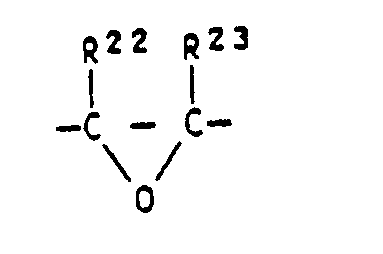

CH₂=CR¹⁶-K-Y VII)
ist, wobei
R¹⁶ Wasserstoff oder C₁-C₂₅-Alkyl,

S eine ganze Zahl von 0 bis 6,
L ein Brückenglied und
Y -OH oder -SH ist.
Applications Claiming Priority (2)
| Application Number | Priority Date | Filing Date | Title |
|---|---|---|---|
| DE19873711704 DE3711704A1 (de) | 1987-04-07 | 1987-04-07 | Thermoplastische formmassen auf basis von polyphenylenether |
| DE3711704 | 1987-04-07 |
Publications (2)
| Publication Number | Publication Date |
|---|---|
| EP0285975A2 true EP0285975A2 (de) | 1988-10-12 |
| EP0285975A3 EP0285975A3 (de) | 1990-09-12 |
Family
ID=6325054
Family Applications (1)
| Application Number | Title | Priority Date | Filing Date |
|---|---|---|---|
| EP19880105035 Withdrawn EP0285975A3 (de) | 1987-04-07 | 1988-03-29 | Thermoplastische Formmassen auf Basis von Polyphenylenether |
Country Status (2)
| Country | Link |
|---|---|
| EP (1) | EP0285975A3 (de) |
| DE (1) | DE3711704A1 (de) |
Cited By (1)
| Publication number | Priority date | Publication date | Assignee | Title |
|---|---|---|---|---|
| EP0346656B1 (de) * | 1988-06-13 | 1995-08-23 | General Electric Company | Polyphenylenätherharze und Zusammensetzungen mit verringertem Geruch und Verfahren zur Verringerung des Geruchs |
Family Cites Families (2)
| Publication number | Priority date | Publication date | Assignee | Title |
|---|---|---|---|---|
| DE3137824A1 (de) * | 1981-09-23 | 1983-03-31 | Basf Ag, 6700 Ludwigshafen | Selbstverloeschende thermoplastische formmassen |
| DE3432750A1 (de) * | 1984-09-06 | 1986-03-06 | Basf Ag, 6700 Ludwigshafen | Halogenfreie, selbstverloeschende thermoplastische formmasse |
-
1987
- 1987-04-07 DE DE19873711704 patent/DE3711704A1/de not_active Withdrawn
-
1988
- 1988-03-29 EP EP19880105035 patent/EP0285975A3/de not_active Withdrawn
Cited By (1)
| Publication number | Priority date | Publication date | Assignee | Title |
|---|---|---|---|---|
| EP0346656B1 (de) * | 1988-06-13 | 1995-08-23 | General Electric Company | Polyphenylenätherharze und Zusammensetzungen mit verringertem Geruch und Verfahren zur Verringerung des Geruchs |
Also Published As
| Publication number | Publication date |
|---|---|
| EP0285975A3 (de) | 1990-09-12 |
| DE3711704A1 (de) | 1988-10-27 |
Similar Documents
| Publication | Publication Date | Title |
|---|---|---|
| EP0309907B1 (de) | Selbstverlöschende thermoplastische Polyphenylenether-Polyamid-Formmassen | |
| EP0176775A2 (de) | Halogenfreie, selbstverlöschende thermoplastische Formmasse | |
| EP0285969B1 (de) | Thermoplastische Formmassen auf Basis von Polyphenylenether | |
| DE3908408A1 (de) | Thermoplastische formmassen auf basis von schlagzaeh modifiziertem polyamid und funktionalisiertem polyphenylenether | |
| EP0176774B1 (de) | Halogenfreie, selbstverlöschende thermoplastische Formmasse | |
| EP0529378B1 (de) | Thermoplastische Formmasse auf Basis von Polyamiden und Polyphenylenethern | |
| EP0886657B1 (de) | Funktionalisierte polymere | |
| DE3526549A1 (de) | Selbstverloeschende halogenfreie thermoplastische formmasse | |
| EP0285964B1 (de) | Thermoplastische Formmassen auf Basis von Polyphenylenether | |
| EP0285976B1 (de) | Thermoplastische Formmassen auf Basis von Polyphenylenether | |
| DE3711757A1 (de) | Thermoplastische formmassen auf basis von polyphenylenether | |
| EP0192154A2 (de) | Halogenfreie, selbstverlöschende thermoplastische Formmasse | |
| EP0285966A2 (de) | Thermoplastische Formmassen auf Basis von Polyphenylenether | |
| DE3711704A1 (de) | Thermoplastische formmassen auf basis von polyphenylenether | |
| EP0496120B1 (de) | Selbstverlöschende, halogenfrei flammgeschützte Formmasse mit verbessertem Brandwiderstandsverhalten | |
| EP0285971B1 (de) | Thermoplastische Formmassen auf Basis von Styrolacrylnitrilcopolymerisaten und Polyphenylenether | |
| DE3711608A1 (de) | Thermoplastische formmassen auf basis von polyphenylenether | |
| DE3920995A1 (de) | Halogenfreie, flammgeschuetzte thermoplastische formmasse | |
| EP0842985B1 (de) | Thermooxidationsstabile thermoplastische Formmassen | |
| EP0285967A2 (de) | Thermoplastische Formmassen auf Basis von Polyphenylenether | |
| DE3711683A1 (de) | Selbstverloeschende, halogenfreie, thermoplastische formmassen auf basis von polyphenylenether | |
| EP0285970B1 (de) | Thermoplastische Formmassen auf Basis von Polyphenylenether | |
| EP0489321B1 (de) | Kontinuierliches Verfahren zur Herstellung von flammgeschützten halogenfreien thermoplastischen Formmassen | |
| EP0496119A1 (de) | Flammgeschützte thermoplastische Formmassen mit erhöhter Fliessfähigkeit | |
| DE3321713A1 (de) | Thermoplastische formmassen |
Legal Events
| Date | Code | Title | Description |
|---|---|---|---|
| PUAI | Public reference made under article 153(3) epc to a published international application that has entered the european phase |
Free format text: ORIGINAL CODE: 0009012 |
|
| AK | Designated contracting states |
Kind code of ref document: A2 Designated state(s): BE DE FR GB NL |
|
| PUAL | Search report despatched |
Free format text: ORIGINAL CODE: 0009013 |
|
| AK | Designated contracting states |
Kind code of ref document: A3 Designated state(s): BE DE FR GB NL |
|
| 17P | Request for examination filed |
Effective date: 19900811 |
|
| 17Q | First examination report despatched |
Effective date: 19910723 |
|
| STAA | Information on the status of an ep patent application or granted ep patent |
Free format text: STATUS: THE APPLICATION HAS BEEN WITHDRAWN |
|
| 18W | Application withdrawn |
Withdrawal date: 19920616 |