EP0286043A2 - Verwendung von Verbindungen mit chiralem, polarem Molekülteil als Komponenten in Flüssigkristall-Mischungen für die Ausnutzung des elektroklinen Effektes - Google Patents
Verwendung von Verbindungen mit chiralem, polarem Molekülteil als Komponenten in Flüssigkristall-Mischungen für die Ausnutzung des elektroklinen Effektes Download PDFInfo
- Publication number
- EP0286043A2 EP0286043A2 EP88105354A EP88105354A EP0286043A2 EP 0286043 A2 EP0286043 A2 EP 0286043A2 EP 88105354 A EP88105354 A EP 88105354A EP 88105354 A EP88105354 A EP 88105354A EP 0286043 A2 EP0286043 A2 EP 0286043A2
- Authority
- EP
- European Patent Office
- Prior art keywords
- liquid
- compounds
- phase
- chiral
- electroclinic effect
- Prior art date
- Legal status (The legal status is an assumption and is not a legal conclusion. Google has not performed a legal analysis and makes no representation as to the accuracy of the status listed.)
- Granted
Links
- 150000001875 compounds Chemical class 0.000 title claims abstract description 15
- 230000000694 effects Effects 0.000 title claims abstract description 13
- 239000000203 mixture Substances 0.000 title claims description 7
- 239000004973 liquid crystal related substance Substances 0.000 title description 3
- 229910052698 phosphorus Inorganic materials 0.000 claims description 7
- 229910052717 sulfur Inorganic materials 0.000 claims description 6
- 230000018199 S phase Effects 0.000 claims description 4
- 125000000217 alkyl group Chemical group 0.000 claims description 2
- 125000004432 carbon atom Chemical group C* 0.000 claims description 2
- 239000007788 liquid Substances 0.000 claims 1
- 239000004593 Epoxy Substances 0.000 abstract description 2
- ONIBWKKTOPOVIA-UHFFFAOYSA-N Proline Natural products OC(=O)C1CCCN1 ONIBWKKTOPOVIA-UHFFFAOYSA-N 0.000 abstract description 2
- JVTAAEKCZFNVCJ-UHFFFAOYSA-N lactic acid Chemical compound CC(O)C(O)=O JVTAAEKCZFNVCJ-UHFFFAOYSA-N 0.000 abstract 2
- 150000003980 alpha-chlorocarboxylic acids Chemical class 0.000 abstract 1
- 125000000446 sulfanediyl group Chemical group *S* 0.000 abstract 1
- 239000000126 substance Substances 0.000 description 10
- 239000002019 doping agent Substances 0.000 description 5
- 229910052757 nitrogen Inorganic materials 0.000 description 4
- 239000004990 Smectic liquid crystal Substances 0.000 description 3
- 230000008878 coupling Effects 0.000 description 3
- 238000010168 coupling process Methods 0.000 description 3
- 238000005859 coupling reaction Methods 0.000 description 3
- 230000005684 electric field Effects 0.000 description 2
- 230000008018 melting Effects 0.000 description 2
- 238000002844 melting Methods 0.000 description 2
- 125000001424 substituent group Chemical group 0.000 description 2
- ZDJYTQLWQYZBJS-UHFFFAOYSA-N CC1=NCC=CO1 Chemical compound CC1=NCC=CO1 ZDJYTQLWQYZBJS-UHFFFAOYSA-N 0.000 description 1
- JUIQOABNSLTJSW-UHFFFAOYSA-N CC1=NCCS1 Chemical compound CC1=NCCS1 JUIQOABNSLTJSW-UHFFFAOYSA-N 0.000 description 1
- VQKFNUFAXTZWDK-UHFFFAOYSA-N Cc1ccc[o]1 Chemical compound Cc1ccc[o]1 VQKFNUFAXTZWDK-UHFFFAOYSA-N 0.000 description 1
- XQQBUAPQHNYYRS-UHFFFAOYSA-N Cc1ccc[s]1 Chemical compound Cc1ccc[s]1 XQQBUAPQHNYYRS-UHFFFAOYSA-N 0.000 description 1
- JVTAAEKCZFNVCJ-REOHCLBHSA-N L-lactic acid Chemical compound C[C@H](O)C(O)=O JVTAAEKCZFNVCJ-REOHCLBHSA-N 0.000 description 1
- 238000000149 argon plasma sintering Methods 0.000 description 1
- 230000015572 biosynthetic process Effects 0.000 description 1
- 239000005262 ferroelectric liquid crystals (FLCs) Substances 0.000 description 1
- 239000012530 fluid Substances 0.000 description 1
- 238000010348 incorporation Methods 0.000 description 1
- 238000005259 measurement Methods 0.000 description 1
- 230000003287 optical effect Effects 0.000 description 1
- 230000005693 optoelectronics Effects 0.000 description 1
- 229910052760 oxygen Inorganic materials 0.000 description 1
- 230000010287 polarization Effects 0.000 description 1
- 230000002269 spontaneous effect Effects 0.000 description 1
- 238000004381 surface treatment Methods 0.000 description 1
Classifications
-
- C—CHEMISTRY; METALLURGY
- C07—ORGANIC CHEMISTRY
- C07C—ACYCLIC OR CARBOCYCLIC COMPOUNDS
- C07C43/00—Ethers; Compounds having groups, groups or groups
- C07C43/02—Ethers
- C07C43/20—Ethers having an ether-oxygen atom bound to a carbon atom of a six-membered aromatic ring
- C07C43/205—Ethers having an ether-oxygen atom bound to a carbon atom of a six-membered aromatic ring the aromatic ring being a non-condensed ring
-
- C—CHEMISTRY; METALLURGY
- C09—DYES; PAINTS; POLISHES; NATURAL RESINS; ADHESIVES; COMPOSITIONS NOT OTHERWISE PROVIDED FOR; APPLICATIONS OF MATERIALS NOT OTHERWISE PROVIDED FOR
- C09K—MATERIALS FOR MISCELLANEOUS APPLICATIONS, NOT PROVIDED FOR ELSEWHERE
- C09K19/00—Liquid crystal materials
- C09K19/04—Liquid crystal materials characterised by the chemical structure of the liquid crystal components, e.g. by a specific unit
- C09K19/06—Non-steroidal liquid crystal compounds
- C09K19/08—Non-steroidal liquid crystal compounds containing at least two non-condensed rings
- C09K19/10—Non-steroidal liquid crystal compounds containing at least two non-condensed rings containing at least two benzene rings
- C09K19/12—Non-steroidal liquid crystal compounds containing at least two non-condensed rings containing at least two benzene rings at least two benzene rings directly linked, e.g. biphenyls
- C09K19/126—Compounds containing at least one asymmetric carbon atom
-
- C—CHEMISTRY; METALLURGY
- C09—DYES; PAINTS; POLISHES; NATURAL RESINS; ADHESIVES; COMPOSITIONS NOT OTHERWISE PROVIDED FOR; APPLICATIONS OF MATERIALS NOT OTHERWISE PROVIDED FOR
- C09K—MATERIALS FOR MISCELLANEOUS APPLICATIONS, NOT PROVIDED FOR ELSEWHERE
- C09K19/00—Liquid crystal materials
- C09K19/04—Liquid crystal materials characterised by the chemical structure of the liquid crystal components, e.g. by a specific unit
- C09K19/06—Non-steroidal liquid crystal compounds
- C09K19/08—Non-steroidal liquid crystal compounds containing at least two non-condensed rings
- C09K19/10—Non-steroidal liquid crystal compounds containing at least two non-condensed rings containing at least two benzene rings
- C09K19/20—Non-steroidal liquid crystal compounds containing at least two non-condensed rings containing at least two benzene rings linked by a chain containing carbon and oxygen atoms as chain links, e.g. esters or ethers
- C09K19/2007—Non-steroidal liquid crystal compounds containing at least two non-condensed rings containing at least two benzene rings linked by a chain containing carbon and oxygen atoms as chain links, e.g. esters or ethers the chain containing -COO- or -OCO- groups
- C09K19/2021—Compounds containing at least one asymmetric carbon atom
-
- C—CHEMISTRY; METALLURGY
- C09—DYES; PAINTS; POLISHES; NATURAL RESINS; ADHESIVES; COMPOSITIONS NOT OTHERWISE PROVIDED FOR; APPLICATIONS OF MATERIALS NOT OTHERWISE PROVIDED FOR
- C09K—MATERIALS FOR MISCELLANEOUS APPLICATIONS, NOT PROVIDED FOR ELSEWHERE
- C09K19/00—Liquid crystal materials
- C09K19/04—Liquid crystal materials characterised by the chemical structure of the liquid crystal components, e.g. by a specific unit
- C09K19/06—Non-steroidal liquid crystal compounds
- C09K19/34—Non-steroidal liquid crystal compounds containing at least one heterocyclic ring
- C09K19/3441—Non-steroidal liquid crystal compounds containing at least one heterocyclic ring having nitrogen as hetero atom
- C09K19/3483—Non-steroidal liquid crystal compounds containing at least one heterocyclic ring having nitrogen as hetero atom the heterocyclic ring being a non-aromatic ring
-
- C—CHEMISTRY; METALLURGY
- C09—DYES; PAINTS; POLISHES; NATURAL RESINS; ADHESIVES; COMPOSITIONS NOT OTHERWISE PROVIDED FOR; APPLICATIONS OF MATERIALS NOT OTHERWISE PROVIDED FOR
- C09K—MATERIALS FOR MISCELLANEOUS APPLICATIONS, NOT PROVIDED FOR ELSEWHERE
- C09K19/00—Liquid crystal materials
- C09K19/04—Liquid crystal materials characterised by the chemical structure of the liquid crystal components, e.g. by a specific unit
- C09K19/06—Non-steroidal liquid crystal compounds
- C09K19/34—Non-steroidal liquid crystal compounds containing at least one heterocyclic ring
- C09K19/3491—Non-steroidal liquid crystal compounds containing at least one heterocyclic ring having sulfur as hetero atom
-
- C—CHEMISTRY; METALLURGY
- C09—DYES; PAINTS; POLISHES; NATURAL RESINS; ADHESIVES; COMPOSITIONS NOT OTHERWISE PROVIDED FOR; APPLICATIONS OF MATERIALS NOT OTHERWISE PROVIDED FOR
- C09K—MATERIALS FOR MISCELLANEOUS APPLICATIONS, NOT PROVIDED FOR ELSEWHERE
- C09K19/00—Liquid crystal materials
- C09K19/04—Liquid crystal materials characterised by the chemical structure of the liquid crystal components, e.g. by a specific unit
- C09K19/06—Non-steroidal liquid crystal compounds
- C09K19/34—Non-steroidal liquid crystal compounds containing at least one heterocyclic ring
- C09K19/3491—Non-steroidal liquid crystal compounds containing at least one heterocyclic ring having sulfur as hetero atom
- C09K19/3497—Non-steroidal liquid crystal compounds containing at least one heterocyclic ring having sulfur as hetero atom the heterocyclic ring containing sulfur and nitrogen atoms
-
- C—CHEMISTRY; METALLURGY
- C09—DYES; PAINTS; POLISHES; NATURAL RESINS; ADHESIVES; COMPOSITIONS NOT OTHERWISE PROVIDED FOR; APPLICATIONS OF MATERIALS NOT OTHERWISE PROVIDED FOR
- C09K—MATERIALS FOR MISCELLANEOUS APPLICATIONS, NOT PROVIDED FOR ELSEWHERE
- C09K19/00—Liquid crystal materials
- C09K19/04—Liquid crystal materials characterised by the chemical structure of the liquid crystal components, e.g. by a specific unit
- C09K19/06—Non-steroidal liquid crystal compounds
- C09K19/34—Non-steroidal liquid crystal compounds containing at least one heterocyclic ring
- C09K19/3402—Non-steroidal liquid crystal compounds containing at least one heterocyclic ring having oxygen as hetero atom
- C09K19/3405—Non-steroidal liquid crystal compounds containing at least one heterocyclic ring having oxygen as hetero atom the heterocyclic ring being a five-membered ring
-
- C—CHEMISTRY; METALLURGY
- C09—DYES; PAINTS; POLISHES; NATURAL RESINS; ADHESIVES; COMPOSITIONS NOT OTHERWISE PROVIDED FOR; APPLICATIONS OF MATERIALS NOT OTHERWISE PROVIDED FOR
- C09K—MATERIALS FOR MISCELLANEOUS APPLICATIONS, NOT PROVIDED FOR ELSEWHERE
- C09K19/00—Liquid crystal materials
- C09K19/04—Liquid crystal materials characterised by the chemical structure of the liquid crystal components, e.g. by a specific unit
- C09K19/06—Non-steroidal liquid crystal compounds
- C09K19/34—Non-steroidal liquid crystal compounds containing at least one heterocyclic ring
- C09K19/3402—Non-steroidal liquid crystal compounds containing at least one heterocyclic ring having oxygen as hetero atom
- C09K19/3411—Non-steroidal liquid crystal compounds containing at least one heterocyclic ring having oxygen as hetero atom the heterocyclic ring being a three-membered ring
-
- C—CHEMISTRY; METALLURGY
- C09—DYES; PAINTS; POLISHES; NATURAL RESINS; ADHESIVES; COMPOSITIONS NOT OTHERWISE PROVIDED FOR; APPLICATIONS OF MATERIALS NOT OTHERWISE PROVIDED FOR
- C09K—MATERIALS FOR MISCELLANEOUS APPLICATIONS, NOT PROVIDED FOR ELSEWHERE
- C09K19/00—Liquid crystal materials
- C09K19/04—Liquid crystal materials characterised by the chemical structure of the liquid crystal components, e.g. by a specific unit
- C09K19/06—Non-steroidal liquid crystal compounds
- C09K19/34—Non-steroidal liquid crystal compounds containing at least one heterocyclic ring
- C09K19/3402—Non-steroidal liquid crystal compounds containing at least one heterocyclic ring having oxygen as hetero atom
- C09K2019/3422—Non-steroidal liquid crystal compounds containing at least one heterocyclic ring having oxygen as hetero atom the heterocyclic ring being a six-membered ring
Definitions
- S A phase The so-called electroclinic effect in the chiral smectic A phase (S A phase), which can be used for light modulation, has been known for some years (S. Garoff and RB Meyer, Phys. Rev. Lett. 38, 848 (1977)) .
- S Phase If an electric field is parallel to the layers of a chiral S A phase (S Phase), the molecules tilt in the orthogonal phase.
- the angle of inclination ⁇ between the director and the layer normal z is proportional to the applied field E.
- the electroclinic coefficient (de / dE) indicates the strength of the linear coupling between the tilt coordinate and the field.
- the electroclinic effect can be understood as a deflection of the angle of inclination which is continuously controlled by the field.
- liquid-crystalline media are used , P or S
- P or S The better the phase, the better the electroclinic coefficient d8 / dE and the higher the electroclinic cutoff frequency f G.
- the invention also relates to liquid-crystalline media in the S , P or SE phase, which contain the said compounds, and electro-optical switching and display elements which contain such media.
- -Z * denotes one of the chiral residues IV
- R 1 and / or R 2 are customary mesogenic residues.
- Mesogenic residues are residues which give the compound such properties that it shows a liquid crystal phase as a compound or in a mixture with certain co-components, ie an enantiotropic (clearing temperature> melting temperature) or monotropic (clearing temperature ⁇ melting temperature) mesophase formation can be expected.
- connections themselves form orthogonal (p , P or S ) liquid-crystalline phases and then already show a pronounced electroclinic effect. In this case, they can be used alone in the orthogonal liquid-crystalline phase as a medium in corresponding switching or display elements.
- the mixtures then contain 0.1 to 70% by weight of the dopant (s). If this (parent) component is not itself chiral, the chiral dopant induces the electroclinic effect. If this (parent) component is itself chiral, the chiral dopant increases the electroclinic coefficient, that is, the amplitude of the electroclinic movement.
- the invention is illustrated by the examples.
- the measurement results in Table 3 were obtained on a cell with a layer thickness of the liquid-crystalline medium of 2 ⁇ m.
- the layer was aligned planar by shear or surface treatment.
- the results show that large angles of inclination e are obtained even with moderate field strengths, which leads to large contrasts.
- high cut-off frequencies of the electroclinic effect and thus short switching times were achieved.
- It also shows that the introduction of the chiral, polar group Z connected symmetry breaking in an orthogonal-smectic phase in any case the electroclinic effect is induced. If a smectogenic framework is selected in formula (A), an efficient coupling of the chiral center to the orthogonal-smectic phase is achieved.
- the special choice of the chiral groupings IV for ZA in formula (A) results in a strong coupling to the applied electric field.
Landscapes
- Chemical & Material Sciences (AREA)
- Organic Chemistry (AREA)
- Crystallography & Structural Chemistry (AREA)
- Engineering & Computer Science (AREA)
- Materials Engineering (AREA)
- Liquid Crystal Substances (AREA)
- Liquid Crystal (AREA)
- Organic Low-Molecular-Weight Compounds And Preparation Thereof (AREA)
Abstract
Description
- Die ungewöhnliche Kombination von anisotropen und fluiden Eigenschaften der Flüssigkristalle haben zu ihrer Verwendung in einer Vielzahl von elektro-optischen Schalt-und Anzeigevorrichtungen geführt. Dabei können ihre elektrischen, magnetischen, elastischen oder thermischen Eigenschaften zu Orientierungsänderungen benutzt werden. Optische Effekte lassen sich dann mit Hilfe ihrer Doppelbrechung ("birefringence mode"), der Einlagerung dichroitisch absorbierender Farbstoffmoleküle ("guest-host mode") oder der Lichtstreuung erzielen.
- Seit einigen Jahren ist der sogenannte elektrokline Effekt in der chiralen smektischen A-Phase (S A -Phase) bekannt, der sich zur Lichtmodulation ausnutzen läßt (S. Garoff und R.B. Meyer, Phys. Rev. Lett. 38, 848 (1977)). Wenn man ein elektrisches Feld parallel zu den Schichten einer chiralen SA-Phase (S-Phase) anlegt, so neigen sich die Moleküle in der an sich orthogonalen Phase. Der Neigungswinkel θ zwischen dem Direktor
 und der Schichtennormalen z ist dem angelegten Feld E proportional. Der elektrokline Koeffizient (de/dE) gibt die Stärke der linearen Kopplung zwischen der Neigungskoordinate und dem Feld an.
- In der von Clark und Lagerwall vorgeschlagenen "booksheif"-Anordnung (N.A. Clark und S.T. Lagerwall, Appl. Phys. Lett. 36, 899 (1980)) kann der elektro-optische Effekt ferroelektrischer Flüssigkristalle ausgenutzt werden. Deren Charakteristika wie Bistabilität, spontane Polarisation und Phasenverdrillung sind den hier besprochenen orthogonalen Phasen wesensfremd. Der elektrokline Effekt geht von einem im feldfreien Raum monostabilen Zustand aus und ergibt beim Anlegen eines Feldes eine für kleine Winkel lineare und für große Winkel schwach gekrümmte elektro-optische Kennlinie. Die Kennlinie des ferroelektrischen Schaltens ist dagegen stark nichtlinear.
- Der elektrokline Effekt kann als eine kontinuierlich durch das Feld gesteuerte Auslenkung des Neigungswinkels aufgefaßt werden.
- Für die praktische Ausnutzung des elektroklinen Effekts in elektro-optischen Schalt-und Anzeigeelementen sind flüssigkristalline Medien, die eine S, S
 oder S
 Phase bilden umso besser geeignet, je größer der elektrokline Koeffizient d8/dE und je höher die elektrokline Grenzfrequenz fG ist.
- Es besteht daher großes Interesse an Substanzen oder Substanzgemischen, die S, Soder SPhasen mit einem großen elektroklinen Koeffizienten und einer hohen elektroklinen Grenzfrequenz bilden.
- Es wurde nun gefunden, daß man auf der Ausnutzung des elektroklinen Effekts in flüssigkristallinen Medien in der S, Soder SPhase beruhende elektro-optische Schalt-und Anzeigelemente mit besonders guten Eigenschaften erhält, wenn man als flüssigkristallines Medium alleine oder in Mischung mit anderen Komponenten Verbindungen verwendet, die eine polare chirale Gruppierung (Molekülteil) aus der Gruppe


- Gegenstand der Erfindung sind auch flüssigkristalline Medien in der S, Soder SE Phase, die einen Gehalt an den genannten Verbindungen aufweisen, sowie elektro-optische Schalt-und Anzeigeelementen, die solche Medien enthalten.
- Die gemäß der Erfindung zu verwendenden Verbindungen sind Derivate von a-Chlorcarbonsäuren (I), a-Hydroxypropionsäure (11), Prolin (III), von Epoxyverbindungen (IV) oder deren Thioanalogen (V). Es handelt sich um Verbindungen, die beschrieben sind in
- (I) Ch. Bahr und G. Heppke, Mol. Cryst. Liq. Cryst. Lett. 4, 31 (1986) und in dort zitierter Literatur
- (II) DE-A 36 38 119
- (III) DE-A 36 44 522
- (IV,V) DE-A 36 33 968
- Sie entsprechen der allgemeinen Formel





- Sofern einer der Reste R', R2 nicht-mesogen ist, dann bedeutet dieser bevorzugt eine geradkettige oder verzweigte durch F, Cl, Br oder CN substituierte oder unsubstituierte Alkylgruppe mit 1 bis 20 C-Atomen, in der eine oder zwei nicht-benachbarte und nicht direkt der Gruppierung (I) bis (V) benachbarte -CH2-Gruppen ersetzt sein können durch -O-, -S-, -CO-, -O-CO-, -CO-0-, -O-CS-, -CO-S-und/oder -CH=CH-, oder die eine Endgruppe -CH = CH2 oder -CH = C(CH3)2 oder

- Diese Verbindungen bilden zum Teil selbst orthogonale (S, Soder S) flüssigkristalline Phasen aus und zeigen dann bereits für sich einen ausgeprägten elektroklinen Effekt. In diesem Fall können sie für sich alleine in der orthogonalen flüssigkristallinen Phase als Medium in entsprechenden Schalt-oder Anzeigeelementen verwendet werden.
- Sie können jedoch auch anderen bekannten Komponenten, die orthogonale flüssigkristalline Phasen bilden, als chirale Dotierstoffe zugesetzt werden, insbesondere enthalten die Mischungen dann 0,1 bis 70 Gew.-% an dem oder den Dotierstoff(en). Sofern diese (Stamm-)Komponente selbst nicht chiral ist, induziert der chirale Dotierstoff den elektroklinen Effekt. Ist diese (Stamm-)Komponente selbst chiral, so erhöht der chirale Dotierstoff den elektroklinen Koeffizienten, also die Amplitude der elektroklinen Bewegung.
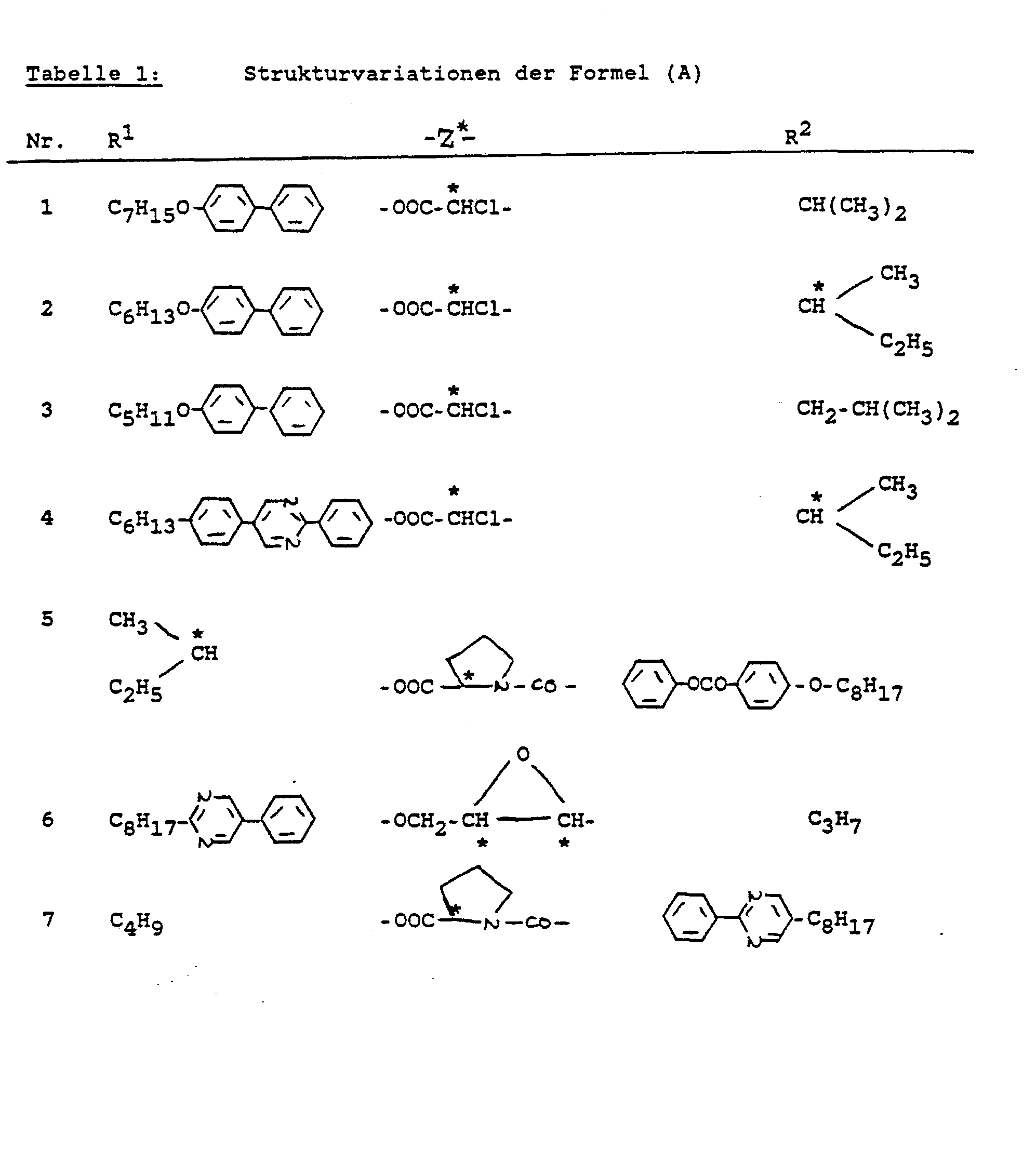
- Die Vielzahl der Variationsmöglichkeiten bezüglich der chiralen Gruppierung-Zund der Substituenten R1 und R2 in (A) gestattet es dabei, die Dotierstoffe hinsichtlich des Phasenbereiches und der Löslichkeitsverhältnisse genau auf eine vorgegebenen orthogonale (Stamm-)Komponente abzustimmen.

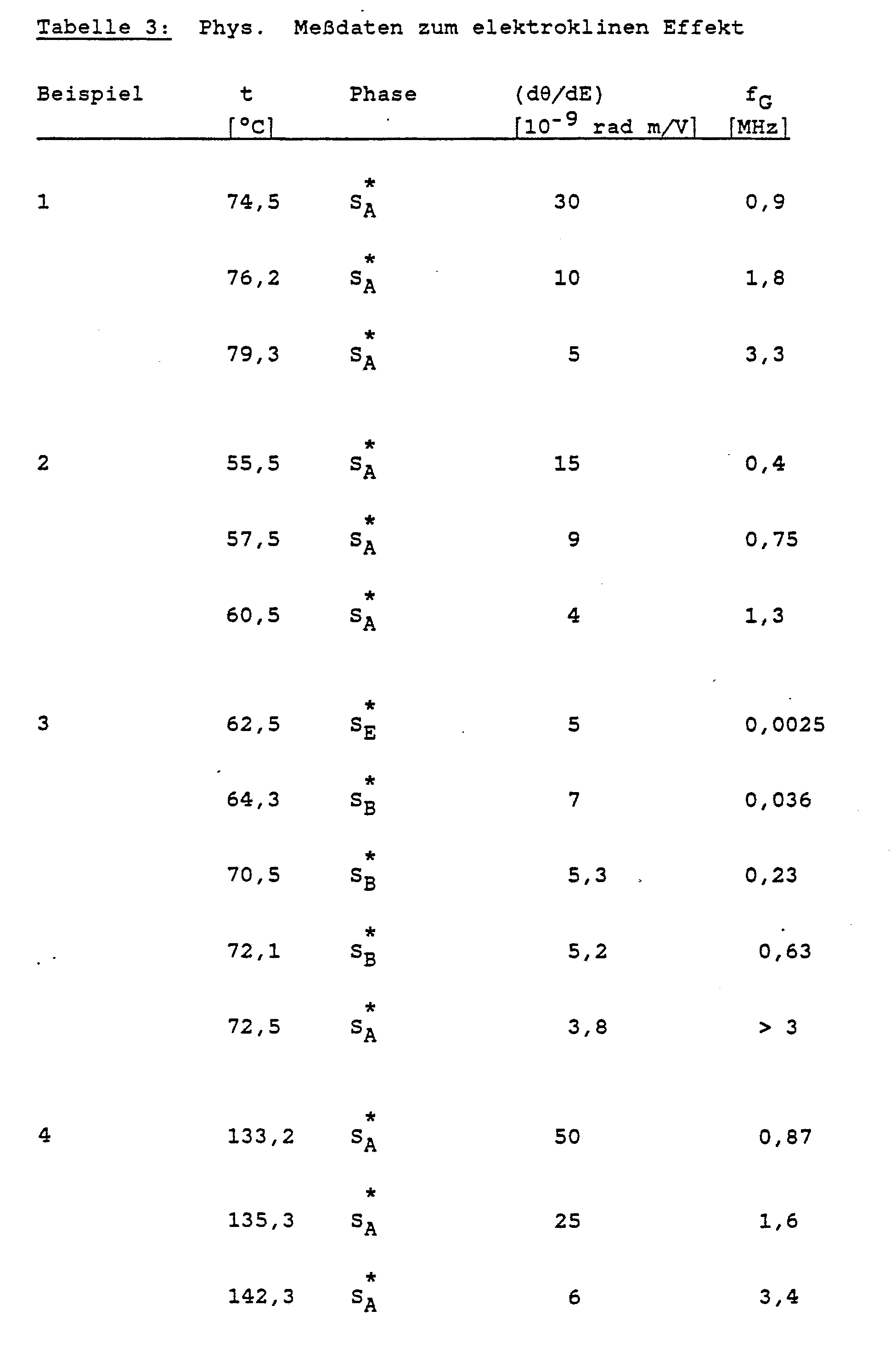
- Die Erfindung wird anhand der Beispiele näher erläutert. Die Meßergebnisse in Tabelle 3 wurden an einer Zelle mit einer Schichtstärke des flüssigkristallinen Mediums von 2 um gewonnen. Die Schicht war durch Scherung oder durch Oberflächenbehandlung planar ausgerichtet. Die Ergebnisse zeigen, daß bereits mit mäßigen Feldstärken große Neigungswinkel e erhalten werden, was zu großen Kontrasten führt. Außerdem wurden hohe Grenzfrequenzen des elektroklinen Effekts und damit kurze Schaltzeiten erzielt. Ferner zeigt sich, daß durch die mit der Einführung der chiralen, polaren Gruppe-Zverbundenen Symmetriebrechung in einer orthogonal-smektischen Phase in jedem Fall der elektroklinen Effekt induziert wird. Wählt man in Formel (A) ein smektogenes Gerüst, so erreicht man eine effiziente Koppelung des chiralen Zentrums an die orthogonal-smektische Phase. Durch die spezielle Wahl der chiralen Gruppierungen I-V für-ZA in Formel (A) erhält man eine starke Koppelung zum anliegenden elektrische Feld.


-
- a als Reinsubstanz gemessen
- b in Mischung mit der racematischen Verbindung

- c wie b, nur betrug der Molenbruch der chiralen Substanz in diesem Fall x = 0,1
- d in Mischung mit dem Racemat

- e wie d, nur betrug der Molenbruch der chiralen Substanz in diesem Fall x = 0,175
- f Mischung aus dem Substanzbeispiel Nr. 2 (x = 0,5) und unter Bemerkung d) angegebenen Racemat (x = 0,5).
- g Mischung aus Substanzbeispiel Nr. 13 (x = 0,6) und Substanzbeispiel Nr. 3 (x = 0,4).


Claims (4)


Priority Applications (1)
| Application Number | Priority Date | Filing Date | Title |
|---|---|---|---|
| AT88105354T ATE91032T1 (de) | 1987-04-07 | 1988-04-02 | Verwendung von verbindungen mit chiralem, polarem molekuelteil als komponenten in fluessigkristall- mischungen fuer die ausnutzung des elektroklinen effektes. |
Applications Claiming Priority (2)
| Application Number | Priority Date | Filing Date | Title |
|---|---|---|---|
| DE3711362 | 1987-04-07 | ||
| DE19873711362 DE3711362A1 (de) | 1987-04-07 | 1987-04-07 | Verwendung von chiralen (alpha)-chlorcarbonsaeureestern, prolinderivaten, oxiranen, thiiranen und (alpha)-oxypropionsaeureestern als komponenten in fluessigkristall-mischungen fuer die ausnutzung des elektroklinen effektes |
Publications (3)
| Publication Number | Publication Date |
|---|---|
| EP0286043A2 true EP0286043A2 (de) | 1988-10-12 |
| EP0286043A3 EP0286043A3 (en) | 1989-12-06 |
| EP0286043B1 EP0286043B1 (de) | 1993-06-23 |
Family
ID=6324857
Family Applications (1)
| Application Number | Title | Priority Date | Filing Date |
|---|---|---|---|
| EP88105354A Expired - Lifetime EP0286043B1 (de) | 1987-04-07 | 1988-04-02 | Verwendung von Verbindungen mit chiralem, polarem Molekülteil als Komponenten in Flüssigkristall-Mischungen für die Ausnutzung des elektroklinen Effektes |
Country Status (6)
| Country | Link |
|---|---|
| EP (1) | EP0286043B1 (de) |
| JP (1) | JPS649286A (de) |
| KR (1) | KR880012514A (de) |
| AT (1) | ATE91032T1 (de) |
| DE (2) | DE3711362A1 (de) |
| NO (1) | NO881471L (de) |
Cited By (1)
| Publication number | Priority date | Publication date | Assignee | Title |
|---|---|---|---|---|
| US5356559A (en) * | 1991-07-19 | 1994-10-18 | Hoffmann-La Roche Inc. | Optically active piperazinyl derivatives as liquid crystals |
Families Citing this family (3)
| Publication number | Priority date | Publication date | Assignee | Title |
|---|---|---|---|---|
| JP2564841B2 (ja) * | 1987-08-19 | 1996-12-18 | 日産化学工業株式会社 | 光学活性な液晶化合物 |
| DE69017483T2 (de) * | 1989-03-14 | 1995-09-14 | Daisow Co Ltd | Vorrichtung mit ferroelektrischen Flüssigkristallen. |
| US5215678A (en) * | 1989-03-31 | 1993-06-01 | Sharp Kabushiki Kaisha | Ferroelectric liquid crystal composition and liquid crystal device incorporating same |
Family Cites Families (3)
| Publication number | Priority date | Publication date | Assignee | Title |
|---|---|---|---|---|
| DE3633968A1 (de) * | 1986-10-06 | 1988-04-07 | Hoechst Ag | Chirale aryl-2,3-epoxyalkyl-ether und deren entsprechende thioverbindungen und ihre verwendung als dotierstoff in fluessigkristall-phasen |
| DE3684784D1 (de) * | 1986-10-07 | 1992-05-14 | Lagerwall S T Sarl | Vorrichtung fuer submikrosekunden-elektrooptische modulation in der smektischen a-fluessigkristallphase. |
| DE3644522A1 (de) * | 1986-12-24 | 1988-07-14 | Hoechst Ag | Verwendung von optisch aktiven 1-acylprolinestern als dotierstoffe in fluessigkristallmischungen und neue optisch aktive 1-acyl-prolinester |
-
1987
- 1987-04-07 DE DE19873711362 patent/DE3711362A1/de not_active Withdrawn
-
1988
- 1988-04-02 EP EP88105354A patent/EP0286043B1/de not_active Expired - Lifetime
- 1988-04-02 DE DE8888105354T patent/DE3881932D1/de not_active Expired - Fee Related
- 1988-04-02 AT AT88105354T patent/ATE91032T1/de not_active IP Right Cessation
- 1988-04-06 NO NO881471A patent/NO881471L/no unknown
- 1988-04-06 JP JP63083229A patent/JPS649286A/ja active Pending
- 1988-04-07 KR KR1019880003869A patent/KR880012514A/ko not_active Withdrawn
Cited By (1)
| Publication number | Priority date | Publication date | Assignee | Title |
|---|---|---|---|---|
| US5356559A (en) * | 1991-07-19 | 1994-10-18 | Hoffmann-La Roche Inc. | Optically active piperazinyl derivatives as liquid crystals |
Also Published As
| Publication number | Publication date |
|---|---|
| NO881471L (no) | 1988-10-10 |
| NO881471D0 (no) | 1988-04-06 |
| EP0286043A3 (en) | 1989-12-06 |
| EP0286043B1 (de) | 1993-06-23 |
| KR880012514A (ko) | 1988-11-28 |
| ATE91032T1 (de) | 1993-07-15 |
| DE3711362A1 (de) | 1988-10-27 |
| JPS649286A (en) | 1989-01-12 |
| DE3881932D1 (de) | 1993-07-29 |
Similar Documents
| Publication | Publication Date | Title |
|---|---|---|
| EP0056501B1 (de) | Flüssigkristallmischung | |
| DE3689329T2 (de) | Verbindungen auf der Basis der Phenylpyrimidine und sie enthaltende flüssigkristalline Zusammensetzungen. | |
| DE3879380T2 (de) | Ferroelektrische fluessigkristall-zusammensetzungen. | |
| EP0355561B1 (de) | Verwendung von optisch aktiven Tetrahydrofuran-2-carbonsäureestern als Dotierstoffe in Flüssigkristallmischungen, diese enthaltende Flüssigkristallmischungen und neue optisch aktive Tetrahydrofuran-2-carbonsäureester | |
| DE3534778A1 (de) | Chirale ester mesogener carbonsaeuren, ein verfahren zu deren herstellung und ihre verwendung als dotierstoff in fluessigkristall-phasen | |
| EP0307880B1 (de) | Flüssigkristalline, insbesondere ferroelektrische flüssigkristalline Mischungen | |
| DE4303335A1 (de) | ||
| DE3637084A1 (de) | Propylenglykoldiether-derivate, fluessigkristallmischung und fluessigkristallvorrichtung | |
| EP0292954B1 (de) | Verwendung von optisch aktiven Oxiran-2-carbonsäureestern als Dotierstoffe in Flüssigkristallmischungen, diese enthaltende Flüssigkristallmischungen und neue optisch aktive Oxiran-2-carbonsäureester | |
| DE69005925T2 (de) | Flüssigkristallzusammensetzung. | |
| EP0217239A2 (de) | Chirale Phenolester mesogener Carbonsäuren und ihre Verwendung als Dotierstoff in Flüssigkristal-Phasen | |
| DE68909631T2 (de) | Ferroelektrische Flüssigkristallzusammensetzung. | |
| DE69008544T2 (de) | Flüssigkristallverbindungen mit hoher optischer Anisotropie. | |
| DE3885864T2 (de) | Kondensate von optisch aktiven 4-(1-Hydroxy-äthyl)-biphenylen mit optisch aktiven organischen Säuren. | |
| DE3709549A1 (de) | Verwendung von 5-phenyl-pyrimidinderivaten als komponenten in smektischen fluessigkristallmischungen | |
| DE4434754A1 (de) | Neue Verbindungen zur Verwendung in Flüssigkristallmischungen | |
| EP0286043B1 (de) | Verwendung von Verbindungen mit chiralem, polarem Molekülteil als Komponenten in Flüssigkristall-Mischungen für die Ausnutzung des elektroklinen Effektes | |
| DE3884779T2 (de) | Ferroelektrische Flüssigkristallzusammensetzung. | |
| EP0449049B1 (de) | Naphthalindicarbonsäureester | |
| DE3644522A1 (de) | Verwendung von optisch aktiven 1-acylprolinestern als dotierstoffe in fluessigkristallmischungen und neue optisch aktive 1-acyl-prolinester | |
| EP0468326B1 (de) | Ferroelektrische Flüssigkristallanzeige | |
| EP0438811A2 (de) | Ester von 3-Halogen- bzw. 3-Cyano-substituierten 2-Methylalkancarbonsäuren und ihre Verwendung als Dotierstoffe in flüssigkristallinen Mischungen | |
| EP0464072B1 (de) | Flüssigkristalline, insbesondere ferroelektrische flüssigkristalline mischungen | |
| WO1990011335A1 (de) | Ferroelektrische flüssigkristalline mischungen | |
| DE69026123T2 (de) | Optisch aktive Verbindung, Flüssigkristallzusammensetzung und Vorrichtung dafür |
Legal Events
| Date | Code | Title | Description |
|---|---|---|---|
| PUAI | Public reference made under article 153(3) epc to a published international application that has entered the european phase |
Free format text: ORIGINAL CODE: 0009012 |
|
| AK | Designated contracting states |
Kind code of ref document: A2 Designated state(s): AT BE CH DE ES FR GB IT LI NL SE |
|
| PUAL | Search report despatched |
Free format text: ORIGINAL CODE: 0009013 |
|
| AK | Designated contracting states |
Kind code of ref document: A3 Designated state(s): AT BE CH DE ES FR GB IT LI NL SE |
|
| RHK1 | Main classification (correction) |
Ipc: G02F 1/137 |
|
| 17P | Request for examination filed |
Effective date: 19900501 |
|
| 17Q | First examination report despatched |
Effective date: 19920623 |
|
| GRAA | (expected) grant |
Free format text: ORIGINAL CODE: 0009210 |
|
| AK | Designated contracting states |
Kind code of ref document: B1 Designated state(s): AT BE CH DE ES FR GB IT LI NL SE |
|
| PG25 | Lapsed in a contracting state [announced via postgrant information from national office to epo] |
Ref country code: IT Free format text: LAPSE BECAUSE OF FAILURE TO SUBMIT A TRANSLATION OF THE DESCRIPTION OR TO PAY THE FEE WITHIN THE PRE;WARNING: LAPSES OF ITALIAN PATENTS WITH EFFECTIVE DATE BEFORE 2007 MAY HAVE OCCURRED AT ANY TIME BEFORE 2007. THE CORRECT EFFECTIVE DATE MAY BE DIFFERENT FROM THE ONE RECORDED.SCRIBED TIME-LIMIT Effective date: 19930623 Ref country code: BE Effective date: 19930623 Ref country code: NL Effective date: 19930623 Ref country code: SE Effective date: 19930623 Ref country code: GB Effective date: 19930623 Ref country code: FR Effective date: 19930623 Ref country code: ES Free format text: THE PATENT HAS BEEN ANNULLED BY A DECISION OF A NATIONAL AUTHORITY Effective date: 19930623 |
|
| REF | Corresponds to: |
Ref document number: 91032 Country of ref document: AT Date of ref document: 19930715 Kind code of ref document: T |
|
| REF | Corresponds to: |
Ref document number: 3881932 Country of ref document: DE Date of ref document: 19930729 |
|
| EN | Fr: translation not filed | ||
| NLV1 | Nl: lapsed or annulled due to failure to fulfill the requirements of art. 29p and 29m of the patents act | ||
| GBV | Gb: ep patent (uk) treated as always having been void in accordance with gb section 77(7)/1977 [no translation filed] |
Effective date: 19930623 |
|
| PG25 | Lapsed in a contracting state [announced via postgrant information from national office to epo] |
Ref country code: AT Effective date: 19940402 |
|
| PLBE | No opposition filed within time limit |
Free format text: ORIGINAL CODE: 0009261 |
|
| STAA | Information on the status of an ep patent application or granted ep patent |
Free format text: STATUS: NO OPPOSITION FILED WITHIN TIME LIMIT |
|
| PG25 | Lapsed in a contracting state [announced via postgrant information from national office to epo] |
Ref country code: LI Effective date: 19940430 Ref country code: CH Effective date: 19940430 |
|
| 26N | No opposition filed | ||
| PGFP | Annual fee paid to national office [announced via postgrant information from national office to epo] |
Ref country code: DE Payment date: 19940616 Year of fee payment: 7 |
|
| REG | Reference to a national code |
Ref country code: CH Ref legal event code: PL |
|
| PG25 | Lapsed in a contracting state [announced via postgrant information from national office to epo] |
Ref country code: DE Effective date: 19960103 |