EP0286057A2 - Commutateur de proximité à circuit d'oscillation - Google Patents
Commutateur de proximité à circuit d'oscillation Download PDFInfo
- Publication number
- EP0286057A2 EP0286057A2 EP88105410A EP88105410A EP0286057A2 EP 0286057 A2 EP0286057 A2 EP 0286057A2 EP 88105410 A EP88105410 A EP 88105410A EP 88105410 A EP88105410 A EP 88105410A EP 0286057 A2 EP0286057 A2 EP 0286057A2
- Authority
- EP
- European Patent Office
- Prior art keywords
- oscillation
- proximity switch
- circuit
- khz
- coil
- Prior art date
- Legal status (The legal status is an assumption and is not a legal conclusion. Google has not performed a legal analysis and makes no representation as to the accuracy of the status listed.)
- Granted
Links
Images

Classifications
-
- H—ELECTRICITY
- H03—ELECTRONIC CIRCUITRY
- H03K—PULSE TECHNIQUE
- H03K17/00—Electronic switching or gating, i.e. not by contact-making and –breaking
- H03K17/16—Modifications for eliminating interference voltages or currents
-
- H—ELECTRICITY
- H03—ELECTRONIC CIRCUITRY
- H03K—PULSE TECHNIQUE
- H03K17/00—Electronic switching or gating, i.e. not by contact-making and –breaking
- H03K17/94—Electronic switching or gating, i.e. not by contact-making and –breaking characterised by the way in which the control signals are generated
- H03K17/945—Proximity switches
- H03K17/95—Proximity switches using a magnetic detector
- H03K17/952—Proximity switches using a magnetic detector using inductive coils
- H03K17/9537—Proximity switches using a magnetic detector using inductive coils in a resonant circuit
- H03K17/9542—Proximity switches using a magnetic detector using inductive coils in a resonant circuit forming part of an oscillator
- H03K17/9547—Proximity switches using a magnetic detector using inductive coils in a resonant circuit forming part of an oscillator with variable amplitude
Definitions
- the present invention relates to an improved proximity switch which detects an object in proximity by a change in the amplitude of an oscillation output or a resonance frequency of an oscillation circuit, and in particular to such a proximity switch which is sensitive only to metallic plates and other objects having a certain expanse which are commonly used as objects to be controlled of their positions in manufacturing plants and is not affected by an aggregate of small metallic pieces such as metal chips which are produced by operation of machine tools.
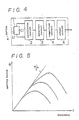
- a parallel resonance circuit 1 is built by a detection coil L1 and a capacitor C1, for instance as shown in Figure 4, and an oscillation circuit 2 is connected to this parallel resonance circuit 1 so as to produce a high frequency signal which is detected by a detection circuit 3. If a metallic object 4 is brought close to the detection coil L1, the loss in the detection coil L1 is increased and the state of oscillation changes with the result that the amplitude of its output diminishes. The output from the detection circuit 3 is then supplied to a comparison circuit 5 for discriminating it against a prescribed level and an object detection signal is obtained so as to be supplied to an external circuit from an output circuit 6.
- an object in proximity can be detected through the detection of the diminishing of the amplitude of the output of the oscillation circuit 2.
- the quality factor Q of the detection coil L1 is expressed by the ratio of the reactance ⁇ L at the given frequency to the internal resistance r of the detection coil L1 itself ( ⁇ L/r). Therefore, as the frequency rises, the quality factor Q increases but, in reality, due to the distributed capacitance between coil wires and the skin effect, reaches a peak value at a certain frequency characteristic to the detection coil as shown in the graph of Figure 5 which is drawn against frequency. In practice, a frequency in the proximity of this peak frequency is selected as the resonance frequency. As a result, the resonance frequencies of conventional proximity switches using a resonance circuit for high frequency oscillation ranged from several hundred kHz to 1 MHz.
- the proximity switch demonstrated a same sensitivity irrespective of whether the metallic objects are metallic chips, such as steel chips and aluminum chips, or metallic plates such as steel plates and aluminum plates.
- the proximity switch detects not only objects like steel plates and aluminum plates which are desired to be detected but also metal chips which, produced by the operation of the machine tool, may accumulate on the detecting surface of the high frequency oscillation type proximity switch and are not desired to be detected.
- metal chips tend to build up on the detection surface of the proximity switch and this increases the possibility of the occurrence of the faulty action of the proximity switch.
- a primary object of the present invention is to provided a proximity switch using a resonance circuit which is sensitive only to relatively large planar metallic objects and insensitive to metallic chips which may accumulate therein.
- a second object of the present invention is to provided a proximity switch which is economical to manufacture and is yet selective in sensitivity so as to be highly useful in environments where machine tools are used.
- a proximity switch for detecting presence of an electroconductive object in proximity, comprising: an oscillation circuit including an oscillation coil serving as a resonance element; a detecting circuit for detecting a change in oscillation output from the oscillation circuit; and a determination circuit for evaluating the change detected by the detecting circuit so as to determine if an electroconductive object has come into a certain proximity of the oscillation coil or not; the oscillation circuit being provided with a resonance frequency in a range from 3 kHz to 30 kHz.
- the resonance frequency is preferably in a range from 3 kHz to 15 kHz. If the object to be detected consist of an aluminum material, the resonance frequency is in a range from 3 kHz to 8 kHz.
- the proximity switch according to the present invention can be most advantageously used in an environment where a machine tool is used and metallic chips tend to accumulate adjacent to the proximity switch.
- An accumulation of metallic chips produced from operation of a machine tool is considered to be consisting of a large number of small electroconductive pieces connected together with a certain electric resistivity while a steel or aluminum plate which is to be detected is considered to be consisting of an integral body involving relatively very little resistivity Therefore, when the oscillation frequency is high, the electromotive force or the induced voltage of the eddy current is high and, therefore, substantially large eddy current will be produced in a metallic plate or in metallic chips. As the frequency becomes lower, the electromotive force of the eddy current becomes lower and substantially large eddy current is produced in the metallic plate but substantially small eddy current is produced in the metallic chips. Therefore, it is possible to distinguish metallic chips from a metallic plate in detecting an object in proximity by lowering the oscillation frequency and evaluating the magnitude of the eddy current which is produced by the presence of the object in proximity of the detection coil.
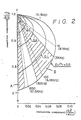
- Figure 2 shows the change in the normalized impedance of the detection coil when a nonmagnetic metallic plate is brought close to the detection coil.
- the upper left point corresponds to a state in which there is no metallic object in proximity of the detection coil and, hence, neither the change in the reactance nor the resistive component due to eddy current is produced.
- the normalized distance l1/r1 defined as a ratio of the distance to the object l1 (infinity to zero) to the radius r1 of the coil L1
- the curves in the graph denote the changes in the reactance and the resistance or, in other words, the loss in the coil against this normalized distance.
- the numerals (1, 10, 100 and 1,000) given in the graph are the values of the normalized frequency F at the corresponding points which are based on Equation (3) given below.
- the present invention is based on the proposal to use a low frequency range in which the change in the resistance or, in other words, the loss in the coil upon detection of relatively large metallic objects is great and the change in the resistance or, in other words, the loss in the coil upon detection of relatively small metallic pieces is small. If the frequency is lower than the region B, detection of even a metallic plate may become impossible.
- the oscillation frequency of the high frequency oscillation type proximity switch is reduced to the range of 3 to 30 kHz which is substantially lower than those of conventional high frequency oscillation type proximity switches. Therefore, planar objects can be detected from the generation of eddy current and the resulting change in the resistance in the coil but small metallic pieces will not generate any significant amount of eddy current and therefore causes very little changes in the resistance of the coil.
- the high frequency oscillation type proximity switch according to the present invention is sensitive to planar metallic objects made of aluminum, steel or the like and can detect them but does not detect minute metallic pieces produced by cutting such metallic objects. Therefore, when the high frequency oscillation type proximity switch of the present invention is used with a machine tool, the proximity switch will not be affected by the metallic chips which are produced as a result of the operation of the machine tool and can drastically improve the reliability of the control system which uses the proximity switch.
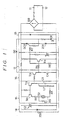
- FIG. 1 is a diagram showing a circuit structure of an AC 2-line high frequency oscillation type proximity switch according to an embodiment of the present invention.
- a diode bridge DB for full-wave rectification is connected to input terminals 11 and 12.
- the positive end of the diode bridge DB is connected to a switching circuit 13 having a thyristor SCR and a zener diode ZD1.
- the zener diode ZD1 supplies a constant voltage to various parts of the circuit when the thyristor SCR is in conductive state.
- a light emitting diode D1 is connected in parallel with the zener diode ZD1 for indicating the active state of the circuit.
- the zener diode ZD1 is further connected to a constant voltage circuit 14 having a zener diode ZD2 and a smoothing capacitor C2, by way of a diode D2.
- This proximity switch is provided with a Hartley oscillation circuit 15 having a parallel resonance circuit consisting of a detection coil L2 and a capacitor C3.
- the hot end of the coil L2 of the oscillation circuit 15 is connected to the base of a transistor Tr1 by way of a transistor Tr2 which is connected as a diode and the emitter of this transistor Tr1 is connected to an intermediate tap of the coil L2 by way of a resistor R1, a parallel connection of a thermistor R2 for temperature compensating the osciilation coil L2 and a resistor R3, and a resistor R4.
- the transistor Tr2 temperature compensates the base-emitter voltage of the transistor Tr1, and its oscillation output is supplied to an integration circuit 16 for its emitter.
- the collector of a transistor Tr3 in the integration circuit 16 is connected to the power while its emitter is connected to a smoothing capacitor C4 and its integration output is supplied to a comparison circuit 17.
- the comparison circuit 17 comprises a pair of resistors R5 and R6 which divide the emitter voltage of the transistor Tr3, and a transistor Tr4 which is controlled by the node between the resistors for discriminating the amplitude of the oscillation according to the output from the integration circuit 16. Its output is supplied from the collector of the transistor Tr4 to the gate of the thyristor SCR by way of a resistor R7.
- a low oscillation frequency is selected for this embodiment as described earlier.
- the detection coil consists of 800 turns of wire which is 0.06 mm in diameter (coil L 2a ) and the value of the capacitor C3 connected in parallel therewith is 0.02 micro F. If the inductance of the detection coil L 2a is 2.5 ⁇ 10 ⁇ 2 (H), the oscillation frequency of the oscillation circuit 15 will be 10 kHz. If the detection coil consists of 600 turns of wire which is 0.14 mm in diameter (coil L 2b ) and the inductance of the detection coil L 2b is 3.38 ⁇ 10 ⁇ 2 (H) while the value of the capacitor C3 connected in parallel therewith is 0.03 micro F, the oscillation frequency of the oscillation circuit 15 will be 5 kHz. Thus, a frequency range which is substantially lower than those of conventional high frequency oscillation type proximity switches is used.
- Tables 1 and 2 given in the following show the changes in the conductance g r of the detection coil L2 in relation with the distance to objects which consist of a steel plate and an aluminum plate, when the oscillation frequency is varied from 100 Hz to 500 kHz.
- Table 3 shows changes in the conductance g r of the detection coil L2 when the distance to the objects to be detected, in this case consisting of aluminum cutting chips as they are and aluminum cutting chips which are compressed by the load of 5 kg, is varied by an increment of 1 mm.
- the unit of conductance in these tables is given by siemens (S).
- the conductance of the detection coil when the metallic object to be detected is brought close to the detection coil must be greater than that of the detection coil when cutting chips are pushed against the detecting surface. Since the conductance of the detection coil varies with the distance to the object to be detected, it is possible to express a region which satisfies the above mentioned conditions as a detectable region by taking frequency on the horizontal axis and the distance to the object to be detected on the vertical axis.
- Figure 3 is such a graph which shows a detectable region in relation with frequency.
- the curve C1 denotes a region in which a steel plate produces a larger change in conductance than aluminum chips which are compressed with a pressure of 5 kg
- curve C2 denotes a detectable region for an aluminum plate under an identical circumstance.
- Curves D1 and D2 denote regions in which detection of a steel plate and an aluminum plate, respectively, is possible because they produce larger changes in conductance than aluminum chips in a distance zero (or, in other words, when they are accumulated on a detection surface).
- the curve C1 shows that there is a region in which detection is not possible when the frequency is below 2 kHz because the inductance of the detection coil increases and the loss in the coil increases as a steel plate is brought closer to the detection coil. Therefore, it is necessary to select the oscillation frequency of the oscillation circuit to be higher than 3 kHz. Meanwhile, the upper limit of the frequency is required to be lower than 100 kHz for detecting an aluminum plate. Further, a practical proximity switch must be capable of detecting a steel plate located at a certain distance for instance 8 mm or more and, therefore, the frequency must be lower than 30 kHz in the curve D1.
- a preferable range of the oscillation circuit of a proximity switch is from 3 kHz to 30 kHz and, if a sufficiently large detection range for a steel plate is required, the preferable range should be from 3 kHz to 15 kHz. Further, in order to avoid faulty detection of a steel plate due to the accumulation of aluminum chips on the detection surface, the preferable frequency range is 3 to 8 kHz.
- the proximity switch according to the present invention can be used as a proximity switch having a selective detection capability which detects an object in proximity depending on its shape.
- the constants for the coil given here are only exemplary and the number of winding turns and the inductance of the detection coil should be selected so as to obtain the above described ranges of frequency and inductance.
- the present embodiment pertained to a proximity switch which uses a normal Hartley oscillation circuit but it is obvious that similar results can be obtained even when oscillation circuits of other types are used.
Landscapes
- Electronic Switches (AREA)
Applications Claiming Priority (2)
| Application Number | Priority Date | Filing Date | Title |
|---|---|---|---|
| JP62083350A JPH069336B2 (ja) | 1987-04-03 | 1987-04-03 | 高周波発振型近接スイツチ |
| JP83350/87 | 1987-04-03 |
Publications (3)
| Publication Number | Publication Date |
|---|---|
| EP0286057A2 true EP0286057A2 (fr) | 1988-10-12 |
| EP0286057A3 EP0286057A3 (en) | 1990-08-08 |
| EP0286057B1 EP0286057B1 (fr) | 1994-07-13 |
Family
ID=13799986
Family Applications (1)
| Application Number | Title | Priority Date | Filing Date |
|---|---|---|---|
| EP88105410A Expired - Lifetime EP0286057B1 (fr) | 1987-04-03 | 1988-04-05 | Commutateur de proximité à circuit d'oscillation |
Country Status (4)
| Country | Link |
|---|---|
| EP (1) | EP0286057B1 (fr) |
| JP (1) | JPH069336B2 (fr) |
| AT (1) | ATE108586T1 (fr) |
| DE (1) | DE3850596T2 (fr) |
Cited By (2)
| Publication number | Priority date | Publication date | Assignee | Title |
|---|---|---|---|---|
| EP0399563A3 (fr) * | 1989-05-26 | 1991-07-17 | Omron Corporation | Commutateur de proximité du type à oscillations de haute fréquence |
| CN109981096A (zh) * | 2017-12-28 | 2019-07-05 | 阿自倍尔株式会社 | 非接触式开关以及夹持系统 |
Families Citing this family (2)
| Publication number | Priority date | Publication date | Assignee | Title |
|---|---|---|---|---|
| DE29906448U1 (de) * | 1999-04-12 | 1999-08-12 | Alfons Haar Maschinenbau Gmbh & Co, 22547 Hamburg | Sensor zur berührungslosen Messung der Drehung eines Rotors in einem Flüssigkeitsdurchflußmesser |
| DE102004014572B4 (de) | 2004-03-25 | 2023-06-07 | Cewe Stiftung & Co. Kgaa | Prüfanordnung und Prüfverfahren für Inhaltsprüfung von Fototaschen |
Family Cites Families (6)
| Publication number | Priority date | Publication date | Assignee | Title |
|---|---|---|---|---|
| US3133456A (en) * | 1960-03-07 | 1964-05-19 | Cross Co | Tool detector |
| FR2302502A1 (fr) * | 1975-02-27 | 1976-09-24 | Telemecanique Electrique | Detecteur de proximite a courant continu du type a deux fils a fonctions travail et/ou repos |
| CH621444A5 (en) * | 1977-08-23 | 1981-01-30 | Baumer Electric Ag | Electronic safety switch which works without contact |
| DE3009679A1 (de) * | 1980-03-11 | 1981-09-24 | Elmeg Elektro-Mechanik Gmbh, 3150 Peine | Verfahren zur unterscheidung von fahrzeugen unterschiedlicher bauart im strassenverkehr |
| ZA834105B (en) * | 1982-06-11 | 1984-02-29 | Square D Co | Proximity switch circuit |
| GB2138613B (en) * | 1983-03-16 | 1986-04-30 | Sarasota Automation | Inductive loop sensor |
-
1987
- 1987-04-03 JP JP62083350A patent/JPH069336B2/ja not_active Expired - Fee Related
-
1988
- 1988-04-05 AT AT88105410T patent/ATE108586T1/de active
- 1988-04-05 DE DE3850596T patent/DE3850596T2/de not_active Expired - Fee Related
- 1988-04-05 EP EP88105410A patent/EP0286057B1/fr not_active Expired - Lifetime
Cited By (2)
| Publication number | Priority date | Publication date | Assignee | Title |
|---|---|---|---|---|
| EP0399563A3 (fr) * | 1989-05-26 | 1991-07-17 | Omron Corporation | Commutateur de proximité du type à oscillations de haute fréquence |
| CN109981096A (zh) * | 2017-12-28 | 2019-07-05 | 阿自倍尔株式会社 | 非接触式开关以及夹持系统 |
Also Published As
| Publication number | Publication date |
|---|---|
| EP0286057B1 (fr) | 1994-07-13 |
| JPS63248220A (ja) | 1988-10-14 |
| EP0286057A3 (en) | 1990-08-08 |
| DE3850596D1 (de) | 1994-08-18 |
| ATE108586T1 (de) | 1994-07-15 |
| DE3850596T2 (de) | 1995-03-23 |
| JPH069336B2 (ja) | 1994-02-02 |
Similar Documents
| Publication | Publication Date | Title |
|---|---|---|
| US3764819A (en) | Electronic switch actuated by proximity of the human body | |
| EP0211142B1 (fr) | Dispositif pour mesurer des déplacements | |
| US5012206A (en) | Inductive proximity switch | |
| US4333052A (en) | Resonant circuit with two partial inductances | |
| AU2016241101B2 (en) | Inductive power transmitter | |
| CA1194943A (fr) | Methode de compensation des effets dus a la chaleur dans un circuit oscillant, oscillateur utilisant cette methode et usage de cet oscillateur | |
| CN102798339B (zh) | 用于位置的感应探测的位置传感器、致动器-传感器装置及方法 | |
| US3986104A (en) | Dual frequency metal detector system | |
| EP0286057B1 (fr) | Commutateur de proximité à circuit d'oscillation | |
| US2572908A (en) | Thickness gauge for magnetic material | |
| KR20190076478A (ko) | 코일을 이용한 인체 감지 장치 및 방법 | |
| US4958131A (en) | Circuit arrangement for the combined application of an inductive and capacitative device for the non-destructive measurement of the ohmic resistance of thin layers | |
| JPH06501557A (ja) | 近接感知装置および方法 | |
| EP0384029B1 (fr) | Système pour détecter l'entrée en contact d'une machine-outil | |
| US4638262A (en) | Proximity switch with improved response time and antimagnetic field circuitry | |
| EP0304272A2 (fr) | Détecteur de proximité à induction | |
| EP0378179A2 (fr) | Commutateur de proximité à micro-ondes | |
| KR102564924B1 (ko) | 정전용량 방식과 인덕터 방식을 혼용한 철 또는 비철금속을 감지하는 초 슬림형 근접센서 | |
| JPH054854B2 (fr) | ||
| US3745379A (en) | Thyristor control circuits including means for sensing the presence of an object | |
| US4139788A (en) | Test circuit for indication of deviation of source voltages from their set points | |
| JPS601481Y2 (ja) | 三軸方向を検出する近接スイツチ | |
| GB1581330A (en) | Device for detecting predetermined foaming conditions in fluids or emulsions | |
| JPH0734387Y2 (ja) | 近接センサ | |
| JPS6089719A (ja) | 水位検知装置 |
Legal Events
| Date | Code | Title | Description |
|---|---|---|---|
| PUAI | Public reference made under article 153(3) epc to a published international application that has entered the european phase |
Free format text: ORIGINAL CODE: 0009012 |
|
| 17P | Request for examination filed |
Effective date: 19880405 |
|
| AK | Designated contracting states |
Kind code of ref document: A2 Designated state(s): AT BE CH DE ES FR GB GR IT LI LU NL SE |
|
| PUAL | Search report despatched |
Free format text: ORIGINAL CODE: 0009013 |
|
| AK | Designated contracting states |
Kind code of ref document: A3 Designated state(s): AT BE CH DE ES FR GB GR IT LI LU NL SE |
|
| 17Q | First examination report despatched |
Effective date: 19910712 |
|
| GRAA | (expected) grant |
Free format text: ORIGINAL CODE: 0009210 |
|
| AK | Designated contracting states |
Kind code of ref document: B1 Designated state(s): AT BE CH DE ES FR GB GR IT LI LU NL SE |
|
| PG25 | Lapsed in a contracting state [announced via postgrant information from national office to epo] |
Ref country code: BE Effective date: 19940713 Ref country code: IT Free format text: LAPSE BECAUSE OF FAILURE TO SUBMIT A TRANSLATION OF THE DESCRIPTION OR TO PAY THE FEE WITHIN THE PRE;WARNING: LAPSES OF ITALIAN PATENTS WITH EFFECTIVE DATE BEFORE 2007 MAY HAVE OCCURRED AT ANY TIME BEFORE 2007. THE CORRECT EFFECTIVE DATE MAY BE DIFFERENT FROM THE ONE RECORDED.SCRIBED TIME-LIMIT Effective date: 19940713 Ref country code: AT Effective date: 19940713 Ref country code: GR Free format text: LAPSE BECAUSE OF FAILURE TO SUBMIT A TRANSLATION OF THE DESCRIPTION OR TO PAY THE FEE WITHIN THE PRESCRIBED TIME-LIMIT Effective date: 19940713 Ref country code: ES Free format text: THE PATENT HAS BEEN ANNULLED BY A DECISION OF A NATIONAL AUTHORITY Effective date: 19940713 Ref country code: CH Effective date: 19940713 Ref country code: LI Effective date: 19940713 Ref country code: NL Effective date: 19940713 |
|
| REF | Corresponds to: |
Ref document number: 108586 Country of ref document: AT Date of ref document: 19940715 Kind code of ref document: T |
|
| REF | Corresponds to: |
Ref document number: 3850596 Country of ref document: DE Date of ref document: 19940818 |
|
| ET | Fr: translation filed | ||
| PG25 | Lapsed in a contracting state [announced via postgrant information from national office to epo] |
Ref country code: SE Effective date: 19941013 |
|
| REG | Reference to a national code |
Ref country code: CH Ref legal event code: PL |
|
| NLV1 | Nl: lapsed or annulled due to failure to fulfill the requirements of art. 29p and 29m of the patents act | ||
| PG25 | Lapsed in a contracting state [announced via postgrant information from national office to epo] |
Ref country code: LU Free format text: LAPSE BECAUSE OF NON-PAYMENT OF DUE FEES Effective date: 19950430 |
|
| PLBE | No opposition filed within time limit |
Free format text: ORIGINAL CODE: 0009261 |
|
| STAA | Information on the status of an ep patent application or granted ep patent |
Free format text: STATUS: NO OPPOSITION FILED WITHIN TIME LIMIT |
|
| 26N | No opposition filed | ||
| REG | Reference to a national code |
Ref country code: GB Ref legal event code: IF02 |
|
| REG | Reference to a national code |
Ref country code: FR Ref legal event code: D6 |
|
| PGFP | Annual fee paid to national office [announced via postgrant information from national office to epo] |
Ref country code: GB Payment date: 20060410 Year of fee payment: 19 |
|
| PGFP | Annual fee paid to national office [announced via postgrant information from national office to epo] |
Ref country code: FR Payment date: 20060411 Year of fee payment: 19 |
|
| PGFP | Annual fee paid to national office [announced via postgrant information from national office to epo] |
Ref country code: DE Payment date: 20060428 Year of fee payment: 19 |
|
| GBPC | Gb: european patent ceased through non-payment of renewal fee |
Effective date: 20070405 |
|
| PG25 | Lapsed in a contracting state [announced via postgrant information from national office to epo] |
Ref country code: DE Free format text: LAPSE BECAUSE OF NON-PAYMENT OF DUE FEES Effective date: 20071101 |
|
| PG25 | Lapsed in a contracting state [announced via postgrant information from national office to epo] |
Ref country code: GB Free format text: LAPSE BECAUSE OF NON-PAYMENT OF DUE FEES Effective date: 20070405 |
|
| PG25 | Lapsed in a contracting state [announced via postgrant information from national office to epo] |
Ref country code: FR Free format text: LAPSE BECAUSE OF NON-PAYMENT OF DUE FEES Effective date: 20070430 |