EP0286327A2 - Traitement de fluides par coagulation - Google Patents
Traitement de fluides par coagulation Download PDFInfo
- Publication number
- EP0286327A2 EP0286327A2 EP88302935A EP88302935A EP0286327A2 EP 0286327 A2 EP0286327 A2 EP 0286327A2 EP 88302935 A EP88302935 A EP 88302935A EP 88302935 A EP88302935 A EP 88302935A EP 0286327 A2 EP0286327 A2 EP 0286327A2
- Authority
- EP
- European Patent Office
- Prior art keywords
- particles
- fluid
- magnetic field
- treatment
- water
- Prior art date
- Legal status (The legal status is an assumption and is not a legal conclusion. Google has not performed a legal analysis and makes no representation as to the accuracy of the status listed.)
- Withdrawn
Links
Images

Classifications
-
- C—CHEMISTRY; METALLURGY
- C02—TREATMENT OF WATER, WASTE WATER, SEWAGE, OR SLUDGE
- C02F—TREATMENT OF WATER, WASTE WATER, SEWAGE, OR SLUDGE
- C02F1/00—Treatment of water, waste water, or sewage
- C02F1/48—Treatment of water, waste water, or sewage with magnetic or electric fields
- C02F1/481—Treatment of water, waste water, or sewage with magnetic or electric fields using permanent magnets
- C02F1/482—Treatment of water, waste water, or sewage with magnetic or electric fields using permanent magnets located on the outer wall of the treatment device, i.e. not in contact with the liquid to be treated, e.g. detachable
-
- B—PERFORMING OPERATIONS; TRANSPORTING
- B03—SEPARATION OF SOLID MATERIALS USING LIQUIDS OR USING PNEUMATIC TABLES OR JIGS; MAGNETIC OR ELECTROSTATIC SEPARATION OF SOLID MATERIALS FROM SOLID MATERIALS OR FLUIDS; SEPARATION BY HIGH-VOLTAGE ELECTRIC FIELDS
- B03C—MAGNETIC OR ELECTROSTATIC SEPARATION OF SOLID MATERIALS FROM SOLID MATERIALS OR FLUIDS; SEPARATION BY HIGH-VOLTAGE ELECTRIC FIELDS
- B03C1/00—Magnetic separation
- B03C1/02—Magnetic separation acting directly on the substance being separated
- B03C1/023—Separation using Lorentz force, i.e. deflection of electrically charged particles in a magnetic field
-
- C—CHEMISTRY; METALLURGY
- C02—TREATMENT OF WATER, WASTE WATER, SEWAGE, OR SLUDGE
- C02F—TREATMENT OF WATER, WASTE WATER, SEWAGE, OR SLUDGE
- C02F1/00—Treatment of water, waste water, or sewage
- C02F1/46—Treatment of water, waste water, or sewage by electrochemical methods
- C02F1/4606—Treatment of water, waste water, or sewage by electrochemical methods for producing oligodynamic substances to disinfect the water
-
- C—CHEMISTRY; METALLURGY
- C02—TREATMENT OF WATER, WASTE WATER, SEWAGE, OR SLUDGE
- C02F—TREATMENT OF WATER, WASTE WATER, SEWAGE, OR SLUDGE
- C02F1/00—Treatment of water, waste water, or sewage
- C02F1/46—Treatment of water, waste water, or sewage by electrochemical methods
- C02F1/461—Treatment of water, waste water, or sewage by electrochemical methods by electrolysis
- C02F1/463—Treatment of water, waste water, or sewage by electrochemical methods by electrolysis by electrocoagulation
-
- C—CHEMISTRY; METALLURGY
- C02—TREATMENT OF WATER, WASTE WATER, SEWAGE, OR SLUDGE
- C02F—TREATMENT OF WATER, WASTE WATER, SEWAGE, OR SLUDGE
- C02F1/00—Treatment of water, waste water, or sewage
- C02F1/48—Treatment of water, waste water, or sewage with magnetic or electric fields
- C02F1/481—Treatment of water, waste water, or sewage with magnetic or electric fields using permanent magnets
-
- C—CHEMISTRY; METALLURGY
- C02—TREATMENT OF WATER, WASTE WATER, SEWAGE, OR SLUDGE
- C02F—TREATMENT OF WATER, WASTE WATER, SEWAGE, OR SLUDGE
- C02F1/00—Treatment of water, waste water, or sewage
- C02F1/50—Treatment of water, waste water, or sewage by addition or application of a germicide or by oligodynamic treatment
- C02F1/505—Treatment of water, waste water, or sewage by addition or application of a germicide or by oligodynamic treatment by oligodynamic treatment
-
- C—CHEMISTRY; METALLURGY
- C02—TREATMENT OF WATER, WASTE WATER, SEWAGE, OR SLUDGE
- C02F—TREATMENT OF WATER, WASTE WATER, SEWAGE, OR SLUDGE
- C02F2103/00—Nature of the water, waste water, sewage or sludge to be treated
- C02F2103/42—Nature of the water, waste water, sewage or sludge to be treated from bathing facilities, e.g. swimming pools
-
- C—CHEMISTRY; METALLURGY
- C02—TREATMENT OF WATER, WASTE WATER, SEWAGE, OR SLUDGE
- C02F—TREATMENT OF WATER, WASTE WATER, SEWAGE, OR SLUDGE
- C02F2303/00—Specific treatment goals
- C02F2303/04—Disinfection
Definitions
- This invention relates to methods and means for inducing the coagulation of particles in fluids.
- the invention may be employed in the removal of impurities from liquids or gases by inducing coagulation of such impurities to facilitate their collection and removal or prevent deposition on vessels, containers or other equipment in which fluid is contained or through which it passes.
- the invention may be employed to introduce materials into liquids or gases in a uniformly dispersed manner.
- the invention comprises a method for the treatment of a fluid to induce coagulation of particles in the fluid comprising subjecting the fluid to the influence of a repulsive magnetic field.
- resilient magnetic field is used herein to refer to a magnetic field generated between opposed like magnetic poles, that is to say opposed South poles or opposed North poles as distinct from a magnetic field generated between North and South poles which is termed an attractive magnetic field.
- oligo-dynamic particles of mineral or other substances are introduced into the fluid before, during or after the fluid is subjected to said magnetic field.
- the introduced particles are of finer size than and are numerically greater than the existing particles.
- the invention also provides apparatus for use in the treatment of fluids comprising means for generating a repulsive magnetic field and means constraining the fluid to pass into the influence of said magnetic field.
- the apparatus also includes means for effecting introduction of oligo-dynamic particles of minerals or other substances into the fluid before, during or after passage of the fluid into the influence of said field.
- said means for introducing said particles comprises a sacrificial anode incorporated in an electrical circuit with a cathode and the fluid as electrolyte.
- the electrical current flowing in said circuit may be self-induced or may be derived from an external electrical potential applied across the circuit.
- Said means for generating said magnetic field may comprise a permanent magnet or an electro-magnet.
- the invention may be applied in the treatment of hard water to prevent or reduce the deposition of scale on containers, conduits or apparatus in which the water is contained or through which it flows.
- the anode requires to be composed of a metal which is sufficiently separated on the galvanic scale from the cathode metal to form an electrolytic current consuming cell.
- anode metal in addition to releasing positively charged ions must release negatively charged salt particles and ions into the water during operation of the device, at least a substantial proportion of such particles and ions being non-adherent both to the anode and the cathode whereby to remain in suspension in the water.
- anode materials which produce amphoteric hydroxides, such as zinc, combined with a copper cathode.
- suitable materials from which the anode may be constructed include aluminium, silver and copper.
- the morphology produced by the invention overcomes the problems usually associated with the glutinous nature of aluminium hydroxide particles formed during electrolysis.
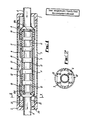
- Fig. 1 of the accompanying drawings which is a vertical cross-section through a device adapted to be inserted in a water supply pipe
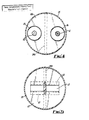
- Fig. 2 which is a cross-section on the line II - II in Fig. 1.
- the device comprises an outer casing 5 of plastics or other electrically insulating material from the opposite ends of which copper tubes 6 project for connection to a section of pipe in which the device is to be fitted.
- the copper tubes 6 are supported in end caps 7 of plastics or other electrically insulating material and are connected at their inner ends through copper connectors 8 to a section 9 of copper tube located within and spaced from the outer casing 5 of the device.
- Bushes 10 of nylon or other electrically insulating material are mounted within each end of the copper tube 9 and incorporate openings 10A in their ends through which liquid may flow.
- the bushes 10 act as supports for a stainless steel tube 11 within which rings 12 of zinc are a tight push fit.
- a section of the copper tube 9 is cut away to form an opening 15 through which passes a wire 16 incorporating a resistor 17.
- the opposite ends of the wire are connected to the copper tube 9 and stainless steel tube 11 thus forming an electrical connection between the copper tube which acts as a cathode and the steel tube and hence the zinc rings 11, which act as an anode. It has been found that the zinc maintains the stainless steel in an anodic mode.
- the resistor controls and stabilizes the current flow in the circuit and is preferably a 0.5 watt resistor of 500 ohms or greater.
- the self induced voltage generated by virtue of the different electrical potentials of the anode and cathode is very small, generally of the order of 0.5 m.V
- the device In operation the device is inserted into a supply conduit of, for example, a water system.
- a supply conduit of, for example, a water system.
- the connecting members 6 and tube 9 on the one hand and the rings 12 on the other hand are formed from different metals, a potential difference exists between them due to their different positions on the galvanic scale.
- liquid passes through the device it forms a conducting path allowing current to flow round the circuit formed by the wire 16.
- the liquid passing through the device is therefore subjected to a self-induced electric field which affects the electrical potential of the suspended scale-forming particles in the liquid and counters the deposition of scale.
- a permanent magnet or electro-magnet 20 is positioned at the outlet end of the device shown in Fig. 1.
- the magnet comprises a pair of opposed magnetic pole pieces 21 and 22 having their like poles, in the illustrated arrangement their North poles, directed towards one another so that the magnetic forces generated tend to repel one another and create a repulsive magnetic field between the pole pieces.
- the particles released by the zinc anodes of the electrolytic cell device pass through the magnetic field which has the effect of inducing very rapid coagulation of scale-forming particles in the water with the introduced particles.
- the organisms so formed remain in suspension in the water and are carried out of the device with the through flow of water.
- the device may be a passive electrolytic device in which no external power source is required for the electrolytic action, the current flow deriving from electrical potential generated by flow of water through the device.
- no external power source is required for the electrolytic action
- the current flow deriving from electrical potential generated by flow of water through the device may be achieved by exerting a more direct control over the electrolytic release of zinc or other particles from the anode and this can be done by applying an external potential and "driving" the chemical reaction at the electrode surface.
- the invention may also be employed to treat fluids by the introduction of materials having desired effects on the fluids or on vessels, containers or other equipment in which they are contained or through which they flow.
- One such application is in the treatment of swimming pools to disinfect the water and control the formation of algae.
- silver and copper salts are introduced, the former acting to destroy bacteria and the latter to kill algae.
- Previously proposed techniques of this kind have suffered from the drawback that it has been difficult to ensure adequate distribution of silver and copper salts throughout the pool water and the manner of introduction has tended to cause the silver and copper salts to react or combine with one another and become less effective.
- such salts are introduced using existing particles already within the water as carriers thereby eliminating these disadvantages.
- a method for treating water to eliminate bacteria and/or algae comprising introducing into the water electrically charged oligo-dynamic metallic salt particles of silver and/or copper, subjecting the water to a repulsive magnetic force, circulating the water through a pool, withdrawing the water, and extracting dead material by filtering.
- introduction and magnetic treatment is preferably effected separately in relation to each metallic salt before introducing the treated water to the pool.
- the oligo-dynamic particles are introduced by electrolysis using the water as electrolyte.
- the device comprises a cylindrical casing 25 of plastics or other electrically insulating material opposite ends of which are divided into semi-cylindrical chambers 26 and 27 by means of inlet and outlet dividers 28A and 28B also of electrically insulating material.
- Electrically insulating end pieces 29 and 30 are provided at opposite ends of the body 25 and incorporate centrally located inlet and outlet pipes 31 and 32 by means of which water to be treated flows into and out of the device. The direction of water flow is indicated by the arrows in Fig. 3.
- Copper tubes 33 and 34 are mounted within the casing 25 being supported at their opposite ends by support members 35A and 35B in the form of discs of plastics or other electrically insulating material.
- the tubes 33 and 34 are interconnected towards their inlet and outlet ends whereby water entering the device through inlet pipe 31 may flow through both tubes 33 and 34 before passing to the outlet pipe 32.
- a copper rod 40 supported in a nylon bush 40A in the end plug 29 is centrally mounted within the tube 33.
- a silver rod 41 in the form of an outer silver tube supported on a hollow nylon support through which a silver wire extends is also mounted in the end plug 29 and is centrally located within the copper tube 34.
- Each of the rods 40 and 41 constitutes an anode connected through an external electrical circuit with the associated copper tubes which act as permanent cathodes, the arrangment being such that the anodes 40 and 41 release electrically charged oligo-dynamic silver and copper salt particles and ions into water flowing over them from the inlet pipe 31 to the outlet pipe 32.
- the disc 42 is mounted in the casing 25 between the support member 35B and the outlet pipe 32 and incorporates a horizontal aperture 45 above and below which are located magnets 46 and 47 having their North poles directed towards the aperture.
- the magnets therefore create in the aperture 45 a repulsive magnetic field through which water flowing through the device and containing charged particles of copper and silver species passes to the outlet pipe 32.
- the central partition 28B extends through the aperture 45 whereby the salt and silver particles are maintained separate during their passage through the repulsive magnetic field. By virtue of the magnetic action the particles attach themselves to particles of impurities already contained within the water and thereby become essentially uniformly distributed through the water. After passage through the two sections of the opening 45 the treated water streams come together and leave the device through the outlet pipe 32.
- the salt particles attach themselves to the scale-forming particles or other impurities contained within and distributed throughout the water and are thus circulated to all regions of the pool to act upon bacteria and algae.
- controlled quantities of oligo-dynamic particles of the silver and copper species may be introduced as required and dead material removed by filtering to effect continuous purification treatment.
- oligo-dynamic silver species may also be used for a wide range of other purposes.
- the shelf and working life of cutting oils or other lubricants may be increased by introduction of silver species effective to kill bacteria which have the effect of decomposing constituents of the oil.
- Similar treatment may be applied to a wide range of food products to eliminate harmful bacteria, silver salts being suitable for treatment of food products as they have no harmful effects on the human body when limited to World Health Organisation restrictions. Deterioration of wine, beer, dyes, detergents and other products may also be prevented in this way.
- Silver may also be introduced into paint and similar coating materials to inhibit crustations and marine organisms from attaching to boats, oil platforms and the like.
- the invention may be employed in the treatment of plants, particularly in the field of hydroponics.
- nutrient salts may be introduced in the form of oligo-dynamic particles into water to be used for the nourishment of plants, the treated water then being subjected to a repulsive magnetic force.
- nutrients may be continuously fed over an extended period during plant growth.
- an electro-magnet supplied from an external electrical supply this may be varied at different times during the growth of the plant to alter the quantities of nutrient supplied in accordance with varations in the plant's requirements.
- the above embodiments refer to the treatment of liquids but the invention may also be applied to the treatment of gases or liquid/gas mixtures.
- gases or liquid/gas mixtures For example, by the introduction of oligo-dynamic particles into the discharge from power stations, followed by passage through a repulsive magnetic field, damaging nitrous oxide and sulphurous oxide contaminants may be induced to coagulate on the introduced particles and may then be removed by filtering before they are discharged to atmosphere.
- Impurities in vehicle exhausts gases may also be induced to coagulate in a similar manner and will then be discharged in solid form and not dispersed as gases into the surrounding atmosphere.
Landscapes
- Chemical & Material Sciences (AREA)
- Life Sciences & Earth Sciences (AREA)
- Hydrology & Water Resources (AREA)
- Engineering & Computer Science (AREA)
- Environmental & Geological Engineering (AREA)
- Water Supply & Treatment (AREA)
- Organic Chemistry (AREA)
- Chemical Kinetics & Catalysis (AREA)
- Electrochemistry (AREA)
- General Chemical & Material Sciences (AREA)
- Water Treatment By Electricity Or Magnetism (AREA)
Applications Claiming Priority (2)
| Application Number | Priority Date | Filing Date | Title |
|---|---|---|---|
| GB878708115A GB8708115D0 (en) | 1987-04-04 | 1987-04-04 | Coagulation treatment of fluids |
| GB8708115 | 1987-04-04 |
Publications (2)
| Publication Number | Publication Date |
|---|---|
| EP0286327A2 true EP0286327A2 (fr) | 1988-10-12 |
| EP0286327A3 EP0286327A3 (fr) | 1989-11-23 |
Family
ID=10615276
Family Applications (1)
| Application Number | Title | Priority Date | Filing Date |
|---|---|---|---|
| EP88302935A Withdrawn EP0286327A3 (fr) | 1987-04-04 | 1988-03-31 | Traitement de fluides par coagulation |
Country Status (4)
| Country | Link |
|---|---|
| US (1) | US4954263A (fr) |
| EP (1) | EP0286327A3 (fr) |
| AU (1) | AU1409488A (fr) |
| GB (2) | GB8708115D0 (fr) |
Cited By (7)
| Publication number | Priority date | Publication date | Assignee | Title |
|---|---|---|---|---|
| WO1994004465A1 (fr) * | 1992-08-21 | 1994-03-03 | Freeman Brian A | Colloide et systemes et procedes de traitement des eaux |
| WO2000000434A1 (fr) * | 1998-06-26 | 2000-01-06 | Mimi Georgieva Koleva | Procede et dispositif de purification et de desinfection de liquides |
| WO2001019736A1 (fr) * | 1999-09-15 | 2001-03-22 | Everclear Environmental Technologies Corporation | Systeme de traitement d'eau pour systeme de chauffage, de ventilation et de climatisation |
| WO2003010095A1 (fr) * | 2001-07-24 | 2003-02-06 | Karl-Johann Klein | Procede et dispositif de desinfection d'eau |
| WO2011008754A3 (fr) * | 2009-07-13 | 2011-04-28 | Mason Elmer B | Dispositif de traitement de fluide magnétohydrodynamique |
| CN103663632A (zh) * | 2013-11-27 | 2014-03-26 | 中煤张家口煤矿机械有限责任公司 | 一种磁流体絮凝沉降方式 |
| WO2021057553A1 (fr) * | 2019-09-29 | 2021-04-01 | 中国环境科学研究院 | Procédé de traitement complet de phytoplancton |
Families Citing this family (28)
| Publication number | Priority date | Publication date | Assignee | Title |
|---|---|---|---|---|
| US5271834A (en) * | 1989-03-30 | 1993-12-21 | Alice Isola | Apparatus for the magnetic treatment of a fluid |
| USD337148S (en) | 1991-01-11 | 1993-07-06 | Kyle Burns | Magnet holder for treatment of liquids |
| GB9106512D0 (en) * | 1991-03-27 | 1991-05-15 | Woodhouse Derek A | Control of scale formation |
| US5487788A (en) * | 1992-04-03 | 1996-01-30 | Tomei Sangyo Kabushiki Kaisha | Method for cleaning and disinfecting contact lens |
| JPH07104221A (ja) * | 1993-10-01 | 1995-04-21 | Tomey Technol Corp | コンタクトレンズの洗浄殺菌方法 |
| GB2285441B (en) * | 1994-01-28 | 1995-12-06 | Derek Alfred Woodhouse | Method and device for the treatment of water |
| US5460718A (en) * | 1994-04-08 | 1995-10-24 | Micasa Trading Corporation | Domestic water treating device including permanent magnet means |
| DE29506467U1 (de) * | 1995-04-15 | 1995-06-29 | Bossert, Gerdi, 78052 Villingen-Schwenningen | Vorrichtung zum Vernichten von Algen in Nutzwasseranlagen |
| JP3009353B2 (ja) * | 1995-08-23 | 2000-02-14 | 幸子 林 | 水処理方法および水処理設備 |
| US5772896A (en) * | 1996-04-05 | 1998-06-30 | Fountainhead Technologies | Self-regulating water purification composition |
| GB2351923A (en) * | 1999-07-12 | 2001-01-17 | Perkins Engines Co Ltd | Self-cleaning particulate filter utilizing electric discharge currents |
| US6428697B1 (en) * | 1999-07-30 | 2002-08-06 | William W. Edgar | System for processing waste water |
| US6802980B1 (en) | 2001-06-20 | 2004-10-12 | Sandia Corporation | Arsenic removal in conjunction with lime softening |
| US6641739B2 (en) * | 2001-12-14 | 2003-11-04 | Clearwater Systems, Llc | Process of forming an oxidizing agent in liquid by use of ringing magnetic flux |
| US6706196B2 (en) * | 2003-02-23 | 2004-03-16 | Herbert W. Holland | Method and apparatus for preventing scale deposits and removing contaminants from fluid columns |
| CA2472285C (fr) * | 2003-07-16 | 2012-08-28 | Frederick J. Dart | Dispositif et methode de traitement de l'eau |
| WO2006081683A1 (fr) * | 2005-02-07 | 2006-08-10 | Bauer Energy Design, Inc. | Systemes et procedes de generation de cristaux mineraux a faible potentiel zeta afin d'ameliorer la qualite de solutions liquides |
| US20080083468A1 (en) * | 2006-09-22 | 2008-04-10 | Eaton Corporation | Magnetic filtering hose |
| US7655116B1 (en) | 2007-03-21 | 2010-02-02 | Herb Tilsner | Anti-electrolysis system inhibiting the erosion metal objects |
| US8894851B1 (en) * | 2008-04-29 | 2014-11-25 | Puradyn Filter Technologies, Inc. | Lubricant purification system |
| KR100948338B1 (ko) * | 2008-05-14 | 2010-03-22 | 심학섭 | 유체의 정전처리 장치 |
| US9272292B1 (en) * | 2010-11-12 | 2016-03-01 | Mccormick And Munson Technologies, Llc | Electronic biological eliminator for inhibiting bio-film and microorganism development in fuels and lubricants |
| RU2486012C1 (ru) * | 2012-04-19 | 2013-06-27 | Федеральное государственное бюджетное учреждение науки Институт горного дела Дальневосточного отделения РАН (ИГД ДВО РАН) | Способ извлечения железосодержащих компонентов из техногенного материала тонкого класса |
| US20150376044A1 (en) * | 2013-05-06 | 2015-12-31 | Mary M.F. Richmond | Water purification process with water pretratment |
| AU2014331497A1 (en) | 2013-10-03 | 2016-03-17 | Ebed Holdings Inc. | Nanobubble-containing liquid solutions |
| RU2594544C1 (ru) * | 2015-02-06 | 2016-08-20 | Владимир Сергеевич Баев | Способ переработки техногенных отходов металлургических и горно-обогатительных производств |
| CN104959185B (zh) * | 2015-06-16 | 2017-06-23 | 安徽智宸蓝藻治理科技有限公司 | 蓝藻挤压破碎装置 |
| CN110540327A (zh) * | 2019-08-27 | 2019-12-06 | 首创爱华(天津)市政环境工程有限公司 | 一种活性砂微絮凝污水深度处理工艺 |
Family Cites Families (22)
| Publication number | Priority date | Publication date | Assignee | Title |
|---|---|---|---|---|
| US2046467A (en) * | 1931-01-29 | 1936-07-07 | Katadyn Inc | Sterilization of liquids by means of oligodynamy |
| US2344548A (en) * | 1940-02-06 | 1944-03-21 | Sunshine Mining Company | Method and apparatus providing a continuously effective source for oligodynamic sterilization |
| LU28155A1 (fr) * | 1945-10-06 | |||
| GB1202100A (en) * | 1967-10-18 | 1970-08-12 | Bethlehem Steel Corp | Magnetic separator method and apparatus |
| US3890224A (en) * | 1970-05-04 | 1975-06-17 | Commw Scient Ind Res Org | Process for controlling surface pollutants |
| US3830621A (en) * | 1972-01-31 | 1974-08-20 | Lectro Static Magnetic Corp | Process and apparatus for effecting efficient combustion |
| US3875743A (en) * | 1973-08-10 | 1975-04-08 | Joe F Mercer | Exhaust device for internal combustion engines |
| US4187170A (en) * | 1977-01-27 | 1980-02-05 | Foxboro/Trans-Sonics, Inc. | Magnetic techniques for separating non-magnetic materials |
| FR2431995B1 (fr) * | 1978-07-27 | 1985-07-05 | Vellas Jean | Procede pour le traitement par voie oligodynamique de liquides et dispositif pour sa mise en oeuvre |
| DE2911288C2 (de) * | 1979-03-22 | 1984-08-30 | Bernd 8000 München Eder | Verfahren zum Entkeimen von Wasser, insbesondere von Schwimmbeckenwasser |
| US4416854A (en) * | 1979-08-24 | 1983-11-22 | Sharon G. Nielsen | Method for killing water borne microorganisms |
| US4291125A (en) * | 1980-01-16 | 1981-09-22 | Greatbatch W | Method for electronic control of infections using silver ions |
| DE3018854A1 (de) * | 1980-05-16 | 1981-11-19 | Licencia Találmányokat Ertékesítö Vállalat, Budapest | Vorrichtung zum behandeln von wasser o.a. fluessigkeiten mit einem magnetischen kraftfeld |
| US4372852A (en) * | 1980-11-17 | 1983-02-08 | Kovacs Albert J | Magnetic device for treating hydrocarbon fuels |
| US4320003A (en) * | 1981-01-09 | 1982-03-16 | Kemtune, Inc. | Bypass water conditioner |
| US4367143A (en) * | 1981-06-03 | 1983-01-04 | Aqua Magnetics, Inc. | Apparatus for magnetically treating liquid flowing through a pipe and clamping means therefor |
| CA1208411A (fr) * | 1982-11-04 | 1986-07-29 | San-Mar Environmental Corporation | Dispositif de repression des algues |
| US4519919A (en) * | 1983-05-19 | 1985-05-28 | Lance Whyte | Method and apparatus for magnetically treating fluids |
| US4568901A (en) * | 1984-11-21 | 1986-02-04 | A Z Industries | Magnetic fuel ion modifier |
| GB2170736B (en) * | 1984-12-19 | 1988-02-03 | Bio Separation Ltd | Process for magnetic separation of metals from aqueous media |
| AT384600B (de) * | 1985-03-29 | 1987-12-10 | Mach Guido | Verfahren zur aufbereitung von trink- und/oder brauchwasser und vorrichtung zum durchfuehren des verfahrens |
| US4755268A (en) * | 1986-05-28 | 1988-07-05 | Yoshiaki Matsuo | Process and apparatus for producing silver-ionic water |
-
1987
- 1987-04-04 GB GB878708115A patent/GB8708115D0/en active Pending
-
1988
- 1988-03-31 US US07/175,769 patent/US4954263A/en not_active Expired - Fee Related
- 1988-03-31 AU AU14094/88A patent/AU1409488A/en not_active Abandoned
- 1988-03-31 EP EP88302935A patent/EP0286327A3/fr not_active Withdrawn
- 1988-03-31 GB GB08807775A patent/GB2204813A/en active Pending
Cited By (7)
| Publication number | Priority date | Publication date | Assignee | Title |
|---|---|---|---|---|
| WO1994004465A1 (fr) * | 1992-08-21 | 1994-03-03 | Freeman Brian A | Colloide et systemes et procedes de traitement des eaux |
| WO2000000434A1 (fr) * | 1998-06-26 | 2000-01-06 | Mimi Georgieva Koleva | Procede et dispositif de purification et de desinfection de liquides |
| WO2001019736A1 (fr) * | 1999-09-15 | 2001-03-22 | Everclear Environmental Technologies Corporation | Systeme de traitement d'eau pour systeme de chauffage, de ventilation et de climatisation |
| WO2003010095A1 (fr) * | 2001-07-24 | 2003-02-06 | Karl-Johann Klein | Procede et dispositif de desinfection d'eau |
| WO2011008754A3 (fr) * | 2009-07-13 | 2011-04-28 | Mason Elmer B | Dispositif de traitement de fluide magnétohydrodynamique |
| CN103663632A (zh) * | 2013-11-27 | 2014-03-26 | 中煤张家口煤矿机械有限责任公司 | 一种磁流体絮凝沉降方式 |
| WO2021057553A1 (fr) * | 2019-09-29 | 2021-04-01 | 中国环境科学研究院 | Procédé de traitement complet de phytoplancton |
Also Published As
| Publication number | Publication date |
|---|---|
| AU1409488A (en) | 1988-10-06 |
| EP0286327A3 (fr) | 1989-11-23 |
| GB8708115D0 (en) | 1987-05-13 |
| GB2204813A (en) | 1988-11-23 |
| US4954263A (en) | 1990-09-04 |
| GB8807775D0 (en) | 1988-05-05 |
Similar Documents
| Publication | Publication Date | Title |
|---|---|---|
| US4954263A (en) | Coagulation treatment of fluids | |
| US5753100A (en) | Ionization-type water purification system | |
| EP0128782B1 (fr) | Purificateur d'eau | |
| US7238289B2 (en) | Fluid treatment apparatus | |
| US5948273A (en) | Water purification process and apparatus | |
| EP0743924A1 (fr) | Generateur electrocatalytique d'oxygene dissous pour le traitement de l'eau | |
| KR101702345B1 (ko) | 초고속 조류 제거 장치 및 방법 | |
| US6332960B1 (en) | Electrostatic fluid purifying device and method of purifying a fluid | |
| US20120241323A1 (en) | Previously entitled "FLUID TREATMENT METHOD AND SYSTEM USING FLOWING GENERATOR TO TREAT WATER" herein amended to "FLUID TREATMENT" | |
| CN102633325A (zh) | 一种新型纳米催化电解装置 | |
| US5938900A (en) | Method and apparatus for treating water | |
| JP2011511709A (ja) | 水処理のための、方法、システム、及び装置 | |
| US7906025B2 (en) | Systems and methods for treatment of liquid solutions for use with livestock operations | |
| RU2043308C1 (ru) | Способ электрохимической очистки питьевой воды | |
| US3701728A (en) | Water purification system | |
| JPS61204085A (ja) | 銅イオン溶出装置 | |
| WO2016010412A1 (fr) | Appareil pour le traitement de l'eau à l'aide d'un champ magnétique | |
| JP3985247B2 (ja) | アオコの死滅方法 | |
| EP1342696B1 (fr) | Procédé et appareil pour contrôler l'encrassement d'une installation d'eau | |
| EP0812302B1 (fr) | Ionisateur de desinfection de l'eau et extraction de contaminants | |
| WO1991001275A1 (fr) | Appareil de traitement des eaux | |
| JP3034388U (ja) | 理水処理装置 | |
| JPS589715B2 (ja) | 水処理装置 | |
| JPS61133194A (ja) | 水の殺菌処理方法及びその装置 | |
| CA2112600A1 (fr) | Methode et appareil servant a traiter des liquides |
Legal Events
| Date | Code | Title | Description |
|---|---|---|---|
| PUAI | Public reference made under article 153(3) epc to a published international application that has entered the european phase |
Free format text: ORIGINAL CODE: 0009012 |
|
| AK | Designated contracting states |
Kind code of ref document: A2 Designated state(s): BE DE ES FR IT |
|
| PUAL | Search report despatched |
Free format text: ORIGINAL CODE: 0009013 |
|
| AK | Designated contracting states |
Kind code of ref document: A3 Designated state(s): BE DE ES FR IT |
|
| RHK1 | Main classification (correction) |
Ipc: C02F 1/48 |
|
| 17P | Request for examination filed |
Effective date: 19900508 |
|
| 17Q | First examination report despatched |
Effective date: 19910319 |
|
| STAA | Information on the status of an ep patent application or granted ep patent |
Free format text: STATUS: THE APPLICATION IS DEEMED TO BE WITHDRAWN |
|
| 18D | Application deemed to be withdrawn |
Effective date: 19910730 |