EP0286423A2 - Procédé et appareil d'expansion du tabac - Google Patents
Procédé et appareil d'expansion du tabac Download PDFInfo
- Publication number
- EP0286423A2 EP0286423A2 EP88303152A EP88303152A EP0286423A2 EP 0286423 A2 EP0286423 A2 EP 0286423A2 EP 88303152 A EP88303152 A EP 88303152A EP 88303152 A EP88303152 A EP 88303152A EP 0286423 A2 EP0286423 A2 EP 0286423A2
- Authority
- EP
- European Patent Office
- Prior art keywords
- tobacco
- zone
- impregnant
- expansion
- impregnated
- Prior art date
- Legal status (The legal status is an assumption and is not a legal conclusion. Google has not performed a legal analysis and makes no representation as to the accuracy of the status listed.)
- Withdrawn
Links
- 235000002637 Nicotiana tabacum Nutrition 0.000 title claims abstract description 101
- 238000000034 method Methods 0.000 title claims abstract description 41
- 244000061176 Nicotiana tabacum Species 0.000 title 1
- 241000208125 Nicotiana Species 0.000 claims abstract description 100
- 239000007789 gas Substances 0.000 claims abstract description 33
- 239000007792 gaseous phase Substances 0.000 claims abstract description 4
- 238000011084 recovery Methods 0.000 claims description 12
- XLYOFNOQVPJJNP-UHFFFAOYSA-N water Substances O XLYOFNOQVPJJNP-UHFFFAOYSA-N 0.000 claims description 11
- 238000005470 impregnation Methods 0.000 claims description 8
- 230000003247 decreasing effect Effects 0.000 abstract description 4
- 239000007788 liquid Substances 0.000 description 11
- 150000001875 compounds Chemical class 0.000 description 5
- 238000009833 condensation Methods 0.000 description 4
- 230000005494 condensation Effects 0.000 description 4
- 238000012360 testing method Methods 0.000 description 4
- 230000000694 effects Effects 0.000 description 3
- 238000010438 heat treatment Methods 0.000 description 3
- 238000012986 modification Methods 0.000 description 3
- 230000004048 modification Effects 0.000 description 3
- OKTJSMMVPCPJKN-UHFFFAOYSA-N Carbon Chemical compound [C] OKTJSMMVPCPJKN-UHFFFAOYSA-N 0.000 description 2
- -1 alkanols Chemical class 0.000 description 2
- 238000001816 cooling Methods 0.000 description 2
- 239000012530 fluid Substances 0.000 description 2
- 238000005259 measurement Methods 0.000 description 2
- 239000000203 mixture Chemical class 0.000 description 2
- 239000002245 particle Substances 0.000 description 2
- 238000011144 upstream manufacturing Methods 0.000 description 2
- 239000002351 wastewater Substances 0.000 description 2
- 125000001931 aliphatic group Chemical class 0.000 description 1
- 150000001338 aliphatic hydrocarbons Chemical class 0.000 description 1
- 150000004945 aromatic hydrocarbons Chemical class 0.000 description 1
- 238000009835 boiling Methods 0.000 description 1
- 150000002170 ethers Chemical class 0.000 description 1
- 150000008282 halocarbons Chemical class 0.000 description 1
- 150000002576 ketones Chemical class 0.000 description 1
- 238000012544 monitoring process Methods 0.000 description 1
- 150000002894 organic compounds Chemical class 0.000 description 1
- 230000001007 puffing effect Effects 0.000 description 1
- 238000000746 purification Methods 0.000 description 1
- 238000005070 sampling Methods 0.000 description 1
- 238000005201 scrubbing Methods 0.000 description 1
- 239000002904 solvent Substances 0.000 description 1
- CYRMSUTZVYGINF-UHFFFAOYSA-N trichlorofluoromethane Chemical compound FC(Cl)(Cl)Cl CYRMSUTZVYGINF-UHFFFAOYSA-N 0.000 description 1
Images
Classifications
-
- A—HUMAN NECESSITIES
- A24—TOBACCO; CIGARS; CIGARETTES; SIMULATED SMOKING DEVICES; SMOKERS' REQUISITES
- A24B—MANUFACTURE OR PREPARATION OF TOBACCO FOR SMOKING OR CHEWING; TOBACCO; SNUFF
- A24B3/00—Preparing tobacco in the factory
- A24B3/18—Other treatment of leaves, e.g. puffing, crimpling, cleaning
- A24B3/182—Puffing
Definitions
- the invention relates to process and apparatus for expanding tobacco. More specifically, the invention relates to a tobacco expansion process and apparatus wherein tobacco is impregnated with a volatile impregnant and the resultant moistened tobacco treated in an expansion zone maintained under conditions causing the rapid volatilization of the impregnant with concomitant expansion of the tobacco.
- Tobacco expansion is disclosed in numerous U.S. and foreign patents and practiced commercially throughout the world.
- Major commercial tobacco expansion processes involve impregnating the tobacco with a volatile impregnant and then subjecting the impregnated tobacco to rapid heating to thereby volatilize the impregnant and expand the tobacco.
- Various impregnants have been used or proposed for use in tobacco expansion.
- One widely used group of impregnants are present as a liquid within the tobacco just prior to expansion.
- U.S. Patent No. 3,524,451 to Fredrickson and U.S. Patent No. 3,524,452 to Moser et al disclose impregnation of tobacco with an organic liquid and thereafter exposing the moistened tobacco to a stream of hot gas whereby the liquid is quickly vaporized with the simultaneous puffing or expansion of the tobacco particles.
- the impregnating liquid employed is substantially chemically inert with respect to the tobacco and falls generally in the classes of aliphatic hydrocarbons, aromatic hydrocarbons, alkanols, ketones, aliphatic esters, ethers, halogenated hydrocarbons and mixtures thereof.
- the latter group of organic compounds, particularly freons have been widely used in the above process.
- tobacco and a stream of vapors of the impregnant are introduced into one end of an impregnation zone and moved in concurrent flow relation to the other end of the impregnation zone during which time the tobacco becomes thoroughly impregnated with the compound.
- the impregnant moistened tobacco is then passed directly into a vapor expansion zone comprising a stream of hot gas.
- U.S. Patent 3,788,331 to Neel et al discloses one such process wherein the organic impregnant is recovered from the hot expansion gas stream by passing a portion of the gas stream into a lower section of a water scrubber comprising a packed tower.
- the hot gas is countercurrently contacted with water introduced at the upper end of the packed tower to thereby effect: removal of tobacco fines from the gas stream; cooling of the stream; condensation of a substantial portion of water present therein; and stripping of organic impregnant from process waste water introduced into the upper section of the tower.
- the organic impregnant is then condensed and recovered by conventional procedures.
- U.S. Patent 3,780,744 to Neel et al discloses recovery of vaporized organic liquid in such tobacco expansion processes by collecting organic impregnant containing vapors normally lost to the atmosphere from tobacco and passing sequentially the collected organic impregnant containing vapors through a separator and then through a bed of activated carbon.
- the invention provides a process for increasing the filling capacity of tobacco comprising the steps: impregnating tobacco with a volatile impregnant in a first zone; recovering impregnated tobacco from the first zone and rapidly passing the impregnated tobacco through a discrete second zone wherein a gaseous phase containing volatile impregnant is removed; expanding tobacco from the second zone in a third discrete zone by contacting the tobacco with a stream of hot gases; and recovering the volatile impregnant removed in the second zone.
- the invention provides apparatus for expanding tobacco comprising: means for impregnating tobacco with a volatile impregnant; a separate, short residence time, e.g., less than ten seconds, vapor removal means downstream of the impregnation means for removing impregnant vapors from impregnated tobacco; and expansion means downstream of the vapor removal means for contacting the tobacco with a stream of hot gas to thereby expand the tobacco.
- the process and apparatus of the invention can provide more efficient use of organic impregnant in a tobacco expansion process and can result in less residual impregnant in the expanded tobacco.
- the improved efficiency tobacco process of the invention is best conducted using the continuous tobacco expansion processes in accordance with the teachings of U.S. Patent No. 3,693,631 issued September 26, 1972 to Moore et al, which is hereby incorporated by reference and in accordance with the teachings of U.S. Patent No. 3,575,178 issued April 20, 1971 to Stewart, which is hereby incorporated by reference. Such processes are considered to be continuous tobacco expansion processes.
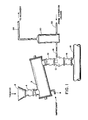
- FIG. 1 illustrates in schematic form, one preferred apparatus embodiment of the invention in which the process of the invention can be conducted.
- Shredded flue-cured or burley tobacco is charged to hopper, 2.
- the tobacco has a water content of 10 to 30%, suitably about 18%, by weight.
- upstream of hopper 2 can be used to adjust the moisture content where desirable or necessary.
- Tobacco in hopper 2 is passed via star feed valve 4 or a similar pressure lock feed valve into impregnator 6 which is advantageously maintained under superatmospheric pressure.
- the impregnator advantageously contains a screw conveyor (not shown) within its interior which, in turn, advances the tobacco through the impregnator from left to right as shown in the drawing.
- vapors of the impregnating compound are introduced via vapor line 8 into the interior of the impregnator.
- the impregnator preferably also includes an outer jacket (not shown) through which heat exchange media may be circulated for appropriate temperature control.
- the vapors come into contact with the tobacco within impregnator and at least a portion of the vapor is condensed on and in the tobacco particles.
- Feed rate of impregnant vapor passing through line 8 is determined by the pressure within the impregnator, which, in turn, is influenced by the rate at which relatively cool tobacco enters through valve 4.
- the vapor feed rates are easily controlled to give an impregnated tobacco containing between 5 and about 200 parts by weight of impregnant per 100 parts of tobacco (dry basis). During the concurrent flow of tobacco and impregnant through impregnator 6, the tobacco is thoroughly impregnated with the volatile impregnant.
- the tobacco is discharged from impregnator through star feed valve 10 and rapidly passed through an impregnant removal zone 12.
- a vapor stream containing gaseous impregnant is removed via vapor line 14.
- Vapor line 14 is preferably maintained at a pressure substantially below that of impregnator 6, thus reducing the pressure within impregnant removal zone 12 substantially below that of the impregnation zone, and causing vapor to be removed via line 14.
- impregnator can be operated at superatmospheric pressure of 20 psig. (238kPa) while pressure within the impregnant removal zone 12 can be at about atmospheric, i.e., 0 psig (100kPa).
- vapor removal from the vapor removal zone can be effected by arrangements other than the pressure differential arrangement discussed above.
- vapor removal can be effected by a sweep gas.
- impregnant removal zone 12 can be maintained at a pressure near but less than the pressure in impregnator 6, and a sweep gas can be introduced into zone 12 via an inlet line (not shown) to sweep impregnant vapors out of zone 12 through line 14.
- a sweep gas should preferably be at a temperature less than or about the same as the tobacco exiting impregnator, 6, and should have a composition substantially inert with respect to the tobacco, e.g., moist air. It will be recognized that with the star valve arrangement shown in FIG.
- Tobacco residence time within impregnant removal zone 12 is short, preferably ten seconds or less, more preferably five seconds or less, most preferably three seconds or less, for example, one second.
- zone 12 is constructed and arranged as a short residence zone. This can be accomplished in various ways. For example, as shown in the drawing, the volume of zone 12 is small. Similarly, the relative speeds of pressure lock feed valves 10 and 16 can be varied to decrease residence time.
- Tobacco is then discharged from zone 12 via star valve 16 into a rapidly moving stream of hot gas in duct 18 and then conveyed to a conventional expansion column which is advantageously substantially in the same form described in the aforementioned '631 and '178 patents.
- the hot gas in duct 18 has a temperature substantially greater than the boiling point of the impregnating compound at the prevailing pressure so that when the tobacco contacts the hot gas, the impregnating compound will vaporize or the vapors within the tobacco will expand to cause the concomitant expansion of tobacco. This expansion occurs within a short time (e.g., less than 10 seconds) during which the gas and tobacco flow through duct 18 and then upwardly through a conventional expansion column (not shown). Because of impregnant vapor removal n zone 12, this expansion in the hot gas stream can allow for a more complete removal of impregnant from tobacco than n prior expansion processes.
- the tobacco, heating gas and vapors of impregnating compounds are convened to a conventional cyclone separator from which the expanded tobacco is passed through an airlock and thereafter to conventional stripping and reordering means wherein the product is adjusted to the desired moisture content, suitably 12 to 14%.
- Gases including steam and vapors of impregnating fluid are withdrawn from the cyclone separator and are recycled and reheated to the desired extent and then recycled back through duct 18. A sidestream of the gases being recycled is withdrawn prior to heating and passed to scrubber 20 via vapor line 22.
- the hot gas is countercurrently contacted with water introduced at the upper end of the packed tower via means, not shown, to thereby effect removal of tobacco fines from the gas stream, cooling of the gas stream, condensation of a substantial portion of the water present therein, and stripping of organic impregnant from process waste water.
- the thus treated vapor is passed via line 24 to conventional liquid recovery means wherein the vapor is condensed in liquid form, separated from water and can be recycled to impregnator 6.
- the aforedescribed scrubbing and vapor recovery operation is more fully described in U.S. Patent No. 3,788,331 to Neel et al which is hereby incorporated by reference.
- vapors withdrawn from impregnant removal zone 12 via line 14, which contain a substantial percentage of impregnant vapors, are also treated for recovery of impregnant.
- the vapors withdrawn from zone 12 are passed countercurrently through water scrubber 20, which is the same scrubber used to treat gases removed from the expansion column.
- the vapor is passed via line 24 to conventional liquid recovery means for condensation and purification of the impregnant.
- the vapors removed from zone 12 will be impregnant rich, i.e., contain a high percentage of impregnant.
- recovery of the impregnant is a relatively efficient process as opposed to prior art systems where this fraction of impregnant was mixed with gasses in the expansion zone prior to recovery. It will be recognized that various recovery operations can be substituted for the scrubber/condensation process described above.
- impregnator 6 can also be operated in the manner described in U.S. Patent No. 3,575,178, according to which, a small pool of volatile impregnant liquid is maintained at the entrance end of the impregnator.
- pressure within impregnator 6 can be maintained at atmospheric or subatmospheric pressures depending on temperature and on the nature of the impregnant. Other such modifications will be apparent.
- Percent freon in the expansion column was measured by gas sampling at a location in the expansion zone just upstream of the location where tobacco falls into the column.
- Rate of freon use in gallons per hour was measured by monitoring freon admitted to the system and freon recovered from the system. It is to be noted that in these tests freon was continuously recovered from the expansion column according to the process described in U.S. Patent 3,788,331; but the post expansion freon recovery described in U.S. Patent 3,780,744 was not used.
- Residual freon in product was measured by recovering a small sample of expanded tobacco immediately after expansion and solvent extracting freon from the expanded product.
Landscapes
- Manufacture Of Tobacco Products (AREA)
- Vaporization, Distillation, Condensation, Sublimation, And Cold Traps (AREA)
Applications Claiming Priority (2)
| Application Number | Priority Date | Filing Date | Title |
|---|---|---|---|
| US07/036,938 US4870980A (en) | 1987-04-10 | 1987-04-10 | Tobacco expansion process and apparatus |
| US36938 | 1987-04-10 |
Publications (2)
| Publication Number | Publication Date |
|---|---|
| EP0286423A2 true EP0286423A2 (fr) | 1988-10-12 |
| EP0286423A3 EP0286423A3 (fr) | 1990-05-23 |
Family
ID=21891523
Family Applications (1)
| Application Number | Title | Priority Date | Filing Date |
|---|---|---|---|
| EP88303152A Withdrawn EP0286423A3 (fr) | 1987-04-10 | 1988-04-08 | Procédé et appareil d'expansion du tabac |
Country Status (5)
| Country | Link |
|---|---|
| US (1) | US4870980A (fr) |
| EP (1) | EP0286423A3 (fr) |
| JP (1) | JPS63254973A (fr) |
| CN (1) | CN88101384A (fr) |
| AU (1) | AU599874B2 (fr) |
Cited By (1)
| Publication number | Priority date | Publication date | Assignee | Title |
|---|---|---|---|---|
| WO2010069237A1 (fr) * | 2008-12-19 | 2010-06-24 | 贵州中烟工业有限责任公司 | Procédé et appareil pour récupérer un agent d’expansion du tabac |
Families Citing this family (3)
| Publication number | Priority date | Publication date | Assignee | Title |
|---|---|---|---|---|
| US5143096A (en) * | 1991-02-04 | 1992-09-01 | The Boc Group, Inc. | Method and apparatus for expanding cellular materials |
| US5259403A (en) * | 1992-03-18 | 1993-11-09 | R. J. Reynolds Tobacco Company | Process and apparatus for expanding tobacco cut filler |
| CN106031525A (zh) * | 2015-03-18 | 2016-10-19 | 北京航天试验技术研究所 | 一种降低介质损耗的烟丝膨胀工艺 |
Family Cites Families (10)
| Publication number | Priority date | Publication date | Assignee | Title |
|---|---|---|---|---|
| US3524451A (en) * | 1968-04-10 | 1970-08-18 | Reynolds Tobacco Co R | Process for increasing the filling capacity of tobacco |
| US3575178A (en) * | 1969-03-13 | 1971-04-20 | Reynolds Tobacco Co R | A process for increasing the filling capacity of tobacco |
| AU2335070A (en) * | 1970-12-15 | 1972-06-22 | R. J. Reynolds Tobacco Company | Process for expanding tobacco |
| US3693631A (en) * | 1971-04-28 | 1972-09-26 | Reynolds Leasing Corp | Tobacco expansion process |
| US3788331A (en) * | 1972-06-26 | 1974-01-29 | Reynolds Tobacco Co R | Solvent recovery in tobacco treating process |
| US3780744A (en) * | 1972-06-26 | 1973-12-25 | Reynolds Tobacco Co R | Recovery of organic liquids used for treating tobacco |
| GB1604024A (en) * | 1977-09-03 | 1981-12-02 | Hauni Werke Koerber & Co Kg | Method and apparatus for increasing the filling property of fibres of tobacco or another smokable material |
| US4333483A (en) * | 1978-03-29 | 1982-06-08 | Philip Morris Incorporated | Tobacco product |
| US4460000A (en) * | 1982-06-14 | 1984-07-17 | The Boc Group, Inc. | Vacuum and gas expansion of tobacco |
| GB8315987D0 (en) * | 1983-06-10 | 1983-07-13 | British American Tobacco Co | Expansion of tobacco |
-
1987
- 1987-04-10 US US07/036,938 patent/US4870980A/en not_active Expired - Fee Related
-
1988
- 1988-03-28 CN CN198888101384A patent/CN88101384A/zh active Pending
- 1988-03-30 JP JP63074851A patent/JPS63254973A/ja active Pending
- 1988-04-08 EP EP88303152A patent/EP0286423A3/fr not_active Withdrawn
- 1988-04-08 AU AU14406/88A patent/AU599874B2/en not_active Ceased
Cited By (1)
| Publication number | Priority date | Publication date | Assignee | Title |
|---|---|---|---|---|
| WO2010069237A1 (fr) * | 2008-12-19 | 2010-06-24 | 贵州中烟工业有限责任公司 | Procédé et appareil pour récupérer un agent d’expansion du tabac |
Also Published As
| Publication number | Publication date |
|---|---|
| US4870980A (en) | 1989-10-03 |
| CN88101384A (zh) | 1988-10-26 |
| EP0286423A3 (fr) | 1990-05-23 |
| JPS63254973A (ja) | 1988-10-21 |
| AU599874B2 (en) | 1990-07-26 |
| AU1440688A (en) | 1988-10-13 |
Similar Documents
| Publication | Publication Date | Title |
|---|---|---|
| US3612066A (en) | Denicotinizing process | |
| AU701359B2 (en) | Process for expanding tobacco | |
| US4336814A (en) | Process for expanding tobacco | |
| JP4821024B2 (ja) | タバコ中の成分の低減 | |
| SU1602386A3 (ru) | Способ удалени ароматических веществ из ча | |
| EP0107932B1 (fr) | Procédé pour augmenter la capacité de charge du tabac | |
| US3693631A (en) | Tobacco expansion process | |
| US4511508A (en) | Process for drying of natural extracts prepared by high pressure extraction | |
| US4418706A (en) | Method for expanding tobacco and apparatus therefor | |
| US4870980A (en) | Tobacco expansion process and apparatus | |
| AU6978694A (en) | Improvements in or relating to processing of smoking material | |
| US3788331A (en) | Solvent recovery in tobacco treating process | |
| HK68980A (en) | Improved process for expanding tobacco | |
| US3780744A (en) | Recovery of organic liquids used for treating tobacco | |
| USRE32014E (en) | Process for expanding tobacco | |
| KR900003439B1 (ko) | 가용성 커피의 제조방법 | |
| JPH01289448A (ja) | 植物材料の脱カフェイン化法 | |
| CA1113335A (fr) | Methode de gonflement du tabac | |
| JP2020525593A (ja) | 熱処理プロセスから製品を抽出する方法および装置 | |
| KR840001352B1 (ko) | 담배 연속팽화 방법 및 장치 | |
| CA1181314A (fr) | Methode pour ameliorer la densite du tabac de remplissage | |
| IL31884A (en) | Process for increasing filling capacity of tobacco |
Legal Events
| Date | Code | Title | Description |
|---|---|---|---|
| PUAI | Public reference made under article 153(3) epc to a published international application that has entered the european phase |
Free format text: ORIGINAL CODE: 0009012 |
|
| AK | Designated contracting states |
Kind code of ref document: A2 Designated state(s): DE FR GB |
|
| PUAL | Search report despatched |
Free format text: ORIGINAL CODE: 0009013 |
|
| AK | Designated contracting states |
Kind code of ref document: A3 Designated state(s): DE FR GB |
|
| 17P | Request for examination filed |
Effective date: 19900626 |
|
| 17Q | First examination report despatched |
Effective date: 19910617 |
|
| STAA | Information on the status of an ep patent application or granted ep patent |
Free format text: STATUS: THE APPLICATION IS DEEMED TO BE WITHDRAWN |
|
| 18D | Application deemed to be withdrawn |
Effective date: 19911028 |