EP0286559A2 - Sattel mit Gesässmuskelstütze - Google Patents
Sattel mit Gesässmuskelstütze Download PDFInfo
- Publication number
- EP0286559A2 EP0286559A2 EP88440029A EP88440029A EP0286559A2 EP 0286559 A2 EP0286559 A2 EP 0286559A2 EP 88440029 A EP88440029 A EP 88440029A EP 88440029 A EP88440029 A EP 88440029A EP 0286559 A2 EP0286559 A2 EP 0286559A2
- Authority
- EP
- European Patent Office
- Prior art keywords
- saddle
- zone
- median
- support
- raised
- Prior art date
- Legal status (The legal status is an assumption and is not a legal conclusion. Google has not performed a legal analysis and makes no representation as to the accuracy of the status listed.)
- Granted
Links
Images






Classifications
-
- B—PERFORMING OPERATIONS; TRANSPORTING
- B62—LAND VEHICLES FOR TRAVELLING OTHERWISE THAN ON RAILS
- B62J—CYCLE SADDLES OR SEATS; AUXILIARY DEVICES OR ACCESSORIES SPECIALLY ADAPTED TO CYCLES AND NOT OTHERWISE PROVIDED FOR, e.g. ARTICLE CARRIERS OR CYCLE PROTECTORS
- B62J1/00—Saddles or other seats for cycles; Arrangement thereof; Component parts
- B62J1/18—Covers for saddles or other seats; Paddings
-
- B—PERFORMING OPERATIONS; TRANSPORTING
- B62—LAND VEHICLES FOR TRAVELLING OTHERWISE THAN ON RAILS
- B62J—CYCLE SADDLES OR SEATS; AUXILIARY DEVICES OR ACCESSORIES SPECIALLY ADAPTED TO CYCLES AND NOT OTHERWISE PROVIDED FOR, e.g. ARTICLE CARRIERS OR CYCLE PROTECTORS
- B62J1/00—Saddles or other seats for cycles; Arrangement thereof; Component parts
Definitions
- the present invention relates to a high performance saddle with gluteal muscle support for cycling, in particular sports.
- the aim of the competition is to constantly increase the performance of athletes.
- the saddle was not the object of a particular attention because probably it did not seem to play a determining role in the improvement of the sports performances.
- the saddle plays a leading role in the efficiency of pedaling work because it contributes, by its reaction force, to better insurance and better efficiency in movement.
- Pedaling on a saddle translates the hip-pelvis-gluteal movement approximately 6 cm in amplitude in the form of a figure eight unfolded or folded depending on the style, size and conformation of the rider , movement which causes friction at the level of the perineum, a very large displacement of the knee in space and an opening of the angle of maximum extension of the knee greater than 165 ° -170 ° where the syndrome of functional hypertension takes place external of the patella.
- the role of the saddle exceeds that of the simple seat. It extends not only throughout the support phase but also of flexion of the lower limb.
- the muscular effort could thus increase significantly, gain in efficiency and be renewed regularly without excessive fatigue.
- the comfort saddle as described in French patent n ° 327562 in the name of René COUETOUX was only designed to provide comfort, comfort and seat stability advantages.
- the biconvex shape of the seat seems particularly well suited to the anatomical configuration of the user for the sole purpose of comfort.
- the object of the present invention is to remedy the various drawbacks of known saddles.
- the transverse support structure which it has at its rear end is an anatomically raised rim curved forward, formed in one piece with the body of the saddle, gradually connecting to it and continuing in a generally perpendicular direction, said raised support flange having a symmetrical relief with upper median corner and with two connecting concavities extending on either side of a projecting median line, relief developing upwards from of the connection area or birth of the raised edge with the saddle body.
- the saddle proposed by the present invention confers numerous advantages in the field of high-level cycling sport, the main ones of which are given below by way of example: . significant increase in sports performance; . markedly improved biomechanical efficiency; . minimum friction allowing persistence of maximum effort for a long time without contact pain; . ergonomic shape particularly well suited to the type of movement to reduce fatigue and the feeling of fatigue; . ease of production by molding; . reduction of friction of the perineum up to 50%; . the knee is treated with equal performance as much in the short term by reducing the risk of tendonitis as in the long term by reducing the patellar chondropathies which impose the end of a cycling career; . it avoids all the drawbacks of the so-called "seatpost" position. .
- urethral lamination is significantly reduced if not eliminated; . the slightest maximum knee extension and the best contribution of the hip-pelvis functional unit to propulsion reduce the so-called "big end" dead spots to make the plantar or dorsal flexion phases of the foot actively propulsive.
- the object of the invention is to produce and maintain, throughout the duration of the pedaling work, optimum support for effort devoid of physical constraints in order to clearly improve the athletic performance of runners.
- the saddle according to the invention aims to significantly improve the performance of sports cyclists in training and in competition.
- the general inventive idea consists in bending upwards and in raising the rear part of a saddle of a sports or competition bicycle by an anatomical rim of optimum longitudinal and transverse enveloping conformation, in relief of longitudinal and transverse wedging, so to make a gluteal support adapted to the morphology of the runner in order to obtain the longitudinal and transverse wedging-wrapping necessary for the correct seat, the assurance of movement, the efficiency of the effort and the notable reduction of the fatigue induced by friction and their direct nuisance in the skin and wear of the joints.
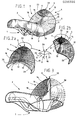
- the saddle according to the present invention consists of a frame 1 supporting the saddle body consisting of a shell 2 covered with a flexible coating 3.
- the shell 2 made for example by molding in a synthetic material, has a rear part raised in one piece with the shell 2, that is to say made by molding in the same mold.
- the shell is thus shaped at the rear according to a raised anatomical posterior rim 4.
- This anatomical rim and those of the connection zone with the body proper of the saddle will be described below and shown in detail in the appended figures.
- the anatomical rim 4 is an integral part of the shell. It constitutes a wedging stop on which the active muscles of the buttocks are directly supported in their rear part and indirectly the saccro-coccyx by the muscular masses and the ligament structures. The pelvis is thus limited in its rearward movement by the reaction of the muscular and ligamentary structures which link it to the posterior parts of the ischions.
- the anatomical posterior rim 4 is directed in a general direction perpendicular to the seating plane. It has a profile 5 of general shape slightly curved forward to follow the general lines of the birth of the back of the runner in his squatting working position.
- the raised rear flange 4 constitutes on the saddle a zone of greater thickness ensuring the overall rigidity and its fixing with the chassis.
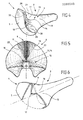
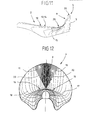
- the front front of the raised rear flange 4 that is to say the part looking at the front of the saddle, has a symmetrical relief in hollow and protruding formed by a longitudinal median zone 6 developing in projection along a crest line 7 terminated upwards by a curved projection 8 forming a median upper corner 9 with convex symmetrical flanks or slopes 10 and 11 of progressive curvatures and variable, corner widening from bottom to top until it connects with the adjacent periphery of the raised edge.
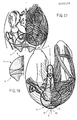
- the aim of this upper median corner 9 is to immobilize the pelvis laterally by constituting a symmetrical support for the upper medial interfessier space 12 according to a biconvex profile of transverse and longitudinal anatomical conformation as shown more particularly in FIG. 18.
- the longitudinal central zone 6 is extended towards the front end of the saddle by an intermediate portion 13 in the form of a ridge 14 connected by two slightly curved concave slopes 15 and 16 to adjacent support concavities 17 and 18 extending from one side and on the other side of said median longitudinal zone 6 to the lines of the adjacent contour of the raised anatomical rim 4 and to a connection zone 19 with the body of the saddle.
- the ridge 14 continues up to the saddle post from a median rear transition zone 20 which widens gradually to transform into a symmetrical volume 21 with two convex slopes 22 and 23 constituting the lower birth of the upper corner median 9.
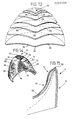
- the section profile of the upper middle corner 9 affects the general relief shape of the Greek letter “epsilon” symmetrical or of the Arabic number "three” arranged lying transversely to the longitudinal axis of the saddle, its branch center directed towards the front of the saddle.
- FIG. 13 This characteristic emerges better and more particularly from FIG. 13 in which the rear flange according to the invention has been shown cut in slices parallel to the seat plane of the saddle.
- Each cutting edge presents, in profile, this general shape.
- the successive shapes of the cutting edges widen gradually from top to bottom. This type of representation makes it possible to completely define and reconstruct the relief of the raised edge 4.
- the support concavities 17 and 18 extend on either side of the longitudinal central zone 6 and have a generally slightly hollow shape, each constituting in their central part a bowl area 27 and 28, of shallow depth, of which the perimeter surfaces 29 and 30 constitute as many progressive zones of connection by variation of curvature with the adjacent elements of the relief: longitudinal median zone 6, bases of the upper median corner 9, external contours of the raised edge 4, connection zone 19 with the saddle body and others.
- the bottom of the bowls and their periphery affect a general anatomical shape adapted to serve as accommodation for each ischion dynamically enveloped by the gluteal muscles in action.
- each support concavity 17 and 18 extends from the connection zone 19 with the body of the saddle and extends upwards.
- the axes of the bowl bottoms 27 and 28 are not directed perfectly upwards like the comfort saddles which have them. On the contrary, the bowl bottom axes are slightly inclined downwards with respect to the vertical so as to constitute an ideal wedging support for each group of gluteal muscles in the working position of the runner. This is the first setting.
- the complementary setting comes from the upper zones of the abutment concavities formed in the front of the anatomical rim 4 constituting the upward extension of the bowls.
- the saddle also provides a transverse wedging by means of the upper median corner 9 as is clear from the figures and more particularly from FIG. 18. This transverse wedging results from the support-wedging of the interfessier space on and on either side of said corner 9.
- This feature prevents alternating slip-swing resulting from repetitive pedaling movements. It also provides better transverse stability which is very appreciable for better sitting in all cases of jolts and tremors coming from the road, the track or the path.
- the bowls ensure the support wedging completed upwards by a wedging-stop on which carry active muscles in compression.
- This composite wedging called wedging-wrapping allows the saddle according to the invention to ensure the best results in the output of the effort and the resistance to fatigue.
- the upper middle corner 9 is delimited in the upper part by curvilinear connecting edges 31 and 32 converging towards the tip of the upper middle corner 9 and gradually joining the edge line of the rim according to the invention.
- the edges 31 and 32 delimit with the adjacent portion of the outer contour of the rim in the upper connection space 33 slightly rounded, generally triangular in shape.
- the anatomical rim achieves by muscular and ligamentary reaction on the upper median corner 9 and its upper connection space a support additional indirect which affects the saccro-coccyx.
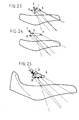
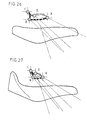
- Figures 23 to 27 show in a comparative manner the amplitudes of the apparent movements of the greater trochanter during pedaling work with a conventional saddle and with the saddle according to the invention.
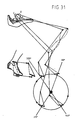
- the letters designate the positions, either of the external relief of the greater trochanter ( Figures 23 to 28 and 31), either from the middle of the head of the radiologically detected femur.
- biomechanical pedaling assembly can be roughly reduced to a simple mechanical equivalent of the connecting rod-crank type.
- the movement will be all the more effective as it approaches a movement of the big end without dead center, the theoretical diagram of which is a circle.
- the length of the saddle can be reduced by reducing the length of the spout.
- the rear flange according to the invention can also be specially studied for races against the clock in pure ascent, which would avoid the energy waste of pedaling said "in dancer” by using the maintenance of the support that the saddle advantageously brings.
Landscapes
- Engineering & Computer Science (AREA)
- Mechanical Engineering (AREA)
- Professional, Industrial, Or Sporting Protective Garments (AREA)
- Orthopedics, Nursing, And Contraception (AREA)
- Steering Devices For Bicycles And Motorcycles (AREA)
- Motorcycle And Bicycle Frame (AREA)
- Prostheses (AREA)
- Rehabilitation Tools (AREA)
- Fittings On The Vehicle Exterior For Carrying Loads, And Devices For Holding Or Mounting Articles (AREA)
- Massaging Devices (AREA)
Priority Applications (1)
| Application Number | Priority Date | Filing Date | Title |
|---|---|---|---|
| AT88440029T ATE81088T1 (de) | 1987-04-09 | 1988-04-08 | Sattel mit gesaessmuskelstuetze. |
Applications Claiming Priority (2)
| Application Number | Priority Date | Filing Date | Title |
|---|---|---|---|
| FR8705176A FR2613684B1 (fr) | 1987-04-09 | 1987-04-09 | Selle de cyclisme a appui fessier |
| FR8705176 | 1987-04-09 |
Publications (3)
| Publication Number | Publication Date |
|---|---|
| EP0286559A2 true EP0286559A2 (de) | 1988-10-12 |
| EP0286559A3 EP0286559A3 (en) | 1990-03-21 |
| EP0286559B1 EP0286559B1 (de) | 1992-09-30 |
Family
ID=9350039
Family Applications (1)
| Application Number | Title | Priority Date | Filing Date |
|---|---|---|---|
| EP88440029A Expired - Lifetime EP0286559B1 (de) | 1987-04-09 | 1988-04-08 | Sattel mit Gesässmuskelstütze |
Country Status (9)
| Country | Link |
|---|---|
| US (1) | US5076642A (de) |
| EP (1) | EP0286559B1 (de) |
| JP (1) | JPS6463482A (de) |
| AT (1) | ATE81088T1 (de) |
| AU (1) | AU620028B2 (de) |
| CA (1) | CA1287790C (de) |
| DE (1) | DE3874934D1 (de) |
| ES (1) | ES2035944T3 (de) |
| FR (1) | FR2613684B1 (de) |
Cited By (5)
| Publication number | Priority date | Publication date | Assignee | Title |
|---|---|---|---|---|
| WO1991001244A1 (en) * | 1989-07-11 | 1991-02-07 | Paul Martin Yates | Orthotic cycle saddle |
| DE4435982C1 (de) * | 1994-10-08 | 1996-05-02 | Joachim Schroeder | Sattel für ein Fahrrad, insbesondere Mountainbike, Sport- und Damenfahrrad |
| WO1998010978A1 (en) * | 1996-09-13 | 1998-03-19 | Evoss Pty. Ltd. | Bicycle seat |
| US6378938B1 (en) * | 1993-05-31 | 2002-04-30 | Paul Damian Nelson | Cycle seat |
| WO2011058430A3 (de) * | 2009-11-14 | 2011-07-07 | Proxowell Gmbh | Sitzkörper für ein zum krafttraining geeignetes fitnessgerät |
Families Citing this family (22)
| Publication number | Priority date | Publication date | Assignee | Title |
|---|---|---|---|---|
| USD333041S (en) | 1990-09-18 | 1993-02-09 | Vistalite, Incorporated | Bicycle seat with rear safety flasher light and reflector |
| NZ280803A (en) * | 1995-01-13 | 1997-09-22 | Martin David Walker | Female cycle saddles: support surface raised at its further most anterior region end between 40 and 70mm |
| AUPO028896A0 (en) * | 1996-06-07 | 1996-07-04 | Acedeal Pty Ltd | Cycle seat |
| JP3729563B2 (ja) * | 1996-06-24 | 2005-12-21 | 陽一 遠藤 | 自転車用サドル |
| WO1999020517A1 (en) | 1997-10-18 | 1999-04-29 | Specialized Bicycle Components, Inc. | Bicycle saddle with cut out |
| USD416140S (en) | 1997-12-12 | 1999-11-09 | Douglas Gregory S | Post and rear supported bicycle saddle with rear extension |
| USD431920S (en) * | 1999-09-08 | 2000-10-17 | Trek Bicycle Corporation | Bicycle saddle |
| USD431919S (en) * | 1999-09-08 | 2000-10-17 | Trek Bicycle Corporation | Bicycle saddle |
| USD429573S (en) * | 1999-09-08 | 2000-08-22 | Trek Bicycle Corporation | Bicycle saddle |
| US6149230A (en) * | 1999-09-09 | 2000-11-21 | Trek Bicycle Corporation | Bicycle saddle |
| JP2004001653A (ja) * | 2002-04-22 | 2004-01-08 | Honda Motor Co Ltd | 自転車用サドル及び自転車用運転者支持構造 |
| US20060035760A1 (en) * | 2003-09-22 | 2006-02-16 | Leann Hill | Passive child therapy tricycle with adjustable seat |
| US20060208542A1 (en) * | 2005-03-16 | 2006-09-21 | Baker Damian R | Motorcycle seat |
| JP2012162255A (ja) * | 2011-01-19 | 2012-08-30 | Ncc:Kk | 二輪車用サドル |
| US10165862B2 (en) * | 2011-10-31 | 2019-01-01 | Johann Burkhard Schmitz | Support structure for saddle-form seat surface |
| DE102012107253B3 (de) | 2012-08-08 | 2013-05-29 | Karsten Bettin | Fahrrad |
| ES2543128B1 (es) * | 2014-02-13 | 2016-05-25 | Ergonomic Bikeware S L | Sillín terapéutico de ciclismo con apéndice de autoposicionamiento |
| US20150274230A1 (en) * | 2014-03-25 | 2015-10-01 | GUTS, Inc. | Motorcycle seat with enhanced traction |
| GB2550945B (en) * | 2016-06-02 | 2020-02-19 | Darius Development Ltd | A cycle seat |
| CN106995019A (zh) * | 2017-04-27 | 2017-08-01 | 贵州大学 | 一种具有久骑提醒功能的自行车座 |
| WO2021015979A1 (en) | 2019-07-22 | 2021-01-28 | Specialized Bicycle Components, Inc. | Bicycle saddle |
| USD990180S1 (en) | 2021-04-30 | 2023-06-27 | Specialized Bicycle Components, Inc. | Bicycle saddle |
Family Cites Families (9)
| Publication number | Priority date | Publication date | Assignee | Title |
|---|---|---|---|---|
| FR327562A (fr) * | 1902-12-22 | 1903-06-26 | Couetoux Rene | Selle de bicyclette à forme anatomique dite "la rationnelle" |
| CH221782A (fr) * | 1941-10-17 | 1942-06-15 | Ducret William | Dossier pour selle de cycle. |
| US2613722A (en) * | 1949-07-01 | 1952-10-14 | Eli W Gaffield | Saddle cover |
| FR1081145A (fr) * | 1953-03-19 | 1954-12-16 | Selle pour cycles et motocycles | |
| US3863978A (en) * | 1973-04-17 | 1975-02-04 | Jr Peter Richard Gillings | Knee-chair |
| US3970345A (en) * | 1975-07-11 | 1976-07-20 | Holcomb Stephen A | Cycle seat with accessory-bearing attachments |
| FR2359022A1 (fr) * | 1976-07-20 | 1978-02-17 | Selle Royal Sas | Selle de bicyclette en forme anatomique |
| US4098537A (en) * | 1977-03-07 | 1978-07-04 | The Jacobs Corporation | Bicycle saddle |
| US5011222A (en) * | 1989-07-11 | 1991-04-30 | Yates Paul M | Orthotic cycle saddle |
-
1987
- 1987-04-09 FR FR8705176A patent/FR2613684B1/fr not_active Expired - Fee Related
-
1988
- 1988-04-08 ES ES198888440029T patent/ES2035944T3/es not_active Expired - Lifetime
- 1988-04-08 CA CA000563637A patent/CA1287790C/fr not_active Expired - Lifetime
- 1988-04-08 DE DE8888440029T patent/DE3874934D1/de not_active Expired - Lifetime
- 1988-04-08 AU AU14443/88A patent/AU620028B2/en not_active Ceased
- 1988-04-08 AT AT88440029T patent/ATE81088T1/de active
- 1988-04-08 EP EP88440029A patent/EP0286559B1/de not_active Expired - Lifetime
- 1988-04-09 JP JP63088026A patent/JPS6463482A/ja active Pending
-
1990
- 1990-02-06 US US07/474,256 patent/US5076642A/en not_active Expired - Fee Related
Cited By (5)
| Publication number | Priority date | Publication date | Assignee | Title |
|---|---|---|---|---|
| WO1991001244A1 (en) * | 1989-07-11 | 1991-02-07 | Paul Martin Yates | Orthotic cycle saddle |
| US6378938B1 (en) * | 1993-05-31 | 2002-04-30 | Paul Damian Nelson | Cycle seat |
| DE4435982C1 (de) * | 1994-10-08 | 1996-05-02 | Joachim Schroeder | Sattel für ein Fahrrad, insbesondere Mountainbike, Sport- und Damenfahrrad |
| WO1998010978A1 (en) * | 1996-09-13 | 1998-03-19 | Evoss Pty. Ltd. | Bicycle seat |
| WO2011058430A3 (de) * | 2009-11-14 | 2011-07-07 | Proxowell Gmbh | Sitzkörper für ein zum krafttraining geeignetes fitnessgerät |
Also Published As
| Publication number | Publication date |
|---|---|
| EP0286559B1 (de) | 1992-09-30 |
| FR2613684B1 (fr) | 1997-08-14 |
| ATE81088T1 (de) | 1992-10-15 |
| CA1287790C (fr) | 1991-08-20 |
| AU620028B2 (en) | 1992-02-13 |
| US5076642A (en) | 1991-12-31 |
| FR2613684A1 (fr) | 1988-10-14 |
| ES2035944T3 (es) | 1993-05-01 |
| AU1444388A (en) | 1988-10-13 |
| EP0286559A3 (en) | 1990-03-21 |
| DE3874934D1 (de) | 1992-11-05 |
| JPS6463482A (en) | 1989-03-09 |
Similar Documents
| Publication | Publication Date | Title |
|---|---|---|
| EP0286559B1 (de) | Sattel mit Gesässmuskelstütze | |
| US7635162B2 (en) | Bicycle seat | |
| CN103950485B (zh) | 自行车鞍座 | |
| US5860330A (en) | Device for holding one's foot at an angle | |
| EP0482067A1 (de) | Körperangepasster fahrradsattel | |
| FR2745488A1 (fr) | Prothese reactive de pied | |
| US6079775A (en) | Seat for a bicycle | |
| EP3033267B1 (de) | Ergonomischer fahrradsattel | |
| CA2296747C (fr) | Dispositif d'appui d'un pied dans une chaussure de sport | |
| FR2853251A1 (fr) | Palme de nage et de plongee repartitrice d'efforts | |
| FR2629038A1 (fr) | Selle a appui musculaire fessier | |
| EP3880024A1 (de) | Sportschuh mit optimierter sohle | |
| CA3102745A1 (fr) | Dispositif d'assise physiologique | |
| EP1383585A1 (de) | Autonomes mechanisches rollendes fortbewegungsmittel welches an jeden fuss eines wanderers anpassbar ist | |
| CA2290097C (fr) | Preuves que contraction du mollet ne peut pas augmenter la pression sur la pedale et mecanismes mettant a profit cette decouverte fondamentale | |
| FR3107695A3 (fr) | « Selle de vélo à surfaces d’appui d’ischions» | |
| US20060119146A1 (en) | Bicycle seat | |
| FR2872407A1 (fr) | Corset pour lombalgie | |
| AU774387B2 (en) | Seat for a bicycle | |
| FR3131571A1 (fr) | « Selle de vélo à surfaces d’appui d’ischions» | |
| EP3416877A1 (de) | Fahrradsattel | |
| FR2961782A1 (fr) | Selle ergonomique de bicyclette | |
| FR2517556A1 (fr) | Selle-tapis pour l'equitation sportive |
Legal Events
| Date | Code | Title | Description |
|---|---|---|---|
| PUAI | Public reference made under article 153(3) epc to a published international application that has entered the european phase |
Free format text: ORIGINAL CODE: 0009012 |
|
| AK | Designated contracting states |
Kind code of ref document: A2 Designated state(s): AT BE CH DE ES GB GR IT LI LU NL SE |
|
| PUAL | Search report despatched |
Free format text: ORIGINAL CODE: 0009013 |
|
| AK | Designated contracting states |
Kind code of ref document: A3 Designated state(s): AT BE CH DE ES GB GR IT LI LU NL SE |
|
| 17P | Request for examination filed |
Effective date: 19900921 |
|
| 17Q | First examination report despatched |
Effective date: 19920211 |
|
| GRAA | (expected) grant |
Free format text: ORIGINAL CODE: 0009210 |
|
| AK | Designated contracting states |
Kind code of ref document: B1 Designated state(s): AT BE CH DE ES GB GR IT LI LU NL SE |
|
| PG25 | Lapsed in a contracting state [announced via postgrant information from national office to epo] |
Ref country code: SE Effective date: 19920930 Ref country code: NL Effective date: 19920930 Ref country code: GR Free format text: LAPSE BECAUSE OF FAILURE TO SUBMIT A TRANSLATION OF THE DESCRIPTION OR TO PAY THE FEE WITHIN THE PRESCRIBED TIME-LIMIT Effective date: 19920930 Ref country code: DE Effective date: 19920930 Ref country code: AT Effective date: 19920930 |
|
| REF | Corresponds to: |
Ref document number: 81088 Country of ref document: AT Date of ref document: 19921015 Kind code of ref document: T |
|
| REF | Corresponds to: |
Ref document number: 3874934 Country of ref document: DE Date of ref document: 19921105 |
|
| ITF | It: translation for a ep patent filed | ||
| GBT | Gb: translation of ep patent filed (gb section 77(6)(a)/1977) |
Effective date: 19930105 |
|
| NLV1 | Nl: lapsed or annulled due to failure to fulfill the requirements of art. 29p and 29m of the patents act | ||
| REG | Reference to a national code |
Ref country code: ES Ref legal event code: FG2A Ref document number: 2035944 Country of ref document: ES Kind code of ref document: T3 |
|
| PLBE | No opposition filed within time limit |
Free format text: ORIGINAL CODE: 0009261 |
|
| STAA | Information on the status of an ep patent application or granted ep patent |
Free format text: STATUS: NO OPPOSITION FILED WITHIN TIME LIMIT |
|
| 26N | No opposition filed | ||
| PGFP | Annual fee paid to national office [announced via postgrant information from national office to epo] |
Ref country code: GB Payment date: 19940408 Year of fee payment: 7 |
|
| EPTA | Lu: last paid annual fee | ||
| PG25 | Lapsed in a contracting state [announced via postgrant information from national office to epo] |
Ref country code: GB Effective date: 19950408 |
|
| PGFP | Annual fee paid to national office [announced via postgrant information from national office to epo] |
Ref country code: ES Payment date: 19951018 Year of fee payment: 8 |
|
| PGFP | Annual fee paid to national office [announced via postgrant information from national office to epo] |
Ref country code: BE Payment date: 19951020 Year of fee payment: 8 |
|
| PGFP | Annual fee paid to national office [announced via postgrant information from national office to epo] |
Ref country code: CH Payment date: 19951026 Year of fee payment: 8 |
|
| GBPC | Gb: european patent ceased through non-payment of renewal fee |
Effective date: 19950408 |
|
| PG25 | Lapsed in a contracting state [announced via postgrant information from national office to epo] |
Ref country code: ES Free format text: LAPSE BECAUSE OF NON-PAYMENT OF DUE FEES Effective date: 19960409 |
|
| PG25 | Lapsed in a contracting state [announced via postgrant information from national office to epo] |
Ref country code: LI Effective date: 19960430 Ref country code: CH Effective date: 19960430 Ref country code: BE Effective date: 19960430 |
|
| PGFP | Annual fee paid to national office [announced via postgrant information from national office to epo] |
Ref country code: LU Payment date: 19961001 Year of fee payment: 10 |
|
| BERE | Be: lapsed |
Owner name: HAUSHALTER GERARD Effective date: 19960430 Owner name: BEYLET DANIEL Effective date: 19960430 |
|
| REG | Reference to a national code |
Ref country code: CH Ref legal event code: PL |
|
| PG25 | Lapsed in a contracting state [announced via postgrant information from national office to epo] |
Ref country code: LU Free format text: LAPSE BECAUSE OF NON-PAYMENT OF DUE FEES Effective date: 19980408 |
|
| REG | Reference to a national code |
Ref country code: ES Ref legal event code: FD2A Effective date: 19990503 |
|
| PG25 | Lapsed in a contracting state [announced via postgrant information from national office to epo] |
Ref country code: IT Free format text: LAPSE BECAUSE OF NON-PAYMENT OF DUE FEES;WARNING: LAPSES OF ITALIAN PATENTS WITH EFFECTIVE DATE BEFORE 2007 MAY HAVE OCCURRED AT ANY TIME BEFORE 2007. THE CORRECT EFFECTIVE DATE MAY BE DIFFERENT FROM THE ONE RECORDED. Effective date: 20050408 |