EP0286565A2 - Cycle de puissance utilisant un mélange de fluides - Google Patents
Cycle de puissance utilisant un mélange de fluides Download PDFInfo
- Publication number
- EP0286565A2 EP0286565A2 EP88500036A EP88500036A EP0286565A2 EP 0286565 A2 EP0286565 A2 EP 0286565A2 EP 88500036 A EP88500036 A EP 88500036A EP 88500036 A EP88500036 A EP 88500036A EP 0286565 A2 EP0286565 A2 EP 0286565A2
- Authority
- EP
- European Patent Office
- Prior art keywords
- cycle
- heat
- accordance
- pressure
- mixture
- Prior art date
- Legal status (The legal status is an assumption and is not a legal conclusion. Google has not performed a legal analysis and makes no representation as to the accuracy of the status listed.)
- Withdrawn
Links
- 239000000126 substance Substances 0.000 title claims abstract description 47
- 239000000203 mixture Substances 0.000 title claims abstract description 33
- XLYOFNOQVPJJNP-UHFFFAOYSA-N water Substances O XLYOFNOQVPJJNP-UHFFFAOYSA-N 0.000 claims abstract description 34
- 239000012530 fluid Substances 0.000 claims abstract description 30
- 238000009833 condensation Methods 0.000 claims abstract description 14
- 230000005494 condensation Effects 0.000 claims abstract description 14
- 238000010438 heat treatment Methods 0.000 claims description 29
- 230000005496 eutectics Effects 0.000 claims description 13
- 230000008016 vaporization Effects 0.000 claims description 11
- 238000001816 cooling Methods 0.000 claims description 10
- 239000007791 liquid phase Substances 0.000 claims description 10
- 238000009834 vaporization Methods 0.000 claims description 9
- 238000000605 extraction Methods 0.000 claims description 8
- 239000007788 liquid Substances 0.000 claims description 8
- 239000012071 phase Substances 0.000 claims description 7
- 238000002156 mixing Methods 0.000 claims description 6
- 238000002485 combustion reaction Methods 0.000 claims description 5
- 238000000034 method Methods 0.000 claims description 5
- 230000001172 regenerating effect Effects 0.000 claims description 4
- 239000000374 eutectic mixture Substances 0.000 claims description 3
- 238000000926 separation method Methods 0.000 claims description 2
- 230000006835 compression Effects 0.000 claims 5
- 238000007906 compression Methods 0.000 claims 5
- 239000012808 vapor phase Substances 0.000 claims 4
- 230000000875 corresponding effect Effects 0.000 claims 1
- 239000000727 fraction Substances 0.000 claims 1
- 239000000543 intermediate Substances 0.000 claims 1
- 229920000136 polysorbate Polymers 0.000 claims 1
- 238000010521 absorption reaction Methods 0.000 abstract description 6
- 230000001965 increasing effect Effects 0.000 abstract description 4
- 238000003303 reheating Methods 0.000 abstract description 3
- 239000003507 refrigerant Substances 0.000 abstract 1
- QGZKDVFQNNGYKY-UHFFFAOYSA-N Ammonia Chemical compound N QGZKDVFQNNGYKY-UHFFFAOYSA-N 0.000 description 12
- 229910021529 ammonia Inorganic materials 0.000 description 6
- 230000009102 absorption Effects 0.000 description 5
- 239000006200 vaporizer Substances 0.000 description 5
- 238000010586 diagram Methods 0.000 description 4
- 239000007789 gas Substances 0.000 description 4
- 208000036366 Sensation of pressure Diseases 0.000 description 2
- 239000000498 cooling water Substances 0.000 description 2
- 238000007710 freezing Methods 0.000 description 2
- 230000008014 freezing Effects 0.000 description 2
- 238000009434 installation Methods 0.000 description 2
- 238000012423 maintenance Methods 0.000 description 2
- 238000005086 pumping Methods 0.000 description 2
- MHCVCKDNQYMGEX-UHFFFAOYSA-N 1,1'-biphenyl;phenoxybenzene Chemical compound C1=CC=CC=C1C1=CC=CC=C1.C=1C=CC=CC=1OC1=CC=CC=C1 MHCVCKDNQYMGEX-UHFFFAOYSA-N 0.000 description 1
- 239000002028 Biomass Substances 0.000 description 1
- ZMJBYMUCKBYSCP-UHFFFAOYSA-N Hydroxycitric acid Chemical compound OC(=O)C(O)C(O)(C(O)=O)CC(O)=O ZMJBYMUCKBYSCP-UHFFFAOYSA-N 0.000 description 1
- 230000005540 biological transmission Effects 0.000 description 1
- 235000010290 biphenyl Nutrition 0.000 description 1
- 239000004305 biphenyl Substances 0.000 description 1
- 125000006267 biphenyl group Chemical group 0.000 description 1
- 238000009835 boiling Methods 0.000 description 1
- 238000010276 construction Methods 0.000 description 1
- 230000007797 corrosion Effects 0.000 description 1
- 238000005260 corrosion Methods 0.000 description 1
- 230000006866 deterioration Effects 0.000 description 1
- USIUVYZYUHIAEV-UHFFFAOYSA-N diphenyl ether Chemical compound C=1C=CC=CC=1OC1=CC=CC=C1 USIUVYZYUHIAEV-UHFFFAOYSA-N 0.000 description 1
- 230000000694 effects Effects 0.000 description 1
- 230000008030 elimination Effects 0.000 description 1
- 238000003379 elimination reaction Methods 0.000 description 1
- 239000000446 fuel Substances 0.000 description 1
- 239000000463 material Substances 0.000 description 1
- ZUOUZKKEUPVFJK-UHFFFAOYSA-N phenylbenzene Natural products C1=CC=CC=C1C1=CC=CC=C1 ZUOUZKKEUPVFJK-UHFFFAOYSA-N 0.000 description 1
- 230000008929 regeneration Effects 0.000 description 1
- 238000011069 regeneration method Methods 0.000 description 1
- 238000009738 saturating Methods 0.000 description 1
Images


Classifications
-
- F—MECHANICAL ENGINEERING; LIGHTING; HEATING; WEAPONS; BLASTING
- F01—MACHINES OR ENGINES IN GENERAL; ENGINE PLANTS IN GENERAL; STEAM ENGINES
- F01K—STEAM ENGINE PLANTS; STEAM ACCUMULATORS; ENGINE PLANTS NOT OTHERWISE PROVIDED FOR; ENGINES USING SPECIAL WORKING FLUIDS OR CYCLES
- F01K25/00—Plants or engines characterised by use of special working fluids, not otherwise provided for; Plants operating in closed cycles and not otherwise provided for
- F01K25/06—Plants or engines characterised by use of special working fluids, not otherwise provided for; Plants operating in closed cycles and not otherwise provided for using mixtures of different fluids
-
- F—MECHANICAL ENGINEERING; LIGHTING; HEATING; WEAPONS; BLASTING
- F01—MACHINES OR ENGINES IN GENERAL; ENGINE PLANTS IN GENERAL; STEAM ENGINES
- F01K—STEAM ENGINE PLANTS; STEAM ACCUMULATORS; ENGINE PLANTS NOT OTHERWISE PROVIDED FOR; ENGINES USING SPECIAL WORKING FLUIDS OR CYCLES
- F01K23/00—Plants characterised by more than one engine delivering power external to the plant, the engines being driven by different fluids
- F01K23/02—Plants characterised by more than one engine delivering power external to the plant, the engines being driven by different fluids the engine cycles being thermally coupled
- F01K23/04—Plants characterised by more than one engine delivering power external to the plant, the engines being driven by different fluids the engine cycles being thermally coupled condensation heat from one cycle heating the fluid in another cycle
Definitions
- a conventional steam cycle requires operating with high pressures and preheating the feed water before it starts absorbing heat from the source. With this, one can obtain a high average temperature of heat absorption.
- both processes have limitations which take it difficult to obtain high efficiencies.
- the elevation of the pressure is limited by the maximum working temperature, because, if this is not high enough for a given pressure, the water will condense in the turbine, reducing the isentropic efficiency thereof and increasing the blade deterioration and the maintenance cost.
- the only way to raise the pressure beyond the corresponding limit is by reheating the steam at an intermediate pressure. This process is costly and usually not feasible in medium-size plants.
- the pressure increase presents the inconvenience of involving a decrease in the global efficiency of the turbine, partly due to the low specific volume of the steam.
- the regenerative preheating of the feed water has the limitation that it must be accomplished by means of steam extractions from the turbine and that its effectiveness is proportional to the number of these extractions.
- it is necessary to reduce the number of steam extractions from the turbine, because of limitations of this as well as the complexity and cost of the cycle as a whole, with consequent negative effect on the cycle efficiency.
- the invention uses as working fluid a mixture of water and another less volatile substance, of higher molecular mass and with tendency to superheat in the isentropic expansion, in such a way that one can obtain dry or scarcely wet expansions down to exhaust pressures which would imply much higher wetness in the case of expanding steam from the same pressure and temperature conditions.
- the two substances used may be vaporized together in the boiler of the installation, if this is of one-through type construction without drum, or alternatively the water may be vaporized first in a conventional system with drum and water recirculation and then the other substance, in liquid state, be mixed with the steam, for the mixture to be then totally vaporized.
- both substances can be recovered separated in liquid phase, at least with a certain purity.
- the water must not bear a greater proportion of the other substance than that of the eutectic mixture of vapors at drum pressure, because otherwise the excess of the other substance would accumulate in the drum.
- Said separation can be done whether during the non-eutectic condensation of the least volatile substance at variable temperature at various points of the cycle, or by separating them in liquid state if the water and the other substance present a considerable degree of inmiscibility, or by separating the part of the least volatile substance which has condensed during one of the mixture expansions, or by cooling with water.
- This heat yield will be normally done in a heat exchanger, separating at the bottom of this the least volatile substance which condenses at variable temperature, so as to maintain it at the highest thermal level possible.
- the condensed part, together with the remaining vapor continues cooling down.
- the heat yielded by the mixture at the turbine outlet will be used in part for heating the final condensate of the cycle, or also for heating the condensed part of the least volatile substance separately if it is not mixed with the final condensate.
- Said heat may also be used for heating processes, through superheated water, steam or thermal fluid, or even combustion air.
- the pressure at the turbine outlet will be higher than that of saturation of water aforementioned and, therefore, it will be necessary to carry out one or more additional expansions in order to complete the cycle, or to use the excess energy for a secondary cycle or a heating process. It is also possible to carry out another expansion and still have excess energy for heating processes or even for secondary cycles if the outlet pressure of this expansion is still not too low.
- the vapor mixture after one or two expansions, is at a sufficiently high pressure as to have an appreciable thermal level during the condensation of water, it will be necessary to use the heat yielded during the condensation at constant temperature of the water (which is always accompanied by the eutectic proportion of the other substance), as well as that of the last fraction of the condensation at variable temperature of the other substance which is not being used for heating condensates.
- This utilization can be for heating processes (through hot water, steam, etc.) or to serve as external energy source for another power cycle with a fluid of low boiling point (ammonia, freon, etc.).
- a part of this heat yield takes place at variable temperature and at a higher thermal level than that of the main yield corresponding to the eutectic condensation, it is possible to superheat the fluid used in the secondary cycle.
- This is interesting in order to preheat the condensate of the secondary cycle by the superheated exhaust of the turbine of said cycle or in order to obtain a virtually dry exhaust from the turbine with fluids of wet isentropic expansion such as ammonia.
- a part of the heat yielded at variable temperature can be used for heating combustion air when using an external energy source that admits it, such as using fuels: fossil, residual, biomass, etc.
- the power cycle of this invention absorbs energy in a refuse incineration boiler, cooling the gases from 900°C to 250°C, this being the temperature wherefrom the gases are used for preheating the combustion air.
- This preheating may also be accomplished by absorbing the heat of gases with an intermediate fluid which can act as heat regulator and storage. Said intermediate fluid may well be the very oil of the cycle.
- the energy absorbed by the cycle is used for generating electric power through two turbines and the residual heat is sent directly to the heat sink which supposedly is cooling water at about 25°C.
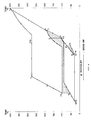
- Table 1 shows, for each point of the cycle, the circulating flow and its phase (liquid or vapor), as well as the pressure, temperature and enthalpic flow. This thermal balance does not take into account pressure drop, fluid leak, thermal loss, or the heat yielded to the fluid by the pumps, but does consider the isentropic efficiencies in the turbines and the practical minimum temperature differences in heat exchangers.
- the enthalpic values have been calculated by algorithms.
- the power cycle of the invention absorbs energy from the same source as in the preceding example, cooling the gases in the same way.
- the energy absorbed by the cycle is used for generating electric power in a turbine and the residual heat is sent to a secondary cycle of R-113.
- This secondary cycle in turn generates electric power through a group of turbo-pump-alternator which can be completely sealed in order to prevent fluid leak.
- the residual heat is sent to the heat sink which supposedly is cooling water at 15°C.
- Table 2 shows, for each point of the cycle, the circulating flow of each substance and its phase, as well as the pressure, temperature and enthalpic flow. This thermal balance does not take into account pressure drop, fluid leak, thermal loss or the heat yielded to the fluid by the pumps, but does consider the isentropic efficiencies in the turbines and the practical minimum temperature differences in heat exchangers.
- the enthalpic values have been calculated by algorithms.
Landscapes
- Engineering & Computer Science (AREA)
- Chemical & Material Sciences (AREA)
- Combustion & Propulsion (AREA)
- Mechanical Engineering (AREA)
- General Engineering & Computer Science (AREA)
- Engine Equipment That Uses Special Cycles (AREA)
- Pharmaceuticals Containing Other Organic And Inorganic Compounds (AREA)
Applications Claiming Priority (2)
| Application Number | Priority Date | Filing Date | Title |
|---|---|---|---|
| ES8701019 | 1987-04-08 | ||
| ES8701019A ES2005135A6 (es) | 1987-04-08 | 1987-04-08 | Ciclo termico con fluido de trabajo mezcla |
Publications (2)
| Publication Number | Publication Date |
|---|---|
| EP0286565A2 true EP0286565A2 (fr) | 1988-10-12 |
| EP0286565A3 EP0286565A3 (fr) | 1988-11-02 |
Family
ID=8250366
Family Applications (1)
| Application Number | Title | Priority Date | Filing Date |
|---|---|---|---|
| EP88500036A Withdrawn EP0286565A3 (fr) | 1987-04-08 | 1988-04-08 | Cycle de puissance utilisant un mélange de fluides |
Country Status (7)
| Country | Link |
|---|---|
| US (1) | US4838027A (fr) |
| EP (1) | EP0286565A3 (fr) |
| JP (1) | JPS63277808A (fr) |
| CA (1) | CA1283784C (fr) |
| ES (1) | ES2005135A6 (fr) |
| FI (1) | FI881607A7 (fr) |
| NO (1) | NO881503L (fr) |
Cited By (13)
| Publication number | Priority date | Publication date | Assignee | Title |
|---|---|---|---|---|
| WO1994025739A1 (fr) * | 1993-05-03 | 1994-11-10 | Sevillana De Electricidad S.A. | Procede d'amelioration de la combinaison entre une turbine a gaz et un cycle de vapeur avec une autre source non fossile d'energie primaire |
| WO2007079940A3 (fr) * | 2005-12-20 | 2008-02-28 | Lurgi Ag | Procédé et dispositif de récupération de chaleur dans un flux de gaz de processus |
| US7517535B2 (en) | 1994-05-20 | 2009-04-14 | Bayer Animal Health Gmbh | Non-systemic control of parasites |
| WO2011005374A3 (fr) * | 2009-06-23 | 2012-07-05 | General Electric Company | Système de récupération de chaleur perdue |
| EP2532845A1 (fr) * | 2005-03-01 | 2012-12-12 | Ormat Technologies Inc. | Système d'alimentation à cycle de rankine organique |
| EP2550436A4 (fr) * | 2010-03-23 | 2016-04-20 | Echogen Power Systems Llc | Moteurs thermiques avec cycles en cascade |
| US10934895B2 (en) | 2013-03-04 | 2021-03-02 | Echogen Power Systems, Llc | Heat engine systems with high net power supercritical carbon dioxide circuits |
| US11187112B2 (en) | 2018-06-27 | 2021-11-30 | Echogen Power Systems Llc | Systems and methods for generating electricity via a pumped thermal energy storage system |
| US11293309B2 (en) | 2014-11-03 | 2022-04-05 | Echogen Power Systems, Llc | Active thrust management of a turbopump within a supercritical working fluid circuit in a heat engine system |
| US11435120B2 (en) | 2020-05-05 | 2022-09-06 | Echogen Power Systems (Delaware), Inc. | Split expansion heat pump cycle |
| US11629638B2 (en) | 2020-12-09 | 2023-04-18 | Supercritical Storage Company, Inc. | Three reservoir electric thermal energy storage system |
| US12331664B2 (en) | 2023-02-07 | 2025-06-17 | Supercritical Storage Company, Inc. | Waste heat integration into pumped thermal energy storage |
| US12516855B2 (en) | 2022-10-27 | 2026-01-06 | Supercritical Storage Company, Inc. | High-temperature, dual rail heat pump cycle for high performance at high-temperature lift and range |
Families Citing this family (18)
| Publication number | Priority date | Publication date | Assignee | Title |
|---|---|---|---|---|
| US5255519A (en) * | 1992-08-14 | 1993-10-26 | Millennium Technologies, Inc. | Method and apparatus for increasing efficiency and productivity in a power generation cycle |
| JP2000145408A (ja) * | 1998-11-06 | 2000-05-26 | Takuma Co Ltd | 二流体型廃棄物発電方法およびその装置 |
| US6253552B1 (en) * | 1999-01-13 | 2001-07-03 | Abb Combustion Engineering | Fluidized bed for kalina cycle power generation system |
| US6105369A (en) * | 1999-01-13 | 2000-08-22 | Abb Alstom Power Inc. | Hybrid dual cycle vapor generation |
| US6195998B1 (en) * | 1999-01-13 | 2001-03-06 | Abb Alstom Power Inc. | Regenerative subsystem control in a kalina cycle power generation system |
| US6968700B2 (en) | 2001-03-01 | 2005-11-29 | Lott Henry A | Power systems |
| US6467273B1 (en) | 2001-03-01 | 2002-10-22 | Henry A. Lott | Method for producing electrical power |
| US6841683B2 (en) * | 2001-08-30 | 2005-01-11 | Teva Pharmaceutical Industries Ltd. | Sulfonation method for zonisamide intermediate in zonisamide synthesis and their novel crystal forms |
| JP3802799B2 (ja) * | 2001-11-21 | 2006-07-26 | 本田技研工業株式会社 | 熱交換装置 |
| US8375719B2 (en) * | 2005-05-12 | 2013-02-19 | Recurrent Engineering, Llc | Gland leakage seal system |
| US8839622B2 (en) | 2007-04-16 | 2014-09-23 | General Electric Company | Fluid flow in a fluid expansion system |
| DE102008024427B4 (de) * | 2008-05-20 | 2010-03-11 | Lurgi Gmbh | Verfahren und Anlage zur Rückgewinnung von Arbeitsfluid |
| US8459029B2 (en) * | 2009-09-28 | 2013-06-11 | General Electric Company | Dual reheat rankine cycle system and method thereof |
| US8739538B2 (en) * | 2010-05-28 | 2014-06-03 | General Electric Company | Generating energy from fluid expansion |
| JP2012082750A (ja) * | 2010-10-12 | 2012-04-26 | Mitsubishi Heavy Ind Ltd | 排熱回収発電装置およびこれを備えた船舶 |
| US9018778B2 (en) | 2012-01-04 | 2015-04-28 | General Electric Company | Waste heat recovery system generator varnishing |
| US9024460B2 (en) | 2012-01-04 | 2015-05-05 | General Electric Company | Waste heat recovery system generator encapsulation |
| US8984884B2 (en) | 2012-01-04 | 2015-03-24 | General Electric Company | Waste heat recovery systems |
Family Cites Families (8)
| Publication number | Priority date | Publication date | Assignee | Title |
|---|---|---|---|---|
| FR371348A (fr) * | 1906-01-20 | 1907-03-05 | Emile Jolicard | Procédé de production et d'emploi d'une vapeur mixte, pour les moteurs à cylindres ou les turbines |
| US3841099A (en) * | 1970-12-22 | 1974-10-15 | Union Carbide Corp | Working fluids for external combustion engines |
| IT1064500B (it) * | 1975-11-28 | 1985-02-18 | Maschf Augsburg Nuernberg Ag | Fluido di lavoro per turbine a vapore o turbine parziali di gruppi a turbine,avente una densita'maggiore rispetto al vapore d'acqua |
| JPS54105652A (en) * | 1978-02-07 | 1979-08-18 | Daikin Ind Ltd | Rankine cycle working fluid |
| JPS5732001A (en) * | 1980-08-01 | 1982-02-20 | Kenichi Oda | Method of recovering waste heat |
| US4439988A (en) * | 1980-11-06 | 1984-04-03 | University Of Dayton | Rankine cycle ejector augmented turbine engine |
| US4548043A (en) * | 1984-10-26 | 1985-10-22 | Kalina Alexander Ifaevich | Method of generating energy |
| ES8607515A1 (es) * | 1985-01-10 | 1986-06-16 | Mendoza Rosado Serafin | Modificaciones de un proceso termodinamico de aproximacion practica al ciclo de carnot para aplicaciones especiales |
-
1987
- 1987-04-08 ES ES8701019A patent/ES2005135A6/es not_active Expired
-
1988
- 1988-03-31 US US07/175,906 patent/US4838027A/en not_active Expired - Fee Related
- 1988-04-05 CA CA000563323A patent/CA1283784C/fr not_active Expired - Lifetime
- 1988-04-07 JP JP63086215A patent/JPS63277808A/ja active Pending
- 1988-04-07 NO NO881503A patent/NO881503L/no unknown
- 1988-04-07 FI FI881607A patent/FI881607A7/fi not_active IP Right Cessation
- 1988-04-08 EP EP88500036A patent/EP0286565A3/fr not_active Withdrawn
Cited By (16)
| Publication number | Priority date | Publication date | Assignee | Title |
|---|---|---|---|---|
| WO1994025739A1 (fr) * | 1993-05-03 | 1994-11-10 | Sevillana De Electricidad S.A. | Procede d'amelioration de la combinaison entre une turbine a gaz et un cycle de vapeur avec une autre source non fossile d'energie primaire |
| ES2116136A1 (es) * | 1993-05-03 | 1998-07-01 | Rosado Serafin Luis Mendoza | Procedimiento de mejora de la combinacion entre una turbina de gas y un ciclo de vapor con otra fuente no fosil de energia primaria. |
| US7517535B2 (en) | 1994-05-20 | 2009-04-14 | Bayer Animal Health Gmbh | Non-systemic control of parasites |
| US8728507B2 (en) | 1994-05-20 | 2014-05-20 | Bayer Intellectual Property Gmbh | Non-systemic control of parasites |
| EP2532845A1 (fr) * | 2005-03-01 | 2012-12-12 | Ormat Technologies Inc. | Système d'alimentation à cycle de rankine organique |
| US8596066B2 (en) | 2005-03-01 | 2013-12-03 | Ormat Technologies, Inc. | Power plant using organic working fluids |
| WO2007079940A3 (fr) * | 2005-12-20 | 2008-02-28 | Lurgi Ag | Procédé et dispositif de récupération de chaleur dans un flux de gaz de processus |
| WO2011005374A3 (fr) * | 2009-06-23 | 2012-07-05 | General Electric Company | Système de récupération de chaleur perdue |
| EP2550436A4 (fr) * | 2010-03-23 | 2016-04-20 | Echogen Power Systems Llc | Moteurs thermiques avec cycles en cascade |
| US10934895B2 (en) | 2013-03-04 | 2021-03-02 | Echogen Power Systems, Llc | Heat engine systems with high net power supercritical carbon dioxide circuits |
| US11293309B2 (en) | 2014-11-03 | 2022-04-05 | Echogen Power Systems, Llc | Active thrust management of a turbopump within a supercritical working fluid circuit in a heat engine system |
| US11187112B2 (en) | 2018-06-27 | 2021-11-30 | Echogen Power Systems Llc | Systems and methods for generating electricity via a pumped thermal energy storage system |
| US11435120B2 (en) | 2020-05-05 | 2022-09-06 | Echogen Power Systems (Delaware), Inc. | Split expansion heat pump cycle |
| US11629638B2 (en) | 2020-12-09 | 2023-04-18 | Supercritical Storage Company, Inc. | Three reservoir electric thermal energy storage system |
| US12516855B2 (en) | 2022-10-27 | 2026-01-06 | Supercritical Storage Company, Inc. | High-temperature, dual rail heat pump cycle for high performance at high-temperature lift and range |
| US12331664B2 (en) | 2023-02-07 | 2025-06-17 | Supercritical Storage Company, Inc. | Waste heat integration into pumped thermal energy storage |
Also Published As
| Publication number | Publication date |
|---|---|
| NO881503D0 (no) | 1988-04-07 |
| FI881607A0 (fi) | 1988-04-07 |
| EP0286565A3 (fr) | 1988-11-02 |
| US4838027A (en) | 1989-06-13 |
| ES2005135A6 (es) | 1989-03-01 |
| NO881503L (no) | 1988-12-19 |
| FI881607A7 (fi) | 1988-10-09 |
| CA1283784C (fr) | 1991-05-07 |
| JPS63277808A (ja) | 1988-11-15 |
Similar Documents
| Publication | Publication Date | Title |
|---|---|---|
| EP0286565A2 (fr) | Cycle de puissance utilisant un mélange de fluides | |
| JP2649235B2 (ja) | 熱力学的サイクルを実施する方法および装置 | |
| US6041604A (en) | Rankine cycle and working fluid therefor | |
| RU95358U1 (ru) | Устройство для осуществления термодинамического циклического процесса | |
| US4009575A (en) | Multi-use absorption/regeneration power cycle | |
| JP4566204B2 (ja) | 有効エネルギーへの熱変換方法およびその装置 | |
| KR100628597B1 (ko) | 가스 터빈 복합 사이클 발전장치로 유입되는 공기의 냉각 방법 및 변형 보토밍 사이클 | |
| US6694740B2 (en) | Method and system for a thermodynamic process for producing usable energy | |
| US4660511A (en) | Flue gas heat recovery system | |
| KR920009138B1 (ko) | 에너지 발생 방법 | |
| US5038567A (en) | Method of and means for using a two-phase fluid for generating power in a rankine cycle power plant | |
| CA2713799C (fr) | Procede de fonctionnement d'un circuit thermodynamique et circuit thermodynamique | |
| JP4388067B2 (ja) | 熱力学サイクルの実施方法と装置 | |
| US4729226A (en) | Process for mechanical power generation | |
| US4876855A (en) | Working fluid for rankine cycle power plant | |
| JPH0427367B2 (fr) | ||
| US4819437A (en) | Method of converting thermal energy to work | |
| US4224796A (en) | Method for converting heat energy to mechanical energy with 1,2-dichloro-1,1-difluoroethane | |
| US4896496A (en) | Single pressure steam bottoming cycle for gas turbines combined cycle | |
| WO1991007573A2 (fr) | Conversion de chaleur en travail mecanique par absorption-desorption | |
| WO2011111075A1 (fr) | Cycle thermodynamique amélioré | |
| EP0664377A1 (fr) | Procede d'amelioration de la combinaison entre une turbine a gaz et un cycle de vapeur avec une autre source non fossile d'energie primaire |
Legal Events
| Date | Code | Title | Description |
|---|---|---|---|
| PUAI | Public reference made under article 153(3) epc to a published international application that has entered the european phase |
Free format text: ORIGINAL CODE: 0009012 |
|
| PUAL | Search report despatched |
Free format text: ORIGINAL CODE: 0009013 |
|
| AK | Designated contracting states |
Kind code of ref document: A2 Designated state(s): AT BE CH DE FR GB GR IT LI LU NL SE |
|
| AK | Designated contracting states |
Kind code of ref document: A3 Designated state(s): AT BE CH DE FR GB GR IT LI LU NL SE |
|
| 17P | Request for examination filed |
Effective date: 19890414 |
|
| 17Q | First examination report despatched |
Effective date: 19900301 |
|
| STAA | Information on the status of an ep patent application or granted ep patent |
Free format text: STATUS: THE APPLICATION IS DEEMED TO BE WITHDRAWN |
|
| 18D | Application deemed to be withdrawn |
Effective date: 19920714 |