EP0286632A2 - Antrieb für landwirtschaftliche Nutzfahrzeuge - Google Patents
Antrieb für landwirtschaftliche Nutzfahrzeuge Download PDFInfo
- Publication number
- EP0286632A2 EP0286632A2 EP88890089A EP88890089A EP0286632A2 EP 0286632 A2 EP0286632 A2 EP 0286632A2 EP 88890089 A EP88890089 A EP 88890089A EP 88890089 A EP88890089 A EP 88890089A EP 0286632 A2 EP0286632 A2 EP 0286632A2
- Authority
- EP
- European Patent Office
- Prior art keywords
- clutch
- drive
- actuator
- torque
- vehicle
- Prior art date
- Legal status (The legal status is an assumption and is not a legal conclusion. Google has not performed a legal analysis and makes no representation as to the accuracy of the status listed.)
- Granted
Links
- 230000005540 biological transmission Effects 0.000 title claims abstract description 17
- 230000008878 coupling Effects 0.000 claims description 23
- 238000010168 coupling process Methods 0.000 claims description 23
- 238000005859 coupling reaction Methods 0.000 claims description 23
- 210000000078 claw Anatomy 0.000 claims description 3
- 230000000712 assembly Effects 0.000 description 3
- 238000000429 assembly Methods 0.000 description 3
- 238000006073 displacement reaction Methods 0.000 description 3
- 238000004519 manufacturing process Methods 0.000 description 2
- 238000010276 construction Methods 0.000 description 1
- 230000007812 deficiency Effects 0.000 description 1
- 238000010586 diagram Methods 0.000 description 1
- 230000000694 effects Effects 0.000 description 1
- 239000004459 forage Substances 0.000 description 1
- 238000005096 rolling process Methods 0.000 description 1
- 238000011144 upstream manufacturing Methods 0.000 description 1
Images

Classifications
-
- B—PERFORMING OPERATIONS; TRANSPORTING
- B60—VEHICLES IN GENERAL
- B60K—ARRANGEMENT OR MOUNTING OF PROPULSION UNITS OR OF TRANSMISSIONS IN VEHICLES; ARRANGEMENT OR MOUNTING OF PLURAL DIVERSE PRIME-MOVERS IN VEHICLES; AUXILIARY DRIVES FOR VEHICLES; INSTRUMENTATION OR DASHBOARDS FOR VEHICLES; ARRANGEMENTS IN CONNECTION WITH COOLING, AIR INTAKE, GAS EXHAUST OR FUEL SUPPLY OF PROPULSION UNITS IN VEHICLES
- B60K23/00—Arrangement or mounting of control devices for vehicle transmissions, or parts thereof, not otherwise provided for
- B60K23/02—Arrangement or mounting of control devices for vehicle transmissions, or parts thereof, not otherwise provided for for main transmission clutches
Definitions
- the invention relates to a drive for agricultural vehicles with a drive train leading from the engine via a drive clutch and a manual transmission to the vehicle drive wheels and a PTO driven independently of this drive train by the engine.
- the invention is therefore based on the object of eliminating this deficiency and creating a drive which can be achieved despite the comparatively high engine output, a reduction in vehicle weight and the cost of production.
- the invention solves this problem in that the gearbox is designed for a reduced input torque compared to the maximum engine torque and has an actuator which responds when it is reached, which first triggers a warning signal, after which if this input torque is exceeded, the drive clutch and / or a clutch of the manual transmission or a separating clutch in the drive train and the service brake of the vehicle can be actuated independently by means of the actuator.
- the vehicle can be equipped with an engine that delivers the required maximum torque for particularly wide implements or for combination travel with a trailer and implement.
- the manual transmission is only dimensioned for a significantly lower torque because, as a rule, sufficiency is found in pure train operation with a significantly lower engine torque.
- the actuator responds when the predetermined input torque is reached and triggers the warning signal, so that the driver can take appropriate measures to prevent the weaker-sized gearbox from being damaged maintain an increased torque to be transmitted. For example, he can depress the drive clutch and thus interrupt the drive, or he can engage a lower gear in the manual transmission in order to bring about a reduction in torque.
- the engine and the PTO continue to run or the like when operating a harvester. Avoid blockages in this device. If the driver does not respond to the warning signal, that is to say do not take the above-mentioned measures on his own, so that the predetermined input torque is exceeded, then at least one of the clutches is actuated independently, thereby preventing the weakly dimensioned manual transmission from being overloaded.
- the simultaneous or immediately subsequent actuation of the service brake of the vehicle is necessary in order to avoid that the vehicle starts rolling unintentionally on a slope when the drive clutch or another separating clutch is actuated with the aid of the actuator and the engine therefore fails as a brake.
- a particularly simple and expedient construction of the actuator is achieved in that it consists in the manner of a coupling of two coupling parts which are non-rotatably seated on a shaft and which engage with screw-like claws or with radial bolts of one coupling part in screw-shaped backdrops of the other coupling part, one of which Coupling part mounted axially and by preferably two springs are loaded in a staggered manner, so that switching operations or the like can result from the axial movement of the latter coupling part which results when the torque increases. are derivable.
- the drive has a drive train leading from the engine 1 via a drive clutch 2 and a manual transmission 3 to the vehicle drive wheels 4. Regardless of this drive train, a PTO 6 driven by the engine 1 via a clutch 5 is provided.
- an actuator 7 is arranged upstream of the manual transmission 3, which is designed for an input torque that is lower than the maximum engine torque, which triggers a warning signal when this input torque is reached, so that, for example, a signal lamp 8 lights up. If the determined input torque is exceeded, the drive clutch 2 and / or a clutch of the manual transmission 3 is actuated by means of the actuator 7 via the lines 9 and at the same time the service brake of the vehicle is applied, which is not shown in FIG. 1 for the sake of clarity.
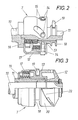
- the actuator 7 consists of two coupling parts 12, 13, each of which is rotationally fixed on a shaft 10, 11, the coupling part 13 engaging with radial bolts 14 in screw-shaped links 15 of the coupling part 12, axially displaceably mounted on the shaft 11 and by two Belleville spring assemblies 16.17 is loaded.
- the torque to be transmitted is increased by a predetermined amount, the relative ver results Rotation of the coupling parts 12, 13 and the link guide of the radial bolt 14 against the force of the spring plate packs 16, 17 an axial displacement of the coupling part 13, initially only the plate spring assembly 16 is compressed and then the plate spring assembly 17 comes into effect, so that a kind of two-stage Displacement of the coupling part 13 results.
- the coupling part 13 is provided with an annular groove 18 into which a shift finger 19 engages, which is moved when the coupling part 13 is displaced and can be used to trigger one or more switching operations.
- the coupling part 12 is connected to the shaft 10 in a rotationally fixed and axially non-displaceable manner, whereas the second coupling part 13 is mounted on the shaft 11 in a rotationally fixed but axially displaceable manner.
- the coupling part 12 is again loaded by two plate spring assemblies 16, 17 and has an annular groove 18 for a shift finger 19.
- the two coupling parts 12, 13 engage with screw-like claws 20, so that when the torque to be transmitted increases again, an axial displacement of the coupling part 13 against the force of the plate spring assemblies 16, 17 and thus an adjustment of the Shift finger 19 results.
Landscapes
- Engineering & Computer Science (AREA)
- Chemical & Material Sciences (AREA)
- Combustion & Propulsion (AREA)
- Transportation (AREA)
- Mechanical Engineering (AREA)
- Transmission Devices (AREA)
- Control Of Transmission Device (AREA)
- Arrangement And Mounting Of Devices That Control Transmission Of Motive Force (AREA)
Abstract
Description
- Die Erfindung bezieht sich auf einen Antrieb für landwirtschaftliche Nutzfahrzeuge mit einem vom Motor über eine Fahrkupplung und ein Schaltgetriebe führenden Antriebsstrang zu den Fahrzeugtriebrädern und einer unabhängig von diesem Antriebsstrang vom Motor angetriebenen Zapfwelle.
- Derartige Nutzfahrzeuge, vor allem Ackerschlepper, haben verschiedene Aufgabe zu erfüllen. Sie dienen einerseits bloß zum Ziehen von verschiedenen Anhängern oder zum Pflügen mit einem Anbau- oder Abhängepflug, anderseits sind sie zufolge der Zapfwelle dafür geeignet, angehängte Arbeitsgeräte nicht nur zu ziehen, sondern auch deren Werkzeuge anzutreiben. Zum reinen Zugbetrieb würde ein Motor mit vergleichsweise geringer Leistung ausreichen. Wenn aber mit einem Arbeitsgerät gefahren und dieses über die Zapfwelle angetrieben werden soll, ist, insbesondere bei Arbeitsgeräten, deren Arbeitsbreite die Spurweite des Nutzfahrzeuges wesentlich übersteigt, eine erhöhte Antriebsleistung erforderlich. Gleiches gilt, wenn außer dem Arbeitsgerät noch ein Anhänger vorgesehen ist, wenn also beispielsweise ein Feldhäcksler zusammen mit einem Häckselwagen gekuppelt und letzterer zunehmend befüllt wird. Für das vom Motor gelieferte verhältnismäßig geringe Drehmoment für den reinen Zugbetrieb würde ein entsprechend schwach dimensioniertes Schaltgetriebe ausreichen, zumal das höhere Drehmoment für Arbeitsgeräte mit drehenden Werkzeugen über die vom Schaltgetriebe unabhängige Zapfwelle übertragen wird. Bisher ist aber das Schaltgetriebe stets entsprechend dem Motordrehmoment ausgelegt, was nicht nur zu einem erhöhten Gewicht des ganzen Fahrzeuges, sondern selbstverständlich auch zu vermehrten Herstellungs- bzw. Anschaffungskosten führt.
- Somit liegt der Erfindung die Aufgabe zugrunde, diesen Mangel zu beseitigen und einen Antrieb zu schaffen, bei dem sich trotz vergleichsweise hoher Motorleistung eine Verringerung des Fahrzeuggewichtes und der Erstehungskosten erreichen lassen.
- Die Erfindung löst die gestellte Aufgabe dadurch, daß das Schaltgetriebe für ein dem Motorhöchstdrehmoment gegenüber verringertes Eingangsdrehmoment ausgelegt ist und ein bei dessen Erreichen ansprechendes Stellglied vorgeordnet hat, das zunächst ein Warnsignal auslöst, wonach bei Überschreitung dieses Eingangsdrehmomentes die Fahrkupplung und/oder eine Schaltkupplung des Schaltgetriebes bzw. eine Trennkupplung im Antriebsstrang sowie die Betriebsbremse des Fahrzeuges mittels des Stellgliedes selbständig betätigbar sind.
- Das Fahrzeug kann mit einem Motor ausgestattet werden, der das geforderte Höchstdrehmoment für besonders breite Arbeitsgeräte oder für Kombinationsfahrt mit Anhänger und Arbeitsgerät liefert. Dennoch wird erfindungsgemäß aber das Schaltgetriebe nur für ein wesentlich geringeres Drehmoment bemessen, weil für den Regelfall im reincn Zugbetrieb mit einem wesentlich geringeren Motordrehmoment das Auslangen gefunden wird. Sollte aber aus irgendeinem Grund über das nunmehr schwächer dimensionierte Schaltgetriebe ein höheres Drehmoment geleitet werden, so spricht bei Erreichen des vorbestimmten Eingangsdrehmomentes das Stellglied an und löst das Warnsignal aus, so daß der Fahrer entsprechende Maßnahmen ergreifen kann, um das schwächer dimensionierte Schaltgetriebe vor Beschädigungen durch ein erhöhtes zu übertragendes Drehmoment zu bewahren. Er kann beispielsweise die Fahrkupplung treten und so den Fahrantrieb unterbrechen oder er kann einen niedrigeren Gang im Schaltgetriebe einlegen, um so eine Drehmomentverringerung herbeizuführen. Der Motor und die Zapfwelle laufen aber weiter, um bei Betrieb eines Erntegerätes od.dgl. Verstopfungen in diesem Gerät zu vermeiden. Sollte der Fahrer auf das Warnsignal nicht reagieren, also nicht die angeführten Maßnahmen von sich aus ergreifen, so daß das vorbestimmte Eingangsdrehmoment überschritten wird, so wird zumindest eine der Kupplungen selbständig betätigt und dadurch auf jeden Fall eine Überlastung des schwächer dimensionierten Schaltgetriebes verhindert. Die gleichzeitige oder unmittelbar nachfolgende Betätigung der Betriebsbremse des Fahrzeuges ist dabei notwendig, um zu vermeiden, daß das Fahrzeug auf einem Hang ungewollt ins Rollen kommt, wenn mit Hilfe des Stellgliedes die Fahrkupplung oder eine andere Trennkupplung betätigt wird und der Motor daher als Bremse ausfällt. Handelt es sich um ein unter Last schaltbares Schaltgetriebe, so ist es möglich, nicht nur einen Gang zu schalten, sondern je nach Bedarf mehrere Gänge abwärts zu schalten, um die gewünschte Verringerung des zu übertragenden Drehmomentes zu erzielen. Die Übertragung vom Stellglied auf die Kupplungen bzw. auf die Betriebsbremse kann auf elektrischem, aber auch auf mechanischem, hydraulischem oder pneumatischem Wege erfolgen.
- Es ist zwar bereits bekannt (DE-A- 29 02 557, GB-A - 1 599 941, DD-A - 16 598 und DE-B - 29 10 395), im Antrieb der Zapfwelle bzw. des von ihr angetriebenen Arbeitsgerätes eine Überlastkupplung vorzusehen. Dabei geht es aber lediglich darum, das angeschlossene Arbeitsgerät vor Beschädigung durch Überlastung von einem zu hohen Drehmoment zu schützen, was aber mit einer Maßnahme zur Verringerung der Abmessungen des Schaltgetriebes nichts zu tun hat.
- Eine besonders einfache und zweckmäßige Konstruktion des Stellgliedes wird dadurch erreicht, daß dieses nach Art einer Kupplung aus zwei auf je einer Welle drehfest sitzenden Kupplungsteilen besteht, die mit schraubenflächigen Klauen oder mit Radialbolzen des einen Kupplungsteiles in schraubenförmige Kulissen des anderen Kupplungsteiles ineinandergreifen, wobei der eine Kupplungsteil axial verschiebbar gelagert und durch vorzugsweise zwei Federn gestaffelt belastet ist, so daß von der sich bei Drehmomentsteigerung ergebenden Axialbewegung des letzteren Kupplungsteiles Schaltvorgänge od.dgl. ableitbar sind.
- In der Zeichnung ist der Erfindungsgegenstand beispielsweise dargestellt, und zwar zeigen
- Fig. 1 das Schema eines Antriebes für landwirtschaftliche Nutzfahrzeuge und die
- Fig. 2 und 3 zwei Ausführungsvarianten des Stellgliedes jeweils in axialem Teilschnitt.
- Der Antrieb weist einen vom Motor 1 über eine Fahrkupplung 2 und ein Schaltgetriebe 3 zu den Fahrzeugtriebrädern 4 führenden Antriebsstrang auf. Unabhängig von diesem Antriebsstrang ist eine vom Motor 1 über eine Trennkupplung 5 angetriebene Zapfwelle 6 vorgesehen. Dem Schaltgetriebe 3, das für ein dem Motorhöchstdrehmoment gegenüber verringertes Eingangsdrehmoment ausgelegt ist, ist erfindungsgemäß ein Stellglied 7 vorgeordnet, das bei Erreichen dieses Eingangsdrehmomentes ein Warnsignal auslöst, so daß beispielsweise eine Signallampe 8 aufleuchtet. Wird das bestimmte Eingangsdrehmoment überschritten, so wird mittels des Stellgliedes 7 über die Leitungen 9 die Fahrkupplung 2 und/oder eine Schaltkupplung des Schaltgetriebes 3 betätigt und zugleich die Betriebsbremse des Fahrzeuges angezogen, was in Fig. 1 der Übersichtlichkeit halber nicht dargestellt ist.
- Gemäß Fig. 2 besteht das Stellglied 7 aus zwei auf je einer Welle 10, 11 drehfest sitzenden Kupplungsteilen 12, 13, wobei der Kupplungsteil 13 mit Radialbolzen 14 in schraubenförmige Kulissen 15 des Kupplungsteiles 12 eingreift, auf der Welle 11 axial verschiebbar gelagert und durch zwei Tellerfederpakete 16,17 belastet ist. Bei Steigerung des zu übertragenden Drehmomentes über ein vorbestimmtes Maß ergibt sich zufolge der Relativver drehung der Kupplungsteile 12, 13 und der Kulissenführung der Radialbolzen 14 gegen die Kraft der Federtellerpakete 16, 17 eine Axialverschiebung des Kupplungsteiles 13, wobei zunächst nur das Tellerfederpaket 16 zusammengedrückt wird und dann erst das Tellerfederpaket 17 zur Wirkung kommt, so daß sich eine Art zweistufige Verschiebung des Kupplungsteiles 13 ergibt. Der Kupplungsteil 13 ist mit einer Ringnut 18 versehen, in die ein Schaltfinger 19 eingreift, der bei der Verschiebung des Kupplungsteiles 13 mitbewegt wird und zur Auslösung eines oder mehrerer Schaltvorgänge herangezogen werden kann.
- Bei der Ausführungsvariante nach der Fig. 3 ist mit der Welle 10 der Kupplungsteil 12 drehfest und axial unverschiebbar verbunden, wogegen auf der Welle 11 der zweite Kupplungsteil 13 drehfest, aber axial verschiebbar gelagert ist. Der Kupplungsteil 12 ist wieder durch zwei Tellerfederpakete 16,17 belastet und weist eine Ringnut 18 für einen Schaltfinger 19 auf. An Stelle der Radialbolzen 14 und der Kulissen 15 greifen die beiden Kupplungsteile 12, 13 mit schraubenflächigen Klauen 20 ineinander, so daß sich bei Steigerung des zu übertragenden Drehmomentes wieder eine Axialverschiebung des Kupplungsteiles 13 gegen die Kraft der Tellerfederpakete 16,17 und damit eine Verstellung des Schaltfingers 19 ergibt.
Claims (2)
Applications Claiming Priority (2)
| Application Number | Priority Date | Filing Date | Title |
|---|---|---|---|
| AT89887A AT395564B (de) | 1987-04-10 | 1987-04-10 | Antrieb fuer landwirtschaftliche nutzfahrzeuge |
| AT898/87 | 1987-04-10 |
Publications (3)
| Publication Number | Publication Date |
|---|---|
| EP0286632A2 true EP0286632A2 (de) | 1988-10-12 |
| EP0286632A3 EP0286632A3 (en) | 1989-04-12 |
| EP0286632B1 EP0286632B1 (de) | 1991-02-27 |
Family
ID=3502372
Family Applications (1)
| Application Number | Title | Priority Date | Filing Date |
|---|---|---|---|
| EP19880890089 Expired - Lifetime EP0286632B1 (de) | 1987-04-10 | 1988-04-08 | Antrieb für landwirtschaftliche Nutzfahrzeuge |
Country Status (3)
| Country | Link |
|---|---|
| EP (1) | EP0286632B1 (de) |
| AT (1) | AT395564B (de) |
| DE (1) | DE3861810D1 (de) |
Families Citing this family (2)
| Publication number | Priority date | Publication date | Assignee | Title |
|---|---|---|---|---|
| DE4205272B4 (de) * | 1992-02-21 | 2005-05-04 | Claas Kgaa Mbh | Meßvorrichtung einer Stellvorrichtung eines variablen Keilriemengetriebes |
| DE19848209A1 (de) * | 1998-10-20 | 2000-04-27 | Volkswagen Ag | Verfahren und Vorrichtung zum Halten eines Kraftfahrzeugs unter einer darauf wirkenden Kraft |
Family Cites Families (14)
| Publication number | Priority date | Publication date | Assignee | Title |
|---|---|---|---|---|
| DD16598A (de) * | ||||
| DE1630707B2 (de) * | 1967-06-08 | 1974-08-29 | Lawima-Holding Ag, Steinhausen, Zug (Schweiz) | Motorfahrzeug, insbesondere für landwirtschaftliche Zwecke |
| US3592318A (en) * | 1968-12-18 | 1971-07-13 | Monsanto Co | Fluid pressure-operated overload clutch and brake |
| GB1213948A (en) * | 1969-06-12 | 1970-11-25 | Tapmatic Corp | Torque limiting clutch |
| US3667290A (en) * | 1970-08-06 | 1972-06-06 | Cincinnati Milacron Inc | Method and apparatus for estimating the force generated by a motor as a function of an external load imposed thereon |
| US3952587A (en) * | 1974-09-24 | 1976-04-27 | Richard Goodhart | Vehicle torque sensing device |
| US4083518A (en) * | 1975-05-29 | 1978-04-11 | Textron, Inc. | Mast torque metering system |
| NL7701445A (nl) * | 1977-02-11 | 1978-08-15 | Lely Nv C Van Der | Trekker. |
| NL184534C (nl) * | 1978-01-31 | 1989-08-16 | Lely Nv C Van Der | Koppelbegrenzer. |
| IT8153357U1 (it) * | 1981-06-12 | 1982-12-12 | Fiat Auto Spa | Strumento indicatore delle condizioni di funzionamento di un motore a combustione interna per autoveicoli |
| US4428249A (en) * | 1981-12-04 | 1984-01-31 | Pako Corporation | Gear torque sensor apparatus |
| DE3209645A1 (de) * | 1982-03-17 | 1983-09-29 | Dr.Ing.H.C. F. Porsche Ag, 7000 Stuttgart | Vorrichtung zum regeln einer kraftfahrzeug-antriebseinheit |
| DE3235396A1 (de) * | 1982-09-24 | 1984-03-29 | Robert Bosch Gmbh, 7000 Stuttgart | Einrichtung zum steuern einer wandlerueberbrueckungskupplung |
| DE3516181A1 (de) * | 1984-12-21 | 1986-07-03 | LuK Lamellen und Kupplungsbau GmbH, 7580 Bühl | Kraftfahrzeug mit einer reibungskupplung |
-
1987
- 1987-04-10 AT AT89887A patent/AT395564B/de not_active IP Right Cessation
-
1988
- 1988-04-08 EP EP19880890089 patent/EP0286632B1/de not_active Expired - Lifetime
- 1988-04-08 DE DE8888890089T patent/DE3861810D1/de not_active Expired - Fee Related
Also Published As
| Publication number | Publication date |
|---|---|
| EP0286632A3 (en) | 1989-04-12 |
| EP0286632B1 (de) | 1991-02-27 |
| ATA89887A (de) | 1992-06-15 |
| AT395564B (de) | 1993-01-25 |
| DE3861810D1 (de) | 1991-04-04 |
Similar Documents
| Publication | Publication Date | Title |
|---|---|---|
| EP2593393B1 (de) | Winde | |
| DE19854562A1 (de) | Einrichtung zur Überwachung der Einzugsbaugruppe einer landwirtschaftlichen Erntemaschine | |
| DE3873440T2 (de) | Fahrzeug fuer gartenarbeiten sowie landwirtschaftliche arbeiten. | |
| DE202010001357U1 (de) | Futtermischwagengetriebeanordnung und Futtermischwagen | |
| DE2921547A1 (de) | Kraftuebertragungsmechanismus fuer fahrzeuge | |
| EP3607811B1 (de) | Schneidwerk | |
| EP0286632B1 (de) | Antrieb für landwirtschaftliche Nutzfahrzeuge | |
| DE69009977T2 (de) | Abscherbolzenverbindung. | |
| DE2902557C2 (de) | ||
| DE9206232U1 (de) | Überlastsicherung für die Antriebselemente einer Aufsammelkolbenpresse für landwirtschaftliches Erntegut | |
| DE69009565T2 (de) | Differentialgetriebe. | |
| DE19618808A1 (de) | Vorrichtung zur Überlastsicherung zwischen einer angetriebenen Einrichtung und einem antreibenden Getriebe | |
| DE60130049T2 (de) | Vierradantrieb-Einschaltvorrichtung | |
| EP1916447B1 (de) | Getriebebremseinrichtung für ein mehrstufiges Schaltgetriebe | |
| EP1060653B1 (de) | Antrieb für eine Kolbensammelpresse für landwirtschaftliche Erntegüter | |
| DE3722367C2 (de) | Sicherheitsvorrichtung fuer das arbeitsaggregat landwirtschaftlicher erntemaschinen | |
| DE3801348C2 (de) | ||
| EP1293693A2 (de) | Sicherheitskupplungsanordnung für Zapfwellen von Landmaschinen | |
| DE2155123A1 (de) | Reibscheibenkupplung, insbesondere für Kraftfahrzeuge | |
| EP0340209B1 (de) | Sperre für ein Differentialgetriebe für Kraftfahrzeuge | |
| EP1092342A1 (de) | Schwenkeinrichtung für den Auswurfbogen von Feldhäckslern | |
| EP0212186A1 (de) | Ladewagen | |
| DE3831001A1 (de) | Antrieb fuer landwirtschaftliche nutzfahrzeuge | |
| DD219652B5 (de) | Reversiertrieb fuer landwirtschaftliche Erntemaschinen | |
| DE957904C (de) | Reibscheibenkupplung, insbesondere für Zapfwellen von Kraftfahrzeugen |
Legal Events
| Date | Code | Title | Description |
|---|---|---|---|
| PUAI | Public reference made under article 153(3) epc to a published international application that has entered the european phase |
Free format text: ORIGINAL CODE: 0009012 |
|
| AK | Designated contracting states |
Kind code of ref document: A2 Designated state(s): BE CH DE FR GB IT LI LU |
|
| PUAL | Search report despatched |
Free format text: ORIGINAL CODE: 0009013 |
|
| AK | Designated contracting states |
Kind code of ref document: A3 Designated state(s): BE CH DE FR GB IT LI LU |
|
| 17P | Request for examination filed |
Effective date: 19890228 |
|
| 17Q | First examination report despatched |
Effective date: 19900417 |
|
| ITF | It: translation for a ep patent filed | ||
| GRAA | (expected) grant |
Free format text: ORIGINAL CODE: 0009210 |
|
| AK | Designated contracting states |
Kind code of ref document: B1 Designated state(s): BE CH DE FR GB IT LI LU |
|
| GBT | Gb: translation of ep patent filed (gb section 77(6)(a)/1977) | ||
| REF | Corresponds to: |
Ref document number: 3861810 Country of ref document: DE Date of ref document: 19910404 |
|
| ET | Fr: translation filed | ||
| PLBE | No opposition filed within time limit |
Free format text: ORIGINAL CODE: 0009261 |
|
| STAA | Information on the status of an ep patent application or granted ep patent |
Free format text: STATUS: NO OPPOSITION FILED WITHIN TIME LIMIT |
|
| 26N | No opposition filed | ||
| PGFP | Annual fee paid to national office [announced via postgrant information from national office to epo] |
Ref country code: FR Payment date: 19920312 Year of fee payment: 5 |
|
| PGFP | Annual fee paid to national office [announced via postgrant information from national office to epo] |
Ref country code: GB Payment date: 19920316 Year of fee payment: 5 Ref country code: CH Payment date: 19920316 Year of fee payment: 5 |
|
| PGFP | Annual fee paid to national office [announced via postgrant information from national office to epo] |
Ref country code: BE Payment date: 19920318 Year of fee payment: 5 |
|
| PGFP | Annual fee paid to national office [announced via postgrant information from national office to epo] |
Ref country code: LU Payment date: 19920326 Year of fee payment: 5 |
|
| EPTA | Lu: last paid annual fee | ||
| PG25 | Lapsed in a contracting state [announced via postgrant information from national office to epo] |
Ref country code: LU Free format text: LAPSE BECAUSE OF NON-PAYMENT OF DUE FEES Effective date: 19930408 Ref country code: GB Effective date: 19930408 |
|
| PG25 | Lapsed in a contracting state [announced via postgrant information from national office to epo] |
Ref country code: LI Effective date: 19930430 Ref country code: CH Effective date: 19930430 Ref country code: BE Effective date: 19930430 |
|
| BERE | Be: lapsed |
Owner name: STEYR-DAIMLER-PUCH A.G. Effective date: 19930430 |
|
| GBPC | Gb: european patent ceased through non-payment of renewal fee |
Effective date: 19930408 |
|
| PG25 | Lapsed in a contracting state [announced via postgrant information from national office to epo] |
Ref country code: FR Effective date: 19931229 |
|
| REG | Reference to a national code |
Ref country code: CH Ref legal event code: PL |
|
| REG | Reference to a national code |
Ref country code: FR Ref legal event code: ST |
|
| PGFP | Annual fee paid to national office [announced via postgrant information from national office to epo] |
Ref country code: DE Payment date: 19990326 Year of fee payment: 12 |
|
| PG25 | Lapsed in a contracting state [announced via postgrant information from national office to epo] |
Ref country code: DE Free format text: LAPSE BECAUSE OF NON-PAYMENT OF DUE FEES Effective date: 20010201 |
|
| PG25 | Lapsed in a contracting state [announced via postgrant information from national office to epo] |
Ref country code: IT Free format text: LAPSE BECAUSE OF NON-PAYMENT OF DUE FEES;WARNING: LAPSES OF ITALIAN PATENTS WITH EFFECTIVE DATE BEFORE 2007 MAY HAVE OCCURRED AT ANY TIME BEFORE 2007. THE CORRECT EFFECTIVE DATE MAY BE DIFFERENT FROM THE ONE RECORDED. Effective date: 20050408 |