EP0287048A2 - Anlage zum Filtrieren - Google Patents
Anlage zum Filtrieren Download PDFInfo
- Publication number
- EP0287048A2 EP0287048A2 EP88105842A EP88105842A EP0287048A2 EP 0287048 A2 EP0287048 A2 EP 0287048A2 EP 88105842 A EP88105842 A EP 88105842A EP 88105842 A EP88105842 A EP 88105842A EP 0287048 A2 EP0287048 A2 EP 0287048A2
- Authority
- EP
- European Patent Office
- Prior art keywords
- flow
- bore
- plate
- cavity
- rear side
- Prior art date
- Legal status (The legal status is an assumption and is not a legal conclusion. Google has not performed a legal analysis and makes no representation as to the accuracy of the status listed.)
- Withdrawn
Links
- 238000001914 filtration Methods 0.000 title claims description 26
- 238000012216 screening Methods 0.000 claims abstract description 11
- 239000004033 plastic Substances 0.000 claims description 25
- 229920003023 plastic Polymers 0.000 claims description 25
- 239000011797 cavity material Substances 0.000 description 56
- 230000008901 benefit Effects 0.000 description 4
- 239000000463 material Substances 0.000 description 4
- 239000003795 chemical substances by application Substances 0.000 description 2
- 238000003754 machining Methods 0.000 description 2
- 230000000694 effects Effects 0.000 description 1
- 239000007789 gas Substances 0.000 description 1
- 239000012535 impurity Substances 0.000 description 1
- 238000000034 method Methods 0.000 description 1
- 238000012986 modification Methods 0.000 description 1
- 230000004048 modification Effects 0.000 description 1
- 239000007787 solid Substances 0.000 description 1
Images


Classifications
-
- B—PERFORMING OPERATIONS; TRANSPORTING
- B29—WORKING OF PLASTICS; WORKING OF SUBSTANCES IN A PLASTIC STATE IN GENERAL
- B29B—PREPARATION OR PRETREATMENT OF THE MATERIAL TO BE SHAPED; MAKING GRANULES OR PREFORMS; RECOVERY OF PLASTICS OR OTHER CONSTITUENTS OF WASTE MATERIAL CONTAINING PLASTICS
- B29B13/00—Conditioning or physical treatment of the material to be shaped
- B29B13/10—Conditioning or physical treatment of the material to be shaped by grinding, e.g. by triturating; by sieving; by filtering
-
- B—PERFORMING OPERATIONS; TRANSPORTING
- B01—PHYSICAL OR CHEMICAL PROCESSES OR APPARATUS IN GENERAL
- B01D—SEPARATION
- B01D33/00—Filters with filtering elements which move during the filtering operation
- B01D33/15—Filters with filtering elements which move during the filtering operation with rotary plane filtering surfaces
-
- B—PERFORMING OPERATIONS; TRANSPORTING
- B29—WORKING OF PLASTICS; WORKING OF SUBSTANCES IN A PLASTIC STATE IN GENERAL
- B29C—SHAPING OR JOINING OF PLASTICS; SHAPING OF MATERIAL IN A PLASTIC STATE, NOT OTHERWISE PROVIDED FOR; AFTER-TREATMENT OF THE SHAPED PRODUCTS, e.g. REPAIRING
- B29C48/00—Extrusion moulding, i.e. expressing the moulding material through a die or nozzle which imparts the desired form; Apparatus therefor
- B29C48/25—Component parts, details or accessories; Auxiliary operations
- B29C48/36—Means for plasticising or homogenising the moulding material or forcing it through the nozzle or die
- B29C48/50—Details of extruders
- B29C48/69—Filters or screens for the moulding material
- B29C48/691—Arrangements for replacing filters, e.g. with two parallel filters for alternate use
- B29C48/6914—Arrangements for replacing filters, e.g. with two parallel filters for alternate use the filters being fitted on a rotatable or pivotable disc or on the circumference of a rotatable or pivotable cylinder
-
- B—PERFORMING OPERATIONS; TRANSPORTING
- B29—WORKING OF PLASTICS; WORKING OF SUBSTANCES IN A PLASTIC STATE IN GENERAL
- B29B—PREPARATION OR PRETREATMENT OF THE MATERIAL TO BE SHAPED; MAKING GRANULES OR PREFORMS; RECOVERY OF PLASTICS OR OTHER CONSTITUENTS OF WASTE MATERIAL CONTAINING PLASTICS
- B29B7/00—Mixing; Kneading
- B29B7/30—Mixing; Kneading continuous, with mechanical mixing or kneading devices
- B29B7/58—Component parts, details or accessories; Auxiliary operations
-
- B—PERFORMING OPERATIONS; TRANSPORTING
- B29—WORKING OF PLASTICS; WORKING OF SUBSTANCES IN A PLASTIC STATE IN GENERAL
- B29C—SHAPING OR JOINING OF PLASTICS; SHAPING OF MATERIAL IN A PLASTIC STATE, NOT OTHERWISE PROVIDED FOR; AFTER-TREATMENT OF THE SHAPED PRODUCTS, e.g. REPAIRING
- B29C48/00—Extrusion moulding, i.e. expressing the moulding material through a die or nozzle which imparts the desired form; Apparatus therefor
- B29C48/03—Extrusion moulding, i.e. expressing the moulding material through a die or nozzle which imparts the desired form; Apparatus therefor characterised by the shape of the extruded material at extrusion
Definitions
- the invention relates to a filtration system for filtering a molten plastic flow. More specifically, the invention relates to such a filtration system which includes a rotatable screening disc having an annularly arranged screening zone comprising a plurality of cavities separated by spacing webs, the system being modified to operate with an increased active filter area.
- Patent 4,588,502 Zibell et al, May 13, 1986, German Patentschrift DE 3 302 343 C2, Rehau Plastics AG, October 24, 1985, German Offenlegungsschrift DE 33 02 343 A1, Gneuss, August 2, 1984, German Patentschrift 33 02 343 C2, Rehau Plastics AG, October 24, 1985, German Patentschrift DE 33 41 508 C1, Gneuss, December 13, 1984.
- the Shirato et al patent uses two parallel screens, while the Lambertus patent teaches the use of a sliding plate with several screens. Neither of these relate to a system using a screening disc having a plurality of screens arranged in an annular screening zone therearound, as does the present invention, and are therefore not relevant having regards to the teachings of the present disclosure.
- the '343 A1 and '343 C2 patents teach such a system.
- the circular disc is housed in a housing which includes plates on either side of the disc, each of the plates having aligned flow-through bores.
- the disc is mounted in the housing such that there is always at least one cavity aligned with the aligned flow-through bores.
- the cavity will include a screen stack to filter the molten plastic of the molten plastic flow.
- the flow-through bores are circular in cross-section.
- the flow channel through the filtration system consisting of the aligned flow-through bores and an aligned cavity, are virtually circular in cross-section.
- the '502 patent teaches a similar system to the systems taught in the German references above-referred to. However, this patent teaches the added improvement of providing evacuation of a cavity preceding the cavity in the flow-through channel.
- the active filter area of this system is limited to approximately the cross-sectional area of the molten plastic flow in the round flow channel entering the filter. If it is attempted to increase the active filter area by simply increasing the circular area of the bores, then the material in the outer periphery of the increased area would tend to move so slowly that this material could be thermally deteriorated.
- the '502 U.S. patent notes that, when a new cavity enters into the flow channel, the air in the cavity entering the flow channel has to be removed.
- the '502 patent proposes that the cavity in advance of the cavity in the flow-through channel be evacuated so that when the evacuated cavity is subsequently inserted into the flow-through channel, it will not provoke any disturbances in the molten plastic nor will air from the channel be caught in the molten plastic flow.
- the cavity on entering the flow-through channel, does not commence to be flooded until such time as the vacuum has already been turned off.
- Material in the bore-through holes of the cavity can, under these conditions, and due to thermal effects on the material in the bore-through holes, build up gases which will enter the cavity to break the vacuum to thereby erase the advantages of evacuating the cavity.
- the vacuum will be off for perhaps as much as an hour until a cavity, on entering the flow-through channel, starts being flooded. It would therefore be of an advantage to provide a system wherein the cavity which is being flooded is still connected to the vacuum source at the same time that the cavity is being flooded.
- the "pulse" will increase with the volume of each cavity. Accordingly, there is an advantage to providing smaller sized (i.e., more) cavities.
- an increased active filter area combined with smaller cavities increases the through-put capabilities of the filtration system while providing a steadier flow.
- a filtration system for filtering a molten plastic flow flowing from a source to a tool which includes a rotatable disc having an annularly arranged screening zone comprising a plurality of like cavities separated by spacing webs.
- a housing for the disc comprises a first plate having a front side and a rear side, and a second plate having a front side and a rear side. The disc being rotatably mounted between the rear side of the first plate and the front side of the second plate.
- a first flow-through bore in the first plate has a front side and a rear side
- a second, aligned, flow-through bore in the second plate has a front side and a rear side.
- the disc is mounted in the housing such that at least one of the cavities is in alignment with the first flow-through bore and the second flow-through bore, the first flow-through bore, the second flow-through bore and the at least one cavity forming a flow-through channel.
- the second flow-through bore has a pre-selected outer contour at the front side thereof.
- the first flow-through bore comprises flow-shape forming means for causing the contour of a cross-section of the molten flow at the rear side of the first flow-through bore to correspond with the pre-selected outer contour.
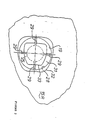
- the novel filtration system illustrated generally at 1, comprises a rotatable disc 3 having a fixed member 5 and a rotatable member 7.
- Annularly arranged screening zone 9, on the rotatable portion, comprises a plurality of like cavities 11. The cavities are separated by spacing webs 13.
- the disc 3 is rotatably mounted in a housing comprising a first, input, plate 15 and a second, output, plate 17.
- Plate 15 comprises a flow-through bore 19, which includes a flow-shape forming means 21 which will be further described below.
- An output from the source of molten plastic (not shown) is connected to the flow-through bore 19.
- Plate 17 comprises a flow-through bore 23 which is aligned with flow-through bore 19.
- the circular disc is mounted in the housing so that at least one cavity is always aligned with aligned bores 19 and 23.
- bore 23 is connected to a tool wherein the molten plastic is to be used, the aligned bores 19 and 23 along with the cavity in alignment with the bores form a flow-through channel for the molten plastic.
- this comprises a circular core 25 and a circular, concentric, outer ring 27.
- the core 25 is connected to the ring 27 by webs 29.
- the core 25 and the outer ring 27 form, between them, a flow ring 31 through which the molten plastic will flow.
- the rear face of the flow-shape forming means 21 comprises a core continuation 33 whose cross-sectional outline corresponds with the contour of the flow-through bore 23.
- the rear face 15R of plate 15 has an opening 32 whose cross-sectional outline also corresponds with the contour of flow-through bore 23. (See also Figure 3).
- core continuation 33 is integral with core 25 (as best seen in Figure 3).
- the circular shape of 25 is transformed into the shape of 33 by machining as is known in the art.
- the circular shaped opening on the front side of plate 15 is also transformed to the shape of 32 on the rear side 15R of plate 15 by machining as is, once again, known in the art.
- the molten flow in the middle of plate 15 comprises a tube having a cross-sectional shape corresponding to the contour of flow-through bore 23.
- the hollow area surrounded by the tube of molten plastic will quickly be filled in, in the space 34 before the rear 15R of plate 15, so that, as the molten plastic exits from the flow-through bore of plate 15 and enters the adjacent cavity 11A (see Figure 3), it will assume the form of a solid member having a cross-section in the shape of the contour on the front side of flow-through bore 23.
- plastic has been driven through to the outer periphery of the contour.
- the cross-sectional area of molten plastic entering the filtration system through the front side of flow-shape forming means 21 is defined by the inner periphery 28 of the outer ring 27 of flow-shape forming means 21.
- the cross-sectional area of the molten plastic exiting on the rear side of plate 15 is defined by the shape of 32 on the rear side 15R of the plate 15. As clearly seen in Figure 2, the area defined by 32 is larger than the area defined by 28.
- the cross-sectional area of the molten plastic entering into the screen area of the filtration system is greater than the cross-sectional area at the output of the source of molten plastic.
- the active filtering area has been increased due to the employment of the flow-shape forming means 21 in the flow-through bore 19 of the input plate 15.
- the increase in active filtering area results in a higher put-through by the filtration system.
- the active filter area could be increased even if the contour of flow-through bore 23 were circular in shape.
- the contour of 23 has been altered from a circular shape to the shape illustrated in the drawings to improve performance in other respects.
- the system also includes a drive means 37 for rotating the disc 3.
- the teeth on the drive means 37 engage with the teeth 39 on the outer periphery of the disc 3.
- the drive means 37 is rotated by means well known in the art and discussed in the above-mentioned references. It will of course be understood that different drive means than those shown in the drawings can be used.
- the drive means will rotate the disc 3 in the direction shown by arrow A in Figure 1.
- Flow-through bore 23 is contoured so that the bottom edge 43 of 23 corresponds with the shape of the back side of the leading edge 41 of each cavity.
- the right-hand edge 47 of flow-through bore 23 corresponds with the shape of the top edge 45 of each cavity
- the bottom edge 49 of each cavity corresponds with the left-hand edge 51 of the flow-through bore 19.
- a maximum portion of the screens in each cavity will be "active" when that cavity is in the flow-through channel.
- each cavity may be smaller while supporting a larger active filter area.
- each cavity comprises a space for a filter or screening stack on the side of the cavity closest to the plate 15, and that each cavity comprises a plurality of flow-through bores 10 (see Figure 3).
- the cavities of the present application are similar to cavities as illustrated in the '502 U.S. patent and in the '343 A1 and '343 C2 German references above-mentioned.
- plate 15 comprises a vacuum opening 53, which is connected to a vacuum pump. As can be seen in Figure 3, the vacuum opening extends completely through the plate and is disposed adjacent to a cavity 11B which is entering the flow channel. A potential position for the vacuum opening is also illustrated in Figure 1.
- a bleed valve 55 Disposed in the vacuum opening is a bleed valve 55.
- the cavity being flooded will be evacuated at the same time that it is being flooded.
- the bleed valve will close to terminate the vacuuming procedure. At the same time, it will ensure that plastic is not drawn up into the vacuum pump. Accordingly, the cavity being flooded will be evacuated while it is flooded and continues to be evacuated substantially until the entire cavity is flooded.
- the flow-shape forming means 21 permits an increase in the active filter area without requiring an increase in the cross-sectional area of the molten plastic flow from the source.
- the steadiness of the flow through the flow-through channel has been increased by increasing the number of cavities and making each of the cavity smaller.
- the performance of the filtration system is improved by evacuating means which evacuate the cavity being flooded while it is being flooded.
Landscapes
- Engineering & Computer Science (AREA)
- Mechanical Engineering (AREA)
- Chemical & Material Sciences (AREA)
- Chemical Kinetics & Catalysis (AREA)
- Extrusion Moulding Of Plastics Or The Like (AREA)
- Filtration Of Liquid (AREA)
- Centrifugal Separators (AREA)
- Moulds For Moulding Plastics Or The Like (AREA)
Applications Claiming Priority (2)
| Application Number | Priority Date | Filing Date | Title |
|---|---|---|---|
| US07/039,328 US4710288A (en) | 1987-04-17 | 1987-04-17 | Filtration system |
| US39328 | 1998-03-16 |
Publications (2)
| Publication Number | Publication Date |
|---|---|
| EP0287048A2 true EP0287048A2 (de) | 1988-10-19 |
| EP0287048A3 EP0287048A3 (de) | 1990-04-18 |
Family
ID=21904887
Family Applications (1)
| Application Number | Title | Priority Date | Filing Date |
|---|---|---|---|
| EP88105842A Withdrawn EP0287048A3 (de) | 1987-04-17 | 1988-04-13 | Anlage zum Filtrieren |
Country Status (3)
| Country | Link |
|---|---|
| US (1) | US4710288A (de) |
| EP (1) | EP0287048A3 (de) |
| CA (1) | CA1285359C (de) |
Cited By (2)
| Publication number | Priority date | Publication date | Assignee | Title |
|---|---|---|---|---|
| WO2003090999A1 (de) * | 2002-04-26 | 2003-11-06 | Maag Pump Systems Textron Ag | Filtrier- bzw. ablassvorrichtung |
| WO2023193841A1 (de) | 2022-04-07 | 2023-10-12 | Gneuss Gmbh | Filtriervorrichtung für die hochdruckfiltration einer kunststoffschmelze |
Families Citing this family (16)
| Publication number | Priority date | Publication date | Assignee | Title |
|---|---|---|---|---|
| DE8716626U1 (de) * | 1987-12-17 | 1988-02-11 | Gneuß Kunststofftechnik GmbH, 4970 Bad Oeynhausen | Siebvorrichtung zur Reinigung von Kunststoffschmelzen |
| AT394496B (de) * | 1990-10-29 | 1992-04-10 | Stoiser & Wolschner | Vorrichtung zum filtern von feststoffen aus fluessigkeiten |
| DE4212928A1 (de) * | 1992-04-21 | 1993-10-28 | Gneuss Kunststofftechnik Gmbh | Filter für Kunststoffschmelzen |
| EP0569866B1 (de) | 1992-05-11 | 1996-03-13 | GNEUSS KUNSTSTOFFTECHNIK GmbH | Filter für Kunststoffschmelzen |
| US5516426A (en) * | 1995-02-21 | 1996-05-14 | Hull; Harold L. | Self-cleaning filter system |
| US6582598B2 (en) * | 2000-12-14 | 2003-06-24 | Hubert Patrovsky | Wave filter for rotary filter |
| RU2194564C1 (ru) * | 2001-05-21 | 2002-12-20 | Закрытое акционерное общество Научно-производственное объединение "Ремгазкомплектпоставка" | Установка для очистки жидкости от механических примесей |
| KR101094842B1 (ko) | 2004-05-22 | 2011-12-15 | 한라공조주식회사 | 흡기 유니트 장치 및 이를 제어하는 방법 |
| US20080179261A1 (en) * | 2007-01-31 | 2008-07-31 | Hubert Patrovsky | Single disc dual flow rotary filter |
| US8262908B2 (en) * | 2007-08-22 | 2012-09-11 | Hubert Patrovsky | Rotary cartridge filter |
| DE102013217020A1 (de) * | 2013-05-16 | 2014-11-20 | Gneuss Gmbh | Schmelzefilter mit einem Schmelzevorflutkanal |
| EP3308940B1 (de) * | 2016-10-17 | 2025-03-05 | Next Generation Analytics GmbH | Filtersystem für viskose oder hochviskose flüssigkeiten, insbesondere kunststoffschmelzen und verfahren zur filtration von viskosen oder hochviskosen flüssigkeiten |
| US11260570B2 (en) * | 2018-05-07 | 2022-03-01 | PSI-Polymer Systems, Inc. | Filtration apparatuses and screen changer devices for polymer processing and related methods |
| DE102018120445B3 (de) * | 2018-08-22 | 2020-01-02 | Gneuss Gmbh | Filtriervorrichtung für hochviskose Medien |
| CN110980307A (zh) * | 2019-12-20 | 2020-04-10 | 广州一品红制药有限公司 | 一种防滤芯堵塞的真空上料机 |
| DE102022102820B4 (de) * | 2022-02-07 | 2023-12-21 | Gneuss Gmbh | Filtriervorrichtung für PVC-Kunststoffschmelze zur Verbindung mit einem Doppelschneckenextruder und Doppelschneckenextruder für die PVC-Verarbeitung |
Family Cites Families (10)
| Publication number | Priority date | Publication date | Assignee | Title |
|---|---|---|---|---|
| US1233016A (en) * | 1916-11-06 | 1917-07-10 | Kent W Bartlett | Liquid-treating apparatus. |
| US2784843A (en) * | 1954-08-10 | 1957-03-12 | American Viscose Corp | Filter construction |
| US3145746A (en) * | 1963-02-25 | 1964-08-25 | Nat Plastic Products Co Inc | Screen changing apparatus |
| DE1554913B1 (de) * | 1966-06-23 | 1971-01-21 | Kreyenborg & Co J | Filtereinrichtung fuer Strangpressen und Spritzgussmaschinen |
| CA989321A (en) * | 1970-07-17 | 1976-05-18 | Pcl Industries Limited | Method and aparatus for filtering flowable material |
| DE2403765C3 (de) * | 1974-01-26 | 1978-08-10 | Rudolf Paul 7000 Stuttgart Fritsch | Siebvorrichtung für die Reinigung schmelzflüssigen Kunststoffs, insbesondere an einen Extruder anbaubare Siebvorrichtung |
| US4237014A (en) * | 1979-03-12 | 1980-12-02 | Beringer Co., Inc. | Flowable material passage with interposable slide member |
| DE3302343C2 (de) * | 1983-01-25 | 1985-10-24 | Rehau Plastiks Ag + Co, 8673 Rehau | Siebwechselvorrichtung |
| DE3341508C1 (de) * | 1983-11-17 | 1984-12-13 | Detlef Dipl.-Ing. 4970 Bad Oeynhausen Gneuss | Siebvorrichtung zur Reinigung von Kunststoffschmelzen |
| US4588502A (en) * | 1983-12-06 | 1986-05-13 | Detlef Gneuss | Sieve device for cleaning molten plastics |
-
1987
- 1987-04-17 US US07/039,328 patent/US4710288A/en not_active Expired - Lifetime
- 1987-06-23 CA CA000540356A patent/CA1285359C/en not_active Expired - Lifetime
-
1988
- 1988-04-13 EP EP88105842A patent/EP0287048A3/de not_active Withdrawn
Cited By (5)
| Publication number | Priority date | Publication date | Assignee | Title |
|---|---|---|---|---|
| WO2003090999A1 (de) * | 2002-04-26 | 2003-11-06 | Maag Pump Systems Textron Ag | Filtrier- bzw. ablassvorrichtung |
| WO2003090997A1 (de) * | 2002-04-26 | 2003-11-06 | Maag Pump Systems Textron Ag | Handsiebwechsler |
| WO2023193841A1 (de) | 2022-04-07 | 2023-10-12 | Gneuss Gmbh | Filtriervorrichtung für die hochdruckfiltration einer kunststoffschmelze |
| DE102022108497A1 (de) | 2022-04-07 | 2023-10-12 | Gneuss Gmbh | Siebrad-Filtriervorrichtung für die Hochdruckfiltration einer Kunststoffschmelze |
| DE102022108497B4 (de) * | 2022-04-07 | 2025-05-22 | Gneuss Gmbh | Siebrad-Filtriervorrichtung für die Hochdruckfiltration einer Kunststoffschmelze |
Also Published As
| Publication number | Publication date |
|---|---|
| US4710288A (en) | 1987-12-01 |
| EP0287048A3 (de) | 1990-04-18 |
| CA1285359C (en) | 1991-07-02 |
Similar Documents
| Publication | Publication Date | Title |
|---|---|---|
| EP0287048A2 (de) | Anlage zum Filtrieren | |
| US4655911A (en) | Liquid filter with reverse flow rinsing operation | |
| JP3420277B2 (ja) | プラスチック溶融体用フィルタ | |
| US4935136A (en) | Disk filter | |
| CA1138350A (en) | Filter device | |
| DE19739613B4 (de) | Mechanismus zur Lärmreduzierung bei einem Staubsauger | |
| GB2216032A (en) | Polymer filtration apparatus | |
| JPS5927698B2 (ja) | プラスチツク押出機における自動「ろ」網交換装置 | |
| WO1992017263A1 (en) | Backflushable rotary melt polymer filter apparatus | |
| ES2012679A6 (es) | Valvula de varias posiciones para retrolavado de filtros. | |
| US4442002A (en) | Filtration devices | |
| EP0744271B1 (de) | Filter für Harzextruder | |
| JP4406170B2 (ja) | フィルタ装置に使用するためのフィルタ要素 | |
| RU2006124849A (ru) | Фильтр для очистки пластмассовых расплавов | |
| JP3827868B2 (ja) | スクリーン交換装置 | |
| US3984325A (en) | Filter device | |
| CN212688248U (zh) | 一种可调节进料的熔喷喷丝板 | |
| CA2171078A1 (en) | Enclosed multi-blade squeegee structure for screen printing | |
| JPS60114313A (ja) | ろ過装置 | |
| CA2027565A1 (en) | Filter for continuous filtration | |
| US4842503A (en) | Spinning pack design | |
| JPH07299310A (ja) | 可塑性材料濾過装置 | |
| EP0117071A3 (de) | Druckfilter | |
| JPS60174627A (ja) | スクリ−ンチエンジヤ | |
| US3361860A (en) | Filament spinning apparatus |
Legal Events
| Date | Code | Title | Description |
|---|---|---|---|
| PUAI | Public reference made under article 153(3) epc to a published international application that has entered the european phase |
Free format text: ORIGINAL CODE: 0009012 |
|
| AK | Designated contracting states |
Kind code of ref document: A2 Designated state(s): CH DE ES FR GB IT LI |
|
| PUAL | Search report despatched |
Free format text: ORIGINAL CODE: 0009013 |
|
| AK | Designated contracting states |
Kind code of ref document: A3 Designated state(s): CH DE ES FR GB IT LI |
|
| STAA | Information on the status of an ep patent application or granted ep patent |
Free format text: STATUS: THE APPLICATION IS DEEMED TO BE WITHDRAWN |
|
| 18D | Application deemed to be withdrawn |
Effective date: 19901105 |