EP0287260A2 - Médicament pour l'extraction de la pulpe dentaire vitale - Google Patents
Médicament pour l'extraction de la pulpe dentaire vitale Download PDFInfo
- Publication number
- EP0287260A2 EP0287260A2 EP88303011A EP88303011A EP0287260A2 EP 0287260 A2 EP0287260 A2 EP 0287260A2 EP 88303011 A EP88303011 A EP 88303011A EP 88303011 A EP88303011 A EP 88303011A EP 0287260 A2 EP0287260 A2 EP 0287260A2
- Authority
- EP
- European Patent Office
- Prior art keywords
- tissue
- pulp
- pulpal
- cut ends
- tooth
- Prior art date
- Legal status (The legal status is an assumption and is not a legal conclusion. Google has not performed a legal analysis and makes no representation as to the accuracy of the status listed.)
- Withdrawn
Links
- 239000003814 drug Substances 0.000 title claims abstract description 28
- 210000004262 dental pulp cavity Anatomy 0.000 claims abstract description 57
- 238000000034 method Methods 0.000 claims abstract description 50
- 239000000203 mixture Substances 0.000 claims abstract description 33
- 230000004888 barrier function Effects 0.000 claims abstract description 26
- VTLYFUHAOXGGBS-UHFFFAOYSA-N Fe3+ Chemical compound [Fe+3] VTLYFUHAOXGGBS-UHFFFAOYSA-N 0.000 claims abstract description 22
- 229910001447 ferric ion Inorganic materials 0.000 claims abstract description 22
- 239000004568 cement Substances 0.000 claims abstract description 12
- 230000000740 bleeding effect Effects 0.000 claims abstract description 11
- 238000002266 amputation Methods 0.000 claims abstract description 5
- 210000003074 dental pulp Anatomy 0.000 claims description 19
- 239000007864 aqueous solution Substances 0.000 claims description 7
- GDPKWKCLDUOTMP-UHFFFAOYSA-B iron(3+);dihydroxide;pentasulfate Chemical compound [OH-].[OH-].[Fe+3].[Fe+3].[Fe+3].[Fe+3].[O-]S([O-])(=O)=O.[O-]S([O-])(=O)=O.[O-]S([O-])(=O)=O.[O-]S([O-])(=O)=O.[O-]S([O-])(=O)=O GDPKWKCLDUOTMP-UHFFFAOYSA-B 0.000 claims description 6
- 238000004519 manufacturing process Methods 0.000 claims description 2
- 230000002265 prevention Effects 0.000 claims description 2
- 150000003839 salts Chemical class 0.000 claims description 2
- 238000007789 sealing Methods 0.000 claims description 2
- 239000012141 concentrate Substances 0.000 claims 3
- QAOWNCQODCNURD-UHFFFAOYSA-L Sulfate Chemical compound [O-]S([O-])(=O)=O QAOWNCQODCNURD-UHFFFAOYSA-L 0.000 claims 1
- 229910021653 sulphate ion Inorganic materials 0.000 claims 1
- 229910000360 iron(III) sulfate Inorganic materials 0.000 abstract description 9
- RUTXIHLAWFEWGM-UHFFFAOYSA-H iron(3+) sulfate Chemical compound [Fe+3].[Fe+3].[O-]S([O-])(=O)=O.[O-]S([O-])(=O)=O.[O-]S([O-])(=O)=O RUTXIHLAWFEWGM-UHFFFAOYSA-H 0.000 abstract description 8
- 238000009792 diffusion process Methods 0.000 abstract description 5
- 210000001519 tissue Anatomy 0.000 description 94
- 239000008188 pellet Substances 0.000 description 11
- 229920000742 Cotton Polymers 0.000 description 10
- 208000032843 Hemorrhage Diseases 0.000 description 10
- 239000000463 material Substances 0.000 description 10
- 230000008439 repair process Effects 0.000 description 9
- 229940030225 antihemorrhagics Drugs 0.000 description 8
- 239000002874 hemostatic agent Substances 0.000 description 8
- 210000004489 deciduous teeth Anatomy 0.000 description 7
- 230000002439 hemostatic effect Effects 0.000 description 7
- 208000015181 infectious disease Diseases 0.000 description 7
- 229940079593 drug Drugs 0.000 description 5
- 230000008569 process Effects 0.000 description 5
- 231100000331 toxic Toxicity 0.000 description 5
- 230000002588 toxic effect Effects 0.000 description 5
- BQCADISMDOOEFD-UHFFFAOYSA-N Silver Chemical compound [Ag] BQCADISMDOOEFD-UHFFFAOYSA-N 0.000 description 4
- 230000000711 cancerogenic effect Effects 0.000 description 4
- 231100000315 carcinogenic Toxicity 0.000 description 4
- 210000003298 dental enamel Anatomy 0.000 description 4
- 210000004268 dentin Anatomy 0.000 description 4
- 239000000126 substance Substances 0.000 description 4
- 241000894006 Bacteria Species 0.000 description 3
- WSFSSNUMVMOOMR-UHFFFAOYSA-N Formaldehyde Chemical compound O=C WSFSSNUMVMOOMR-UHFFFAOYSA-N 0.000 description 3
- 239000000872 buffer Substances 0.000 description 3
- 230000000694 effects Effects 0.000 description 3
- 230000007794 irritation Effects 0.000 description 3
- 230000000717 retained effect Effects 0.000 description 3
- XLOMVQKBTHCTTD-UHFFFAOYSA-N Zinc monoxide Chemical compound [Zn]=O XLOMVQKBTHCTTD-UHFFFAOYSA-N 0.000 description 2
- 230000002159 abnormal effect Effects 0.000 description 2
- 230000009471 action Effects 0.000 description 2
- 230000001580 bacterial effect Effects 0.000 description 2
- 230000017531 blood circulation Effects 0.000 description 2
- 239000003795 chemical substances by application Substances 0.000 description 2
- 150000001875 compounds Chemical class 0.000 description 2
- 230000007547 defect Effects 0.000 description 2
- RRAFCDWBNXTKKO-UHFFFAOYSA-N eugenol Chemical compound COC1=CC(CC=C)=CC=C1O RRAFCDWBNXTKKO-UHFFFAOYSA-N 0.000 description 2
- 230000036541 health Effects 0.000 description 2
- 230000023597 hemostasis Effects 0.000 description 2
- 238000011065 in-situ storage Methods 0.000 description 2
- 208000014674 injury Diseases 0.000 description 2
- 230000014759 maintenance of location Effects 0.000 description 2
- 235000015097 nutrients Nutrition 0.000 description 2
- 239000011148 porous material Substances 0.000 description 2
- 208000006860 root resorption Diseases 0.000 description 2
- 239000000243 solution Substances 0.000 description 2
- 230000003068 static effect Effects 0.000 description 2
- 210000001114 tooth apex Anatomy 0.000 description 2
- 230000008736 traumatic injury Effects 0.000 description 2
- 238000011282 treatment Methods 0.000 description 2
- UCTWMZQNUQWSLP-VIFPVBQESA-N (R)-adrenaline Chemical compound CNC[C@H](O)C1=CC=C(O)C(O)=C1 UCTWMZQNUQWSLP-VIFPVBQESA-N 0.000 description 1
- 229930182837 (R)-adrenaline Natural products 0.000 description 1
- BGEJDKIAUUZFIQ-UHFFFAOYSA-N 2-methoxy-4-prop-2-enylphenol;phenol Chemical compound OC1=CC=CC=C1.COC1=CC(CC=C)=CC=C1O BGEJDKIAUUZFIQ-UHFFFAOYSA-N 0.000 description 1
- QTWJRLJHJPIABL-UHFFFAOYSA-N 2-methylphenol;3-methylphenol;4-methylphenol Chemical compound CC1=CC=C(O)C=C1.CC1=CC=CC(O)=C1.CC1=CC=CC=C1O QTWJRLJHJPIABL-UHFFFAOYSA-N 0.000 description 1
- NPBVQXIMTZKSBA-UHFFFAOYSA-N Chavibetol Natural products COC1=CC=C(CC=C)C=C1O NPBVQXIMTZKSBA-UHFFFAOYSA-N 0.000 description 1
- 239000005770 Eugenol Substances 0.000 description 1
- UVMRYBDEERADNV-UHFFFAOYSA-N Pseudoeugenol Natural products COC1=CC(C(C)=C)=CC=C1O UVMRYBDEERADNV-UHFFFAOYSA-N 0.000 description 1
- 208000035415 Reinfection Diseases 0.000 description 1
- -1 amalgum 72 Chemical compound 0.000 description 1
- 230000002421 anti-septic effect Effects 0.000 description 1
- 229940064004 antiseptic throat preparations Drugs 0.000 description 1
- 230000015572 biosynthetic process Effects 0.000 description 1
- 239000008280 blood Substances 0.000 description 1
- 210000004369 blood Anatomy 0.000 description 1
- 230000015271 coagulation Effects 0.000 description 1
- 238000005345 coagulation Methods 0.000 description 1
- 239000000470 constituent Substances 0.000 description 1
- 238000007796 conventional method Methods 0.000 description 1
- 229930003836 cresol Natural products 0.000 description 1
- 230000006378 damage Effects 0.000 description 1
- 238000000354 decomposition reaction Methods 0.000 description 1
- 230000018044 dehydration Effects 0.000 description 1
- 238000006297 dehydration reaction Methods 0.000 description 1
- 230000002939 deleterious effect Effects 0.000 description 1
- 208000002925 dental caries Diseases 0.000 description 1
- 239000003085 diluting agent Substances 0.000 description 1
- 238000006073 displacement reaction Methods 0.000 description 1
- 230000002708 enhancing effect Effects 0.000 description 1
- 229960005139 epinephrine Drugs 0.000 description 1
- 229960002217 eugenol Drugs 0.000 description 1
- 238000001802 infusion Methods 0.000 description 1
- 230000009545 invasion Effects 0.000 description 1
- 210000005228 liver tissue Anatomy 0.000 description 1
- 230000007246 mechanism Effects 0.000 description 1
- QSHDDOUJBYECFT-UHFFFAOYSA-N mercury Chemical compound [Hg] QSHDDOUJBYECFT-UHFFFAOYSA-N 0.000 description 1
- 229910052753 mercury Inorganic materials 0.000 description 1
- 231100000219 mutagenic Toxicity 0.000 description 1
- 230000003505 mutagenic effect Effects 0.000 description 1
- 210000005084 renal tissue Anatomy 0.000 description 1
- 238000009877 rendering Methods 0.000 description 1
- 125000006850 spacer group Chemical group 0.000 description 1
- 239000003381 stabilizer Substances 0.000 description 1
- 229910001220 stainless steel Inorganic materials 0.000 description 1
- 239000010935 stainless steel Substances 0.000 description 1
- 230000008961 swelling Effects 0.000 description 1
- 238000005406 washing Methods 0.000 description 1
- 239000011787 zinc oxide Substances 0.000 description 1
- LRXTYHSAJDENHV-UHFFFAOYSA-H zinc phosphate Chemical compound [Zn+2].[Zn+2].[Zn+2].[O-]P([O-])([O-])=O.[O-]P([O-])([O-])=O LRXTYHSAJDENHV-UHFFFAOYSA-H 0.000 description 1
- 239000002672 zinc phosphate cement Substances 0.000 description 1
Images
Classifications
-
- A—HUMAN NECESSITIES
- A61—MEDICAL OR VETERINARY SCIENCE; HYGIENE
- A61K—PREPARATIONS FOR MEDICAL, DENTAL OR TOILETRY PURPOSES
- A61K33/00—Medicinal preparations containing inorganic active ingredients
- A61K33/24—Heavy metals; Compounds thereof
- A61K33/26—Iron; Compounds thereof
Definitions
- This invention relates to a substance used in preparing medicaments employed in methods for repairing teeth, particularly methods of tooth repair involving partial amputation of the coronal pulp so that the vitality of the remaining pulp is maintained and the repaired tooth can function as a healthy biological unit.
- pulpal tissue is completely removed from the crown and root canals of the tooth and replaced by various materials in order to establish a seal to the canal openings at the root ends.
- primary teeth exhibit special structural characteristics which may make the full removal of pulpal tissue difficult in endodontic procedures.
- the root canals in such teeth tend to have cross sections that are more flat and ribbon-like than in adult teeth. This is particularly true as a primary tooth matures.
- Root resorption in primary teeth requires that, if the pulpal tissue in root canals is removed, the filling used to replace that tissue, at least in the area of the roots of the teeth, must be capable of resorption with the rest of the root. This may undesirably limit the types of filling materials to which a practitioner may resort during dental repair.
- a vital dental pulpotomy involves the amputation of the vital coronal pulp down to the orifices of the pulp canals. This is usually accomplished by accessing the roof of the pulp chamber and using an excavator to remove the portion of the dental pulp desired. Frequently, bleeding in this stage of the procedure can be substantial and difficult to curtail, as the presence of a beginning infection in the pulpal tissue will normally stimulate blood flow thereto.
- a suitable drug is applied to the exposed cut ends of the pulpal tissue in order to inhibit bacterial activity at that site and in order to create thereat barrier regions of fixed pulpal tissue between the vital pulpal tissue in the pulp canals and the excavated coronal pulpal chamber.
- the barrier regions serve as buffers between the living tissue remaining and the filling placed in the coronal pulpal chamber in restoring the original tooth profile.
- the problem already described above is an inherent result of the fact that two distinct compounds, a hemostatic agent and a tissue fixing agent, must be applied in sequence to the ends of the cut pulpal tissues. The second application cannot occur until the hemostatic agent has been effective.
- formacresol When employed in pulpotomies, formacresol causes undesirable local effects, as well as potential damage to liver and kidney tissues, which are remote from the treatment site.
- harmful local effects noted are irritation of the tissues immediate to the treated tooth, abnormal levels of enamel defects in replacement permanent teeth, and rotation and displacement of those replacement teeth as they develop.
- ferric ions for the manufacture of a medicament for the prevention of bleeding and/or fixation of pulpal tissue during partial amputation of coronal pulp in endodontic procedures.
- the medicament is useful in methods for repairing a tooth comprising the initial steps of accessing the pulp chamber of the tooth and amputating the dental pulp in the pulp chamber to the orifices of the pulp canals. Thereafter, hemorrhaging is arrested from the exposed cut ends of the pulpal tissue in the pulp canals.
- the exposed cut ends of the pulpal tissue then are fixed through the application of a composition containing ferric ions.
- a composition containing ferric ions preferably comprises an aqueous solution of ferric sulfate (Fe2(SO4)3).
- ferric subsulfate (Fe4(OH)2(SO4)5) may be used.
- fixing refers to rendering that tissue less soluble, less changeable, and more resistant to the action of bacteria through a process which could generally be described as mummification. While the successful results from the use of the present invention are readily observable, the exact mechanism by which fixing of the exposed cut ends of the pulpal tissue occurs through the use of compositions containing ferric ions is not entirely understood.
- a barrier region is created of fixed tissue between the pulpal chamber and the vital pulpal tissue in the pulp canals.
- the tissue of the barrier region is preserved from infection and decomposition and serves as a buffer for the vital tissue that remains on the other side of the barrier in the pulp canals.
- the barrier regions of fixed tissue are themselves sealed from the pulpal chamber using a cement base, and the original profile of the tooth is restored by conventional techniques.
- Both tissue fixation and the arresting of hemorrhaging from the exposed cut ends of the pulpal tissue may be accomplished by administering compositions containing ferric ions. These compositions may be identical, in which case the two steps can be performed simultaneously. This results in simplification of the procedure and a corresponding savings in time.
- Ferric sulfate or ferric subsulfate when infused into the exposed cut ends of the pulpal tissue, operates promptly and efficiently to arrest hemorrhaging.
- the application of these compositions to the exposed ends of the pulpal tissue has also proven clinically effective in creating a barrier region of fixed tissue which permits the filling of the empty portion of the pulpal chamber and the restoration of the original tooth profile without reinfection or irritation to the living tissue in the pulp canals.
- the ferric ion is common in the body chemistry. Accordingly, it is not toxic. Therefore, the use of a composition containing ferric ions in place of formocresol in such dental procedures accomplishes a major objective of the present invention: creation of a biocompatible barrier at the cut ends of the vital pulpal tissue retained in a tooth during a vital pulpotomy without introducing into the body a drug having toxic and carcinogenic qualities.
- use of the present invention results in a streamlined method of performing vital pulpotomies, in that a single composition containing ferric ions will function simultaneously to control bleeding and to create a barrier region of fixed tissues as described above.
- composition applied to the exposed cut ends of the pulpal tissue to control bleeding is infused into that tissue using a controlled diffusion medicament applicator.
- a controlled diffusion medicament applicator is used to infuse a hemostatic composition into the exposed cut ends of the pulpal tissue in a vital pulpotomy, bleeding control is superior to that obtained by applying that composition using cotton pellets.
- the hemostatic control material preferably is not merely applied to the surface of the cut ends of the pulpal tissue, but infused directly into the openings of the capillaries therein under hydraulic pressure, producing hemostatis in the openings of the capillaries due to coagulation formation induced by the hemostatic control material.
- the medicament may be made up using ferric ions in an effective concentration, e.g. from 3% to 40% by weight of ferric salt, in aqueous solution or with a clinically inert carrier or diluent.
- the solution may contain other clinically compatible constituents, such as stabilisers, antiseptics, further medication, or the like if desired.
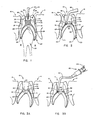
- FIG. 1 depicts a damaged tooth 10 in which traumatic injury or a carious invasion has exposed the pulp tissue 12 thereof to infection. Damaged tooth 10 is located between adjacent teeth 14 and 16 in gum tissue 18. The extent of the exposure of pulp tissue 12 to infection, in combination with the age and structural aspects of damaged tooth 10, render repair of damaged tooth 10 appropriate through the procedure of a vital pulpotomy.
- damaged tooth 10 is shown in Fig. 1 as a primary tooth.
- the roots 20 and 22 of damaged tooth 10 nestle a growing secondary tooth bud 24 within gum tissue 18 below damaged tooth 10.
- Each root 20 and 22 of damaged tooth 10 contains a corresponding root or pulp canal 26 and 28, respectively, which is filled with pulp tissue 12.
- a vital pulpotomy in general, and of the methods of the present invention in particular, to repair damaged tooth 10 in such a manner as to arrest the spread of infection within pulp tissue 12, to restore the physical integrity of the crown 30 above gum line 22 which has permitted infection to enter pulp tissue 12, and to retain as a vital living component of the repaired tooth that portion of pulp tissue 12 housed in pulp canals 26 and 28.
- damaged tooth 10 is anesthetized.
- the roof of coronal pulp chamber 34 is then accessed by the creation of an opening 42 through layers of enamel 36 and dentin 38 of crown 30 using, for example, a fissure bur 40. Opening 42 is widened to eliminate dentin overhangs 43 and afford unrestricted access to coronal pulp chamber 34, as is shown in Fig. 2.
- dental pulp tissue 12 in coronal pulp chamber 34 is amputated to the orifices 44 and 46 of pulp canals 26 and 28, respectively, using a round bur or curette 48, for example. While the walls of coronal pulp chamber 34 must be scoured clean of dental pulp tissue, care must be taken to avoid perforating floor 50 of coronal pulp chamber 34 in the process.
- Floor 50 of a coronal pulp chamber is understood to be permeated by minute accessory channels 52 which afford for the transport of some of the nutrients required by the dental pulp tissue in the coronal pulp chamber.
- the removal of all dental pulp tissue 12 from coronal pulp chamber 34 obviates the utility of accessory channels 52.
- the portion of dental pulp tissue 12 remaining in pulp canals 26 and 28 following the step of removing dental pulp tissue 12 from coronal pulp chamber 34 will continue to receive nutrients through apical foramen 54 and 56 at the tips of roots 20 and 22, respectively.
- Figs. 3A and 3B show alternative third stages of the method of the present invention in which hemorrhaging is arrested from the exposed cut ends 58 and 60 of the remaining dental pulp tissue 12 and in which exposed cut ends 58 and 60 are fixed to create at orifices 44 and 46, respectively, barrier regions of fixed tissue.
- cotton pellets 61 may be moistened with epinephrine, or with a composition containing ferric ions, such as ferric sulfate or ferric subsulfate.
- ferric sulfate concentration in the range of from about 4% to about 30%, or more preferably from about 10% to about 20% is acceptable.
- a 15.5% aqueous solution of ferric sulfate has been found to serve adequately in this regard.
- a suitable commercially available form of ferric sulfate at this level of concentration is sold under the trademark Astringedent® from Ultradent Products, Inc.
- Ferric subsulfate at the standard concentration found in Monsel Solution of from about 19% to 20%, or at concentrations in the range from about 3% to about 40%, are equally satisfactory for this purpose.
- the term "fixing,” as used herein in the method of the present invention in relation to the exposed cut ends of pulpal tissue, such as exposed cut ends 58 and 60, means to render that tissue less soluble, less changable, and more resistant to the action of bacteria.
- the process in which this is accomplished can generally be likened to mumification or leatherfication.
- the barrier regions resulting have proven to function as a clinically adequate bacteria static barriers, as well as buffers preventing irritation to the dental pulp tissue 12 remaining in pulp canals 26 and 28.
- a controlled diffusion medicament applicator 65 may advantageously be used.
- Devices such as medicament applicator 65 include a reservoir 66 for holding a quantity of hemostatic agent and a generally tubular shaped member 67 communicating with reservoir 66 through which the hemostatic agent in reservoir 66 can be applied directly to a site in a controlled manner. This is accomplished through the application of hydraulic pressure to the hemostatic agent in reservoir 66 by operation of a plunger (not shown) fitted thereinto.
- a porous material 68 is secured substantially filling distal end 69 of tubular member 67 so that the hemostatic agent dispensed from medicament applicator 65 exits tubular member 66 under hydraulic pressure.
- porous material 68 at distal end 69 of tubular member 67 is placed against exposed cut ends 58 and 60 of dental pulp tissue 12. Then syringe-type operation of the plunger fitted in reservoir 66 infuses the hemostatic into the openings of the capillaries of the live tissue of exposed cut ends 58 and 60. This results in hemostatis occurring in the orifices of the capillaries, rather than on the surface, of exposed cut ends 58 and 60.
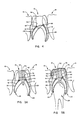
- Fig. 4 a damaged tooth 10 as shown in Fig. 4 having a coronal pulp chamber 34 emptied of dental pulp tissue, but pulp canals 26 and 28 continuing to be filled therewith.
- the tissue at exposed cut ends 58 and 60 of dental pulp tissue 12 remaining in pulp canals 26 and 28, respectively, will have ceased to hemorrhage and have been fixed into barrier region 62 and 64, respectively.
- the method of the present invention introduces no such toxic, carcinogenic material into the body of a patient, either temporarily or on an extended basis as a continuing source of infusion.
- the body chemistry routinely processes ferric ions.
- ferric ions such as ferric sulfate or ferric subsulfate, as either or both a hemorrhage control composition or a tissue-fixing composition, represents a dramatic increase in safety to the patient.
- cement base layer 70 has been applied above barrier regions 62 and 64 and on floor 50 of coronal pulp chamber 34 as a seal.
- Cement base layer 70 may be comprised of a mixture of eugenol and zinc oxide.
- coronal pulp chamber 34 and opening 42 thereinto has been filled by an amalgum 72 or other adequate restorative material in order to recreate the original profile of damaged tooth 10.
- cement base layer 70 is understood to perform two functions. First, cement base layer 70 serves to prevent mercury commonly included in an amalgum, such as amalgum 72, from diffusing into the body of the patient through contact with vital tissue. Secondly, because it contains the phenol eugenol, cement base layer 70 is believed to serve as a bacterial static barrier enhancing the effectiveness of barrier regions 62 and 64.
- damaged tooth 10 can be restored to its original profile by preparing a crown 74 duplicating that profile and then capping tooth 10 with the crown.
- damaged tooth 10 will generally be entirely filled with the material comprising cement base 70 in Fig. 5A, and then crown 74 will be adhered thereto using some form of cement 76, such as a zinc phosphate cement.
- cement 76 such as a zinc phosphate cement.
- crown 74 will frequently be composed of stainless steel, as such teeth will often fracture after pulpotomies due to brittleness arising from dentin dehydration.
- the method of the present invention eliminates all use of formocresol, that replacement tooth can be expected to exhibit no unusual number of enamel defects and no abnormal disorientation due to the pulpotomy procedure employed to save damaged tooth 10. Damaged tooth 10 will accordingly serve as an effective spacer between adjacent teeth 14 and 16 to preserve room for its replacement secondary tooth.
- the method of the present invention is a method for repairing teeth so that the vitality of some of the pulp tissue is maintained.
- the repaired tooth can accordingly be retained in location for its normal lifetime until replaced by a secondary tooth or lost due to other causes not related to the condition of the pulp tissue. This procedure permits normal root resorption to facilitate the growth and emergence of secondary teeth.
- composition containing ferric ions in place of formocresol permits the creation of biocompatible barriers at the cut ends of the vital pulp tissue retained in the tooth, without introducing into the body chemicals having known toxic and carcinogenic qualities.
- the present invention results in a method of performing vital pulpotomies which is simplified by comparison with those previously employed.
- a single composition may be used in the method of the present invention both to control bleeding and to fix tissue at the barrier regions.
- composition may be infused into the exposed ends of the pulpal tissue, rather than applied superficially, resulting in even more efficient and effective hemostasis and tissue fixation.
Landscapes
- Health & Medical Sciences (AREA)
- Chemical & Material Sciences (AREA)
- Inorganic Chemistry (AREA)
- Medicinal Chemistry (AREA)
- Pharmacology & Pharmacy (AREA)
- Epidemiology (AREA)
- Life Sciences & Earth Sciences (AREA)
- Animal Behavior & Ethology (AREA)
- General Health & Medical Sciences (AREA)
- Public Health (AREA)
- Veterinary Medicine (AREA)
- Dental Preparations (AREA)
- Dental Tools And Instruments Or Auxiliary Dental Instruments (AREA)
Applications Claiming Priority (2)
| Application Number | Priority Date | Filing Date | Title |
|---|---|---|---|
| US07/038,198 US4895517A (en) | 1987-04-14 | 1987-04-14 | Methods for performing vital dental pulpotomy |
| US38198 | 1987-04-14 |
Publications (2)
| Publication Number | Publication Date |
|---|---|
| EP0287260A2 true EP0287260A2 (fr) | 1988-10-19 |
| EP0287260A3 EP0287260A3 (fr) | 1989-10-25 |
Family
ID=21898605
Family Applications (1)
| Application Number | Title | Priority Date | Filing Date |
|---|---|---|---|
| EP88303011A Withdrawn EP0287260A3 (fr) | 1987-04-14 | 1988-04-05 | Médicament pour l'extraction de la pulpe dentaire vitale |
Country Status (2)
| Country | Link |
|---|---|
| US (1) | US4895517A (fr) |
| EP (1) | EP0287260A3 (fr) |
Families Citing this family (26)
| Publication number | Priority date | Publication date | Assignee | Title |
|---|---|---|---|---|
| US6282013B1 (en) | 1997-04-30 | 2001-08-28 | Lasermed, Inc. | System for curing polymeric materials, such as those used in dentistry, and for tailoring the post-cure properties of polymeric materials through the use of light source power modulation |
| US6008264A (en) | 1997-04-30 | 1999-12-28 | Laser Med, Inc. | Method for curing polymeric materials, such as those used in dentistry, and for tailoring the post-cure properties of polymeric materials through the use of light source power modulation |
| US6096328A (en) * | 1997-06-06 | 2000-08-01 | The Procter & Gamble Company | Delivery system for an oral care substance using a strip of material having low flexural stiffness |
| US20020018754A1 (en) * | 1999-03-15 | 2002-02-14 | Paul Albert Sagel | Shapes for tooth whitening strips |
| WO1999021505A1 (fr) | 1997-10-29 | 1999-05-06 | Bisco, Inc. | Systeme de durcissement de composite dentaire par photoexposition |
| US6116900A (en) * | 1997-11-17 | 2000-09-12 | Lumachem, Inc. | Binary energizer and peroxide delivery system for dental bleaching |
| US6200134B1 (en) | 1998-01-20 | 2001-03-13 | Kerr Corporation | Apparatus and method for curing materials with radiation |
| US6157661A (en) * | 1999-05-12 | 2000-12-05 | Laserphysics, Inc. | System for producing a pulsed, varied and modulated laser output |
| BR0115137A (pt) * | 2000-11-06 | 2003-09-16 | Paper Science & Tech Inst Inc | Composto e método de reforço de material de base mineral |
| US6652840B1 (en) | 2001-02-21 | 2003-11-25 | Terence Prevendar | Bleeding control and healing aid compositions and methods of use |
| US6949240B2 (en) * | 2002-05-23 | 2005-09-27 | The Procter & Gamble Company | Tooth whitening products |
| US8524200B2 (en) | 2002-09-11 | 2013-09-03 | The Procter & Gamble Company | Tooth whitening products |
| US20050019277A1 (en) * | 2002-09-11 | 2005-01-27 | The Procter & Gamble Company | Tooth whitening products |
| US8703104B2 (en) * | 2007-10-25 | 2014-04-22 | Ecolab Usa Inc | Use of metal astringents for the treatment of hairy heel warts |
| US9066777B2 (en) | 2009-04-02 | 2015-06-30 | Kerr Corporation | Curing light device |
| US9072572B2 (en) | 2009-04-02 | 2015-07-07 | Kerr Corporation | Dental light device |
| WO2014143014A1 (fr) | 2013-03-15 | 2014-09-18 | Triagenics, Llc | Ablation thérapeutique de bourgeon dentaire |
| CA2761652C (fr) * | 2009-05-11 | 2019-10-01 | Leigh E. Colby | Ablation therapeutique de bourgeon dentaire |
| US12514679B2 (en) | 2009-05-11 | 2026-01-06 | TriAgenics, Inc. | Therapeutic tooth bud ablation |
| US10022202B2 (en) | 2013-03-15 | 2018-07-17 | Triagenics, Llc | Therapeutic tooth bud ablation |
| CN104736133B (zh) | 2012-10-17 | 2020-07-10 | 宝洁公司 | 用于递送口腔护理活性物质的条带以及施用口腔护理活性物质的方法 |
| EP2956110B1 (fr) * | 2013-02-14 | 2020-08-12 | DENTSPLY SIRONA Inc. | Compositions résorbables et durcissables à utiliser en dentisterie |
| US9438264B1 (en) | 2015-09-10 | 2016-09-06 | Realtek Semiconductor Corp. | High-speed capacitive digital-to-analog converter and method thereof |
| CA3140710A1 (fr) | 2019-06-06 | 2020-12-10 | Leigh E. Colby | Systemes de sonde d'ablation |
| EP4470491A3 (fr) | 2020-10-26 | 2025-01-22 | TriAgenics, Inc. | Systèmes de sonde d'ablation |
| CN114299804B (zh) * | 2021-12-20 | 2023-07-25 | 四川大学 | 用于体外模拟根管屏障术的患牙模型及其构建方法和应用 |
Family Cites Families (16)
| Publication number | Priority date | Publication date | Assignee | Title |
|---|---|---|---|---|
| US459738A (en) * | 1891-09-22 | Styptic remedy | ||
| US2209454A (en) * | 1938-12-19 | 1940-07-30 | Howard L Guest | Germicide |
| US2322735A (en) * | 1939-08-11 | 1943-06-22 | Albert D Mizzy | Hemostatic analgesic, and bactericidal composition of matter |
| US2584082A (en) * | 1948-04-26 | 1952-01-29 | Foster D Snell Inc | Method of making rigid foam composition |
| US3434209A (en) * | 1965-05-12 | 1969-03-25 | Bernard Weissman | Method for building superstructures on dentition |
| US4207306A (en) * | 1974-08-02 | 1980-06-10 | Sterling Drug Inc. | Process for producing polycrystalline ceramic oxides |
| US3968567A (en) * | 1975-04-21 | 1976-07-13 | Nevins Alan J | Endodontic composition and method |
| US4251565A (en) * | 1979-02-09 | 1981-02-17 | American Dental Association Health Foundation | Use of a polyfunctional surface-active comonomer and other agents to improve adhesion between a resin or composite material and a substrate |
| US4578055A (en) * | 1979-07-25 | 1986-03-25 | Fischer Dan E | Controlled diffusion medicament applicator |
| JPS56139423A (en) * | 1980-04-02 | 1981-10-30 | Toyo Seiyaku Kasei Kk | Hemostatic agent for dental oral use |
| US4548583A (en) * | 1981-02-17 | 1985-10-22 | Dennis Smith Consulting Ltd. | Bonding to calcified tissues |
| US4382792A (en) * | 1981-02-17 | 1983-05-10 | Dennis Smith Consulting Limited | Bonding to calcified tissues |
| US4551100A (en) * | 1982-06-07 | 1985-11-05 | Ultradent, Inc. | Method of preparing gingival area for dental crowns |
| US4659751A (en) * | 1983-01-10 | 1987-04-21 | American Dental Association Health Foundation | Simplified method for obtained strong adhesive bonding of composites to dentin, enamel and other substrates |
| US4597960A (en) * | 1983-04-19 | 1986-07-01 | Cohen Edgar C | Microencapsulated astringent hemostatic agents and methods of use |
| US4522593A (en) * | 1983-07-07 | 1985-06-11 | Fischer Dan E | Knitted gingival retraction cord |
-
1987
- 1987-04-14 US US07/038,198 patent/US4895517A/en not_active Expired - Lifetime
-
1988
- 1988-04-05 EP EP88303011A patent/EP0287260A3/fr not_active Withdrawn
Also Published As
| Publication number | Publication date |
|---|---|
| EP0287260A3 (fr) | 1989-10-25 |
| US4895517A (en) | 1990-01-23 |
Similar Documents
| Publication | Publication Date | Title |
|---|---|---|
| EP0287260A2 (fr) | Médicament pour l'extraction de la pulpe dentaire vitale | |
| Rodd et al. | Pulp therapy for primary molars | |
| Trope et al. | Short vs. long‐term calcium hydroxide treatment of established inflammatory root resorption in replanted dog teeth | |
| Foreman et al. | A review of calcium hydroxide | |
| O'neal et al. | Submergence of roots for alveolar bone preservation: I. Endodontically treated roots | |
| SWIFT JR et al. | Vital pulp therapy for the mature tooth–can it work? | |
| Rud et al. | Retrograde root filling with composite and a dentin‐bonding agent. 2. | |
| Kim et al. | Pulpal reaction to caries and dental procedures | |
| Cox et al. | Technique sensitivity: biological factors contributing to clinical success with various restorative materials | |
| Camp | Pediatric endodontic treatment | |
| Rodd et al. | UK national clinical guidelines in paediatric dentistry | |
| Llewelyn | UK National Clinical Guidelines in Paediatric Dentistry. | |
| Lu | Intentional replantation of periodontally involved and endodontically mistreated tooth | |
| Leonardo et al. | Pulpectomy: Immediate root canal filling with calcium hydroxide: Concept and procedures | |
| Kola et al. | A histopathological comparison of pulpal response to formocresol and sodium hypochlorite used as pulpotomy medicaments: In primary teeth–A clinical trialA histopathological comparison of pulpal response to formocresol and sodium hypochlorite used as pulpotomy medicaments: In primary teeth–A clinical trial | |
| Bansode et al. | Root resorption and it’s management: a review article | |
| MASSLER | Biologic considerations in the selection and use of restorative materials | |
| JP5439642B2 (ja) | 殺菌性根管充填用シーラー及び調製用キット | |
| MASSLER et al. | Pulp capping and pulp amputation | |
| Goldberg et al. | Indirect and direct pulp capping, apexogenesis and apexification | |
| Fuks et al. | Glutaraldehyde as a pulp dressing after pulpotomy in primary teeth of baboon monkeys | |
| US20040053201A1 (en) | Antibacterial sponges for use in endodontic procedures and methods of use | |
| Wilder‐Smith et al. | CO2 laser treatment of traumatic pulpal exposures in dogs | |
| Stark et al. | Direct and indirect pulp capping | |
| Wemes et al. | Glutaraldehyde in endodontic therapy: philosophy and practice |
Legal Events
| Date | Code | Title | Description |
|---|---|---|---|
| PUAI | Public reference made under article 153(3) epc to a published international application that has entered the european phase |
Free format text: ORIGINAL CODE: 0009012 |
|
| AK | Designated contracting states |
Kind code of ref document: A2 Designated state(s): DE ES FR GB IT |
|
| PUAL | Search report despatched |
Free format text: ORIGINAL CODE: 0009013 |
|
| AK | Designated contracting states |
Kind code of ref document: A3 Designated state(s): DE ES FR GB IT |
|
| 17P | Request for examination filed |
Effective date: 19900420 |
|
| 17Q | First examination report despatched |
Effective date: 19910313 |
|
| STAA | Information on the status of an ep patent application or granted ep patent |
Free format text: STATUS: THE APPLICATION IS DEEMED TO BE WITHDRAWN |
|
| 18D | Application deemed to be withdrawn |
Effective date: 19910724 |