EP0287295A2 - Diffusion virtuelle d'instructions E/S programmées sur bus E/S multiple - Google Patents
Diffusion virtuelle d'instructions E/S programmées sur bus E/S multiple Download PDFInfo
- Publication number
- EP0287295A2 EP0287295A2 EP88303195A EP88303195A EP0287295A2 EP 0287295 A2 EP0287295 A2 EP 0287295A2 EP 88303195 A EP88303195 A EP 88303195A EP 88303195 A EP88303195 A EP 88303195A EP 0287295 A2 EP0287295 A2 EP 0287295A2
- Authority
- EP
- European Patent Office
- Prior art keywords
- bus
- input
- output process
- referenced
- processor
- Prior art date
- Legal status (The legal status is an assumption and is not a legal conclusion. Google has not performed a legal analysis and makes no representation as to the accuracy of the status listed.)
- Withdrawn
Links
Images

Classifications
-
- G—PHYSICS
- G06—COMPUTING OR CALCULATING; COUNTING
- G06F—ELECTRIC DIGITAL DATA PROCESSING
- G06F9/00—Arrangements for program control, e.g. control units
- G06F9/06—Arrangements for program control, e.g. control units using stored programs, i.e. using an internal store of processing equipment to receive or retain programs
- G06F9/46—Multiprogramming arrangements
- G06F9/48—Program initiating; Program switching, e.g. by interrupt
- G06F9/4806—Task transfer initiation or dispatching
- G06F9/4843—Task transfer initiation or dispatching by program, e.g. task dispatcher, supervisor, operating system
- G06F9/4881—Scheduling strategies for dispatcher, e.g. round robin, multi-level priority queues
-
- G—PHYSICS
- G06—COMPUTING OR CALCULATING; COUNTING
- G06F—ELECTRIC DIGITAL DATA PROCESSING
- G06F13/00—Interconnection of, or transfer of information or other signals between, memories, input/output devices or central processing units
- G06F13/10—Program control for peripheral devices
-
- G—PHYSICS
- G06—COMPUTING OR CALCULATING; COUNTING
- G06F—ELECTRIC DIGITAL DATA PROCESSING
- G06F15/00—Digital computers in general; Data processing equipment in general
- G06F15/16—Combinations of two or more digital computers each having at least an arithmetic unit, a program unit and a register, e.g. for a simultaneous processing of several programs
- G06F15/161—Computing infrastructure, e.g. computer clusters, blade chassis or hardware partitioning
-
- G—PHYSICS
- G06—COMPUTING OR CALCULATING; COUNTING
- G06F—ELECTRIC DIGITAL DATA PROCESSING
- G06F9/00—Arrangements for program control, e.g. control units
- G06F9/06—Arrangements for program control, e.g. control units using stored programs, i.e. using an internal store of processing equipment to receive or retain programs
- G06F9/46—Multiprogramming arrangements
- G06F9/50—Allocation of resources, e.g. of the central processing unit [CPU]
- G06F9/5005—Allocation of resources, e.g. of the central processing unit [CPU] to service a request
- G06F9/5011—Allocation of resources, e.g. of the central processing unit [CPU] to service a request the resources being hardware resources other than CPUs, Servers and Terminals
Definitions
- This invention relates to a technique for performing programmed input/output instructions in a multiprocessor system and, more particularly, to a technique for performing programmed input/output instructions on multiple I/O buses without requiring extensive hardware or software modifications from an existing uniprocessor design.
- Computer software is typically designed for use in a uniprocessor environment wherein a single processor communicates with one or more input/output (I/O) devices on a single I/O bus.
- I/O input/output
- PIO programmed input/output
- Multiprocessor systems having two or more concurrently operating processors are utilized to increase processing capability.
- a single I/O bus may be connected to one of the processors. All I/O must be performed by the associated processor, thereby placing a heavier workload on the processor to which the I/O bus is connected.
- the I/O capability of the multiprocessor system is limited by the capabilities of the single I/O bus.
- I/O buses can be connected to the multiple processors to increase I/O speed and capacity using existing uniprocessor and uni-I/O bus communication design techniques.
- Each processor can only communicate with its associated or "local" I/O bus.
- the software running on the multiprocessor system may attempt to perform an I/O process containing PIO instructions referencing I/O devices located on any one of the I/O buses in the system.
- an I/O process is any process that attempts to execute a programmed I/O instruction, and a process, or task, is a single program entity in a multiprogrammed system.
- the software references an I/O device connected on a remote I/O bus
- the software (originally designed for a uniprocessor system) does not know that the device is connected to a remote I/O bus and does not know if there is a communication link to the referenced I/O device.
- One solution is to provide a hardware connection between each processor and each I/O bus.
- the system design is unduly complicated because additional hardware is required for the bus interconnections, and control hardware is required to arbitrate processor requests for use of each I/O bus.
- the PIO instruction can only be performed on the processor associated with the I/O bus where the referenced I/O device is connected.
- a method for performing an input/output process containing a programmed input/output instruction in a multiprocessor system including at least two processors, each having an associated I/O bus with one or more I/O devices connected thereto.
- the method comprises the steps of storing a unique I/O device address and an I/O bus location for each I/O device in a device location table, determining the address of a referenced I/O device prior to performing the programmed input/output instruction, reading the corresponding I/O bus location of the referenced I/O device from the device location table, and executing the input/output process on the processor associated with the I/O bus to which the referenced I/O device is connected.
- the multiprocessor system includes process scheduling means for scheduling and running processes according to their priorities.
- the process scheduling means includes a process control block associated with each scheduled process.
- the step of executing the input/output process includes the steps of executing the input/output process on the local processor when the referenced I/O device is connected to the local I/O bus and, when the referenced I/O device is connected to a prescribed remote I/O bus, placing a locked descriptor in the process control block of the input/output process, the locked descriptor indicating that the input/output process can be performed only on the remote processor associated with the prescribed remote I/O bus, saving the registers of the input/output process in its process control block, and scheduling the input/output process in accordance with its priority on the remote processor associated with the prescribed remote I/O bus.
- the method of the present invention results in the software effectively providing a virtual broadcast of programmed input/output operations to all I/O devices connected to the system.
- the term "virtual broadcast" is appropriate because the software appears to communicate with an I/O device located on any I/O bus when it executes a programmed input/output instruction. In reality, only the processor associated with the referenced I/O bus executes the instruction and only one I/O bus is used.
- the software is not required to know the I/O bus to which a referenced I/O device is connected, nor is it required to determine whether there is a communication path between the processor and the referenced I/O device.
- the hardware for interconnection of multiple I/O buses and the control hardware for bus arbitration are eliminated as a result of the present invention. Software designed for use on a uniprocessor system is compatible with multiprocessor systems.
- the present invention provides an algorithm for enabling programmed input/output (PIO) instructions, wherein software communicates with an I/O device, to run on a multiprocessor system having two or more I/O buses.
- the algorithm forces an I/O process containing the PIO instruction to run on the processor associated with the I/O bus to which the referenced I/O device is connected. Modification of the I/O process software is not required to implement the algorithm.
- the present invention requires that the computer system operate in a multiprogrammed, or multitasking, environment having an operating system that allows multiple tasks in memory which share the central processing unit.
- the system is assumed to be a tightly coupled multiprocessor having a central processing unit composed of multiple processors, each of which can execute any task in shared memory, and having only one operating system.
- the operating system includes a task scheduler that schedules tasks for execution on the processors according to their assigned priorities. Tasks of appropriate priority are scheduled to run on an available processor until a required resource is unavailable. Then, the task of next highest priority is run until the required resource becomes available.
- the task scheduler uses process control blocks which contain information regarding every scheduled task or process.
- the process control block typically contains scheduling information such as priority, scheduling, queues, pointers and register states; registers including a program counter, program status word, general registers and address registers; and account information such as total elapsed time, CPU time used and time remaining in time slice.
- scheduling information such as priority, scheduling, queues, pointers and register states
- registers including a program counter, program status word, general registers and address registers
- account information such as total elapsed time, CPU time used and time remaining in time slice.
- the process control block can also include a locked descriptor. The information in the process control block permits a task to be started or resumed when the necessary resources are available and no higher priority task is waiting.
- a suitable multiprocessor configuration includes two or more processors with a shared memory. Each processor has an associated input/output (I/O) bus each of which in turn has one or more I/O devices connected to it.
- I/O input/output
- the multiple I/O buses must appear as a single I/O bus at the software level. Therefore, every I/O device in the system must have a unique I/O device address. This requirement is distinguished from the case where a unique device address is required only on each I/O bus.
- the invention is an algorithm for forcing the input/output process to run on the processor associated with the I/O bus where the referenced I/O device is connected. It requires no special hardware and yet has minimal performance overhead.
- the invention eliminates the need for a communication link between every I/O bus and every processor.
- the processor determines if the referenced I/O device is connected on the local I/O bus with which it can directly communicate. If the referenced I/O device is on the local bus, then the programmed input/output instruction is performed normally.
- the programmed input/output instruction is forced to be executed on the remote processor associated with the I/O bus on which the referenced I/O device is connected, as described hereinafter.
- the local processor executes the task of next highest priority in the schedule.
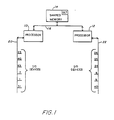
- a multiprocessor system suitable for incorporation of the present invention is shown in block diagram form in FIG. 1.
- a processor 10 and a processor 12 communicate with a shared memory 14 on a multiconductor memory bus 16.
- the processors 10 and 12 communicate with each other via the shared memory 14.
- the dual processor system may have any desired memory configuration and any desired channel of communication between processors with the limitation that the system have a single operating system including means for scheduling tasks on processors 10 and 12 according to priority.
- I/O bus 20 is connected to processor 10 and an I/O bus 22 is connected to processor 12.
- the I/O buses 20, 22, each of which is a multiconductor data communication link, provide communication between each processor and the I/O devices connected on the respective I/O bus.
- the I/O devices which may include interfaces to disk drives, tape drives, video display terminals and the like, are shown diagrammatically in FIG. 1 by numbers representing I/O device addresses.
- I/O devices having addresses 23, 40, 63, 7, 1 and 31 are connected to I/O bus 20; and I/O devices having addresses 26, 25, 24, 8, 9 and 42 are connected to I/O bus 22.
- a requirement of the present invention is that each I/O device in the system must have a unique address.
- processors 10, 12 can be identical and based on a uniprocessor design.
- An example of such a processor is Model P9955II manufactured by Prime Computer.
- Each processor has been modified to support shared memory in the dual processor configuration, but no I/O hardware modifications have been made.
- the device location table may exist in the shared memory 14 and is preferably formed during system initialization. It has fixed entries as long as the I/O device configuration remains the same.
- the device location table includes an entry corresponding to each possible unique I/O device address.
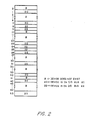
- An example of a device location table for the system of FIG. 1 is shown in FIG. 2. For each I/O device address, there are three possible entries; 0 indicating that an I/O device does not exist for that address, 20 indicating that the I/O device is connected to I/O bus 20, and 22 indicating that the I/O device is connected to I/O bus 22. When the system includes more than two I/O buses, more than two I/O device locations are required.
- the device location table is formed during system initialization by polling each of the I/O buses 20, 22 to determine the addresses of the I/O devices connected to that bus. For each address, an entry is made in the device location table as shown in FIG. 2.
- the processor determines if the referenced I/O device is connected on the I/O bus with which it can directly communicate. If this is the case, then the PIO instruction is executed normally. If the referenced I/O device resides on a different, or remote, I/O bus, then a process exchange mechanism is used to force the I/O process to be executed on the appropriate remote processor.
- process exchange refers to the method employed by a processor when it switches from one task or process to another. This mechanism is also
- the multiprocessor process exchange algorithm needs to recognize that a process can be locked to a processor. This is achieved by having the processor check a locked descriptor before executing a new process. If the process is locked to another processor, then this processor must find a different process to run. This function is required for use of the invention, but it is often included in multiprocessor systems for other applications, such as performance measurement.
- the I/O process is locked to that remote processor and a pseudo-notify is performed. In other words, the I/O process is treated as if it just became ready for execution.
- the local processor that initiated execution of the PIO instruction will not attempt to run that process again because it is locked to another remote processor. Instead, the local processor finds the next highest priority task to run.
- the remote processor that is the target of the I/O process will begin running that process as soon as it is the highest priority task that can be run. When the I/O process does run on the remote processor, it is executed in normal fashion.
- registers In most computer architectures, there are hardware registers that are defined to control or support I/O operations. These registers need to be maintained in a coherent manner to support I/O activity on the multiple I/O buses. I/O virtual-to-physical memory mapping registers and I/O channel control registers are examples of these registers. In most cases, coherency can be maintained using any general purpose interprocessor communication technique. Such techniques which may be in hardware or software are generally part of every multiprocessor system.
- the invention has the side effect of leaving processes locked to a particular processor. In most cases, this is a desirable side effect. Since communication to I/O devices is usually performed by device interface modules (DIM's) on behalf of users, only the DIM's become locked. Since DIM's will communicate with the same I/O devices repeatedly, or in some cases can only communicate with one I/O device, the DIM's will usually be executing on the appropriate processor. If there is balanced activity on each I/O bus, then the DIM's should be approximately balanced on the multiple processor.
- DIM's device interface modules
- the user in this case is an I/O process, but he can have his locked descriptor field cleared whenever he releases or unassigns an I/O device (that is, he is finished performing PIO instructions). This is only necessary to insure load balancing of users on the system.
- the process exchange algorithm of the present invention can be implemented in microcode in the processors of the multiprocessor. No software modifications are required in order to use this algorithm.
- the algorithm can also be implemented in a combination of microcode and software, depending on the architecture of the multiprocessor systems being used.
- a flow chart of the programmed I/O instruction is illustrated in FIG. 3.
- the algorithm is initiated when a processor begins execution of a programmed input/output instruction, as indicated in step 50.
- the instruction is examined to determine the referenced I/O device address.
- the location of the referenced I/O device is read from the device location table (FIG. 2) utilizing the address of the referenced I/O device.
- the algorithm determines whether the referenced I/O device is connected on the local I/O bus.
- the PIO instruction is executed in step 58 in the normal manner as required by the architecture of the processor.
- the PIO instruction is completed, and the processor continues executing the process that contained the PIO instruction, as shown in step 60.
- step 64 the existence of the referenced I/O device in the system is verified in step 64 of the algorithm.
- appropriate flags are set in step 66 as required by the computer architecture, and the processor continues executing the same process as shown in step 68.
- the remote processor connected to the referenced I/O device is identified in step 70.
- the remote processor is identified by reference to the device location table.
- the process control block (PCB) of the task scheduler is notified that this programmed input/output process may only be executed on the remote processor identified in the previous step. This notification is done by placing a locked descriptor in the PCB for this process. Whenever the task scheduler attempts to run this process, it will first reference the locked descriptor to determine whether the process is locked to a particular processor and will run the process only on that processor. The process registers for this I/O process are saved in the PCB in step 74 so that the process can be resumed on the appropriate remote processor.
- the I/O process is ready for scheduling on the appropriate remote processor.
- the relative priorities of the I/O process and the process currently running on the appropriate remote processor are determined in step 76.
- the remote processor is signalled in step 80 to preempt its currently running process and to begin running the I/O process in question.
- Communication between processors can be by any conventional means such as by a mailbox in shared memory 14.
- the local processor searches in step 82 for another process for execution. This is done by exiting to the task scheduler itself.
- D2XDIM schedules activity for I/O devices at addresses 23, 24, 25 and 26, and assume that processor 12 is executing D2XDIM.
- a PIO instruction is executed which requires communication with the I/O device at address 26. Since I/O device 26 is connected to processor 12 on I/O bus 22 as indicated in the device location table, processor 12 performs the specified PIO operation on I/O bus 22.
- processor 12 executes another PIO instruction which is still part of the D2XDIM process. This time the PIO operation is intended for the I/O device at address 23.
- Processor 12 determines from the device location table that the referenced I/O device is connected to processor 10 on I/O bus 20.
- Processor 12 modifies the locked descriptor word in the process control block for D2XDIM so that the locked descriptor now indicates that D2XDIM may only be executed by processor 10.
- Processor 12 determines that processor 10 is currently running a higher priority task, so processor 12 does not send a message to processor 10.
- Processor 12 finds a new unrelated task to execute after it has saved the registers for D2XDIM in the process control block for D2XDIM.
- Processor 10 finds that D2XDIM is the highest priority task that can be run.
- the state of D2XDIM is loaded into processor 10 from the process control block for D2XDIM.
- the first instruction that processor 10 executes is a PIO instruction referencing I/O device 23 (the same PIO instruction that processor 12 attempted to run earlier).
- Processor 10 finds in the device location table that device 23 is connected to it by I/O bus 20, and so processor 10 performs the PIO operation on I/O bus 20.
- the D2XDIM process continues to be executed on processor 10 for some time. It only executes PIO instructions to I/O device 23 which is connected to processor 10.
- processor 10 locks D2XDIM to processor 12 by modifying the locked descriptor word in the PCB for D2XDIM and saves the registers for D2XDIM in the PCB for D2XDIM.
- Processor 10 determines that processor 12 is executing a process which is lower in priority than D2XDIM, so processor 10 sends a message to processor 12 indicating that the currently running process must be preempted.
- Processor 10 finds a new task to run, and processor 12 executes D2XDIM as soon as it is possible to preempt the currently running process.
- Processor 12 will execute the PIO instruction to I/O device 24 when it runs D2XDIM.
- the D2XDIM program does nothing special to deal with the multiple I/O buses.
- the program has no notion of the processor on which it is being executed, or of the I/O bus to which it is issuing commands.
- the same program runs in a uniprocessor, single I/O bus environment with no modifications.
Landscapes
- Engineering & Computer Science (AREA)
- Theoretical Computer Science (AREA)
- Physics & Mathematics (AREA)
- General Engineering & Computer Science (AREA)
- Software Systems (AREA)
- General Physics & Mathematics (AREA)
- Computer Hardware Design (AREA)
- Mathematical Physics (AREA)
- Multi Processors (AREA)
Applications Claiming Priority (2)
| Application Number | Priority Date | Filing Date | Title |
|---|---|---|---|
| US37707 | 1987-04-13 | ||
| US07/037,707 US4855899A (en) | 1987-04-13 | 1987-04-13 | Multiple I/O bus virtual broadcast of programmed I/O instructions |
Publications (2)
| Publication Number | Publication Date |
|---|---|
| EP0287295A2 true EP0287295A2 (fr) | 1988-10-19 |
| EP0287295A3 EP0287295A3 (fr) | 1990-08-08 |
Family
ID=21895853
Family Applications (1)
| Application Number | Title | Priority Date | Filing Date |
|---|---|---|---|
| EP88303195A Withdrawn EP0287295A3 (fr) | 1987-04-13 | 1988-04-11 | Diffusion virtuelle d'instructions E/S programmées sur bus E/S multiple |
Country Status (5)
| Country | Link |
|---|---|
| US (1) | US4855899A (fr) |
| EP (1) | EP0287295A3 (fr) |
| JP (1) | JPS63310051A (fr) |
| AU (1) | AU603876B2 (fr) |
| CA (1) | CA1304513C (fr) |
Families Citing this family (16)
| Publication number | Priority date | Publication date | Assignee | Title |
|---|---|---|---|---|
| JP2892675B2 (ja) * | 1989-04-07 | 1999-05-17 | 株式会社日立製作所 | コンソール装置の監視方法及び情報処理システムのコンソール制御方法 |
| US5250943A (en) * | 1991-03-29 | 1993-10-05 | International Business Machines Corporation | GVT-NET--A Global Virtual Time Calculation Apparatus for Multi-Stage Networks |
| US5365228A (en) * | 1991-03-29 | 1994-11-15 | International Business Machines Corporation | SYNC-NET- a barrier synchronization apparatus for multi-stage networks |
| US5404461A (en) * | 1991-03-29 | 1995-04-04 | International Business Machines Corp. | Broadcast/switching apparatus for executing broadcast/multi-cast transfers over unbuffered asynchronous switching networks |
| US5276684A (en) * | 1991-07-22 | 1994-01-04 | International Business Machines Corporation | High performance I/O processor |
| US5542055A (en) * | 1993-05-28 | 1996-07-30 | International Business Machines Corp. | System for counting the number of peripheral buses in each hierarch connected to primary bus for creating map of peripheral buses to locate peripheral devices |
| US5590338A (en) * | 1993-07-23 | 1996-12-31 | Dell Usa, L.P. | Combined multiprocessor interrupt controller and interprocessor communication mechanism |
| US5717950A (en) | 1994-01-11 | 1998-02-10 | Hitachi, Ltd. | Input/output device information management system for multi-computer system |
| US6163793A (en) * | 1994-08-05 | 2000-12-19 | Intel Corporation | Method and apparatus for using a driver program executing on a host processor to control the execution of code on an auxiliary processor |
| US6539415B1 (en) * | 1997-09-24 | 2003-03-25 | Sony Corporation | Method and apparatus for the allocation of audio/video tasks in a network system |
| US6434592B1 (en) * | 1998-01-05 | 2002-08-13 | Intel Corporation | Method for accessing a network using programmed I/O in a paged, multi-tasking computer |
| US8171474B2 (en) | 2004-10-01 | 2012-05-01 | Serguei Mankovski | System and method for managing, scheduling, controlling and monitoring execution of jobs by a job scheduler utilizing a publish/subscription interface |
| US8266477B2 (en) | 2009-01-09 | 2012-09-11 | Ca, Inc. | System and method for modifying execution of scripts for a job scheduler using deontic logic |
| US9081621B2 (en) * | 2009-11-25 | 2015-07-14 | Microsoft Technology Licensing, Llc | Efficient input/output-aware multi-processor virtual machine scheduling |
| KR20170094911A (ko) * | 2016-02-12 | 2017-08-22 | 삼성전자주식회사 | 반도체 장치의 동작 방법 및 반도체 시스템 |
| US10684968B2 (en) * | 2017-06-15 | 2020-06-16 | International Business Machines Corporation | Conditional memory spreading for heterogeneous memory sizes |
Family Cites Families (11)
| Publication number | Priority date | Publication date | Assignee | Title |
|---|---|---|---|---|
| US3938098A (en) * | 1973-12-26 | 1976-02-10 | Xerox Corporation | Input/output connection arrangement for microprogrammable computer |
| JPS5178643A (en) * | 1974-12-29 | 1976-07-08 | Fujitsu Ltd | Sabuchaneru memori akusesuseigyohoshiki |
| US4228496A (en) * | 1976-09-07 | 1980-10-14 | Tandem Computers Incorporated | Multiprocessor system |
| US4320456A (en) * | 1980-01-18 | 1982-03-16 | International Business Machines Corporation | Control apparatus for virtual address translation unit |
| US4665482A (en) * | 1983-06-13 | 1987-05-12 | Honeywell Information Systems Inc. | Data multiplex control facility |
| AU591057B2 (en) * | 1984-06-01 | 1989-11-30 | Digital Equipment Corporation | Local area network for digital data processing system |
| US4707693A (en) * | 1984-06-13 | 1987-11-17 | Hewlett-Packard Company | Through-traffic priority protocol in a communications system |
| JPS6258341A (ja) * | 1985-09-03 | 1987-03-14 | Fujitsu Ltd | 入出力割込処理方式 |
| US5109484A (en) * | 1986-04-09 | 1992-04-28 | International Business Machines Corporation | Self configuring terminal which polls loop network and generates list of connected devices for use in selectively downloading control programs |
| US4783730A (en) * | 1986-09-19 | 1988-11-08 | Datapoint Corporation | Input/output control technique utilizing multilevel memory structure for processor and I/O communication |
| US4821170A (en) * | 1987-04-17 | 1989-04-11 | Tandem Computers Incorporated | Input/output system for multiprocessors |
-
1987
- 1987-04-13 US US07/037,707 patent/US4855899A/en not_active Expired - Lifetime
-
1988
- 1988-03-18 AU AU13266/88A patent/AU603876B2/en not_active Ceased
- 1988-04-11 EP EP88303195A patent/EP0287295A3/fr not_active Withdrawn
- 1988-04-12 CA CA000563908A patent/CA1304513C/fr not_active Expired - Fee Related
- 1988-04-13 JP JP63091229A patent/JPS63310051A/ja active Pending
Also Published As
| Publication number | Publication date |
|---|---|
| AU603876B2 (en) | 1990-11-29 |
| CA1304513C (fr) | 1992-06-30 |
| AU1326688A (en) | 1988-10-13 |
| US4855899A (en) | 1989-08-08 |
| EP0287295A3 (fr) | 1990-08-08 |
| JPS63310051A (ja) | 1988-12-19 |
Similar Documents
| Publication | Publication Date | Title |
|---|---|---|
| EP0644487B1 (fr) | Structure échelonnable d'un système d'interruption pour un système à multi-programmes | |
| US4855899A (en) | Multiple I/O bus virtual broadcast of programmed I/O instructions | |
| US5448732A (en) | Multiprocessor system and process synchronization method therefor | |
| EP3039540B1 (fr) | Moniteur de machine virtuelle conçu pour prendre en charge des machines virtuelles sensibles à une latence | |
| US5390329A (en) | Responding to service requests using minimal system-side context in a multiprocessor environment | |
| US7299464B2 (en) | System and method for transferring data between virtual machines or other computer entities | |
| US5884077A (en) | Information processing system and method in which computer with high load borrows processor of computer with low load to execute process | |
| JP3335172B2 (ja) | データ処理システム及びそれに使用するための入出力プロセッサ | |
| JP4001873B2 (ja) | 論理的にパーティションが作成されたコンピュータ・システム内で割り込みを仮想化するための装置および方法 | |
| KR100501289B1 (ko) | 입력/출력 서브-프로세서와의 비동기 인터페이스를 통한 입력/출력 성능 개선 방법 | |
| EP0783734B1 (fr) | Systeme et procede permettant de produire des interruptions cooperatives dans un environnement d'ordonnancement de taches preemptif | |
| US8572626B2 (en) | Symmetric multi-processor system | |
| EP0106669B1 (fr) | Programme superviseur pour système d'exploitation | |
| EP0564256A2 (fr) | Sérialisation de demandes d'accès aux ressources pour des interruptions et des processus | |
| EP0794492A2 (fr) | Exécution répartie de commandes à mode inadapté dans des systèmes multiprocesseurs | |
| US5666523A (en) | Method and system for distributing asynchronous input from a system input queue to reduce context switches | |
| US7103631B1 (en) | Symmetric multi-processor system | |
| EP0644489A2 (fr) | Méthode et appareil pour signaler des informations d'interruption dans un système de traitement de données | |
| JPH0533410B2 (fr) | ||
| US4725946A (en) | P and V instructions for semaphore architecture in a multiprogramming/multiprocessing environment | |
| US20060230400A1 (en) | Allocating entitled processor cycles for preempted virtual processors | |
| US6052729A (en) | Event-reaction communication protocol in an object oriented processor array | |
| WO2000028418A1 (fr) | Programmation de requetes de ressources dans un systeme informatique | |
| EP0049521A2 (fr) | Système de traitement d'information | |
| EP0052713A2 (fr) | Système de gestron des processus pour coordonner des requêtes de travail dans un système de traitement de données |
Legal Events
| Date | Code | Title | Description |
|---|---|---|---|
| PUAI | Public reference made under article 153(3) epc to a published international application that has entered the european phase |
Free format text: ORIGINAL CODE: 0009012 |
|
| AK | Designated contracting states |
Kind code of ref document: A2 Designated state(s): AT BE CH DE ES FR GB GR IT LI LU NL SE |
|
| PUAL | Search report despatched |
Free format text: ORIGINAL CODE: 0009013 |
|
| AK | Designated contracting states |
Kind code of ref document: A3 Designated state(s): AT BE CH DE ES FR GB GR IT LI LU NL SE |
|
| 17P | Request for examination filed |
Effective date: 19910124 |
|
| STAA | Information on the status of an ep patent application or granted ep patent |
Free format text: STATUS: THE APPLICATION IS DEEMED TO BE WITHDRAWN |
|
| 18D | Application deemed to be withdrawn |
Effective date: 19921105 |