EP0287340B1 - Acylierungsverfahren für die Synthese von HMG-COA-Reductase-Inhibitoren - Google Patents
Acylierungsverfahren für die Synthese von HMG-COA-Reductase-Inhibitoren Download PDFInfo
- Publication number
- EP0287340B1 EP0287340B1 EP88303304A EP88303304A EP0287340B1 EP 0287340 B1 EP0287340 B1 EP 0287340B1 EP 88303304 A EP88303304 A EP 88303304A EP 88303304 A EP88303304 A EP 88303304A EP 0287340 B1 EP0287340 B1 EP 0287340B1
- Authority
- EP
- European Patent Office
- Prior art keywords
- alkyl
- hydrogen
- phenyl
- oxy
- independently
- Prior art date
- Legal status (The legal status is an assumption and is not a legal conclusion. Google has not performed a legal analysis and makes no representation as to the accuracy of the status listed.)
- Expired - Lifetime
Links
- 0 CCC(C1)[C@](*)C(C(C*[C@]2C3)*=O)C23C1N Chemical compound CCC(C1)[C@](*)C(C(C*[C@]2C3)*=O)C23C1N 0.000 description 5
Classifications
-
- C—CHEMISTRY; METALLURGY
- C07—ORGANIC CHEMISTRY
- C07D—HETEROCYCLIC COMPOUNDS
- C07D309/00—Heterocyclic compounds containing six-membered rings having one oxygen atom as the only ring hetero atom, not condensed with other rings
- C07D309/16—Heterocyclic compounds containing six-membered rings having one oxygen atom as the only ring hetero atom, not condensed with other rings having one double bond between ring members or between a ring member and a non-ring member
- C07D309/28—Heterocyclic compounds containing six-membered rings having one oxygen atom as the only ring hetero atom, not condensed with other rings having one double bond between ring members or between a ring member and a non-ring member with hetero atoms or with carbon atoms having three bonds to hetero atoms with at the most one bond to halogen, e.g. ester or nitrile radicals, directly attached to ring carbon atoms
- C07D309/30—Oxygen atoms, e.g. delta-lactones
-
- C—CHEMISTRY; METALLURGY
- C07—ORGANIC CHEMISTRY
- C07F—ACYCLIC, CARBOCYCLIC OR HETEROCYCLIC COMPOUNDS CONTAINING ELEMENTS OTHER THAN CARBON, HYDROGEN, HALOGEN, OXYGEN, NITROGEN, SULFUR, SELENIUM OR TELLURIUM
- C07F7/00—Compounds containing elements of Groups 4 or 14 of the Periodic Table
- C07F7/02—Silicon compounds
- C07F7/08—Compounds having one or more C—Si linkages
- C07F7/18—Compounds having one or more C—Si linkages as well as one or more C—O—Si linkages
- C07F7/1804—Compounds having Si-O-C linkages
Definitions
- the C-8-ester functionality is typically inserted by acylation of the C-8-alcohol with the appropriate acyl chloride.
- This reaction generally requires prolonged high temperatures (100°C, 18-36 hours) and large excesses of the often difficult to obtain acid chloride; however, even under these conditions the yields are low.
- the conditions of the acyl chloride reaction lead to a high percentage of undesired side product whereby a tertbutyldimethylsilyloxy radical, often present as a protecting group of alcohols, is eliminated from the ⁇ -valerolactone moiety. Large amounts of starting alcohol and unconsumed acid chloride typically remain at the end of the reaction.
- This invention relates to a novel acylation process for the preparation of antihypercholesterolemic compounds of structural formula (I), wherein: n is 0 to 5 R1 and R2 are independently H or C1 ⁇ 10 alkyl or R1 and R2 together with the carbon atom to which they are attached form a carbocyclic ring of 3 to 8 carbon atoms; R3 and R4 are independently H or C1 ⁇ 3 alkyl, C3 ⁇ 7cycloalkyl, C1 ⁇ 3alkylthio, phenyl, phenylthio or substituted phenyl in which the substituents are X and Y and when n is 2 to 5, each of the R3s and R4s are independently hydrogen, C1 ⁇ 3 alkyl, C3 ⁇ 7 cycloalkyl or only one of the R3s and R4s is phenyl or substituted phenyl; R5 is hydrogen, halogen, C1 ⁇ 10alkyl, phenyl or substituted phenyl in which
- the invention is an improved method for the acylation of a hindered alcohol and/or a hindered acyl chloride.
- the fundamental principle is the activation of an acyl chloride using an alkali metal bromide/dialkylaminopyridine in reaction with an alcohol.
- the structure of the in situ generated acylating agent (2) is unknown it may be the acyl bromide (2a) or where the solvent is pyridine a pyridinium complex (2b) or a dialkylaminopyridinium complex (2c).
- the sequence below displays a typical reaction scheme: Following the sequence from (1) to (5) the acid chloride (1) reacts with an alkali metal bromide in a solvent followed by addition of dialkylaminopyridine. In this way the highly reactive acylating agent is available to acylate the alcohol (3) to give the ester (4) with virtually complete consumption of starting alcohol at a lower temperature (70°C) for shorter periods of time (6-8 hours).
- the reaction conditions of the instant invention are compatible with the silyl-protecting groups and thus only a minimal amount (1-2%) of unsaturated by-product (6) is formed. The increased purity of the product mixture greatly simplifies the isolation procedures.
- acylation following the instant invention is advantageous compared to using the acyl chloride itself, furthermore the instant invention is also advantageous compared to using acyl bromides.
- the instant invention uses acid chlorides which are readily prepared and purified and can be stored indefinitely due to their relative stability towards hydrolytic decomposition.
- the preparation of acid bromides requires expensive, hard to obtain reagents and distillative purification of acyl bromides is hampered by their high boiling point and instability.
- the invention disclosed is applicable to all acylation reactions between an acyl chloride and an alcohol which would occur albeit in low yield without the improvement conditions of the present invention.
- the invention is particularly applicable to hindered alcohol and acyl chloride reactants and such reactants which demonstrate elimination under normal acylation conditions.
- One embodiment of this invention is the compounds prepared by the process disclosed herein where OR is the alkoxy residue of alcohol type (i):
- the compounds prepared by the process of this invention are those compounds of formula (I) wherein R5 is trialkylsilyoxy-C1 ⁇ 3alkyl.
- R1 is methyl
- R11 is hydrogen
- a , b , c , d are all single bonds or one of b , c or d is a double bond or b and d are double bonds.
- Illustrative of this subclass are the following compounds:
- a second class of this embodiment are the compounds prepared wherein R5 is triphenylmethylthio-C1 ⁇ 3alkyl.
- R1 is methyl
- R11 is hydrogen
- a , b , c , d are all single bonds or one of b , c , d is a double bond or b and d are double bonds.
- Illustrative of this subclass is the following compound:
- a third class of this embodiment are the compounds prepared wherein R5 is C1 ⁇ 3alkanoyloxy-C1 ⁇ 3alkyl.
- R1 is methyl
- R11 is hydrogen
- a , b , c , d are all single bonds or one of b , c or d is a double bond or b and d are double bonds.
- Illustrative of this subclass is the following compound:
- a fourth class of this embodiment are the compounds prepared wherein R5 is C1 ⁇ 3alkyloxyacyl(CH2) m where m is 0 to 3.
- R1 is methyl
- R11 is hydrogen
- a , b , c , d are all single bonds or one of b , c or d is a double bond or b and d are double bonds.
- Illustrative of this subclass are the following compounds:
- a fifth class of this embodiment are the compounds prepared wherein R5 is In a subclass are the compounds prepared wherein R1 is methyl, R11 is hydrogen and a , b , c , d are all single bonds or one of b , c or d is a double bond or b and d are double bonds.
- R1 is methyl
- R11 is hydrogen
- a , b , c , d are all single bonds or one of b , c or d is a double bond or b and d are double bonds.
- Illustrative of this subclass is the following compound:
- a sixth class of this embodiment are the compounds prepared wherein R5 is C1 ⁇ 3 alkylthio-(CH2) m , phenylthio-(CH2) m , or C1 ⁇ 3 alkylsulfinyl-(CH2) m or phenylsulfinyl-(CH2) m .
- R1 is methyl
- R11 is hydrogen
- a , b , c , d are all single bonds or one of b , c or d is a double bond or b and d are double bonds.
- Illustrative of this subclass is the following compound:
- a seventh class of this embodiment are the compounds prepared wherein R5 is phenyl or phenyl substituted with X and Y.
- R1 is methyl
- R11 is hydrogen
- a , b , c , d are all single bonds or one of b , c or d is a double bond or b and d are double bonds.
- Illustrative of this subclass is the following compound:
- An eighth class of this embodiment are the compounds prepared wherein R5 is C1 ⁇ 3alkyl.
- R1 is methyl
- R11 is hydrogen
- a , b , c , d are all single bonds or one of b , c or d is a double bond or b and d are double bonds.
- Illustrative of this subclass is the following compound:
- Another embodiment of this invention is the compounds of formula (I) prepared by the process disclosed herein where OR is the alkoxy residue of alcohol type (ii).
- OR is the alkoxy residue of alcohol type (ii).
- the compounds prepared wherein alcohol type (ii) E is CH2CH2 or CH CH and R15 R16 R17 R18 and R19 independently are hydrogen, fluoro, C1 ⁇ 4alkyl or hydroxy-C1 ⁇ 4alkyl.
- Illustrative of this subclass is the following compound:
- the acyl chloride, alcohol, alkali metal bromide and dialkylaminopyridine catalyst may be combined in any sequence.
- the acyl chloride is combined with an anhydrous alkali metal bromide in an appropriate solvent under an inert atmosphere for approximately 10-15 minutes before combination with the alcohol.
- appropriate solvents are: pyridine, 1,2 dichloroethane, methylene chloride, triethylamine and mixtures of pyridine with tetrahydrofuran, diethyl ether and methylene chloride.
- the preferred solvent is pyridine.
- the preferred alkali metal bromide is lithium bromide.
- the mole ratio of alkali metal bromide to acyl chloride can vary between 1.0-10.0 mole equivalents alkali metal bromide to 1.0 mole equivalent acyl chloride.
- the preferred ratio is 2.0 mole equivalents metal bromide to 1 equivalent acyl chloride. It is critical that the alkali metal bromide be dried prior to use and that it not thereafter be exposed to the atmosphere.
- the mole ratio of acyl chloride to alcohol can vary between 2.0 to 3.0 mole equivalents of acyl chloride to 1.0 mole equivalents of alcohol.
- the preferred ratio is 2 equivalents acyl chloride to 1 equivalent alcohol.
- the acyl chloride is treated with an alcohol and an appropriate catalyst.
- the catalysts employed are N, N, dialkylaminopyridines and cycloalkylated aminopyridines including 4,-N,N-dimethylaminopyridine, 4-pyrollidinopyridine, 4-(2,5-dimethyl)-pyrollidinopyridine and N,N,N ⁇ ,N ⁇ -tetramethyl-N ⁇ -4-pyridinyl-guanidine.
- the preferred catalyst is 4-N,N-dimethylaminopyridine.
- the amount of catalyst employed is approximately 0.1 mole equivalent to 1.0 mole equivalent acyl chloride.
- the mixture of reactants, solvent and catalyst is heated between 25-75°C, preferably 70-75°C for 6-8 hours.
- the precusor starting materials are compactin, mevinolin and their dihydro and tetrahydro analogs which are readily available or may be prepared according to fermentation procedures disclosed in U.S. Patent 3,983,140, U.S. Patent 4,049,495, U.S. Patent 4,231,938, U.S. Patent 4,294,846 and U.S.Patent 4,343,814, and the hydrogenation procedures disclosed in U.S. Patent 4,351,844.
- Reactants which contain a hydroxymethyl or a protected hydroxymethyl group in the 6-position of the polyhydronaphthyl ring are prepared according to the procedures disclosed in copending U.S. application S.N. 001933 filed January 9, 1987.
- the appropriate starting material of formula (7) is then hydrolyzed under the conditions disclosed in U.S. Patent 4,444,784 to afford the compounds of formula (8).
- the 4-hydroxy function in the lactone moiety of the compounds of formula (8) is protected with a suitable protecting agent, exemplified here as a dimethyl-t-butylsilyl group according to the procedure disclosed in U.S. Patent 4,444,784.
- Reactant alcohols of type (ii) are prepared from starting materials utilizing standard chemical transformations specific examples of such procedures are found in European patent applications nos. 259 087 and 23299.
- reaction mixture was cooled to room temperature and some of the pyridine (6 L) removed in vacuo .
- the thick, brown mixture was diluted with 4 L of ethyl acetate and 2 kg of ice and cooled to 15°C as the pH was adjusted to 2.7 with 6N HCl (7700 mL).
- the acid was added at such a rate to keep the temperature ⁇ 20°C.
- the pH was monitored with a pH meter.
- Lithium bromide (2.95 g, 34 mmol, anhydrous) was added as rapidly as possible to a solution of 2,2-dimethylbutyryl chloride (2.28 g, 17 mmol) in anhydrous pyridine (13 mL) under N2.
- a solution of the alcohol (3.71 g, 8.51 mmol) and 4,4-dimethylaminopyridine (0.208 g, 1.7 mmol) in pyridine (10 mL) was added.
- the mixture was stirred at 70°C for 3.5 hours.
- the mixture was cooled to room temperature, poured into H2O (100 mL) and extracted with 2 x 100 mL of ethyl acetate.
Landscapes
- Chemical & Material Sciences (AREA)
- Organic Chemistry (AREA)
- Pyrane Compounds (AREA)
Claims (10)
- Verfahren zur Herstellung von Verbindungen der Strukturformel (I):

n eine Zahl von 0 bis 5 darstellt;
R₁ und R₂ unabhängig für H oder C₁₋₁₀-Alkyl stehen oder R₁ und R₂ zusammen mit dem Kohlenstoffatom, an das sie angeknüpft sind, einen carbocyclischen Ring mit 3 bis 8 Kohlenstoffatomen bilden;
R₃ und R₄ unabhängig H oder C₁₋₃-Alkyl, C₃₋₇-Cycloalkyl, C₁₋₃-Alkylthio, Phenyl, Phenylthio oder substituiertes Phenyl darstellen, worin die Substituenten X und Y sind, und wenn n eine Zahl von 2 bis 5 ist, jedes von R₃s und R₄s unabhängig Wasserstoff, C₁₋₃-Alkyl, C₃₋₇-Cycloalkyl darstellen oder nur eines von R₃s und R₄s Phenyl oder substituiertes Phenyl bedeuten;
R₅ für Wasserstoff, Halogen, C₁₋₁₀-Alkyl, Phenyl oder substituiertes Phenyl steht, worin die Substituenten X und Y oder eine Gruppe bedeuten, ausgewählt aus:a) Trialkylsilyloxy-C₁₋₁₀-alkyl oder Alkyldiarylsilyloxy-C₁₋₁₀-alkyl;b) Triphenylmethylthio-C₁₋₁₀-alkyl;c) C₁₋₈-Alkanoyloxy-C₁₋₄-alkyl;d) e)
e)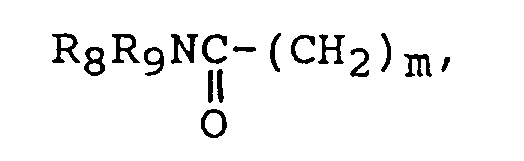 f)X und Y unabhängig für Wasserstoff, Halogen, Trifluormethyl, C₁₋₃-Alkyl, C₁₋₃-Alykloxy, C₁₋₃-Alkylthio,


OR steht für
R₁₁ Wasserstoff oder Trialkylsilyloxy oder Alkyldiarylsilyloxy bedeutet;
A
R₁₃ Wasserstoff oder Trialkylsilyloxy oder Alkyldiarylsilyloxy darstellt; a, b, c, d Einzelbindungen darstellen, eines von a, b, c oder d eine Doppelbindung darstellt oder sowohl a als auch c oder sowohl b als auch d Doppelbindungen darstellen, mit der Maßgabe, daß, wenn a eine Doppelbindung ist, A für
oder
E CH₂-CH₂ oder CH=CH bedeutet;
R₁₅, R₁₆, R₁₇, R₁₈ und R₁₉ unabhängig
Wasserstoff,
Halogen,
C₁₋₄-Alkyl,
C₁₋₄-Halogenalkyl,
Oxy-C₁₋₄-alkyl,
C₁₋₈-Alkanoyloxy-C₁₋₄-alykl,
C₈₋₁₂-Aralkanoyloxy-C₁₋₄-alkyl, oder
C₇ oder C₁₁-Aroyloxy-C₁₋₄-alkyl bedeuten, mit der Maßgabe, daß eines von R₁₅, R₁₆, R₁₇, R₁₈ und R₁₉ C₁₋₄-Alkyl oder Oxy- bedeutet, worin Oxy, der Sauerstoff, direkt an den aromatischen Ring gebunden ist;
welches umfaßt Kombinieren von


R'₁₅, R'₁₆, R'₁₇, R'₁₈, R'₁₉ die Definitionen besitzen, die für R₁₅, R₁₆, R₁₇, R₁₈ bzw. R₁₉ gegeben wurden, mit der Maßgabe, daß, wenn R₁₅, R₁₆, R₁₇, R₁₈ oder R₁₉ Oxy-C₁₋₄-alkyl oder Oxy- bedeutet, R'₁₅, R'₁₆, R'₁₇, R'₁₈ oder R'₁₉ dann für Hydroxy-C₁₋₄-alkyl bzw. Hydroxy stehen;
in einem Lösungsmittel, um die Verbindung (I) zu ergeben. - Verfahren nach Anspruch 1, worin OR (a) bedeutet; und worin R₅ ausgewählt wird aus einer Gruppe, bestehend aus:
Trialkylsilyloxy-C₁₋₃-alkyl,
Triphenylmethylthio-C₁₋₃-alkyl,
C₁₋₃-Alkanoyloxy-C₁₋₃-alykl,


Phenyl oder Phenyl, substituiert mit X und Y,
Phenyl oder Phenyl, substituiert mit X und Y, oder
C₁₋₃-Alkyl darstellt; und worin R₁ für Methyl steht,
R₁₁ Wasserstoff bedeutet und a, b, c, d, alle Einfachbindungen darstellen; oder eines von a, b, c, d, eine Doppelbindung ist oder b und d Doppelbindungen darstellen; und worin R₂ für Methyl steht,
R₃ und R₄ Wasserstoff darstellen; und worin R₁₃ Wasserstoff bedeutet. - Verfahren nach Anspruch 2, worin R₅ C₁₋₃-Alkanoyloxy-C₁₋₃-alkyl darstellt.
- Verfahren nach Anspruch 3, worin die hergestellte Verbindung 6(R)-[2-[8(S)-(4-Acetyloxy-2,2-dimethylbutyryloxy)-2(S),6(R)-dimethyl-1,2,6,7,8,8a(R)-hexahydronaphthyl-1(S)]-ethyl]-4(R)-tert-butyldimethylsilyloxy-3,4,5,6-tetrahydro-2H-pyran-2-on darstellt.
- Verfahren nach Anspruch 1, worin OR (b) bedeutet; und worin E CH=CH darstellt; R₁₅, R₁₆, R₁₇, R₁₈, R₁₉ unabhängig für Methyl, Oxymethyl, Fluor und Wasserstoff stehen.
- Verfahren nach einem der vorausgegangenen Ansprüche, worin das Alkalimetallbromid Lithiumbromid ist.
- Verfahren nach einem der vorausgegangenen Ansprüche, worin der Dialkylaminopyridin-Katalysator ausgewählt wird aus einer Gruppe, bestehend aus Di(C₁₋₅-alkyl)aminopyridin), 4-Pyrrolidinpyridin, 4-(2,5-Dimethylpyrrolidinpyridin und N,N,N',N'-Tetramethyl-N''-4-pyridinylguanidin.
- Verfahren nach Anspruch 7, bei dem der Dialkylaminopyridin-Katalysator 4,4-Dimethylaminopyridin ist.
- Verfahren nach Anspruch 2, welches weiterhin umfaßt die Behandlung von Verbindung (I) mit Tetrabutylammoniumfluorid und verdünnter Säure unter Bildung von:

R₆ die bei R₅ gegebene Definition besitzt, mit der Maßgabe, daß Trialkylsilyloxy-C₁₋₁₀-alkyl oder Alkyldiarlysilyloxy-C₁₋₁₀-alykl Hydroxy-C₁₋₁₀-alkyl darstellen und Triphenylmethylthio-C₁₋₁₀-alkyl Thio-C₁₋₁₀-alkyl darstellt;
und OR'
worin
R'₁₁ für Wasserstoff oder Hydroxy steht;
A'
R'₁₃ Wasserstoff oder Hydroxy bedeutet, mit der Maßgabe, daß, wenn a eine Doppelbindung ist,
A' für
- Verfahren nach Anspruch 5, das ferner umfaßt die Behandlung von Verbindung (I) mit Tetrabutylammoniumfluorid und verdünnter Säure unter Bildung von

R'₆ die bei R₅ gegebene Definition besitzt, mit der Maßgabe, daß Trialkylsilyloxy-C₁₋₁₀-alkyl oder Alkyldiarylsilyloxy-C₁₋₁₀-alkyl Hydroxy-C₁₋₁₀-alkyl bedeutet und Triphenylmethylthio-C₁₋₁₀-alkyl Thio-C₁₋₁₀-alkyl darstellt, und
OR''
Applications Claiming Priority (2)
| Application Number | Priority Date | Filing Date | Title |
|---|---|---|---|
| US07/038,580 US4845237A (en) | 1987-04-15 | 1987-04-15 | Acylation process for the synthesis of HMG-CoA reductase inhibitors |
| US38580 | 1987-04-15 |
Publications (3)
| Publication Number | Publication Date |
|---|---|
| EP0287340A2 EP0287340A2 (de) | 1988-10-19 |
| EP0287340A3 EP0287340A3 (en) | 1989-12-27 |
| EP0287340B1 true EP0287340B1 (de) | 1993-09-29 |
Family
ID=21900723
Family Applications (1)
| Application Number | Title | Priority Date | Filing Date |
|---|---|---|---|
| EP88303304A Expired - Lifetime EP0287340B1 (de) | 1987-04-15 | 1988-04-13 | Acylierungsverfahren für die Synthese von HMG-COA-Reductase-Inhibitoren |
Country Status (6)
| Country | Link |
|---|---|
| US (1) | US4845237A (de) |
| EP (1) | EP0287340B1 (de) |
| JP (1) | JP2688357B2 (de) |
| CA (1) | CA1317295C (de) |
| DE (1) | DE3884445T2 (de) |
| IE (1) | IE62185B1 (de) |
Families Citing this family (6)
| Publication number | Priority date | Publication date | Assignee | Title |
|---|---|---|---|---|
| US5166364A (en) * | 1989-02-27 | 1992-11-24 | E. R. Squibb & Sons, Inc. | Mevinic acid derivatives useful as antihypercholesterolemic agents and method for preparing same |
| US5099035A (en) * | 1989-02-27 | 1992-03-24 | E. R. Squibb & Sons, Inc. | Mevinic acid derivatives useful as antihypercholesterolemic agents and method for preparing same |
| SI9800057A (sl) | 1998-02-26 | 1999-08-31 | Krka, Tovarna Zdravil, D.D. | Postopek za pripravo simvastatina in njegovih derivatov |
| SI20116A (sl) | 1998-12-02 | 2000-06-30 | LEK, tovarna farmacevtskih in kemi�nih izdelkov, d.d. | Nov postopek za pripravo simvastatina in njegovih analogov |
| CA2388182A1 (en) | 1999-10-27 | 2001-05-03 | Merck & Co., Inc. | Lactonization process |
| WO2007096753A2 (en) * | 2006-02-21 | 2007-08-30 | Cadila Healthcare Limited | Process for preparing highly pure simvastatin |
Citations (6)
| Publication number | Priority date | Publication date | Assignee | Title |
|---|---|---|---|---|
| US4231938A (en) * | 1979-06-15 | 1980-11-04 | Merck & Co., Inc. | Hypocholesteremic fermentation products and process of preparation |
| US4444784A (en) * | 1980-08-05 | 1984-04-24 | Merck & Co., Inc. | Antihypercholesterolemic compounds |
| EP0245004A2 (de) * | 1986-05-05 | 1987-11-11 | Merck & Co. Inc. | Antihypercholesterolemische Verbindungen |
| EP0245003A2 (de) * | 1986-05-05 | 1987-11-11 | Merck & Co. Inc. | Antihypercholesterolemische Verbindungen |
| EP0245990A2 (de) * | 1986-05-05 | 1987-11-19 | Merck & Co. Inc. | Antihypercholesterolemische Verbindungen |
| US4864038A (en) * | 1986-05-05 | 1989-09-05 | Merck & Co., Inc. | Antihypercholesterolemic compounds |
Family Cites Families (4)
| Publication number | Priority date | Publication date | Assignee | Title |
|---|---|---|---|---|
| DE1618202C3 (de) * | 1967-02-03 | 1980-09-18 | Chemische Fabrik Kalk Gmbh, 5000 Koeln | Verfahren zur Herstellung von Carbonsä'urebromiden |
| US4611068A (en) * | 1984-11-19 | 1986-09-09 | Merck Frosst Canada, Inc. | Process for the preparation of HMG-CoA reductase inhibitors and intermediate compounds employed therein |
| US4668699A (en) * | 1985-08-05 | 1987-05-26 | Merck & Co., Inc. | Novel HMG-CoA reductase inhibitors |
| US4661483A (en) * | 1986-05-05 | 1987-04-28 | Merck & Co., Inc. | Antihypercholesterolemic lactone compounds, compositions and use |
-
1987
- 1987-04-15 US US07/038,580 patent/US4845237A/en not_active Expired - Lifetime
-
1988
- 1988-04-13 EP EP88303304A patent/EP0287340B1/de not_active Expired - Lifetime
- 1988-04-13 DE DE88303304T patent/DE3884445T2/de not_active Expired - Fee Related
- 1988-04-14 IE IE112888A patent/IE62185B1/en not_active IP Right Cessation
- 1988-04-14 CA CA000564193A patent/CA1317295C/en not_active Expired - Fee Related
- 1988-04-15 JP JP63091877A patent/JP2688357B2/ja not_active Expired - Lifetime
Patent Citations (6)
| Publication number | Priority date | Publication date | Assignee | Title |
|---|---|---|---|---|
| US4231938A (en) * | 1979-06-15 | 1980-11-04 | Merck & Co., Inc. | Hypocholesteremic fermentation products and process of preparation |
| US4444784A (en) * | 1980-08-05 | 1984-04-24 | Merck & Co., Inc. | Antihypercholesterolemic compounds |
| EP0245004A2 (de) * | 1986-05-05 | 1987-11-11 | Merck & Co. Inc. | Antihypercholesterolemische Verbindungen |
| EP0245003A2 (de) * | 1986-05-05 | 1987-11-11 | Merck & Co. Inc. | Antihypercholesterolemische Verbindungen |
| EP0245990A2 (de) * | 1986-05-05 | 1987-11-19 | Merck & Co. Inc. | Antihypercholesterolemische Verbindungen |
| US4864038A (en) * | 1986-05-05 | 1989-09-05 | Merck & Co., Inc. | Antihypercholesterolemic compounds |
Also Published As
| Publication number | Publication date |
|---|---|
| IE881128L (en) | 1988-10-15 |
| JPS63277668A (ja) | 1988-11-15 |
| JP2688357B2 (ja) | 1997-12-10 |
| US4845237A (en) | 1989-07-04 |
| IE62185B1 (en) | 1994-12-28 |
| CA1317295C (en) | 1993-05-04 |
| DE3884445D1 (de) | 1993-11-04 |
| DE3884445T2 (de) | 1994-04-21 |
| EP0287340A3 (en) | 1989-12-27 |
| EP0287340A2 (de) | 1988-10-19 |
Similar Documents
| Publication | Publication Date | Title |
|---|---|---|
| US4282155A (en) | Antihypercholesterolemic compounds | |
| WO1995013283A1 (en) | Process for producing simvastatin and analogs thereof | |
| EP0447456A1 (de) | Verfahren für zwischenprodukte zur herstellung von penemen und carbapenemen | |
| CA2018483A1 (en) | 4-substituted hmg-coa reductase inhibitors | |
| CZ286576B6 (cs) | Klíčové meziprodukty při výrobě simvastatinu | |
| US4894466A (en) | Intermediates and processes for β-6-hydroxymethyl HMG-CoA reductable inhibitors | |
| EP0137445B1 (de) | Verfahren zur C-Methylierung von 2-Methylbutyraten | |
| US4845237A (en) | Acylation process for the synthesis of HMG-CoA reductase inhibitors | |
| EP0349063B1 (de) | 5-Sauerstoffhaltige HMG-Co-A Reduktase-Inhibitoren | |
| US5166364A (en) | Mevinic acid derivatives useful as antihypercholesterolemic agents and method for preparing same | |
| EP0548947B1 (de) | Optisch aktive fluorhaltige Verbindungen | |
| US4855456A (en) | Intermediates for 6-alpha-hydroxymethyl HMG-CoA reductase inhibitors | |
| EP1363516B1 (de) | Verbessertes verfahren zur herstellung von simvastatin | |
| CZ297405B6 (cs) | Zpusob prípravy simvastatinu a jeho derivátu | |
| US4894465A (en) | Intermediates and processes for 6-hydroxymethyl HMG-CoA reductable inhibitors | |
| EP0296810B1 (de) | Zwischenprodukte und Verfahren zur Herstellung von HMG-CoA-Reduktasehemmern | |
| EP0444888B1 (de) | Verfahren zur Desilylierung eines 4-Silyloxy-tetrahydro-pyran-2-ones | |
| CA2027765C (en) | Mevinic acid derivatives | |
| EP0451965A1 (de) | Verfahren und Zwischenprodukte für die Herstellung von 5-sauerstoffhaltigen HMG-CoA Reduktase-Inhibitoren | |
| KR100286421B1 (ko) | 고지혈증 치료 화합물의 개선된 제조방법 | |
| KR100322630B1 (ko) | 심바스타틴및 이의 중간체 화합물을 제조하는 방법 | |
| EP0409399B1 (de) | 3-Keto-HMG-CoA Reduktase-Inhibitoren | |
| EP0402154A1 (de) | Antihypercholesterolämische Verbindungen | |
| KR20030077183A (ko) | 심바스타틴 및 이의 중간체 화합물들의 개선된 제조방법 | |
| HU187296B (en) | Process for the preparation of new 2-bracket-8-acyloxy-2,6-dimethyl-polyhydroxynaphthyl-1-bracket closed-ethane derivatives |
Legal Events
| Date | Code | Title | Description |
|---|---|---|---|
| PUAI | Public reference made under article 153(3) epc to a published international application that has entered the european phase |
Free format text: ORIGINAL CODE: 0009012 |
|
| AK | Designated contracting states |
Kind code of ref document: A2 Designated state(s): CH DE FR GB IT LI NL |
|
| ITCL | It: translation for ep claims filed |
Representative=s name: SOCIETA' ITALIANA BREVETTI S.P.A. |
|
| RIN1 | Information on inventor provided before grant (corrected) |
Inventor name: VERHOEVEN, THOMAS R. Inventor name: WEINSTOCK, LEONARD M. Inventor name: DECAMP, ANN ELISABETH |
|
| PUAL | Search report despatched |
Free format text: ORIGINAL CODE: 0009013 |
|
| AK | Designated contracting states |
Kind code of ref document: A3 Designated state(s): CH DE FR GB IT LI NL |
|
| 17P | Request for examination filed |
Effective date: 19900504 |
|
| 17Q | First examination report despatched |
Effective date: 19921027 |
|
| ITTA | It: last paid annual fee | ||
| GRAA | (expected) grant |
Free format text: ORIGINAL CODE: 0009210 |
|
| AK | Designated contracting states |
Kind code of ref document: B1 Designated state(s): CH DE FR GB IT LI NL |
|
| ITF | It: translation for a ep patent filed | ||
| REF | Corresponds to: |
Ref document number: 3884445 Country of ref document: DE Date of ref document: 19931104 |
|
| ET | Fr: translation filed | ||
| PLBE | No opposition filed within time limit |
Free format text: ORIGINAL CODE: 0009261 |
|
| STAA | Information on the status of an ep patent application or granted ep patent |
Free format text: STATUS: NO OPPOSITION FILED WITHIN TIME LIMIT |
|
| 26N | No opposition filed | ||
| REG | Reference to a national code |
Ref country code: GB Ref legal event code: IF02 |
|
| PGFP | Annual fee paid to national office [announced via postgrant information from national office to epo] |
Ref country code: GB Payment date: 20030313 Year of fee payment: 16 |
|
| PGFP | Annual fee paid to national office [announced via postgrant information from national office to epo] |
Ref country code: NL Payment date: 20030318 Year of fee payment: 16 |
|
| PGFP | Annual fee paid to national office [announced via postgrant information from national office to epo] |
Ref country code: FR Payment date: 20030403 Year of fee payment: 16 |
|
| PGFP | Annual fee paid to national office [announced via postgrant information from national office to epo] |
Ref country code: DE Payment date: 20030430 Year of fee payment: 16 |
|
| PGFP | Annual fee paid to national office [announced via postgrant information from national office to epo] |
Ref country code: CH Payment date: 20030605 Year of fee payment: 16 |
|
| PG25 | Lapsed in a contracting state [announced via postgrant information from national office to epo] |
Ref country code: GB Free format text: LAPSE BECAUSE OF NON-PAYMENT OF DUE FEES Effective date: 20040413 |
|
| PG25 | Lapsed in a contracting state [announced via postgrant information from national office to epo] |
Ref country code: LI Free format text: LAPSE BECAUSE OF NON-PAYMENT OF DUE FEES Effective date: 20040430 Ref country code: CH Free format text: LAPSE BECAUSE OF NON-PAYMENT OF DUE FEES Effective date: 20040430 |
|
| PG25 | Lapsed in a contracting state [announced via postgrant information from national office to epo] |
Ref country code: NL Free format text: LAPSE BECAUSE OF NON-PAYMENT OF DUE FEES Effective date: 20041101 |
|
| PG25 | Lapsed in a contracting state [announced via postgrant information from national office to epo] |
Ref country code: DE Free format text: LAPSE BECAUSE OF NON-PAYMENT OF DUE FEES Effective date: 20041103 |
|
| GBPC | Gb: european patent ceased through non-payment of renewal fee |
Effective date: 20040413 |
|
| REG | Reference to a national code |
Ref country code: CH Ref legal event code: PL |
|
| PG25 | Lapsed in a contracting state [announced via postgrant information from national office to epo] |
Ref country code: FR Free format text: LAPSE BECAUSE OF NON-PAYMENT OF DUE FEES Effective date: 20041231 |
|
| NLV4 | Nl: lapsed or anulled due to non-payment of the annual fee |
Effective date: 20041101 |
|
| REG | Reference to a national code |
Ref country code: FR Ref legal event code: ST |
|
| PG25 | Lapsed in a contracting state [announced via postgrant information from national office to epo] |
Ref country code: IT Free format text: LAPSE BECAUSE OF NON-PAYMENT OF DUE FEES;WARNING: LAPSES OF ITALIAN PATENTS WITH EFFECTIVE DATE BEFORE 2007 MAY HAVE OCCURRED AT ANY TIME BEFORE 2007. THE CORRECT EFFECTIVE DATE MAY BE DIFFERENT FROM THE ONE RECORDED. Effective date: 20050413 |