EP0287355A2 - Précurseurs de polyimide, leur utilisation et préparation - Google Patents
Précurseurs de polyimide, leur utilisation et préparation Download PDFInfo
- Publication number
- EP0287355A2 EP0287355A2 EP88303333A EP88303333A EP0287355A2 EP 0287355 A2 EP0287355 A2 EP 0287355A2 EP 88303333 A EP88303333 A EP 88303333A EP 88303333 A EP88303333 A EP 88303333A EP 0287355 A2 EP0287355 A2 EP 0287355A2
- Authority
- EP
- European Patent Office
- Prior art keywords
- acid
- polyamide
- bis
- hexafluoropropane
- phenyl
- Prior art date
- Legal status (The legal status is an assumption and is not a legal conclusion. Google has not performed a legal analysis and makes no representation as to the accuracy of the status listed.)
- Withdrawn
Links
- 239000002243 precursor Substances 0.000 title claims abstract description 39
- 239000004642 Polyimide Substances 0.000 title claims abstract description 38
- 229920001721 polyimide Polymers 0.000 title claims abstract description 38
- 230000015572 biosynthetic process Effects 0.000 title claims description 6
- 239000000203 mixture Substances 0.000 claims abstract description 40
- -1 alkyl diester Chemical class 0.000 claims abstract description 35
- HHLMWQDRYZAENA-UHFFFAOYSA-N 4-[4-[2-[4-(4-aminophenoxy)phenyl]-1,1,1,3,3,3-hexafluoropropan-2-yl]phenoxy]aniline Chemical compound C1=CC(N)=CC=C1OC1=CC=C(C(C=2C=CC(OC=3C=CC(N)=CC=3)=CC=2)(C(F)(F)F)C(F)(F)F)C=C1 HHLMWQDRYZAENA-UHFFFAOYSA-N 0.000 claims abstract description 31
- 239000004952 Polyamide Substances 0.000 claims abstract description 27
- 229920002647 polyamide Polymers 0.000 claims abstract description 27
- 238000000034 method Methods 0.000 claims abstract description 24
- 239000002904 solvent Substances 0.000 claims abstract description 16
- 239000007787 solid Substances 0.000 claims abstract description 13
- 239000012943 hotmelt Substances 0.000 claims abstract description 11
- 239000007788 liquid Substances 0.000 claims abstract description 9
- 229920005575 poly(amic acid) Polymers 0.000 claims abstract description 9
- MFTFTIALAXXIMU-UHFFFAOYSA-N 3-[4-[2-[4-(3-aminophenoxy)phenyl]-1,1,1,3,3,3-hexafluoropropan-2-yl]phenoxy]aniline Chemical compound NC1=CC=CC(OC=2C=CC(=CC=2)C(C=2C=CC(OC=3C=C(N)C=CC=3)=CC=2)(C(F)(F)F)C(F)(F)F)=C1 MFTFTIALAXXIMU-UHFFFAOYSA-N 0.000 claims abstract description 5
- CYIDZMCFTVVTJO-UHFFFAOYSA-N pyromellitic acid Chemical compound OC(=O)C1=CC(C(O)=O)=C(C(O)=O)C=C1C(O)=O CYIDZMCFTVVTJO-UHFFFAOYSA-N 0.000 claims description 34
- 239000011248 coating agent Substances 0.000 claims description 29
- 238000000576 coating method Methods 0.000 claims description 29
- 239000000758 substrate Substances 0.000 claims description 24
- ZMXDDKWLCZADIW-UHFFFAOYSA-N N,N-Dimethylformamide Chemical compound CN(C)C=O ZMXDDKWLCZADIW-UHFFFAOYSA-N 0.000 claims description 18
- SECXISVLQFMRJM-UHFFFAOYSA-N N-Methylpyrrolidone Chemical compound CN1CCCC1=O SECXISVLQFMRJM-UHFFFAOYSA-N 0.000 claims description 11
- 238000001816 cooling Methods 0.000 claims description 11
- 239000000010 aprotic solvent Substances 0.000 claims description 7
- FXHOOIRPVKKKFG-UHFFFAOYSA-N N,N-Dimethylacetamide Chemical compound CN(C)C(C)=O FXHOOIRPVKKKFG-UHFFFAOYSA-N 0.000 claims description 6
- 229940113088 dimethylacetamide Drugs 0.000 claims description 6
- 239000000835 fiber Substances 0.000 claims description 5
- 238000004519 manufacturing process Methods 0.000 claims description 5
- 150000002148 esters Chemical class 0.000 claims description 3
- 239000002253 acid Substances 0.000 claims description 2
- 150000007513 acids Chemical class 0.000 claims description 2
- 230000009969 flowable effect Effects 0.000 claims description 2
- 125000002496 methyl group Chemical group [H]C([H])([H])* 0.000 claims 2
- AMZBGUVPUIDWAW-UHFFFAOYSA-N 3-(2,3-dicarboxyphenoxy)phthalic acid 4-[2-(3,4-dicarboxyphenyl)-1,1,1,3,3,3-hexafluoropropan-2-yl]phthalic acid 5-phenylbenzene-1,2,3,4-tetracarboxylic acid Chemical compound C1(=C(C(=C(C(=C1)C(=O)O)C(=O)O)C(=O)O)C(=O)O)C1=CC=CC=C1.O(C1=C(C(C(=O)O)=CC=C1)C(=O)O)C1=C(C(C(=O)O)=CC=C1)C(=O)O.C(=O)(O)C=1C=C(C=CC1C(=O)O)C(C(F)(F)F)(C(F)(F)F)C1=CC(=C(C=C1)C(=O)O)C(=O)O AMZBGUVPUIDWAW-UHFFFAOYSA-N 0.000 claims 1
- 229910052799 carbon Inorganic materials 0.000 abstract description 3
- 239000000306 component Substances 0.000 description 14
- 150000005690 diesters Chemical class 0.000 description 13
- APXJLYIVOFARRM-UHFFFAOYSA-N 4-[2-(3,4-dicarboxyphenyl)-1,1,1,3,3,3-hexafluoropropan-2-yl]phthalic acid Chemical compound C1=C(C(O)=O)C(C(=O)O)=CC=C1C(C(F)(F)F)(C(F)(F)F)C1=CC=C(C(O)=O)C(C(O)=O)=C1 APXJLYIVOFARRM-UHFFFAOYSA-N 0.000 description 10
- WYURNTSHIVDZCO-UHFFFAOYSA-N Tetrahydrofuran Chemical compound C1CCOC1 WYURNTSHIVDZCO-UHFFFAOYSA-N 0.000 description 10
- LFQSCWFLJHTTHZ-UHFFFAOYSA-N Ethanol Chemical compound CCO LFQSCWFLJHTTHZ-UHFFFAOYSA-N 0.000 description 9
- OKKJLVBELUTLKV-UHFFFAOYSA-N Methanol Chemical compound OC OKKJLVBELUTLKV-UHFFFAOYSA-N 0.000 description 9
- VLDPXPPHXDGHEW-UHFFFAOYSA-N 1-chloro-2-dichlorophosphoryloxybenzene Chemical compound ClC1=CC=CC=C1OP(Cl)(Cl)=O VLDPXPPHXDGHEW-UHFFFAOYSA-N 0.000 description 7
- 239000011347 resin Substances 0.000 description 7
- 229920005989 resin Polymers 0.000 description 7
- GTDPSWPPOUPBNX-UHFFFAOYSA-N ac1mqpva Chemical compound CC12C(=O)OC(=O)C1(C)C1(C)C2(C)C(=O)OC1=O GTDPSWPPOUPBNX-UHFFFAOYSA-N 0.000 description 6
- 239000004744 fabric Substances 0.000 description 6
- OJURWUUOVGOHJZ-UHFFFAOYSA-N methyl 2-[(2-acetyloxyphenyl)methyl-[2-[(2-acetyloxyphenyl)methyl-(2-methoxy-2-oxoethyl)amino]ethyl]amino]acetate Chemical compound C=1C=CC=C(OC(C)=O)C=1CN(CC(=O)OC)CCN(CC(=O)OC)CC1=CC=CC=C1OC(C)=O OJURWUUOVGOHJZ-UHFFFAOYSA-N 0.000 description 6
- 229920000049 Carbon (fiber) Polymers 0.000 description 5
- 239000004917 carbon fiber Substances 0.000 description 5
- 235000019441 ethanol Nutrition 0.000 description 5
- YLQBMQCUIZJEEH-UHFFFAOYSA-N tetrahydrofuran Natural products C=1C=COC=1 YLQBMQCUIZJEEH-UHFFFAOYSA-N 0.000 description 5
- IJGRMHOSHXDMSA-UHFFFAOYSA-N Atomic nitrogen Chemical compound N#N IJGRMHOSHXDMSA-UHFFFAOYSA-N 0.000 description 4
- VNWKTOKETHGBQD-UHFFFAOYSA-N methane Chemical compound C VNWKTOKETHGBQD-UHFFFAOYSA-N 0.000 description 4
- 239000000178 monomer Substances 0.000 description 4
- ZWEHNKRNPOVVGH-UHFFFAOYSA-N 2-Butanone Chemical compound CCC(C)=O ZWEHNKRNPOVVGH-UHFFFAOYSA-N 0.000 description 3
- ZDQWESQEGGJUCH-UHFFFAOYSA-N Diisopropyl adipate Chemical compound CC(C)OC(=O)CCCCC(=O)OC(C)C ZDQWESQEGGJUCH-UHFFFAOYSA-N 0.000 description 3
- 238000004458 analytical method Methods 0.000 description 3
- 125000003118 aryl group Chemical group 0.000 description 3
- 238000010438 heat treatment Methods 0.000 description 3
- 230000000704 physical effect Effects 0.000 description 3
- 238000010992 reflux Methods 0.000 description 3
- 238000003756 stirring Methods 0.000 description 3
- SMDGQEQWSSYZKX-UHFFFAOYSA-N 3-(2,3-dicarboxyphenoxy)phthalic acid Chemical compound OC(=O)C1=CC=CC(OC=2C(=C(C(O)=O)C=CC=2)C(O)=O)=C1C(O)=O SMDGQEQWSSYZKX-UHFFFAOYSA-N 0.000 description 2
- VQVIHDPBMFABCQ-UHFFFAOYSA-N 5-(1,3-dioxo-2-benzofuran-5-carbonyl)-2-benzofuran-1,3-dione Chemical compound C1=C2C(=O)OC(=O)C2=CC(C(C=2C=C3C(=O)OC(=O)C3=CC=2)=O)=C1 VQVIHDPBMFABCQ-UHFFFAOYSA-N 0.000 description 2
- JVERADGGGBYHNP-UHFFFAOYSA-N 5-phenylbenzene-1,2,3,4-tetracarboxylic acid Chemical compound OC(=O)C1=C(C(O)=O)C(C(=O)O)=CC(C=2C=CC=CC=2)=C1C(O)=O JVERADGGGBYHNP-UHFFFAOYSA-N 0.000 description 2
- CSCPPACGZOOCGX-UHFFFAOYSA-N Acetone Chemical compound CC(C)=O CSCPPACGZOOCGX-UHFFFAOYSA-N 0.000 description 2
- YMWUJEATGCHHMB-UHFFFAOYSA-N Dichloromethane Chemical compound ClCCl YMWUJEATGCHHMB-UHFFFAOYSA-N 0.000 description 2
- RTZKZFJDLAIYFH-UHFFFAOYSA-N Diethyl ether Chemical compound CCOCC RTZKZFJDLAIYFH-UHFFFAOYSA-N 0.000 description 2
- IAZDPXIOMUYVGZ-UHFFFAOYSA-N Dimethylsulphoxide Chemical compound CS(C)=O IAZDPXIOMUYVGZ-UHFFFAOYSA-N 0.000 description 2
- UFHFLCQGNIYNRP-UHFFFAOYSA-N Hydrogen Chemical compound [H][H] UFHFLCQGNIYNRP-UHFFFAOYSA-N 0.000 description 2
- KFZMGEQAYNKOFK-UHFFFAOYSA-N Isopropanol Chemical compound CC(C)O KFZMGEQAYNKOFK-UHFFFAOYSA-N 0.000 description 2
- 238000005481 NMR spectroscopy Methods 0.000 description 2
- 125000000217 alkyl group Chemical group 0.000 description 2
- 150000008064 anhydrides Chemical class 0.000 description 2
- 239000002131 composite material Substances 0.000 description 2
- 239000001257 hydrogen Substances 0.000 description 2
- 229910052739 hydrogen Inorganic materials 0.000 description 2
- 238000011065 in-situ storage Methods 0.000 description 2
- 239000000463 material Substances 0.000 description 2
- 238000010128 melt processing Methods 0.000 description 2
- 229910052757 nitrogen Inorganic materials 0.000 description 2
- 239000002002 slurry Substances 0.000 description 2
- 238000003860 storage Methods 0.000 description 2
- LCZVKKUAUWQDPX-UHFFFAOYSA-N tert-butyl 2-[(2-acetyloxyphenyl)methyl-[2-[(2-acetyloxyphenyl)methyl-[2-[(2-methylpropan-2-yl)oxy]-2-oxoethyl]amino]ethyl]amino]acetate Chemical compound CC(=O)OC1=CC=CC=C1CN(CC(=O)OC(C)(C)C)CCN(CC(=O)OC(C)(C)C)CC1=CC=CC=C1OC(C)=O LCZVKKUAUWQDPX-UHFFFAOYSA-N 0.000 description 2
- 150000000000 tetracarboxylic acids Chemical class 0.000 description 2
- OXHNLMTVIGZXSG-UHFFFAOYSA-N 1-Methylpyrrole Chemical compound CN1C=CC=C1 OXHNLMTVIGZXSG-UHFFFAOYSA-N 0.000 description 1
- LWRCATSAYMOROD-UHFFFAOYSA-N 3-[2,3-bis(butan-2-yloxycarbonyl)phenoxy]phthalic acid Chemical compound CCC(C)OC(=O)C1=CC=CC(OC=2C(=C(C(O)=O)C=CC=2)C(O)=O)=C1C(=O)OC(C)CC LWRCATSAYMOROD-UHFFFAOYSA-N 0.000 description 1
- IPQPOPNDOCDCSG-UHFFFAOYSA-N 3-[2,3-bis(ethoxycarbonyl)phenoxy]phthalic acid Chemical compound CCOC(=O)C1=CC=CC(OC=2C(=C(C(O)=O)C=CC=2)C(O)=O)=C1C(=O)OCC IPQPOPNDOCDCSG-UHFFFAOYSA-N 0.000 description 1
- IINQCCICURURAH-UHFFFAOYSA-N 3-[2,3-bis(methoxycarbonyl)phenoxy]phthalic acid Chemical compound COC(=O)C1=CC=CC(OC=2C(=C(C(O)=O)C=CC=2)C(O)=O)=C1C(=O)OC IINQCCICURURAH-UHFFFAOYSA-N 0.000 description 1
- FIBUXLQRLKALMV-UHFFFAOYSA-N 3-[2,3-bis(propan-2-yloxycarbonyl)phenoxy]phthalic acid Chemical compound CC(C)OC(=O)C1=CC=CC(OC=2C(=C(C(O)=O)C=CC=2)C(O)=O)=C1C(=O)OC(C)C FIBUXLQRLKALMV-UHFFFAOYSA-N 0.000 description 1
- KZHMKYXCRPEEJL-UHFFFAOYSA-N 4,5-bis(propan-2-yloxycarbonyl)phthalic acid Chemical compound CC(C)OC(=O)C1=CC(C(O)=O)=C(C(O)=O)C=C1C(=O)OC(C)C KZHMKYXCRPEEJL-UHFFFAOYSA-N 0.000 description 1
- VYBANJZHJKQWIN-UHFFFAOYSA-N 4,5-bis[(2-methylpropan-2-yl)oxycarbonyl]phthalic acid Chemical compound CC(C)(C)OC(=O)C1=CC(C(O)=O)=C(C(O)=O)C=C1C(=O)OC(C)(C)C VYBANJZHJKQWIN-UHFFFAOYSA-N 0.000 description 1
- MZPURYKMOSBQBQ-UHFFFAOYSA-N 4-ethoxycarbonyl-5-methoxycarbonylphthalic acid Chemical compound CCOC(=O)C1=CC(C(O)=O)=C(C(O)=O)C=C1C(=O)OC MZPURYKMOSBQBQ-UHFFFAOYSA-N 0.000 description 1
- OKTJSMMVPCPJKN-UHFFFAOYSA-N Carbon Chemical compound [C] OKTJSMMVPCPJKN-UHFFFAOYSA-N 0.000 description 1
- 238000004566 IR spectroscopy Methods 0.000 description 1
- DHXVGJBLRPWPCS-UHFFFAOYSA-N Tetrahydropyran Chemical compound C1CCOCC1 DHXVGJBLRPWPCS-UHFFFAOYSA-N 0.000 description 1
- 230000002411 adverse Effects 0.000 description 1
- 150000001298 alcohols Chemical class 0.000 description 1
- 238000009835 boiling Methods 0.000 description 1
- 239000003795 chemical substances by application Substances 0.000 description 1
- 230000001276 controlling effect Effects 0.000 description 1
- 239000000498 cooling water Substances 0.000 description 1
- 150000004985 diamines Chemical class 0.000 description 1
- SBZXBUIDTXKZTM-UHFFFAOYSA-N diglyme Chemical compound COCCOCCOC SBZXBUIDTXKZTM-UHFFFAOYSA-N 0.000 description 1
- 238000004821 distillation Methods 0.000 description 1
- 230000000694 effects Effects 0.000 description 1
- 150000002170 ethers Chemical class 0.000 description 1
- 239000011152 fibreglass Substances 0.000 description 1
- ANSXAPJVJOKRDJ-UHFFFAOYSA-N furo[3,4-f][2]benzofuran-1,3,5,7-tetrone Chemical compound C1=C2C(=O)OC(=O)C2=CC2=C1C(=O)OC2=O ANSXAPJVJOKRDJ-UHFFFAOYSA-N 0.000 description 1
- 238000005227 gel permeation chromatography Methods 0.000 description 1
- 239000003365 glass fiber Substances 0.000 description 1
- 229910002804 graphite Inorganic materials 0.000 description 1
- 239000010439 graphite Substances 0.000 description 1
- 238000009434 installation Methods 0.000 description 1
- 150000002576 ketones Chemical class 0.000 description 1
- 239000004033 plastic Substances 0.000 description 1
- 229920003023 plastic Polymers 0.000 description 1
- 239000012704 polymeric precursor Substances 0.000 description 1
- 230000002028 premature Effects 0.000 description 1
- 238000002360 preparation method Methods 0.000 description 1
- BDERNNFJNOPAEC-UHFFFAOYSA-N propan-1-ol Chemical compound CCCO BDERNNFJNOPAEC-UHFFFAOYSA-N 0.000 description 1
- 239000000376 reactant Substances 0.000 description 1
- 230000001105 regulatory effect Effects 0.000 description 1
- 230000000717 retained effect Effects 0.000 description 1
- 238000005096 rolling process Methods 0.000 description 1
- 239000000126 substance Substances 0.000 description 1
- 238000010792 warming Methods 0.000 description 1
Images
Classifications
-
- C—CHEMISTRY; METALLURGY
- C08—ORGANIC MACROMOLECULAR COMPOUNDS; THEIR PREPARATION OR CHEMICAL WORKING-UP; COMPOSITIONS BASED THEREON
- C08G—MACROMOLECULAR COMPOUNDS OBTAINED OTHERWISE THAN BY REACTIONS ONLY INVOLVING UNSATURATED CARBON-TO-CARBON BONDS
- C08G73/00—Macromolecular compounds obtained by reactions forming a linkage containing nitrogen with or without oxygen or carbon in the main chain of the macromolecule, not provided for in groups C08G12/00 - C08G71/00
- C08G73/06—Polycondensates having nitrogen-containing heterocyclic rings in the main chain of the macromolecule
- C08G73/10—Polyimides; Polyester-imides; Polyamide-imides; Polyamide acids or similar polyimide precursors
- C08G73/1046—Polyimides containing oxygen in the form of ether bonds in the main chain
- C08G73/1053—Polyimides containing oxygen in the form of ether bonds in the main chain with oxygen only in the tetracarboxylic moiety
-
- C—CHEMISTRY; METALLURGY
- C08—ORGANIC MACROMOLECULAR COMPOUNDS; THEIR PREPARATION OR CHEMICAL WORKING-UP; COMPOSITIONS BASED THEREON
- C08G—MACROMOLECULAR COMPOUNDS OBTAINED OTHERWISE THAN BY REACTIONS ONLY INVOLVING UNSATURATED CARBON-TO-CARBON BONDS
- C08G73/00—Macromolecular compounds obtained by reactions forming a linkage containing nitrogen with or without oxygen or carbon in the main chain of the macromolecule, not provided for in groups C08G12/00 - C08G71/00
- C08G73/06—Polycondensates having nitrogen-containing heterocyclic rings in the main chain of the macromolecule
- C08G73/10—Polyimides; Polyester-imides; Polyamide-imides; Polyamide acids or similar polyimide precursors
- C08G73/1003—Preparatory processes
- C08G73/1007—Preparatory processes from tetracarboxylic acids or derivatives and diamines
- C08G73/1028—Preparatory processes from tetracarboxylic acids or derivatives and diamines characterised by the process itself, e.g. steps, continuous
- C08G73/1032—Preparatory processes from tetracarboxylic acids or derivatives and diamines characterised by the process itself, e.g. steps, continuous characterised by the solvent(s) used
-
- C—CHEMISTRY; METALLURGY
- C08—ORGANIC MACROMOLECULAR COMPOUNDS; THEIR PREPARATION OR CHEMICAL WORKING-UP; COMPOSITIONS BASED THEREON
- C08G—MACROMOLECULAR COMPOUNDS OBTAINED OTHERWISE THAN BY REACTIONS ONLY INVOLVING UNSATURATED CARBON-TO-CARBON BONDS
- C08G73/00—Macromolecular compounds obtained by reactions forming a linkage containing nitrogen with or without oxygen or carbon in the main chain of the macromolecule, not provided for in groups C08G12/00 - C08G71/00
- C08G73/06—Polycondensates having nitrogen-containing heterocyclic rings in the main chain of the macromolecule
- C08G73/10—Polyimides; Polyester-imides; Polyamide-imides; Polyamide acids or similar polyimide precursors
- C08G73/1039—Polyimides; Polyester-imides; Polyamide-imides; Polyamide acids or similar polyimide precursors comprising halogen-containing substituents
Definitions
- This invention relates to polyimide precursors which are eminently suited for use in the pseudo hot-melt prepregging process and which result in polyimide composites of excellent high temperature performance.
- the pseudo hot-melt prepregging process is a desirable way of producing reinforced polyimide laminates and shapes.
- a very viscous hot solution of a curable polymeric precursor is spread onto rolls of release paper. After cooling to room temperature the coating becomes a flexible resinous solid. It is subsequently transferred to a continuous fibrous substrate by passing the coated web and the fibrous substrate through a bank of hot rolls to impregnate the coating onto the substrate.
- the product (often referred to as prepreg tape) is sold according to grade or areal weight of fiber which usually ranges from 50 to 300 grams per square meter and more typically 100 to 200 grams per square meter. Amounts of curable resin in the tape are usually in the range of 25 to 50%, typically 30 to 35%. Tolerances in the product are critical and typically fall in the range of plus or minus 3 percent.
- polyimide precursor solutions of 4-BDAF and tetracarboxylic acid derivatives e.g., diesters of pyromellitic acid or 3,3 ⁇ ,-4,4 ⁇ -benzophenonetetracarboxylic acid
- solubility of these polyimide monomers in certain dipolar aprotic solvents at room temperature is quite high, even solutions in these solvents have too low a viscosity to be useful in the process. While the solubility of these monomers in the solvents can be increased to 60% or more by warming the solutions, the solutions deposit solids on cooling to room temperature and are consequently unsuited for prepregging using the pseudo hot-melt process.
- this invention provides, inter alia, polyimide precursors that consist essentially of a mixture of (a) 40 to 70 percent by weight of a substantially equimolar mixture of (i) 2,2-bis[4-(4-aminophenoxy)phenyl]-hexafluoropropane (4-BDAF) and/or 2,2-bis[4-(3-aminophenoxy)phenyl]hexafluoropropane (3-BDAF) and (ii) lower alkyl diester of one or more aromatic tetracarboxylic acids such as pyromellitic acid (PMA), 3,3 ⁇ ,4,4 ⁇ -benzophenonetetracarboxylic acid (BTA), 2,2-bis(3,4-dicarboxyphenyl)hexafluoropropane (FDA), oxydiphthalic acid, biphenyltetracarboxylic acid, or other aromatic tetracarboxylic acids (particularly those free or substantially free of
- the solvent of these compositions should contain from 10 to 100 percent by weight of one or more dipolar aprotic solvents, preferably dimethylformamide, dimethylacetamide, N-methylpyrrole, diglyme, dimethylsulfoxide, or the like.
- dipolar aprotic solvents preferably dimethylformamide, dimethylacetamide, N-methylpyrrole, diglyme, dimethylsulfoxide, or the like.
- Other solvents which may be used include ethers such as tetrahydrofuran, tetrahydropyran, etc.; chlorohydrocarbons such as methylene dichloride, etc.; ketones such as acetone, methyl ethyl ketone, etc.; alcohols such as methanol, ethanol, propanol, isopropanol, etc.; and the like.
- Component (b) the polyamide, preferably corresponds in makeup to a polyamide that is producible from the particular components (i) and (ii) present in the aforesaid substantially equimolar mixture.
- the polyamide component of the polyimide precursors of this invention may be producible from a set of components (i) and (ii) that differ from those actually present in the precursor mixture.
- component (b) is preferably a 4-BDAF-PMA polyamic acid (polyamide) although component (b) may instead be a 4-BDAF-BTA polyamic acid, a 3-BDAF-FDA polyamic acid, or the like.
- the polyamide need not actually be prepared from 3-BDAF or 4-BDAF and the diester of an aromatic tetracarboxylic acid since, as is well known in the art, such polyamic acids are most readily produced by reaction between 4-BDAF or 3-BDAF and the dianhydride of a given aromatic tetracarboxylic acid.
- Preferred polyimide precursors of this invention have the following composition:
- the polyamide component will generally be of relatively low molecular weight, e.g., its weight average molecular weight will often fall in the range of 1500 to 5000.
- Another embodiment of this invention is the provision of a paper web coated with a polyimide precursor of this invention.
- Such coated paper is readily prepared by applying to a web of release paper a flowable coating of a polyimide precursor of this invention heated to a temperature at which very little polyimide formation occurs (e.g. 40 to 80°C.), and then cooling the coating to produce a coating that remains solid at room temperature.
- the coating is preferably applied to only one side of the paper web and for this purpose roll coaters or other standard coating apparatus may be used.
- Still another embodiment of this invention involves the use of the polyimide precursors of this invention in the production of prepreg tape or the like.
- a continuous fibrous substrate e.g., carbon fibers or glass fibers, whether aligned unidirectionally or woven
- a polyimide precursor of the type described hereinabove is impregnated with a polyimide precursor of the type described hereinabove.
- this is accomplished by passing a web of sized release paper one side of which is coated with a polyimide precursor of this invention and the fibrous substrate through a bank of hot rolls so that the heat-softened coating comes in contact with the fibrous substrate and is transferred thereto and impregnated thereon. Thereupon, the impregnated substrate is cooled so that the polyimide precursor is solidified.
- the temperature of the heating is controlled so that polyimide formation is kept to a minimum.
- a web of uncoated sized release paper is passed through the bank of hot rolls on the opposite side of the substrate to prevent the transferred coating from adhering to the rolls on that side of the substrate. After the coating has solidified on the substrate, this web of release paper is separated from the impregnated substrate and discarded.
- a particularly desirable procedure is to form an essentially equimolar mixture of (a) 4-BDAF (2,2-bis[4-(4-aminophenoxy)phenyl]hexafluoropropane) and/or 3-BDAF (2,2-bis[4-(3-aminophenoxy)phenyl]hexafluoropropane) and (b) lower alkyl diester of an aromatic tetracarboxylic acid such as PMA, BTA, FDA, etc., or any mixture of lower alkyl diesters of two or more tetracarboxylic acids in an excess quantity of the solvent, preferably a solvent containing at least 10% by weight of a dipolar aprotic solvent, and subject the mixture to vacuum stripping using a rotary evaporator at 70 to 100°C and a few mm of pressure.
- Another procedure is to perform the polyamide by reaction at low temperature (e.g., zero to 90°C) between equimolar amounts of (a) 4-BDAF and/or 3-BDAF and (b) an aromatic dianhydride such as pyromellitic acid dianhydride, 3,3 ⁇ ,4,4 ⁇ -benzophenonetetracarboxylic acid dianhydride, 2,2-bis(3,4-dicarboxyphenyl)hexafluoropropane dianhydride, oxydiphthalic acid dianhydride, biphenyltetracarboxylic acid dianhydride, or any mixture of such materials.
- aromatic dianhydride such as pyromellitic acid dianhydride, 3,3 ⁇ ,4,4 ⁇ -benzophenonetetracarboxylic acid dianhydride, 2,2-bis(3,4-dicarboxyphenyl)hexafluoropropane dianhydride, oxydiphthalic acid dianhydride, biphenyltetracar
- this polyamide also known as polyamic acid
- suitable quantities of this polyamide are blended with the other components in the requisite quantities to form the precursor of this invention.
- care should be taken to avoid exposure of the reactants to excessive heat as this could result in premature polyimide formation, which is undesirable.
- Another particularly convenient procedure is to form the polyamide in situ by forming a mixture of (a) 4-BDAF and/or 3-BDAF, (b) diester-diacid of PMA, BTA, and/or FDA, or other aromatic tetracarboxylic acid (or mixture of such materials), and (c) solvent, which mixture contains from 2 to 20 molar excess 4-BDAF and/or 3-BDAF relative to the diester-diacid(s) present and to this adding an amount of an aromatic anhydride substantially equivalent to the amount of excess 4-BDAF and/or 3-BDAF present.
- This anhydride reacts with the excess quantity of 4-BDAF and/or 3-BDAF to form polyamide in situ and leaves the substantially equimolar quantities of the 4-BDAF and/or 3-BDAF and diester-diacid unreacted.
- the precursor should possess the requisite physical properties, viz., it should be clear resinous solid at 25°C, it should have a softening temperature in the range of 30 to 40°C, and at 60°C it should be a viscous liquid having a viscosity in the range of 2,000 to 12,000 centistokes.
- the diesters used in the practice of this invention may be represented by the general formula wherein A is a tetravalent aromatic group and R1 to R4 are hydrogen or lower alkyl with two of them (usually one of R1 and R2 and one of R3 and R4) being hydrogen and the other two being lower alkyl.
- the tetravalent aromatic group (A) is preferably one having one of the following structures: wherein X is one or more of the following:
- diesters are preferably used in the practice of this invention: dimethyl ester of 1,2,4,5-benzenetetracarboxylic acid, (also known as dimethyl ester of pyromellitic acid) diethyl ester of 1,2,4,5-benzenetetracarboxylic acid diisopropyl ester of 1,2,4,5-benzenetetracarboxylic acid methyl ethyl ester of 1,2,4,5-benzenetetracarboxylic acid methyl isopropyl ester of 1,2,4,5-benzenetetracarboxylic acid dimethyl ester of 3,3 ⁇ ,4,4 ⁇ -benzophenonetetracarboxylic acid diethyl ester of 3,3 ⁇ ,4,4 ⁇ -benzophenonetetracarboxylic acid diisopropyl ester of 3,3 ⁇ ,4,4 ⁇ -benzophenonetetracarboxylic acid methyl ethyl ester of 3,3 ⁇ ,4,4 ⁇ -benzophenonetetra
- diesters which may be used include: dipropyl ester of 1,2,4,5-benzenetetracarboxylic acid di-tert-butyl ester of 1,2,4,5-benzenetetracarboxylic acid di-sec-butyl ester of 1,2,4,5-benzenetetracarboxylic acid methyl propyl ester of 1,2,4,5-benzenetetracarboxylic acid methyl tert-butyl ester of 1,2,4,5-benzenetetracarboxylic acid dipropyl ester of 3,3 ⁇ ,4,4 ⁇ -benzophenonetetracarboxylic acid di-tert-butyl ester of 3,3 ⁇ ,4,4 ⁇ -benzophenonetetracarboxylic acid di-sec-butyl ester of 3,3 ⁇ ,4,4 ⁇ -benzophenonetetracarboxylic acid methyl propyl ester of 3,3 ⁇ ,4,4 ⁇ -benzophenonetetracarboxylic acid methyl sec
- the following examples illustrate the production of various precursors of this invention using the vacuum stripping procedure.
- the general procedure used was as follows: Pyromellitic dianhydride (PMDA) or benzophenonetetracarboxylic dianhydride (BTDA) is heated for 2 to 3 hours with a low boiling alcohol (e.g. ethyl alcohol, EtOH) in a dipolar aprotic solvent such as N-methyl pyrrolidone (NMP), dimethylformamide (DMF), or dimethylacetamide (DMAc) at 60-90°C until reaction is complete (1 to 3 hours).
- NMP N-methyl pyrrolidone
- DMF dimethylformamide
- DMAc dimethylacetamide
- Each of the freshly prepared precursors of Examples 1-10 was found to have the requisite physical properties for use in preparing prepregs.
- fiberglass cloth was impregnated with the freshly prepared respective precursors at 60 to 80°C and the impregnated cloth was found to have the necessary tack and drape for prepregging.
- a piece of woven carbon fiber cloth was placed on top of a piece of the coated paper and then covered with another piece of release paper.
- the sandwich-like product was warmed to 60 to 70°C on a hot plate and pressure applied to help the melted coating to flow for a few seconds.
- the paper was peeled from the now fully impregnated carbon fiber cloth. Virtually all of the coating had been transferred from the paper to the cloth -- another requirement in the hot melt process.
- the resulting carbon fiber prepreg had good tack and drape and was stored on paper backing. Ongoing storage tests at 0°C and 25°C have shown that the prepreg has retained its tack and drape for two weeks with little or no change in its chemical composition. This demonstrates that the prepreg compositions have adequate stability for handling under normal operating conditions. However, when a portion of the prepreg was kept at 50-60°C overnight, it hardened and lost its tack -- emphasizing the need for proper storage of the product.
- a prepreg was made by the procedure described in the Example 11. Although it was somewhat tackier than the prepreg of Example 11, it possessed the same desirable properties.
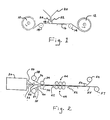
- a heated coating transfer roll 18 Positioned above the tensioned paper web is a heated coating transfer roll 18 which receives the coating resin (i.e., a polyimide precursor of this invention) from hopper 20.
- Roll 18 keeps the resin in a molten condition and the molten coating adhering thereto is transferred to the paper web, the thickness of the coating being regulated by knife 22 which keeps a puddle of molten resin on the upper portion of roll 18 between knife 22 and fence 24.
- a plurality of fibers 33 are drawn from creel 30 and through comb 32 which closely aligns them in parallel.
- creel 30 may contain, say, 100 to 500 bobbins of fiber.
- the resultant fibrous substrate 40 is passed between rolls 34,34 between a paper web 35 coated with a polyimide precursor of this invention (from supply roll 37) and an uncoated paper web 36 (from supply roll 38). The coating is of course on the side of web 35 confronting substrate 40.
- the sandwich structure leaving rolls 34,34 is passed over heater 42 and thence between a bank of hot rolls 44 whereby the substrate 40 is impregnated with resinous coating from web 35.
- the sandwich structure is then passed over platen 52 to cause the softened resinous polyimide precursor to solidify.
- web 36 is drawn off by roll 50 and spool 54.
- the cooled paper-backed prepreg 55 is taken up on spool 57.
- the apparatus is adapted for use in production of a unidirectional prepreg according to this invention.
- a woven fibrous substrate may be used as a substrate 40 in lieu of aligned fibers.
- the webs 35 and 36 may be reversed so that the coated web is above and the uncoated web is below substrate 40, again with the coating confronting the substrate.
- two rolls of coated paper web one above and one below substrate 40. In all cases, the paper web should be sized with a suitable releasing agent so that it can be readily separated from the adjacent fibrous substrate.
Landscapes
- Chemical & Material Sciences (AREA)
- Health & Medical Sciences (AREA)
- Chemical Kinetics & Catalysis (AREA)
- Medicinal Chemistry (AREA)
- Polymers & Plastics (AREA)
- Organic Chemistry (AREA)
- Macromolecular Compounds Obtained By Forming Nitrogen-Containing Linkages In General (AREA)
- Treatments For Attaching Organic Compounds To Fibrous Goods (AREA)
- Reinforced Plastic Materials (AREA)
- Polymers With Sulfur, Phosphorus Or Metals In The Main Chain (AREA)
Applications Claiming Priority (2)
| Application Number | Priority Date | Filing Date | Title |
|---|---|---|---|
| US3753787A | 1987-04-13 | 1987-04-13 | |
| US37537 | 1987-04-13 |
Publications (2)
| Publication Number | Publication Date |
|---|---|
| EP0287355A2 true EP0287355A2 (fr) | 1988-10-19 |
| EP0287355A3 EP0287355A3 (fr) | 1990-10-24 |
Family
ID=21894872
Family Applications (1)
| Application Number | Title | Priority Date | Filing Date |
|---|---|---|---|
| EP19880303333 Withdrawn EP0287355A3 (fr) | 1987-04-13 | 1988-04-13 | Précurseurs de polyimide, leur utilisation et préparation |
Country Status (2)
| Country | Link |
|---|---|
| EP (1) | EP0287355A3 (fr) |
| JP (1) | JPS6426638A (fr) |
Cited By (4)
| Publication number | Priority date | Publication date | Assignee | Title |
|---|---|---|---|---|
| EP0373647A3 (fr) * | 1988-12-15 | 1991-01-09 | Ethyl Corporation | Préparation de particules de polyimides |
| EP0596149B1 (fr) * | 1991-10-24 | 1996-10-16 | BASF Lacke + Farben Aktiengesellschaft | Solutions de précurseurs de polyimides |
| EP0814138A3 (fr) * | 1996-06-17 | 1998-09-09 | Occidental Chemical Corporation | Ruban adhésif comprenant un film polyamide entièrement imidisé, autoporteur, non collant, contenant un solvant |
| CN113685441A (zh) * | 2013-12-31 | 2021-11-23 | 美国圣戈班性能塑料公司 | 具有聚酰亚胺基质的复合轴承 |
Families Citing this family (1)
| Publication number | Priority date | Publication date | Assignee | Title |
|---|---|---|---|---|
| WO2007013134A1 (fr) * | 2005-07-26 | 2007-02-01 | Shimadzu Corporation | Dispositif laser à l'état solide excité par un laser à semi-conducteur |
Family Cites Families (4)
| Publication number | Priority date | Publication date | Assignee | Title |
|---|---|---|---|---|
| US3511807A (en) * | 1968-06-11 | 1970-05-12 | Du Pont | Coupling polymerization of low molecular weight polyamide-acids to produce high molecular weight polyimides |
| US4111906A (en) * | 1976-07-19 | 1978-09-05 | Trw Inc. | Polyimides prepared from perfluoroisopropylidene diamine |
| US4336175A (en) * | 1980-10-01 | 1982-06-22 | E. I. Du Pont De Nemours And Company | Polyimide precursor solutions |
| US4535101A (en) * | 1984-04-03 | 1985-08-13 | Imi-Tech Corporation | Polyimide of 2,2-bis(4-(4-aminophenoxy)phenyl)-hexafluoropropane and process for the preparation of same |
-
1988
- 1988-04-13 EP EP19880303333 patent/EP0287355A3/fr not_active Withdrawn
- 1988-04-13 JP JP9122188A patent/JPS6426638A/ja active Pending
Cited By (5)
| Publication number | Priority date | Publication date | Assignee | Title |
|---|---|---|---|---|
| EP0373647A3 (fr) * | 1988-12-15 | 1991-01-09 | Ethyl Corporation | Préparation de particules de polyimides |
| EP0596149B1 (fr) * | 1991-10-24 | 1996-10-16 | BASF Lacke + Farben Aktiengesellschaft | Solutions de précurseurs de polyimides |
| EP0814138A3 (fr) * | 1996-06-17 | 1998-09-09 | Occidental Chemical Corporation | Ruban adhésif comprenant un film polyamide entièrement imidisé, autoporteur, non collant, contenant un solvant |
| CN113685441A (zh) * | 2013-12-31 | 2021-11-23 | 美国圣戈班性能塑料公司 | 具有聚酰亚胺基质的复合轴承 |
| CN113685441B (zh) * | 2013-12-31 | 2023-08-15 | 美国圣戈班性能塑料公司 | 具有聚酰亚胺基质的复合轴承 |
Also Published As
| Publication number | Publication date |
|---|---|
| EP0287355A3 (fr) | 1990-10-24 |
| JPS6426638A (en) | 1989-01-27 |
Similar Documents
| Publication | Publication Date | Title |
|---|---|---|
| US4576857A (en) | Melt-fusible polyimides | |
| US4913759A (en) | Polyimide precursor and pseudo hot-melt prepregging process employing same | |
| RU2051157C1 (ru) | Раствор в полярном растворителе для получения полиимидов | |
| US4218555A (en) | Process for preparation of acetylene end-capped polyimide oligomers | |
| DE68924283T2 (de) | Lösliche Polyimidsiloxane, Verfahren zu ihrer Herstellung und ihre Verwendung. | |
| US4299750A (en) | Novel partially acetylene end-capped polyimide oligomers | |
| JPS6218426A (ja) | ポリイミド組成物 | |
| EP0280801B1 (fr) | Articles en polyimide incolore transparent et leur procédé de production | |
| US6156820A (en) | Polyamideimidesiloxane hot melt adhesive | |
| EP0298668A2 (fr) | Adhésifs à haute température pour films en polyimide et leur utilisation | |
| KR910008338B1 (ko) | 고도의 용해성 방향족 폴리이미드 | |
| US4742152A (en) | High temperature fluorinated polyimides | |
| JP5027416B2 (ja) | 芳香族ポリアミド酸及びポリイミド | |
| EP0287355A2 (fr) | Précurseurs de polyimide, leur utilisation et préparation | |
| US5041526A (en) | Dimer for synthesis of high performance polymer matrix composites | |
| US4533574A (en) | Polyimide coating compositions of esterified anhydride and aromatic amine mixture | |
| US4892896A (en) | Processing polyimide precursor compositions | |
| EP0178762A2 (fr) | Matériaux composites | |
| US5585438A (en) | Remeltable thermoset resin | |
| GB2063895A (en) | Fibrous materials pre-impregnated with unsaturated bisimide resins and processes for manufacturing the same | |
| US5354836A (en) | Thiophene-based polymers | |
| JP3048703B2 (ja) | ポリアミック酸共重合体及びそれからなるポリイミドフィルム | |
| JP2714661B2 (ja) | エチレン性不飽和基を末端基とするポリ(ベンズヒドロールイミド)、熱重合によって得られる網状ポリイミド及びこれらの用途 | |
| JP2910796B2 (ja) | ポリアミック酸共重合体及びそれからなるポリイミドフィルム並びにそれらの製造方法 | |
| JPH023428A (ja) | 高分子アミド |
Legal Events
| Date | Code | Title | Description |
|---|---|---|---|
| PUAI | Public reference made under article 153(3) epc to a published international application that has entered the european phase |
Free format text: ORIGINAL CODE: 0009012 |
|
| AK | Designated contracting states |
Kind code of ref document: A2 Designated state(s): AT BE CH DE ES FR GB IT LI LU NL SE |
|
| PUAL | Search report despatched |
Free format text: ORIGINAL CODE: 0009013 |
|
| AK | Designated contracting states |
Kind code of ref document: A3 Designated state(s): AT BE CH DE ES FR GB IT LI LU NL SE |
|
| 17P | Request for examination filed |
Effective date: 19910215 |
|
| 17Q | First examination report despatched |
Effective date: 19920706 |
|
| STAA | Information on the status of an ep patent application or granted ep patent |
Free format text: STATUS: THE APPLICATION IS DEEMED TO BE WITHDRAWN |
|
| 18D | Application deemed to be withdrawn |
Effective date: 19921117 |