EP0287700A2 - Lichtempfindliche Elemente für Elektrophotographie - Google Patents
Lichtempfindliche Elemente für Elektrophotographie Download PDFInfo
- Publication number
- EP0287700A2 EP0287700A2 EP87111368A EP87111368A EP0287700A2 EP 0287700 A2 EP0287700 A2 EP 0287700A2 EP 87111368 A EP87111368 A EP 87111368A EP 87111368 A EP87111368 A EP 87111368A EP 0287700 A2 EP0287700 A2 EP 0287700A2
- Authority
- EP
- European Patent Office
- Prior art keywords
- photosensitive
- photosensitive layer
- self
- type resin
- photosensitive member
- Prior art date
- Legal status (The legal status is an assumption and is not a legal conclusion. Google has not performed a legal analysis and makes no representation as to the accuracy of the status listed.)
- Ceased
Links
Images
Classifications
-
- G—PHYSICS
- G03—PHOTOGRAPHY; CINEMATOGRAPHY; ANALOGOUS TECHNIQUES USING WAVES OTHER THAN OPTICAL WAVES; ELECTROGRAPHY; HOLOGRAPHY
- G03G—ELECTROGRAPHY; ELECTROPHOTOGRAPHY; MAGNETOGRAPHY
- G03G5/00—Recording-members for original recording by exposure, e.g. to light, to heat or to electrons; Manufacture thereof; Selection of materials therefor
- G03G5/02—Charge-receiving layers
- G03G5/04—Photoconductive layers; Charge-generation layers or charge-transporting layers; Additives therefor; Binders therefor
- G03G5/05—Organic bonding materials; Methods for coating a substrate with a photoconductive layer; Inert supplements for use in photoconductive layers
- G03G5/0525—Coating methods
Definitions
- This invention relates to a photosensitive member or a photoconductor for use in electrophotography.
- the surface of a photoconductor utilized in electrophotography is smooth as far as possible.
- the flatness of the surface of the photoconductor is important for the reasons that when a powder image formed by applying a charged toner consisting of a fine powder onto a latent image is transfer printed onto a copying paper or the like, blur of the reproduced picture image could be prevented or decreased as the smoothness of the photoconductor is improved and that cleaning of the toner remaining on the photoconductor after transfer printing becomes easy and perfect as the flatness is improved.
- the surface hardness of the photoconductor should be high and the surface of the photoconductor should be wear resistant, these characteristics being important for elongating the life of the photoconductor.
- cleaning of the photoconductor is generally made with a cleaning blade so that the smoothness of the photoconductor governs the cleaning effect, whereas the hardness is an important factor that determines the life.
- the prior art photoconductor is constituted by an electroconductive substrate, usually a metal cylinder, and a layer of a photosensitive fine powder coated on the surface of the substrate by using a binder made of a synthetic resin which hardens when a solvent evaporates off.
- the surface of the photosensitive layer has an irregularity of the order of several tens of micron, so that when the remaining toner is cleaned by a blade, a certain quantity of the toner particles will remain in the recesses on the surface of the photosensitive layer. Such remaining particles would be heated and solidified by the friction between the particles and the cleaning blade thus forming larger particles having a tendency of forming scratches on the surface of the photoconductor or damaging the edge of the cleaning blade.
- the photosenstive layer would be readily worn out by the frictions between the photosensitive layer and the blade and between the photosensitive layer and the copying paper thus decreasing the life of the photoconductor.
- a photosensitive member for use in electrophotography comprising an electroconductive substrate, and a photosensitive layer coated on the substrate, the photosensitive layer being made of a mixture of a binder of a self-hardening type resin and a powder of a photosensitive material, the mixture being coated on the electroconductive substrate, and the photosensitive layer being smoothed mechanically and caused to self-harden.
- a method of manufacturing a photosensitive member for use in electrophotography comprising the steps of preparing a coating material by mixing together a powder of photosensitive material and a binder consisting of a self-hardening type resin, applying the coating material onto the surface of an electroconductive substrate to form a photosensitive layer, mechanically smoothing the surface of the photosensitive layer, and hardening the photosensitive layer, thereby completing the photosensitive member.
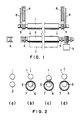
- FIG. 1 One example of apparatus for manufacturing a cylindrical photosensitive element will be described with reference to Fig. 1.
- the outer surface of an iron roller 1 having an outer diameter of 50 mm and a length of 300 mm is ground, electroplated with hard chromium and then mirror finished with a diamond tool to a surface smoothness or irregularity of less than 0.1 ⁇ m.
- a rubber press roller 2 having a diameter of 50 mm and a length of 300 mm is prepared.
- rollers 1 and 2 are supported by bearings 3 and 4 to rotate smoothly.
- the press roller 2 is driven by an electric motor 5 at any desired speed.
- the cylindrical photosensitive element coated with a photosensitive layer 6 can be mounted and dismounted from the press roller 2 as shown by dot and dash lines shown in Fig. 1.
- each end of the mirror finished roller 1 are connected the piston rod of an air or oil pressure cylinders 8 and a returning spring 9 so that by controlling the pressure of air or oil it is possible to separate the roller 1 away from the press roller 2 or to urge the roller against the press roller at any desired pressure.
- Fig. 2a shows the relation between the mirror finished roller 1 and the press roller 2 before applying a photosensitive layer 6.
- Fig. 2b shows a state in which the metal cylinder 7 applied with the photosensitive layer 6 is mounted on the press roller 2. At this time, previously removed bearing 4 has been returned to the original position to support opposite ends of the press roller 2 and electric motor 5 is started to rotate the press roller 2. Then due to friction the photosensitive element (6,7) is also rotated.
- the mirror finished roller 1 is urged against the press roller 2 by air or oil pressure cylinders 8 for clamping the cylindrical photosensitive element between the rollers 1 and 2. Since the press roller 2 is made of soft rubber, the pressure applied between two rollers 1 and 2 is applied on the surface of the photosensitive element in the longitudinal direction thereof. This state is maintained for a suitable time to rotate the photosensitive element by a predetermined number of rotations.
- Fig. 2d shows a state in which the mirror finished roller 1 has been moved away from the photosensitive layer 6 by gradually decreasing the pressure of air or oil in the cylinders 8. Thereafter motor 5 is stopped.
- the surface of the photosensitive layer 6 is mechanically smoothed. Then the lefthand bearing 4 is removed to dismount the finished photosensitive element from the press roller 2.
- compositions of the photosensitive layer are as follows.
- the constituents were mixed together for 12 hours with a ball mill to form a liquid coating material.
- An alminum cylinder finished to have an outer diameter of 80 mm, a wall thickness of 1 mm and a surface irregularity of 0.5 ⁇ m was coated with the coating liquid. Thickness of the coated liquid was controlled such that the thickness would be 12 ⁇ 13 after drying and hardening. Drying .was made in air for about 2 hours at a room temperature of 25°C.
- the coating material was divided into two parts. One part was used to form the photosensitive layer 6. Its surface was smoothed and heated for one hour in an electric furnace maintained at a temperature of 150°C. Then the resulting photosensitive element was used to form a picture image. The other part was processed in the same. manner as in the first mentioned part except that the air drying time was increased to 3 hours.
- the smoothing treatment of the photosensitive layer was carried out in the following manner.
- the cylindrical photosensitive member whose photosensitive layer 6 has been air dried was mounted on the press roller 2 as shown by dot and dash lines in Fig. 1.
- the motor 5 was rotated at a speed of 5 r.p.m. and pressurized air was supplied to cylinders 8 to urge the mirror finished roller 1 against the photosensitive element for smoothing the photosensitive layer 6. Since the mirror finish roller 1 is normally pulled by the returning springs 9, the roller 1 can be urged at any desired pressure by adjusting the pressure of air or oil admitted into the cylinders 8.
- composition of the coating liquid is characterized in that a mixture of a polyester resin and melamine resin is used as a binder.
- the molecules of these two resins are bridged together when heated so as to form a film having a large mechanical strength. Where air drying is used, a mechanical pressure is applied to make smooth the photosensitive layer.
- the result of inspecting the surface smoothness or irregularly of the photosensitive layer 6 with a microscope shows that the surface of the photosensitive layer 6 not subjected to the smoothing step has an irregularity of larger than 1 ⁇ m on an average, whereas that of the surface subjected to the smoothing step is less than 0.1 ⁇ m.
- the average particle diameter of ⁇ phthalocyanine powder is less than 0.5 ⁇ m but the powder usually contains large particles of about 1 ⁇ m and as is well known in the art, since ⁇ phthalocyanine does not satisfactorily disperse in a binder solution, it is impossible to perfectly disintegrate coagulated particles even when the particles are ground in a ball mill over a long time, so that by merely coating and drying the coating material it is difficult to obtain a surface like a mirror.
- the characteristics of a smoothed photosensitive layer are the same as those of not smoothed photosensitive layer at the initial state. But when the photosensitive layer is mounted on an electrophotographic copying machine utilizing so-called blade cleaning a remarkable difference appeared between smoothed and not smoothed photosensitive layers.
- a binder that can be hardened or set with heat or ultraviolet ray can also be used.
- the binder and solvent used in the embodiment are mere examples.
- the percentage of ⁇ phthalocyanine is also one example. My experiment shows that as the percentage of ⁇ phthalocyanine is increased the sensitivity of the photosensitive element increases.
- a thermoplastic binder in which case the mirror finished roller 1 is heated.
- the mirror finished roller can be coated with a Teflon coating or with a silicone mold release agent.
- the ⁇ phthalocyanine powder was selected for the purpose of describing the advantageous effect of this invention.
- the other type photosensitive powder for example ⁇ phthalocyanine is also effective. Since ⁇ phthalocyanine disperses well its effect is not remarkable. Moreover, since ⁇ phthalocyanine has a low dark resistance it is advantageous to use a mixture of ⁇ and ⁇ phthalocyanines at a suitable ratio. Then a photosensitive element can be obtained having a high sensitivity of ⁇ phthalocyanine and a high dark resistance of ⁇ phthalocyanine, and having perfectly smooth surface and a high mechanical strength.
- a successful N type photoconductor can be obtained by using particles of CdS having a mean particle diameter of 3 ⁇ m and an epoxy resin as a binder.
- a powder of ZnO can also be used.
- the photosensitive material that can be used in this invention includes phthalocyanine, CdS, CdSe, ZnO, Zns, PbO and other well known substances, and as the binder, polyester, epoxy, melamin, acryl resins or the like can be used.
- Example 1 The binder (polyester resin and melamine resin) utilized in Example 1 was substituted by a polyurethane resin.
- the coating material was prepared in the same manner as in Example 1. After forming the photosensitive layer using the coating material, the photosensitive element was dried in air and then the surface of the photosensitive layer was smoothed in the same manner as in Example 1. Then the photosensitive layer was maintained at a room temperature for 36 hours. Then by the function of oxygen in air, a bridging phenomenon is enhanced so as to obtain an excellent photosensitive element having smooth and hard surface as well as a high image forming performance.
- a mixture of a self-hardening type resin acting as a binder and a powder of a photosensitive material is coated on a hollow metal cylinder as a thin film so that the surface of the coated film is smoothed by mechanical means, and the resin is caused to self-harden. Accordingly, it is possible to produce a novel photosensitive layer having excellent smoothness and hardness. More particularly, the surface irregularity of the photosensitive layer of this invention is less than 0.1 ⁇ m. With such photosensitive layer, a toner image can be accurately and clearly transferred without any blur.
- the surface of the photosensitive layer can be readily cleaned with a conventional blade and since the photosensitive layer has a hardness of 6H of a pencil it would not be broken or worn out by the friction between the layer and the cleaning blade or copying paper, thus elongating the operating life of the photosensitive element.
Landscapes
- Physics & Mathematics (AREA)
- General Physics & Mathematics (AREA)
- Photoreceptors In Electrophotography (AREA)
Applications Claiming Priority (2)
| Application Number | Priority Date | Filing Date | Title |
|---|---|---|---|
| JP62097971A JPS63262655A (ja) | 1987-04-21 | 1987-04-21 | 感光体 |
| JP97971/87 | 1987-04-21 |
Publications (2)
| Publication Number | Publication Date |
|---|---|
| EP0287700A2 true EP0287700A2 (de) | 1988-10-26 |
| EP0287700A3 EP0287700A3 (de) | 1989-04-26 |
Family
ID=14206557
Family Applications (1)
| Application Number | Title | Priority Date | Filing Date |
|---|---|---|---|
| EP87111368A Ceased EP0287700A3 (de) | 1987-04-21 | 1987-08-06 | Lichtempfindliche Elemente für Elektrophotographie |
Country Status (3)
| Country | Link |
|---|---|
| US (1) | US4963453A (de) |
| EP (1) | EP0287700A3 (de) |
| JP (1) | JPS63262655A (de) |
Cited By (2)
| Publication number | Priority date | Publication date | Assignee | Title |
|---|---|---|---|---|
| EP0408380A1 (de) * | 1989-07-13 | 1991-01-16 | Matsushita Electric Industrial Co., Ltd. | Lichtempfindliches Material für Elektrophotographie und Verfahren zu dessen Herstellung |
| EP0460806A3 (en) * | 1990-06-06 | 1992-04-08 | Koichi Kinoshita | Electrophotographic sensitive member |
Families Citing this family (5)
| Publication number | Priority date | Publication date | Assignee | Title |
|---|---|---|---|---|
| JP3020371B2 (ja) * | 1993-01-28 | 2000-03-15 | 三田工業株式会社 | ブラッシングが防止された有機感光体の製造方法 |
| US5440216A (en) * | 1993-06-08 | 1995-08-08 | Samsung Electronics Co., Ltd. | Robot cleaner |
| US5834147A (en) * | 1993-11-05 | 1998-11-10 | Mitsubishi Denki Kabushiki Kaisha | Photosensitive member for electrophotography |
| JPH10288847A (ja) * | 1997-04-11 | 1998-10-27 | F I T:Kk | 電子写真感光体 |
| FR2777452B1 (fr) * | 1998-04-15 | 2000-12-15 | Aesculap Sa | Prothese de genou |
Family Cites Families (12)
| Publication number | Priority date | Publication date | Assignee | Title |
|---|---|---|---|---|
| DE1070016B (de) * | 1959-11-26 | Arum.: J. M. Voith G.m.b.H., Heidenheim'Brenz | Preß- oder Belastungswarze an Papiermaschinen od. dgl., insbesondere mit d'cr Siebsau'gwailze zusammenarbeitende Preßwalze | |
| GB932730A (de) * | 1958-12-18 | |||
| US3472673A (en) * | 1966-05-09 | 1969-10-14 | Mead Corp | Process for producing coating on paper base having electrophotographic properties |
| US3640710A (en) * | 1969-12-31 | 1972-02-08 | Zerox Corp | Phthalocyanine photoconductive elements containing multiple binder materials |
| JPS50122939A (de) * | 1974-03-12 | 1975-09-26 | ||
| JPS51129235A (en) * | 1975-05-02 | 1976-11-10 | Ricoh Co Ltd | Electronic photosensitizer process |
| GB1581930A (en) * | 1976-03-24 | 1980-12-31 | Curran D G | Coverings |
| JPS538140A (en) * | 1976-07-12 | 1978-01-25 | Konishiroku Photo Ind Co Ltd | Transfer type light sensitive material |
| US4296190A (en) * | 1977-06-24 | 1981-10-20 | Ricoh Co., Ltd. | Photosensitive material for use in electrophotography with a radiation cured binder resin |
| JPS59171963A (ja) * | 1983-03-18 | 1984-09-28 | Fuji Photo Film Co Ltd | 電子写真製版材料 |
| JPS60104953A (ja) * | 1983-11-11 | 1985-06-10 | Hitachi Koki Co Ltd | 電子写真感光体 |
| JPS63202753A (ja) * | 1987-02-19 | 1988-08-22 | Koichi Kinoshita | 感光体 |
-
1987
- 1987-04-21 JP JP62097971A patent/JPS63262655A/ja active Pending
- 1987-08-06 EP EP87111368A patent/EP0287700A3/de not_active Ceased
-
1989
- 1989-02-08 US US07/308,996 patent/US4963453A/en not_active Expired - Fee Related
Cited By (3)
| Publication number | Priority date | Publication date | Assignee | Title |
|---|---|---|---|---|
| EP0408380A1 (de) * | 1989-07-13 | 1991-01-16 | Matsushita Electric Industrial Co., Ltd. | Lichtempfindliches Material für Elektrophotographie und Verfahren zu dessen Herstellung |
| US5087540A (en) * | 1989-07-13 | 1992-02-11 | Matsushita Electric Industrial Co., Ltd. | Phthalocyanine photosensitive materials for electrophotography and processes for making the same |
| EP0460806A3 (en) * | 1990-06-06 | 1992-04-08 | Koichi Kinoshita | Electrophotographic sensitive member |
Also Published As
| Publication number | Publication date |
|---|---|
| US4963453A (en) | 1990-10-16 |
| EP0287700A3 (de) | 1989-04-26 |
| JPS63262655A (ja) | 1988-10-28 |
Similar Documents
| Publication | Publication Date | Title |
|---|---|---|
| US5145724A (en) | Method of making a cleaning blade coated with graphite fluoride | |
| US4372246A (en) | Externally heated fusing member for electrostatographic copiers | |
| DE69718849T2 (de) | Flüssigbeschichtungsverfahren zur Herstellung von Kunststoffdrucker- und Bandbauteilen | |
| DE2053167A1 (de) | Verfahren und Vorrichtung zum Fixieren | |
| US3554798A (en) | Magnetic recording members | |
| JPH02245767A (ja) | 電子写真感光体とその製法並びにそれを用いた電子写真法及び電子写真装置 | |
| US4963453A (en) | Photosensitive members for use in electrophotography | |
| US5378525A (en) | Crowned resilient roll with coating layer and method of producing the same | |
| US5456782A (en) | Toner carrier and method of producing the same | |
| DE102012212100B4 (de) | Applikationselement zur verwendung in einer bilderzeugungsvorrichtung und bilderzeugungsvorrichtung | |
| DE2247821A1 (de) | Aufschmelzwalze und verfahren zu ihrer herstellung | |
| US2843499A (en) | Pressure transfer of xerographic images | |
| EP0414459A2 (de) | Fixierwalze nutzbar für Elektrophotographie und Verfahren zu ihrer Herstellung | |
| DE4124206C2 (de) | Entwicklervorrichtung mit einem Toneraustragkörper und Verfahren zur Herstellung des Toneraustragkörpers | |
| US5189476A (en) | Developing device for producing a developed image | |
| CA1110026A (en) | Squeegee roller and method of making same | |
| JPS63202753A (ja) | 感光体 | |
| GB2067471A (en) | Fuser roll and method of manufacture thereof | |
| JPH10296642A (ja) | 研磨テープ | |
| CN1277159C (zh) | 显影辊的制造方法 | |
| US4040827A (en) | Development imaging methods | |
| JPH0235304B2 (de) | ||
| JPH04326355A (ja) | 像保持部材の製造方法 | |
| DE2654096A1 (de) | Verfahren zum glaetten einer abbildungsflaeche | |
| JP3474675B2 (ja) | 電子写真装置用クリーニングブレード |
Legal Events
| Date | Code | Title | Description |
|---|---|---|---|
| PUAI | Public reference made under article 153(3) epc to a published international application that has entered the european phase |
Free format text: ORIGINAL CODE: 0009012 |
|
| AK | Designated contracting states |
Kind code of ref document: A2 Designated state(s): DE GB NL |
|
| PUAL | Search report despatched |
Free format text: ORIGINAL CODE: 0009013 |
|
| AK | Designated contracting states |
Kind code of ref document: A3 Designated state(s): DE GB NL |
|
| 17P | Request for examination filed |
Effective date: 19890920 |
|
| 17Q | First examination report despatched |
Effective date: 19900508 |
|
| STAA | Information on the status of an ep patent application or granted ep patent |
Free format text: STATUS: THE APPLICATION HAS BEEN REFUSED |
|
| 18R | Application refused |
Effective date: 19920518 |