EP0287813A2 - Elektrischer Leiter, der mit einer elektrischen Isolierung umgeben ist - Google Patents
Elektrischer Leiter, der mit einer elektrischen Isolierung umgeben ist Download PDFInfo
- Publication number
- EP0287813A2 EP0287813A2 EP88104398A EP88104398A EP0287813A2 EP 0287813 A2 EP0287813 A2 EP 0287813A2 EP 88104398 A EP88104398 A EP 88104398A EP 88104398 A EP88104398 A EP 88104398A EP 0287813 A2 EP0287813 A2 EP 0287813A2
- Authority
- EP
- European Patent Office
- Prior art keywords
- protective layer
- insulation
- electrical conductor
- thickness
- conductor according
- Prior art date
- Legal status (The legal status is an assumption and is not a legal conclusion. Google has not performed a legal analysis and makes no representation as to the accuracy of the status listed.)
- Granted
Links
Images

Classifications
-
- H—ELECTRICITY
- H01—ELECTRIC ELEMENTS
- H01B—CABLES; CONDUCTORS; INSULATORS; SELECTION OF MATERIALS FOR THEIR CONDUCTIVE, INSULATING OR DIELECTRIC PROPERTIES
- H01B3/00—Insulators or insulating bodies characterised by the insulating materials; Selection of materials for their insulating or dielectric properties
- H01B3/18—Insulators or insulating bodies characterised by the insulating materials; Selection of materials for their insulating or dielectric properties mainly consisting of organic substances
- H01B3/30—Insulators or insulating bodies characterised by the insulating materials; Selection of materials for their insulating or dielectric properties mainly consisting of organic substances plastics; resins; waxes
-
- C—CHEMISTRY; METALLURGY
- C08—ORGANIC MACROMOLECULAR COMPOUNDS; THEIR PREPARATION OR CHEMICAL WORKING-UP; COMPOSITIONS BASED THEREON
- C08K—Use of inorganic or non-macromolecular organic substances as compounding ingredients
- C08K3/00—Use of inorganic substances as compounding ingredients
- C08K3/18—Oxygen-containing compounds, e.g. metal carbonyls
- C08K3/20—Oxides; Hydroxides
- C08K3/22—Oxides; Hydroxides of metals
-
- Y—GENERAL TAGGING OF NEW TECHNOLOGICAL DEVELOPMENTS; GENERAL TAGGING OF CROSS-SECTIONAL TECHNOLOGIES SPANNING OVER SEVERAL SECTIONS OF THE IPC; TECHNICAL SUBJECTS COVERED BY FORMER USPC CROSS-REFERENCE ART COLLECTIONS [XRACs] AND DIGESTS
- Y10—TECHNICAL SUBJECTS COVERED BY FORMER USPC
- Y10T—TECHNICAL SUBJECTS COVERED BY FORMER US CLASSIFICATION
- Y10T428/00—Stock material or miscellaneous articles
- Y10T428/29—Coated or structually defined flake, particle, cell, strand, strand portion, rod, filament, macroscopic fiber or mass thereof
- Y10T428/2913—Rod, strand, filament or fiber
- Y10T428/2933—Coated or with bond, impregnation or core
- Y10T428/294—Coated or with bond, impregnation or core including metal or compound thereof [excluding glass, ceramic and asbestos]
- Y10T428/2942—Plural coatings
- Y10T428/2947—Synthetic resin or polymer in plural coatings, each of different type
-
- Y—GENERAL TAGGING OF NEW TECHNOLOGICAL DEVELOPMENTS; GENERAL TAGGING OF CROSS-SECTIONAL TECHNOLOGIES SPANNING OVER SEVERAL SECTIONS OF THE IPC; TECHNICAL SUBJECTS COVERED BY FORMER USPC CROSS-REFERENCE ART COLLECTIONS [XRACs] AND DIGESTS
- Y10—TECHNICAL SUBJECTS COVERED BY FORMER USPC
- Y10T—TECHNICAL SUBJECTS COVERED BY FORMER US CLASSIFICATION
- Y10T428/00—Stock material or miscellaneous articles
- Y10T428/29—Coated or structually defined flake, particle, cell, strand, strand portion, rod, filament, macroscopic fiber or mass thereof
- Y10T428/2913—Rod, strand, filament or fiber
- Y10T428/2933—Coated or with bond, impregnation or core
- Y10T428/294—Coated or with bond, impregnation or core including metal or compound thereof [excluding glass, ceramic and asbestos]
- Y10T428/2942—Plural coatings
- Y10T428/2949—Glass, ceramic or metal oxide in coating
-
- Y—GENERAL TAGGING OF NEW TECHNOLOGICAL DEVELOPMENTS; GENERAL TAGGING OF CROSS-SECTIONAL TECHNOLOGIES SPANNING OVER SEVERAL SECTIONS OF THE IPC; TECHNICAL SUBJECTS COVERED BY FORMER USPC CROSS-REFERENCE ART COLLECTIONS [XRACs] AND DIGESTS
- Y10—TECHNICAL SUBJECTS COVERED BY FORMER USPC
- Y10T—TECHNICAL SUBJECTS COVERED BY FORMER US CLASSIFICATION
- Y10T428/00—Stock material or miscellaneous articles
- Y10T428/29—Coated or structually defined flake, particle, cell, strand, strand portion, rod, filament, macroscopic fiber or mass thereof
- Y10T428/2913—Rod, strand, filament or fiber
- Y10T428/2933—Coated or with bond, impregnation or core
- Y10T428/294—Coated or with bond, impregnation or core including metal or compound thereof [excluding glass, ceramic and asbestos]
- Y10T428/2958—Metal or metal compound in coating
Definitions
- the invention relates to an electrical conductor provided with a surrounding electrical insulation according to the pre-characterising part of Claim 1.
- the US-A-4,493,873 and US-A-4,537,804 describe an electrical conductor which is provided with an electrical insulation consisting of two layers arranged on the conductor, one consisting of a filler-free organic polymer and one of an organic polymer containing finely-divided aluminum oxide.
- the incorporation of the aluminum oxide in the insulation will increase the resistance of the insulation against partial silent discharges, called corona.
- the invention aims at developing an electrical conductor of the above-mentioned kind whose insulation proves markedly more corona-resistant than previously known conductor insulations without increasing the total thickness of the overall insulation surrounding the conductor.
- the invention suggests an electrical conductor provided with a surrounding electrical insulation according to the introductory part of Claim 1, which is characterized by the features of the characterizing part of Claim 1.
- a layer of an organic polymer is arranged outside the insulation containing a sufficient quantity of at least one of the substances chromium oxide and iron oxide in powder form, preferably in a thickness which is smaller than the thickness of the underlying insulation layer.
- the aluminum oxide used in the described, known case has a considerably higher instrinsic resistivity than chromium oxide and iron oxide. It is therefore surprising and has been completely unpredictable that chromium oxide and iron oxide, which are more low-resistive insulating materials than aluminum oxide, give a better insulation than the corresponding insulation with aluminum oxide.
- the layer of chromium oxide or iron oxide is arranged preferably in a thickness which is smaller than the thickness of the rest of the insulation.
- the powdered filler preferably has an intrisic resistivity of 104 - 108 ohm m.
- the protective layer containing the filler preferably has a thickness which is smaller than the thickness of the underlying insulation, i.e. of the insulation located between the conductor and the protective layer.
- the protective layer preferably has a resistivity of above 1010 ohm m.
- the electrical conductor according to the invention has the shape of a wire, rod, tape or bar, i.e. is elongated with a constant cross-section of circular or otherwise curved or multi-corner shape. It can be used to advantage in windings for electrical machines, electrical transformers and other electrical high voltage equipment of varying types in which the insulation of the conductor is often subjected to corona.
- Chromium is a preferred filler material because of its property to give the protective layer a corona resistance which is not - or only insignificantly - reduced by the influence of external factors, such as moisture.
- the particle size of the powdered filler is suitably 0.005-30 ⁇ m (micrometer) and preferably 0.005-5 ⁇ m.
- the content of the powdered filler suitably amounts to 10-40% of the volume of the protective layer. Particularly preferred is a content of powdered filler of 10-30% of the volume of the protective layer.
- the organic polymer in the protective layer may, among other things, consist of a wire enamel of such types as are normally used when enamelling winding wire such as terephtalic acid alkyds, polyester imides, polyamide imides, polyimides, polyurethanes, epoxy resins, polysulphons, silicones, polyamides, and polymers based on polyhydantoin.
- a wire enamel of such types as are normally used when enamelling winding wire such as terephtalic acid alkyds, polyester imides, polyamide imides, polyimides, polyurethanes, epoxy resins, polysulphons, silicones, polyamides, and polymers based on polyhydantoin.
- the insulation surrounded by the protective layer may consist of filler-free resins, as specified in the preceding paragraph. However, it may also consist of a prefabricated polymer film, for example a film of polyamide imide, polyimide, polypropylene, polymethyl pentene, polyethylene glycol terephthalate, polycarbonate, or polysulphon wound helically around the conductor or wrapped around the conductor with a longitudinal joint, or of a wrapping of a glass fibre wire which is impregnated with a resin, for example an epoxy resin, and applied around the conductor, or a wrapping of a tape built up of a felt of fibres of an organic polymer such as aromatic polyamide (e.g. NOMEX R 410 from Du Pont, USA).
- a prefabricated polymer film for example a film of polyamide imide, polyimide, polypropylene, polymethyl pentene, polyethylene glycol terephthalate, polycarbonate, or
- the protective layer may be arranged as the outermost layer on the conductor. However, it may be provided with a coating if special demands are placed on the surface of the insulated conductor, such as diffusion density or surface fineness, and therefore a relatively thin filler-free organic polymer is applied as surface layer.
- the organic polymer may be of a kind as exemplified for the organic polymer in the protective layer. In certain cases, such as when there is a risk that the insulation may become detached from the surface of the conductor, for example because of the effect of oxygen diffused therein, it may be suitable to apply a layer of the same kind as the protective layer nearest the conductor, i.e. inside the insulation surrounded by the protective layer.
- the thickness of the protective layer suitably amounts to 5-100 ⁇ m and preferably to 10-50 ⁇ m, the thickness of the insulation located between the conductor and the protective layer suitably to 10-500 ⁇ m and preferably to 10-200 ⁇ m.
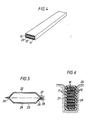
- a wire 10 with a cross section of 10 mm x 2 mm is coated with polyester-imide wire enamel, for example Terebec r 533 L-33 from BASF (Fed. Rep. of Germany) in a conventional manner using multipass coating and wiping dies or felts, the wire passing twelve times through the wiping devices and a heating device providing a temperature of about 400° C for curing of the enamel.
- the increase in thickness upon each passage is approximately 5 ⁇ m.
- the finished layer 11 thus has a thickness of about 60 ⁇ m.
- a protective layer 12 consisting of an epoxy resin and chromium oxide (Cr2O3) with a particle size of less than 5 ⁇ m.
- the protective layer has a thickness of 20 ⁇ m and the chromium oxide constitutes 25% of its volume.
- the epoxy resin used for the application of the protective layer may consist of 100 parts by weight of an epoxy resin of bisphenol A-type containing 5.15-5.5 moles epoxy groups per kg (e.g.
- Epikote 828 from Shell, Holland and 50 parts by weight curing agent of amino type with an amino value of 400-460 mg KOH/g, dissolved in equal parts xylene and butanol.
- the epoxy resin contains 25 per cent by volume chromium oxide, calculated on the solid constituents of the resin without solvent.
- the thickness of the protective layer 12 constitutes 33% of the thickness of the insulation 11.
- a protective layer 12 consisting of a polyesterimide containing chromium oxide of the same kind as described in Example 1.
- the protective layer 12 has a thickness of 20 ⁇ m and 30% of its volume consists of chromium oxide.
- the polyesterimide enamel used for the application of the protective layer may be of the same kind as that in the wire enamel layer 11, however chromium oxide and further cresol being added to the polyesterimide enamel so that the viscosity becomes suitable for the application of the protective layer using the same method as described in Example 1.
- the enamel then contains 30 per cent by volume chromium oxide, calculated on the contents of solid substance of the enamel without solvent.
- the thickness of the protective layer 12 constitutes 33% of the thickness of the insulation 11.
- a protective layer 12 consisting of a polyamideimidecontaining chromium oxide of the same kind as described in Example 1.
- the protective layer 12 has a thickness of 20 ⁇ m and 25% of its volume consists of chromium oxide.
- the polyamideimide enamel used for the application of the protective layer may consist of, for example Lack E 3561/27 from Herberts GmbH, Fed. Rep. of Germany, to which chromium oxide and N-methylpyrrolidone have been added so that the viscosity becomes suitable for the application of the protective layer using the same method as described in Example 1.
- the enamel then contains 25 per cent by volume chromium oxide, calculated on the solid constituents of the enamel without solvent.
- the thickness of the protective layer 12 constitutes 33% of the thickness of the insulation 11.
- a round wire 13 according to Figure 2 with a diameter of 1 mm is enamelled with a polyamideimide wire enamel, for example Lack E 3560/32 form Herberts GmbH, Fed. Rep. of Germany. It is applied in the manner described in Example 1 using dies to form an enamel layer 14 having a thickness of 40 ⁇ m.
- the application of the protective layer is also carried out using dies.
- the thickness of the protective layer 15 constitutes 25% of the thickness of the insulation 14.
- a tape of a polyimide film (e.g. Kapton R Type F from Du Pont, USA) having a thickness of 25 ⁇ m, which is provided on the side facing the conductor with a 12 ⁇ m thick layer of fluoridated ethyleneporpylene polymer (e.g. Teflon FEP R from Du Pont, USA).
- fluoridated ethyleneporpylene polymer e.g. Teflon FEP R from Du Pont, USA
- Overlapping parts of the tape are fixed to one another, and parts of the tape making contact with the conductor 16 are fixed to the conductor by the fluorinated ethylene propylene by the film being heated to a temperature of 270° C in a heating device suited for the purpose.
- the thickness of the protective layer 12 constitutes 20% of the thickness of the insulation (layers 17 and 18).
- a rectangular cross-sectional wire 10 according to Figure 1 with the cross-section 10 mm x 2 mm is provided with an insulating layer 11 in the form of a wrapping 11 of glass yarn which has been impregnated with a binder in the form of an epoxy resin, which has thereafter been cured.
- the epoxy resin may consist of a polyamide-modified epoxy resin (such as AF-42 from Minnesota Mining and Manufacturing Company, USA), or of an epoxy resin of the kind described in Example 1.
- the insulating layer 11 has a thickness of 100 ⁇ m.
- the thickness of the protective layer 12 constitutes 40% of the thickness of the insulation 11.
- a rectangular cross-sectional wire according to Figure 4 with the cross-section 10 mm x 2 mm is enamelled with a layer 11 of a polyesterimide enamel in the manner described in Example 1 into a thickness of 60 ⁇ m and is provided with a protective layer 12 of epoxy resin with addition of chromium oxide also in the manner described in Example 1.
- a coating 20 in the form of a polyamideimide enamel for example Lack E 3561/27 form Herberts GmbH, Fed. Rep. of Germany, in a thickness of 20 ⁇ m.
- the coating can be applied in accordance with the method using multipass coating and wiping dies or felts, the wire passing through wiping equipment and associated heating equipment with a temperature of about 400° C four times with an increase in thickness of the coating of about 5 ⁇ m upon each passage, so that the finished coating attains a thickness of about 20 ⁇ m.
- chromium oxide instead of chromium oxide (Cr2O3) in the cases exemplified above there can be used an equally great percentage by volume of iron oxide (Fe2O3) with the same size of the grains, or an equally great percentage by volume of a mixture of iron oxide and chromium oxide in arbitrary proportions, for example in equal parts by weight.
- a conductor according to the present invention is excellently well suited for use in coils for electrical machines for operating voltages in excess of 3 kV.
- coils there are arranged around the conductor insulation layers of mica to render the conductor insulation corona-resistant.
- conductors according to the present invention in such coils it is possible to make the insulation and the corona protection around the conductors considerably thinner than with the described previously known corona-resistant conductor insulation. This results in an increased percentage of conductor material in a coil of given dimensions, and consequently in an increase in power of a machine of given dimensions or in reduced dimensions for a machine of a certain power.
- Such a coil comprises a bundle of several adjacently arranged lengths of a conductor according to the invention with rectangular cross-section and a main insulation surrounding the conductor bundle for insulating the bundle against the walls of the machine slot.
- the conductor bundle may consist of several turns of one single insulated conductor which has been bent while forming the final shape of the bundle. It may also consist of several separate insulated conductors, which at their ends are electrically connected to each other, usually in parallel. Particularly great advantages are obtained according to the invention for the former type of conductor bundle, since the stresses between adjacent conductors are in that case greater and a short-circuit caused by a damaged conductor insulation is more serious.
- the main insulation may be formed in different, previously known ways.
- it may consist of a wrapping of mica tapes or mica sheets. These may be made of large mica flakes of conventional kind, which are attached to a carrier material of paper, woven glass fibre or the like, for example, with a resinous binder such as an alkyd resin or a thin thermoplastic film.
- the mica materials may also consist of self-supporting tape or sheet of small mica flakes, overlapping each other, manufactured by splitting of ordinary mica, these mica materials then usually also being attached to a carrier material.
- a resinous binder which subsequently, when the materials are applied around the conductor bundle, binds the various layers in the conductor insulation to one another.
- a binder may be supplied after the insulating material has been applied around the conductor bundle by an impregnation.
- suitable binders for the turns in the wrapping may be mentioned solvent-free resins such as epoxy resins and unsaturated polyester resins.
- a conductor of a kind described in any of Examples 1 to 3 and 5 to 6 is bent into a coil containing several turns of the conductor positioned adjacent to each other, as shown in Figure 5 and Figure 6, respectively.
- the mentioned turns positioned adjacent to each other form the conductor bundle 21 of the coil.
- the bending is carried out such that the coil has straight parts 22 and 23 intended to be positioned in the slots 24 of the machine, as well as bent end parts 25 and 26 which extend outside the slots.
- the terminals of the coil are designated 27 and 28.
- the conductor bundle 21 is then wound turn-by-turn with, for example, half an overlap with a 25 mm wide mica tape consisting of a 0.09 mm thick self-supporting layer of small mica flakes which overlap each other and which are fixed to an 0.04 mm thick woven glass fibre with an 0.006 mm thick polyethyleneglycol terephthalate film.
- Such an insulating tape is described in SE-A-200 820.
- the resin may consist of 100 parts by weight of an epoxy resin, which in a known manner has been produced from epichlorhydrin and 4.4′-dioxydiphenyl-dimenthylmethane and which has an epoxy equivalent of 192, and 100 parts by weight of a curing agent consisting of a mixture of 75 parts by weight hexahydrophthalic acid anhydride and 25 parts by weight tetrahydrophthalic acid anhydride.
- the impregnated conductor bundle with the mica tape wrapping can be surrounded by a sealing tape of polytetrafluoroethylene or the like.
- the coil is then placed in a forming tool for curing of the resinous material. The curing takes place at a temperature of about 160° C for a period of about 10 hours.
- a coil is manufactured using an insulating tape which is impregnated with impregnating resin prior to its wrapping around the bundle 21 (Figure 6), which may be of the same kind as in the example above.
- the resin contains an unsaturated polyester resin manufactured from adipic acid (11 mole per cent), phthalic acid anhydride (11 mole per cent), maleic acid anhydride (23 mole per cent) and ethylene glycol (55 mole per cent) to which have been added, on the one hand, diallyl phthalate in such an amount that the diallyl phthalate constitutes 40% of the total weight of polyester resin and diallyl phthalate and, on the other hand, bensoyl peroxide in an amount corresponding to 1% of the entire weight of the resin.
- the polyester resin itself can be manufactured by reaction of a mixture of the mentioned acids and alcohol in an inert atmosphere by increasing the temperature to 220° C and maintaining this temperature until the acid value of the reaction product is about 30.
- 100 parts by weight of the resin Prior to the impregnation of the insulating tape, 100 parts by weight of the resin is diluted with 100 parts by weight acetone.
- the insulating mica tape which may be of the same kind as that described in Example 1, can be impregnated with the resinous material at room temperature and at atmospheric pressure.
- the impregnated mica tape is then wound, after driving off the solvent, around the conductor bundle 21 with half an overlap into thirty layers placed one above the other to form the main insulation 29.
- the coil is then placed in a forming tool for curing the resinous material at a temperature of 160° C for a period of three hours.
- polyester resin consisting of 60 parts by weight of a reaction product of 3 moles maleic acid anhydride, 1 mole adipic acid, and 4.4 moles ethylene glycol with an acid value of 30, and of 40 parts by weight diallyl phthalate and containing 0.75% bensoyl peroxide
- polyester resin consisting of 70 part by weight of a reaction product of 1 mole fumaric acid, 1 mole phthalic acid and 2.2 moles propylene glycol with an acid value of 25, and of 30 parts by weight monostyrene and containing 0.5% bensoyl peroxide
- epoxy resin consisting of 100 parts by weight "Epon 828" (Shell Chemical Co.) and 65 parts hexahydrophthalic acid anhydride
Landscapes
- Chemical & Material Sciences (AREA)
- Health & Medical Sciences (AREA)
- Chemical Kinetics & Catalysis (AREA)
- Medicinal Chemistry (AREA)
- Polymers & Plastics (AREA)
- Organic Chemistry (AREA)
- Physics & Mathematics (AREA)
- Spectroscopy & Molecular Physics (AREA)
- Insulation, Fastening Of Motor, Generator Windings (AREA)
- Insulated Conductors (AREA)
- Inorganic Insulating Materials (AREA)
Applications Claiming Priority (2)
| Application Number | Priority Date | Filing Date | Title |
|---|---|---|---|
| SE8701214 | 1987-03-24 | ||
| SE8701214A SE457031B (sv) | 1987-03-24 | 1987-03-24 | Elektrisk ledare foersedd med en omgivande isolering omfattande ett skikt av en organisk polymer samt anvaendning av ledaren i en haerva. |
Publications (3)
| Publication Number | Publication Date |
|---|---|
| EP0287813A2 true EP0287813A2 (de) | 1988-10-26 |
| EP0287813A3 EP0287813A3 (de) | 1990-06-27 |
| EP0287813B1 EP0287813B1 (de) | 1998-06-10 |
Family
ID=20367958
Family Applications (1)
| Application Number | Title | Priority Date | Filing Date |
|---|---|---|---|
| EP88104398A Expired - Lifetime EP0287813B1 (de) | 1987-03-24 | 1988-03-19 | Elektrischer Leiter, der mit einer elektrischen Isolierung umgeben ist |
Country Status (7)
| Country | Link |
|---|---|
| US (1) | US4935302A (de) |
| EP (1) | EP0287813B1 (de) |
| JP (1) | JPS63250010A (de) |
| AT (1) | ATE167330T1 (de) |
| CA (1) | CA1299260C (de) |
| DE (1) | DE3856201T2 (de) |
| SE (1) | SE457031B (de) |
Cited By (6)
| Publication number | Priority date | Publication date | Assignee | Title |
|---|---|---|---|---|
| EP0440865A1 (de) * | 1990-02-09 | 1991-08-14 | Asea Brown Boveri Ab | Elektrische Isolierung |
| EP0860835A1 (de) * | 1997-02-24 | 1998-08-26 | Alcatel | Lackierter Draht mit hoher Teilentladungsfestigkeit |
| WO1999035728A1 (en) * | 1998-01-07 | 1999-07-15 | Abb Ab | A stator for an electric alternating current machine |
| EP0959551A1 (de) * | 1998-05-16 | 1999-11-24 | Asea Brown Boveri AG | Hochspannungsisolierte Statorwicklung |
| US7253357B2 (en) | 2001-12-21 | 2007-08-07 | Ppe Invex Produtos Padronizados E Epeciais Ltda. | Pulsed voltage surge resistant magnet wire |
| EP4550360A1 (de) * | 2023-10-30 | 2025-05-07 | DuPont Electronics, Inc. | Elektrisch isolierte leiter und verfahren zur elektrischen isolierung von leitern |
Families Citing this family (42)
| Publication number | Priority date | Publication date | Assignee | Title |
|---|---|---|---|---|
| SE457030B (sv) * | 1987-03-24 | 1988-11-21 | Asea Ab | Elektriskt isolermaterial omfattande ett isolerskikt av en organisk polymer samt anvaendning av isolermaterialet i en haerva. |
| SE461940B (sv) * | 1988-08-30 | 1990-04-09 | Asea Brown Boveri | Elektriskt isolermaterial i form av en sjaelvbaerande film av en organisk polymer samt anvaendning av isolermaterial i en haerva |
| SE461941B (sv) * | 1988-08-30 | 1990-04-09 | Asea Brown Boveri | Elektrisk ledare med en omgivande isolering samt anvaendning av ledaren i en haerva |
| US5633477A (en) * | 1994-05-16 | 1997-05-27 | Westinghouse Electric Corporation | Electrically conductive prepreg for suppressing corona discharge in high voltage devices |
| US5989702A (en) * | 1994-08-15 | 1999-11-23 | General Electric Canada Inc. | Sandwich insulation for increased corona resistance |
| US5552222A (en) * | 1995-01-27 | 1996-09-03 | General Electric Company | Electrically conductive articles comprising insulation resistant to corona discharge-induced degradation |
| EP0729158B1 (de) * | 1995-02-24 | 2003-04-09 | Sumitomo Wiring Systems, Ltd. | Strahlender Draht |
| US6060162A (en) * | 1995-06-08 | 2000-05-09 | Phelps Dodge Industries, Inc. | Pulsed voltage surge resistant magnet wire |
| US5654095A (en) * | 1995-06-08 | 1997-08-05 | Phelps Dodge Industries, Inc. | Pulsed voltage surge resistant magnet wire |
| WO1996042089A1 (en) | 1995-06-08 | 1996-12-27 | Weijun Yin | Pulsed voltage surge resistant magnet wire |
| CA2231656A1 (en) * | 1995-09-14 | 1997-04-03 | Thomas L. Linsenbardt | An insulated conductor and process for making an insulated conductor |
| JPH1041122A (ja) * | 1996-07-19 | 1998-02-13 | Toshiba Corp | 電磁機器 |
| US5861578A (en) * | 1997-01-27 | 1999-01-19 | Rea Magnet Wire Company, Inc. | Electrical conductors coated with corona resistant, multilayer insulation system |
| US5780525A (en) * | 1997-02-14 | 1998-07-14 | Reliance Electric Industrial Company | Photocurable composition for electrical insulation |
| US6159600A (en) | 1997-02-14 | 2000-12-12 | Reliance Electric Technologies, Llc | Oxygen plasma resistant polymer for electrical devices |
| US6100474A (en) | 1997-06-23 | 2000-08-08 | Essex Group, Inc. | Magnet wire insulation for inverter duty motors |
| EP1002323B1 (de) | 1997-08-06 | 2005-05-04 | Altana Electrical Insulation GmbH | Teilentladungsbeständige beschichtung für lackdrähte |
| US6228494B1 (en) * | 1998-12-02 | 2001-05-08 | Siemens Westinghouse Power Corporation | Method to reduce partial discharge in high voltage stator coil's roebel filler |
| TW516043B (en) * | 1998-12-19 | 2003-01-01 | Tai I Electric Wire & Amp Cabl | High temperature resistant colored enamel wires |
| US6319604B1 (en) | 1999-07-08 | 2001-11-20 | Phelps Dodge Industries, Inc. | Abrasion resistant coated wire |
| US6724118B2 (en) * | 2001-06-13 | 2004-04-20 | Siemens Westinghouse Power Corporation | Electrical isolation layer system strand assembly and method of forming for electrical generator |
| US6914093B2 (en) | 2001-10-16 | 2005-07-05 | Phelps Dodge Industries, Inc. | Polyamideimide composition |
| US7973122B2 (en) * | 2004-06-17 | 2011-07-05 | General Cable Technologies Corporation | Polyamideimide compositions having multifunctional core structures |
| JP2007005174A (ja) * | 2005-06-24 | 2007-01-11 | Sumitomo Electric Wintec Inc | 絶縁被覆電線、コイル及びその製造方法 |
| JP2007134124A (ja) * | 2005-11-09 | 2007-05-31 | Fanuc Ltd | 導電性線材用皮膜 |
| US20070151743A1 (en) * | 2006-01-03 | 2007-07-05 | Murray Thomas J | Abrasion resistant coated wire |
| US20080193637A1 (en) * | 2006-01-03 | 2008-08-14 | Murray Thomas J | Abrasion resistant coated wire |
| KR101261384B1 (ko) * | 2010-06-03 | 2013-05-06 | 엘에스전선 주식회사 | 절연전선 |
| JP5889290B2 (ja) * | 2010-06-22 | 2016-03-22 | エー ビー ビー リサーチ リミテッド | 包囲電気絶縁体を有する導電体 |
| JP5731252B2 (ja) * | 2011-03-29 | 2015-06-10 | 浦谷エンジニアリング株式会社 | 配線部品 |
| US20130069474A1 (en) * | 2011-09-16 | 2013-03-21 | Remy Technologies, L.L.C. | Composite conductor insulation |
| EP2595157B1 (de) | 2011-11-16 | 2018-01-10 | ABB Research Ltd. | Elektroisolierungssystem |
| CN106062894B (zh) * | 2014-03-12 | 2018-07-17 | 古河电气工业株式会社 | 扁平绝缘电线、线圈以及电气电子设备 |
| JP6016846B2 (ja) * | 2014-06-03 | 2016-10-26 | 古河電気工業株式会社 | 絶縁ワイヤおよびその製造方法 |
| EP2999092A1 (de) * | 2014-09-18 | 2016-03-23 | ABB Technology AG | Isolierung eines gewickelten Leiters und Verfahren zum Isolieren eines derartigen Leiters |
| US11728067B2 (en) | 2018-05-07 | 2023-08-15 | Essex Furukawa Magnet Wire Usa Llc | Magnet wire with flexible corona resistant insulation |
| WO2019217254A1 (en) * | 2018-05-07 | 2019-11-14 | Essex Group, Inc. | Magnet wire with corona resistant polyimide insulation |
| US11728068B2 (en) | 2018-05-07 | 2023-08-15 | Essex Furukawa Magnet Wire Usa Llc | Magnet wire with corona resistant polyimide insulation |
| US11352521B2 (en) | 2018-05-07 | 2022-06-07 | Essex Furukawa Magnet Wire Usa Llc | Magnet wire with corona resistant polyamideimide insulation |
| US11705771B2 (en) * | 2019-05-06 | 2023-07-18 | Essex Furukawa Magnet Wire Usa Llc | Electric machines having insulation formed on laminated structures |
| EP4169714A4 (de) * | 2020-06-19 | 2024-07-03 | Sumitomo Seika Chemicals Co., Ltd. | Geschichteter körper eines leiters und isolierfilm, spule, elektrische drehmaschine, isolierschicht und isolierfilm |
| EP4661032A1 (de) * | 2024-06-03 | 2025-12-10 | Abb Schweiz Ag | Emaillierter draht |
Family Cites Families (8)
| Publication number | Priority date | Publication date | Assignee | Title |
|---|---|---|---|---|
| BE621744A (de) * | 1961-08-28 | 1900-01-01 | ||
| FR2432029A1 (fr) * | 1972-03-21 | 1980-02-22 | Thomson Csf | Materiau a structure alveolaire absorbant les ondes electromagnetiques |
| JPS4947900A (de) * | 1972-09-14 | 1974-05-09 | ||
| US4315183A (en) * | 1979-06-14 | 1982-02-09 | Diagnostic Information, Inc. | Support structure for high voltage substrate |
| IT1139567B (it) * | 1981-10-27 | 1986-09-24 | Pirelli Cavi Spa | Materiale per isolanti e guaine di cavi elettrici e cavi elettrici provvisti di isolanti e guaine in tale materiale |
| US4493873A (en) * | 1982-05-05 | 1985-01-15 | General Electric Company | Corona-resistant wire enamel compositions and conductors insulated therewith |
| US4537804A (en) * | 1982-05-05 | 1985-08-27 | General Electric Company | Corona-resistant wire enamel compositions and conductors insulated therewith |
| US4403061A (en) * | 1982-06-29 | 1983-09-06 | Standard Oil Company (Indiana) | Injection moldable amide-imide polymers and copolymers containing metal oxides capable of forming hydrates stable at temperatures in excess of 500° F. |
-
1987
- 1987-03-24 SE SE8701214A patent/SE457031B/sv not_active IP Right Cessation
-
1988
- 1988-03-19 DE DE3856201T patent/DE3856201T2/de not_active Expired - Fee Related
- 1988-03-19 EP EP88104398A patent/EP0287813B1/de not_active Expired - Lifetime
- 1988-03-19 AT AT88104398T patent/ATE167330T1/de not_active IP Right Cessation
- 1988-03-21 US US07/171,438 patent/US4935302A/en not_active Expired - Lifetime
- 1988-03-22 JP JP63065973A patent/JPS63250010A/ja active Pending
- 1988-03-23 CA CA000562224A patent/CA1299260C/en not_active Expired - Lifetime
Cited By (9)
| Publication number | Priority date | Publication date | Assignee | Title |
|---|---|---|---|---|
| EP0440865A1 (de) * | 1990-02-09 | 1991-08-14 | Asea Brown Boveri Ab | Elektrische Isolierung |
| EP0860835A1 (de) * | 1997-02-24 | 1998-08-26 | Alcatel | Lackierter Draht mit hoher Teilentladungsfestigkeit |
| FR2760123A1 (fr) * | 1997-02-24 | 1998-08-28 | Alsthom Cge Alcatel | Fil emaille de resistance elevee aux decharges partielles |
| US6087592A (en) * | 1997-02-24 | 2000-07-11 | Alcatel | Enameled wire with high resistance to partial discharges |
| WO1999035728A1 (en) * | 1998-01-07 | 1999-07-15 | Abb Ab | A stator for an electric alternating current machine |
| EP0959551A1 (de) * | 1998-05-16 | 1999-11-24 | Asea Brown Boveri AG | Hochspannungsisolierte Statorwicklung |
| US6075303A (en) * | 1998-05-16 | 2000-06-13 | Asea Brown Boveri Ag | High-voltage insulated stator winding |
| US7253357B2 (en) | 2001-12-21 | 2007-08-07 | Ppe Invex Produtos Padronizados E Epeciais Ltda. | Pulsed voltage surge resistant magnet wire |
| EP4550360A1 (de) * | 2023-10-30 | 2025-05-07 | DuPont Electronics, Inc. | Elektrisch isolierte leiter und verfahren zur elektrischen isolierung von leitern |
Also Published As
| Publication number | Publication date |
|---|---|
| SE8701214D0 (sv) | 1987-03-24 |
| ATE167330T1 (de) | 1998-06-15 |
| EP0287813A3 (de) | 1990-06-27 |
| EP0287813B1 (de) | 1998-06-10 |
| JPS63250010A (ja) | 1988-10-17 |
| SE457031B (sv) | 1988-11-21 |
| DE3856201T2 (de) | 1999-01-21 |
| CA1299260C (en) | 1992-04-21 |
| US4935302A (en) | 1990-06-19 |
| DE3856201D1 (de) | 1998-07-16 |
| SE8701214L (sv) | 1988-09-25 |
Similar Documents
| Publication | Publication Date | Title |
|---|---|---|
| US4935302A (en) | Electrical conductor provided with a surrounding insulation | |
| US5061554A (en) | Electrical insulating material comprising an insulating layer in the form of an organic polymer | |
| US4806806A (en) | Coil for arrangement in slots in a stator or rotor of an electrical machine | |
| US3723797A (en) | Insulated coil for arrangement in a slot in the stator or rotor of an electrical machine | |
| US4207482A (en) | Multilayered high voltage grading system for electrical conductors | |
| EP0440865A1 (de) | Elektrische Isolierung | |
| US3775628A (en) | Insulated coil for arrangement in a slot in the stator or rotor of an electric machine | |
| US4760296A (en) | Corona-resistant insulation, electrical conductors covered therewith and dynamoelectric machines and transformers incorporating components of such insulated conductors | |
| US4537804A (en) | Corona-resistant wire enamel compositions and conductors insulated therewith | |
| US4546041A (en) | Corona-resistant wire enamel compositions and conductors insulated therewith | |
| US4493873A (en) | Corona-resistant wire enamel compositions and conductors insulated therewith | |
| US4503124A (en) | Corona-resistant wire enamel compositions and conductors insulated therewith | |
| CA1329641C (en) | Electrical conductor provided with a surrounding insulation | |
| EP0915484A1 (de) | Glimmerband und isolierte Wicklung damit | |
| US3777198A (en) | Insulated coil for arrangement in a slot in the stator or rotor of an electric machine | |
| RU2332736C1 (ru) | Слюдяная лента, имеющая максимальное содержание слюды | |
| EP0356928A1 (de) | Elektrisches Isolierungsmaterial in Band- und Bogenform | |
| GB2100068A (en) | Consolidated structure of conductive members and insulation therebetween | |
| US4836769A (en) | Water-cooled winding for electromagnetic stirrer | |
| US20070089899A1 (en) | Mica tape having maximized mica content | |
| EP0059867B1 (de) | Dünne isolierende Schicht | |
| DE2126853A1 (de) | Spule fur elektrische Maschinen | |
| Masood et al. | Practices of insulating materials in instrument transformers | |
| CA2008984A1 (en) | Electrical insulation |
Legal Events
| Date | Code | Title | Description |
|---|---|---|---|
| PUAI | Public reference made under article 153(3) epc to a published international application that has entered the european phase |
Free format text: ORIGINAL CODE: 0009012 |
|
| AK | Designated contracting states |
Kind code of ref document: A2 Designated state(s): AT BE CH DE FR GB IT LI |
|
| PUAL | Search report despatched |
Free format text: ORIGINAL CODE: 0009013 |
|
| AK | Designated contracting states |
Kind code of ref document: A3 Designated state(s): AT BE CH DE FR GB IT LI |
|
| 17P | Request for examination filed |
Effective date: 19901219 |
|
| 17Q | First examination report despatched |
Effective date: 19930805 |
|
| GRAG | Despatch of communication of intention to grant |
Free format text: ORIGINAL CODE: EPIDOS AGRA |
|
| GRAG | Despatch of communication of intention to grant |
Free format text: ORIGINAL CODE: EPIDOS AGRA |
|
| GRAH | Despatch of communication of intention to grant a patent |
Free format text: ORIGINAL CODE: EPIDOS IGRA |
|
| GRAH | Despatch of communication of intention to grant a patent |
Free format text: ORIGINAL CODE: EPIDOS IGRA |
|
| GRAA | (expected) grant |
Free format text: ORIGINAL CODE: 0009210 |
|
| AK | Designated contracting states |
Kind code of ref document: B1 Designated state(s): AT BE CH DE FR GB IT LI |
|
| REF | Corresponds to: |
Ref document number: 167330 Country of ref document: AT Date of ref document: 19980615 Kind code of ref document: T |
|
| REG | Reference to a national code |
Ref country code: CH Ref legal event code: EP |
|
| REF | Corresponds to: |
Ref document number: 3856201 Country of ref document: DE Date of ref document: 19980716 |
|
| ITF | It: translation for a ep patent filed | ||
| REG | Reference to a national code |
Ref country code: CH Ref legal event code: NV Representative=s name: PATENTANWAELTE SCHAAD, BALASS, MENZL & PARTNER AG |
|
| ET | Fr: translation filed | ||
| PLBE | No opposition filed within time limit |
Free format text: ORIGINAL CODE: 0009261 |
|
| STAA | Information on the status of an ep patent application or granted ep patent |
Free format text: STATUS: NO OPPOSITION FILED WITHIN TIME LIMIT |
|
| 26N | No opposition filed | ||
| REG | Reference to a national code |
Ref country code: GB Ref legal event code: IF02 |
|
| PGFP | Annual fee paid to national office [announced via postgrant information from national office to epo] |
Ref country code: FR Payment date: 20020312 Year of fee payment: 15 |
|
| PGFP | Annual fee paid to national office [announced via postgrant information from national office to epo] |
Ref country code: AT Payment date: 20020313 Year of fee payment: 15 |
|
| PGFP | Annual fee paid to national office [announced via postgrant information from national office to epo] |
Ref country code: GB Payment date: 20020320 Year of fee payment: 15 |
|
| PGFP | Annual fee paid to national office [announced via postgrant information from national office to epo] |
Ref country code: DE Payment date: 20020327 Year of fee payment: 15 |
|
| PGFP | Annual fee paid to national office [announced via postgrant information from national office to epo] |
Ref country code: CH Payment date: 20020328 Year of fee payment: 15 |
|
| PGFP | Annual fee paid to national office [announced via postgrant information from national office to epo] |
Ref country code: BE Payment date: 20020527 Year of fee payment: 15 |
|
| PG25 | Lapsed in a contracting state [announced via postgrant information from national office to epo] |
Ref country code: GB Free format text: LAPSE BECAUSE OF NON-PAYMENT OF DUE FEES Effective date: 20030319 Ref country code: AT Free format text: LAPSE BECAUSE OF NON-PAYMENT OF DUE FEES Effective date: 20030319 |
|
| PG25 | Lapsed in a contracting state [announced via postgrant information from national office to epo] |
Ref country code: LI Free format text: LAPSE BECAUSE OF NON-PAYMENT OF DUE FEES Effective date: 20030331 Ref country code: CH Free format text: LAPSE BECAUSE OF NON-PAYMENT OF DUE FEES Effective date: 20030331 Ref country code: BE Free format text: LAPSE BECAUSE OF NON-PAYMENT OF DUE FEES Effective date: 20030331 |
|
| BERE | Be: lapsed |
Owner name: *ASEA BROWN BOVERI A.B. Effective date: 20030331 |
|
| PG25 | Lapsed in a contracting state [announced via postgrant information from national office to epo] |
Ref country code: DE Free format text: LAPSE BECAUSE OF NON-PAYMENT OF DUE FEES Effective date: 20031001 |
|
| GBPC | Gb: european patent ceased through non-payment of renewal fee |
Effective date: 20030319 |
|
| REG | Reference to a national code |
Ref country code: CH Ref legal event code: PL |
|
| PG25 | Lapsed in a contracting state [announced via postgrant information from national office to epo] |
Ref country code: FR Free format text: LAPSE BECAUSE OF NON-PAYMENT OF DUE FEES Effective date: 20031127 |
|
| REG | Reference to a national code |
Ref country code: FR Ref legal event code: ST |
|
| PG25 | Lapsed in a contracting state [announced via postgrant information from national office to epo] |
Ref country code: IT Free format text: LAPSE BECAUSE OF NON-PAYMENT OF DUE FEES;WARNING: LAPSES OF ITALIAN PATENTS WITH EFFECTIVE DATE BEFORE 2007 MAY HAVE OCCURRED AT ANY TIME BEFORE 2007. THE CORRECT EFFECTIVE DATE MAY BE DIFFERENT FROM THE ONE RECORDED. Effective date: 20050319 |