EP0287891A2 - Einrichtung und Verfahren zur Verminderung einer Verzerrung, die durch einen Bild-Kompressor mit prädiktiver Codierung eingeführt ist - Google Patents
Einrichtung und Verfahren zur Verminderung einer Verzerrung, die durch einen Bild-Kompressor mit prädiktiver Codierung eingeführt ist Download PDFInfo
- Publication number
- EP0287891A2 EP0287891A2 EP88105465A EP88105465A EP0287891A2 EP 0287891 A2 EP0287891 A2 EP 0287891A2 EP 88105465 A EP88105465 A EP 88105465A EP 88105465 A EP88105465 A EP 88105465A EP 0287891 A2 EP0287891 A2 EP 0287891A2
- Authority
- EP
- European Patent Office
- Prior art keywords
- value
- values
- qerr
- pixel
- merr
- Prior art date
- Legal status (The legal status is an assumption and is not a legal conclusion. Google has not performed a legal analysis and makes no representation as to the accuracy of the status listed.)
- Granted
Links
- 238000000034 method Methods 0.000 title claims abstract description 39
- 238000007906 compression Methods 0.000 claims abstract description 21
- 238000013139 quantization Methods 0.000 claims abstract description 21
- 230000006835 compression Effects 0.000 claims abstract description 20
- 238000001914 filtration Methods 0.000 claims description 8
- 238000012545 processing Methods 0.000 claims description 4
- 238000013507 mapping Methods 0.000 claims 4
- 230000006837 decompression Effects 0.000 abstract description 8
- 230000008569 process Effects 0.000 abstract description 8
- 238000012937 correction Methods 0.000 description 16
- 230000000694 effects Effects 0.000 description 16
- 238000013144 data compression Methods 0.000 description 12
- 230000007704 transition Effects 0.000 description 8
- 230000014509 gene expression Effects 0.000 description 5
- 238000010586 diagram Methods 0.000 description 3
- 230000009467 reduction Effects 0.000 description 3
- 230000003044 adaptive effect Effects 0.000 description 2
- 230000008901 benefit Effects 0.000 description 2
- 230000010355 oscillation Effects 0.000 description 2
- 238000012805 post-processing Methods 0.000 description 2
- 230000005540 biological transmission Effects 0.000 description 1
- 238000004364 calculation method Methods 0.000 description 1
- 230000008859 change Effects 0.000 description 1
- 230000000295 complement effect Effects 0.000 description 1
- 125000004122 cyclic group Chemical group 0.000 description 1
- 230000001351 cycling effect Effects 0.000 description 1
- 238000011161 development Methods 0.000 description 1
- 230000010354 integration Effects 0.000 description 1
- 230000008447 perception Effects 0.000 description 1
- 230000001902 propagating effect Effects 0.000 description 1
- 238000012360 testing method Methods 0.000 description 1
- 238000012546 transfer Methods 0.000 description 1
- 230000000007 visual effect Effects 0.000 description 1
Images


Classifications
-
- H—ELECTRICITY
- H04—ELECTRIC COMMUNICATION TECHNIQUE
- H04N—PICTORIAL COMMUNICATION, e.g. TELEVISION
- H04N19/00—Methods or arrangements for coding, decoding, compressing or decompressing digital video signals
- H04N19/50—Methods or arrangements for coding, decoding, compressing or decompressing digital video signals using predictive coding
- H04N19/593—Methods or arrangements for coding, decoding, compressing or decompressing digital video signals using predictive coding involving spatial prediction techniques
Definitions
- the present invention relates to image data compression and more particularly to reducing distortion in images which are data compressed and reconstructed using predictive coding methods.
- an image is represented as rows of picture elements referred to as “pixels” or “pels”.
- a feature e.g., luminance, red intensity, blue intensity, or the like
- the graylevel value ranges from white to black over a plurality of steps.
- each pixel may be represented by a graylevel value from between 0 and 255 (28-1).
- PCM pulse code modulation
- image data compression In applications in which image data is to be transferred quickly and/or is to be contained in limited storage, it is often required to represent the graylevel information for the pixels in an image by less than the nearly two million bits indicated above.
- image data compression Associated with data compression is a complementary process (i.e., decompression) by which the original pixel values can be approximated from the compressed data.
- a predicted value --based on one or more neighboring pixel values-- is determined for a "current" pixel (i.e., a pixel which is currently being processed).
- the difference D between the original graylevel value for the current pixel and the predicted value therefor is mapped to a corresponding quantization level of a previously defined quantization table.
- the QN levels in the quantizer table are symmetrical about the Q0 level.
- N ⁇ 0 (e.g. Q0, Q1, Q2, and so on).
- Each level has a predefined value associated therewith; for example, Q0 may be designated as 0; Q1 may be designated as 4; Q2 may be designated as 12; and so on.
- the first quantizer level below Q0 has a value of -Q1 VALUE, or -4; the second quantizer level below Q0 has a value of -12; and so on.
- predictive coding provides that the designated value for the QN level serve to represent the graylevel of a pixel.
- a specific known type of predictive coding is differential pulse code modulation (DPCM).
- the pixel data is greatly compressible.
- entropy coding Another prior art data compression technique, which is often used in combination with predictive coding, is referred to as "entropy coding” or “variable-length coding”.
- entropy coding the number of bits used in representing events is intended to be inversely related to event probability.
- entropy coding is applied to the quantization levels (or designated values therefor). That is, the more probable quantization levels are represented by code-words characterized by relatively short lengths (of bits), whereas less probable quantization levels are represented by relatively longer lengths.
- One further aspect of predictive coding is reconstructing graylevel values for pixels after the original values therefor have been predictively coded.
- pixels having the same original graylevel value of X may have differing respective reconstructed values X ⁇ .
- successive pixels in a row located in an area of uniform original graylevel will tend to have the same X ⁇ value; the reconstructed value X ⁇ propagating along the row. If a first row propagates a reconstructed value X ⁇ 1, a second row propagates another reconstructed value X ⁇ 2, and a third row propagates its own respective reconstructed value X ⁇ 3, the pixels in each row will display graylevels of slightly different magnitudes. If the magnitudes are sufficiently different to be perceptible, the variations will be seen as distortion, or streaking, in an image formed from reconstructed pixel values.
- a further problem relating to distortion in the form of streaking involves a phenomenon referred to as "Mach-banding".
- graylevel "step” transitions in an image are typically exaggerated when viewed by a human.
- the difference between two graylevels --at a step transition-- thus appears greater than the actual difference therebetween and provides undesired distortion.
- a three-pass postprocessor filter has been suggested by the prior technology, e.g. as described in US Patent No. 4,504,864, or the corresponding EP-A-114,961, to address the problem of the exaggerated perception of streaks.
- the three-pass technique requires lengthy execution time.
- the first pass is a nearest neighbor filter
- the second pass is a two nearest neighbor filter
- the third pass is a four nearest neighbor filter.
- the second pass two nearest neighbor filter requires 17 seconds on an IBM PC-AT, using a highly optimized register intensive assembly language implementation. A full software implementation of the original post-processing filter is thus impractical.
- apparatus and method are provided for reducing streaking step size in an image derived from reconstructed pixel values and also, preferably, reducing the effects of "Mach-banding" without significantly sacrificing coding compression.
- the present invention involves two methodologies which preferably are combined.
- error carry Assuming a symmetrical quantizer, it involves (a) remapping the quantizer error QERR-D to an MERR value wherein each QERR value such that
- ⁇ (+Q1 VALUE)/2 is remapped to MERR 0; (b) accumulating the MERR values for successive pixels wherein the Q0 level is again selected; and (c) adjusting the QN value of a pixel and resetting the sum when the magnitude of accumulated sum of MERR values exceeds a predefined threshold value THRERRA.
- the threshold THR0 is defined as the decision level that determines the range of DPCM difference values that are to be mapped to a zero quantization value. When combined with entropy coding, a larger value of THR0 enables greater image data compression.
- THR0 is increased above the level suggested by J. Max in an article entitled “Quantizing for minimum distortion", IRE Transactions on information Theory, IT-6, 7, 1960.
- the remapping of the quantizer error prior to integration is of fundamental importance to the first methodology.
- the remapping which can be implemented via a look-up table, assigns a value of zero to quantizer errors whose magnitude is less than or equal to (+Q1 VALUE)/2. This requirement avoids limit cycle oscillations --introduced by the non-linear nature of the quantization process-- that would reduce compression gains obtained by having a large THR0.
- the correction reduces the magnitude of the quantizer error to values less than or equal to (+Q1 VALUE)/2. In this manner, attenuation of the largest streaks is achieved to a level similar to that achieved by the quantizer of J. Max, but with greater compression.
- Isolated quantizer errors that are relatively large will not automatically trigger the correction process. Only the integrated effect of these errors can trigger the correction.
- low-amplitude quantizer errors --those that are remapped to a zero value-- are completely ignored, regardless of their spatial frequency.
- the first methodology serves to affect the graylevel values to reduce horizontal streaking without compromising compression.
- the second methodology addresses the Mach-banding problem.
- the second methodology involves a postprocessor filter which re-evaluates the reconstructed value of a pixel in a low activity (i.e., relatively uniform graylevel) are based on values for selected neighboring pixels.
- a filtered value I ⁇ 0 for the current pixel is determined to be equal to I0 + W[(I ⁇ 1 - I0) C- + (I+1 - I0) C+ ]
- the weighting factor W is set preferably equal to 1.
- I20 I10 + 1/8[(I ⁇ 2 I0) C2 + 2(I ⁇ 1 - I0) C2 + 2(I+1 - I0) C2 + (I+2 - I0) C2 ]
- I20 I10 + 1/2[(I ⁇ 1 - I0) + (I+1 - I0)] which is in the same form as the first pass except that the weighting factor is 1/2 instead of 1/4. (For small differences the clipping factor is ignored.)
- the two passes provide a weighting factor of approximately 3/4 for the sum of differences.
- the weighting factor of W equal to (or substantially equal to) 1 has provided improved results, i.e., smooths the perceived transitions and reduces streaking.
- the present postprocessor saves computation time by providing filtering in a simple single pass.
- the present postprocessor is readily integrated into data compression methodology in which alternate lines forming a first field are compressed --with reconstructed pixel values being generated therefor-- and in which values for pixels in the remaining lines (of a second field) are interpolated from the reconstructed values of first field pixels.
- the present postprocessor uses only a simple nearest neighbor filter structure on alternate lines of the image and because the filter is integrated into, and takes advantage of, calculations required for the second field decompression algorithm, only about 1.2 seconds of IBM PC-AT (6 MHz) processing time beyond that normally required when decompressing an image is required.
- Use of the second methodology of the invention results in a reduction in the required time for decompressing the data from approximately 30 seconds to less than 12 seconds.
- an image data compression/decompression system first applies predictive encoding to graylevel data for a "current" pixel to derive a QN value therefor, and thereafter subjects the derived QN value to entropy encoding to produce compressed image data.
- the compressed image data may be stored or transmitted as desired in compressed form.
- the inverse operations to entropy and predictive encoding are applied to the compressed data in order to generate graylevel values which substantially correspond to the original graylevel input values.
- a previously generated value D is shown entering a quantizer 102 and the switch 106.
- the value D is preferably a difference value determined by first generating a predicted value P for the current pixel and substracting P from the original graylevel value X of the current pixel.
- the quantizer 102 groups the D values according to magnitude and assigns a QN value to each group.
- the quantizer 102 is a ROM look-up table which matches each D value to a corresponding QN value.
- the QN value enters a QN selector 104.
- the QERR value enters a remap element 108.
- the remap element 108 groups the QERR values and assigns a corresponding MERR value to the values in a given group. That is, QERR values in a first range are assigned a first MERR value; QERR values in a second range (of larger values) are assigned to a (larger) MERR value; and so on.
- MERR values for pixels in a row of relatively uniform graylevel are accumulated (i.e., summed) in an integrator 110. It is noted that for those QERR values which are less than or equal to (+Q1 VALUE)/2, the sum generated by the integrator 110 does not increase. For other values of QERR, corresponding MERR values are added to the sum.
- the integrator 110 is reset at appropriate times as described hereinbelow.
- the sum produced by the integrator 110 is compared to a positive threshold +THRERRA and a negative threshold -THRERRA in respective comparators 112 and 114.
- the output lines of comparators 112 and 114 are connected to the QN selector 104.
- the QN selector 104 receives as input the QN values generated by the quantizer 102. Hence the input to the QN selector 104 may correspond to the value for Q0 (which, in the preferred mode, is valued at 0) or may correspond to the value for Q1, Q2, or so on.
- a signal to the QN selector 104 indicates that the QN selector 104 is to output the +Q1 VALUE.
- a signal from comparator 114 triggers the QN selector 104 to produce the -Q1 VALUE as output. If none of the thresholds is exceeded the QN output from the quantizer 102 is selected. In any of the above three cases, a signal which indicates that a QN value not equal to zero is output from the QN selector 104, provides a reset input to the integrator 110. The reset input initializes the sum stored by the integrator 110 to zero.
- the integrator 110 adds MERR values only so long as the QN selector 104 outputs the Q0 value (i.e., zero), and resets each time either THRERRA is reached or QN ⁇ Q0 is outputted from the quantizer 102.
- the summing of MERR values and adjusting the quantizer selector output represents an "error carry" correction in accordance with the invention.
- RMS root mean square
- the sign of the DPCM difference also needs coding whenever QN ⁇ 0.
- the actual coding of QN and its sign can be accomplished by suitable models for entropy coding, such as those described in the aforementioned U.S. Patent No. 4,504,864.
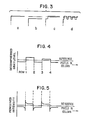
- Fig. 3 graphically shows the events described above, applied to a sequence of pixels.
- Part (a) the original values of the pixels are illustrated.
- Part (b) of Fig. 3 shows the reconstructed values using the quantizer in Table 2 without any corrections.
- Part (c) shows the same results after adding error carry correction with remapping of quantizer errors via Table 4.
- Part (c) of Fig. 3 illustrates the sequence of events when QERR is remapped using Table 4. After an initial delay, the correction is such that --if generated-- it results in QERR locking into the smaller magnitude value (in the example, this value is +1). This behavior is not only desirable from the point of view of compression performance, but also from the point of view of distortion. Note that similar results are obtained for other DPCM predictors.
- the QN value output from the QN selector 104 enters an entropy encoder 120.
- the entropy encoder 120 is preferably an arithmetic coding encoder.
- a model 122 provides a state input to the entropy encoder 120.
- the state input provides a context --normally based on history-- for the QN value which enters the entropy encoder 120.
- the entropy encoder 120 encodes the QN value input thereto so that more probable QN value inputs are represented by codes of shorter lengths and less probable QN value inputs are represented by codes of longer lengths.
- the state input helps identify the conditional probabilities of the QN values.
- the output of the entropy encoder 120 is image data in compressed form. As one pixel after another is processed as the "current" pixel, successive QN values are output from the QN selector 104 and enter the entropy encoder 120.
- the entropy encoder 120 outputs a stream of compressed data for the successively processed pixels.
- the stream of compressed data is directed to a transfer medium 124 for either storage or for transmission.
- the stream of compressed data is provided as one input to an entropy decoder 126.
- the other inputs to the entropy decoder is a state input from a model 128 which corresponds to the model 122.
- the entropy decoder 126 provides the QN value as output.
- a graylevel generator 130 determines a graylevel value for each QN value produced by the entropy decoder 126.
- the graylevel generator 130 typically includes an inverse quantizer (not shown) which provides a difference value D ⁇ for a given entropy decoded QN value, and a predictor element (not shown) which computes a predicted value P ⁇ computed in the same manner that P is computed. For example, if the value for the left adjacent pixel is the predicted value P (used in computing the input value D for quantizer 102), the decompressed value computed for the left adjacent pixel serves as the predicted value P ⁇ for the current pixel. By adding D ⁇ and P ⁇ , a decompressed graylevel value I0 for a current pixel is determined.
- Pixels are compressed and decompressed in the same order --normally left to right along one row after another.
- successive adjacent rows may be processed in order downward through the image if desired.
- the rows may be processed by fields (e.g., odd rows being processed first and then even rows being processed thereafter).
- the graylevel generator 130 computes decompressed graylevel values for each pixel in the image. It is noted that, in areas which were originally uniform in graylevel, the decompressed value may differ from one row to the next. That is, vertically there are step-like transitions in decompressed graylevel value.
- Fig. 4 the decompressed graylevel of pixels in successive rows and aligned in a single column are shown.
- the pixels are in an area in which the QN value is zero --which suggests a relatively uniform graylevel region.
- Fig. 5 is a graph depicting how human vision perceives the graylevels shown in Fig. 4.
- step transitions are perceived as enhanced contrasts (depicted as intensity spikes in the graph) in accordance with the well-known phenomenon of Mach-banding.
- a vertical filter 132 is included in Fig. 1 following the graylevel generator 130.
- the vertical filter 132 in effect smooths the steps of Fig. 4 to soften the perceived transitions.
- the vertical filter 132 serves to aid in reducing horizontal streaking and transition distortion.
- the vertical filter 132 includes a non-linear, simple nearest neighbor filter structure which postprocesses pixels in preferably alternate lines. The vertical filter 132 and the context in which it is used is now described.
- the vertical filter 132 simply adjusts the value I0 of a current pixel based on the values of pixels vertically above and below the current pixel.
- a filtered value I ⁇ 0 for the current pixel is determined to be equal to I0 + W[(I ⁇ 1 - I0) C- + (I+1 - I0) C+ ] in which the two differences are each limited by a respective predefined value C- or C+ and in which W is substantially equal to 1.
- the vertical filter 132 is applied to pixel data generated for an entire image (i.e., without dividing the image into separate interlaced fields). In such an embodiment, a reconstructed value is generated for each pixel independently.
- the vertical filter 132 is advantageously employed where the image is divided into two interlaced fields --one including pixels in odd rows and the other including pixels in even rows.
- a predicted value thereof is determined as: (The predicted value is used in determining the value D as discussed hereinabove.)
- a gradient value is computed as I2 ⁇ - A2.
- the state input has (i) a gradient portion which is derived from the gradient value and (ii) a sign portion which is derived from the sign of the quantized output for the pixel to the left of pixel i2.
- the interpolation performed on a second field pixel exactly splits the difference between the two first field pixels.
- the interpolation may be altered; and in such regions streaking is masked by the activity.
- the vertical filter 132 is to be applied to only pixels in regions of low activity.
- a nearest neighbor filter does not change the interpolated pixels.
- a second-pass two-nearest neighbor filter introduces only second order changes in these second field lines, as the two closest neighbor differences cancel. Therefore, first-pass filtering of second field rows has no effect, and second-pass filtering can at most introduce very small changes. Consequently, post-processing second field rows provides no appreciable benefit and hence is not performed. This results in computational efficiency.
- the vertical filter 132 can be integrated with software code used in the interpolation of second field values.
- the vertical filter 132 is run on only first field rows, the second field rows being determined therefrom.
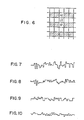
- Fig. 7 through Fig. 10 show plots for a column of reconstructed image data processed under four different conditions. In each plot, proceeding from left to right corresponds to traversing from one row to another along a column of pixels in an image.
- Fig. 7 represents reconstructed data --in a region with a uniform graylevel-- where the data was not processed by the present invention.
- Fig. 8 only the vertical filter aspect of the invention is employed.
- Fig. 9 only the "error carry” aspect is employed.
- Fig. 10 represents data subjected to "error carry" and vertical filtering according to the invention. In examining the plot in Fig. 10, it is observed that there is greater conformance in value from row to row in the column.
- the plot of Fig. 10 shows a reduction in step transitions along the column; large steps, for example, are shown reduced in size and/or split into several smaller steps in Fig. 10. Also, by providing enhanced weighting of the difference between adjacent first field rows, a dithering of values for the rows results which serves to mask streaks.
- the quantizer 102 --as noted hereinabove-- is implementable as a ROM table.
- the REMAP 108 is implementable by a ROM table.
- the switch 106, the integrator 110, and the threshold comparators 112 and 114 are conventional elements.
- the entropy coding elements are implementable by conventional entropy coding elements.
- the entropy coding is performed as set forth in a co-pending U.S. patent application S.N. 06/907714 entitled "Arithmetic Coding Encoder and Decoder System", filed on September 15, 1986 or the corresponding European patent application 87111964.0.
- the graylevel generator 130 is generally described in the aforementioned patent application "Adaptive Graylevel Image Compression System", which is cited to furnish disclosure pertaining to deriving graylevel output from entropy decoded data.
- remapping QERR to MERR values preferably involves remapping to a smaller set of values; however, remapping also relates to one-to-one remapping in which QERR values are remapped to themselves or some other respective value.
- the above described embodiment discloses a QN table which is symmetrical about Q0.
- the quantizer levels may be non-symmetrical.
- the QN levels may be defined as Q(-3), Q(-2), Q(-1), Q0, Q1, and so on with each level having a respective negative, zero, or positive value.
- the preferred remapping would also be non-symmetrical. That is, a remapping to zero occurs when It is further preferred that clamping limits C+ and C- are the same although the two limits may differ.
- the thresholds -THRERRA and +THRERRA may be the same or may differ as desired.
- the invention has been implemented on an IBM 370 computer with a PDS (Programming Development System) language which uses a forward Polish notation.
- PDS Programming Development System
- the present methodologies are also implementable in software in any of various programming languages (such as PASCAL or an assembler language) on any of various computing systems.
Landscapes
- Engineering & Computer Science (AREA)
- Multimedia (AREA)
- Signal Processing (AREA)
- Compression Or Coding Systems Of Tv Signals (AREA)
- Image Processing (AREA)
- Compression, Expansion, Code Conversion, And Decoders (AREA)
Applications Claiming Priority (2)
| Application Number | Priority Date | Filing Date | Title |
|---|---|---|---|
| US07/042,132 US4785356A (en) | 1987-04-24 | 1987-04-24 | Apparatus and method of attenuating distortion introduced by a predictive coding image compressor |
| US42132 | 1987-04-24 |
Publications (3)
| Publication Number | Publication Date |
|---|---|
| EP0287891A2 true EP0287891A2 (de) | 1988-10-26 |
| EP0287891A3 EP0287891A3 (en) | 1990-12-19 |
| EP0287891B1 EP0287891B1 (de) | 1994-01-05 |
Family
ID=21920212
Family Applications (1)
| Application Number | Title | Priority Date | Filing Date |
|---|---|---|---|
| EP88105465A Expired - Lifetime EP0287891B1 (de) | 1987-04-24 | 1988-04-06 | Einrichtung und Verfahren zur Verminderung einer Verzerrung, die durch einen Bild-Kompressor mit prädiktiver Codierung eingeführt ist |
Country Status (5)
| Country | Link |
|---|---|
| US (1) | US4785356A (de) |
| EP (1) | EP0287891B1 (de) |
| JP (1) | JPS63274283A (de) |
| CA (1) | CA1325672C (de) |
| DE (1) | DE3886804T2 (de) |
Cited By (2)
| Publication number | Priority date | Publication date | Assignee | Title |
|---|---|---|---|---|
| EP0639032A3 (de) * | 1993-08-09 | 1995-11-29 | C Cube Microsystems | Struktur und Verfahren für einen Mehrnormen-Bildkodierer/-dekodierer. |
| US5910909A (en) * | 1995-08-28 | 1999-06-08 | C-Cube Microsystems, Inc. | Non-linear digital filters for interlaced video signals and method thereof |
Families Citing this family (14)
| Publication number | Priority date | Publication date | Assignee | Title |
|---|---|---|---|---|
| FR2591050B1 (fr) * | 1985-12-04 | 1990-07-20 | Thomson Cgr | Procede et dispositif de compression par codage conditionnel d'images numeriques sans perte d'informations |
| JPS63190473A (ja) * | 1986-09-25 | 1988-08-08 | Nippon Board Computer Kk | 多階調画像デ−タの情報量圧縮方法及び装置 |
| JPH02243080A (ja) * | 1989-03-16 | 1990-09-27 | Nec Corp | テレビ信号符号化回路 |
| JPH0722396B2 (ja) * | 1989-11-06 | 1995-03-08 | 三菱電機株式会社 | 画像符号化装置 |
| US5136375A (en) * | 1990-07-17 | 1992-08-04 | Zenith Electronics Corporation | Spectrum compatible-HDTV data transmission system |
| AU1996292A (en) * | 1991-05-17 | 1992-12-30 | Analytic Sciences Corporation, The | Continuous-tone image compression |
| US5663763A (en) * | 1992-10-29 | 1997-09-02 | Sony Corp. | Picture signal encoding method and apparatus and picture signal decoding method and apparatus |
| US5357250A (en) * | 1992-11-20 | 1994-10-18 | International Business Machines Corporation | Adaptive computation of symbol probabilities in n-ary strings |
| JP3089941B2 (ja) * | 1994-02-28 | 2000-09-18 | 日本ビクター株式会社 | 画像間予測符号化装置 |
| US5751859A (en) * | 1995-06-14 | 1998-05-12 | Lucent Technologies Inc. | Compression of text images by soft pattern matching |
| JP3388459B2 (ja) * | 1999-03-25 | 2003-03-24 | 日本電気株式会社 | 画像縮小/復元装置、画像縮小/復元方法および画像縮小/復元用プログラムを記録した記録媒体 |
| US7266245B1 (en) * | 2002-03-28 | 2007-09-04 | Magnachip Semiconductor Ltd. | Image signal compression method and system |
| US8107751B2 (en) * | 2007-03-16 | 2012-01-31 | Sharp Laboratories Of America, Inc. | DPCM with adaptive range and PCM escape mode |
| JP5742427B2 (ja) * | 2011-04-25 | 2015-07-01 | 富士ゼロックス株式会社 | 画像処理装置 |
Family Cites Families (30)
| Publication number | Priority date | Publication date | Assignee | Title |
|---|---|---|---|---|
| US3729678A (en) * | 1971-07-20 | 1973-04-24 | Philips Corp | Pcm system including a pulse pattern analyzer |
| GB1344312A (en) * | 1971-08-27 | 1974-01-23 | Post Office | Digital encoding system |
| US3987412A (en) * | 1975-01-27 | 1976-10-19 | International Business Machines Corporation | Method and apparatus for image data compression utilizing boundary following of the exterior and interior borders of objects |
| US3984626A (en) * | 1975-08-01 | 1976-10-05 | Bell Telephone Laboratories, Incorporated | Picture signal coder |
| US4028731A (en) * | 1975-09-29 | 1977-06-07 | International Business Machines Corporation | Apparatus for compression coding using cross-array correlation between two-dimensional matrices derived from two-valued digital images |
| US4124870A (en) * | 1977-03-31 | 1978-11-07 | International Business Machines Corporation | Method for improving print quality of coarse-scan/fine-print character reproduction |
| US4125861A (en) * | 1977-08-18 | 1978-11-14 | Bell Telephone Laboratories, Incorporated | Video signal encoding |
| GB2046051B (en) * | 1979-03-29 | 1983-01-26 | Philips Electronic Associated | Real time histogram modification system for image processing |
| DE2921011C2 (de) * | 1979-05-23 | 1981-04-23 | Matsumoto Yushi-Seiyaku Co., Ltd., Yao, Osaka | Verfahren zum Erzeugen eines Reliefs |
| JPS56128070A (en) * | 1980-03-13 | 1981-10-07 | Fuji Photo Film Co Ltd | Band compressing equipment of variable density picture |
| JPS56136093A (en) * | 1980-03-26 | 1981-10-23 | Fuji Photo Film Co Ltd | Adaptive quantizer |
| US4554593A (en) * | 1981-01-02 | 1985-11-19 | International Business Machines Corporation | Universal thresholder/discriminator |
| US4369463A (en) * | 1981-06-04 | 1983-01-18 | International Business Machines Corporation | Gray scale image data compression with code words a function of image history |
| FR2515450B1 (fr) * | 1981-10-27 | 1986-01-24 | Thomson Csf | Procede, et systeme, de codage et decodage differentiel de donnees limitant la propagation des erreurs de transmission |
| US4554670A (en) * | 1982-04-14 | 1985-11-19 | Nec Corporation | System and method for ADPCM transmission of speech or like signals |
| JPS58202666A (ja) * | 1982-05-21 | 1983-11-25 | Ricoh Co Ltd | 2値化方式 |
| US4488174A (en) * | 1982-06-01 | 1984-12-11 | International Business Machines Corporation | Method for eliminating motion induced flicker in a video image |
| US4488175A (en) * | 1982-06-28 | 1984-12-11 | At&T Bell Laboratories | DPCM Video signal processing technique with spatial subsampling |
| IT1155557B (it) * | 1982-07-19 | 1987-01-28 | Cselt Centro Studi Lab Telecom | Metdodo e dispositivo per la codifica del segnale d immagine con riduzione di ridondanza a distorsione localmente uniforme |
| DE3237578C2 (de) * | 1982-10-09 | 1984-11-29 | Standard Elektrik Lorenz Ag, 7000 Stuttgart | Digitales Nachrichtenübertragungssystem, insbesondere Farbfernsehübertragungssystem |
| US4504864A (en) * | 1982-12-30 | 1985-03-12 | International Business Machines Corporation | Nonlinear filtering of gray scale images |
| US4562467A (en) * | 1983-04-01 | 1985-12-31 | Itek Corporation | Data compression apparatus and method for encoding and decoding multi-line signals |
| GB2139849B (en) * | 1983-05-07 | 1986-11-19 | Nippon Telegraph & Telephone | Image data compression system |
| DE3331426A1 (de) * | 1983-08-31 | 1985-03-14 | Siemens AG, 1000 Berlin und 8000 München | Anordnung zur zweidimensionalen dpcm-codierung |
| US4633325A (en) * | 1983-09-01 | 1986-12-30 | Nec Corporation | Adaptive predictive encoding and/or decoding apparatus |
| US4599656A (en) * | 1984-02-21 | 1986-07-08 | International Business Machines Corporation | Processing of gray scale image pels to facilitate data compression |
| US4613948A (en) * | 1984-06-01 | 1986-09-23 | Bell Communications Research, Inc. | Conditional quantization grey level and color image coding apparatus |
| US4578713A (en) * | 1984-07-20 | 1986-03-25 | The Mead Corporation | Multiple mode binary image processing |
| US4601056A (en) * | 1984-08-13 | 1986-07-15 | Recognition Equipment Incorporated | Video correlator for video format unit |
| US4593325A (en) * | 1984-08-20 | 1986-06-03 | The Mead Corporation | Adaptive threshold document duplication |
-
1987
- 1987-04-24 US US07/042,132 patent/US4785356A/en not_active Expired - Fee Related
-
1988
- 1988-03-15 JP JP63059573A patent/JPS63274283A/ja active Granted
- 1988-03-28 CA CA000562726A patent/CA1325672C/en not_active Expired - Fee Related
- 1988-04-06 EP EP88105465A patent/EP0287891B1/de not_active Expired - Lifetime
- 1988-04-06 DE DE3886804T patent/DE3886804T2/de not_active Expired - Fee Related
Cited By (7)
| Publication number | Priority date | Publication date | Assignee | Title |
|---|---|---|---|---|
| EP0639032A3 (de) * | 1993-08-09 | 1995-11-29 | C Cube Microsystems | Struktur und Verfahren für einen Mehrnormen-Bildkodierer/-dekodierer. |
| US5598514A (en) * | 1993-08-09 | 1997-01-28 | C-Cube Microsystems | Structure and method for a multistandard video encoder/decoder |
| US5630033A (en) * | 1993-08-09 | 1997-05-13 | C-Cube Microsystems, Inc. | Adaptic threshold filter and method thereof |
| US5740340A (en) * | 1993-08-09 | 1998-04-14 | C-Cube Microsystems, Inc. | 2-dimensional memory allowing access both as rows of data words and columns of data words |
| US6071004A (en) * | 1993-08-09 | 2000-06-06 | C-Cube Microsystems, Inc. | Non-linear digital filters for interlaced video signals and method thereof |
| US6122442A (en) * | 1993-08-09 | 2000-09-19 | C-Cube Microsystems, Inc. | Structure and method for motion estimation of a digital image by matching derived scores |
| US5910909A (en) * | 1995-08-28 | 1999-06-08 | C-Cube Microsystems, Inc. | Non-linear digital filters for interlaced video signals and method thereof |
Also Published As
| Publication number | Publication date |
|---|---|
| DE3886804T2 (de) | 1994-06-23 |
| DE3886804D1 (de) | 1994-02-17 |
| EP0287891B1 (de) | 1994-01-05 |
| JPH0511837B2 (de) | 1993-02-16 |
| CA1325672C (en) | 1993-12-28 |
| EP0287891A3 (en) | 1990-12-19 |
| US4785356A (en) | 1988-11-15 |
| JPS63274283A (ja) | 1988-11-11 |
Similar Documents
| Publication | Publication Date | Title |
|---|---|---|
| EP0287891B1 (de) | Einrichtung und Verfahren zur Verminderung einer Verzerrung, die durch einen Bild-Kompressor mit prädiktiver Codierung eingeführt ist | |
| US4816914A (en) | Method and apparatus for efficiently encoding and decoding image sequences | |
| EP0519962B1 (de) | Digitale bildkodierung mit einer zufallsabtastung der bilder | |
| US6005981A (en) | Quadtree-structured coding of color images and intra-coded images | |
| Tzou | Progressive image transmission: a review and comparison of techniques | |
| US4541012A (en) | Video bandwidth reduction system employing interframe block differencing and transform domain coding | |
| US6249546B1 (en) | Adaptive entropy coding in adaptive quantization framework for video signal coding systems and processes | |
| US5218435A (en) | Digital advanced television systems | |
| US5367629A (en) | Digital video compression system utilizing vector adaptive transform | |
| EP0587783B1 (de) | System zur adaptiven kompression der blockgrössen eines bildes | |
| JP2783534B2 (ja) | 符号化装置 | |
| EP2285117B1 (de) | Videokodierer mit impliziter Koeffizientprädiktion und Scanadaption für Bildkodierung und Videointrakodierung | |
| JP2000125297A (ja) | 連続画像の符号化方法及び復号化方法 | |
| KR0141824B1 (ko) | 가변길이의 적응 영상 압축 방법 및 장치 | |
| US5555028A (en) | Post-processing method and apparatus for use in an image signal decoding system | |
| JPH01200883A (ja) | 復号装置及び復号方法 | |
| JP2000506686A (ja) | オーバラップブロック動き補償及びゼロツリーウェーブレット符号化を用いる低ビットレートビデオ符号化器 | |
| US5822000A (en) | Video encoding using rearrangement of transform coefficients and inter-block correlation | |
| EP0519995B1 (de) | Digitale bildverarbeitung mit filterung der blockkanten | |
| EP0297862A1 (de) | Vorhersage-Kodiersystem mit Geräuschverminderung | |
| US5724096A (en) | Video signal encoding method and apparatus employing inter-block redundancies | |
| US5825422A (en) | Method and apparatus for encoding a video signal based on inter-block redundancies | |
| US20030215152A1 (en) | Data compression | |
| JP3402212B2 (ja) | ディジタルデータの圧縮方法 | |
| Ngan et al. | Enhancement of image quality for low bit rate video coding |
Legal Events
| Date | Code | Title | Description |
|---|---|---|---|
| PUAI | Public reference made under article 153(3) epc to a published international application that has entered the european phase |
Free format text: ORIGINAL CODE: 0009012 |
|
| AK | Designated contracting states |
Kind code of ref document: A2 Designated state(s): DE FR GB IT |
|
| 17P | Request for examination filed |
Effective date: 19890222 |
|
| PUAL | Search report despatched |
Free format text: ORIGINAL CODE: 0009013 |
|
| AK | Designated contracting states |
Kind code of ref document: A3 Designated state(s): DE FR GB IT |
|
| 17Q | First examination report despatched |
Effective date: 19930324 |
|
| GRAA | (expected) grant |
Free format text: ORIGINAL CODE: 0009210 |
|
| AK | Designated contracting states |
Kind code of ref document: B1 Designated state(s): DE FR GB IT |
|
| PG25 | Lapsed in a contracting state [announced via postgrant information from national office to epo] |
Ref country code: IT Free format text: LAPSE BECAUSE OF FAILURE TO SUBMIT A TRANSLATION OF THE DESCRIPTION OR TO PAY THE FEE WITHIN THE PRESCRIBED TIME-LIMIT;WARNING: LAPSES OF ITALIAN PATENTS WITH EFFECTIVE DATE BEFORE 2007 MAY HAVE OCCURRED AT ANY TIME BEFORE 2007. THE CORRECT EFFECTIVE DATE MAY BE DIFFERENT FROM THE ONE RECORDED. Effective date: 19940105 |
|
| REF | Corresponds to: |
Ref document number: 3886804 Country of ref document: DE Date of ref document: 19940217 |
|
| ET | Fr: translation filed | ||
| PLBE | No opposition filed within time limit |
Free format text: ORIGINAL CODE: 0009261 |
|
| STAA | Information on the status of an ep patent application or granted ep patent |
Free format text: STATUS: NO OPPOSITION FILED WITHIN TIME LIMIT |
|
| 26N | No opposition filed | ||
| PGFP | Annual fee paid to national office [announced via postgrant information from national office to epo] |
Ref country code: FR Payment date: 19960412 Year of fee payment: 9 |
|
| PG25 | Lapsed in a contracting state [announced via postgrant information from national office to epo] |
Ref country code: FR Free format text: LAPSE BECAUSE OF NON-PAYMENT OF DUE FEES Effective date: 19971231 |
|
| REG | Reference to a national code |
Ref country code: FR Ref legal event code: ST |
|
| PGFP | Annual fee paid to national office [announced via postgrant information from national office to epo] |
Ref country code: GB Payment date: 19980319 Year of fee payment: 11 |
|
| PGFP | Annual fee paid to national office [announced via postgrant information from national office to epo] |
Ref country code: DE Payment date: 19980422 Year of fee payment: 11 |
|
| PG25 | Lapsed in a contracting state [announced via postgrant information from national office to epo] |
Ref country code: GB Free format text: LAPSE BECAUSE OF NON-PAYMENT OF DUE FEES Effective date: 19990406 |
|
| GBPC | Gb: european patent ceased through non-payment of renewal fee |
Effective date: 19990406 |
|
| PG25 | Lapsed in a contracting state [announced via postgrant information from national office to epo] |
Ref country code: DE Free format text: LAPSE BECAUSE OF NON-PAYMENT OF DUE FEES Effective date: 20000201 |