EP0287928A2 - Flammwidrige, halogenfreie thermoplastische Polymermasse - Google Patents
Flammwidrige, halogenfreie thermoplastische Polymermasse Download PDFInfo
- Publication number
- EP0287928A2 EP0287928A2 EP88105768A EP88105768A EP0287928A2 EP 0287928 A2 EP0287928 A2 EP 0287928A2 EP 88105768 A EP88105768 A EP 88105768A EP 88105768 A EP88105768 A EP 88105768A EP 0287928 A2 EP0287928 A2 EP 0287928A2
- Authority
- EP
- European Patent Office
- Prior art keywords
- weight
- vinyl acetate
- filler
- parts
- ethylene
- Prior art date
- Legal status (The legal status is an assumption and is not a legal conclusion. Google has not performed a legal analysis and makes no representation as to the accuracy of the status listed.)
- Granted
Links
Images

Classifications
-
- C—CHEMISTRY; METALLURGY
- C08—ORGANIC MACROMOLECULAR COMPOUNDS; THEIR PREPARATION OR CHEMICAL WORKING-UP; COMPOSITIONS BASED THEREON
- C08L—COMPOSITIONS OF MACROMOLECULAR COMPOUNDS
- C08L31/00—Compositions of homopolymers or copolymers of compounds having one or more unsaturated aliphatic radicals, each having only one carbon-to-carbon double bond, and at least one being terminated by an acyloxy radical of a saturated carboxylic acid, of carbonic acid or of a haloformic acid; Compositions of derivatives of such polymers
- C08L31/02—Homopolymers or copolymers of esters of monocarboxylic acids
- C08L31/04—Homopolymers or copolymers of vinyl acetate
-
- C—CHEMISTRY; METALLURGY
- C08—ORGANIC MACROMOLECULAR COMPOUNDS; THEIR PREPARATION OR CHEMICAL WORKING-UP; COMPOSITIONS BASED THEREON
- C08K—Use of inorganic or non-macromolecular organic substances as compounding ingredients
- C08K3/00—Use of inorganic substances as compounding ingredients
- C08K3/01—Use of inorganic substances as compounding ingredients characterized by their specific function
- C08K3/013—Fillers, pigments or reinforcing additives
-
- C—CHEMISTRY; METALLURGY
- C08—ORGANIC MACROMOLECULAR COMPOUNDS; THEIR PREPARATION OR CHEMICAL WORKING-UP; COMPOSITIONS BASED THEREON
- C08L—COMPOSITIONS OF MACROMOLECULAR COMPOUNDS
- C08L23/00—Compositions of homopolymers or copolymers of unsaturated aliphatic hydrocarbons having only one carbon-to-carbon double bond; Compositions of derivatives of such polymers
- C08L23/02—Compositions of homopolymers or copolymers of unsaturated aliphatic hydrocarbons having only one carbon-to-carbon double bond; Compositions of derivatives of such polymers not modified by chemical after-treatment
- C08L23/04—Homopolymers or copolymers of ethene
- C08L23/08—Copolymers of ethene
-
- C—CHEMISTRY; METALLURGY
- C08—ORGANIC MACROMOLECULAR COMPOUNDS; THEIR PREPARATION OR CHEMICAL WORKING-UP; COMPOSITIONS BASED THEREON
- C08L—COMPOSITIONS OF MACROMOLECULAR COMPOUNDS
- C08L2205/00—Polymer mixtures characterised by other features
- C08L2205/02—Polymer mixtures characterised by other features containing two or more polymers of the same C08L -group
-
- Y—GENERAL TAGGING OF NEW TECHNOLOGICAL DEVELOPMENTS; GENERAL TAGGING OF CROSS-SECTIONAL TECHNOLOGIES SPANNING OVER SEVERAL SECTIONS OF THE IPC; TECHNICAL SUBJECTS COVERED BY FORMER USPC CROSS-REFERENCE ART COLLECTIONS [XRACs] AND DIGESTS
- Y10—TECHNICAL SUBJECTS COVERED BY FORMER USPC
- Y10T—TECHNICAL SUBJECTS COVERED BY FORMER US CLASSIFICATION
- Y10T428/00—Stock material or miscellaneous articles
- Y10T428/29—Coated or structually defined flake, particle, cell, strand, strand portion, rod, filament, macroscopic fiber or mass thereof
- Y10T428/2913—Rod, strand, filament or fiber
- Y10T428/2933—Coated or with bond, impregnation or core
-
- Y—GENERAL TAGGING OF NEW TECHNOLOGICAL DEVELOPMENTS; GENERAL TAGGING OF CROSS-SECTIONAL TECHNOLOGIES SPANNING OVER SEVERAL SECTIONS OF THE IPC; TECHNICAL SUBJECTS COVERED BY FORMER USPC CROSS-REFERENCE ART COLLECTIONS [XRACs] AND DIGESTS
- Y10—TECHNICAL SUBJECTS COVERED BY FORMER USPC
- Y10T—TECHNICAL SUBJECTS COVERED BY FORMER US CLASSIFICATION
- Y10T428/00—Stock material or miscellaneous articles
- Y10T428/29—Coated or structually defined flake, particle, cell, strand, strand portion, rod, filament, macroscopic fiber or mass thereof
- Y10T428/2913—Rod, strand, filament or fiber
- Y10T428/2933—Coated or with bond, impregnation or core
- Y10T428/294—Coated or with bond, impregnation or core including metal or compound thereof [excluding glass, ceramic and asbestos]
Definitions
- thermoplastically processable polymer materials with good mechanical properties are increasingly required.
- thermoplastic processability of a material enables a rational production of molded articles by e.g. Extrusion and reuse of material residues and / or process waste.
- polymer materials are stretched with mineral fillers and / or halogen-containing organic and inorganic substances, or polymers containing high halogen are used, which are often also stretched with fillers.
- Polymer materials that contain halogen-containing additives, or whose polymers themselves contain halogen, have serious weaknesses in the event of a fire consequential fire damage (health damage caused by smoke; corrosive damage to the building structure) can cause the actual fire damage.
- DIN 57 207 and VDE standard 0207 (part 24) also require a minimum strength of 6.5 MPa with an elongation at break of at least 125% for halogen-free cable sheath compounds.
- DE-OS 2 947 332 describes polymers which consist of crosslinked vinyl acetate / alkene copolymer or a mixture of crosslinked vinyl acetate / alkene copolymer and other polymer components.
- DE-OS 2 805 930 describes, inter alia, mixtures of crosslinked vinyl acetate / alkene copolymer and polyolefin, such as Polypropylene and polyethylene. Dynamic networking is also described in these published documents.
- Dynamic networking is a networking process that e.g. is known from US 3 037 954, where it can sometimes be advantageous to carry out only partial crosslinking (see e.g. US 3 862 106).
- the appropriate amounts of crosslinking chemicals and suitable parameters for the crosslinking process must be determined depending on the polymer processed.
- Preparations based on uncrosslinked vinyl acetate / ethylene copolymer are also known as flame-retardant, thermoplastic, halogen-free molding compositions: DE-OS 3 047 269 and DE-OS 3 306 776 describe mixtures of a rubber-like vinyl acetate / ethylene copolymer and a plastic-like (plastomer) Vinyl acetate / ethylene copolymer. Furthermore describes DE-OS 3 047 269 that such mixtures of two different vinyl acetate / ethylene copolymers are very highly fillable. As expected (see, for example, DE-OS 2 947 332 and DE-OS 3 104 984), the higher the proportion of filler, the higher the LOI of such highly filled polymer preparations.
- FR-A 8 400 640 which describes highly filled thermoplastically processable mixtures based on ethylene / vinyl copolymer.
- the essential improvements that can be achieved by using filler-polymer coupling agents are described.
- mixtures of ethylene / vinyl acetate copolymers are particularly suitable as a polymer base for flame-retardant, halogen-free, thermoplastically processable preparations, provided the copolymers have been dynamically crosslinked .
- the preferred ethylene / vinyl acetate copolymers with a content of 5 to 15% by weight of vinyl acetate units have melt indexes (190 / 2.16 bp according to DIN 53 735) of 0.15 to 1.8 g / 10 minutes. Polymers that have melt indexes between 1.3 and 1.8 g / 10 minutes are particularly suitable. Such polymers are partially crystalline and their Vicat softening temperatures (VST A, according to DIN 53 460) are between 75 and 95 ° C. Polymers which have Vicat softening temperatures between 75 and 85 ° C. are particularly advantageous.
- the preferred ethylene / vinyl acetate copolymers with a content of 42 to 70% by weight of vinyl acetate units are essentially linear polymers with no or with little crystalline regions. They have Mooney viscosities (ML-4 (100 ° C) according to DIN 53 523) between 15 and 40 ME. Polymers with Mooney viscosities (ML-4 (100 ° C)) between 20 and 30 ME are particularly suitable.
- Ethylene / vinyl acetate copolymers can be produced by radical-initiated polymerization of ethylene and vinyl acetate at high pressure or in solution at medium pressure.
- terpolymers with up to 5% by weight of copolymerized termonomer units such as e.g. Acrylic acid, methacrylic acid or maleic acid units can be used advantageously for the purposes of the invention.
- the parts by weight (parts by weight) of the components are in each case based on 100 parts by weight of polymer.
- thermoplastic processability such as: extrudability
- “Dynamic crosslinking” in the sense of the invention means a process according to which the polymer mixture masticates in the presence of crosslinker and, if appropriate, cover crosslinker while networking is taking place.
- dynamic means that the mixture is subjected to shear forces during crosslinking, while in “static” crosslinking it is crosslinked without the action of shear forces.
- the shear rate in the case of an extruder, the quotient of the largest circumference of the screw described by the screw shaft times revolutions of the screw per second
- the screw tolerance distance between the screw and the wall of the screw chamber
- the upper limit of the shear rate is only limited by the risk of thermal damage to the polymers.
- the dynamic crosslinking is advantageously carried out at a temperature above the softening temperature of the higher-melting copolymer, preferably 20 to 50 ° C. above this softening temperature (determined by differential thermal analysis).
- At least one dwell time in the dynamic zone must be provided, which is 4 times the half-life of the peroxide used (at the temperature of the dynamic crosslinking).
- Suitable units are kneaders, such as Banbury mixers, Brabender mixers, or mixing extruders, such as single and twin screw machines.
- peroxides are e.g. Dicumyl peroxide, 2,5-bis (t-butyl peroxide-2,5-dimethylhexane) and 4,4'-bis (t-butyl peroxy) diisopropylbenzene are particularly preferred. It is important that the peroxide used does not disintegrate below 125 ° C. or only very slowly. Peroxides which have a disintegration half-life of 1 minute at a temperature between 130 and 190 ° C. are particularly suitable.
- Cross crosslinkers or “co-curing agents” are to be understood as meaning multifunctional organic and organometallic compounds which alone do not produce any or only insufficient crosslinking of the polymers. Examples of such compounds are triallyl cyanurate, triallyl isocyanurate, pentaerythritol tetramethacrylate and N, N′-m-phenylenedimaleimide, the latter being particularly preferred.
- the dynamic crosslinking can be carried out in the presence or absence of the filler. To achieve comparable mechanical properties, however, larger amounts of crosslinking chemicals have to be used for the dynamic crosslinking of filler-containing mixtures.
- Unfilled mixtures are filled after the dynamic crosslinking.
- filler * means filler III, which is present during the dynamic crosslinking.
- Particularly preferred fillers are those which give off water when heated, such as aluminum hydroxide or hydrated aluminum oxide of the formula Al2O3 ⁇ xH2O, where x is in the range from 0.5 to 3.0, especially Al2O3 ⁇ 3H2O, hydrated magnesium oxide or magnesium hydroxide and hydrated calcium silicate .
- Mixtures which contain more than 50% by weight (based on the total filler) of the above fillers can advantageously be used together with other fillers, such as, for example, carbon black and / or silicon dioxide in the preparations according to the invention. Further examples such as mixtures of the above hydroxides with less than 50% by weight Magnesium carbonate and / or chalk and / or zinc borate have proven to be particularly suitable.
- Particularly preferred fillers are those in which less than 10% by weight of the particles have a diameter of more than 3 ⁇ m and at least 50% by weight of the particles have a diameter of less than 2 ⁇ m.
- the filler can optionally be chemically treated in order to improve its compatibility with the polymer material or to bring about a certain coupling to one of the polymers or both.
- chemical compatibilizers are e.g. Stearates or stearic acid.
- coupling agents e.g. Silanes such as dimethyldichlorosilane, methyltrichlorosilane, vinyltrichlorosilane, methacryloxypropyltrimethoxysilane and vinyltrimethoxysilane can be used. Further examples of coupling agents are described in DE-OS 2 947 332 and in the literature cited therein. Surface treatment agents are usually used in a weight ratio (based on the filler) of (1 to 100): 1,000, preferably of (5 to 50): 1,000.
- the preparations according to the invention contain 0.1 to 20 parts by weight of saponified ethylene / vinyl acetate copolymer with a degree of saponification of from 70 to 100, preferably from 85 to 99%, per 100 parts by weight of I + II.
- Preferred saponified ethylene / Vinyl acetate copolymers are those made of ethylene / vinyl acetate copolymers with a content of vinyl acetate units from 10 to 50, preferably from 20 to 40 wt .-%. Such polymers are known, for example from DE-OS 2 943 469. The addition increases the strength without seriously impairing the elasticity or the LOI.
- the saponified ethylene / vinyl acetate copolymer can be mixed in before, during or after the dynamic crosslinking of the copolymers I and II.
- the preparations according to the invention can contain up to a maximum of 20 parts by weight of conventional antioxidants, intumescent, flame retardant and other processing aids. Only halogen-free components should preferably be used here.
- the group of common processing aids includes plasticizers such as oils, fats and waxes, provided they are halogen-free.
- the group of conventional anti-aging agents includes, for example, sterically hindered phenols, phenylnaphthylamines, substituted diphenylamines, p-phenylenediamines, ketone amine condensates, substituted phenols, thiobisphenols, mercapto compounds, imidazoles, benzimidazoles, mercaptobenzimidazoles, phenol condensation ether products, phenol esters, phenol esters heavy metal organic compounds, urethane compounds, Si organic compounds, polymeric amines, polyarylalkanes, nitriles, benzotriazoles, phosphoric acid amides, amines and molecular sieves, carboxylic acid derivatives, aromatic dihydroxy polycarbonates, esters of phosphoric acid, dihydroquinoline derivatives.
- organic or flammable processing aids can lower the LOI value of the preparation.
- the preparations according to the invention can be processed in an internal mixer to form products which, when transferred to a rubber roller at temperatures of 150 to 200 ° C., form continuous skins.
- the formation of a continuous skin or a skin with a smooth surface has proven to be a good rapid test for the thermoplastic processability of the products.
- the preparations according to the invention can be prepared in a one-step process, the filler having been or being already mixed with the polymer during dynamic crosslinking, or it is possible first to prepare the thermoplastic polymer mixture (if appropriate with auxiliaries) and this after it crosslinks has been intimately mixed with the filler in a second process step. This variant of the production is preferred if a continuous unit, such as a twin-screw extruder or a co-kneader, is used.
- the preparations according to the invention are used wherever a polymer of excellent flame resistance and good mechanical properties is required in the form of plates, sheets or tubes.
- the preparations according to the invention are particularly suitable for producing cable sheathing.
- ®VULKANOX HS is the trade name of a polymer antioxidant based on 2,2,4-trimethyl-1,2-dihydroquinoline.
- ®IRGAFOS TNPP is the trade name for trinonylphenyl phosphite and ®PERKADOX 14/40 is the trade name for a granulate containing 40% by weight bis- (t-butylperoxy-isopropyl) -benzene.
- TAC is triallyl cyanurate and NPD is N, N'-m-phenylenedimaleimide, both are co-curing reagents.
- ®CORAX N 550 is a carbon black.
- the mechanical properties of the samples were tested in accordance with DIN 53 515 (tear resistance) and DIN 53 504 (tensile test).
- the LOI was measured according to ASTM D-2863.
- the test specimens were punched out of press plates which were pressed at 190 ° C. and 300 bar for 5 minutes. Before being removed from the mold, the plates were cooled to room temperature under this pressure.
- the samples (Table 2) were produced in a 1 l laboratory kneader at a shaft temperature of 60 ° C. and at 60 rpm.
- the mixing sequence for samples 1 and 2 was:
- Samples 7 and 8 were prepared using the same mixing sequence as samples 5 and 6, except that at 3 'the ®PERKADOX was added and the total mixing time was about 10 minutes.
- Sample 8 is a mixture according to the invention.
- Samples 1-4 show that at 100 parts by weight of filler can be achieved neither by increasing the vinyl acetate content of the ethylene-vinyl acetate copolymers from 40% by weight to 70% by weight (polymers III; V) nor by the dynamic crosslinking a significant increase in the LOI.
- a comparison of samples 5-8 shows, however, that surprising effects occur when 200 parts by weight of filler are used.
- the improvement in tensile strength by means of dynamic crosslinking is about twice as large as with only 100 parts by weight of filler.
- Samples 12 to 15 were prepared using the same mixing sequences as samples 9 to 11, except that the ®PERKADOX 14/40 was added during the first minute.
- a comparison between samples 12 and 13 or 14 and 15 shows an unexpectedly great improvement in the mechanical properties of the polymer base of the mixtures according to the invention if an ethylene / vinyl acetate copolymer is used instead of homo-polyethylene.
Landscapes
- Chemical & Material Sciences (AREA)
- Health & Medical Sciences (AREA)
- Chemical Kinetics & Catalysis (AREA)
- Medicinal Chemistry (AREA)
- Polymers & Plastics (AREA)
- Organic Chemistry (AREA)
- Compositions Of Macromolecular Compounds (AREA)
- Processes Of Treating Macromolecular Substances (AREA)
- Organic Insulating Materials (AREA)
- Addition Polymer Or Copolymer, Post-Treatments, Or Chemical Modifications (AREA)
Abstract
Description
- Insbesondere für Kabel- und Leitungsummantelungen, aber auch für andere Anwendungen, z.B. als Fußbodenbeläge, werden in zunehmendem Maße halogenfreie, thermoplastisch verarbeitbare Polymerwerkstoffe mit guten mechanischen Eigenschaften gefordert.
- Die thermoplastische Verarbeitbarkeit eines Materials ermöglicht eine rationelle Herstellung von Formkörpern durch z.B. Extrusion und die Wiederverwendung von Materialresten und/oder Prozeßabfällen.
- Zur Erhöhung ihrer Flammwidrigkeit werden Polymerwerkstoffe mit mineralischen Füllstoffen und/oder halogenhaltigen organischen und anorganischen Substanzen gestreckt oder man verwendet hochhalogenhaltige Polymere, die häufig auch mit Füllstoffen gestreckt werden. Polymerwerkstoffe, die halogenhaltige Zuschläge enthalten, oder deren Polymere selbst halogenhaltig sind, weisen im Brandfall gravierende Schwächen auf, die zu die Höhe des eigentlichen Brandschadens übersteigenden Brandfolgeschäden (gesundheitliche Schäden durch Raucheinwirkung; korrosive Schädigung der Bausubstanz) führen können.
- Ein Maßstab für die Flammwidrigkeit von Polymerwerkstoffen ist der LOI (Limiting Oxygen Index), der der Sauerstoffkonzentration entspricht, bei der ein brennender Prüfkörper gerade noch nicht verlöscht. Daraus folgt, daß ein Material mit einem LOI <20 an der Atmosphäre im Brandfall nicht mehr selbst verlöscht (ASTMD-2863).
- Die DIN 57 207 und die VDE-Norm 0207 (Teil 24) fordern für halogenfreie Kabelmantelkompounds (unter anderem) neben der Nichtkorrosivität der Brandgase eine Mindestfestigkeit von 6,5 MPa bei einer Bruchdehnung von mindestens 125 %.
- Werkstoffe, die diesen Anforderungen genügen, sind bekannt, aber in zunehmendem Maße werden weiter verbesserte Materialien gewünscht, die neben einem LOI über 30 bei guter Festigkeit und eine Bruchdehnung möglichst von 200 % oder darüber aufweisen müssen.
- Die DE-OS 2 947 332 beschreibt Polymere, die aus vernetztem Vinylacetat/Alken-Copolymerisat oder einem Gemisch von vernetztem Vinylacetat/Alken-Copolymerisat und weiteren Polymerkomponenten bestehen. Die DE-OS 2 805 930 beschreibt u.a. Gemische aus vernetztem Vinylacetat/Alken-Copolymerisat und Polyolefin, wie z.B. Polypropylen und Polyethylen. In diesen Offenlegungsschriften wird auch eine dynamische Vernetzung beschrieben.
- Die dynamische Vernetzung ist ein Vernetzungsverfahren, das z.B. aus US 3 037 954 bekannt ist, wobei es manchmal vorteilhaft sein kann, nur eine partielle Vernetzung durchzuführen (siehe z.B. US 3 862 106). Die geeigneten Mengen an Vernetzungschemikalien und geeignete Parameter für das Vernetzungsverfahren müssen in Abhängigkeit vom verarbeiteten Polymer ermittelt werden.
- US 3 399 250 beschreibt ungefüllt partiell vernetzte Polymermischungen aus Polyethylen und Ethylen/Vinylacetat-Copolymerisat. Ähnliche Zubereitungen aus partiell vernetzten Ethylen/Vinylacetat-Copolymerisat und Polypropylen werden in US 4 232 132 beschrieben. Solche Zubereitungen weisen die typischen Vorteile thermoplastischer Kunststoffe auf, die partiell oder vollständig vernetzten Kautschuk enthalten, aber ihr Brandverhalten ist im Sinne der gestellten Aufgabe völlig unzureichend.
- Zubereitungen auf Basis von unvernetztem Vinylacetat/Ethylen-Copolymerisat sind auch als flammwidrige, thermoplastische, halogenfreie Formmassen bekannt: DE-OS 3 047 269 und DE-OS 3 306 776 beschreiben Mischungen aus einem kautschukartigen Vinylacetat/Ethylen-Copolymerisat und einem kunststoffartigen (plastomer) Vinylacetat/Ethylen-Copolymerisat. Weiterhin beschreibt DE-OS 3 047 269, daß solche Mischungen aus zwei verschiedenen Vinylacetat/Ethylen-Copolymeren sehr hoch füllbar sind. Erwartungsgemäß (siehe z.B. DE-OS 2 947 332 und DE-OS 3 104 984) ist der LOI solcher hoch gefüllten Polymerzubereitungen umso höher, je höher der Füllstoffanteil ist.
- Weiterhin beispielhaft für den Stand der Technik ist die FR-A 8 400 640, die hoch gefüllte thermoplastisch verarbeitbare Mischungen auf Basis von Ethylen/Vinyl-Copolymerisat beschreibt. In dieser Schrift werden die wesentlichen Verbessungen, die durch Anwendung von Füllstoff-Polymer-Kopplungsmitteln zu erzielen sind, beschrieben.
- Nach diesem Stand der Technik konnten jedoch keine Materialien, die den strengen Anforderungen der gestellten Aufgabe genügen, hergestellt werden.
- Überraschend wurde nun gefunden, daß sich Mischungen aus Ethylen/Vinylacetat-Copolymerisaten, von denen das eine einen niedrigen und das andere einen hohen Vinylacetatgehalt besitzen, besonders gut als Polymerbasis für flammwidrige, halogenfreie, thermoplastisch verarbeitbare Zubereitungen eignen, sofern die Copolymerisate dynamisch vernetzt worden sind.
- Gegenstand der Erfindung sind also halogenfreie, thermoplatisch verarbeitbare Zusammensetzungen aus
- I. 20 bis 50, vorzugsweise 30 bis 50, Gew.-Teilen eines Ethylen/Vinylacetat-Copolymeren mit einem Gehalt an Vinylacetateinheiten von 5 bis 15 Gew.-%, vorzugsweise von 5 bis 10 Gew.-%,
- II. 80 bis 50, vorzugsweise 70 bis 50 Gew.-Teilen eines Ethylen/Vinylacetat-Copolymeren mit einem Gehalt au Vinylacetateinheiten von 42 bis 75 Gew.-%, vorzugsweise von 60 bis 70 Gew.-%,
- III. 150 bis 220, vorzugsweise 160 bis 200 Gew.-Teilen mineralischem Füllstoff pro 100 Gew.-Teile I + II und
- Die bevorzugten Ethylen/Vinylacetat-Copolymeren mit einem Gehalt von 5 bis 15 Gew.-% Vinylacetat-Einheiten haben Schmelzindices (190/2,16 Kp nach DIN 53 735) von 0,15 bis 1,8 g/10 Minuten. Polymere, die Schmelzindices zwischen 1,3 und 1,8 g/10 Minuten aufweisen, sind besonders geeignet. Solche Polymere sind teilkristallin und ihre Vicat-Erweichungstemperaturen (VST A, nach DIN 53 460) liegen zwischen 75 und 95°C. Besonders vorteilhaft sind Polymere, die Vicat-Erweichungstemperaturen zwischen 75 und 85°C aufweisen.
- Die bevorzugten Ethylen/Vinylacetat-Copolymeren mit einem Gehalt von 42 bis 70 Gew.-% Vinylacetat-Einheiten sind im wesentlichen lineare Polymere ohne oder mit geringen kristallinen Bereichen. Sie weisen Mooney-Viskositäten (ML-4 (100°C) nach DIN 53 523) zwischen 15 und 40 ME auf. Besonders gut geeignet sind Polymere mit Mooney Viskositäten (ML-4 (100°C)) zwischen 20 und 30 ME. Ethylen/Vinylacetat-Copolymere können durch radikalinitiierte Polymerisation von Ethylen und Vinylacetat bei Hochdruck oder in Lösung bei Mitteldruck hergestellt werden.
- Obwohl einfache Copolymere aus Ethylen und Vinylacetat besonders bevorzugte Einsatzmaterialien darstellen, können auch Terpolymere mit bis zu 5 Gew.-% copolymerisierter Termonomereinheiten, wie z.B. Acrylsäure-, Methacrylsäure- oder Maleinsäureeinheiten, vorteilhaft im Sinne de Erfindung eingesetzt werden.
- In der weiteren Beschreibung der erfindungsgemäßen Zubereitungen werden die Gewichtsteile (Gew.-Teile) der Komponenten jeweils auf 100 Gew.-Teile Polymer bezogen.
- Um die geforderten Eigenschaften zu erreichen und eine thermoplastische Verarbeitbarkeit (wie. z.B: Extrudierbarkeit) zu gewährleisten, ist es unerläßlich, die Zubereitungen dynamisch zu vernetzen. Unter "dynamischer Vernetzung" im Sinne der Erfindung versteht man ein Verfahren, wonach die Polymermischung in Gegenwart von Vernetzer und gegebenenfalls Covernetzer mastiziert wird, während die Vernetzung erfolgt. Der Begriff "dynamisch" drückt aus, daß die Mischung während der Vernetzung Scherkräften ausgesetzt wird, während bei der "statischen" Vernetzung ohne Einwirkung von Scherkräften vernetzt wird.
- Die Scherrate (d.h. im Falle eines Extruders der Quotient aus [von der Schneckenwelle beschriebenem größtem Kreisumfang mal Umdrehungen der Schnecke pro sec.] und Schneckentoleranz (= Abstand zwischen Schnecke und Wand der Schneckenkammer), also Umfangsgeschwindigkeit der Schnecke durch Schneckentoleranz) beträgt im allgemeinen über 100 sec⁻¹ , vorzugsweise über 1000 sec⁻¹ , insbesondere 2000 bis 7000 sec⁻¹. Nach oben hin wird die Scherrate lediglich durch das Risiko einer thermischen Schädigung der Polymeren begrenzt.
- Die dynamische Vernetzung erfolgt zweckmäßigerweise bei einer Temperatur oberhalb der Erweichungstemperatur des höher schmelzenden Copolymeren, vorzugsweise 20 bis 50° C über dieser Erweichungstemperatur (bestimmt durch Differentialthermoanalyse).
- Für die dynamische Vernetzung ist mindestens eine Verweilzeit in der dynamischen Zone vorzusehen, die das 4-fache der Halbwertzeit des verwendeten Peroxids (bei der temperatur der dynamischen Vernetzung) beträgt.
- Geeignete Aggregate sind Kneter, wie z.B. Banburymischer, Brabendermischer, oder Mischextruder, wie z.B. Ein- und Zweischneckenmaschinen.
- Unter den Peroxiden sind z.B. Dicumylperoxid, 2,5-Bis-(t-butylperoxid-2,5-dimethylhexan) und 4,4′-Bis-(t-butylperoxy)-diisopropylbenzol besonders bevorzugt. Hierbei ist wichtig, daß das angewendete Peroxid nicht oder nur sehr zögernd unterhalb 125°C zerfällt. Besonders geeignet sind solcher Peroxide die eine Zerfallshalbwertzeit von 1 Minute bei einer Temperatur zwischen 130 und 190°C aufweisen.
- Unter "Covernetzern" oder "Co-Härtungsmitteln" sind mehrfunktionelle organische und organometallische Verbindungen zu verstehen, die allein keine oder nur eine nicht ausreichende Vernetzung der Polymeren hervorrufen. Beispiele für solche Verbindungen sind Triallylcyanurat, Triallylisocyanurat, Pentaerythrittetramethacrylat und N,N′-m-Phenylendimaleimid, wobei letzteres besonders bevorzugt wird.
- Die dynamische Vernetzung kann in An- oder Abwesenheit des Füllstoffs durchgeführt werden. Zur Erzielung vergleichbarer mechanischer Eigenschaften müssen zur dynamischen Vernetzung füllstoffhaltiger Mischungen jedoch größere Mengen an Vernetzungschemikalien eingesetzt werden.
- Ungefüllte Mischungen werden im Anschluß an die dynamische Vernetzung gefüllt.
- Zur dynamischen Vernetzung werden vorzugsweise nicht mehr als

- Jedenfalls werden wesentlich weniger Vernetzungschemikalien eingesetzt (etwa 1/3), als für eine vollständige statische Vulkanisation, d.h. bei einer Vulkanisation während der das Material keiner Scherung unterworfen wird, verwendet werden müßten.
- Besonders bevorzugte Füllstoffe sind solche, die beim Erhitzen Wasser abgeben, wie z.B. Aluminiumhydroxid oder hydratisiertes Aluminiumoxid der Formel Al₂O₃·xH₂O, wobei x im Bereich von 0,5 bis 3,0 liegt, speziell Al₂O₃·3H₂O, hydratisiertes Magnesiumoxid oder Magnesiumhydroxid und hydratisiertes Calciumsilikat. Gemische, die zu mehr als 50 Gew.-% (bezogen auf den Gesamtfüllstoff) der obigen Füllstoffe enthalten, können zusammen mit anderen Füllstoffen, wie z.B. Ruß und/oder Siliciumdioxid in den erfindungsgemäßen Zubereitungen vorteilhaft verwendet werden. Weitere Beispiele wie Mischungen aus den obigen Hydroxiden mit weniger als 50 Gew.-% Magnesiumcarbonat und/oder Kreide und/oder Zinkborat haben sich als besonders geeignet erwiesen. Besonders bevorzugt Füllstoffe sind solche, worin weniger als 10 Gew.-% der Teilchen einen Durchmesser von mehr als 3 µm und mindestens 50 Gew.-% der Teilchen einen Durchmesser kleiner als 2 µm haben.
- Gegebenenfalls kann der Füllstoff chemisch behandelt werden, um seine Verträglichkeit mit dem Polymermaterial zu verbessern bzw. eine gewisse Ankopplung an eines der Polymere oder beide zu bewirken. Beispiele für chemische Verträglichmacher sind z.B. Stearate oder Stearinsäure. Als Kopplungsmittel können z.B. Silane wie Dimethyldichlorsilan, Methyltrichlorsilan, Vinyltrichlorsilan, Methacryloxypropyl-trimethoxysilan und Vinyltrimethoxysilan verwendet werden. Weitere Beispiele für Kopplungsmittel sind in der DE-OS 2 947 332 und in der dort zitierten Literatur beschrieben. Oberflächenbehandlungsmittel werden üblicherweise in einem Gewichtsverhältnis (bezogen auf den Füllstoff) von (1 bis 100):1.000, vorzugsweise von (5 bis 50):1.000, verwendet.
- Entsprechend einer besonderen Ausführungsform enthalten die erfindungsgemäßen Zubereitungen 0,1 bis 20 Gew.-Teile verseiftes Ethylen/Vinylacetat-Copolymerisat mit einem Verseifungsgrad von 70 bis 100, vorzugsweise von 85 bis 99 % pro 100 Gew.-Teile I + II. Bevorzugte verseifte Ethylen/Vinylacetat-Copolymerisate sind solche aus Ethylen/Vinylacetat-Copolymerisaten mit einem Gehalt an Vinylacetateinheiten von 10 bis 50, vorzugsweise von 20 bis 40 Gew.-%. Derartige Polymerisate sind, z.B. aus der DE-OS 2 943 469, bekannt. Der Zusatz erhöht die Festigkeit, ohne die Dehnfähigkeit oder den LOI gravierend zu verschlechtern.
- Das verseifte Ethylen/Vinylacetat-Copolymerisat kann vor, während oder nach der dynamischen Vernetzung der Copolymeren I und II zugemischt werden.
- Die erfindungsgemäßen Zubereitungen können bis zu maximal 20 Gew.-Teile üblicher Antioxidantien, Intumeszenz-, Flammschutz- und sonstige Verarbeitungshilfsmittel enthalten. Hierbei sind vorzugsweise nur halogenfreie Komponenten zu verwenden. Zur Gruppe der üblichen Verarbeitungshilfsmittel gehören Weichmacher wie Öle, Fette und Wachse, sofern diese halogenfrei sind. Zur Gruppe der üblichen Alterungsschutzmittel gehören beispielsweise sterisch gehinderte Phenole, Phenylnaphthyl-amine, substituierte Diphenyl-amine, p-Phenylen-diamine, Keton Amin-Kondensate, substituierte Phenole, Thiobisphenole, Mercaptoverbindungen, Imidazole, Benzimidazole, Mercaptobenzimidazole, Phenolkondensationsprodukte, Phenolester, Polyether, schwermetall-organische Verbindungen, Urethanverbindungen, Si-organische Verbindungen, polymere Amine, Polyarylalkane, Nitrile, Benzotriazole, Phosphorsäureamide, Amine und Molekularsiebe, Carbonsäurederivate, aromatische Dihydroxy-polycarbonate, Ester der Phosporsäure, Dihydrochinolinderivate. Bei der Wahl der Hilfsmittel ist zu berücksichtigen, daß organische bzw. brennbare Verarbeitungshilfsmittel den LOI-Wert der Zubereitung erniedrigen können. Komponenten, die einen Halogengehalt der Zubereitung von weniger als 2 Gew.-% erzeugen, sind in Ausnahmefällen ebenfalls einsetzbar.
- Die erfindungsgemäßen Zubereitungen können in einem Innenmischer zu Produkten verarbeitet werden, die, wenn sie bei Temperaturen von 150 bis 200°C auf eine Kautschukwalze übertragen werden, kontinuierliche Felle bilden. Die Bildung eines kontinuierlichen Fells bzw. eines Fells mit einer glatten Oberfläche hat sich als guter Schnelltest für die thermoplastische Verarbeitbarkeit der Produkte erwiesen. Die erfindungsgemäßen Zubereitungen können in einem einstufigen Verfahren hergestellt werden, wobei der Füllstoff während des dynamischen Vernetzens mit dem Polymeren schon vermicht worden ist oder wird, oder es ist möglich, erst das thermoplastische Polymergemisch (gegebenenfalls mit Hilfsmitteln) herzustellen und dies, nach dem es vernetzt worden ist, in einem zweiten Prozeßschritt mit dem Füllstoff innig zu vermischen. Diese Variante der Herstellung wird bevorzugt wenn ein kontinuierliches Aggregat, wie ein Zweiwellen-Extruder oder ein Co-Kneter, angewendet wird.
- Die erfindungsgemäßen Zubereitungen finden überall dort Anwendung, wo in Form von Platten, Bahnen oder Schläuchen ein Polymer von ausgezeichneter Flammwidrigkeit und guten mechanischen Eigenschaften gefordert wird.
- Besonders geeignet sind die erfindungsgemäßen Zubereitungen zur Herstellung von Kabelummantelungen.
- Die folgenden Beispiele dienen der näheren Erläuterung der Erfindung.
- Die Polymeren, die in den Beispielen Anwendung finden, sind in Tabelle 1 spezifiziert. Die Korngrößenverteilung der zwei Typen Aluminiumhydroxid sind in Abb. 1 wiedergegeben. ®VULKANOX HS ist die Handelsbezeichnung eines Polymer-Antioxidationsmittels auf Basis 2,2,4-Trimethyl-1,2-dihydrochinolin. ®IRGAFOS TNPP ist die Handeslbezeichnung für Trinonylphenylphosphit und ®PERKADOX 14/40 ist die Handelsbezeichnung für ein Granulat, das 40 Gew.-% Bis-(t-butylperoxy-isopropyl)-benzol enthält. TAC ist Triallylcyanurat und NPD ist N,N′-m-Phenylendimaleimid, beide sind Co-Härtungsreagenzien. ®CORAX N 550 ist ein Ruß.
- Die mechanischen Eigenschaften der Proben wurden gemäß DIN 53 515 (Weiterreißfestigkeit) und DIN 53 504 (Zugversuch) geprüft. Der LOI wurde gemäß ASTM D-2863 gemessen. Die Probekörper wurden aus Preßplatten, die bei 190°C und 300 bar für 5 Minuten gepreßt wurden, gestanzt. Bevor sie der Form entnommen wurden, wurden die Platten unter diesem Druck auf Raumtemperatur abgekühlt.
- Die Proben (Tabelle 2) wurden in einem 1 l Laborkneter bei einer Wellentemperatur von 60°C und bei 60 UpM hergestellt. Die Mischfolge für Proben 1 und 2 war:
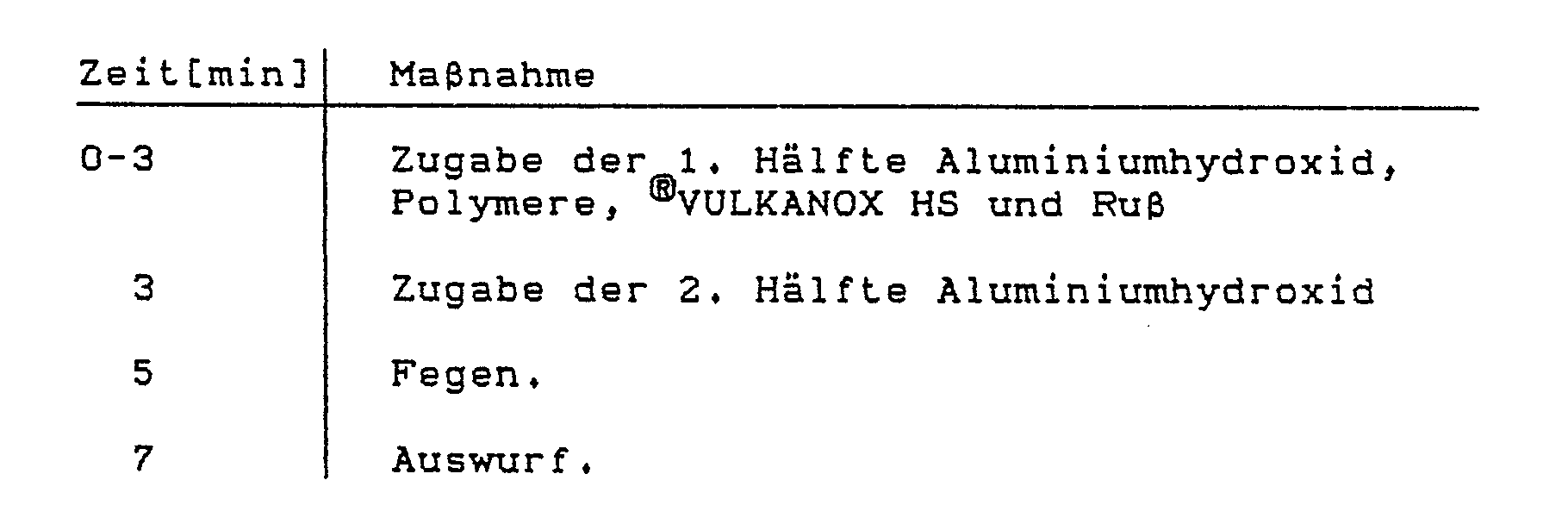
- Für die Proben 3 und 4 war die Mischfolge ähnlich, aber bei 5′ wurde das ®PERKADOX 14/40 zugegeben, und die Mischzeit betrug 9 Minuten. Für Proben 5 und 6 war die Mischfolge:

- Die Proben 7 und 8 wurden nach der gleichen Mischfolge wie die Proben 5 und 6 hergestellt, mit der Ausnahme, daß bei 3′ das ®PERKADOX zugegeben wurde und die Gesamtmischzeit etwa 10 Minuten betrug. Probe 8 ist eine erfindungsgemäße Mischung. Proben 1 - 4 zeigen, daß bei 100 Gew.-Teilen Füllstoff weder durch Erhöhung des Vinylacetatgehalts der Ethylen Vinylacetat-Copolymeren von 40 Gew.-% auf 70 Gew.-% (Polymere III; V) noch durch die dynamische Vernetzung eine deutliche Erhöhung des LOI erreicht werden kann. Ein Vergleich der Proben 5 -8 zeigt jedoch, daß beim Einsatz von 200 Gew.-Teilen Füllstoff überraschende Effekte eintreten. Neben der Tatsache, daß bei dieser hohen Füllstoffdosierung eine überproportionale LOI-Verbesserung erfolgt, wenn man den Vinylacetatgehalt der Ethylen Vinylacetat-Copolymeren von 40 Gew.-% auf 70 Gew.-% (Polymere IV; V) erhöht, ergibt auch die dynamische Vernetzung eine zusätliche LOI-Erhöhung.
- Zusätzlich ist die Verbesserung der Zugfestigkeit mittels dynamischer Vernetzung etwa doppelt so groß wie mit nur 100 Gew.-Teilen Füllstoff.
- Die Proben (Tabelle 3) wurden in einem 1,3 l Laborkneter bei einer Wellentemperatur von 100°C und einer Drehzahl von 100 UpM hergestellt. Proben 14 und 15 sind die Polymerbasis für die erfindungsgemäße Zubereitung. Proben 9 bis 11 waren nach dem Knetzyklus pulvrig und konnten nicht zu einem kontinuierlichen Fell auf der Walze (T = 150°C) verarbeitet werden. Der Mischzyklus für diese Proben war:
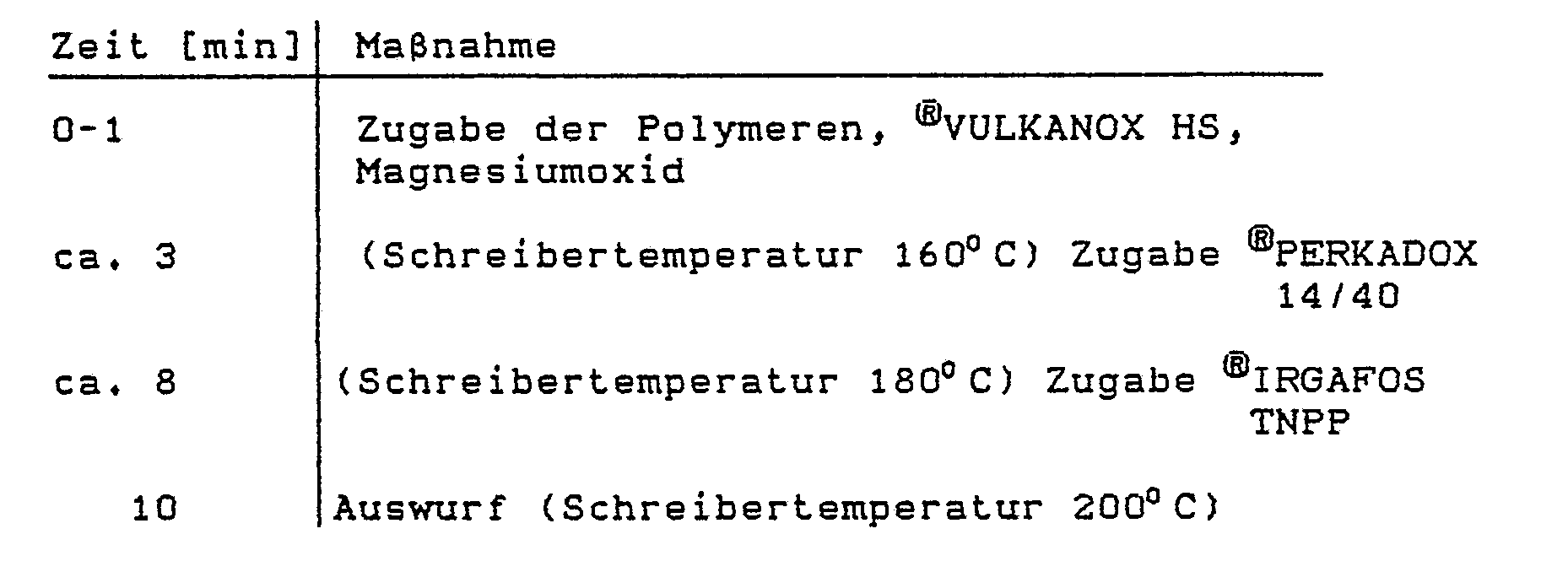
- Die Proben 12 bis 15 wurden nach der gleichen Mischfolgen wie die Proben 9 bis 11 hergestellt, mit der Ausnahme, daß das ®PERKADOX 14/40 schon während der ersten Minute zugegeben wurde.
- Ein Vergleich zwischen den Proben 12 und 13 oder 14 und 15 zeigt eine unerwartet große Verbesserung der mechanischen Eigenschaften der Polymerbasis der erfindungsgemäßen Mischungen, wenn man statt Homo-Polyethylen ein Ethylen/Vinylacetat-Copolymer einsetzt.
- In Tabelle 4 sind die mechanischen Eigenschaften der Proben 13 und 14 wiedergegeben, nachdem diese mit unterschiedlichen Mengen Füllstoff (Typ 1) an einer Mischwalze (T = 150°C) während 15 Minuten innig gemischt wurden.
- Diese Beispiele zeigen, daß mit einem Ethylen/Vinylacetat-Copolymer statt eines Polyethylen-Homopolymers (vgl. Proben 13, 16 und 17 mit 15, 20 und 21) nicht nur die mechanischen Eigenschaften der Polymerbasismischung deutlich besser sind, sondern auch eine bessere Füllbarkeit vorhanden ist, denn die Verschlechterung der mechanischen Eigenschaften bei höherer Füllung ist deutlich schwächer. Obwohl Beispiele 18 und 19 erfindungsgemäße Zubereitungen darstellen, zeigt ein Vergleich mit den Proben 20 und 21 die Vorteile der besonders bevorzugten Ausführungsformen der Erfindung.


dadurch gekennzeichnet, daß die Copolymeren dynamisch vernetzt worden sind.
Claims (8)
I. 20 bis 50 Gew.-Teilen eines Ethylen/Vinyl acetat-Copolymeren mit einem Gehalt an Vinylacetateinheiten von 5 bis 15 Gew.-%,
II. 80 bis 50 Gew.-Teilen eines Ethylen/Vinylacetat-Copolymeren mit einem Gehalt an Vinylacetateinheiten von 42 bis 75 Gew.-%,
III. 150 bis 220 Gew.-Teilen mineralischem Füllstoff pro 100 Gew.-Teile I + II und
gegebenenfalls Verarbeitungshilfsmitteln und/oder sonstigen Zusätzen,
dadurch gekennzeichnet, daß die Copolymeren dynamisch vernetzt worden sind.

Applications Claiming Priority (4)
| Application Number | Priority Date | Filing Date | Title |
|---|---|---|---|
| DE3713671 | 1987-04-24 | ||
| DE19873713671 DE3713671A1 (de) | 1987-04-24 | 1987-04-24 | Flammwidrige, halogenfreie thermoplastische polymermasse |
| DE3803269A DE3803269A1 (de) | 1988-02-04 | 1988-02-04 | Flammwidrige, halogenfreie thermoplastische polyestermasse |
| DE3803269 | 1988-02-04 |
Publications (3)
| Publication Number | Publication Date |
|---|---|
| EP0287928A2 true EP0287928A2 (de) | 1988-10-26 |
| EP0287928A3 EP0287928A3 (en) | 1990-07-11 |
| EP0287928B1 EP0287928B1 (de) | 1992-11-11 |
Family
ID=25854897
Family Applications (1)
| Application Number | Title | Priority Date | Filing Date |
|---|---|---|---|
| EP88105768A Expired - Lifetime EP0287928B1 (de) | 1987-04-24 | 1988-04-12 | Flammwidrige, halogenfreie thermoplastische Polymermasse |
Country Status (6)
| Country | Link |
|---|---|
| US (1) | US4868053A (de) |
| EP (1) | EP0287928B1 (de) |
| JP (1) | JPS63280754A (de) |
| CA (1) | CA1318066C (de) |
| DE (1) | DE3875781D1 (de) |
| ES (1) | ES2052631T3 (de) |
Cited By (4)
| Publication number | Priority date | Publication date | Assignee | Title |
|---|---|---|---|---|
| EP1241222A1 (de) * | 2001-03-13 | 2002-09-18 | Universität Stuttgart Institut für Kunststofftechnologie | Ethylen-Vinylacetat-Polymermaterial, Verfahren zu seiner Herstellung und Mischungen mit thermoplastischen Polyurethanen |
| US6608135B1 (en) | 1998-03-31 | 2003-08-19 | Teknor Apex Company | Polymer compositions |
| US9318240B2 (en) | 2010-05-24 | 2016-04-19 | Dow Global Technologies Llc | Halogen-free, flame retardant composition comprising crosslinked silane-g-EVA |
| WO2019207125A1 (de) | 2018-04-27 | 2019-10-31 | Tesa Se | Latent reaktiver klebefilm |
Families Citing this family (13)
| Publication number | Priority date | Publication date | Assignee | Title |
|---|---|---|---|---|
| JPH0376737A (ja) * | 1989-08-17 | 1991-04-02 | Mitsubishi Cable Ind Ltd | 走水防止用組成物及びそれを用いた走水防止ケーブル |
| JP2799884B2 (ja) * | 1989-08-18 | 1998-09-21 | 三菱電線工業株式会社 | 走水防止用組成物及びそれを用いた走水防止ケーブル |
| US5391612A (en) * | 1989-11-03 | 1995-02-21 | Armstrong World Industries, Inc. | Halogen-free resilient flooring |
| US5498476A (en) * | 1993-10-08 | 1996-03-12 | Minnesota Mining And Manufacturing Company | Electrically insulating film backing |
| IT1283362B1 (it) * | 1996-07-30 | 1998-04-17 | Pirelli Cavi S P A Ora Pirelli | Cavo autoestinguente e a bassa emissione di fumi e gas tossici e corrosivi |
| GB9700449D0 (en) * | 1997-01-10 | 1997-02-26 | Reddiplex Group Plc | Non-halogenated intumescent compositions |
| EP1634896A1 (de) * | 2004-09-10 | 2006-03-15 | Borealis Technology Oy | Polymerzusammensetzung |
| DE102005019982A1 (de) * | 2005-04-27 | 2006-11-02 | Basf Ag | Kunststoffgegenstände mit metallähnlicher oder mineralähnlicher Haptik und Optik und guten Formgebungseigenschaften |
| JP4852259B2 (ja) * | 2005-05-13 | 2012-01-11 | 株式会社アオイ | コントロールチューブ |
| JP4270237B2 (ja) * | 2006-07-31 | 2009-05-27 | 日立電線株式会社 | 非ハロゲン難燃性熱可塑性エラストマー組成物及びその製造方法並びにこれを用いた電線・ケーブル |
| MX2009004712A (es) * | 2006-10-30 | 2009-09-07 | Dow Global Technologies Inc | Composiciones retardantes de flama basadas en hidroxido de magnesio elaboradas por medio de la hidratacion en el sitio de los compuestos del polimero que comprenden oxido de magnesio. |
| WO2008123177A1 (ja) * | 2007-03-23 | 2008-10-16 | Du Pont-Mitsui Polychemicals Co. Ltd. | 難燃性樹脂組成物 |
| JP7006248B2 (ja) * | 2016-12-26 | 2022-02-10 | 住友化学株式会社 | 無機鉱物含有樹脂組成物および無機鉱物含有樹脂シート |
Family Cites Families (17)
| Publication number | Priority date | Publication date | Assignee | Title |
|---|---|---|---|---|
| JPS5845460B2 (ja) * | 1975-07-04 | 1983-10-11 | 大日本インキ化学工業株式会社 | シ−トセイケイヨウエチレン / サクサンビニルキヨウジユウゴウタイソセイブツ |
| GB2007685B (en) * | 1977-10-11 | 1982-05-12 | Asahi Dow Ltd | Composition for drawn film cold drawn film made of said composition and process for manufacture of said film |
| DE2811550A1 (de) * | 1978-03-16 | 1979-09-20 | Bayer Ag | Elastomere thermoplastische mischungen aus polypropylen und aethylen- vinylacetat-copolymerisaten |
| SE445559C (sv) * | 1978-11-23 | 1989-04-17 | Raychem Ltd | Flamhaemmad, halogenfri polymerkomposition och anvaendning daerav foer bildning av ett vaermeaaterhaemtningsbart alster |
| US4322575A (en) * | 1978-12-13 | 1982-03-30 | Raychem Limited | Flame retardant compositions |
| US4228250A (en) * | 1979-06-28 | 1980-10-14 | National Distillers And Chemical Corporation | Blends of hydrolyzed ethylene-vinyl acetate resins having increased impact strength |
| JPS5620042A (en) * | 1979-07-26 | 1981-02-25 | Ube Ind Ltd | Stretch film for wrapping of accumulation |
| DK169628B1 (da) * | 1979-11-03 | 1994-12-27 | Raychem Ltd | Mod vand stabiliseret polymert materiale samt elektrisk udstyr |
| DE3047269C2 (de) * | 1980-12-16 | 1983-08-04 | AEG-Telefunken Kabelwerke AG, Rheydt, 4050 Mönchengladbach | "Thermoplastische Polymermischung" |
| JPS58138742A (ja) * | 1982-02-12 | 1983-08-17 | Furukawa Electric Co Ltd:The | エチレン−酢酸ビニル共重合体の架橋方法 |
| CA1221188A (en) * | 1982-04-26 | 1987-04-28 | James W. Biggs | Flame retardant crosslinked ethylene copolymer electrical insulation |
| US4639487A (en) * | 1984-07-11 | 1987-01-27 | Exxon Research & Engineering Co. | Heat shrinkable thermoplastic olefin composition |
| US4571410A (en) * | 1985-02-07 | 1986-02-18 | Magic Seal Corporation | Caulking composition |
| GB2174095A (en) * | 1985-03-20 | 1986-10-29 | Dainichi Nippon Cables Ltd | Flame-retardant resin compositions |
| GB8510392D0 (en) * | 1985-04-24 | 1985-05-30 | British Petroleum Co Plc | Production of thermoplastic elastomer composition |
| US4735986A (en) * | 1985-08-02 | 1988-04-05 | Air Products And Chemicals, Inc. | Vinyl acetate/ethylene copolymer emulsions useful as carpet adhesives |
| JPS6326906A (ja) * | 1986-07-18 | 1988-02-04 | 日立電線株式会社 | 難燃性電気絶縁組成物 |
-
1988
- 1988-04-12 EP EP88105768A patent/EP0287928B1/de not_active Expired - Lifetime
- 1988-04-12 ES ES88105768T patent/ES2052631T3/es not_active Expired - Lifetime
- 1988-04-12 DE DE8888105768T patent/DE3875781D1/de not_active Expired - Lifetime
- 1988-04-13 US US07/181,115 patent/US4868053A/en not_active Expired - Lifetime
- 1988-04-18 JP JP63093611A patent/JPS63280754A/ja active Pending
- 1988-04-22 CA CA000564836A patent/CA1318066C/en not_active Expired - Fee Related
Cited By (5)
| Publication number | Priority date | Publication date | Assignee | Title |
|---|---|---|---|---|
| US6608135B1 (en) | 1998-03-31 | 2003-08-19 | Teknor Apex Company | Polymer compositions |
| EP1241222A1 (de) * | 2001-03-13 | 2002-09-18 | Universität Stuttgart Institut für Kunststofftechnologie | Ethylen-Vinylacetat-Polymermaterial, Verfahren zu seiner Herstellung und Mischungen mit thermoplastischen Polyurethanen |
| US9318240B2 (en) | 2010-05-24 | 2016-04-19 | Dow Global Technologies Llc | Halogen-free, flame retardant composition comprising crosslinked silane-g-EVA |
| WO2019207125A1 (de) | 2018-04-27 | 2019-10-31 | Tesa Se | Latent reaktiver klebefilm |
| US11535778B2 (en) | 2018-04-27 | 2022-12-27 | Tesa Se | Latent reactive adhesive film |
Also Published As
| Publication number | Publication date |
|---|---|
| US4868053A (en) | 1989-09-19 |
| CA1318066C (en) | 1993-05-18 |
| EP0287928B1 (de) | 1992-11-11 |
| ES2052631T3 (es) | 1994-07-16 |
| JPS63280754A (ja) | 1988-11-17 |
| EP0287928A3 (en) | 1990-07-11 |
| DE3875781D1 (de) | 1992-12-17 |
Similar Documents
| Publication | Publication Date | Title |
|---|---|---|
| EP0287928B1 (de) | Flammwidrige, halogenfreie thermoplastische Polymermasse | |
| DE69023039T2 (de) | Feuerfeste Polymerzusammensetzung. | |
| DE3781025T2 (de) | Thermoplastische zusammensetzung von kristallinem polyolefin und aethylen-copolymer. | |
| DE3786236T2 (de) | Äthylen-Copolymerzusammensetzung. | |
| DE60021613T2 (de) | Vernetzte zusammensetzungen aus silan-modifizierten polyolefinen und polypropylen | |
| DE69218889T2 (de) | Propylenpolymere und Copolymere mit Vinylpolybutadien gepfropft und deren Herstellungsverfahren | |
| DE2953070C1 (de) | Kunstharzmassen auf Polyethylenbasis mit hoher Konzentration an anorganischen Materialien | |
| DE68904568T2 (de) | Flammhemmende aethylenpolymer-mischungen. | |
| DE2553066C3 (de) | HeiBvulkanisierbare Masse | |
| DE68906575T2 (de) | Flammfester thermoplast mit geringer giftigkeit. | |
| DE3850365T2 (de) | Thermoplastische elastomere Zusammensetzungen und Verfahren zu deren Herstellung. | |
| DE69231604T2 (de) | Halogenfreie flammwidrige Harzzusammensetzung und damit überzogene Drähte und Kabel | |
| DE69603241T2 (de) | Dynamisch vulkanisierte polyolefinzusammensetzungen | |
| DE3785378T2 (de) | Feuerhemmende polyolefinzusammensetzung. | |
| DE69724258T2 (de) | Vernetzte thermoplastische elastomere auf olefinbasis und ein verfahren zu deren herstellung | |
| DE69838675T2 (de) | Mischungen aus ethylen-vinylacetat copolymeren und ethylen-vinylacetat- kohlenmonoxyd terpolymeren | |
| DE3650376T2 (de) | Verfahren zur Herstellung vernetzbarer Zusammensetzungen. | |
| DE60005886T2 (de) | In der Schmelze zu verarbeitende, vernetzbare Beschichtung | |
| DE2501497A1 (de) | Polymerzusammensetzungen | |
| DE3300681A1 (de) | Polymerzusammensetzung auf der basis von propylen und aethylen | |
| DE69212543T2 (de) | Thermoplastische Elastomer und Verfahren zu seiner Herstellung | |
| DE69109979T2 (de) | Flammhemmende Harzzusammensetzung und isolierter elektrischer Draht mit dieser. | |
| DE69705122T2 (de) | Elastomere, verfahren zur herstellung davon, und aus diesen elastomeren hergestellten gegenständen | |
| DE60214035T2 (de) | Olefinisches thermoplastisches elastomer, verfahren zu seiner herstellung, olefinisches thermoplastisches elastomer enthaltende zusammensetzungen, verfahren zu ihrer herstellung und formkörper daraus | |
| DD237517A5 (de) | Polymerenzusammensetzung |
Legal Events
| Date | Code | Title | Description |
|---|---|---|---|
| PUAI | Public reference made under article 153(3) epc to a published international application that has entered the european phase |
Free format text: ORIGINAL CODE: 0009012 |
|
| 17P | Request for examination filed |
Effective date: 19880412 |
|
| AK | Designated contracting states |
Kind code of ref document: A2 Designated state(s): DE ES FR GB IT NL SE |
|
| PUAL | Search report despatched |
Free format text: ORIGINAL CODE: 0009013 |
|
| AK | Designated contracting states |
Kind code of ref document: A3 Designated state(s): DE ES FR GB IT NL SE |
|
| 17Q | First examination report despatched |
Effective date: 19910529 |
|
| GRAA | (expected) grant |
Free format text: ORIGINAL CODE: 0009210 |
|
| AK | Designated contracting states |
Kind code of ref document: B1 Designated state(s): DE ES FR GB IT NL SE |
|
| REF | Corresponds to: |
Ref document number: 3875781 Country of ref document: DE Date of ref document: 19921217 |
|
| ITF | It: translation for a ep patent filed | ||
| ET | Fr: translation filed | ||
| GBT | Gb: translation of ep patent filed (gb section 77(6)(a)/1977) |
Effective date: 19930217 |
|
| PGFP | Annual fee paid to national office [announced via postgrant information from national office to epo] |
Ref country code: SE Payment date: 19930323 Year of fee payment: 6 |
|
| PGFP | Annual fee paid to national office [announced via postgrant information from national office to epo] |
Ref country code: ES Payment date: 19930412 Year of fee payment: 6 |
|
| ITTA | It: last paid annual fee | ||
| PGFP | Annual fee paid to national office [announced via postgrant information from national office to epo] |
Ref country code: NL Payment date: 19930430 Year of fee payment: 6 |
|
| PLBE | No opposition filed within time limit |
Free format text: ORIGINAL CODE: 0009261 |
|
| STAA | Information on the status of an ep patent application or granted ep patent |
Free format text: STATUS: NO OPPOSITION FILED WITHIN TIME LIMIT |
|
| 26N | No opposition filed | ||
| PG25 | Lapsed in a contracting state [announced via postgrant information from national office to epo] |
Ref country code: SE Effective date: 19940413 Ref country code: ES Free format text: LAPSE BECAUSE OF NON-PAYMENT OF DUE FEES Effective date: 19940413 |
|
| REG | Reference to a national code |
Ref country code: ES Ref legal event code: FG2A Ref document number: 2052631 Country of ref document: ES Kind code of ref document: T3 |
|
| PG25 | Lapsed in a contracting state [announced via postgrant information from national office to epo] |
Ref country code: NL Effective date: 19941101 |
|
| NLV4 | Nl: lapsed or anulled due to non-payment of the annual fee | ||
| EUG | Se: european patent has lapsed |
Ref document number: 88105768.1 Effective date: 19941110 |
|
| PGFP | Annual fee paid to national office [announced via postgrant information from national office to epo] |
Ref country code: GR Payment date: 19970430 Year of fee payment: 10 |
|
| REG | Reference to a national code |
Ref country code: ES Ref legal event code: FD2A Effective date: 19990405 |
|
| REG | Reference to a national code |
Ref country code: GB Ref legal event code: IF02 |
|
| PGFP | Annual fee paid to national office [announced via postgrant information from national office to epo] |
Ref country code: DE Payment date: 20040320 Year of fee payment: 17 |
|
| PGFP | Annual fee paid to national office [announced via postgrant information from national office to epo] |
Ref country code: FR Payment date: 20040406 Year of fee payment: 17 |
|
| PGFP | Annual fee paid to national office [announced via postgrant information from national office to epo] |
Ref country code: GB Payment date: 20040407 Year of fee payment: 17 |
|
| PG25 | Lapsed in a contracting state [announced via postgrant information from national office to epo] |
Ref country code: IT Free format text: LAPSE BECAUSE OF NON-PAYMENT OF DUE FEES;WARNING: LAPSES OF ITALIAN PATENTS WITH EFFECTIVE DATE BEFORE 2007 MAY HAVE OCCURRED AT ANY TIME BEFORE 2007. THE CORRECT EFFECTIVE DATE MAY BE DIFFERENT FROM THE ONE RECORDED. Effective date: 20050412 Ref country code: GB Free format text: LAPSE BECAUSE OF NON-PAYMENT OF DUE FEES Effective date: 20050412 |
|
| PG25 | Lapsed in a contracting state [announced via postgrant information from national office to epo] |
Ref country code: DE Free format text: LAPSE BECAUSE OF NON-PAYMENT OF DUE FEES Effective date: 20051101 |
|
| GBPC | Gb: european patent ceased through non-payment of renewal fee |
Effective date: 20050412 |
|
| PG25 | Lapsed in a contracting state [announced via postgrant information from national office to epo] |
Ref country code: FR Free format text: LAPSE BECAUSE OF NON-PAYMENT OF DUE FEES Effective date: 20051230 |
|
| REG | Reference to a national code |
Ref country code: FR Ref legal event code: ST Effective date: 20051230 |