EP0288002A2 - Organo-platinum complex and use thereof - Google Patents
Organo-platinum complex and use thereof Download PDFInfo
- Publication number
- EP0288002A2 EP0288002A2 EP88106214A EP88106214A EP0288002A2 EP 0288002 A2 EP0288002 A2 EP 0288002A2 EP 88106214 A EP88106214 A EP 88106214A EP 88106214 A EP88106214 A EP 88106214A EP 0288002 A2 EP0288002 A2 EP 0288002A2
- Authority
- EP
- European Patent Office
- Prior art keywords
- platinum
- complex
- trans
- diamino
- dimethyl
- Prior art date
- Legal status (The legal status is an assumption and is not a legal conclusion. Google has not performed a legal analysis and makes no representation as to the accuracy of the status listed.)
- Withdrawn
Links
- RJFFRIZDQDUTSW-UHFFFAOYSA-N CNC[Si](C)(N)I Chemical compound CNC[Si](C)(N)I RJFFRIZDQDUTSW-UHFFFAOYSA-N 0.000 description 1
Classifications
-
- C—CHEMISTRY; METALLURGY
- C07—ORGANIC CHEMISTRY
- C07F—ACYCLIC, CARBOCYCLIC OR HETEROCYCLIC COMPOUNDS CONTAINING ELEMENTS OTHER THAN CARBON, HYDROGEN, HALOGEN, OXYGEN, NITROGEN, SULFUR, SELENIUM OR TELLURIUM
- C07F15/00—Compounds containing elements of Groups 8, 9, 10 or 18 of the Periodic Table
- C07F15/0006—Compounds containing elements of Groups 8, 9, 10 or 18 of the Periodic Table compounds of the platinum group
- C07F15/0086—Platinum compounds
- C07F15/0093—Platinum compounds without a metal-carbon linkage
-
- A—HUMAN NECESSITIES
- A61—MEDICAL OR VETERINARY SCIENCE; HYGIENE
- A61P—SPECIFIC THERAPEUTIC ACTIVITY OF CHEMICAL COMPOUNDS OR MEDICINAL PREPARATIONS
- A61P35/00—Antineoplastic agents
Definitions
- the present invention relates to novel organo-platinum complexes and an anti-tumor composition containing at least one of the complexes as an effective ingredient therefor.
- each of such known organo-platinum complexes has advantages of showing an excellent anti-tumor action, having a wide anti-tumor spectrum and having a good solubility to water, but shows a disadvantage of having a relatively high side effect.
- the Cisplatin which is one of examplar conventional organo-platinum complexes shows a high nephrotoxicity, may accompany a violent nausea or vomiting, when the complex is dosed, and eventually causes dysacousis.
- a basic object of the invention is, therefore to provide a novel organo-platinum complex which shows a relatively high anti-tumor activity and weak side effect and more particularly in nephrotoxicity.
- Another object of the invention is to provide an anti-tumor composition containing the complex, as an effective ingredient.
- an organo-platinum complex having a silicon-containing diamine as ligand and represented by the following general formula.
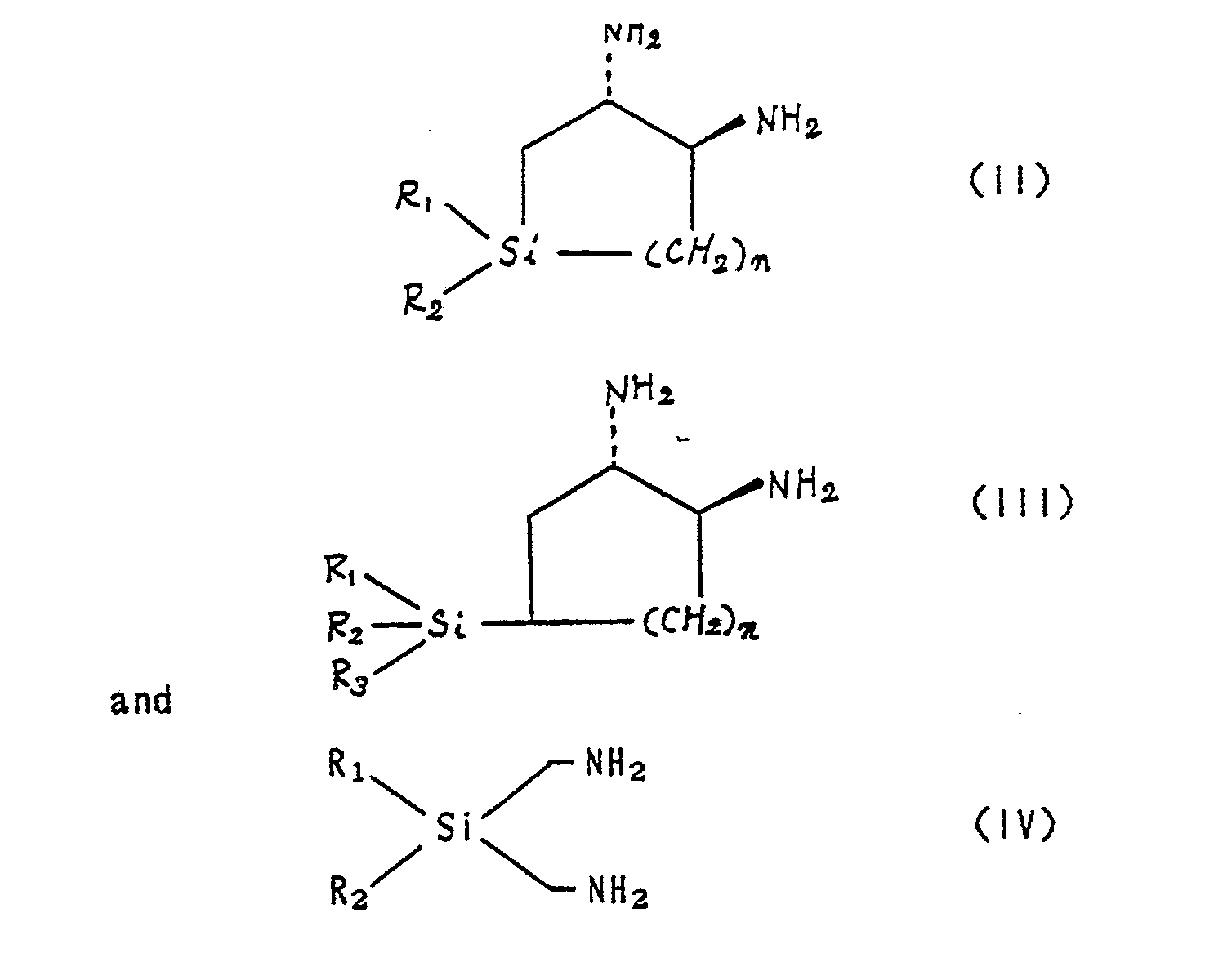
- X and Y have the same meaning of a halogen, oxyanion or carboxylate, respectively or X is an oxyanion or dicarboxylate together with Y and L1 and L2 are bonded together to form one of silicon containing diamine compounds selected from the group consisting of and in which R1, R2 and R3 are a lower alkyl or phenyl, respectively.
- n is an integer of 0 or 1.
- An anti-tumor composition according to the invention is characterized by comprising as an effective ingredient at least one of the complexes shown by said Formula (I) in an effective amount, together with a pharmaceutically acceptable carrier.
- each substituent shall be given as follows.
- the term of halogen may be of chlorine, bromine or iodine.
- oxyanion sulfate, nitrate, selenite or the like may be listed.
- carboxylate chloroacetate, pyruvate, glucolate or the like may be listed.
- dicarboxylate oxalate, malonate, hydroxymalonate, carboxyphthalate, 1,1-cyclobutanedicarboxylate or the like may be listed.
- the lower alkyl may be of straight-chain or branched-chain alkyl groups having 1 to 5 carbon atoms, for instance methyl, ethyl, propyl, isopropyl, butyl, isobutyl, pentyl and the like.
- organo-platinum complexes (1) according to the invention can be prepared by utilizing various methods known per se, for instance, as stated below.
- the complex can be prepared by reacting a halogenated platinic acid salt with the compound II, III or IV.
- halogenated platinic acid salt lithium salt, potassium salt, sodium salt or the like may be listed, but the potassium salt is preferable.
- trans-1,2-diamino-4,4-dimethyl-4- silacyclopentane, trans-1,2-diamino-4,4-dimethyl-4-silacyclohexane or the like may be listed as the compound II; trans-1,2-diamino-4-trimethylsilylpentane, trans-1,2-diamino-4-trimethylsilylhexane or the like may be listed as the compound III; and bis(aminomethyl)dimethylsilane or the like may be listed as the compound IV.
- the complex can be prepared by reacting a complex to be obtained by the method a), wherein X and Y are a halogen atom, respectively with a silver salt of an organic or inorganic acid.
- the complex (I), wherein X and Y are a carboxylate or dicarboxylate can also be prepared by reacting a complex, wherein X represents sulfate together with Y, with barium hydroxide and then reacting the resulting intermediate of dihydroxy platinum (II) with an organic or inorganic acid.
- each of such reactions can be carried out in an aqueous solvent and the reaction proceeds smoothly at the room or elevated temperature. After completion of the reaction, precipitates are collected or the reaction solution is concentrated to dryness to afford the desired complex. In general, there is required no further purification but if necessary, the crude complex can be purified in a conventional manner, for instance through recrystallization with use of a suitable solvent such as water, ethanol or the like.
- the starting material (Va) in the above identified reaction system has been known and can be obtained from the market and otherwise, may be synthesized in accordance with one of the methods disclosed in "J. Organomet. Chem.” Vol. 63, pages 119-131 (1973) and Vol. 264, pages 127 to 133 (1984) as well as “Izv. Akad. Nauk SSSR, Ser. Khim” pages 1452 to 1953 (1977).
- Each of the compounds (Vb, Vc and Vd) can be prepared in accordance with methods known per se.
- the compound (Vb) can be synthesized by azilidinizing the compound (Va) in accordance with the method as disclosed in "J. Chem. Soc. Chem.
- the compound (Vc) can be synthesized by azidizing the compound (Vb) in accordance with the method as disclosed in "J. Org. Chem.” Vol. 32, pages 511 to 517 (1967), and the compound (Vd) can be synthesized by diazidizing the compound (Va) in accordance method as disclosed in "Tetrahedron Lett.” Vol. 27, pages 4953 to 4963 (1971).
- each of the compounds (II and III) which can be employed as one of starting materials for preparing the organo-platinum complexes of the invention can be prepared by reducing the compound (Vc or Vd) through a catalytic hydrogenation or with use of a metal hydride.
- an anti-tumor composition with use of at least one of the organo-platinum complexes, as effective ingredient(s), there is no limitation in its medicine form and thus it may be made into one for oral or non-oral administration.
- oral administration tablet, capsule, granule, powder amd the like.
- non-oral administration a solution and dry powder for injection and a suppository may exemplarly be listed.
- the medicine can be prepared in a conventional manner.
- An amount for the administration of the complex for human depends on kind of complex selected, condition of illness, age of a patient, form of the medicine and other factors but in general, 1 to 500mg/kg/day is preferable.
- This compound was prepared by the similar procedure as in the case of Example 5, except for the treatment with cis-dichloro(trans-1,2-diamino-4,4-dimethyl-4-silacyclohexane)platinum (II) (2.09g, 5.00mmol) instead of cis-dichloro(trans-1,2-diamino-4,4-dimethyl-4-silacylopentane)platinum (II).
- the yield was 2.00g (90.6%) as pale yellow crystals.
- This compound was prepared by the similar procedure as in the case of Example 5, except for the treatment with cis-dichloro(trans-1,2-diamino-4-trimethylsilylcyclohexane)platinum (II) (2.26g, 5.00mmol) instead of cis-dichloro(trans-1,2-diamino-4,4-dimethyl-4-silacyclopentane)platinum (II).
- the yield was 1.55g (64.8%) as pale yellow crystals.
- This compound was prepared by the similar procedure as in the case of Example 5, except for the treatment with cis-dichloro[bis(aminomethy)dimethylsilane]platinum (II) (1.92g, 5.00mmol) instead of cis-dichloro(trans-1,2-diamino-4,4-dimethyl-4-silacyclopentane)platinum (II).
- the yield was 1.83g (85.4%) as pale yellow crystals.
- This compound was prepared by the similar procedure as in the case of Example 9, except for the treatment with sulfato[bis(aminomethyl)dimethylsilane]platinum (II) (1.07g, 2.50mmol) instead of sulfato(trans-1,2-diamino-4,4-dimethyl-4-silacyclopentane]platinum (II).
- the yield was 790 mg (78.9%) as colorless crystals.
- This compound was prepared by the similar procedure as in the case of Example 9, except for the treatment with 1,1-cyclobutanedicarboxylic acid (360mg, 2.50mmol) instead of oxalic acid.
- the yield was 1.03g (85.2%) as colorless crystals.
- This compound was prepared by the similar procedure as in the case of Example 10, except for the treatment with 1,1-cyclobutanedicarboxylic acid (360mg, 2.50mmol) instead of oxalic acid.
- the yield was 880mg (77.3%) as colorless crystals.
- This compound was prepared by the similar procedure as in the case of Example 18, except for the treatment with cis-dichloro[bis(aminomethyl)dimethylsilane]platinum (II) (2.14g, 5.00mmol) instead of cis-dichloro(trans-1,2-diamino-4,4-dimethyl-4-silacyclopentane)platinum (II).
- the yield was 1.82g (81.5%) as pale yellow crystals.
- L-1210 leukemia cells (1 x 10⁵) were intraperitoneally transplanted to CDF1 male mice (age of about 5 weeks, 4 to 5 heads/group). Each of the testing compounds was intraperitoneally injected over 5 days (1 time per day) after expired 24 hours from the inoculation. Anti-tumor activity of each testing compound was determined by comparison of the mean survival time of the treated group (T) to that of the control group (C).
- the compounds were evaluated for nephrotoxicity by determining their effects on blood urea nitrogen (BUN) levels in rats.
- BUN blood urea nitrogen
- testing compounds, or saline for control were given intravenously to male Fisher-344 rats (age of about 5 weeks, 5 heads per group), as a single injection.
- the BUN values were measured on the 5th day after the dosage. Results are shown in following Table 2.
Landscapes
- Chemical & Material Sciences (AREA)
- Organic Chemistry (AREA)
- Health & Medical Sciences (AREA)
- General Chemical & Material Sciences (AREA)
- Medicinal Chemistry (AREA)
- Nuclear Medicine, Radiotherapy & Molecular Imaging (AREA)
- Chemical Kinetics & Catalysis (AREA)
- Pharmacology & Pharmacy (AREA)
- Life Sciences & Earth Sciences (AREA)
- Animal Behavior & Ethology (AREA)
- General Health & Medical Sciences (AREA)
- Public Health (AREA)
- Veterinary Medicine (AREA)
- Pharmaceuticals Containing Other Organic And Inorganic Compounds (AREA)
- Acyclic And Carbocyclic Compounds In Medicinal Compositions (AREA)
Abstract
Description
- The present invention relates to novel organo-platinum complexes and an anti-tumor composition containing at least one of the complexes as an effective ingredient therefor.
- It has been known that certain organo-platinum complexes show an anti-tumor activity. Since the fact that cis-dichlorodiamine platinum (II) (General term : Cisplatin) has anti-tumor activity was reported by B. Rosenberg et al ["Nature" Vol. 222, page 358 (1969)], various studies have been energitically made to develop various organo-platinum complexes per se or to establish a new chemotherapy system on tumors and more particularly cancers. As a result, for instance, following organo-platinum complexes have been proposed.
- a) Malonato(1,2-diaminocyclohexane)platinum (II)
[Jap. Pat. No. 53 - 31648 (A)], - b) Sulfato(1,2-diaminocyclohexane)platinum (II)
[Jap. Pat. No. 54 - 44620 (A)], - c) 4-Carboxyphthalato(1,2-diaminocyclohexane)platinum (II)
[Jap. Pat. No. 54 - 46752 (A)], and - d) cis-Dichloro-trans-dihydroxy-bis(isopropylamine)platinum (II)
[Jap. Pat. No. 54 - 77694 (A)]. - Each of such known organo-platinum complexes has advantages of showing an excellent anti-tumor action, having a wide anti-tumor spectrum and having a good solubility to water, but shows a disadvantage of having a relatively high side effect. For instance, the Cisplatin which is one of examplar conventional organo-platinum complexes shows a high nephrotoxicity, may accompany a violent nausea or vomiting, when the complex is dosed, and eventually causes dysacousis.
- In order to suppress a generation of such side effects, and more particularly the nephrotoxicity or reduce a symptom due to this side effect, hitherto, various measures have been adopted in dosing manner of the organo-platinum complex, for instance the Cisplatin was mixed with mannitol, dextrose or the like, or dosed together with a diurectic drug such as phlocemide. However, each of such measures is a passive one and is not preferable, since its effect will be influenced by difference in each individual.
- A basic object of the invention is, therefore to provide a novel organo-platinum complex which shows a relatively high anti-tumor activity and weak side effect and more particularly in nephrotoxicity.
- Another object of the invention is to provide an anti-tumor composition containing the complex, as an effective ingredient.
- According to the invention, such objects and other objects which shall be appreciated by more fully understanding the invention can be attained by an organo-platinum complex having a silicon-containing diamine as ligand and represented by the following general formula.

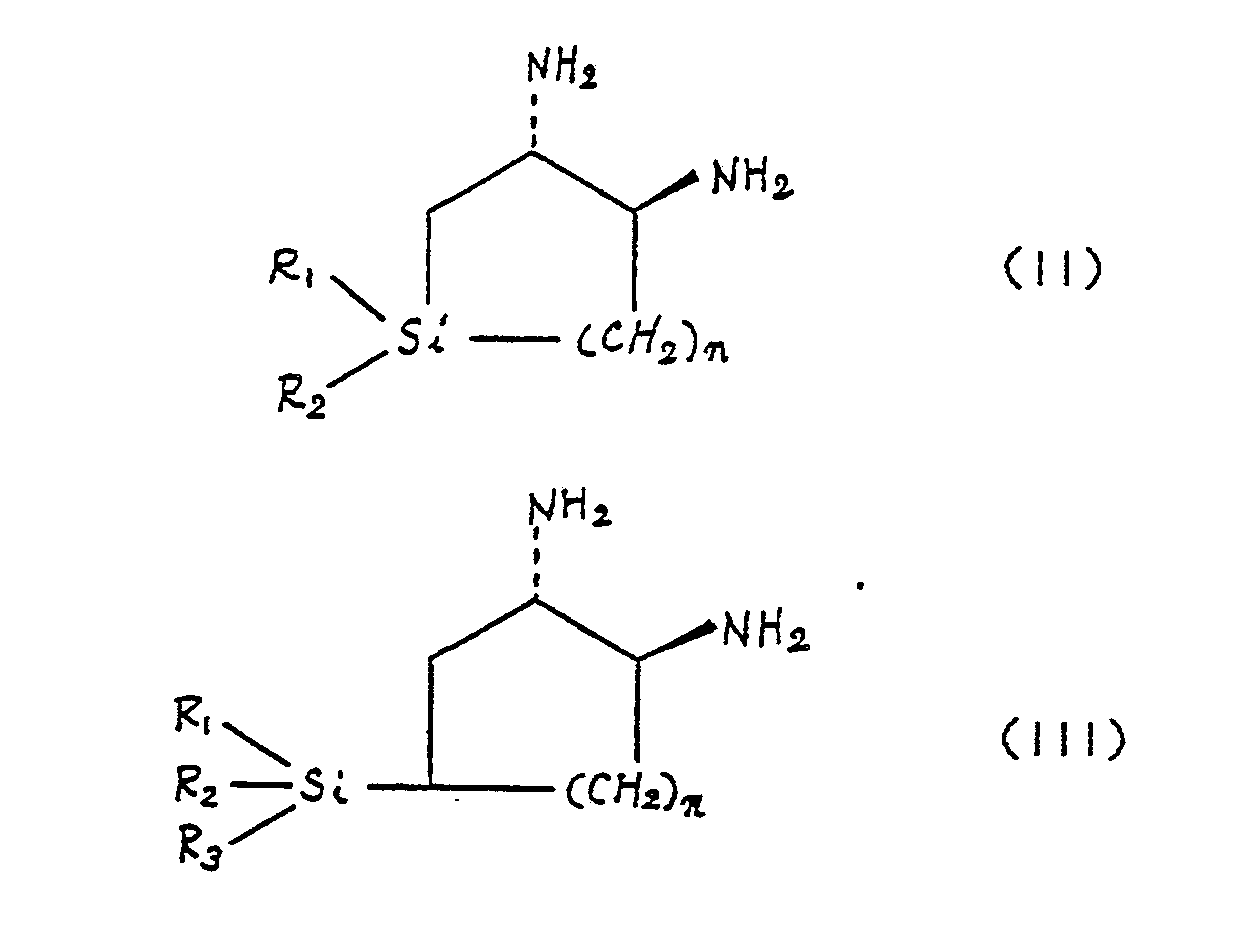

- An anti-tumor composition according to the invention is characterized by comprising as an effective ingredient at least one of the complexes shown by said Formula (I) in an effective amount, together with a pharmaceutically acceptable carrier.
- In connection with the complexes shown by said Formula (I), the definition of each substituent shall be given as follows. The term of halogen may be of chlorine, bromine or iodine. As the oxyanion, sulfate, nitrate, selenite or the like may be listed. As the carboxylate, chloroacetate, pyruvate, glucolate or the like may be listed. As the dicarboxylate, oxalate, malonate, hydroxymalonate, carboxyphthalate, 1,1-cyclobutanedicarboxylate or the like may be listed. The lower alkyl may be of straight-chain or branched-chain alkyl groups having 1 to 5 carbon atoms, for instance methyl, ethyl, propyl, isopropyl, butyl, isobutyl, pentyl and the like.
- The organo-platinum complexes (1) according to the invention can be prepared by utilizing various methods known per se, for instance, as stated below.
- The complex can be prepared by reacting a halogenated platinic acid salt with the compound II, III or IV.
- As the halogenated platinic acid salt, lithium salt, potassium salt, sodium salt or the like may be listed, but the potassium salt is preferable. Among the other reactant, trans-1,2-diamino-4,4-dimethyl-4- silacyclopentane, trans-1,2-diamino-4,4-dimethyl-4-silacyclohexane or the like may be listed as the compound II; trans-1,2-diamino-4-trimethylsilylpentane, trans-1,2-diamino-4-trimethylsilylhexane or the like may be listed as the compound III; and bis(aminomethyl)dimethylsilane or the like may be listed as the compound IV.
- The complex can be prepared by reacting a complex to be obtained by the method a), wherein X and Y are a halogen atom, respectively with a silver salt of an organic or inorganic acid. The complex (I), wherein X and Y are a carboxylate or dicarboxylate can also be prepared by reacting a complex, wherein X represents sulfate together with Y, with barium hydroxide and then reacting the resulting intermediate of dihydroxy platinum (II) with an organic or inorganic acid. Of course, it is preferable to carry out the reaction under a dark atmosphere, when the silver salt reagent is used.
- Each of such reactions can be carried out in an aqueous solvent and the reaction proceeds smoothly at the room or elevated temperature. After completion of the reaction, precipitates are collected or the reaction solution is concentrated to dryness to afford the desired complex. In general, there is required no further purification but if necessary, the crude complex can be purified in a conventional manner, for instance through recrystallization with use of a suitable solvent such as water, ethanol or the like.
- Among the starting materials for preparing the organo-platinum complexes (I), bis(aminomethyl)dimethylsilane belonging to the compound (IV) is known compound and is available from the market and otherwise, it may be synthesized in accordance with the method as disclosed in "Z. Anorg. Allgem. Chem." Vol. 317, pages 41 to 53 (1962). While each of the compounds (II) and (III) is novel compound not disclosed in any literature but can be synthesized as shown in the following reaction formula.
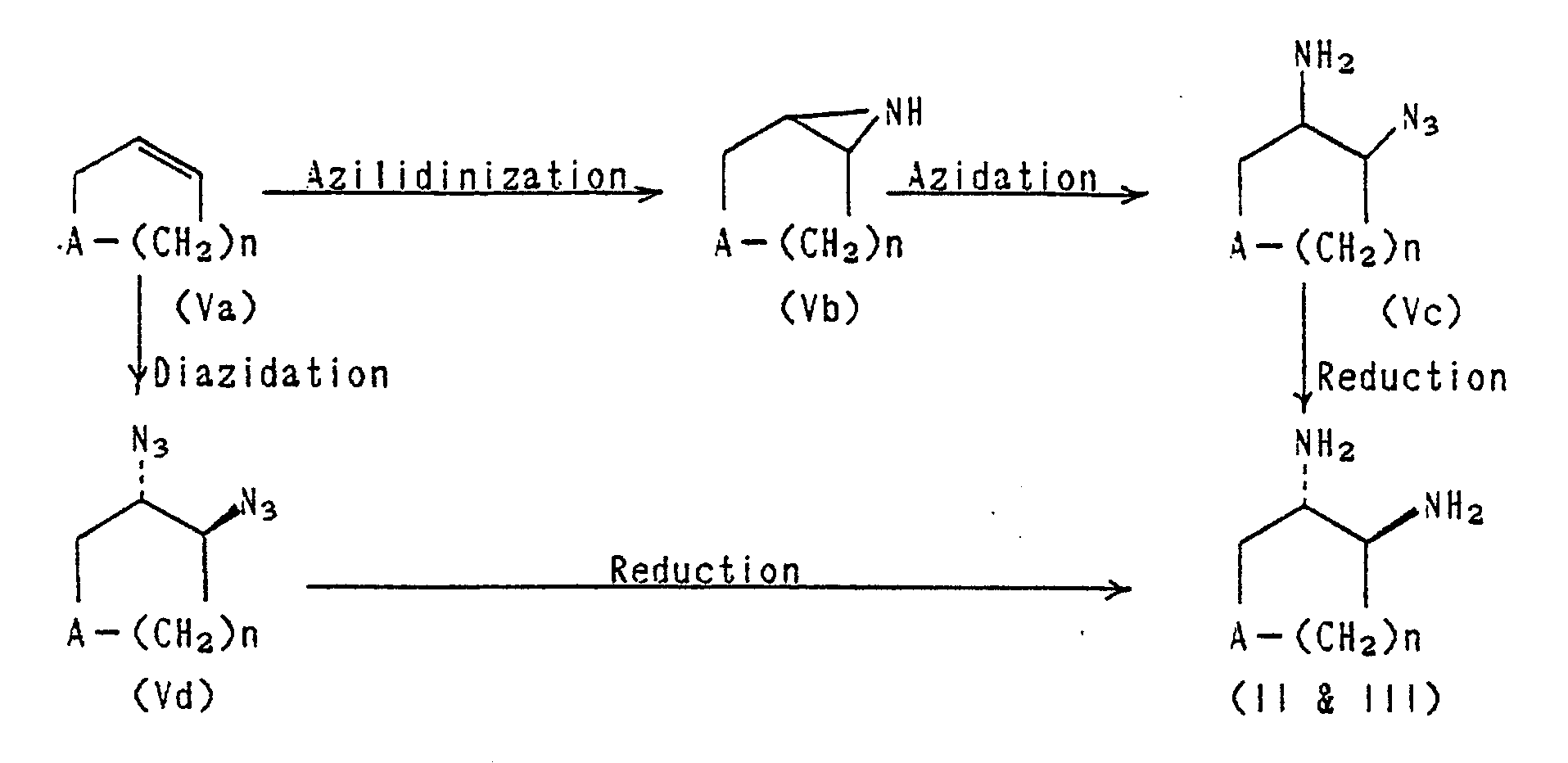

- The starting material (Va) in the above identified reaction system has been known and can be obtained from the market and otherwise, may be synthesized in accordance with one of the methods disclosed in "J. Organomet. Chem." Vol. 63, pages 119-131 (1973) and Vol. 264, pages 127 to 133 (1984) as well as "Izv. Akad. Nauk SSSR, Ser. Khim" pages 1452 to 1953 (1977). Each of the compounds (Vb, Vc and Vd) can be prepared in accordance with methods known per se. For instance, the compound (Vb) can be synthesized by azilidinizing the compound (Va) in accordance with the method as disclosed in "J. Chem. Soc. Chem. Comm." pages 560 to 561 (1980), the compound (Vc) can be synthesized by azidizing the compound (Vb) in accordance with the method as disclosed in "J. Org. Chem." Vol. 32, pages 511 to 517 (1967), and the compound (Vd) can be synthesized by diazidizing the compound (Va) in accordance method as disclosed in "Tetrahedron Lett." Vol. 27, pages 4953 to 4963 (1971).
- Further, each of the compounds (II and III) which can be employed as one of starting materials for preparing the organo-platinum complexes of the invention can be prepared by reducing the compound (Vc or Vd) through a catalytic hydrogenation or with use of a metal hydride.
- In case of preparing an anti-tumor composition with use of at least one of the organo-platinum complexes, as effective ingredient(s), there is no limitation in its medicine form and thus it may be made into one for oral or non-oral administration. As for oral administration, tablet, capsule, granule, powder amd the like. While as for non-oral administration, a solution and dry powder for injection and a suppository may exemplarly be listed. In connection with this, the medicine can be prepared in a conventional manner.
- An amount for the administration of the complex for human depends on kind of complex selected, condition of illness, age of a patient, form of the medicine and other factors but in general, 1 to 500mg/kg/day is preferable.
- The invention will now be further explained with reference to Reference Examples, Examples for preparing organo-platinum complexes, Pharmacological Test Examples as well as Examples for preparing medicines.
- To a solution of 40.0g (0.212mol) of p-toluenesulfonylhydroxylamine in 500ml of methylene chloride was added 12.0g (0.106mol) of 1,1-dimethyl-1-silacyclopent-3-ene and the mixture was stirred at 4°C for 64 hours.
- The reaction mixture was concentrated in vacuo and the resulting residue was dissolved in 100ml of water and extracted with ethyl ether (200ml). The aqueous layer was neutralized with sodium bicarbonate, extracted with ethyl ether (100ml x 2), the ether layer was washed with water, dried over sodium sulfate and distilled out ethyl ether at the atmospheric pressure. Then the resulting residue was distilled under reduced pressure to afford 7.11g (52.3%) of the desired compound as colorless oil.
Boiling point : 84 - 85°C (80mmHg)
HRMS (m/z) :
127.0828 (M⁺, C₆H₁₃NSi; Calcd. 127.0817)
126.0762 (M-H, C₆H₁₂NSi; Calcd. 126.0739)
MS (El/GC) m/z :
127 (M⁺), 126 (M-H), 112 (M-Me, base peak)
ʹH-NMR (CDCl₃) δ ppm :
0.03 and 0.06 (each 3H, s, SiMe₂)
0.5 -1.3

3340 (NH), 3000, 2950, 2910 (CH), 1550 (NH), 1250, 845 (C-Si) - A mixture of 7.00g (55.1mmol) of 3,3-dimethyl-6-aza-3-silabicyclo[3.1.0]hexane as obtained in Reference Example 1, 17.9g (0.276mol) of sodium azide and 17.4g (0.276mol) of ammonium chloride in 360ml of a mixed solvent of ethanol-water (5 : 1) was refluxed for 1 hour. The reaction mixture was cooled and poured into ice-water (1 litre), extracted with ethyl ether (500ml x 3), the ethyl ether layer was washed with water, dried over sodium sulfate and evaporated in vacuo to afford 7.75g(82.7%) of the desired compound as pale yellow oil.
MS (El/GC) m/z :
171 (M+1), 155 (M-Me), 142 (M-N₂), 74 (base peak)
ʹH-NMR (CDCl₃) δ ppm :
0.03 (6H, s, SiMe₂)
0.6 - 1.2

3400, 3330 (NH₂), 2960, 2900 (CH), 2100 (N₃), 1620 (NH₂), 1260, 845 (C-Si) - To a suspension of 3.35g (88.2mmol) of lithium aluminum hydride in 100ml of anhydrous ethyl ether was added dropwise a solution of 7.50g (44.1mmol) of trans-1-amino-2-azido-4,4-dimethyl-4-silacyclopentane as obtained in Reference Example 2 in 100ml of anhydrous ethyl ether with stirring at 5 - 10°C under argon atmosphere for 1.5 hours.
- After stirring at room temperature for 2 hours, 3.35ml of 15% sodium hydroxide and 13.4ml of water were added dropwose to the reaction mixture and then the resulting precipitate was filtered off. The filtrate was dried over sodium sulfate, and distilled out ethyl ether at atmospheric pressure and the resulting residue was distilled under reduced pressure to afford 5.15g (81.1%) of the desired compound as colorless oil.
Boiling point : 120°C (40mmHg)
HRMS (m/z) :
144.1064 (M⁺, C₆H₁₆N₂Si; Calcd. 144.1082)
MS (El/GC) m/z :
144 (M⁺), 129 (M-Me), 101, 86 (base peak)
ʹH-NMR (CDCl₃) δ ppm :
0.00 (6H, s, SiMe₂)
0.2 - 1.2 (4H, m, -CH₂SiCH₂-)
1.30 (4H, s, -NH₂ x 2)
2.3 - 2.7 (2H, m, CH-NH₂ x 2)
IR (KBr) cm⁻¹ :
3340, 3260, 3180 (NH₂), 2940, 2880, 2840 (CH), 1600, 1580 (NH₂), 1250, 840 (C-Si) - To a solution of 1.24g (6.43mmol) of 4-trimethylsilylcyclohexene, 8.36g (0.129mol) of sodium azide, 35.7g (0.129mol) of iron (II) sulfate and 124mg of iron (III) sulfate in 60ml of a mixed solvent of acetone-water (1 : 1) was added dropwise 3.94ml of 30% hydrogen peroxide with stirring at 0 to 5°C for 30 minutes.
- After stirring at 0 to 5°C for 1 hour, the reaction mixture was diluted with water and extracted with ethyl ether (200ml x 2), the ether layer was washed with water, dried over sodium sulfate and evaporated in vacuo to afford 1.22g (71.9%) of the desired compound as pale yellow oil.
MS (El/GC) m/z :
223 (M-Me), 154 (M-2N₃) 73 (base peak)
ʹH-NMR (CDCl₃) δ ppm :
0.00 (9H, s, SiMe₃)
0.6 - 2.8 (7H, m, -CH₂- x 3, Si-CH-)
3.5 - 4.1 (2H, m, CH-N₃ x 2)
IR (KBr) cm⁻¹ :
2930, 2860 (CH), 2090 (N₃), 1270 (C-Si) - To a suspension of 700 mg (18.5mmol) of lithium aluminum hydride in 10ml of anhydrous ethyl ether was added dropwise a solution of 1.10g (4.61mmol) of trans-1,2-diazido-4-trimethylsilylcyclohexane (as obtained in Reference Example 4) in 10ml of anhydrous ethyl ether with stirring at 0 to 5°C under argon atmosphere for 30 minutes.
- After stirring at 0 to 5°C for 1 hours, 0.70ml of 15% sodium hydroxide and 2.80ml of water were added dropwose to the reaction mixture and then the resulting precipitate was filtered off. The filtrate was dried over sodium sulfate and evaporated in vacuo. Then the resulting residue was distilled in vacuo to afford 560mg (65.2%) of the desired compound as colorless oil.
Boiling point : 155°C (35mmHg)
MS (El/GC) m/z :
186 (M⁺), 171 (M-Me), 128 (base peak)
ʹH-NMR (CDCl₃) δ ppm :
0.00 (9H, s, SiMe₃)
0.7 - 2.4 (7H, m, -CH₂- x 3 Si-CH-)
1.52 (4H, s, -NH₂ x 2)
2.5 - 2.8 (2H, m, CH-N x 2)
IR (KBr) cm⁻¹ :
3350, 3280 (NH₂), 2910, 2840 (CH), 1250 (C-Si) - To a solution of 1.44g (10.0mmol) of trans-1,2-diamino-4,4-dimethyl-4-silacyclopentane (as obtained in Reference Example 3) in 30ml of water was added 4.15g (10.0mmol) of potassium tetrachloroplatinate and the resulting mixture was stirred at 25°C for 18 hours. The precipitate was filtered, washed with water and dried in vacuo to afford 3.88g (94.6%) of the desired compound as yellow crystals.
Melting point : 310 - 315°C (dec.)
FAB-MS (m/z) :
451, 452, 453 (M+41, ¹⁹⁴Pt, ¹⁹⁵Pt, ¹⁹⁶Pt)
IR (KBr) cm⁻¹ :
3440 (br.), 3260, 3200 (NH₂), 2950, 2850 (CH), 1630, 1560 (NH₂), 1250, 840 (C-Si)
Elementary analysis (C₆H₁₆Cl₂N₂SiPt) :
Cal. : C, 17.56; H, 3.93; N, 6.83
Found: C, 17.75; H, 3.95; N,6.68 - This compound was prepared by the similar procedure as in the case of Example 1, except for the treatment with trans-1,2-diamino-4,4-dimethyl-4-silacyclohexane (1.58g, 10.0mmol) in stead of trans-1,2-diamino-4,4-dimethyl-4-silacyclopentane. The yield was 3.64g (85.9%) as yellow crystals.
Melting point : 300 - 310°C (dec.)
IR (KBr) cm⁻¹ :
3440, 3264, 3192 (NH₂), 2916 (CH), 1555 (NH₂), 1254, 845 (C-Si)
Elementary analysis (C₇H₁₈Cl₂N₂SiPt) :
Cal. : C, 19.81; H, 4.28; N, 6.60
Found : C, 19.96; H, 4.30; N, 6.22 - This compound was prepared by the similar procedure as in the case of Example 1, except for the treatment with trans-1,2-diamino-4-trimethylsilylcyclohexane (1.86g, 10.0mmol) in stead of trans-1,2-di-amino-4,4-dimethyl-4-silacyclopentane. The yield was 3.32g (73.5%) as yellow crystals.
Melting point : 290 - 300°C (dec.)
IR (Kbr) cm⁻¹ :
3435, 3255 (NH₂), 3195, 3105, 2935, 2855 (CH), 1252 (C-Si)
Elementary analysis (C₉H₂₂Cl₂N₂SiPt) :
Cal. : C, 23.89; H, 4.90; N, 6.19
Found :C, 27.87; H, 5.61; N, 6.06 - This compound was prepared by the similar procedure as in the case of Example 1, except for the treatment with bis(aminomethyl)dimethylsilane (1.18g, 10.0mmol) in stead of trans-1,2-diamino-4,4-dimethyl-4-silacyclopentane. The yield was 3.16g (82.3%) as yellow crystals.
Melting point : 270 - 300°C (dec.)
IR (KBr) cm⁻¹ :
3440, 3236, 3204 (NH₂), 2952, 2888 (CH), 1602 (NH₂), 1257, 850 (C-Si)
Elementary analysis (C₄H₁₄Cl₂N₂SiPt) :
Cal. : C, 12.50; H, 3.67; N, 7.29
Found : C, 12.46; H, 3.71; N, 7.11 - To a suspension of 2.05g (5.00mmol) of cis-dichloro(trans-1,2-diamino-4,4-dimethyl-4-silacyclopentane)plantinum (II) (as obtained in Example 1) in 100ml of tetrahydrofuran was added a solution of 1.56g (5.00mmol) of silver sulfate in 400ml of water and the resulting mixture was stirred in the dark atmosphere at 25°C for 16 hours. The resulting precipitate of silver chloride was filtered off, then the filtrate was evaporated in vacuo and the residue was crystallized with acetone. The crystals were filtered, washed with acetone and dried in vacuo to afford 2.00g (91.7%) of the desired compound as yellow crystals.
Melting point : 215 - 225°C (dec.)
FAB-MS (m/z) :
435 (M⁺, ¹⁹⁴Pt), 436 [(M+1)⁺, ¹⁹⁵Pt], 437[(M+2)⁺, ¹⁹⁶Pt]
IR (KBr) cm⁻¹ :
3430, 3250, 3200 (NH₂), 2956, 2900 (CH), 1620, 1560 (NH₂), 1120 (S=O), 1254, 838 (C-Si)
Elementary analysis (C₆H₁₆N₂O₄SSiPt·H₂O)
Cal. : C, 15.89; H, 4.00; N, 6.18
Found: C, 15.98; H, 4.05; N, 6.04 - This compound was prepared by the similar procedure as in the case of Example 5, except for the treatment with cis-dichloro(trans-1,2-diamino-4,4-dimethyl-4-silacyclohexane)platinum (II) (2.09g, 5.00mmol) instead of cis-dichloro(trans-1,2-diamino-4,4-dimethyl-4-silacylopentane)platinum (II). The yield was 2.00g (90.6%) as pale yellow crystals.
Melting point : 240 - 250°C (dec.)
FAB-MS (m/z) :
449(M⁺, ¹⁹⁴Pt), 450 [(M+1)⁺, ¹⁹⁵Pt], 451 [(M+2)⁺, ¹⁹⁶Pt]
IR (KBr) cm⁻¹ :
3426, 3184 (NH₂), 2946 (CH), 1627 (NH₂), 1255, 845 (C-Si), 1119 (S=O)
Elementary analysis (C₇H₁₈N₂O₄SSiPt) :
Cal. : C, 17.98; H, 4.31; N, 5.99
Found : C, 17.98; H, 4.08; N, 5.67 - This compound was prepared by the similar procedure as in the case of Example 5, except for the treatment with cis-dichloro(trans-1,2-diamino-4-trimethylsilylcyclohexane)platinum (II) (2.26g, 5.00mmol) instead of cis-dichloro(trans-1,2-diamino-4,4-dimethyl-4-silacyclopentane)platinum (II). The yield was 1.55g (64.8%) as pale yellow crystals.
Melting point : 235 - 245°C (dec.)
FAB-MS (m/z) :
476(M⁺, ¹⁹⁴Pt), 477 [(M+1)⁺, ¹⁹⁵Pt], 478 [(M+2)⁺, ¹⁹⁶Pt]
IR (KBr) cm⁻¹ :
3430, 3200 (NH₂), 3080, 2935, 2860 (CH), 1250 (C-Si), 1125 (S=O)
Elementary analysis (C₉H₂₂N₂O₄SSiPt·H₂O) :
Cal. : C, 21.81; H, 4.88; N, 5.65
Found : C, 22.20; H, 5.13; N, 4.96 - This compound was prepared by the similar procedure as in the case of Example 5, except for the treatment with cis-dichloro[bis(aminomethy)dimethylsilane]platinum (II) (1.92g, 5.00mmol) instead of cis-dichloro(trans-1,2-diamino-4,4-dimethyl-4-silacyclopentane)platinum (II). The yield was 1.83g (85.4%) as pale yellow crystals.
Melting point : 200 - 205°C (dec.)
FAB-MS (m/z) :
409(M⁺, ¹⁹⁴Pt), 410 [(M+1)⁺, ¹⁹⁵Pt], 411 [(M+2)⁺, ¹⁹⁶Pt]
IR (KBr) cm⁻¹ :
3474, 3222 (NH₂), 2952, 2902 (CH), 1598 (NH₂), 1258, 840 (C-Si), 1113 (S=O)
Elementary analysis (C₄H₁₄N₂O₄SSiPt·H₂O) :
Cal. : C, 11.24; H, 3.77; N, 6.55
Found : C, 11.38; H, 3.51; N, 6.33 - To a suspension of 1.13g (2.50mmol) of sulfato(trans-1,2-diamino-4,4-dimethyl-4-silacyclopentane)platinum (II) (as obtained in Example 5) in 70ml of water was added 790mg (2.50mmol) of barium hydroxide and the resulting mixture was stirred at 20°C for 1 hour. The resulting precipitate of barium sulfate was filtered off, then 315mg (2.50mmol) of oxalic acid was added to the filtrate and the mixture was stirred at 20°C for 2 hours. The reaction mixture was evaporated in vacuo and the residue was crystallized with acetone. The crystals were filtered, washed with acetone and dried in vacuo to afford 910mg (85.6%) of the desired compound as colorless crystals.
Melting point : 275 - 283°C (dec.)
FAB-MS (m/z) :
427(M⁺, ¹⁹⁴Pt), 428 [(M+1)⁺, ¹⁹⁵Pt], 429 [(M+2)⁺, ¹⁹⁶Pt]
IR (KBr) cm⁻¹ :
3438, 3228 (NH₂), 2956, 2905 (CH), 1708, 1660 (C=O), 1588 (NH₂), 1254, 849 (C-Si)
Elementary analysis (C₈H₁₆N₂O₄SiPt·1/2H₂O)
Cal. : C, 22.02; H, 3.93; N, 6.42
Found : C, 22.03; H, 3.66; N, 6.38 - This compound was prepared by the similar procedure as in the case of Example 9, except for the treatment with sulfato[bis(aminomethyl)dimethylsilane]platinum (II) (1.07g, 2.50mmol) instead of sulfato(trans-1,2-diamino-4,4-dimethyl-4-silacyclopentane]platinum (II). The yield was 790 mg (78.9%) as colorless crystals.
Melting point : 210 - 230°C (dec.)
FAB-MS (m/z) :
401 (M⁺, ¹⁹⁴Pt), 402 [(M+1)⁺, ¹⁹⁵Pt], 403 [(M+2)⁺, ¹⁹⁶Pt]
IR (KBr) cm⁻¹ :
3440, 3216 (NH₂), 1696, 1671 (C=O), 1253, 848 (C-Si)
Elementary analysis (C₆H₁₄N₂O₄SiPt) :
Cal. : C, 17.95; H, 3.52; N, 6.98
Found : C, 18.29; H, 3.46; N, 6.59 - This compound was prepared by the similar procedure as in the case of Example 9, except for the treatment with 1,1-cyclobutanedicarboxylic acid (360mg, 2.50mmol) instead of oxalic acid. The yield was 1.03g (85.2%) as colorless crystals.
Melting point : 295 - 305°C (dec.)
FAB-MS (m/z) :
481(M⁺, ¹⁹⁴Pt), 482 [(m+1)⁺, ¹⁹⁵Pt], 483 [(M+2)⁺, ¹⁹⁶Pt]
IR (KBr) cm⁻¹ :
3440, 3200 (NH₂), 2954 (CH), 1639, 1619 (C=O), 1256, 848 (C-Si)
Elementary analysis (C₁₂H₂₂N₂O₄SiPt) :
Cal. : C, 29.93; H, 4.61; N, 5.82
Found : C, 29.65; H 4.41; N, 5.66 - This compound was prepared by the similar procedure as in the case of Example 10, except for the treatment with 1,1-cyclobutanedicarboxylic acid (360mg, 2.50mmol) instead of oxalic acid. The yield was 880mg (77.3%) as colorless crystals.
Melting point : 280 - 300°C (dec.)
FAB-MS (m/z) :
455(M⁺, ¹⁹⁴Pt), 456[(M+1)⁺, ¹⁹⁵Pt], 457[(M+2)⁺, ¹⁹⁶Pt]
IR (KBr) cm⁻¹ :
3440, 3240 (NH₂), 2950 (CH), 1625 (C=O), 1255, 848 (C-Si)
Elementary analysis (C₁₀H₂₀N₂O₄SiPt) :
Cal. : C, 26.73; H, 4.43; N, 6.15
Found : C, 26.58; H, 4.29; N, 6.11 - This compound was prepared by the similar procedure as in the case of Example 9, except for the treatment with glycolic acid (190mg, 2.50mmol) instead of oxalic acid. The yield was 1.05g (98.4%) as colorless crystals.
Melting point : 190 - 205°C (dec.)
FAB-MS (m/z) :
413(M⁺, ¹⁹⁴Pt), 414 [(M+1)⁺, ¹⁹⁵Pt], 415 [(M+2)⁺, ¹⁹⁶Pt]
IR (KBr) cm⁻¹ :
3410, 3194 (NH₂), 2956, 2095(CH), 1602 (C=O), 1253, 847 (C-Si)
Elementary analysis (C₈H₁₈N₂O₃SiPt) :
Cal. : C, 23.24; H, 4.39; N, 6.78 :
Found : C, 23.52; H, 4.55; N, 6.50 - This compound was prepared by the similar procedure as in the case of Example 10, except for the treatment with glycolic acid (190mg, 2.50mmol) instead of oxalic acid. The yield was 725mg (75.0%) as colorless crystals.
Melting point : 185 - 205°C (dec.)
FAB-MS (m/z) :
387(M⁺, ¹⁹⁴Pt), 388 [(M+1)⁺, ¹⁹⁵Pt], 389 [(M+2)⁺, ¹⁹⁶Pt]
IR (KBr) cm⁻¹ :
3410, 3190 (NH₂), 2950, 2900 (CH), 1600 (C=O), 1253, 847 (C-Si)
Elementary analysis (C₆H₁₆N₂O₃SiPt) :
Cal. : C, 18.60; H, 4.16; N, 7.23
Found : C, 18.35; H, 4.33; N, 7.00 - This compound was prepared by the similar procedure as in the case of Example 9, except for the treatment with boric acid (155mg, 2.50mmol) instead of oxalic acid. The yield was 865mg (86.7%) as colorless crystals.
Melting point : 190 - 200°C (dec.)
FAB-MS (m/z) :
367(M-32, ¹⁹⁴Pt), 368 [(M-31), ¹⁹⁵Pt], 369 [(M-30), ¹⁹⁶Pt]
IR (KBr) cm⁻¹ :
3430, 3220 (NH₂), 2950, 2900 (CH), 1600 (C=O), 1250, 840 (C-Si)
Elementary analysis (C₆H₁₇BN₂O₃SiPt·4H₂O) :
Cal. : C, 15.29; H, 5.35; N, 5.94
Found : C, 15.08; H, 5.25; N, 5.95 - This compound was prepared by the similar procedure as in the case of Example 9, except for the treatment with 1-butaneboric acid (255mg, 2.50mmol) instead of oxalic acid. The yield was 760mg (69.3%) as colorless crystals.
Melting point : 210 - 215°C (dec.)
IR (KBr) cm⁻¹ :
3440, 3194 (NH₂), 2950, 2920, 2864 (CH), 1600 (C=O), 1250, 840 (C-Si)
Elementary analysis (C₁₀H₂₅BN₂O₂SiPt) :
Cal. : C, 27.34; H, 5.74; N, 6.38
Found : C, 27.24; H, 6.61; N, 6.73 - To a suspension of 1.23g (3.00mmol) of cis-dichloro)trans-1,2-diamino-4,4-dimethyl-4-silacyclopentane)platinum (II) (as obtained in Example 1) in 50ml of tetrahydrofuran was added a solution of 1.02g (6.0mmol) of silver nitrate in 150ml of water and the resulting mixture was stirred at 25°C in the dark atmosphere for 16 hours.
- The resulting precipitate of silver chloride was filtered off, then 444mg (3.00mmol) of disodium malonate was added to the filtrate and the mixture was stirred at 10 to 20°C for 18 hours. The resulting precipitate was filtered and dried in vacuo to afford 810mg (61.4%) of the desired compound as colorless crystals.
Melting point : 285 - 295°C (dec.)
FAB-MS (m/z) :
441(M⁺, ¹⁹⁴Pt), 442 [(M+1)⁺, ¹⁹⁵Pt], 443 [(M+2)⁺, ¹⁹⁶Pt]
IR (KBr) cm⁻¹ :
3422, 3172 (NH₂), 1670, 1638 (C=O), 1254, 850 (C-Si)
Elementary analysis(C₉H₁₈N₂O₄SiPt) :
Cal. : C, 24.49; H, 4.11; N, 6.35
Found : C, 24.03; H, 4.10; N, 6.20 - This compound was prepared by the similar procedure as in the case of Example 5, except for the treatment with silver selenite (1.72g, 5.00mmol) instead of silver sulfate. The yield was 1.98g (85.0%) as pale yellow crystals.
Melting point : 200 - 210°C (dec.)
IR (KBr) cm⁻¹ :
3428, 3198 (NH₂), 2956 (CH), 1594 (NH₂), 1253, 846 (C-Si)
Elementary analysis (C₆H₁₆N₂O₃SeSiPt·H₂O) :
Cal. : C, 14.88; H, 3.75; N, 5.78
Found : C, 14.59; H, 4.00; N, 5.99 - This compound was prepared by the similar procedure as in the case of Example 18, except for the treatment with cis-dichloro[bis(aminomethyl)dimethylsilane]platinum (II) (2.14g, 5.00mmol) instead of cis-dichloro(trans-1,2-diamino-4,4-dimethyl-4-silacyclopentane)platinum (II). The yield was 1.82g (81.5%) as pale yellow crystals.
Melting point : 195 - 215°C (dec.)
IR (KBr) cm⁻¹ :
3430, 3200 (NH₂), 2956 (CH), 1595 (NH₂), 1255, 848 (C-Si)
Elementary analysis (C₄H₁₄N₂O₃SeSiPt·H₂O) :
Cal. : C, 10.48; H, 3.52; N, 6.11
Found : C, 10.15; H, 3.80; N, 6.33 - L-1210 leukemia cells (1 x 10⁵) were intraperitoneally transplanted to CDF₁ male mice (age of about 5 weeks, 4 to 5 heads/group). Each of the testing compounds was intraperitoneally injected over 5 days (1 time per day) after expired 24 hours from the inoculation. Anti-tumor activity of each testing compound was determined by comparison of the mean survival time of the treated group (T) to that of the control group (C).
- Results are shown in following Table 1, in which
T/C (%) = (T/C) x 100.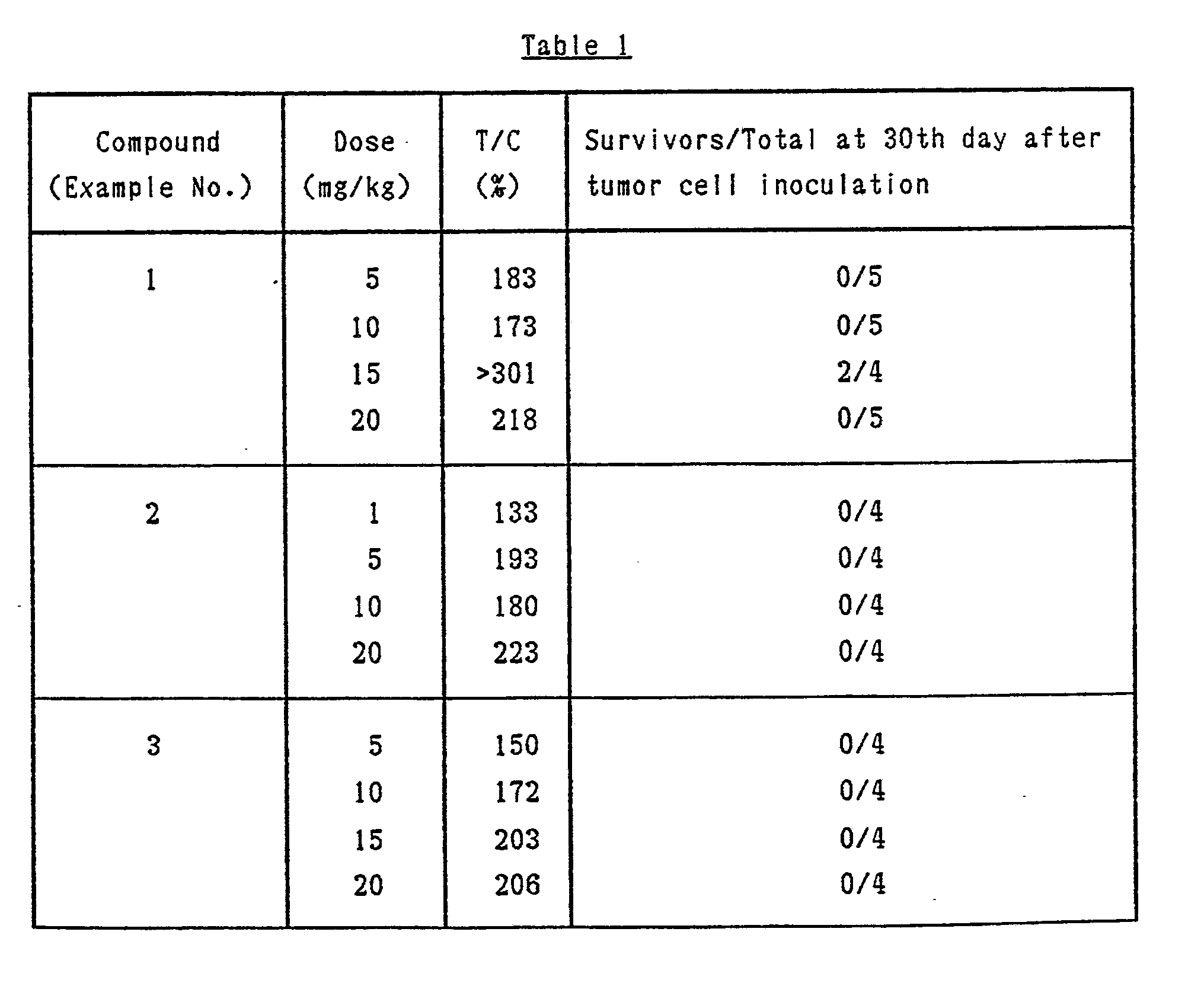


- The compounds were evaluated for nephrotoxicity by determining their effects on blood urea nitrogen (BUN) levels in rats.
- The testing compounds, or saline for control were given intravenously to male Fisher-344 rats (age of about 5 weeks, 5 heads per group), as a single injection. The BUN values were measured on the 5th day after the dosage. Results are shown in following Table 2.


Claims (22)



together with a pharmaceutically acceptable carrier.
Applications Claiming Priority (2)
| Application Number | Priority Date | Filing Date | Title |
|---|---|---|---|
| JP62098676A JPS63267794A (en) | 1987-04-23 | 1987-04-23 | Organic platinum complex and antitumor agent containing the same |
| JP98676/87 | 1987-04-23 |
Publications (2)
| Publication Number | Publication Date |
|---|---|
| EP0288002A2 true EP0288002A2 (en) | 1988-10-26 |
| EP0288002A3 EP0288002A3 (en) | 1990-08-16 |
Family
ID=14226116
Family Applications (1)
| Application Number | Title | Priority Date | Filing Date |
|---|---|---|---|
| EP88106214A Withdrawn EP0288002A3 (en) | 1987-04-23 | 1988-04-19 | Organo-platinum complex and use thereof |
Country Status (3)
| Country | Link |
|---|---|
| US (1) | US4870062A (en) |
| EP (1) | EP0288002A3 (en) |
| JP (1) | JPS63267794A (en) |
Cited By (2)
| Publication number | Priority date | Publication date | Assignee | Title |
|---|---|---|---|---|
| US4994591A (en) * | 1989-06-02 | 1991-02-19 | The Research Foundation Of State University Of Ny | Platinum complexes derived from b-silyamines |
| US10465283B2 (en) * | 2015-05-12 | 2019-11-05 | Tanaka Kikinzoku Kogyo K.K. | Organoplatinum compound for use in the chemical deposition of platinum compound thin films |
Families Citing this family (4)
| Publication number | Priority date | Publication date | Assignee | Title |
|---|---|---|---|---|
| EP0407623A1 (en) * | 1989-02-01 | 1991-01-16 | Institut Fizicheskoi Khimii Imeni L.V.Pisarzhevskogo Akademii Nauk Ukrainskoi Ssr | Derivatives of platinum (p) with methyl silicone, method of obtaining them and antitumoral means based thereon |
| GB9103191D0 (en) * | 1991-02-14 | 1991-04-03 | Dow Corning | Platinum complexes and use thereof |
| CA2106679C (en) * | 1991-03-23 | 1996-01-09 | Dae-Kee Kim | Novel platinum (ii) complex and processes for preparing the same |
| US7138520B2 (en) * | 2003-01-13 | 2006-11-21 | Massachusetts Institute Of Technology | Coordination complexes having tethered therapeutic agents and/or targeting moieties, and methods of making and using the same |
Family Cites Families (2)
| Publication number | Priority date | Publication date | Assignee | Title |
|---|---|---|---|---|
| US4500465A (en) * | 1982-06-28 | 1985-02-19 | Engelhard Corporation | Solubilized platinum (II) complexes |
| US4675336A (en) * | 1985-06-26 | 1987-06-23 | American Cyanamid Company | Platinum complexes of amines with dibasic acids |
-
1987
- 1987-04-23 JP JP62098676A patent/JPS63267794A/en active Pending
-
1988
- 1988-04-19 EP EP88106214A patent/EP0288002A3/en not_active Withdrawn
- 1988-04-19 US US07/183,575 patent/US4870062A/en not_active Expired - Fee Related
Cited By (2)
| Publication number | Priority date | Publication date | Assignee | Title |
|---|---|---|---|---|
| US4994591A (en) * | 1989-06-02 | 1991-02-19 | The Research Foundation Of State University Of Ny | Platinum complexes derived from b-silyamines |
| US10465283B2 (en) * | 2015-05-12 | 2019-11-05 | Tanaka Kikinzoku Kogyo K.K. | Organoplatinum compound for use in the chemical deposition of platinum compound thin films |
Also Published As
| Publication number | Publication date |
|---|---|
| EP0288002A3 (en) | 1990-08-16 |
| US4870062A (en) | 1989-09-26 |
| JPS63267794A (en) | 1988-11-04 |
Similar Documents
| Publication | Publication Date | Title |
|---|---|---|
| CA1164882A (en) | Compositions containing platinum | |
| EP0318464B1 (en) | Antitumor platinum complexes | |
| US4359425A (en) | Organo-platinum complex | |
| EP0008936B1 (en) | Platinum complexes, processes for their preparation, pharmaceutical compositions containing them and their use as medicaments | |
| Ozawa et al. | Reductive Elimination of cis-PtMe (SiPh3)(PMePh2) 2 | |
| HUT60747A (en) | Process for producing new trans-platinum compounds and pharmaceutical compositions comprising same as active ingredient | |
| Lu et al. | Synthesis, structures and luminescence properties of amine-bis (N-heterocyclic carbene) copper (I) and silver (I) complexes | |
| Brock et al. | Pyrazole derivatives of diborane (4) | |
| Someşan et al. | Novel mono-and bimetallic organotin (iv) compounds as potential linkers for coordination polymers | |
| EP0288002A2 (en) | Organo-platinum complex and use thereof | |
| Karasik et al. | 1, 3, 6‐Azadiphosphacycloheptanes: A novel type of heterocyclic diphosphines | |
| Takacs et al. | Multiple bonds between transition metals and main-group elements. 74. Five-membered rhenacycles through condensation reactions of methyl (trioxo) rhenium (VII) with bidentate ligands. X-ray crystal structures of 8-oxyquinolinato and catecholato complexes | |
| EP0115929A1 (en) | Novel organic platinum complex and process for the preparation thereof | |
| Gaballa et al. | Ligand Substitution Reactions on Aquapentachloro‐and Hexachloroplatinic Acid—Synthesis and Characterization of Tetrachloroplatinum (IV) Complexes with Heterocyclic N, N Donors | |
| CA1251203A (en) | Amino-anthracenediones-platinum complexes useful as anti-cancer compounds | |
| Suntrup et al. | Serendipitous discoveries of new coordination modes of the 1, 5-regioisomer of 1, 2, 3-triazoles enroute to the attempted synthesis of a carbon-anchored tri-mesoionic carbene | |
| Kiefer et al. | Alkynyl-functionalized gold NHC complexes and their coinage metal clusters | |
| EP0264109A1 (en) | Platinum complex, process for preparing same and antitumor agent | |
| CA2046313C (en) | Platinum (ii) complex and agent for treating malignant tumor | |
| Cadierno et al. | Ruthenium (ii) and ruthenium (iv) complexes containing hemilabile heterodifunctional iminophosphorane-phosphine ligands Ph 2 PCH 2 P ([double bond, length as m-dash] NR) Ph 2 | |
| Buxton et al. | Organoamidometallics. I. Syntheses of [n, n′-bis (polyfluorophenyl) ethane-1, 2-diaminato (2-)] platinum (II) complexes by decarboxylation | |
| Diversi et al. | Catalytic and stoichiometric reactions of tertiary silanes with [Ir (Me) 2Cp* L](Cp*= η5-C5Me5; L= PMe3, PMe2Ph, PMePh2, PPh3) in the presence of one-electron oxidants. A unique case of Si H, Si C, Ir C and P F bonds one-step activation: crystal structure of [Ir (Ph)(SiPh2F) Cp*(PMe3)] | |
| EP0345356A1 (en) | Platinum complex and therapeutic agent for malignant tumor | |
| Carmichael et al. | Studies of how redox chemistry influences the synthesis of transition metal phosphametallocenes: a convenient synthesis of 2, 5-diester-substituted phosphametallocenes and 2, 2′, 5, 5′-tetraester-substituted-1, 1′-diphosphaferrocenes | |
| EP0227127B1 (en) | Pharmaceutically active phosphino-hydrocarbon-group viii-metal complexes, antitumor compositions containing these complexes, and a process for preparing said compounds or antitumor compositions |
Legal Events
| Date | Code | Title | Description |
|---|---|---|---|
| PUAI | Public reference made under article 153(3) epc to a published international application that has entered the european phase |
Free format text: ORIGINAL CODE: 0009012 |
|
| AK | Designated contracting states |
Kind code of ref document: A2 Designated state(s): CH DE FR GB IT LI |
|
| PUAL | Search report despatched |
Free format text: ORIGINAL CODE: 0009013 |
|
| AK | Designated contracting states |
Kind code of ref document: A3 Designated state(s): CH DE FR GB IT LI |
|
| 17P | Request for examination filed |
Effective date: 19901029 |
|
| 17Q | First examination report despatched |
Effective date: 19911220 |
|
| STAA | Information on the status of an ep patent application or granted ep patent |
Free format text: STATUS: THE APPLICATION IS DEEMED TO BE WITHDRAWN |
|
| 18D | Application deemed to be withdrawn |
Effective date: 19930316 |