EP0288006A2 - Process for producing crosslinked polymer particles - Google Patents
Process for producing crosslinked polymer particles Download PDFInfo
- Publication number
- EP0288006A2 EP0288006A2 EP88106224A EP88106224A EP0288006A2 EP 0288006 A2 EP0288006 A2 EP 0288006A2 EP 88106224 A EP88106224 A EP 88106224A EP 88106224 A EP88106224 A EP 88106224A EP 0288006 A2 EP0288006 A2 EP 0288006A2
- Authority
- EP
- European Patent Office
- Prior art keywords
- polymer particles
- process according
- crosslinked polymer
- polymerization
- particle size
- Prior art date
- Legal status (The legal status is an assumption and is not a legal conclusion. Google has not performed a legal analysis and makes no representation as to the accuracy of the status listed.)
- Granted
Links
- 239000002245 particle Substances 0.000 title claims abstract description 237
- 238000000034 method Methods 0.000 title claims abstract description 54
- 229920006037 cross link polymer Polymers 0.000 title claims abstract description 41
- 229920000642 polymer Polymers 0.000 claims abstract description 171
- 238000006116 polymerization reaction Methods 0.000 claims abstract description 114
- 239000000178 monomer Substances 0.000 claims abstract description 84
- 238000004132 cross linking Methods 0.000 claims abstract description 34
- 239000002609 medium Substances 0.000 claims abstract description 19
- 239000012736 aqueous medium Substances 0.000 claims abstract description 5
- 230000000379 polymerizing effect Effects 0.000 claims abstract description 4
- -1 aromatic divinyl compound Chemical class 0.000 claims description 46
- XLYOFNOQVPJJNP-UHFFFAOYSA-N water Substances O XLYOFNOQVPJJNP-UHFFFAOYSA-N 0.000 claims description 28
- RTZKZFJDLAIYFH-UHFFFAOYSA-N Diethyl ether Chemical compound CCOCC RTZKZFJDLAIYFH-UHFFFAOYSA-N 0.000 claims description 23
- 239000000203 mixture Substances 0.000 claims description 21
- 239000003505 polymerization initiator Substances 0.000 claims description 15
- 238000009826 distribution Methods 0.000 claims description 13
- VOZRXNHHFUQHIL-UHFFFAOYSA-N glycidyl methacrylate Chemical compound CC(=C)C(=O)OCC1CO1 VOZRXNHHFUQHIL-UHFFFAOYSA-N 0.000 claims description 11
- 239000002904 solvent Substances 0.000 claims description 11
- 150000007942 carboxylates Chemical class 0.000 claims description 8
- KAKZBPTYRLMSJV-UHFFFAOYSA-N vinyl-ethylene Natural products C=CC=C KAKZBPTYRLMSJV-UHFFFAOYSA-N 0.000 claims description 8
- 239000003085 diluting agent Substances 0.000 claims description 5
- 239000000463 material Substances 0.000 claims description 5
- 229920002554 vinyl polymer Polymers 0.000 claims description 5
- 150000001413 amino acids Chemical class 0.000 claims description 4
- RPQRDASANLAFCM-UHFFFAOYSA-N oxiran-2-ylmethyl prop-2-enoate Chemical compound C=CC(=O)OCC1CO1 RPQRDASANLAFCM-UHFFFAOYSA-N 0.000 claims description 4
- 239000000839 emulsion Substances 0.000 claims description 3
- 238000004811 liquid chromatography Methods 0.000 claims description 3
- 150000007824 aliphatic compounds Chemical class 0.000 claims description 2
- 238000004458 analytical method Methods 0.000 claims description 2
- 238000004366 reverse phase liquid chromatography Methods 0.000 claims description 2
- 239000000725 suspension Substances 0.000 claims description 2
- 150000001338 aliphatic hydrocarbons Chemical class 0.000 claims 4
- 150000004945 aromatic hydrocarbons Chemical class 0.000 claims 3
- 239000004215 Carbon black (E152) Substances 0.000 claims 2
- 230000001476 alcoholic effect Effects 0.000 claims 2
- 229930195733 hydrocarbon Natural products 0.000 claims 2
- 125000002887 hydroxy group Chemical group [H]O* 0.000 claims 2
- 238000012856 packing Methods 0.000 claims 2
- 239000006185 dispersion Substances 0.000 description 36
- LFQSCWFLJHTTHZ-UHFFFAOYSA-N Ethanol Chemical compound CCO LFQSCWFLJHTTHZ-UHFFFAOYSA-N 0.000 description 30
- MYRTYDVEIRVNKP-UHFFFAOYSA-N 1,2-Divinylbenzene Chemical compound C=CC1=CC=CC=C1C=C MYRTYDVEIRVNKP-UHFFFAOYSA-N 0.000 description 28
- 238000006243 chemical reaction Methods 0.000 description 26
- PPBRXRYQALVLMV-UHFFFAOYSA-N Styrene Chemical group C=CC1=CC=CC=C1 PPBRXRYQALVLMV-UHFFFAOYSA-N 0.000 description 25
- YXFVVABEGXRONW-UHFFFAOYSA-N Toluene Chemical compound CC1=CC=CC=C1 YXFVVABEGXRONW-UHFFFAOYSA-N 0.000 description 21
- DGAQECJNVWCQMB-PUAWFVPOSA-M Ilexoside XXIX Chemical compound C[C@@H]1CC[C@@]2(CC[C@@]3(C(=CC[C@H]4[C@]3(CC[C@@H]5[C@@]4(CC[C@@H](C5(C)C)OS(=O)(=O)[O-])C)C)[C@@H]2[C@]1(C)O)C)C(=O)O[C@H]6[C@@H]([C@H]([C@@H]([C@H](O6)CO)O)O)O.[Na+] DGAQECJNVWCQMB-PUAWFVPOSA-M 0.000 description 19
- 229910052708 sodium Inorganic materials 0.000 description 19
- 239000011734 sodium Substances 0.000 description 19
- IJGRMHOSHXDMSA-UHFFFAOYSA-N Atomic nitrogen Chemical compound N#N IJGRMHOSHXDMSA-UHFFFAOYSA-N 0.000 description 14
- 239000012798 spherical particle Substances 0.000 description 14
- OZAIFHULBGXAKX-UHFFFAOYSA-N 2,2'-azo-bis-isobutyronitrile Substances N#CC(C)(C)N=NC(C)(C)C#N OZAIFHULBGXAKX-UHFFFAOYSA-N 0.000 description 13
- 239000007864 aqueous solution Substances 0.000 description 12
- 229910001873 dinitrogen Inorganic materials 0.000 description 10
- 239000003381 stabilizer Substances 0.000 description 10
- DBMJMQXJHONAFJ-UHFFFAOYSA-M Sodium laurylsulphate Chemical compound [Na+].CCCCCCCCCCCCOS([O-])(=O)=O DBMJMQXJHONAFJ-UHFFFAOYSA-M 0.000 description 9
- 235000019333 sodium laurylsulphate Nutrition 0.000 description 9
- 238000012674 dispersion polymerization Methods 0.000 description 8
- 238000007720 emulsion polymerization reaction Methods 0.000 description 8
- 238000004519 manufacturing process Methods 0.000 description 8
- 238000000045 pyrolysis gas chromatography Methods 0.000 description 8
- 229940083575 sodium dodecyl sulfate Drugs 0.000 description 8
- DBCAQXHNJOFNGC-UHFFFAOYSA-N 4-bromo-1,1,1-trifluorobutane Chemical compound FC(F)(F)CCCBr DBCAQXHNJOFNGC-UHFFFAOYSA-N 0.000 description 7
- 238000005345 coagulation Methods 0.000 description 7
- 230000015271 coagulation Effects 0.000 description 7
- 229920001577 copolymer Chemical compound 0.000 description 7
- 238000010828 elution Methods 0.000 description 7
- STVZJERGLQHEKB-UHFFFAOYSA-N ethylene glycol dimethacrylate Substances CC(=C)C(=O)OCCOC(=O)C(C)=C STVZJERGLQHEKB-UHFFFAOYSA-N 0.000 description 7
- 238000000926 separation method Methods 0.000 description 7
- 239000011877 solvent mixture Substances 0.000 description 7
- RZXLPPRPEOUENN-UHFFFAOYSA-N Chlorfenson Chemical compound C1=CC(Cl)=CC=C1OS(=O)(=O)C1=CC=C(Cl)C=C1 RZXLPPRPEOUENN-UHFFFAOYSA-N 0.000 description 6
- XDTMQSROBMDMFD-UHFFFAOYSA-N Cyclohexane Chemical compound C1CCCCC1 XDTMQSROBMDMFD-UHFFFAOYSA-N 0.000 description 6
- 230000008961 swelling Effects 0.000 description 6
- WSLDOOZREJYCGB-UHFFFAOYSA-N 1,2-Dichloroethane Chemical compound ClCCCl WSLDOOZREJYCGB-UHFFFAOYSA-N 0.000 description 5
- 230000001804 emulsifying effect Effects 0.000 description 5
- XWJBRBSPAODJER-UHFFFAOYSA-N 1,7-octadiene Chemical compound C=CCCCCC=C XWJBRBSPAODJER-UHFFFAOYSA-N 0.000 description 4
- DHMQDGOQFOQNFH-UHFFFAOYSA-N Glycine Chemical compound NCC(O)=O DHMQDGOQFOQNFH-UHFFFAOYSA-N 0.000 description 4
- RRHGJUQNOFWUDK-UHFFFAOYSA-N Isoprene Chemical compound CC(=C)C=C RRHGJUQNOFWUDK-UHFFFAOYSA-N 0.000 description 4
- BAPJBEWLBFYGME-UHFFFAOYSA-N Methyl acrylate Chemical compound COC(=O)C=C BAPJBEWLBFYGME-UHFFFAOYSA-N 0.000 description 4
- 239000004793 Polystyrene Substances 0.000 description 4
- QAOWNCQODCNURD-UHFFFAOYSA-N Sulfuric acid Chemical compound OS(O)(=O)=O QAOWNCQODCNURD-UHFFFAOYSA-N 0.000 description 4
- 150000001875 compounds Chemical class 0.000 description 4
- 229920002223 polystyrene Polymers 0.000 description 4
- 229920002451 polyvinyl alcohol Polymers 0.000 description 4
- NWUYHJFMYQTDRP-UHFFFAOYSA-N 1,2-bis(ethenyl)benzene;1-ethenyl-2-ethylbenzene;styrene Chemical compound C=CC1=CC=CC=C1.CCC1=CC=CC=C1C=C.C=CC1=CC=CC=C1C=C NWUYHJFMYQTDRP-UHFFFAOYSA-N 0.000 description 3
- GWCJNVUIVCCXER-UHFFFAOYSA-N 2-(1-phenylprop-2-enoxymethyl)oxirane Chemical compound C=1C=CC=CC=1C(C=C)OCC1CO1 GWCJNVUIVCCXER-UHFFFAOYSA-N 0.000 description 3
- WEVYAHXRMPXWCK-UHFFFAOYSA-N Acetonitrile Chemical compound CC#N WEVYAHXRMPXWCK-UHFFFAOYSA-N 0.000 description 3
- UHOVQNZJYSORNB-UHFFFAOYSA-N Benzene Chemical compound C1=CC=CC=C1 UHOVQNZJYSORNB-UHFFFAOYSA-N 0.000 description 3
- 239000004342 Benzoyl peroxide Substances 0.000 description 3
- OMPJBNCRMGITSC-UHFFFAOYSA-N Benzoylperoxide Chemical compound C=1C=CC=CC=1C(=O)OOC(=O)C1=CC=CC=C1 OMPJBNCRMGITSC-UHFFFAOYSA-N 0.000 description 3
- KFZMGEQAYNKOFK-UHFFFAOYSA-N Isopropanol Chemical compound CC(C)O KFZMGEQAYNKOFK-UHFFFAOYSA-N 0.000 description 3
- OKKJLVBELUTLKV-UHFFFAOYSA-N Methanol Chemical compound OC OKKJLVBELUTLKV-UHFFFAOYSA-N 0.000 description 3
- CTQNGGLPUBDAKN-UHFFFAOYSA-N O-Xylene Chemical compound CC1=CC=CC=C1C CTQNGGLPUBDAKN-UHFFFAOYSA-N 0.000 description 3
- 229920002873 Polyethylenimine Polymers 0.000 description 3
- 238000010521 absorption reaction Methods 0.000 description 3
- 235000001014 amino acid Nutrition 0.000 description 3
- 235000019400 benzoyl peroxide Nutrition 0.000 description 3
- 239000000969 carrier Substances 0.000 description 3
- 238000007796 conventional method Methods 0.000 description 3
- SUPCQIBBMFXVTL-UHFFFAOYSA-N ethyl 2-methylprop-2-enoate Chemical compound CCOC(=O)C(C)=C SUPCQIBBMFXVTL-UHFFFAOYSA-N 0.000 description 3
- 230000004927 fusion Effects 0.000 description 3
- 238000004255 ion exchange chromatography Methods 0.000 description 3
- 239000000049 pigment Substances 0.000 description 3
- 229920003023 plastic Polymers 0.000 description 3
- 239000004033 plastic Substances 0.000 description 3
- 239000011347 resin Substances 0.000 description 3
- 229920005989 resin Polymers 0.000 description 3
- 239000004094 surface-active agent Substances 0.000 description 3
- 238000010557 suspension polymerization reaction Methods 0.000 description 3
- 229920001059 synthetic polymer Polymers 0.000 description 3
- 239000008096 xylene Substances 0.000 description 3
- MTCFGRXMJLQNBG-REOHCLBHSA-N (2S)-2-Amino-3-hydroxypropansäure Chemical compound OC[C@H](N)C(O)=O MTCFGRXMJLQNBG-REOHCLBHSA-N 0.000 description 2
- SMZOUWXMTYCWNB-UHFFFAOYSA-N 2-(2-methoxy-5-methylphenyl)ethanamine Chemical compound COC1=CC=C(C)C=C1CCN SMZOUWXMTYCWNB-UHFFFAOYSA-N 0.000 description 2
- NIXOWILDQLNWCW-UHFFFAOYSA-N 2-Propenoic acid Natural products OC(=O)C=C NIXOWILDQLNWCW-UHFFFAOYSA-N 0.000 description 2
- OMIGHNLMNHATMP-UHFFFAOYSA-N 2-hydroxyethyl prop-2-enoate Chemical compound OCCOC(=O)C=C OMIGHNLMNHATMP-UHFFFAOYSA-N 0.000 description 2
- 238000004438 BET method Methods 0.000 description 2
- NIQCNGHVCWTJSM-UHFFFAOYSA-N Dimethyl phthalate Chemical compound COC(=O)C1=CC=CC=C1C(=O)OC NIQCNGHVCWTJSM-UHFFFAOYSA-N 0.000 description 2
- WHUUTDBJXJRKMK-UHFFFAOYSA-N Glutamic acid Natural products OC(=O)C(N)CCC(O)=O WHUUTDBJXJRKMK-UHFFFAOYSA-N 0.000 description 2
- 239000004471 Glycine Substances 0.000 description 2
- CKLJMWTZIZZHCS-REOHCLBHSA-N L-aspartic acid Chemical compound OC(=O)[C@@H](N)CC(O)=O CKLJMWTZIZZHCS-REOHCLBHSA-N 0.000 description 2
- WHUUTDBJXJRKMK-VKHMYHEASA-N L-glutamic acid Chemical compound OC(=O)[C@@H](N)CCC(O)=O WHUUTDBJXJRKMK-VKHMYHEASA-N 0.000 description 2
- CERQOIWHTDAKMF-UHFFFAOYSA-N Methacrylic acid Chemical compound CC(=C)C(O)=O CERQOIWHTDAKMF-UHFFFAOYSA-N 0.000 description 2
- VVQNEPGJFQJSBK-UHFFFAOYSA-N Methyl methacrylate Chemical compound COC(=O)C(C)=C VVQNEPGJFQJSBK-UHFFFAOYSA-N 0.000 description 2
- MTCFGRXMJLQNBG-UHFFFAOYSA-N Serine Natural products OCC(N)C(O)=O MTCFGRXMJLQNBG-UHFFFAOYSA-N 0.000 description 2
- CDBYLPFSWZWCQE-UHFFFAOYSA-L Sodium Carbonate Chemical compound [Na+].[Na+].[O-]C([O-])=O CDBYLPFSWZWCQE-UHFFFAOYSA-L 0.000 description 2
- WYURNTSHIVDZCO-UHFFFAOYSA-N Tetrahydrofuran Chemical compound C1CCOC1 WYURNTSHIVDZCO-UHFFFAOYSA-N 0.000 description 2
- 239000003945 anionic surfactant Substances 0.000 description 2
- 235000003704 aspartic acid Nutrition 0.000 description 2
- OQFSQFPPLPISGP-UHFFFAOYSA-N beta-carboxyaspartic acid Natural products OC(=O)C(N)C(C(O)=O)C(O)=O OQFSQFPPLPISGP-UHFFFAOYSA-N 0.000 description 2
- 230000015572 biosynthetic process Effects 0.000 description 2
- 150000001732 carboxylic acid derivatives Chemical class 0.000 description 2
- 239000003729 cation exchange resin Substances 0.000 description 2
- 239000003795 chemical substances by application Substances 0.000 description 2
- 238000004587 chromatography analysis Methods 0.000 description 2
- JHIVVAPYMSGYDF-UHFFFAOYSA-N cyclohexanone Chemical compound O=C1CCCCC1 JHIVVAPYMSGYDF-UHFFFAOYSA-N 0.000 description 2
- 238000001514 detection method Methods 0.000 description 2
- DOIRQSBPFJWKBE-UHFFFAOYSA-N dibutyl phthalate Chemical compound CCCCOC(=O)C1=CC=CC=C1C(=O)OCCCC DOIRQSBPFJWKBE-UHFFFAOYSA-N 0.000 description 2
- 150000001993 dienes Chemical class 0.000 description 2
- FLKPEMZONWLCSK-UHFFFAOYSA-N diethyl phthalate Chemical compound CCOC(=O)C1=CC=CC=C1C(=O)OCC FLKPEMZONWLCSK-UHFFFAOYSA-N 0.000 description 2
- 238000001914 filtration Methods 0.000 description 2
- 235000013922 glutamic acid Nutrition 0.000 description 2
- 239000004220 glutamic acid Substances 0.000 description 2
- BXWNKGSJHAJOGX-UHFFFAOYSA-N hexadecan-1-ol Chemical compound CCCCCCCCCCCCCCCCO BXWNKGSJHAJOGX-UHFFFAOYSA-N 0.000 description 2
- 238000005470 impregnation Methods 0.000 description 2
- 229910052757 nitrogen Inorganic materials 0.000 description 2
- 239000002736 nonionic surfactant Substances 0.000 description 2
- 150000002894 organic compounds Chemical class 0.000 description 2
- 150000002978 peroxides Chemical class 0.000 description 2
- 125000005498 phthalate group Chemical class 0.000 description 2
- 229920006316 polyvinylpyrrolidine Polymers 0.000 description 2
- 239000000843 powder Substances 0.000 description 2
- 125000006850 spacer group Chemical group 0.000 description 2
- 150000003440 styrenes Chemical class 0.000 description 2
- RYHBNJHYFVUHQT-UHFFFAOYSA-N 1,4-Dioxane Chemical compound C1COCCO1 RYHBNJHYFVUHQT-UHFFFAOYSA-N 0.000 description 1
- XNWFRZJHXBZDAG-UHFFFAOYSA-N 2-METHOXYETHANOL Chemical compound COCCO XNWFRZJHXBZDAG-UHFFFAOYSA-N 0.000 description 1
- RCEJCSULJQNRQQ-UHFFFAOYSA-N 2-methylbutanenitrile Chemical compound CCC(C)C#N RCEJCSULJQNRQQ-UHFFFAOYSA-N 0.000 description 1
- RKOOOVKGLHCLTP-UHFFFAOYSA-N 2-methylprop-2-enoic acid;propane-1,2,3-triol Chemical compound CC(=C)C(O)=O.OCC(O)CO RKOOOVKGLHCLTP-UHFFFAOYSA-N 0.000 description 1
- WPIYAXQPRQYXCN-UHFFFAOYSA-N 3,3,5-trimethylhexanoyl 3,3,5-trimethylhexaneperoxoate Chemical compound CC(C)CC(C)(C)CC(=O)OOC(=O)CC(C)(C)CC(C)C WPIYAXQPRQYXCN-UHFFFAOYSA-N 0.000 description 1
- IWTYTFSSTWXZFU-UHFFFAOYSA-N 3-chloroprop-1-enylbenzene Chemical compound ClCC=CC1=CC=CC=C1 IWTYTFSSTWXZFU-UHFFFAOYSA-N 0.000 description 1
- XRUKRHLZDVJJSX-UHFFFAOYSA-N 4-cyanopentanoic acid Chemical compound N#CC(C)CCC(O)=O XRUKRHLZDVJJSX-UHFFFAOYSA-N 0.000 description 1
- HRPVXLWXLXDGHG-UHFFFAOYSA-N Acrylamide Chemical compound NC(=O)C=C HRPVXLWXLXDGHG-UHFFFAOYSA-N 0.000 description 1
- 239000001856 Ethyl cellulose Substances 0.000 description 1
- ZZSNKZQZMQGXPY-UHFFFAOYSA-N Ethyl cellulose Chemical compound CCOCC1OC(OC)C(OCC)C(OCC)C1OC1C(O)C(O)C(OC)C(CO)O1 ZZSNKZQZMQGXPY-UHFFFAOYSA-N 0.000 description 1
- WOBHKFSMXKNTIM-UHFFFAOYSA-N Hydroxyethyl methacrylate Chemical compound CC(=C)C(=O)OCCO WOBHKFSMXKNTIM-UHFFFAOYSA-N 0.000 description 1
- 229920002153 Hydroxypropyl cellulose Polymers 0.000 description 1
- 108010093096 Immobilized Enzymes Proteins 0.000 description 1
- YIVJZNGAASQVEM-UHFFFAOYSA-N Lauroyl peroxide Chemical compound CCCCCCCCCCCC(=O)OOC(=O)CCCCCCCCCCC YIVJZNGAASQVEM-UHFFFAOYSA-N 0.000 description 1
- 229920002125 Sokalan® Polymers 0.000 description 1
- HVUMOYIDDBPOLL-XWVZOOPGSA-N Sorbitan monostearate Chemical compound CCCCCCCCCCCCCCCCCC(=O)OC[C@@H](O)[C@H]1OC[C@H](O)[C@H]1O HVUMOYIDDBPOLL-XWVZOOPGSA-N 0.000 description 1
- ULUAUXLGCMPNKK-UHFFFAOYSA-N Sulfobutanedioic acid Chemical compound OC(=O)CC(C(O)=O)S(O)(=O)=O ULUAUXLGCMPNKK-UHFFFAOYSA-N 0.000 description 1
- DKGAVHZHDRPRBM-UHFFFAOYSA-N Tert-Butanol Chemical compound CC(C)(C)O DKGAVHZHDRPRBM-UHFFFAOYSA-N 0.000 description 1
- 239000000853 adhesive Substances 0.000 description 1
- 230000001070 adhesive effect Effects 0.000 description 1
- 125000000129 anionic group Chemical group 0.000 description 1
- 150000001491 aromatic compounds Chemical class 0.000 description 1
- 239000007869 azo polymerization initiator Substances 0.000 description 1
- 229920005601 base polymer Polymers 0.000 description 1
- 239000011230 binding agent Substances 0.000 description 1
- 239000000919 ceramic Substances 0.000 description 1
- 229960000541 cetyl alcohol Drugs 0.000 description 1
- 239000012986 chain transfer agent Substances 0.000 description 1
- 239000003153 chemical reaction reagent Substances 0.000 description 1
- 239000011248 coating agent Substances 0.000 description 1
- 238000000576 coating method Methods 0.000 description 1
- 238000004440 column chromatography Methods 0.000 description 1
- 239000002537 cosmetic Substances 0.000 description 1
- 210000002858 crystal cell Anatomy 0.000 description 1
- 239000008367 deionised water Substances 0.000 description 1
- 229910021641 deionized water Inorganic materials 0.000 description 1
- 238000011161 development Methods 0.000 description 1
- 238000003745 diagnosis Methods 0.000 description 1
- FBSAITBEAPNWJG-UHFFFAOYSA-N dimethyl phthalate Natural products CC(=O)OC1=CC=CC=C1OC(C)=O FBSAITBEAPNWJG-UHFFFAOYSA-N 0.000 description 1
- 229960001826 dimethylphthalate Drugs 0.000 description 1
- 239000002612 dispersion medium Substances 0.000 description 1
- GVGUFUZHNYFZLC-UHFFFAOYSA-N dodecyl benzenesulfonate;sodium Chemical compound [Na].CCCCCCCCCCCCOS(=O)(=O)C1=CC=CC=C1 GVGUFUZHNYFZLC-UHFFFAOYSA-N 0.000 description 1
- 239000000428 dust Substances 0.000 description 1
- 230000000694 effects Effects 0.000 description 1
- 238000004945 emulsification Methods 0.000 description 1
- 235000019325 ethyl cellulose Nutrition 0.000 description 1
- 229920001249 ethyl cellulose Polymers 0.000 description 1
- 238000001704 evaporation Methods 0.000 description 1
- 230000008020 evaporation Effects 0.000 description 1
- 229920000578 graft copolymer Polymers 0.000 description 1
- 229920001519 homopolymer Polymers 0.000 description 1
- 239000001863 hydroxypropyl cellulose Substances 0.000 description 1
- 235000010977 hydroxypropyl cellulose Nutrition 0.000 description 1
- 239000003999 initiator Substances 0.000 description 1
- 239000000976 ink Substances 0.000 description 1
- 238000007689 inspection Methods 0.000 description 1
- 238000005342 ion exchange Methods 0.000 description 1
- 239000003456 ion exchange resin Substances 0.000 description 1
- 229920003303 ion-exchange polymer Polymers 0.000 description 1
- 239000004816 latex Substances 0.000 description 1
- 229920000126 latex Polymers 0.000 description 1
- 239000007788 liquid Substances 0.000 description 1
- 239000004973 liquid crystal related substance Substances 0.000 description 1
- 239000000314 lubricant Substances 0.000 description 1
- 238000005259 measurement Methods 0.000 description 1
- XKBGEWXEAPTVCK-UHFFFAOYSA-M methyltrioctylammonium chloride Chemical compound [Cl-].CCCCCCCC[N+](C)(CCCCCCCC)CCCCCCCC XKBGEWXEAPTVCK-UHFFFAOYSA-M 0.000 description 1
- 239000003094 microcapsule Substances 0.000 description 1
- 239000003607 modifier Substances 0.000 description 1
- ZIUHHBKFKCYYJD-UHFFFAOYSA-N n,n'-methylenebisacrylamide Chemical compound C=CC(=O)NCNC(=O)C=C ZIUHHBKFKCYYJD-UHFFFAOYSA-N 0.000 description 1
- 229920005615 natural polymer Polymers 0.000 description 1
- SRSFOMHQIATOFV-UHFFFAOYSA-N octanoyl octaneperoxoate Chemical compound CCCCCCCC(=O)OOC(=O)CCCCCCC SRSFOMHQIATOFV-UHFFFAOYSA-N 0.000 description 1
- 239000003960 organic solvent Substances 0.000 description 1
- 229920002454 poly(glycidyl methacrylate) polymer Polymers 0.000 description 1
- 229920002432 poly(vinyl methyl ether) polymer Polymers 0.000 description 1
- 229920000036 polyvinylpyrrolidone Polymers 0.000 description 1
- 239000001267 polyvinylpyrrolidone Substances 0.000 description 1
- 235000013855 polyvinylpyrrolidone Nutrition 0.000 description 1
- 238000002360 preparation method Methods 0.000 description 1
- 235000018102 proteins Nutrition 0.000 description 1
- 108090000623 proteins and genes Proteins 0.000 description 1
- 102000004169 proteins and genes Human genes 0.000 description 1
- 150000003242 quaternary ammonium salts Chemical class 0.000 description 1
- 235000004400 serine Nutrition 0.000 description 1
- 229910000029 sodium carbonate Inorganic materials 0.000 description 1
- 235000017550 sodium carbonate Nutrition 0.000 description 1
- 239000001509 sodium citrate Substances 0.000 description 1
- APSBXTVYXVQYAB-UHFFFAOYSA-M sodium docusate Chemical compound [Na+].CCCCC(CC)COC(=O)CC(S([O-])(=O)=O)C(=O)OCC(CC)CCCC APSBXTVYXVQYAB-UHFFFAOYSA-M 0.000 description 1
- 229940080264 sodium dodecylbenzenesulfonate Drugs 0.000 description 1
- SUKJFIGYRHOWBL-UHFFFAOYSA-N sodium hypochlorite Chemical compound [Na+].Cl[O-] SUKJFIGYRHOWBL-UHFFFAOYSA-N 0.000 description 1
- 239000000243 solution Substances 0.000 description 1
- 239000001587 sorbitan monostearate Substances 0.000 description 1
- 235000011076 sorbitan monostearate Nutrition 0.000 description 1
- 229940035048 sorbitan monostearate Drugs 0.000 description 1
- 238000006277 sulfonation reaction Methods 0.000 description 1
- 230000002195 synergetic effect Effects 0.000 description 1
- FBWNMEQMRUMQSO-UHFFFAOYSA-N tergitol NP-9 Chemical compound CCCCCCCCCC1=CC=C(OCCOCCOCCOCCOCCOCCOCCOCCOCCO)C=C1 FBWNMEQMRUMQSO-UHFFFAOYSA-N 0.000 description 1
- YLQBMQCUIZJEEH-UHFFFAOYSA-N tetrahydrofuran Natural products C=1C=COC=1 YLQBMQCUIZJEEH-UHFFFAOYSA-N 0.000 description 1
- 125000000391 vinyl group Chemical group [H]C([*])=C([H])[H] 0.000 description 1
Classifications
-
- C—CHEMISTRY; METALLURGY
- C08—ORGANIC MACROMOLECULAR COMPOUNDS; THEIR PREPARATION OR CHEMICAL WORKING-UP; COMPOSITIONS BASED THEREON
- C08F—MACROMOLECULAR COMPOUNDS OBTAINED BY REACTIONS ONLY INVOLVING CARBON-TO-CARBON UNSATURATED BONDS
- C08F257/00—Macromolecular compounds obtained by polymerising monomers on to polymers of aromatic monomers as defined in group C08F12/00
- C08F257/02—Macromolecular compounds obtained by polymerising monomers on to polymers of aromatic monomers as defined in group C08F12/00 on to polymers of styrene or alkyl-substituted styrenes
-
- C—CHEMISTRY; METALLURGY
- C08—ORGANIC MACROMOLECULAR COMPOUNDS; THEIR PREPARATION OR CHEMICAL WORKING-UP; COMPOSITIONS BASED THEREON
- C08F—MACROMOLECULAR COMPOUNDS OBTAINED BY REACTIONS ONLY INVOLVING CARBON-TO-CARBON UNSATURATED BONDS
- C08F291/00—Macromolecular compounds obtained by polymerising monomers on to macromolecular compounds according to more than one of the groups C08F251/00 - C08F289/00
Definitions
- the present invention relates to a process for producing crosslinked polymer particles. More particularly, it relates to a process for producing crosslinked polymer particles having a narrow particle size distribution within a particle size range of from 1 to 30 ⁇ m.
- Polymer particles having a particle size of about 10 ⁇ m are in strong demand in wide range of industrial fields. However, their production is usually not easy.
- suspension polymerization For the production of conventional polymer particles, suspension polymerization, emulsion polymerization and dispersion polymerization are known.
- suspension polymerization polymerization is conducted by suspending monomer oil drops in aqueous medium by mechanical force to produce polymer particles.
- the particles obtained by such a method usally have particle size of at least 100 ⁇ m, and it is extremely difficult to obtain polymer particles having particle size of about 10 ⁇ m.
- the particle size distribution of the polymer particles obtained by dispersing the monomer oil drops by a mechanical force will naturally be wide, whereby a classification of particles will be required, such being disadvantageous.
- the yield tends to be poor if it is attempted to obtain polymer particles having a narrower particle size distribution.
- the particle size of the polymer particles usually obtained is at most 1 ⁇ m, and it is practically impossible to obtain polymer particles having a particle size of about 10 ⁇ m.
- a polymerizable monomer is absorbed in polymer particles (hereinafter referred to as "seed polymer") obtained by emulsion polymerization, followed by polymerization to obtain enlarged polymer particles.
- seed polymer polymer particles obtained by emulsion polymerization
- the seed polymer must be a non-crosslinked linear polymer. If the seed polymer is crosslinked, the degree of enlargement will be restricted, and it will be extremely difficult to enlarge the particles to a size of about 10 ⁇ m.
- 97582/1979 discloses that by adding a chain transfer agent during emulsion polymerization, a linear polymer having a molecular weight substantially lower than a usual polymer latex is prepared, and this polymer is used as a seed polymer so that a polymerizable monomer slightly soluble in water is absorbed by this seed polymer, followed by polymerization.
- this method there is a limitation in the size of the polymer particles obtained.
- oil soluble polymerization initiator or water soluble polymerization initiator there will be a problem such as coagulation or formation of new particles, whereby it will be difficult to obtain polymer particles certainly in good yield.
- Japanese Unexamined Patent Publication No. 126288/1979 discloses a method wherein in the first step of the polymerization, a seed polymer is permitted to absorb an organic compound having a solubility of less than 10 ⁇ 2 g/liter (10 ⁇ 3% by weight) to water, which serves as a swelling aid, and in the second step, the seed polymer is permitted to absorb a monomer slightly soluble in water usually in an amount of from 20 to 300 times, at the maximum 1,000 times, by volume relative to the seed polymer, to form swelled monomer particles, followed by polymerization while maintaining the particle form.
- the size of the polymer particles obtained in the first step is at best about 10 times the size of the seed polymer. Accordingly, if polymer particles having a size of 10 ⁇ m are to be prepared by using a seed polymer having a size of 0.5 ⁇ m, it is necessary to conduct polymerization firstly by using the seed polymer of 0.5 ⁇ m to obtain polymer particles having a size of about 3 ⁇ m and then to repeat the same polymerization step by using the polymer particles as a seed polymer. Thus, this method has drawbacks that it involves a number of steps, and the production is not easy.
- Japanese Unexamined Patent Publication No. 190504/1986 discloses a method of enlarging linear polymer particles at least 1,000 times by volume to overcome the above-mentioned drawbacks.
- the seed polymer in order to efficiently conduct the enlargement, firstly the seed polymer is permitted to absorb a swelling aid, an organic compound having a solubility of not more than 0.02% by weight to water and a molecular weight of not higher than 5,000, and then permitted to absorb a polymerizable monomer, followed by polymerization.
- this method has a difficulty that it takes 66 hours merely to absorb the swelling aid.
- the seed polymer is extremely enlarged, and the properties of the polymer used as seed polymer can not adequately be reflected in the nature of the enlarged polymer particles finally obtained. Further, in such methods, it is necessary to extract and remove the linear polymer used as seeds, whereby the polymer particles finally obtained tend to be porous, and it is difficult to produce gel type polymer particles.
- the present inventors have conducted various studies to obtain polymer particles having a high uniformity coefficient, particularly particles of from 1 to 30 ⁇ m suitable as separation media, based on the dispersion polymerization. As a result, they have found it possible to produce particles having an intermediate particle size (1-10 ⁇ m) between the particle sizes obtainable by the emulsion polymerization and the subspension polymerization as disclosed in J. Polym. Sci. Polym. Chem. Ed., 24 , 2955, (1987).
- the particle size of a seed polymer produced in the first step is large, and the degree of enlargment to the desired particle size may be small (i.e. the amount of the monomer impregnated in the second step may be small).
- the seed polymer is a crosslinked polymer.
- the present invention provides a process for producing crosslinked polymer particles which comprises a first step of polymerizing a polymerizable monomer containing from 0.1 to 2.0% by weight, based on the entire polymerizable monomer, of a crosslinkable monomer in a medium in which the polymerizable monomer is soluble but the resulting polymer is insoluble, to obtain crosslinked polymer particles having a particle size of from 0.8 to 10 ⁇ m, and a second step of letting the crosslinked polymer particles absorb from 1 to 50 times by weight of a polymerizable monomer containing from 2 to 100% by weight, based on the entire polymerizable monomer, of a crosslinkable monomer in an aqueous medium, followed by polymerization to obtain crosslinked polymer particles having a particle size of from 1 to 30 ⁇ m and a crosslinking degree of from 1.0 to 98%.
- the particles obtained by dispersion polymerization are excellent in both the standard deviation of the particle size distribution and the proportion of the deformed polymer in the formed polymer particles, whereby there is no significance in conducting seeded polymerization wherein the polymerization is conducted in two steps.
- the significance of the seeded polymerization is remarkable.
- a polymerizable monomer containing a crosslinkable monomer is polymerized in a medium wherein the polymerizable monomer is soluble but the resulting polymer is insoluble, to obtain crosslinked polymer particles, and in the second step, the crosslinked polymer particles thus obtained are permitted to absorb a polymerizable monomer containing a crosslinkable monomer, followed by polymerization to obtain crosslinked polymer particles.
- a common vinyl monomer such as an aromatic vinyl monomer such as styrene, a halogenated styrene or vinyl benzyl glycidyl ether, an ethylenically unsaturated carboxylic acid such as acrylic acid or methacrylic acid, an ethylenically unsaturated carboxylate such as methyl acrylate, methyl methacrylate, glycidyl acrylate, glycidyl methacrylate, 2-hydroxyethyl acrylate or 2(N,N ⁇ -dimethylamino)ethyl methacrylate and an acrylamide may be mentioned.
- an aromatic vinyl monomer such as styrene, a halogenated styrene or vinyl benzyl glycidyl ether
- an ethylenically unsaturated carboxylic acid such as acrylic acid or methacrylic acid
- an ethylenically unsaturated carboxylate such as
- an aromatic divinyl compound such as divinyl benzene, a diethylenically unsaturated carboxylate such as ethylene glycol dimethacrylate, an aliphatic diolefin compound such as 1,7-octadiene, a conjugated diolefin such as butadiene or isoprene and methylenebisacrylamide may be mentioned.
- the crosslinking degree of the seed polymer is usually within a range of from 0.1 to 2.0% by weight, preferably from 0.1 to 1.5% by weight, more preferably from 0.3 to 1.0% by weight.
- the crosslinking degree is less than 0.1%, the product tends to contain a substantial amount of non-crosslinked polymer, whereby the deformation or coagulation is likely to take place during the seed polymerization, such being undesirable.
- the crosslinking degree is higher than 2.0%, the deformation or coagulation of particles is likely to take place during the dispersion polymerization, whereby it will be difficult to obtain a spherical seed polymer.
- the crosslinking degree means the proportion by weight of the crosslinkable monomer in the entire monomer.
- a part of such a monomer serves as a crosslinkable monomer, and a suitable seed polymer may be obtained even when the crosslinking degree is less than the above-mentioned range.
- the solubility parameter of the medium in order to obtain polymer particles having a desired particle size, it is necessary to properly select the solubility parameter of the medium. Namely, there is a tendency that the larger the difference between the solubility parameter of the resulting polymer particles and the solubility parameter represented by ( ⁇ E/V) 1/2 where ⁇ E is the evaporation heat of the medium to be used and V is the molecular volume thereof, the smaller the particle size of the resulting polymer particles.
- a medium having its solubility parameter within a range of from 10.0 to 20.0 (cal/cm3) 1/2 , preferably from 10.6 to 16.5 (cal/cm3) 1/2 may be employed.
- it may be an alcohol such as methanol, ethanol, 2-propanol or 2-methyl-2-propanol, an alcohol having an ether linkage in its molecule such as 2-methoxy-ethanol, an ether such as tetrahydrofuran or dioxane or a mixture of such solvents with water.
- an alcohol such as methanol, ethanol, 2-propanol or 2-methyl-2-propanol
- an alcohol having an ether linkage in its molecule such as 2-methoxy-ethanol
- an ether such as tetrahydrofuran or dioxane or a mixture of such solvents with water.
- a diluent in order to moderate an abrupt change of the solubility parameter in the reaction system during the polymerization of the seed polymer, a diluent may be used as the case requires.
- the amount of such a diluent may vary depending upon the type and the amount of the polymerizable monomer, and the solubility parameter is preferably within a range of from 8.0 to 9.0 (cal/cm3) 1/2 .
- cyclohexane or xylene may be mentioned.
- a dispersion stabilizer in order to prevent the coagulation, deformation or fusion of the resulting polymer particles and to increase the dispersion stability of the particles during the polymerization of the seed polymer, it is preferred to employ a dispersion stabilizer.
- a dispersion stabilizer it is possible to employ synthetic polymer compounds such as various homopolymers, graftpolymers or blockpolymers or natural polymer compounds or their derivatives. Specifically, poly(vinyl pyrrolidone), poly(vinyl methyl ether), poly(ethyleneimine), poly(acrylic acid), copoly(vinyl alcohol-vinyl acetate), ethylcellulose and hydroxypropylcellulose may be mentioned.
- an assisting stabilizer in addition to the above dispersion stabilizer.
- an anionic surfactant, nonionic surfactant, a quaternary ammonium salt or a long chain alcohol may be employed.
- sodium di(2-ethylhexyl)sulfosuccinate. nonylphenoxypolyethoxyethanol tricaprylylmethylammonium chloride and cetyl alcohol may be mentioned.
- an azopolymerization initiator such as 2,2 ⁇ -azobisisobutyronitrile, 4,4 ⁇ -azobis-(4-cyanopentanoic acid), 2,2 ⁇ -azobis-(2-methylbutyronitrile) or 2,2 ⁇ -azobis-(2,4-dimethylvaleronitrile) and a peroxide such as benzoyl peroxide, may be mentioned.
- the polymerization temperature is usually from 40 to 90°C, preferably from 60 to 80°C.
- seed polymerization is employed for the second step of the present invention i.e. for enlarging the seed polymer.
- a crosslinked polymer such as the styrene-type crosslinked polymer or the acryl type crosslinked polymer obtained in the first step may be mentioned.
- Such a seed polymer may be used in the form of a dispersion such as an emulsion or suspension.
- the particle size of the seed polymer may optionally be selected within a range of at least 1/4 of the particle size of the desired polymer. Further, it is also possible to use the polymer particles obtained in the present invention as a seed polymer for the subsequent step to obtain polymer particles having a larger size.
- a polymerization initiator it is preferred to impregnate a polymerization initiator to the seed polymer prior to the impregnation of the polymerizable monomer in order to prevent the formation of new particles.
- the polymerization initiator is dissolved in a small amount of a solvent, and the solution is impregnated as oil drops finely dispersed in the aqueous dispersion of the seed polymer.
- the time for impregnating the polymerization initiator is usually a few hours.
- the solvent for the polymerization initiator must be the one having no solubility or an extremely low distribution coefficient to the dispersion medium of the seed polymer.
- an aromatic compound such as benzene, toluene or xylene, or a halogenated aliphatic compound such as 1,2-dichloroethane or 1,1 ⁇ ,2-trichloroethane may be mentioned.
- the polymerization initiator which may preferably be used for the seeded polymerization of the present invention, includes an azo-type polymerization initiator such as 2,2-azobisisobutyronitrile, 4,4 ⁇ -azobis(4-cyanopentanoic acid), 2,2 ⁇ -azobis(2-methylbutyronitrile) or 2,2 ⁇ -azobis(2,4-dimethylvaleronitrile) and a peroxide such as benzoyl peroxide, lauroyl peroxide, octanoyl peroxide or 3,3,5-trimethylhexanoyl peroxide.
- an azo-type polymerization initiator such as 2,2-azobisisobutyronitrile, 4,4 ⁇ -azobis(4-cyanopentanoic acid), 2,2 ⁇ -azobis(2-methylbutyronitrile) or 2,2 ⁇ -azobis(2,4-dimethylvaleronitrile
- a peroxide such as benzoyl peroxide, lauroyl peroxid
- the polymerizable monomer which may preferably be used for the seeded polymerization of the present invention, includes an aromatic vinyl monomer such as styrene, a halogenated styrene or vinyl benzyl glycidyl ether, an ethylenically unsaturated carboxylic acid such as acrylic acid or methacrylic acid, and an ethylenically unsaturated carboxylate such as methyl acrylate, methyl methacrylate, glycidyl acrylate, glycidyl methacrylate, 2-hydroxyethyl acrylate or 2(N,N ⁇ -dimethylamino)ethyl methacrylate.
- aromatic vinyl monomer such as styrene, a halogenated styrene or vinyl benzyl glycidyl ether
- an ethylenically unsaturated carboxylic acid such as acrylic acid or methacrylic acid
- the crosslinkable monomer which may be used for the seeded polymerization of the present invention includes an aromatic divinyl compound such as divinyl benzene, a diethylenically unsaturated carboxylate such as ethylene glycol methacrylate, an aliphatic diolefin compound such as 1,7-octadiene and a conjucated diolefin such as butadiene or isoprene.
- an aromatic divinyl compound such as divinyl benzene
- a diethylenically unsaturated carboxylate such as ethylene glycol methacrylate
- an aliphatic diolefin compound such as 1,7-octadiene and a conjucated diolefin such as butadiene or isoprene.
- the crosslinking degree of the charge in the seeded polymerization of the present invention is from 1 to 100%.
- porous polymer particles by adding a suitable pore-forming solvent to the monomer phase during the seeded polymerization.
- a suitable pore-forming solvent it is preferred to employ an organic solvent having a small ability of swelling the resulting polymer particles.
- a dispersion stabilizer in order to improve the dispersibility.
- a known stabilizer may be employed.
- an anionic surfactant such as sodium dodecylbenzene sulfonate, sodium lauryl sulfate or sodium dialkyl sulfosuccinate may be mentioned.
- a non-ionic surfactant such as poly(oxyethylene nonyl phenyl ether), poly(ethylene glycol monostearate) or sorbitan monostearate, or a synthetic polymer compound such as poly(vinyl pyrrolidone), poly(ethyleneimine) or a copoly(vinyl alcohol-vinyl acetate), may be used together.
- a dispersion stabilizer in order to prevent the coagulation, deformation or fusion of the seeded polymer enlarged upon absorption of the (polymerization) initiator and the polymerizable monomer and to increase the dispersion stability of the polymer during the seeded polymerization, it is necessary to use a dispersion stabilizer.
- a conventional anionic or nonioic surfactant may be used.
- such a surfactant may be used in combination with a synthetic polymer compound such as polyvinyl pyrrolidone, polyethyleneimine or a vinyl alcohol-vinyl acetate copolymer.
- the polymerization temperature is usually from 40 to 90°C, preferably from 50 to 80°C.
- the polymer particles obtained by this polymerization were observed by a scanning electron microscope, whereby they were found to be spherical particles having an extremely high monodisperse nature with a particle size of 2.0 ⁇ m and a standard deviation of 1.0%. By using the particles as the seed polymer, the following opration was conducted.
- This dispersion was added to an aqueous dispersion prepared by emulsifying 1 g of the mono disperse polystyrene having a crosslinking degree of 0.6% and a particle size of 2.0 ⁇ m obtained in the previous polymerization, 0.01 g of sodium alkyldiphenyl ether solfonate "Pelex SS-H" and 9 g of water. The mixture was slowly stirred at room temperature for two hours to let the seed polymer absorb the dispersed oil drops containing the polymerization initiator.
- the aqueous dispersion of this seed polymer was added to 48 g of a 0.1% aqueous solution of sodium alkyldiphenyl ether sulfonate "Pelex SS-H". Further, 3.5 g of styrene and 1.3 g of divinyl benzene were added thereto, and the mixture was slowly stirred at 30°C for one hour to let the seeds polymer absorb the monomer, followed by polymerization at 60°C for 7 hours and at 70°C for one hour.
- the polymer particles obtained by the above polymerization were observed by a scanning electron microscope, whereby they were found to be spherical particles having an extremely high monodisperse nature with a particle size of 3.0 ⁇ m and a standard deviation of 1.2%.
- the crosslinking degree of the polymer particles thus obtained was determined by a pyrolysis gas chromatography and found to be 0.9%, which indicates that the seed polymerization proceeded satisfactorily in view of the fact that the conversion by this polymerization was 75%.
- the polymer particles obtained by this polymerization were observed by a scanning electron microscope, whereby they were found to be spherical particles having an extremely high monodisperse nature with a particle size of 1.2 ⁇ m and a standard deviation of 2.0%. By using these particles as the seed polymer, the following operation was conducted.
- This dispersion was added to an aqueous dispersion prepared by emulsifying 1 g of the monodisperse polystyrene having a crosslinking degree of 1.5% and a particle size of 1.2 ⁇ m obtained by the previous polymerization, 0.01 g of sodium alkyldiphenyl ether sulfonate "Pelex SS-H" and 9 g of water. The mixture was slowly stirred at room temperature for two hours to let the seed polymer absorb the dispersed oil drops.
- the aqueous dispersion of this seed polymer was added to 50 g of a 0.1% aqueous solution of sodium alkyldiphenyl ether sulfonate "Pelex SS-H". Further, 4.4 g of styrene and 0.6 g of divinyl benzene were added thereto, and the mixture was slowly stirred at 30°C for one hour to let the seed polymer absorb the monomer, followed by polymerization at 60°C for 7 hours and at 70°C for one hour.
- the polymer particles obtained by the above polymerization were observed by a scanning electron microscope, whereby they were found to be spherical particles having an extremely high monodisperse nature with a particle size of 2 ⁇ m and a standard deviation of 2.1%. Further, the crosslinking degree of the polymer particles thus obtained were determined by a pyrolysis gas chromatography and found to be 9.0%. The conversion by this seeded polymerization was 70%.
- the polymer particles obtained by this polymerization were observed by a scanning electron microscope, whereby they were found to be spherical particles having an extremely high monodisperse nature with a particle size of 6.0 ⁇ m and a standard deviation of 2.3%.
- the particles By using the particles as the seed polymer, the following operation was conducted.
- This dispersion was added to an aqueous dispersion obtained by emulsifying 1 g of the mono disperse polystyrene having a crosslinking degree of 0.6% and a particle size of 6.0 ⁇ m obtained by the previous polymerization, 0.01 g of sodium alkyldiphenyl ether sulfonate "Pelex SS-H" and 9 g of water. The mixture was slowly stirred at room temperature for two hours to let the seed polymer absorb the dispersed oil drops.
- the aqueous dispersion of this seed polymer was added to 31.6 g of a 0.1% aqueous solution of sodium alkyldiphenyl ether sulfonate "Pelex SS-H". Further, 29.6 g of styrene and 2.0 g of divinyl benzene were added thereto, and the mixture was slowly stirred at 30°C for one hour to let the seed polymer absorb the monomer. Then, the polymerization was conducted at 60°C for 7 hours at at 70°C for one hour.
- the polymer particles obtained by the above polymerization were observed by a scanning electron microscope, whereby they were found to be spherical particles having an extremely high monodisperse nature with a particle size of 18 ⁇ m and a standard deviation of 2.6%. Further, the crosslinking degree of the polymer particles thus obtained were determined by a pyrolysis gas chromatography and found to be 5.0%. The conversion by this seeded polymerization was 80%.
- the polymer particles obtained by this polymerization were observed by a scanning electron microscope, whereby they were found to be spherical particles having an extremely high monodisperse nature with a particle size of 2.0 ⁇ m and a standard deviation of 1.0%.
- the particles By using the particles as the seed polymer, the following operation was conducted.
- This dispersion was added to an aqueous dispersion obtained by emulsifying 1 g of the monodisperse polystyrene having a crosslinking degree of 0.6% and a particle size of 2.0 ⁇ m obtained by the previous polymerization, 0.01 g of sodium alkyldiphenyl ether sulfonate "Pelex SS-H" and 9 g of water. The mixture was slowly stirred at room temperature for two hours to let the seed polymer absorb the dispersed oil drops.
- the aqueous dispersion of this seed polymer was added to an aqueous solution comprising 0.02 g of polyvinyl pyrrolidone K-30, 8 x 10 ⁇ 3 g of di-2-ethylhexyl sulfosuccinate and 28 g of water. Further, 0.7 g of styrene and 2.1 g of divinyl benzene were added thereto, and the mixture was slowly stirred at 30°C for one hour to let the seed polymer absorb the monomer. Then, the polymerization was conducted at 60°C for 7 hours and at 70°C for one hour.
- the polymer particles obtained by the above polymerization were observed by a scanning electron microscope, whereby they were found to be spherical particles having an extremely high monodisperse nature with a particle size of 3.1 ⁇ m and a standard deviation of 1.5%. Further, the crosslinking degree of the polymer particles thus obtained were determined by a pyrolysis gas chromatography and found to be 43%. The conversion of this seeded polymerization was 78%.
- the polymer particles obtained by this polymerization were observed by a scanning electron microscope, whereby they were found to be spherical particles having an extremely high monodisperse nature with a particle size of 4 ⁇ m and a standard deviation of 2.8%.
- the particles By using the particles as the seed polymer, the following operation was conducted.
- This dispersion was added to an aqueous dispersion obtained by emulsifying 1 g of the monodisperse copoly(styrene-divinyl benzene-glycidyl methacrylate) having a crosslinking degree of 0.6% and a particle size of 4 ⁇ m obtained by the previous polymerization, 0.01 g of sodium alkyldiphenyl ether, disulfonate "Pelex SS-H" and 9 g of water. The mixture was slowly stirred at room temperature for two hours to let the seed polymer absorb the dispersed oil drops.
- the aqueous dispersion of this seed polymer was added to an aqueous solution comprising 0.02 g of polyvinyl pyrrolidone K-30, 8 x 10 ⁇ 3 g of di-2-ethylhexyl sulfosuccinate and 21 g of water. Further, 1.2 g of styrene and 0.92 g of divinyl benzene were added thereto, and the mixture was slowly stirred at 30°C for one hour to let the seed polymer absorb the monomer. Then, the polymerization was conducted at 60°C for 7 hours and at 70°C for one hour.
- the polymer particles obtained by the above polymerization were observed by a scanning electron microscope, whereby they were found to be spherical particles having an extremely high monodisperse nature with a particle size of 5 ⁇ m and a standard deviation of 3.0%. Further, the crosslinking degree of the polymer particles thus obtained were determined by a pyrolysis gas chromatography and found to be 24%. The conversion by this seeded polymerization was 83%.
- the polymerization was conducted in the same manner as in Example 5 except that 0.13 g of 2-(N,N ⁇ -dimethyl)ethyl methacrylate was used instead of glycidyl methacrylate in Example 5.
- the particle size of the seed polymer obtained, its standard deviation and the conversion by the polymerization as well as the particle size of the polymer particles enlarged by the seed polymerization, its standard deviation, the conversion by the seed polymerization and the crosslinking degree determined by the pyrolysis gas chromatography are shown in Table 2.
- Example 5 The polymerization was conducted in the same manner as in Example 5 except that 0.13 g of chloromethyl styrene was used instead of glycidyl methacrylate in Example 5.
- the particle size of the seed polymer obtained, its standard deviation and the conversion by the polymerization as well as the particle size of the polymer particles enlarged by the seeded polymerization, its standard deviation, the conversion by the seed polymerization and the crossliking degree determined by the pyrolysis gas chromatography are shown in Table 2.
- Example 5 The polymerization was conducted in the same manner as in Example 5 except that 0.13 g of vinyl benzyl glycidyl ether was used instead of glycidyl methacrylate in Example 5.
- the particle size of the seed polymer obtained, its standard deviation and the conversion by the polymerization as well as the particle size of the polymer particles enlarged by the seeded polymerization, its standard deviation, the conversion by the seeded polymerization and the crosslinking degree determined by the pyrolysis gas chromatography are shown in Table 2.
- This emulsion was dropwise added at room temperature over a period of two hours to an aqueous dispersion comprising 5.0 g of the monodisperse copoly(glycidyl methacrylate-ethylene glycol dimethacrylate) having a crosslinking degree of 0.1% and a particle size of 1.6 ⁇ m obtained by the previous polymerization, 0.01 g of sodium dodecylsulfate and 124 g of water.
- the mixture was further slowly stirred at the same temperature for 12 hours to let the seed polymer absorb the oil drops.
- 30.5 g of a 3% poly(vinyl alcohol) aqueous solution was added thereto, and the polymerization was conducted at 70°C for 8 hours under a nitrogen gas stream.
- the final conversion by this polymerization was 93%.
- the polymer particles thus obtained were porous particles having a specific surface area of 10.50 m2/g as measured by BET method.
- the polymer particles obtained by this polymerization were observed by a scanning electron microscope, whereby they were found to have an extremely high monodisperse nature with a particle size of 3.2 ⁇ m and a standard deviation of 1.9%.
- the polymer particles obtained by this polymerization were observed by a scanning electron microscope, whereby they were found to be spherical particles having an extremely high monodisperse nature with a particle size of 1.4 ⁇ m and a standard deviation of 1.0%.
- the particles By using the particles as the seed polymer, the following operation was conducted.
- This dispersion was dropwise added at room temperature over a period of two hours to an aqueous dispersion comprising 5.0 g of the monodisperse copoly(glycidyl methacrylate-ethylene glycol dimethacrylate) having a crosslinking degree of 0.05% and a particle size of 1.4 ⁇ m obtained by the previous polymerization, 0.01 g of sodium dodecylsulfate and 124 g of water. The mixture was further slowly stirred at the same temperature for 12 hours to let the seed polymer absorb the oil drops.
- the polymer particles obtained by this polymerization were observed by a scanning electron microscope, whereby they were found to have an extremely high monodisperse nature with a particle size of 3.2 ⁇ m and a standard deviation of 2.0%.
- the polymerization was conducted in the same manner as in Example 4 except that the amount of the divinyl benzene was changed to 0.04 g from 0.08 g in the production of the seed polymer in Example 4, to obtain spherical particles having an extremely high monodisperse nature with a particle size of 2.0 ⁇ m and a standard deviation of 1.0%.
- the particles By using the particles as the seed polymer, the following operation was conducted.
- 260 g of the dispersion thus obtained was dropwise added at 50°C over a period of 10 minutes to an aqueous dispersion comprising 1.5 g of the monodisperse copoly(styrene-divinyl benzene) having a crosslinking degree of 0.3% and a particle size of 2.0 ⁇ m obtained by the previous polymerization, 0.15 g of sodium dodecylsulfate and 15 g of water.
- the mixture was further stirred slowly at the same temperature for one hour to let the seed polymer absorb the dispersed oil drops.
- the polymer particles obtained by this polymerization were observed by a scanning electron microscope, whereby they were found to have an extremely high monodisperse nature with a particle size of 4.0 ⁇ m and a standard deviation of 2.4%.
- the polymer particles obtained by this polymerization were observed by a scanning electron microscope, whereby they were found to have an extremely high monodisperse nature with a particle size of 4.9 ⁇ m and a standard deviation of 2.8%.
- the ion exchange capacity of the ion exchange resin prepared in the above manner was 4.0 meq/g.
- the elution times of the respective amino acids were 15 minutes (aspartic acid), 18 minutes (serine), 22.5 minutes (glutamic acid) and 29 minutes (glycine), and thus a chromatogram showing excellent separation performance was obtained.
- the ion exchange chromatography apparatus according to the isoclatic elution method was LC-3A system by Shimadzu Corporation. Further, the measuring conditions were as follows.
- Example 11 The polymer particles obtained in Example 11, were packed in a column, and the separation of phthalates by reversed phase chromatography according to the isoclatic elution method was conducted.
- the elution times of the respective phthalates were 3.6 minutes (dimethyl phthalate), 4.4 minutes (diethyl phthalate) and 8.0 minutes (dibutyl phthalate), and thus a chromatogram showing excellent separation performance was obtained.
- the measuring conditions are shown below.
- the particle size of the seed polymer obtained in the first step is large, whereby the degree of enlargement in the seed polymerization may be small.
- the amount of the polymerizable monomer to be absorbed to the seed polymer may be controlled to a level of not higher than 50 times by volume relative to the seed polymer particles. Accordingly, the impregnation of the polymerization initiator and the polymerizable monomer can be conducted in a substantially shorter period of time than the conventional methods, and yet it is possible to certainly produce crosslinked polymer particles having particularly excellent monodisperse nature.
- a crosslinked polymer is used as the seed polymer, whereby production of gel-type polymer particles is possible, and besides, in order to form an interpenetrating polymer network system, the same effect can be attained with a lower crosslinking degree than the usual crosslinking degree. Further, it is also possible to increase the physical strength of the particles. Furthermore, as the degree of enlargement of the seed polymer can be reduced, the properties of the seed polymer can be reflected in the enlarged particles.
- the polymer particles produced by the process of the present invention are polymer particles having optional crosslinking degree and particle size within the ranges of a crosslinking degree of from 2.0 to 98% and a particle size of from 1 to 30 ⁇ m and having a narrow particle size distribution.
- the polymer particles obtained by the process of the present invention are useful in various fields.
- they may be used as carriers for various chromatographies, as standard samples for microscopic inspection, as model materials for separation, liquid flow, centrifugal separation, difusion measurement and dust study, as carriers for biomedical diagnosis reagents, as carriers for immobilized enzymes, as powder inks, as toners for electrostatic development, as coating materials, as powder lubricants, as modifiers for sensitive agent layers, as spacer materials for protecting microcapsules of a pressure sensitive copying papers, as spacers for liquid crystal cells, as plastic pigments for wall papers, as plastic pigments for adhesives, as binders for ceramics, as base polymer particles for impact resistance resins, or as the plastic pigments for cosmetics.
- the resin of the present invention is particularly suitable for use as a carrier for liquid chromatography.
- it is usuful as a carrier for amino acid analysis as a separating agent for proteins, as a carrier for ion chromatography, or as a carrier for polymer type reversed phase column chromatography.
- the polymer particles obtained by the present invention were used as a carrier for chromatography, they exhibited excellent separating performance by virtue of the uniformity of the particle size.
Landscapes
- Chemical & Material Sciences (AREA)
- Health & Medical Sciences (AREA)
- Chemical Kinetics & Catalysis (AREA)
- Medicinal Chemistry (AREA)
- Polymers & Plastics (AREA)
- Organic Chemistry (AREA)
- Addition Polymer Or Copolymer, Post-Treatments, Or Chemical Modifications (AREA)
- Graft Or Block Polymers (AREA)
- Polymerisation Methods In General (AREA)
- Pharmaceuticals Containing Other Organic And Inorganic Compounds (AREA)
Abstract
Description
- The present invention relates to a process for producing crosslinked polymer particles. More particularly, it relates to a process for producing crosslinked polymer particles having a narrow particle size distribution within a particle size range of from 1 to 30 µm.
- Polymer particles having a particle size of about 10 µm are in strong demand in wide range of industrial fields. However, their production is usually not easy.
- For the production of conventional polymer particles, suspension polymerization, emulsion polymerization and dispersion polymerization are known. In the suspension polymerization, polymerization is conducted by suspending monomer oil drops in aqueous medium by mechanical force to produce polymer particles. The particles obtained by such a method usally have particle size of at least 100 µm, and it is extremely difficult to obtain polymer particles having particle size of about 10 µm. Besides, the particle size distribution of the polymer particles obtained by dispersing the monomer oil drops by a mechanical force will naturally be wide, whereby a classification of particles will be required, such being disadvantageous. The yield tends to be poor if it is attempted to obtain polymer particles having a narrower particle size distribution.
- On the other hand, in the emulsion polymerization wherein a surface active agent is used for emulsification and dispersion, it is possible to obtain polymer particles having a very narrow particle size distribution. However, the particle size of the polymer particles usually obtained is at most 1 µm, and it is practically impossible to obtain polymer particles having a particle size of about 10 µm.
- In the dispersion polymerization wherein polymerization is carried out in a medium in which the polymerizable monomer is soluble but the resulting polymer is insoluble, it is extremely difficult to obtain particles having high crosslinking degree at a level of 2.0% or higher, since coagulation of the particles is likely to take place. Further, this method has a drawback such that the particle size distribution tends to be wide if it is attempted to obtain particles having a particle size of 10 µm or larger.
- In addition to the above methods, seeded polymerization is known, for which active studies have been made in recent years.
- In this method, a polymerizable monomer is absorbed in polymer particles (hereinafter referred to as "seed polymer") obtained by emulsion polymerization, followed by polymerization to obtain enlarged polymer particles. However, the following drawbacks have been pointed out with this method. Namely, the size of particles obtained by emulsion polymerization is very small, and in order to enlarge them to a size of at least 1 µm, the seed polymer must be a non-crosslinked linear polymer. If the seed polymer is crosslinked, the degree of enlargement will be restricted, and it will be extremely difficult to enlarge the particles to a size of about 10 µm. Japanese Unexamined Patent Publication No. 97582/1979 discloses that by adding a chain transfer agent during emulsion polymerization, a linear polymer having a molecular weight substantially lower than a usual polymer latex is prepared, and this polymer is used as a seed polymer so that a polymerizable monomer slightly soluble in water is absorbed by this seed polymer, followed by polymerization. However, in this method, there is a limitation in the size of the polymer particles obtained. Further, when a commonly employed oil soluble polymerization initiator or water soluble polymerization initiator is employed, there will be a problem such as coagulation or formation of new particles, whereby it will be difficult to obtain polymer particles certainly in good yield.
- Further, Japanese Unexamined Patent Publication No. 126288/1979 discloses a method wherein in the first step of the polymerization, a seed polymer is permitted to absorb an organic compound having a solubility of less than 10⁻² g/liter (10⁻³% by weight) to water, which serves as a swelling aid, and in the second step, the seed polymer is permitted to absorb a monomer slightly soluble in water usually in an amount of from 20 to 300 times, at the maximum 1,000 times, by volume relative to the seed polymer, to form swelled monomer particles, followed by polymerization while maintaining the particle form.
- However, in this method, the amount of the swelling aid absorbed to the seed polymer is small, and the absorption of the polymerizable monomer can not be so high. Accordingly, this method has a difficulty that the enlargement of polymer particles can not adequately be accomplished. Namely, the size of the polymer particles obtained in the first step is at best about 10 times the size of the seed polymer. Accordingly, if polymer particles having a size of 10 µm are to be prepared by using a seed polymer having a size of 0.5 µm, it is necessary to conduct polymerization firstly by using the seed polymer of 0.5 µm to obtain polymer particles having a size of about 3µm and then to repeat the same polymerization step by using the polymer particles as a seed polymer. Thus, this method has drawbacks that it involves a number of steps, and the production is not easy.
- On the other hand, Japanese Unexamined Patent Publication No. 190504/1986 discloses a method of enlarging linear polymer particles at least 1,000 times by volume to overcome the above-mentioned drawbacks. In this method, in order to efficiently conduct the enlargement, firstly the seed polymer is permitted to absorb a swelling aid, an organic compound having a solubility of not more than 0.02% by weight to water and a molecular weight of not higher than 5,000, and then permitted to absorb a polymerizable monomer, followed by polymerization. However, this method has a difficulty that it takes 66 hours merely to absorb the swelling aid.
- In each of the above seeded polymerization methods, the seed polymer is extremely enlarged, and the properties of the polymer used as seed polymer can not adequately be reflected in the nature of the enlarged polymer particles finally obtained. Further, in such methods, it is necessary to extract and remove the linear polymer used as seeds, whereby the polymer particles finally obtained tend to be porous, and it is difficult to produce gel type polymer particles.
- The problems involved in the above-mentioned conventional techniques may be summarized as follows.
- (a) In the suspension polymerization, the particle size distribution is wide and it is difficult to obtain polymer particles having a uniform particle size.
- (b) In the emulsion polymerization, it is difficult to obtain polymer particles having a particle size of at least 1 µm.
- (c) In the dispersion polymerization, it is difficult to obtain polymer particles having a high crosslinking degree.
- (d) In the seeded polymerization, it is necessary to extremely enlarge a seed polymer obtained by emulsion polymerization, whereby it is necessary to use a certain sepecial type of a swelling aid. Further, there is a limitation in the process such that it requires a long period of time for the enlarging step.
- It is an object of the present invention to overcome the above-mentioned drawbacks of the conventional techniques and to provide a process for producing polymer particles having an optional crosslinking degree within a range of from 2.0 to 98% and an optional particle size within a range of from 1 to 30 µm, and which has a narrow particle size distribution.
- Under these circumstances, the present inventors have conducted various studies to obtain polymer particles having a high uniformity coefficient, particularly particles of from 1 to 30 µm suitable as separation media, based on the dispersion polymerization. As a result, they have found it possible to produce particles having an intermediate particle size (1-10 µm) between the particle sizes obtainable by the emulsion polymerization and the subspension polymerization as disclosed in J. Polym. Sci. Polym. Chem. Ed., 24, 2955, (1987). Thus, it has been found that even in the dispersion polymerization whereby it has been considered unnecesary to conduct after polymerization as required by the seeded polymerization for enlargement, it is important to combine such after polymerization for the production of crosslinked particles. Namely, in the case of crosslinked particles, the standard deviation of the particle size distribution of the resulting particles tends to deteriorate and the proportion of deformed polymer increases as the particle size increases, also when particles of from 1 to 30 µm are to be obtained by dispersion polymerization.
- In the present invention, the particle size of a seed polymer produced in the first step is large, and the degree of enlargment to the desired particle size may be small (i.e. the amount of the monomer impregnated in the second step may be small). In addition, the seed polymer is a crosslinked polymer. By the synergistic effect of these two features, upon absorption of a monomer by the seed polymer in the second step, the stability of polymer particles swelled by the monomer will be substantially higher than the case where the conventional linear polymer is used as the seed polymer, whereby coagulation, fusion or deformation of the particles during the polymerization can be prevented. The present invention has been accomplished on the basis of these discoveries.
- The present invention provides a process for producing crosslinked polymer particles which comprises a first step of polymerizing a polymerizable monomer containing from 0.1 to 2.0% by weight, based on the entire polymerizable monomer, of a crosslinkable monomer in a medium in which the polymerizable monomer is soluble but the resulting polymer is insoluble, to obtain crosslinked polymer particles having a particle size of from 0.8 to 10 µm, and a second step of letting the crosslinked polymer particles absorb from 1 to 50 times by weight of a polymerizable monomer containing from 2 to 100% by weight, based on the entire polymerizable monomer, of a crosslinkable monomer in an aqueous medium, followed by polymerization to obtain crosslinked polymer particles having a particle size of from 1 to 30 µm and a crosslinking degree of from 1.0 to 98%.
- Now, the present invention will be described in detail with reference to the preferred embodiments.
- In the present invention, it is essential to obtain a crossliked polymer in the first step, which is significant in the present invention.
- Namely, the significance of the present invention is evident from the following Table 1 in which the non-crosslinked particles prepared by using styrene monomer are compared with the crosslinked particles prepared in the same manner as in Example 1 by using styrene monomer and divinyl benzene.
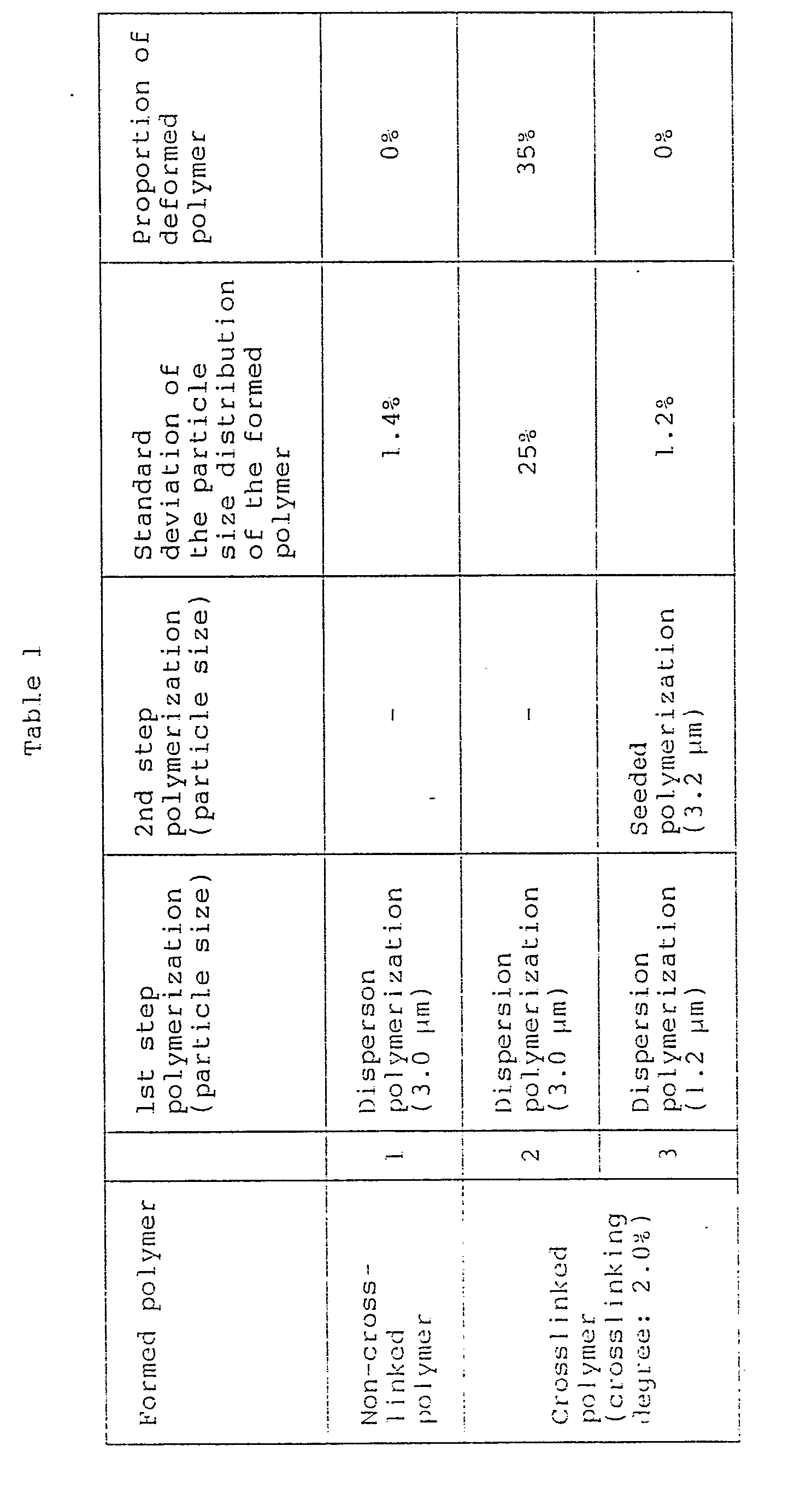
- As is evident from the above Table, in the production of non-crosslinked particles, the particles obtained by dispersion polymerization (No. 1 in the Table) are excellent in both the standard deviation of the particle size distribution and the proportion of the deformed polymer in the formed polymer particles, whereby there is no significance in conducting seeded polymerization wherein the polymerization is conducted in two steps. Whereas, in the production of crosslinked polymer, the significance of the seeded polymerization is remarkable.
- According to the present invention, in the first step, a polymerizable monomer containing a crosslinkable monomer is polymerized in a medium wherein the polymerizable monomer is soluble but the resulting polymer is insoluble, to obtain crosslinked polymer particles, and in the second step, the crosslinked polymer particles thus obtained are permitted to absorb a polymerizable monomer containing a crosslinkable monomer, followed by polymerization to obtain crosslinked polymer particles.
- As the polymerizable monomer useful for the first step of the present invention i.e. for the polymerization of the seed polymer, a common vinyl monomer may be mentioned. Specifically, an aromatic vinyl monomer such as styrene, a halogenated styrene or vinyl benzyl glycidyl ether, an ethylenically unsaturated carboxylic acid such as acrylic acid or methacrylic acid, an ethylenically unsaturated carboxylate such as methyl acrylate, methyl methacrylate, glycidyl acrylate, glycidyl methacrylate, 2-hydroxyethyl acrylate or 2(N,Nʹ-dimethylamino)ethyl methacrylate and an acrylamide may be mentioned.
- As the crosslinkable monomer useful for the polymerization of the seed polymer, an aromatic divinyl compound such as divinyl benzene, a diethylenically unsaturated carboxylate such as ethylene glycol dimethacrylate, an aliphatic diolefin compound such as 1,7-octadiene, a conjugated diolefin such as butadiene or isoprene and methylenebisacrylamide may be mentioned.
- In the present invention, the crosslinking degree of the seed polymer is usually within a range of from 0.1 to 2.0% by weight, preferably from 0.1 to 1.5% by weight, more preferably from 0.3 to 1.0% by weight.
- If the crosslinking degree is less than 0.1%, the product tends to contain a substantial amount of non-crosslinked polymer, whereby the deformation or coagulation is likely to take place during the seed polymerization, such being undesirable. On the other hand, if the crosslinking degree is higher than 2.0%, the deformation or coagulation of particles is likely to take place during the dispersion polymerization, whereby it will be difficult to obtain a spherical seed polymer.
- Here, the crosslinking degree means the proportion by weight of the crosslinkable monomer in the entire monomer. However, in the case of glycidyl acrylate or glycidyl methacrylate, a part of such a monomer serves as a crosslinkable monomer, and a suitable seed polymer may be obtained even when the crosslinking degree is less than the above-mentioned range.
- In the first step of the present invention, in order to obtain polymer particles having a desired particle size, it is necessary to properly select the solubility parameter of the medium. Namely, there is a tendency that the larger the difference between the solubility parameter of the resulting polymer particles and the solubility parameter represented by (ΔE/V)1/2 where ΔE is the evaporation heat of the medium to be used and V is the molecular volume thereof, the smaller the particle size of the resulting polymer particles. As the medium to be used in the present invention, a medium having its solubility parameter within a range of from 10.0 to 20.0 (cal/cm³)1/2, preferably from 10.6 to 16.5 (cal/cm³)1/2, may be employed. Specifically, it may be an alcohol such as methanol, ethanol, 2-propanol or 2-methyl-2-propanol, an alcohol having an ether linkage in its molecule such as 2-methoxy-ethanol, an ether such as tetrahydrofuran or dioxane or a mixture of such solvents with water.
- In the present invention, in order to moderate an abrupt change of the solubility parameter in the reaction system during the polymerization of the seed polymer, a diluent may be used as the case requires. The amount of such a diluent may vary depending upon the type and the amount of the polymerizable monomer, and the solubility parameter is preferably within a range of from 8.0 to 9.0 (cal/cm³)1/2. Specifically, cyclohexane or xylene may be mentioned.
- In the present invention, in order to prevent the coagulation, deformation or fusion of the resulting polymer particles and to increase the dispersion stability of the particles during the polymerization of the seed polymer, it is preferred to employ a dispersion stabilizer. As such a dispersion stabilizer, it is possible to employ synthetic polymer compounds such as various homopolymers, graftpolymers or blockpolymers or natural polymer compounds or their derivatives. Specifically, poly(vinyl pyrrolidone), poly(vinyl methyl ether), poly(ethyleneimine), poly(acrylic acid), copoly(vinyl alcohol-vinyl acetate), ethylcellulose and hydroxypropylcellulose may be mentioned. Further, in order to stabilize the polymerization and improve the dispersion stability during the polymerization of the seed polymer, it is also possible to employ an assisting stabilizer in addition to the above dispersion stabilizer. As such an assisting stabilizer, an anionic surfactant, nonionic surfactant, a quaternary ammonium salt or a long chain alcohol may be employed. Specifically, sodium di(2-ethylhexyl)sulfosuccinate.
nonylphenoxypolyethoxyethanol tricaprylylmethylammonium chloride and cetyl alcohol may be mentioned. Further, as a polymerization initiator which may preferably be used for the polymerization of the seed polymer of the present invention, an azopolymerization initiator such as 2,2ʹ-azobisisobutyronitrile,
4,4ʹ-azobis-(4-cyanopentanoic acid),
2,2ʹ-azobis-(2-methylbutyronitrile) or
2,2ʹ-azobis-(2,4-dimethylvaleronitrile) and a peroxide such as benzoyl peroxide, may be mentioned. - For the polymerization of the seed polymer in the present invention, the polymerization temperature is usually from 40 to 90°C, preferably from 60 to 80°C.
- For the second step of the present invention i.e. for enlarging the seed polymer, seed polymerization is employed.
- As the seed polymer useful for the seed polymerization of the present invention, a crosslinked polymer such as the styrene-type crosslinked polymer or the acryl type crosslinked polymer obtained in the first step may be mentioned.
- Such a seed polymer may be used in the form of a dispersion such as an emulsion or suspension.
- The particle size of the seed polymer may optionally be selected within a range of at least 1/4 of the particle size of the desired polymer. Further, it is also possible to use the polymer particles obtained in the present invention as a seed polymer for the subsequent step to obtain polymer particles having a larger size.
- In the present invention, it is preferred to impregnate a polymerization initiator to the seed polymer prior to the impregnation of the polymerizable monomer in order to prevent the formation of new particles. In such a case, the polymerization initiator is dissolved in a small amount of a solvent, and the solution is impregnated as oil drops finely dispersed in the aqueous dispersion of the seed polymer. The time for impregnating the polymerization initiator is usually a few hours. The solvent for the polymerization initiator must be the one having no solubility or an extremely low distribution coefficient to the dispersion medium of the seed polymer. Specifically, an aromatic compound such as benzene, toluene or xylene, or a halogenated aliphatic compound such as 1,2-dichloroethane or 1,1ʹ,2-trichloroethane may be mentioned.
- The polymerization initiator which may preferably be used for the seeded polymerization of the present invention, includes an azo-type polymerization initiator such as 2,2-azobisisobutyronitrile,
4,4ʹ-azobis(4-cyanopentanoic acid),
2,2ʹ-azobis(2-methylbutyronitrile) or
2,2ʹ-azobis(2,4-dimethylvaleronitrile) and a peroxide such as benzoyl peroxide, lauroyl peroxide, octanoyl peroxide or 3,3,5-trimethylhexanoyl peroxide. - The polymerizable monomer which may preferably be used for the seeded polymerization of the present invention, includes an aromatic vinyl monomer such as styrene, a halogenated styrene or vinyl benzyl glycidyl ether, an ethylenically unsaturated carboxylic acid such as acrylic acid or methacrylic acid, and an ethylenically unsaturated carboxylate such as methyl acrylate, methyl methacrylate, glycidyl acrylate, glycidyl methacrylate, 2-hydroxyethyl acrylate or 2(N,Nʹ-dimethylamino)ethyl methacrylate. These polymerizable monomers may be used alone or in combination as a mixture, depending upon the particular purpose.
- The crosslinkable monomer which may be used for the seeded polymerization of the present invention, includes an aromatic divinyl compound such as divinyl benzene, a diethylenically unsaturated carboxylate such as ethylene glycol methacrylate, an aliphatic diolefin compound such as 1,7-octadiene and a conjucated diolefin such as butadiene or isoprene.
- The crosslinking degree of the charge in the seeded polymerization of the present invention is from 1 to 100%.
- Further, it is possible to obtain porous polymer particles by adding a suitable pore-forming solvent to the monomer phase during the seeded polymerization. As the pore-forming solvent, it is preferred to employ an organic solvent having a small ability of swelling the resulting polymer particles. Further, for the preparation of the dispersion, it is preferred to employ a dispersion stabilizer in order to improve the dispersibility. As such a dispersion stabilizer, a known stabilizer may be employed. For example, an anionic surfactant such as sodium dodecylbenzene sulfonate, sodium lauryl sulfate or sodium dialkyl sulfosuccinate may be mentioned. Further, a non-ionic surfactant such as poly(oxyethylene nonyl phenyl ether), poly(ethylene glycol monostearate) or sorbitan monostearate, or a synthetic polymer compound such as poly(vinyl pyrrolidone), poly(ethyleneimine) or a copoly(vinyl alcohol-vinyl acetate), may be used together.
- In the present invention, in order to prevent the coagulation, deformation or fusion of the seeded polymer enlarged upon absorption of the (polymerization) initiator and the polymerizable monomer and to increase the dispersion stability of the polymer during the seeded polymerization, it is necessary to use a dispersion stabilizer. As such a dispersion stabilizer, a conventional anionic or nonioic surfactant may be used. Further, such a surfactant may be used in combination with a synthetic polymer compound such as polyvinyl pyrrolidone, polyethyleneimine or a vinyl alcohol-vinyl acetate copolymer.
- For the seeded polymerization of the present invention, the polymerization temperature is usually from 40 to 90°C, preferably from 50 to 80°C.
- Now, the present invention will be described in further detail with reference to Examples. However, it should be understood that the present invention is by no means restricted by these specific Examples. In these Examples, "%" means "% by weight".
- 1.8 g of poly(vinyl pyrrolidone) K-30 (manufactured by Tokyo Kasei Kogyo K.K., average molecular weight: 40,000), 0.5 g of sodium di-2-ethylhexyl sulfosuccinate, 12.5 g of styrene monomer, 0.08 g of divinyl benzene and 0.13 g of 2,2ʹ-azobisisobutyronitrile were dissolved in a solvent mixture comprising 2.5 g of ethanol and 13 g of cyclohexane and polymerized at 70°C for 8 hours under nitrogen stream. The conversion by this polymerization was 95%. The polymer particles obtained by this polymerization were observed by a scanning electron microscope, whereby they were found to be spherical particles having an extremely high monodisperse nature with a particle size of 2.0 µm and a standard deviation of 1.0%. By using the particles as the seed polymer, the following opration was conducted.
- Firstly, 0.015 g of 2,2ʹ-azobis(2,4-dimethylvaleronitrile), 0.035 g of toluene and 2 x 10⁻⁴ g of sodium alkyldiphenyl ether disulfonate "Pelex SS-H" (manufactured by Kao Corporation) and 1 g of water were mixed, emulsified and finely dispersed so that the particle size of oil drops became at most 0.5 µm. This dispersion was added to an aqueous dispersion prepared by emulsifying 1 g of the mono disperse polystyrene having a crosslinking degree of 0.6% and a particle size of 2.0 µm obtained in the previous polymerization, 0.01 g of sodium alkyldiphenyl ether solfonate "Pelex SS-H" and 9 g of water. The mixture was slowly stirred at room temperature for two hours to let the seed polymer absorb the dispersed oil drops containing the polymerization initiator.
- Then, the aqueous dispersion of this seed polymer was added to 48 g of a 0.1% aqueous solution of sodium alkyldiphenyl ether sulfonate "Pelex SS-H". Further, 3.5 g of styrene and 1.3 g of divinyl benzene were added thereto, and the mixture was slowly stirred at 30°C for one hour to let the seeds polymer absorb the monomer, followed by polymerization at 60°C for 7 hours and at 70°C for one hour.
- The polymer particles obtained by the above polymerization were observed by a scanning electron microscope, whereby they were found to be spherical particles having an extremely high monodisperse nature with a particle size of 3.0 µm and a standard deviation of 1.2%. The crosslinking degree of the polymer particles thus obtained was determined by a pyrolysis gas chromatography and found to be 0.9%, which indicates that the seed polymerization proceeded satisfactorily in view of the fact that the conversion by this polymerization was 75%.
- 1.8 g of poly(vinyl pyrrolidone) K-30, 0.5 g of sodium di-2-ethylhexyl sulfosuccinate. 5.6 g of styrene monomer, 0.084 g of divinyl benzene and 0.057 g of 2,2ʹ-azobisisobutyronitrile were dissolved in a solvent mixture comprising 74.9 g of ethanol and 17.1 g of cyclohexane and polymerized at 70°C for 8 hours under a nitrogen gas stream. The conversion by this polymerization was 90%. The polymer particles obtained by this polymerization were observed by a scanning electron microscope, whereby they were found to be spherical particles having an extremely high monodisperse nature with a particle size of 1.2 µm and a standard deviation of 2.0%. By using these particles as the seed polymer, the following operation was conducted.
- Firstly, 0.015 g of 2,2ʹ-azobis(2,4-dimethylvaleronitrile), 0.035 g of toluene, 2 x 10⁻⁴ g of sodium alkyldiphenyl ether disulfonate "Pelex SS-H" and 1 g of water were emulsified and finely dispersed so that the particle size of oil drops became at most 0.5 µm. This dispersion was added to an aqueous dispersion prepared by emulsifying 1 g of the monodisperse polystyrene having a crosslinking degree of 1.5% and a particle size of 1.2 µm obtained by the previous polymerization, 0.01 g of sodium alkyldiphenyl ether sulfonate "Pelex SS-H" and 9 g of water. The mixture was slowly stirred at room temperature for two hours to let the seed polymer absorb the dispersed oil drops.
- Then, the aqueous dispersion of this seed polymer was added to 50 g of a 0.1% aqueous solution of sodium alkyldiphenyl ether sulfonate "Pelex SS-H". Further, 4.4 g of styrene and 0.6 g of divinyl benzene were added thereto, and the mixture was slowly stirred at 30°C for one hour to let the seed polymer absorb the monomer, followed by polymerization at 60°C for 7 hours and at 70°C for one hour.
- The polymer particles obtained by the above polymerization were observed by a scanning electron microscope, whereby they were found to be spherical particles having an extremely high monodisperse nature with a particle size of 2 µm and a standard deviation of 2.1%. Further, the crosslinking degree of the polymer particles thus obtained were determined by a pyrolysis gas chromatography and found to be 9.0%. The conversion by this seeded polymerization was 70%.
- 1.8 g of poly(vinyl pyrrolidone) K-30, 0.5 g of sodium di-2-ethylhexyl sulfosuccinate, 20 g of styrene monomer, 0.12 g of divinyl benzene and 0.21 g of 2,2ʹ-azobisisobutyronitrile were dissolved in a solvent mixture comprising 35 g of ethanol and 42 g of xylene and polymerized at 70°C for 8 hours under a nitrogen gas stream. The conversion by this polymerization was 85%. The polymer particles obtained by this polymerization were observed by a scanning electron microscope, whereby they were found to be spherical particles having an extremely high monodisperse nature with a particle size of 6.0 µm and a standard deviation of 2.3%. By using the particles as the seed polymer, the following operation was conducted.
- Firstly, 0.015 g of 2,2ʹ-azobis(2,4-dimethylvaleronitrile), 0.035 g of toluene, 2 x 10⁻⁴ g of sodium alkyldiphenyl ether disulfonate "Pelex SS-H" and 1 g of water were emulsified and finely dispersed so that the particle size of oil drops became at most 0.5 µm. This dispersion was added to an aqueous dispersion obtained by emulsifying 1 g of the mono disperse polystyrene having a crosslinking degree of 0.6% and a particle size of 6.0 µm obtained by the previous polymerization, 0.01 g of sodium alkyldiphenyl ether sulfonate "Pelex SS-H" and 9 g of water. The mixture was slowly stirred at room temperature for two hours to let the seed polymer absorb the dispersed oil drops.
- Then, the aqueous dispersion of this seed polymer was added to 31.6 g of a 0.1% aqueous solution of sodium alkyldiphenyl ether sulfonate "Pelex SS-H". Further, 29.6 g of styrene and 2.0 g of divinyl benzene were added thereto, and the mixture was slowly stirred at 30°C for one hour to let the seed polymer absorb the monomer. Then, the polymerization was conducted at 60°C for 7 hours at at 70°C for one hour.
- The polymer particles obtained by the above polymerization were observed by a scanning electron microscope, whereby they were found to be spherical particles having an extremely high monodisperse nature with a particle size of 18 µm and a standard deviation of 2.6%. Further, the crosslinking degree of the polymer particles thus obtained were determined by a pyrolysis gas chromatography and found to be 5.0%. The conversion by this seeded polymerization was 80%.
- 1.8 g of poly(vinyl pyrrolidone) K-30, 0.5 g of sodium di-2-ethylhexyl sulfosuccinate, 12.5 g of styrene monomer, 0.08 g of divinyl benzene and 0.13 g of 2,2ʹ-azobisisobutyronitrile were dissolved in a solvent mixture comprising 72.5 g of ethanol and 13 g of cyclohexane and polymerized at 70°C for 8 hours under a nitrogen gas stream. The conversion by this polymerization was 95%. The polymer particles obtained by this polymerization were observed by a scanning electron microscope, whereby they were found to be spherical particles having an extremely high monodisperse nature with a particle size of 2.0 µm and a standard deviation of 1.0%. By using the particles as the seed polymer, the following operation was conducted.
- Firstly, 0.015 g of 2.2ʹ-azobis(2,4-dimethyl valeronitrile), 0.035 g of toluene, 2 x 10⁻⁴ g of sodium alkyldiphenyl ether disulfonate "Pelex SS-H" and 1 g of water were emulsified and finely dispersed so that the particle size of oil drops became at most 0.5 µm. This dispersion was added to an aqueous dispersion obtained by emulsifying 1 g of the monodisperse polystyrene having a crosslinking degree of 0.6% and a particle size of 2.0 µm obtained by the previous polymerization, 0.01 g of sodium alkyldiphenyl ether sulfonate "Pelex SS-H" and 9 g of water. The mixture was slowly stirred at room temperature for two hours to let the seed polymer absorb the dispersed oil drops.
- Then, the aqueous dispersion of this seed polymer was added to an aqueous solution comprising 0.02 g of polyvinyl pyrrolidone K-30, 8 x 10⁻³ g of di-2-ethylhexyl sulfosuccinate and 28 g of water. Further, 0.7 g of styrene and 2.1 g of divinyl benzene were added thereto, and the mixture was slowly stirred at 30°C for one hour to let the seed polymer absorb the monomer. Then, the polymerization was conducted at 60°C for 7 hours and at 70°C for one hour.
- The polymer particles obtained by the above polymerization were observed by a scanning electron microscope, whereby they were found to be spherical particles having an extremely high monodisperse nature with a particle size of 3.1 µm and a standard deviation of 1.5%. Further, the crosslinking degree of the polymer particles thus obtained were determined by a pyrolysis gas chromatography and found to be 43%. The conversion of this seeded polymerization was 78%.
- 1.8 g of poly(vinyl pyrrolidone) K-30, 12.5 g of styrene monomer, 0.08 g of divinyl benzene, 0.13 g of glycidyl methacrylate and 0.13 g of 2,2ʹ-azobisisobutyronitrile were dissolved in a solvent mixture comprising 60 g of ethanol and 25.4 g of cyclohexanone and polymerized at 70°C for 8 hours under a nitrogen stream. The conversion by this polymerization was 80%. The polymer particles obtained by this polymerization were observed by a scanning electron microscope, whereby they were found to be spherical particles having an extremely high monodisperse nature with a particle size of 4 µm and a standard deviation of 2.8%. By using the particles as the seed polymer, the following operation was conducted.
- Firstly, 0.015 g of 2,2ʹ-azobis(2,4-dimethyl valeronitrile), 0.035 g of toluene, 2 x 10⁻⁴ g of sodium alkyldiphenyl ether disulfonate "Pelex SS-H" were emulsified and finely dispersed so that the particle size of oil drops became at most 0.5 µm. This dispersion was added to an aqueous dispersion obtained by emulsifying 1 g of the monodisperse copoly(styrene-divinyl benzene-glycidyl methacrylate) having a crosslinking degree of 0.6% and a particle size of 4 µm obtained by the previous polymerization, 0.01 g of sodium alkyldiphenyl ether, disulfonate "Pelex SS-H" and 9 g of water. The mixture was slowly stirred at room temperature for two hours to let the seed polymer absorb the dispersed oil drops.
- Then, the aqueous dispersion of this seed polymer was added to an aqueous solution comprising 0.02 g of polyvinyl pyrrolidone K-30, 8 x 10⁻³ g of di-2-ethylhexyl sulfosuccinate and 21 g of water. Further, 1.2 g of styrene and 0.92 g of divinyl benzene were added thereto, and the mixture was slowly stirred at 30°C for one hour to let the seed polymer absorb the monomer. Then, the polymerization was conducted at 60°C for 7 hours and at 70°C for one hour.
- The polymer particles obtained by the above polymerization were observed by a scanning electron microscope, whereby they were found to be spherical particles having an extremely high monodisperse nature with a particle size of 5 µm and a standard deviation of 3.0%. Further, the crosslinking degree of the polymer particles thus obtained were determined by a pyrolysis gas chromatography and found to be 24%. The conversion by this seeded polymerization was 83%.
- The polymerization was conducted in the same manner as in Example 5 except that 0.13 g of 2-(N,Nʹ-dimethyl)ethyl methacrylate was used instead of glycidyl methacrylate in Example 5.
- The particle size of the seed polymer obtained, its standard deviation and the conversion by the polymerization as well as the particle size of the polymer particles enlarged by the seed polymerization, its standard deviation, the conversion by the seed polymerization and the crosslinking degree determined by the pyrolysis gas chromatography are shown in Table 2.
- The polymerization was conducted in the same manner as in Example 5 except that 0.13 g of chloromethyl styrene was used instead of glycidyl methacrylate in Example 5.
- The particle size of the seed polymer obtained, its standard deviation and the conversion by the polymerization as well as the particle size of the polymer particles enlarged by the seeded polymerization, its standard deviation, the conversion by the seed polymerization and the crossliking degree determined by the pyrolysis gas chromatography are shown in Table 2.
- The polymerization was conducted in the same manner as in Example 5 except that 0.13 g of vinyl benzyl glycidyl ether was used instead of glycidyl methacrylate in Example 5.
- The particle size of the seed polymer obtained, its standard deviation and the conversion by the polymerization as well as the particle size of the polymer particles enlarged by the seeded polymerization, its standard deviation, the conversion by the seeded polymerization and the crosslinking degree determined by the pyrolysis gas chromatography are shown in Table 2.

- 1.8 g of poly(vinyl pyrrolidone) K-30, 12.5 g of glycidyl methacrylate, 0.01 g of ethylene glycol dimethacrylate and 0.13 g of 2,2ʹ-azobisisobutyronitrile were dissolved in a solvent mixture comprising 73.0 g of ethanol and 12.5 g of cyclohexane and polymerized at 70°C for 8 hours under a nitrogen gas stream. The conversion by the polymerization was 98%. The polymer particles obtained by this polymerization were observed by a scanning electron microscope, whereby they were found to be spherical particles having an extremely high monodisperse nature with a particle size of 1.6 µm and a standard deviation of 1.0%. By using the particles as the seed polymer, the following operation was conducted.
- Firstly, 0.36 g of 2,2ʹ-azobisisobutyronitrile, 36.6 g of ethylene glycol dimethacrylate, 43.8 g of 1,2-dichloroethane, 0.66 g of sodium dodecylsulfate and 280 g of water were finely dispersed so that the particle size of oil drops became at most 0.5 µm. This emulsion was dropwise added at room temperature over a period of two hours to an aqueous dispersion comprising 5.0 g of the monodisperse copoly(glycidyl methacrylate-ethylene glycol dimethacrylate) having a crosslinking degree of 0.1% and a particle size of 1.6 µm obtained by the previous polymerization, 0.01 g of sodium dodecylsulfate and 124 g of water. The mixture was further slowly stirred at the same temperature for 12 hours to let the seed polymer absorb the oil drops. Then, 30.5 g of a 3% poly(vinyl alcohol) aqueous solution was added thereto, and the polymerization was conducted at 70°C for 8 hours under a nitrogen gas stream. The final conversion by this polymerization was 93%. The polymer particles thus obtained were porous particles having a specific surface area of 10.50 m²/g as measured by BET method. The polymer particles obtained by this polymerization were observed by a scanning electron microscope, whereby they were found to have an extremely high monodisperse nature with a particle size of 3.2 µm and a standard deviation of 1.9%.
- 1.8 g of poly(vinyl pyrrolidone) K-30 (manufactured by Tokyo Kasei K.K., average molecular weight: 40,000), 12.5 g of glycidyl methacrylate, 0.005 g of ethylene glycol dimethacrylate and 0.13 g of 2,2ʹ-azobisisobutyronitrile were dissolved in a solvent mixture comprising 73.0 g of ethanol and 12.5 g of cyclohexane and polymerized at 70°C for 8 hours under a nitrogen gas stream. The conversion by this polymerization was 98%. The polymer particles obtained by this polymerization were observed by a scanning electron microscope, whereby they were found to be spherical particles having an extremely high monodisperse nature with a particle size of 1.4 µm and a standard deviation of 1.0%. By using the particles as the seed polymer, the following operation was conducted.
- Firstly, 0.36 of 2,2ʹ-azobisisobutyronitrile, 32.9 g of ethylene glycol dimethacrylate, 3.7 g of glycerin monomethacrylate, 43.8 g of 1,2-dichloroethane, 0.66 g of sodium dodecylsulfate and 280 g of water were finely dispersed so that the particle size of oil drops became at most 0.5 µm. This dispersion was dropwise added at room temperature over a period of two hours to an aqueous dispersion comprising 5.0 g of the monodisperse copoly(glycidyl methacrylate-ethylene glycol dimethacrylate) having a crosslinking degree of 0.05% and a particle size of 1.4 µm obtained by the previous polymerization, 0.01 g of sodium dodecylsulfate and 124 g of water. The mixture was further slowly stirred at the same temperature for 12 hours to let the seed polymer absorb the oil drops.
- Then, 30.5 g of a 3% poly(vinyl alcohol) aqueous solution was added thereto, and the polymerization was conducted at 70°C for 8 hours under a nitrogen gas stream to obtain particles with a final conversion by polymerization of 90%.
- The polymer particles obtained by this polymerization were observed by a scanning electron microscope, whereby they were found to have an extremely high monodisperse nature with a particle size of 3.2 µm and a standard deviation of 2.0%.
- The polymerization was conducted in the same manner as in Example 4 except that the amount of the divinyl benzene was changed to 0.04 g from 0.08 g in the production of the seed polymer in Example 4, to obtain spherical particles having an extremely high monodisperse nature with a particle size of 2.0 µm and a standard deviation of 1.0%. By using the particles as the seed polymer, the following operation was conducted.
- Firstly, 1.6 g of benzoyl peroxide, 158 g of toluene, 105 g of ethylene glycol dimethacrylate, 4.6 g of sodium dodecylsulfate and 2,000 g of water were finely dispersed so that the particle size of oil drops became at most 0.5 µm. 260 g of the dispersion thus obtained was dropwise added at 50°C over a period of 10 minutes to an aqueous dispersion comprising 1.5 g of the monodisperse copoly(styrene-divinyl benzene) having a crosslinking degree of 0.3% and a particle size of 2.0 µm obtained by the previous polymerization, 0.15 g of sodium dodecylsulfate and 15 g of water. The mixture was further stirred slowly at the same temperature for one hour to let the seed polymer absorb the dispersed oil drops.
- Then, 220 g of a 3% poly(vinyl alcohol) aqueous solution was added thereto, and the polymerization was conducted at 80°C for 8 hours under a nitrogen gas stream. The final conversion by the polymerization was 90%. The particles thereby obtained were porous particles having a specific surface area of 350 m²/g as measured by BET method.
- The polymer particles obtained by this polymerization were observed by a scanning electron microscope, whereby they were found to have an extremely high monodisperse nature with a particle size of 4.0 µm and a standard deviation of 2.4%.
- 1.8 g of poly(vinyl pyrrolidone) K-30, 30 g of glycidyl methacrylate and 0.3 g of 2,2ʹ-azobisisobutyronitrile were dissolved in 67.9 g of ethanol and polymerized at 70°C for 8 hours under a nitrogen gas stream. The conversion by this polymerization was 95%. The polymer particles obtained by this polymerization were observed by a scanning electron microscope, whereby they were found to be spherical particles having an extremely high monodisperse nature with a particle size of 2.5 µm and a standard deviation of 2.0%. By using the particles as the seed polymer, the following seeded polymerization was conducted.
- Firstly, 0.004 g of 2,2ʹ-azobisisobutyronitrile, 40 g of ethylene glycol dimethacrylate, 40 g of 1,2-dichloroethane, 0.77 g of sodium dodecylsulfate and 320 g of water were finely dispersed so that the particle size of dispersed oil drops became at most 0.5 µm. The dispersion was dropwise added at room temperature over a period of two hours to an aqueous dispersion comprising 5.0 g of the crosslinked poly(glycidyl methacrylate) having a particle size of 2.5 µm obtained by the previous polymerization, 0.01 g of sodium dodecylsulfate and 50 g of water. The mixture was further slowly stirred at the same temperature for 12 hours to let the seed polymer absorb the oil drops.
- Then, 166 g of a 3% poly(vinyl alcohol) aqueous solution was added thereto, and the polymerization was conducted at 70°C for 8 hours under a nitrogen gas stream to obtain porous particles with a final conversion by polymerization of 92%.
- The polymer particles obtained by this polymerization were observed by a scanning electron microscope, whereby they were found to have an extremely high monodisperse nature with a particle size of 4.9 µm and a standard deviation of 2.8%.
- 10 g of the polymer obtained in Example 1 was poured into 50 g of 1,2-dichloroethane, maintained at a temperature of 80°C for 5 hours and then collected by filtration. The polymer thus obtained was added to 80 g of 98% sulfuric acid and maintained at a temperature of 80°C for 8 hours for sulfonation. After completion of the reaction, deionized water was added to bring the sulfuric acid concentration to a level of not higher than 30%, and a 10% Na₂CO₃ aqueous solution was added thereto to neutralize the system. Then, 20 g of a 2% NaClO aqueous solution was added thereto, and the mixture was thoroughly stirred and then subjected to filtration. The resin thus obtained was maintained in water at 95°C for 5 hours to obtain a styrene type cation exchange resin having sulfonic groups quantitatively.
- The ion exchange capacity of the ion exchange resin prepared in the above manner was 4.0 meq/g.
- By using the styrene type cation exchange resin having sulfonic groups thus prepared, the separation of an amino acid mixture comprising aspartic acid, serine, glutamic acid and glycine was conducted by ion exchange chromatography according to an isoclatic elution method.
- The elution times of the respective amino acids were 15 minutes (aspartic acid), 18 minutes (serine), 22.5 minutes (glutamic acid) and 29 minutes (glycine), and thus a chromatogram showing excellent separation performance was obtained.
- The ion exchange chromatography apparatus according to the isoclatic elution method was LC-3A system by Shimadzu Corporation. Further, the measuring conditions were as follows.
- Column: 4.6 mmID x 150 mm
Flow rate: 0.5 mm/ml
Elution: Isoclatic-sodium citrate type buffer
Reaction: Sodium hypochlorite-OPA
Detection: Flourescence method (Ex. 360 nm, Em. 450 nm)
Temperature: 60°C - The polymer particles obtained in Example 11, were packed in a column, and the separation of phthalates by reversed phase chromatography according to the isoclatic elution method was conducted.
- The elution times of the respective phthalates were 3.6 minutes (dimethyl phthalate), 4.4 minutes (diethyl phthalate) and 8.0 minutes (dibutyl phthalate), and thus a chromatogram showing excellent separation performance was obtained.
- The measuring conditions are shown below.
- Column: 7.5 mmID x 75 mm
Flow rate: 0.8 ml/min
Elution: Isoclatic 65 v/v% acetonitrile aqueous solution
Detection: UC 254 nm
Temperature: 25°C - According to the present invention, the particle size of the seed polymer obtained in the first step is large, whereby the degree of enlargement in the seed polymerization may be small. Namely, the amount of the polymerizable monomer to be absorbed to the seed polymer may be controlled to a level of not higher than 50 times by volume relative to the seed polymer particles. Accordingly, the impregnation of the polymerization initiator and the polymerizable monomer can be conducted in a substantially shorter period of time than the conventional methods, and yet it is possible to certainly produce crosslinked polymer particles having particularly excellent monodisperse nature. Further, in the present invention, a crosslinked polymer is used as the seed polymer, whereby production of gel-type polymer particles is possible, and besides, in order to form an interpenetrating polymer network system, the same effect can be attained with a lower crosslinking degree than the usual crosslinking degree. Further, it is also possible to increase the physical strength of the particles. Furthermore, as the degree of enlargement of the seed polymer can be reduced, the properties of the seed polymer can be reflected in the enlarged particles.
- The polymer particles produced by the process of the present invention are polymer particles having optional crosslinking degree and particle size within the ranges of a crosslinking degree of from 2.0 to 98% and a particle size of from 1 to 30 µm and having a narrow particle size distribution.
- The polymer particles obtained by the process of the present invention are useful in various fields. For example, they may be used as carriers for various chromatographies, as standard samples for microscopic inspection, as model materials for separation, liquid flow, centrifugal separation, difusion measurement and dust study, as carriers for biomedical diagnosis reagents, as carriers for immobilized enzymes, as powder inks, as toners for electrostatic development, as coating materials, as powder lubricants, as modifiers for sensitive agent layers, as spacer materials for protecting microcapsules of a pressure sensitive copying papers, as spacers for liquid crystal cells, as plastic pigments for wall papers, as plastic pigments for adhesives, as binders for ceramics, as base polymer particles for impact resistance resins, or as the plastic pigments for cosmetics.
- The resin of the present invention is particularly suitable for use as a carrier for liquid chromatography. For example, it is usuful as a carrier for amino acid analysis as a separating agent for proteins, as a carrier for ion chromatography, or as a carrier for polymer type reversed phase column chromatography.
- When the polymer particles obtained by the present invention were used as a carrier for chromatography, they exhibited excellent separating performance by virtue of the uniformity of the particle size.
Claims (26)
Applications Claiming Priority (2)
| Application Number | Priority Date | Filing Date | Title |
|---|---|---|---|
| JP9952487 | 1987-04-22 | ||
| JP99524/87 | 1987-04-22 |
Publications (3)
| Publication Number | Publication Date |
|---|---|
| EP0288006A2 true EP0288006A2 (en) | 1988-10-26 |
| EP0288006A3 EP0288006A3 (en) | 1990-08-22 |
| EP0288006B1 EP0288006B1 (en) | 1994-03-23 |
Family
ID=14249620
Family Applications (1)
| Application Number | Title | Priority Date | Filing Date |
|---|---|---|---|
| EP88106224A Expired - Lifetime EP0288006B1 (en) | 1987-04-22 | 1988-04-19 | Process for producing crosslinked polymer particles |
Country Status (4)
| Country | Link |
|---|---|
| US (2) | US4908392A (en) |
| EP (1) | EP0288006B1 (en) |
| DE (1) | DE3888564T2 (en) |
| NO (1) | NO170730C (en) |
Cited By (7)
| Publication number | Priority date | Publication date | Assignee | Title |
|---|---|---|---|---|
| EP0399729A3 (en) * | 1989-05-23 | 1991-09-25 | ILFORD Limited | Preparation of polymer dispersions and photographic elements containing polymer particles |
| US5231115A (en) * | 1991-12-19 | 1993-07-27 | The Dow Chemical Company | Seeded porous copolymers and ion-exchange resins prepared therefrom |
| WO2003064478A3 (en) * | 2002-01-25 | 2004-12-09 | Phenomenex Inc | Surface graft modified resins and formation thereof |
| WO2005075530A3 (en) * | 2004-02-06 | 2005-12-22 | Lanxess Deutschland Gmbh | Method for the production of monodispersed ion exchangers containing pores |
| EP0897939B1 (en) * | 1997-08-20 | 2006-02-22 | Agfa-Gevaert N.V. | Process for preparation of spherical polymers |
| DE102005021335A1 (en) * | 2005-05-04 | 2006-11-09 | Röhm Gmbh | Process for the preparation of bead polymers having a mean particle size in the range of 1 .mu.m to 40 .mu.m, and molding compositions and moldings comprising bead polymer |
| EP4373599A4 (en) * | 2021-07-20 | 2025-06-25 | Ion Exchange (India) Limited | TWO-COMPONENT ION EXCHANGE RESINS |
Families Citing this family (17)
| Publication number | Priority date | Publication date | Assignee | Title |
|---|---|---|---|---|
| JP2728910B2 (en) * | 1988-12-27 | 1998-03-18 | 三井東圧化学株式会社 | Method for producing synthetic resin particles having small holes |
| US5214075A (en) * | 1989-10-06 | 1993-05-25 | Cassella Aktiengesellschaft | Hydrophilic, swellable polymers |
| DE3933351A1 (en) * | 1989-10-06 | 1991-04-18 | Cassella Ag | HYDROPHILIC, SOURCEABLE POLYMERISATE |
| DE3936596A1 (en) * | 1989-11-03 | 1991-05-08 | Basf Ag | EXPANDABLE STYRENE POLYMERISATES AND AROMAT-RESISTANT FOAMS MADE THEREOF |
| JPH03210336A (en) * | 1990-01-16 | 1991-09-13 | Nippon Paint Co Ltd | Production of crosslinked resin particle |
| US5380536A (en) | 1990-10-15 | 1995-01-10 | The Board Of Regents, The University Of Texas System | Biocompatible microcapsules |
| DE4038042A1 (en) * | 1990-11-29 | 1992-06-04 | Basf Ag | OIL-RESISTANT EXPANDABLE STYRENE POLYMERS |
| US5216096A (en) * | 1991-09-24 | 1993-06-01 | Japan Synthetic Rubber Co., Ltd. | Process for the preparation of cross-linked polymer particles |
| US5252620A (en) * | 1991-11-15 | 1993-10-12 | University Of Akron | Microcellular foams |
| KR960001417B1 (en) * | 1992-09-26 | 1996-01-27 | 한국과학기술원 | Synthesis of Improved Porous Polymer Carrier |
| JPH0989857A (en) * | 1995-09-21 | 1997-04-04 | Procter & Gamble Co:The | Method for analyzing polyvinylpyrrolidone |
| DE19634393A1 (en) * | 1996-08-26 | 1998-03-05 | Bayer Ag | Process for the preparation of crosslinked polymers |
| US20030148073A1 (en) * | 2001-12-20 | 2003-08-07 | Eastman Kodak Company | Porous organic particles for ink recording element use |
| NZ523249A (en) * | 2002-12-16 | 2005-04-29 | Mattersmiths Holdings Ltd | Method of delivering compositions to substrates |
| DE102004006115A1 (en) * | 2004-02-06 | 2005-08-25 | Bayer Chemicals Ag | Process for the preparation of monodisperse acrylic-containing bead polymers |
| DE102005035616A1 (en) * | 2005-07-29 | 2007-02-08 | Lanxess Deutschland Gmbh | Monodisperse cation exchanger |
| JP5487530B2 (en) * | 2006-01-27 | 2014-05-07 | Jsr株式会社 | Amorphous particles, irregularly shaped particle composition and production method thereof, and light diffusion molded article |
Family Cites Families (12)
| Publication number | Priority date | Publication date | Assignee | Title |
|---|---|---|---|---|
| US3743611A (en) * | 1966-06-08 | 1973-07-03 | Hitachi Ltd | Foamable thermoplastic beads and a process for the preparation thereof |
| JPS597729B2 (en) * | 1979-03-19 | 1984-02-20 | 鐘淵化学工業株式会社 | Method for producing expandable thermoplastic resin particles |
| US4419245A (en) * | 1982-06-30 | 1983-12-06 | Rohm And Haas Company | Copolymer process and product therefrom consisting of crosslinked seed bead swollen by styrene monomer |
| US4659600A (en) * | 1985-11-29 | 1987-04-21 | Atlantic Richfield Company | High strength foamed articles |
| US4652609A (en) * | 1985-11-29 | 1987-03-24 | Atlantic Richfield Company | Modified styrenic polymer beads |
| US4626554A (en) * | 1985-11-29 | 1986-12-02 | Atlantic Richfield Company | Process for producing modified styrenic polymer beads for high strength foamed articles |
| US4622346A (en) * | 1985-11-29 | 1986-11-11 | Atlantic Richfield Company | Process for producing modified styrenic polymer beads for high strength foamed articles |
| US4661564A (en) * | 1985-11-29 | 1987-04-28 | Atlantic Richfield Company | Modified styrenic polymer beads |
| US4661386A (en) * | 1985-11-29 | 1987-04-28 | Atlantic Richfield Company | High strength foamed articles |
| US4659745A (en) * | 1985-11-29 | 1987-04-21 | Atlantic Richfield Company | Process for producing modified styrenic polymer beads for high strength foamed articles |
| US4659000A (en) * | 1986-03-20 | 1987-04-21 | K Mart Corporation | Carrying case for dual instruments |
| US4663357A (en) * | 1986-05-12 | 1987-05-05 | Atlantic Richfield Company | Higher molecular weight thermoplastics having multimodal molecular weight distribution |
-
1988
- 1988-04-19 EP EP88106224A patent/EP0288006B1/en not_active Expired - Lifetime
- 1988-04-19 DE DE3888564T patent/DE3888564T2/en not_active Expired - Lifetime
- 1988-04-21 NO NO881728A patent/NO170730C/en not_active IP Right Cessation
-
1989
- 1989-03-27 US US07/329,289 patent/US4908392A/en not_active Expired - Lifetime
- 1989-03-27 US US07/329,279 patent/US4906698A/en not_active Expired - Lifetime
Cited By (7)
| Publication number | Priority date | Publication date | Assignee | Title |
|---|---|---|---|---|
| EP0399729A3 (en) * | 1989-05-23 | 1991-09-25 | ILFORD Limited | Preparation of polymer dispersions and photographic elements containing polymer particles |
| US5231115A (en) * | 1991-12-19 | 1993-07-27 | The Dow Chemical Company | Seeded porous copolymers and ion-exchange resins prepared therefrom |
| EP0897939B1 (en) * | 1997-08-20 | 2006-02-22 | Agfa-Gevaert N.V. | Process for preparation of spherical polymers |
| WO2003064478A3 (en) * | 2002-01-25 | 2004-12-09 | Phenomenex Inc | Surface graft modified resins and formation thereof |
| WO2005075530A3 (en) * | 2004-02-06 | 2005-12-22 | Lanxess Deutschland Gmbh | Method for the production of monodispersed ion exchangers containing pores |
| DE102005021335A1 (en) * | 2005-05-04 | 2006-11-09 | Röhm Gmbh | Process for the preparation of bead polymers having a mean particle size in the range of 1 .mu.m to 40 .mu.m, and molding compositions and moldings comprising bead polymer |
| EP4373599A4 (en) * | 2021-07-20 | 2025-06-25 | Ion Exchange (India) Limited | TWO-COMPONENT ION EXCHANGE RESINS |
Also Published As
| Publication number | Publication date |
|---|---|
| US4908392A (en) | 1990-03-13 |
| US4906698A (en) | 1990-03-06 |
| NO881728L (en) | 1988-10-24 |
| DE3888564T2 (en) | 1994-10-20 |
| NO170730C (en) | 1998-06-15 |
| DE3888564D1 (en) | 1994-04-28 |
| NO881728D0 (en) | 1988-04-21 |
| EP0288006A3 (en) | 1990-08-22 |
| EP0288006B1 (en) | 1994-03-23 |
| NO170730B (en) | 1992-08-17 |
Similar Documents
| Publication | Publication Date | Title |
|---|---|---|
| EP0288006B1 (en) | Process for producing crosslinked polymer particles | |
| US5292814A (en) | Process for the preparation of monodispersed polymer beads | |
| US5599889A (en) | Method of forming polymer microspheres | |
| KR100286528B1 (en) | Crosslinked Methacrylic Anhydride Copolymers | |
| EP0534057A1 (en) | Process for the preparation of crosslinked polymer particles | |
| CA2137360A1 (en) | An adiabatic process for the preparation of ion exchange and adsorbent copolymers | |
| US6239224B1 (en) | Method of production of particulate polymers | |
| CN111548444B (en) | Preparation method of surface ionic liquid functionalized polymer microspheres | |
| JPH07103206B2 (en) | Method for producing crosslinked polymer particles | |
| US7540962B2 (en) | Method of preparing spheroid polymer particles having a narrow size distribution by dispersion polymerization, particles obtainable by the method and use of these particles | |
| JPS61215603A (en) | Production of polymer particle | |
| Bamford et al. | Particulate precipitation polymerization: a convenient procedure for the synthesis of crosslinked polymers useful as polymeric supports | |
| JPH07149807A (en) | Method for producing cross-linked monodisperse polymer particles | |
| JP3087332B2 (en) | Packing material for liquid chromatography | |
| JP4009752B2 (en) | Self-activated polymer particles having a narrow particle size distribution and method for producing the same | |
| KR100993008B1 (en) | Method for producing polystyrene particles with uniform particle size distribution by precipitation polymerization method | |
| KR19990070970A (en) | Method for producing porous polymer particles | |
| JP3657448B2 (en) | Polymer packing material for liquid chromatography and process for producing the same | |
| KR100751598B1 (en) | Method for preparing vinyl polymer particles having various sizes and shapes by oil-free emulsion polymerization | |
| CA1325310C (en) | Process for the preparation of monodispersed polymer beads | |
| Sherrington | Preparation, modification and characterisation of polymer‐supported species | |
| JPH02126155A (en) | Separation column | |
| US6914100B2 (en) | Method of producing a crosslinked polymer particle | |
| JPH11271294A (en) | Spherical porous crosslinked polymer particles and method for producing the same | |
| KR100572014B1 (en) | Manufacturing method of polymer particles with uniform particle size distribution by seed polymerization |
Legal Events
| Date | Code | Title | Description |
|---|---|---|---|
| PUAI | Public reference made under article 153(3) epc to a published international application that has entered the european phase |
Free format text: ORIGINAL CODE: 0009012 |
|
| AK | Designated contracting states |
Kind code of ref document: A2 Designated state(s): CH DE FR GB LI SE |
|
| PUAL | Search report despatched |
Free format text: ORIGINAL CODE: 0009013 |
|
| AK | Designated contracting states |
Kind code of ref document: A3 Designated state(s): CH DE FR GB LI SE |
|
| 17P | Request for examination filed |
Effective date: 19901102 |
|
| 17Q | First examination report despatched |
Effective date: 19920406 |
|
| GRAA | (expected) grant |
Free format text: ORIGINAL CODE: 0009210 |
|
| AK | Designated contracting states |
Kind code of ref document: B1 Designated state(s): CH DE FR GB LI SE |
|
| PG25 | Lapsed in a contracting state [announced via postgrant information from national office to epo] |
Ref country code: LI Effective date: 19940323 Ref country code: CH Effective date: 19940323 |
|
| REF | Corresponds to: |
Ref document number: 3888564 Country of ref document: DE Date of ref document: 19940428 |
|
| ET | Fr: translation filed | ||
| REG | Reference to a national code |
Ref country code: CH Ref legal event code: PL |
|
| PLBE | No opposition filed within time limit |
Free format text: ORIGINAL CODE: 0009261 |
|
| STAA | Information on the status of an ep patent application or granted ep patent |
Free format text: STATUS: NO OPPOSITION FILED WITHIN TIME LIMIT |
|
| EAL | Se: european patent in force in sweden |
Ref document number: 88106224.4 |
|
| 26N | No opposition filed | ||
| REG | Reference to a national code |
Ref country code: GB Ref legal event code: IF02 |
|
| PGFP | Annual fee paid to national office [announced via postgrant information from national office to epo] |
Ref country code: GB Payment date: 20070326 Year of fee payment: 20 Ref country code: SE Payment date: 20070326 Year of fee payment: 20 |
|
| PGFP | Annual fee paid to national office [announced via postgrant information from national office to epo] |
Ref country code: DE Payment date: 20070606 Year of fee payment: 20 |
|
| PGFP | Annual fee paid to national office [announced via postgrant information from national office to epo] |
Ref country code: FR Payment date: 20070320 Year of fee payment: 20 |
|
| REG | Reference to a national code |
Ref country code: GB Ref legal event code: PE20 Expiry date: 20080418 |
|
| EUG | Se: european patent has lapsed | ||
| PG25 | Lapsed in a contracting state [announced via postgrant information from national office to epo] |
Ref country code: GB Free format text: LAPSE BECAUSE OF EXPIRATION OF PROTECTION Effective date: 20080418 |