EP0288131A2 - Fensterbriefumschlag mit Rückumschlag - Google Patents
Fensterbriefumschlag mit Rückumschlag Download PDFInfo
- Publication number
- EP0288131A2 EP0288131A2 EP88300910A EP88300910A EP0288131A2 EP 0288131 A2 EP0288131 A2 EP 0288131A2 EP 88300910 A EP88300910 A EP 88300910A EP 88300910 A EP88300910 A EP 88300910A EP 0288131 A2 EP0288131 A2 EP 0288131A2
- Authority
- EP
- European Patent Office
- Prior art keywords
- sheet means
- address
- outer sheet
- mailer
- Prior art date
- Legal status (The legal status is an assumption and is not a legal conclusion. Google has not performed a legal analysis and makes no representation as to the accuracy of the status listed.)
- Granted
Links
Images


Classifications
-
- B—PERFORMING OPERATIONS; TRANSPORTING
- B42—BOOKBINDING; ALBUMS; FILES; SPECIAL PRINTED MATTER
- B42D—BOOKS; BOOK COVERS; LOOSE LEAVES; PRINTED MATTER CHARACTERISED BY IDENTIFICATION OR SECURITY FEATURES; PRINTED MATTER OF SPECIAL FORMAT OR STYLE NOT OTHERWISE PROVIDED FOR; DEVICES FOR USE THEREWITH AND NOT OTHERWISE PROVIDED FOR; MOVABLE-STRIP WRITING OR READING APPARATUS
- B42D5/00—Sheets united without binding to form pads or blocks
- B42D5/02—Form sets
- B42D5/023—Continuous form sets
- B42D5/025—Mailer assemblies
Definitions
- One such method of design utilizes the following principles of manufacture.
- the recipient Upon receiving the document, the recipient first opens the document by removing three edges, previously perforated during manufacturing. The recipient then separates the left and right portions, by means of a perforation, and further separates the return portion, and encloses it into the provided return envelope, along with a bank check, in many cases.
- a hinged, or Flip Window is incorporated into the form during manufacture.
- This device is manufactured in such a way that is it hinged backward and down, and delivered to the initial mailer in this fashion.
- the original recipient's name and address (Outgoing Mail To) is computer printed on this flip window, while the Remit To (Return Mail To) information is imaged (during manufacture or by computer imaging) on the portion serving as the return envelope.
- the Flip Window is flipped closed during further processing, then the forms are processed as in the previously discussed practice. Recipient and remittance usage also are as in the previously discussed practice. This practice has several advantages for the initial mailer, Postal Serivce, and recipient fo the return mailing.
- the use of the Flip Window removes the outgoing address from the return envelope. This allows the initial mailing party to position both addresses in such a manner that the document may be processed more efficiently by the Postal Service. This can result in a discount of the postage fee, as well as faster delivery and return, thus possibly increasing cash flow for the business. Additionally, the Flip Window can be positioned in a location which provides for a return document processible by Optical Character Reader (OCR) equipment, thus increasing the rate of processing remittances.
- OCR Optical Character Reader
- the flip window usually is limited by existing maufacturing constraints to a 2-3/4 inch/(7 cms) maximum width, which does not allow sufficient space for data entry in a fair number of cases, e.g. where the given and family names of two individuals are to be listed on the name line, or where the street address line must also contain a long building, floor or suite identifier, or more than one of these.
- the technique currently used for flipping-open the die-cut hinged window flap takes more time than preceding or succeeding steps, so that it acts as a bottleneck on the production line.
- the recipient of a mailer severs a marginal portion in order to separate a cover sheet, through a window of which the initial mail-to address label was visible, from a return envelope which, except for the initial mail-to address, has an upside-down orientation relative to the mailer.
- the recipient then turns the return envelope right-side-up which places the initial mail-to address in the upper left hand corner, upside down, as a from address, and places the return mail-to address (which was formerly hidden, in an inverted orientation, by the cover sheet, right-side-up in a customary position.
- the recipient detaches a remittance document from the separated cover sheet and places it in the return envelope, e.g. together with a bank check or other form of payment, seals the return envelope and mails it back.
- the stock for the mailer of the present invention most advantageously is manufactured out of indeterminate length webs of paper or the like which is furnished to the business or other institution in boxes or rolls containing a succession of serially connected segments, each of which will become an individual mailer.
- This stock usually has been pre-printed by the form stock manufacturer with most or all of the non-varying information which is to appear on each mailer, and the business or other institution, using a production line which may include a computerized printer, folder, heat sealer and severing device applies the varying information successively to each increment of the stock, folds the stock along a longitudinal line and heat-seals the two folded leaves together, and transversally severs the resulting composite into individual mailers ready for mailing.
- Many variables may be changed without departing from the principles of the invention, e.g. certain businesses or other institutions may wish to obtain the form stock already severed into individual segments.
- front and other terms, such as “top”, “left” and the like are used fairly arbitrarily herein, in reference to the various elements as they happen to be oriented in the drawing figures. No spatial limitation is intended by such reference, unless one appears from the context to be essential for successful use.
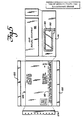
- the face 14 of the segment of the first sheet 10 which has just been designated the "front”, is the one which will at a later stage be folded along a longitudinal line to become the inside of the outer wrapper of the mailer.
- the segment 10 is shown made from a full-width web, so that it has a respective row of sprocket-receiving holes 16, 18 bordering its left edge 20 and its right edge 22, each of these rows being segregated onto a marginal strip 24, 26 by a respective longitudinally-running line of weakness 28, 30, e.g. a respective perforation line.
- the first sheet 10 is shown provided with a third longitudinal line of weakness 43(also, and like all of the others which will be described, typically being a line of perforations).
- top and bottom marginal strips 32, 34 are defined bordering the top and bottom edges 36, 38 of the sheet 10 by respective lines of weakness 40, 42.
- the medial line of weakness 43 divides the region of the sheet 10 bounded by the marginal strips 24, 26, 32, 34 into a left half and a right half (or more generically, a "first portion” and a “second portion”).
- the right half which is printed on this face in inverted relation to the left half and to its own opposite face, is shown in Figure 1 provided with a fourth longitudinal line of weakness 44 and a third transverse line of weakness 46, respectively positioned so as to define, together with the medial line of weakness 43 and the lower marginal strip-defining transverse line of weakness 40, a region 48, which, when later severed along those four lines of weakness will become a remittance document which is tall and wide enough to be read by a standard optical character reader, yet short and narrow enough to fit in the return envelope (to be described) without needing to be folded in either direction.
- the potential remittance document 48 occupies the northeastern quadrant.
- the southeastern quadrant is shown provided with a die-cut window aperture 50 elongated transversally of the web and having a standard size, shape and location. (I.e. on the completed mailer, as seen from the outside ( Figure 7), the window 50 will appear at the lower right, at a site suitable for having an address read therethrough by OCR and for example ZIP+4 automated mail sorting and routing equipment meeting existing Postal standards.)
- the first portion i.e. the left portion of the first sheet 10 is shown additionally provided with a fourth transverse line of weakness 52. It is spaced below the upper marginal strip-defining transverse line of weakness 40 by a small distance sufficient to define a discard strip 54, which the user will later tear off in order to expose the glued side of the return envelope glue flap (to be described), for folding down over the mouth of the envelope which mouth will be in part defined by the edge created at 52 when the discard strip 54 is torn off.
- the right portion of the sheet 10 is shown provided on the top, right and bottom marginal strips with a medially-open, squared C-shaped band 56 of heat sealable adhesive. (This will be activated at a later stage (to be described) to close the folded form stock on itself to complete an individual mailer.)
- the left portion of the sheet 10 is shown provided with two squared C-shaped bands of adhesive e.g. cold adhesive, including a first medially-open band 58 provided on the upper, left and lower marginal strips, and a second upwardly-open band 60 provided about the perimeter of the return envelope rear panel 62 which is delimited by the medial line of weakness 43, the lower marginal strip-defining line of weakness, and the potential return envelope mouth-defining line of weakness 52.
- the outer band 58 will be used by the forms manufacturer to marginally plate a second sheet (to be described) to the first sheet
- the inner band 60 which is embraced by the outer band, will be used by the forms manufacturer to marginally secure three margins of the front panel of the return envelope portion of the second sheet to the first sheet, as will be described.
- the window aperture 50 it will be acceptable for the window aperture 50 to remain open. In others, it is preferable or essential, whether for security, or for avoidance of processing problems that the window aperture 50 be glazed, e.g. by a patch 64 of glassine or other transparent, translucent or clear flexible sheet material, e.g. perimetrically glued by a band of adhesive 66 to the sheet 10, e.g. using the same type or adhesive as is used at 58, 60, the window in such an instance being glazed prior to application of the glue band 56 in order to avoid prematurely heat activating the latter while glazing the window 50.
- a patch 64 of glassine or other transparent, translucent or clear flexible sheet material e.g. perimetrically glued by a band of adhesive 66 to the sheet 10, e.g. using the same type or adhesive as is used at 58, 60
- Figure 2 depicts a rear elevational view of a second sheet 68 for the mailer, this sheet being constituted by a respective segment of a web having a longitudinal direction indicated by the arrow 70.
- the second sheet 68 is as tall as, but only half as wide as the first sheet 10. It is designed to be superimposed on the first sheet 10 so that its right marginal edge 72 coincides with the medial line of weakness 43 and its left marginal edge 74 coincides with the left marginal edge of the first sheet 10.
- Figure 2 and the left half of Figure 1 show the faces of the two respective sheets which will confront one another as the form stock is manufactured. Accordingly, the terms "left" and "right” are used in regard to the second sheet consistently with the Figures 1 and 3 orientations of the second sheet, rather than with the orientation which is shown in Figure 2.
- the second sheet 68 is shown provided with a row of sprocket holes 76 on its left marginal strip, which is delimited by a longitudinal line of perforations 78.
- Top and bottom transverse marginal strips 80, 82 are delimited by respective transverse lines of perforations 84, 86 and top and bottom edges 88, 90. All of the foregoing features are sized and placed to correspond thicknesswise of the form stock with the corresponding features of the left portion of the first sheet 10 as depicted in Figure 1.
- the second sheet 68 is shown provided with a transverse line of weakness 92 which divides the panel 94 which will form the front panel of the return envelope from the strip which will form the fold over and seal glue flap 98 of the return envelope.
- the glue flap 98 is shown provided on its rear face with a transversally extending band of rewettable adhesive 100.
- the first and second sheets of the form stock are plated together to produce the composite 102 shown in Figure 3, by registering the second sheet with the left portion of the first, and pressing the two together while the hot melt adhesive of the bands 58, 60 is in a heat-activated state.
- the forms manufacturer may print the return send-to address 112 directly on the front of the return envelope front panel, in a usual location, as shown, where it is available, when exposed, to be read manually, and by an OCR. It should be noted that this return send-to address is positioned to be totally out of registry with the aperture 50 when the mailer is in its Figure 4 condition.
- the business or other institution which is the forms manufacturer's customer receives the product in the form which is illustrated in Figure 3 (except that it may be in the form of a composite web of indeterminate length, and the form stock may or may not be already pre-folded on the medial line of weakness 43).
- the business or other institution variably prints on the face of the composite form that is exposed in Figure 3, (the portion containing the die cut), e.g. to apply data relating to transactions in a particular account of a particular intended recipient, and to apply the name and address of the intended recipient who is responsible for the particular account, i.e. an initial send-to address 114 to the front panel of the return envelope, in the southeast quadrant in an inverted relation to the returning mail-to address 112 which was pre-printed on the same panel.
- the variable information printed on the right half of the sheet 10 at this stage preferably has the same orientation as the return "From" address 114 and the graphics and/or infor- mation pre-printed on the potential OCR remittance document 48.
- the form stock is doubled over on itself along the medial line of weakness 43, run through a heat sealer and hot pressed therein to produce closed and sealed mailers 118.
- the mailers are still serially connected in composite web form, they are serially severed to cause them to become individual mailers ready to be mailed to the initial send-to addressees, the addresses 114 for whom are visible through the respective windows 50 ( Figure 4).
- the intial return address may be pre-printed in the customary northwest quadrant location on the outer face of the left half of the sheet 10, so that it appears in its conventional location and orientation when the mailer is sent ( Figure 4).
Landscapes
- Credit Cards Or The Like (AREA)
- Supplying Of Containers To The Packaging Station (AREA)
- Making Paper Articles (AREA)
- Toys (AREA)
- Sink And Installation For Waste Water (AREA)
- Vending Machines For Individual Products (AREA)
- Ultra Sonic Daignosis Equipment (AREA)
- Microwave Tubes (AREA)
- Seal Device For Vehicle (AREA)
- Absorbent Articles And Supports Therefor (AREA)
- Gas-Filled Discharge Tubes (AREA)
- Semiconductor Memories (AREA)
- Graft Or Block Polymers (AREA)
- Medicines Containing Antibodies Or Antigens For Use As Internal Diagnostic Agents (AREA)
Priority Applications (1)
| Application Number | Priority Date | Filing Date | Title |
|---|---|---|---|
| AT88300910T ATE91980T1 (de) | 1987-02-20 | 1988-02-03 | Fensterbriefumschlag mit rueckumschlag. |
Applications Claiming Priority (2)
| Application Number | Priority Date | Filing Date | Title |
|---|---|---|---|
| US07/017,078 US4756468A (en) | 1987-02-20 | 1987-02-20 | Windowed mailer with tumble-style return envelope for remittance document, having return mail-to address exposed by removal of apertured cover |
| US17078 | 1987-02-20 |
Publications (3)
| Publication Number | Publication Date |
|---|---|
| EP0288131A2 true EP0288131A2 (de) | 1988-10-26 |
| EP0288131A3 EP0288131A3 (en) | 1990-01-10 |
| EP0288131B1 EP0288131B1 (de) | 1993-07-28 |
Family
ID=21780603
Family Applications (1)
| Application Number | Title | Priority Date | Filing Date |
|---|---|---|---|
| EP88300910A Expired - Lifetime EP0288131B1 (de) | 1987-02-20 | 1988-02-03 | Fensterbriefumschlag mit Rückumschlag |
Country Status (10)
| Country | Link |
|---|---|
| US (1) | US4756468A (de) |
| EP (1) | EP0288131B1 (de) |
| AT (1) | ATE91980T1 (de) |
| BR (1) | BR8800679A (de) |
| CA (1) | CA1297454C (de) |
| DE (1) | DE3882570T2 (de) |
| DK (1) | DK87788A (de) |
| FI (1) | FI880805A7 (de) |
| MX (1) | MX163874B (de) |
| NO (1) | NO880615L (de) |
Cited By (1)
| Publication number | Priority date | Publication date | Assignee | Title |
|---|---|---|---|---|
| EP0587314A1 (de) * | 1992-08-21 | 1994-03-16 | Moore Business Forms, Inc. | Wiederverwendbarer Rückantwort-Umschlagsatz |
Families Citing this family (26)
| Publication number | Priority date | Publication date | Assignee | Title |
|---|---|---|---|---|
| US4860946A (en) * | 1988-06-29 | 1989-08-29 | Moore Business Forms, Inc. | Invoice form with card and envelope |
| US4896823A (en) * | 1988-08-09 | 1990-01-30 | Moore Business Forms, Inc. | Mailer with return envelope |
| US4840306A (en) * | 1988-08-22 | 1989-06-20 | Moore Business Forms, Inc. | Fold-over mailer with side-open return envelope with slittable edge |
| US4898322A (en) * | 1988-10-18 | 1990-02-06 | Ncr Corporation | Automated machine envelope |
| US4915287A (en) * | 1988-11-03 | 1990-04-10 | Moore Business Forms, Inc. | Intelligently imaged envelopes with intelligently imaged integral tear-off flaps |
| US4969594A (en) * | 1989-06-16 | 1990-11-13 | Moore Business Forms, Inc. | Business forms mailer and related manufacturing process |
| US5039000A (en) * | 1990-02-22 | 1991-08-13 | Moore Business Forms, Inc. | Mailer with tear strip on outgoing and return envelopes |
| US5104036A (en) * | 1990-07-11 | 1992-04-14 | Avery International Corporation | Mailer with reply envelope |
| US5201464A (en) * | 1991-08-08 | 1993-04-13 | Moore Business Forms, Inc. | Pressure seal c-fold two-way mailer |
| US5174494A (en) * | 1991-10-04 | 1992-12-29 | Moore Business Forms, Inc. | Bifold mailer with return envelope |
| US5207592A (en) * | 1991-10-22 | 1993-05-04 | Moore Business Forms, Inc. | Multiple part business form and related process |
| US5154344A (en) * | 1991-10-22 | 1992-10-13 | Mark Loch | Multiple part business form and related process |
| US5238182A (en) * | 1992-03-31 | 1993-08-24 | Moore Business Forms, Inc. | Four part form from two sheets |
| US5431337A (en) * | 1994-07-08 | 1995-07-11 | Leslie J. Bell | Reply mail envelope |
| US6003760A (en) * | 1998-06-19 | 1999-12-21 | Laser Compositions, Inc. | Two-way Z-fold business form mailer |
| US6276601B1 (en) * | 1998-09-18 | 2001-08-21 | Robert K. Ross | Combined letter and envelope for dual orientation printing |
| US6152361A (en) * | 1999-03-01 | 2000-11-28 | Goodwin Graphics, Inc. | Z-fold business mailer |
| US6612484B2 (en) * | 2001-06-26 | 2003-09-02 | Ncr Corporation | Duplex envelope |
| KR200280858Y1 (ko) * | 2002-04-12 | 2002-07-06 | 유학철 | 봉합식 우편용지 |
| US7108287B2 (en) * | 2003-07-22 | 2006-09-19 | Moore Wallace North America, Inc. | Method and personalized label and note paper booklet for direct mail |
| US7721943B2 (en) | 2004-09-09 | 2010-05-25 | Moore Wallace North America, Inc. | Two way electronic media mailer |
| US9604493B2 (en) * | 2009-11-25 | 2017-03-28 | Bell And Howell, Llc | Method and system to manufacture an integrated return mailpiece on wrapping document processing system |
| US8544720B2 (en) * | 2009-11-25 | 2013-10-01 | Bell And Howell, Llc | Article of manufacture for usage as an integrated bidirectional mailpiece and method of manufacturing integrated bidirectional mailpieces |
| US20110192892A1 (en) | 2010-02-09 | 2011-08-11 | Bowe Bell + Howell Company | Mailpiece with personalized communication and return slip and related method utilizing wrapper system |
| US20110204132A1 (en) * | 2010-02-19 | 2011-08-25 | Vera Jude C | Tamper-Evident Reusable Mailing Envelope |
| JP2017526759A (ja) * | 2014-07-03 | 2017-09-14 | ボスティック,インコーポレイテッド | 凝集破壊性、非汚染性ホットメルト粘着剤 |
Family Cites Families (6)
| Publication number | Priority date | Publication date | Assignee | Title |
|---|---|---|---|---|
| US2941711A (en) * | 1957-05-10 | 1960-06-21 | Biek George | Window envelope and addressed filler sheet assembly |
| US3652007A (en) * | 1969-12-08 | 1972-03-28 | Dominion Envelope Co Ltd | Two-way mailing envelope |
| US3802618A (en) * | 1972-03-10 | 1974-04-09 | M Wiessner | Send and return envelope |
| US4055294A (en) * | 1975-12-11 | 1977-10-25 | Traise John E | Combined mailer and return envelope assembly |
| US4148430A (en) * | 1977-05-25 | 1979-04-10 | Innovative Business Forms, Inc. | Business form |
| IE54870B1 (en) * | 1983-06-27 | 1990-02-28 | Moore Business Forms Inc | Continuous business assembly of combined nailers and top-opening return envelopes |
-
1987
- 1987-02-20 US US07/017,078 patent/US4756468A/en not_active Expired - Fee Related
-
1988
- 1988-02-03 EP EP88300910A patent/EP0288131B1/de not_active Expired - Lifetime
- 1988-02-03 DE DE88300910T patent/DE3882570T2/de not_active Expired - Fee Related
- 1988-02-03 AT AT88300910T patent/ATE91980T1/de active
- 1988-02-11 NO NO880615A patent/NO880615L/no unknown
- 1988-02-19 MX MX10475A patent/MX163874B/es unknown
- 1988-02-19 FI FI880805A patent/FI880805A7/fi not_active Application Discontinuation
- 1988-02-19 DK DK087788A patent/DK87788A/da not_active Application Discontinuation
- 1988-02-19 CA CA000559303A patent/CA1297454C/en not_active Expired - Lifetime
- 1988-02-19 BR BR8800679A patent/BR8800679A/pt unknown
Cited By (1)
| Publication number | Priority date | Publication date | Assignee | Title |
|---|---|---|---|---|
| EP0587314A1 (de) * | 1992-08-21 | 1994-03-16 | Moore Business Forms, Inc. | Wiederverwendbarer Rückantwort-Umschlagsatz |
Also Published As
| Publication number | Publication date |
|---|---|
| DK87788A (da) | 1988-08-21 |
| NO880615D0 (no) | 1988-02-11 |
| DE3882570T2 (de) | 1994-02-03 |
| DK87788D0 (da) | 1988-02-19 |
| FI880805A7 (fi) | 1988-08-21 |
| ATE91980T1 (de) | 1993-08-15 |
| US4756468A (en) | 1988-07-12 |
| FI880805A0 (fi) | 1988-02-19 |
| EP0288131B1 (de) | 1993-07-28 |
| BR8800679A (pt) | 1988-10-04 |
| DE3882570D1 (de) | 1993-09-02 |
| NO880615L (no) | 1988-08-22 |
| EP0288131A3 (en) | 1990-01-10 |
| MX163874B (es) | 1992-06-29 |
| CA1297454C (en) | 1992-03-17 |
Similar Documents
| Publication | Publication Date | Title |
|---|---|---|
| EP0288131B1 (de) | Fensterbriefumschlag mit Rückumschlag | |
| EP0274225B1 (de) | Fensterbrief mit Rückumschlag für das zurückzuschickende Dokument, das eine Rückadresse enthält, die freigelegt wird durch das Entfernen des Originaladressenetiketts | |
| US4044942A (en) | Multiple mailing folder | |
| US4308987A (en) | Remailable envelope | |
| US3718277A (en) | Printed folder including mailable article | |
| US6129389A (en) | Self mailer with return envelope formed from a single cut sheet | |
| US6863310B1 (en) | Special service mailing assembly with label, tracking area and receipt and a method for preparing a mailpiece for delivery | |
| US3652007A (en) | Two-way mailing envelope | |
| AU675563B2 (en) | Single-part statement mailer | |
| US5467917A (en) | Envelope | |
| US5472240A (en) | Pressure seal pop-ups | |
| EP0331851B1 (de) | Zweiteiliger Faltbrief mit oben zu öffnendem Rückumschlag | |
| US6431437B1 (en) | Z-fold mailer with built-in return envelope | |
| US4715530A (en) | Two-part mailer with return envelope | |
| US5039000A (en) | Mailer with tear strip on outgoing and return envelopes | |
| US6402022B1 (en) | Mailing form for non-impact printing | |
| EP0534893B1 (de) | Umschlag | |
| US5263637A (en) | Self-mailer with return order envelope and the method for producing the same | |
| US6123255A (en) | Z-fold pressure seal with side opening envelope | |
| US5271554A (en) | V-fold mailer with return envelope | |
| US20020125305A1 (en) | Two way double-fold business form mailer and method of transmitting information from a first user to an end user | |
| US6079615A (en) | Mailer assembly | |
| US5607100A (en) | Direct mail packet with plurality of detachably joined envelopes and method of manufacture | |
| EP0237215A2 (de) | Zweiteiliges Poststück mit Rückumschlag | |
| EP0097421A2 (de) | Zweiwegbriefumschlageinheit |
Legal Events
| Date | Code | Title | Description |
|---|---|---|---|
| PUAI | Public reference made under article 153(3) epc to a published international application that has entered the european phase |
Free format text: ORIGINAL CODE: 0009012 |
|
| AK | Designated contracting states |
Kind code of ref document: A2 Designated state(s): AT BE CH DE ES GB IT LI LU NL SE |
|
| PUAL | Search report despatched |
Free format text: ORIGINAL CODE: 0009013 |
|
| AK | Designated contracting states |
Kind code of ref document: A3 Designated state(s): AT BE CH DE ES GB IT LI LU NL SE |
|
| 17P | Request for examination filed |
Effective date: 19900314 |
|
| 17Q | First examination report despatched |
Effective date: 19911002 |
|
| GRAA | (expected) grant |
Free format text: ORIGINAL CODE: 0009210 |
|
| AK | Designated contracting states |
Kind code of ref document: B1 Designated state(s): AT BE CH DE ES GB IT LI LU NL SE |
|
| PG25 | Lapsed in a contracting state [announced via postgrant information from national office to epo] |
Ref country code: IT Free format text: LAPSE BECAUSE OF FAILURE TO SUBMIT A TRANSLATION OF THE DESCRIPTION OR TO PAY THE FEE WITHIN THE PRE;WARNING: LAPSES OF ITALIAN PATENTS WITH EFFECTIVE DATE BEFORE 2007 MAY HAVE OCCURRED AT ANY TIME BEFORE 2007. THE CORRECT EFFECTIVE DATE MAY BE DIFFERENT FROM THE ONE RECORDED.SCRIBED TIME-LIMIT Effective date: 19930728 Ref country code: ES Free format text: THE PATENT HAS BEEN ANNULLED BY A DECISION OF A NATIONAL AUTHORITY Effective date: 19930728 Ref country code: SE Effective date: 19930728 Ref country code: AT Effective date: 19930728 Ref country code: CH Effective date: 19930728 Ref country code: LI Effective date: 19930728 Ref country code: BE Effective date: 19930728 |
|
| REF | Corresponds to: |
Ref document number: 91980 Country of ref document: AT Date of ref document: 19930815 Kind code of ref document: T |
|
| REF | Corresponds to: |
Ref document number: 3882570 Country of ref document: DE Date of ref document: 19930902 |
|
| REG | Reference to a national code |
Ref country code: CH Ref legal event code: PL |
|
| PG25 | Lapsed in a contracting state [announced via postgrant information from national office to epo] |
Ref country code: LU Free format text: LAPSE BECAUSE OF NON-PAYMENT OF DUE FEES Effective date: 19940228 |
|
| PLBE | No opposition filed within time limit |
Free format text: ORIGINAL CODE: 0009261 |
|
| STAA | Information on the status of an ep patent application or granted ep patent |
Free format text: STATUS: NO OPPOSITION FILED WITHIN TIME LIMIT |
|
| 26N | No opposition filed | ||
| PGFP | Annual fee paid to national office [announced via postgrant information from national office to epo] |
Ref country code: GB Payment date: 19960119 Year of fee payment: 9 |
|
| PGFP | Annual fee paid to national office [announced via postgrant information from national office to epo] |
Ref country code: NL Payment date: 19960123 Year of fee payment: 9 |
|
| PGFP | Annual fee paid to national office [announced via postgrant information from national office to epo] |
Ref country code: DE Payment date: 19960124 Year of fee payment: 9 |
|
| PG25 | Lapsed in a contracting state [announced via postgrant information from national office to epo] |
Ref country code: GB Effective date: 19970203 |
|
| PG25 | Lapsed in a contracting state [announced via postgrant information from national office to epo] |
Ref country code: NL Effective date: 19970901 |
|
| GBPC | Gb: european patent ceased through non-payment of renewal fee |
Effective date: 19970203 |
|
| PG25 | Lapsed in a contracting state [announced via postgrant information from national office to epo] |
Ref country code: DE Effective date: 19971101 |
|
| NLV4 | Nl: lapsed or anulled due to non-payment of the annual fee |
Effective date: 19970901 |