EP0288434A1 - Verfahren zur Herstellung konzentrierter wässriger Farbstoffzubereitungen - Google Patents
Verfahren zur Herstellung konzentrierter wässriger Farbstoffzubereitungen Download PDFInfo
- Publication number
- EP0288434A1 EP0288434A1 EP88810229A EP88810229A EP0288434A1 EP 0288434 A1 EP0288434 A1 EP 0288434A1 EP 88810229 A EP88810229 A EP 88810229A EP 88810229 A EP88810229 A EP 88810229A EP 0288434 A1 EP0288434 A1 EP 0288434A1
- Authority
- EP
- European Patent Office
- Prior art keywords
- dye
- sodium
- dyes
- salts
- potassium
- Prior art date
- Legal status (The legal status is an assumption and is not a legal conclusion. Google has not performed a legal analysis and makes no representation as to the accuracy of the status listed.)
- Granted
Links
- 238000000034 method Methods 0.000 title claims abstract description 25
- 238000002360 preparation method Methods 0.000 title claims abstract description 22
- 238000004519 manufacturing process Methods 0.000 title description 3
- 239000000975 dye Substances 0.000 claims abstract description 112
- 239000012528 membrane Substances 0.000 claims abstract description 39
- 150000003839 salts Chemical class 0.000 claims abstract description 31
- 238000000926 separation method Methods 0.000 claims abstract description 21
- 125000000129 anionic group Chemical group 0.000 claims abstract description 19
- 229910052700 potassium Inorganic materials 0.000 claims abstract description 14
- 159000000000 sodium salts Chemical class 0.000 claims abstract description 14
- 239000000725 suspension Substances 0.000 claims abstract description 14
- ZLMJMSJWJFRBEC-UHFFFAOYSA-N Potassium Chemical compound [K] ZLMJMSJWJFRBEC-UHFFFAOYSA-N 0.000 claims abstract description 13
- 239000011591 potassium Substances 0.000 claims abstract description 13
- 239000002253 acid Substances 0.000 claims abstract description 7
- 150000001735 carboxylic acids Chemical class 0.000 claims abstract description 6
- BITYAPCSNKJESK-UHFFFAOYSA-N potassiosodium Chemical compound [Na].[K] BITYAPCSNKJESK-UHFFFAOYSA-N 0.000 claims abstract description 6
- FQLQNUZHYYPPBT-UHFFFAOYSA-N potassium;azane Chemical compound N.[K+] FQLQNUZHYYPPBT-UHFFFAOYSA-N 0.000 claims abstract description 5
- 150000007513 acids Chemical class 0.000 claims abstract description 4
- 229910052500 inorganic mineral Inorganic materials 0.000 claims abstract description 3
- 239000011707 mineral Substances 0.000 claims abstract description 3
- 239000000243 solution Substances 0.000 claims description 49
- FAPWRFPIFSIZLT-UHFFFAOYSA-M Sodium chloride Chemical compound [Na+].[Cl-] FAPWRFPIFSIZLT-UHFFFAOYSA-M 0.000 claims description 26
- -1 sodium halides Chemical class 0.000 claims description 21
- XLYOFNOQVPJJNP-UHFFFAOYSA-N water Substances O XLYOFNOQVPJJNP-UHFFFAOYSA-N 0.000 claims description 16
- 239000011780 sodium chloride Substances 0.000 claims description 14
- 230000015572 biosynthetic process Effects 0.000 claims description 12
- 238000003786 synthesis reaction Methods 0.000 claims description 11
- HEMHJVSKTPXQMS-UHFFFAOYSA-M Sodium hydroxide Chemical compound [OH-].[Na+] HEMHJVSKTPXQMS-UHFFFAOYSA-M 0.000 claims description 9
- 239000000654 additive Substances 0.000 claims description 8
- 125000004432 carbon atom Chemical group C* 0.000 claims description 8
- 239000000985 reactive dye Substances 0.000 claims description 8
- 239000011734 sodium Substances 0.000 claims description 7
- 229910052708 sodium Inorganic materials 0.000 claims description 6
- 239000008367 deionised water Substances 0.000 claims description 5
- 229910021641 deionized water Inorganic materials 0.000 claims description 5
- 238000004043 dyeing Methods 0.000 claims description 5
- 239000000123 paper Substances 0.000 claims description 4
- CDBYLPFSWZWCQE-UHFFFAOYSA-L sodium carbonate Substances [Na+].[Na+].[O-]C([O-])=O CDBYLPFSWZWCQE-UHFFFAOYSA-L 0.000 claims description 4
- 239000002657 fibrous material Substances 0.000 claims description 3
- 239000010985 leather Substances 0.000 claims description 3
- 229920002994 synthetic fiber Polymers 0.000 claims description 3
- 239000007864 aqueous solution Substances 0.000 claims description 2
- 238000010790 dilution Methods 0.000 claims description 2
- 239000012895 dilution Substances 0.000 claims description 2
- 235000010755 mineral Nutrition 0.000 claims description 2
- 235000011182 sodium carbonates Nutrition 0.000 claims description 2
- 235000011008 sodium phosphates Nutrition 0.000 claims description 2
- 235000011152 sodium sulphate Nutrition 0.000 claims description 2
- PMZURENOXWZQFD-UHFFFAOYSA-L Sodium Sulfate Chemical class [Na+].[Na+].[O-]S([O-])(=O)=O PMZURENOXWZQFD-UHFFFAOYSA-L 0.000 claims 1
- 239000001488 sodium phosphate Substances 0.000 claims 1
- 229910052938 sodium sulfate Inorganic materials 0.000 claims 1
- 239000004758 synthetic textile Substances 0.000 claims 1
- RYFMWSXOAZQYPI-UHFFFAOYSA-K trisodium phosphate Chemical class [Na+].[Na+].[Na+].[O-]P([O-])([O-])=O RYFMWSXOAZQYPI-UHFFFAOYSA-K 0.000 claims 1
- 238000011033 desalting Methods 0.000 abstract description 2
- BDHFUVZGWQCTTF-UHFFFAOYSA-M sulfonate Chemical compound [O-]S(=O)=O BDHFUVZGWQCTTF-UHFFFAOYSA-M 0.000 description 19
- 239000000203 mixture Substances 0.000 description 11
- WCUXLLCKKVVCTQ-UHFFFAOYSA-M Potassium chloride Chemical compound [Cl-].[K+] WCUXLLCKKVVCTQ-UHFFFAOYSA-M 0.000 description 10
- 230000002378 acidificating effect Effects 0.000 description 8
- RTZKZFJDLAIYFH-UHFFFAOYSA-N Diethyl ether Chemical compound CCOCC RTZKZFJDLAIYFH-UHFFFAOYSA-N 0.000 description 6
- WSFSSNUMVMOOMR-UHFFFAOYSA-N Formaldehyde Chemical compound O=C WSFSSNUMVMOOMR-UHFFFAOYSA-N 0.000 description 6
- DGAQECJNVWCQMB-PUAWFVPOSA-M Ilexoside XXIX Chemical compound C[C@@H]1CC[C@@]2(CC[C@@]3(C(=CC[C@H]4[C@]3(CC[C@@H]5[C@@]4(CC[C@@H](C5(C)C)OS(=O)(=O)[O-])C)C)[C@@H]2[C@]1(C)O)C)C(=O)O[C@H]6[C@@H]([C@H]([C@@H]([C@H](O6)CO)O)O)O.[Na+] DGAQECJNVWCQMB-PUAWFVPOSA-M 0.000 description 6
- PXHVJJICTQNCMI-UHFFFAOYSA-N Nickel Chemical compound [Ni] PXHVJJICTQNCMI-UHFFFAOYSA-N 0.000 description 6
- 238000009472 formulation Methods 0.000 description 6
- 229910052751 metal Inorganic materials 0.000 description 6
- 239000002184 metal Substances 0.000 description 6
- 238000001223 reverse osmosis Methods 0.000 description 6
- IAYPIBMASNFSPL-UHFFFAOYSA-N Ethylene oxide Chemical compound C1CO1 IAYPIBMASNFSPL-UHFFFAOYSA-N 0.000 description 5
- 239000007859 condensation product Substances 0.000 description 5
- 125000002496 methyl group Chemical group [H]C([H])([H])* 0.000 description 5
- 229920000642 polymer Polymers 0.000 description 5
- 239000001103 potassium chloride Substances 0.000 description 5
- 235000011164 potassium chloride Nutrition 0.000 description 5
- 239000000126 substance Substances 0.000 description 5
- 150000001875 compounds Chemical class 0.000 description 4
- 229910052736 halogen Inorganic materials 0.000 description 4
- 125000005843 halogen group Chemical group 0.000 description 4
- 150000002367 halogens Chemical class 0.000 description 4
- 239000000463 material Substances 0.000 description 4
- 229920002239 polyacrylonitrile Polymers 0.000 description 4
- 238000000108 ultra-filtration Methods 0.000 description 4
- 125000000954 2-hydroxyethyl group Chemical group [H]C([*])([H])C([H])([H])O[H] 0.000 description 3
- UHOVQNZJYSORNB-UHFFFAOYSA-N Benzene Chemical compound C1=CC=CC=C1 UHOVQNZJYSORNB-UHFFFAOYSA-N 0.000 description 3
- 239000004952 Polyamide Substances 0.000 description 3
- GOOHAUXETOMSMM-UHFFFAOYSA-N Propylene oxide Chemical compound CC1CO1 GOOHAUXETOMSMM-UHFFFAOYSA-N 0.000 description 3
- 125000002252 acyl group Chemical group 0.000 description 3
- 125000000217 alkyl group Chemical group 0.000 description 3
- 150000003863 ammonium salts Chemical class 0.000 description 3
- PYKYMHQGRFAEBM-UHFFFAOYSA-N anthraquinone Natural products CCC(=O)c1c(O)c2C(=O)C3C(C=CC=C3O)C(=O)c2cc1CC(=O)OC PYKYMHQGRFAEBM-UHFFFAOYSA-N 0.000 description 3
- 150000004056 anthraquinones Chemical class 0.000 description 3
- 239000000872 buffer Substances 0.000 description 3
- 239000000835 fiber Substances 0.000 description 3
- 230000004907 flux Effects 0.000 description 3
- 239000001257 hydrogen Substances 0.000 description 3
- 229910052739 hydrogen Inorganic materials 0.000 description 3
- 125000004435 hydrogen atom Chemical group [H]* 0.000 description 3
- WSFSSNUMVMOOMR-NJFSPNSNSA-N methanone Chemical compound O=[14CH2] WSFSSNUMVMOOMR-NJFSPNSNSA-N 0.000 description 3
- VMGAPWLDMVPYIA-HIDZBRGKSA-N n'-amino-n-iminomethanimidamide Chemical compound N\N=C\N=N VMGAPWLDMVPYIA-HIDZBRGKSA-N 0.000 description 3
- PSZYNBSKGUBXEH-UHFFFAOYSA-N naphthalene-1-sulfonic acid Chemical compound C1=CC=C2C(S(=O)(=O)O)=CC=CC2=C1 PSZYNBSKGUBXEH-UHFFFAOYSA-N 0.000 description 3
- 229910052759 nickel Inorganic materials 0.000 description 3
- 239000012466 permeate Substances 0.000 description 3
- 229920002492 poly(sulfone) Polymers 0.000 description 3
- 229920002647 polyamide Polymers 0.000 description 3
- 239000011148 porous material Substances 0.000 description 3
- BOLDJAUMGUJJKM-LSDHHAIUSA-N renifolin D Natural products CC(=C)[C@@H]1Cc2c(O)c(O)ccc2[C@H]1CC(=O)c3ccc(O)cc3O BOLDJAUMGUJJKM-LSDHHAIUSA-N 0.000 description 3
- FVAUCKIRQBBSSJ-UHFFFAOYSA-M sodium iodide Chemical compound [Na+].[I-] FVAUCKIRQBBSSJ-UHFFFAOYSA-M 0.000 description 3
- 239000007787 solid Substances 0.000 description 3
- 239000002904 solvent Substances 0.000 description 3
- 238000003756 stirring Methods 0.000 description 3
- 125000001174 sulfone group Chemical group 0.000 description 3
- 239000004094 surface-active agent Substances 0.000 description 3
- 210000002268 wool Anatomy 0.000 description 3
- QTWJRLJHJPIABL-UHFFFAOYSA-N 2-methylphenol;3-methylphenol;4-methylphenol Chemical compound CC1=CC=C(O)C=C1.CC1=CC=CC(O)=C1.CC1=CC=CC=C1O QTWJRLJHJPIABL-UHFFFAOYSA-N 0.000 description 2
- DHXNZYCXMFBMHE-UHFFFAOYSA-N 3-bromopropanoic acid Chemical compound OC(=O)CCBr DHXNZYCXMFBMHE-UHFFFAOYSA-N 0.000 description 2
- QOXOZONBQWIKDA-UHFFFAOYSA-N 3-hydroxypropyl Chemical group [CH2]CCO QOXOZONBQWIKDA-UHFFFAOYSA-N 0.000 description 2
- IJGRMHOSHXDMSA-UHFFFAOYSA-N Atomic nitrogen Chemical compound N#N IJGRMHOSHXDMSA-UHFFFAOYSA-N 0.000 description 2
- ZAMOUSCENKQFHK-UHFFFAOYSA-N Chlorine atom Chemical compound [Cl] ZAMOUSCENKQFHK-UHFFFAOYSA-N 0.000 description 2
- RYGMFSIKBFXOCR-UHFFFAOYSA-N Copper Chemical compound [Cu] RYGMFSIKBFXOCR-UHFFFAOYSA-N 0.000 description 2
- 229920000742 Cotton Polymers 0.000 description 2
- 239000004793 Polystyrene Substances 0.000 description 2
- PJANXHGTPQOBST-VAWYXSNFSA-N Stilbene Natural products C=1C=CC=CC=1/C=C/C1=CC=CC=C1 PJANXHGTPQOBST-VAWYXSNFSA-N 0.000 description 2
- 229910052784 alkaline earth metal Inorganic materials 0.000 description 2
- 150000001412 amines Chemical class 0.000 description 2
- 125000000751 azo group Chemical group [*]N=N[*] 0.000 description 2
- 229920002301 cellulose acetate Polymers 0.000 description 2
- 239000003153 chemical reaction reagent Substances 0.000 description 2
- 239000003795 chemical substances by application Substances 0.000 description 2
- 239000000460 chlorine Substances 0.000 description 2
- 229910052801 chlorine Inorganic materials 0.000 description 2
- 150000001844 chromium Chemical class 0.000 description 2
- 150000001868 cobalt Chemical class 0.000 description 2
- 229920001577 copolymer Polymers 0.000 description 2
- 150000001879 copper Chemical class 0.000 description 2
- 229910052802 copper Inorganic materials 0.000 description 2
- 239000010949 copper Substances 0.000 description 2
- 229930003836 cresol Natural products 0.000 description 2
- 238000010612 desalination reaction Methods 0.000 description 2
- 239000002270 dispersing agent Substances 0.000 description 2
- JBKVHLHDHHXQEQ-UHFFFAOYSA-N epsilon-caprolactam Chemical compound O=C1CCCCCN1 JBKVHLHDHHXQEQ-UHFFFAOYSA-N 0.000 description 2
- 150000002505 iron Chemical class 0.000 description 2
- 239000007788 liquid Substances 0.000 description 2
- 239000012669 liquid formulation Substances 0.000 description 2
- 239000000434 metal complex dye Substances 0.000 description 2
- RQNVIKXOOKXAJQ-UHFFFAOYSA-N naphthazarin Chemical compound O=C1C=CC(=O)C2=C1C(O)=CC=C2O RQNVIKXOOKXAJQ-UHFFFAOYSA-N 0.000 description 2
- 125000000449 nitro group Chemical group [O-][N+](*)=O 0.000 description 2
- 230000003287 optical effect Effects 0.000 description 2
- 239000001007 phthalocyanine dye Substances 0.000 description 2
- 229920002223 polystyrene Polymers 0.000 description 2
- 229920002451 polyvinyl alcohol Polymers 0.000 description 2
- 235000019422 polyvinyl alcohol Nutrition 0.000 description 2
- 125000002924 primary amino group Chemical group [H]N([H])* 0.000 description 2
- 238000005185 salting out Methods 0.000 description 2
- JHJLBTNAGRQEKS-UHFFFAOYSA-M sodium bromide Chemical compound [Na+].[Br-] JHJLBTNAGRQEKS-UHFFFAOYSA-M 0.000 description 2
- 235000019832 sodium triphosphate Nutrition 0.000 description 2
- PJANXHGTPQOBST-UHFFFAOYSA-N stilbene Chemical compound C=1C=CC=CC=1C=CC1=CC=CC=C1 PJANXHGTPQOBST-UHFFFAOYSA-N 0.000 description 2
- 235000021286 stilbenes Nutrition 0.000 description 2
- 125000000020 sulfo group Chemical group O=S(=O)([*])O[H] 0.000 description 2
- 125000000542 sulfonic acid group Chemical group 0.000 description 2
- 239000004753 textile Substances 0.000 description 2
- 239000000080 wetting agent Substances 0.000 description 2
- JNELGWHKGNBSMD-UHFFFAOYSA-N xanthone Chemical compound C1=CC=C2C(=O)C3=CC=CC=C3OC2=C1 JNELGWHKGNBSMD-UHFFFAOYSA-N 0.000 description 2
- JYEUMXHLPRZUAT-UHFFFAOYSA-N 1,2,3-triazine Chemical group C1=CN=NN=C1 JYEUMXHLPRZUAT-UHFFFAOYSA-N 0.000 description 1
- RWFZHFYWPYSEOZ-UHFFFAOYSA-N 1,2-diphenyl-N,N'-bis(triazin-4-yl)ethene-1,2-diamine Chemical compound N1=NN=C(C=C1)NC(=C(C1=CC=CC=C1)NC1=NN=NC=C1)C1=CC=CC=C1 RWFZHFYWPYSEOZ-UHFFFAOYSA-N 0.000 description 1
- KEQGZUUPPQEDPF-UHFFFAOYSA-N 1,3-dichloro-5,5-dimethylimidazolidine-2,4-dione Chemical compound CC1(C)N(Cl)C(=O)N(Cl)C1=O KEQGZUUPPQEDPF-UHFFFAOYSA-N 0.000 description 1
- ZMLPKJYZRQZLDA-UHFFFAOYSA-N 1-(2-phenylethenyl)-4-[4-(2-phenylethenyl)phenyl]benzene Chemical group C=1C=CC=CC=1C=CC(C=C1)=CC=C1C(C=C1)=CC=C1C=CC1=CC=CC=C1 ZMLPKJYZRQZLDA-UHFFFAOYSA-N 0.000 description 1
- GKQHIYSTBXDYNQ-UHFFFAOYSA-M 1-dodecylpyridin-1-ium;chloride Chemical compound [Cl-].CCCCCCCCCCCC[N+]1=CC=CC=C1 GKQHIYSTBXDYNQ-UHFFFAOYSA-M 0.000 description 1
- SMZOUWXMTYCWNB-UHFFFAOYSA-N 2-(2-methoxy-5-methylphenyl)ethanamine Chemical compound COC1=CC=C(C)C=C1CCN SMZOUWXMTYCWNB-UHFFFAOYSA-N 0.000 description 1
- NIXOWILDQLNWCW-UHFFFAOYSA-N 2-Propenoic acid Natural products OC(=O)C=C NIXOWILDQLNWCW-UHFFFAOYSA-N 0.000 description 1
- BCHZICNRHXRCHY-UHFFFAOYSA-N 2h-oxazine Chemical compound N1OC=CC=C1 BCHZICNRHXRCHY-UHFFFAOYSA-N 0.000 description 1
- CYDQOEWLBCCFJZ-UHFFFAOYSA-N 4-(4-fluorophenyl)oxane-4-carboxylic acid Chemical compound C=1C=C(F)C=CC=1C1(C(=O)O)CCOCC1 CYDQOEWLBCCFJZ-UHFFFAOYSA-N 0.000 description 1
- QTBSBXVTEAMEQO-UHFFFAOYSA-M Acetate Chemical compound CC([O-])=O QTBSBXVTEAMEQO-UHFFFAOYSA-M 0.000 description 1
- NLHHRLWOUZZQLW-UHFFFAOYSA-N Acrylonitrile Chemical compound C=CC#N NLHHRLWOUZZQLW-UHFFFAOYSA-N 0.000 description 1
- QGZKDVFQNNGYKY-UHFFFAOYSA-O Ammonium Chemical compound [NH4+] QGZKDVFQNNGYKY-UHFFFAOYSA-O 0.000 description 1
- LSNNMFCWUKXFEE-UHFFFAOYSA-M Bisulfite Chemical compound OS([O-])=O LSNNMFCWUKXFEE-UHFFFAOYSA-M 0.000 description 1
- 0 C*=CCCNC Chemical compound C*=CCCNC 0.000 description 1
- VYZAMTAEIAYCRO-UHFFFAOYSA-N Chromium Chemical compound [Cr] VYZAMTAEIAYCRO-UHFFFAOYSA-N 0.000 description 1
- 239000004375 Dextrin Substances 0.000 description 1
- 229920001353 Dextrin Polymers 0.000 description 1
- KCXVZYZYPLLWCC-UHFFFAOYSA-N EDTA Chemical compound OC(=O)CN(CC(O)=O)CCN(CC(O)=O)CC(O)=O KCXVZYZYPLLWCC-UHFFFAOYSA-N 0.000 description 1
- PXGOKWXKJXAPGV-UHFFFAOYSA-N Fluorine Chemical compound FF PXGOKWXKJXAPGV-UHFFFAOYSA-N 0.000 description 1
- WQZGKKKJIJFFOK-GASJEMHNSA-N Glucose Natural products OC[C@H]1OC(O)[C@H](O)[C@@H](O)[C@@H]1O WQZGKKKJIJFFOK-GASJEMHNSA-N 0.000 description 1
- WHXSMMKQMYFTQS-UHFFFAOYSA-N Lithium Chemical compound [Li] WHXSMMKQMYFTQS-UHFFFAOYSA-N 0.000 description 1
- FYYHWMGAXLPEAU-UHFFFAOYSA-N Magnesium Chemical compound [Mg] FYYHWMGAXLPEAU-UHFFFAOYSA-N 0.000 description 1
- 229910019142 PO4 Inorganic materials 0.000 description 1
- ISWSIDIOOBJBQZ-UHFFFAOYSA-N Phenol Chemical compound OC1=CC=CC=C1 ISWSIDIOOBJBQZ-UHFFFAOYSA-N 0.000 description 1
- 239000004642 Polyimide Substances 0.000 description 1
- 229920000388 Polyphosphate Polymers 0.000 description 1
- 239000004372 Polyvinyl alcohol Substances 0.000 description 1
- VMHLLURERBWHNL-UHFFFAOYSA-M Sodium acetate Chemical compound [Na+].CC([O-])=O VMHLLURERBWHNL-UHFFFAOYSA-M 0.000 description 1
- 239000004280 Sodium formate Substances 0.000 description 1
- AWMVMTVKBNGEAK-UHFFFAOYSA-N Styrene oxide Chemical compound C1OC1C1=CC=CC=C1 AWMVMTVKBNGEAK-UHFFFAOYSA-N 0.000 description 1
- QAOWNCQODCNURD-UHFFFAOYSA-L Sulfate Chemical compound [O-]S([O-])(=O)=O QAOWNCQODCNURD-UHFFFAOYSA-L 0.000 description 1
- XSQUKJJJFZCRTK-UHFFFAOYSA-N Urea Chemical compound NC(N)=O XSQUKJJJFZCRTK-UHFFFAOYSA-N 0.000 description 1
- 125000002777 acetyl group Chemical group [H]C([H])([H])C(*)=O 0.000 description 1
- 239000000980 acid dye Substances 0.000 description 1
- 150000007933 aliphatic carboxylic acids Chemical class 0.000 description 1
- 125000001931 aliphatic group Chemical group 0.000 description 1
- 239000003513 alkali Substances 0.000 description 1
- 229910052783 alkali metal Inorganic materials 0.000 description 1
- 150000001340 alkali metals Chemical class 0.000 description 1
- 150000001447 alkali salts Chemical class 0.000 description 1
- 125000003545 alkoxy group Chemical group 0.000 description 1
- 125000004390 alkyl sulfonyl group Chemical group 0.000 description 1
- 125000002947 alkylene group Chemical group 0.000 description 1
- 125000003277 amino group Chemical group 0.000 description 1
- 239000003945 anionic surfactant Substances 0.000 description 1
- 150000001450 anions Chemical class 0.000 description 1
- 239000001000 anthraquinone dye Substances 0.000 description 1
- 230000002528 anti-freeze Effects 0.000 description 1
- 239000004599 antimicrobial Substances 0.000 description 1
- 125000004391 aryl sulfonyl group Chemical group 0.000 description 1
- 239000012752 auxiliary agent Substances 0.000 description 1
- 239000000987 azo dye Substances 0.000 description 1
- 238000010923 batch production Methods 0.000 description 1
- SOYBJIUDKRLQTA-UHFFFAOYSA-N benzene;dinaphthalen-1-yldiazene Chemical compound C1=CC=CC=C1.C1=CC=C2C(N=NC=3C4=CC=CC=C4C=CC=3)=CC=CC2=C1 SOYBJIUDKRLQTA-UHFFFAOYSA-N 0.000 description 1
- SRSXLGNVWSONIS-UHFFFAOYSA-N benzenesulfonic acid Chemical compound OS(=O)(=O)C1=CC=CC=C1 SRSXLGNVWSONIS-UHFFFAOYSA-N 0.000 description 1
- 229940092714 benzenesulfonic acid Drugs 0.000 description 1
- WQZGKKKJIJFFOK-VFUOTHLCSA-N beta-D-glucose Chemical compound OC[C@H]1O[C@@H](O)[C@H](O)[C@@H](O)[C@@H]1O WQZGKKKJIJFFOK-VFUOTHLCSA-N 0.000 description 1
- 239000011230 binding agent Substances 0.000 description 1
- 125000001246 bromo group Chemical group Br* 0.000 description 1
- 125000000484 butyl group Chemical group [H]C([*])([H])C([H])([H])C([H])([H])C([H])([H])[H] 0.000 description 1
- 239000004202 carbamide Substances 0.000 description 1
- 125000005586 carbonic acid group Chemical group 0.000 description 1
- 125000003178 carboxy group Chemical group [H]OC(*)=O 0.000 description 1
- 150000001732 carboxylic acid derivatives Chemical class 0.000 description 1
- 125000002843 carboxylic acid group Chemical group 0.000 description 1
- 125000002091 cationic group Chemical group 0.000 description 1
- 239000001913 cellulose Substances 0.000 description 1
- 229920002678 cellulose Polymers 0.000 description 1
- SFZULDYEOVSIKM-UHFFFAOYSA-N chembl321317 Chemical group C1=CC(C(=N)NO)=CC=C1C1=CC=C(C=2C=CC(=CC=2)C(=N)NO)O1 SFZULDYEOVSIKM-UHFFFAOYSA-N 0.000 description 1
- 239000007795 chemical reaction product Substances 0.000 description 1
- 125000002668 chloroacetyl group Chemical group ClCC(=O)* 0.000 description 1
- XTHPWXDJESJLNJ-UHFFFAOYSA-N chlorosulfonic acid Substances OS(Cl)(=O)=O XTHPWXDJESJLNJ-UHFFFAOYSA-N 0.000 description 1
- 238000004532 chromating Methods 0.000 description 1
- 229910052804 chromium Inorganic materials 0.000 description 1
- 239000011651 chromium Substances 0.000 description 1
- 238000010924 continuous production Methods 0.000 description 1
- 150000004696 coordination complex Chemical class 0.000 description 1
- 239000007822 coupling agent Substances 0.000 description 1
- 238000011161 development Methods 0.000 description 1
- 235000019425 dextrin Nutrition 0.000 description 1
- 238000011026 diafiltration Methods 0.000 description 1
- 238000000502 dialysis Methods 0.000 description 1
- 125000000664 diazo group Chemical group [N-]=[N+]=[*] 0.000 description 1
- 235000014113 dietary fatty acids Nutrition 0.000 description 1
- 238000007865 diluting Methods 0.000 description 1
- WSEFXLKPOBQART-UHFFFAOYSA-N dinaphthalen-1-yldiazene;naphthalene Chemical compound C1=CC=CC2=CC=CC=C21.C1=CC=C2C(N=NC=3C4=CC=CC=C4C=CC=3)=CC=CC2=C1 WSEFXLKPOBQART-UHFFFAOYSA-N 0.000 description 1
- 235000019329 dioctyl sodium sulphosuccinate Nutrition 0.000 description 1
- 239000000982 direct dye Substances 0.000 description 1
- YHAIUSTWZPMYGG-UHFFFAOYSA-L disodium;2,2-dioctyl-3-sulfobutanedioate Chemical compound [Na+].[Na+].CCCCCCCCC(C([O-])=O)(C(C([O-])=O)S(O)(=O)=O)CCCCCCCC YHAIUSTWZPMYGG-UHFFFAOYSA-L 0.000 description 1
- AFOSIXZFDONLBT-UHFFFAOYSA-N divinyl sulfone Chemical class C=CS(=O)(=O)C=C AFOSIXZFDONLBT-UHFFFAOYSA-N 0.000 description 1
- YRIUSKIDOIARQF-UHFFFAOYSA-N dodecyl benzenesulfonate Chemical compound CCCCCCCCCCCCOS(=O)(=O)C1=CC=CC=C1 YRIUSKIDOIARQF-UHFFFAOYSA-N 0.000 description 1
- 229940071161 dodecylbenzenesulfonate Drugs 0.000 description 1
- 238000001035 drying Methods 0.000 description 1
- 238000000909 electrodialysis Methods 0.000 description 1
- 239000003792 electrolyte Substances 0.000 description 1
- 239000000839 emulsion Substances 0.000 description 1
- 150000002148 esters Chemical group 0.000 description 1
- 125000001495 ethyl group Chemical group [H]C([H])([H])C([H])([H])* 0.000 description 1
- LYCAIKOWRPUZTN-UHFFFAOYSA-N ethylene glycol Natural products OCCO LYCAIKOWRPUZTN-UHFFFAOYSA-N 0.000 description 1
- 230000007717 exclusion Effects 0.000 description 1
- 239000000194 fatty acid Substances 0.000 description 1
- 229930195729 fatty acid Natural products 0.000 description 1
- 150000004665 fatty acids Chemical class 0.000 description 1
- 150000002191 fatty alcohols Chemical class 0.000 description 1
- 238000001914 filtration Methods 0.000 description 1
- 239000013020 final formulation Substances 0.000 description 1
- 229910052731 fluorine Inorganic materials 0.000 description 1
- 239000011737 fluorine Substances 0.000 description 1
- 125000001153 fluoro group Chemical group F* 0.000 description 1
- 239000006260 foam Substances 0.000 description 1
- 239000008103 glucose Substances 0.000 description 1
- 125000003055 glycidyl group Chemical group C(C1CO1)* 0.000 description 1
- 150000002334 glycols Chemical class 0.000 description 1
- 125000000623 heterocyclic group Chemical group 0.000 description 1
- 239000003906 humectant Substances 0.000 description 1
- QAOWNCQODCNURD-UHFFFAOYSA-M hydrogensulfate Chemical compound OS([O-])(=O)=O QAOWNCQODCNURD-UHFFFAOYSA-M 0.000 description 1
- 125000002887 hydroxy group Chemical group [H]O* 0.000 description 1
- WGCNASOHLSPBMP-UHFFFAOYSA-N hydroxyacetaldehyde Natural products OCC=O WGCNASOHLSPBMP-UHFFFAOYSA-N 0.000 description 1
- 125000002768 hydroxyalkyl group Chemical group 0.000 description 1
- 239000003014 ion exchange membrane Substances 0.000 description 1
- 150000002500 ions Chemical class 0.000 description 1
- 229910052744 lithium Inorganic materials 0.000 description 1
- 235000001055 magnesium Nutrition 0.000 description 1
- TWRXJAOTZQYOKJ-UHFFFAOYSA-L magnesium chloride Substances [Mg+2].[Cl-].[Cl-] TWRXJAOTZQYOKJ-UHFFFAOYSA-L 0.000 description 1
- 229910001629 magnesium chloride Inorganic materials 0.000 description 1
- 125000001434 methanylylidene group Chemical group [H]C#[*] 0.000 description 1
- 125000000956 methoxy group Chemical group [H]C([H])([H])O* 0.000 description 1
- 238000001471 micro-filtration Methods 0.000 description 1
- 239000000178 monomer Substances 0.000 description 1
- 230000007935 neutral effect Effects 0.000 description 1
- 238000006386 neutralization reaction Methods 0.000 description 1
- 150000002815 nickel Chemical class 0.000 description 1
- 229910052757 nitrogen Inorganic materials 0.000 description 1
- 239000011368 organic material Substances 0.000 description 1
- 150000002924 oxiranes Chemical class 0.000 description 1
- WXZMFSXDPGVJKK-UHFFFAOYSA-N pentaerythritol Chemical compound OCC(CO)(CO)CO WXZMFSXDPGVJKK-UHFFFAOYSA-N 0.000 description 1
- 125000001997 phenyl group Chemical group [H]C1=C([H])C([H])=C(*)C([H])=C1[H] 0.000 description 1
- XYFCBTPGUUZFHI-UHFFFAOYSA-O phosphonium Chemical compound [PH4+] XYFCBTPGUUZFHI-UHFFFAOYSA-O 0.000 description 1
- 150000003013 phosphoric acid derivatives Chemical class 0.000 description 1
- IEQIEDJGQAUEQZ-UHFFFAOYSA-N phthalocyanine Chemical class N1C(N=C2C3=CC=CC=C3C(N=C3C4=CC=CC=C4C(=N4)N3)=N2)=C(C=CC=C2)C2=C1N=C1C2=CC=CC=C2C4=N1 IEQIEDJGQAUEQZ-UHFFFAOYSA-N 0.000 description 1
- 238000005554 pickling Methods 0.000 description 1
- 229920001223 polyethylene glycol Polymers 0.000 description 1
- 229920000151 polyglycol Polymers 0.000 description 1
- 239000010695 polyglycol Substances 0.000 description 1
- 229920001721 polyimide Polymers 0.000 description 1
- 239000001205 polyphosphate Substances 0.000 description 1
- 235000011176 polyphosphates Nutrition 0.000 description 1
- 159000000001 potassium salts Chemical class 0.000 description 1
- 235000011151 potassium sulphates Nutrition 0.000 description 1
- 239000000047 product Substances 0.000 description 1
- 125000001436 propyl group Chemical group [H]C([*])([H])C([H])([H])C([H])([H])[H] 0.000 description 1
- JEXVQSWXXUJEMA-UHFFFAOYSA-N pyrazol-3-one Chemical compound O=C1C=CN=N1 JEXVQSWXXUJEMA-UHFFFAOYSA-N 0.000 description 1
- 125000000714 pyrimidinyl group Chemical group 0.000 description 1
- IZMJMCDDWKSTTK-UHFFFAOYSA-N quinoline yellow Chemical compound C1=CC=CC2=NC(C3C(C4=CC=CC=C4C3=O)=O)=CC=C21 IZMJMCDDWKSTTK-UHFFFAOYSA-N 0.000 description 1
- 150000003254 radicals Chemical class 0.000 description 1
- 239000012070 reactive reagent Substances 0.000 description 1
- 239000011833 salt mixture Substances 0.000 description 1
- 229920006395 saturated elastomer Polymers 0.000 description 1
- 125000000467 secondary amino group Chemical group [H]N([*:1])[*:2] 0.000 description 1
- 235000015424 sodium Nutrition 0.000 description 1
- 239000001632 sodium acetate Substances 0.000 description 1
- 235000017281 sodium acetate Nutrition 0.000 description 1
- 229960004249 sodium acetate Drugs 0.000 description 1
- HLBBKKJFGFRGMU-UHFFFAOYSA-M sodium formate Chemical compound [Na+].[O-]C=O HLBBKKJFGFRGMU-UHFFFAOYSA-M 0.000 description 1
- 235000019254 sodium formate Nutrition 0.000 description 1
- 235000009518 sodium iodide Nutrition 0.000 description 1
- 229910001415 sodium ion Inorganic materials 0.000 description 1
- 239000001540 sodium lactate Substances 0.000 description 1
- 235000011088 sodium lactate Nutrition 0.000 description 1
- 229940005581 sodium lactate Drugs 0.000 description 1
- ZNCPFRVNHGOPAG-UHFFFAOYSA-L sodium oxalate Chemical compound [Na+].[Na+].[O-]C(=O)C([O-])=O ZNCPFRVNHGOPAG-UHFFFAOYSA-L 0.000 description 1
- 229940039790 sodium oxalate Drugs 0.000 description 1
- 238000001694 spray drying Methods 0.000 description 1
- 238000003860 storage Methods 0.000 description 1
- 125000005504 styryl group Chemical group 0.000 description 1
- 125000001424 substituent group Chemical group 0.000 description 1
- 238000006277 sulfonation reaction Methods 0.000 description 1
- 150000003457 sulfones Chemical class 0.000 description 1
- 150000003460 sulfonic acids Chemical class 0.000 description 1
- RWSOTUBLDIXVET-UHFFFAOYSA-O sulfonium group Chemical group [SH3+] RWSOTUBLDIXVET-UHFFFAOYSA-O 0.000 description 1
- 150000003467 sulfuric acid derivatives Chemical class 0.000 description 1
- 239000012209 synthetic fiber Substances 0.000 description 1
- 125000001302 tertiary amino group Chemical group 0.000 description 1
- 125000003396 thiol group Chemical group [H]S* 0.000 description 1
- QXJQHYBHAIHNGG-UHFFFAOYSA-N trimethylolethane Chemical compound OCC(C)(CO)CO QXJQHYBHAIHNGG-UHFFFAOYSA-N 0.000 description 1
- AAAQKTZKLRYKHR-UHFFFAOYSA-N triphenylmethane Chemical compound C1=CC=CC=C1C(C=1C=CC=CC=1)C1=CC=CC=C1 AAAQKTZKLRYKHR-UHFFFAOYSA-N 0.000 description 1
- 238000009736 wetting Methods 0.000 description 1
Classifications
-
- C—CHEMISTRY; METALLURGY
- C09—DYES; PAINTS; POLISHES; NATURAL RESINS; ADHESIVES; COMPOSITIONS NOT OTHERWISE PROVIDED FOR; APPLICATIONS OF MATERIALS NOT OTHERWISE PROVIDED FOR
- C09B—ORGANIC DYES OR CLOSELY-RELATED COMPOUNDS FOR PRODUCING DYES, e.g. PIGMENTS; MORDANTS; LAKES
- C09B67/00—Influencing the physical, e.g. the dyeing or printing properties of dyestuffs without chemical reactions, e.g. by treating with solvents grinding or grinding assistants, coating of pigments or dyes; Process features in the making of dyestuff preparations; Dyestuff preparations of a special physical nature, e.g. tablets, films
- C09B67/0071—Process features in the making of dyestuff preparations; Dehydrating agents; Dispersing agents; Dustfree compositions
- C09B67/0072—Preparations with anionic dyes or reactive dyes
- C09B67/0073—Preparations of acid or reactive dyes in liquid form
-
- C—CHEMISTRY; METALLURGY
- C09—DYES; PAINTS; POLISHES; NATURAL RESINS; ADHESIVES; COMPOSITIONS NOT OTHERWISE PROVIDED FOR; APPLICATIONS OF MATERIALS NOT OTHERWISE PROVIDED FOR
- C09B—ORGANIC DYES OR CLOSELY-RELATED COMPOUNDS FOR PRODUCING DYES, e.g. PIGMENTS; MORDANTS; LAKES
- C09B67/00—Influencing the physical, e.g. the dyeing or printing properties of dyestuffs without chemical reactions, e.g. by treating with solvents grinding or grinding assistants, coating of pigments or dyes; Process features in the making of dyestuff preparations; Dyestuff preparations of a special physical nature, e.g. tablets, films
- C09B67/0096—Purification; Precipitation; Filtration
Definitions
- the present invention relates to a process for the preparation of concentrated aqueous dye formulations of anionic dyes by largely removing crude dye solutions or suspensions in which the dyes are present as relatively poorly soluble dye salts by means of a membrane separation process from the inorganic salts which are also present, and more readily soluble by adding sodium salts Produces dye salts and the dye solutions concentrated.
- DE-A-2805891 already discloses a process for the preparation of concentrated aqueous dye or brightener solutions, according to which inorganic salts are removed from the corresponding synthesis solutions by means of a membrane separation process and on the other hand the dyes or sodium, potassium or alkaline earth metal salts or Brighteners can be converted into lithium or ammonium salts.
- the present invention therefore relates to a process for the preparation of concentrated aqueous dye preparations of anionic dyes, characterized in that raw dye solutions or suspensions containing aqueous, inorganic salts in which the anionic dyes e.g. are present as potassium, sodium-potassium or ammonium-potassium mixed salts, mixed with sodium salts of mineral acids or lower organic carboxylic acids and optionally other conventional additives and desalted and concentrated by means of a membrane separation process.
- the anionic dyes e.g. are present as potassium, sodium-potassium or ammonium-potassium mixed salts, mixed with sodium salts of mineral acids or lower organic carboxylic acids and optionally other conventional additives and desalted and concentrated by means of a membrane separation process.
- the present invention furthermore relates to the concentrated aqueous dye preparations obtained by the process according to the invention and their use for dyeing and printing natural or synthetic, in particular textile, fiber materials, and also paper or leather.
- Inorganic salts are understood to mean those which result from the neutralization and / or salting out of the dye from the synthesis and are carried along in the synthesis solution or suspension, such as alkali metal or alkaline earth metal salts, for example magnesium, Sodium or potassium chloride, sulfate or hydrogen sulfate, especially sodium and potassium chloride, and also ammonium salts.
- alkali metal or alkaline earth metal salts for example magnesium, Sodium or potassium chloride, sulfate or hydrogen sulfate, especially sodium and potassium chloride, and also ammonium salts.
- the anionic dyes can be present in the raw dye solutions or suspensions as used according to the invention as potassium, as sodium-potassium or as ammonium-potassium mixed salts (dye salts).
- Anionic dyes which can be used according to the invention are organic dyes, for example acidic (Color Index (C.I.) acid and direct dyes), such as metal complex, chromating, development and pickling dyes, and above all anionic reactive dyes.
- it is sulfonic acid or carbonic acid group-containing, metal-free or metal-containing and metallizable mono-, dis- and polyazo dyes, further pyrazolone, thioxanthrone, oxazine, syllable, formazan, anthraquinone, nitro, methine, triphenylmethane, xanthone, naphthazarin, styryl , Azastyryl, naphthoperinone, quinophthalone and phthalocyanine dyes, and, preferably, those dyes which have at least one fiber-reactive radical in the dye molecule.
- C.I. Color Index
- direct dyes such as metal complex, chromating, development and pick
- the anionic dyes processed according to the present process into dye formulations are the potassium or sodium-potassium or ammonium-potassium mixed salts of, in particular, acidic wool dyes, reactive dyes or substantive cotton or paper dyes of the azo, anthraquinone and phthalocyanine series.
- azo dyes come e.g. metal-containing or metal-free mono- and disazo dyes and formazan dyes which contain one or more sulfonic acid groups.
- 1-Amino-4-arylamino-anthraquinone-2-sulfonic acids and, in particular, sulfated copper or nickel phthalocyanines or phthalocyanine amides as phthalocyanine dyes are to be mentioned as anthraquinone dyes.
- Suitable metal complex dyes are the specified salts of metal complex dyes containing sulfonic acid or carboxylic acid groups, for example 1: 1 or 1: 2 metal complexes of azo or azomethine dyes or metallized phthalocyanines, in particular copper and nickel phthalocyanines.
- the 1: 1 and 1: 2 metal complexes are preferably 1: 1 nickel complexes, 1: 1 cobalt complexes, 1: 1 copper complexes, 1: 1 chromium complexes, 1: 1 iron complexes or symmetrical or asymmetrical 1: 2 cobalt complexes, 1: 2 iron complexes or 1: 2 chromium complexes, in particular o-carboxy-o ⁇ -hydroxy-, o-hydroxy-o ⁇ -amino- or o, o ⁇ -dihydroxyazo dyes of benzo-azo-benzene, naphthalene-azo-naphthalene, benzene-azo-naphthalene, benzene-azo-pyrazolone, benzene-azo-pyridone or benzene-azo-acetoacetic acid amide type, where these groups can be unsubstituted or substituted.
- suitable substituents are: optionally substituted sulfonic acid amides or
- the copper and nickel phthalocyanines are derived from the usual mixtures of various degrees of sulfonation and preferably contain 2 to 3 or even 4 sulfated sulfonic acid- ⁇ - or - ⁇ -hydroxy-alkylamide groups, but can also contain individual halogens and individual sulfonic acid amide groups, these sulfonic acid amide groups can be unsubstituted or substituted on the nitrogen, for example by lower alkyl, such as methyl, ethyl, propyl, butyl, or lower hydroxyalkyl groups, such as 2-hydroxyethyl, 2-hydroxypropyl, 3-hydroxypropyl.
- lower alkyl such as methyl, ethyl, propyl, butyl, or lower hydroxyalkyl groups, such as 2-hydroxyethyl, 2-hydroxypropyl, 3-hydroxypropyl.
- the reactive dyes contain, for example, heterocyclic groups or an acyl group of a carboxylic acid as suitable fiber-reactive groups, these groups having at least one halogen atom which can be split off under dyeing conditions.
- these are, for example, the following groups: s-triazinyl radicals which carry one or two halogen atoms on the triazine ring, such as chlorine, fluorine or bromine atoms, pyrimidyl radicals which have one to three halogen atoms such as chlorine and / or fluorine atoms or one or two Arylsulfonyl or alkanesulfonyl groups on the pyrimidine ring carry, dichloroquinoxylinyl, or 2-chlorobenzthiazolyl groups, or the acyl residues of halogen-containing aliphatic carboxylic acids or unsaturated carboxylic acids, such as the chloroacetyl residue or the acyl residue of acrylic acid, or the residues of
- fiber reactive groups of the vinylsulfone series are, in addition to the vinylsulfonyl group itself, aliphatic sulfone groups which, in the ⁇ -position relative to the sulfone group, contain an alkali-eliminable group, such as a halogen atom or an ester residue of an acid, such as, for example, the ⁇ -chloroethylsulfonyl, ⁇ -acetoxyethylsulfonyl , ⁇ - (3-sulfobenzoyloxy) ethylsulfonyl-, ⁇ -sulfatoethylsulfonyl-, ⁇ -thiosulfatoethylsulfonyl-, ⁇ -phosphatoethylsulfonyl, ⁇ -sulfatoethylsulfonylmethylamino-, vinylsulfonylmethylamino-, 4-vinylsul
- fiber reactive groups e.g. still in question: halocyclobutane, mono- or bis- ( ⁇ -halogen- ⁇ -hydroxypropyl) amino groups, ⁇ -haloethylsulfamide residues, ⁇ -haloethoxy groups, ⁇ -haloethyl mercapto groups, ⁇ -halo- ⁇ -hydroxy-propylsulfamide residues or 2,3- Epoxypropyl groups.
- the dyes can optionally also be in mixtures with one another or optionally with dyes of another type.
- anionic dyes in the present context should also be understood to mean optical brighteners, namely primarily stilbene brighteners, especially those of the bistriazinylaminostilbene disulfonic acid, bis-styrylbiphenyl and benzene type and bis-triazoylstilbene disulfonic acids.
- the brighteners containing sulfo groups are in the form of metal salts (e.g. potassium salts, potassium / ammonium or sodium mixed salts), as are obtained in the synthesis.
- the dyes or optical brighteners are prepared by known continuous or batch processes and are obtained at the end of the synthesis, depending on the process and solubility properties, in the form of a synthesis solution or suspension.
- a membrane separation process for the process according to the invention - Dialysis over a concentration gradient on ion-selective membranes, or - Electrodialysis by applying an electrical voltage and using ion exchange membranes as a diaphragm, and in particular - ultrafiltration and - reverse osmosis is suitable.
- Ultrafiltration and reverse osmosis are usually carried out with fine-pored membranes with pore diameters of approximately 0.1 to 1000 nm.
- the pore diameters for reverse osmosis (hyperfiltration) membranes are in the lower part of this range, that is to say essentially in the range from 0.1 to 50 nm, preferably in the range from 0.1 to 10 nm.
- the ultrafiltration can be operated both under pressure and by applying a vacuum. It is also possible to work under pressure on the dye solution side and at the same time apply a vacuum on the permeate side. The work is generally carried out at a pressure of 0.5 to 10 bar or a vacuum of 200 to 20 mbar. Ultrafiltration can advantageously be carried out by applying a vacuum, since a negative pressure on the permeate side counteracts blockage of the membrane and significantly increases the membrane flux.
- Hyperfiltration is a molecular separation method which, using semi-permeable membranes with a separation cut in the molecular weight range of 300 to 1,000, is preferred as 400 to 800, is carried out.
- membranes allow water and dissolved substances, which are below the separation limit due to their molecular weight, to pass through at low to medium pressure.
- pressures 10 to 100 bar and preferably 10 to 40 bar and in particular 10 to 30 bar are used.
- the membranes which are preferably used in the process according to the invention on account of their good separation properties consist of a polymeric organic material which may be modified on the surface by acidic or basic groups.
- the polymeric membrane material is natural, semisynthetic or synthetic materials which can contain reactive groups, for example hydroxyl, amino and / or amidoxime groups. If they are to be chemically modified, such materials can be reacted with suitable reagents which contain acidic or basic (ionic) groups on the one hand and at least one group which is reactive to form a chemical (covalent) bond on the other hand.
- suitable reagents which contain acidic or basic (ionic) groups on the one hand and at least one group which is reactive to form a chemical (covalent) bond on the other hand.
- the acidic groups are primarily carboxyl and sulfone groups and the basic groups are primary, secondary or tertiary amino groups, furthermore phosphonium or sulfonium groups.
- membrane-forming polymers can be used to manufacture membranes - Cellulose acetates, for example those with a low acetyl group content, but also higher acylated cellulose, for example so-called two and a half acetate, or - polyvinyl alcohols, Polyacrylonitrile and copolymers of acrylonitrile and other ethylenically unsaturated monomers, - polysulfones, - polystyrenes, - polyamides or - polyimides.
- Suitable mixtures of these polymers are also suitable.
- reactive reagents containing an acidic or basic group there are colorless, e.g. Sulfonating reagents, such as chlorosulfonic acid, and colored compounds, especially acidic reactive dyes, which can belong to different classes, such as anthraquinone, azo and formazan dyes. If appropriate, they can also be present as metal complexes.
- Sulfonating reagents such as chlorosulfonic acid
- colored compounds especially acidic reactive dyes, which can belong to different classes, such as anthraquinone, azo and formazan dyes. If appropriate, they can also be present as metal complexes.
- Semipermeable membranes with pore diameters of 0.1 to 50 nm and a separation cut in the molecular weight range of 300 to 1000, preferably from 400 to 800, are particularly suitable. These are essentially anionically modified cellulose acetate, polyacrylonitrile, polystyrene, polyvinyl alcohol. and in particular polysulfone membranes. (See US-A-4 247 401, US-A-4 604 204, US-A-4 477 634, US-A-4 584 103, US-A-4 690 765, US-A-4 690 766 , EP-A-47953, EP-A-82355).
- the raw dye solutions or suspensions used according to the invention generally have a dye content of 5 to 20% by weight and a salt content of 0.05 to 15% by weight, in particular 1 to 5% by weight. They can be obtained from dye synthesis suspensions by dilution with water or else from dye press cakes by slurrying with deionized water or dilute aqueous sodium hydroxide solutions.
- the dye press cake is obtained, for example, by salting out dye synthesis solutions or suspensions and separating / filtering off the dyes using, for example, press filters. Insoluble parts can be removed by microfiltration. Desalination, desalting and concentration are carried out until a dye content of 10 to 50% by weight is reached.
- the salt content (inorganic salts) of the dye preparations treated in this way is in the range from about 0.05 to 5% by weight, a salt content in the range from 0.1 to 1% by weight preferably being achieved.
- the raw dye solutions which are used according to the invention can have temperatures in the range from 10 to 80 ° C., preferably 20 to 60 ° C. As a rule, work is carried out at room temperature. Their pH values can range from 4 to 10, preferably 5 to 9. Suitable membranes are available for the entire temperature and pH range.
- Sodium halides e.g. Sodium bromide and sodium iodide, but especially sodium chloride.
- Further inorganic sodium salts which are suitable are sodium carbonates, sulfates and phosphates, the acidic and the neutral salts being mentioned; also polyphosphates, e.g. Sodium tripolyphosphate.
- Suitable organic sodium salts are those of lower organic carboxylic acids with e.g. 1 to 5 carbon atoms, e.g. Sodium formate, sodium acetate, sodium lactate or sodium oxalate.
- Sodium chloride is preferably used, namely before or during the membrane separation process of the raw dye solution or emulsion in amounts of 5 to 200 wt .-%, preferably 15 to 70 wt .-%, based on the weight of the dye.
- the salts are usually used as aqueous solutions.
- Sufficient sodium chloride is usually added so that there is a stoichiometric excess of sodium ions, based on the dye anions.
- the procedure according to which the membrane separation process is carried out in stages is very particularly preferred, i.e. the crude dye solution is passed over the membrane several times, an increasing degree of desalination being achieved, and sodium chloride being added after the first stage and, if appropriate, after further stages. Salt mixtures can also be used.
- solubilizers such as glycols or glycol ethers, caprolactam, trimethylolethane or pentaerythritol, anionic or nonionic surface-active compounds (surfactants) or others
- surfactants anionic or nonionic surface-active compounds
- additives such as urea, glucose or dextrin.
- the procedure must be such that these additives are not completely removed from the dye solution during the membrane separation process. If necessary, separated parts can be added again after the individual stages of the membrane separation process.
- these additives are used in amounts of 0.1 to 30% by weight, preferably 1 to 20% by weight, based on the weight of the dye.
- Suitable surface-active compounds which can be used according to the invention are, for example: dispersants, wetting or dispersing agents of an anionic, cationic or nonionic nature, such as sodium dioctylsulfosuccinate, dibutylnaphthalenesulfonate, dodecylbenzenesulfonate, laurylpyridinium chloride, alkylphenylpolyglycol ether and ethylene oxide adduct, stearyloxydiphenyl ethylenediodiphenyl ether
- dispersants wetting or dispersing agents of an anionic, cationic or nonionic nature, such as sodium dioctylsulfosuccinate, dibutylnaphthalenesulfonate, dodecylbenzenesulfonate, laurylpyridinium chloride, alkylphenylpolyglycol ether and ethylene oxide adduct, stearyloxydipheny
- Preferred anionic surfactants are condensation products of aromatic sulfonic acids with formaldehyde, such as condensation products from formaldehyde, naphthalenesulfonic acid and benzenesulfonic acid, or condensation products from crude cresol, formaldehyde and naphthalenesulfonic acid, and above all condensation products from phenol, cresol or naphthosulfonic acid and formaldehyde or ligninsulfonyl sulfonate sulfonate sulfonate sulfonate sulfonate sulfonate sulfonate sulfonate sulfonate sulfonate sulfonate sulfonate sulfonate sulfonate or sulfonate sulfonate sulfonate sulfonate sulfonate sulfonate , and in particular condensation products of naphthalene
- the nonionic surface-active compounds which can be used according to the invention are in particular: polyethylene glycols with a molecular weight of preferably 200 to 1000; Copolymers of ethylene oxide and propylene oxide (so-called block polymers); Reaction products from fatty acids with 8 to 22 carbon atoms and amines or hydroxyalkylamines; and addition products of, for example, 5 to 80 mol, preferably 10 to 30 mol, of alkylene oxides, in particular of ethylene oxide, where individual ethylene oxide units can be replaced by substituted epoxides, such as styrene oxide and / or propylene oxide, and saturated or unsaturated alcohols mercaptans or amines with 8 to 22 Carbon atoms or alkylphenols or alkylthiophenols whose alkyl radical has at least 7 carbon atoms, for example fatty alcohol polyglycol ether.
- polyethylene glycols with a molecular weight of preferably 200 to 1000 Copolymers of
- the dye preparations obtained according to the invention which are notable for their high concentration of dye, their homogeneity and their good stability over a period of several months and in a wide temperature range (0 ° C.-50 ° C.), can then be converted into liquid and solid, commercially available dye formulations be transferred.
- the concentrated aqueous dye preparation is, if necessary, only after adding the components customary for liquid formulations, such as foam suppressants, antifreezes, humectants, surfactants, buffer substances and / or antimicrobials and adjusting the pH, only by diluting and / or with Bringing coup agents to a specified final dye content.
- the dye preparation can, if appropriate after addition of additives, such as binders, dedusting agents, wetting agents, buffer substances and / or coupling agents, be converted into a solid dye preparation by removing water. Thanks to the increased dye concentration, less energy is required to dry. Usual drying methods, in particular spray drying, are used.
- auxiliaries or additives mentioned can of course not only be added to the dye solution before their final formulation, but, as mentioned, can be introduced into the raw dye solution before or during the process and are therefore at least partially already in the dye solution from which the final, commercially available dye preparation is made is available (e.g. solubilizers, solvents, surfactants etc.).
- An addition during the process is, of course, only useful if the auxiliary agent (s) are not completely removed from the solution by one of the membrane separation processes.
- the ready-to-use liquid formulations or the solid dye preparations are used for the production of dyebaths, padding liquors or printing pastes, which, depending on the dye, can be used for dyeing and printing natural and synthetic fiber materials, e.g. of textile fiber materials made of cotton, wool, silk, polyacrylonitrile or polyamide or also of such materials made of fiber mixtures, e.g. made of wool / polyamide, and also suitable for dyeing and printing leather or paper.
- natural and synthetic fiber materials e.g. of textile fiber materials made of cotton, wool, silk, polyacrylonitrile or polyamide or also of such materials made of fiber mixtures, e.g. made of wool / polyamide, and also suitable for dyeing and printing leather or paper.
- the membrane flux is given in liters of permeate per m2 of membrane surface and day (l / m2 ⁇ d).
- the solution is diafiltered with 11 l of deionized water on a reverse osmosis system (0.0655 m 2 area) equipped with chemically modified polyacrylonitrile membranes which have an exclusion limit of about 500 (cf. Example 1 of US Pat. No. 4,584,103) until the Salinity of the dye solution is about 0.1%.
- Diafiltration time 28 h.
- aqueous sodium chloride solution which additionally contains 16 g of a block polymer of ethylene oxide and propylene oxide, is added to the dye solution and the dye solution is diafiltered again with a further 16 l of deionized water.
- the salt content of the dye solution obtained is less than 0.1%.
- the dye solution is then concentrated to a dry matter content of 24%.
- This concentrated solution can be converted into a commercial formulation by e.g. Buffer substances, such as sodium tripolyphosphate, are added and the formulation is then adjusted to the desired concentration by adding water.
- Buffer substances such as sodium tripolyphosphate
- this solution is first diafiltered with 10.5 l of water to a salt content of approximately 0.1%.
- the average membrane flow is 950 l / m2 ⁇ d.
- 0.75 l of 30% sodium chloride solution is added to the dye solution and diafiltered again with a further 14 l of water to a salt content of less than 0.1%.
- concentration to a dry matter content of 25% (Na / K ratio 10: 1) gives a concentrated solution which can be used to prepare a commercially available dye solution.
- the solution is diafiltered with 18 l of softened water on a reverse osmosis system with an area of 0.125 m2, equipped with sulfonated polysulfone membranes, until the salt content is approximately 0.2%. Then 2 l of 30% sodium chloride solution are added and the mixture is diafiltered again with a further 30 l of softened water. After a salt content of less than 0.1% has been reached, the dye solution is concentrated to a dry content of 29% and can then be used to prepare a commercially available formulation.
Landscapes
- Chemical & Material Sciences (AREA)
- Chemical Kinetics & Catalysis (AREA)
- Organic Chemistry (AREA)
- Coloring (AREA)
- Agricultural Chemicals And Associated Chemicals (AREA)
Abstract
Description
- Die vorliegende Erfindung betrifft ein Verfahren zur Herstellung konzentrierter wässriger Farbstoffzubereitungen von anionischen Farbstoffen, indem man Rohfarbstofflösungen oder -suspensionen, in denen die Farbstoffe als relativ schwerlösliche Farbstoffsalze vorliegen, mittels eines Membrantrennprozesses von den ebenfalls vorhandenen anorganischen Salzen weitgehend befreit, durch Zusatz von Natriumsalzen leichter lösliche Farbstoffsalze herstellt und die Farbstofflösungen aufkonzentriert.
- Aus der DE-A-2805891 ist bereits ein Verfahren zur Herstellung konzentrierter wässriger Farbstoff- oder Aufhellerlösungen bekannt, gemäss dem einerseits anorganische Salze mittels eines Membrantrennverfahrens aus den entsprechenden Syntheselösungen entfernt werden und andererseits die als Natrium-, Kalium- oder Erdalkalimetallsalze vorliegenden Farbstoffe bzw. Aufheller in Lithium- oder Ammonium- salze übergeführt werden.
- Es wurde nun gefunden, dass man stabile, konzentrierte, wässrige Farbstoffzubereitungen von anionischen Farbstoffen, insbesondere von anionischen Reaktivfarbstoffen erhalten kann, wenn man Rohfarbstofflösungen oder -suspensionen dieser Farbstoffe, worin die Farbstoffe im wesentlichen als Kalium- oder Natrium-Kalium-Mischsalze vorliegen und die synthesebedingt einen relativ hohen Anteil anorganischer Salze enthalten, mittels eines Membrantrennverfahrens von den anorganischen Salzen weitgehend befreit und die Farbstoffsalze durch Zugabe von Natriumsalzen vor und/oder während des Membrantrennprozesses umsalzt, d.h., in die leichter löslichen Natriumsalze der Farbstoffe überführt.
- Anschliessend werden diese Farbstofflösungen aufkonzentriert und man erhält, gegebenenfalls nach Zugabe üblicher Zusätze, die erfindungsgemässen Farbstoffzubereitungen.
- Gegenstand der vorliegenden Erfindung ist daher ein Verfahren zur Herstellung konzentrierter wässriger Farbstoffzubereitungen von anionischen Farbstoffen, dadurch gekennzeichnet, dass man wässrige, anorganische Salze enthaltende Rohfarbstofflösungen oder -suspensionen, in denen die anionischen Farbstoffe z.B. als Kalium-, Natrium-Kalium- oder Ammonium-Kalium-Mischsalze vorliegen, mit Natriumsalzen von Mineralsäuren oder niederen organischen Carbonsäuren und gegebenenfalls weiteren üblichen Zusätzen versetzt und mittels eines Membrantrennverfahrens entsalzt und aufkonzentriert.
- Weitere Gegenstände der vorliegenden Erfindung sind die nach dem erfindungsgemässen Verfahren erhaltenen konzentrierten wässrigen Farbstoffzubereitungen sowie deren Verwendung zum Färben und Bedrucken von natürlichen oder synthetischen, insbesondere textilen Fasermaterialien, ferner von Papier oder Leder.
- Unter anorganischen Salzen (bzw. Elektrolyten) werden solche verstanden, welche von der Neutralisation und/oder dem Aussalzen des Farbstoffes aus der Synthese herrühren und in der Syntheselösung bzw. -suspension mitgeführt werden, wie Alkali- oder Erdalkalimetall-Salze, beispielsweise Magnesium-, Natrium- bzw. Kaliumchlorid, -sulfat oder -hydrogensulfat, vor allem Natrium- und Kaliumchlorid, ferner auch Ammoniumsalze.
- Die anionischen Farbstoffe können in den Rohfarbstofflösungen oder -suspensionen, wie sie erfindungsgemäss eingesetzt werden, als Kalium-, als Natrium-Kalium- oder auch als Ammonium-Kalium-Mischsalze (Farbstoffsalze), vorliegen.
- Als erfindungsgemäss verwendbare anionische Farbstoffe kommen organische Farbstoffe, beispielsweise saure (Colour Index (C.I.) acid and direct dyes), wie Metallkomplex-, Chromierungs-, Entwicklungs- und Beizenfarbstoffe, sowie vor allem anionische Reaktivfarbstoffe in Frage. Es handelt sich insbesondere um sulfonsäure- bzw. carbonsäuregruppenhaltige, metallfreie oder metallhaltige und metallisierbare Mono-, Dis- und Polyazofarbstoffe, ferner Pyrazolon-, Thioxanthron-, Oxazin-, Silben-, Formazan-, Anthrachinon-, Nitro-, Methin-, Triphenylmethan-, Xanthon-, Naphthazarin-, Styryl, Azastyryl-, Naphthoperinon-, Chinophthalon- und Phthalocyaninfarbstoffe, sowie, vorzugsweise um solche Farbstoffe, die mindestens einen faserreaktiven Rest im Farbstoffmolekül aufweisen.
- Bei den gemäss vorliegendem Verfahren zu Farbstofformulierungen verarbeiteten anionischen Farbstoffen handelt es sich um die Kalium- bzw. Natrium-Kalium- oder Ammonium-Kalium-Mischsalze von insbesondere sauren Wollfarbstoffen, Reaktivfarbstoffen oder substantiven Baumwoll- oder Papierfarbstoffen der Azo-, Anthrachinon- und Phthalocyaninreihe. Als Azofarbstoffe kommen z.B. metallhaltige oder metallfreie Mono- und Disazofarbstoffe sowie Formazanfarbstoffe, die eine oder mehrere Sulfonsäuregruppen enthalten, in Betracht. Als Anthrachinonfarbstoffe sind insbesondere 1-Amino-4-arylamino-anthrachinon-2-sulfonsäuren und als Phthalocyaninfarbstoffe besonders sulfierte Kupfer- oder Nickelphthalocyanine oder Phthalocyaninarylamide zu erwähnen.
- Als Metallkomplexfarbstoffe kommen die angegebenen Salze von sulfonsäure- bzw. carbonsäuregruppenhaltigen Metallkomplexfarbstoffen, beispielsweise 1:1- oder 1:2-Metallkomplexe von Azo- oder Azomethinfarbstoffen oder metallisierte Phthalocyanine, insbesondere Kupfer- und Nickelphthalocyanine, in Betracht. Bei den 1:1 und 1:2-Metallkomplexen handelt es sich vorzugsweise um 1:1-Nickelkomplexe, 1:1-Kobaltkomplexe, 1:1-Kupferkomplexe, 1:1-Chromkomplexe, 1:1-Eisenkomplexe oder um symmetrische oder asymmetrische 1:2-Kobaltkomplexe, 1:2-Eisenkomplexe oder 1:2-Chromkomplexe von insbesondere o-Carboxy-oʹ-hydroxy-, o-Hydroxy-oʹ-amino- oder o,oʹ-Dihydroxyazofarbstoffen des Benzo-azo-benzol-, Naphthalin-azo-naphthalin-, Benzol-azo-naphthalin-, Benzol-azo-pyrazolon-, Benzol-azo-pyridon-oder Benzol-azo-acetessigsäureamid-Typs, wobei diese Gruppierungen unsubstituiert oder auch substituiert sein können. Als Substituenten kommen z.B. in Betracht: gegebenenfalls substituierte Sulfonsäureamide oder Sulfone, Halogen oder Nitro.
- Die Kupfer- und Nickelphthalocyanine leiten sich von den üblichen Gemischen verschiedener Sulfonierungsgrade ab und enthalten vorzugsweise 2 bis 3 oder auch 4 sulfatierte Sulfonsäure-β- oder -γ-hydroxy-alkylamidgruppen, können daneben aber auch einzelne Halogene und einzelne Sulfonsäureamidgruppen enthalten, wobei diese Sulfonsäureamidgruppen am Stickstoff unsubstituiert oder substituiert sein können, beispielsweise durch nieder Alkyl, wie Methyl, Ethyl, Propyl, Butyl, oder niedere Hydroxyalkylgruppen, wie 2-Hydroxyethyl, 2-Hydroxypropyl, 3-Hydroxypropyl.
- Als geeignete faserreaktive Gruppen enthalten die Reaktivfarbstoffe z.B. heterocyclische Gruppen oder eine Acylgruppe von einer Carbonsäure, wobei diese Gruppen mindestens ein unter Färbebedingungen abspaltbares Halogenatom aufweisen. Es handelt sich beispielsweise um die folgenden Gruppen: s-Triazinylreste, die am Triazinring ein oder zwei Halogenatome, wie Chlor-, Fluor- oder Bromatome tragen, Pyrimidylreste, die ein bis drei Halogenatome wie Chlor- und/oder Fluoratome bzw. eine oder zwei Arylsulfonyl- oder Alkansulfonylgruppen am Pyrimidinring tragen, Dichlorchinoxylinyl-, oder 2-Chlorbenzthiazolylgruppen, oder die Acylreste halogenhaltiger aliphatischer Carbonsäuren oder ungesättigter Carbonsäuren, wie der Chloracetylrest oder der Acylrest der Acrylsäure, oder die Reste der β-Brompropionsäure und der α,β-Dibrompropionsäure. Die Reaktivfarbstoffe können z.B. 1 bis 4, vorzugsweise 1 oder 2 faserreaktive Gruppen enthalten, wobei diese gleich oder voneinander verschieden sein können.
- Beispiele für Faserreaktivgruppen der Vinylsulfon-Reihe sind neben der Vinylsulfonylgruppe selbst aliphatische Sulfongruppen, die in β-Stellung zur Sulfongruppe eine alkalisch eliminierbare Gruppe, wie ein Halogenatom oder einen Esterrest einer Säure, enthalten, wie beispielsweise die β-Chloräthylsulfonyl-, β-Acetoxyäthylsulfonyl-, β-(3-Sulfobenzoyloxy)-äthylsulfonyl-, β-Sulfatoäthylsulfonyl-, β-Thiosulfatoäthylsulfonyl-, β-Phosphatoäthylsulfonyl, β-Sulfatoäthylsulfonylmethylamino-, Vinylsulfonylmethylamino-, 4-Vinylsulfonylbutyryl-, 4-Chloräthylsulfonylbutyryl-, Vinylsulfonyläthoxyäthylamino- oder die 4-β-Sulfatoäthylsulfonylanilino-Gruppe.
- Desweiteren kommen als faserreaktive Gruppen z.B. noch in Frage: Halogencyclobutan-, Mono- oder Bis-(γ-halogen-β-hydroxypropyl)-aminogruppen, β-Halogenethylsulfamidreste, β-Halogenethoxygruppen, β-Halogenethylmercaptogruppen, γ-Halogen-β-hydroxy-propylsulfamidreste oder 2,3-Epoxypropylgruppen.
- Die Farbstoffe können gegebenenfalls auch in Mischungen miteinander oder gegebenenfalls mit Farbstoffen eines anderen Typs vorliegen.
- Unter dem Begriff anionische Farbstoffe sollen im vorliegenden auch optische Aufheller verstanden werden und zwar in erster Linie Stilbenaufheller, vor allem solche vom Typ der Bistriazinylaminostilben-disulfonsäure, der Bis-styrylbiphenyle und -benzole und der Bis-triazoylstilben-disulfonsäuren. Dabei liegen die sulfogruppenhaltigen Aufheller in Form von Metallsalzen (z.B. Kaliumsalze, Kalium/Ammonium- oder Natrium-Mischsalze) vor, wie sie bei der Synthese anfallen.
- Bevorzugt werden mit Hilfe des erfindungsgemässen Verfahrens sulfogruppenhaltige Stilbenaufheller der Formel

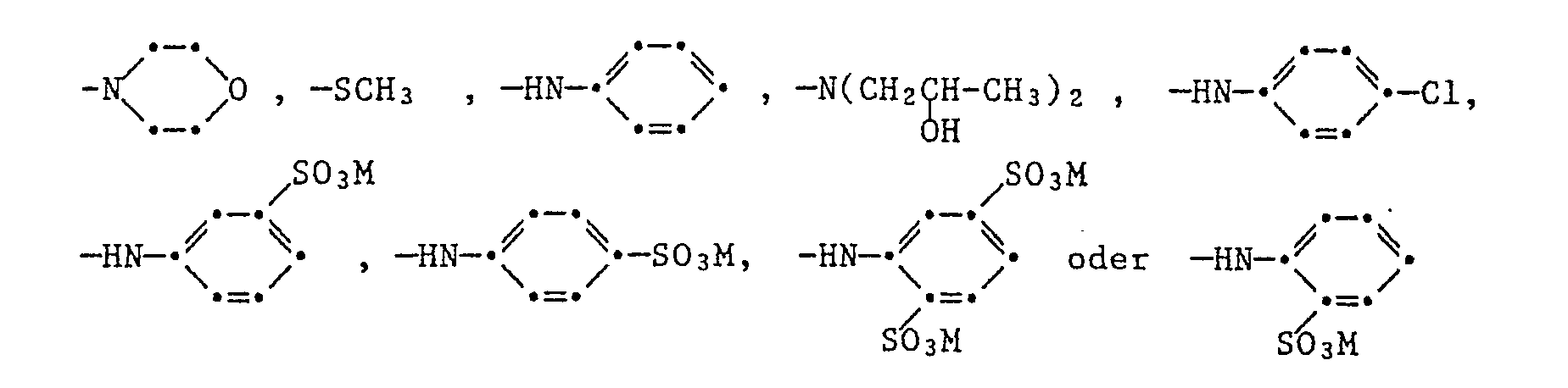

ferner der Formel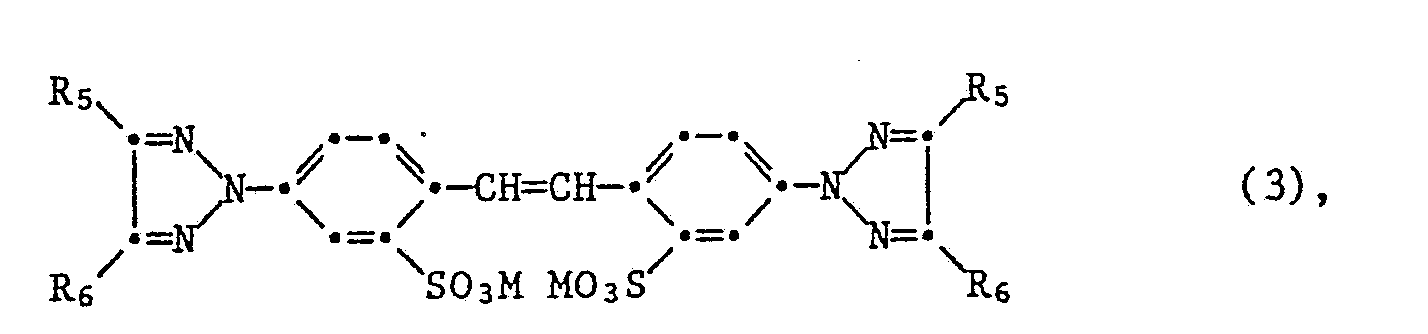

- Die Farbstoffe bzw. optischen Aufheller werden nach bekannten kontinuierlich oder diskontinuierlich arbeitenden Verfahren hergestellt und fallen am Ende der Synthese, je nach Verfahrensführung und Löslichkeitseigenschaften, in Form einer Syntheselösung oder Synthesesuspension an.
- Als Membrantrennverfahren sidn für das erfindungsgemässe Verfahren
- die Dialyse über ein Konzentrationsgefälle an ionen-selektiven Membranen, oder
- die Elektrodialyse durch Anlegen einer elektrischen Spannung und unter Anwendung von Ionenausttauschermembranen als Diaphragma, und insbesondere
- die Ultrafiltration und
- die Umkehrosmose geeignet. - Ultrafiltration und Umkehrosmose werden in der Regel mit feinporigen Membranen mit Porendurchmessern von etwa 0,1 bis 1000 nm durchgeführt.
- Die Porendurchmesser für Umkehrosmose (Hyperfiltration)-Membranen liegen im unteren Teil dieses Bereichs, also im wesentlichen im Bereich von 0,1 bis 50 nm, vorzugsweise im Bereich von 0,1 bis 10 nm.
- Die Ultrafiltration kann sowohl unter Druck, als auch durch Anlegen eines Vakuums betrieben werden. Ferner kann auf Seiten der Farbstofflösung unter Druck gearbeitet und permeatseitig gleichzeitig ein Vakuum angelegt werden. Gearbeitet wird allgemein mit einem Druck von 0.5 bis 10 bar oder einem Vakuum von 200 bis 20 mbar. Vorteilhaft kann man die Ultrafiltration durch Anglegen eines Vakuums durchführen, da ein Unterdruck permeatseitig einer Verstopfung der Membran entgegenwirkt und den Membranflux deutlich steigert.
- Bei der Hyperfiltration handelt es sich um eine Molekulartrennmethode, die unter Verwendung semipermeabler Membranen mit einem Trennschnitt im Molekulargewichtsbereich von 300 bis 1.000, vorzugs weise 400 bis 800, durchgeführt wird. Derartige Membranen lassen Wasser und aufgelöste Stoffe, die aufgrund ihres Molekulargewichts unterhalb der Trenngrenze liegen, bei geringem bis mittlerem Druck durchtreten. Allgemein werden Drucke von 10 bis 100 bar und vorzugsweise 10 bis 40 bar und insbesondere 10 bis 30 bar verwendet.
- Die im erfindungsgemässen Verfahren aufgrund ihrer guten Trenneigenschaften bevorzugt verwendeten Membranen bestehen aus einem polymeren organischen Material, das gegebenenfalls an der Oberfläche durch saure oder basische Gruppen modifiziert sein kann.
- Bei dem polymeren Membranmaterial handelt es sich um natürliche, halbsynthetische oder synthetische Materialien, die reaktionsfähige Gruppen, beispielsweise Hydroxy-, Amino- und/oder Amidoximgruppen enthalten können. Derartige Materialien können - sofern sie chemisch modifiziert werden sollen - mit geeigneten Reagenzien umgesetzt werden, die einerseits saure oder basische (ionische) Gruppen und anderseits mindestens eine unter Bildung einer chemischen (kovalenten) Bindung reaktionsfähige Gruppierung enthalten.
- Bei den sauren Gruppen handelt es sich in erster Linie um Carboxyl- und Sulfongruppen und bei den basischen Gruppen um primäre, sekundäre oder tertiäre Aminogruppen, ferner Phosphonium- oder Sulfoniumgruppen.
- Beispielsweise können folgende membranbildende Polymere zur Herstellung von Membranen verwendet werden
- Celluloseacetate, z.B. solche mit niedrigem Acetylgruppengehalt, aber auch höher acylierte Cellulose, z.B. sogenanntes Zweieinhalbacetat, oder
- Polyvinylalkohole,
- Polyacrylnitril und Copolymere aus Acrylnitril und anderen ethylenisch ungesättigten Monomeren,
- Polysulfone,
- Polystyrole,
- Polyamide oder
- Polyimide. - Geeignete Gemische dieser Polymeren sind ebenfalls geeignet.
- Vorzugsweise verwendet man solche Polymeren, die vor und/oder nach der Membranbildung wie angegeben chemisch modifiziert werden.
- Als reaktive Reagenzien, die eine saure oder basische Gruppe enthalten, kommen farblose, z.B. Sulfonierungsreagenzien, wie Chlorsulfonsäure, und farbige Verbindungen in Betracht, vor allem saure Reaktivfarbstoffe, die verschiedenen Klassen angehören können, wie Anthrachinon-, Azo- und Formazanfarbstoffe. Sie können gegebenenfalls auch als Metallkomplexe vorliegen.
- Besonders geeignet sind semipermeable Membranen mit Porendurchmessern von 0,1 bis 50 nm und einem Trennschnitt im Molekulargewichtsbereich von 300 bis 1000, vorzugsweise von 400 bis 800. Es handelt sich hierbei im wesentlichen um anionisch modifizierte Celluloseacetat-, Polyacrylnitril-, Polystyrol-, Polyvinylalkohol- und insbesondere Polysulfonmembranen. (Vgl. US-A-4 247 401, US-A-4 604 204, US-A-4 477 634, US-A-4 584 103, US-A-4 690 765, US-A-4 690 766, EP-A-47953, EP-A-82355).
- Die erfindungsgemäss eingesetzten Rohfarbstofflösungen bzw. -suspensionen haben in der Regel einen Farbstoffgehalt von 5 bis 20 Gew.-% und einem Salzgehalt von 0.05 bis 15 Gew.-% insbesondere von 1 bis 5 Gew-%. Sie können aus Farbstoffsynthesesuspensionen durch Verdünnen mit Wasser oder auch aus Farbstoffpresskuchen durch Anschlämmen mit deionisiertem Wasser oder verdünnten wässrigen Natriumhydroxidlösungen erhalten werden. Die Farbstoffpresskuchen erhält man beispielsweise durch Aussalzen von Farbstoffsyntheselösungen oder -suspensionen und Abtrennen/Abfiltrieren der Farbstoffe über z.B. Pressfilter. Unlösliche Anteile können durch Mikrofiltration abgetrennt werden. Die Entsalzung, Umsalzung und Aufkonzentrierung wird so lange durchgeführt, bis ein Farbstoffgehalt von 10 bis 50 Gew.-% erreicht ist. Der Salzgehalt (anorganische Salze) der so behandelten Farbstoffzubereitungen liegt im Bereich von etwa 0,05 bis 5 Gew.-%, wobei vorzugsweise ein Salzgehalt im Bereich von 0,1 bis 1 Gew.-% errreicht wird.
- Die Rohfarbstofflösungen, die erfindungsgemäss eingesetzt werden, können Temperaturen im Bereich von 10 bis 80°C, vorzugsweise 20 bis 60°C aufweisen. In der Regel wird bei Raumtemperatur gearbeitet. Ihre pH-Werte können im Bereich von 4 bis 10, vorzugsweise 5 bis 9 liegen. Für den gesamten Temperatur- und pH-Wert-Bereich stehen geeignete Membranen zur Verfügung.
- Als Natriumsalze kommen Natriumhalogenide, z.B. Natriumbromid und Natriumjodid, insbesondere aber Natriumchlorid in Betracht. Weitere anorganische Natriumsalze, die geeignet sind, sind Natriumcarbonate, -sulfate und -phosphate, wobei die sauren und die Neutralsalze genannt seien; ferner auch Polyphosphate, wie z.B. Natriumtripolyphosphat. Geeignete organische Natriumsalze sind solche von niederen organischen Carbonsäuren mit z.B. 1 bis 5 Kohlenstoffatomen, wie z.B. Natriumformiat, Natriumacetat, Natriumlactat oder Natriumoxalat.
- Vorzugsweise wird Natriumchlorid verwendet und zwar wird es vor oder während des Membrantrennverfahrens der Rohfarbstofflösung bzw. -emulsion in Mengen von 5 bis 200 Gew.-%, vorzugsweise 15 bis 70 Gew.-%, bezogen auf das Gewicht des Farbstoffs, zugesetzt. Die Salze werden in der Regel als wässrige Lösungen eingesetzt. Ueblicherweise wird soviel Natriumchlorid zugesetzt, dass ein stöchiometrischer Ueberschuss von Natriumionen, bezogen auf die Farbstoffanionen, vorliegt. Ganz besonders bevorzugt is die Verfahrensweise, gemäss der man das Membrantrennverfahren stufenweise durchführt, d.h., die Rohfarbstofflösung wird mehrfach über die Membran geleitet, wobei ein steigender Entsalzungsgrad erreicht wird, und nach der ersten Stufe und gegebenenfalls auch nach weiteren Stufen Natriumchlorid zugesetzt wird. Salzmischungen können ebenfalls verwendet werden.
- Zur Optimierung des Membrantrennverfahrens kann man den Rohfarbstofflösungen z.B. Lösungsvermittler wie Glykole oder Glykoläther, Caprolactam, Trimethyloläthan oder Pentaerylthrit, anionische oder nichtionische oberflächenaktive Verbindungen (Tenside) oder weitere übliche Zusatzmittel wie Harnstoff, Glucose oder Dextrin zusetzen. Das Verfahren ist so zu führen, dass diese Zusatzmittel während des Membrantrennverfahrens nicht vollständig wieder aus der Farbstofflösung entfernt werden. Gegebenenfalls können abgetrennte Teile nach den einzelnen Stufen des Membrantrennverfahrens wieder zugesetzt werden. In der Regel werden diese Zusatzmittel in Mengen von 0,1 bis 30 Gew.-% vorzugsweise von 1 bis 20 Gew.-% bezogen auf das Gewicht des Farbstoffs eingesetzt.
- Man kann so z.B. eine Erhöhung der Durchflussrate erreichen und vermeidet Membranverstopfungen, erreicht also insgesamt eine grössere Effektivität des Verfahrens.
- Als erfindungsgemäss verwendbare oberflächenaktive Verbindungen kommen beispielsweise in Frage: Dispergatoren, Netz- oder Dispergiermittel anionischer, kationischer oder nichtionischer Natur, wie Natriumdioctylsulfosuccinat, Dibutylnaphthalinsulfonat, Dodecylbenzolsulfonat, Laurylpyridiniumchlorid, Alkylphenylpolyglykoläther, Stearyl-diphenyl-oxyäthyldiäthylentriamin und Aethylenoxid-Addittionsprodukte.
- Bevorzugte anionische Tenside sind Kondensationsprodukte aromatischer Sulfonsäuren mit Formaldehyd wie Kondensationsprodukte aus Formaldehyd, Naphthalinsulfonsäure und Benzolsulfonsäure, oder Kondensationsprodukte aus Rohkresol, Formaldehyd und Naphthalinsulfonsäure, sowie vor allem Kondensationsprodukte aus Phenol-, Kresol- oder Naphthosulfonsäure und Formaldehyd oder Ligninsulfonate (Sulfit-Celluloseablauge) oder Oxyligninsulfonate, und insbesondere Kondensationsprodukte aus Naphthalinsulfonsäure und Formaldehyd, wobei diese vorzugsweise als Alkali- und/oder Ammoniumslaze vorliegen.
- Als erfindungsgemäss verwendbare nichtionogene oberflächenaktive Verbindungen kommen vor allem in Betracht: Polyäthylenglykole mit einem Molekulargewicht von vorzugsweise 200 bis 1000; Mischpolymerisate aus Aethylenoxid und Propylenoxid (sog. Blockpolymerisate); Umsetzungsprodukte aus Fettsäuren mit 8 bis 22 Kohlenstoffatomen und Aminen oder Hydroxyalkylaminen; sowie Anlagerungsprodukte aus z.B. 5 bis 80 Mol, vorzugsweise 10 bis 30 Mol Alkylenoxiden, insbesondere von Aethylenoxid, wobei einzelne Aethylenoxideinheiten durch substituierte Epoxide, wie Styroloxid und/oder Propylenoxid, ersetzt sein können, und gesättigten oder ungesättigten Alkoholen Mercaptanen oder Aminen mit 8 bis 22 Kohlenstoffatomen oder Alkylphenolen oder Alkylthiophenolen deren Alkylrest mindestens 7 Kohlenstoffatome aufweisen, beispielsweise Fettalkoholpolyglykoläther.
- Im Rahmen einer rationellen Arbeitsweise erweist es sich als besonders vorteilhaft, die Farbstoffsynthese und die anschliessende Membranbehandlung kontinuierlich durchzuführen.
- Die erfindungsgemäss erhaltenen Farbstoffzubereitungen, die sich durch ihre hohe Konzentration an Farbstoff, ihre Homogenität und ihre gute Stabilität über einen Zeitraum von mehreren Monaten und in einem weiten Temperaturbereich (0°C-50°C) auszeichnen, können dann in flüssige und feste handelsfertige Farbstofformulierungen übergeführt werden.
- Zur Herstellung einer handelsfertigen Flüssigform ist die konzentrierte wässrige Farbstoffzubereitung gegebenenfalls nach Zugabe von den für Flüssigformulierungen üblichen Komponenten, wie schaumdämpfenden Mitteln, Gefrierschutzmitteln, Feuchthaltemitteln, Tensiden, Puffersubstanzen und/oder Antimikrobika und Einstellen des pH-Wertes, nur noch durch Verdünnen und/oder mit Hilfe von Coupagemitteln auf einen vorgegebenen Endfarbstoffgehalt zu bringen. Die Farbstoffzubereitung kann aber auch, gegebenenfalls nach Zugabe von Zusätzen, wie Bindemitteln, Entstäubungsmitteln, Netzmitteln, Puffersubstanzen und/oder Coupagemitteln, durch Wasserentzug, in ein festes Farbstoffpräparat übergeführt werden. Dank der erhöhten Farbstoffkonzentration benötigt man weniger Energie zum Trocknen. Man verwendet übliche Trocknungsverfahren, insbesondere die Sprühtrocknung.
- Die genannten Hilfsmittel oder Zusatzmittel können der Farbstofflösung natürlich nicht nur vor deren endgültiger Formulierung zugesetzt, sondern wie erwähnt bereits vor oder während des Verfahrens in die Lösung des Rohfarbstofffs eingebracht werden und sind damit wenigstens teilweise bereits in der Farbstofflösung, aus der die endgültige handelsfertige Farbstoffzubereitung hergestellt wird, vorhanden (z.B. Lösungsvermittler, Lösungsmittel, Tenside etc.). Eine Zugabe während des Verfahrens ist selbstverständlich nur dann sinnvoll, wenn das oder die Hilfsmittel nicht durch eines der Membrantrennverfahren wieder vollständig aus der Lösung entfernt werden.
- Verwendung finden die handelsfertigen Flüssigformulierungen bzw. die festen Farbstoffpräparate zur Herstellung von Färbebädern, Klotzflotten oder Druckpasten, die sich je nach Farbstoff zum Färben und Bedrucken von natürlichen, wie auch synthetischen Fasermaterialien, wie z.B. von Textilfasermaterialien aus Baumwolle, Wolle, Seide, Polyacrylnitril oder Polyamid oder auch von solchen Materialien aus Fasermischungen, wie z.B. aus Wolle/Polyamid, sowie ferner auch zum Färben und Bedrucken von Leder oder Papier eignen.
- Die folgenden Beispiele dienen der Erläuterung der Erfindung; Teile bedeuten Gewichtsteile und Prozente Gewichtsprozente. Der Membranflux ist angegeben in Liter Permeat pro m² Membranfläche und Tag (l/m²·d).
- 1 kg Presskuchen eines in Kalium- und Natriumsalzform vorliegenden anionischen Farbstoffes der Formel

- Die Lösung wird auf einer Umkehrosmoseanlage (0,0655 m² Fläche), bestückt mit chemisch modifizierten Polyacrylnitrilmembranen, die eine Ausschlussgrenze von etwa 500 aufweisen (vgl. Beispiel 1 der US-A-4 584 103), mit 11 l deionisiertem Wasser diafiltriert bis der Salzgehalt der Farbstofflösung etwa 0,1 % beträgt. Membrandurchfluss (Flux): 380 1/m²·d. Dauer der Diafiltration: 28 h.
- Dann gibt man 1 l 30 %ige wässrige Natriumchloridlösung, die zusätzlich noch 16 g eines Blockpolymeren aus Aethylenoxid und Propylenoxid enthält, zu der Farbstofflösung und diafiltriert die Farbstofflösung erneut mit weiteren 16 l deionisiertem Wasser. Der Salzgehalt der erhaltenen Farbstofflösung liegt unter 0,1 %. Die Farbstofflösung wird dann auf einen Trockengehalt von 24 % aufkonzentriert.
- Diese konzentrierte Lösung kann in eine handelsfertige Formulierung übergeführt werden, indem man z.B. Puffersubstanzen, wie Natriumtripolyphosphat, zugibt und dann durch Zugabe von Wasser die Formulierung auf die gewünschte Konzentration einstellt.
- In analoger Weise und unter Erzielung ebenfalls guter Ergebnisse kann man auch aus Presskuchen der mono-, di- oder tri-reaktiven Farbstoffe der folgenden Formeln lagerstabile konzentrierte Farbstoffzubereitungen herstellen (M = Na, K):


- 950 g Presskuchen eines in Kalium- und Natriumform (Verhältnis 1:1) vorliegenden asymmetrischen 1:2 Chromkomplex-Farbstoffes der Formel

- Auf einer Umkehrosmoseanlage gemäss Beispiel 1 wird bei einem Druck von 40 bar diese Lösung zuerst mit 10,5 l Wasser bis zu einem Salzgehalt von etwa 0,1% diafiltriert. Der mittlere Membrandurchfluss beträgt 950 l/m²·d. In der Folge gibt man 0,75 l 30%ige Natriumchloridlösung zu der Farbstofflösung und diafiltriert erneut mit weiteren 14 l Wasser bis zu einem Salzgehalt von unter 0,1%. Durch anschliessende Aufkonzentrierung auf einen Trockengehalt von 25% (Na/K-Verhältnis 10:1) wird eine konzentrierte Lösung erhalten, die zur Herstellung einer handelsfertigen Farbstofflösung verwendet werden kann.
- 2 kg Presskuchen des in Kalium- und Natriumsalzform vorliegenden anionischen Farbstoffes der Formel

- Die Lösung wird auf einer Umkehrosmoseanlage von 0,125 m² Fläche, bestückt mit sulfonierten Polysulfonmembranen, mit 18 l enthärtetem Wasser diafiltriert bis der Salzgehalt etwa 0,2% beträgt. Anschliessend gibt man 2 l 30%ige Natriumchloridlösung zu und diafiltriert erneut mit weiteren 30 l enthärtetem Wasser. Nach Erreichen eines Salzgehalts von unter 0,1% wird die Farbstofflösung auf einen Trockengehalt von 29% aufkonzentriert und kann anschliessend zur Herstellung einer handelsfähigen Formulierung verwendet werden.
Claims (10)
Applications Claiming Priority (2)
| Application Number | Priority Date | Filing Date | Title |
|---|---|---|---|
| CH150687 | 1987-04-16 | ||
| CH1506/87 | 1987-04-16 |
Publications (2)
| Publication Number | Publication Date |
|---|---|
| EP0288434A1 true EP0288434A1 (de) | 1988-10-26 |
| EP0288434B1 EP0288434B1 (de) | 1991-02-06 |
Family
ID=4212035
Family Applications (1)
| Application Number | Title | Priority Date | Filing Date |
|---|---|---|---|
| EP88810229A Expired - Lifetime EP0288434B1 (de) | 1987-04-16 | 1988-04-06 | Verfahren zur Herstellung konzentrierter wässriger Farbstoffzubereitungen |
Country Status (5)
| Country | Link |
|---|---|
| US (1) | US4838895A (de) |
| EP (1) | EP0288434B1 (de) |
| JP (1) | JPS63275670A (de) |
| DE (1) | DE3861738D1 (de) |
| ES (1) | ES2020344B3 (de) |
Cited By (7)
| Publication number | Priority date | Publication date | Assignee | Title |
|---|---|---|---|---|
| EP0360093A3 (en) * | 1988-09-20 | 1990-07-18 | Basf Aktiengesellschaft | Process for separating salts by electrodialysis |
| EP0602562A1 (de) * | 1992-12-18 | 1994-06-22 | BASF Aktiengesellschaft | Verfahren zur Herstellung von Phthalocyaninreaktivfarbstoffe |
| FR2726831A1 (fr) * | 1994-11-10 | 1996-05-15 | Sandoz Sa | Nouveaux melanges de colorants, leur preparation et leur utilisation |
| EP0816406A3 (de) * | 1996-06-26 | 1998-04-29 | Bayer Ag | Verfahren zur Herstellung salzarmer Präparationen von Kondensationsprodukten |
| EP0802240A3 (de) * | 1996-04-18 | 1998-12-09 | Bayer Ag | Verfahren zur Herstellung salzarmer, flüssiger Farbstoffpräparationen |
| EP0992547A3 (de) * | 1998-09-22 | 2001-01-10 | Bayer Aktiengesellschaft | Verfahren zur Herstellung von Farbstoffen und/oder Aufhellerzubereitungen |
| WO2005054376A1 (en) * | 2003-12-04 | 2005-06-16 | Clariant International Ltd | Concentrated aqueous compositions of dyestuffs |
Families Citing this family (9)
| Publication number | Priority date | Publication date | Assignee | Title |
|---|---|---|---|---|
| US5282939A (en) * | 1988-09-20 | 1994-02-01 | Basf Aktiengesellschaft | Removal of salts by electrodialysis |
| DE4008262A1 (de) * | 1990-03-15 | 1991-09-19 | Bayer Ag | Verfahren zur herstellung lagerstabiler farbstoffloesungen |
| JPH06306304A (ja) * | 1993-04-21 | 1994-11-01 | Kanebo Ltd | 染料溶液の精製方法 |
| US5491259A (en) * | 1994-09-13 | 1996-02-13 | The Dow Chemical Company | Process to produce aminocarboxylic acids containing low residual salt |
| US6613104B2 (en) | 1998-09-22 | 2003-09-02 | Bayer Aktiengesellschaft | Process for preparing dyes and/or brightener formulations |
| US5986075A (en) * | 1999-01-20 | 1999-11-16 | Bayer Corporation | Process for the production of diazonium compounds with a low content of sodium ions |
| WO2001032786A1 (en) * | 1999-10-29 | 2001-05-10 | Ciba Specialty Chemicals Holding Inc. | Process for the preparation of solutions of anionic organic compounds |
| WO2001090257A2 (en) * | 2000-05-26 | 2001-11-29 | Ciba Specialty Chemicals Holding Inc. | Process for preparing solutions of anionic organic compounds |
| WO2021096906A1 (en) * | 2019-11-13 | 2021-05-20 | Chromascape, Llc | Colorant composition |
Citations (3)
| Publication number | Priority date | Publication date | Assignee | Title |
|---|---|---|---|---|
| GB1441585A (en) * | 1972-07-11 | 1976-07-07 | Ici Ltd | Dyestuff composition |
| FR2416926A1 (fr) * | 1978-02-13 | 1979-09-07 | Bayer Ag | Procede de production de solutions concentrees de colorants et d'azurants |
| EP0049802A1 (de) * | 1980-10-10 | 1982-04-21 | Bayer Ag | Lederfärbemittel und ihre Herstellung |
Family Cites Families (7)
| Publication number | Priority date | Publication date | Assignee | Title |
|---|---|---|---|---|
| FR2124359B1 (de) * | 1971-02-02 | 1977-04-01 | Ciba Geigy Ag | |
| DE2934949A1 (de) * | 1979-08-29 | 1981-03-19 | Bayer Ag, 5090 Leverkusen | Verfahren zur herstellung von fluessigen farbstoffpraeparationen |
| US4452608A (en) * | 1982-03-05 | 1984-06-05 | Ciba-Geigy Corporation | Process for the preparation of metal complex dye formulations using membrane separation |
| US4523924A (en) * | 1982-12-20 | 1985-06-18 | Ciba-Geigy Corporation | Process for the preparation of stable aqueous solutions of water-soluble reactive dyes by membrane separation |
| US4648883A (en) * | 1984-07-25 | 1987-03-10 | Ciba-Geigy Corporation | Process for the preparation of storage stable aqueous formulations of anionic dyes: amon exchange resin treatment |
| CH667664A5 (de) * | 1985-03-29 | 1988-10-31 | Ciba Geigy Ag | Verfahren zur herstellung von praeparaten wasserloeslicher organischer farbstoffe. |
| DE3521129A1 (de) * | 1985-06-13 | 1986-12-18 | Bayer Ag, 5090 Leverkusen | Verfahren zur herstellung konzentrierter loesungen von anionischen farbstoffen und farbstoffadditiven |
-
1988
- 1988-04-06 EP EP88810229A patent/EP0288434B1/de not_active Expired - Lifetime
- 1988-04-06 DE DE8888810229T patent/DE3861738D1/de not_active Expired - Lifetime
- 1988-04-06 ES ES88810229T patent/ES2020344B3/es not_active Expired - Lifetime
- 1988-04-08 US US07/179,350 patent/US4838895A/en not_active Expired - Fee Related
- 1988-04-13 JP JP63089167A patent/JPS63275670A/ja active Pending
Patent Citations (3)
| Publication number | Priority date | Publication date | Assignee | Title |
|---|---|---|---|---|
| GB1441585A (en) * | 1972-07-11 | 1976-07-07 | Ici Ltd | Dyestuff composition |
| FR2416926A1 (fr) * | 1978-02-13 | 1979-09-07 | Bayer Ag | Procede de production de solutions concentrees de colorants et d'azurants |
| EP0049802A1 (de) * | 1980-10-10 | 1982-04-21 | Bayer Ag | Lederfärbemittel und ihre Herstellung |
Cited By (11)
| Publication number | Priority date | Publication date | Assignee | Title |
|---|---|---|---|---|
| EP0360093A3 (en) * | 1988-09-20 | 1990-07-18 | Basf Aktiengesellschaft | Process for separating salts by electrodialysis |
| US5089102A (en) * | 1988-09-20 | 1992-02-18 | Basf Aktiengesellschaft | Removal of salts by electrodialysis |
| EP0602562A1 (de) * | 1992-12-18 | 1994-06-22 | BASF Aktiengesellschaft | Verfahren zur Herstellung von Phthalocyaninreaktivfarbstoffe |
| US5516901A (en) * | 1992-12-18 | 1996-05-14 | Basf Aktiengesellschaft | Preparation of reactive phthalocyanine dyes |
| FR2726831A1 (fr) * | 1994-11-10 | 1996-05-15 | Sandoz Sa | Nouveaux melanges de colorants, leur preparation et leur utilisation |
| EP0802240A3 (de) * | 1996-04-18 | 1998-12-09 | Bayer Ag | Verfahren zur Herstellung salzarmer, flüssiger Farbstoffpräparationen |
| EP0816406A3 (de) * | 1996-06-26 | 1998-04-29 | Bayer Ag | Verfahren zur Herstellung salzarmer Präparationen von Kondensationsprodukten |
| US5888400A (en) * | 1996-06-26 | 1999-03-30 | Bayer Aktiengesellschaft | Process for preparing low-salt preparations of condensation products |
| EP0992547A3 (de) * | 1998-09-22 | 2001-01-10 | Bayer Aktiengesellschaft | Verfahren zur Herstellung von Farbstoffen und/oder Aufhellerzubereitungen |
| WO2005054376A1 (en) * | 2003-12-04 | 2005-06-16 | Clariant International Ltd | Concentrated aqueous compositions of dyestuffs |
| US7597721B2 (en) | 2003-12-04 | 2009-10-06 | Clariant Finance (Bvi) Limited | Concentrated aqueous compositions of dyestuffs |
Also Published As
| Publication number | Publication date |
|---|---|
| US4838895A (en) | 1989-06-13 |
| JPS63275670A (ja) | 1988-11-14 |
| DE3861738D1 (de) | 1991-03-14 |
| EP0288434B1 (de) | 1991-02-06 |
| ES2020344B3 (es) | 1991-08-01 |
Similar Documents
| Publication | Publication Date | Title |
|---|---|---|
| EP0287515B1 (de) | Verfahren zur Herstellung von konzentrierten, wässrigen Farbstoffzubereitungen wasserlöslicher organischer Farbstoffe | |
| EP0288434B1 (de) | Verfahren zur Herstellung konzentrierter wässriger Farbstoffzubereitungen | |
| EP0197006B1 (de) | Verfahren zur Herstellung von Präparaten wasserlöslicher organischer Farbstoffe | |
| EP0210378B1 (de) | Verfahren zur Herstellung konzentrierter Lösungen von anionischen Farbstoffen und Farbstoffadditiven | |
| EP0992547B1 (de) | Verfahren zur Herstellung von Farbstoffen und/oder Aufhellerzubereitungen | |
| EP0041240B1 (de) | Verfahren zum Spritzfärben von Leder | |
| DE3234784C2 (de) | ||
| DE60126268T2 (de) | Verfahren zur herstellung von lösungen anionischer organischer verbindungen | |
| EP0596383B1 (de) | Kupferphthalocyanin-Flüssigformierung | |
| DE4234222A1 (de) | Wasserlösliche Schwefelfarbstoffe, ihre Herstellung und Verwendung | |
| EP0167107B1 (de) | Verfahren zur Herstellung salzarmer, flüssiger, wässriger Zubereitungen von faserreaktiven Farbstoffen | |
| EP0126830B1 (de) | Verfahren zur Umwandlung schwerlöslicher Salze anionischer Farbstoffe und optischer Aufheller in leichter lösliche Salze mittels Kationenaustausch | |
| EP0059782B1 (de) | Verfahren zur Herstellung konzentrierter wässriger Farbstoffpräparate von anionischen Papier- oder Wollfarbstoffen | |
| EP0029960A1 (de) | Wässrige, lösungsmittelfreie konzentrierte Präparationen von Reaktivfarbstoffen und Verfahren zu ihrer Herstellung | |
| EP0184556B1 (de) | Verfahren zur Herstellung konzentrierter salzarmer wässriger Lösungen von Aminotriazinyl-Reaktivfarbstoffen | |
| DE19831095A1 (de) | Wasserlösliche schwarze Stilbenfarbstoffe, ihre Herstellung und Verwendung | |
| EP0505870B1 (de) | Verfahren zur Gewinnung fester Farbstoffe | |
| DE19645105A1 (de) | Verfahren zur Herstellung von sulfonsäuregruppenhaltigen Cu-Phthalocyaninfarbstoffen | |
| EP0182743B1 (de) | Konzentrierte lagerstabile wässrige Lösungen gelber Stilbenazo(xy)-farbstoffe | |
| EP0122224B1 (de) | Konzentrierte lagerstabile wässrige Lösungen gelber bis grünstichig gelber Stilbenazo(xy)farbstoffe | |
| EP0433810A2 (de) | Verfahren zur Herstellung lagerstabiler Farbstofflösungen | |
| EP0539825B1 (de) | Lagerstabile Präparation von Reaktivfarbstoffen | |
| EP0426617B1 (de) | Faserreaktive Formazanfarbstoffe, Verfahren zu deren Herstellung und deren Verwendung | |
| CH648584A5 (en) | Process for preparing concentrated aqueous formulations of anionic dyes | |
| DE19927398A1 (de) | Verfahren zur Herstellung von Farbstoffen und/oder Aufhellerzubereitungen |
Legal Events
| Date | Code | Title | Description |
|---|---|---|---|
| PUAI | Public reference made under article 153(3) epc to a published international application that has entered the european phase |
Free format text: ORIGINAL CODE: 0009012 |
|
| 17P | Request for examination filed |
Effective date: 19880409 |
|
| AK | Designated contracting states |
Kind code of ref document: A1 Designated state(s): BE CH DE ES FR GB IT LI |
|
| 17Q | First examination report despatched |
Effective date: 19900228 |
|
| GRAA | (expected) grant |
Free format text: ORIGINAL CODE: 0009210 |
|
| AK | Designated contracting states |
Kind code of ref document: B1 Designated state(s): BE CH DE ES FR GB IT LI |
|
| ET | Fr: translation filed | ||
| REF | Corresponds to: |
Ref document number: 3861738 Country of ref document: DE Date of ref document: 19910314 |
|
| ITF | It: translation for a ep patent filed | ||
| GBT | Gb: translation of ep patent filed (gb section 77(6)(a)/1977) | ||
| PLBE | No opposition filed within time limit |
Free format text: ORIGINAL CODE: 0009261 |
|
| STAA | Information on the status of an ep patent application or granted ep patent |
Free format text: STATUS: NO OPPOSITION FILED WITHIN TIME LIMIT |
|
| 26N | No opposition filed | ||
| PGFP | Annual fee paid to national office [announced via postgrant information from national office to epo] |
Ref country code: DE Payment date: 19920202 Year of fee payment: 5 |
|
| PGFP | Annual fee paid to national office [announced via postgrant information from national office to epo] |
Ref country code: FR Payment date: 19920217 Year of fee payment: 5 |
|
| PGFP | Annual fee paid to national office [announced via postgrant information from national office to epo] |
Ref country code: ES Payment date: 19920323 Year of fee payment: 5 |
|
| PGFP | Annual fee paid to national office [announced via postgrant information from national office to epo] |
Ref country code: GB Payment date: 19920327 Year of fee payment: 5 |
|
| PGFP | Annual fee paid to national office [announced via postgrant information from national office to epo] |
Ref country code: BE Payment date: 19920428 Year of fee payment: 5 |
|
| PGFP | Annual fee paid to national office [announced via postgrant information from national office to epo] |
Ref country code: CH Payment date: 19920721 Year of fee payment: 5 |
|
| PG25 | Lapsed in a contracting state [announced via postgrant information from national office to epo] |
Ref country code: GB Effective date: 19930406 |
|
| PG25 | Lapsed in a contracting state [announced via postgrant information from national office to epo] |
Ref country code: ES Free format text: LAPSE BECAUSE OF NON-PAYMENT OF DUE FEES Effective date: 19930407 |
|
| PG25 | Lapsed in a contracting state [announced via postgrant information from national office to epo] |
Ref country code: LI Effective date: 19930430 Ref country code: CH Effective date: 19930430 Ref country code: BE Effective date: 19930430 |
|
| BERE | Be: lapsed |
Owner name: CIBA-GEIGY A.G. Effective date: 19930430 |
|
| GBPC | Gb: european patent ceased through non-payment of renewal fee |
Effective date: 19930406 |
|
| PG25 | Lapsed in a contracting state [announced via postgrant information from national office to epo] |
Ref country code: FR Effective date: 19931229 |
|
| REG | Reference to a national code |
Ref country code: CH Ref legal event code: PL |
|
| PG25 | Lapsed in a contracting state [announced via postgrant information from national office to epo] |
Ref country code: DE Effective date: 19940101 |
|
| REG | Reference to a national code |
Ref country code: FR Ref legal event code: ST |
|
| REG | Reference to a national code |
Ref country code: ES Ref legal event code: FD2A Effective date: 19990201 |
|
| PG25 | Lapsed in a contracting state [announced via postgrant information from national office to epo] |
Ref country code: IT Free format text: LAPSE BECAUSE OF NON-PAYMENT OF DUE FEES;WARNING: LAPSES OF ITALIAN PATENTS WITH EFFECTIVE DATE BEFORE 2007 MAY HAVE OCCURRED AT ANY TIME BEFORE 2007. THE CORRECT EFFECTIVE DATE MAY BE DIFFERENT FROM THE ONE RECORDED. Effective date: 20050406 |