EP0288437A2 - Apparat für passive Erholungsübung und Rückenextension - Google Patents
Apparat für passive Erholungsübung und Rückenextension Download PDFInfo
- Publication number
- EP0288437A2 EP0288437A2 EP88810247A EP88810247A EP0288437A2 EP 0288437 A2 EP0288437 A2 EP 0288437A2 EP 88810247 A EP88810247 A EP 88810247A EP 88810247 A EP88810247 A EP 88810247A EP 0288437 A2 EP0288437 A2 EP 0288437A2
- Authority
- EP
- European Patent Office
- Prior art keywords
- base
- support
- cushion
- flat support
- panel
- Prior art date
- Legal status (The legal status is an assumption and is not a legal conclusion. Google has not performed a legal analysis and makes no representation as to the accuracy of the status listed.)
- Granted
Links
Images


Classifications
-
- A—HUMAN NECESSITIES
- A61—MEDICAL OR VETERINARY SCIENCE; HYGIENE
- A61H—PHYSICAL THERAPY APPARATUS, e.g. DEVICES FOR LOCATING OR STIMULATING REFLEX POINTS IN THE BODY; ARTIFICIAL RESPIRATION; MASSAGE; BATHING DEVICES FOR SPECIAL THERAPEUTIC OR HYGIENIC PURPOSES OR SPECIFIC PARTS OF THE BODY
- A61H1/00—Apparatus for passive exercising; Vibrating apparatus; Chiropractic devices, e.g. body impacting devices, external devices for briefly extending or aligning unbroken bones
- A61H1/02—Stretching or bending or torsioning apparatus for exercising
- A61H1/0218—Drawing-out devices
-
- A—HUMAN NECESSITIES
- A61—MEDICAL OR VETERINARY SCIENCE; HYGIENE
- A61G—TRANSPORT, PERSONAL CONVEYANCES, OR ACCOMMODATION SPECIALLY ADAPTED FOR PATIENTS OR DISABLED PERSONS; OPERATING TABLES OR CHAIRS; CHAIRS FOR DENTISTRY; FUNERAL DEVICES
- A61G13/00—Operating tables; Auxiliary appliances therefor
- A61G13/009—Physiotherapeutic tables, beds or platforms; Chiropractic or osteopathic tables
-
- A—HUMAN NECESSITIES
- A61—MEDICAL OR VETERINARY SCIENCE; HYGIENE
- A61H—PHYSICAL THERAPY APPARATUS, e.g. DEVICES FOR LOCATING OR STIMULATING REFLEX POINTS IN THE BODY; ARTIFICIAL RESPIRATION; MASSAGE; BATHING DEVICES FOR SPECIAL THERAPEUTIC OR HYGIENIC PURPOSES OR SPECIFIC PARTS OF THE BODY
- A61H2203/00—Additional characteristics concerning the patient
- A61H2203/04—Position of the patient
- A61H2203/0481—Hanging
- A61H2203/0493—Hanging by hanging the patient upside down or inclined downwardly
Definitions
- the present invention relates to a passive relaxation and back extension exercise device comprising a smooth tilting flat support supported by a base.
- the inclined support consisting of a board
- a harness fixed at its upper end and intended to support the user by the thorax during lumbar extension exercises.
- the tensile force on the spine is given only by the oblique component of the weight of the pelvis and legs. This force is relatively low and the user must remain on the board for a relatively long time, of the order of half an hour, for the extension effect to be perceptible.
- the harness should not tighten the body, the user tends to slide out of the harness, which has the effect of causing a contraction of the back muscles which prevents relaxation of the lumbar part.
- the stretched legs position is generally not the most suitable position for achieving proper alignment of the lumbar vertebrae, and dorsal relaxation is not fully achieved.
- the oblique support must be longer than the largest user, its length must be at least 2 meters.
- the object of the present invention is to provide a device for passive exercise in relaxation and dorsal extension which obviates the drawbacks of previous devices and which better meets current medical criteria.
- the apparatus according to the invention is characterized in that the upper end of the smooth flat support has an elastically compressible part covering the upper edge of the flat support and having a surface with a high coefficient of friction.
- the elastically compressible part is intended to support and hold the user by the hollow of the knees, which allows him to choose a position of the legs more or less flexed according to his morphology, so as to reduce the pinching of the lumbar vertebrae and to obtain excellent back relaxation. In this position, the lumbar vertebrae are aligned, without pinching, and the relaxation of the lumbar part is excellent.
- the traction on the back is also as good as in the extended legs position, which makes it possible to obtain the same effect with a substantially shorter device, a length of 150 cm being sufficient, which makes it a space-saving device, even in a non-folding version.
- this consists of a rectangular cushion, of firm elastic material with a coating of high coefficient of friction, protruding from the end of the flat support.
- a cushion has the effect of supporting the legs in a slightly folded position which is particularly suitable.
- the device represented in FIG. 1 comprises an inclined plane support 1, made of wood or synthetic material, having a smooth and slippery surface, consisting of two parts 2 and 3 hinged together by two hinges 4 shown in FIG. 7.
- Each parts 2 consists of a frame 5 respectively 6 and a panel 7, respectively 7 ⁇ ( Figure 7).
- Part 2 is provided with a base 8 articulated near the hinge 4 and connected on the other hand to a central cross member 9 of part 2 by a flexible non-elastic belt 10 limiting the clearance of the base 8 and maintaining this base 8 in a stable position slightly oblique.
- Part 3 is also provided with a base 11 similar to base 8 and articulated to frame 6 of part 3 near the end opposite to the hinges 4.
- the base of this base 11 is connected to the side 6a of frame 6 carrying the hinges 4 by a flexible non-elastic belt 12 limiting the clearance of the base 11 and maintaining it in a position parallel to that of the base 8.
- the bases of the bases 8 and 11 are furthermore connected to each other by a flexible non-elastic belt 13 of security. This belt 13 ensures the deployment of the base 8 with the base 11.
- the bases 8 and 11 are tubular and U-shaped, similar to those which will be described in relation to Figures 5 and 6.
- the inclined support 1 is provided with a rectangular cushion 14 made of elastically compressible but relatively firm material, for example foam firm quality polyethylene or polyurethane, the surface of which has a high coefficient of friction. This coefficient of friction can be obtained by an adequate envelope.
- the cushion 14 has a part 14a projecting beyond the plane support 1, the width of this projecting part being less than or equal to half the width of the cushion.
- the apparatus is used as shown in FIG. 1.
- the user is lying on an inclined support 1, head down, the hollow of the knee and the calves resting on the cushion 14, the protruding part 14a of which supports the legs in a slightly bent position.
- the body is therefore retained at knee height and tends to slide on the slippery surface of the inclined support 1 by exerting traction on the spine, in particular on the lumbar vertebrae.
- the restraint of the body is ensured by the slightly folded position of the legs and the surface with a high coefficient of friction of the cushion 14, but the user also has a strap 15 passing over the knees, to ensure in this position.
- the strap 15 also makes it possible to stand up or perform abdominal exercises.
- the strap 15 is for example made in two parts, one being provided with a piece of injected synthetic material 16 snapping into a piece 17, integral and movable on the other part, in the manner of a belt of security.
- the second embodiment shown in Figures 2 and 4, comprises an inclined support 18 in one piece also consisting of a frame and a panel. It is provided with a single articulated base 19 identical to the base 11 and the base of which is connected to a median cross member 20 by a flexible non-elastic belt 21 limiting the clearance of the base 19 and determining its oblique open position.
- the upper edge of the flat support 18 is provided with a lining 22 of approximately cylindrical shape and of material similar to that constituting the cushion 14.
- the lining 22 is housed in the hollow of the knee and that the legs of the user are folded at almost 90 °.
- the device is also equipped with a strap 23 identical to strap 15 and for the same use.
- a flat support 18 is equipped with a rectangular cushion 24 identical to the cushion 14 of the first embodiment.
- This cushion 24 is connected to the underside of the flat support, more particularly to the frame 25 of this support by two strips 26 and 27, one end of which is fixed to the back of the cushion 24 at two points 28 and 29.
- the position of these attachment points 28 and 29 and the length of the straps 26 and 27 are such that when the cushion is placed on the flat support, straps stretched, the width of its projecting part is less than the width of the part resting on the support plan.
- the cushion 24 is placed inside the frame 25 with the base 19, as shown in FIG. 5.
- FIG. 8 shows a detail of the articulation of the base 19 to the frame 25.
- the tubular base 19 is provided with a pin 30 passing through a bushing 31 passing through the frame 25.
- the outer end of the shaft 30 is provided with a head 32 retaining a washer 33.
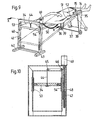
- FIGS 9 and 10 show a third embodiment of the invention particularly intended for physiotherapist offices.
- the flat support here consists of a rigid plate 34 provided at one of its ends with a non-articulated base consisting of two legs 35 and 36 connected by a bar 37 provided with rollers 38 and 39.
- the other end of the plate 34 is supported by a base 40 consisting of a frame 41 formed of metal tubes of square section fixed on two horizontal feet 42 and 43.
- the plate 34 is supported in its middle by a cable 44 penetrating inside the upper part of the frame 41 and passing over two rollers 45 and 46 to descend into one of the uprights of the frame 41 in which it is attached to a nut 47 mounted on a worm screw 48 rotatable by an electric motor 49 with reverse gear .
- This motor 49 is connected by a cable 50 to a control box mounted on the side of the plate 34 and provided with a handle 52 operable by the user.
- the plate 34 is further provided on its sides with two vertical U-shaped parts 53 and 54 pivotally mounted on the plate 34 and engaging the uprights of the frame 41 so as to be able to slide freely on these uprights.
- the tray 34 is further provided with the cushion 14 and the strap 15. The user can lie on the tray 34 in a horizontal or slightly inclined position. It can then tilt the plate 34 at will by acting on the motor 49. When the plate 34 is tilted, the legs 35 and 36 can wind move thanks to the rollers, while the base 40 remains fixed. A strongly inclined position of the plate 34 has been shown in dashed lines.
- the base 40 could be replaced by any other motorized height-adjustable base, the lowering and lifting of the plate respectively can be done with any known type of jack.
Landscapes
- Health & Medical Sciences (AREA)
- Life Sciences & Earth Sciences (AREA)
- Public Health (AREA)
- Veterinary Medicine (AREA)
- Physical Education & Sports Medicine (AREA)
- Rehabilitation Therapy (AREA)
- Animal Behavior & Ethology (AREA)
- General Health & Medical Sciences (AREA)
- Biophysics (AREA)
- Pain & Pain Management (AREA)
- Epidemiology (AREA)
- Orthopedic Medicine & Surgery (AREA)
- Engineering & Computer Science (AREA)
- Biomedical Technology (AREA)
- Orthopedics, Nursing, And Contraception (AREA)
- Rehabilitation Tools (AREA)
- Chair Legs, Seat Parts, And Backrests (AREA)
- Professional, Industrial, Or Sporting Protective Garments (AREA)
- Automatic Cycles, And Cycles In General (AREA)
- Telephone Function (AREA)
- Spinning Or Twisting Of Yarns (AREA)
Priority Applications (1)
| Application Number | Priority Date | Filing Date | Title |
|---|---|---|---|
| AT88810247T ATE72394T1 (de) | 1987-04-24 | 1988-04-18 | Apparat fuer passive erholungsuebung und rueckenextension. |
Applications Claiming Priority (2)
| Application Number | Priority Date | Filing Date | Title |
|---|---|---|---|
| CH1576/87 | 1987-04-24 | ||
| CH1576/87A CH672592A5 (de) | 1987-04-24 | 1987-04-24 |
Publications (3)
| Publication Number | Publication Date |
|---|---|
| EP0288437A2 true EP0288437A2 (de) | 1988-10-26 |
| EP0288437A3 EP0288437A3 (en) | 1989-02-22 |
| EP0288437B1 EP0288437B1 (de) | 1992-02-05 |
Family
ID=4213645
Family Applications (1)
| Application Number | Title | Priority Date | Filing Date |
|---|---|---|---|
| EP88810247A Expired - Lifetime EP0288437B1 (de) | 1987-04-24 | 1988-04-18 | Apparat für passive Erholungsübung und Rückenextension |
Country Status (6)
| Country | Link |
|---|---|
| EP (1) | EP0288437B1 (de) |
| JP (1) | JPS63279846A (de) |
| AT (1) | ATE72394T1 (de) |
| CH (1) | CH672592A5 (de) |
| DE (1) | DE3868291D1 (de) |
| ES (1) | ES2029900T3 (de) |
Family Cites Families (7)
| Publication number | Priority date | Publication date | Assignee | Title |
|---|---|---|---|---|
| US2658754A (en) * | 1950-11-07 | 1953-11-10 | William F Courtney | Foldable exercising and resting table |
| DE2308900A1 (de) * | 1973-02-23 | 1974-08-29 | Guenter Wiegand | Entspannungsliege |
| US4103681A (en) * | 1976-09-10 | 1978-08-01 | Shanley Bernard J | Tilting traction apparatus |
| US4333638A (en) * | 1979-04-04 | 1982-06-08 | Gillotti Michael A | Massage and therapeutic body work table |
| DE3300201A1 (de) * | 1983-01-05 | 1984-07-05 | Ulrich 4300 Essen Hoberg | Steilhangliege mit elektrischer hebe- und senkvorrichtung fuer selbstaendige, stufenlose schraegstellung |
| DE3430515A1 (de) * | 1984-08-18 | 1986-02-27 | Werner Winterthur Renggli | Vorrichtung zum heben und senken eines bettgestelles |
| GB2171914B (en) * | 1985-03-05 | 1988-09-14 | Frank Nattrass | Traction bed |
-
1987
- 1987-04-24 CH CH1576/87A patent/CH672592A5/fr not_active IP Right Cessation
-
1988
- 1988-04-18 EP EP88810247A patent/EP0288437B1/de not_active Expired - Lifetime
- 1988-04-18 DE DE8888810247T patent/DE3868291D1/de not_active Expired - Fee Related
- 1988-04-18 AT AT88810247T patent/ATE72394T1/de not_active IP Right Cessation
- 1988-04-18 ES ES198888810247T patent/ES2029900T3/es not_active Expired - Lifetime
- 1988-04-22 JP JP63098425A patent/JPS63279846A/ja active Pending
Also Published As
| Publication number | Publication date |
|---|---|
| ATE72394T1 (de) | 1992-02-15 |
| DE3868291D1 (de) | 1992-03-19 |
| EP0288437A3 (en) | 1989-02-22 |
| ES2029900T3 (es) | 1992-10-01 |
| JPS63279846A (ja) | 1988-11-16 |
| EP0288437B1 (de) | 1992-02-05 |
| CH672592A5 (de) | 1989-12-15 |
Similar Documents
| Publication | Publication Date | Title |
|---|---|---|
| FR2537006A1 (fr) | Dispositif de traction de tout le poids du corps | |
| FR2963728A1 (fr) | Table pliante, portable, en particulier table de massage. | |
| FR2546411A1 (fr) | Appareil d'exercice a lit inclinable | |
| EP0288437A2 (de) | Apparat für passive Erholungsübung und Rückenextension | |
| FR2685804A1 (fr) | Support pour bras et mains d'un utilisateur d'un instrument ou appareil a clavier, a dessin, a tricoter. | |
| WO2018104595A1 (fr) | Dispositif d'appui antérieur pour les membres inférieurs | |
| FR2554356A1 (fr) | Appareil cale-pieds pour la pratique d'exercices physiques | |
| FR2625660A1 (fr) | Siege s'adaptant aux attitudes morphologiques de l'utilisateur | |
| FR2547492A1 (fr) | Siege pliant | |
| FR2615375A1 (fr) | Ensemble de mobilier transformable multifonctionnel destine aux enfants en bas age | |
| EP0575680A1 (de) | Schulterstützegerät zur vertikalen Positionierung des menschlichen Körpers mit dem Kopf nach unten | |
| FR2584922A1 (fr) | Table d'elongation du corps humain | |
| FR2673820A1 (fr) | Dispositif unitaire comprenant un siege et une table. | |
| BE1029268B1 (fr) | Dispositif et méthode d'étirement | |
| FR3024025A1 (fr) | Dispositif de support postural pour positions debout | |
| FR2855728A1 (fr) | Siege de relaxation comportant une organe souple de soutien de l'utilisateur conjointement porte par un dossier et une assise articules entre eux et montes mobiles en glissement sur un chassis | |
| CH678693A5 (en) | Anatomical support for sitting patient - comprises frame with two lateral upright members, each having spring-biassed pivotable support arm to rest beneath armpits of patient | |
| FR2816816A1 (fr) | Poste de travail ergonomique notamment a appui pour le trone | |
| FR2513735A1 (fr) | Dispositif de reglage de la position d'un plateau | |
| CH662941A5 (en) | Physiotherapy apparatus including a rocking cot | |
| FR3000652A1 (fr) | Fauteuil de relaxation pliable dont le systeme d'interaction entre les differents segments engendre une grande amplitude de mouvement | |
| FR2473290A1 (fr) | Plateau de relaxation et table comportant un tel plateau | |
| EP0378472A1 (de) | Zusammenklappbares Bügelbrett | |
| FR2640879A1 (de) | ||
| FR2671896A1 (fr) | Socle repliable et deplacable, servant de support notamment pour panneau publicitaire. |
Legal Events
| Date | Code | Title | Description |
|---|---|---|---|
| PUAI | Public reference made under article 153(3) epc to a published international application that has entered the european phase |
Free format text: ORIGINAL CODE: 0009012 |
|
| AK | Designated contracting states |
Kind code of ref document: A2 Designated state(s): AT BE DE ES FR GB IT NL SE |
|
| PUAL | Search report despatched |
Free format text: ORIGINAL CODE: 0009013 |
|
| AK | Designated contracting states |
Kind code of ref document: A3 Designated state(s): AT BE DE ES FR GB IT NL SE |
|
| 17P | Request for examination filed |
Effective date: 19890530 |
|
| 17Q | First examination report despatched |
Effective date: 19901022 |
|
| GRAA | (expected) grant |
Free format text: ORIGINAL CODE: 0009210 |
|
| AK | Designated contracting states |
Kind code of ref document: B1 Designated state(s): AT BE DE ES FR GB IT NL SE |
|
| PG25 | Lapsed in a contracting state [announced via postgrant information from national office to epo] |
Ref country code: SE Effective date: 19920205 Ref country code: AT Effective date: 19920205 |
|
| REF | Corresponds to: |
Ref document number: 72394 Country of ref document: AT Date of ref document: 19920215 Kind code of ref document: T |
|
| ITF | It: translation for a ep patent filed | ||
| REF | Corresponds to: |
Ref document number: 3868291 Country of ref document: DE Date of ref document: 19920319 |
|
| PG25 | Lapsed in a contracting state [announced via postgrant information from national office to epo] |
Ref country code: ES Free format text: LAPSE BECAUSE OF NON-PAYMENT OF DUE FEES Effective date: 19920420 |
|
| PG25 | Lapsed in a contracting state [announced via postgrant information from national office to epo] |
Ref country code: BE Effective date: 19920430 |
|
| PG25 | Lapsed in a contracting state [announced via postgrant information from national office to epo] |
Ref country code: GB Effective date: 19920505 |
|
| GBT | Gb: translation of ep patent filed (gb section 77(6)(a)/1977) | ||
| REG | Reference to a national code |
Ref country code: ES Ref legal event code: FG2A Ref document number: 2029900 Country of ref document: ES Kind code of ref document: T3 |
|
| BERE | Be: lapsed |
Owner name: S.A. ARIEH-COURVOISIER Effective date: 19920430 |
|
| PG25 | Lapsed in a contracting state [announced via postgrant information from national office to epo] |
Ref country code: NL Effective date: 19921101 |
|
| PLBE | No opposition filed within time limit |
Free format text: ORIGINAL CODE: 0009261 |
|
| STAA | Information on the status of an ep patent application or granted ep patent |
Free format text: STATUS: NO OPPOSITION FILED WITHIN TIME LIMIT |
|
| NLV4 | Nl: lapsed or anulled due to non-payment of the annual fee | ||
| GBPC | Gb: european patent ceased through non-payment of renewal fee |
Effective date: 19920505 |
|
| 26N | No opposition filed | ||
| PGFP | Annual fee paid to national office [announced via postgrant information from national office to epo] |
Ref country code: DE Payment date: 19931025 Year of fee payment: 6 |
|
| PGFP | Annual fee paid to national office [announced via postgrant information from national office to epo] |
Ref country code: FR Payment date: 19931027 Year of fee payment: 6 |
|
| PG25 | Lapsed in a contracting state [announced via postgrant information from national office to epo] |
Ref country code: FR Effective date: 19941229 |
|
| PG25 | Lapsed in a contracting state [announced via postgrant information from national office to epo] |
Ref country code: DE Effective date: 19950103 |
|
| REG | Reference to a national code |
Ref country code: FR Ref legal event code: ST |
|
| REG | Reference to a national code |
Ref country code: ES Ref legal event code: FD2A Effective date: 19990301 |
|
| PG25 | Lapsed in a contracting state [announced via postgrant information from national office to epo] |
Ref country code: IT Free format text: LAPSE BECAUSE OF NON-PAYMENT OF DUE FEES;WARNING: LAPSES OF ITALIAN PATENTS WITH EFFECTIVE DATE BEFORE 2007 MAY HAVE OCCURRED AT ANY TIME BEFORE 2007. THE CORRECT EFFECTIVE DATE MAY BE DIFFERENT FROM THE ONE RECORDED. Effective date: 20050418 |