EP0289880A2 - Grille pour la construction de tapis ou décrottoirs - Google Patents
Grille pour la construction de tapis ou décrottoirs Download PDFInfo
- Publication number
- EP0289880A2 EP0289880A2 EP88106435A EP88106435A EP0289880A2 EP 0289880 A2 EP0289880 A2 EP 0289880A2 EP 88106435 A EP88106435 A EP 88106435A EP 88106435 A EP88106435 A EP 88106435A EP 0289880 A2 EP0289880 A2 EP 0289880A2
- Authority
- EP
- European Patent Office
- Prior art keywords
- bristle material
- longitudinal
- base body
- grate
- grate according
- Prior art date
- Legal status (The legal status is an assumption and is not a legal conclusion. Google has not performed a legal analysis and makes no representation as to the accuracy of the status listed.)
- Granted
Links
Images

Classifications
-
- A—HUMAN NECESSITIES
- A47—FURNITURE; DOMESTIC ARTICLES OR APPLIANCES; COFFEE MILLS; SPICE MILLS; SUCTION CLEANERS IN GENERAL
- A47L—DOMESTIC WASHING OR CLEANING; SUCTION CLEANERS IN GENERAL
- A47L23/00—Cleaning footwear
- A47L23/22—Devices or implements resting on the floor for removing mud, dirt, or dust from footwear
- A47L23/26—Mats or gratings combined with brushes ; Mats
-
- E—FIXED CONSTRUCTIONS
- E04—BUILDING
- E04F—FINISHING WORK ON BUILDINGS, e.g. STAIRS, FLOORS
- E04F15/00—Flooring
- E04F15/02—Flooring or floor layers composed of a number of similar elements
- E04F15/02161—Floor elements with grooved main surface
- E04F15/02166—Floor elements with grooved main surface wherein the grooves are filled with inserts
Definitions
- the invention relates to a grate for the formation of running mats or wipers, in which by transverse connections spaced longitudinal rods made of rigid material with insert strips made of deformable material, e.g. Bristle material, textile covering, felt, needle fleece, rubber or the like are provided, and in which the insert strips with their surface forming the tread surface of the grate protrude beyond the upper edge of the longitudinal bars.
- deformable material e.g. Bristle material, textile covering, felt, needle fleece, rubber or the like
- Gratings of this type are already known in various embodiments, as can be seen, for example, from EP-B 0 059 886 and also from EP-B 0 125 618.
- footwear with strongly notched soles - profiled soles - has become more and more common in everyday use compared to footwear with smooth soles enforced. It can be assumed that footwear with strongly notched soles has now reached a share of over 70%, especially because sneakers have become a daily commodity that is used not only in leisure time but also when going to work and school will.
- the invention therefore aims to design a grate for the formation of running mats or wipers of the type initially specified in such a way that it has, at least in some areas, a tread made of deformable material which, even when being walked on with strongly notched profile soles, has all parts of the same , ie also with the delimiting surfaces of the notches, can come into safe wiping contact.
- the object on which the invention is based is given by the characterizing features of claim 1, namely in that at least one, but preferably several, bristle-bearing insert strips are arranged between the felt strips, needled fleece and textile covering or the like in the spaced-apart longitudinal rods, that the bristle material is arranged in the Auf- or insert strips in bristle material rows and / or bundles is provided, which are spaced from each other, and that the bristle material rows and / or bundles with their free ends the top edge plane of the felt, needle fleece and textile covering or the like protrude equipped insert strips by a predetermined minimum dimension.
- the bristle material provided according to the invention also penetrates securely into the indentation areas of the profile soles and loosens and removes the road dirt adhering or pinched there.
- both the insert strips carrying the bristle material and the attachment or insert strips equipped with felt, needle fleece and textile covering or the like each extend over the entire length of the longitudinal rods receiving them
- the invention does indeed exist but also the possibility in the longitudinal direction of one and the same longitudinal bar to alternately provide insert strips with bristle material or top or insert strips with felt, needle fleece and textile covering or the like and then arrange them longitudinally offset relative to one another on the adjacent longitudinal rods.
- an embodiment of the inventive design of the insert strips carrying the bristle material lies - according to claim 3 - in that the mounting strips or insert strips carrying the bristle material have a strip-shaped base body which is connected to the longitudinal rods or can be coupled.
- the strip-shaped base body can have an upper side which is stepped in the cross-sectional direction, and the bristle material rows and / or bristle material bundles can protrude above the upper side of all the steps of the base body with at least approximately the same free length.
- the height of the steps on the base body can be between 20 and 30% of the free length of the bristle material and preferably correspond to about 25% of the same.
- the height of the individual steps on the base body should be approximately 2 mm, so that the free ends of the bristle material -Rows and / or -bundles in the area of the different levels differ in height by about these 2 mm.
- each base body has two steps and these steps are occupied with a different number of rows of bristle material.
- the lower step can be equipped with only one row of bristle material, but the higher step can be equipped with at least two rows of bristle material.
- each base body has three steps, of which the two outer ones are approximately at the same height. It can - according to claim 9 - the middle step of the base body is higher than its two outer steps. In addition - according to claim 10 - it is recommended that each step is provided with the same number of rows of bristle material, for example - according to claim 11 - is occupied with only one row of bristle material.
- the invention further provides - according to claim 12 - that the base body of the up or insert strips are made of plastic and are manufactured by extrusion or injection molding.
- each bristle material row consists of a plurality of bristle material bundles anchored in holes in the base body, and that the bristle material bundles in adjacent bristle material rows are offset from one another by a gap Holes are added.
- a grate according to the invention for forming running mats or wipers is - according to claim 15 - also seen in the fact that on the one hand the longitudinal bars on their top and others on the one hand, the base bodies of the up or insert strips have undercut profiled longitudinal webs and longitudinal grooves on their underside, which can either be positively pushed into one another in the longitudinal direction or can be locked resiliently with one another transversely to their longitudinal direction.
- the longitudinal bars which are kept at a distance from one another by transverse connections, directly through the base body of the up or insert strips
- the cross connections between adjacent longitudinal bars consist of holding elements which have undercut shaped head parts, by means of which they can each be inserted into an undercut groove on the underside of the longitudinal bars, whereby two undercut longitudinal grooves on the underside of the Longitudinal bars are located and are each arranged on the edge.
- the holding elements can - according to claim 17 - have a substantially U-shaped cross section, each of its flanges carrying an undercut designed head part.
- the longitudinal bars - according to claim 18 - have channels delimited by upwardly directed flanges or strips, in which the insert strips are accommodated at least over most of the height of their base bodies.
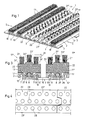
- the grate 1 according to FIG. 1 of the drawing consists of longitudinal bars 2 which are spaced apart and with their longitudinal axes parallel to one another.
- the longitudinal bars 2 are connected to one another by holding elements 3 directed transversely to them and at the same time are kept at a distance from one another.
- the grids 1 are manufactured as a one-piece molded part made of plastic, for example by injection molding, so that the longitudinal bars and the holding elements 3 are connected to one another in one piece.
- the longitudinal bars 2 are preferably produced by extrusion or extrusion and can consist of metal or plastic. It has proven particularly useful to manufacture the longitudinal bars 2 from rigid plastic.
- the holding elements 3 can also be separated in this case from a rail profile made by extrusion or extrusion in a suitable width, and this rail profile used to produce the holding elements 3 can also consist of metal or plastic, preferably of rigid plastic.
- the longitudinal bars 2 in the embodiment according to FIGS. 1 and 2 have a substantially U-shaped cross section, i.e. they each have two flanges 4 'and 4' 'which are integrally connected by a web 5.
- the longitudinal rods 2 limit an upwardly open groove 6, which has two paragraphs 6', 6 '' at a distance above the web, to which one of the web 5 initially trapezoidal narrowing and then again trapezoidal widening recess 7.
- the longitudinal bars 2 are profiled symmetrically overall to their longitudinal center plane 9-9 and from the underside two relatively narrow, that is slot-like grooves 10 ', 10''are formed. These grooves 10 'and 10''are symmetrical to the longitudinal center plane 9-9 and are arranged on the edge side following a vertical plane coinciding with the inner surface of the flanges 4' and 4 ''.
- Each of the two slot-like grooves 10 ', 10' goes into an upward, arrowhead-like extension 11 'and 11' ', so that in each groove 10', 10 '' two undercuts are limited.
- the outer boundary of the grooves 10 ', 10' ' consists of a one-piece molded hook profile, the inwardly directed hook shoulder 12' or 12 '' with its underside is approximately at the same level with the top of the web 5.
- the holding elements 3, by means of which the longitudinal bars 2 can be connected to form the grate 1, have an essentially U-shaped cross section.
- Each of its two flanges 13 'and 13' ' is formed by two mutually mirror-image hook webs 14' and 14 '', which protrude from the profile web 15.
- a spacing gap 16 is formed in each case.
- the profile web 15 of the holding elements 3 has a thickness which corresponds to the thickness of the web 5 on the longitudinal bars 2.
- the holding elements 3 When assembling the grate 1, the holding elements 3 are simply pressed into the grooves 10 'and 10''on the underside of the longitudinal bars 2 with the aid of their respective flanges 13' and 13 '' formed by the hook webs 14 'and 14'', so that they snap into each of the undercut extensions 11 ', 11''.
- the profile webs 15 of the holding elements 3 come to lie on the same level with the webs 5 of the longitudinal bars 2, in such a way that the longitudinal bars 2 and the holding elements 3 coupling them together have a common, large-area support plane on the finished grate 1, such as that clearly shows Fig. 2.
- the open to the top of the grate 1 grooves 6 of the longitudinal bars 2 serve to receive insert strips 17, the surface of which forms the walkable step surface on the finished grate 1.
- the insert strips 17 are inserted into the groove 6 of the longitudinal bars 2 so that they protrude with their surface forming the tread surface of the grate 1 over the upper edge of the flanges 4 'and 4' '.
- the insert strips 17 can have a different design. While, for example, according to FIGS. 1 and 2, the insert strips 17 'each have a needle-fleece layer 20 seated on a base or support layer 19 in an approximately U-shaped holding rail 18, the insert strips 17' 'have a bristle material 21 , strip-shaped base body 22.
- Each of the base bodies 22 can consist of plastic and can be manufactured by extrusion or injection molding.
- the base body 22 While the base body 22 with its cross-sectional profile largely fits into the groove 6 of the longitudinal bars 2, as can be seen in FIG. 2, it has a stepped upper side.
- the base body 22 may, for example, be provided with two steps 23 'and 23'', of which the step 23' approximately with the upper end edge of the flanges 4 'and 4''of the longitudinal rods 2, while the step 23' opposite These end edges are several millimeters higher.
- the width of the step 23 ' corresponds to about a third of the total width of the base body 22, while the step 23' 'has a width that is equal to two thirds of the total width of the base body 22.
- the base body 22 carries one row of bristle material 21', while the step 23 '' is occupied by two such rows of bristle material 21 '.
- Each individual bristle material row 21 ' is formed by a plurality of bristle material bundles 21' ', as can be clearly seen in Fig. 1.
- the base body 22 of the insert strips 17 '' on its upper side can also have two steps 24 'at the same height, between which a higher step 24' 'is formed.
- each of the steps 24 'and 24' ' corresponds to about a third of the total width of the base body 22 and each of these steps 24' and 24 '' is occupied with only one row of bristles 21 '.
- the free bristle length of all rows of bristle material 21 'and / or bristle material bundle 21'' is designed to match, as can be clearly seen in FIG. 2.
- This ensures that the bristle material rows 21 'or bristle material bundles 21''arranged in the region of the low step 23' or 24 'of the base body 22''with their free ends by a dimension 25 relative to the free ends of the bristle material rows 21 ′ or bristle material Bundle 21 '' on the higher levels 23 '' or 24 '', which corresponds approximately to the height difference between levels 23 'and 23''or24' and 24 ''.
- the height difference between the stages 23 'and 23' 'or 24' and 24 '' of the base body 22 should be between 1.5 and 2.5 mm, preferably be set to about 2 mm.
- both the insert strips 17 'and the insert strips 17' ' can be reliably set in the grooves 6 of the longitudinal bars 2, but can still be removed relatively easily if necessary, for example for the purpose of replacement special arrangements made.
- Both the U-shaped holding rails 18 of the insert strips 17 'and the base body 22 of the insert strips 17' ' are provided for this purpose with molded lugs 26 which contain an undercut molded longitudinal groove 27.
- the holding rails 18 or the base body 22 can either be pushed positively in the longitudinal direction on the undercut beads 8 on the web 5 of the longitudinal bars 2, or they are transversely to their longitudinal direction in the manner of a snap-lock -Device clipped onto the beads 8.
- a grate 1 to form running mats or wipers differs from that of FIGS. 1 and 2 practically only in that longitudinal bars 2 are used, which have no upward flanges 4 'and 4'' have so that they have a relatively flat shape.
- longitudinal bars 2 which have no upward flanges 4 'and 4'' have so that they have a relatively flat shape.
- bristle material rows 21 'or bristle material bundles 21'''existing elements 17'' are not designed as insert strips, but rather as attachment strips, which can be placed directly on these with a given width dimension of the relatively flat longitudinal rods 2 and can extend with their cross-sectional profile over the entire width of the same.
- the basic design of the grate 1 according to FIG. 5 corresponds to the grate 1 according to FIGS. 1 and 2.
- Each of the longitudinal bars 2 of the grate 1 according to FIG. 5 has a groove 6 which is open towards the top and which serves to receive insert strips 17, the surface of which in turn forms the walkable tread of the finished grate 1, which overall is above the upper edges of the flanges 4 'and 4 '' of the longitudinal bars 2 lies.
- insert strips 17 ' are each arranged in an approximately U-shaped holding rail 18 in cross-section, wherein they carry a needle fleece layer 20 seated on a base or support layer 19.
- An insert strip 17 designed in this way is arranged in each case in the two outer longitudinal bars 2 of the grate section according to FIG. 5.
- the three longitudinal rods 2 arranged therebetween are equipped with insert strips 17 '' which have a strip-shaped base body 22 equipped with bristle material 21.
- each base body 22 can consist of plastic and can be produced by extrusion or injection molding.
- the base body 22 according to FIG. 5 has no stepped upper side.
- the base body 22 of the left-hand insert strip 17 '' does not completely fit into the groove 6 of the longitudinal bar 2 with its cross-sectional profile. Rather, it is dimensioned in such a thickness that it overlaps the upper edges of the two flanges 4 'and 4' 'to a certain extent, for example by 2 mm.
- the middle insert strip 17 '' according to FIG. 5, however, is equipped with a base body 22, the cross-sectional profile of which is dimensioned such that its upper side is flush with the end edges of the two flanges 4 'and 4''of the longitudinal rod 2 concerned.
- the insert strip 17 'shown on the right in Fig. 5 finally has a cross-sectional profile with an inclined upper side, in such a way that this upper side is flush with the end edge of the left flange 4' on the longitudinal rod 2, while the end edge of the right flange 4 '' By a certain amount, for example by 2 mm, towering above.
- Each insert strip 17 '' is equipped with bristle material 21, which consists of several, for example three, parallel bristle material rows 21 '.
- Each of these bristle material rows 21 ' is formed by a plurality of bristle material bundles 21' 'which are spaced apart from one another in holes 28 which are located in the top of the base body 22.
- An important design criterion of the grate 1 according to FIG. 5 is that the free ends of the bristle material 21 of all rows of bristle material 21 'and bundle 21' 'lie on a common horizontal plane 29-29, which are at a distance 31 above a horizontal plane 30 -30 is located, which forms the upper edge plane of the needle fleece layer 20 on the insert strips 17 '.
- the upper edge level 30-30 of the needle fleece layer 20 insert strips 17 'of the grate 1 is thus surmounted by the bristle material of the insert strips 17' 'by the dimension 31.
- the bristle material 21 of all three rows of bristle material 21 'each have the same length.
- the length of the bristle material 21 on the middle insert strip 17 '' is dimensioned somewhat longer than on the left insert strip 17 '', because there the surface of the base body 22 with the end edges of the flanges 4 'and 4 ⁇ completes, while in the left-hand insert strip 17 ⁇ the top of the base body 22 projects beyond the end edges of these flanges 4 'and 4''.
- the greatest free length has the bristle material 21 in the left row of bristle material 21 ', while it has the lowest free length in the area of the right row of bristle material 21'.
- the base body 22 if it is important to obtain different free lengths of the bristle material 21 in the different rows of bristle material 21 '. So the surface of the base body 22 could have a concave curvature in the cross-sectional direction if the bristle material 21 in the middle row of bristle material 21 'is to have a greater free length than in the outer rows of bristle material 21. On the other hand, the result is a convexly curved surface smallest free length for the bristle material 21 in the middle row of bristle material, while the two outer rows of bristle material then have the greater free length of the bristle material 21.
- the distance dimension 31 between the two parallel planes 29-29 and 30-30 is dimensioned such that only an elastic deformation of the bristle material 21 in the rows of bristle material 21 'and the bristle material bundles 21''can take place until the soles of the shoes receive their firm support on the needle fleece layer 20 of the insert strips 17'.
- the embodiment shown in Fig. 6 has proven itself in which the bristle material bundles 21 '' are extended to be effective in any direction in the region of the groove-like depressions of profile soles.
- the free ends can, for example, be sharpened like a truncated cone or cut at an angle.
- the higher level 23 '' is advantageously equipped with obliquely cut, the lower level 23 'with truncated cone-shaped bristle material bundles 21' ', the bristle material bundle 21' 'of the low level 23' with their free ends by a measure 25 compared to the free ends of the bristle material bundle 21 '' on the higher level 23 '', which corresponds approximately to the height difference between levels 23 'and 23' '.
- This arrangement ensures simultaneous cleaning of the channel-like depression of profile soles and the oppositely designed profile bars.
- the distance 31 between the two planes 29-29 and 30-30 is approximately between 3 and 5 mm, so that the bristle material 21 can project beyond the needle fleece layer 20 at most by this relatively small amount.
- the base body 22 of the insert strips 17 '' can be manufactured as injection molded plastic parts in a predetermined length, the abutting surfaces of the adjacent abutting molded parts can interlock to a certain extent with trapezoidal teeth, so that in all rows of bristle material 21 'the distance between successive bristle material bundles 21' 'is retained in the area of the joints.
Landscapes
- Engineering & Computer Science (AREA)
- Architecture (AREA)
- Civil Engineering (AREA)
- Structural Engineering (AREA)
- Brushes (AREA)
- Footwear And Its Accessory, Manufacturing Method And Apparatuses (AREA)
- Preliminary Treatment Of Fibers (AREA)
Priority Applications (1)
| Application Number | Priority Date | Filing Date | Title |
|---|---|---|---|
| AT88106435T ATE72510T1 (de) | 1987-05-07 | 1988-04-22 | Rost zur bildung von laufmatten oder fussabstreifern. |
Applications Claiming Priority (2)
| Application Number | Priority Date | Filing Date | Title |
|---|---|---|---|
| DE3715192 | 1987-05-07 | ||
| DE19873715192 DE3715192A1 (de) | 1987-05-07 | 1987-05-07 | Rost zur bildung von laufmatten oder fussabstreifern |
Publications (3)
| Publication Number | Publication Date |
|---|---|
| EP0289880A2 true EP0289880A2 (fr) | 1988-11-09 |
| EP0289880A3 EP0289880A3 (en) | 1989-05-24 |
| EP0289880B1 EP0289880B1 (fr) | 1992-02-12 |
Family
ID=6327004
Family Applications (1)
| Application Number | Title | Priority Date | Filing Date |
|---|---|---|---|
| EP88106435A Expired - Lifetime EP0289880B1 (fr) | 1987-05-07 | 1988-04-22 | Grille pour la construction de tapis ou décrottoirs |
Country Status (3)
| Country | Link |
|---|---|
| EP (1) | EP0289880B1 (fr) |
| AT (1) | ATE72510T1 (fr) |
| DE (2) | DE3715192A1 (fr) |
Cited By (14)
| Publication number | Priority date | Publication date | Assignee | Title |
|---|---|---|---|---|
| FR2676909A1 (fr) * | 1991-05-27 | 1992-12-04 | Laurent Patrick | Dispositif de nettoyage de chaussures. |
| EP0523925A1 (fr) * | 1991-07-18 | 1993-01-20 | Psa Threshold Limited | Paillasson |
| EP0605042A1 (fr) * | 1992-12-23 | 1994-07-06 | "Debomat" | Paillasson ou revêtement de sol destiné entre autre à une entrée ou similaire |
| EP0706775A1 (fr) * | 1994-10-04 | 1996-04-17 | Davero AG | Elément support pour paillassons |
| EP0955005A1 (fr) * | 1998-04-14 | 1999-11-10 | Davero AG | Paillasson |
| WO2001019230A1 (fr) * | 1999-09-15 | 2001-03-22 | Simon Kerr Macdonald | Tapis d'entree |
| EP1038493A3 (fr) * | 1999-03-23 | 2002-06-26 | R & L Marketing, Inc. | Pallaisson universel à bandes détachables |
| US6635331B2 (en) | 1998-03-23 | 2003-10-21 | Ronald N. Kessler | Universal mat with removable strips |
| US7043792B2 (en) | 2002-04-19 | 2006-05-16 | R&L Marketing & Sales, Inc. | Floor mat system with flanged cover |
| EP1629763A3 (fr) * | 2004-08-24 | 2007-09-05 | Erwin Müller GmbH | Paillasson |
| WO2009065616A1 (fr) * | 2007-11-24 | 2009-05-28 | Trumpf Werkzeugmaschinen Gmbh + Co. Kg | Bande de segment de brosse |
| KR200489458Y1 (ko) * | 2018-01-09 | 2019-06-20 | 황형철 | 돌기형 수세미 |
| GB2581179A (en) * | 2019-02-06 | 2020-08-12 | Sapphire Balconies Ltd | Construction panel system with adaptable surface |
| US20210001822A1 (en) * | 2019-07-04 | 2021-01-07 | P.P.H. ,,Polmar” Dionizy Szczerba | Tire tread wiper |
Families Citing this family (6)
| Publication number | Priority date | Publication date | Assignee | Title |
|---|---|---|---|---|
| DE9201939U1 (de) * | 1992-02-15 | 1992-05-27 | Mattes, Friedrich, 7022 Leinfelden-Echterdingen | Roll-Rost, insbesondere für Fußböden |
| DE4324142A1 (de) * | 1993-07-19 | 1995-02-09 | Ika Ind Kunststoff Anwendungen | Plattensystem |
| DE20115339U1 (de) | 2001-09-17 | 2002-01-17 | Coronet, König & Böschke GmbH, 32051 Herford | Bodenbelag mit schmutzabstreifender Wirkung |
| DE10300315B4 (de) * | 2003-01-09 | 2010-04-29 | C-Tec E.K. | Bodenbelag mit schmutzabstreifender Wirkung |
| USD540094S1 (en) | 2005-03-24 | 2007-04-10 | R + L Marketing & Sales, Inc. | Floor mat with scraping and wiping characteristics |
| DE102015010240A1 (de) * | 2015-08-04 | 2017-02-09 | Birgit Klaue | Vorrichtung zum Reinigen der Räder von Gehhilfen und Rollstühlen |
Family Cites Families (9)
| Publication number | Priority date | Publication date | Assignee | Title |
|---|---|---|---|---|
| GB747500A (en) * | 1953-06-10 | 1956-04-04 | Philipson & Co Bolton Ltd | Combined doormat and scraper |
| DE2347790A1 (de) * | 1973-09-22 | 1975-04-10 | Arplast Gmbh Kunststoff | Rost, insbesondere rollrost |
| DE2555125A1 (de) * | 1975-12-08 | 1977-06-16 | Otto Renner Fa | Gitterrost mit abstreifwirksamen einlagen |
| DE2648683A1 (de) * | 1976-10-27 | 1978-05-03 | Claus Kolckmann | Wasserdurchlaessige und -bestaendige matte |
| DE2719857B1 (de) * | 1977-05-04 | 1978-10-26 | Erich Arens | Rost oder Matte |
| DE3109206A1 (de) * | 1981-03-11 | 1982-09-23 | Erich 5900 Siegen Arens | Rost zur bildung von laufmatten oder fussabstreifern |
| DE3315180A1 (de) * | 1983-04-27 | 1984-10-31 | Fritz-Helmut 3050 Wunstorf Namendorf | Fussabstreifmatte |
| DE3317410A1 (de) * | 1983-05-13 | 1984-11-15 | Erich 5900 Siegen Arens | Rost zur bildung von laufmatten oder fussabstreifern |
| DE3434069C2 (de) * | 1984-09-17 | 1986-07-24 | Erich 5900 Siegen Arens | Haltevorrichtung zur lösbaren Fixierung von leisten- und/oder streifenförmigen Körpern in, an, auf oder unter Tragkonstruktionen |
-
1987
- 1987-05-07 DE DE19873715192 patent/DE3715192A1/de active Granted
-
1988
- 1988-04-22 DE DE8888106435T patent/DE3868349D1/de not_active Expired - Lifetime
- 1988-04-22 EP EP88106435A patent/EP0289880B1/fr not_active Expired - Lifetime
- 1988-04-22 AT AT88106435T patent/ATE72510T1/de not_active IP Right Cessation
Cited By (19)
| Publication number | Priority date | Publication date | Assignee | Title |
|---|---|---|---|---|
| FR2676909A1 (fr) * | 1991-05-27 | 1992-12-04 | Laurent Patrick | Dispositif de nettoyage de chaussures. |
| EP0523925A1 (fr) * | 1991-07-18 | 1993-01-20 | Psa Threshold Limited | Paillasson |
| EP0605042A1 (fr) * | 1992-12-23 | 1994-07-06 | "Debomat" | Paillasson ou revêtement de sol destiné entre autre à une entrée ou similaire |
| BE1006475A3 (nl) * | 1992-12-23 | 1994-09-06 | Debomat | Voetmat of vloerbekleding bedoeld ondermeer voor een ingangshall of dergelijke. |
| EP0706775A1 (fr) * | 1994-10-04 | 1996-04-17 | Davero AG | Elément support pour paillassons |
| US6635331B2 (en) | 1998-03-23 | 2003-10-21 | Ronald N. Kessler | Universal mat with removable strips |
| US7303801B2 (en) | 1998-03-23 | 2007-12-04 | R & L Marketing & Sales, Inc. | Universal mat with removable strips |
| US6663937B2 (en) | 1998-03-23 | 2003-12-16 | Myron Ullman | Universal mat with removable strips |
| US7175899B2 (en) | 1998-03-23 | 2007-02-13 | R&L Marketing & Sales, Inc. | Universal mat with removable strips |
| EP0955005A1 (fr) * | 1998-04-14 | 1999-11-10 | Davero AG | Paillasson |
| EP1038493A3 (fr) * | 1999-03-23 | 2002-06-26 | R & L Marketing, Inc. | Pallaisson universel à bandes détachables |
| WO2001019230A1 (fr) * | 1999-09-15 | 2001-03-22 | Simon Kerr Macdonald | Tapis d'entree |
| US7043792B2 (en) | 2002-04-19 | 2006-05-16 | R&L Marketing & Sales, Inc. | Floor mat system with flanged cover |
| EP1629763A3 (fr) * | 2004-08-24 | 2007-09-05 | Erwin Müller GmbH | Paillasson |
| WO2009065616A1 (fr) * | 2007-11-24 | 2009-05-28 | Trumpf Werkzeugmaschinen Gmbh + Co. Kg | Bande de segment de brosse |
| KR200489458Y1 (ko) * | 2018-01-09 | 2019-06-20 | 황형철 | 돌기형 수세미 |
| GB2581179A (en) * | 2019-02-06 | 2020-08-12 | Sapphire Balconies Ltd | Construction panel system with adaptable surface |
| GB2581179B (en) * | 2019-02-06 | 2022-08-03 | Mydek Ltd | Construction panel system with adaptable surface |
| US20210001822A1 (en) * | 2019-07-04 | 2021-01-07 | P.P.H. ,,Polmar” Dionizy Szczerba | Tire tread wiper |
Also Published As
| Publication number | Publication date |
|---|---|
| EP0289880B1 (fr) | 1992-02-12 |
| DE3868349D1 (de) | 1992-03-26 |
| DE3715192C2 (fr) | 1989-09-14 |
| EP0289880A3 (en) | 1989-05-24 |
| DE3715192A1 (de) | 1988-12-01 |
| ATE72510T1 (de) | 1992-02-15 |
Similar Documents
| Publication | Publication Date | Title |
|---|---|---|
| EP0289880B1 (fr) | Grille pour la construction de tapis ou décrottoirs | |
| EP0125618B1 (fr) | Grille pour la constitution des tapis-décrottoir ou des tapis essuie-pieds | |
| DE69526959T2 (de) | Bürstenanordnung für eine zahnbürste | |
| DE3241360C2 (fr) | ||
| EP0337110A1 (fr) | Caniveau d'évacuation d'eau de surface | |
| DE2112573A1 (de) | Rost oder Matte,beispielsweise zur begehbaren Abdeckung von Rinnen,Becken,Gruben oder als Fussabtreter | |
| DE2926976C2 (de) | Aus einzelnen Elementen zusammensetzbarer Körper | |
| DE10331369A1 (de) | Zahnbürste | |
| EP0175172A2 (fr) | Dispositif de retenue pour la fixation amovible de corps en forme de listeau et/ou bande dans, sur ou dessous des constructions porteuses | |
| EP0676169A1 (fr) | Grilles ou tapis en particulier paillaissons et/ou décrottoirs | |
| DE2719857C2 (fr) | ||
| DE4106496C2 (de) | Laufmatte und/oder Fußabstreifer | |
| EP0059886B1 (fr) | Grille pour paillasson ou décrottoir | |
| DE3821722C2 (fr) | ||
| DE3511302A1 (de) | Rost oder matte als bodenbelag | |
| DE3315180A1 (de) | Fussabstreifmatte | |
| DE2412151C3 (de) | Rost oder Matte, beispielsweise zur begehbaren Abdeckung von Rinnen, Becken, Graben oder als Fußabtreter | |
| EP0007006B1 (fr) | Caillebotis pour le revêtement d'un plancher ou pour former un gratte-pied | |
| EP0955005B1 (fr) | Paillasson | |
| DE3910126C2 (de) | Rost zur Bildung von Laufmatten oder Fußabstreifern | |
| DE3207165C2 (de) | Schuhabstreifmatte | |
| DE3611124C2 (de) | Stabrost | |
| DE3103290C2 (de) | "Fußraummatte aus Gummi, Kunststoff o.dgl. für Kraftfahrzeuge" | |
| DE1906928U (de) | Sohle mit gleitschutzprofil fuer sportschuhe. | |
| EP0279329A2 (fr) | Paillasson |
Legal Events
| Date | Code | Title | Description |
|---|---|---|---|
| PUAI | Public reference made under article 153(3) epc to a published international application that has entered the european phase |
Free format text: ORIGINAL CODE: 0009012 |
|
| 17P | Request for examination filed |
Effective date: 19880502 |
|
| AK | Designated contracting states |
Kind code of ref document: A2 Designated state(s): AT BE CH DE FR GB IT LI LU NL SE |
|
| PUAL | Search report despatched |
Free format text: ORIGINAL CODE: 0009013 |
|
| AK | Designated contracting states |
Kind code of ref document: A3 Designated state(s): AT BE CH DE FR GB IT LI LU NL SE |
|
| 17Q | First examination report despatched |
Effective date: 19910121 |
|
| GRAA | (expected) grant |
Free format text: ORIGINAL CODE: 0009210 |
|
| AK | Designated contracting states |
Kind code of ref document: B1 Designated state(s): AT BE CH DE FR GB IT LI LU NL SE |
|
| REF | Corresponds to: |
Ref document number: 72510 Country of ref document: AT Date of ref document: 19920215 Kind code of ref document: T |
|
| GBT | Gb: translation of ep patent filed (gb section 77(6)(a)/1977) | ||
| REF | Corresponds to: |
Ref document number: 3868349 Country of ref document: DE Date of ref document: 19920326 |
|
| ITF | It: translation for a ep patent filed | ||
| ET | Fr: translation filed | ||
| PLBE | No opposition filed within time limit |
Free format text: ORIGINAL CODE: 0009261 |
|
| STAA | Information on the status of an ep patent application or granted ep patent |
Free format text: STATUS: NO OPPOSITION FILED WITHIN TIME LIMIT |
|
| 26N | No opposition filed | ||
| EPTA | Lu: last paid annual fee | ||
| EAL | Se: european patent in force in sweden |
Ref document number: 88106435.6 |
|
| REG | Reference to a national code |
Ref country code: CH Ref legal event code: NV Representative=s name: ULRICH UND BRIGITTE BALLMER PATENTANWAELTE |
|
| REG | Reference to a national code |
Ref country code: GB Ref legal event code: IF02 |
|
| PGFP | Annual fee paid to national office [announced via postgrant information from national office to epo] |
Ref country code: GB Payment date: 20060420 Year of fee payment: 19 |
|
| PGFP | Annual fee paid to national office [announced via postgrant information from national office to epo] |
Ref country code: FR Payment date: 20060422 Year of fee payment: 19 |
|
| PGFP | Annual fee paid to national office [announced via postgrant information from national office to epo] |
Ref country code: CH Payment date: 20060424 Year of fee payment: 19 Ref country code: LU Payment date: 20060424 Year of fee payment: 19 Ref country code: SE Payment date: 20060424 Year of fee payment: 19 |
|
| PGFP | Annual fee paid to national office [announced via postgrant information from national office to epo] |
Ref country code: AT Payment date: 20060426 Year of fee payment: 19 |
|
| PGFP | Annual fee paid to national office [announced via postgrant information from national office to epo] |
Ref country code: BE Payment date: 20060502 Year of fee payment: 19 |
|
| PGFP | Annual fee paid to national office [announced via postgrant information from national office to epo] |
Ref country code: NL Payment date: 20070430 Year of fee payment: 20 |
|
| PGFP | Annual fee paid to national office [announced via postgrant information from national office to epo] |
Ref country code: DE Payment date: 20070522 Year of fee payment: 20 |
|
| REG | Reference to a national code |
Ref country code: CH Ref legal event code: PL |
|
| GBPC | Gb: european patent ceased through non-payment of renewal fee |
Effective date: 20070422 |
|
| BERE | Be: lapsed |
Owner name: *ARENS ERICH Effective date: 20070430 |
|
| PGFP | Annual fee paid to national office [announced via postgrant information from national office to epo] |
Ref country code: IT Payment date: 20070613 Year of fee payment: 20 |
|
| PG25 | Lapsed in a contracting state [announced via postgrant information from national office to epo] |
Ref country code: CH Free format text: LAPSE BECAUSE OF NON-PAYMENT OF DUE FEES Effective date: 20070430 Ref country code: LI Free format text: LAPSE BECAUSE OF NON-PAYMENT OF DUE FEES Effective date: 20070430 Ref country code: AT Free format text: LAPSE BECAUSE OF NON-PAYMENT OF DUE FEES Effective date: 20070422 |
|
| PG25 | Lapsed in a contracting state [announced via postgrant information from national office to epo] |
Ref country code: BE Free format text: LAPSE BECAUSE OF NON-PAYMENT OF DUE FEES Effective date: 20070430 |
|
| PG25 | Lapsed in a contracting state [announced via postgrant information from national office to epo] |
Ref country code: GB Free format text: LAPSE BECAUSE OF NON-PAYMENT OF DUE FEES Effective date: 20070422 |
|
| PG25 | Lapsed in a contracting state [announced via postgrant information from national office to epo] |
Ref country code: NL Free format text: LAPSE BECAUSE OF EXPIRATION OF PROTECTION Effective date: 20080422 |
|
| PG25 | Lapsed in a contracting state [announced via postgrant information from national office to epo] |
Ref country code: SE Free format text: LAPSE BECAUSE OF NON-PAYMENT OF DUE FEES Effective date: 20070423 |
|
| NLV7 | Nl: ceased due to reaching the maximum lifetime of a patent |
Effective date: 20080422 |
|
| PG25 | Lapsed in a contracting state [announced via postgrant information from national office to epo] |
Ref country code: FR Free format text: LAPSE BECAUSE OF NON-PAYMENT OF DUE FEES Effective date: 20070430 |
|
| PG25 | Lapsed in a contracting state [announced via postgrant information from national office to epo] |
Ref country code: LU Free format text: LAPSE BECAUSE OF NON-PAYMENT OF DUE FEES Effective date: 20070422 |