EP0289927A2 - Herbizide Mittel - Google Patents
Herbizide Mittel Download PDFInfo
- Publication number
- EP0289927A2 EP0289927A2 EP88106713A EP88106713A EP0289927A2 EP 0289927 A2 EP0289927 A2 EP 0289927A2 EP 88106713 A EP88106713 A EP 88106713A EP 88106713 A EP88106713 A EP 88106713A EP 0289927 A2 EP0289927 A2 EP 0289927A2
- Authority
- EP
- European Patent Office
- Prior art keywords
- carbon atoms
- formula
- phenyl
- phenoxy
- cyano
- Prior art date
- Legal status (The legal status is an assumption and is not a legal conclusion. Google has not performed a legal analysis and makes no representation as to the accuracy of the status listed.)
- Withdrawn
Links
Classifications
-
- A—HUMAN NECESSITIES
- A01—AGRICULTURE; FORESTRY; ANIMAL HUSBANDRY; HUNTING; TRAPPING; FISHING
- A01N—PRESERVATION OF BODIES OF HUMANS OR ANIMALS OR PLANTS OR PARTS THEREOF; BIOCIDES, e.g. AS DISINFECTANTS, AS PESTICIDES OR AS HERBICIDES; PEST REPELLANTS OR ATTRACTANTS; PLANT GROWTH REGULATORS
- A01N47/00—Biocides, pest repellants or attractants, or plant growth regulators containing organic compounds containing a carbon atom not being member of a ring and having no bond to a carbon or hydrogen atom, e.g. derivatives of carbonic acid
- A01N47/02—Biocides, pest repellants or attractants, or plant growth regulators containing organic compounds containing a carbon atom not being member of a ring and having no bond to a carbon or hydrogen atom, e.g. derivatives of carbonic acid the carbon atom having no bond to a nitrogen atom
-
- A—HUMAN NECESSITIES
- A01—AGRICULTURE; FORESTRY; ANIMAL HUSBANDRY; HUNTING; TRAPPING; FISHING
- A01N—PRESERVATION OF BODIES OF HUMANS OR ANIMALS OR PLANTS OR PARTS THEREOF; BIOCIDES, e.g. AS DISINFECTANTS, AS PESTICIDES OR AS HERBICIDES; PEST REPELLANTS OR ATTRACTANTS; PLANT GROWTH REGULATORS
- A01N37/00—Biocides, pest repellants or attractants, or plant growth regulators containing organic compounds containing a carbon atom having three bonds to hetero atoms with at the most two bonds to halogen, e.g. carboxylic acids
- A01N37/44—Biocides, pest repellants or attractants, or plant growth regulators containing organic compounds containing a carbon atom having three bonds to hetero atoms with at the most two bonds to halogen, e.g. carboxylic acids containing at least one carboxylic group or a thio analogue, or a derivative thereof, and a nitrogen atom attached to the same carbon skeleton by a single or double bond, this nitrogen atom not being a member of a derivative or of a thio analogue of a carboxylic group, e.g. amino-carboxylic acids
- A01N37/46—N-acyl derivatives
-
- A—HUMAN NECESSITIES
- A01—AGRICULTURE; FORESTRY; ANIMAL HUSBANDRY; HUNTING; TRAPPING; FISHING
- A01N—PRESERVATION OF BODIES OF HUMANS OR ANIMALS OR PLANTS OR PARTS THEREOF; BIOCIDES, e.g. AS DISINFECTANTS, AS PESTICIDES OR AS HERBICIDES; PEST REPELLANTS OR ATTRACTANTS; PLANT GROWTH REGULATORS
- A01N37/00—Biocides, pest repellants or attractants, or plant growth regulators containing organic compounds containing a carbon atom having three bonds to hetero atoms with at the most two bonds to halogen, e.g. carboxylic acids
- A01N37/44—Biocides, pest repellants or attractants, or plant growth regulators containing organic compounds containing a carbon atom having three bonds to hetero atoms with at the most two bonds to halogen, e.g. carboxylic acids containing at least one carboxylic group or a thio analogue, or a derivative thereof, and a nitrogen atom attached to the same carbon skeleton by a single or double bond, this nitrogen atom not being a member of a derivative or of a thio analogue of a carboxylic group, e.g. amino-carboxylic acids
- A01N37/48—Nitro-carboxylic acids; Derivatives thereof
Definitions
- the invention relates to the use of alkoximinoalkylamides as herbicides.
- the compounds of formula (I) can exist as geometric isomers or isomer mixtures of different compositions. Both the use of the pure isomers and that of the isomer mixtures are claimed according to the invention.
- alkoximinoalkylamides of the general formula (I) which can be used according to the invention have considerably better herbicidal properties than that Substituted amides known from the prior art, for example 2- (4-chlorobenzoylamino) -2-ethoxyacetonitrile, which are chemically and functionally obvious compounds.
- Formula (I) provides a general definition of the alkoximinoalkylamides which can be used according to the invention.
- R represents hydrogen or straight-chain or branched alkyl having 1 to 4 carbon atoms
- R1 for hydrogen, fluorine, chlorine, bromine, iodine, cyano, nitro, for each straight-chain or branched alkyl, alkoxy or alkylthio each having 1 to 4 carbon atoms, for each straight-chain or branched haloalkyl, haloalkoxy or haloalkylthio each having 1 to 4 carbon atoms and 1 to 9 identical or different halogen atoms, for phenyl, phenoxy, formyl, for alkanoyl with 1 to 5 carbon atoms, for alkoxycarbonyl with 1 to 5 carbon atoms or for alkoximinoalkyl each with 1 to 5 carbon atoms in the individual alkyl parts and R2 for fluorine,
- R represents hydrogen, methyl, ethyl, n- or i-propyl or t-butyl
- R1 for hydrogen, fluorine, chlorine, bromine, iodine, cyano, nitro, methyl, ethyl, n- or i-propyl, n-, i-, s- or t-butyl, methoxy, ethoxy, methylthio, trifluoromethyl, trifluoromethoxy, Trifluoromethylthio, phenyl, phenoxy, formyl, acetyl, methoxycarbonyl, ethoxycarbonyl, methoximinomethyl, methoximinoethyl or ethoximinomethyl and R2 for fluorine, chlorine, bromine, iodine, cyano, nitro, methyl, ethyl, n- or i-propyl, n-, i-,
- R represents hydrogen, methyl, ethyl or t-butyl
- R1 represents hydrogen, fluorine, chlorine, bromine, cyano, nitro, methyl, ethyl, methoxy, trifluoromethyl
- R2 represents fluorine, chlorine, bromine, cyano, nitro, methyl, ethyl, methoxy, trifluoromethyl, trifluoromethoxy, trifluoromethylthio, phenyl, phenoxy, methoxycarbonyl, methoximinomethyl or methoximinoethyl.
- alkoximinoalkylamides of the general formula (I) may be mentioned individually:
- alkoximinoalkylamides of the formula (I) which can be used according to the invention are not yet known. However, they are the subject of a separate, previously unpublished patent application (cf. German patent application P 3 627 072 of 08/08/1986).
- reaction sequence of the production process can be represented by the following formula:
- Formula (II) provides a general definition of the bromine-substituted amides required as starting materials for carrying out the production process.
- R.sup.1 and R.sup.2 preferably represent those radicals which have already been mentioned as preferred for these substituents in connection with the description of the substances of the formula (I) which can be used according to the invention.
- the bromine-substituted amides of the formula (II) are known (cf. e.g. EP 59 536 or EP 135 304).
- Formula (III) provides a general definition of the oximes which are further required as starting materials for carrying out the production process.
- R preferably represents those radicals which have already been mentioned as preferred for these substituents in connection with the description of the substances of the formula (I) which can be used according to the invention.
- the oximes of the formula (III) are generally known compounds of organic chemistry.
- Inert organic solvents are suitable as diluents for carrying out the production process.
- These include in particular aliphatic, alicyclic or aromatic, optionally halogenated hydrocarbons, such as, for example, gasoline, benzene, toluene, Xylene, chlorobenzene, petroleum ether, hexane, cyclohexane, dichloromethane, chloroform, carbon tetrachloride, ethers, such as diethyl ether, dioxane, tetrahydrofuran or ethylene glycol dimethyl or diethyl ether, ketones, such as acetone or butanone, nitriles, such as acetonitrile or propionitrile amide, amine Dimethylacetamide, N-methylformanilide, N-methylpyrrolidone or hexamethylphosphoric triamide, esters such as ethyl acetate or sulfoxides such as dimethyl sul
- the manufacturing process is preferably carried out in the presence of a suitable acid binder.
- a suitable acid binder preferably include tertiary amines such as triethylamine, N, N-dimethylaniline, pyridine, N, N-dimethylaminopyridine, diazabicyclooctane (DABCO), diazabicyclonones (DBN) or diazabicycloundecene (DBU) or alkali alcoholates such as sodium methylate or sodium ethylate.
- tertiary amines such as triethylamine, N, N-dimethylaniline, pyridine, N, N-dimethylaminopyridine, diazabicyclooctane (DABCO), diazabicyclonones (DBN) or diazabicycloundecene (DBU) or alkali alcoholates such as sodium methylate or sodium ethylate.
- DABCO diazabicyclo
- reaction temperatures can be varied within a wide range when carrying out the production process. In general, temperatures between -50 ° C and + 100 ° C, preferably at temperatures between -30 ° C and + 50 ° C.
- the bromine-substituted amides of the formula (II) used as starting materials are prepared in a preceding reaction directly in the reaction vessel by the corresponding cyanomethylamides of the formula (IV), in which R1 and R2 have the meaning given above, with a suitable brominating agent, such as, for example, with elemental bromine, in a suitable diluent, such as, for example, acetic acid or ethyl acetate, and optionally in the presence of a suitable acidic catalyst, such as, for example, hydrobromic acid, brominated at temperatures between -20 ° C and + 20 ° C and then immediately implemented in the 'one-pot process'.
- a suitable brominating agent such as, for example, with elemental bromine
- a suitable diluent such as, for example, acetic acid or ethyl acetate
- a suitable acidic catalyst such as, for example, hydrobromic acid
- reaction, working up and isolation of the reaction products of the formula (I) is carried out in analogy to known methods (cf. EP 59 536).
- the active compounds which can be used according to the invention can be used as defoliants, desiccants, haulm killers and in particular as weed killers.
- the active substances which can be used according to the invention can e.g. can be used in the following plants:
- the compounds are suitable for total weed control, e.g. on industrial and track systems and on paths and squares with and without tree cover.
- the compounds for weed control in permanent crops e.g. Forests, ornamental trees, fruit, wine, citrus, nut, banana, coffee, tea, rubber, oil palm, cocoa, berry fruit and hop plants and for selective weed control in annual crops.
- the active compounds which can be used according to the invention can be used with particularly good results for controlling monocotyledon and dicotyledon weeds in monocotyledon and dicotyledon crops, such as, for example, wheat or soybeans.
- the active ingredients can be converted into the customary formulations, such as solutions, emulsions, wettable powders, suspensions, powders, dusts, pastes, soluble powders, granules, suspension emulsion concentrates, nature impregnated with active ingredients and synthetic substances, as well as very fine encapsulations in polymeric substances.
- formulations are prepared in a known manner, e.g. B. by mixing the active ingredients with extenders, that is liquid solvents and / or solid carriers, optionally using surface-active agents, ie emulsifiers and / or dispersants and / or foam-generating agents.
- extenders that is liquid solvents and / or solid carriers
- surface-active agents ie emulsifiers and / or dispersants and / or foam-generating agents.
- organic solvents can also be used as auxiliary solvents.
- auxiliary solvents e.g. organic solvents
- aromatics such as xylene, toluene, or alkylnaphthalenes
- chlorinated aromatics and chlorinated aliphatic hydrocarbons such as chlorobenzenes, chlorethylenes or methylene chloride
- aliphatic hydrocarbons such as cyclohexane or paraffins, e.g.
- Petroleum fractions mineral and vegetable oils, alcohols such as butanol or glycol as well as their ethers and esters, ketones such as acetone, methyl ethyl ketone, methyl isobutyl ketone or cyclohexanone, strongly polar solvents such as dimethylformamide and dimethyl sulfoxide, and water.
- ammonium salts and natural rock powders such as kaolins, clays, talc, chalk, quartz, attapulgite, montmorillonite or diatomaceous earth and synthetic rock powders, such as highly disperse silica, aluminum oxide and silicates, are suitable as solid carriers for granules: e.g.
- suitable emulsifying and / or foam-generating agents are: for example nonionic and anionic emulsifiers, such as polyoxyethylene fatty acid esters, polyoxyethylene fatty alcohol ethers, for example alkylaryl polyglycol ethers, alkyl sulfonates, alkyl sulfates, aryl sulfonates and protein hydrolyzates;
- suitable emulsifying and / or foam-generating agents are: for example nonionic and anionic emulsifiers, such as polyoxyethylene fatty acid esters, polyoxyethylene fatty alcohol ethers, for example alkylaryl polyglycol ethers, alkyl sulfonates, alkyl sulfates, aryl sulfonates and protein hydrolyzates;
- dispersants for example lignin sulfite waste liquor and methyl cellulose.
- Adhesives such as carboxymethyl cellulose, natural and synthetic powdery, granular or latex-shaped polymers, such as gum arabic, polyvinyl alcohol, polyvinyl acetate, and natural phospholipids, such as cephalins and lecithins and synthetic phospholipids, can be used in the formulations.
- Other additives can be mineral and vegetable oils.
- Dyes such as inorganic pigments, e.g. Iron oxide, titanium oxide, ferrocyan blue and organic dyes such as alizarin, azo and metal phthalocyanine dyes and trace nutrients such as salts of iron, manganese, boron, copper, cobalt, molybdenum and zinc can be used.
- the formulations generally contain between 0.1 and 95 percent by weight of active compound, preferably between 0.5 and 90%.
- the active compounds which can be used according to the invention, as such or in their formulations, can also be used in a mixture with known herbicides for combating weeds, finished formulations or tank mixes being possible.
- Known herbicides such as e.g. 1-amino-6-ethylthio-3- (2,2-dimethylpropyl) -1,3,5-triazine-2,4 (1H, 3H) -dione or N- (2-benzothiazolyl) -N, N'- dimethyl urea for weed control in cereals; 4-amino-3-methyl-6-phenyl-1,2,4-triazin-5 (4H) -one for weed control in sugar beets and 4-amino-6- (1,1-dimethylethyl) -3-methylthio-1 , 2,4-triazin-5 (4H) -one for weed control in soybeans, in question.
- a mixture with other known active compounds such as fungicides, insecticides, acaricides, nematicides, bird repellants, plant nutrients and agents which improve soil structure, is also possible.
- the active compounds can be used as such, in the form of their formulations or in the use forms prepared therefrom by further dilution, such as ready-to-use solutions, suspensions, emulsions, powders, pastes and granules. They are used in the usual way, e.g. by pouring, spraying, spraying, sprinkling.
- the active compounds which can be used according to the invention can be applied both before and after emergence of the plants.
- the amount of active ingredient used can vary over a wide range. It essentially depends on the type of effect desired. In general, the application rates are between 0.01 and 10 kg of active ingredient per hectare of soil, preferably between 0.05 and 5 kg per ha.
- alkoximinoalkylamides of the general formula (I) are obtained in a corresponding manner and in accordance with the general information on the preparation: *)
- the 1 H-NMR spectra were recorded in deuterochloroform (CDCl3) with tetramethylsilane (TMS) as the internal standard.
- TMS tetramethylsilane
- the chemical shift is given as a ⁇ value in ppm.
- the active ingredient is mixed well with the additives and ground to a powder. Before use, the wettable powder is stirred with enough water that the resulting dispersion contains the active ingredient in the concentration desired in each case.
- the emulsion concentrate formed by mixing the active ingredient with the additives is diluted with so much water that the resulting mixture contains the active ingredient in the desired concentration.
- the active ingredient is finely ground with the rock flour. Sand is placed in a mixer, latex is added and then the active ingredient mixture is added. The product is dried with hot air.
- active compound 1 part by weight of active compound is mixed with the stated amount of solvent, the stated amount of emulsifier is added and the concentrate is diluted with water to the desired concentration.
- Seeds of the test plants are sown in normal soil and watered with the preparation of active compound after 24 hours.
- the amount of water per unit area is expediently kept constant.
- the concentration of active substance in the preparation is irrelevant, the only decisive factor is the amount of active substance applied per unit area.
- the compound according to the following preparation examples shows a clear superiority in effectiveness compared to the comparison substance (A): 4 and 11.
Landscapes
- Life Sciences & Earth Sciences (AREA)
- Agronomy & Crop Science (AREA)
- Pest Control & Pesticides (AREA)
- Plant Pathology (AREA)
- Health & Medical Sciences (AREA)
- Engineering & Computer Science (AREA)
- Dentistry (AREA)
- General Health & Medical Sciences (AREA)
- Wood Science & Technology (AREA)
- Zoology (AREA)
- Environmental Sciences (AREA)
- Agricultural Chemicals And Associated Chemicals (AREA)
- Organic Low-Molecular-Weight Compounds And Preparation Thereof (AREA)
Abstract

R für Wasserstoff oder Alkyl steht,
R¹ für Wasserstoff, Halogen, Cyano, Nitro, Alkyl, Alkoxy, Alkylthio, Halogenalkyl, Halogenalkoxy, Halogenalkylthio, Phenyl, Phenoxy, Formyl, Alkoxycarbonyl, Alkanoyl oder Alkoximinoalkyl steht und
R² für Halogen, Cyano, Nitro, Alkyl, Alkoxy, Alkylthio, Halogenalkyl, Halogenalkoxy, Halogenalkylthio, Phenyl, Phenoxy, Formyl, Alkoxycarbonyl, Alkanoyl oder Alkoximinoalkyl steht,
als Herbizide.
Description
- Die Erfindung betrifft die Verwendung von Alkoximinoalkylamiden als Herbizide.
- Es ist bereits bekannt, daß bestimmte substituierte Amide, wie beispielsweise das 2-(4-Chlorbenzoylamino)-2-ethoxy-acetonitril herbizide und fungizide Eigenschaften besitzen (vgl. z.B. EP 59 536).
- Die herbizide Wirksamkeit dieser vorbekannten Verbindungen gegenüber Problemunkräutern ist jedoch insbesondere bei niedrigen Aufwandmengen und Konzentrationen nicht in allen Anwendungsbereichen völlig zufriedenstellend.
- Es wurde gefunden, daß Alkoximinoalkylamide der allgemeinen Formel (I),

R für Wasserstoff oder Alkyl steht,
R¹ für Wasserstoff, Halogen, Cyano, Nitro, Alkyl, Alkoxy, Alkylthio, Halogenalkyl, Halogenalkoxy, Halogenalkylthio, Phenyl, Phenoxy, Formyl, Alkoxycarbonyl, Alkanoyl oder Alkoximinoalkyl steht und
R² für Halogen, Cyano, Nitro, Alkyl, Alkoxy, Alkylthio, Halogenalkyl, Halogenalkoxy, Halogenalkylthio, Phenyl, Phenoxy, Formyl, Alkoxycarbonyl, Alkanoyl oder Alkoximinoalkyl steht,
herbizide Eigenschaften besitzen. - Die Verbindungen der Formel (I) können als geometrische Isomere oder Isomerengemische unterschiedlicher Zusammensetzung vorliegen. Sowohl die Verwendung der reinen Isomeren als auch die der Isomerengemische werden erfindungsgemäß beansprucht.
- Überraschenderweise zeigen die erfindungsgemäß verwendbaren Alkoximinoalkylamide der allgemeinen Formel (I) erheblich bessere herbizide Eigenschaften als die aus dem Stand der Technik bekannten substituierten Amide wie beispielsweise das 2-(4-Chlorbenzoylamino)-2-ethoxyacetonitril, welche chemisch und wirkungsmäßig naheliegende Verbindungen sind.
- Die erfindungsgemäß verwendbaren Alkoximinoalkylamide sind durch die Formel (I) allgemein definiert. Bevorzugt verwendbar sind Verbindungen der Formel (I), bei welchen
R für Wasserstoff oder für geradkettiges oder verzweigtes Alkyl mit 1 bis 4 Kohlenstoffatomen steht,
R¹ für Wasserstoff, Fluor, Chlor, Brom, Iod, Cyano, Nitro, für jeweils geradkettiges oder verzweigtes Alkyl, Alkoxy oder Alkylthio mit jeweils 1 bis 4 Kohlenstoffatomen, für jeweils geradkettiges oder verzweigtes Halogenalkyl, Halogenalkoxy oder Halogenalkylthio mit jeweils 1 bis 4 Kohlenstoffatomen und 1 bis 9 gleichen oder verschiedenen Halogenatomen, für Phenyl, Phenoxy, Formyl, für Alkanoyl mit 1 bis 5 Kohlenstoffatomen, für Alkoxycarbonyl mit 1 bis 5 Kohlenstoffatomen oder für Alkoximinoalkyl mit jeweils 1 bis 5 Kohlenstoffatomen in den einzelnen Alkylteilen steht und
R² für Fluor, Chlor, Brom, Iod, Cyano, Nitro, für jeweils geradkettiges oder verzweigtes Alkyl, Alkoxy oder Alkylthio mit jeweils 1 bis 4 Kohlen stoffatomen, für jeweils geradkettiges oder verzweigtes Halogenalkyl, Halogenalkoxy oder Halogenalkylthio mit jeweils 1 bis 4 Kohlenstoffatomen und 1 bis 9 gleichen oder verschiedenen Halogenatomen, für Phenyl, Phenoxy, Formyl, für Alkanoyl mit 1 bis 5 Kohlenstoffatomen, für Alkoxycarbonyl mit 1 bis 5 Kohlenstoffatomen oder für Alkoximinoalkyl mit jeweils 1 bis 5 Kohlenstoffatomen in den einzelnen Alkylteilen steht. - Besonders bevorzugt verwendbar sind Verbindungen der Formel (I), bei welchen
R für Wasserstoff, Methyl, Ethyl, n- oder i-Propyl oder t-Butyl steht,
R¹ für Wasserstoff, Fluor, Chlor, Brom, Iod, Cyano, Nitro, Methyl, Ethyl, n- oder i-Propyl, n-, i-, s- oder t-Butyl, Methoxy, Ethoxy, Methylthio, Trifluormethyl, Trifluormethoxy, Trifluormethylthio, Phenyl, Phenoxy, Formyl, Acetyl, Methoxycarbonyl, Ethoxycarbonyl, Methoximinomethyl, Methoximinoethyl oder Ethoximinomethyl steht und
R² für Fluor, Chlor, Brom, Iod, Cyano, Nitro, Methyl, Ethyl, n- oder i-Propyl, n-, i-, s- oder t-Butyl, Methoxy, Ethoxy, Methylthio, Trifluormethyl, Trifluormethoxy, Trifluormethylthio, Phenyl, Phenoxy, Formyl, Acetyl, Methoxycarbonyl, Ethoxycarbonyl, Methoximinomethyl, Methoximinoethyl und Ethoximinomethyl steht. - Ganz besonders bevorzugt verwendbar sind Verbindungen der Formel (I), bei welchen
R für Wasserstoff, Methyl, Ethyl oder t-Butyl steht,
R¹ für Wasserstoff, Fluor, Chlor, Brom, Cyano, Nitro, Methyl, Ethyl, Methoxy, Trifluormethyl, Phenyl, Phenoxy, Methoxycarbonyl, Methoximinomethyl oder Methoximinoethyl steht und
R² für Fluor, Chlor, Brom, Cyano, Nitro, Methyl, Ethyl, Methoxy, Trifluormethyl, Trifluormethoxy, Trifluormethylthio, Phenyl, Phenoxy, Methoxycarbonyl, Methoximinomethyl oder Methoximinoethyl steht. - Im einzelnen seien außer den bei den Herstellungsbeispielen genannten Verbindungen die folgenden Alkoximinoalkylamide der allgemeinen Formel (I) genannt:


- Die erfindungsgemäß verwendbaren Alkoximinoalkylamide der Formel (I) sind noch nicht bekannt. Sie sind jedoch Gegenstand einer eigenen vorgängigen noch nicht publizierten Patentanmeldung (vgl. Deutsche Patentanmeldung P 3 627 072 vom 09.08.1986).
- Man erhält sie, wenn man bromsubstituierte Amide der Formel (II),

R¹ und R² die oben angegebene Bedeutung haben,
mit Oximen der Formel (III),
HO-N=CH-R (III)
in welcher
R die oben angegebene Bedeutung hat,
gegebenenfalls in Gegenwart eines Verdünnungsmittels und gegebenenfalls in Gegenwart eines Säurebindemittels umsetzt. - Verwendet man beispielsweise 2-(3-Chlorbenzoylamino)-2-bromacetonitril und Acetaldehydoxim als Ausgangsstoffe, so läßt sich der Reaktionsablauf des Herstellungsverfahrens durch das folgende Formelschema darstellen:

- Die zur Durchführung des Herstellungsverfahrens als Ausgangsstoffe benötigten bromsubstituierten Amide sind durch die Formel (II) allgemein definiert. In dieser Formel (II) stehen R¹ und R² vorzugsweise für diejenigen Reste, die bereits im Zusammenhang mit der Beschreibung der erfindungsgemäß verwendbaren Stoffe der Formel (I) als bevorzugt für diese Substituenten genannt wurden. Die bromsubstituierten Amide der Formel (II) sind bekannt (vgl. Z.B. EP 59 536 oder EP 135 304).
- Die zur Durchführung des Herstellungsverfahrens weiterhin als Ausgangsstoffe benötigten Oxime sind durch die Formel (III) allgemein definiert. In dieser Formel (III) steht R vorzugsweise für diejenigen Reste, die bereits im Zusammenhang mit der Beschreibung der erfindungsgemäß verwendbaren Stoffe der Formel (I) als bevorzugt für diesen Substituenten genannt wurden.
Die Oxime der Formel (III) sind allgemein bekannte Verbindungen der organischen Chemie. - Als Verdünnungsmittel zur Durchführung des Herstellungsverfahrens kommen inerte organische Lösungsmittel infrage.
Hierzu gehören insbesondere aliphatische, alicyclische oder aromatische, gegebenenfalls halogenierte Kohlenwasserstoffe, wie beispielsweise Benzin, Benzol, Toluol, Xylol, Chlorbenzol, Petrolether, Hexan, Cyclohexan, Dichlormethan, Chloroform, Tetrachlorkohlenstoff, Ether, wie Diethylether, Dioxan, Tetrahydrofuran oder Ethylenglykoldimethyl- oder -diethylether, Ketone, wie Aceton oder Butanon, Nitrile, wie Acetonitril oder Propionitril, Amide, wie Dimethylformamid, Dimethylacetamid, N-Methylformanilid, N-Methylpyrrolidon oder Hexamethylphosphorsäuretriamid, Ester, wie Essigsäureethylester oder Sulfoxide, wie Dimethylsulfoxid. - Das Herstellungsverfahren wird vorzugsweise in Gegenwart eines geeigneten Säurebindemittels durchgeführt. Hierzu gehören vorzugsweise tertiäre Amine, wie Triethylamin, N,N-Dimethylanilin, Pyridin, N,N-Dimethylaminopyridin, Diazabicyclooctan (DABCO), Diazabicyclononen (DBN) oder Diazabicycloundecen (DBU) oder Alkalialkoholate wie Natriummethylat oder Natriumethylat.
- Die Reaktionstemperaturen können bei der Durchführung des Herstellungsverfahrens in einem größeren Bereich variiert werden. Im allgemeinen arbeitet man bei Temperaturen zwischen -50° C und +100° C, vorzugsweise bei Temperaturen zwischen -30° C und +50° C.
- Zur Durchführung des Herstellungsverfahrens setzt man pro Mol an bromsubstituiertem Amid der Formel (II) im allgemeinen 1.0 bis 3.0 Mol, insbesondere 1.0 bis 1.2 Mol an Oxim der Formel (III) und 1.0 bis 3.0 Mol, insbesondere 1.0 bis 2.0 Mol an Säurebindemittel ein.
- In einer bevorzugten Durchführungsform stellt man die als Ausgangsstoffe verwendeten bromsubstituierten Amide der Formel (II) in einer vorgelagerten Reaktion direkt im Reaktionsgefäß her, indem man die entsprechenden Cyanmethylamide der Formel (IV),

R¹ und R² die oben angegebene Bedeutung haben,
mit einem geeigneten Bromierungsmittel, wie beispielsweise mit elementarem Brom, in einem geeigneten Verdünnungsmittel wie beispielsweise Essigsäure oder Essigester, und gegebenenfalls in Gegenwart eines geeigneten sauren Katalysators, wie beispielsweise Bromwasserstoffsäure, bei Temperaturen zwischen -20° C und + 20° C bromiert und direkt anschließend im 'Eintopfverfahren' umsetzt. - Die Reaktionsdurchführung, Aufarbeitung und Isolierung der Reaktionsprodukte der Formel (I) erfolgt in Analogie zu bekannten Methoden (vgl. EP 59 536).
- Die erfindungsgemäß verwendbaren Wirkstoffe können als Defoliants, Desiccants, Krautabtötungsmittel und insbesondere als Unkrautvernichtungsmittel verwendet werden. Unter Unkraut im weitesten Sinne sind alle Pflanzen zu verstehen, die an Orten aufwachsen, wo sie unerwünscht sind. Ob die erfindungsgemäß verwendbaren Stoffe als totale oder selektive Herbizide wirken, hängt im wesentlichen von der angewendeten Menge ab.
- Die erfindungsgemäß verwendbaren Wirkstoffe können z.B. bei den folgenden Pflanzen verwendet werden:
- Dikotyle Unkräuter der Gattungen: Sinapis, Lepidium, Galium, Stellaria, Matricaria, Anthemis, Galinsoga, Chenopodium, Urtica, Senecio, Amaranthus, Portulaca, Xanthium, Convolvulus, Ipomoea, Polygonum, Sesbania, Ambrosia, Cirsium, Carduus, Sonchus, Solanum, Rorippa, Rotala, Lindernia, Lamium, Veronica, Abutilon, Emex, Datura, Viola, Galeopsis, Papaver, Centaurea.
- Dikotyle Kulturen der Gattungen: Gossypium, Glycine, Beta, Daucus, Phaseolus, Pisum, Solanum, Linum, Ipomoea, Vicia, Nicotiana, Lycopersicon, Arachis, Brassica, Lactuca, Cucumis, Cucurbita.
- Monokotyle Unkräuter der Gattungen: Echinochloa, Setaria, Panicum, Digitaria, Phleum, Poa, Festuca, Eleusine, Brachiaria, Lolium, Bromus, Avena, Cyperus, Sorghum, Agropyron, Cynodon, Monochoria, Fimbristylis, Sagittaria, Eleocharis, Scirpus, Paspalum, Ischaemum, Sphenoclea, Dactyloctenium, Agrostis, Alopecurus, Apera.
- Monokotyle Kulturen der Gattungen: Oryza, Zea, Triticum, Hordeum, Avena, Secale, Sorghum, Panicum, Saccharum, Ananas, Asparagus, Allium.
- Die Verwendung der erfindungsgemäß verwendbaren Wirkstoffe ist jedoch keineswegs auf diese Gattungen beschränkt, sondern erstreckt sich in gleicher Weise auch auf andere Pflanzen.
- Die Verbindungen eignen sich in Abhängigkeit von der Konzentration zur Totalunkrautbekämpfung z.B. auf Industrie- und Gleisanlagen und auf Wegen und Plätzen mit und ohne Baumbewuchs. Ebenso können die Verbindungen zur Unkrautbekämpfung in Dauerkulturen, z.B. Forst, Ziergehölz-, Obst-, Wein-, Citrus-, Nuß-, Bananen-, Kaffee-, Tee-, Gummi-, Ölpalm-, Kakao-, Beerenfrucht- und Hopfenanlagen und zur selektiven Unkrautbekämpfung in einjährigen Kulturen eingesetzt werden.
- Dabei lassen sich die erfindungsgemäß verwendbaren Wirkstoffe mit besonders gutem Erfolg zur Bekämpfung von monokotylen und dikotylen Unkräutern in monokotylen und dikotylen Kulturen wie beispielsweise Weizen oder Soja einsetzen.
- Die Wirkstoffe können in die üblichen Formulierungen überführt werden, wie Lösungen, Emulsionen, Spritzpulver, Suspensionen, Pulver, Stäubemittel, Pasten, lösliche Pulver, Granulate, Suspensions-Emulsions-Konzentrate, Wirkstoff-imprägnierte Natur und synthetische Stoffe sowie Feinstverkapselungen in polymeren Stoffen.
- Diese Formulierungen werden in bekannter Weise hergestellt, z. B. durch Vermischen der Wirkstoffe mit Streckmitteln, also flüssigen Lösungsmitteln und/oder festen Trägerstoffen, gegebenenfalls unter Verwendung von oberflächenaktiven Mitteln, also Emulgiermitteln und/oder Dispergiermitteln und/oder schaumerzeugenden Mitteln.
- Im Falle der Benutzung von Wasser als Streckmittel können z.B. auch organische Lösungsmittel als Hilfslösungsmittel verwendet werden. Als flüssige Lösungsmittel kommen im wesentlichen in Frage: Aromaten, wie Xylol, Toluol, oder Alkylnaphthaline, chlorierte Aromaten und chlorierte aliphatische Kohlenwasserstoffe, wie Chlorbenzole, Chlorethylene oder Methylenchlorid, aliphatische Kohlenwasserstoffe, wie Cyclohexan oder Paraffine, z.B. Erdölfraktionen, mineralische und pflanzliche Öle, Alkohole, wie Butanol oder Glykol sowie deren Ether und Ester, Ketone wie Aceton, Methylethylketon, Methylisobutylketon oder Cyclohexanon, stark polare Lösungsmittel, wie Dimethylformamid und Dimethylsulfoxid, sowie Wasser.
- Als feste Trägerstoffe kommen in Frage:
Z.B. Ammoniumsalze und natürliche Gesteinsmehle, wie Kaoline, Tonerden, Talkum, Kreide, Quarz, Attapulgit, Montmorillonit oder Diatomeenerde und synthetische Gesteinsmehle, wie hochdisperse Kieselsäure, Aluminiumoxid und Silikate, als feste Trägerstoffe für Granulate kommen in Frage: z.B. gebrochene und fraktionierte natürliche Gesteine wie Calcit, Marmor, Bims, Sepiolith, Dolomit sowie synthetische Granulate aus anorganischen und organischen Mehlen sowie Granulate aus organischem Material wie Sägemehl, Kokosnußschalen, Maiskolben und Tabakstengeln; als Emulgier- und/oder schaumerzeugende Mittel kommen in Frage: z.B. nichtionogene und anionische Emulgatoren, wie Polyoxyethylen-Fettsäure-Ester, Polyoxyethylen-Fettalkohol-Ether, z.B. Alkylarylpolyglykolether, Alkylsulfonate, Alkylsulfate, Arylsulfonate sowie Eiweißhydrolysate; als Dispergiermittel kommen in Frage: z.B. Lignin-Sulfitablaugen und Methylcellulose. - Es können in den Formulierungen Haftmittel wie Carboxymethylcellulose, natürliche und synthetische pulvrige, körnige oder latexförmige Polymere verwendet werden, wie Gummiarabicum, Polyvinylalkohol, Polyvinylacetat, sowie natürliche Phospholipide, wie Kephaline und Lecithine und synthetische Phospholipide. Weitere Additive können mineralische und vegetabile Öle sein.
- Es können Farbstoffe wie anorganische Pigmente, z.B. Eisenoxid, Titanoxid, Ferrocyanblau und organische Farbstoffe, wie Alizarin-, Azo- und Metallphthalocyaninfarbstoffe und Spurennährstoffe wie Salze von Eisen, Mangan, Bor, Kupfer, Kobalt, Molybdän und Zink verwendet werden.
- Die Formulierungen enthalten im allgemeinen zwischen 0,1 und 95 Gewichtsprozent Wirkstoff, vorzugsweise zwischen 0,5 und 90 %.
- Die erfindungsgemäß verwendbaren Wirkstoffe können als solche oder in ihren Formulierungen auch in Mischung mit bekannten Herbiziden zur Unkrautbekämpfung Verwendung finden, wobei Fertigformulierungen oder Tankmischungen möglich sind.
- Für die Mischungen kommen bekannte Herbizide wie z.B. 1-Amino-6-ethylthio-3-(2,2-dimethylpropyl)-1,3,5-triazin-2,4(1H,3H)-dion oder N-(2-Benzthiazolyl)-N,N′-dimethylharnstoff zur Unkrautbekämpfung in Getreide; 4-Amino-3-methyl-6-phenyl-1,2,4-triazin-5(4H)-on zur Unkrautbekämpfung in Zuckerrüben und 4-Amino-6-(1,1-dimethylethyl)-3-methylthio-1,2,4-triazin-5(4H)-on zur Unkrautbekämpfung in Sojabohnen, in Frage.
- Auch Mischungen mit
Chloressigsäure-N-(methoxymethyl)-2,6-diethylanilid;
2-Chlor-4-ethylamino-6-isopropylamino-1,3,5-triazin;
5-Amino-4-chlor-2-phenyl-2,3-dihydro-3-oxy-pyridazin;
2-Chlor-N-{[(4-methoxy-6-methyl-1,3,5-triazin-2-yl)-amino]carbonyl}-benzolsulfonamid;
N,N-Dimethyl-N′-(3-chlor-4-methylphenyl)-harnstoff;
exo-1-Methyl-4-(1-methylethyl)-2-(2-methylphenyl-methoxy)-7-oxabicyclo(2,2,1)-heptan;
Ethyl-2-{[(4-chlor-6-methoxy-2-pyridinyl)-aminocarbonyl]aminosulfonyl}-benzoat;
2-Chlor-4-ethylamino-6-(3-cyanopropylamino)-1,3,5-triazin;
4-Amino-6-t-butyl-3-ethylthio-1,2,4-triazin-5(4H)-on;
N,N-Di-n-propyl-thiocarbamidsäure-S-ethylester;
N,N-Dimethyl-N′(3-trifluormethylphenyl)-harnstoff;
1-Methyl-3-phenyl-5-(3-trifluormethylphenyl)-4-pyridon;
2-[4-(3,5-Dichlorpyrid-2-yloxy)-phenoxy]-propionsäure-(trimethylsilylmethylester);
2,4-Dichlorphenoxyessigsäure;
2,4-Dichlorphenoxypropionsäure;
(4-Chlor-2-methylphenoxy)-propionsäure;
(2-Methyl-4-chlorphenoxy)-essigsäure;
Methyl-2-[4,5-dihydro-4-methyl-4-(1-methylethyl)-5-oxo-1H-imidazol-2-yl]-4(5)-methylbenzoat;
2-[5-Methyl-5-(1-methylethyl)-4-oxo-2-imidazolin-2-yl]-3-chinolincarbonsäure;
1-Isobutylaminocarbonyl-2-imidazolidinon;
N,N-Dimethyl-N′-(4-isopropylphenyl)-harnstoff;
3-Cyclohexyl-5,6-trimethylen-uracil;
(2-Ethoxy-1-methyl-2-oxo-ethyl)-5-[2-chlor-4-(trifluormethyl)-phenoxy]-2-nitrobenzoat;
N-Methyl-2-(1,3-benzthiazol-2-yloxy)-acetanilid;
2-Chlor-N-(2,6-dimethylphenyl)-N-[(1H)-pyrazol-1-yl-methyl]acetamid;
2-Ethyl-6-methyl-N-(1-methyl-2-methoxyethyl)chloracetanilid;
2-{[[((4-Methoxy-6-methyl-1,3,5-triazin-2-yl)-amino)-carbonyl]-amino]-sulfonyl}-benzoesäure oder deren Methylester;
N-(1-Ethylpropyl)-3,4-dimethyl-2,6-dinitroanilin;
α-Chlor-2′,6′-diethyl-N-(2-propoxyethyl)-acetanilid;
2-Chlor-4,6-bis-(ethylamino)-1,3,5-triazin und
Methyl-2-{[4,6-dimethyl-2-pyrimidinyl)-aminocarbonyl]aminosulfonyl}-benzoat sind möglich.
Einige Mischungen zeigen überraschenderweise auch synergistische Wirkung. - Auch eine Mischung mit anderen bekannten Wirkstoffen, wie Fungiziden, Insektiziden, Akariziden, Nematiziden, Schutzstoffen gegen Vogelfraß, Pflanzennährstoffen und Bodenstrukturverbesserungsmitteln ist möglich.
- Die Wirkstoffe können als solche, in Form ihrer Formulierungen oder den daraus durch weiteres Verdünnen bereiteten Anwendungsformen, wie gebrauchsfertige Lösungen, Suspensionen, Emulsionen, Pulver, Pasten und Granulate angewandt werden. Die Anwendung geschieht in üblicher Weise, z.B. durch Gießen, Spritzen, Sprühen, Streuen.
- Die erfindungsgemäß verwendbaren Wirkstoffe können sowohl vor als auch nach dem Auflaufen der Pflanzen appliziert werden.
- Sie können auch vor der Saat in den Boden eingearbeitet werden.
- Die angewandte Wirkstoffmenge kann in einem größeren Bereich schwanken. Sie hängt im wesentlichen von der Art des gewünschten Effektes ab. Im allgemeinen liegen die Aufwandmengen zwischen 0,01 und 10 kg Wirkstoff pro Hektar Bodenfläche, vorzugsweise zwischen 0,05 und 5 kg pro ha.
- Die Herstellung und die Verwendung der erfindungsgemäß verwendbaren Wirkstoffe geht aus den nachfolgenden Beispielen hervor.
-

- Zu 5,07 g (0.0261 Mol) 3-Chlorbenzoylamino-acetonitril in 250 ml absolutem Essigester gibt man bei 0° C einige Tropfen Brom und startet die Reaktion durch Zugabe einiger Tropfen einer 33%igen Lösung von Bromwasserstoff in Eisessig, wobei sich die Reaktionsmischung entfärbt. Anschließend gibt man ebenfalls bei 0° C das restliche Brom [insgesamt 4,2 g (0,0262 Mol)] langsam zu, kühlt nach beendeter Zugabe auf -25° C ab und gibt in einer Portion ein Gemisch aus 1,55 g (0.0262 Mol) Acetaldehydoxim und 5,3g (0,0523 Mol) Triethylamin in 50 ml absolutem Essigester zu, wobei sich die Reaktionsmischung auf -10° C erwärmt und Triethylaminhydrochlorid ausfällt. Man rührt 15 Minuten bei 0° C, filtriert, engt das Filtrat ein und reinigt den öligen Rückstand durch Chromatographie an Kieselgel (Laufmittel: Dichlormethan).
Man erhält 1,3 g (20 % der Theorie) an 2-(3-Chlorbenzoylamino)-2-ethylideniminoxy-acetonitril als E/Z-Gemisch vom Schmelzpunkt 92 °C. - In entsprechender Weise und gemäß den allgemeinen Angaben zur Herstellung erhält man die folgenden Alkoximinoalkylamide der allgemeinen Formel (I):

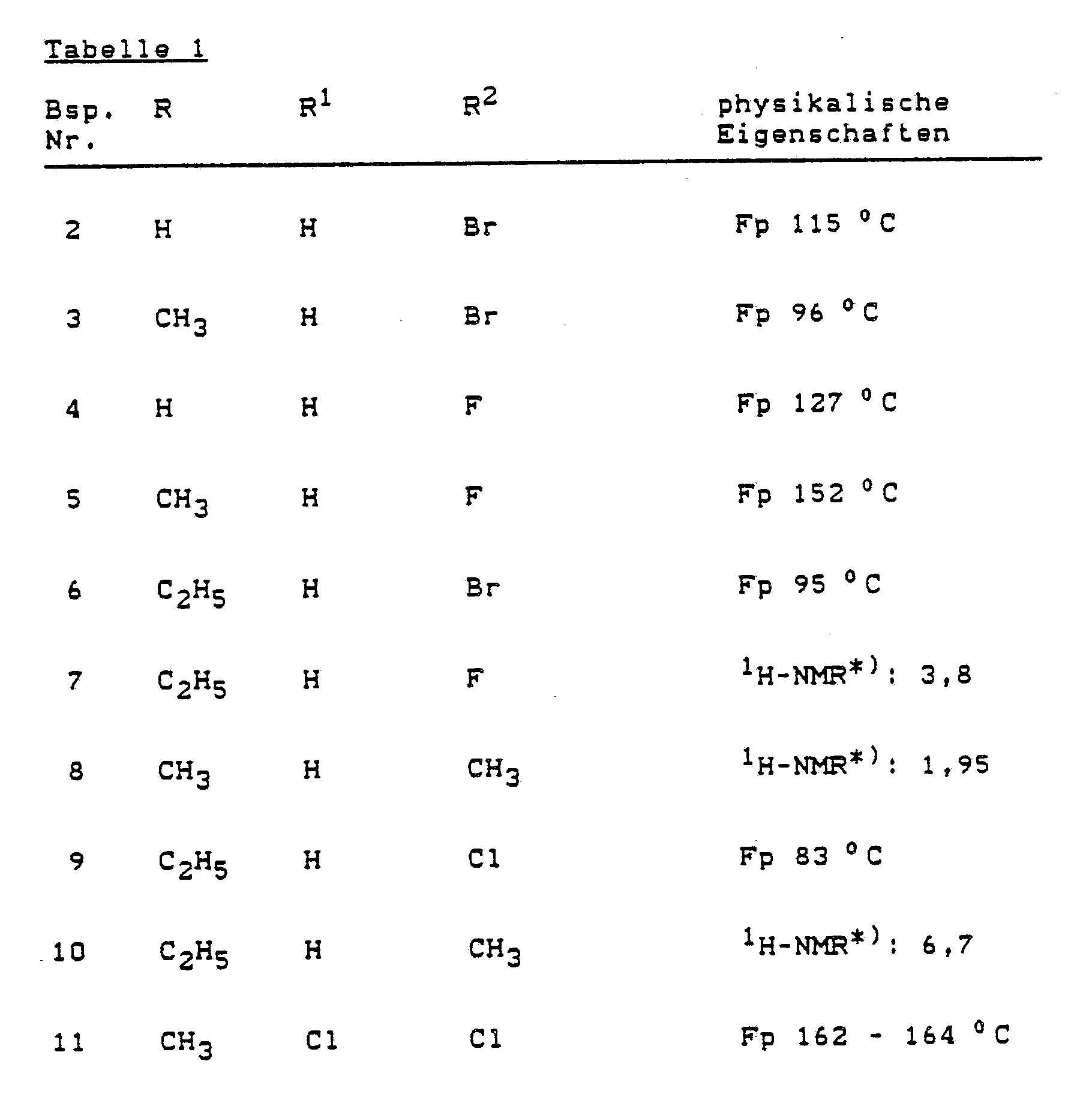


-

- Der Wirkstoff wird mit den Zusatzstoffen gut vermischt und zu einem Pulver vermahlen. Vor der Anwendung wird das benetzbare Pulver mit soviel Wasser verrrührt, daß die dabei entstehende Dispersion den Wirkstoff in der jeweils gewünschten Konzentration enthält.

- Das durch das Vermisches des Wirkstoffes mit den Zusatzstoffen entstehende Emulsionskonzentrat wird mit soviel Wasser verdünnt, daß die dabei entstehende Mischung den Wirkstoff in der jeweils gewünschten Konzentration enthält.

- Der Wirkstoff wird mit dem Gesteinsmehl fein vermahlen. In einen Mischer legt man Sand vor, gibt Latex und anschließend die Wirkstoff-Mischung zu. Das Produkt wird mit Heißluft getrocknet.
- In dem folgenden Anwendungsbeispiel wurde die nachstehend aufgeführte Verbindung als Vergleichssubstanz eingesetzt:

- Lösungsmittel: 5 Gewichtsteile Aceton
Emulgator: 1 Gewichtsteil Alkylarylpolyglykolether
- Zur Herstellung einer zweckmäßigen Wirkstoffzubereitung vermischt man 1 Gewichtsteil Wirkstoff mit der angegebenen Menge Lösungsmittel, gibt die angegebene Menge Emulgator zu und verdünnt das Konzentrat mit Wasser auf die gewünschte Konzentration.
- Samen der Testpflanzen werden in normalen Boden ausgesät und nach 24 Stunden mit der Wirkstoffzubereitung begossen. Dabei hält man die Wassermenge pro Flächeneinheit zweckmäßigerweise konstant. Die Wirkstoffkonzentration in der Zubereitung spielt keine Rolle, entscheidend ist nur die Aufwandmenge des Wirkstoffs pro Flächeneinheit. Nach drei Wochen wird der Schädigungsgrad der Pflanzen bonitiert in % Schädigung im Vergleich zur Entwicklung der unbehandelten Kontrolle. Es bedeuten:
0 % = keine Wirkung (wie unbehandelte Kontrolle)
100 % = totale Vernichtung - Eine deutliche Überlegenheit in der Wirksamkeit gegenüber der Vergleichssubstanz (A) zeigen in diesem Test z.B. die Verbindung gemäß folgender Herstellungsbeispiele: 4 und 11.

Claims (7)

R für Wasserstoff oder Alkyl steht,
R¹ für Wasserstoff, Halogen, Cyano, Nitro, Alkyl, Alkoxy, Alkylthio, Halogenalkyl, Halogenalkoxy, Halogenalkylthio, Phenyl, Phenoxy, Formyl, Alkoxycarbonyl, Alkanoyl oder Alkoximinoalkyl steht und
R² für Halogen, Cyano, Nitro, Alkyl, Alkoxy, Alkylthio, Halogenalkyl, Halogenalkoxy, Halogenalkylthio, Phenyl, Phenoxy, Formyl, Alkoxycarbonyl, Alkanoyl oder Alkoximinoalkyl steht.
R¹ für Wasserstoff, Fluor, Chlor, Brom, Iod, Cyano, Nitro, für jeweils geradkettiges oder verzweigtes Alkyl, Alkoxy oder Alkylthio mit jeweils 1 bis 4 Kohlenstoffatomen, für jeweils geradkettiges oder verzweigtes Halogenalkyl, Halogenalkoxy oder Halogenalkylthio mit jeweils 1 bis 4 Kohlenstoffatomen und 1 bis 9 gleichen oder verschiedenen Halogenatomen, für Phenyl, Phenoxy, Formyl, für Alkanoyl mit 1 bis 5 Kohlenstoffatomen, für Alkoxycarbonyl mit 1 bis 5 Kohlenstoffatomen oder für Alkoximinoalkyl mit jeweils 1 bis 5 Kohlenstoffatomen in den einzelnen Alkylteilen steht und
R² für Fluor, Chlor, Brom, Iod, Cyano, Nitro, für jeweils geradkettiges oder verzweigtes Alkyl, Alkoxy oder Alkylthio mit jeweils 1 bis 4 Kohlenstoffatomen, für jeweils geradkettiges oder verzweigtes Halogenalkyl, Halogenalkoxy oder Halogenalkylthio mit jeweils 1 bis 4 Kohlenstoffatomen und 1 bis 9 gleichen oder verschiedenen Halogenatomen, für Phenyl, Phenoxy, Formyl, für Alkanoyl mit 1 bis 5 Kohlenstoffatomen, für Alkoxycarbonyl mit 1 bis 5 Kohlenstoffatomen oder für Alkoximinoalkyl mit jeweils 1 bis 5 Kohlenstoffatomen in den einzelnen Alkylteilen steht.
R für Wasserstoff, Methyl, Ethyl, n- oder i-Propyl oder t-Butyl steht,
R¹ für Wasserstoff, Fluor, Chlor, Brom, Iod, Cyano, Nitro, Methyl, Ethyl, n- oder i-Propyl, n-, i-, s- oder t-Butyl, Methoxy, Ethoxy, Methylthio, Trifluormethyl, Trifluormethoxy, Trifluormethylthio, Phenyl, Phenoxy, Formyl, Acetyl, Methoxycarbonyl, Ethoxycarbonyl, Methoximinomethyl, Methoximinoethyl oder Ethoximinomethyl steht und
R² für Fluor, Chlor, Brom, Iod, Cyano, Nitro, Methyl, Ethyl, n- oder i-Propyl, n-, i-, s- oder t-Butyl, Methoxy, Ethoxy, Methylthio, Trifluormethyl, Trifluormethoxy, Trifluormethylthio, Phenyl, Phenoxy, Formyl, Acetyl, Methoxycarbonyl, Ethoxycarbonyl, Methoximinomethyl, Methoximinoethyl und Ethoximinomethyl steht.
R für Wasserstoff, Methyl, Ethyl oder t-Butyl steht,
R¹ für Wasserstoff, Fluor, Chlor, Brom, Cyano, Nitro, Methyl, Ethyl, Methoxy, Trifluormethyl, Phenyl, Phenoxy, Methoxycarbonyl, Methoximinomethyl oder Methoximinoethyl steht und
R² für Fluor, Chlor, Brom, Cyano, Nitro, Methyl, Ethyl, Methoxy, Trifluormethyl, Trifluormethoxy, Trifluormethylthio, Phenyl, Phenoxy, Methoxycarbonyl, Methoximinomethyl oder Methoximinoethyl steht.
Applications Claiming Priority (2)
| Application Number | Priority Date | Filing Date | Title |
|---|---|---|---|
| DE19873715248 DE3715248A1 (de) | 1987-05-08 | 1987-05-08 | Herbizide mittel |
| DE3715248 | 1987-05-08 |
Publications (2)
| Publication Number | Publication Date |
|---|---|
| EP0289927A2 true EP0289927A2 (de) | 1988-11-09 |
| EP0289927A3 EP0289927A3 (de) | 1991-01-16 |
Family
ID=6327031
Family Applications (1)
| Application Number | Title | Priority Date | Filing Date |
|---|---|---|---|
| EP19880106713 Withdrawn EP0289927A3 (de) | 1987-05-08 | 1988-04-27 | Herbizide Mittel |
Country Status (6)
| Country | Link |
|---|---|
| US (1) | US4874424A (de) |
| EP (1) | EP0289927A3 (de) |
| JP (1) | JPH01117806A (de) |
| AU (1) | AU1569788A (de) |
| DE (1) | DE3715248A1 (de) |
| DK (1) | DK249488A (de) |
Family Cites Families (2)
| Publication number | Priority date | Publication date | Assignee | Title |
|---|---|---|---|---|
| DE3276110D1 (en) * | 1981-03-04 | 1987-05-27 | Ici Plc | Amide derivatives, processes for preparing them, their use as fungicides and pesticidal compositions containing them |
| DE3709780A1 (de) * | 1986-08-09 | 1988-02-11 | Bayer Ag | Alkoximinoalkylamide |
-
1987
- 1987-05-08 DE DE19873715248 patent/DE3715248A1/de not_active Withdrawn
-
1988
- 1988-04-27 US US07/186,548 patent/US4874424A/en not_active Expired - Fee Related
- 1988-04-27 EP EP19880106713 patent/EP0289927A3/de not_active Withdrawn
- 1988-05-02 AU AU15697/88A patent/AU1569788A/en not_active Abandoned
- 1988-05-06 DK DK249488A patent/DK249488A/da not_active Application Discontinuation
- 1988-05-06 JP JP63109279A patent/JPH01117806A/ja active Pending
Also Published As
| Publication number | Publication date |
|---|---|
| DK249488D0 (da) | 1988-05-06 |
| DK249488A (da) | 1988-11-09 |
| US4874424A (en) | 1989-10-17 |
| DE3715248A1 (de) | 1988-11-17 |
| AU1569788A (en) | 1988-11-10 |
| JPH01117806A (ja) | 1989-05-10 |
| EP0289927A3 (de) | 1991-01-16 |
Similar Documents
| Publication | Publication Date | Title |
|---|---|---|
| EP0412358B1 (de) | 3-Amino-5-aminocarbonyl-1,2,4-triazol-Derivate | |
| EP0305844B1 (de) | Substituierte Triazolinone | |
| EP0354329B1 (de) | (Hetero)Aryloxynaphthaline mit über Schwefel gebundenen Substituenten | |
| EP0294666B1 (de) | Substituierte Triazolinone | |
| EP0363585A1 (de) | N-Aryl-Stickstoffheterocyclen | |
| EP0137358A2 (de) | 1,3-Diaryl-5-methylen-perhydropyrimidin-2-one | |
| EP0391187B1 (de) | Substituierte 4-Amino-5-alkylthio-1,2,4-triazol-3-one | |
| EP0303153A2 (de) | 1-Arylpyrazole | |
| DE3640155A1 (de) | Triazolo-pyrimidin-2-sulfonamide | |
| EP0300344B1 (de) | Halogenierte Thiadiazolyl-oxyessig-säureamide, Verfahren und Zwischenprodukte zu ihrer Herstellung und ihre Verwendung als Herbizide | |
| EP0173312A1 (de) | 1-(2-Trifluormethoxy-phenylsulfonyl)-3-heteroaryl-(thio)-harnstoffe | |
| EP0316733A1 (de) | 3-Aminopyrazolin-5-one | |
| EP0138085A1 (de) | 2-Aryl-2-Halogenalkyloxirane | |
| EP0460479A1 (de) | Cycloalkyl-substituierte Thiadiazolyloxyessigsäureamide | |
| EP0289927A2 (de) | Herbizide Mittel | |
| EP0324175A1 (de) | Difluorphenylharnstoffe | |
| EP0467139A2 (de) | Nicotinsäurederivate als Herbizide | |
| EP0230244A2 (de) | Neue 2,4-Diamino-6-halogenalkylpyrimidine | |
| EP0451651A1 (de) | Imidazolidinderivate | |
| DE3513488A1 (de) | Herbizide mittel | |
| EP0443164A1 (de) | Chlorfluormethyl-thiadiazolyloxyessigsäureamide | |
| DE3431933A1 (de) | Heteroarylthioharnstoffe | |
| DE3035021A1 (de) | 3-dimethylamino-4-methyl-6-phenyl-1, 2,4-triazin-5-one, verfahren zu ihrer herstellung sowie ihre verwendung als herbizide | |
| EP0117477A1 (de) | Alkoximinoalkylamino-1,3,5-triazine, Verfahren zu ihrer Herstellung und ihre Verwendung als Herbizide | |
| EP0431390A1 (de) | Substituierte Triazolinone |
Legal Events
| Date | Code | Title | Description |
|---|---|---|---|
| PUAI | Public reference made under article 153(3) epc to a published international application that has entered the european phase |
Free format text: ORIGINAL CODE: 0009012 |
|
| 17P | Request for examination filed |
Effective date: 19880427 |
|
| AK | Designated contracting states |
Kind code of ref document: A2 Designated state(s): BE CH DE FR GB IT LI NL |
|
| PUAL | Search report despatched |
Free format text: ORIGINAL CODE: 0009013 |
|
| RHK1 | Main classification (correction) |
Ipc: A01N 37/46 |
|
| AK | Designated contracting states |
Kind code of ref document: A3 Designated state(s): BE CH DE FR GB IT LI NL |
|
| STAA | Information on the status of an ep patent application or granted ep patent |
Free format text: STATUS: THE APPLICATION HAS BEEN WITHDRAWN |
|
| 18W | Application withdrawn |
Withdrawal date: 19910207 |