EP0289936A2 - Method for the preparation of foreign proteins in streptomyces - Google Patents
Method for the preparation of foreign proteins in streptomyces Download PDFInfo
- Publication number
- EP0289936A2 EP0289936A2 EP88106786A EP88106786A EP0289936A2 EP 0289936 A2 EP0289936 A2 EP 0289936A2 EP 88106786 A EP88106786 A EP 88106786A EP 88106786 A EP88106786 A EP 88106786A EP 0289936 A2 EP0289936 A2 EP 0289936A2
- Authority
- EP
- European Patent Office
- Prior art keywords
- plasmid
- gene
- tendamistat
- fusion protein
- protein
- Prior art date
- Legal status (The legal status is an assumption and is not a legal conclusion. Google has not performed a legal analysis and makes no representation as to the accuracy of the status listed.)
- Granted
Links
Images


Classifications
-
- C—CHEMISTRY; METALLURGY
- C12—BIOCHEMISTRY; BEER; SPIRITS; WINE; VINEGAR; MICROBIOLOGY; ENZYMOLOGY; MUTATION OR GENETIC ENGINEERING
- C12N—MICROORGANISMS OR ENZYMES; COMPOSITIONS THEREOF; PROPAGATING, PRESERVING, OR MAINTAINING MICROORGANISMS; MUTATION OR GENETIC ENGINEERING; CULTURE MEDIA
- C12N15/00—Mutation or genetic engineering; DNA or RNA concerning genetic engineering, vectors, e.g. plasmids, or their isolation, preparation or purification; Use of hosts therefor
-
- C—CHEMISTRY; METALLURGY
- C07—ORGANIC CHEMISTRY
- C07K—PEPTIDES
- C07K14/00—Peptides having more than 20 amino acids; Gastrins; Somatostatins; Melanotropins; Derivatives thereof
- C07K14/195—Peptides having more than 20 amino acids; Gastrins; Somatostatins; Melanotropins; Derivatives thereof from bacteria
- C07K14/36—Peptides having more than 20 amino acids; Gastrins; Somatostatins; Melanotropins; Derivatives thereof from bacteria from Actinomyces; from Streptomyces (G)
-
- C—CHEMISTRY; METALLURGY
- C07—ORGANIC CHEMISTRY
- C07K—PEPTIDES
- C07K14/00—Peptides having more than 20 amino acids; Gastrins; Somatostatins; Melanotropins; Derivatives thereof
- C07K14/435—Peptides having more than 20 amino acids; Gastrins; Somatostatins; Melanotropins; Derivatives thereof from animals; from humans
- C07K14/575—Hormones
- C07K14/62—Insulins
-
- C—CHEMISTRY; METALLURGY
- C12—BIOCHEMISTRY; BEER; SPIRITS; WINE; VINEGAR; MICROBIOLOGY; ENZYMOLOGY; MUTATION OR GENETIC ENGINEERING
- C12N—MICROORGANISMS OR ENZYMES; COMPOSITIONS THEREOF; PROPAGATING, PRESERVING, OR MAINTAINING MICROORGANISMS; MUTATION OR GENETIC ENGINEERING; CULTURE MEDIA
- C12N15/00—Mutation or genetic engineering; DNA or RNA concerning genetic engineering, vectors, e.g. plasmids, or their isolation, preparation or purification; Use of hosts therefor
- C12N15/09—Recombinant DNA-technology
- C12N15/11—DNA or RNA fragments; Modified forms thereof; Non-coding nucleic acids having a biological activity
-
- C—CHEMISTRY; METALLURGY
- C12—BIOCHEMISTRY; BEER; SPIRITS; WINE; VINEGAR; MICROBIOLOGY; ENZYMOLOGY; MUTATION OR GENETIC ENGINEERING
- C12N—MICROORGANISMS OR ENZYMES; COMPOSITIONS THEREOF; PROPAGATING, PRESERVING, OR MAINTAINING MICROORGANISMS; MUTATION OR GENETIC ENGINEERING; CULTURE MEDIA
- C12N15/00—Mutation or genetic engineering; DNA or RNA concerning genetic engineering, vectors, e.g. plasmids, or their isolation, preparation or purification; Use of hosts therefor
- C12N15/09—Recombinant DNA-technology
- C12N15/63—Introduction of foreign genetic material using vectors; Vectors; Use of hosts therefor; Regulation of expression
- C12N15/74—Vectors or expression systems specially adapted for prokaryotic hosts other than E. coli, e.g. Lactobacillus, Micromonospora
- C12N15/76—Vectors or expression systems specially adapted for prokaryotic hosts other than E. coli, e.g. Lactobacillus, Micromonospora for Actinomyces; for Streptomyces
-
- C—CHEMISTRY; METALLURGY
- C12—BIOCHEMISTRY; BEER; SPIRITS; WINE; VINEGAR; MICROBIOLOGY; ENZYMOLOGY; MUTATION OR GENETIC ENGINEERING
- C12P—FERMENTATION OR ENZYME-USING PROCESSES TO SYNTHESISE A DESIRED CHEMICAL COMPOUND OR COMPOSITION OR TO SEPARATE OPTICAL ISOMERS FROM A RACEMIC MIXTURE
- C12P21/00—Preparation of peptides or proteins
- C12P21/02—Preparation of peptides or proteins having a known sequence of two or more amino acids, e.g. glutathione
-
- C—CHEMISTRY; METALLURGY
- C07—ORGANIC CHEMISTRY
- C07K—PEPTIDES
- C07K2319/00—Fusion polypeptide
- C07K2319/01—Fusion polypeptide containing a localisation/targetting motif
- C07K2319/02—Fusion polypeptide containing a localisation/targetting motif containing a signal sequence
-
- C—CHEMISTRY; METALLURGY
- C07—ORGANIC CHEMISTRY
- C07K—PEPTIDES
- C07K2319/00—Fusion polypeptide
- C07K2319/70—Fusion polypeptide containing domain for protein-protein interaction
- C07K2319/74—Fusion polypeptide containing domain for protein-protein interaction containing a fusion for binding to a cell surface receptor
- C07K2319/75—Fusion polypeptide containing domain for protein-protein interaction containing a fusion for binding to a cell surface receptor containing a fusion for activation of a cell surface receptor, e.g. thrombopoeitin, NPY and other peptide hormones
Definitions
- Patent application 88103141.3 (corresponding to German patent application P 37 07 150.5 dated March 6, 1987) has already proposed a method for the excretion of fusion proteins from streptomycetes, which is characterized in that the coding sequence for the desired protein is modified into the optionally modified Tendamistat Gene is inserted and the recombinant gene is expressed in a streptomycete cell.
- the tendamistat structural gene is used as a "carrier” for another gene, whereby fusion proteins are obtained in which the amino acid sequence of another protein is arranged within the tendamistat amino acid sequence.
- the chemical or enzymatic cleavage of this fusion protein to release the other protein consequently gives two partial sequences of the tendamistate.
- tendamistate derivatives including those with a significantly shortened amino acid chain. Such derivatives can react reversibly with the specific receptors in the form of a competitive inhibitory mechanism.
- foreign proteins in Streptomycetes can also be produced by constructing genes for fusion proteins in which the structural gene for the desired protein is coupled to the 3'-end (of the coding strand) of the optionally modified tendamistat gene.
- the modification of the Tendamistat gene can consist in particular in a shortening at the 3'-end.
- the DNA coding for tendamistat is given in EP-A 0 161 629 (there as DNA sequence C and in the appendix as Table 1).
- This structural gene contains several interfaces for restriction enzymes that can be used to modify the encoded amino acid sequence.
- the interfaces for BstEII in the region of triplets 31 and 32, StuI in the region of triplets 43 and 44 and Sau3A in the region of triplets 52 and 53 are suitable.
- linkers one or more additional amino acids can be inserted at these points, DMA- Segments between these interfaces can be eliminated or shortened amino acid sequences can be encoded by incorporating stop codons.
- any amino acids can be inserted, exchanged or eliminated by site-specific mutagenesis. In this way, proteins are obtained which show ⁇ -amylase inhibitory activity, or proteins without this activity, but which still react with the corresponding receptors.
- the invention further relates to corresponding gene structures, vectors containing these gene structures, streptomyces cells transformed with these vectors, the excreted fusion proteins and their use for producing the foreign proteins and tendamistate derivatives. Preferred embodiments of the invention are explained in more detail below or defined in the patent claims.
- the fusion proteins obtained according to the invention and exported from the cell offer the advantage that they can easily be isolated from the culture filtrate.
- the isolation can be carried out in a manner known per se, advantageously by means of adsorption or ion exchange chromatography and / or gel filtration.
- the desired foreign protein (fusion partner) is also released by enzymatic or chemical cleavage in a manner known per se.
- cleavage depends primarily on the amino acid sequence of the desired protein. In many cases it will be expedient to incorporate a link or bridge link into the cleavage site between the tendamistat sequence and the amino acid sequence of the desired protein. If, for example, the desired protein does not contain methionine, the link can mean met, followed by chemical cleavage with cyanogen or cyanogen bromide. If there is cysteine in the link at the carboxy terminus or the link stands for Cys, an enzymatic cleavage specific to cysteine or a chemical cleavage can follow, for example after specific S-cyanylation. If tryptophan is in the bridge link at the carboxy terminus or Trp is the link, chemical cleavage with N-bromosuccinimide can take place.
- Desired proteins that do not contain Asp-Pro in their amino acid sequence and are sufficiently acid-stable can be proteolytically cleaved as fusion proteins with this bridge member in a manner known per se. In this way, proteins are obtained which contain N-terminal proline or C-terminal aspartic acid. In this way, modified proteins can also be synthesized.
- the Asp-Pro bond can be made even more acid labile if this bridge member means (Asp) n -Pro or is Glu- (Asp) n -Pro, where n means 1 to 3.
- enzymatic cleavages are also known, and modified enzymes with improved specificity can also be used (cf. CS Craik et al., Science 228 (1985) 291-197).
- a peptide sequence is expediently chosen in which an amino acid (Arg. Lys) which can be split off by trypsin is bound to the N-terminal amino acid (Phe) of the proinsulin, for example Ala-Ser-Met-
- the fusion protein can be cleaved with the corresponding bridge member with factor Xa (EP-A 0 025 190 and 0 161 973).
- protent data refer to weight.
- the plasmid pKAI650 which is described in German Offenlegungsschrift 3 536 182 and in EP-A 0 218 204, serves as the starting material.
- This plasmid is accessible from the plasmid pKAI1 described in German Offenlegungsschrift 3,331,860 by isolating the 650 bp HincII-SstI fragment and cloning into the plasmid pUC19 opened with these enzymes.
- the singular HindIII site is removed (by cutting with this enzyme, filling in the protruding ends and ligating) and the plasmid pKAI650a (1) is thus obtained.
- pKK3a (3) After transformation of the ligation mixture into E. coli JM 109, those clones are isolated which carry the recombinant plasmid pKK3a (3).
- the isolated plasmid DNA is characterized by an interface for the restriction enzyme HindIII, which allows characterization by restriction analysis.
- pKK3a (3) is 12 base pairs larger than pKAI650a (1) and has a nucleotide sequence that extends the amino acid sequence by 4 amino acids as follows:
- the plasmid pYE24 (4) serves as a further starting material.
- This plasmid is obtained by opening the vector pUC8 with EcoRI and HindIII and into this linearized plasmid the monkey proinsulin gene (Table 2; see. Wetekam et al., Gene 19 (1982) 179-183).
- the plasmid (7) contains the proinsulin sequence within the tendamistat gene.
- (7) is digested with SphI and SalI and the fragment (8) is isolated.
- the vector pUC19 is opened with SphI and SalI and the linearized plasmid ligated with the fragment (8).
- the plasmid pKK310 (9) thus obtained codes for a fusion protein in which only the proinsulin sequence follows the shortened tendamistat sequence and the linker shown above.
- FIG. 1 The entire construction is shown in FIG. 1.
- the commercial expression vector pIJ702 (11) (available from the John Innes Foundation, Norwich, England) is opened with SphI and SstI and the linearized plasmid (12) ligated with the fragment (10). After transformation of the strain Streptomyces lividans TK 24 (John Innes Foundation), the desired clones are determined by selection for resistance to thiostrepton. The plasmid DNA from thiostrepton-resistant clones is isolated and checked by restriction analysis. Plasmids with the desired orientation of the gene are called pTF1 (13). Clones containing this recombinant plasmid secrete a protein with a molecular weight of 16 kD into the culture medium. This protein reacts positively with insulin antibodies in the "immunoblot". (see example 5).
- the plasmid pKK3a (3) on the one hand and the vector pUC18 on the other hand are each opened with HindIII and ligated together.
- the E. coli strain JM 109 is transformed, which clones successfully in the presence of isopropyl- ⁇ -thiogalactopyranoside (IPTG) and 5-bromo-4-chloro-3-indolyl- ⁇ -D-galactopyranoside (X- Gal) is indicated by the formation of undyed colonies.
- the resulting recombined plasmid pRS1 (14) is isolated in a manner known per se.
- the pUC18 portion is deleted except for the polylinker sequence (mcs) and the rest of the tendamistat gene.
- the plasmid pRS10 (15) is obtained.
- the plasmid (15) is suitable due to its polylinker portion for cloning any structural genes, whereby plasmids are obtained which code for the corresponding fusion proteins with the shortened Tendamistatsequenz.
- pRS10 (15) is digested with SphI and SstI and the smaller fragment is isolated, this can be ligated into the expression vector pIJ702 analogously to Example 2.
- the expression vector pTF10 (16) is thus obtained, which also allows versatile constructions due to its polylinker content.
- the plasmid pYE24 (4) is opened with EcoRI and the linker is inserted a, the plasmid pYE241 is obtained.
- the plasmid pKK32 is obtained analogously to Example 1. This codes for a fusion protein in which the tendamistat sequence is linked to the proinsulin sequence by the following link:
- pKK32 is cut with SphI and SstI and the approximately 650 bp fragment which has been opened with these enzymes is cloned into pUC19.
- the resulting plasmid pKK320 corresponds to plasmid pKK310 (9) except for the above bridge member (in which the sequence introduced by the linker is highlighted in bold).
- Example 2 Analogously to Example 2, the SstI-SphI fragment with the recombinant gene from pKK320 is cloned into pIJ702, whereby the expression plasmid pTF2 is obtained.
- S. lividans TK 24 a 16 kd fusion protein is expressed and secreted, which reacts with insulin antibodies (cf. Example 5).
- pKK310 (9) is partially digested with EcoRI so that only one of the two EcoRI interfaces is opened. After filling the protruding ends with the help of Klenow polymerase, the plasmid is religated and the result is checked by restriction analysis. The desired plasmid, in which the EcoRI site at the end of the proinsulin gene was eliminated, is given the designation pKK310a (17). This now contains a unique restriction site for EcoRI in the linker region between the shortened Tendamistat gene and the proinsulin gene.
- the DNA sequence coding for tendamistat (Table 1) a unique interface for KpnI was introduced in the area of codons for amino acids 68/69.
- the isolated DNA from pKAI650a (1) is digested with Sst and SphI and the 650 bp fragment is cloned into the RF DNA of the phage M13mp18, which is also double digested with these enzymes, and the single-stranded DNA is produced by known methods.
- the RF-DNA is isolated from the isolated M13 clones with the mutated gene, which can be selected by the additional KpnI cleavage site, and the base exchange (C for G at the third position of the codon for Arg68) is ensured by sequencing.
- the nucleotide exchange therefore does not change the amino acid sequence, but the introduction of the desired new singular cleavage into the tendamistat structural gene.
- the mutated sequence is cloned from the M13mp18-RF-DNA into the plasmid pUC19, whereby the plasmid kpKAI651 (18) is obtained.
- the 650 bp SstI-SphI inert from (18) is inserted into the plasmid pIJ702 according to Example 2, the plasmid pAX651 being obtained.
- this plasmid into Streptomyces lividans TK 24 one gets the same expression rates for tendamistat as for the plasmid pAX650 with the unchanged tendamistat gene (German Offenlegungsschrift 3 536 182, Fig. 3).
- the plasmid pKAI651 (18) is now digested with SphI and KpnI and the small fragment with the linker (19) and the plasmid pKK310a (17) opened with SphI and EcoRI.
- E. coli JM 109 is transformed with the ligation mixture, the plasmid DNA is isolated and the correct fusion is verified by DNA sequencing.
- the plasmid with the correct sequence is named pKK400 (20).
- the linker (19) codes not only for the remaining amino acids of tendamistat, but also for the part of a "spacer” which separates the tendamistat - and the proinsulin gene - and overall - with the 5'- end of the gene according to Table 2 - includes the codons for the following 11 amino acids: Phe-Asn-Ala-Met-Ala-Thr-Gly-Asn-Ser-Ala-Arg
- the fusion protein thus contains, inter alia, the amino acids methionine and arginine in this "spacer", which allow cleavage with cyanogen or trypin.
- the plasmid pKK400 (20) is converted into by double digestion SstI and SphI isolated the inert of about 1090 bp and ligated the DNA into the plasmid pIJ702 (12) opened with the same enzymes.
- the plasmid pGF1 (21) results.
- the ligation mixture is transformed into S. lividans TK 24 and the plasmid DNA is isolated from thiostrepton-resistant transformants which show tendamistat activity. All positive clones contain the 1090 bp SstI-SphI insert from pGF1.
- the Tendamistat activity is determined according to the plate test, which is described in EP-A1 0 161 629 in Example 3 and in German Offenlegungsschrift 3 536 182, Example 2.
- the expression of the fusion protein encoded by pGF1 can be carried out in a known manner. If the transformed strain S. lividans TK24 is incubated for four days at 28 ° C in a shake flask and the mycelium is separated from the culture solution by centrifugation, the fusion protein can be detected in the clear solution as follows:
Landscapes
- Health & Medical Sciences (AREA)
- Life Sciences & Earth Sciences (AREA)
- Chemical & Material Sciences (AREA)
- Genetics & Genomics (AREA)
- Organic Chemistry (AREA)
- Engineering & Computer Science (AREA)
- Zoology (AREA)
- Wood Science & Technology (AREA)
- Biotechnology (AREA)
- General Engineering & Computer Science (AREA)
- Molecular Biology (AREA)
- Bioinformatics & Cheminformatics (AREA)
- Biomedical Technology (AREA)
- General Health & Medical Sciences (AREA)
- Biochemistry (AREA)
- Biophysics (AREA)
- Microbiology (AREA)
- Proteomics, Peptides & Aminoacids (AREA)
- Physics & Mathematics (AREA)
- Plant Pathology (AREA)
- Medicinal Chemistry (AREA)
- Gastroenterology & Hepatology (AREA)
- Diabetes (AREA)
- Endocrinology (AREA)
- Toxicology (AREA)
- Chemical Kinetics & Catalysis (AREA)
- General Chemical & Material Sciences (AREA)
- Preparation Of Compounds By Using Micro-Organisms (AREA)
- Peptides Or Proteins (AREA)
- Micro-Organisms Or Cultivation Processes Thereof (AREA)
- Saccharide Compounds (AREA)
Abstract
Das Tendamistatgen kann zur Konstruktion von Genfusionen benutzt werden, mit denen in Steptomyceten-Wirtszellen Fusionsproteine exprimiert und exkretiert werden. Der Tendamistat-Anteil kann modifiziert, insbesondere C-terminal verkürzt werden. 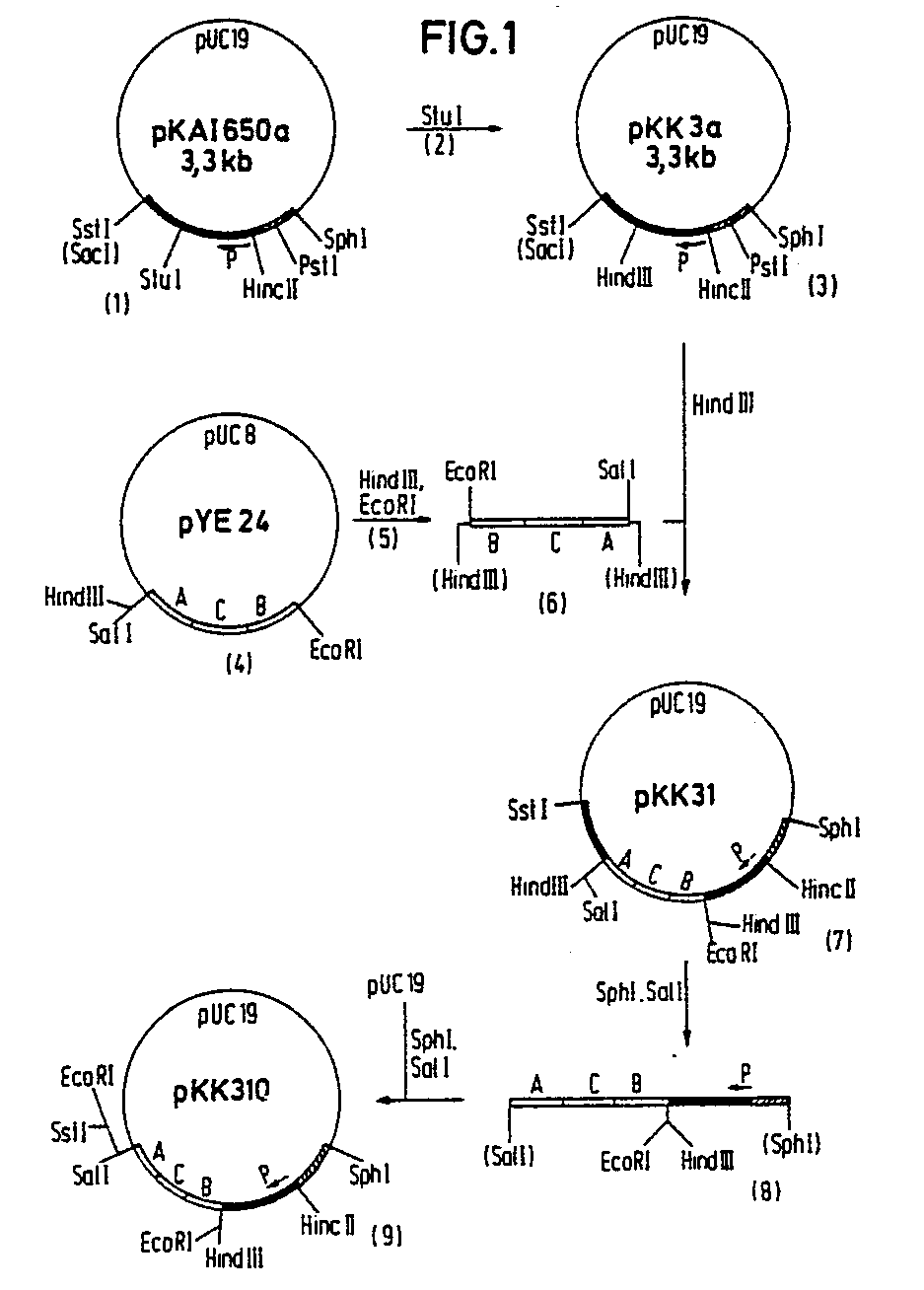
Description
Aus der europäischen Patentanmeldung mit der Veröffentlichungsnummer (EP-A) 0 161 629 bzw. aus der südarfrikansichen Patentschrift 85/3672 ist es bekannt, die für das Signalpeptid (Präpeptid) des α-Amylase-Inhibitors Tendamistat codierende DNA zu nutzen, um ein Polypeptid, insbesondere Tendamistat, aus einer Streptomycetenzelle zu exkretieren. Die entsprechende DNA kann grundsätzlich aus jedem Tendamistat produzierenden Stamm gewonnen werden, bevorzugt wird jedoch eine gemäß Beispiel 3 der deutschen Offenlegunsschrift 3 331 860 erhaltene DNA eingesetzt.From the European patent application with the publication number (EP-A) 0 161 629 and from the South African patent 85/3672 it is known to use the DNA coding for the signal peptide (prepeptide) of the α-amylase inhibitor tendamistate in order to use a polypeptide , in particular tendamistat, from a streptomycete cell. The corresponding DNA can in principle be obtained from any strain producing Tendamistat, but a DNA obtained in accordance with Example 3 of German Offenlegungsschrift 3,331,860 is preferably used.
In der Patentanmeldung 88103141.3 (entsprechend der deutschen Patentanmeldung P 37 07 150.5 vom 6. März 1987) wurde bereits ein Verfahren zur Exkretion von Fusionsproteinen aus Streptomyceten vorgeschalgen, das dadurch gekennzeichnet ist, daß man die codierende Sequenz für das gewünschte Protein in das gegebenenfalls modifizierte Tendamistat-Gen einbaut und das rekombinante Gen in einer Streptomycetenzelle exprimiert. Hier wird also das Tendamistat-Strukturgen als "Träger" für ein anderes Gen benutzt, wobei man Fusionsproteine erhält, bei denen die Aminosäuresequenz eines anderen Proteins innerhalb der Tendamistat-Aminosäuresequenz angeordnet ist. Bei der chemischen oder enzymatischen Spaltung dieses Fusionsproteins zur Freisetzung des anderen Proteins erhält man folglich zwei Teilsequenzen des Tendamistats. Die genannte frühere Anmeldung bezieht sich auch auf Tendamistat-Derivate, worunter u. a. auch solche mit deutliche verkürzter Aminosäurekette verstanden werden. Solche Derivate können in reversibler Weise mit den spezifischen Rezeptoren in Form eines kompetitiven Hemmechanismus reagieren.Patent application 88103141.3 (corresponding to German patent application P 37 07 150.5 dated March 6, 1987) has already proposed a method for the excretion of fusion proteins from streptomycetes, which is characterized in that the coding sequence for the desired protein is modified into the optionally modified Tendamistat Gene is inserted and the recombinant gene is expressed in a streptomycete cell. Here, the tendamistat structural gene is used as a "carrier" for another gene, whereby fusion proteins are obtained in which the amino acid sequence of another protein is arranged within the tendamistat amino acid sequence. The chemical or enzymatic cleavage of this fusion protein to release the other protein consequently gives two partial sequences of the tendamistate. The earlier application mentioned also relates to tendamistate derivatives, including those with a significantly shortened amino acid chain. Such derivatives can react reversibly with the specific receptors in the form of a competitive inhibitory mechanism.
Es wurde nun gefunden, daß Fremdproteine in Streptomyceten auch dadurch hergestellt werden können, daß man Gene für Fusionsproteine konstruiert, in denen das Strukturgen für das gewünschte Protein an das 3′-Ende (des codierenden Stranges) des gegebenenfalls modifizierten Tendamistat-Gens gekoppelt wird. Die Modifikation des Tendamistat-Gens kann insbesondere in einer Verkürzung am 3′-Ende bestehen.It has now been found that foreign proteins in Streptomycetes can also be produced by constructing genes for fusion proteins in which the structural gene for the desired protein is coupled to the 3'-end (of the coding strand) of the optionally modified tendamistat gene. The modification of the Tendamistat gene can consist in particular in a shortening at the 3'-end.
Die für Tendamistat codierende DNA ist in der EP-A 0 161 629 (dort als DNA-Sequenz C und im Anhang als Tabelle 1) wiedergegeben. In diesem Strukturgen befinden sich mehrere Schnittstellen für Restriktionsenzyme, die zur Modifikation der kodierten Aminosäurefolge genutzt werden können. Geeignet sind die Schnittstellen für BstEII im Bereich der Tripletts 31 und 32, StuI im Bereich der Tripletts 43 und 44 sowie Sau3A im Bereich der Tripletts 52 und 53. Durch Einbau entsprechender Linker können an diesen Stellen eine oder mehrere zusätzliche Aminosäuren eingeschoben werden, DMA-Segmente zwischen diesen Schnittstellen eliminiert werden oder durch Einbau von Stopp-Kodons verkürzte Aminosäuresequenzen kodiert werden. Darüber hinaus können durch ortssprezifische Mutagenese beliebige Aminosäuren eingefügt, ausgetauscht oder eliminiert werden. Man erhält so Proteine, die α-Amylase-Inhibitorwirkung zeigen, oder aber Proteine ohne diese Wirksamkeit, die aber noch mit den entsprechenden Rezeptoren reagieren.The DNA coding for tendamistat is given in EP-A 0 161 629 (there as DNA sequence C and in the appendix as Table 1). This structural gene contains several interfaces for restriction enzymes that can be used to modify the encoded amino acid sequence. The interfaces for BstEII in the region of triplets 31 and 32, StuI in the region of triplets 43 and 44 and Sau3A in the region of triplets 52 and 53 are suitable. By installing appropriate linkers, one or more additional amino acids can be inserted at these points, DMA- Segments between these interfaces can be eliminated or shortened amino acid sequences can be encoded by incorporating stop codons. In addition, any amino acids can be inserted, exchanged or eliminated by site-specific mutagenesis. In this way, proteins are obtained which show α-amylase inhibitory activity, or proteins without this activity, but which still react with the corresponding receptors.
Die Erfindung betrifft weiterhin entsprechende Genstrukturen, diese Genstrukturen enthaltende Vektoren, mit diesen Vektoren transformierte Streptomycetenzellen, die exkretierten Fusionsproteine und deren Verwendung zur Herstellung der Fremdproteine und Tendamistat-Derivate. Bevorzugte Ausgestaltungen der Erfindung werden im folgenden näher erläutert bzw. in den Patentansprüchen definiert.The invention further relates to corresponding gene structures, vectors containing these gene structures, streptomyces cells transformed with these vectors, the excreted fusion proteins and their use for producing the foreign proteins and tendamistate derivatives. Preferred embodiments of the invention are explained in more detail below or defined in the patent claims.
In den Figuren 1 bis 4 sind einig erfindungsgemäße Plasmidkonstruktionen dargestellt.
- Die Fig. 1 zeigt die Herstellung des Hybridplasmids pKK310, das für ein Fusionsprotein codiert, in dem auf einen Teil der Aminosäuresequenz für Tendamistat ein Brückenglied von sieben Aminosäuren und hierauf die Aminosäuresequenz von Affenproinsulin folgt.
- Die Fig. 2 zeigt die Überführung des Plasmids pKK310 in das Expressionsplasmid pTF1.
- Die Fig. 3 zeigt die Konstruktion des Plasmids pRS10, in dem auf einen Teil des Tendamistatgens der Polylinker aus pUC18 folgt, und dessen Überführung in das Expressionsplasmid pTF10. "mcs" bedeutet die Polylinkerregion (multiple cloning site) von pUC18.
- Die Fig. 4 zeigt schließlich die Konstruktion des Plasmids pKK400, das für ein Fusionsprotein codiert, in dem auf die gesamte Aminosäursequenz des Tendamistats ein Brückenglied aus elf Aminosäuren und hierauf die Aminosäuresequenz von Affenproinsulin folgt, und dessen Überführung in das Expressionsplasmid pGF1.
- FIG. 1 shows the production of the hybrid plasmid pKK310, which codes for a fusion protein in which a bridge member of seven amino acids follows a part of the amino acid sequence for tendamistat and then the amino acid sequence of monkey proinsulin.
- 2 shows the conversion of the plasmid pKK310 into the expression plasmid pTF1.
- FIG. 3 shows the construction of the plasmid pRS10, in which part of the tendamistat gene is followed by the polylinker from pUC18, and its conversion into the expression plasmid pTF10. "mcs" means the polylinker region (multiple cloning site) of pUC18.
- 4 finally shows the construction of the plasmid pKK400, which codes for a fusion protein in which the entire amino acid sequence of the tendamistate is followed by a bridge member of eleven amino acids and then the amino acid sequence of monkey proinsulin, and its conversion into the expression plasmid pGF1.
Die Figuren sind nicht maßstäblich gezeichnet.The figures are not drawn to scale.
Die erfindungsgemäß gewonnenen, aus der Zelle exportierten Fusionsproteine bieten den Vorteil, daß sie leicht aus dem Kulturfiltrat isoliert werden können. Die Isolierung kann in an sich bekannter Weise erfolgen, vorteilhaft durch Adsorptions- oder Ionenaustauschchromatographie und/oder Gelfiltration.The fusion proteins obtained according to the invention and exported from the cell offer the advantage that they can easily be isolated from the culture filtrate. The isolation can be carried out in a manner known per se, advantageously by means of adsorption or ion exchange chromatography and / or gel filtration.
Die Freisetzung des gewünschten Fremdproteins (Fusionspartners) durch enzymatische oder chemische Spaltung erfolgt ebenfalls in an sich bekannter Weise.The desired foreign protein (fusion partner) is also released by enzymatic or chemical cleavage in a manner known per se.
Hierbei richtet sich die Art der Spaltung vor allem nach der Aminosäuresequenz des gewünschten Proteins. In vielen Fällen wird es zweckmäßig sein, in die Spaltstelle zwischen Tendamistat-Sequenz und der Aminosäuresequenz des gewünschten Proteins ein Bindeglied bzw. Brückenglied einzubauen. Wenn das gewünschte Protein beispielsweise kein Methionin enthält, kann das Bindeglied Met bedeuten, worauf eine chemische Spaltung mit Chlor- oder Bromcyan erfolgt. Steht im Bindeglied am Carboxyterminus Cystein oder steht das Bindeglied für Cys, so kann eine enzymatische Cysteinspezifische Spaltung oder eine chemische Spaltung, beispielsweise nach spezifischer S-Cyanylierung, folgen. Steht im Brückenglied am Carboxyterminus Tryptophan oder das Bindeglied für Trp, so kann eine chemische Spaltung mit N-Bromsuccinimid erfolgen.The type of cleavage depends primarily on the amino acid sequence of the desired protein. In many cases it will be expedient to incorporate a link or bridge link into the cleavage site between the tendamistat sequence and the amino acid sequence of the desired protein. If, for example, the desired protein does not contain methionine, the link can mean met, followed by chemical cleavage with cyanogen or cyanogen bromide. If there is cysteine in the link at the carboxy terminus or the link stands for Cys, an enzymatic cleavage specific to cysteine or a chemical cleavage can follow, for example after specific S-cyanylation. If tryptophan is in the bridge link at the carboxy terminus or Trp is the link, chemical cleavage with N-bromosuccinimide can take place.
Gewünschte Proteine, die in ihrer Aminosäuresequenz nicht Asp - Pro enthalten und hinreichend säurestabil sind, können als Fusionsproteine mit diesem Brückenglied in an sich bekannter Weise proteolytisch gespalten werden. Hierdurch erhält man Proteine, die N-terminal Prolin bzw. C-terminal Asparaginsäure enthalten. Auf diese Weise können also auch modifizierte Proteine synthetisiert werden.Desired proteins that do not contain Asp-Pro in their amino acid sequence and are sufficiently acid-stable can be proteolytically cleaved as fusion proteins with this bridge member in a manner known per se. In this way, proteins are obtained which contain N-terminal proline or C-terminal aspartic acid. In this way, modified proteins can also be synthesized.
Die Asp-Pro-Bindung kann noch säurelabiler gestaltet werden, wenn dieses Brückenglied (Asp)n-Pro bedeutet bzw. Glu-(Asp)n-Pro ist, wobei n 1 bis 3 bedeutet.The Asp-Pro bond can be made even more acid labile if this bridge member means (Asp) n -Pro or is Glu- (Asp) n -Pro, where n means 1 to 3.
Beispiele für enzymatische Spaltungen sind ebenfalls bekannt, wobei auch modifizierte Enzyme mit verbesserter Spezifität eingesetzt werden können (vgl. C.S. Craik et al., Science 228 (1985) 291-197). Ist das gewünschte eukaryotische Peptid Proinsulin so wählt man zweckmäßig eine Peptidsequenz, bei der eine durch Trypsin abspaltbare Aminosäure (Arg. Lys) and die N-terminale Aminosäure (Phe) des Proinsulins gebunden ist, beispielsweise Ala-Ser-Met- Enthält das gewünschte Protein nicht die Aminosäurefolge
Ile-Glu-Gly-Art,
so kann das Fusionsprotein mit dem entsprechenden Brückenglied mit Faktor Xa gespalten werden (EP-A 0 025 190 und 0 161 973).Examples of enzymatic cleavages are also known, and modified enzymes with improved specificity can also be used (cf. CS Craik et al., Science 228 (1985) 291-197). If the desired eukaryotic peptide is proinsulin, a peptide sequence is expediently chosen in which an amino acid (Arg. Lys) which can be split off by trypsin is bound to the N-terminal amino acid (Phe) of the proinsulin, for example Ala-Ser-Met- If the desired protein does not contain the amino acid sequence
Ile-Glu-Gly species,
the fusion protein can be cleaved with the corresponding bridge member with factor Xa (EP-A 0 025 190 and 0 161 973).
Die Isolierung der Spaltprodukte richtet sich nach den Eigenschaften dieser Proteine. Hinsichtlich der Isolierung von Tendamistat und seinen Derivaten kann auf die in der deutschen Offenlegungsschrift 3 331 860 zitierte Literatur verwiesen werden.The isolation of the cleavage products depends on the properties of these proteins. With regard to the isolation of tendamistate and its derivatives, reference can be made to the literature cited in German Offenlegungsschrift 3,331,860.
In den folgenden Beispielen wird die Erfindung näher erläutert. Sofern keine anderen Angaben gemacht sind, beziehen sich Protentangaben auf das Gewicht.The invention is explained in more detail in the following examples. Unless otherwise stated, protent data refer to weight.
Die Beispiele werden durch Figuren gleicher Nummer erläutert. In den Figuren sind die Plasmide und Genfragmente nicht maßstäblich dargestellt; insbesondere in Polylinkersequenzen ist der Maßstab gedehnt.The examples are illustrated by figures with the same number. The plasmids and gene fragments are not shown to scale in the figures; especially in polylinker sequences, the scale is stretched.
Als Ausgangsmaterial dient das Plasmid pKAI650, das in der deutschen Offenlegungsschrift 3 536 182 bzw. in der EP-A 0 218 204 beschrieben ist. Dieses Plasmid ist aus dem in der deutschen Offenlegungsschrift 3 331 860 beschriebenen Plasmid pKAI1 durch Isolieren des 650 bp HincII-SstI-Fragments und Klonieren in das mit diesen Enzymen geöffnete Plasmid pUC19 zugänglich. In diesem Plasmid wird die singuläre HindIII-Schnittstelle (durch Schneiden mit diesem Enzym, Auffüllen der überstehenden Enden und Ligieren) entfernt und so das Plasmid pKAI650a (1) erhalten.The plasmid pKAI650, which is described in German Offenlegungsschrift 3 536 182 and in EP-A 0 218 204, serves as the starting material. This plasmid is accessible from the plasmid pKAI1 described in German Offenlegungsschrift 3,331,860 by isolating the 650 bp HincII-SstI fragment and cloning into the plasmid pUC19 opened with these enzymes. In this plasmid, the singular HindIII site is removed (by cutting with this enzyme, filling in the protruding ends and ligating) and the plasmid pKAI650a (1) is thus obtained.
2 µg über CsCl-Gradientenzentrifugation gereinigt DNA von (1) wird 2 Stunden in einem 50 µl-Reaktionsansatz mit StuI nach den Angaben des Herstellers komplett verdaut und das Enzym durch Phenolextraktion entfernt. Die linearisierte DNA wird mit Ethanol gefällt, wieder gelöst und in ein Ligationsgemisch eingebracht, dem als zusätzlicher Reaktionspartner 0,1 µg des chemisch synthetisierten, am 5′-Ende phosphorylierten, doppelsträngigen Oligonukleotids (2)
Nach Transformation des Ligationsgemisches in E.coli JM 109 werden solche Klone isoliert, die das rekombinante Plasmid pKK3a (3) tragen. Die isolierte Plasmid-DNA ist durch eine Schnittstelle für das Restriktionsenzym HindIII gekennzeichnet, die eine Charakterisierung durch Restriktionsanalyse erlaubt. pKK3a (3) ist um 12 Basenpaare größer als pKAI650a (1) und weist eine Nukleotidsequenz auf, durch die die Aminosäuresequenz wie folgt um 4 Aminosäuren erweitert wird:
Als ein weiteres Ausgangsmaterial dient das Plasmid pYE24 (4). Dieses Plasmid wird dadurch erhalten, daß der Vektor pUC8 mit EcoRI und HindIII geöffnet wird und in dieses linearisierte Plasmid das Affen-Proinsulingen (Tabelle 2; vgl. Wetekam et al., Gene 19 (1982) 179-183) hineinligiert wird.The plasmid pYE24 (4) serves as a further starting material. This plasmid is obtained by opening the vector pUC8 with EcoRI and HindIII and into this linearized plasmid the monkey proinsulin gene (Table 2; see. Wetekam et al., Gene 19 (1982) 179-183).
2 µg des Plasmids pYE24 (4) werden mit den Restriktionsenzymen EcoRI und HindIII umgesetzt, das Affen-Proinsulingen durch Elektroelution isoliert und nach Reinigung und Konzentrierung durch Ethanolfällung mit dem synthetischen DNA-Linker (5)

Im Plasmid (7) befindet sich die Proinsulin-Sequenz innerhalb des Tendamistat-Gens. Zur Überführung dieses Plasmids in ein erfindungsgemäßes Plasmid wird (7) mit SphI und SalI verdaut und das Fragment (8) isoliert. Der Vektor pUC19 wird mit SphI und SalI geöffnet und das linearisierte Plasmid mit dem Fragment (8) ligiert. Das so erhaltene Plasmid pKK310 (9) codiert für ein Fusionsprotein, bei dem auf die verkürzte Tendamistat-Sequenz und den vorstehend dargestellten Linker nur noch die Proinsulinsequenz folgt.The plasmid (7) contains the proinsulin sequence within the tendamistat gene. To convert this plasmid into a plasmid according to the invention, (7) is digested with SphI and SalI and the fragment (8) is isolated. The vector pUC19 is opened with SphI and SalI and the linearized plasmid ligated with the fragment (8). The plasmid pKK310 (9) thus obtained codes for a fusion protein in which only the proinsulin sequence follows the shortened tendamistat sequence and the linker shown above.
Die gesamte Konstruktion ist in der Figur 1 dargestellt.The entire construction is shown in FIG. 1.
Zur Überführung des Plasmids pKK310 (9) in ein Expressionsplasmid wird (9) mit SstI und SphI umgesetzt und das Fragment (10) isoliert.To convert the plasmid pKK310 (9) into an expression plasmid, (9) is reacted with SstI and SphI and the fragment (10) is isolated.
Der handelsübliche Expressionsvektor pIJ702 (11) (erhältlich bei der John Innes Foundation, Norwich, England) wird mit SphI und SstI geöffnet und das linearisierte Plasmid (12) mit dem Fragment (10) ligiert. Nach Transformation des Stammes Streptomyces lividans TK 24 (John Innes Foundation) werden die gewünschten Klone durch Selektion auf Resistenz gegenüber Thiostrepton ermittelt. Die Plasmid-DNA aus Thiostrepton-resistenten Klonen wird isoliert und durch Restriktionsanalyse überprüft. Plasmide mit der gewünschten Orientierung des Gens erhalten die Bezeichnung pTF1 (13). Klone, die dieses rekombinante Plasmid enthalten, sekretieren ein Protein mit dem Molekulargewicht 16 kD in das Kulturmedium. Dieses Protein reagiert mit Insulin-Antikörpern im "Immunblot" positiv. (vgl. Beispiel 5).The commercial expression vector pIJ702 (11) (available from the John Innes Foundation, Norwich, England) is opened with SphI and SstI and the linearized plasmid (12) ligated with the fragment (10). After transformation of the strain Streptomyces lividans TK 24 (John Innes Foundation), the desired clones are determined by selection for resistance to thiostrepton. The plasmid DNA from thiostrepton-resistant clones is isolated and checked by restriction analysis. Plasmids with the desired orientation of the gene are called pTF1 (13). Clones containing this recombinant plasmid secrete a protein with a molecular weight of 16 kD into the culture medium. This protein reacts positively with insulin antibodies in the "immunoblot". (see example 5).
Die Konstruktion von pTF1 (13) ist in der Figur 2 dargestellt.The construction of pTF1 (13) is shown in Figure 2.
Das Plasmid pKK3a (3) einerseits und der Vektor pUC18 andererseits werden jeweils mit HindIII geöffnet und zusammenligiert. Mit dem Ligationsansatz wird der E. coli-Stamm JM 109 transformiert, der die erfolgreiche Klonierung in Gegenwart von Isopropyl-β-thiogalactopyranosid (IPTG) und 5-Brom-4-chlor-3-indolyl-β-D-galactopyranosid (X-Gal) durch die Bildung ungefärbter Kolonien anzeigt. Das entstandene rekombinierte Plasmid pRS1 (14) wird in an sich bekannter Weise isoliert. Durch Verdauung von 1 µg des Plasmids mit dem Restriktionsenzym SstI und nachfolgende Religation wird der pUC18-Anteil bis auf die Polylinkersequenz (mcs) sowie der Rest des Tendamistatgens deletiert. Man erhält das Plasmid pRS10 (15).The plasmid pKK3a (3) on the one hand and the vector pUC18 on the other hand are each opened with HindIII and ligated together. With the ligation approach, the E. coli strain JM 109 is transformed, which clones successfully in the presence of isopropyl-β-thiogalactopyranoside (IPTG) and 5-bromo-4-chloro-3-indolyl-β-D-galactopyranoside (X- Gal) is indicated by the formation of undyed colonies. The resulting recombined plasmid pRS1 (14) is isolated in a manner known per se. By digesting 1 µg of the plasmid with the restriction enzyme SstI and subsequent religation, the pUC18 portion is deleted except for the polylinker sequence (mcs) and the rest of the tendamistat gene. The plasmid pRS10 (15) is obtained.
Das Plasmid (15) eignet sich durch seinen Polylinkeranteil zur Klonierung beliebiger Strukturgene, wodurch Plasmide erhalten werden, die für die entsprechenden Fusionsproteine mit der verkürzten Tendamistatsequenz codieren.The plasmid (15) is suitable due to its polylinker portion for cloning any structural genes, whereby plasmids are obtained which code for the corresponding fusion proteins with the shortened Tendamistatsequenz.
Verdaut man pRS10 (15) mit SphI und SstI und isoliert das kleinere Fragment, so kann man dieses analog Beispiel 2 in den Expressionsvektor pIJ702 ligieren. Man erhält so den Expressionsvektor pTF10 (16), der ebenfalls auf Grund seines Polylinkeranteils vielseitige Konstruktionen erlaubt.If pRS10 (15) is digested with SphI and SstI and the smaller fragment is isolated, this can be ligated into the expression vector pIJ702 analogously to Example 2. The expression vector pTF10 (16) is thus obtained, which also allows versatile constructions due to its polylinker content.
Die Konstruktion von pTF10 (16) ist in der Figur 3 dargestellt.The construction of pTF10 (16) is shown in Figure 3.
Man öffnet das Plasmid pYE24 (4) mit EcoRI und setzt den Linker

Analog Beispiel 1 wird pKK32 mit SphI und SstI geschnitten und das ca. 650 bp große Fragment in pUC19, das mit diesen Enzymen geöffnet wurde, umkloniert. Das resultierende Plasmid pKK320 entspricht dem Plasmid pKK310 (9) bis auf das vorstehende Brückenglied (in dem die durch den Linker eingeführte Sequenz durch Fettdruck hervorgehoben ist).Analogously to Example 1, pKK32 is cut with SphI and SstI and the approximately 650 bp fragment which has been opened with these enzymes is cloned into pUC19. The resulting plasmid pKK320 corresponds to plasmid pKK310 (9) except for the above bridge member (in which the sequence introduced by the linker is highlighted in bold).
Analog Beispiel 2 wird das SstI-SphI-Fragment mit dem rekombinanten Gen aus pKK320 in pIJ702 umkloniert, wodurch das Expressionsplasmid pTF2 erhalten wird. In S. lividans TK 24 wird ein Fusionsprotein von 16 kd exprimiert und sekretiert, das mit Insulinantikörpern reagiert (vgl. Beispiel 5).Analogously to Example 2, the SstI-SphI fragment with the recombinant gene from pKK320 is cloned into pIJ702, whereby the expression plasmid pTF2 is obtained. In S. lividans
Wegen der Ähnlichkeit der Konstruktion von pTF2 mit pTF1 (13), Figuren 1 und 2, wurde auf eine zeichnerische Darstellung verzichtet.Because of the similarity of the construction of pTF2 with pTF1 (13), Figures 1 and 2, a graphic representation has been omitted.
pKK310 (9) wird mit EcoRI partiell verdaut, so daß nur eine der beiden EcoRI-Schnittstellen geöffnet wird. Nach Auffüllen der überstehenden Enden mit Hilfe von Klenow-Polymerase wird das Plasmid religiert und durch Restriktionsanalyse das Ergebnis überprüft. Das gewünschte Plasmid, bei dem die am Ende des Proinsulingens stehende EcoRI-Stelle eliminiert wurde, erhält die Bezeichnung pKK310a (17). Dieses enthält also nunmehr eine singuläre Restriktionsstelle für EcoRI in der Linkerregion zwischen dem verkürzten Tendamistatgen und dem Proinsulingen.pKK310 (9) is partially digested with EcoRI so that only one of the two EcoRI interfaces is opened. After filling the protruding ends with the help of Klenow polymerase, the plasmid is religated and the result is checked by restriction analysis. The desired plasmid, in which the EcoRI site at the end of the proinsulin gene was eliminated, is given the designation pKK310a (17). This now contains a unique restriction site for EcoRI in the linker region between the shortened Tendamistat gene and the proinsulin gene.
Zur Konstruktion eines Plasmids, das für ein Fusionsprotein mit der kompletten Sequenz des Tendamistats codiert, wird in die für Tendamistat codierende DNA-Sequenz (Tabelle 1) im Bereich der Codons für die Aminosäuren 68/69 eine singuläre Schnittstelle für KpnI eingeführt. Dazu wird die isoliert DNA von pKAI650a (1) mit Sst und SphI verdaut und das 650 bp große Fragment in die ebenfalls mit diesen Enzymen doppelt verdaute RF-DNA des Phagen M13mp18 umkloniert und nach bekannten Methoden die Einzelstrang-DNA hergestellt. 1 µg dieser ssDNA wird zusammen mit 0,1 µg des mutagenen "Primers"
5′ C GAG GTA CCG GGC GT 3′
in eine "site directed mutagenesis" eingesetzt (M. J. Zoller u. J. Smith, Nucleic Acid Res. 10 (1982) 6487-6500).In order to construct a plasmid which codes for a fusion protein with the complete sequence of the tendamistat, the DNA sequence coding for tendamistat (Table 1) a unique interface for KpnI was introduced in the area of codons for amino acids 68/69. For this purpose, the isolated DNA from pKAI650a (1) is digested with Sst and SphI and the 650 bp fragment is cloned into the RF DNA of the phage M13mp18, which is also double digested with these enzymes, and the single-stranded DNA is produced by known methods. 1 µg of this ssDNA is combined with 0.1 µg of the mutagenic "primer"
5 ′ C GAG GTA
used in a "site directed mutagenesis" (MJ Zoller and J. Smith, Nucleic Acid Res. 10 (1982) 6487-6500).
Aus den isolierten M13-Klonen mit dem mutierten Gen, das sich durch die zusätzliche KpnI-Schnittstelle selektieren läßt, wird die RF-DNA isoliert und der Basenaustausch (C gegen G an der dritten Position des Codons für Arg⁶⁸) durch Sequenzierung abgesichert. Der Nucleotidaustausch bewirkt also keine Veränderung der Aminosäuresequenz, jedoch die Einführung der gewünschten neuen singulären Schnittstelle in das Tendamistat-Strukturgen.
Die mutierte Sequenz wird nach SstI-SphI-Verdauung aus der M13mp18-RF-DNA in das Plasmid pUC19 umkloniert, wobei das Plasmid kpKAI651 (18) erhalten wird.After SstI-SphI digestion, the mutated sequence is cloned from the M13mp18-RF-DNA into the plasmid pUC19, whereby the plasmid kpKAI651 (18) is obtained.
Zur Kontrolle wird das 650 bp SstI-SphI-Inert aus (18) entsprechend Beispiel 2 in das Plasmid pIJ702 eingebaut, wobei man das Plasmid pAX651 erhält. Nach Transformation dieses Plasmids in Streptomyces lividans TK 24 erhält man die gleichen Expressionsraten für Tendamistat wie für das Plasmid pAX650 mit dem unveränderten Tendamistatgen (deutsche Offenlegungsschrift 3 536 182, Fig. 3).As a control, the 650 bp SstI-SphI inert from (18) is inserted into the plasmid pIJ702 according to Example 2, the plasmid pAX651 being obtained. After transformation of this plasmid into Streptomyces lividans
Zur Herstellung eines erfindungsgemäßen Plasmids für ein Fusionsprotein mit der gesamten Aminosäuresequenz von Tendamistat wird nun das Plasmid pKAI651 (18) mit SphI und KpnI verdaut und das kleine Fragment mit dem Linker (19)
Mit dem Ligationsgemisch wird E. coli JM 109 transformiert, die Plasmid-DNA isoliert und die korrekte Fusion durch DNA-Sequenzierung verifiziert. Das Plasmid mit der korrekten Sequenz erhält die Bezeichnung pKK400 (20).E. coli JM 109 is transformed with the ligation mixture, the plasmid DNA is isolated and the correct fusion is verified by DNA sequencing. The plasmid with the correct sequence is named pKK400 (20).
Der Linker (19) codiert nicht nur für die restlichen Aminosäuren von Tendamistat, sondern auch für den Teil eines "Spacer", der das Tendamistat - und das Proinsulingen - voneinander trennt und insgesamt - mit dem 5′- Ende des Gens nach Tabelle 2 - die Codons für die folgenden 11 Aminosäuren umfaßt:
Phe-Asn-Ala-Met-Ala-Thr-Gly-Asn-Ser-Ala-Arg
Das Fusionsprotein enthält also in diesem "Spacer" unter anderem die Aminosäuren Methionin und Arginin, die eine Spaltung mit Halogencyan bzw. Trypin erlauben.The linker (19) codes not only for the remaining amino acids of tendamistat, but also for the part of a "spacer" which separates the tendamistat - and the proinsulin gene - and overall - with the 5'- end of the gene according to Table 2 - includes the codons for the following 11 amino acids:
Phe-Asn-Ala-Met-Ala-Thr-Gly-Asn-Ser-Ala-Arg
The fusion protein thus contains, inter alia, the amino acids methionine and arginine in this "spacer", which allow cleavage with cyanogen or trypin.
Aus dem Plasmid pKK400 (20) wird durch Doppelverdauung mit SstI und SphI das Inert von etwa 1090 bp isoliert und die DNA in das mit den gleichen Enzymen geöffnete Plasmid pIJ702 (12) ligiert. Es resultiert das Plasmid pGF1 (21). Das Ligationsgemisch wird in S. lividans TK 24 transformiert und aus Thiostrepton-resistenten Transformanten, die Tendamistat-Aktivität zeigen, die Plasmid-DNA isoliert. Alle positiven Klone enthalten das 1090 bp große SstI-SphI-Insert aus pGF1.The plasmid pKK400 (20) is converted into by double digestion SstI and SphI isolated the inert of about 1090 bp and ligated the DNA into the plasmid pIJ702 (12) opened with the same enzymes. The plasmid pGF1 (21) results. The ligation mixture is transformed into S. lividans
Die Konstruktion von pGF1 (21) ist in der Figure 4 dargestellt.The construction of pGF1 (21) is shown in Figure 4.
Die Tendamistat-Aktivität wird nach dem Plattentest ermittelt, der in der EP-A1 0 161 629 in Beispiel 3 sowie in der deutschen Offenlegungsschrift 3 536 182, Beispiel 2, beschrieben ist.The Tendamistat activity is determined according to the plate test, which is described in EP-A1 0 161 629 in Example 3 and in
Die Expression des von pGF1 codierten Fusionsproteins kann in bekannter Weise erfolgen. Inkubiert man den transformierten Stamm S. lividans TK24 vier Tage bei 28°C im Schüttelkolben und trennt das Mycel von der Kulturlösung durch Zentrifugieren ab, so kann man das Fusionsprotein in der klaren Lösung wie folgt nachweisen:The expression of the fusion protein encoded by pGF1 can be carried out in a known manner. If the transformed strain S. lividans TK24 is incubated for four days at 28 ° C in a shake flask and the mycelium is separated from the culture solution by centrifugation, the fusion protein can be detected in the clear solution as follows:
10 bis 100 µl Lösung werden mit 20 bis 200 µl 15%iger Trichloressigsäure versetzt, das ausgefallene Protein durch Zentrifugieren angereichert, gewaschen und in SDS-haltigem Probenpuffer (U. Laemmli, Nature 227 (1970) 680-685) aufgenommen. Nach 2 Minuten Inkubation bei 90°C trennt man elektrophoretisch auf einem 10- bis 17%igen SDS-Polyacrylamidgel auf. Man erhält ein Protein vom Molekulargewicht 19 kD, also im erwarteten Molekulargewichtsbereich für das Fusionsprotein aus Tendamistat und Proinsulin. Das Fusionsprotein reagiert sowohl mit Antikörpern gegen Tendamistat als auch mit Antikörpern gegen Insulin.


Claims (8)
Priority Applications (1)
| Application Number | Priority Date | Filing Date | Title |
|---|---|---|---|
| AT88106786T ATE94905T1 (en) | 1987-05-05 | 1988-04-28 | PROCEDURES FOR THE PRODUCTION OF FOREIGN PROTEINS IN STREPTOMYCETES. |
Applications Claiming Priority (2)
| Application Number | Priority Date | Filing Date | Title |
|---|---|---|---|
| DE3714866 | 1987-05-05 | ||
| DE19873714866 DE3714866A1 (en) | 1987-05-05 | 1987-05-05 | METHOD FOR THE PRODUCTION OF FOREIGN PROTEINS IN STREPTOMYCETES |
Publications (3)
| Publication Number | Publication Date |
|---|---|
| EP0289936A2 true EP0289936A2 (en) | 1988-11-09 |
| EP0289936A3 EP0289936A3 (en) | 1989-11-23 |
| EP0289936B1 EP0289936B1 (en) | 1993-09-22 |
Family
ID=6326841
Family Applications (1)
| Application Number | Title | Priority Date | Filing Date |
|---|---|---|---|
| EP88106786A Expired - Lifetime EP0289936B1 (en) | 1987-05-05 | 1988-04-28 | Method for the preparation of foreign proteins in streptomyces |
Country Status (19)
| Country | Link |
|---|---|
| EP (1) | EP0289936B1 (en) |
| JP (1) | JP2671260B2 (en) |
| KR (1) | KR970001235B1 (en) |
| CN (1) | CN1029989C (en) |
| AR (1) | AR241658A1 (en) |
| AT (1) | ATE94905T1 (en) |
| AU (1) | AU612144B2 (en) |
| CA (1) | CA1338338C (en) |
| DE (2) | DE3714866A1 (en) |
| DK (1) | DK175525B1 (en) |
| ES (1) | ES2045004T3 (en) |
| FI (1) | FI97549C (en) |
| HU (1) | HU204094B (en) |
| IE (1) | IE62522B1 (en) |
| IL (1) | IL86277A0 (en) |
| NO (1) | NO178036C (en) |
| NZ (1) | NZ224464A (en) |
| PT (1) | PT87400B (en) |
| ZA (1) | ZA883168B (en) |
Cited By (4)
| Publication number | Priority date | Publication date | Assignee | Title |
|---|---|---|---|---|
| EP0367163A3 (en) * | 1988-11-03 | 1991-03-06 | Hoechst Aktiengesellschaft | Process for producing an insulin precursor in streptomyces |
| EP0453969A1 (en) * | 1990-04-21 | 1991-10-30 | Hoechst Aktiengesellschaft | Process for production of stranger protein in streptomycetes |
| US5426036A (en) * | 1987-05-05 | 1995-06-20 | Hoechst Aktiengesellschaft | Processes for the preparation of foreign proteins in streptomycetes |
| US5506202A (en) * | 1988-12-29 | 1996-04-09 | Hoechst Aktiengesellschaft | Insulin derivatives, a process for the preparation thereof, the use thereof, and a pharmaceutical formulation containing them |
Families Citing this family (1)
| Publication number | Priority date | Publication date | Assignee | Title |
|---|---|---|---|---|
| DE3936876A1 (en) * | 1989-11-06 | 1991-05-23 | Hoechst Ag | NEW INSULINE DERIVATIVES, METHOD FOR THE PRODUCTION THEREOF, THEIR USE AND A PHARMACEUTICAL PREPARATION CONTAINING THE SAME |
Family Cites Families (5)
| Publication number | Priority date | Publication date | Assignee | Title |
|---|---|---|---|---|
| DE3331860A1 (en) * | 1983-09-03 | 1985-03-21 | Hoechst Ag, 6230 Frankfurt | Process for the preparation of tendamistat |
| DE3418274A1 (en) * | 1984-05-17 | 1985-11-21 | Hoechst Ag, 6230 Frankfurt | SIGNAL PEPTIDE FOR THE EXCRETION OF PEPTIDES IN STREPTOMYCETS |
| CA1260858A (en) * | 1985-03-28 | 1989-09-26 | Lawrence S. Cousens | Expression using fused genes providing for protein product |
| DE3707150A1 (en) * | 1987-03-06 | 1988-09-15 | Hoechst Ag | TENDAMISTAT DERIVATIVES |
| ATE132531T1 (en) * | 1988-11-03 | 1996-01-15 | Hoechst Ag | METHOD FOR PRODUCING AN INSULIN PREPRODUCT IN STREPTOMYCETES |
-
1987
- 1987-05-05 DE DE19873714866 patent/DE3714866A1/en not_active Withdrawn
-
1988
- 1988-04-28 EP EP88106786A patent/EP0289936B1/en not_active Expired - Lifetime
- 1988-04-28 ES ES88106786T patent/ES2045004T3/en not_active Expired - Lifetime
- 1988-04-28 DE DE88106786T patent/DE3884261D1/en not_active Expired - Lifetime
- 1988-04-28 AT AT88106786T patent/ATE94905T1/en not_active IP Right Cessation
- 1988-05-03 AR AR88310742A patent/AR241658A1/en active
- 1988-05-03 FI FI882059A patent/FI97549C/en not_active IP Right Cessation
- 1988-05-03 KR KR1019880005131A patent/KR970001235B1/en not_active Expired - Lifetime
- 1988-05-03 NZ NZ224464A patent/NZ224464A/en unknown
- 1988-05-04 IL IL86277A patent/IL86277A0/en not_active IP Right Cessation
- 1988-05-04 NO NO881942A patent/NO178036C/en unknown
- 1988-05-04 PT PT87400A patent/PT87400B/en not_active IP Right Cessation
- 1988-05-04 AU AU15559/88A patent/AU612144B2/en not_active Expired
- 1988-05-04 CA CA000565869A patent/CA1338338C/en not_active Expired - Lifetime
- 1988-05-04 IE IE133888A patent/IE62522B1/en not_active IP Right Cessation
- 1988-05-04 DK DK198802416A patent/DK175525B1/en not_active IP Right Cessation
- 1988-05-04 CN CN88102568A patent/CN1029989C/en not_active Expired - Lifetime
- 1988-05-04 ZA ZA883168A patent/ZA883168B/en unknown
- 1988-05-04 HU HU882276A patent/HU204094B/en unknown
- 1988-05-06 JP JP63110295A patent/JP2671260B2/en not_active Expired - Lifetime
Cited By (5)
| Publication number | Priority date | Publication date | Assignee | Title |
|---|---|---|---|---|
| US5426036A (en) * | 1987-05-05 | 1995-06-20 | Hoechst Aktiengesellschaft | Processes for the preparation of foreign proteins in streptomycetes |
| EP0367163A3 (en) * | 1988-11-03 | 1991-03-06 | Hoechst Aktiengesellschaft | Process for producing an insulin precursor in streptomyces |
| US5506202A (en) * | 1988-12-29 | 1996-04-09 | Hoechst Aktiengesellschaft | Insulin derivatives, a process for the preparation thereof, the use thereof, and a pharmaceutical formulation containing them |
| EP0453969A1 (en) * | 1990-04-21 | 1991-10-30 | Hoechst Aktiengesellschaft | Process for production of stranger protein in streptomycetes |
| LT3686B (en) | 1990-04-21 | 1996-01-25 | Hoechst Ag | Process for preparing fused proteins, gene structure, process for transformation of hybride and streptomycetes cells |
Also Published As
Similar Documents
| Publication | Publication Date | Title |
|---|---|---|
| DE69032743T2 (en) | MANUFACTURE OF FUSION PROTEINS | |
| DE3486216T2 (en) | Hybrid DNA synthesis of mature insulin-like growth factors. | |
| DE3486493T2 (en) | Cloning of superoxide dismutase and expression in microorganisms | |
| DE69018920T2 (en) | USE OF DNA FRAGMENTS ENCODING A SIGNAL PEPTIDE FOR SECRETION OF MATURE PROTEINS IN RECOMBINANT YEARS, EXPRESSION CASSETTES, TRANSFORMED YEARS AND METHOD FOR PRODUCING THESE PROTEINS. | |
| EP0229998B1 (en) | Fusion proteins with an eukaryotic ballast sequence | |
| DE3785864T2 (en) | Process for the preparation of human epidermal growth factor and its analogs. | |
| EP0612325B1 (en) | Recombinant core-streptavidin | |
| EP0211299B1 (en) | Fusion proteins, method for their production and their use | |
| EP0324162B1 (en) | Method of producing antibodies by genetic engineering | |
| DE60208343T2 (en) | FUSION PROTEINS from hirudin and proinsulin or insulin | |
| DD291093A5 (en) | RECOMBINATIVE DNA SEQUENCES AND METHOD FOR THE PRODUCTION OF HUMAN PROAPOLIPOPROTEIN A-I | |
| DD212403A5 (en) | PROCESS FOR SYNTHETIZING BOVINE GROWTH HORMONE | |
| DE69434661T2 (en) | System linked to the periplasmic membrane for the determination of protein-protein interactions | |
| EP1025253B1 (en) | Positive-negative selection for homologous recombination | |
| DE69013495T2 (en) | REGULATION OF GENE EXPRESSION. | |
| DE3332264A1 (en) | PLASMID VECTORS FOR EXPRESSION IN BACILLUS SUBTILIS AND METHOD FOR THE PRODUCTION THEREOF | |
| EP0453969B1 (en) | Process for production of stranger protein in streptomycetes | |
| EP0289936B1 (en) | Method for the preparation of foreign proteins in streptomyces | |
| DE3536939A1 (en) | BIOLOGICALLY ACTIVE DERIVATIVES OF HUMAN (GAMMA) INTERFERON, THEIR PRODUCTION AND MEDICINAL PRODUCTS CONTAINING SUCH DERIVATIVES | |
| DE69025211T2 (en) | Protein anti-cancer drug | |
| EP0367163B1 (en) | Process for producing an insulin precursor in streptomyces | |
| EP0281090B1 (en) | Tendamistate derivatives | |
| EP0161629A1 (en) | Signal peptide for the excretion of polypeptides in Streptomycetes | |
| DE68927009T2 (en) | EXPRESSION AND PROCESSING OF ACETYLATED FGFs IN YEARS | |
| DE3910084A1 (en) | POLYPEPTIDES WITH GROWTH FACTOR ACTIVITY AND NUCLEAR SEA SEQUENCES |
Legal Events
| Date | Code | Title | Description |
|---|---|---|---|
| PUAI | Public reference made under article 153(3) epc to a published international application that has entered the european phase |
Free format text: ORIGINAL CODE: 0009012 |
|
| AK | Designated contracting states |
Kind code of ref document: A2 Designated state(s): AT BE CH DE ES FR GB GR IT LI LU NL SE |
|
| PUAL | Search report despatched |
Free format text: ORIGINAL CODE: 0009013 |
|
| AK | Designated contracting states |
Kind code of ref document: A3 Designated state(s): AT BE CH DE ES FR GB GR IT LI LU NL SE |
|
| 17P | Request for examination filed |
Effective date: 19900125 |
|
| 17Q | First examination report despatched |
Effective date: 19920320 |
|
| GRAA | (expected) grant |
Free format text: ORIGINAL CODE: 0009210 |
|
| AK | Designated contracting states |
Kind code of ref document: B1 Designated state(s): AT BE CH DE ES FR GB GR IT LI LU NL SE |
|
| REF | Corresponds to: |
Ref document number: 94905 Country of ref document: AT Date of ref document: 19931015 Kind code of ref document: T |
|
| REF | Corresponds to: |
Ref document number: 3884261 Country of ref document: DE Date of ref document: 19931028 |
|
| ITF | It: translation for a ep patent filed | ||
| ET | Fr: translation filed | ||
| GBT | Gb: translation of ep patent filed (gb section 77(6)(a)/1977) |
Effective date: 19931202 |
|
| REG | Reference to a national code |
Ref country code: ES Ref legal event code: FG2A Ref document number: 2045004 Country of ref document: ES Kind code of ref document: T3 |
|
| REG | Reference to a national code |
Ref country code: GR Ref legal event code: FG4A Free format text: 3009927 |
|
| EPTA | Lu: last paid annual fee | ||
| PLBE | No opposition filed within time limit |
Free format text: ORIGINAL CODE: 0009261 |
|
| 26N | No opposition filed | ||
| EAL | Se: european patent in force in sweden |
Ref document number: 88106786.2 |
|
| PGFP | Annual fee paid to national office [announced via postgrant information from national office to epo] |
Ref country code: SE Payment date: 19970320 Year of fee payment: 10 |
|
| PGFP | Annual fee paid to national office [announced via postgrant information from national office to epo] |
Ref country code: AT Payment date: 19970326 Year of fee payment: 10 |
|
| PGFP | Annual fee paid to national office [announced via postgrant information from national office to epo] |
Ref country code: GR Payment date: 19970430 Year of fee payment: 10 |
|
| PGFP | Annual fee paid to national office [announced via postgrant information from national office to epo] |
Ref country code: LU Payment date: 19970507 Year of fee payment: 10 |
|
| PG25 | Lapsed in a contracting state [announced via postgrant information from national office to epo] |
Ref country code: LU Free format text: LAPSE BECAUSE OF NON-PAYMENT OF DUE FEES Effective date: 19980428 Ref country code: AT Free format text: LAPSE BECAUSE OF NON-PAYMENT OF DUE FEES Effective date: 19980428 |
|
| PG25 | Lapsed in a contracting state [announced via postgrant information from national office to epo] |
Ref country code: SE Free format text: LAPSE BECAUSE OF NON-PAYMENT OF DUE FEES Effective date: 19980429 |
|
| PG25 | Lapsed in a contracting state [announced via postgrant information from national office to epo] |
Ref country code: GR Free format text: LAPSE BECAUSE OF NON-PAYMENT OF DUE FEES Effective date: 19980430 |
|
| EUG | Se: european patent has lapsed |
Ref document number: 88106786.2 |
|
| REG | Reference to a national code |
Ref country code: GB Ref legal event code: IF02 |
|
| PGFP | Annual fee paid to national office [announced via postgrant information from national office to epo] |
Ref country code: NL Payment date: 20070403 Year of fee payment: 20 |
|
| PGFP | Annual fee paid to national office [announced via postgrant information from national office to epo] |
Ref country code: CH Payment date: 20070427 Year of fee payment: 20 |
|
| PGFP | Annual fee paid to national office [announced via postgrant information from national office to epo] |
Ref country code: DE Payment date: 20070430 Year of fee payment: 20 |
|
| PGFP | Annual fee paid to national office [announced via postgrant information from national office to epo] |
Ref country code: ES Payment date: 20070521 Year of fee payment: 20 |
|
| PGFP | Annual fee paid to national office [announced via postgrant information from national office to epo] |
Ref country code: BE Payment date: 20070615 Year of fee payment: 20 |
|
| PGFP | Annual fee paid to national office [announced via postgrant information from national office to epo] |
Ref country code: GB Payment date: 20070425 Year of fee payment: 20 |
|
| PGFP | Annual fee paid to national office [announced via postgrant information from national office to epo] |
Ref country code: IT Payment date: 20070625 Year of fee payment: 20 |
|
| BE20 | Be: patent expired |
Owner name: HOECHST A.G. Effective date: 20080428 |
|
| PGFP | Annual fee paid to national office [announced via postgrant information from national office to epo] |
Ref country code: FR Payment date: 20070411 Year of fee payment: 20 |
|
| REG | Reference to a national code |
Ref country code: GB Ref legal event code: PE20 Expiry date: 20080427 |
|
| PG25 | Lapsed in a contracting state [announced via postgrant information from national office to epo] |
Ref country code: NL Free format text: LAPSE BECAUSE OF EXPIRATION OF PROTECTION Effective date: 20080428 |
|
| REG | Reference to a national code |
Ref country code: CH Ref legal event code: PL |
|
| NLV7 | Nl: ceased due to reaching the maximum lifetime of a patent |
Effective date: 20080428 |
|
| REG | Reference to a national code |
Ref country code: ES Ref legal event code: FD2A Effective date: 20080429 |
|
| PG25 | Lapsed in a contracting state [announced via postgrant information from national office to epo] |
Ref country code: ES Free format text: LAPSE BECAUSE OF EXPIRATION OF PROTECTION Effective date: 20080429 |
|
| PG25 | Lapsed in a contracting state [announced via postgrant information from national office to epo] |
Ref country code: GB Free format text: LAPSE BECAUSE OF EXPIRATION OF PROTECTION Effective date: 20080427 |