EP0289955B2 - Use of an insulated wire for direct solderimg - Google Patents
Use of an insulated wire for direct solderimg Download PDFInfo
- Publication number
- EP0289955B2 EP0289955B2 EP88106924A EP88106924A EP0289955B2 EP 0289955 B2 EP0289955 B2 EP 0289955B2 EP 88106924 A EP88106924 A EP 88106924A EP 88106924 A EP88106924 A EP 88106924A EP 0289955 B2 EP0289955 B2 EP 0289955B2
- Authority
- EP
- European Patent Office
- Prior art keywords
- insulating coating
- resin
- coating formulation
- polyester
- imide
- Prior art date
- Legal status (The legal status is an assumption and is not a legal conclusion. Google has not performed a legal analysis and makes no representation as to the accuracy of the status listed.)
- Expired - Lifetime
Links
- 229920005989 resin Polymers 0.000 claims abstract description 93
- 239000011347 resin Substances 0.000 claims abstract description 93
- 229920003055 poly(ester-imide) Polymers 0.000 claims abstract description 49
- 125000004122 cyclic group Chemical group 0.000 claims abstract description 34
- LFQSCWFLJHTTHZ-UHFFFAOYSA-N Ethanol Chemical compound CCO LFQSCWFLJHTTHZ-UHFFFAOYSA-N 0.000 claims abstract description 19
- OFOBLEOULBTSOW-UHFFFAOYSA-N Malonic acid Chemical compound OC(=O)CC(O)=O OFOBLEOULBTSOW-UHFFFAOYSA-N 0.000 claims abstract description 16
- 239000007795 chemical reaction product Substances 0.000 claims abstract description 9
- 239000000203 mixture Substances 0.000 claims abstract description 9
- DNIAPMSPPWPWGF-GSVOUGTGSA-N (R)-(-)-Propylene glycol Chemical compound C[C@@H](O)CO DNIAPMSPPWPWGF-GSVOUGTGSA-N 0.000 claims abstract description 3
- 239000008199 coating composition Substances 0.000 claims description 79
- LYCAIKOWRPUZTN-UHFFFAOYSA-N Ethylene glycol Chemical compound OCCO LYCAIKOWRPUZTN-UHFFFAOYSA-N 0.000 claims description 42
- SRPWOOOHEPICQU-UHFFFAOYSA-N trimellitic anhydride Chemical compound OC(=O)C1=CC=C2C(=O)OC(=O)C2=C1 SRPWOOOHEPICQU-UHFFFAOYSA-N 0.000 claims description 33
- 239000004020 conductor Substances 0.000 claims description 30
- 238000000576 coating method Methods 0.000 claims description 27
- 229920000728 polyester Polymers 0.000 claims description 27
- PEDCQBHIVMGVHV-UHFFFAOYSA-N Glycerine Chemical compound OCC(O)CO PEDCQBHIVMGVHV-UHFFFAOYSA-N 0.000 claims description 26
- 239000011248 coating agent Substances 0.000 claims description 21
- 239000004962 Polyamide-imide Substances 0.000 claims description 16
- -1 alkyl titanate Chemical compound 0.000 claims description 16
- 229920002312 polyamide-imide Polymers 0.000 claims description 16
- 125000003118 aryl group Chemical group 0.000 claims description 14
- 235000011187 glycerol Nutrition 0.000 claims description 13
- ZJCCRDAZUWHFQH-UHFFFAOYSA-N Trimethylolpropane Chemical compound CCC(CO)(CO)CO ZJCCRDAZUWHFQH-UHFFFAOYSA-N 0.000 claims description 7
- 238000005476 soldering Methods 0.000 claims description 7
- XXMIOPMDWAUFGU-UHFFFAOYSA-N hexane-1,6-diol Chemical compound OCCCCCCO XXMIOPMDWAUFGU-UHFFFAOYSA-N 0.000 claims description 6
- 229920006122 polyamide resin Polymers 0.000 claims description 6
- ARCGXLSVLAOJQL-UHFFFAOYSA-N trimellitic acid Chemical compound OC(=O)C1=CC=C(C(O)=O)C(C(O)=O)=C1 ARCGXLSVLAOJQL-UHFFFAOYSA-N 0.000 claims description 6
- KXGFMDJXCMQABM-UHFFFAOYSA-N 2-methoxy-6-methylphenol Chemical compound [CH]OC1=CC=CC([CH])=C1O KXGFMDJXCMQABM-UHFFFAOYSA-N 0.000 claims description 4
- 229920001568 phenolic resin Polymers 0.000 claims description 4
- 150000003628 tricarboxylic acids Chemical class 0.000 claims description 4
- 150000004985 diamines Chemical class 0.000 claims description 3
- 125000005442 diisocyanate group Chemical group 0.000 claims description 3
- OIAUFEASXQPCFE-UHFFFAOYSA-N formaldehyde;1,3-xylene Chemical compound O=C.CC1=CC=CC(C)=C1 OIAUFEASXQPCFE-UHFFFAOYSA-N 0.000 claims description 3
- 238000009413 insulation Methods 0.000 claims description 3
- 125000005462 imide group Chemical group 0.000 claims 1
- 239000003960 organic solvent Substances 0.000 claims 1
- 150000003627 tricarboxylic acid derivatives Chemical class 0.000 abstract 1
- 238000006243 chemical reaction Methods 0.000 description 35
- QTWJRLJHJPIABL-UHFFFAOYSA-N 2-methylphenol;3-methylphenol;4-methylphenol Chemical compound CC1=CC=C(O)C=C1.CC1=CC=CC(O)=C1.CC1=CC=CC=C1O QTWJRLJHJPIABL-UHFFFAOYSA-N 0.000 description 32
- 239000002253 acid Substances 0.000 description 28
- 229930003836 cresol Natural products 0.000 description 27
- 238000000034 method Methods 0.000 description 23
- 239000011541 reaction mixture Substances 0.000 description 20
- 239000002904 solvent Substances 0.000 description 19
- 230000000052 comparative effect Effects 0.000 description 18
- 238000012360 testing method Methods 0.000 description 18
- 239000011369 resultant mixture Substances 0.000 description 17
- 229910000679 solder Inorganic materials 0.000 description 17
- 150000001875 compounds Chemical class 0.000 description 14
- 239000007858 starting material Substances 0.000 description 13
- 150000008064 anhydrides Chemical class 0.000 description 12
- 239000002244 precipitate Substances 0.000 description 12
- 239000000047 product Substances 0.000 description 12
- CTQNGGLPUBDAKN-UHFFFAOYSA-N O-Xylene Chemical compound CC1=CC=CC=C1C CTQNGGLPUBDAKN-UHFFFAOYSA-N 0.000 description 11
- 238000004519 manufacturing process Methods 0.000 description 11
- YBRVSVVVWCFQMG-UHFFFAOYSA-N 4,4'-diaminodiphenylmethane Chemical compound C1=CC(N)=CC=C1CC1=CC=C(N)C=C1 YBRVSVVVWCFQMG-UHFFFAOYSA-N 0.000 description 10
- 239000008096 xylene Substances 0.000 description 10
- UPMLOUAZCHDJJD-UHFFFAOYSA-N 4,4'-Diphenylmethane Diisocyanate Chemical compound C1=CC(N=C=O)=CC=C1CC1=CC=C(N=C=O)C=C1 UPMLOUAZCHDJJD-UHFFFAOYSA-N 0.000 description 9
- 238000001816 cooling Methods 0.000 description 9
- ISWSIDIOOBJBQZ-UHFFFAOYSA-N phenol group Chemical group C1(=CC=CC=C1)O ISWSIDIOOBJBQZ-UHFFFAOYSA-N 0.000 description 9
- 229920001228 polyisocyanate Polymers 0.000 description 9
- 239000005056 polyisocyanate Substances 0.000 description 9
- IJGRMHOSHXDMSA-UHFFFAOYSA-N Atomic nitrogen Chemical compound N#N IJGRMHOSHXDMSA-UHFFFAOYSA-N 0.000 description 7
- RYGMFSIKBFXOCR-UHFFFAOYSA-N Copper Chemical compound [Cu] RYGMFSIKBFXOCR-UHFFFAOYSA-N 0.000 description 7
- 239000004677 Nylon Substances 0.000 description 7
- 239000003849 aromatic solvent Substances 0.000 description 7
- YHWCPXVTRSHPNY-UHFFFAOYSA-N butan-1-olate;titanium(4+) Chemical compound [Ti+4].CCCC[O-].CCCC[O-].CCCC[O-].CCCC[O-] YHWCPXVTRSHPNY-UHFFFAOYSA-N 0.000 description 7
- 229910052799 carbon Inorganic materials 0.000 description 7
- 229910052802 copper Inorganic materials 0.000 description 7
- 239000010949 copper Substances 0.000 description 7
- 229910001873 dinitrogen Inorganic materials 0.000 description 7
- 239000011810 insulating material Substances 0.000 description 7
- 229920001778 nylon Polymers 0.000 description 7
- UHOVQNZJYSORNB-UHFFFAOYSA-N Benzene Chemical compound C1=CC=CC=C1 UHOVQNZJYSORNB-UHFFFAOYSA-N 0.000 description 6
- SECXISVLQFMRJM-UHFFFAOYSA-N N-Methylpyrrolidone Chemical compound CN1CCCC1=O SECXISVLQFMRJM-UHFFFAOYSA-N 0.000 description 6
- YXFVVABEGXRONW-UHFFFAOYSA-N Toluene Chemical compound CC1=CC=CC=C1 YXFVVABEGXRONW-UHFFFAOYSA-N 0.000 description 6
- 150000002148 esters Chemical group 0.000 description 6
- 238000001914 filtration Methods 0.000 description 6
- RLSSMJSEOOYNOY-UHFFFAOYSA-N m-cresol Chemical compound CC1=CC=CC(O)=C1 RLSSMJSEOOYNOY-UHFFFAOYSA-N 0.000 description 6
- 229910052751 metal Inorganic materials 0.000 description 6
- 239000002184 metal Substances 0.000 description 6
- QWVGKYWNOKOFNN-UHFFFAOYSA-N o-cresol Chemical compound CC1=CC=CC=C1O QWVGKYWNOKOFNN-UHFFFAOYSA-N 0.000 description 6
- IWDCLRJOBJJRNH-UHFFFAOYSA-N p-cresol Chemical compound CC1=CC=C(O)C=C1 IWDCLRJOBJJRNH-UHFFFAOYSA-N 0.000 description 6
- RUELTTOHQODFPA-UHFFFAOYSA-N toluene 2,6-diisocyanate Chemical compound CC1=C(N=C=O)C=CC=C1N=C=O RUELTTOHQODFPA-UHFFFAOYSA-N 0.000 description 6
- CYTYCFOTNPOANT-UHFFFAOYSA-N Perchloroethylene Chemical compound ClC(Cl)=C(Cl)Cl CYTYCFOTNPOANT-UHFFFAOYSA-N 0.000 description 5
- 229910052782 aluminium Inorganic materials 0.000 description 5
- XAGFODPZIPBFFR-UHFFFAOYSA-N aluminium Chemical compound [Al] XAGFODPZIPBFFR-UHFFFAOYSA-N 0.000 description 5
- 239000013078 crystal Substances 0.000 description 5
- 239000002274 desiccant Substances 0.000 description 5
- 238000005886 esterification reaction Methods 0.000 description 5
- 239000002243 precursor Substances 0.000 description 5
- 238000003756 stirring Methods 0.000 description 5
- KVNYFPKFSJIPBJ-UHFFFAOYSA-N 1,2-diethylbenzene Chemical compound CCC1=CC=CC=C1CC KVNYFPKFSJIPBJ-UHFFFAOYSA-N 0.000 description 4
- BPXVHIRIPLPOPT-UHFFFAOYSA-N 1,3,5-tris(2-hydroxyethyl)-1,3,5-triazinane-2,4,6-trione Chemical compound OCCN1C(=O)N(CCO)C(=O)N(CCO)C1=O BPXVHIRIPLPOPT-UHFFFAOYSA-N 0.000 description 4
- QWBBPBRQALCEIZ-UHFFFAOYSA-N 2,3-dimethylphenol Chemical compound CC1=CC=CC(O)=C1C QWBBPBRQALCEIZ-UHFFFAOYSA-N 0.000 description 4
- NKTOLZVEWDHZMU-UHFFFAOYSA-N 2,5-xylenol Chemical compound CC1=CC=C(C)C(O)=C1 NKTOLZVEWDHZMU-UHFFFAOYSA-N 0.000 description 4
- NXXYKOUNUYWIHA-UHFFFAOYSA-N 2,6-Dimethylphenol Chemical compound CC1=CC=CC(C)=C1O NXXYKOUNUYWIHA-UHFFFAOYSA-N 0.000 description 4
- 239000010754 BS 2869 Class F Substances 0.000 description 4
- YNQLUTRBYVCPMQ-UHFFFAOYSA-N Ethylbenzene Chemical compound CCC1=CC=CC=C1 YNQLUTRBYVCPMQ-UHFFFAOYSA-N 0.000 description 4
- 239000004952 Polyamide Substances 0.000 description 4
- GTDPSWPPOUPBNX-UHFFFAOYSA-N ac1mqpva Chemical compound CC12C(=O)OC(=O)C1(C)C1(C)C2(C)C(=O)OC1=O GTDPSWPPOUPBNX-UHFFFAOYSA-N 0.000 description 4
- 150000004945 aromatic hydrocarbons Chemical class 0.000 description 4
- RWGFKTVRMDUZSP-UHFFFAOYSA-N cumene Chemical compound CC(C)C1=CC=CC=C1 RWGFKTVRMDUZSP-UHFFFAOYSA-N 0.000 description 4
- WOZVHXUHUFLZGK-UHFFFAOYSA-N dimethyl terephthalate Chemical compound COC(=O)C1=CC=C(C(=O)OC)C=C1 WOZVHXUHUFLZGK-UHFFFAOYSA-N 0.000 description 4
- 238000007598 dipping method Methods 0.000 description 4
- NAQMVNRVTILPCV-UHFFFAOYSA-N hexane-1,6-diamine Chemical compound NCCCCCCN NAQMVNRVTILPCV-UHFFFAOYSA-N 0.000 description 4
- 125000002887 hydroxy group Chemical group [H]O* 0.000 description 4
- 229920002647 polyamide Polymers 0.000 description 4
- 125000002924 primary amino group Chemical group [H]N([H])* 0.000 description 4
- 239000000126 substance Substances 0.000 description 4
- DVKJHBMWWAPEIU-UHFFFAOYSA-N toluene 2,4-diisocyanate Chemical compound CC1=CC=C(N=C=O)C=C1N=C=O DVKJHBMWWAPEIU-UHFFFAOYSA-N 0.000 description 4
- 239000013638 trimer Substances 0.000 description 4
- YPFDHNVEDLHUCE-UHFFFAOYSA-N 1,3-propanediol Substances OCCCO YPFDHNVEDLHUCE-UHFFFAOYSA-N 0.000 description 3
- ZWEHNKRNPOVVGH-UHFFFAOYSA-N 2-Butanone Chemical compound CCC(C)=O ZWEHNKRNPOVVGH-UHFFFAOYSA-N 0.000 description 3
- HLBLWEWZXPIGSM-UHFFFAOYSA-N 4-Aminophenyl ether Chemical compound C1=CC(N)=CC=C1OC1=CC=C(N)C=C1 HLBLWEWZXPIGSM-UHFFFAOYSA-N 0.000 description 3
- CSCPPACGZOOCGX-UHFFFAOYSA-N Acetone Chemical compound CC(C)=O CSCPPACGZOOCGX-UHFFFAOYSA-N 0.000 description 3
- XEKOWRVHYACXOJ-UHFFFAOYSA-N Ethyl acetate Chemical compound CCOC(C)=O XEKOWRVHYACXOJ-UHFFFAOYSA-N 0.000 description 3
- ZMXDDKWLCZADIW-UHFFFAOYSA-N N,N-Dimethylformamide Chemical compound CN(C)C=O ZMXDDKWLCZADIW-UHFFFAOYSA-N 0.000 description 3
- IMNFDUFMRHMDMM-UHFFFAOYSA-N N-Heptane Chemical compound CCCCCCC IMNFDUFMRHMDMM-UHFFFAOYSA-N 0.000 description 3
- RTAQQCXQSZGOHL-UHFFFAOYSA-N Titanium Chemical compound [Ti] RTAQQCXQSZGOHL-UHFFFAOYSA-N 0.000 description 3
- 150000001338 aliphatic hydrocarbons Chemical class 0.000 description 3
- 230000015572 biosynthetic process Effects 0.000 description 3
- 230000000903 blocking effect Effects 0.000 description 3
- 125000003178 carboxy group Chemical group [H]OC(*)=O 0.000 description 3
- 239000011280 coal tar Substances 0.000 description 3
- 150000003972 cyclic carboxylic anhydrides Chemical group 0.000 description 3
- 150000001991 dicarboxylic acids Chemical class 0.000 description 3
- MTHSVFCYNBDYFN-UHFFFAOYSA-N diethylene glycol Chemical compound OCCOCCO MTHSVFCYNBDYFN-UHFFFAOYSA-N 0.000 description 3
- ROORDVPLFPIABK-UHFFFAOYSA-N diphenyl carbonate Chemical compound C=1C=CC=CC=1OC(=O)OC1=CC=CC=C1 ROORDVPLFPIABK-UHFFFAOYSA-N 0.000 description 3
- RTZKZFJDLAIYFH-UHFFFAOYSA-N ether Substances CCOCC RTZKZFJDLAIYFH-UHFFFAOYSA-N 0.000 description 3
- 238000005187 foaming Methods 0.000 description 3
- 238000010438 heat treatment Methods 0.000 description 3
- 239000000463 material Substances 0.000 description 3
- 239000012046 mixed solvent Substances 0.000 description 3
- 239000003208 petroleum Substances 0.000 description 3
- 239000007787 solid Substances 0.000 description 3
- CXWXQJXEFPUFDZ-UHFFFAOYSA-N tetralin Chemical compound C1=CC=C2CCCCC2=C1 CXWXQJXEFPUFDZ-UHFFFAOYSA-N 0.000 description 3
- LLZRNZOLAXHGLL-UHFFFAOYSA-J titanic acid Chemical compound O[Ti](O)(O)O LLZRNZOLAXHGLL-UHFFFAOYSA-J 0.000 description 3
- QXJQHYBHAIHNGG-UHFFFAOYSA-N trimethylolethane Chemical compound OCC(C)(CO)CO QXJQHYBHAIHNGG-UHFFFAOYSA-N 0.000 description 3
- 239000013585 weight reducing agent Substances 0.000 description 3
- 150000003739 xylenols Chemical class 0.000 description 3
- CBCKQZAAMUWICA-UHFFFAOYSA-N 1,4-phenylenediamine Chemical compound NC1=CC=C(N)C=C1 CBCKQZAAMUWICA-UHFFFAOYSA-N 0.000 description 2
- OGRAOKJKVGDSFR-UHFFFAOYSA-N 2,3,5-trimethylphenol Chemical compound CC1=CC(C)=C(C)C(O)=C1 OGRAOKJKVGDSFR-UHFFFAOYSA-N 0.000 description 2
- VXSCPERJHPWROZ-UHFFFAOYSA-N 2,4,5-trimethylphenol Chemical compound CC1=CC(C)=C(O)C=C1C VXSCPERJHPWROZ-UHFFFAOYSA-N 0.000 description 2
- KUFFULVDNCHOFZ-UHFFFAOYSA-N 2,4-xylenol Chemical compound CC1=CC=C(O)C(C)=C1 KUFFULVDNCHOFZ-UHFFFAOYSA-N 0.000 description 2
- RWLALWYNXFYRGW-UHFFFAOYSA-N 2-Ethyl-1,3-hexanediol Chemical compound CCCC(O)C(CC)CO RWLALWYNXFYRGW-UHFFFAOYSA-N 0.000 description 2
- SVTBMSDMJJWYQN-UHFFFAOYSA-N 2-methylpentane-2,4-diol Chemical compound CC(O)CC(C)(C)O SVTBMSDMJJWYQN-UHFFFAOYSA-N 0.000 description 2
- YCOXTKKNXUZSKD-UHFFFAOYSA-N 3,4-xylenol Chemical compound CC1=CC=C(O)C=C1C YCOXTKKNXUZSKD-UHFFFAOYSA-N 0.000 description 2
- TUAMRELNJMMDMT-UHFFFAOYSA-N 3,5-xylenol Chemical compound CC1=CC(C)=CC(O)=C1 TUAMRELNJMMDMT-UHFFFAOYSA-N 0.000 description 2
- ALYNCZNDIQEVRV-UHFFFAOYSA-N 4-aminobenzoic acid Chemical compound NC1=CC=C(C(O)=O)C=C1 ALYNCZNDIQEVRV-UHFFFAOYSA-N 0.000 description 2
- QDQMEHXIUFCIGR-UHFFFAOYSA-N 4-ethyl-2-methylphenol Chemical compound CCC1=CC=C(O)C(C)=C1 QDQMEHXIUFCIGR-UHFFFAOYSA-N 0.000 description 2
- AYGDIAGADYTJRY-UHFFFAOYSA-N 5-ethyl-2-methylphenol Chemical compound CCC1=CC=C(C)C(O)=C1 AYGDIAGADYTJRY-UHFFFAOYSA-N 0.000 description 2
- OYHQOLUKZRVURQ-HZJYTTRNSA-M 9-cis,12-cis-Octadecadienoate Chemical compound CCCCC\C=C/C\C=C/CCCCCCCC([O-])=O OYHQOLUKZRVURQ-HZJYTTRNSA-M 0.000 description 2
- CURLTUGMZLYLDI-UHFFFAOYSA-N Carbon dioxide Chemical compound O=C=O CURLTUGMZLYLDI-UHFFFAOYSA-N 0.000 description 2
- MQJKPEGWNLWLTK-UHFFFAOYSA-N Dapsone Chemical compound C1=CC(N)=CC=C1S(=O)(=O)C1=CC=C(N)C=C1 MQJKPEGWNLWLTK-UHFFFAOYSA-N 0.000 description 2
- FXHOOIRPVKKKFG-UHFFFAOYSA-N N,N-Dimethylacetamide Chemical compound CN(C)C(C)=O FXHOOIRPVKKKFG-UHFFFAOYSA-N 0.000 description 2
- PWATWSYOIIXYMA-UHFFFAOYSA-N Pentylbenzene Chemical compound CCCCCC1=CC=CC=C1 PWATWSYOIIXYMA-UHFFFAOYSA-N 0.000 description 2
- DNIAPMSPPWPWGF-UHFFFAOYSA-N Propylene glycol Chemical compound CC(O)CO DNIAPMSPPWPWGF-UHFFFAOYSA-N 0.000 description 2
- QCWXUUIWCKQGHC-UHFFFAOYSA-N Zirconium Chemical compound [Zr] QCWXUUIWCKQGHC-UHFFFAOYSA-N 0.000 description 2
- YIMQCDZDWXUDCA-UHFFFAOYSA-N [4-(hydroxymethyl)cyclohexyl]methanol Chemical compound OCC1CCC(CO)CC1 YIMQCDZDWXUDCA-UHFFFAOYSA-N 0.000 description 2
- 150000001408 amides Chemical class 0.000 description 2
- UJMDYLWCYJJYMO-UHFFFAOYSA-N benzene-1,2,3-tricarboxylic acid Chemical compound OC(=O)C1=CC=CC(C(O)=O)=C1C(O)=O UJMDYLWCYJJYMO-UHFFFAOYSA-N 0.000 description 2
- QMKYBPDZANOJGF-UHFFFAOYSA-N benzene-1,3,5-tricarboxylic acid Chemical compound OC(=O)C1=CC(C(O)=O)=CC(C(O)=O)=C1 QMKYBPDZANOJGF-UHFFFAOYSA-N 0.000 description 2
- VHRGRCVQAFMJIZ-UHFFFAOYSA-N cadaverine Chemical compound NCCCCCN VHRGRCVQAFMJIZ-UHFFFAOYSA-N 0.000 description 2
- 125000004432 carbon atom Chemical group C* 0.000 description 2
- 239000004203 carnauba wax Substances 0.000 description 2
- 235000013869 carnauba wax Nutrition 0.000 description 2
- 239000013522 chelant Substances 0.000 description 2
- NNBZCPXTIHJBJL-UHFFFAOYSA-N decalin Chemical compound C1CCCC2CCCCC21 NNBZCPXTIHJBJL-UHFFFAOYSA-N 0.000 description 2
- DIOQZVSQGTUSAI-UHFFFAOYSA-N decane Chemical compound CCCCCCCCCC DIOQZVSQGTUSAI-UHFFFAOYSA-N 0.000 description 2
- 239000003085 diluting agent Substances 0.000 description 2
- SNRUBQQJIBEYMU-UHFFFAOYSA-N dodecane Chemical compound CCCCCCCCCCCC SNRUBQQJIBEYMU-UHFFFAOYSA-N 0.000 description 2
- 229960005082 etohexadiol Drugs 0.000 description 2
- 125000000524 functional group Chemical group 0.000 description 2
- 125000000623 heterocyclic group Chemical group 0.000 description 2
- 239000012948 isocyanate Substances 0.000 description 2
- IQPQWNKOIGAROB-UHFFFAOYSA-N isocyanate group Chemical group [N-]=C=O IQPQWNKOIGAROB-UHFFFAOYSA-N 0.000 description 2
- 150000002513 isocyanates Chemical class 0.000 description 2
- QQVIHTHCMHWDBS-UHFFFAOYSA-N isophthalic acid Chemical compound OC(=O)C1=CC=CC(C(O)=O)=C1 QQVIHTHCMHWDBS-UHFFFAOYSA-N 0.000 description 2
- 150000002576 ketones Chemical class 0.000 description 2
- HTUMBQDCCIXGCV-UHFFFAOYSA-N lead oxide Chemical compound [O-2].[Pb+2] HTUMBQDCCIXGCV-UHFFFAOYSA-N 0.000 description 2
- YEXPOXQUZXUXJW-UHFFFAOYSA-N lead(II) oxide Inorganic materials [Pb]=O YEXPOXQUZXUXJW-UHFFFAOYSA-N 0.000 description 2
- XMGQYMWWDOXHJM-UHFFFAOYSA-N limonene Chemical compound CC(=C)C1CCC(C)=CC1 XMGQYMWWDOXHJM-UHFFFAOYSA-N 0.000 description 2
- 229940049918 linoleate Drugs 0.000 description 2
- 230000001050 lubricating effect Effects 0.000 description 2
- TVMXDCGIABBOFY-UHFFFAOYSA-N octane Chemical compound CCCCCCCC TVMXDCGIABBOFY-UHFFFAOYSA-N 0.000 description 2
- HFPZCAJZSCWRBC-UHFFFAOYSA-N p-cymene Chemical compound CC(C)C1=CC=C(C)C=C1 HFPZCAJZSCWRBC-UHFFFAOYSA-N 0.000 description 2
- CFJYNSNXFXLKNS-UHFFFAOYSA-N p-menthane Chemical compound CC(C)C1CCC(C)CC1 CFJYNSNXFXLKNS-UHFFFAOYSA-N 0.000 description 2
- 150000003141 primary amines Chemical class 0.000 description 2
- KIDHWZJUCRJVML-UHFFFAOYSA-N putrescine Chemical compound NCCCCN KIDHWZJUCRJVML-UHFFFAOYSA-N 0.000 description 2
- 150000003839 salts Chemical class 0.000 description 2
- 238000007711 solidification Methods 0.000 description 2
- 230000008023 solidification Effects 0.000 description 2
- BGHCVCJVXZWKCC-UHFFFAOYSA-N tetradecane Chemical compound CCCCCCCCCCCCCC BGHCVCJVXZWKCC-UHFFFAOYSA-N 0.000 description 2
- 239000010936 titanium Substances 0.000 description 2
- 229910052719 titanium Inorganic materials 0.000 description 2
- XFNJVJPLKCPIBV-UHFFFAOYSA-N trimethylenediamine Chemical compound NCCCN XFNJVJPLKCPIBV-UHFFFAOYSA-N 0.000 description 2
- 229910052726 zirconium Inorganic materials 0.000 description 2
- DNIAPMSPPWPWGF-VKHMYHEASA-N (+)-propylene glycol Chemical compound C[C@H](O)CO DNIAPMSPPWPWGF-VKHMYHEASA-N 0.000 description 1
- FKTHNVSLHLHISI-UHFFFAOYSA-N 1,2-bis(isocyanatomethyl)benzene Chemical compound O=C=NCC1=CC=CC=C1CN=C=O FKTHNVSLHLHISI-UHFFFAOYSA-N 0.000 description 1
- VGHSXKTVMPXHNG-UHFFFAOYSA-N 1,3-diisocyanatobenzene Chemical compound O=C=NC1=CC=CC(N=C=O)=C1 VGHSXKTVMPXHNG-UHFFFAOYSA-N 0.000 description 1
- WZCQRUWWHSTZEM-UHFFFAOYSA-N 1,3-phenylenediamine Chemical compound NC1=CC=CC(N)=C1 WZCQRUWWHSTZEM-UHFFFAOYSA-N 0.000 description 1
- PWGJDPKCLMLPJW-UHFFFAOYSA-N 1,8-diaminooctane Chemical compound NCCCCCCCCN PWGJDPKCLMLPJW-UHFFFAOYSA-N 0.000 description 1
- VLDPXPPHXDGHEW-UHFFFAOYSA-N 1-chloro-2-dichlorophosphoryloxybenzene Chemical compound ClC1=CC=CC=C1OP(Cl)(Cl)=O VLDPXPPHXDGHEW-UHFFFAOYSA-N 0.000 description 1
- JIABEENURMZTTI-UHFFFAOYSA-N 1-isocyanato-2-[(2-isocyanatophenyl)methyl]benzene Chemical compound O=C=NC1=CC=CC=C1CC1=CC=CC=C1N=C=O JIABEENURMZTTI-UHFFFAOYSA-N 0.000 description 1
- LFSYUSUFCBOHGU-UHFFFAOYSA-N 1-isocyanato-2-[(4-isocyanatophenyl)methyl]benzene Chemical compound C1=CC(N=C=O)=CC=C1CC1=CC=CC=C1N=C=O LFSYUSUFCBOHGU-UHFFFAOYSA-N 0.000 description 1
- FQXGHZNSUOHCLO-UHFFFAOYSA-N 2,2,4,4-tetramethyl-1,3-cyclobutanediol Chemical compound CC1(C)C(O)C(C)(C)C1O FQXGHZNSUOHCLO-UHFFFAOYSA-N 0.000 description 1
- BPRYUXCVCCNUFE-UHFFFAOYSA-N 2,4,6-trimethylphenol Chemical compound CC1=CC(C)=C(O)C(C)=C1 BPRYUXCVCCNUFE-UHFFFAOYSA-N 0.000 description 1
- XGKKWUNSNDTGDS-UHFFFAOYSA-N 2,5-dimethylheptane-1,7-diamine Chemical compound NCC(C)CCC(C)CCN XGKKWUNSNDTGDS-UHFFFAOYSA-N 0.000 description 1
- YXOKJIRTNWHPFS-UHFFFAOYSA-N 2,5-dimethylhexane-1,6-diamine Chemical compound NCC(C)CCC(C)CN YXOKJIRTNWHPFS-UHFFFAOYSA-N 0.000 description 1
- HZAXFHJVJLSVMW-UHFFFAOYSA-N 2-Aminoethan-1-ol Chemical compound NCCO HZAXFHJVJLSVMW-UHFFFAOYSA-N 0.000 description 1
- NGNBDVOYPDDBFK-UHFFFAOYSA-N 2-[2,4-di(pentan-2-yl)phenoxy]acetyl chloride Chemical compound CCCC(C)C1=CC=C(OCC(Cl)=O)C(C(C)CCC)=C1 NGNBDVOYPDDBFK-UHFFFAOYSA-N 0.000 description 1
- JVGDVPVEKJSWIO-UHFFFAOYSA-N 2-[4-(2-hydroxyethyl)cyclohexyl]ethanol Chemical compound OCCC1CCC(CCO)CC1 JVGDVPVEKJSWIO-UHFFFAOYSA-N 0.000 description 1
- DSKYSDCYIODJPC-UHFFFAOYSA-N 2-butyl-2-ethylpropane-1,3-diol Chemical compound CCCCC(CC)(CO)CO DSKYSDCYIODJPC-UHFFFAOYSA-N 0.000 description 1
- LCHYEKKJCUJAKN-UHFFFAOYSA-N 2-propylphenol Chemical compound CCCC1=CC=CC=C1O LCHYEKKJCUJAKN-UHFFFAOYSA-N 0.000 description 1
- WJQOZHYUIDYNHM-UHFFFAOYSA-N 2-tert-Butylphenol Chemical compound CC(C)(C)C1=CC=CC=C1O WJQOZHYUIDYNHM-UHFFFAOYSA-N 0.000 description 1
- QQOMQLYQAXGHSU-UHFFFAOYSA-N 236TMPh Natural products CC1=CC=C(C)C(O)=C1C QQOMQLYQAXGHSU-UHFFFAOYSA-N 0.000 description 1
- MYZPKVLYFUZIBC-UHFFFAOYSA-N 3,4-dimethylphenol;3,5-dimethylphenol Chemical compound CC1=CC(C)=CC(O)=C1.CC1=CC=C(O)C=C1C MYZPKVLYFUZIBC-UHFFFAOYSA-N 0.000 description 1
- LJGHYPLBDBRCRZ-UHFFFAOYSA-N 3-(3-aminophenyl)sulfonylaniline Chemical compound NC1=CC=CC(S(=O)(=O)C=2C=C(N)C=CC=2)=C1 LJGHYPLBDBRCRZ-UHFFFAOYSA-N 0.000 description 1
- SGEWZUYVXQESSB-UHFFFAOYSA-N 3-methylheptane-1,7-diamine Chemical compound NCCC(C)CCCCN SGEWZUYVXQESSB-UHFFFAOYSA-N 0.000 description 1
- ICNFHJVPAJKPHW-UHFFFAOYSA-N 4,4'-Thiodianiline Chemical compound C1=CC(N)=CC=C1SC1=CC=C(N)C=C1 ICNFHJVPAJKPHW-UHFFFAOYSA-N 0.000 description 1
- VPWNQTHUCYMVMZ-UHFFFAOYSA-N 4,4'-sulfonyldiphenol Chemical class C1=CC(O)=CC=C1S(=O)(=O)C1=CC=C(O)C=C1 VPWNQTHUCYMVMZ-UHFFFAOYSA-N 0.000 description 1
- VQVIHDPBMFABCQ-UHFFFAOYSA-N 5-(1,3-dioxo-2-benzofuran-5-carbonyl)-2-benzofuran-1,3-dione Chemical compound C1=C2C(=O)OC(=O)C2=CC(C(C=2C=C3C(=O)OC(=O)C3=CC=2)=O)=C1 VQVIHDPBMFABCQ-UHFFFAOYSA-N 0.000 description 1
- NKFIBMOQAPEKNZ-UHFFFAOYSA-N 5-amino-1h-indole-2-carboxylic acid Chemical compound NC1=CC=C2NC(C(O)=O)=CC2=C1 NKFIBMOQAPEKNZ-UHFFFAOYSA-N 0.000 description 1
- SLXKOJJOQWFEFD-UHFFFAOYSA-N 6-aminohexanoic acid Chemical compound NCCCCCC(O)=O SLXKOJJOQWFEFD-UHFFFAOYSA-N 0.000 description 1
- JFDRLWLPQDIHQU-UHFFFAOYSA-N CCCCC.CCCCCC(O)O Chemical class CCCCC.CCCCCC(O)O JFDRLWLPQDIHQU-UHFFFAOYSA-N 0.000 description 1
- OYPRJOBELJOOCE-UHFFFAOYSA-N Calcium Chemical compound [Ca] OYPRJOBELJOOCE-UHFFFAOYSA-N 0.000 description 1
- ROZZMLUWBPPEMU-GRVYQHKQSA-L Calcium linoleate Chemical compound [Ca+2].CCCCC\C=C/C\C=C/CCCCCCCC([O-])=O.CCCCC\C=C/C\C=C/CCCCCCCC([O-])=O ROZZMLUWBPPEMU-GRVYQHKQSA-L 0.000 description 1
- KXDHJXZQYSOELW-UHFFFAOYSA-N Carbamic acid Chemical class NC(O)=O KXDHJXZQYSOELW-UHFFFAOYSA-N 0.000 description 1
- XDTMQSROBMDMFD-UHFFFAOYSA-N Cyclohexane Chemical compound C1CCCCC1 XDTMQSROBMDMFD-UHFFFAOYSA-N 0.000 description 1
- PIICEJLVQHRZGT-UHFFFAOYSA-N Ethylenediamine Chemical compound NCCN PIICEJLVQHRZGT-UHFFFAOYSA-N 0.000 description 1
- DHMQDGOQFOQNFH-UHFFFAOYSA-N Glycine Chemical compound NCC(O)=O DHMQDGOQFOQNFH-UHFFFAOYSA-N 0.000 description 1
- 239000005057 Hexamethylene diisocyanate Substances 0.000 description 1
- PWHULOQIROXLJO-UHFFFAOYSA-N Manganese Chemical compound [Mn] PWHULOQIROXLJO-UHFFFAOYSA-N 0.000 description 1
- 229920000877 Melamine resin Polymers 0.000 description 1
- NTIZESTWPVYFNL-UHFFFAOYSA-N Methyl isobutyl ketone Chemical compound CC(C)CC(C)=O NTIZESTWPVYFNL-UHFFFAOYSA-N 0.000 description 1
- UIHCLUNTQKBZGK-UHFFFAOYSA-N Methyl isobutyl ketone Natural products CCC(C)C(C)=O UIHCLUNTQKBZGK-UHFFFAOYSA-N 0.000 description 1
- ALQSHHUCVQOPAS-UHFFFAOYSA-N Pentane-1,5-diol Chemical class OCCCCCO ALQSHHUCVQOPAS-UHFFFAOYSA-N 0.000 description 1
- XBDQKXXYIPTUBI-UHFFFAOYSA-M Propionate Chemical compound CCC([O-])=O XBDQKXXYIPTUBI-UHFFFAOYSA-M 0.000 description 1
- BQCADISMDOOEFD-UHFFFAOYSA-N Silver Chemical compound [Ag] BQCADISMDOOEFD-UHFFFAOYSA-N 0.000 description 1
- 235000021355 Stearic acid Nutrition 0.000 description 1
- GSEJCLTVZPLZKY-UHFFFAOYSA-N Triethanolamine Chemical compound OCCN(CCO)CCO GSEJCLTVZPLZKY-UHFFFAOYSA-N 0.000 description 1
- HCHKCACWOHOZIP-UHFFFAOYSA-N Zinc Chemical compound [Zn] HCHKCACWOHOZIP-UHFFFAOYSA-N 0.000 description 1
- FDLQZKYLHJJBHD-UHFFFAOYSA-N [3-(aminomethyl)phenyl]methanamine Chemical compound NCC1=CC=CC(CN)=C1 FDLQZKYLHJJBHD-UHFFFAOYSA-N 0.000 description 1
- ISKQADXMHQSTHK-UHFFFAOYSA-N [4-(aminomethyl)phenyl]methanamine Chemical compound NCC1=CC=C(CN)C=C1 ISKQADXMHQSTHK-UHFFFAOYSA-N 0.000 description 1
- DHKHKXVYLBGOIT-UHFFFAOYSA-N acetaldehyde Diethyl Acetal Natural products CCOC(C)OCC DHKHKXVYLBGOIT-UHFFFAOYSA-N 0.000 description 1
- 150000001241 acetals Chemical class 0.000 description 1
- KXKVLQRXCPHEJC-UHFFFAOYSA-N acetic acid trimethyl ester Natural products COC(C)=O KXKVLQRXCPHEJC-UHFFFAOYSA-N 0.000 description 1
- 150000007513 acids Chemical class 0.000 description 1
- 239000000654 additive Substances 0.000 description 1
- 239000003513 alkali Substances 0.000 description 1
- 150000001412 amines Chemical class 0.000 description 1
- 150000001414 amino alcohols Chemical class 0.000 description 1
- 229960004050 aminobenzoic acid Drugs 0.000 description 1
- 229960002684 aminocaproic acid Drugs 0.000 description 1
- 239000004760 aramid Substances 0.000 description 1
- 150000004984 aromatic diamines Chemical class 0.000 description 1
- 229920003235 aromatic polyamide Polymers 0.000 description 1
- UCMIRNVEIXFBKS-UHFFFAOYSA-N beta-alanine Chemical compound NCCC(O)=O UCMIRNVEIXFBKS-UHFFFAOYSA-N 0.000 description 1
- IISBACLAFKSPIT-UHFFFAOYSA-N bisphenol A Chemical class C=1C=C(O)C=CC=1C(C)(C)C1=CC=C(O)C=C1 IISBACLAFKSPIT-UHFFFAOYSA-N 0.000 description 1
- 238000009835 boiling Methods 0.000 description 1
- OZCRKDNRAAKDAN-UHFFFAOYSA-N but-1-ene-1,4-diol Chemical compound O[CH][CH]CCO OZCRKDNRAAKDAN-UHFFFAOYSA-N 0.000 description 1
- 229910052791 calcium Inorganic materials 0.000 description 1
- 239000011575 calcium Substances 0.000 description 1
- 239000001569 carbon dioxide Substances 0.000 description 1
- 229910002092 carbon dioxide Inorganic materials 0.000 description 1
- 150000001244 carboxylic acid anhydrides Chemical group 0.000 description 1
- 239000003795 chemical substances by application Substances 0.000 description 1
- 230000008094 contradictory effect Effects 0.000 description 1
- 150000001896 cresols Chemical class 0.000 description 1
- 230000006866 deterioration Effects 0.000 description 1
- 238000007865 diluting Methods 0.000 description 1
- SZXQTJUDPRGNJN-UHFFFAOYSA-N dipropylene glycol Chemical compound OCCCOCCCO SZXQTJUDPRGNJN-UHFFFAOYSA-N 0.000 description 1
- 239000006185 dispersion Substances 0.000 description 1
- 238000004090 dissolution Methods 0.000 description 1
- CBLAIDIBZHTGLV-UHFFFAOYSA-N dodecane-2,11-diamine Chemical compound CC(N)CCCCCCCCC(C)N CBLAIDIBZHTGLV-UHFFFAOYSA-N 0.000 description 1
- 239000003822 epoxy resin Substances 0.000 description 1
- 150000002170 ethers Chemical class 0.000 description 1
- XYIBRDXRRQCHLP-UHFFFAOYSA-N ethyl acetoacetate Chemical compound CCOC(=O)CC(C)=O XYIBRDXRRQCHLP-UHFFFAOYSA-N 0.000 description 1
- VOOLKNUJNPZAHE-UHFFFAOYSA-N formaldehyde;2-methylphenol Chemical compound O=C.CC1=CC=CC=C1O VOOLKNUJNPZAHE-UHFFFAOYSA-N 0.000 description 1
- 235000013905 glycine and its sodium salt Nutrition 0.000 description 1
- 150000004820 halides Chemical class 0.000 description 1
- 150000008282 halocarbons Chemical class 0.000 description 1
- PWSKHLMYTZNYKO-UHFFFAOYSA-N heptane-1,7-diamine Chemical compound NCCCCCCCN PWSKHLMYTZNYKO-UHFFFAOYSA-N 0.000 description 1
- RRAMGCGOFNQTLD-UHFFFAOYSA-N hexamethylene diisocyanate Chemical compound O=C=NCCCCCCN=C=O RRAMGCGOFNQTLD-UHFFFAOYSA-N 0.000 description 1
- 229940051250 hexylene glycol Drugs 0.000 description 1
- 230000007062 hydrolysis Effects 0.000 description 1
- 238000006460 hydrolysis reaction Methods 0.000 description 1
- 238000006358 imidation reaction Methods 0.000 description 1
- 230000001771 impaired effect Effects 0.000 description 1
- 150000003951 lactams Chemical class 0.000 description 1
- 239000011133 lead Substances 0.000 description 1
- GIWKOZXJDKMGQC-UHFFFAOYSA-L lead(2+);naphthalene-2-carboxylate Chemical compound [Pb+2].C1=CC=CC2=CC(C(=O)[O-])=CC=C21.C1=CC=CC2=CC(C(=O)[O-])=CC=C21 GIWKOZXJDKMGQC-UHFFFAOYSA-L 0.000 description 1
- 229940018564 m-phenylenediamine Drugs 0.000 description 1
- 229910052748 manganese Inorganic materials 0.000 description 1
- 239000011572 manganese Substances 0.000 description 1
- 230000000873 masking effect Effects 0.000 description 1
- 150000002736 metal compounds Chemical class 0.000 description 1
- ITNVWQNWHXEMNS-UHFFFAOYSA-N methanolate;titanium(4+) Chemical compound [Ti+4].[O-]C.[O-]C.[O-]C.[O-]C ITNVWQNWHXEMNS-UHFFFAOYSA-N 0.000 description 1
- 239000012170 montan wax Substances 0.000 description 1
- AJFDBNQQDYLMJN-UHFFFAOYSA-N n,n-diethylacetamide Chemical compound CCN(CC)C(C)=O AJFDBNQQDYLMJN-UHFFFAOYSA-N 0.000 description 1
- GEMHFKXPOCTAIP-UHFFFAOYSA-N n,n-dimethyl-n'-phenylcarbamimidoyl chloride Chemical compound CN(C)C(Cl)=NC1=CC=CC=C1 GEMHFKXPOCTAIP-UHFFFAOYSA-N 0.000 description 1
- IJDNQMDRQITEOD-UHFFFAOYSA-N n-butane Chemical compound CCCC IJDNQMDRQITEOD-UHFFFAOYSA-N 0.000 description 1
- OBKARQMATMRWQZ-UHFFFAOYSA-N naphthalene-1,2,5,6-tetracarboxylic acid Chemical compound OC(=O)C1=C(C(O)=O)C=CC2=C(C(O)=O)C(C(=O)O)=CC=C21 OBKARQMATMRWQZ-UHFFFAOYSA-N 0.000 description 1
- OKBVMLGZPNDWJK-UHFFFAOYSA-N naphthalene-1,4-diamine Chemical compound C1=CC=C2C(N)=CC=C(N)C2=C1 OKBVMLGZPNDWJK-UHFFFAOYSA-N 0.000 description 1
- KQSABULTKYLFEV-UHFFFAOYSA-N naphthalene-1,5-diamine Chemical compound C1=CC=C2C(N)=CC=CC2=C1N KQSABULTKYLFEV-UHFFFAOYSA-N 0.000 description 1
- DOBFTMLCEYUAQC-UHFFFAOYSA-N naphthalene-2,3,6,7-tetracarboxylic acid Chemical compound OC(=O)C1=C(C(O)=O)C=C2C=C(C(O)=O)C(C(=O)O)=CC2=C1 DOBFTMLCEYUAQC-UHFFFAOYSA-N 0.000 description 1
- QIQXTHQIDYTFRH-UHFFFAOYSA-N octadecanoic acid Chemical compound CCCCCCCCCCCCCCCCCC(O)=O QIQXTHQIDYTFRH-UHFFFAOYSA-N 0.000 description 1
- OQCDKBAXFALNLD-UHFFFAOYSA-N octadecanoic acid Natural products CCCCCCCC(C)CCCCCCCCC(O)=O OQCDKBAXFALNLD-UHFFFAOYSA-N 0.000 description 1
- KSCKTBJJRVPGKM-UHFFFAOYSA-N octan-1-olate;titanium(4+) Chemical compound [Ti+4].CCCCCCCC[O-].CCCCCCCC[O-].CCCCCCCC[O-].CCCCCCCC[O-] KSCKTBJJRVPGKM-UHFFFAOYSA-N 0.000 description 1
- 125000005474 octanoate group Chemical group 0.000 description 1
- 230000003647 oxidation Effects 0.000 description 1
- 238000007254 oxidation reaction Methods 0.000 description 1
- 229930004008 p-menthane Natural products 0.000 description 1
- PMJHHCWVYXUKFD-UHFFFAOYSA-N penta-1,3-diene Chemical compound CC=CC=C PMJHHCWVYXUKFD-UHFFFAOYSA-N 0.000 description 1
- 239000002798 polar solvent Substances 0.000 description 1
- 229920000647 polyepoxide Polymers 0.000 description 1
- 229920001225 polyester resin Polymers 0.000 description 1
- 239000004645 polyester resin Substances 0.000 description 1
- 229920001223 polyethylene glycol Polymers 0.000 description 1
- 229920000139 polyethylene terephthalate Polymers 0.000 description 1
- 239000005020 polyethylene terephthalate Substances 0.000 description 1
- 229920001721 polyimide Polymers 0.000 description 1
- 239000009719 polyimide resin Substances 0.000 description 1
- 229920000166 polytrimethylene carbonate Polymers 0.000 description 1
- 239000000843 powder Substances 0.000 description 1
- 230000002265 prevention Effects 0.000 description 1
- HKJYVRJHDIPMQB-UHFFFAOYSA-N propan-1-olate;titanium(4+) Chemical compound CCCO[Ti](OCCC)(OCCC)OCCC HKJYVRJHDIPMQB-UHFFFAOYSA-N 0.000 description 1
- RLJWTAURUFQFJP-UHFFFAOYSA-N propan-2-ol;titanium Chemical compound [Ti].CC(C)O.CC(C)O.CC(C)O.CC(C)O RLJWTAURUFQFJP-UHFFFAOYSA-N 0.000 description 1
- 230000035939 shock Effects 0.000 description 1
- 229920002050 silicone resin Polymers 0.000 description 1
- 229910052709 silver Inorganic materials 0.000 description 1
- 239000004332 silver Substances 0.000 description 1
- WSFQLUVWDKCYSW-UHFFFAOYSA-M sodium;2-hydroxy-3-morpholin-4-ylpropane-1-sulfonate Chemical compound [Na+].[O-]S(=O)(=O)CC(O)CN1CCOCC1 WSFQLUVWDKCYSW-UHFFFAOYSA-M 0.000 description 1
- 230000000087 stabilizing effect Effects 0.000 description 1
- 229910001220 stainless steel Inorganic materials 0.000 description 1
- 239000008117 stearic acid Substances 0.000 description 1
- 150000005846 sugar alcohols Polymers 0.000 description 1
- 230000002194 synthesizing effect Effects 0.000 description 1
- UWHCKJMYHZGTIT-UHFFFAOYSA-N tetraethylene glycol Chemical compound OCCOCCOCCOCCO UWHCKJMYHZGTIT-UHFFFAOYSA-N 0.000 description 1
- VXUYXOFXAQZZMF-UHFFFAOYSA-N tetraisopropyl titanate Substances CC(C)O[Ti](OC(C)C)(OC(C)C)OC(C)C VXUYXOFXAQZZMF-UHFFFAOYSA-N 0.000 description 1
- 238000005979 thermal decomposition reaction Methods 0.000 description 1
- ZIBGPFATKBEMQZ-UHFFFAOYSA-N triethylene glycol Chemical compound OCCOCCOCCO ZIBGPFATKBEMQZ-UHFFFAOYSA-N 0.000 description 1
- PXXNTAGJWPJAGM-UHFFFAOYSA-N vertaline Natural products C1C2C=3C=C(OC)C(OC)=CC=3OC(C=C3)=CC=C3CCC(=O)OC1CC1N2CCCC1 PXXNTAGJWPJAGM-UHFFFAOYSA-N 0.000 description 1
- 239000001993 wax Substances 0.000 description 1
- 238000004804 winding Methods 0.000 description 1
- 229910052725 zinc Inorganic materials 0.000 description 1
- 239000011701 zinc Substances 0.000 description 1
- MXODCLTZTIFYDV-UHFFFAOYSA-L zinc;1,4a-dimethyl-7-propan-2-yl-2,3,4,4b,5,6,10,10a-octahydrophenanthrene-1-carboxylate Chemical compound [Zn+2].C12CCC(C(C)C)=CC2=CCC2C1(C)CCCC2(C)C([O-])=O.C12CCC(C(C)C)=CC2=CCC2C1(C)CCCC2(C)C([O-])=O MXODCLTZTIFYDV-UHFFFAOYSA-L 0.000 description 1
- CHJMFFKHPHCQIJ-UHFFFAOYSA-L zinc;octanoate Chemical compound [Zn+2].CCCCCCCC([O-])=O.CCCCCCCC([O-])=O CHJMFFKHPHCQIJ-UHFFFAOYSA-L 0.000 description 1
Classifications
-
- H—ELECTRICITY
- H01—ELECTRIC ELEMENTS
- H01B—CABLES; CONDUCTORS; INSULATORS; SELECTION OF MATERIALS FOR THEIR CONDUCTIVE, INSULATING OR DIELECTRIC PROPERTIES
- H01B3/00—Insulators or insulating bodies characterised by the insulating materials; Selection of materials for their insulating or dielectric properties
- H01B3/18—Insulators or insulating bodies characterised by the insulating materials; Selection of materials for their insulating or dielectric properties mainly consisting of organic substances
- H01B3/30—Insulators or insulating bodies characterised by the insulating materials; Selection of materials for their insulating or dielectric properties mainly consisting of organic substances plastics; resins; waxes
- H01B3/303—Macromolecular compounds obtained by reactions forming a linkage containing nitrogen with or without oxygen or carbon in the main chain of the macromolecule, not provided for in groups H01B3/38 or H01B3/302
- H01B3/306—Polyimides or polyesterimides
-
- C—CHEMISTRY; METALLURGY
- C08—ORGANIC MACROMOLECULAR COMPOUNDS; THEIR PREPARATION OR CHEMICAL WORKING-UP; COMPOSITIONS BASED THEREON
- C08G—MACROMOLECULAR COMPOUNDS OBTAINED OTHERWISE THAN BY REACTIONS ONLY INVOLVING UNSATURATED CARBON-TO-CARBON BONDS
- C08G63/00—Macromolecular compounds obtained by reactions forming a carboxylic ester link in the main chain of the macromolecule
- C08G63/68—Polyesters containing atoms other than carbon, hydrogen and oxygen
- C08G63/685—Polyesters containing atoms other than carbon, hydrogen and oxygen containing nitrogen
- C08G63/6852—Polyesters containing atoms other than carbon, hydrogen and oxygen containing nitrogen derived from hydroxy carboxylic acids
-
- C—CHEMISTRY; METALLURGY
- C08—ORGANIC MACROMOLECULAR COMPOUNDS; THEIR PREPARATION OR CHEMICAL WORKING-UP; COMPOSITIONS BASED THEREON
- C08G—MACROMOLECULAR COMPOUNDS OBTAINED OTHERWISE THAN BY REACTIONS ONLY INVOLVING UNSATURATED CARBON-TO-CARBON BONDS
- C08G73/00—Macromolecular compounds obtained by reactions forming a linkage containing nitrogen with or without oxygen or carbon in the main chain of the macromolecule, not provided for in groups C08G12/00 - C08G71/00
- C08G73/06—Polycondensates having nitrogen-containing heterocyclic rings in the main chain of the macromolecule
- C08G73/10—Polyimides; Polyester-imides; Polyamide-imides; Polyamide acids or similar polyimide precursors
- C08G73/16—Polyester-imides
-
- Y—GENERAL TAGGING OF NEW TECHNOLOGICAL DEVELOPMENTS; GENERAL TAGGING OF CROSS-SECTIONAL TECHNOLOGIES SPANNING OVER SEVERAL SECTIONS OF THE IPC; TECHNICAL SUBJECTS COVERED BY FORMER USPC CROSS-REFERENCE ART COLLECTIONS [XRACs] AND DIGESTS
- Y10—TECHNICAL SUBJECTS COVERED BY FORMER USPC
- Y10T—TECHNICAL SUBJECTS COVERED BY FORMER US CLASSIFICATION
- Y10T428/00—Stock material or miscellaneous articles
- Y10T428/29—Coated or structually defined flake, particle, cell, strand, strand portion, rod, filament, macroscopic fiber or mass thereof
- Y10T428/2913—Rod, strand, filament or fiber
- Y10T428/2933—Coated or with bond, impregnation or core
- Y10T428/294—Coated or with bond, impregnation or core including metal or compound thereof [excluding glass, ceramic and asbestos]
-
- Y—GENERAL TAGGING OF NEW TECHNOLOGICAL DEVELOPMENTS; GENERAL TAGGING OF CROSS-SECTIONAL TECHNOLOGIES SPANNING OVER SEVERAL SECTIONS OF THE IPC; TECHNICAL SUBJECTS COVERED BY FORMER USPC CROSS-REFERENCE ART COLLECTIONS [XRACs] AND DIGESTS
- Y10—TECHNICAL SUBJECTS COVERED BY FORMER USPC
- Y10T—TECHNICAL SUBJECTS COVERED BY FORMER US CLASSIFICATION
- Y10T428/00—Stock material or miscellaneous articles
- Y10T428/29—Coated or structually defined flake, particle, cell, strand, strand portion, rod, filament, macroscopic fiber or mass thereof
- Y10T428/2913—Rod, strand, filament or fiber
- Y10T428/2933—Coated or with bond, impregnation or core
- Y10T428/294—Coated or with bond, impregnation or core including metal or compound thereof [excluding glass, ceramic and asbestos]
- Y10T428/2942—Plural coatings
- Y10T428/2947—Synthetic resin or polymer in plural coatings, each of different type
-
- Y—GENERAL TAGGING OF NEW TECHNOLOGICAL DEVELOPMENTS; GENERAL TAGGING OF CROSS-SECTIONAL TECHNOLOGIES SPANNING OVER SEVERAL SECTIONS OF THE IPC; TECHNICAL SUBJECTS COVERED BY FORMER USPC CROSS-REFERENCE ART COLLECTIONS [XRACs] AND DIGESTS
- Y10—TECHNICAL SUBJECTS COVERED BY FORMER USPC
- Y10T—TECHNICAL SUBJECTS COVERED BY FORMER US CLASSIFICATION
- Y10T428/00—Stock material or miscellaneous articles
- Y10T428/31504—Composite [nonstructural laminate]
- Y10T428/31678—Of metal
- Y10T428/31681—Next to polyester, polyamide or polyimide [e.g., alkyd, glue, or nylon, etc.]
-
- Y—GENERAL TAGGING OF NEW TECHNOLOGICAL DEVELOPMENTS; GENERAL TAGGING OF CROSS-SECTIONAL TECHNOLOGIES SPANNING OVER SEVERAL SECTIONS OF THE IPC; TECHNICAL SUBJECTS COVERED BY FORMER USPC CROSS-REFERENCE ART COLLECTIONS [XRACs] AND DIGESTS
- Y10—TECHNICAL SUBJECTS COVERED BY FORMER USPC
- Y10T—TECHNICAL SUBJECTS COVERED BY FORMER US CLASSIFICATION
- Y10T428/00—Stock material or miscellaneous articles
- Y10T428/31504—Composite [nonstructural laminate]
- Y10T428/31721—Of polyimide
Definitions
- the invention relates to the field of insulated wires for direct soldering without prior removal of the insulatory coating.
- thermally stable materials such as class F (155°C) glycerin-containing polyester imide resins, class H (180°C) polyester imide resins containing tris-(2-hydroxyethyl) isocyanurate (hereinafter abbreviated as "THEIC"), class H (180°C) THEIC-containing polyester amide-imide resins, class H (180°C) THEIC-containing polyester resins, class K (200°C) aromatic polyamide-imide resins and class M (220°C) polyimide resins.
- TEEIC tris-(2-hydroxyethyl) isocyanurate
- solderable means that when an insulated wire is dipped in a bath of heated and molten solder, its insulating film is decomposed and removed at the dipped section and the solder is also applied on the conductor to facilitate subsequent soldering. Accordingly, it should not be interpreted in such a way that direct soldering is feasible.
- any molten solder temperatures higher than 400°C lead to accelerated oxidation and deterioration of the molten solder and faster dissolution of copper as the conductor of the wires in the molten solder.
- the latter problem turns to the problem of thinning or diameter reduction of the insulated wires.
- this invention has provided the polyester imide resin which has a softening point of at least 300°C while making it possible to provide an insulated wire permitting end stripping work with molten solder at 450°C or lower and for 10 seconds or shorter.
- the polyester imide resin of this invention is obtained by using the above components (A) and (B) as acid components and the above components (C) and (D) as alcohol components and then esterifying them by a method known per se in the art.
- the above starting materials may be used as they are in most instances. However, their precursors may also be used.
- a polyester imide resin obtained by reacting the components (A), (B), (C) and (D) in proportions of 5-20 equivalent %, 10-30 equivalent %, 25-60 equivalent % and 10-40 equivalent % respectively.
- the proportion of the component (A) is smaller than 5 equivalent %, insulated wires to be obtained from the insulating material of this invention will have insufficient solderability and thermal shock resistance. If it exceeds 20 equivalent %, the production cost will jump up in view of the starting materials and the flexibility of coatings will be reduced. It is hence not preferred to use the component A in any proportion outside the above range. If the proportion of the component (B) is smaller than 10 equivalent %, the resulting insulated wires have insufficient solderability. If the proportion exceeds 30 equivalent %, difficulties will be encountered upon production of a resin and the resin will be lowered in flexibility. It is hence not preferable to use the component (B) in any proportion outside the above range.
- the proportion of the component (C) is smaller than 25 equivalent %, the coatings of the resulting insulated wires will be lowered significantly in flexibility. Any proportions of the component (C) in excess of 60 equivalent % will however result in a reduction in solderability. If the proportion of the component (D) is smaller than 10 equivalent %, the softening point of coatings of the resulting insulated wires will be lowered, while any proportions of the component (D) greater than 40 equivalent % will lead to poor solderability. It is hence not preferable to use the component (D) in any proportion outside the above range.
- component (A) namely, the dicarboxylic acid containing the 5-membered cyclic imido group or the derivative thereof or the mixture thereof useful in the practice of this invention, may be mentioned those obtained by reacting the following compounds (a) and (b) or the following compounds (b) and (c).
- tetracarboxylic dianhydrides may be mentioned pyromellitic dianhydride, mellophanic dianhydride, 2,3,6,7-naphthalenetetracarboxylic dianhydride, 1,2,5,6-naphthalenetetracarboxylic dianhydride, 3,3',4,4'-diphenyltetracarboxylic dianhydride, 3,3',4,4'-diphenylethertetracarboxylic dianhydride, 3,3',4,4'-diphenylmethanetetracarboxylic dianhydride, 3,3',4,4'-benzophenonetetracarboxylic dianhydride, and so on.
- trimellitic acid anhydride that is particularly useful.
- Illustrative examples of the compound (b), which contains a primary amino group and at least one additional functional group may include aliphatic diamines such as ethylenediamine, trimethylenediamine, tetramethylenediamine, pentamethylenediamine, hexamethylenediamine, heptamethylenediamine and octamethylenediamine; aromatic primary diamines such as 4,4'-diaminodiphenylmethane, 4,4'-diaminodiphenylpropane, 4,4'-diaminodiphenylsulfide, 4,4'-diaminodiphenylsulfone, 4,4'-diaminodiphenyl ether, 3,3'-diaminodiphenyl, 3,3'-diaminodiphenylsulfone, 3,3'-dimethyl-4,4'-bisphenyldiamine, 1,4-diaminonaphthalene, 1,5-d
- polyisocyanate (c) may be mentioned single-nucleus polyisocyanates, e.g., m-phenylene diisocyanate, 2,4-tolylene diisocyanate, 2,6-tolylene diisocyanate, xylylene diisocyanate, etc.
- aromatic polyisocyanate compounds having more than one nucleus may be mentioned diphenylether-4,4'-diisocyanate, diphenylmethane-4,4'-diisocyanate, diphenylmethane-2,4'-diisocyanate, diphenylmethane-2,2'-diisocyanate, diphenylsulfone-4,4'-diisocyanate, diphenylthioether-4,4'-diisocyanate, anphthalene diisocyanate, etc. Hexamethylene diisocyanate and the like may also be mentioned.
- So-called stabilized isocyanates obtained by stabilizing the isocyanate groups of these polyisocyanates with a phenolic hydroxyl group may also be used.
- dicarboxylic acids containing a 5-membered cyclic imido group are dicarboxylic acids obtained from 2 moles of trimellitic acid anhydride and 1 mole of 4,4'-diaminodiphenylmethane, 1 mole of 4,4'-diaminodiphenyl ether, 1 mole of diphenylmethane-4,4'-diisocyanate and 1 mole of diphenylether-4,4'-diisocyanate respectively.
- these dicarboxylic acids containing a 5-membered cyclic imido group can each be obtained by reacting the compounds (a) and (b) or the compounds (a) and (c) in a solvent.
- the solvent useful upon obtaining the dicarboxylic acid containing a 5-membered imido group may be mentioned N-methyl-2-pyrrolidone, N,N-dimethylacetamide, N,N-dimethylformamide, N,N-diethylacetamide, cresylic acid, phenol, o-cresol, m-cresol, p-cresol, 2,3-xylenol, 2,4-xylenol, 2,5-xylenol, 2,6-xylenol, 3,4-xylenol 3,5-xylenol, aliphatic hydrocarbons, aromatic hydrocarbons, halogenated hydrocarbons, ethers, ketones and esters.
- solvents may include benzene, toluene, xylene, ethylbenzene, diethylbenzene, isopropylbenzene, petroleum naphtha, coal tar naphtha, solvent naphtha, acetone, methyl ethyl ketone, methyl isobutyl ketone, methyl acetate, ethyl acetate, etc. They may be used not only as single solvents but also as mixed solvents.
- Illustrative examples of the derivative of the dicarboxylic acid containing a 5-membered cyclic imido group may include esters, halides, etc.
- tricarboxylic acid or its derivative (B) may be mentioned, in addition to trimellitic acid and trimesic acid, trimellitic acid anhydride, hemimellitic acid, 1,2,5-naphthalenetricarboxylic anhydride, 2,3,6-naphthalenetricarboxylic anhydride, 1,8,4-naphthalenetricarboxylic anhydride, 3,4,4'-diphenyltricarboxylic anhydride, 3,4,4'-diphenylmethanetricarboxylic anhydride, 3,4,4'-diphenylethertricarboxylic anhydride, 3,4,4'-benzophenonetricarboxylic anhydride, etc.
- esters of these tricarboxylic acids may also be included as their derivatives, trimellitic acid anhydride and trimellitic acid may be mentioned as particularly useful ones.
- dihydric alcohol (C) may include ethylene glycol; diethylene glycol; triethylene glycol; tetraethylene glycol; 1,2-propylene glycol; dipropylene glycol; 1,3-propanediol; various butane-, pentane- and hexanediols such as 1,3- and 1,4-bulanediols, 1,5-pentanediols, 1,6-hexanediol, 1,4-butene-2-diol, 2,2-dimethylpropanediol-1,3, 2-ethyl-2-butyl-propanediol-1,3, 1,4-dimethylolcyclohexane and 1,4-butenediol; hydrogenated bisphenols, for example, hydrogenated p,p'-dihydroxydiphenylpropane and its analogous compounds; cyclic glycols, for example, 2,2,4,4-tetramethyl-1,
- ethylene glycol and 1,6-hexanediol are particularly preferred.
- trihydric aliphatic alcohol as used herein means those containing neither aromatic nor heterocyclic ring at any position in the molecule.
- a trihydric alcohol containing an aromatic or heterocyclic ring or a tetrahydric or higher polyhydric alcohol is used, the solderability will be impaired significantly. Its addition is therefore not preferred.
- trihydric aliphatic alcohols may be mentioned glycerin, 1,1,1-trimethylolethane,1,1,1-trimethylolpropane, etc. Glycerin is particularly preferred.
- polyester imide resin of this invention which has been obtained by the reaction of the starting materials (A), (B), (C) and (D) as described above, can be used in any field where heat resistance is required, its most preferable application field is to use it as a principal component of an insulating coating formulation for electric wires.
- an insulating coating formulation can be obtained by either dissolving the polyester imide resin according to the first aspect of this invention with a solvent or adjusting the concentration of the polyester imide resin to a suitable level with the solvent.
- Illustrative examples of the solvent may include those containing a phenolic hydroxyl group. It is preferable to use, for example, phenol, o-cresol, m-cresol, p-cresol, 2,3-xylenol, 2,4-xylenol, 2,5-xylenol, 2,6-xylenol, 3,4-xylenol, 3,5-xylenol, o-n-propylphenol, 2,4,6-trimethylphenol, 2,3,5-trimethylphenol, 2,4,5-trimethylphenol, 4-ethyl-2-methylphenol, 5-ethyl-2-methylphenol, and cresylic acid which is a mixture of the cresols and xylenols.
- polar solvents such as N-methyl-2-pyrrolidone and N,N-dimethylacetamide may also be used.
- diluent it is possible to use, for example, an aliphatic hydrocarbon, aromatic hydrocarbon, ether, acetal, ketone, ester or the like.
- aliphatic hydrocarbons and aromatic hydrocarbons may be mentioned n-heptane, n-octane, cyclohexane, decalin, dipentene, pinene, p-menthane, decane, dodecane, tetradecane, benzene, toluene, xylene, ethylbenzene, diethylbenzene, isopropylbenzene, amylbenzene, p-cymene and tetralin; mixtures thereof; petroleum naphtha; coal tar naphtha; and solvent naphtha.
- Cresylic acid is most useful as a solvent for the insulating coating formulation making use of the polyester imide resin according to the first aspect of this invention.
- Cresylic acid has a boiling point range of from 180°C to 230 ⁇ and contains phenol, o-cresol, m-cresol, p-cresol and xylenols.
- cresylic acid By diluting cresylic acid with an aromatic hydrocarbon, for example, petroleum naphtha, coal tar naphtha, solvent naphtha or the like, it is possible to improve the efficiency of work upon production of an insulated wire by coating a conductor with an insulating coating formulation and then baking the insulating coating formulation.
- aromatic hydrocarbon for example, petroleum naphtha, coal tar naphtha, solvent naphtha or the like
- Illustrative examples of such a diluent may be mentioned xylene, solvent naphtha #2, solvesso #100, solvesso #150, etc. They may be used in an amount of 0-30%, preferably, 10-20% of the weight of the solvent.
- a metal drying agent upon production of an insulated wire by coating a conductor with the thus-obtained insulating coating formulation and then baking the coating formulation, because the metal drying agent can improve the surface smoothness of the insulated wire and at the same time allows to increase the take-up speed and can hence improve the efficiency of the work further.
- the octoate, linoleate or the like of zinc, calcium or lead is useful as the metal drying agent.
- the metal drying agent may include zinc octoate, calcium naphthenate, zinc naphthenate, lead naphthenate, lead linoleate, calcium linoleate, zinc resinate, etc.
- manganese naphthaenate, cobalt naphthenate and the like may also be mentioned.
- titanic acid compounds may be mentioned tetraalkyl titanates such as tetraisopropyl titanate, tetrabutyl titanate, tetrahexyl titanate, tetramethyl titanate, tetrapropyl titanate and tetraoctyl titanate.
- tetraalkyl titanates such as tetraisopropyl titanate, tetrabutyl titanate, tetrahexyl titanate, tetramethyl titanate, tetrapropyl titanate and tetraoctyl titanate.
- Tetraalkyl titanium chelate compounds obtained by reacting tetraalkyl titanates with octylene glycol triethanolamine, 2,4-pentadiene, an acetoacetic ester or the like are also useful.
- Tetraalkyl titanium acylates obtained by tetraalkyl titanates with stearic acid or the like are also useful.
- zirconic acid may be mentioned tetraalkyl zirconates, zirconium chelate compounds, zirconium acylates, which correspond to the above-described titanic acid compounds.
- These metal compounds may be added in an amount of 0.1-6.0 wt.%, preferably, 1-3 wt.% based on the solid content of the above-described insulating coating formulation.
- a stabilized polyisocyanate formed by blocking the isocyanate groups of a polyisocyanate with phenol, cresol or the like may be used as a hardening agent.
- a stabilized polyisocyanate may be mentioned the cyclic trimer of 2,4-tolylene diisocyanate, the cyclic trimer of 2,6-tolylene diisocyanate, the trimer of diphenylmethane-4,4'-diisocyanate, the reaction product of diphenylmethane-4,4'-diisocyanate and trimethylolpropane at a molar ratio of 3 to 1, the reaction product of 2,4-tolylene diisocyanate and trimethylolpropane at a molar ratio of 3 to 1, the reaction product of 2,6-tolylene diisocyanate and trimethylolpropane at a molar ratio of 3 to 1, the reaction product of 2,4-tolylene diisocyanate and trimethylolpropane at
- the appearance and work efficiency of insulated wires can be improved further by adding 1-5 wt.% of a phenol-formaldehyde resin, melamine-formaldehyde resin, cresol-formaldehyde resin, xylene-formaldehyde resin, epoxy resin or silicone resin. If the proportion of such a resin is smaller than 1 wt.%, the proportion is too small to improve the work efficiency. If such a resin is added in an amount greater than 5 wt.%, a carbonized matter will be formed substantially upon stripping the coating with molten solder. A phenol-formaldehyde resin or xylene-formaldehyde resin is particularly preferred. The addition of such a resin in a proportion of 1-2 wt.% can improve the appearance and work efficiency of an insulated wire without impairing its solderability.
- a solderable insulated wire making use of the insulating coating formulation according to the second aspect of this invention is provided.
- the heat-resistant insulated wire can be obtained by coating a conductor with the insulating coating formulation and then baking the coating formulation to a desired coating thickness.
- the conductor usable here may be a copper, silver, aluminum or stainless steel wire by way of example.
- Usable conductor diameters may be of any sizes, ranging from very thin wires to thick wires.
- the present invention is not limited to any specific conductor diameter.
- copper wires having a diameter of from about 0.050 to 2.0 mm or so are used.
- a desired insulating film can be formed on the conductor by following a conventionally-known method. It may be formed, for example, by applying the insulating coating formulation in accordance with a method such as felt squeezing or die squeezing and then causing the thus-coated conductor to pass several times to somewhat more than ten times repeatedly through a baking oven of about 350-550°C.
- the thickness of the insulating film is that specified in a standard such as JIS, NEMA, IEC or the like.
- solderable heat-resistant insulated wires improved significantly in both softening point and solderability can be provided economically.
- a solderable heat-resistant insulated wire obtained by applying a film, which is made from an aromatic polyamide-imide insulating coating formulation, over the surface of the insulated wire according to the third embodiment.
- aromatic polyamide-imide insulating coating formulation means an insulating coating formulation which is composed principally of an aromatic polyamide-imide resin or an aromatic polyamide-imide precursor resin.
- Insulating coating formulations of the present invention are limited to the use of either one of a polyamide-imide resin and polyamide-imide precursor resin, which are both aromatic resins. 0f these, an insulating coating formulation composed principally of a polyamide-imide resin formed of trimellitic acid anhydride and diphenylmethane-4,4'-diisocyanate is useful.
- the aromatic polyamide-imide insulating coating formulation useful in the practice of the fourth aspect of this invention has been described above.
- the solderable and heat-resistant insulated wire of this invention can be provided by coating a conductor with the above-described polyester imide insulating coating formulation, baking the coating formulation into a desired film thickness, and then applying and applying the above-described aromatic polyamide-imide insulating coating formulation to a desired film thickness in a similar manner.
- the conductor employed here is similar to the conductor exemplified above.
- a conventionally-known method may be followed as described above.
- the thickness of the insulating film is that specified in a specification such as JIS, NEMA, IEC or the like.
- the inner, i.e., lower layer accounts for about 60-90 wt.%, preferably, 70-80 wt.% of the whole film. If such a film thickness is not formed by a single coating and baking operation, the coating and baking operation may be repeated as many as needed.
- a solderable heat-resistant insulated wire improved significantly in softening point, solderability and temperature index can be obtained economically by forming the lower layer of an insulating film of a double-layered structure with the specific polyester imide resin and then applying the upper layer with the aromatic polyamide-imide insulating coating formulation.
- a solderable heat-resistant insulated wire formed by covering the surface of the insulated wire according to the third aspect of this invention with a film formed from a linear polyester amide-imide insulating coating formulation.
- linear polyester amide-imide insulating coating formulation as used in the fifth aspect of this invention, is meant an insulating coating formulation composed principally of a linear polyester amide-imide resin or a linear polyester imide-amide precursor resin.
- An insulating coating formulation of a cresol-soluble linear polyester amide-imide resin which is a reaction product of an intermediate and a linear polyester compound, is useful.
- the intermediate is prepared, as the most representative production process, by masking with diphenyl carbonate the terminal groups of an amido- and imido-containing dicarboxylic acid which has been obtained by reacting trimellitic acid anhydride, a dibasic acid and diphenylmethane-4,4'-diisocyanate.
- polyester amide-imide insulating coating formulation useful in the fifth aspect of this invention has been described above.
- the solderable heat-resistant insulated wire according to the fifth aspect of this invention can be provided by applying and baking the above polyester amide-imide insulating coating formulation to a desired film thickness on the surface of the insulated wire of the third aspect of this invention in a similar manner.
- the conductor useful here may be a conductor similar to the above-exemplified conductors.
- the thickness of the insulating film is that specified in a specification such as JIS, NEMA, IEC or the like.
- the lower layer accounts for about 60-90 wt.%, preferably, 70-80 wt.% of the whole film. If such a film thickness is not formed by a single coating and baking operation, the coating and baking operation may be repeated as many as needed.
- a solderable heat-resistant insulated wire improved significantly in softening point, solderability and temperature index can be obtained economically by forming the lower layer of an insulating film of a double-layered structure with the specific polyester imide resin and then applying the upper layer with the polyester amide-imide insulating coating formulation.
- a solderable, self-lubricating, insulated wire obtained by applying and baking a self-lubricating coating formulation composed principally of an polyamide resin either directly or via another insulation on the surface of the insulated wire according to the third aspect of this invention.
- the self-lubricating coating formulation useful in the sixth aspect of this invention is obtained by dissolving a polyamide resin, which is composed principally of 6-nylon or 6,6-nylon, in the above-described solvent. It is also preferred to add one or more additives, for example, another polyamide resin, wax, carnauba wax, montan wax and metal salts thereof, and mixtures thereof.
- Such self-lubricating coating formulations are disclosed, for example, in Japanese Patent Laid-Open Nos. 80204/1980, 88211/1980, 5205/1982, 60616/1982, 126010/1082, 17179/1983, 128709/1984, 140268/1984, etc.
- the self-lubricating coating formulation which is useful in the sixth aspect of this invention and is composed principally of a polyamide resin has been described above.
- the solderable self-lubricating insulated wire according to the sixth aspect of this invention can be provided by applying and baking a self-lubricating coating formulation of a polyamide resin as a principal component to a desired film thickness on the surface of the insulated wire of the third aspect of this invention in a similar manner.
- the conductor useful here may be a conductor similar to the above-exemplified conductors.
- the thickness of the insulating film is that specified in a specification such as JIS, NEMA, IEC or the like.
- the thickness of the insulating film is that specified in a specification such as JIS, NEMA, IEC or the like.
- the thickness of the self-lubricating film may be 10 ⁇ m or smaller, preferably 2-5 ⁇ m. If such a film thickness is not formed by a single coating and baking operation, the coating and baking operation may be repeated as many as needed.
- a solderable self-lubricating insulated wire improved significantly in softening point, solderability, self-lubricity and solderability can be obtained economically by forming the lower layer of an insulation film of a multi-layered structure with the specific polyester imide resin and then covering the upper layer with the self-lubricating coating formulation,
- Trimellitic acid anhydride (192 g, 1.0 mole) was added to 600 g of cresol, followed by an addition of 99g (0.5 mole) of 4,4'-diaminodiphenylmethane.
- the resultant mixture was reacted at 140°C for 6 hours. After cooling, a precipitate of fine crystals having a pale yellow color was obtained. The precipitate was washed several times with ethanol and then collected by filtration, thereby obtaining a 5-membered cyclic diimidodicarboxylic acid.
- Trimellitic acid anhydride (192 g, 1.0 mole) was added to 600 g of cresol, followed by an addition of 100g (0.5 mole) of 4,4'-diaminodiphenyl ether. The resultant mixture was reacted at 180°C for 4 hours. After cooling, a precipitate of brown crystals was obtained. The precipitate was washed several times with ethanol and then collected by filtration, thereby obtaining a 5-membered cyclic diimidodicarboxylic acid.
- Trimellitic acid anhydride (192 g, 1.0 mole) was added to 600 g of cresol, followed by an addition of 124 g (0.5 mole) of 4,4'-diaminodiphenylsulfone. The resultant mixture was reacted at 160°C for 4 hours. After cooling, a precipitate of white crystals was obtained. The precipitate was washed several times with ethanol and then collected by filtration, thereby obtaining a 5-membered cyclic diimidodicarboxylic acid.
- Trimellitic acid anhydride (192 g, 1.0 mole) was added to 600 g of cresol, followed by an addition of 108 g (0.5 mole) of p-phenylenediamine. The resultant mixture was reacted at 180°C for 4 hours. After cooling, a precipitate of greenish brown crystals was obtained. The precipitate was washed several times with ethanol and then collected by filtration, thereby obtaining a 5-membered cyclic diimidodicarboxylic acid.
- Trimellitic acid anhydride (192 g, 1.0 mole) was added to 600 g of cresol, followed by an addition of 58g (0.5 mole) of hexamethylenediamine. The resultant mixture was reacted at 180°C for 4 hours. After cooling, a precipitate of white crystals was obtained. The precipitate was washed several times with ethanol and then collected by filtration, thereby obtaining a 5-membered cyclic diimidodicarboxylic acid.
- Trimellitic acid anhydride (192 g, 1.0 mole) and 137 g (1.0 mole) of p-aminobenzoic acid were added to and dispersed in 600 g of cresol. The resultant mixture was reacted at 150°C for 4 hours. After cooling, a fine granular precipitate of white powder was obtained. The precipitate was washed several times with ethanol and then collected by filtration, thereby obtaining a 5-membered cyclic diimidodicarboxylic acid.
- Trimellitic acid anhydride (192 g, 1.0 mole) and 125 g (0.5 mole) of diphenylmethane-4,4'-diisocyanate were added to 150 g of solvent naphtha ("Hi-Sol #100", trade name; product of Nippon Petrochemicals Co., Ltd.).
- solvent naphtha ("Hi-Sol #100", trade name; product of Nippon Petrochemicals Co., Ltd.).
- Violent foaming took place as the reaction proceeded, followed by solidification.
- the resultant solid matter was ground to obtain a 5-membered cyclic diimidodicarboxylic acid.
- Trimellitic acid anhydride (192 g, 1.0 mole) and 126 g (0.5 mole) of diphenylether-4,4'-diisocyanate were added to 150 g of solvent naphtha ("Hi-Sol #100", trade name; product of Nippon Petrochemicals Co., Ltd.).
- solvent naphtha ("Hi-Sol #100", trade name; product of Nippon Petrochemicals Co., Ltd.).
- Violent foaming took place as the reaction proceeded, followed by solidification.
- the resultant solid matter was ground to obtain a 5-membered cyclic diimidodicarboxylic acid.
- Trimellitic acid anhydride (185 g, 0.95 mole) and 250 g (1.0 mole) of diphenylmethane-4,4'-diisocyanate were added to a mixed solvent composed of 810 g of N-methyl-2-pyrrolidone and 90 g of xylol.
- a mixed solvent composed of 810 g of N-methyl-2-pyrrolidone and 90 g of xylol.
- the reaction mixture was heated further to 140°C, at which the reaction was continued for about 3 hours to obtain a polyamide-imide insulating coating formulation.
- Trimellitic acid anhydride (125 g, 0.65 mole), 42 g (0.25 mole) of isophthalic acid and 130 g of cresol were placed in a reactor and were then heated to 100°C. Under stirring, 200 g (0.8 mole) of diphenylmethane-4,4'-diaminoisocyanatewere added. Thereafter, they were reacted at 240°C for 3 hours. Diphenyl carbonate (20g) and 1 g of tetrabutyl titanate were added to the reaction mixture, followed by a reaction for 2 hours. Cresol (480 g) was added subsequent to the reaction.
- a self-lubricating polyamide coating formulation useful in the practice of this invention was produced in the same manner as in Referential Example 11 except that 160 g of 6,6-nylon ("Aramin CM 3001N", trade name; product of Toray Industries, Inc.) was used instead of 6-nylon.
- a self-lubricating polyamide coating formulation useful in the practice of this invention was produced in the same manner as in Referential Example 11 except that 160 g of modified 6,6-nylon ("Aramin CM 3001N", trade name; product of Toray Industries, Inc.) and 4.8 g of carnauba wax were used instead of 6-nylon.
- the 5-membered cyclic diimidodicarboxylic acid reacted with the resulting polyester component, whereby a clear resin solution was obtained.
- samples were collected periodically. The reaction was terminated when the viscosity of the resin sample reached Z 3 (as measured by a Gardner viscometer) at a resin concentration of 40% in cresol. After termination of the reaction, cresol was added to the reaction mixture to adjust the total concentration of non-volatile components to 40%.
- the polyester component After cooling the polyester component to 80°C, it was added to a dispersion of the above-prepared 5-membered cyclic diimidocarboxylic acid to conduct a reaction again. The reaction was carried out up to a temperature of 200°C over 5-7 hours. The 5-membered cyclic diimidodicarboxylic acid reacted with the polyester component, whereby a clear resin solution was obtained. In order to determine the progress of the reaction on the basis of an increase in viscosity, samples were collected periodically. The reaction was terminated when the viscosity of the resin sample reached Z 3 + (as measured by a Gardner viscometer) at a resin concentration of 40% in cresol.
- cresol was added to the reaction mixture to adjust the total concentration of non-volatile components to 40%.
- Hi-Sol #100 trade name; aromatic solvent; product of Nippon Petrochemicals Co., Ltd.
- the thus-obtained resin solution was processed in the same manner as in Example 1, thereby producing an insulating coating formulation containing a polyester imide resin according to this invention.
- the thus-obtained resin solution was processed in the same manner as in Example 1, thereby producing an insulating coating formulation containing a polyester imide resin according to this invention.
- the thus-obtained resin solution was processed in the same manner as in Example 1, thereby producing an insulating coating formulation containing a polyester imide resin according to this invention.
- An insulating coating formulation containing a polyester imide resin according to this invention was obtained in the same manner as in Example 3 except for the use of 200 g (3.4 equivalents) of 1,6-hexanediol in lieu of 105 g (3.4 equivalents) of ethylene glycol.
- An insulating coating formulation containing a polyester imide resin according to this invention was obtained in the same manner as in Example 3 except that 200 g (3.4 equivalents) of 1,6-hexanediol was used in place of 105 g (3.4 equivalents) of ethylene glycol and 38 g (0.85 equivalent) of 1,1,1-trimethylolpropane was used instead of 26 g (0.85 equivalent) of glycerin.
- an insulating coating formulation containing a polyester imide resin according to this invention was obtained from 58 g (0.9 equivalent) of trimellitic acid anhydride, 93 g (3.0 equivalents) of ethylene glycol, 92 g (3.0 equivalents) of glycerin, 20 g of xylene, 900 g of cresol, 384 g (2.0 moles) of trimellitic acid anhydride and 198 g (1.0 mole) of 4,4'-diaminodiphenylmethane (namely, 2.0 equivalents of the diimidodicarboxylic acid).
- an insulating coating formulation containing a polyester imide resin according to this invention was obtained from 250 g (3.9 equivalents) of trimellitic acid anhydride, 310 g (10.0 equivalents) of ethylene glycol, 92 g (3.0 equivalents) of glycerin, 20 g of xylene, 1,100 g of cresol, 192 g (1.0 mole) of trimellitic acid anhydride and 99 g (0.5 mole) of 4,4'-diaminodiphenylmethane (namely, 1.0 equivalents of the diimidodicarboxylic acid).
- insulating coating formulations containing respectively polyester imide resins according to this invention were separately obtained using the 5-membered cyclic diimidodicarboxylic acids of Referential Examples 2-6 respectively in place of 192 g (1.0 mole) of trimellitic acid anhydride and 99 g (0.5 mole) of 4,4'-diaminodiphenylmethane.
- an insulating coating formulation containing a polyester imide resin according to this invention was obtained using the 5-membered cyclic diimidodicarboxylic acid of Referential Example 8 in place of 192 g (1.0 mole) of trimellitic acid anhydride and 99 g (0.5 mole) of 4,4'-diaminodiphenylmethane.
- reaction temperature was raised to 200°C.
- the 5-membered cyclic diimidodicarboxylic acid reacted with the polyester component so that a clear resin solution was obtained.
- the reaction temperature was thereafter raised to 240°C, at which the reaction mixture was maintained for 1-2 hours.
- the reaction mixture was then distilled under reduced pressure.
- cresol was added to adjust the total concentration of non-volatile components to 40%.
- "Hi-Sol #100" (trade name; aromatic solvent; product of Nippon Petrochemicals Co., Ltd.) was added to the resultant mixture to obtain a resin solution containing 35% of the non-volatile components.
- Tetrabutyl titanate in an amount of 3% based on the resin content was added further, thereby obtaining an insulating coating formulation containing a polyester imide resin as a comparative resin.
- the reaction temperature was raised to 200°C. In the course of the heating, a 5-membered cyclic diimidodicarboxylic acid formed at 140-150°C reacted with the polyester component so that a clear resin solution was obtained.
- the reaction temperature was thereafter raised to 240°C, at which the reaction mixture was maintained for 1-2 hours.
- the reaction mixture was then distilled under reduced pressure. When the reaction mixture became sufficiently viscous, cresol was added to adjust the total concentration of non-volatile components to 40%.
- "Hi-Sol #100" (trade name; aromatic solvent; product of Nippon Petrochemicals Co., Ltd.) was added to the resultant mixture to obtain a resin solution containing 35% of the non-volatile components. Tetrabutyl titanate in an amount of 3% based on the resin content was added further, thereby obtaining an insulating coating formulation containing a polyester imide resin as a comparative resin.
- the insulating coating formulations of the Examples and Comparative Examples which contained their corresponding polyester imide resins, were applied and baked under the following conditions to produce insulated wires respectively.
- each TI temperature index was measured in accordance with IEC 251-1978 (Methods of test for winding wires, Part 1: Enameled round wires).
Landscapes
- Chemical & Material Sciences (AREA)
- Chemical Kinetics & Catalysis (AREA)
- Physics & Mathematics (AREA)
- Medicinal Chemistry (AREA)
- Polymers & Plastics (AREA)
- Organic Chemistry (AREA)
- Health & Medical Sciences (AREA)
- Spectroscopy & Molecular Physics (AREA)
- Macromolecular Compounds Obtained By Forming Nitrogen-Containing Linkages In General (AREA)
- Organic Insulating Materials (AREA)
- Polyesters Or Polycarbonates (AREA)
- Polymers With Sulfur, Phosphorus Or Metals In The Main Chain (AREA)
- Paints Or Removers (AREA)
Abstract
Description
- The invention relates to the field of insulated wires for direct soldering without prior removal of the insulatory coating.
- In recent years, remarkable achievements have been made in the size and weight reduction of electric components such as motors and transformers. These achievements have taken an important role for the size and weight reduction not only in the field of home electric appliances but also in the fields of automotive vehicles and aircrafts. On the other hand, there is a strong demand for improvements in the reliability of electric components.
- From the foregoing viewpoint, there is an outstanding demand for the development a material which has excellent heat resistance and is usable as a coating material for insulated wired to be employed in electric components such as motors and transformers.
- For the size and weight reduction of such components, it is also necessary to make wires thinner. Since insulated wires of such a reduced diameter are subjected to heavier loads compared to conventional insulated wires, they are obviously require to exhibit higher performance.
- As a result, the heat resistance of insulating materials for insulated wires has been improved, leading to the development of thermally stable materials such as class F (155°C) glycerin-containing polyester imide resins, class H (180°C) polyester imide resins containing tris-(2-hydroxyethyl) isocyanurate (hereinafter abbreviated as "THEIC"), class H (180°C) THEIC-containing polyester amide-imide resins, class H (180°C) THEIC-containing polyester resins, class K (200°C) aromatic polyamide-imide resins and class M (220°C) polyimide resins.
- Since insulated wires coated principally with these resins are used under severe conditions, such resins are required to have chemical resistance, solvent resistance, hydrolysis resistance and alkali resistance in addition to heat resistance.
- Besides improvements in heat resistance and the like of insulating materials, manufacturers of electric components also wish to rationalize the production steps for the reduction of the production cost and to improve the performance of the insulating materials. As one example of such wishes, it is desired to reduce the man power required for the end stripping work of these insulated wires and also to automate the end stripping work.
Insulated wires making use of the above-described insulating materials however have excellent chemical resistance, so that the automation of the end stripping work of these insulated wires is prevented. - There are now various methods for performing the end stripping work, including (1) mechanical stripping, (2) stripping relying upon thermal decomposition, (3) chemical stripping and (4) stripping with molten solder. The stripping method making use of molten solder (4) is however most preferred in view of the time required for the stripping work, the prevention of damages to thin conductors, the possibility of continuous performance of the stripping work, etc.
- Accordingly, there is a strong demand from manufacturers of electric components for the development of insulating materials capable of affording insulated wires which permit the end stripping work with molten solder, in other words, are solderable and have heat resistance rated as class F (155°C) to class H (180°C).
- In order to meet the above demand, solderable polyester imide resins have been developed.
- In the present field of art, the expression "solderable" means that when an insulated wire is dipped in a bath of heated and molten solder, its insulating film is decomposed and removed at the dipped section and the solder is also applied on the conductor to facilitate subsequent soldering. Accordingly, it should not be interpreted in such a way that direct soldering is feasible.
- Upon soldering a number of insulated wires of a twisted structure, there is a recent tendency to perform their end stripping work in such a way that the insulated wires with their insulating films still applied thereon are dipped directly in a bath of molten solder so as to perform both removal of the insulating films and soldering at the same time. For this purpose, the insulating films must be removed as soon as possible, namely, immediately after their dipping in the bath of the molten solder. Needless to say. the shorter the dipping time in the bath of the molten solder, the better.
- In the end stripping work making uso of molten solder, any molten solder temperatures higher than 400°C lead to accelerated oxidation and deterioration of the molten solder and faster dissolution of copper as the conductor of the wires in the molten solder. The latter problem turns to the problem of thinning or diameter reduction of the insulated wires.
- Although the above-mentioned conventional polyester imide resins having solderability have heat resistance of at least class F, they require a solder bath temperature of at least 450°C and a dipping time period of at least 10 seconds in order to completely decompose insulating films in the solder bath and to avoid the existence of any carbonized coatings left over on the conductors. Nevertheless, their softening points are as low as 290-300°C.
- There is hence a demand for the development of an insulating material which permits end stripping work without leaving any carbonized coatings on conductors even when the temperature of the solder bath is 450°C or lower and the dipping time is 10 seconds or shorter and which also has an excellent softening point.
This problem is solved by the method of use as characterized in the claims.
The wire of this method of use has excellent thermal, mechanical, electrical and chemical properties as well as good solderability. Although it has been considered in the prior art that solderability and heat resistance are properties which are contradictory to each other, this invention has provided the polyester imide resin which has a softening point of at least 300°C while making it possible to provide an insulated wire permitting end stripping work with molten solder at 450°C or lower and for 10 seconds or shorter. - The polyester imide resin of this invention is obtained by using the above components (A) and (B) as acid components and the above components (C) and (D) as alcohol components and then esterifying them by a method known per se in the art. In general, the above starting materials may be used as they are in most instances. However, their precursors may also be used.
- According to the present invention there is provided a polyester imide resin obtained by reacting the components (A), (B), (C) and (D) in proportions of 5-20 equivalent %, 10-30 equivalent %, 25-60 equivalent % and 10-40 equivalent % respectively.
- Regarding the above proportions, if the proportion of the component (A) is smaller than 5 equivalent %, insulated wires to be obtained from the insulating material of this invention will have insufficient solderability and thermal shock resistance. If it exceeds 20 equivalent %, the production cost will jump up in view of the starting materials and the flexibility of coatings will be reduced. It is hence not preferred to use the component A in any proportion outside the above range. If the proportion of the component (B) is smaller than 10 equivalent %, the resulting insulated wires have insufficient solderability. If the proportion exceeds 30 equivalent %, difficulties will be encountered upon production of a resin and the resin will be lowered in flexibility. It is hence not preferable to use the component (B) in any proportion outside the above range. If the proportion of the component (C) is smaller than 25 equivalent %, the coatings of the resulting insulated wires will be lowered significantly in flexibility. Any proportions of the component (C) in excess of 60 equivalent % will however result in a reduction in solderability. If the proportion of the component (D) is smaller than 10 equivalent %, the softening point of coatings of the resulting insulated wires will be lowered, while any proportions of the component (D) greater than 40 equivalent % will lead to poor solderability. It is hence not preferable to use the component (D) in any proportion outside the above range.
- In order to impart well-balanced solderability, softening point and class F heat-resistance properties to insulated electrical wires to be obtained from the polyester imide resin of this invention, it is preferable to use a resin obtained by reacting the components (A), (B), (C) and (D) in such proportions that the sum of the components (A) and (B) falls within a range of 30-40 equivalent % and the sum of the components (C) and (D) falls within a range of 60-70 equivalent %.
- As illustrative examples of the component (A), namely, the dicarboxylic acid containing the 5-membered cyclic imido group or the derivative thereof or the mixture thereof useful in the practice of this invention, may be mentioned those obtained by reacting the following compounds (a) and (b) or the following compounds (b) and (c).
- (a) Aromatic carboxylic anhydrides having at least one reactive group in addition to a 5-membered cyclic carboxylic anhydride moiety.
The former reactive group may be a carboxyl group, a carboxylic anhydride moiety, a hydroxyl group or the like.
The primary amines and half amides to be recited below under (b) are also usable so long as they can form, instead of the 5-membered cyclic carboxylic anhydride moiety, two carboxyl groups bonded to an adjacent carbon atom or esters or half esters thereof or two imido groups bonded to an adjacent carbon atom. - (b) Primary amines having at least one reactive group in addition to a primary amino group.
The former reactive group may be a carboxyl group, a hydroxyl group, a primary amino group or the like.
So long as the primary amino group can form an imido group, salts, amides, lactams and polyamides of the amines may also be used. - (c) Polyisocyanates:
As illustrative examples of the compound (a) having a 5-membered cyclic carboxylic anhydride moiety and another functional group, may be mentioned tricarboxylic anhydrides, for example, trimellitic acid anhydride, hemimellitic anhydride, 1,2,5-naphthalenetricarboxylic anhydride, 2,3,6-naphthalenetricarboxylic anhydride, 3,4,4'-diphenyltricarboxylic anhydride, 3,4,4'-diphenylmethanetricarboxylic anhydride, 3,4,4'-diphenylethertricarboxylic anhydride, 3,4,4'-benzophenonetricarboxylic anhydride, etc. - As exemplary tetracarboxylic dianhydrides, may be mentioned pyromellitic dianhydride, mellophanic dianhydride, 2,3,6,7-naphthalenetetracarboxylic dianhydride, 1,2,5,6-naphthalenetetracarboxylic dianhydride, 3,3',4,4'-diphenyltetracarboxylic dianhydride, 3,3',4,4'-diphenylethertetracarboxylic dianhydride, 3,3',4,4'-diphenylmethanetetracarboxylic dianhydride, 3,3',4,4'-benzophenonetetracarboxylic dianhydride, and so on.
- Of these, it is trimellitic acid anhydride that is particularly useful.
- Illustrative examples of the compound (b), which contains a primary amino group and at least one additional functional group, may include aliphatic diamines such as ethylenediamine, trimethylenediamine, tetramethylenediamine, pentamethylenediamine, hexamethylenediamine, heptamethylenediamine and octamethylenediamine; aromatic primary diamines such as 4,4'-diaminodiphenylmethane, 4,4'-diaminodiphenylpropane, 4,4'-diaminodiphenylsulfide, 4,4'-diaminodiphenylsulfone, 4,4'-diaminodiphenyl ether, 3,3'-diaminodiphenyl, 3,3'-diaminodiphenylsulfone, 3,3'-dimethyl-4,4'-bisphenyldiamine, 1,4-diaminonaphthalene, 1,5-diaminonaphthalene, m-phenylenediamine, p-phenylenediamine, m-xylylenediamine, p-xylylenediamine and 1-isopropyl-2,4-metaphenylenediamine; branched aliphatic diamines such as di-(p-aminocyclohexyl)methane diaminopropyl, 3-methyl-heptamethylenediamine, 4,4'-dimethylheptamethylenediamine, 2,5-dimethylhexamethylenediamine and 2,5-dimethylheptamethylenediamine; alicyclic diamines such as 1,4-diaminocyclohexanone and 1,10-diamino-1,10-dimethyldecane; amino alcohols such as monoethanolamine, monopropanolamine and dimethylethanolmaine; and aminocarboxylic acids such as glycocoll, aminopropionic acid and aminocaproic acid. Of these, the aromatic diamines are particularly preferred.
- As illustrative examples of the polyisocyanate (c), may be mentioned single-nucleus polyisocyanates, e.g., m-phenylene diisocyanate, 2,4-tolylene diisocyanate, 2,6-tolylene diisocyanate, xylylene diisocyanate, etc. As exemplary aromatic polyisocyanate compounds having more than one nucleus, may be mentioned diphenylether-4,4'-diisocyanate, diphenylmethane-4,4'-diisocyanate, diphenylmethane-2,4'-diisocyanate, diphenylmethane-2,2'-diisocyanate, diphenylsulfone-4,4'-diisocyanate, diphenylthioether-4,4'-diisocyanate, anphthalene diisocyanate, etc. Hexamethylene diisocyanate and the like may also be mentioned.
- So-called stabilized isocyanates obtained by stabilizing the isocyanate groups of these polyisocyanates with a phenolic hydroxyl group may also be used.
- Most preferred as dicarboxylic acids containing a 5-membered cyclic imido group are dicarboxylic acids obtained from 2 moles of trimellitic acid anhydride and 1 mole of 4,4'-diaminodiphenylmethane, 1 mole of 4,4'-diaminodiphenyl ether, 1 mole of diphenylmethane-4,4'-diisocyanate and 1 mole of diphenylether-4,4'-diisocyanate respectively. In general, these dicarboxylic acids containing a 5-membered cyclic imido group can each be obtained by reacting the compounds (a) and (b) or the compounds (a) and (c) in a solvent.
- As illustrative examples of the solvent useful upon obtaining the dicarboxylic acid containing a 5-membered imido group, may be mentioned N-methyl-2-pyrrolidone, N,N-dimethylacetamide, N,N-dimethylformamide, N,N-diethylacetamide, cresylic acid, phenol, o-cresol, m-cresol, p-cresol, 2,3-xylenol, 2,4-xylenol, 2,5-xylenol, 2,6-xylenol, 3,4-xylenol 3,5-xylenol, aliphatic hydrocarbons, aromatic hydrocarbons, halogenated hydrocarbons, ethers, ketones and esters. Specific examples of these solvents may include benzene, toluene, xylene, ethylbenzene, diethylbenzene, isopropylbenzene, petroleum naphtha, coal tar naphtha, solvent naphtha, acetone, methyl ethyl ketone, methyl isobutyl ketone, methyl acetate, ethyl acetate, etc. They may be used not only as single solvents but also as mixed solvents.
- Illustrative examples of the derivative of the dicarboxylic acid containing a 5-membered cyclic imido group may include esters, halides, etc.
- As illustrative examples of the tricarboxylic acid or its derivative (B), may be mentioned, in addition to trimellitic acid and trimesic acid, trimellitic acid anhydride, hemimellitic acid, 1,2,5-naphthalenetricarboxylic anhydride, 2,3,6-naphthalenetricarboxylic anhydride, 1,8,4-naphthalenetricarboxylic anhydride, 3,4,4'-diphenyltricarboxylic anhydride, 3,4,4'-diphenylmethanetricarboxylic anhydride, 3,4,4'-diphenylethertricarboxylic anhydride, 3,4,4'-benzophenonetricarboxylic anhydride, etc.
- Although esters of these tricarboxylic acids may also be included as their derivatives, trimellitic acid anhydride and trimellitic acid may be mentioned as particularly useful ones.
- Illustrative examples of the dihydric alcohol (C) may include ethylene glycol; diethylene glycol; triethylene glycol; tetraethylene glycol; 1,2-propylene glycol; dipropylene glycol; 1,3-propanediol; various butane-, pentane- and hexanediols such as 1,3- and 1,4-bulanediols, 1,5-pentanediols, 1,6-hexanediol, 1,4-butene-2-diol, 2,2-dimethylpropanediol-1,3, 2-ethyl-2-butyl-propanediol-1,3, 1,4-dimethylolcyclohexane and 1,4-butenediol; hydrogenated bisphenols, for example, hydrogenated p,p'-dihydroxydiphenylpropane and its analogous compounds; cyclic glycols, for example, 2,2,4,4-tetramethyl-1,3-cyclobutanediol, hydroquinonedi-β-hydroxyethyl-ether,1,4-cyclohexanedimethanol, 1,4-cyclohexanediethanol, trimethylene glycol, hexylene glycol, octylene glycol, etc.
- Of these, particularly preferred are ethylene glycol and 1,6-hexanediol.
- The term "trihydric aliphatic alcohol" as used herein means those containing neither aromatic nor heterocyclic ring at any position in the molecule. When a trihydric alcohol containing an aromatic or heterocyclic ring or a tetrahydric or higher polyhydric alcohol is used, the solderability will be impaired significantly. Its addition is therefore not preferred.
- As illustrative examples of these trihydric aliphatic alcohols (D), may be mentioned glycerin, 1,1,1-trimethylolethane,1,1,1-trimethylolpropane, etc. Glycerin is particularly preferred.
- The following processes may be mentioned as embodiments for synthesizing a polyester imide resin from these starting compounds in the present invention.
- (1) The dicarboxylic acid (A) containing a 5-membered imido group is formed by reacting the starting compounds (a) and (b) or (a) and (c), which have been mentioned above in connection with the dicarboxylic acid (A) containing a 5-membered imido group, in a solvent.
The other starting materials (B), (C) and (D) are then added to the above reaction system, followed by an esterification reaction at 200-210°C for 3-7 hours to synthesize the polyester imide resin in the form of a solution. - (2) The dicarboxylic acid (A) containing a 5-membered imido group is formed by reacting the starting compounds (a) and (b) or (a) and (c), which have been mentioned above in connection with the dicarboxylic acid (A) containing a 5-membered imido group, in a solvent.
A polyester intermediate, which has been synthesized from the other starting materials (B), (C) and (D), is then added to the above reaction system, followed by an esterification reaction at 200-210°C for 3-5 hours to synthesize the polyester imide resin in the form of a solution. - (3) The dicarboxylic acid (A) containing a 5-membered cyclic imido group and systhesized from the above-described starting compounds (a) and (b) or (a) and (c) is added to a system of a polyester intermediate obtained in the same manner as in the above process (2). An esterification reaction is then allowed to proceed at 200-210°C for 3-5 hours to synthesize the polyester imide resin in the form of a solution.
- (4) A solution of a polyester intermediate obtained in the same manner as in the above process (2) is cooled to 100°C or lower, followed by an addition of the above-described compounds (a) and (b) which are starting compounds for the dicarboxylic acid (A) containing a 5-membered cyclic imido group. The imido-containing dicarboxylic acid (A) is formed at 120-160°C, and the reaction temperature is then raised to 200°C, whereby an esterification reaction is allowed to proceed at 200-210°C for 3-5 hours to synthesize the polyester imide resin in the form of a solution.
- (5) The starting compounds (a) and (b), which are starting compounds for the dicarboxylic acid (A) containing a 5-membered cyclic imido group, and the other starting materials (B), (C) and (D) are mixed at once. In the same system, an imidation reaction is performed at 120-160°C. The system is heated to 200°C, whereby a direct esterification reaction is conducted at 200-210°C for 3-5 hours to synthesize the polyester imide resin in the form of a solution. This is a so-called simultaneous reaction process.
- Although the polyester imide resin of this invention, which has been obtained by the reaction of the starting materials (A), (B), (C) and (D) as described above, can be used in any field where heat resistance is required, its most preferable application field is to use it as a principal component of an insulating coating formulation for electric wires.
- In the second aspect of this invention, an insulating coating formulation can be obtained by either dissolving the polyester imide resin according to the first aspect of this invention with a solvent or adjusting the concentration of the polyester imide resin to a suitable level with the solvent.
- Illustrative examples of the solvent may include those containing a phenolic hydroxyl group. It is preferable to use, for example, phenol, o-cresol, m-cresol, p-cresol, 2,3-xylenol, 2,4-xylenol, 2,5-xylenol, 2,6-xylenol, 3,4-xylenol, 3,5-xylenol, o-n-propylphenol, 2,4,6-trimethylphenol, 2,3,5-trimethylphenol, 2,4,5-trimethylphenol, 4-ethyl-2-methylphenol, 5-ethyl-2-methylphenol, and cresylic acid which is a mixture of the cresols and xylenols. Besides, polar solvents such as N-methyl-2-pyrrolidone and N,N-dimethylacetamide may also be used. As the diluent, it is possible to use, for example, an aliphatic hydrocarbon, aromatic hydrocarbon, ether, acetal, ketone, ester or the like.
- As exemplary aliphatic hydrocarbons and aromatic hydrocarbons, may be mentioned n-heptane, n-octane, cyclohexane, decalin, dipentene, pinene, p-menthane, decane, dodecane, tetradecane, benzene, toluene, xylene, ethylbenzene, diethylbenzene, isopropylbenzene, amylbenzene, p-cymene and tetralin; mixtures thereof; petroleum naphtha; coal tar naphtha; and solvent naphtha.
- Cresylic acid is most useful as a solvent for the insulating coating formulation making use of the polyester imide resin according to the first aspect of this invention. Cresylic acid has a boiling point range of from 180°C to 230θ and contains phenol, o-cresol, m-cresol, p-cresol and xylenols.
- By diluting cresylic acid with an aromatic hydrocarbon, for example, petroleum naphtha, coal tar naphtha, solvent naphtha or the like, it is possible to improve the efficiency of work upon production of an insulated wire by coating a conductor with an insulating coating formulation and then baking the insulating coating formulation.
- Illustrative examples of such a diluent, may be mentioned xylene, solvent naphtha #2, solvesso #100, solvesso #150, etc. They may be used in an amount of 0-30%, preferably, 10-20% of the weight of the solvent.
- It is preferable to use a small amount of a metal drying agent upon production of an insulated wire by coating a conductor with the thus-obtained insulating coating formulation and then baking the coating formulation, because the metal drying agent can improve the surface smoothness of the insulated wire and at the same time allows to increase the take-up speed and can hence improve the efficiency of the work further.
- The octoate, linoleate or the like of zinc, calcium or lead is useful as the metal drying agent. Illustrative examples of the metal drying agent may include zinc octoate, calcium naphthenate, zinc naphthenate, lead naphthenate, lead linoleate, calcium linoleate, zinc resinate, etc. Besides, manganese naphthaenate, cobalt naphthenate and the like may also be mentioned.
- It is however more advantageous to use a compound such as titanic acid or zirconic acid instead of such a metal drying agent.
- As representative titanic acid compounds, may be mentioned tetraalkyl titanates such as tetraisopropyl titanate, tetrabutyl titanate, tetrahexyl titanate, tetramethyl titanate, tetrapropyl titanate and tetraoctyl titanate.
- Tetraalkyl titanium chelate compounds obtained by reacting tetraalkyl titanates with octylene glycol triethanolamine, 2,4-pentadiene, an acetoacetic ester or the like are also useful.
- Tetraalkyl titanium acylates obtained by tetraalkyl titanates with stearic acid or the like are also useful.
- As compounds of zirconic acid, may be mentioned tetraalkyl zirconates, zirconium chelate compounds, zirconium acylates, which correspond to the above-described titanic acid compounds.
- These metal compounds may be added in an amount of 0.1-6.0 wt.%, preferably, 1-3 wt.% based on the solid content of the above-described insulating coating formulation.
- A stabilized polyisocyanate formed by blocking the isocyanate groups of a polyisocyanate with phenol, cresol or the like may be used as a hardening agent. As illustrative examples of such a stabilized polyisocyanate, may be mentioned the cyclic trimer of 2,4-tolylene diisocyanate, the cyclic trimer of 2,6-tolylene diisocyanate, the trimer of diphenylmethane-4,4'-diisocyanate, the reaction product of diphenylmethane-4,4'-diisocyanate and trimethylolpropane at a molar ratio of 3 to 1, the reaction product of 2,4-tolylene diisocyanate and trimethylolpropane at a molar ratio of 3 to 1, the reaction product of 2,6-tolylene diisocyanate and trimethylolpropane at a molar ratio of 3 to 1, the reaction product of 2,4-tolylene diisocyanate and trimethylolethane at a molar ratio of 3 to 1, the reaction product of 2,6-tolylene diisocyanate and trimethylolethane at a molar ratio of 3 to 1, the reaction product of mixed 2,4- and 2,6-tolylene diisocyanates and trimethylolpropane at a molar ratio of 3 to 1, and a stabilized polyisocyanate obtained by blocking the cyclic trimer or the like of mixed 2,4- and 2,6-tolylene diisocyanates. In addition, stabilized isocyanate obtained by blocking diphenylmethane-4,4'-diisocyanate with xylenol is also useful.
- Further, the appearance and work efficiency of insulated wires can be improved further by adding 1-5 wt.% of a phenol-formaldehyde resin, melamine-formaldehyde resin, cresol-formaldehyde resin, xylene-formaldehyde resin, epoxy resin or silicone resin. If the proportion of such a resin is smaller than 1 wt.%, the proportion is too small to improve the work efficiency. If such a resin is added in an amount greater than 5 wt.%, a carbonized matter will be formed substantially upon stripping the coating with molten solder. A phenol-formaldehyde resin or xylene-formaldehyde resin is particularly preferred. The addition of such a resin in a proportion of 1-2 wt.% can improve the appearance and work efficiency of an insulated wire without impairing its solderability.
- In the third embodiment of this invention, a solderable insulated wire making use of the insulating coating formulation according to the second aspect of this invention is provided. The heat-resistant insulated wire can be obtained by coating a conductor with the insulating coating formulation and then baking the coating formulation to a desired coating thickness.
- The conductor usable here may be a copper, silver, aluminum or stainless steel wire by way of example. Usable conductor diameters may be of any sizes, ranging from very thin wires to thick wires. The present invention is not limited to any specific conductor diameter. In general, copper wires having a diameter of from about 0.050 to 2.0 mm or so are used.
- A desired insulating film can be formed on the conductor by following a conventionally-known method. It may be formed, for example, by applying the insulating coating formulation in accordance with a method such as felt squeezing or die squeezing and then causing the thus-coated conductor to pass several times to somewhat more than ten times repeatedly through a baking oven of about 350-550°C. The thickness of the insulating film is that specified in a standard such as JIS, NEMA, IEC or the like.
- According to the first to third aspects of this invention, solderable heat-resistant insulated wires improved significantly in both softening point and solderability can be provided economically.
- In the fourth aspect of this invention, there is provided a solderable heat-resistant insulated wire obtained by applying a film, which is made from an aromatic polyamide-imide insulating coating formulation, over the surface of the insulated wire according to the third embodiment.
- The term "aromatic polyamide-imide insulating coating formulation" as used herein means an insulating coating formulation which is composed principally of an aromatic polyamide-imide resin or an aromatic polyamide-imide precursor resin.
- Regarding the production process of the polyamide-imide resin contained as a principal component in the polyamide-imide insulating coating formulation, reference may be had, for example, to Japanese Patent Publication Nos. 9698/1964, 15637/1967, 19814/1968, 22998/1968, 30260/1968, 19274/1969, 27395/1969, 29269/1969, 2397/1970, 9394/1970, 27611/1970, 35072/1970, 35073/1970, 37902/1970, 38574/1970, 2270/1971, 29730/1971, 42385/1971, 3659/1972, 33079/1972, 10999/1973, 17759/1973, 18117/1973 and 34455/1974; U.S. Patent Nos. 3,238,181, 3,260,691, 3,306,771, 3,314,923, 3,347,828, 3,360,502, 3,392,144, 3,428,486, 3,440,215, 3,458,595 and 3,562,217; and U.K Patent Nos. 1,032,649, 1,119,791, 1,155,230 and 1,160,097.
- As the most representative production process, the acid chloride of a tricaroxylic anhydride and at least one diamine or a tricarboxylic anhydride and a diisocyanate are reacted. The latter production process is preferred. Insulating coating formulations of the present invention are limited to the use of either one of a polyamide-imide resin and polyamide-imide precursor resin, which are both aromatic resins. 0f these, an insulating coating formulation composed principally of a polyamide-imide resin formed of trimellitic acid anhydride and diphenylmethane-4,4'-diisocyanate is useful.
- The aromatic polyamide-imide insulating coating formulation useful in the practice of the fourth aspect of this invention has been described above. The solderable and heat-resistant insulated wire of this invention can be provided by coating a conductor with the above-described polyester imide insulating coating formulation, baking the coating formulation into a desired film thickness, and then applying and applying the above-described aromatic polyamide-imide insulating coating formulation to a desired film thickness in a similar manner.
- The conductor employed here is similar to the conductor exemplified above. For the formation of the insulating film of the different kind on the conductor, a conventionally-known method may be followed as described above. The thickness of the insulating film is that specified in a specification such as JIS, NEMA, IEC or the like. Of the film, the inner, i.e., lower layer accounts for about 60-90 wt.%, preferably, 70-80 wt.% of the whole film. If such a film thickness is not formed by a single coating and baking operation, the coating and baking operation may be repeated as many as needed.
- According to the fourth aspect of this invention, a solderable heat-resistant insulated wire improved significantly in softening point, solderability and temperature index can be obtained economically by forming the lower layer of an insulating film of a double-layered structure with the specific polyester imide resin and then applying the upper layer with the aromatic polyamide-imide insulating coating formulation.
- In the fifth aspect of this invention, there is provided a solderable heat-resistant insulated wire formed by covering the surface of the insulated wire according to the third aspect of this invention with a film formed from a linear polyester amide-imide insulating coating formulation.
- By the term "linear polyester amide-imide insulating coating formulation" as used in the fifth aspect of this invention, is meant an insulating coating formulation composed principally of a linear polyester amide-imide resin or a linear polyester imide-amide precursor resin.
- Regarding the production process of the linear polyester amide-imide resin or its precursor resin which is contained as a principal component in the cresol-soluble linear polyester amide-imide insulating coating formulation, reference may be made, for example, to Japanese Patent Publication Nos. 11624/1967, 13597/1970, 18316/1970, 18678/1970, 5089/1971, 23920/1972, 26116/1972, 40717/1972, 46480/1972, 3717/1973, 4709/1974, 21676/1975, 21677/1975, 23409/1975, 23410/1975, 35555/1975, 7689/1976, 15859/1976, 23999/1976, 46155/1976, 46156/1976, 7032/1977, 31543/1977, 39718/1977, 20661/1979 and 38296/1979.
- An insulating coating formulation of a cresol-soluble linear polyester amide-imide resin, which is a reaction product of an intermediate and a linear polyester compound, is useful. The intermediate is prepared, as the most representative production process, by masking with diphenyl carbonate the terminal groups of an amido- and imido-containing dicarboxylic acid which has been obtained by reacting trimellitic acid anhydride, a dibasic acid and diphenylmethane-4,4'-diisocyanate.
- The polyester amide-imide insulating coating formulation useful in the fifth aspect of this invention has been described above. The solderable heat-resistant insulated wire according to the fifth aspect of this invention can be provided by applying and baking the above polyester amide-imide insulating coating formulation to a desired film thickness on the surface of the insulated wire of the third aspect of this invention in a similar manner.
- The conductor useful here may be a conductor similar to the above-exemplified conductors.
- For the formation of the insulating film of the different kind on the conductor, a conventionally-known method may be followed as described above. The thickness of the insulating film is that specified in a specification such as JIS, NEMA, IEC or the like. In the film, the lower layer accounts for about 60-90 wt.%, preferably, 70-80 wt.% of the whole film. If such a film thickness is not formed by a single coating and baking operation, the coating and baking operation may be repeated as many as needed.
- According to the fifth aspect of this invention, a solderable heat-resistant insulated wire improved significantly in softening point, solderability and temperature index can be obtained economically by forming the lower layer of an insulating film of a double-layered structure with the specific polyester imide resin and then applying the upper layer with the polyester amide-imide insulating coating formulation.
- In the sixth aspect of this invention, there is provided a solderable, self-lubricating, insulated wire obtained by applying and baking a self-lubricating coating formulation composed principally of an polyamide resin either directly or via another insulation on the surface of the insulated wire according to the third aspect of this invention.
- The self-lubricating coating formulation useful in the sixth aspect of this invention is obtained by dissolving a polyamide resin, which is composed principally of 6-nylon or 6,6-nylon, in the above-described solvent. It is also preferred to add one or more additives, for example, another polyamide resin, wax, carnauba wax, montan wax and metal salts thereof, and mixtures thereof.
- Such self-lubricating coating formulations are disclosed, for example, in Japanese Patent Laid-Open Nos. 80204/1980, 88211/1980, 5205/1982, 60616/1982, 126010/1082, 17179/1983, 128709/1984, 140268/1984, etc.
- The self-lubricating coating formulation which is useful in the sixth aspect of this invention and is composed principally of a polyamide resin has been described above. The solderable self-lubricating insulated wire according to the sixth aspect of this invention can be provided by applying and baking a self-lubricating coating formulation of a polyamide resin as a principal component to a desired film thickness on the surface of the insulated wire of the third aspect of this invention in a similar manner.
- The conductor useful here may be a conductor similar to the above-exemplified conductors.
- For the formation of the insulating film of the different kind on the conductor, a conventionally-known method may be followed as described above. The thickness of the insulating film is that specified in a specification such as JIS, NEMA, IEC or the like. In the film, the thickness of the insulating film is that specified in a specification such as JIS, NEMA, IEC or the like. In the thickness, the thickness of the self-lubricating film may be 10µm or smaller, preferably 2-5 µm. If such a film thickness is not formed by a single coating and baking operation, the coating and baking operation may be repeated as many as needed.
- According to the sixth aspect of this invention, a solderable self-lubricating insulated wire improved significantly in softening point, solderability, self-lubricity and solderability can be obtained economically by forming the lower layer of an insulation film of a multi-layered structure with the specific polyester imide resin and then covering the upper layer with the self-lubricating coating formulation,
- Details of the present invention will hereinafter be described specifically by the following Referential Examples, Comparative Examples and Examples. It should however be borne in mind that this invention is not limited to or by the following Examples.
- Trimellitic acid anhydride (192 g, 1.0 mole) was added to 600 g of cresol, followed by an addition of 99g (0.5 mole) of 4,4'-diaminodiphenylmethane. The resultant mixture was reacted at 140°C for 6 hours. After cooling, a precipitate of fine crystals having a pale yellow color was obtained. The precipitate was washed several times with ethanol and then collected by filtration, thereby obtaining a 5-membered cyclic diimidodicarboxylic acid.
- Trimellitic acid anhydride (192 g, 1.0 mole) was added to 600 g of cresol, followed by an addition of 100g (0.5 mole) of 4,4'-diaminodiphenyl ether. The resultant mixture was reacted at 180°C for 4 hours. After cooling, a precipitate of brown crystals was obtained. The precipitate was washed several times with ethanol and then collected by filtration, thereby obtaining a 5-membered cyclic diimidodicarboxylic acid.
- Trimellitic acid anhydride (192 g, 1.0 mole) was added to 600 g of cresol, followed by an addition of 124 g (0.5 mole) of 4,4'-diaminodiphenylsulfone. The resultant mixture was reacted at 160°C for 4 hours. After cooling, a precipitate of white crystals was obtained. The precipitate was washed several times with ethanol and then collected by filtration, thereby obtaining a 5-membered cyclic diimidodicarboxylic acid.
- Trimellitic acid anhydride (192 g, 1.0 mole) was added to 600 g of cresol, followed by an addition of 108 g (0.5 mole) of p-phenylenediamine. The resultant mixture was reacted at 180°C for 4 hours. After cooling, a precipitate of greenish brown crystals was obtained. The precipitate was washed several times with ethanol and then collected by filtration, thereby obtaining a 5-membered cyclic diimidodicarboxylic acid.
- Trimellitic acid anhydride (192 g, 1.0 mole) was added to 600 g of cresol, followed by an addition of 58g (0.5 mole) of hexamethylenediamine. The resultant mixture was reacted at 180°C for 4 hours. After cooling, a precipitate of white crystals was obtained. The precipitate was washed several times with ethanol and then collected by filtration, thereby obtaining a 5-membered cyclic diimidodicarboxylic acid.
- Trimellitic acid anhydride (192 g, 1.0 mole) and 137 g (1.0 mole) of p-aminobenzoic acid were added to and dispersed in 600 g of cresol. The resultant mixture was reacted at 150°C for 4 hours. After cooling, a fine granular precipitate of white powder was obtained. The precipitate was washed several times with ethanol and then collected by filtration, thereby obtaining a 5-membered cyclic diimidodicarboxylic acid.
- Trimellitic acid anhydride (192 g, 1.0 mole) and 125 g (0.5 mole) of diphenylmethane-4,4'-diisocyanate were added to 150 g of solvent naphtha ("Hi-Sol #100", trade name; product of Nippon Petrochemicals Co., Ltd.). The resultant mixture was reacted at 150°C for 4 hours. Violent foaming took place as the reaction proceeded, followed by solidification. The resultant solid matter was ground to obtain a 5-membered cyclic diimidodicarboxylic acid.
- Trimellitic acid anhydride (192 g, 1.0 mole) and 126 g (0.5 mole) of diphenylether-4,4'-diisocyanate were added to 150 g of solvent naphtha ("Hi-Sol #100", trade name; product of Nippon Petrochemicals Co., Ltd.). The resultant mixture was reacted at 150°C for 4 hours. Violent foaming took place as the reaction proceeded, followed by solidification. The resultant solid matter was ground to obtain a 5-membered cyclic diimidodicarboxylic acid.
- Trimellitic acid anhydride (185 g, 0.95 mole) and 250 g (1.0 mole) of diphenylmethane-4,4'-diisocyanate were added to a mixed solvent composed of 810 g of N-methyl-2-pyrrolidone and 90 g of xylol. When the reaction temperature was raised to 100°C, the reaction proceeded promptly and considerable foaming (evolution of carbon dioxide) was observed. The reaction mixture was heated further to 140°C, at which the reaction was continued for about 3 hours to obtain a polyamide-imide insulating coating formulation.
- Trimellitic acid anhydride (125 g, 0.65 mole), 42 g (0.25 mole) of isophthalic acid and 130 g of cresol were placed in a reactor and were then heated to 100°C. Under stirring, 200 g (0.8 mole) of diphenylmethane-4,4'-diaminoisocyanatewere added. Thereafter, they were reacted at 240°C for 3 hours. Diphenyl carbonate (20g) and 1 g of tetrabutyl titanate were added to the reaction mixture, followed by a reaction for 2 hours. Cresol (480 g) was added subsequent to the reaction. On the side, 200 g of polyethylene terephthalate, 100 g of diphenyl carbonate and 2 g of tetrabutyl titanate were placed in a reactor and then reacted at 240°C for 2 hours to form an oligomer. Eighty grams of the oligomer were added to the former reaction mixture, followed by a reaction at 180°C for 1 hour. Thereafter, 8 g of tetrabutyl titanate was added. With a 7:3 mixed solvent of cresol/xylene, a linear polyester amide-imide resin coating formulation having a non-volatile content of 30% was obtained.
- In a 4-necked 2,000 cc flask fitted with a stirrer, a nitrogen gas inlet tube, a thermometer and a condenser, 160 g of 6-nylon ("Aramin CM 1001", trade name; product of Toray Industries, Inc.) was dissolved under heat at about 80°C for 3 hours in 672 g of cresol and 168 g of "Hi-Sol #100" (trade name; aromatic solvent; product of Nippon Petrochemicals Co., Ltd.), thereby producing a self-lubricating polyamide coating formulation useful in the practice of this invention.
- A self-lubricating polyamide coating formulation useful in the practice of this invention was produced in the same manner as in Referential Example 11 except that 160 g of 6,6-nylon ("Aramin CM 3001N", trade name; product of Toray Industries, Inc.) was used instead of 6-nylon.
- A self-lubricating polyamide coating formulation useful in the practice of this invention was produced in the same manner as in Referential Example 11 except that 160 g of modified 6,6-nylon ("Aramin CM 3001N", trade name; product of Toray Industries, Inc.) and 4.8 g of carnauba wax were used instead of 6-nylon.
- In a 4-necked 2,000 cc flask fitted with a stirrer, a nitrogen gas inlet tube, a thermometer and a condenser, 192 g (1.0 mole) of trimellitic acid anhydride was added to and dispersed in 600 g of cresol in the same manner as in Referential Example 1. 4,4'-Diaminodiphenylmethane (99 g, 0.5 mole) was then added, and the resultant mixture was reacted at 150°C for 3 hours to obtain 273 g (1.0 equivalent) of a 5-membered cyclic diimidodicarboxylic acid. After cooling the reaction mixture to 100°C or lower, 96 g (1.5 equivalents) of trimellitic acid anhydride, 105 g (3.4 equivalents) of ethylene glycol and 26 g (0.85 equivalent) of glycerin were added. The contents were heated under stirring to 200°C over 6 hours and at the same temperature, were reacted for 5 hours.
- The 5-membered cyclic diimidodicarboxylic acid reacted with the resulting polyester component, whereby a clear resin solution was obtained. In order to determine the progress of the reaction on the basis of an increase in viscosity, samples were collected periodically. The reaction was terminated when the viscosity of the resin sample reached Z3 (as measured by a Gardner viscometer) at a resin concentration of 40% in cresol. After termination of the reaction, cresol was added to the reaction mixture to adjust the total concentration of non-volatile components to 40%. The above-employed "Hi-Sol #100" (trade name; aromatic solvent; product of Nippon Petrochemicals Co., Ltd.) was added to the resultant mixture to obtain a resin solution containing 35% of the non-volatile components. A phenol-formaldehyde resin composed principally of tetrabutyl titanate and tert-butylphenol was added further in an amount of 2% based on the resin content, thereby preparing an insulating coating formulation of a polyester imide resin according to this invention.
- In a 4-necked 1,000 cc flask fitted with a stirrer, a nitrogen gas inlet tube, a thermometer and a condenser, 192 g (1.0 mole) of trimellitic acid anhydride was added to and dispersed in 600 g of cresol. 4,4'-Diaminodiphenylmethane (99 g, 0.5 mole) was then added, and the resultant mixture was reacted at 150°C for 3 hours to obtain 273 g (1.0 equivalent) of a 5-membered cyclic diimidodicarboxylic acid. The reaction mixture was cooled to 100°C or lower. On the side, in a 500 cc reaction vessel similar to the above-mentioned flask, 96 g (1.5 equivalents) of trimellitic acid anhydride, 105 g (3.4 equivalents) of ethylene glycol, 26 g (0.85 equivalent) of glycerin and 30 g of xylene were heated under stirring to 200°C over 6 hours and were then reacted at the same temperature.
- After cooling the polyester component to 80°C, it was added to a dispersion of the above-prepared 5-membered cyclic diimidocarboxylic acid to conduct a reaction again. The reaction was carried out up to a temperature of 200°C over 5-7 hours. The 5-membered cyclic diimidodicarboxylic acid reacted with the polyester component, whereby a clear resin solution was obtained. In order to determine the progress of the reaction on the basis of an increase in viscosity, samples were collected periodically. The reaction was terminated when the viscosity of the resin sample reached Z3 + (as measured by a Gardner viscometer) at a resin concentration of 40% in cresol. After termination of the reaction, cresol was added to the reaction mixture to adjust the total concentration of non-volatile components to 40%. The above-employed "Hi-Sol #100" (trade name; aromatic solvent; product of Nippon Petrochemicals Co., Ltd.) was added to the resultant mixture to obtain a resin solution containing 35% of the non-volatile components.
- The thus-obtained resin solution was processed in the same manner as in Example 1, thereby producing an insulating coating formulation containing a polyester imide resin according to this invention.
- In a 4-necked 2,000 cc flask fitted with a stirrer, a nitrogen gas inlet tube, a thermometer and a condenser, 96 g (1.5 equivalents) of trimellitic acid anhydride, 105 g (3.4 equivalents) of ethylene glycol, 26 g (0.85 equivalent) of glycerin and 30 g of xylene were heated under stirring to 200°C over 6 hours, thereby reacting them to synthesize a polyester component. Cresol (300 g) was added to the polyester component and the resultant mixture was cooled to 80°C. Thereafter, 192 g (1.0 mole) of trimellitic acid anhydride and 96 g (0.5 mole) of 4,4'-diaminodiphenolmethane were added, and the reaction temperature was raised to 200°C. In the course of that heating, a 5-membered cyclic diimidodicarboxylic acid (1.0 equivalent) was formed and precipitated at 140-150°C so that the reaction mixture became cloudy and highly viscous. As the temperature became higher, the diimidodicarboxylic acid was progressively absorbed in the polyester component so that the reaction mixture turned into a solution-like mixture and then into a clear resin solution. The resin solution was then heated at a reaction temperature of 200°C for 1-2 hours. In order to determine the progress of the reaction on the basis of an increase in viscosity, samples were collected periodically. The reaction was terminated when the viscosity of the resin sample reached Z2 (as measured by a Gardner viscometer) at a resin concentration of 40% in cresol. After termination of the reaction, cresol was added to the reaction mixture to adjust the total concentration of non-volatile components to 40%. The above-employed "Hi-Sol #100" (trade name; aromatic solvent; product of Nippon Petrochemicals Co., Ltd.) was added to the resultant mixture to obtain a resin solution containing 35% of the non-volatile components.
- The thus-obtained resin solution was processed in the same manner as in Example 1, thereby producing an insulating coating formulation containing a polyester imide resin according to this invention.
- In a 4-necked 2,000 cc flask fitted with a stirrer, a nitrogen gas inlet tube, a thermometer and a condenser, 288 g (2.5 equivalents) of trimellitic acid anhydride, 99 g (0.5 mole) of 4,4'-diaminodiphenylmethane, 105 g (3.4 equivalents) of ethylene glycol, 26 g (0.85 equivalent) of glycerin and 300 g of cresol were heated under stirring to 200°C over 6 hours. In the course of that heating, a 5-membered cyclic diimidodicarboxylic acid was formed and precipitated at 140°C so that the reaction mixture became cloudy and highly viscous. As the temperature became higher, the 5-membered cyclic diimidodicarboxylic acid was absorbed gradually in the polyester component. A reaction was continued at 200°C for 5 hours. In order to determine the progress of the reaction on the basis of an increase in viscosity, samples were collected periodically. The reaction was terminated when the viscosity of the resin sample reached Z2 + (as measured by a Gardner viscometer) at a resin concentration of 40% in cresol. After termination of the reaction, cresol was added to the reaction mixture to adjust the total concentration of non-volatile components to 40%. The above-employed "Hi-Sol #100" (trade name; aromatic solvent; product of Nippon Petrochemicals Co., Ltd.) was added to the resultant mixture to obtain a resin solution containing 35% of the non-volatile components.
- The thus-obtained resin solution was processed in the same manner as in Example 1, thereby producing an insulating coating formulation containing a polyester imide resin according to this invention.
- An insulating coating formulation containing a polyester imide resin according to this invention was obtained in the same manner as in Example 3 except for the use of 200 g (3.4 equivalents) of 1,6-hexanediol in lieu of 105 g (3.4 equivalents) of ethylene glycol.
- An insulating coating formulation containing a polyester imide resin according to this invention was obtained in the same manner as in Example 3 except that 200 g (3.4 equivalents) of 1,6-hexanediol was used in place of 105 g (3.4 equivalents) of ethylene glycol and 38 g (0.85 equivalent) of 1,1,1-trimethylolpropane was used instead of 26 g (0.85 equivalent) of glycerin.
- Following the procedure of Example 3, an insulating coating formulation containing a polyester imide resin according to this invention was obtained from 58 g (0.9 equivalent) of trimellitic acid anhydride, 93 g (3.0 equivalents) of ethylene glycol, 92 g (3.0 equivalents) of glycerin, 20 g of xylene, 900 g of cresol, 384 g (2.0 moles) of trimellitic acid anhydride and 198 g (1.0 mole) of 4,4'-diaminodiphenylmethane (namely, 2.0 equivalents of the diimidodicarboxylic acid).
- Following the procedure of Example 3, an insulating coating formulation containing a polyester imide resin according to this invention was obtained from 250 g (3.9 equivalents) of trimellitic acid anhydride, 310 g (10.0 equivalents) of ethylene glycol, 92 g (3.0 equivalents) of glycerin, 20 g of xylene, 1,100 g of cresol, 192 g (1.0 mole) of trimellitic acid anhydride and 99 g (0.5 mole) of 4,4'-diaminodiphenylmethane (namely, 1.0 equivalents of the diimidodicarboxylic acid).
- Following the procedure of Example 3, insulating coating formulations containing respectively polyester imide resins according to this invention were separately obtained using the 5-membered cyclic diimidodicarboxylic acids of Referential Examples 2-6 respectively in place of 192 g (1.0 mole) of trimellitic acid anhydride and 99 g (0.5 mole) of 4,4'-diaminodiphenylmethane.
- Following the procedure of Example 3, an insulating coating formulation containing a polyester imide resin according to this invention was obtained using the 5-membered cyclic diimidodicarboxylic acid of Referential Example 8 in place of 192 g (1.0 mole) of trimellitic acid anhydride and 99 g (0.5 mole) of 4,4'-diaminodiphenylmethane.
- In a 4-necked 2,000 cc flask fitted with a stirrer, a nitrogen gas inlet tube, a thermometer and a condenser, 340 g (3.5 equivalents) of dimethyl terephthalate, 155 g (5.0 equivalents) of ethylene glycol, 154 g (5.0 equivalents) of glycerin, 0.4 g of litharge and 300 g of xylene were placed and mixed. The contents were heated to 180°C, at which they were reacted for 5 hours. To the reaction mixture, 410 g (1.5 equivalents) of the 5-membered cyclic diimidodicarboxylic acid obtained in Referential Example 7 was added gradually. In the course of the addition, the reaction temperature was raised to 200°C. During this procedure, the 5-membered cyclic diimidodicarboxylic acid reacted with the polyester component so that a clear resin solution was obtained. The reaction temperature was thereafter raised to 240°C, at which the reaction mixture was maintained for 1-2 hours. The reaction mixture was then distilled under reduced pressure. When the reaction mixture became sufficiently viscous, cresol was added to adjust the total concentration of non-volatile components to 40%. "Hi-Sol #100" (trade name; aromatic solvent; product of Nippon Petrochemicals Co., Ltd.) was added to the resultant mixture to obtain a resin solution containing 35% of the non-volatile components.
- Tetrabutyl titanate in an amount of 3% based on the resin content was added further, thereby obtaining an insulating coating formulation containing a polyester imide resin as a comparative resin.
- In a 4-necked 2,000 cc flask fitted with a stirrer, a nitrogen gas inlet tube, a thermometer and a condenser, 340 g (3.5 equivalents) of dimethyl terephthalate, 155 g (5.0 equivalents) of ethylene glycol, 154 g (5.0 equivalents) of glycerin, 0.4 g of litharge and 300 g of xylene were placed and mixed. The contents were heated to 180°C, at which they were reacted for 5 hours. After cooling the reaction mixture to 80°C, 288 g (1.5 moles) of trimellitic acid anhydride and 149 g (0.75 mole) of 4,4'-diaminophenolmethane were added. The reaction temperature was raised to 200°C. In the course of the heating, a 5-membered cyclic diimidodicarboxylic acid formed at 140-150°C reacted with the polyester component so that a clear resin solution was obtained. The reaction temperature was thereafter raised to 240°C, at which the reaction mixture was maintained for 1-2 hours. The reaction mixture was then distilled under reduced pressure. When the reaction mixture became sufficiently viscous, cresol was added to adjust the total concentration of non-volatile components to 40%. "Hi-Sol #100" (trade name; aromatic solvent; product of Nippon Petrochemicals Co., Ltd.) was added to the resultant mixture to obtain a resin solution containing 35% of the non-volatile components. Tetrabutyl titanate in an amount of 3% based on the resin content was added further, thereby obtaining an insulating coating formulation containing a polyester imide resin as a comparative resin.
- In the same manner as in Comparative Example 2, an insulating coating formulation containing a polyester imide resin as a comparative resin was obtained using 295 g (5.0 equivalents) of 1,6-hexanediol instead of 155 g (5.0 equivalents) of ethylene glycol.
- In order to conduct a test on the performance of those insulating coating formulations, the insulating coating formulations of the Examples and Comparative Examples, which contained their corresponding polyester imide resins, were applied and baked under the following conditions to produce insulated wires respectively.
- Conductor diameter: 0.32 mm
- Baking oven: Horizontal baking oven having an effective oven length of 2.5 m
- Baking temperature: 500°C (max.)
- Squeezing method: Die squeezing
- Number of coating operation: 6 times
- Film thickness: 0.020-0.025 mm
- The test was conducted following the testing method for enameled copper wires and enameled aluminum wires as prescribed in JIS C3003-1984. Test results are shown in Table 1. As apparent from the test results, it is clear that the softening point and solderability were improved significantly by the use of the insulating coating formulations containing their corresponding polyester imide resins according to this invention compared with the use of the insulating coating formulations containing the conventional polyester imide resins respectively.
Table 1 Softening point load: 400 g, 2°C/min Solderability (sec) 440°C 460°C 480°C Ex. 1 319 7.0 4.0 2.5 Ex. 2 326 6.5 3.5 2.0 Ex. 3 328 6.5 3.5 2.0 Ex. 4 321 7.0 3.5 2.5 Ex. 5 309 4.0 2.0 1.0 Ex. 6 310 5.0 3.0 1.5 Ex. 7 306 9.0 5.0 3.0 Ex. 8 330 5.0 3.0 1.5 Ex. 9 328 7.0 4.0 2.5 Ex. 10 325 6.5 4.0 2.5 Ex. 11 326 6.5 4.5 2.5 Ex. 12 312 5.0 2.5 1.0 Ex. 13 326 6.5 4.5 2.5 Ex. 14 327 8.0 4.5 2.5 Comp.
Ex. 1290 18.0 6.0 4.0 Comp.
Ex. 2295 18.0 17.5 4.0 Comp.
Ex. 3223 8.5 4.5 2.0 - Using the insulating coating formulations of Examples 1-14 of the first to third aspects of this invention, Comparative Examples 1-3 and Referential Example 9 separately, double-coated insulated wires of the fourth aspect of this invention and certain comparative examples were produced under the following conditions.
- Conductor diameter: 0.32 mm
- Baking oven: Horizontal baking oven having an effective oven length of 2.5 m
- Baking temperature: 500°C (max.)
- Squeezing method: Die squeezing
- Number of coating operations:
- 6 times/lower layer, plus
- 3 times/upper layer
- Lower layer: Polyester imide insulating coating formulation
- Upper layer: Aromatic polyamide insulating coating formulation prepared in Referential Example 9 Film thickness: 0.025-0.030 mm
- A test was conducted following the testing method for enameled copper wires and enameled aluminum wires as prescribed in JIS C3003-1984. Test results are shown in Table 2. As apparent from the test results, it is clear that the softening point, solderability and temperature index (TI) were improved significantly by the use of the polyester imide insulating coating formulations according to this invention compared with the use of the conventioal polyester imide insulating coating formulations.
- Incidentally, each TI (temperature index) was measured in accordance with IEC 251-1978 (Methods of test for winding wires, Part 1: Enameled round wires).
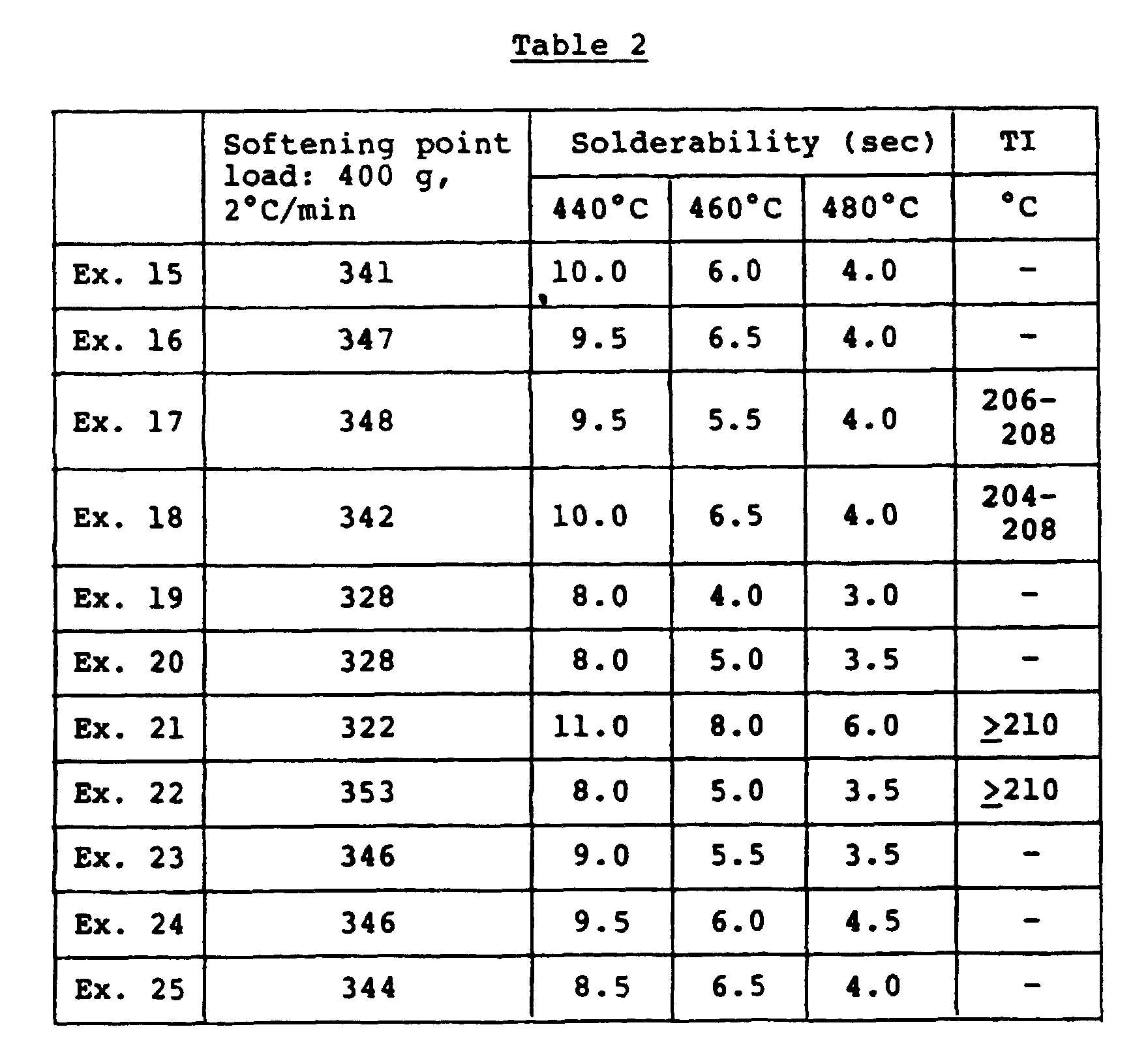

- Using the insulating coating formulations of Examples 1-14 of the first to third aspects of this invention, Comparative Examples 1-3 and Referential Example 10 separately, double-coated insulated wires of the fifth aspect of this invention and certain comparative examples were produced under the following conditions.
- Conductor diameter: 0.32 mm
- Baking oven: Horizontal baking oven having an effective oven length of 2.5 m
- Baking temperature: 500°C (max.)
- Squeezing method: Die squeezing
- Number of coating operations:
- 6 times/lower layer, plus
- 3 times/upper layer
- Lower layer: Polyester imide insulating coating formulation
- Upper layer: Linear polyester amide-imide insulating coating formulation prepared in Referential Example 10
- Film thickness: 0.025-0.030 mm
- A test was conducted following the testing method for enameled copper wires and enameled aluminum wires as prescribed in JIS C3003-1984. Test results are shown in Table 3. As apparent from the test results, it is clear that the softening point, solderability and temperature index (TI) were improved significantly by the use of the polyester imide insulating coating formulations according to this invention compared with the use of the conventional polyester imide insulating coating formulations.
Table 3 Softening point load: 400 g, 2°C/min Solderability (sec) TI 440°C 460°C 480°C °C Ex. 29 330 9.5 5.5 3.5 - Ex. 30 338 9.0 5.5 3.5 - Ex. 31 338 9.0 5.0 3.0 202-206 Ex. 32 331 9.5 5.0 3.0 200-202 Ex. 33 320 7.0 3.5 2.0 - Ex. 34 323 7.5 4.5 3.5 - Ex. 35 314 10.0 7.0 5.0 206 Ex. 36 342 7.5 5.0 2.5 207 Ex. 37 337 8.5 5.5 3.0 - Ex. 38 336 8.5 5.0 3.5 - Ex. 39 336 8.0 5.5 3.5 - Ex. 40 321 7.5 3.5 2.0 - Ex. 41 336 9.0 5.5 3.0 - Ex. 42 338 9.5 6.0 3.5 - Comp. Ex. 7 301 20.0 7.5 5.0 181 Comp. Ex. 8 307 19.5 7.5 5.5 182-185 Comp. Ex. 9 238 9.5 6.5 3.5 162-164 - Using the insulating coating formulations of Examples 1-14 of the first to third aspects of this invention, Comparative Examples 1-3 and Referential Examples 11-13 separately, self-lubricating insulated wires of the sixth aspect of this invention and certain comparative examples were produced under the following conditions.
- Conductor diameter: 0.32 mm
- Baking oven: Horizontal baking oven having an effective oven length of 2.5 m
- Baking temperature:
- Insulating layer: 500°C (max.)
- Lubricating layer: 500°C (max.)
- Squeezing method: Die squeezing
- Take-up speed: 20 m/min
- Number of coating operations:
- Insulating layer: 6 times
- Lubricating layer: 2 times (by simultaneous coating method)
- Film thickness: 0.014-0.026 mm
- A test was conducted following the testing method for enameled copper wires and enameled aluminum wires as prescribed in JIS C3003-1984. Test results are shown in Table 4. As apparent from the test results, it is clear that the softening point, self-lubricating property, solderability and temperature index (TI) were improved significantly by the use of the polyester imide insulating coating formulations according to this invention compared with the use of the conventional polyester imide insulating coating formulations.


Claims (11)
- Use of an insulated wire obtained by coating a conductor with an insulating coating formulation comprising a polyester-imide resin obtained as a reaction product of (A) a dicarboxylic acid containing 5-membered cyclic imide group or derivative thereof, or a mixture thereof, (B) a tricarboxylic acid or derivative thereof, or mixture thereof, (C) a dihydric alcohol and (D) a trihydric aliphatic alcohol, wherein said components (A), (B), (C) and (D) are in proportions of 5-20 equivalent %, 10-30 equivalent %, 25-60 equivalent % and 10-40 equivalent %, respectively for soldering directly whereby removal of the insulating coating and soldering are performed at the same time.
- The use as claimed in claim 1, wherein the dicarboxylic acid containing the 5-membered cyclic imido group is a dicarboxylic acid obtained by reacting 2 moles of trimellitic acid anhydride and 1 mole of a diamine or diisocyanate.
- The use as claimed in claim 1, wherein the tricarboxylic acid is trimellitic acid or trimellitic acid anhydride.
- The use as claimed in claim 1, wherein the dihydric alcohol is ethylene glycol or 1,6-hexanediol.
- The use as claimed in claim 1, wherein the trihydric alcohol is glycerin or 1,1,1-trimethylolpropane.
- The use as claimed in one of claims 1 to 5, wherein the insulating coating formulation is obtained by dissolving the polyester imide resin in an organic solvent.
- The use as claimed in claim 6, wherein the insulating coating formulation comprises an alkyl titanate, a phenol-formaldehyde resin and/or a xylene-formaldehyde resin.
- The use of one of claims 1 to 7, wherein the insulated wire is obtained by first coating and subsequent baking the insulating coating formulation.
- The use of claim 8, wherein the insulating coating formulation contains an aromatic polyamide-imide.
- The use of claim 8 wherein the insulating coating formulation contains a linear polyester polyamide-imide resin.
- The use of claim 8, wherein the surface of the insulated wire is, either directly or via another insulation, coated with a self-lubricating coating composition composed principally of polyamide resin.
Priority Applications (1)
| Application Number | Priority Date | Filing Date | Title |
|---|---|---|---|
| AT88106924T ATE79890T1 (en) | 1987-05-08 | 1988-04-29 | POLYESTERIMIDE RESINS. |
Applications Claiming Priority (2)
| Application Number | Priority Date | Filing Date | Title |
|---|---|---|---|
| JP110678/87 | 1987-05-08 | ||
| JP62110678A JPH0794542B2 (en) | 1987-05-08 | 1987-05-08 | Polyester imide resin |
Publications (3)
| Publication Number | Publication Date |
|---|---|
| EP0289955A1 EP0289955A1 (en) | 1988-11-09 |
| EP0289955B1 EP0289955B1 (en) | 1992-08-26 |
| EP0289955B2 true EP0289955B2 (en) | 1996-07-17 |
Family
ID=14541682
Family Applications (1)
| Application Number | Title | Priority Date | Filing Date |
|---|---|---|---|
| EP88106924A Expired - Lifetime EP0289955B2 (en) | 1987-05-08 | 1988-04-29 | Use of an insulated wire for direct solderimg |
Country Status (5)
| Country | Link |
|---|---|
| US (1) | US4921761A (en) |
| EP (1) | EP0289955B2 (en) |
| JP (1) | JPH0794542B2 (en) |
| AT (1) | ATE79890T1 (en) |
| DE (1) | DE3873971T3 (en) |
Families Citing this family (6)
| Publication number | Priority date | Publication date | Assignee | Title |
|---|---|---|---|---|
| AU606296B2 (en) * | 1988-10-20 | 1991-01-31 | Mitsui Chemicals, Inc. | Insulated wire and production process of the insulated wire |
| US5310850A (en) * | 1992-10-26 | 1994-05-10 | Industrial Technology Research Institute | Heat resistant poly(urethane amideimide) composition and method for preparing the same |
| GB201310837D0 (en) | 2013-06-18 | 2013-07-31 | Dupont Teijin Films Us Ltd | Polyester film -IV |
| GB201317705D0 (en) | 2013-10-07 | 2013-11-20 | Dupont Teijin Films Us Ltd | Copolyesters |
| GB201411044D0 (en) | 2014-06-20 | 2014-08-06 | Dupont Teijin Films Us Ltd | Copolyestermides and films made therefrom |
| CN115073735B (en) * | 2021-03-10 | 2023-05-26 | 上海交通大学 | Hyperbranched semiaromatic polyester imide polymer and preparation method thereof |
Family Cites Families (5)
| Publication number | Priority date | Publication date | Assignee | Title |
|---|---|---|---|---|
| US4170684A (en) * | 1961-11-02 | 1979-10-09 | Dr. Beck & Co. A.G. | Conductors having insulation of polyester imide resin |
| JPS52110736A (en) * | 1976-03-13 | 1977-09-17 | Kyowa Yuka Kk | Waterrsoluble polyester paint for insulation |
| US4362861A (en) * | 1980-12-23 | 1982-12-07 | Schenectady Chemicals, Inc. | Polyesterimide |
| JPS57209967A (en) * | 1981-06-18 | 1982-12-23 | Sumitomo Electric Ind Ltd | Insulated wire |
| JPH0629380B2 (en) * | 1985-05-07 | 1994-04-20 | 日立化成工業株式会社 | Manufacturing method of electrical insulation paint |
-
1987
- 1987-05-08 JP JP62110678A patent/JPH0794542B2/en not_active Expired - Fee Related
-
1988
- 1988-04-29 DE DE3873971T patent/DE3873971T3/en not_active Expired - Lifetime
- 1988-04-29 EP EP88106924A patent/EP0289955B2/en not_active Expired - Lifetime
- 1988-04-29 AT AT88106924T patent/ATE79890T1/en not_active IP Right Cessation
- 1988-05-04 US US07/190,072 patent/US4921761A/en not_active Expired - Lifetime
Also Published As
| Publication number | Publication date |
|---|---|
| DE3873971T2 (en) | 1993-03-11 |
| EP0289955A1 (en) | 1988-11-09 |
| DE3873971T3 (en) | 1997-01-09 |
| EP0289955B1 (en) | 1992-08-26 |
| DE3873971D1 (en) | 1992-10-01 |
| US4921761A (en) | 1990-05-01 |
| JPH0192220A (en) | 1989-04-11 |
| ATE79890T1 (en) | 1992-09-15 |
| JPH0794542B2 (en) | 1995-10-11 |
Similar Documents
| Publication | Publication Date | Title |
|---|---|---|
| US3922465A (en) | Solderable and thermostable insulated wires | |
| EP0289955B2 (en) | Use of an insulated wire for direct solderimg | |
| JPH0815014B2 (en) | Insulated wire that can be soldered | |
| JP2652017B2 (en) | Polyester imide insulating paint | |
| JPH0587924B2 (en) | ||
| JP2991394B2 (en) | Polyester imide insulating paint | |
| JPH07698B2 (en) | Method for producing polyesterimide resin | |
| JPH01265411A (en) | Self-lubricating insulated wire available for soldering process | |
| JPH0828130B2 (en) | Insulated wire that can be soldered | |
| JPH0692563B2 (en) | Polyester imide insulating paint | |
| JPS63289712A (en) | Heat-resistant insulated wire that can be soldered | |
| JP2628393B2 (en) | Polyesterimide / Stabilized polyisocyanate insulated wire | |
| JPH0587923B2 (en) | ||
| JPH03190917A (en) | Polyesterimide/stabilized polyisocyanate resin composition | |
| JP3490895B2 (en) | Insulated wire | |
| JP3816694B2 (en) | Insulating paint | |
| JPH07258603A (en) | Polyester imide insulating paint | |
| JPH03237170A (en) | Polyesterimide / stabilized polyisocyanate insulating coating | |
| JPH07242745A (en) | Polyester imide resin and method for producing the same | |
| JPH01225623A (en) | insulation paint | |
| JP3504859B2 (en) | Insulating paint | |
| JPH06119819A (en) | Heat-resistant insulated wire that can be soldered | |
| JP2001006444A (en) | Insulated wire | |
| JP3504858B2 (en) | Solder peelable insulated wire | |
| JPH07272541A (en) | Insulated wire |
Legal Events
| Date | Code | Title | Description |
|---|---|---|---|
| PUAI | Public reference made under article 153(3) epc to a published international application that has entered the european phase |
Free format text: ORIGINAL CODE: 0009012 |
|
| AK | Designated contracting states |
Kind code of ref document: A1 Designated state(s): AT DE FR GB |
|
| 17P | Request for examination filed |
Effective date: 19890419 |
|
| 17Q | First examination report despatched |
Effective date: 19910301 |
|
| GRAA | (expected) grant |
Free format text: ORIGINAL CODE: 0009210 |
|
| AK | Designated contracting states |
Kind code of ref document: B1 Designated state(s): AT DE FR GB |
|
| REF | Corresponds to: |
Ref document number: 79890 Country of ref document: AT Date of ref document: 19920915 Kind code of ref document: T |
|
| REF | Corresponds to: |
Ref document number: 3873971 Country of ref document: DE Date of ref document: 19921001 |
|
| ET | Fr: translation filed | ||
| PLBI | Opposition filed |
Free format text: ORIGINAL CODE: 0009260 |
|
| 26 | Opposition filed |
Opponent name: HERBERTS GMBH Effective date: 19930526 |
|
| PLAW | Interlocutory decision in opposition |
Free format text: ORIGINAL CODE: EPIDOS IDOP |
|
| PUAH | Patent maintained in amended form |
Free format text: ORIGINAL CODE: 0009272 |
|
| STAA | Information on the status of an ep patent application or granted ep patent |
Free format text: STATUS: PATENT MAINTAINED AS AMENDED |
|
| 27A | Patent maintained in amended form |
Effective date: 19960717 |
|
| AK | Designated contracting states |
Kind code of ref document: B2 Designated state(s): AT DE FR GB |
|
| ET3 | Fr: translation filed ** decision concerning opposition | ||
| REG | Reference to a national code |
Ref country code: GB Ref legal event code: IF02 |
|
| PGFP | Annual fee paid to national office [announced via postgrant information from national office to epo] |
Ref country code: AT Payment date: 20070412 Year of fee payment: 20 |
|
| PGFP | Annual fee paid to national office [announced via postgrant information from national office to epo] |
Ref country code: DE Payment date: 20070426 Year of fee payment: 20 |
|
| PGFP | Annual fee paid to national office [announced via postgrant information from national office to epo] |
Ref country code: GB Payment date: 20070425 Year of fee payment: 20 |
|
| PGFP | Annual fee paid to national office [announced via postgrant information from national office to epo] |
Ref country code: FR Payment date: 20070411 Year of fee payment: 20 |
|
| REG | Reference to a national code |
Ref country code: GB Ref legal event code: PE20 Expiry date: 20080428 |
|
| PG25 | Lapsed in a contracting state [announced via postgrant information from national office to epo] |
Ref country code: GB Free format text: LAPSE BECAUSE OF EXPIRATION OF PROTECTION Effective date: 20080428 |