EP0289995B1 - Clonage d'ADN encodant le précurseur de motiline humaine et expression du précurseur - Google Patents
Clonage d'ADN encodant le précurseur de motiline humaine et expression du précurseur Download PDFInfo
- Publication number
- EP0289995B1 EP0289995B1 EP88107108A EP88107108A EP0289995B1 EP 0289995 B1 EP0289995 B1 EP 0289995B1 EP 88107108 A EP88107108 A EP 88107108A EP 88107108 A EP88107108 A EP 88107108A EP 0289995 B1 EP0289995 B1 EP 0289995B1
- Authority
- EP
- European Patent Office
- Prior art keywords
- stranded dna
- precursor
- motilin
- double
- amino acid
- Prior art date
- Legal status (The legal status is an assumption and is not a legal conclusion. Google has not performed a legal analysis and makes no representation as to the accuracy of the status listed.)
- Expired - Lifetime
Links
- LVRVABPNVHYXRT-BQWXUCBYSA-N 52906-92-0 Chemical compound C([C@H](N)C(=O)N[C@H](C(=O)N1CCC[C@H]1C(=O)N[C@@H]([C@@H](C)CC)C(=O)N[C@@H](CC=1C=CC=CC=1)C(=O)N[C@@H]([C@@H](C)O)C(=O)N[C@@H](CC=1C=CC(O)=CC=1)C(=O)NCC(=O)N[C@@H](CCC(O)=O)C(=O)N[C@@H](CC(C)C)C(=O)N[C@@H](CCC(N)=O)C(=O)N[C@@H](CCCNC(N)=N)C(=O)N[C@@H](CCSC)C(=O)N[C@@H](CCC(N)=O)C(=O)N[C@@H](CCC(O)=O)C(=O)N[C@@H](CCCCN)C(=O)N[C@@H](CCC(O)=O)C(=O)N[C@@H](CCCNC(N)=N)C(=O)N[C@@H](CC(N)=O)C(=O)N[C@@H](CCCCN)C(=O)NCC(=O)N[C@@H](CCC(N)=O)C(O)=O)C(C)C)C1=CC=CC=C1 LVRVABPNVHYXRT-BQWXUCBYSA-N 0.000 title claims description 70
- 101500028621 Homo sapiens Motilin Proteins 0.000 title claims description 48
- 239000002243 precursor Substances 0.000 title claims description 40
- 238000010367 cloning Methods 0.000 title description 4
- 108020004414 DNA Proteins 0.000 claims description 51
- 239000002773 nucleotide Substances 0.000 claims description 29
- 125000003729 nucleotide group Chemical group 0.000 claims description 28
- 101800002372 Motilin Proteins 0.000 claims description 22
- 102000002419 Motilin Human genes 0.000 claims description 22
- 238000000034 method Methods 0.000 claims description 21
- 239000013612 plasmid Substances 0.000 claims description 21
- 239000002299 complementary DNA Substances 0.000 claims description 14
- 108091032973 (ribonucleotides)n+m Proteins 0.000 claims description 12
- 108020004705 Codon Proteins 0.000 claims description 9
- 108091034057 RNA (poly(A)) Proteins 0.000 claims description 8
- 108020004999 messenger RNA Proteins 0.000 claims description 8
- 229940124276 oligodeoxyribonucleotide Drugs 0.000 claims description 8
- 239000000523 sample Substances 0.000 claims description 8
- 238000012216 screening Methods 0.000 claims description 8
- 241000588724 Escherichia coli Species 0.000 claims description 7
- 230000000295 complement effect Effects 0.000 claims description 7
- 238000002360 preparation method Methods 0.000 claims description 6
- 229930010555 Inosine Natural products 0.000 claims description 4
- UGQMRVRMYYASKQ-KQYNXXCUSA-N Inosine Chemical compound O[C@@H]1[C@H](O)[C@@H](CO)O[C@H]1N1C2=NC=NC(O)=C2N=C1 UGQMRVRMYYASKQ-KQYNXXCUSA-N 0.000 claims description 4
- 229960003786 inosine Drugs 0.000 claims description 4
- 210000000813 small intestine Anatomy 0.000 claims description 4
- 108091034117 Oligonucleotide Proteins 0.000 claims description 3
- 239000000203 mixture Substances 0.000 claims description 3
- 239000005547 deoxyribonucleotide Substances 0.000 claims description 2
- 125000002637 deoxyribonucleotide group Chemical group 0.000 claims description 2
- 230000001131 transforming effect Effects 0.000 claims description 2
- 102000053602 DNA Human genes 0.000 claims 14
- 108020004682 Single-Stranded DNA Proteins 0.000 claims 9
- 125000003275 alpha amino acid group Chemical group 0.000 claims 4
- 238000002372 labelling Methods 0.000 claims 1
- 150000001413 amino acids Chemical group 0.000 description 26
- 239000012634 fragment Substances 0.000 description 22
- 235000001014 amino acid Nutrition 0.000 description 14
- 108091008146 restriction endonucleases Proteins 0.000 description 9
- 238000012360 testing method Methods 0.000 description 5
- 229960000723 ampicillin Drugs 0.000 description 4
- AVKUERGKIZMTKX-NJBDSQKTSA-N ampicillin Chemical compound C1([C@@H](N)C(=O)N[C@H]2[C@H]3SC([C@@H](N3C2=O)C(O)=O)(C)C)=CC=CC=C1 AVKUERGKIZMTKX-NJBDSQKTSA-N 0.000 description 4
- 210000004027 cell Anatomy 0.000 description 4
- 108010076504 Protein Sorting Signals Proteins 0.000 description 3
- HEMHJVSKTPXQMS-UHFFFAOYSA-M Sodium hydroxide Chemical compound [OH-].[Na+] HEMHJVSKTPXQMS-UHFFFAOYSA-M 0.000 description 3
- 239000000872 buffer Substances 0.000 description 3
- 230000001595 contractor effect Effects 0.000 description 3
- 244000005700 microbiome Species 0.000 description 3
- FFEARJCKVFRZRR-BYPYZUCNSA-N L-methionine Chemical compound CSCC[C@H](N)C(O)=O FFEARJCKVFRZRR-BYPYZUCNSA-N 0.000 description 2
- COLNVLDHVKWLRT-QMMMGPOBSA-N L-phenylalanine Chemical compound OC(=O)[C@@H](N)CC1=CC=CC=C1 COLNVLDHVKWLRT-QMMMGPOBSA-N 0.000 description 2
- 239000006142 Luria-Bertani Agar Substances 0.000 description 2
- KDXKERNSBIXSRK-UHFFFAOYSA-N Lysine Natural products NCCCCC(N)C(O)=O KDXKERNSBIXSRK-UHFFFAOYSA-N 0.000 description 2
- 230000004071 biological effect Effects 0.000 description 2
- 229940088623 biologically active substance Drugs 0.000 description 2
- 238000003776 cleavage reaction Methods 0.000 description 2
- 238000001816 cooling Methods 0.000 description 2
- OPTASPLRGRRNAP-UHFFFAOYSA-N cytosine Chemical compound NC=1C=CNC(=O)N=1 OPTASPLRGRRNAP-UHFFFAOYSA-N 0.000 description 2
- 208000010643 digestive system disease Diseases 0.000 description 2
- 238000001962 electrophoresis Methods 0.000 description 2
- 210000003527 eukaryotic cell Anatomy 0.000 description 2
- 208000018685 gastrointestinal system disease Diseases 0.000 description 2
- 210000001035 gastrointestinal tract Anatomy 0.000 description 2
- UYTPUPDQBNUYGX-UHFFFAOYSA-N guanine Chemical compound O=C1NC(N)=NC2=C1N=CN2 UYTPUPDQBNUYGX-UHFFFAOYSA-N 0.000 description 2
- 238000009396 hybridization Methods 0.000 description 2
- 230000035873 hypermotility Effects 0.000 description 2
- 235000018977 lysine Nutrition 0.000 description 2
- 229930182817 methionine Natural products 0.000 description 2
- 210000000056 organ Anatomy 0.000 description 2
- 230000007017 scission Effects 0.000 description 2
- 238000012163 sequencing technique Methods 0.000 description 2
- 210000002460 smooth muscle Anatomy 0.000 description 2
- 230000002194 synthesizing effect Effects 0.000 description 2
- RWQNBRDOKXIBIV-UHFFFAOYSA-N thymine Chemical compound CC1=CNC(=O)NC1=O RWQNBRDOKXIBIV-UHFFFAOYSA-N 0.000 description 2
- 210000001519 tissue Anatomy 0.000 description 2
- QKNYBSVHEMOAJP-UHFFFAOYSA-N 2-amino-2-(hydroxymethyl)propane-1,3-diol;hydron;chloride Chemical compound Cl.OCC(N)(CO)CO QKNYBSVHEMOAJP-UHFFFAOYSA-N 0.000 description 1
- 229930024421 Adenine Natural products 0.000 description 1
- GFFGJBXGBJISGV-UHFFFAOYSA-N Adenine Chemical compound NC1=NC=NC2=C1N=CN2 GFFGJBXGBJISGV-UHFFFAOYSA-N 0.000 description 1
- 229920001817 Agar Polymers 0.000 description 1
- 102000012410 DNA Ligases Human genes 0.000 description 1
- 108010061982 DNA Ligases Proteins 0.000 description 1
- QNAYBMKLOCPYGJ-REOHCLBHSA-N L-alanine Chemical compound C[C@H](N)C(O)=O QNAYBMKLOCPYGJ-REOHCLBHSA-N 0.000 description 1
- 239000004472 Lysine Substances 0.000 description 1
- 241001465754 Metazoa Species 0.000 description 1
- 241000713333 Mouse mammary tumor virus Species 0.000 description 1
- 239000000020 Nitrocellulose Substances 0.000 description 1
- 108091028043 Nucleic acid sequence Proteins 0.000 description 1
- 108020005187 Oligonucleotide Probes Proteins 0.000 description 1
- 108700026244 Open Reading Frames Proteins 0.000 description 1
- 241000283973 Oryctolagus cuniculus Species 0.000 description 1
- 206010061902 Pancreatic neoplasm Diseases 0.000 description 1
- 108091005804 Peptidases Proteins 0.000 description 1
- 108091000080 Phosphotransferase Proteins 0.000 description 1
- 239000004365 Protease Substances 0.000 description 1
- 108020004511 Recombinant DNA Proteins 0.000 description 1
- 102100037486 Reverse transcriptase/ribonuclease H Human genes 0.000 description 1
- 102000040739 Secretory proteins Human genes 0.000 description 1
- 108091058545 Secretory proteins Proteins 0.000 description 1
- 108091081024 Start codon Proteins 0.000 description 1
- ZMZDMBWJUHKJPS-UHFFFAOYSA-M Thiocyanate anion Chemical compound [S-]C#N ZMZDMBWJUHKJPS-UHFFFAOYSA-M 0.000 description 1
- ZKHQWZAMYRWXGA-KNYAHOBESA-N [[(2r,3s,4r,5r)-5-(6-aminopurin-9-yl)-3,4-dihydroxyoxolan-2-yl]methoxy-hydroxyphosphoryl] dihydroxyphosphoryl hydrogen phosphate Chemical compound C1=NC=2C(N)=NC=NC=2N1[C@@H]1O[C@H](COP(O)(=O)OP(O)(=O)O[32P](O)(O)=O)[C@@H](O)[C@H]1O ZKHQWZAMYRWXGA-KNYAHOBESA-N 0.000 description 1
- 239000013543 active substance Substances 0.000 description 1
- 229960000643 adenine Drugs 0.000 description 1
- 239000008272 agar Substances 0.000 description 1
- 235000004279 alanine Nutrition 0.000 description 1
- 125000000539 amino acid group Chemical group 0.000 description 1
- 210000004102 animal cell Anatomy 0.000 description 1
- 238000000211 autoradiogram Methods 0.000 description 1
- 230000001580 bacterial effect Effects 0.000 description 1
- 239000012148 binding buffer Substances 0.000 description 1
- 230000015572 biosynthetic process Effects 0.000 description 1
- 239000008280 blood Substances 0.000 description 1
- 210000004369 blood Anatomy 0.000 description 1
- 239000001913 cellulose Substances 0.000 description 1
- 229920002678 cellulose Polymers 0.000 description 1
- 239000003795 chemical substances by application Substances 0.000 description 1
- 210000004978 chinese hamster ovary cell Anatomy 0.000 description 1
- 229960005091 chloramphenicol Drugs 0.000 description 1
- WIIZWVCIJKGZOK-RKDXNWHRSA-N chloramphenicol Chemical compound ClC(Cl)C(=O)N[C@H](CO)[C@H](O)C1=CC=C([N+]([O-])=O)C=C1 WIIZWVCIJKGZOK-RKDXNWHRSA-N 0.000 description 1
- 230000000112 colonic effect Effects 0.000 description 1
- 238000010276 construction Methods 0.000 description 1
- 238000012258 culturing Methods 0.000 description 1
- 229940104302 cytosine Drugs 0.000 description 1
- 238000004925 denaturation Methods 0.000 description 1
- 230000036425 denaturation Effects 0.000 description 1
- 238000003745 diagnosis Methods 0.000 description 1
- 210000001198 duodenum Anatomy 0.000 description 1
- 230000000694 effects Effects 0.000 description 1
- 238000000605 extraction Methods 0.000 description 1
- ZDXPYRJPNDTMRX-UHFFFAOYSA-N glutamine Natural products OC(=O)C(N)CCC(N)=O ZDXPYRJPNDTMRX-UHFFFAOYSA-N 0.000 description 1
- ZMZDMBWJUHKJPS-UHFFFAOYSA-N hydrogen thiocyanate Natural products SC#N ZMZDMBWJUHKJPS-UHFFFAOYSA-N 0.000 description 1
- 230000002209 hydrophobic effect Effects 0.000 description 1
- 238000011031 large-scale manufacturing process Methods 0.000 description 1
- 150000002669 lysines Chemical class 0.000 description 1
- 208000015486 malignant pancreatic neoplasm Diseases 0.000 description 1
- 210000004400 mucous membrane Anatomy 0.000 description 1
- 229920001220 nitrocellulos Polymers 0.000 description 1
- 239000002751 oligonucleotide probe Substances 0.000 description 1
- 201000002528 pancreatic cancer Diseases 0.000 description 1
- 208000008443 pancreatic carcinoma Diseases 0.000 description 1
- 238000002262 pancreatoduodenectomy Methods 0.000 description 1
- 239000000813 peptide hormone Substances 0.000 description 1
- COLNVLDHVKWLRT-UHFFFAOYSA-N phenylalanine Natural products OC(=O)C(N)CC1=CC=CC=C1 COLNVLDHVKWLRT-UHFFFAOYSA-N 0.000 description 1
- 102000020233 phosphotransferase Human genes 0.000 description 1
- 230000001766 physiological effect Effects 0.000 description 1
- 239000002157 polynucleotide Substances 0.000 description 1
- 108090000623 proteins and genes Proteins 0.000 description 1
- 238000003127 radioimmunoassay Methods 0.000 description 1
- 230000028327 secretion Effects 0.000 description 1
- 239000011780 sodium chloride Substances 0.000 description 1
- FAPWRFPIFSIZLT-UHFFFAOYSA-M sodium chloride Inorganic materials [Na+].[Cl-] FAPWRFPIFSIZLT-UHFFFAOYSA-M 0.000 description 1
- 210000002784 stomach Anatomy 0.000 description 1
- 239000000126 substance Substances 0.000 description 1
- 238000003786 synthesis reaction Methods 0.000 description 1
- 229940113082 thymine Drugs 0.000 description 1
- 230000009466 transformation Effects 0.000 description 1
Images
Classifications
-
- C—CHEMISTRY; METALLURGY
- C07—ORGANIC CHEMISTRY
- C07K—PEPTIDES
- C07K14/00—Peptides having more than 20 amino acids; Gastrins; Somatostatins; Melanotropins; Derivatives thereof
- C07K14/435—Peptides having more than 20 amino acids; Gastrins; Somatostatins; Melanotropins; Derivatives thereof from animals; from humans
- C07K14/575—Hormones
- C07K14/63—Motilins
Definitions
- the present invention relates to motilin and more particularly to a cloned single-strand DNA comprising nucleotide sequence which encodes human motilin precursor, a cloned double-strand DNA consisting of the single-strand DNA and its complementary single-strand DNA, a fragment of the single- or double-strand DNA, and a plasmid, in which the double-strand DNA or its fragment is integrated , as well as a process for the preparation of the single- or double-strand DNA.
- the motilin is one of peptide hormones, firstly isolated from mucous membrane of porcine upper small intestine and determined its amino acid sequence by Brown, J. C. et al ["Gastroenterology” Vol. 62, pages 4010 - 4040 (1972) and "Can. J. Biochem.” Vol. 52, pages 7 - 10 (1974)].
- the porcine motilin disclosed in such literatures is one extracted from the animal tissue, consists of 22 amino acids and has molecular weight of about 2700. It has been well known that the porcine motilin has a hypermotility action of digestive tract and contracting action of gastroduodinal and colonic smooth muscle therein, as physiological actions. As the hypermotility action, it has been reported that a staying period of time in stomach is shortened [ “Gastroenterology" Vol. 80, pages 456 - 460 (1981)] and as the contracting action of smooth muscle in the digestive tract, it has been known that the motilin shows a strong contracting action to rabbit and human gastrointesinal tract, independing from a neuro system. Therefore, it has been considered that the motilin is useful for curing gastro-enteropathys at the period of post-operation and for diagnosis thereof.
- the motilin according to the prior arts has been obtained through extraction from porcine organ and thus it was quite difficult to obtain the same in a large amount. Further, a structure of human motilin has not yet been determined. Namely, the motilin has not actually been applied for clinical use, due to its poor productivity, in spite of that an effectiveness thereof as the agent for curing gastro-enteropathy has been expected.
- a basic object of the invention lies in developping an industrially acceptable process for the preparation of human motilin and its related substances, by utilizing so-called --Bio-Technologies--.
- a principal object of the invention is to provide a cloned DNA comprising a human motilin precursor, or a fragment thereof.
- An additional object of the invention is to provide a process for the preparation of the cloned DNA encoding the human motilin precursor, or the fragment thereof.
- a further object of the invention is to provide a plasmid, wherein the cloned DNA or its fragment, for instance the human motilin per se or another physiologically or biologically active portion in the human motilin precursor, is integrated, so that a micro-organism or animal cell transformed by such plasmid expresses the human motilin or other biologically active substances to allow a large scale production thereof.
- the inventors have carefully studied and investigated to finally obtain the cloned DNA for the human motilin precursor and determine its structure, whereby the basic object has been attained.
- the principal object is attained by a cloned single-strand DNA comprising about 550 nucleotides which encodes therein an amino acid sequence for human motilin precursor.
- the DNA according to the invention has the following nucleotide sequence or any other nucleotide sequence same with the former in biological view point.
- A, C, G and T are, respectively, a oligodeoxyribonucleotide having adenine, cytosine, guanine or thymine base and said sequence is given as that of each codon corresponding to a specified amino acid.
- the human motilin is encoded in a region of the 26th to 47th counting from methionine (Met) residue designated by the initiative codon of ATG and partitioned at both ends by alanine (Ala) residue designated by the codon of GCC and lysine (Lys) residue designated by the codon of AAG. It can be considered that the firstly arranged about 25 amino acids beginning from the initiative Met are those corresponding to a signal peptide which concerns to secretion, in view of its structure.
- the cloned double-strand DNA encoding human motilin precursor can be prepared by converting RNA extracted from upper small intestine (duodenum) into poly(A)RNA, constructing cDNA library with use of the poly(A)RNA and vector/primer DNA to carry out a transformation of Escherichia coli (E.
- A oligodeoxylibonucleotide
- a cloned single-strand DNA encoding human motilin can be prepared by denaturing the resulting cloned double-strand DNA with use of a method known per se, for instance treating same at 90°C for about 3 minutes and then cooling with an ice bath.
- the cloned single- or double-strand DNA encoding human motilin precursor can be made into a fragment or fragments of various length, by treating same with a suitable restriction enzyme(s), binding fragments, synthesizing a region not obtaining through the cleaving technique and binding the synthesized region to the cleaved fragment to make the desired fragment of human motilin region only or another region showing a physiological or biological activity.
- the cloned double-strand DNA encoding human motilin precursor or any fragment thereof may be integrated into a plasmid with a technique known per se, for instance taking out a plasmid from E. coli, purifying the plasmid, treating the plasmid with a restriction enzyme to cut the same at a specified base position, and ligating with a DNA ligase the cloned DNA to the cleavage site of the cut plasmid to re-construct a plasmid with the recombinant DNA.
- a technique known per se for instance taking out a plasmid from E. coli, purifying the plasmid, treating the plasmid with a restriction enzyme to cut the same at a specified base position, and ligating with a DNA ligase the cloned DNA to the cleavage site of the cut plasmid to re-construct a plasmid with the recombinant DNA.
- the human motilin precursor, human motilin per se or other biologically active substance(s) can be prepared in a large amount by transforming a microorganism or eukaryotic cell with the plasmid integrated therein the double-strand DNA or a fragment thereof and culturing the microorganism of eukaryotic cell. Further, the DNA fragment encoding an amino acid sequence other than that for motilin may also be employed for investigating novel biologically active substance(s).
- the total RNA (1.2mg) was extracted from the tissue by 4M-guanidium thiocyanate, bonded to an oligo(dT)cellulose column with use of 10mM-Tris hydrochloride buffer containing 0.5M-KCl, as a binding buffer, and eluted with use of a buffer free from KCl to obtain about 150 ⁇ g of the desired poly(A)RNA.
- a mixture of 24 tricosamers each consisting of 23 deoxyribonucleotides of the formula wherein I is inosine and employed for the position in the nucleotide sequence, where any of A, G, T and C possibly occupies, which is complementary to mRNA corresponding to Phe-Val-Pro-Ile-Phe-thr-Tyr-Gly of 1st to 8th amino acids from N-terminal in known amino acid sequence for porcine motilin were synthesized with use of a DNA synthesizer marketed as --Gene Assembler-- from Pharmacia, Sweden, It is to be noted that these oligodeoxyribonucleotides include all of possible mRNA sequences corresponding to said amino acid sequence.
- a cDNA library was constructed with use of about 30 ⁇ g of said poly(A)RNA and 4.3 ⁇ g of vector/primer DNA and in accordance with the method disclosed by Okayama, H and Berg, P. ["Mol. Cell. Biol.” Vol. 2, pages 161 - 170 (1982)] and E. coli (HB101 strain) was transformed in accordance with the method disclosed by Morrison, D. A. [ “Methods in Enzymol.” Vol. 68, pages 326 - 331, (1979)].
- ampicillin resistant transformants were obtained by 10,000 cells per 1 ⁇ g of poly(A)RNA, namely 300,000 cells in total.
- a colony formed on the filter was subjected to bacteriolysis by treatment of 0.5N sodium hydroxide for 5 minutes, namely a double-strand DNA was made into a single-strand DNA, fixed on a plate, neutralized to make pH to 7.5 and dipped the filter for 5 minutes in Tris hydrochloride buffer (pH 7.5) containing 1.5M-NaCl to remove bacterial fragments and the like other than DNA. Thereafter, the filter was air dried and baked for 2 hours at 80 °C to obtain a testing filter for screening.
- each of the oligodeoxyribonucleotides synthesized by the method as stated in said Item (b) and shown by said formula (A) was labeled at 5′-end with [ ⁇ - 32P]ATP (Amersham, 5,000 Ci/mmol) and T4-polynucleotide kinase (Toyobo Co., Ltd., Osaka, Japan) to make the same into probe for screening.
- a relative activity of each probe was 1 - 2 x 10⁶ cpm/pmol.
- the transformants on the testing filter were screened by a hybridization at 50°C and with use of the probes (labeled oligodeoxyribonucleotides) and judged by a conventional autoradiogram method to find that only one transformant among about 50,000 transformants is hybridizing positive clone.
- This positive clone namely that comprising human motilin precursor was analized by an electrophoresis to find that it has cDNA insert region of about 650bp including poly(dA)(dT) tails and poly(dG)(dC) tracts.
- This cloned DNA is double-strand one and nucleotide sequence thereof had been elucidated as disclosed in the Test Example to be stated below. Therefore, the DNA can be made into a fragment(s) in various length, by treating same with a suitable restriction enzyme(s) and if necessary, binding a synthetic DNA to the fragment to obtain a desired DNA fragment consisting of the motilin precursor region, motilin region only or other region showing a certain biological activity.
- double-strand DNA in full length, fragment or piece thereof can be made into corresponding single-strand one by treating same at 90°C for about 3 minutes and then ice cooling to cause a denaturation thereof.
- a nucleotide sequence of cDNA insert region for the cloned human motilin precursor obtained in Example 1 was determined by sub-cloning to a pUC19 plasmid, in accordance with the method disclosed by Maxam, A. M. et al [ “Methods in Enzymol.” Vol. 65, pages 499 - 560 (1980)] and the dideoxy method disclosed by Hattori, M. et al [ "Anal. Biochem.” Vol. 152, pages 232 - 238 (1980)], who employs a modified plasmid.
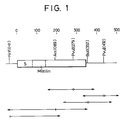
- Fig. 1 there are given a cDNA region of the cloned human motilin precursor, restriction enzymes selected for determining a nucleotide sequence in the region and a strategy for sequencing the cloned cDNA.
- the numerals at uppermost portion in the Figure are nucleotide number given as from the human motilin precursor region boxed at intermediate portion.
- the --Pvull-- and the like are names of the restriction enzymes as selected and a numeral given in parentheses shows the numbers indicating the 5′-terminal nucleotide generated by cleavage.
- a region (S) shows putative signal peptides
- another region (Motilin) shows that to be estimated as corresponding to human motilin per se.
- each of horizontal arrow shows a direction and limit of the nucleotide sequence to be determined, due to the respective restriction enzyme.
- Each of the determination results obtained in accordance with the method disclosed by Maxam A. M. et al isshown by an arrow with a short vertical line which shows an isotope labeled position at 5′-terminal. While, each determination results obtained in accordance with the method disclosed by Hattori, M. et al isshown by adding a small circle at an end of the arrow which indicates a starting position for nucleotide sequencing.
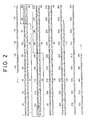
- Fig. 2 there are given thus determined nucleotide sequence of the cloned cDNA encoding the human motilin precursor as well as the amino acid sequence corresponding to the nucleotide sequence in the human motilin precursor region.
- the numeral given at upper side is number of nucleotides similar to Fig. 1 and another numeral given at lower side is number of amino acid residues in the human motilin precursor region.
- the region boxed with a solid line shows the putative motilin region, and the region boxed with broken line shows the location of the oligonucleotide probe for screening the transformants in Example 1.
- the human motilin precursor region lies as an open reading frame begining from the initiation codon of ATG and ending by the terminal codon of TGA, which comprises therein the nucleotide sequence encoding the amino acid sequence same with the known porcine motilin.
- the nucleotide sequence occupies such a position in the amino acid number counting from first methionine (Met) as from 26th phenylalanine (Phe) to 47th glutamine (Gln).
- the begining portion in the human motilin precursor region, namely the 1st Met to 25th Ala seems to be a signal sequence ( S region in Fig.
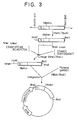
- the resulting plasmid has DNA clone of the human motilin precursor at down-stream of a powerful promoter of a long terminal repeat on mouse mammary tumor virus (MMTV-LTR). If L or CHO cells are transformed in a conventional manner but with use of such plasmid and cultured same, therefore, the human motilin can be prepared in a large amount.
- MMTV-LTR mouse mammary tumor virus
Landscapes
- Health & Medical Sciences (AREA)
- Chemical & Material Sciences (AREA)
- Organic Chemistry (AREA)
- Life Sciences & Earth Sciences (AREA)
- Biophysics (AREA)
- Gastroenterology & Hepatology (AREA)
- Zoology (AREA)
- Biochemistry (AREA)
- Toxicology (AREA)
- General Health & Medical Sciences (AREA)
- Genetics & Genomics (AREA)
- Medicinal Chemistry (AREA)
- Molecular Biology (AREA)
- Proteomics, Peptides & Aminoacids (AREA)
- Endocrinology (AREA)
- Preparation Of Compounds By Using Micro-Organisms (AREA)
- Peptides Or Proteins (AREA)
Claims (4)
- ADN monocaténaire cloné codant pour le précurseur de la motiline humaine et présentant une séquence nucléotidique de :ADN monocaténaire ayant une séquence nucléotidique qui présente des codons identiques à ceux ci-dessus en dégénérescence,

ou ADN bicaténaire consistent en ledit ADN monocaténaire et son ADN monocaténaire complémentaire. - ADN monocaténaire ou bicaténaire cloné selon la revendication 1, dans lequel ledit ADN code pour une séquence d'acides aminés de :

- Plasmide comprenant un ADN bicaténaire codant pour le précurseur de la motiline humaine et ayant un simple brin qui comprend des nucléotides codant pour une séquence d'acides aminés de :

- Procédé de préparation d'un ADN monocaténaire cloné, codant pour le précurseur de la motiline humaine, et d'un ADN bicaténaire consistant en ledit ADN monocaténaire et son ADN monocaténaire complémentaire, lequel procédé comprend les étapes consistant à :- convertir l'ARNm extrait de l'intestin grêle supérieur humain en ARN poly(A) ;- construire une banque d'ADNc à partir dudit ARN poly(A) et d'un ADN vecteur/amorce ;- transformer des colonies d'Escherichia coli avec ladite banque d'ADNc ;- sélectionner les transformants avec des sondes de synthèse et marquées comprenant un mélange de 24 tricosamères, consistant chacun en 23 désoxyribonucléotides de la formule :dans laquelle I représente inosine,

et chaque tricosamère étant complémentaire de l'ARNm correspondant à :
Phe-Val-Pro-Ile-Phe-Thr-Tyr-Gly
de la séquence du 1er au 8ème acide aminé à partir de l'extrémité N-terminale de la séquence d'acides aminés de la motiline ;- marquer chaque oligodésoxyribonucléotide synthétisé représenté par ladite formule (A) à l'extrémité N-terminale ;- sélectionner ledit Escherichia coli transformé en sélectionnant des clones qui s'hybrident avec lesdites sondes ; et- si nécessaire, dénaturer l'ADN bicaténaire en ADN monocaténaire.
Applications Claiming Priority (2)
| Application Number | Priority Date | Filing Date | Title |
|---|---|---|---|
| JP109757/87 | 1987-05-07 | ||
| JP62109757A JP2575022B2 (ja) | 1987-05-07 | 1987-05-07 | ヒトモチリン前駆体、該前駆体含有クローン化dna、その調製法並びに該クローン化dnaが組込まれたプラスミド |
Publications (2)
| Publication Number | Publication Date |
|---|---|
| EP0289995A1 EP0289995A1 (fr) | 1988-11-09 |
| EP0289995B1 true EP0289995B1 (fr) | 1993-09-29 |
Family
ID=14518468
Family Applications (1)
| Application Number | Title | Priority Date | Filing Date |
|---|---|---|---|
| EP88107108A Expired - Lifetime EP0289995B1 (fr) | 1987-05-07 | 1988-05-03 | Clonage d'ADN encodant le précurseur de motiline humaine et expression du précurseur |
Country Status (4)
| Country | Link |
|---|---|
| US (1) | US4985356A (fr) |
| EP (1) | EP0289995B1 (fr) |
| JP (1) | JP2575022B2 (fr) |
| DE (1) | DE3884452T2 (fr) |
Families Citing this family (4)
| Publication number | Priority date | Publication date | Assignee | Title |
|---|---|---|---|---|
| JP2753274B2 (ja) * | 1988-08-24 | 1998-05-18 | 株式会社三和化学研究所 | モチリン様ポリペプチドの製法並びにそのための組換えdna及び発現用プラスミド |
| US5459049A (en) * | 1989-01-06 | 1995-10-17 | Sanwa Kagaku Kenkyushko Co., Ltd. | Motilin-like polypeptide and use thereof |
| EP0378078A1 (fr) * | 1989-01-06 | 1990-07-18 | Sanwa Kagaku Kenkyusho Co., Ltd. | Polypeptides analogues de la motiline et leur utilisation |
| US6701774B2 (en) * | 2000-08-02 | 2004-03-09 | Symyx Technologies, Inc. | Parallel gas chromatograph with microdetector array |
Family Cites Families (1)
| Publication number | Priority date | Publication date | Assignee | Title |
|---|---|---|---|---|
| JP2862870B2 (ja) * | 1986-09-12 | 1999-03-03 | 協和醗酵工業株式会社 | 新規ペプチド |
-
1987
- 1987-05-07 JP JP62109757A patent/JP2575022B2/ja not_active Expired - Lifetime
-
1988
- 1988-05-03 DE DE88107108T patent/DE3884452T2/de not_active Expired - Fee Related
- 1988-05-03 EP EP88107108A patent/EP0289995B1/fr not_active Expired - Lifetime
- 1988-05-06 US US07/190,849 patent/US4985356A/en not_active Expired - Fee Related
Also Published As
| Publication number | Publication date |
|---|---|
| US4985356A (en) | 1991-01-15 |
| DE3884452T2 (de) | 1994-05-05 |
| JPS63276489A (ja) | 1988-11-14 |
| EP0289995A1 (fr) | 1988-11-09 |
| JP2575022B2 (ja) | 1997-01-22 |
| DE3884452D1 (de) | 1993-11-04 |
Similar Documents
| Publication | Publication Date | Title |
|---|---|---|
| US5155214A (en) | Basic fibroblast growth factor | |
| EP0228449B1 (fr) | Facteur de croissance des fibroblastes | |
| KR910002701B1 (ko) | 합성 펩티드 및 이를 함유한 제약학적 조성물 | |
| US4549986A (en) | Human CGRP | |
| US5783416A (en) | Human spasmolytic polypeptide in glycosylated form | |
| JP2670001B2 (ja) | ヒト−レラキシン遺伝子 | |
| NZ231936A (en) | Insulin analogues with lys or arg in position b28, and pharmaceutical compositions | |
| IE58190B1 (en) | Oligopeptides and intermediates and processes for their manufacture | |
| US5432261A (en) | Motlin-like polypeptide and use thereof | |
| EP0289995B1 (fr) | Clonage d'ADN encodant le précurseur de motiline humaine et expression du précurseur | |
| EP0269072B1 (fr) | Clonage d'ADN codant le précurseur du gip humain et expression du précurseur | |
| US5474913A (en) | Process for the preparation of motilin-like polypeptide and expression thereof | |
| EP0095351B1 (fr) | Précurseur d'un polypeptide amidé à l'extrémité-C et sa production | |
| US4736023A (en) | DNA encoding human CGRP | |
| US5831000A (en) | Hybrid calcitonin | |
| EP0303859A2 (fr) | Clonage d'ADN codant pour un précurseur d'un polypeptide antibactérien et expression du précurseur | |
| US5017486A (en) | Cloning of DNA encoding antibacterial polypeptide precursor | |
| US5252482A (en) | Precursor of a C-terminal amidated calcitonin | |
| EP0622459A1 (fr) | Protéines de fusion pour la préparation d'analogues de polypeptides vasoactifs intestinaux, méthode de préparation et plasmides recombinants et microorganismes transformants | |
| US6280968B1 (en) | Human PEC-60-like protein and DNA encoding the same | |
| EP0325773A1 (fr) | Gène codant pour le polypeptide humain de la 5-lipoxygénase | |
| US6703201B1 (en) | Human PEC-60-like protein and DNA encoding this protein | |
| EP0464553A2 (fr) | Clone d'ADN codant un précurseur d'une substance ressemblant à la lectine de Periplaneta americana et procédé de clonage à cet effet | |
| KR920001746B1 (ko) | 인간 종양괴사인자(TNF-α) 발현벡터[pYLBC-A/G-TNF-α]와 그의 제조방법 | |
| JPH08271A (ja) | 新規なポリペプチド、その製造方法、そのポリペプチドをコードするdna、そのdnaからなるベクター、そのベクターで形質転換された宿主細胞、そのポリペプチドの抗体、およびそのペプチドまたは抗体を含有する薬学的組成物 |
Legal Events
| Date | Code | Title | Description |
|---|---|---|---|
| PUAI | Public reference made under article 153(3) epc to a published international application that has entered the european phase |
Free format text: ORIGINAL CODE: 0009012 |
|
| AK | Designated contracting states |
Kind code of ref document: A1 Designated state(s): CH DE FR GB IT LI |
|
| 17P | Request for examination filed |
Effective date: 19890201 |
|
| 17Q | First examination report despatched |
Effective date: 19920525 |
|
| GRAA | (expected) grant |
Free format text: ORIGINAL CODE: 0009210 |
|
| AK | Designated contracting states |
Kind code of ref document: B1 Designated state(s): CH DE FR GB IT LI |
|
| REF | Corresponds to: |
Ref document number: 3884452 Country of ref document: DE Date of ref document: 19931104 |
|
| ITF | It: translation for a ep patent filed | ||
| ET | Fr: translation filed | ||
| PLBE | No opposition filed within time limit |
Free format text: ORIGINAL CODE: 0009261 |
|
| STAA | Information on the status of an ep patent application or granted ep patent |
Free format text: STATUS: NO OPPOSITION FILED WITHIN TIME LIMIT |
|
| 26N | No opposition filed | ||
| PGFP | Annual fee paid to national office [announced via postgrant information from national office to epo] |
Ref country code: GB Payment date: 19970424 Year of fee payment: 10 |
|
| PGFP | Annual fee paid to national office [announced via postgrant information from national office to epo] |
Ref country code: DE Payment date: 19970509 Year of fee payment: 10 |
|
| PGFP | Annual fee paid to national office [announced via postgrant information from national office to epo] |
Ref country code: FR Payment date: 19970513 Year of fee payment: 10 |
|
| PGFP | Annual fee paid to national office [announced via postgrant information from national office to epo] |
Ref country code: CH Payment date: 19970522 Year of fee payment: 10 |
|
| PG25 | Lapsed in a contracting state [announced via postgrant information from national office to epo] |
Ref country code: GB Free format text: LAPSE BECAUSE OF NON-PAYMENT OF DUE FEES Effective date: 19980503 |
|
| PG25 | Lapsed in a contracting state [announced via postgrant information from national office to epo] |
Ref country code: LI Free format text: LAPSE BECAUSE OF NON-PAYMENT OF DUE FEES Effective date: 19980531 Ref country code: FR Free format text: LAPSE BECAUSE OF NON-PAYMENT OF DUE FEES Effective date: 19980531 Ref country code: CH Free format text: LAPSE BECAUSE OF NON-PAYMENT OF DUE FEES Effective date: 19980531 |
|
| GBPC | Gb: european patent ceased through non-payment of renewal fee |
Effective date: 19980503 |
|
| REG | Reference to a national code |
Ref country code: CH Ref legal event code: PL |
|
| PG25 | Lapsed in a contracting state [announced via postgrant information from national office to epo] |
Ref country code: DE Free format text: LAPSE BECAUSE OF NON-PAYMENT OF DUE FEES Effective date: 19990302 |
|
| REG | Reference to a national code |
Ref country code: FR Ref legal event code: ST |
|
| PG25 | Lapsed in a contracting state [announced via postgrant information from national office to epo] |
Ref country code: IT Free format text: LAPSE BECAUSE OF NON-PAYMENT OF DUE FEES;WARNING: LAPSES OF ITALIAN PATENTS WITH EFFECTIVE DATE BEFORE 2007 MAY HAVE OCCURRED AT ANY TIME BEFORE 2007. THE CORRECT EFFECTIVE DATE MAY BE DIFFERENT FROM THE ONE RECORDED. Effective date: 20050503 |