EP0294100A1 - Procédé pour la production d'hydrate d'hydrazine purifiée - Google Patents
Procédé pour la production d'hydrate d'hydrazine purifiée Download PDFInfo
- Publication number
- EP0294100A1 EP0294100A1 EP88304773A EP88304773A EP0294100A1 EP 0294100 A1 EP0294100 A1 EP 0294100A1 EP 88304773 A EP88304773 A EP 88304773A EP 88304773 A EP88304773 A EP 88304773A EP 0294100 A1 EP0294100 A1 EP 0294100A1
- Authority
- EP
- European Patent Office
- Prior art keywords
- hydrazine hydrate
- process according
- aqueous solution
- distillation
- salt
- Prior art date
- Legal status (The legal status is an assumption and is not a legal conclusion. Google has not performed a legal analysis and makes no representation as to the accuracy of the status listed.)
- Granted
Links
- IKDUDTNKRLTJSI-UHFFFAOYSA-N hydrazine monohydrate Substances O.NN IKDUDTNKRLTJSI-UHFFFAOYSA-N 0.000 title claims abstract description 113
- NWZSZGALRFJKBT-KNIFDHDWSA-N (2s)-2,6-diaminohexanoic acid;(2s)-2-hydroxybutanedioic acid Chemical compound OC(=O)[C@@H](O)CC(O)=O.NCCCC[C@H](N)C(O)=O NWZSZGALRFJKBT-KNIFDHDWSA-N 0.000 title claims abstract description 111
- 238000000034 method Methods 0.000 title claims abstract description 42
- 238000004821 distillation Methods 0.000 claims abstract description 57
- 150000003839 salts Chemical class 0.000 claims abstract description 45
- 239000007864 aqueous solution Substances 0.000 claims abstract description 37
- 239000000243 solution Substances 0.000 claims abstract description 16
- 229910019142 PO4 Inorganic materials 0.000 claims abstract description 7
- QAOWNCQODCNURD-UHFFFAOYSA-L Sulfate Chemical compound [O-]S([O-])(=O)=O QAOWNCQODCNURD-UHFFFAOYSA-L 0.000 claims abstract description 5
- NBIIXXVUZAFLBC-UHFFFAOYSA-K phosphate Chemical compound [O-]P([O-])([O-])=O NBIIXXVUZAFLBC-UHFFFAOYSA-K 0.000 claims abstract description 5
- 239000010452 phosphate Substances 0.000 claims abstract description 5
- BVKZGUZCCUSVTD-UHFFFAOYSA-L Carbonate Chemical compound [O-]C([O-])=O BVKZGUZCCUSVTD-UHFFFAOYSA-L 0.000 claims abstract description 4
- VEXZGXHMUGYJMC-UHFFFAOYSA-N Hydrochloric acid Chemical compound Cl VEXZGXHMUGYJMC-UHFFFAOYSA-N 0.000 claims abstract description 4
- QGZKDVFQNNGYKY-UHFFFAOYSA-N Ammonia Chemical compound N QGZKDVFQNNGYKY-UHFFFAOYSA-N 0.000 claims description 30
- PFLUPZGCTVGDLV-UHFFFAOYSA-N acetone azine Chemical compound CC(C)=NN=C(C)C PFLUPZGCTVGDLV-UHFFFAOYSA-N 0.000 claims description 20
- 229910021529 ammonia Inorganic materials 0.000 claims description 15
- DBLJAFVPFHRQSP-UHFFFAOYSA-N aminoazanium;sulfate Chemical compound NN.NN.OS(O)(=O)=O DBLJAFVPFHRQSP-UHFFFAOYSA-N 0.000 claims description 11
- 150000002576 ketones Chemical class 0.000 claims description 10
- 230000007062 hydrolysis Effects 0.000 claims description 7
- 238000006460 hydrolysis reaction Methods 0.000 claims description 7
- FAPWRFPIFSIZLT-UHFFFAOYSA-M Sodium chloride Chemical compound [Na+].[Cl-] FAPWRFPIFSIZLT-UHFFFAOYSA-M 0.000 claims description 6
- BWHMMNNQKKPAPP-UHFFFAOYSA-L potassium carbonate Chemical compound [K+].[K+].[O-]C([O-])=O BWHMMNNQKKPAPP-UHFFFAOYSA-L 0.000 claims description 6
- 238000000926 separation method Methods 0.000 claims description 6
- 239000007800 oxidant agent Substances 0.000 claims description 5
- NLXLAEXVIDQMFP-UHFFFAOYSA-N Ammonia chloride Chemical compound [NH4+].[Cl-] NLXLAEXVIDQMFP-UHFFFAOYSA-N 0.000 claims description 4
- TWRXJAOTZQYOKJ-UHFFFAOYSA-L Magnesium chloride Chemical compound [Mg+2].[Cl-].[Cl-] TWRXJAOTZQYOKJ-UHFFFAOYSA-L 0.000 claims description 4
- CSNNHWWHGAXBCP-UHFFFAOYSA-L Magnesium sulfate Chemical compound [Mg+2].[O-][S+2]([O-])([O-])[O-] CSNNHWWHGAXBCP-UHFFFAOYSA-L 0.000 claims description 4
- WCUXLLCKKVVCTQ-UHFFFAOYSA-M Potassium chloride Chemical compound [Cl-].[K+] WCUXLLCKKVVCTQ-UHFFFAOYSA-M 0.000 claims description 4
- CDBYLPFSWZWCQE-UHFFFAOYSA-L Sodium Carbonate Chemical group [Na+].[Na+].[O-]C([O-])=O CDBYLPFSWZWCQE-UHFFFAOYSA-L 0.000 claims description 4
- KWGKDLIKAYFUFQ-UHFFFAOYSA-M lithium chloride Chemical group [Li+].[Cl-] KWGKDLIKAYFUFQ-UHFFFAOYSA-M 0.000 claims description 4
- LWIHDJKSTIGBAC-UHFFFAOYSA-K tripotassium phosphate Chemical compound [K+].[K+].[K+].[O-]P([O-])([O-])=O LWIHDJKSTIGBAC-UHFFFAOYSA-K 0.000 claims description 4
- PMZURENOXWZQFD-UHFFFAOYSA-L Sodium Sulfate Chemical group [Na+].[Na+].[O-]S([O-])(=O)=O PMZURENOXWZQFD-UHFFFAOYSA-L 0.000 claims description 3
- BZOCFPMNTFJZTG-UHFFFAOYSA-N aminoazanium;phosphate Chemical compound [NH3+]N.[NH3+]N.[NH3+]N.[O-]P([O-])([O-])=O BZOCFPMNTFJZTG-UHFFFAOYSA-N 0.000 claims description 3
- 229910000027 potassium carbonate Inorganic materials 0.000 claims description 3
- 239000011780 sodium chloride Substances 0.000 claims description 3
- UXVMQQNJUSDDNG-UHFFFAOYSA-L Calcium chloride Chemical compound [Cl-].[Cl-].[Ca+2] UXVMQQNJUSDDNG-UHFFFAOYSA-L 0.000 claims description 2
- BIVUUOPIAYRCAP-UHFFFAOYSA-N aminoazanium;chloride Chemical compound Cl.NN BIVUUOPIAYRCAP-UHFFFAOYSA-N 0.000 claims description 2
- 235000019270 ammonium chloride Nutrition 0.000 claims description 2
- BFNBIHQBYMNNAN-UHFFFAOYSA-N ammonium sulfate Chemical compound N.N.OS(O)(=O)=O BFNBIHQBYMNNAN-UHFFFAOYSA-N 0.000 claims description 2
- 229910052921 ammonium sulfate Inorganic materials 0.000 claims description 2
- 235000011130 ammonium sulphate Nutrition 0.000 claims description 2
- WDIHJSXYQDMJHN-UHFFFAOYSA-L barium chloride Chemical compound [Cl-].[Cl-].[Ba+2] WDIHJSXYQDMJHN-UHFFFAOYSA-L 0.000 claims description 2
- 229910001626 barium chloride Inorganic materials 0.000 claims description 2
- 239000001110 calcium chloride Substances 0.000 claims description 2
- 229910001628 calcium chloride Inorganic materials 0.000 claims description 2
- 229910001629 magnesium chloride Inorganic materials 0.000 claims description 2
- 229910052943 magnesium sulfate Inorganic materials 0.000 claims description 2
- 235000019341 magnesium sulphate Nutrition 0.000 claims description 2
- 239000001103 potassium chloride Substances 0.000 claims description 2
- 235000011164 potassium chloride Nutrition 0.000 claims description 2
- 229910000160 potassium phosphate Inorganic materials 0.000 claims description 2
- 235000011009 potassium phosphates Nutrition 0.000 claims description 2
- OTYBMLCTZGSZBG-UHFFFAOYSA-L potassium sulfate Chemical compound [K+].[K+].[O-]S([O-])(=O)=O OTYBMLCTZGSZBG-UHFFFAOYSA-L 0.000 claims description 2
- 229910052939 potassium sulfate Inorganic materials 0.000 claims description 2
- 235000011151 potassium sulphates Nutrition 0.000 claims description 2
- 238000000746 purification Methods 0.000 claims description 2
- 229910000029 sodium carbonate Inorganic materials 0.000 claims description 2
- 229910052938 sodium sulfate Inorganic materials 0.000 claims description 2
- 235000011152 sodium sulphate Nutrition 0.000 claims description 2
- 229910001631 strontium chloride Inorganic materials 0.000 claims description 2
- AHBGXTDRMVNFER-UHFFFAOYSA-L strontium dichloride Chemical compound [Cl-].[Cl-].[Sr+2] AHBGXTDRMVNFER-UHFFFAOYSA-L 0.000 claims description 2
- 230000003647 oxidation Effects 0.000 claims 1
- 238000007254 oxidation reaction Methods 0.000 claims 1
- FZUJWWOKDIGOKH-UHFFFAOYSA-N sulfuric acid hydrochloride Chemical compound Cl.OS(O)(=O)=O FZUJWWOKDIGOKH-UHFFFAOYSA-N 0.000 claims 1
- 239000012535 impurity Substances 0.000 description 28
- ZWEHNKRNPOVVGH-UHFFFAOYSA-N 2-Butanone Chemical compound CCC(C)=O ZWEHNKRNPOVVGH-UHFFFAOYSA-N 0.000 description 27
- XLYOFNOQVPJJNP-UHFFFAOYSA-N water Substances O XLYOFNOQVPJJNP-UHFFFAOYSA-N 0.000 description 25
- 239000000047 product Substances 0.000 description 22
- OAKJQQAXSVQMHS-UHFFFAOYSA-N Hydrazine Chemical compound NN OAKJQQAXSVQMHS-UHFFFAOYSA-N 0.000 description 20
- MHAJPDPJQMAIIY-UHFFFAOYSA-N Hydrogen peroxide Chemical compound OO MHAJPDPJQMAIIY-UHFFFAOYSA-N 0.000 description 18
- 239000000470 constituent Substances 0.000 description 15
- OKTJSMMVPCPJKN-UHFFFAOYSA-N Carbon Chemical compound [C] OKTJSMMVPCPJKN-UHFFFAOYSA-N 0.000 description 12
- 230000001590 oxidative effect Effects 0.000 description 10
- 238000001577 simple distillation Methods 0.000 description 9
- 239000007788 liquid Substances 0.000 description 5
- -1 etc. Chemical compound 0.000 description 4
- 239000000523 sample Substances 0.000 description 4
- 238000001179 sorption measurement Methods 0.000 description 4
- 239000000126 substance Substances 0.000 description 4
- JUJWROOIHBZHMG-UHFFFAOYSA-N Pyridine Chemical class C1=CC=NC=C1 JUJWROOIHBZHMG-UHFFFAOYSA-N 0.000 description 3
- 239000003463 adsorbent Substances 0.000 description 3
- 230000000052 comparative effect Effects 0.000 description 3
- 239000007859 condensation product Substances 0.000 description 3
- 235000021317 phosphate Nutrition 0.000 description 3
- 150000003467 sulfuric acid derivatives Chemical class 0.000 description 3
- KYQCOXFCLRTKLS-UHFFFAOYSA-N Pyrazine Chemical compound C1=CN=CC=N1 KYQCOXFCLRTKLS-UHFFFAOYSA-N 0.000 description 2
- KAESVJOAVNADME-UHFFFAOYSA-N Pyrrole Chemical compound C=1C=CNC=1 KAESVJOAVNADME-UHFFFAOYSA-N 0.000 description 2
- 239000005708 Sodium hypochlorite Substances 0.000 description 2
- 238000009825 accumulation Methods 0.000 description 2
- 238000009835 boiling Methods 0.000 description 2
- 238000011088 calibration curve Methods 0.000 description 2
- 229910052799 carbon Inorganic materials 0.000 description 2
- 150000004649 carbonic acid derivatives Chemical class 0.000 description 2
- 150000001875 compounds Chemical class 0.000 description 2
- 239000012141 concentrate Substances 0.000 description 2
- 238000011437 continuous method Methods 0.000 description 2
- 239000003814 drug Substances 0.000 description 2
- 230000000694 effects Effects 0.000 description 2
- 239000004088 foaming agent Substances 0.000 description 2
- 150000007857 hydrazones Chemical class 0.000 description 2
- 150000003840 hydrochlorides Chemical class 0.000 description 2
- 230000003301 hydrolyzing effect Effects 0.000 description 2
- RAXXELZNTBOGNW-UHFFFAOYSA-N imidazole Natural products C1=CNC=N1 RAXXELZNTBOGNW-UHFFFAOYSA-N 0.000 description 2
- 238000000622 liquid--liquid extraction Methods 0.000 description 2
- 239000000463 material Substances 0.000 description 2
- 239000000203 mixture Substances 0.000 description 2
- 150000003013 phosphoric acid derivatives Chemical class 0.000 description 2
- 230000007420 reactivation Effects 0.000 description 2
- SUKJFIGYRHOWBL-UHFFFAOYSA-N sodium hypochlorite Chemical compound [Na+].Cl[O-] SUKJFIGYRHOWBL-UHFFFAOYSA-N 0.000 description 2
- 238000000638 solvent extraction Methods 0.000 description 2
- 229910021653 sulphate ion Inorganic materials 0.000 description 2
- LFQSCWFLJHTTHZ-UHFFFAOYSA-N Ethanol Chemical compound CCO LFQSCWFLJHTTHZ-UHFFFAOYSA-N 0.000 description 1
- PCNDJXKNXGMECE-UHFFFAOYSA-N Phenazine Natural products C1=CC=CC2=NC3=CC=CC=C3N=C21 PCNDJXKNXGMECE-UHFFFAOYSA-N 0.000 description 1
- WTKZEGDFNFYCGP-UHFFFAOYSA-N Pyrazole Chemical compound C=1C=NNC=1 WTKZEGDFNFYCGP-UHFFFAOYSA-N 0.000 description 1
- 239000003905 agrochemical Substances 0.000 description 1
- 150000001298 alcohols Chemical class 0.000 description 1
- 150000001408 amides Chemical class 0.000 description 1
- 150000001412 amines Chemical class 0.000 description 1
- 239000001166 ammonium sulphate Substances 0.000 description 1
- 230000015572 biosynthetic process Effects 0.000 description 1
- 239000006227 byproduct Substances 0.000 description 1
- 238000006243 chemical reaction Methods 0.000 description 1
- 239000007806 chemical reaction intermediate Substances 0.000 description 1
- 239000007795 chemical reaction product Substances 0.000 description 1
- 239000012459 cleaning agent Substances 0.000 description 1
- 239000013078 crystal Substances 0.000 description 1
- 238000000354 decomposition reaction Methods 0.000 description 1
- 230000003247 decreasing effect Effects 0.000 description 1
- 230000007547 defect Effects 0.000 description 1
- DIXBSCZRIZDQGC-UHFFFAOYSA-N diaziridine Chemical compound C1NN1 DIXBSCZRIZDQGC-UHFFFAOYSA-N 0.000 description 1
- 239000012470 diluted sample Substances 0.000 description 1
- 239000012153 distilled water Substances 0.000 description 1
- 238000000605 extraction Methods 0.000 description 1
- 238000001914 filtration Methods 0.000 description 1
- 239000012467 final product Substances 0.000 description 1
- 238000005187 foaming Methods 0.000 description 1
- 150000002391 heterocyclic compounds Chemical class 0.000 description 1
- 229940042795 hydrazides for tuberculosis treatment Drugs 0.000 description 1
- 150000002429 hydrazines Chemical class 0.000 description 1
- 150000002460 imidazoles Chemical class 0.000 description 1
- 238000011065 in-situ storage Methods 0.000 description 1
- 239000003317 industrial substance Substances 0.000 description 1
- 239000000543 intermediate Substances 0.000 description 1
- 238000002156 mixing Methods 0.000 description 1
- 150000002923 oximes Chemical class 0.000 description 1
- IWZKICVEHNUQTL-UHFFFAOYSA-M potassium hydrogen phthalate Chemical compound [K+].OC(=O)C1=CC=CC=C1C([O-])=O IWZKICVEHNUQTL-UHFFFAOYSA-M 0.000 description 1
- 239000001120 potassium sulphate Substances 0.000 description 1
- DNXIASIHZYFFRO-UHFFFAOYSA-N pyrazoline Chemical compound C1CN=NC1 DNXIASIHZYFFRO-UHFFFAOYSA-N 0.000 description 1
- PBMFSQRYOILNGV-UHFFFAOYSA-N pyridazine Chemical compound C1=CC=NN=C1 PBMFSQRYOILNGV-UHFFFAOYSA-N 0.000 description 1
- UMJSCPRVCHMLSP-UHFFFAOYSA-N pyridine Natural products COC1=CC=CN=C1 UMJSCPRVCHMLSP-UHFFFAOYSA-N 0.000 description 1
- 239000001488 sodium phosphate Substances 0.000 description 1
- 229910000162 sodium phosphate Inorganic materials 0.000 description 1
- 238000003786 synthesis reaction Methods 0.000 description 1
- 150000003852 triazoles Chemical class 0.000 description 1
- JSPLKZUTYZBBKA-UHFFFAOYSA-N trioxidane Chemical compound OOO JSPLKZUTYZBBKA-UHFFFAOYSA-N 0.000 description 1
- RYFMWSXOAZQYPI-UHFFFAOYSA-K trisodium phosphate Chemical compound [Na+].[Na+].[Na+].[O-]P([O-])([O-])=O RYFMWSXOAZQYPI-UHFFFAOYSA-K 0.000 description 1
Images
Classifications
-
- C—CHEMISTRY; METALLURGY
- C01—INORGANIC CHEMISTRY
- C01B—NON-METALLIC ELEMENTS; COMPOUNDS THEREOF; METALLOIDS OR COMPOUNDS THEREOF NOT COVERED BY SUBCLASS C01C
- C01B21/00—Nitrogen; Compounds thereof
- C01B21/082—Compounds containing nitrogen and non-metals and optionally metals
- C01B21/16—Hydrazine; Salts thereof
Definitions
- This invention relates to a process for producing a purified hydrazine hydrate by reducing the TOC (total organic carbon) concentration in hydrazine hydrate produced from ketazine.
- Hydrazine is used in boiler cleaning agents, foaming agents, agricultural chemicals, pharmaceuticals, industrial chemicals, etc., and a high TOC concentration in hydrazine is not desirable in some cases, such as in use as a material for pharmaceuticals, foaming agents which require strict accuracy.
- the process for synthesis of hydrazine from ketazine comprises oxidizing ammonia with an oxidizing agent such as sodium hypochlorite, hydrogen peroxide etc., in the presence of ketone to produce ketazine, hydrolyzing the ketazine to produce hydrazine hydrate and further purifying the hydrazine hydrate by distillation.
- the TOC constituents in the final product of hydrazine hydrate depend upon what oxidizing agent and ketone are used to produce ketazine and what process is used for hydrolysis of the ketazine to obtain hydrazine.
- hydrazine purified by distillation even has a TOC concentration of 500 to 1,500 ppm if any special purification procedure is not taken.
- Hydrazine hydrate obtained by hydrolysis of ketazine contains substances formed from impurities contained in ketazine, by-products formed from ketazine during its hydrolysis, unreacted ketazine and hydrazone which is a hydrolysis intermediate, etc.
- volatilities of the impurities relative to hydrazine also vary from small relative volatilities to large ones. There are some impurities having relative volatilities very close to that of hydrazine, and these impurities cannot be removed if a ultraaccuracy distillation at the sacrifice of economy is not carried out. It is difficult to remove these impurities to a low level by ordinary distillation procedures.
- hydrazine hydrate obtained by such ordinary distillation procedures usually contain 500 to 1,500 ppm of TOC derived from these impurities.
- impurities are, in addition to unreacted materials and reaction intermediates such as ketazine, hydrazone, diazacyclopropane, etc., alcohol, ketoalcohol, unsaturated ketone, condensation product of ketone, condensation product of ketone with ammonia and reaction products of these compounds with hydrazine.
- the above impurities are, for example, various alcohols, ketones, amines, amides, oximes, hydrazine compounds such as hydrazides, azine derivatives, etc., and heterocyclic compounds such as pyrazine, pyrazole, pyrazoline, pyrrol, pyridine, pyridazine, triazole,imidazole, etc.
- the impurities vary in wide range.
- steps to take can be, in general, distillation, liquid-liquid extraction, adsorption, etc.
- Liquid-liquid extraction method is effective to some extent. Since, however, some impurities have low distribution coefficient and cannot be extracted completely. Therfore, this method has an economical limitation of up to about 300 to 600 TOC contents.
- activated carbon can remove impurities comparatively easily to about 300 ppm of TOC constituents concentration.
- the activated carbon has defects that the presence of a large amount of impurities requires frequent reactivation thereof, which thus results in extreme consumption of the activated carbon; an activated carbon usually brings about decomposition of hydrazine hydrate, thus causing a large loss of hydrazine hydrate; a foaming takes place at the time of adsorption operation, thus the operation being difficult; etc.
- a synthetic adsorbent does not decompose hydrazine and gives the similar adsorption effect as that of the activated carbon.
- the synthetic adsorbent is expensive and similarly requires frequent reactivation thereof when an amount for the treatment is large. Therefore, economy imposes a limitation of up to about 300 ppm on the removal by the synthetic adsorbent.
- the object of this invention is to provide a process for producing a purified hydrazine hydrate having a low TOC concentration.
- Another object of this invention is to provide an economical and easily operatable process for producing a purified hydrazine hydrate having a low TOC concentration.
- This invention provides a process for producing a purified hydrazine hydrate having a low TOC concentration, comprising a step of concentrating an aqueous solution of hydrazine hydrate by distillation in the presence of at least one salt selected from the group consisting of hydrochloride, sulfate, phosphate snd carbonate end a step of separating a hydrazine hydrate from the concentrated solution by distillation.
- the hydrazine hydrate to be purified in this invention is in the state of an aqueous solution of hydrazine hydrate obtained by reacting ammonia with an oxidizing agent in the presence of ketone to produce ketazine and hydrolyzing the ketazine, or nn aqueous solution of hydrazine hydrate purified by distilling the obtained aqueous solution of hydrazine hydrate.
- the process of this invention comprises two steps.
- the first step comprises adding an aqueous solution of hydrochloride, sulphate, etc., to an aqueous solution of hydrazine hydrate and distilling the mixture to distil water out and distill a major part of TOC constituents out together with the water.
- the second step comprises distilling the bottom product of the first step in which the major part of TOC constituents is distilled off to obtain the hydrazine hydrate having a low TOC content and at the same time, recover concentrated salts.
- the recovered salts can be recycled in the two steps.
- the first step is referred to as “concentration-distillation step” and the second step as “hydrazine hydrate distillation step” hereinbelow.
- salts rich do not change the structure of hydrazine hydrate by reaction but have high solubility.
- Such salts are hydrochlorides, sulphates, phosphates and carbonates.
- the hydrochlorides include lithium chloride, sodium chloride, potassium chloride, magnesium chloride, calcium chloride, barium chloride, strontium chloride, ammonium chloride, hydraziniumu monochloride, etc.
- the sulphates include sodium sulphate, potassium sulphate, magnesium sulphate, ammonium sulphate, dihydraziniumu sulphate, etc.
- the phosphates include sodium phosphate, potassium phosphate, hydrazinium phosphate, etc.
- the carbonates include sodium carbonate, potassium carbonate, etc.
- the sulphates are more preferably used, and especially, dihydrazinium sulphate is preferably used.
- a major part of TOC constituents can be removed by mixing a hydrazine hydrate and a salt and subjecting the mixture to a distillation procedure to distill off the TOC constituents together with water.
- an aqueous solution of hydrazine hydrate and a liquid containing the salt are fed separately from each other.
- An aqueous solution of the salt is fed to an upper stage of a distillation column and an aqueous solution of hydrazine hydrate is fed to a stage lower than the stage to which the aqueous solution of the salt is fed.
- a liquid containig the salt is fed to the vicinity of the top of a distillation column where the concentration of hydrazine hydrate is low.
- the salt is fed to a zone of the distillation column where the concentration of hydrazine hydrate is reduced to not more than 35 %. At the vicinity of this zone, it is easy to separate the low volatile substances.
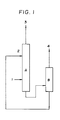
- Figure 1 is a flow chart showing one of the preferred embodiments of this invention in which a liquid containing the salt is fed to the vicinity of a disitillation column top.
- A indicates a concentration- distillation step
- B indicates a hydrazine hydrate distillation step
- 1 indicates an aqueous solution of hydrazine hydrate to be fed
- 2 indicates an aqueous solution of hydrazine hydrate containing the salt
- 3 indicates water (containing TOC constituents)
- 4 indicates an aqueous solution of hydrazine hydrate.
- the conditions for the concentration-distillation step are as follows.
- the salt concentration in the system increases, it goes easier to separate TOC constituents from hydrazine hydrate. Hence, it is desirable to use the salt in as large a concentration as possible. Preferably, it is adjusted such that the salt concentration in the bottom product is not less than 10 %, especially not less than 15 %. When the salt concentration is over the above lower limit, most part of TOC constituents is distilled off together with water.
- the higher concentration of hydrazine hydrate to be fed is economically desirable. Although, even the lower concentration thereof does not make much difference. It is preferable to carry the distillation out at pressure not higher than the vicinity of atmospheric pressure when taking account of the stability on hydrazine hydrate.
- the object of the distillation step is to separate the salt, hydrazine hydrate and impurities having higher boiling points than that of hydrazine hydrate from one another.
- the bottom product i.e., aliquid containing the salt
- the salt concentration in the bottom product is as high as possible such that the TOC constituents can be easily removed.
- the maximum concentration of the salt is the same as its concentration in the solubility thereof at a temperature of the liquid. When an amount of the salt exceeds the solubility, crystals are deposited and the viscosity of the liquid is made very high, thus the operational difficulty being caused.
- the distillation may be carried out under elevated pressure or reduced pressure. It is, however, preferable to carry it out at pressure not higher than the vicinity of atmospheric pressure.
- This invention can be carried out in both batch method and continuous method.
- the continuous method is preferable from the view point of operationability.
- the batch method it is naturally possible to carry out the two steps by using the same apparatus.
- Dihydrazinium sulfate, hydrazinium monochloride, etc. may be prepared in situ.
- the salt when the salt is recycled, the salt is to be little by little replaced by a fresh salt or the impurities accumulated in the salt are to be removed by some method (e.g., extraction, filtration, etc.) depending upon the amount of the accumulated impurities.
- some method e.g., extraction, filtration, etc.
- the TOC concentrations in the Examples were measured in the following method.
- a sample to be measured was diluted by the distilled water such that the concentration of the hydrazine hydrate in the sample was not higher than 50 ppm. Then, 10 ⁇ l of the diluted sample was injected to an analyzer of total organic carbon (produced by Shimazu Seisakusho Co., Ltd. TOC-500 type) by microsyringe and the TOC concentration was measured.
- the calibration curve was prepared in advance by using a potassium hydrogen phthalate as standard sample.
- the concentration of the TOC was calculated based on the calibration curve by using the above concentration of the TOC.
- the TOC concentration are expressed as that of the undiluted measuring sample.
- a 60 % aqueous solution of hydrazine hydrate having 630 ppm of TOC which was obtained by a process of oxidizing ammonia with hydrogen peroxide in the presence of methylethyl ketone and distilling the resulting product, was fed at 60 g/hr to the 10th stage from the bottom in an Oldershaw type distillation column having 40 stages in the concentration-distillation step.
- a solution of 4% water, 16% hydrazine hydrate and 80 % dihydrazinium sulphate was fed to the 10th stage (having 20 % hydrazine hydrate) from the top at 40 g/hr.
- the hydrazine hydrate was fed to the 5th stage from the bottom at 40 g/hr together with water at 10 g/hr.
- a solution of 10 % hydrazine hydrate and 90 % dihydrazinium sulfate was fed to 10th stage (having 4 % hydrazine hydrate) from the top at 10 g/hr.
- the hydrazine hydrate was fed to the 5th stage from the bottom at 40 g/hr together with water at 10 g/hr.
- a solution of 20 % hydrazine hydrate and 80 % dihydrazinium sulphate was fed to the 10th stage (having 32 % hydrazine hydrate) from the top at 70 g/hr.
- the aqueous solution of the hydrazine hydrate was fed to the 15th stage from the bottom at 97 g/hr.
- a solution of 4% water, 22 % hydrazine hydrate and 74 % dihydrazinium sulphate was fed to the 10th stage (having 25 % hydrazine hydrate) from the top at 223 g/hr.
- the aqueous solution of the hydrazine hydrate was fed to the 15th stage from the bottom at 60 g/hr.
- a solution of 15% water, 67 % hydrazine hydrate and 18 % sodium chloride was fed to the 10th stage (having 32 % hydrazine hydrate) from the top at 83 g/hr.
- the aqueous solution of the hydrazine hydrate was fed to the 15th stage from the bottom at 66.5 g/hr at 10 g/hr.
- a solution of 2.4% water, 9.8% hydrazine hydrate and 87.8% hydrazinium monophosphate was fed to the 10th stage (having 4.5 % hydrazine hydrate) from the top at 38.5 g/hr.
- the aqueous solution of the hydrazine hydrate was fed to the 15th stage from the bottom at 90 g/hr.
- a solution of 17% water, 63 % hydrazine hydrate and 20 % potassium carbonate was fed to the 10th stage (having 27 % hydrazine hydrate) from the top at 120 g/hr.
- a 60 % aqueous solution of hydrazine hydrate having 630 ppm of TOC which was obtained by a process of oxidizing ammonia with hydrogen peroxide in the presence of methylethyl ketone, was fed at 60 g/hr to 15th stage from the bottom of the same apparatus as in Example 1.
Landscapes
- Chemical & Material Sciences (AREA)
- Organic Chemistry (AREA)
- Inorganic Chemistry (AREA)
- Organic Low-Molecular-Weight Compounds And Preparation Thereof (AREA)
Applications Claiming Priority (2)
| Application Number | Priority Date | Filing Date | Title |
|---|---|---|---|
| JP62129773A JPS63295408A (ja) | 1987-05-28 | 1987-05-28 | 水加ヒドラジン水溶液の精製方法 |
| JP129773/87 | 1987-05-28 |
Publications (2)
| Publication Number | Publication Date |
|---|---|
| EP0294100A1 true EP0294100A1 (fr) | 1988-12-07 |
| EP0294100B1 EP0294100B1 (fr) | 1992-07-29 |
Family
ID=15017855
Family Applications (1)
| Application Number | Title | Priority Date | Filing Date |
|---|---|---|---|
| EP88304773A Expired EP0294100B1 (fr) | 1987-05-28 | 1988-05-26 | Procédé pour la production d'hydrate d'hydrazine purifiée |
Country Status (4)
| Country | Link |
|---|---|
| US (1) | US4963232A (fr) |
| EP (1) | EP0294100B1 (fr) |
| JP (1) | JPS63295408A (fr) |
| DE (1) | DE3873185T2 (fr) |
Cited By (4)
| Publication number | Priority date | Publication date | Assignee | Title |
|---|---|---|---|---|
| US5393508A (en) * | 1989-12-04 | 1995-02-28 | Atochem | Vaporization of solutions of hydrazine hydrate |
| FR2709481A1 (fr) * | 1993-09-02 | 1995-03-10 | Bayer Ag | Procédé pour l'élimination d'impuretés de l'hydrate d'hydrazine. |
| WO1999058445A1 (fr) * | 1998-05-14 | 1999-11-18 | Atofina | Procede de preparation d'hydrate d'hydrazine |
| CN106008278A (zh) * | 2016-06-06 | 2016-10-12 | 青海盐湖工业股份有限公司 | 一种联二脲的制备方法 |
Families Citing this family (14)
| Publication number | Priority date | Publication date | Assignee | Title |
|---|---|---|---|---|
| FR2778659B1 (fr) * | 1998-05-14 | 2000-06-23 | Atochem Elf Sa | Procede de preparation d'hydrate d'hydrazine |
| CA2844154C (fr) * | 2003-08-06 | 2016-12-20 | The Government Of The United States Of America, As Represented By The Secretary, Department Of Health And Human Services | Vaccins conjugues polysaccharide-proteine |
| CN101405028B (zh) | 2006-03-17 | 2015-08-19 | 美国政府健康及人类服务部 | 制备复合的多价免疫原性结合物的方法 |
| JP2009035467A (ja) * | 2007-08-06 | 2009-02-19 | Mitsubishi Gas Chem Co Inc | 金属微粉末製造に用いる水加ヒドラジンの製造方法 |
| CN102826520B (zh) * | 2012-09-17 | 2014-06-04 | 宁夏日盛实业有限公司 | 一种提纯水合肼实现adc发泡剂废水联产硫酸铵的方法 |
| WO2014057735A1 (fr) * | 2012-10-11 | 2014-04-17 | 株式会社村田製作所 | Procédé de fabrication de poudre de métal |
| CN103043636B (zh) * | 2013-01-06 | 2015-07-08 | 杭州海虹精细化工有限公司 | 一种提高水合肼浓度的方法 |
| CN103613237A (zh) * | 2013-11-28 | 2014-03-05 | 天津普莱化工技术有限公司 | 一种处理酮连氮法制水合肼高盐废水的工艺方法 |
| RU2596223C2 (ru) * | 2014-07-22 | 2016-09-10 | Федеральное государственное унитарное предприятие "Российский научный центр "Прикладная химия" | Способ получения гидразина высокой чистоты |
| FR3096048B1 (fr) | 2019-05-16 | 2021-04-30 | Arkema France | Procede ameliore de preparation d'hydrate d'hydrazine avec recyclage oxime |
| FR3096049B1 (fr) | 2019-05-16 | 2021-12-17 | Arkema France | Procede ameliore de preparation d'hydrate d'hydrazine avec recyclage pyrazoline |
| CN118307418A (zh) * | 2020-04-17 | 2024-07-09 | 株式会社德山 | 卤素含氧酸的制造方法以及卤素含氧酸的制造装置 |
| CN114894755B (zh) * | 2022-04-25 | 2024-04-26 | 宜宾天原科创设计有限公司 | 酮连氮水合肼生产系统中异丙基肼的定性分析方法 |
| CN121698310A (zh) * | 2026-02-10 | 2026-03-20 | 宁夏日盛高新产业股份有限公司 | 一种高效绿色合成水合肼的方法 |
Citations (3)
| Publication number | Priority date | Publication date | Assignee | Title |
|---|---|---|---|---|
| FR1517080A (fr) * | 1967-02-03 | 1968-03-15 | Ugine Kuhlmann | Perfectionnement à la préparation de l'hydrate d'hydrazine |
| US3740436A (en) * | 1969-12-02 | 1973-06-19 | Olin Corp | Low impurity hydrazine |
| JPS5659745A (en) * | 1979-10-19 | 1981-05-23 | Otsuka Chem Co Ltd | Purification of crude ketazine solution containing ketoxime |
Family Cites Families (11)
| Publication number | Priority date | Publication date | Assignee | Title |
|---|---|---|---|---|
| US2799631A (en) * | 1952-10-07 | 1957-07-16 | Fairmount Chem | Process of recovering hydrazine |
| NL229959A (fr) * | 1957-07-31 | |||
| NL230104A (fr) * | 1957-08-01 | |||
| DE1137720B (de) * | 1961-07-28 | 1962-10-11 | Bayer Ag | Verfahren zur Herstellung von Hydrazinhydrat |
| JPS42653Y1 (fr) * | 1965-11-10 | 1967-01-17 | ||
| DE1282617B (de) * | 1966-12-17 | 1968-11-14 | Bayer Ag | Verfahren zur Aufbereitung von Hydrazin aus waessrigen Ketazinloesungen |
| GB1211547A (en) * | 1967-10-12 | 1970-11-11 | Fisons Ind Chemicals Ltd | Hydrazine |
| FR2120517A5 (fr) * | 1971-01-07 | 1972-08-18 | Ugine Kuhlmann | |
| FR2211939A5 (fr) * | 1972-12-21 | 1974-07-19 | Ugine Kuhlmann | |
| FR2323635A1 (fr) * | 1975-09-10 | 1977-04-08 | Ugine Kuhlmann | Procede de preparation de solutions concentrees d'hydrate d'hydrazine |
| JPS5738312A (en) * | 1980-08-11 | 1982-03-03 | Mitsubishi Gas Chem Co Inc | Manufacture of hydrazine |
-
1987
- 1987-05-28 JP JP62129773A patent/JPS63295408A/ja active Granted
-
1988
- 1988-05-26 DE DE8888304773T patent/DE3873185T2/de not_active Expired - Lifetime
- 1988-05-26 EP EP88304773A patent/EP0294100B1/fr not_active Expired
-
1989
- 1989-05-22 US US07/355,188 patent/US4963232A/en not_active Expired - Lifetime
Patent Citations (3)
| Publication number | Priority date | Publication date | Assignee | Title |
|---|---|---|---|---|
| FR1517080A (fr) * | 1967-02-03 | 1968-03-15 | Ugine Kuhlmann | Perfectionnement à la préparation de l'hydrate d'hydrazine |
| US3740436A (en) * | 1969-12-02 | 1973-06-19 | Olin Corp | Low impurity hydrazine |
| JPS5659745A (en) * | 1979-10-19 | 1981-05-23 | Otsuka Chem Co Ltd | Purification of crude ketazine solution containing ketoxime |
Non-Patent Citations (2)
| Title |
|---|
| PATENT ABSTRACTS OF JAPAN vol. 005, no. 124 (C - 66)<796> 11 August 1981 (1981-08-11) * |
| PATENT ABSTRACTS OF JAPAN, vol. 5, no. 124 (C-66)[796], 11th August 1981; & JP-A-56 059 744 (OTSUKA KAGAKU YAKUHIN K.K.) 23-05-1981 * |
Cited By (7)
| Publication number | Priority date | Publication date | Assignee | Title |
|---|---|---|---|---|
| US5393508A (en) * | 1989-12-04 | 1995-02-28 | Atochem | Vaporization of solutions of hydrazine hydrate |
| FR2709481A1 (fr) * | 1993-09-02 | 1995-03-10 | Bayer Ag | Procédé pour l'élimination d'impuretés de l'hydrate d'hydrazine. |
| WO1999058445A1 (fr) * | 1998-05-14 | 1999-11-18 | Atofina | Procede de preparation d'hydrate d'hydrazine |
| FR2778660A1 (fr) * | 1998-05-14 | 1999-11-19 | Atochem Elf Sa | Procede de preparation d'hydrate d'hydrazine |
| AU747951B2 (en) * | 1998-05-14 | 2002-05-30 | Atofina | Method for preparing hydrazine hydrate |
| KR100584631B1 (ko) * | 1998-05-14 | 2006-05-30 | 아르끄마 | 히드라진 히드레이트의 제조방법 |
| CN106008278A (zh) * | 2016-06-06 | 2016-10-12 | 青海盐湖工业股份有限公司 | 一种联二脲的制备方法 |
Also Published As
| Publication number | Publication date |
|---|---|
| JPH0555445B2 (fr) | 1993-08-17 |
| EP0294100B1 (fr) | 1992-07-29 |
| DE3873185T2 (de) | 1993-03-18 |
| DE3873185D1 (de) | 1992-09-03 |
| JPS63295408A (ja) | 1988-12-01 |
| US4963232A (en) | 1990-10-16 |
Similar Documents
| Publication | Publication Date | Title |
|---|---|---|
| EP0294100B1 (fr) | Procédé pour la production d'hydrate d'hydrazine purifiée | |
| KR100522063B1 (ko) | 유리 히드록실아민 수용액의 제조 방법 | |
| CA2230946C (fr) | Extraction d'impuretes de carbonyle contenues dans un flux de processus de carbonylation | |
| KR100214231B1 (ko) | 아진 합성용 반응기 중 co2 함량을 감소시키는 방법 | |
| US4044108A (en) | Process for removing organic material from wet process phosphoric acid | |
| JP3206103B2 (ja) | メチオニンの製造方法 | |
| US4551208A (en) | Recovery of formic acid by distillation | |
| JP3394981B2 (ja) | フリーヒドロキシルアミン水溶液の製造方法 | |
| JP4183286B2 (ja) | 高純度ヒドロキシルアミン水溶液の製造 | |
| JP3104312B2 (ja) | アセトニトリルの精製方法 | |
| US4276126A (en) | Separation of ethylene glycol from N-methylpyrrolidone | |
| US5227028A (en) | Process for treating amides | |
| US5637700A (en) | Purification of caprolactam | |
| JP2001002638A (ja) | 高純度ピロリドン類の製造方法 | |
| KR100732799B1 (ko) | 황산암모늄 용액 상과 수성 락탐 상을 포함하는 혼합물의 처리 방법 | |
| US3576856A (en) | Process for simultaneous catalyst recovery and byproduct removal | |
| US4743707A (en) | Process for purifying allyl alcohol | |
| US4251457A (en) | Process for purification of the off-gases resulting from the production of benzoyl chloride from phosgene | |
| US4209460A (en) | Production of pure acetyl chloride | |
| US5011987A (en) | Process for manufacturing high-purity o-toluic acid | |
| JP3230859B2 (ja) | 水加ヒドラジンの精製方法 | |
| JPH0418062A (ja) | 塩酸、硫酸およびそのヒドロキシルアンモニウム塩およびアンモニウム塩を含む水性母液の処理法 | |
| DE69406187T2 (de) | Verfahren zur Reinigung von Wasserstoffperoxyd | |
| JPH0662482B2 (ja) | 1,1’―パーオキシジシクロヘキシルアミンの熱分解反応混合液からシクロヘキサノンを回収する方法 | |
| US6043399A (en) | Process for the preparation of cumene hydroperoxide |
Legal Events
| Date | Code | Title | Description |
|---|---|---|---|
| PUAI | Public reference made under article 153(3) epc to a published international application that has entered the european phase |
Free format text: ORIGINAL CODE: 0009012 |
|
| AK | Designated contracting states |
Kind code of ref document: A1 Designated state(s): DE FR GB |
|
| 17P | Request for examination filed |
Effective date: 19890201 |
|
| 17Q | First examination report despatched |
Effective date: 19910102 |
|
| GRAA | (expected) grant |
Free format text: ORIGINAL CODE: 0009210 |
|
| AK | Designated contracting states |
Kind code of ref document: B1 Designated state(s): DE FR GB |
|
| ET | Fr: translation filed | ||
| REF | Corresponds to: |
Ref document number: 3873185 Country of ref document: DE Date of ref document: 19920903 |
|
| PLBE | No opposition filed within time limit |
Free format text: ORIGINAL CODE: 0009261 |
|
| STAA | Information on the status of an ep patent application or granted ep patent |
Free format text: STATUS: NO OPPOSITION FILED WITHIN TIME LIMIT |
|
| 26N | No opposition filed | ||
| REG | Reference to a national code |
Ref country code: GB Ref legal event code: IF02 |
|
| PGFP | Annual fee paid to national office [announced via postgrant information from national office to epo] |
Ref country code: DE Payment date: 20070524 Year of fee payment: 20 |
|
| PGFP | Annual fee paid to national office [announced via postgrant information from national office to epo] |
Ref country code: GB Payment date: 20070523 Year of fee payment: 20 |
|
| PGFP | Annual fee paid to national office [announced via postgrant information from national office to epo] |
Ref country code: FR Payment date: 20070510 Year of fee payment: 20 |
|
| REG | Reference to a national code |
Ref country code: GB Ref legal event code: PE20 Expiry date: 20080525 |
|
| PG25 | Lapsed in a contracting state [announced via postgrant information from national office to epo] |
Ref country code: GB Free format text: LAPSE BECAUSE OF EXPIRATION OF PROTECTION Effective date: 20080525 |