EP0294143A2 - Réduction de la perméabilité dans des zones à haute perméabilité dans des formations d'huile et de gaz - Google Patents
Réduction de la perméabilité dans des zones à haute perméabilité dans des formations d'huile et de gaz Download PDFInfo
- Publication number
- EP0294143A2 EP0294143A2 EP88304934A EP88304934A EP0294143A2 EP 0294143 A2 EP0294143 A2 EP 0294143A2 EP 88304934 A EP88304934 A EP 88304934A EP 88304934 A EP88304934 A EP 88304934A EP 0294143 A2 EP0294143 A2 EP 0294143A2
- Authority
- EP
- European Patent Office
- Prior art keywords
- formation
- cross
- polymer
- well bore
- linking agent
- Prior art date
- Legal status (The legal status is an assumption and is not a legal conclusion. Google has not performed a legal analysis and makes no representation as to the accuracy of the status listed.)
- Withdrawn
Links
Images
Classifications
-
- C—CHEMISTRY; METALLURGY
- C09—DYES; PAINTS; POLISHES; NATURAL RESINS; ADHESIVES; COMPOSITIONS NOT OTHERWISE PROVIDED FOR; APPLICATIONS OF MATERIALS NOT OTHERWISE PROVIDED FOR
- C09K—MATERIALS FOR MISCELLANEOUS APPLICATIONS, NOT PROVIDED FOR ELSEWHERE
- C09K8/00—Compositions for drilling of boreholes or wells; Compositions for treating boreholes or wells, e.g. for completion or for remedial operations
- C09K8/60—Compositions for stimulating production by acting on the underground formation
- C09K8/84—Compositions based on water or polar solvents
- C09K8/86—Compositions based on water or polar solvents containing organic compounds
- C09K8/88—Compositions based on water or polar solvents containing organic compounds macromolecular compounds
- C09K8/885—Compositions based on water or polar solvents containing organic compounds macromolecular compounds obtained otherwise than by reactions only involving carbon-to-carbon unsaturated bonds
-
- C—CHEMISTRY; METALLURGY
- C09—DYES; PAINTS; POLISHES; NATURAL RESINS; ADHESIVES; COMPOSITIONS NOT OTHERWISE PROVIDED FOR; APPLICATIONS OF MATERIALS NOT OTHERWISE PROVIDED FOR
- C09K—MATERIALS FOR MISCELLANEOUS APPLICATIONS, NOT PROVIDED FOR ELSEWHERE
- C09K8/00—Compositions for drilling of boreholes or wells; Compositions for treating boreholes or wells, e.g. for completion or for remedial operations
- C09K8/60—Compositions for stimulating production by acting on the underground formation
- C09K8/84—Compositions based on water or polar solvents
- C09K8/86—Compositions based on water or polar solvents containing organic compounds
- C09K8/88—Compositions based on water or polar solvents containing organic compounds macromolecular compounds
- C09K8/887—Compositions based on water or polar solvents containing organic compounds macromolecular compounds containing cross-linking agents
Definitions
- An isolated high-permeability zone or fracture can be plugged at the well bore face by a shallow layer of applied cement, though such a permanent, relatively irrevocable technique often is undesirable.
- a communicating high-permeability zone is plugged to some considerable depth in order to prevent flood water from otherwise merely flowing around a narrow shallow plug and back into the high-permeability or swept zone. Indepth plugging of a relatively high-permeability zone converts the zone into a much lower permeability zone. Then, subsequently injecting flood water or other fluid will tend to enter the formerly by-passed, but now relatively more permeable hydrocarbon-bearing zones and thus mobilize increased amounts of hydrocarbons therefrom.
- permeability of a highly permeable zone in a subterranean formation is reduced by introducing to the formation, an aqueous solution of a water soluble polymer selected from the group consisting of polyalkylenimines and polyalkylenepolyamines and mixtures thereof and a cross-linking agent which is capable of cross-linking with and gelling said polymers.
- U.S. Patent No. 3,909,469 discloses an adhesive composition comprising a solution of polyethylenimine containing an aldehyde which causes the solution to gel or form gel particles.
- the solution also contains water soluble carboxylic acid to inhibit gel formation.
- U.S. Patent No. 4,326,009 discloses the cross-linking between polyethylenimine and glutaraldehyde.
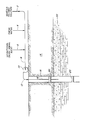
- the drawing is a schematic flow diagram (partially in cross-section) of an apparatus arrangement which illustrates the method for carrying out the invention.
- Well 16 is preferably provided with packing means 20 to isolate zone 22.
- An aqueous solution of polymer, such as polyethylenimine is introduced through lines 2 and 8, passing through pump 10 and line 12 into well bore 16.
- the polymer entering the well passes downwardly through tubing string 18 and enters formation 22.
- the cationic characteristics of this material cause it to be adsorbed onto the formation rock.
- Waterflood water (usually formation water) is then injected into the formation in a similar manner via line 4.
- the water serves to clean the well bore and the adjacent formation of polyethylenimine to prevent premature gelling in these locations upon introduction of the gelling agent.
- a cross-linking gelling agent containing difunctional groups such as glutaraldehyde is injected into the formation in a corresponding manner through line 6.
- the cross-linking agent reacts with the adsorbed polymer and leaves additional reactive groups open for further reaction.
- a second water injection is then carried out via line 4.
- additional polymer is injected through line 2. This additional material reacts with the open reactive groups of the cross-linking agent in the formation to form a cross-linked gel system.
- the foregoing steps can be repeated to obtain any desired degree of permeability reduction.
- zone 22 has previously passed a major portion of the fluids injected into the formation, these fluids are now forced into other zones which contain oil thereby increasing the production of oil from the formation.
- the cross-linking agent and water soluble polymer are separately introduced into the subterranean formation. However, with certain precautions (discussed later), these materials may be combined outside the formation.
- the water soluble polymers which are used in the practice of the invention are selected from the class consisting of polyalkylenimines, polyalkylenepolyamines and mixtures thereof.
- the preferred polyalkylenepolyamines are the polymeric condensates of lower molecular weight polyalkylenepolyamines and a vicinal dihaloalkane.
- the polyalkylenimines are best illustrated by polymerized ethylenimine or propylenimine.
- the polyalkylenepolyamines are exemplified by polyethylene and polypropylenepolyamines.
- water soluble polymers are generally used in this invention in amounts of about 0.1% to 50% by weight based upon the weight of the polymer and water combination and preferably in amounts between about 2% and about 6%.
- Any difunctional compounds which are capable of reacting with and cross-linking the above described polymers may be used in the process of the invention. Included are such compounds as difunctional aldehydes, ketones, alkyl halides, isocyanates, compounds with activated double bonds and carboxylic acids. These compounds and their reactions with the amine groups of the polyalkylenimine and polyalkylenepolyamine polymers are illustrated by the following reactions: Where R is straight chain or branched alkyl containing 0 to about 4 carbon atoms. Where R and R1 are straight chain or branched alkyl, R contains 0 to about 2 carbon atoms and R1 contains 0 to about 4 carbon atoms.
- X is halogen and R is straight chain or branched alkyl containing 1 to about 6 carbon atoms. Where R is straight chain or branched alkyl containing 1 to about 4 carbon atoms. Where X is a reactive group such as halogen, oxygen, nitro, etc and R is straight chain or branched alkyl containing 0 to about 2 carbon atoms. Where R is straight chain or alkyl containing 0 to about 4 carbon atoms.
- Specific difunctional cross-linking agents include such compounds as glutaraldehyde, succinaldehyde, 2,4-pentadione, 1,2-dichloroethane, 1,3-diisocyanopropane, dimethylketene and adipic acid.
- the difunctional cross-linking agents can be used in amounts from about 0.1 percent to about 10 percent by weight of the polymer, but preferably are employed in amounts between about 2 percent and about 4 percent by weight.
- a water carrier is normally provided for the cross-linking agent, usually in an amount to provide a concentration of cross-linking agent between about 0.2 percent and about 30 percent by weight.
- cross-linking agents and polymers will vary widely depending on the amounts and the particular materials used. For example, glutaraldehyde, even in very small quantities, cross-links with polyethylenimine almost immediately. Other difunctional cross-linking agents are much slower to react.
- the volume of material (polymer and cross-linking agent) injected in the zone of high permeability to be treated is determined by the size of the zone. Typically, volumes from about 5 to about 100 percent of the pore volume of the zone to be treated are used.
- the treatment time can then be estimated. If the polymer and cross-linking agent are to be injected into the formation together, they are then selected to provide a material which is stable for the amount of time equal to the required treatment time.
- salt water is injected for six months. At the end of this time, the well is logged and it is found that 70 percent of the injection water is being lost into a thief zone.
- the dichloroethane reacts with and cross-links the polyethylenepolyamine to form a gel, thereby plugging the entire thief zone.
- the thief zone Upon logging the injection well a second time, it is determined that the thief zone is now taking only 10 percent of the injection water. Thus, the permeability of the thief zone is substantially reduced by the method of the invention.
Landscapes
- Chemical & Material Sciences (AREA)
- Life Sciences & Earth Sciences (AREA)
- General Life Sciences & Earth Sciences (AREA)
- Engineering & Computer Science (AREA)
- Materials Engineering (AREA)
- Organic Chemistry (AREA)
- Chemical Kinetics & Catalysis (AREA)
- Macromolecular Compounds Obtained By Forming Nitrogen-Containing Linkages In General (AREA)
- Separation Using Semi-Permeable Membranes (AREA)
- Polyamides (AREA)
- Solid-Sorbent Or Filter-Aiding Compositions (AREA)
Applications Claiming Priority (2)
| Application Number | Priority Date | Filing Date | Title |
|---|---|---|---|
| US07/056,193 US4773482A (en) | 1987-06-01 | 1987-06-01 | Reducing permeability of highly permeable zones in oil and gas formations |
| US56193 | 1987-06-01 |
Publications (2)
| Publication Number | Publication Date |
|---|---|
| EP0294143A2 true EP0294143A2 (fr) | 1988-12-07 |
| EP0294143A3 EP0294143A3 (fr) | 1989-04-05 |
Family
ID=22002796
Family Applications (1)
| Application Number | Title | Priority Date | Filing Date |
|---|---|---|---|
| EP88304934A Withdrawn EP0294143A3 (fr) | 1987-06-01 | 1988-05-31 | Réduction de la perméabilité dans des zones à haute perméabilité dans des formations d'huile et de gaz |
Country Status (4)
| Country | Link |
|---|---|
| US (1) | US4773482A (fr) |
| EP (1) | EP0294143A3 (fr) |
| CA (1) | CA1301445C (fr) |
| NO (1) | NO882396L (fr) |
Cited By (3)
| Publication number | Priority date | Publication date | Assignee | Title |
|---|---|---|---|---|
| RU2144130C1 (ru) * | 1999-04-21 | 2000-01-10 | Уренгойское производственное объединение им.С.А.Оруджева "Уренгойгазпром" | Способ ликвидации межколонных газопроявлений в скважине |
| RU2333346C1 (ru) * | 2007-01-09 | 2008-09-10 | Государственное образовательное учреждение высшего профессионального образования "Тюменский государственный нефтегазовый университет" | Способ ликвидации негерметичности эксплуатационной колонны нефтегазовой скважины |
| DE102008010795A1 (de) * | 2008-02-23 | 2009-08-27 | Basf Construction Polymers Gmbh | Additiv zum Zementieren von Bohrlöchern |
Families Citing this family (15)
| Publication number | Priority date | Publication date | Assignee | Title |
|---|---|---|---|---|
| US5219476A (en) * | 1989-03-31 | 1993-06-15 | Eniricerche S.P.A. | Gellable aqueous composition and its use in enhanced petroleum recovery |
| US4973410A (en) * | 1989-11-29 | 1990-11-27 | Air Products And Chemicals, Inc. | Crosslinked vinylamine polymer in enhanced oil recovery |
| US6124246A (en) * | 1997-11-17 | 2000-09-26 | Halliburton Energy Services, Inc. | High temperature epoxy resin compositions, additives and methods |
| US6006835A (en) * | 1998-02-17 | 1999-12-28 | Halliburton Energy Services, Inc. | Methods for sealing subterranean zones using foamed resin |
| US6012524A (en) * | 1998-04-14 | 2000-01-11 | Halliburton Energy Services, Inc. | Remedial well bore sealing methods and compositions |
| US6068055A (en) | 1998-06-30 | 2000-05-30 | Halliburton Energy Services, Inc. | Well sealing compositions and methods |
| US6059035A (en) * | 1998-07-20 | 2000-05-09 | Halliburton Energy Services, Inc. | Subterranean zone sealing methods and compositions |
| US6098711A (en) * | 1998-08-18 | 2000-08-08 | Halliburton Energy Services, Inc. | Compositions and methods for sealing pipe in well bores |
| US6279652B1 (en) | 1998-09-23 | 2001-08-28 | Halliburton Energy Services, Inc. | Heat insulation compositions and methods |
| US6271181B1 (en) | 1999-02-04 | 2001-08-07 | Halliburton Energy Services, Inc. | Sealing subterranean zones |
| US6328106B1 (en) | 1999-02-04 | 2001-12-11 | Halliburton Energy Services, Inc. | Sealing subterranean zones |
| US6244344B1 (en) | 1999-02-09 | 2001-06-12 | Halliburton Energy Services, Inc. | Methods and compositions for cementing pipe strings in well bores |
| US6234251B1 (en) | 1999-02-22 | 2001-05-22 | Halliburton Energy Services, Inc. | Resilient well cement compositions and methods |
| US6321841B1 (en) | 2001-02-21 | 2001-11-27 | Halliburton Energy Services, Inc. | Methods of sealing pipe strings in disposal wells |
| US6569983B1 (en) * | 2001-12-20 | 2003-05-27 | Ondeo Nalco Energy Services, L.P. | Method and composition for recovering hydrocarbon fluids from a subterranean reservoir |
Family Cites Families (11)
| Publication number | Priority date | Publication date | Assignee | Title |
|---|---|---|---|---|
| US3491049A (en) * | 1965-10-13 | 1970-01-20 | Dow Chemical Co | Low water-loss aqueous cement slurry and method of use |
| US3500929A (en) * | 1968-09-03 | 1970-03-17 | Dow Chemical Co | Temporary diverting agent and use thereof in treatmeint of subterranean strata |
| US3762476A (en) * | 1972-01-03 | 1973-10-02 | Phillips Petroleum Co | Subterranean formation permeability correction |
| US3994344A (en) * | 1974-12-26 | 1976-11-30 | Getty Oil Company | Method for recovery of acidic crude oils |
| FR2376287A1 (fr) * | 1976-12-30 | 1978-07-28 | Elf Aquitaine | Prevention des venues d'eau dans les puits deja fores ou en cours de forage |
| US4326009A (en) * | 1977-07-27 | 1982-04-20 | Royer Garfield P | Polymeric particulate carrier |
| US4216307A (en) * | 1977-09-29 | 1980-08-05 | Nippon Oil Company, Ltd. | Polyhexamethylenimine and process for its preparation |
| US4460627A (en) * | 1978-09-28 | 1984-07-17 | Halliburton Company | Polymeric well treating method |
| US4519843A (en) * | 1983-11-03 | 1985-05-28 | The Dow Chemical Company | Modified polyalkylenepolyamines |
| US4657948A (en) * | 1985-05-09 | 1987-04-14 | Ethyl Corporation | Fluid loss control in well cement slurries |
| US4703801A (en) * | 1986-05-13 | 1987-11-03 | Halliburton Company | Method of reducing fluid loss in cement compositions which may contain substantial salt concentrations |
-
1987
- 1987-06-01 US US07/056,193 patent/US4773482A/en not_active Expired - Fee Related
-
1988
- 1988-05-24 CA CA000567557A patent/CA1301445C/fr not_active Expired - Lifetime
- 1988-05-31 NO NO882396A patent/NO882396L/no unknown
- 1988-05-31 EP EP88304934A patent/EP0294143A3/fr not_active Withdrawn
Cited By (3)
| Publication number | Priority date | Publication date | Assignee | Title |
|---|---|---|---|---|
| RU2144130C1 (ru) * | 1999-04-21 | 2000-01-10 | Уренгойское производственное объединение им.С.А.Оруджева "Уренгойгазпром" | Способ ликвидации межколонных газопроявлений в скважине |
| RU2333346C1 (ru) * | 2007-01-09 | 2008-09-10 | Государственное образовательное учреждение высшего профессионального образования "Тюменский государственный нефтегазовый университет" | Способ ликвидации негерметичности эксплуатационной колонны нефтегазовой скважины |
| DE102008010795A1 (de) * | 2008-02-23 | 2009-08-27 | Basf Construction Polymers Gmbh | Additiv zum Zementieren von Bohrlöchern |
Also Published As
| Publication number | Publication date |
|---|---|
| EP0294143A3 (fr) | 1989-04-05 |
| US4773482A (en) | 1988-09-27 |
| CA1301445C (fr) | 1992-05-26 |
| NO882396L (no) | 1988-12-02 |
| NO882396D0 (no) | 1988-05-31 |
Similar Documents
| Publication | Publication Date | Title |
|---|---|---|
| US4773481A (en) | Reducing permeability of highly permeable zones in underground formations | |
| US4773482A (en) | Reducing permeability of highly permeable zones in oil and gas formations | |
| US5377759A (en) | Formation treating methods | |
| CA1307457C (fr) | Procede de consolidation du sable dans une formation souterraine | |
| US5285849A (en) | Formation treating methods | |
| EP0350548A1 (fr) | Réduction de la perméabilité de zones fortement perméables dans les formations souterraines | |
| US6152234A (en) | Method for strengthening a subterranean formation | |
| CA1308894C (fr) | Gravier filtre consolidable | |
| US4974677A (en) | Profile control process for use under high temperature reservoir conditions | |
| US4817721A (en) | Reducing the permeability of a rock formation | |
| US4915170A (en) | Enhanced oil recovery method using crosslinked polymeric gels for profile control | |
| US4462718A (en) | Oil well treating method and composition | |
| US4809781A (en) | Method for selectively plugging highly permeable zones in a subterranean formation | |
| US3791446A (en) | Method for stimulating well production | |
| US3656550A (en) | Forming a barrier between zones in waterflooding | |
| US4630678A (en) | In-situ formation of polyvalent metal ions for crosslinking polymers within carbonate rock-containing reservoirs | |
| US3897827A (en) | Lignosulfonate gels for sweep improvement in flooding operations | |
| US4494606A (en) | Process for improving vertical conformance in a near well bore environment | |
| CA2013469C (fr) | Composition tampon, aqueuse gelafiable et son utilisation pour la recuperation assistee du petrole | |
| US4505751A (en) | Process for utilizing a silicate/silica cement in oil field applications | |
| US4482015A (en) | Selectively plugging subterranean formations with a hydrocarbon soluble fluid | |
| JPS61296084A (ja) | 水性スルホメチル化メラミンゲル形成組成物 | |
| US10414972B2 (en) | Peroxide containing formation conditioning and pressure generating composition and method | |
| US3682245A (en) | Selective plugging of more permeable zones | |
| JPH0768427B2 (ja) | アミノアルキル化ポリアクリルアミド−アルデヒドゲル、その製法、およびその用途 |
Legal Events
| Date | Code | Title | Description |
|---|---|---|---|
| PUAI | Public reference made under article 153(3) epc to a published international application that has entered the european phase |
Free format text: ORIGINAL CODE: 0009012 |
|
| AK | Designated contracting states |
Kind code of ref document: A2 Designated state(s): GB NL |
|
| PUAL | Search report despatched |
Free format text: ORIGINAL CODE: 0009013 |
|
| AK | Designated contracting states |
Kind code of ref document: A3 Designated state(s): GB NL |
|
| 17P | Request for examination filed |
Effective date: 19890925 |
|
| STAA | Information on the status of an ep patent application or granted ep patent |
Free format text: STATUS: THE APPLICATION HAS BEEN WITHDRAWN |
|
| 18W | Application withdrawn |
Withdrawal date: 19910311 |
|
| R18W | Application withdrawn (corrected) |
Effective date: 19910311 |