EP0294152A2 - Composant optique du type à gradient d'indice et procédé pour sa production - Google Patents
Composant optique du type à gradient d'indice et procédé pour sa production Download PDFInfo
- Publication number
- EP0294152A2 EP0294152A2 EP88304947A EP88304947A EP0294152A2 EP 0294152 A2 EP0294152 A2 EP 0294152A2 EP 88304947 A EP88304947 A EP 88304947A EP 88304947 A EP88304947 A EP 88304947A EP 0294152 A2 EP0294152 A2 EP 0294152A2
- Authority
- EP
- European Patent Office
- Prior art keywords
- light
- ion
- transparent dielectric
- optical device
- absorbing portion
- Prior art date
- Legal status (The legal status is an assumption and is not a legal conclusion. Google has not performed a legal analysis and makes no representation as to the accuracy of the status listed.)
- Granted
Links
Images

Classifications
-
- G—PHYSICS
- G02—OPTICS
- G02B—OPTICAL ELEMENTS, SYSTEMS OR APPARATUS
- G02B6/00—Light guides; Structural details of arrangements comprising light guides and other optical elements, e.g. couplings
- G02B6/02—Optical fibres with cladding with or without a coating
- G02B6/028—Optical fibres with cladding with or without a coating with core or cladding having graded refractive index
- G02B6/0281—Graded index region forming part of the central core segment, e.g. alpha profile, triangular, trapezoidal core
-
- C—CHEMISTRY; METALLURGY
- C03—GLASS; MINERAL OR SLAG WOOL
- C03C—CHEMICAL COMPOSITION OF GLASSES, GLAZES OR VITREOUS ENAMELS; SURFACE TREATMENT OF GLASS; SURFACE TREATMENT OF FIBRES OR FILAMENTS MADE FROM GLASS, MINERALS OR SLAGS; JOINING GLASS TO GLASS OR OTHER MATERIALS
- C03C21/00—Treatment of glass, not in the form of fibres or filaments, by diffusing ions or metals in the surface
-
- G—PHYSICS
- G02—OPTICS
- G02B—OPTICAL ELEMENTS, SYSTEMS OR APPARATUS
- G02B6/00—Light guides; Structural details of arrangements comprising light guides and other optical elements, e.g. couplings
- G02B6/10—Light guides; Structural details of arrangements comprising light guides and other optical elements, e.g. couplings of the optical waveguide type
- G02B6/12—Light guides; Structural details of arrangements comprising light guides and other optical elements, e.g. couplings of the optical waveguide type of the integrated circuit kind
- G02B6/13—Integrated optical circuits characterised by the manufacturing method
- G02B6/134—Integrated optical circuits characterised by the manufacturing method by substitution by dopant atoms
- G02B6/1345—Integrated optical circuits characterised by the manufacturing method by substitution by dopant atoms using ion exchange
Definitions
- the present invention relates to a gradient index-type optical device and a process for production thereof based on an ion exchange process wherein a transparent dielectric body is soaked in or caused to contact a molten salt containing an ion providing a gradient index or refractive index gradient to cause exchange between the ion in the molten salt and an ion in the transparent dielectric body thereby to form a gradient index in the transparent dielectric body.
- the respective rod lenses are required to have uniform optical characteristic and outer diameter, so that a lowering in accuracy of outer diameter during the application of a light-absorbing material around the rod lenses should be avoided and the improvement thereof has been desired.
- An object of the present invention is to provide a gradient index-type optical device having a light-absorbing surface portion and yet having a high size accuracy.
- Another object of the present invention is to provide a gradient index-type optical device having a light-absorbing surface portion and yet free of crack generation in the light-absorbing portion.
- a further object of the present invention is to provide a gradient index-type optical device having a transparent core and a light-absorbing surface portion, which causes little reflection at the boundary between the transparent core and the light-absorbing surface portion and is free of flare.
- a still further object of the present invention is to provide a process for effectively producing a gradient index-type optical device as described above.
- a yet further of the invention is to provide a gradient index-type optical device having a three-dimensionally varying shape of the light-absorbing portion containing a coloring component and a process for production thereof.
- a gradient index-type optical device produced by the ion exchange process, comprising a transparent dielectric body having a refractive index distribution and a light-absorbing portion disposed on at least a part of the surface of the transparent dielectric body and comprising an ion introduced by ion exchange and a coloring component.
- a process for producing a gradient index-type optical device which comprises: providing a transparent dielectric body coating an ion to be exchanged with a light-absorbing portion containing an ion to be exchanged and a coloring component at at least a part of the surface of the transparent dielectric body, and causing the transparent dielectric to be soaked in or to contact a molten salt containing an ion providing a refractive index distribution, thereby to effect ion exchange.
- the gradient index-type optical device is formed by subjecting a part of the optical device comprising a light-absorbing portion to ion-exchange. Accordingly, it is unnecessary to form a light-absorbing portion after the preparation of the gradient index-type optical device. Therefore, the optical device is free of a reduction in size accuracy caused by application of a light-absorbing material after preparation of a gradient index-type optical device. Further, the light-absorbing portion in the gradient index-type optical device has been obtained through ion-exchange similarly as the transparent dielectric core portion and is composed of a similar material as the transparent dielectric portion.
- the refractive index of the light-absorbing portion and the refractive index of the transparent dielectric portion are composed of different types of materials, so that the reflection at the boundary can be minimized.
- the refractive indexes of both portions can be equalized in the neighborhood of the boundary therebetween through appropriate selection of materials.
- the thermal expansion coefficient of the light-absorbing portion is substantially equal to or smaller than that of the transparent dielectric portion in the neighborhood of the boundary between both portions.
- the transparent dielectric body used in the present invention comprises a transparent dielectric material containing an ion to be ion-exchanged, i.e., an (ion-)exchangeable ion.
- the material therefor may include optical glass and crystals such as LiNbO3 and LiTaO5, and various kinds of glass may generally be used suitably.
- the light-absorbing portion or material disposed in contact with the surface of the transparent dielectric body contains an exchangeable ion and a coloring component, and the ion-exchange reaction is effected through this portion to provide a refractive index distribution in the transparent dielectric body.
- the exchangeable ion may preferably be a cation, such as Li+, Na+, K+, Rb+, Cs+, Tl+ or Ag+.
- the molten salt also contains an exchangeable ion which is different from the exchangeable ion in the transparent dielectric body but may preferably be selected from the same group of cations as described above.
- the exchangeable ion in the molten salt may particularly preferably be sodium or potassium.
- the exchangeable ion contained in the light-absorbing portion and the exchangeable ion in the transparent dielectric body may be either the same or different.
- the exchangeable ion contained in the light-absorbing portion can also be the same as the exchangeable ion in the molten salt.
- the light-absorbing portion has a light-absorbing function and functions to decrease flare light. More specifically, the light-absorbing portion may be composed of one or more kinds of glass containing a metal ion, such as that of Mn, Cr, Co, Ni, Fe, Cu, Ag, Ti, Pb, Ru, Cd, V or Mo as a coloring component.
- a metal ion such as that of Mn, Cr, Co, Ni, Fe, Cu, Ag, Ti, Pb, Ru, Cd, V or Mo as a coloring component.
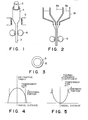
- Figures 1 and 3 illustrate an embodiment of the invention. More specifically, Figure 3 shows a rod lens having a light-absorbing layer and Figure 1 illustrates an embodiment of the process for producing the lens.
- a cylindrical light-absorbing glass 4 containing an exchangeable ion and a coloring component is disposed to encircle a rod core glass 3, and both are heated by an electric furnace 5 and drawn by pulling rollers 6 to provide a double glass rod 7 through melt integration of the core glass 3 and the light-absorbing glass 4.
- the double glass rod is cut into an appropriate length and soaked in a molten salt containing an exchangeable ion thereby to effect ion exchange between the exchangeable ion in the double glass rod and the exchangeable ion in the molten salt.
- the double rod after the ion exchange is formed into a rod lens comprising a transparent core 8 and a light-absorbing layer 9 surrounding the core 8 as shown in Figure 3.
- the gradient index-type rod lens produced according to the process of the present invention through melt integration of a transparent dielectric body and a light-absorbing member is caused to have a refractive index distribution as shown in Figure 4 and a distribution of thermal expansion coefficient as shown in Figure 5.
- the refractive index of the light-absorbing portion may be lowered by (1) decreasing Li2O and increasing Na2O instead or (2) decreasing PbO, TiO2 or ZrO2 in comparison with the content in the glass composition constituting the transparent core.
- thermal expansion coefficient of the outer light-absorbing portion may be substantially equal to or smaller than that at the boundary between the transparent core and the light-absorbing portion as shown in Figure 5.
- the thermal expansion coefficient of the light-absorbing portion may for example be lowered by (1) increasing B2O3 or Al2O3 or (2) increasing SiO2 compared with that in the transparent core.
- the rod lens having such distribution patterns with respect to refractive index and thermal expansion coefficient shows optical characteristics and strength which are much more excellent than those of the conventional rod lens.
- the accuracy of the outer diameter of the rod lens is ensured at a certain level in the step of melt integration of the transparent core and the light-absorbing member according to the invention, so that a level of outer diameter accuracy particularly required for preparation of a lens array can be obtained easily.
- the melt integration of a transparent dielectric body and a light-absorbing material can also be effected in a manner as shown in Figure 2 wherein the respective materials are heat-melted in a double-walled crucible 18 so that a transparent dielectric material 8a is melted in an inner crucible, a light-absorbing material 9a containing an exchangeable ion and a coloring component is melted and both materials are respectively withdrawn through lower nozzles and pulling rollers 6 to produce a melt-integrated structure of both materials.
- the shapes of the transparent dielectric body and the light-absorbing portion allow, it is possible to spray powdery glass containing a coloring component onto the core to cause hot fusion or to use a transparent dielectric body of a glass blank containing Ag+ ion or Pb++ ion and reduce the surface thereof with hydrogen to precipitate Ag or Pb, thus forming an integral light-absorbing layer.
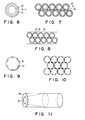
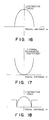
- Figures 11, 13 and 14 respectively show a gradient index-type lens having a special shape of light-absorbing portion containing a coloring component and subjected to ion exchange.
- a 30 mm diameter core glass 3 of a borosilicate glass of the following composition containing 20 mol.% of SiO2 was provided.
- Core glass composition (mol.%) Li2O Na2O MgO CaO PbO B2O3 Al2O3 SiO2 TiO2 20.0 8.0 10.0 0.5 1.0 5.0 1.0 49.5 5.0
- a hollow cylindrical light-absorbing glass 4 having a thickness of 0.7 mm and comprising a borosilicate glass of the following composition containing 5 mol % of MnO as the coloring component.
- Light-absorbing glass composition (mol %) Li2O Na2O MgO CaO PbO B2O3 Al2O3 SiO2 TiO2 MnO 20.0 7.4 9.3 0.4 0.8 4.7 0.9 46.8 4.7 5.0
- the glass rod was cut into a length of 1 m and soaked in a molten bath of sodium nitrate to effect ion exchange between Li+ ion in the glass rod and Na+ ion in the molten salt.
- the glass rod after the ion exchange comprised a transparent core 8 having a refractive index distribution and a light-absorbing layer 9.
- the refractive index distribution and the distribution of thermal expansion coefficient of the glass and after the ion exchange are shown in Figures 4 and 5, respectively.
- the refractive index was identical at the boundary of the transparent core and the light-absorbing layer and decreased substantially continuously.
- the thermal expansion coefficient was identical to or even smaller in the light-absorbing layer compared with that of the transparent core at the boundary.
- the refractive indexes of the glass rod at respective parts with different radial distances were as shown in the following table.
- thermal expansion coefficients along the radial direction of the glass rod were as shown in the following table.
- the thus obtained glass rod showed a good flare removal effect and an improved strength due to a a moderate caulking force exerted by the light-absorbing layer.
- a rod lens was prepared in the same manner as in Example 1 by using a rod glass and a light-absorbing glass of the following compositions.
- Core glass composition (mol %) Li2O Na2O MgO PbO B2O3 Al2O3 SiO2 TiO2 ZrO2 14.7 10.0 10.1 1.0 5.0 0.2 51.0 4.5 3.5
- Light-absorbing glass composition obtained by adding 3 mol of CoO to 100 mol of the core glass composition.
- the refractive indexes (n d ) and thermal expansion coefficients ( ⁇ ) of the rod lens measured along the radial distance from the center were as shown below.
- a plurality of the triple rod lenses thus prepared were arranged as shown in Figure 7 and heated to a temperature around the softening point of the second light-absorbing glass 10 under pressure.
- the second light-absorbing layer 10 having a lower softening point was softened to fill the gaps among the double glass rod comprising a transparent core 8 and a light-absorbing layer 9, thus forming a gap-filling light-absorbing material.
- the resultant integral lens array formed a lens assembly of a wholly glassy substance showing a remarkably improved durability. Further, as the outer diameter accuracy of the unit rod lenses was good, the lens array showed a good optical characteristics.
- a transparent conical glass core 8 containing Li as an exchangeable ion and a light-absorbing member 14 containing Li as an exchangeable ion and Co and Mn as coloring components were respectively prepared by guiding and fitted to each other, followed by heat fusion for integration.
- the integrated body was subjected to ion exchange through the light-absorbing member in a molten salt of NaNO3, whereby a rod lens having a unique conical shape and yet having an outer shape of a cylinder suitable for easy handling was obtained.
- Such a lens show a refractive index distribution and a distribution of thermal expansion coefficient as shown in Figures 4 and 5, respectively, and is suitably used for photocoupling.
- a transparent flat glass plate 15 having the same composition as the core glass in Example 1 and a wedge-shaped light-absorbing member 16 containing Li as an exchangeable ion and Co as a coloring component, were respectively prepared by grinding and integrated with each other through heat fusion.
- the integrated body was subjected to ion exchange through the light-absorbing member 16 in a molten salt of NaNO3. After the ion exchange, the transparent member 15 was grounded into a spherical face to obtain an axial lens 17 having locally varying transmittances.
- a thin sector-shaped light-absorbing member 19 in place of the above wedge-shaped light-absorbing member 16 was applied by heat fusion to a transparent glass member, whereby an axial lens having locally different transmittances. These axial lenses are suitably used for optical switching.
Landscapes
- Physics & Mathematics (AREA)
- Chemical & Material Sciences (AREA)
- Engineering & Computer Science (AREA)
- Optics & Photonics (AREA)
- General Physics & Mathematics (AREA)
- Chemical Kinetics & Catalysis (AREA)
- Materials Engineering (AREA)
- Organic Chemistry (AREA)
- Microelectronics & Electronic Packaging (AREA)
- Geochemistry & Mineralogy (AREA)
- General Chemical & Material Sciences (AREA)
- Life Sciences & Earth Sciences (AREA)
- Surface Treatment Of Glass (AREA)
- Glass Compositions (AREA)
Applications Claiming Priority (2)
| Application Number | Priority Date | Filing Date | Title |
|---|---|---|---|
| JP62137716A JP2557388B2 (ja) | 1987-06-02 | 1987-06-02 | 屈折率分布型光学素子およびその製造方法 |
| JP137716/87 | 1987-06-02 |
Publications (3)
| Publication Number | Publication Date |
|---|---|
| EP0294152A2 true EP0294152A2 (fr) | 1988-12-07 |
| EP0294152A3 EP0294152A3 (en) | 1989-08-02 |
| EP0294152B1 EP0294152B1 (fr) | 1992-09-16 |
Family
ID=15205150
Family Applications (1)
| Application Number | Title | Priority Date | Filing Date |
|---|---|---|---|
| EP88304947A Expired EP0294152B1 (fr) | 1987-06-02 | 1988-05-31 | Composant optique du type à gradient d'indice et procédé pour sa production |
Country Status (4)
| Country | Link |
|---|---|
| US (1) | US4971423A (fr) |
| EP (1) | EP0294152B1 (fr) |
| JP (1) | JP2557388B2 (fr) |
| DE (1) | DE3874615T2 (fr) |
Cited By (1)
| Publication number | Priority date | Publication date | Assignee | Title |
|---|---|---|---|---|
| CN100447586C (zh) * | 2004-10-05 | 2008-12-31 | 日本板硝子株式会社 | 折射率分布型柱透镜及使用了它的柱透镜阵列及图像处理装置 |
Families Citing this family (18)
| Publication number | Priority date | Publication date | Assignee | Title |
|---|---|---|---|---|
| US5032000A (en) * | 1988-01-29 | 1991-07-16 | Canon Kabushiki Kaisha | Gradient index-type optical device and process for production thereof |
| JP2659101B2 (ja) * | 1989-10-27 | 1997-09-30 | オリンパス光学工業株式会社 | 屈折率分布型光学素子 |
| US5062688A (en) * | 1990-09-14 | 1991-11-05 | Nippon Sheet Glass Co., Ltd. | Flat plate optical element and method for preparing the same |
| JP2959877B2 (ja) * | 1991-06-24 | 1999-10-06 | 古河電気工業株式会社 | 光ファイバの製造方法 |
| US5557701A (en) * | 1993-12-02 | 1996-09-17 | Ceramoptec Industries, Inc. | Power laser delivery fiber system with enhanced damage threshold |
| US5588085A (en) * | 1996-04-17 | 1996-12-24 | Lucent Technologies Inc. | Radiolytic method for making a mode-field transforming optical waveguide |
| JPH11136439A (ja) * | 1997-10-29 | 1999-05-21 | Canon Inc | イメージセンサ及び、それを用いた情報処理装置 |
| JPH11153705A (ja) * | 1997-11-20 | 1999-06-08 | Nippon Sheet Glass Co Ltd | 軸方向屈折率分布型レンズ |
| WO2000004409A1 (fr) * | 1998-07-16 | 2000-01-27 | Nippon Sheet Glass Co.,Ltd. | Element optique du type a distribution de l'indice de refraction et ensemble lentille barreau du type a distribution de l'indice de refraction |
| US6128926A (en) * | 1999-03-15 | 2000-10-10 | Dicon Fiberoptics, Inc. | Graded index lens for fiber optic applications and technique of fabrication |
| TW524995B (en) * | 1999-10-27 | 2003-03-21 | Mitsubishi Rayon Co | Lens array, image sensor, and information processor and information processing system comprising the image sensor |
| AU1307401A (en) * | 1999-11-10 | 2001-06-06 | Hamamatsu Photonics K.K. | Optical lens and optical system |
| CN100463484C (zh) * | 2001-03-29 | 2009-02-18 | 松下电器产业株式会社 | 图像写入装置,光源,光源单元,微透镜以及微透镜的制造方法 |
| JP4841742B2 (ja) * | 2001-05-09 | 2011-12-21 | 浜松ホトニクス株式会社 | 光学レンズの製造方法 |
| US6606199B2 (en) * | 2001-10-10 | 2003-08-12 | Honeywell International Inc. | Graded thickness optical element and method of manufacture therefor |
| JP5235584B2 (ja) * | 2008-09-30 | 2013-07-10 | キヤノン株式会社 | 光学素子 |
| US11686884B2 (en) * | 2018-12-07 | 2023-06-27 | Apple Inc. | Light-absorbing flange lenses |
| WO2023026574A1 (fr) * | 2021-08-26 | 2023-03-02 | 株式会社村田製作所 | Élément optique |
Family Cites Families (6)
| Publication number | Priority date | Publication date | Assignee | Title |
|---|---|---|---|---|
| GB1113229A (en) * | 1966-02-10 | 1968-05-08 | Corning Glass Works | Fiber optical bundle |
| US3941474A (en) * | 1968-03-15 | 1976-03-02 | Nippon Selfoc Kabushiki Kaisha | Light-conducting glass structures |
| DE2727054A1 (de) * | 1977-06-15 | 1978-12-21 | Siemens Ag | Verfahren zur herstellung eines glasfaserlichtleiters |
| JPS5993403A (ja) * | 1982-11-19 | 1984-05-29 | Furukawa Electric Co Ltd:The | 光フアイバ |
| KR950003433B1 (ko) * | 1986-03-27 | 1995-04-12 | 미쓰비시 레이욘 가부시끼가이샤 | 플라스틱 광전송체, 이의 제조방법 및 이를 사용한 렌즈 어레이 |
| JPS63190732A (ja) * | 1987-01-30 | 1988-08-08 | Hoya Corp | 屈折率分布型ガラス体の作製法 |
-
1987
- 1987-06-02 JP JP62137716A patent/JP2557388B2/ja not_active Expired - Lifetime
-
1988
- 1988-05-31 DE DE8888304947T patent/DE3874615T2/de not_active Expired - Lifetime
- 1988-05-31 EP EP88304947A patent/EP0294152B1/fr not_active Expired
- 1988-06-01 US US07/200,858 patent/US4971423A/en not_active Expired - Lifetime
Cited By (1)
| Publication number | Priority date | Publication date | Assignee | Title |
|---|---|---|---|---|
| CN100447586C (zh) * | 2004-10-05 | 2008-12-31 | 日本板硝子株式会社 | 折射率分布型柱透镜及使用了它的柱透镜阵列及图像处理装置 |
Also Published As
| Publication number | Publication date |
|---|---|
| DE3874615D1 (de) | 1992-10-22 |
| EP0294152A3 (en) | 1989-08-02 |
| EP0294152B1 (fr) | 1992-09-16 |
| US4971423A (en) | 1990-11-20 |
| DE3874615T2 (de) | 1993-04-08 |
| JP2557388B2 (ja) | 1996-11-27 |
| JPS63301901A (ja) | 1988-12-08 |
Similar Documents
| Publication | Publication Date | Title |
|---|---|---|
| EP0294152B1 (fr) | Composant optique du type à gradient d'indice et procédé pour sa production | |
| US20110199687A1 (en) | Process for the manufacture of flat optical elements and elements thus obtained | |
| CA1149655A (fr) | Conduit souple pour fibre optique, et methode de fabrication connexe | |
| US20080159705A1 (en) | Optical fiber array substrate | |
| US5062877A (en) | Method for making an optical device | |
| CA2073570C (fr) | Connecteur optique | |
| EP0909967B1 (fr) | Ferrule pour connecteurs de fibres optiques | |
| EP0391742B1 (fr) | Faisceau de fibres optiques transmetteur d'image, et méthode de fabrication dudit faisceau | |
| CN113955937B (zh) | 可化学强化光纤面板及其制备方法 | |
| US5032000A (en) | Gradient index-type optical device and process for production thereof | |
| EP0101742B1 (fr) | Procede pour fabriquer des fibres optiques multiples | |
| GB2110660A (en) | Acid-soluble glass for making flexible optical fiber bundle | |
| US6151916A (en) | Methods of making glass ferrule optical fiber connectors | |
| GB2084565A (en) | Acid-soluble glass composition | |
| CA2030748A1 (fr) | Fibre optique guide-ondes avec revetement externe en dioxyde de titane et silice; procede de fabrication | |
| US6141155A (en) | Refractive index distribution type optical element and refractive index distribution type rod lens array | |
| CN117756386B (zh) | 一种玻璃基盖板材料及制备方法和应用 | |
| US4851024A (en) | Process for producing optical glass | |
| US3190738A (en) | Method for uniting an abraded element to an envelope | |
| JPS6332731B2 (fr) | ||
| JPH0135782B2 (fr) | ||
| EP0312933B1 (fr) | Verre fluoroborosilicaté et article revêtu | |
| EP0314956A1 (fr) | Procédé de fabrication de préformes pour lentilles multifocales | |
| Staronski et al. | Gradient-index elements made from phosphate glasses in the system Al (PO3) 3-Na2O-Ag2O by ion-exchange process | |
| CA1206755A (fr) | Methode de production de cables optiques multifibre |
Legal Events
| Date | Code | Title | Description |
|---|---|---|---|
| PUAI | Public reference made under article 153(3) epc to a published international application that has entered the european phase |
Free format text: ORIGINAL CODE: 0009012 |
|
| AK | Designated contracting states |
Kind code of ref document: A2 Designated state(s): DE FR GB NL |
|
| PUAL | Search report despatched |
Free format text: ORIGINAL CODE: 0009013 |
|
| AK | Designated contracting states |
Kind code of ref document: A3 Designated state(s): DE FR GB NL |
|
| 17P | Request for examination filed |
Effective date: 19891229 |
|
| 17Q | First examination report despatched |
Effective date: 19910827 |
|
| GRAA | (expected) grant |
Free format text: ORIGINAL CODE: 0009210 |
|
| AK | Designated contracting states |
Kind code of ref document: B1 Designated state(s): DE FR GB NL |
|
| REF | Corresponds to: |
Ref document number: 3874615 Country of ref document: DE Date of ref document: 19921022 |
|
| ET | Fr: translation filed | ||
| PLBE | No opposition filed within time limit |
Free format text: ORIGINAL CODE: 0009261 |
|
| STAA | Information on the status of an ep patent application or granted ep patent |
Free format text: STATUS: NO OPPOSITION FILED WITHIN TIME LIMIT |
|
| 26N | No opposition filed | ||
| REG | Reference to a national code |
Ref country code: GB Ref legal event code: IF02 |
|
| PGFP | Annual fee paid to national office [announced via postgrant information from national office to epo] |
Ref country code: NL Payment date: 20070515 Year of fee payment: 20 |
|
| PGFP | Annual fee paid to national office [announced via postgrant information from national office to epo] |
Ref country code: DE Payment date: 20070719 Year of fee payment: 20 |
|
| PGFP | Annual fee paid to national office [announced via postgrant information from national office to epo] |
Ref country code: GB Payment date: 20070517 Year of fee payment: 20 |
|
| PGFP | Annual fee paid to national office [announced via postgrant information from national office to epo] |
Ref country code: FR Payment date: 20070522 Year of fee payment: 20 |
|
| REG | Reference to a national code |
Ref country code: GB Ref legal event code: PE20 Expiry date: 20080530 |
|
| NLV7 | Nl: ceased due to reaching the maximum lifetime of a patent |
Effective date: 20080531 |
|
| PG25 | Lapsed in a contracting state [announced via postgrant information from national office to epo] |
Ref country code: NL Free format text: LAPSE BECAUSE OF EXPIRATION OF PROTECTION Effective date: 20080531 |
|
| PG25 | Lapsed in a contracting state [announced via postgrant information from national office to epo] |
Ref country code: GB Free format text: LAPSE BECAUSE OF EXPIRATION OF PROTECTION Effective date: 20080530 |