EP0295109B2 - Process for preparing optically active alcohol - Google Patents
Process for preparing optically active alcohol Download PDFInfo
- Publication number
- EP0295109B2 EP0295109B2 EP88305293A EP88305293A EP0295109B2 EP 0295109 B2 EP0295109 B2 EP 0295109B2 EP 88305293 A EP88305293 A EP 88305293A EP 88305293 A EP88305293 A EP 88305293A EP 0295109 B2 EP0295109 B2 EP 0295109B2
- Authority
- EP
- European Patent Office
- Prior art keywords
- binap
- group
- formula
- carbon atoms
- alkyl group
- Prior art date
- Legal status (The legal status is an assumption and is not a legal conclusion. Google has not performed a legal analysis and makes no representation as to the accuracy of the status listed.)
- Expired - Lifetime
Links
- LFQSCWFLJHTTHZ-UHFFFAOYSA-N Ethanol Chemical compound CCO LFQSCWFLJHTTHZ-UHFFFAOYSA-N 0.000 title claims description 18
- 238000004519 manufacturing process Methods 0.000 title claims description 6
- XYFCBTPGUUZFHI-UHFFFAOYSA-N Phosphine Chemical compound P XYFCBTPGUUZFHI-UHFFFAOYSA-N 0.000 claims description 20
- 125000000217 alkyl group Chemical group 0.000 claims description 14
- 238000000034 method Methods 0.000 claims description 12
- 239000003054 catalyst Substances 0.000 claims description 11
- 125000004432 carbon atom Chemical group C* 0.000 claims description 10
- 229910000073 phosphorus hydride Inorganic materials 0.000 claims description 10
- 239000002904 solvent Substances 0.000 claims description 10
- 150000004725 beta keto acid derivatives Chemical class 0.000 claims description 8
- 229910001914 chlorine tetroxide Inorganic materials 0.000 claims description 8
- VLTRZXGMWDSKGL-UHFFFAOYSA-M perchlorate Chemical compound [O-]Cl(=O)(=O)=O VLTRZXGMWDSKGL-UHFFFAOYSA-M 0.000 claims description 8
- 150000001875 compounds Chemical class 0.000 claims description 7
- 125000004435 hydrogen atom Chemical group [H]* 0.000 claims description 6
- 125000005843 halogen group Chemical group 0.000 claims description 4
- 150000003512 tertiary amines Chemical class 0.000 claims description 4
- 125000003118 aryl group Chemical group 0.000 claims description 3
- 125000001797 benzyl group Chemical group [H]C1=C([H])C([H])=C(C([H])=C1[H])C([H])([H])* 0.000 claims description 3
- 125000001997 phenyl group Chemical group [H]C1=C([H])C([H])=C(*)C([H])=C1[H] 0.000 claims description 3
- 125000004453 alkoxycarbonyl group Chemical group 0.000 claims description 2
- 125000002496 methyl group Chemical group [H]C([H])([H])* 0.000 claims description 2
- 125000000325 methylidene group Chemical group [H]C([H])=* 0.000 claims description 2
- 125000000999 tert-butyl group Chemical group [H]C([H])([H])C(*)(C([H])([H])[H])C([H])([H])[H] 0.000 claims description 2
- 125000002023 trifluoromethyl group Chemical group FC(F)(F)* 0.000 claims description 2
- YMWUJEATGCHHMB-UHFFFAOYSA-N Dichloromethane Chemical compound ClCCl YMWUJEATGCHHMB-UHFFFAOYSA-N 0.000 description 27
- ZMANZCXQSJIPKH-UHFFFAOYSA-N Triethylamine Chemical compound CCN(CC)CC ZMANZCXQSJIPKH-UHFFFAOYSA-N 0.000 description 16
- MUALRAIOVNYAIW-UHFFFAOYSA-N binap Chemical compound C1=CC=CC=C1P(C=1C(=C2C=CC=CC2=CC=1)C=1C2=CC=CC=C2C=CC=1P(C=1C=CC=CC=1)C=1C=CC=CC=1)C1=CC=CC=C1 MUALRAIOVNYAIW-UHFFFAOYSA-N 0.000 description 13
- 230000003287 optical effect Effects 0.000 description 11
- 238000009876 asymmetric hydrogenation reaction Methods 0.000 description 10
- YXFVVABEGXRONW-UHFFFAOYSA-N Toluene Chemical compound CC1=CC=CC=C1 YXFVVABEGXRONW-UHFFFAOYSA-N 0.000 description 9
- 238000006243 chemical reaction Methods 0.000 description 8
- XLYOFNOQVPJJNP-UHFFFAOYSA-N water Substances O XLYOFNOQVPJJNP-UHFFFAOYSA-N 0.000 description 7
- OKKJLVBELUTLKV-UHFFFAOYSA-N Methanol Chemical compound OC OKKJLVBELUTLKV-UHFFFAOYSA-N 0.000 description 6
- 239000003444 phase transfer catalyst Substances 0.000 description 6
- -1 thiomethyl acetoacetate Chemical compound 0.000 description 6
- LDLDJEAVRNAEBW-UHFFFAOYSA-N Methyl 3-hydroxybutyrate Chemical compound COC(=O)CC(C)O LDLDJEAVRNAEBW-UHFFFAOYSA-N 0.000 description 5
- 238000004821 distillation Methods 0.000 description 5
- WRQNANDWMGAFTP-UHFFFAOYSA-N Methylacetoacetic acid Chemical compound COC(=O)CC(C)=O WRQNANDWMGAFTP-UHFFFAOYSA-N 0.000 description 4
- VYPSYNLAJGMNEJ-UHFFFAOYSA-N Silicium dioxide Chemical compound O=[Si]=O VYPSYNLAJGMNEJ-UHFFFAOYSA-N 0.000 description 4
- HEDRZPFGACZZDS-MICDWDOJSA-N Trichloro(2H)methane Chemical compound [2H]C(Cl)(Cl)Cl HEDRZPFGACZZDS-MICDWDOJSA-N 0.000 description 4
- 230000015572 biosynthetic process Effects 0.000 description 4
- 238000004817 gas chromatography Methods 0.000 description 4
- 239000000203 mixture Substances 0.000 description 4
- 150000003839 salts Chemical class 0.000 description 4
- 238000003756 stirring Methods 0.000 description 4
- 238000003786 synthesis reaction Methods 0.000 description 4
- UHOVQNZJYSORNB-UHFFFAOYSA-N Benzene Chemical compound C1=CC=CC=C1 UHOVQNZJYSORNB-UHFFFAOYSA-N 0.000 description 3
- RTZKZFJDLAIYFH-UHFFFAOYSA-N Diethyl ether Chemical compound CCOCC RTZKZFJDLAIYFH-UHFFFAOYSA-N 0.000 description 3
- KJTLSVCANCCWHF-UHFFFAOYSA-N Ruthenium Chemical compound [Ru] KJTLSVCANCCWHF-UHFFFAOYSA-N 0.000 description 3
- DHCWLIOIJZJFJE-UHFFFAOYSA-L dichlororuthenium Chemical compound Cl[Ru]Cl DHCWLIOIJZJFJE-UHFFFAOYSA-L 0.000 description 3
- 238000004128 high performance liquid chromatography Methods 0.000 description 3
- LDLDJEAVRNAEBW-SCSAIBSYSA-N methyl (3r)-3-hydroxybutanoate Chemical compound COC(=O)C[C@@H](C)O LDLDJEAVRNAEBW-SCSAIBSYSA-N 0.000 description 3
- 239000012046 mixed solvent Substances 0.000 description 3
- VLKZOEOYAKHREP-UHFFFAOYSA-N n-Hexane Chemical compound CCCCCC VLKZOEOYAKHREP-UHFFFAOYSA-N 0.000 description 3
- 239000000047 product Substances 0.000 description 3
- 239000011541 reaction mixture Substances 0.000 description 3
- 229910052707 ruthenium Inorganic materials 0.000 description 3
- 239000007787 solid Substances 0.000 description 3
- 238000004679 31P NMR spectroscopy Methods 0.000 description 2
- IJGRMHOSHXDMSA-UHFFFAOYSA-N Atomic nitrogen Chemical compound N#N IJGRMHOSHXDMSA-UHFFFAOYSA-N 0.000 description 2
- UFHFLCQGNIYNRP-UHFFFAOYSA-N Hydrogen Chemical compound [H][H] UFHFLCQGNIYNRP-UHFFFAOYSA-N 0.000 description 2
- PXHVJJICTQNCMI-UHFFFAOYSA-N Nickel Chemical class [Ni] PXHVJJICTQNCMI-UHFFFAOYSA-N 0.000 description 2
- NBIIXXVUZAFLBC-UHFFFAOYSA-N Phosphoric acid Chemical compound OP(O)(O)=O NBIIXXVUZAFLBC-UHFFFAOYSA-N 0.000 description 2
- 240000004808 Saccharomyces cerevisiae Species 0.000 description 2
- 235000014680 Saccharomyces cerevisiae Nutrition 0.000 description 2
- WYURNTSHIVDZCO-UHFFFAOYSA-N Tetrahydrofuran Chemical compound C1CCOC1 WYURNTSHIVDZCO-UHFFFAOYSA-N 0.000 description 2
- IOPQYDKQISFMJI-UHFFFAOYSA-N [1-[2-bis(4-methylphenyl)phosphanylnaphthalen-1-yl]naphthalen-2-yl]-bis(4-methylphenyl)phosphane Chemical group C1=CC(C)=CC=C1P(C=1C(=C2C=CC=CC2=CC=1)C=1C2=CC=CC=C2C=CC=1P(C=1C=CC(C)=CC=1)C=1C=CC(C)=CC=1)C1=CC=C(C)C=C1 IOPQYDKQISFMJI-UHFFFAOYSA-N 0.000 description 2
- 150000001298 alcohols Chemical class 0.000 description 2
- 125000003277 amino group Chemical group 0.000 description 2
- 239000012298 atmosphere Substances 0.000 description 2
- 238000000921 elemental analysis Methods 0.000 description 2
- 229910052739 hydrogen Inorganic materials 0.000 description 2
- 239000001257 hydrogen Substances 0.000 description 2
- 238000005984 hydrogenation reaction Methods 0.000 description 2
- 239000010410 layer Substances 0.000 description 2
- 239000007788 liquid Substances 0.000 description 2
- 229910052757 nitrogen Inorganic materials 0.000 description 2
- 230000002194 synthesizing effect Effects 0.000 description 2
- VYXHVRARDIDEHS-QGTKBVGQSA-N (1z,5z)-cycloocta-1,5-diene Chemical compound C\1C\C=C/CC\C=C/1 VYXHVRARDIDEHS-QGTKBVGQSA-N 0.000 description 1
- SYSFTTYJTWPOOR-UHFFFAOYSA-N (2-diphenylphosphanyl-1-naphthalen-1-yl-3h-naphthalen-2-yl)-diphenylphosphane Chemical group C1C=C2C=CC=CC2=C(C=2C3=CC=CC=C3C=CC=2)C1(P(C=1C=CC=CC=1)C=1C=CC=CC=1)P(C=1C=CC=CC=1)C1=CC=CC=C1 SYSFTTYJTWPOOR-UHFFFAOYSA-N 0.000 description 1
- PAORVUMOXXAMPL-SECBINFHSA-N (2s)-3,3,3-trifluoro-2-methoxy-2-phenylpropanoyl chloride Chemical compound CO[C@](C(Cl)=O)(C(F)(F)F)C1=CC=CC=C1 PAORVUMOXXAMPL-SECBINFHSA-N 0.000 description 1
- XNWFRZJHXBZDAG-UHFFFAOYSA-N 2-METHOXYETHANOL Chemical compound COCCO XNWFRZJHXBZDAG-UHFFFAOYSA-N 0.000 description 1
- REIYHFWZISXFKU-UHFFFAOYSA-N Butyl acetoacetate Chemical compound CCCCOC(=O)CC(C)=O REIYHFWZISXFKU-UHFFFAOYSA-N 0.000 description 1
- GKKZMYDNDDMXSE-UHFFFAOYSA-N Ethyl 3-oxo-3-phenylpropanoate Chemical compound CCOC(=O)CC(=O)C1=CC=CC=C1 GKKZMYDNDDMXSE-UHFFFAOYSA-N 0.000 description 1
- 125000003545 alkoxy group Chemical group 0.000 description 1
- 229910000147 aluminium phosphate Inorganic materials 0.000 description 1
- 238000004458 analytical method Methods 0.000 description 1
- CHQVQXZFZHACQQ-UHFFFAOYSA-M benzyl(triethyl)azanium;bromide Chemical compound [Br-].CC[N+](CC)(CC)CC1=CC=CC=C1 CHQVQXZFZHACQQ-UHFFFAOYSA-M 0.000 description 1
- 125000000051 benzyloxy group Chemical group [H]C1=C([H])C([H])=C(C([H])=C1[H])C([H])([H])O* 0.000 description 1
- 238000009835 boiling Methods 0.000 description 1
- 229910052799 carbon Inorganic materials 0.000 description 1
- DVSDDICSXBCMQJ-UHFFFAOYSA-N diethyl 2-acetylbutanedioate Chemical compound CCOC(=O)CC(C(C)=O)C(=O)OCC DVSDDICSXBCMQJ-UHFFFAOYSA-N 0.000 description 1
- 125000004177 diethyl group Chemical group [H]C([H])([H])C([H])([H])* 0.000 description 1
- OGINYHLEYVNAAR-UHFFFAOYSA-N dimethyl 2-acetylpropanedioate Chemical compound COC(=O)C(C(C)=O)C(=O)OC OGINYHLEYVNAAR-UHFFFAOYSA-N 0.000 description 1
- 229910001873 dinitrogen Inorganic materials 0.000 description 1
- 238000006073 displacement reaction Methods 0.000 description 1
- 239000003814 drug Substances 0.000 description 1
- 230000000694 effects Effects 0.000 description 1
- 150000002148 esters Chemical class 0.000 description 1
- RDULEYWUGKOCMR-UHFFFAOYSA-N ethyl 2-chloro-3-oxobutanoate Chemical compound CCOC(=O)C(Cl)C(C)=O RDULEYWUGKOCMR-UHFFFAOYSA-N 0.000 description 1
- FNENWZWNOPCZGK-UHFFFAOYSA-N ethyl 2-methyl-3-oxobutanoate Chemical compound CCOC(=O)C(C)C(C)=O FNENWZWNOPCZGK-UHFFFAOYSA-N 0.000 description 1
- FGSGHBPKHFDJOP-UHFFFAOYSA-N ethyl 2-oxocyclohexane-1-carboxylate Chemical compound CCOC(=O)C1CCCCC1=O FGSGHBPKHFDJOP-UHFFFAOYSA-N 0.000 description 1
- JHZPNBKZPAWCJD-UHFFFAOYSA-N ethyl 2-oxocyclopentane-1-carboxylate Chemical compound CCOC(=O)C1CCCC1=O JHZPNBKZPAWCJD-UHFFFAOYSA-N 0.000 description 1
- KRAHENMBSVAAHD-UHFFFAOYSA-N ethyl 3-(4-methoxyphenyl)-3-oxopropanoate Chemical compound CCOC(=O)CC(=O)C1=CC=C(OC)C=C1 KRAHENMBSVAAHD-UHFFFAOYSA-N 0.000 description 1
- BOZNWXQZCYZCSH-UHFFFAOYSA-N ethyl 3-oxo-4-phenylbutanoate Chemical compound CCOC(=O)CC(=O)CC1=CC=CC=C1 BOZNWXQZCYZCSH-UHFFFAOYSA-N 0.000 description 1
- DXUTWLTWGKEWJA-UHFFFAOYSA-N ethyl 3-oxo-4-phenylmethoxybutanoate Chemical compound CCOC(=O)CC(=O)COCC1=CC=CC=C1 DXUTWLTWGKEWJA-UHFFFAOYSA-N 0.000 description 1
- ZQZBPLVTKYAPOF-UHFFFAOYSA-N ethyl 3-oxononanoate Chemical compound CCCCCCC(=O)CC(=O)OCC ZQZBPLVTKYAPOF-UHFFFAOYSA-N 0.000 description 1
- YGRJFGCEOYRREO-UHFFFAOYSA-N ethyl 3-oxooctanoate Chemical compound CCCCCC(=O)CC(=O)OCC YGRJFGCEOYRREO-UHFFFAOYSA-N 0.000 description 1
- BKALCQBTSJOFLT-UHFFFAOYSA-N ethyl 3-oxoundecanoate Chemical compound CCCCCCCCC(=O)CC(=O)OCC BKALCQBTSJOFLT-UHFFFAOYSA-N 0.000 description 1
- OCJKUQIPRNZDTK-UHFFFAOYSA-N ethyl 4,4,4-trifluoro-3-oxobutanoate Chemical compound CCOC(=O)CC(=O)C(F)(F)F OCJKUQIPRNZDTK-UHFFFAOYSA-N 0.000 description 1
- SRLCEXBJBBTQIR-UHFFFAOYSA-N ethyl 4-(dimethylamino)-3-oxobutanoate Chemical compound CCOC(=O)CC(=O)CN(C)C SRLCEXBJBBTQIR-UHFFFAOYSA-N 0.000 description 1
- OPLFIRHAUVQZRW-UHFFFAOYSA-N ethyl 4-(methylamino)-3-oxobutanoate Chemical compound CCOC(=O)CC(=O)CNC OPLFIRHAUVQZRW-UHFFFAOYSA-N 0.000 description 1
- OHLRLMWUFVDREV-UHFFFAOYSA-N ethyl 4-chloro-3-oxobutanoate Chemical compound CCOC(=O)CC(=O)CCl OHLRLMWUFVDREV-UHFFFAOYSA-N 0.000 description 1
- NZJBBKAVCWXTPT-UHFFFAOYSA-N ethyl 4-hydroxy-3-oxobutanoate Chemical compound CCOC(=O)CC(=O)CO NZJBBKAVCWXTPT-UHFFFAOYSA-N 0.000 description 1
- XYIBRDXRRQCHLP-UHFFFAOYSA-N ethyl acetoacetate Chemical compound CCOC(=O)CC(C)=O XYIBRDXRRQCHLP-UHFFFAOYSA-N 0.000 description 1
- 125000001495 ethyl group Chemical group [H]C([H])([H])C([H])([H])* 0.000 description 1
- 239000000706 filtrate Substances 0.000 description 1
- 238000001914 filtration Methods 0.000 description 1
- YAVJSVDUZGIQPQ-UHFFFAOYSA-N heptyl 3-oxobutanoate Chemical compound CCCCCCCOC(=O)CC(C)=O YAVJSVDUZGIQPQ-UHFFFAOYSA-N 0.000 description 1
- QNZLAXONNWOLJY-UHFFFAOYSA-N hexyl 3-oxobutanoate Chemical compound CCCCCCOC(=O)CC(C)=O QNZLAXONNWOLJY-UHFFFAOYSA-N 0.000 description 1
- 125000002887 hydroxy group Chemical group [H]O* 0.000 description 1
- 238000011835 investigation Methods 0.000 description 1
- 239000004973 liquid crystal related substance Substances 0.000 description 1
- 229910052744 lithium Inorganic materials 0.000 description 1
- 229910052749 magnesium Inorganic materials 0.000 description 1
- 239000000463 material Substances 0.000 description 1
- 238000005259 measurement Methods 0.000 description 1
- LDLDJEAVRNAEBW-BYPYZUCNSA-N methyl (3s)-3-hydroxybutanoate Chemical compound COC(=O)C[C@H](C)O LDLDJEAVRNAEBW-BYPYZUCNSA-N 0.000 description 1
- BLUIJYAEOVJVJS-UHFFFAOYSA-N methyl 3-oxo-4-phenylmethoxybutanoate Chemical compound COC(=O)CC(=O)COCC1=CC=CC=C1 BLUIJYAEOVJVJS-UHFFFAOYSA-N 0.000 description 1
- SQVSJIIOQBUFOS-UHFFFAOYSA-N methyl 3-oxo-5-phenylpentanoate Chemical compound COC(=O)CC(=O)CCC1=CC=CC=C1 SQVSJIIOQBUFOS-UHFFFAOYSA-N 0.000 description 1
- CZTKGERSDUGZPQ-UHFFFAOYSA-N methyl 3-oxoheptanoate Chemical compound CCCCC(=O)CC(=O)OC CZTKGERSDUGZPQ-UHFFFAOYSA-N 0.000 description 1
- XJMIXEAZMCTAGH-UHFFFAOYSA-N methyl 3-oxopentanoate Chemical compound CCC(=O)CC(=O)OC XJMIXEAZMCTAGH-UHFFFAOYSA-N 0.000 description 1
- HKEYZNUKIUFGNG-UHFFFAOYSA-N methyl 4-(dimethylamino)-3-oxobutanoate Chemical compound COC(=O)CC(=O)CN(C)C HKEYZNUKIUFGNG-UHFFFAOYSA-N 0.000 description 1
- BATNLKUKSXRODF-UHFFFAOYSA-N methyl 4-amino-3-oxobutanoate Chemical compound COC(=O)CC(=O)CN BATNLKUKSXRODF-UHFFFAOYSA-N 0.000 description 1
- HFLMYYLFSNEOOT-UHFFFAOYSA-N methyl 4-chloro-3-oxobutanoate Chemical compound COC(=O)CC(=O)CCl HFLMYYLFSNEOOT-UHFFFAOYSA-N 0.000 description 1
- OJYJRDRXGWCIND-UHFFFAOYSA-N methyl 4-fluoro-3-oxobutanoate Chemical compound COC(=O)CC(=O)CF OJYJRDRXGWCIND-UHFFFAOYSA-N 0.000 description 1
- YPEWWOUWRRQBAX-UHFFFAOYSA-N n,n-dimethyl-3-oxobutanamide Chemical compound CN(C)C(=O)CC(C)=O YPEWWOUWRRQBAX-UHFFFAOYSA-N 0.000 description 1
- KOHNUEXAOQRRPI-UHFFFAOYSA-N n-benzyl-3-oxobutanamide Chemical compound CC(=O)CC(=O)NCC1=CC=CC=C1 KOHNUEXAOQRRPI-UHFFFAOYSA-N 0.000 description 1
- MELCHBVBYGSSOC-UHFFFAOYSA-N naphthalene-1-carboximidamide Chemical compound C1=CC=C2C(C(=N)N)=CC=CC2=C1 MELCHBVBYGSSOC-UHFFFAOYSA-N 0.000 description 1
- 239000012299 nitrogen atmosphere Substances 0.000 description 1
- 125000004433 nitrogen atom Chemical group N* 0.000 description 1
- QJGQUHMNIGDVPM-UHFFFAOYSA-N nitrogen group Chemical group [N] QJGQUHMNIGDVPM-UHFFFAOYSA-N 0.000 description 1
- IKYDDBGYKFPTGF-UHFFFAOYSA-N octyl 3-oxobutanoate Chemical compound CCCCCCCCOC(=O)CC(C)=O IKYDDBGYKFPTGF-UHFFFAOYSA-N 0.000 description 1
- 239000012044 organic layer Substances 0.000 description 1
- 239000003960 organic solvent Substances 0.000 description 1
- IDZAUPYMMSSVHP-UHFFFAOYSA-N pentyl 3-oxobutanoate Chemical compound CCCCCOC(=O)CC(C)=O IDZAUPYMMSSVHP-UHFFFAOYSA-N 0.000 description 1
- VLTRZXGMWDSKGL-UHFFFAOYSA-N perchloric acid Chemical compound OCl(=O)(=O)=O VLTRZXGMWDSKGL-UHFFFAOYSA-N 0.000 description 1
- GTBPUYSGSDIIMM-UHFFFAOYSA-N phosphane;ruthenium Chemical compound P.[Ru] GTBPUYSGSDIIMM-UHFFFAOYSA-N 0.000 description 1
- 150000004714 phosphonium salts Chemical group 0.000 description 1
- 125000004437 phosphorous atom Chemical group 0.000 description 1
- 229910052698 phosphorus Inorganic materials 0.000 description 1
- 238000001394 phosphorus-31 nuclear magnetic resonance spectrum Methods 0.000 description 1
- 229910052700 potassium Inorganic materials 0.000 description 1
- GVIIRWAJDFKJMJ-UHFFFAOYSA-N propan-2-yl 3-oxobutanoate Chemical compound CC(C)OC(=O)CC(C)=O GVIIRWAJDFKJMJ-UHFFFAOYSA-N 0.000 description 1
- 150000003242 quaternary ammonium salts Chemical class 0.000 description 1
- 239000000376 reactant Substances 0.000 description 1
- 229910052703 rhodium Inorganic materials 0.000 description 1
- 239000010948 rhodium Substances 0.000 description 1
- MHOVAHRLVXNVSD-UHFFFAOYSA-N rhodium atom Chemical compound [Rh] MHOVAHRLVXNVSD-UHFFFAOYSA-N 0.000 description 1
- YBCAZPLXEGKKFM-UHFFFAOYSA-K ruthenium(iii) chloride Chemical compound [Cl-].[Cl-].[Cl-].[Ru+3] YBCAZPLXEGKKFM-UHFFFAOYSA-K 0.000 description 1
- 238000000926 separation method Methods 0.000 description 1
- 238000010898 silica gel chromatography Methods 0.000 description 1
- 239000000377 silicon dioxide Substances 0.000 description 1
- 229910052709 silver Inorganic materials 0.000 description 1
- 229910052708 sodium Inorganic materials 0.000 description 1
- 239000011734 sodium Substances 0.000 description 1
- BAZAXWOYCMUHIX-UHFFFAOYSA-M sodium perchlorate Chemical compound [Na+].[O-]Cl(=O)(=O)=O BAZAXWOYCMUHIX-UHFFFAOYSA-M 0.000 description 1
- 229910001488 sodium perchlorate Inorganic materials 0.000 description 1
- 239000007858 starting material Substances 0.000 description 1
- 239000000126 substance Substances 0.000 description 1
- 125000001424 substituent group Chemical group 0.000 description 1
- 239000000758 substrate Substances 0.000 description 1
- JKUYRAMKJLMYLO-UHFFFAOYSA-N tert-butyl 3-oxobutanoate Chemical compound CC(=O)CC(=O)OC(C)(C)C JKUYRAMKJLMYLO-UHFFFAOYSA-N 0.000 description 1
- YLQBMQCUIZJEEH-UHFFFAOYSA-N tetrahydrofuran Natural products C=1C=COC=1 YLQBMQCUIZJEEH-UHFFFAOYSA-N 0.000 description 1
- 238000013519 translation Methods 0.000 description 1
Classifications
-
- C—CHEMISTRY; METALLURGY
- C07—ORGANIC CHEMISTRY
- C07C—ACYCLIC OR CARBOCYCLIC COMPOUNDS
- C07C227/00—Preparation of compounds containing amino and carboxyl groups bound to the same carbon skeleton
- C07C227/30—Preparation of optical isomers
- C07C227/32—Preparation of optical isomers by stereospecific synthesis
-
- C—CHEMISTRY; METALLURGY
- C07—ORGANIC CHEMISTRY
- C07C—ACYCLIC OR CARBOCYCLIC COMPOUNDS
- C07C323/00—Thiols, sulfides, hydropolysulfides or polysulfides substituted by halogen, oxygen or nitrogen atoms, or by sulfur atoms not being part of thio groups
Definitions
- This invention relates to a process for preparing an optically active alcohol useful as intermediate for synthesizing pharmaceuticals, liquid crystal material, and the like by asymmetric hydrogenation of a ⁇ -keto acid derivative in the presence of a ruthenium-optically active phosphine complex as a catalyst.
- Known techniques for asymmetrically synthesizing optically active alcohols include a process comprising asymmetric hydrogenation using baker's yeast and a process comprising asymmetric hydrogenation using a specific catalyst.
- the process using a tartaric acid-modified nickel catalyst involves the disadvantages of difficulty in preparing the catalyst and insufficient optical yield.
- an optically active alcohol having high optical purity can be obtained by asymmetric hydrogenation of a ⁇ -keto acid derivative in the presence of a relatively cheap ruthenium-optically active phosphine complex as a catalyst.
- the present invention has been completed based on this finding.
- the present invention relates to a process for preparing an optically active alcohol represented by formula (I): wherein R 1 represents a substituted or unsubstituted lower alkyl group, a trifluoromethyl group or an aryl group; R 2 represents OR 4 , wherein R 4 represents an alkyl group having from 1 to 8 carbon atoms, SR 5 , wherein R 5 represents a lower alkyl group or a phenyl group, or NR 6 R 7 , wherein R 6 and R 7 , which may be the same or different, each represents a hydrogen atom, a lower alkyl group or a benzyl group; and R 3 represents a hydrogen atom, a halogen atom, a lower alkyl group, a lower alkoxycarbonyl group or a lower alkoxycarbonyl-lower alkyl group; or R 1 and R 3 are connected to each other to form a methylene chain, forming a 4- to 6-membered ring together with the carbon
- the "lower" alkyl or alkoxy groups have 1 to 7, preferably 1 to 4 carbon atoms.
- substituents for the lower alkyl group as represented by R 1 include a halogen atom, a hydroxyl group, an amino group, a lower alkyl-substituted amino group, a benzyloxy group, and an aryl group.
- the ⁇ -keto acid derivative represented by formula (II) which can be used in the present invention as a starting compound specifically includes methyl acetoacetate, ethyl acetoacetate, isopropyl acetoacetate, n-butyl acetoacetate, t-butyl acetoacetate, n-pentyl acetoacetate, n-hexyl acetoacetate, n-heptyl acetoacetate, n-octyl acetoacetate, methyl 4-chloroacetoacetate, ethyl 4-chloroacetoacetate, methyl 4-fluoroacetoacetate, methyl 3-oxopentanoate, methyl 3-oxohexanoate, methyl 3-oxoheptanoate, ethyl 3-oxooctanoate, ethyl 3-oxononanoate, ethyl 3-oxodecanoate, e
- BINAP represents a 2,2-bis(diphenylphosphino)-1,1'-binaphthyl moiety (hereinafter the same).
- the compound of formula (III) can be obtained by the process disclosed in T. Ikariya et al., J. Chem. Soc., Chem. Commun. , 922-924 (1985) and Japanese Patent Application (OPI) No. 63690/86 (the term "OPI” as used herein means "unexamined published Japanese patent application”).
- the complex of formula (III) wherein y is 0 can be prepared by reacting 1 mol of [RuCl 2 (COD)] n (wherein COD represents cycloocta-1,5-diene, hereinafter the same), which is obtainable by reacting ruthenium chloride and COD in an ethanol solution, and 1.2 mols of a 2,2'-bis(di-p-R 8 -phenyl-phosphino)-1,1'-binaphthyl (R 8 -BINAP) in a solvent, e.g., toluene or ethanol, in the presence of 4 mols of a tertiary amine, e.g., triethylamine.
- a solvent e.g., toluene or ethanol
- the complex of formula (III) wherein y is 1 can be obtained by reacting 1 mol of [RuCl 2 (COD)] n , 2.25 mols of R 8 -BINAP, and 4.5 mols of a tertiary amine.
- the complex of formula (V) wherein l is 0, v is 1 and w is 2 can be prepared by reacting Ru 2 Cl 4 (R 8 -BINAP) 2 (NEt 3 ) (wherein Et represents an ethyl group, hereinafter the same), which is obtained by the above-described process, with a salt represented by formula (VI): MY (VI) wherein M represents Na, K, Li, Mg or Ag; and Y is as defined above, in a solvent system comprising water and methylene chloride in the presence of a quaternary ammonium salt or quaternary phosphonium salt represented by formula (VII): R 9 R 10 R 11 R 12 AB (VII) wherein R 9 , R 10 , R 11 , and R 12 each represents an alkyl group having from 1 to 16 carbon atoms, a phenyl group or a benzyl group; A represents a nitrogen atom or a phosphorus atom; and B represents a halogen atom,
- the reaction can be carried out by adding the reactants and the phase transfer catalyst of formula (VII) to a mixed solvent of water and methylene chloride and stirring the system.
- the amounts of the salt of formula (VI) and the phase transfer catalyst of formula (VII) to be added range from 2 to 10 mols, and preferably 5 mols, and from 1/100 to 1/10 mol, respectively, per mol of ruthenium.
- the reaction sufficiently proceeds by stirring at a temperature of from 5 to 30°C for a period of from 6 to 18 hours, and usually 12 hours. Examples of the phase transfer catalyst of formula (VII) are described in literature , i.e., W.P. Weber and G.W.
- the complex of formula (V) where l is 1, v is 2 and w is 1 can be prepared by reacting RuHCl(R 8 -BINAP) 2 obtainable by the process disclosed in Japanese Patent Application (OPI) No. 63690/86 with the salt of formula (VI) in a mixed solvent of water and an organic solvent, e.g., methylene chloride, in the presence of the phase transfer catalyst of formula (VII).
- the amounts of the salt of formula (VI) and the phase transfer catalyst of formula (VII) range from 2 to 10 mols, and preferably 5 mols, and form 1/100 to 1/10 mol, respectively, per mol of ruthenium. This reaction sufficiently proceeds by stirring at a temperature of from 5 to 30°C for a period of from 6 to 18 hours, and usually 12 hours.
- a ⁇ -keto acid derivative of formula (II) is dissolved in an amphiprotic solvent, e.g., methanol, ethanol or methyl cellosolve, or a mixed solvent of such an amphiprotic solvent with another solvent such as tetrahydrofuran, toluene, benzene or methylene chloride.
- an amphiprotic solvent e.g., methanol, ethanol or methyl cellosolve
- another solvent such as tetrahydrofuran, toluene, benzene or methylene chloride.
- the hydrogenation reaction is effected under stirring at a temperature of from 5 to 50°C, and preferably from 25 to 35°C, at a hydrogen pressure of from 5 to 100 kg/cm 2 for a period of from 1 to 48 hours.
- the solvent is removed by distillation, and the residue is distilled under reduced pressure or subjected to silica gel column chromatography to thereby isolate the desired optically active alcohol of formula (I) in a substantially quantitative yield.
- Polarimeter DIP-4 manufactured by Nippon Bunko Kogyo K.K.
- the product was found to have a purity of 99.0% by GC and an optical rotation [ ⁇ ] 20 D of -24.17° (neat).
- Example 2 The same procedure of Example 1 was repeated, except for altering the reaction substrate, catalyst and reaction conditions as shown Table 1 below. The analytical results obtained are shown in Table 2.
- the present invention provides an industrially valuable process for preparing a useful optically active alcohol at high efficiency.
Landscapes
- Chemical & Material Sciences (AREA)
- Organic Chemistry (AREA)
- Organic Low-Molecular-Weight Compounds And Preparation Thereof (AREA)
- Low-Molecular Organic Synthesis Reactions Using Catalysts (AREA)
- Catalysts (AREA)
Description
- This invention relates to a process for preparing an optically active alcohol useful as intermediate for synthesizing pharmaceuticals, liquid crystal material, and the like by asymmetric hydrogenation of a β-keto acid derivative in the presence of a ruthenium-optically active phosphine complex as a catalyst.
- Known techniques for asymmetrically synthesizing optically active alcohols include a process comprising asymmetric hydrogenation using baker's yeast and a process comprising asymmetric hydrogenation using a specific catalyst.
- In particular, with respect to asymmetric hydrogenation of ℓ-keto acid derivatives to obtain optically active alcohols, it has been reported that the asymmetric hydrogenation can be carried out by using a rhodium-optically active phosphine complex as a catalyst. For example, J. Solodar reports in Chemtech., 421-423 (1975) that asymmetric hydrogenation of methyl acetoacetate gives methyl 3-hydroxybutyrate in an optical yield of 71%ee.
- Further, asymmetric hydrogenation using a tartaric acid-modified nickel catalyst has been proposed. According to this technique, asymmetric hydrogenation of methyl acetoacetate gives methyl 3-hydroxybutyrate in an optical yield of 85%ee as disclosed in Tai, Yukagaku, 822-831 (1980).
- Although the process using baker's yeast produces an alcohol having relatively high optical purity, the resulting optically active alcohol is limited in absolute configuration, and synthesis of an enantiomer is difficult.
- The process utilizing asymmetric hydrogenation of β-keto acid derivative in the presence of a rhodium-optically active phosphine complex does not produce an alcohol having sufficient optical purity. Besides, metallic rhodium to be used in the catalyst is expensive due to limitations in place and quantity of production. When used as a catalyst component, it forms a large proportion in cost of the catalyst, ultimately resulting in increase in cost of the final commercial products.
- The process using a tartaric acid-modified nickel catalyst involves the disadvantages of difficulty in preparing the catalyst and insufficient optical yield.
- As a result of extensive investigations with the purpose of meeting the above-described problems, the inventors have found that an optically active alcohol having high optical purity can be obtained by asymmetric hydrogenation of a β-keto acid derivative in the presence of a relatively cheap ruthenium-optically active phosphine complex as a catalyst. The present invention has been completed based on this finding.
- The present invention relates to a process for preparing an optically active alcohol represented by formula (I):

which comprises asymmetrically hydrogenating a β-keto acid derivative represented by formula (II):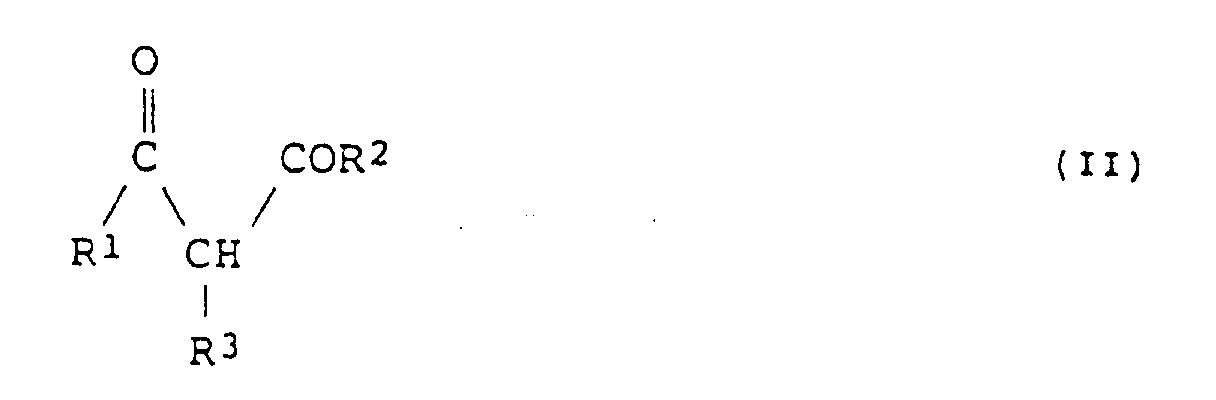
in the presence as a catalyst of a ruthenium-optically active phosphine complex of the following formulae (III):
RuxHyClz(R8-BINAP)2(S)p (III)
wherein R8-BINAP represents a tertiary phosphine represented by formula (IV):
[RuHℓ(R8-BINAP)v]Yw (V)
represents wherein R8-BINAP is as defined above; Y represents ClO4, BF4 or PF6; when ℓ represents 0, then v represents 1, and w represents 2; and when ℓ represents 1, then v represents 2 and w represents 1. - The "lower" alkyl or alkoxy groups have 1 to 7, preferably 1 to 4 carbon atoms.
- In formulae (I) and (II), substituents for the lower alkyl group as represented by R1 include a halogen atom, a hydroxyl group, an amino group, a lower alkyl-substituted amino group, a benzyloxy group, and an aryl group.
- The β-keto acid derivative represented by formula (II) which can be used in the present invention as a starting compound specifically includes methyl acetoacetate, ethyl acetoacetate, isopropyl acetoacetate, n-butyl acetoacetate, t-butyl acetoacetate, n-pentyl acetoacetate, n-hexyl acetoacetate, n-heptyl acetoacetate, n-octyl acetoacetate, methyl 4-chloroacetoacetate, ethyl 4-chloroacetoacetate, methyl 4-fluoroacetoacetate, methyl 3-oxopentanoate, methyl 3-oxohexanoate, methyl 3-oxoheptanoate, ethyl 3-oxooctanoate, ethyl 3-oxononanoate, ethyl 3-oxodecanoate, ethyl 3-oxoundecanoate, ethyl 3-oxo-3-phenylpropanoate, ethyl 3-oxo-3-p-methoxyphenylpropanoate, ethyl 4-phenyl-3-oxobutanoate, methyl 5-phenyl-3-oxopentanoate, ethyl 3-trifluoromethyl-3-oxopropanoate, ethyl 4-hydroxy-3-oxobutanoate, methyl 4-benzyloxy-3-oxobutanoate, ethyl 4-benzyloxy-3-oxobutanoate, methyl 4-amino-3-oxobutanoate, ethyl 4-methylamino-3-oxobutanoate, methyl 4-dimethylamino-3-oxobutanoate, ethyl 4-dimethylamino-3-oxobutanoate, ethyl 2-methylacetoacetate, ethyl 2-chloroacetoacetate, diethyl 2-acetylsuccinate, diethyl 2-acetylglutalate, 2-carboethoxy-cyclopentanone, 2-carboethoxy-cyclohexanone, dimethyl acetylmalonate, 3-oxobutanoic dimethylamide, 3-oxobutanoic benzylamide, thiomethyl acetoacetate, thioethyl acetoacetate and thiophenyl acetoacetate.
- In formulae (III) and (V), "BINAP" represents a 2,2-bis(diphenylphosphino)-1,1'-binaphthyl moiety (hereinafter the same).
- The compound of formula (III) can be obtained by the process disclosed in T. Ikariya et al., J. Chem. Soc., Chem. Commun., 922-924 (1985) and Japanese Patent Application (OPI) No. 63690/86 (the term "OPI" as used herein means "unexamined published Japanese patent application"). More specifically, the complex of formula (III) wherein y is 0 can be prepared by reacting 1 mol of [RuCl2(COD)]n (wherein COD represents cycloocta-1,5-diene, hereinafter the same), which is obtainable by reacting ruthenium chloride and COD in an ethanol solution, and 1.2 mols of a 2,2'-bis(di-p-R8-phenyl-phosphino)-1,1'-binaphthyl (R8-BINAP) in a solvent, e.g., toluene or ethanol, in the presence of 4 mols of a tertiary amine, e.g., triethylamine. The complex of formula (III) wherein y is 1 can be obtained by reacting 1 mol of [RuCl2(COD)]n, 2.25 mols of R8-BINAP, and 4.5 mols of a tertiary amine.
- The complex of formula (V) wherein ℓ is 0, v is 1 and w is 2 can be prepared by reacting Ru2Cl4(R8-BINAP)2(NEt3) (wherein Et represents an ethyl group, hereinafter the same), which is obtained by the above-described process, with a salt represented by formula (VI):
MY (VI)
wherein M represents Na, K, Li, Mg or Ag; and Y is as defined above,
in a solvent system comprising water and methylene chloride in the presence of a quaternary ammonium salt or quaternary phosphonium salt represented by formula (VII):
R9R10R11R12AB (VII)
wherein R9, R10, R11, and R12 each represents an alkyl group having from 1 to 16 carbon atoms, a phenyl group or a benzyl group; A represents a nitrogen atom or a phosphorus atom; and B represents a halogen atom, as a phase transfer catalyst. The reaction can be carried out by adding the reactants and the phase transfer catalyst of formula (VII) to a mixed solvent of water and methylene chloride and stirring the system. The amounts of the salt of formula (VI) and the phase transfer catalyst of formula (VII) to be added range from 2 to 10 mols, and preferably 5 mols, and from 1/100 to 1/10 mol, respectively, per mol of ruthenium. The reaction sufficiently proceeds by stirring at a temperature of from 5 to 30°C for a period of from 6 to 18 hours, and usually 12 hours. Examples of the phase transfer catalyst of formula (VII) are described in literature , i.e., W.P. Weber and G.W. Gokel, Sokan Ido Shokubai (Japanese translation), 1st Ed., Kagaku Dojinsha (1978). After completion of the reaction, the reaction mixture is allowed to stand still, followed by liquid separation. After the aqueous layer is removed, the methylene chloride solution is washed with water, and methylene chloride is removed by distillation under reduced pressure to obtain the desired compound. - The complex of formula (V) where ℓ is 1, v is 2 and w is 1 can be prepared by reacting RuHCl(R8-BINAP)2 obtainable by the process disclosed in Japanese Patent Application (OPI) No. 63690/86 with the salt of formula (VI) in a mixed solvent of water and an organic solvent, e.g., methylene chloride, in the presence of the phase transfer catalyst of formula (VII). The amounts of the salt of formula (VI) and the phase transfer catalyst of formula (VII) range from 2 to 10 mols, and preferably 5 mols, and form 1/100 to 1/10 mol, respectively, per mol of ruthenium. This reaction sufficiently proceeds by stirring at a temperature of from 5 to 30°C for a period of from 6 to 18 hours, and usually 12 hours.
- Specific examples of the above-described ruthenium-phosphine complex according to the present invention are shown below.
- Ru2Cl4(BINAP)2(NEt3)
- Ru2Cl4(T-BINAP)2(NEt3)
- [T-BINAP represents 2,2'-bis(di-p-tolylphosphino)-1,1'-binaphthyl]
- Ru2Cl4(T-Bu-BINAP)2(NEt3)
- [t-Bu-BINAP represents 2,2'-bis(di-p-t-butylphenylphosphino)-1,1'-binaphthyl]
- RuHCl[BINAP]2
- RuHCl[T-BINAP]2
- RuHCl[t-Bu-BINAP]2
- [Ru(BINAP)] (ClO4)2
- [Ru(T-BINAP)] (ClO4)2
- [Ru(t-Bu-BINAP)] (ClO4)2
- [Ru(BINAP)] (BF4)2
- [Ru(T-BINAP)] (BF4)2
- [Ru(t-Bu-BINAP)] (BF4)2
- [Ru(BINAP)] (PF6)2
- [Ru(T-BINAP)] (PF6)2
- [RuH(BINAP)2ClO4
- [RuH(T-BINAP)2]ClO4
- [RuH(BINAP)2]BF4
- [RuH(T-BINAP)2]BF4
- [RuH(BINAP)2]PF6
- [RuH(T-BINAP)2]PF6
- In carrying out the present invention, a β-keto acid derivative of formula (II) is dissolved in an amphiprotic solvent, e.g., methanol, ethanol or methyl cellosolve, or a mixed solvent of such an amphiprotic solvent with another solvent such as tetrahydrofuran, toluene, benzene or methylene chloride. The solution is charged in an autoclave, and from 1/100 to 1/50,000 mol of a ruthenium-optically active phosphine complex is added thereto per mol of the β-keto acid derivative. The hydrogenation reaction is effected under stirring at a temperature of from 5 to 50°C, and preferably from 25 to 35°C, at a hydrogen pressure of from 5 to 100 kg/cm2 for a period of from 1 to 48 hours. After completion of the reaction, the solvent is removed by distillation, and the residue is distilled under reduced pressure or subjected to silica gel column chromatography to thereby isolate the desired optically active alcohol of formula (I) in a substantially quantitative yield.
- The present invention will now be illustrated in greater detail with reference to Reference Examples and Examples, but the invention is not limited thereto. In these examples, analytical instruments and conditions used for various analyses are as follows.
- SHIMADZU GC-9A manufactured by Shimadzu Corporation
- Column:
- PEG-20M Silica Capillary, 0.25 mm in diameter and 25 m in length, manufactured by Gasukuro Kogyo Inc.
- Measurement Temperature:
- 100-250°C and increasing at a rate of 3°C/min.
- Hitachi Liquid Chromatography-655A-11 manufactured by Hitachi, Ltd.
- Column:
- Chemcopack Nucleosil 100-3, 4.6 mm in diameter and 300 mm in length, manufactured by Chemco Co.
- Developing Solvent:
- Hexane:diethyl ether=7:3; flow rate: 1 ml/min
- Detector:
- UV Detector 655A (UV-254), manufactured by Hitachi, Ltd.
- Polarimeter DIP-4, manufactured by Nippon Bunko Kogyo K.K.
- JNM-GX400 (161 MHz) manufactured by JEOL Ltd.
Chemical shift was determined by using 85% phosphoric acid as an external standard. - To 100 ml of toluene were added 1 g (3.56 mmol) of [RuCl2(COD)]n, 2.66 g (4.27 mmol) of (+)-BINAP, and 1.5 g of triethylamine in a nitrogen atmosphere, and the mixture was heat-refluxed for 10 hours. The solvent was removed from the reaction mixture by distillation under reduced pressure, and the residual solid was dissolved in methylene chloride, followed by filtration through Celite filter aid. The filtrate was concentrated to dryness to obtain 3.7 g of the entitled compound as a deep brown solid.
Elemental Analysis for C94H79Cl4NP4Ru2: Calcd. (%): Ru 11.96; C 66.85; H 4.71; P 7.33 Found (%): Ru 11.68; C 67.62; H 4.97; P 6.94 - 31P NMR (CDCl3) δ ppm:
- 51.06 (s), 51.98 (s), 53.87 (s), and 54.83 (s)
- In a 250 ml-volume Schlenk's tube was charged 0.54 g (0.3 mmol) of Ru2Cl4[(-)-T-BINAP]2(NEt3). After thorough displacement of the atmosphere with nitrogen gas, 60 ml of methylene chloride was added thereto, and then a solution of 0.73 g (6.0 mmols) of sodium perchlorate in 60 ml of water and a solution of 16 mg (0.06 mmol) of triethylbenzylammonium bromide in 3 ml of water were added to the mixture. The mixture was stirred at room temperature for 12 hours. After completion of the reaction, the reaction mixture was allowed to stand, and the aqueous layer was removed. The methylene chloride was removed from the organic layer by distillation under reduced pressure, and the residue was dried under reduced pressure to obtain 0.59 g (yield: 99.6%) of the entitled compound as a deep brown solid.
Elemental Analysis for C48H40Cl2O8P2Ru: Calcd. (%): Ru 10.32; C 58.90; H 4.12; P 6.33 Found (%): Ru 10.08; C 58.61; H 4.53; P 5.97 - 31P NMR (CDCl3) δ ppm:
- 12.920 (d, J=41.1 Hz) and 61.402 (d, J=41.1 Hz)
- In a 200 ml-volume stainless steel-made autoclave whose atmosphere had been replaced with nitrogen were charged 10 ml (93 mmols) of methyl acetoacetate, 50 ml of methanol, and 0.5 ml of water, and 42 mg (0.025 mmol) of Ru2Cl4((+)-BINAP)2(NEt3) as prepared in Reference Example 1 was added thereto to effect hydrogenation at a temperature of 30°C under a hydrogen pressure of 40 kg/cm2 for 20 hours. The solvent was removed by distillation, and the residue was distilled under reduced pressure to obtain 10.8 g (98%) of the entitled compound having a boiling point of 72°C/17 mmHg.
- The product was found to have a purity of 99.0% by GC and an optical rotation [α]

- Thirty milligrams of the resulting alcohol was esterified with (+)-α-methoxy-α-trifluoromethylphenylacetyl chloride, and the ester was analyzed by GC and HPLC. The results revealed that the product was a mixture comprising 99.55% of methyl (3R)-(-)-3-hydroxybutyrate and 0.45% of methyl (3S)-(+)-3-hydroxybutyrate. Accordingly, the optical yield of the methyl (3R)-(-)-3-hydroxybutyrate was found to be 99.1%.
- The same procedure of Example 1 was repeated, except for altering the reaction substrate, catalyst and reaction conditions as shown Table 1 below. The analytical results obtained are shown in Table 2.
- In Examples 7, 8, 14, and 15, the optically active alcohol produced contains two asymmetric centers forming diastereomers. A ratio of the syn form to the anti form in each case was determined by HPLC, and the optical yield of each form was determined. The results obtained are separately shown in Table 3.


TABLE 3 Example No. Syn:Anti Ratio Optical Yield (%ee) Syn Anti 7 60:40 92 88 8 50:50 90 87 14 55:45 91 89 15 60:40 92 86 - As described above, the present invention provides an industrially valuable process for preparing a useful optically active alcohol at high efficiency.
Claims (2)
- A process for preparing an optically active alcohol represented by formula (I):

which comprises asymmetrically hydrogenating a β-keto acid derivative represented by formula (II):
in the presence as a catalyst of a ruthenium-optically active phosphine complex represented by formula (III):
RuxHyClz(R8-BINAP)2(S)p (III)
wherein R8-BINAP represents a tertiary phosphine represented by formula (IV):
or a compound represented by formula (V):
[RuHℓ(R8-BINAP)v]Yw (V)
wherein R8-BINAP is as defined above; Y represents ClO4, BF4 or PF6; when ℓ represents 0, then v represents 1, and w represents 2; and when ℓ represents 1, then v represents 2 and w represents 1. - A process as claimed in Claim 1, wherein the derivative formulae (II) is dissolved in an amphiprotic solvent and the phosphine complex is added in an amount of 1/100 to 1/50,000 mol per mol of the derivative (I).
Applications Claiming Priority (2)
| Application Number | Priority Date | Filing Date | Title |
|---|---|---|---|
| JP62145975A JPH0699367B2 (en) | 1987-06-11 | 1987-06-11 | Production method of optically active alcohol |
| JP145975/87 | 1987-06-11 |
Publications (3)
| Publication Number | Publication Date |
|---|---|
| EP0295109A1 EP0295109A1 (en) | 1988-12-14 |
| EP0295109B1 EP0295109B1 (en) | 1992-03-04 |
| EP0295109B2 true EP0295109B2 (en) | 1996-09-04 |
Family
ID=15397308
Family Applications (1)
| Application Number | Title | Priority Date | Filing Date |
|---|---|---|---|
| EP88305293A Expired - Lifetime EP0295109B2 (en) | 1987-06-11 | 1988-06-09 | Process for preparing optically active alcohol |
Country Status (4)
| Country | Link |
|---|---|
| US (1) | US4933482A (en) |
| EP (1) | EP0295109B2 (en) |
| JP (1) | JPH0699367B2 (en) |
| DE (1) | DE3868700D1 (en) |
Families Citing this family (34)
| Publication number | Priority date | Publication date | Assignee | Title |
|---|---|---|---|---|
| US4895973A (en) * | 1986-08-14 | 1990-01-23 | G. D. Searle & Company | Substituted glutaric acid lactones in the treatment of hyperlipidemia |
| JPH064543B2 (en) * | 1987-06-18 | 1994-01-19 | 高砂香料工業株式会社 | Method for producing optically active alcohol |
| JPH064544B2 (en) * | 1987-06-19 | 1994-01-19 | 高砂香料工業株式会社 | Method for producing optically active alcohol |
| JPH0641444B2 (en) * | 1987-12-22 | 1994-06-01 | 高砂香料工業株式会社 | Method for producing optically active threonine |
| JP2804284B2 (en) * | 1988-03-23 | 1998-09-24 | 三共株式会社 | Stereoselective synthesis of 4-amino-3-hydroxycarboxylic acids |
| US4994602A (en) * | 1989-02-27 | 1991-02-19 | Takasago International Corporation | Process for preparing optically active 6-t-butyoxy-3,5-dihydroxyhexanoic esters |
| JPH0753680B2 (en) * | 1989-07-17 | 1995-06-07 | 高砂香料工業株式会社 | Method for producing optically active ketone |
| FR2670207B1 (en) * | 1990-12-11 | 1993-01-22 | Rhone Poulenc Sante | NOVEL OPTICALLY ACTIVE BETHA-HYDROXYESTERS, THEIR PREPARATION AND THEIR USE. |
| US5442105A (en) * | 1991-06-21 | 1995-08-15 | Takasago International Corporation | Process for producing cyclohexylbutyric acid derivative |
| FR2693190B1 (en) * | 1992-07-02 | 1994-09-23 | Elf Aquitaine | Enantioselective hydrogenation process for the C = O OXO double bond. |
| US5508435A (en) * | 1992-07-29 | 1996-04-16 | Merck & Co., Inc. | Asymmetric hydrogenation of beta- or gamma-ketoesters and beta- or gamma-ketoamides |
| JP3076154B2 (en) | 1992-08-13 | 2000-08-14 | 高砂香料工業株式会社 | (3R, 5S) -3,5,6-trihydroxyhexanoic acid derivative and method for producing the same |
| US5750754A (en) * | 1993-03-29 | 1998-05-12 | Zeneca Limited | Heterocyclic compounds |
| AU712507B2 (en) * | 1994-01-05 | 1999-11-11 | Merck & Co., Inc. | Chiral ruthenium (II) BINAP and t-BINAP compounds |
| WO1995027694A1 (en) * | 1994-04-07 | 1995-10-19 | Fujisawa Pharmaceutical Co., Ltd. | PROCESS FOR PRODUCING α,β-DISUBSTITUTED ALCOHOL DERIVATIVE |
| JP3660385B2 (en) * | 1995-03-01 | 2005-06-15 | 高砂香料工業株式会社 | Process for producing optically active allophenylnorstatin derivative |
| JP3184758B2 (en) | 1996-02-02 | 2001-07-09 | 高砂香料工業株式会社 | Method for producing optically active 4-hydroxy-2-pyrrolidone |
| DE19709069C2 (en) * | 1997-03-06 | 2000-04-06 | Asta Medica Ag | Enantiomerically pure 3-hydroxyoctanedioic acid diester, process for the preparation thereof by asymmetric catalytic hydrogenation and process for the preparation of R - (+) - and S - (-) - alpha-lipoic acid |
| US6495598B1 (en) | 1997-04-22 | 2002-12-17 | Ophtecs Corporation | Perfusate preparation for ophthalmic operation |
| IT1303757B1 (en) * | 1998-11-16 | 2001-02-23 | Sigma Tau Ind Farmaceuti | INDUSTRIAL PROCESS FOR THE PRODUCTION OF L-CARNITINA. |
| EP1052240B1 (en) | 1999-05-11 | 2003-03-19 | Dow AgroSciences LLC | Process for the preparation of substituted 3-hydroxybutyrate esters |
| JP5392217B2 (en) * | 2000-06-21 | 2014-01-22 | ダイキン工業株式会社 | Method for producing optically active fluorinated alcohols, method for producing optically active fluorinated 2-hydroxyalkaneamides and / or optically active fluorinated alcohols, and method for producing optically active fluorinated lactic acid or derivatives thereof |
| JP4601779B2 (en) * | 2000-07-25 | 2010-12-22 | 高砂香料工業株式会社 | Method for producing optically active alcohol |
| JP4015450B2 (en) * | 2001-05-18 | 2007-11-28 | 高砂香料工業株式会社 | Method for producing optically active alcohol |
| GB0211716D0 (en) | 2002-05-22 | 2002-07-03 | Phoenix Chemicals Ltd | Process |
| CA2531898C (en) | 2003-07-10 | 2012-01-03 | Nissan Chemical Industries, Ltd. | Process for producing optically active .beta.-hydroxy-.alpha.-aminoc arboxylic acid derivative |
| EP1528053A1 (en) * | 2003-10-31 | 2005-05-04 | Lonza Ag | Process for the preparation of (S)- or (R)-4-halo-3-hydroxybutyrates |
| JP5283867B2 (en) * | 2007-07-26 | 2013-09-04 | 国立大学法人 千葉大学 | Method for producing optically active β-hydroxycarboxylic acid derivative |
| EP2386536A1 (en) * | 2010-05-11 | 2011-11-16 | Lonza Ltd. | A process for the hydrogenation of ketoesters |
| CN102633664B (en) * | 2012-03-30 | 2014-05-28 | 广西新晶科技有限公司 | Preparation method of L-carnitine |
| EP2895613A2 (en) | 2012-09-14 | 2015-07-22 | BioAmber Inc. | Alternative pathways to adipates and adipic acid by combined fermentation and catalytic methods |
| CN104030934B (en) * | 2014-07-04 | 2016-06-15 | 东北制药集团股份有限公司 | A kind of preparation method of levocarnitine compound |
| CN109201059B (en) * | 2018-08-28 | 2021-09-21 | 华东师范大学 | Catalyst for preparing methyl glycolate by selective hydrogenation of dimethyl oxalate and preparation method and application thereof |
| CN110128366A (en) * | 2019-06-05 | 2019-08-16 | 南京焕然生物科技有限公司 | The preparation method of one kind (R) -3- methoxyl group -4- morpholine carboxylic acid -2- propylene -1- base ester |
Family Cites Families (2)
| Publication number | Priority date | Publication date | Assignee | Title |
|---|---|---|---|---|
| CA1000293A (en) * | 1972-03-16 | 1976-11-23 | Arthur J. Solodar | Asymmetric reduction of ketones to form optically active alcohols |
| US4273933A (en) * | 1979-04-25 | 1981-06-16 | Kawaken Fine Chemicals Co., Ltd. | Modified catalyst for stereo-differentiating reduction of _carbonyl compounds and process for reduction with same catalyst |
-
1987
- 1987-06-11 JP JP62145975A patent/JPH0699367B2/en not_active Expired - Lifetime
-
1988
- 1988-06-09 US US07/204,480 patent/US4933482A/en not_active Expired - Lifetime
- 1988-06-09 DE DE8888305293T patent/DE3868700D1/en not_active Expired - Lifetime
- 1988-06-09 EP EP88305293A patent/EP0295109B2/en not_active Expired - Lifetime
Also Published As
| Publication number | Publication date |
|---|---|
| US4933482A (en) | 1990-06-12 |
| JPH0699367B2 (en) | 1994-12-07 |
| JPS63310847A (en) | 1988-12-19 |
| EP0295109A1 (en) | 1988-12-14 |
| EP0295109B1 (en) | 1992-03-04 |
| DE3868700D1 (en) | 1992-04-09 |
Similar Documents
| Publication | Publication Date | Title |
|---|---|---|
| EP0295109B1 (en) | Process for preparing optically active alcohol | |
| EP0272787B1 (en) | Catalytic production of optically active carboxylic acid | |
| US4895979A (en) | Process for preparing carnitine | |
| EP0245959B1 (en) | Ruthenium-phosphine complexes | |
| EP0295890B1 (en) | Process of preparing optically active alcohol | |
| EP0271311B1 (en) | Ruthenium-phosphine complexes | |
| US4916252A (en) | Process for preparing optically active alcohol | |
| EP0403188B1 (en) | A compound of 2,2'-bis(diphenylphosphino)-1,1'-binaphthyl and catalytic complexes thereof | |
| EP0271310B1 (en) | Ruthenium-phosphine complexes | |
| US5159093A (en) | Iridium-optically active phosphine complex and process for producing optically active alcohols using the same | |
| US5312939A (en) | 2,2'-bis (dicyclopentylphosphino)-1,1'-binaphthyl and transition metal complex using the same as ligand | |
| US5563295A (en) | Process for producing optically active carboxylic acid | |
| EP0478147A1 (en) | Process for producing optically active gamma-butyrolactone derivatives | |
| US4962242A (en) | Process for producing optically active alcohols | |
| US5324870A (en) | Process for producing optically active 1-substituted-1,3-propanediols using ruthenium-phosphine complex as a catalyst | |
| US5919962A (en) | Process for preparing ruthenium-phosphine complex | |
| US5334758A (en) | Process for preparing optically active carboxylic acid | |
| US4906773A (en) | Process for preparing optically active threonine | |
| JPH0720910B2 (en) | Process for producing optically active carboxylic acid | |
| US5210332A (en) | Iridium-optically active phosphine complex and process for producing optically active alcohols using the same | |
| JPH11302226A (en) | Method for producing optically active alcohol | |
| JPH06192159A (en) | Production of optically active gamma-hydroxyketones |
Legal Events
| Date | Code | Title | Description |
|---|---|---|---|
| PUAI | Public reference made under article 153(3) epc to a published international application that has entered the european phase |
Free format text: ORIGINAL CODE: 0009012 |
|
| AK | Designated contracting states |
Kind code of ref document: A1 Designated state(s): CH DE FR GB LI NL |
|
| 17P | Request for examination filed |
Effective date: 19890607 |
|
| 17Q | First examination report despatched |
Effective date: 19910408 |
|
| GRAA | (expected) grant |
Free format text: ORIGINAL CODE: 0009210 |
|
| AK | Designated contracting states |
Kind code of ref document: B1 Designated state(s): CH DE FR GB LI NL |
|
| REF | Corresponds to: |
Ref document number: 3868700 Country of ref document: DE Date of ref document: 19920409 |
|
| ET | Fr: translation filed | ||
| PLBI | Opposition filed |
Free format text: ORIGINAL CODE: 0009260 |
|
| 26 | Opposition filed |
Opponent name: F. HOFFMANN-LA ROCHE & CO. AKTIENGESELLSCHAFT Effective date: 19921203 |
|
| NLR1 | Nl: opposition has been filed with the epo |
Opponent name: F.HOFFMANN-LA ROCHE & CO. AG |
|
| PLAW | Interlocutory decision in opposition |
Free format text: ORIGINAL CODE: EPIDOS IDOP |
|
| PUAH | Patent maintained in amended form |
Free format text: ORIGINAL CODE: 0009272 |
|
| STAA | Information on the status of an ep patent application or granted ep patent |
Free format text: STATUS: PATENT MAINTAINED AS AMENDED |
|
| 27A | Patent maintained in amended form |
Effective date: 19960904 |
|
| AK | Designated contracting states |
Kind code of ref document: B2 Designated state(s): CH DE FR GB LI NL |
|
| REG | Reference to a national code |
Ref country code: CH Ref legal event code: AEN Free format text: MAINTIEN DU BREVET DONT L'ETENDUE A ETE MODIFIEE |
|
| ET3 | Fr: translation filed ** decision concerning opposition | ||
| NLR2 | Nl: decision of opposition | ||
| NLR3 | Nl: receipt of modified translations in the netherlands language after an opposition procedure | ||
| REG | Reference to a national code |
Ref country code: GB Ref legal event code: IF02 |
|
| PGFP | Annual fee paid to national office [announced via postgrant information from national office to epo] |
Ref country code: DE Payment date: 20060601 Year of fee payment: 19 |
|
| PGFP | Annual fee paid to national office [announced via postgrant information from national office to epo] |
Ref country code: GB Payment date: 20060607 Year of fee payment: 19 |
|
| PGFP | Annual fee paid to national office [announced via postgrant information from national office to epo] |
Ref country code: FR Payment date: 20060608 Year of fee payment: 19 |
|
| PGFP | Annual fee paid to national office [announced via postgrant information from national office to epo] |
Ref country code: CH Payment date: 20060614 Year of fee payment: 19 |
|
| PGFP | Annual fee paid to national office [announced via postgrant information from national office to epo] |
Ref country code: NL Payment date: 20060615 Year of fee payment: 19 |
|
| REG | Reference to a national code |
Ref country code: CH Ref legal event code: PL |
|
| GBPC | Gb: european patent ceased through non-payment of renewal fee |
Effective date: 20070609 |
|
| NLV4 | Nl: lapsed or anulled due to non-payment of the annual fee |
Effective date: 20080101 |
|
| REG | Reference to a national code |
Ref country code: FR Ref legal event code: ST Effective date: 20080229 |
|
| PG25 | Lapsed in a contracting state [announced via postgrant information from national office to epo] |
Ref country code: NL Free format text: LAPSE BECAUSE OF NON-PAYMENT OF DUE FEES Effective date: 20080101 Ref country code: LI Free format text: LAPSE BECAUSE OF NON-PAYMENT OF DUE FEES Effective date: 20070630 Ref country code: DE Free format text: LAPSE BECAUSE OF NON-PAYMENT OF DUE FEES Effective date: 20080101 Ref country code: CH Free format text: LAPSE BECAUSE OF NON-PAYMENT OF DUE FEES Effective date: 20070630 |
|
| PG25 | Lapsed in a contracting state [announced via postgrant information from national office to epo] |
Ref country code: GB Free format text: LAPSE BECAUSE OF NON-PAYMENT OF DUE FEES Effective date: 20070609 |
|
| PG25 | Lapsed in a contracting state [announced via postgrant information from national office to epo] |
Ref country code: FR Free format text: LAPSE BECAUSE OF NON-PAYMENT OF DUE FEES Effective date: 20070702 |