EP0295223B1 - Rolltor - Google Patents
Rolltor Download PDFInfo
- Publication number
- EP0295223B1 EP0295223B1 EP88830253A EP88830253A EP0295223B1 EP 0295223 B1 EP0295223 B1 EP 0295223B1 EP 88830253 A EP88830253 A EP 88830253A EP 88830253 A EP88830253 A EP 88830253A EP 0295223 B1 EP0295223 B1 EP 0295223B1
- Authority
- EP
- European Patent Office
- Prior art keywords
- panel
- spring
- balancing
- bracket
- cross member
- Prior art date
- Legal status (The legal status is an assumption and is not a legal conclusion. Google has not performed a legal analysis and makes no representation as to the accuracy of the status listed.)
- Expired - Lifetime
Links
- 238000004804 winding Methods 0.000 claims abstract description 8
- 230000005540 biological transmission Effects 0.000 description 1
- 238000005266 casting Methods 0.000 description 1
- 238000012423 maintenance Methods 0.000 description 1
- 238000004519 manufacturing process Methods 0.000 description 1
- 239000000463 material Substances 0.000 description 1
- 239000007769 metal material Substances 0.000 description 1
- 239000004033 plastic Substances 0.000 description 1
- 229920003023 plastic Polymers 0.000 description 1
- 230000001681 protective effect Effects 0.000 description 1
Images



Classifications
-
- E—FIXED CONSTRUCTIONS
- E06—DOORS, WINDOWS, SHUTTERS, OR ROLLER BLINDS IN GENERAL; LADDERS
- E06B—FIXED OR MOVABLE CLOSURES FOR OPENINGS IN BUILDINGS, VEHICLES, FENCES OR LIKE ENCLOSURES IN GENERAL, e.g. DOORS, WINDOWS, BLINDS, GATES
- E06B9/00—Screening or protective devices for wall or similar openings, with or without operating or securing mechanisms; Closures of similar construction
- E06B9/56—Operating, guiding or securing devices or arrangements for roll-type closures; Spring drums; Tape drums; Counterweighting arrangements therefor
- E06B9/68—Operating devices or mechanisms, e.g. with electric drive
-
- E—FIXED CONSTRUCTIONS
- E06—DOORS, WINDOWS, SHUTTERS, OR ROLLER BLINDS IN GENERAL; LADDERS
- E06B—FIXED OR MOVABLE CLOSURES FOR OPENINGS IN BUILDINGS, VEHICLES, FENCES OR LIKE ENCLOSURES IN GENERAL, e.g. DOORS, WINDOWS, BLINDS, GATES
- E06B9/00—Screening or protective devices for wall or similar openings, with or without operating or securing mechanisms; Closures of similar construction
- E06B9/56—Operating, guiding or securing devices or arrangements for roll-type closures; Spring drums; Tape drums; Counterweighting arrangements therefor
- E06B9/62—Counterweighting arrangements
Definitions
- the present invention relates to a roller door including a flexible panel provided with a cross member at its free end, a roller onto which the panel is wound, two vertical guide frames provided with facing vertical slots in which the ends of the cross member are engaged, means for balancing the weight of the panel, and means for keeping the panel under tension vertically.
- a roller door of the above type is known from the published European application EP-A-144,893 and includes balancing torsion springs housed in the upper horizontal roller onto which the panel is wound and tensioning torsion springs arranged at the sides of the roller, which tension the panel by means of lateral vertical cables and pulleys fixed to the ground.
- a roller door of the above type is known from the patent US-A-3,878,879 and uses, on each of the two sides of the door, a closed system constituted by a cable which connects the free end of the panel to a roller fast with the roller onto which the panel is wound and passes over two fixed pulleys and a vertically movable pulley subject to the action of a counterweight.
- This closed system simultaneously fulfils the functions of balancing the weight of the panel and of tensioning the panel itself.
- EP-A-125.217 describes a variant of the system known from the aforementioned patent US-A-3,878,879, in which the counterweight acting on the vertically movable pulley is replaced by a helical spring working under tension.
- a belt or cable which passes over two lower fixed return pulleys, over the upper surface of a pulley mounted rotatably on an upper fixed bracket and over the under surface of a vertically movable pulley, rotatably mounted on a bracket which is connected to a fixed point at the base of the frame by a tensioning spring, the opposite end of each of said belts or cables being wound onto a disc which is mounted on the same shaft as the roll-up roller.
- the force of said tensioning spring is divided into two vertical components, one of which is transferred to the panel as a downwardly directed force which fulfills the function of tensioning the panel and the other of which is transferred to the panel as an upwardly directed force which fulfills the function of balancing the weight of the panel itself.
- the subject of the present invention is a roller door of the type specified above having the features claimed in claim 1.
- the flexible panel for example of plastics material, of a roller door is indicated 1.
- the panel winds onto a winding roller 2 whose shaft 3 is supported rotatably in the upper structure of the door, indicated 4.
- the shaft 3 is rotated by an electric motor M through a transmission 5.
- An electromagnetic brake 6 associated with the motor M is released when the motor is supplied and engaged under the action of a spring when there is no supply to the motor.
- a lever control (not illustrated) enables the above brake to be released in an emergency, to enable free rotation of the shaft 3.
- the free end of the panel 1 carries a cross member 7 whose ends are engaged in guide slots formed in two vertical frames 8 which support the upper structure 4.
- a rubber protective device 9 Associated with the cross member 7 is a rubber protective device 9 serving to reverse the sense of rotation of the motor M in the event of the cross member encountering an obstacle during the closing of the door.
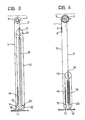
- a cable 10 which passes, within the respective frame 8, over two lower return pulleys 11, 12 rotatably supported at the base of each vertical frame 8, and which is wound, in the sense opposite the sense of the winding of the panel 1, onto an upper vertically movable pulley 13 connected with the interposition of a helical tensioning spring 14 working under tension, to a fixed point 15 at the base of the frame.
- the pulley 13 is supported rotatably by a bracket 16 supported by a belt 17 whose folded end is gripped by a clamp 18.
- the belt 17 (which could also be replaced by a cable) is wound onto the shaft 3 of the roller 2 in the sense opposite the sense of winding of the panel.
- the belt 17 could be wound onto a pulley fixed to the shaft.
- the bracket 16 is connected at its lower end to a helical balancing spring 19 working under tension, the lower end of which is connected to a fixed point 20 at the base of the frame 8.
- the spring 19 is preferably dimensioned so as to exert on the shaft of the roller 2 a moment greater than that exerted by the weight of the panel 1 in a clockwise sense when the door is in the closed position.
- the device described above enables a correct and constant balancing of the weight of the panel 1 and its cross member 7 to be achieved as a result of the variations in the diameters of winding of the panel 1 on the roller 2 and of the belt or cable 17 on the shaft 3 which occur as the door moves from the open position to the closed position. Moreover, it enables the desired tensioning of the panel to be achieved when the door is closed.
- the lower end of the bracket 16 carries a cross member 20a inserted between the upper coils of the spring 19.
- a possible counterweight fixed to the base of the bracket 16 and housed within the balancing spring 19 is indicated 21.
- the above-described device for connection between the bracket 16 and the balancing spring 19 enables the tension of the spring to be adjusted easily from the ground. In fact, after the disengagement of the clamp 18 to detach the belt 17 from the bracket 16, it is only necessary to rotate the bracket to vary its axial position relative to the spring 19.
- the tension of the tensioning spring 14 can also be adjusted easily with the use of a known axially adjustable attachment device for connecting this spring to the cable 10.
- the above-described system enables extremely quick, simple and effortless manual operation in an emergency; in fact, it suffices manually to release the brake coupled to the electric motor M, since the closed door opens automatically up to its maximum height due to the prevalence of the moment exerted by the spring 19 over the moment exerted by the weight of the panel 1.
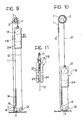
- the device for adjusting the tension in the balancing spring 19 differs from that described with reference to Figure 5 in that a cross member 20a provided with two holes 22 at its ends, through which the upper coil of the spring 19 is passed, is fixed to the base of the bracket 16.
- the adjustment of the tension of the spring 19 is also achieved by rotation of the cross member 20a relative to the spring after the removal of the clamp 18, which must be fixed again after adjustment.
- the variant illustrated in Figures 7 and 8 differs from that illustrated in Figures 3 and 4 in that the cable 10 passes over a single return pulley 23 at the bottom and is wound onto the movable pulley 16 in the sense opposite the sense of winding of the panel.
- the tensioning spring 14 housed in each of the two vertical structures 8 is situated on the side of the panel 1 opposite the balancing spring 19, instead of being between the panel 1 and the spring 19 as in the embodiment described above.
- the bracket 116 is in the form of a hollow body comprising two containers 25 which are side by side and support the pulley 13 between them.
- the lower parts of the containers 25 contain lead which is introduced by casting and forms the counterweight 24.
- Loose metallic material can be added to the upper parts of the containers 25 to adjust the balancing.
Landscapes
- Engineering & Computer Science (AREA)
- Structural Engineering (AREA)
- Architecture (AREA)
- Civil Engineering (AREA)
- Power-Operated Mechanisms For Wings (AREA)
- Devices For Conveying Motion By Means Of Endless Flexible Members (AREA)
- Lift-Guide Devices, And Elevator Ropes And Cables (AREA)
- Window Of Vehicle (AREA)
- Support Devices For Sliding Doors (AREA)
- Rolls And Other Rotary Bodies (AREA)
- Closing And Opening Devices For Wings, And Checks For Wings (AREA)
- Gates (AREA)
- Lock And Its Accessories (AREA)
- Power Steering Mechanism (AREA)
Claims (10)
Priority Applications (1)
| Application Number | Priority Date | Filing Date | Title |
|---|---|---|---|
| AT88830253T ATE67272T1 (de) | 1987-06-12 | 1988-06-07 | Rolltor. |
Applications Claiming Priority (2)
| Application Number | Priority Date | Filing Date | Title |
|---|---|---|---|
| IT6750687 | 1987-06-12 | ||
| IT8767506A IT1210793B (it) | 1987-06-12 | 1987-06-12 | Porta ad arrotolamento |
Publications (2)
| Publication Number | Publication Date |
|---|---|
| EP0295223A1 EP0295223A1 (de) | 1988-12-14 |
| EP0295223B1 true EP0295223B1 (de) | 1991-09-11 |
Family
ID=11302992
Family Applications (1)
| Application Number | Title | Priority Date | Filing Date |
|---|---|---|---|
| EP88830253A Expired - Lifetime EP0295223B1 (de) | 1987-06-12 | 1988-06-07 | Rolltor |
Country Status (6)
| Country | Link |
|---|---|
| EP (1) | EP0295223B1 (de) |
| AT (1) | ATE67272T1 (de) |
| DE (1) | DE3864753D1 (de) |
| ES (1) | ES2025814T3 (de) |
| GR (1) | GR3002728T3 (de) |
| IT (1) | IT1210793B (de) |
Families Citing this family (5)
| Publication number | Priority date | Publication date | Assignee | Title |
|---|---|---|---|---|
| DE4005963A1 (de) * | 1989-03-03 | 1990-09-06 | Itw Ind Und Werkzeugmaschinen | Rolltor |
| DE10011789A1 (de) * | 2000-03-13 | 2001-09-20 | Aktor Ind Gmbh | Rolltor mit aufwickelbaren Torblatt |
| DE60308049T2 (de) | 2002-10-18 | 2006-12-14 | Dentsply International Inc. | Doppelfaden-Dynamometer zur Messung der Leistung eines Dental-Handstücks bei hoher Geschwindigkeit und niedrigem Drehmoment |
| US9250160B2 (en) | 2013-03-15 | 2016-02-02 | American Dental Association | Method and apparatus for characterizing handpieces |
| CN108533162B (zh) * | 2018-05-24 | 2020-02-21 | 张集文 | 一种上下自由开合卷帘 |
Family Cites Families (5)
| Publication number | Priority date | Publication date | Assignee | Title |
|---|---|---|---|---|
| US2543711A (en) * | 1947-07-02 | 1951-02-27 | Schultz Abraham | Closure operator |
| FR2181601B1 (de) * | 1972-04-24 | 1974-12-20 | Ressorts Francais | |
| AT341177B (de) * | 1975-10-13 | 1978-01-25 | Lindpointner Ludwig | Rolltor od.dgl. |
| DE3245009A1 (de) * | 1982-12-06 | 1984-06-14 | Adolf Seuster GmbH, 5880 Lüdenscheid | Rolltor |
| SE8300573L (sv) * | 1983-02-03 | 1984-08-04 | Nordiskafilt Ab | Rullport |
-
1987
- 1987-06-12 IT IT8767506A patent/IT1210793B/it active
-
1988
- 1988-06-07 ES ES198888830253T patent/ES2025814T3/es not_active Expired - Lifetime
- 1988-06-07 AT AT88830253T patent/ATE67272T1/de not_active IP Right Cessation
- 1988-06-07 EP EP88830253A patent/EP0295223B1/de not_active Expired - Lifetime
- 1988-06-07 DE DE8888830253T patent/DE3864753D1/de not_active Expired - Fee Related
-
1991
- 1991-09-16 GR GR91401343T patent/GR3002728T3/el unknown
Also Published As
| Publication number | Publication date |
|---|---|
| EP0295223A1 (de) | 1988-12-14 |
| GR3002728T3 (en) | 1993-01-25 |
| ES2025814T3 (es) | 1992-04-01 |
| ATE67272T1 (de) | 1991-09-15 |
| IT1210793B (it) | 1989-09-20 |
| IT8767506A0 (it) | 1987-06-12 |
| DE3864753D1 (de) | 1991-10-17 |
Similar Documents
| Publication | Publication Date | Title |
|---|---|---|
| JP3291365B2 (ja) | 2部品ガイドフォロアー付き可動遮蔽体 | |
| CA2085692C (en) | Roll-up industrial door having a combined pulley for counterweight and spring tension belts | |
| US4697630A (en) | Tilt mechanism for venetian blinds | |
| US5048588A (en) | Roll-up door construction | |
| US20100206492A1 (en) | Window covering featuring automatic cord collection | |
| US5323877A (en) | Device for the triggering of safety equipments of a lift plant | |
| WO1998051899A1 (en) | Roll-up door | |
| CN110723603B (zh) | 一种无人机机载收放线装置 | |
| CN117361232B (zh) | 一种纱线自动张紧机构及方法 | |
| EP0295223A1 (de) | Rolltor | |
| US4610408A (en) | Strip feed mechanism | |
| CA1040175A (en) | Pole and device for raising and lowering lighting fixtures thereon | |
| JP2001039648A (ja) | エレベータ調速機用ロープのテンション方法及びその装置 | |
| CN209740430U (zh) | 用于系留无人机收放线的线缆阻尼结构 | |
| CN210029577U (zh) | 一种钢丝绳生产过程中合绳收线恒张力装置 | |
| EP0697990A1 (de) | Spulengestell | |
| CA1052351A (en) | Strand carrier for a strand fabricating machine | |
| EP0987072B1 (de) | Zugvorrichtung zur Verwendung in der Herstellung von Schmuckketten | |
| CN211644232U (zh) | 一种安全电梯限速器张紧装置 | |
| US5186285A (en) | Method of, and a device for, controlling the rotation of an element about an axis by means of a wrap spring | |
| EP0345901B1 (de) | Verfahren und Vorrichtung zum Regeln der Drehung eines Elementes um eine Welle durch eine Schlingfeder | |
| US12337248B1 (en) | Gravity-powered zip line trolley return system | |
| CN212798818U (zh) | 一种放卷机配件 | |
| JPH0750556Y2 (ja) | スクリーンの巻取り機構 | |
| CN220785416U (zh) | 一种线轮式电动遮阳帘运动异常监控系统 |
Legal Events
| Date | Code | Title | Description |
|---|---|---|---|
| PUAI | Public reference made under article 153(3) epc to a published international application that has entered the european phase |
Free format text: ORIGINAL CODE: 0009012 |
|
| AK | Designated contracting states |
Kind code of ref document: A1 Designated state(s): AT BE CH DE ES FR GB GR IT LI LU NL SE |
|
| 17P | Request for examination filed |
Effective date: 19890527 |
|
| 17Q | First examination report despatched |
Effective date: 19900212 |
|
| GRAA | (expected) grant |
Free format text: ORIGINAL CODE: 0009210 |
|
| AK | Designated contracting states |
Kind code of ref document: B1 Designated state(s): AT BE CH DE ES FR GB GR IT LI LU NL SE |
|
| PG25 | Lapsed in a contracting state [announced via postgrant information from national office to epo] |
Ref country code: IT Free format text: LAPSE BECAUSE OF FAILURE TO SUBMIT A TRANSLATION OF THE DESCRIPTION OR TO PAY THE FEE WITHIN THE PRE;WARNING: LAPSES OF ITALIAN PATENTS WITH EFFECTIVE DATE BEFORE 2007 MAY HAVE OCCURRED AT ANY TIME BEFORE 2007. THE CORRECT EFFECTIVE DATE MAY BE DIFFERENT FROM THE ONE RECORDED.SCRIBED TIME-LIMIT Effective date: 19910911 Ref country code: SE Effective date: 19910911 Ref country code: AT Effective date: 19910911 Ref country code: NL Effective date: 19910911 |
|
| REF | Corresponds to: |
Ref document number: 67272 Country of ref document: AT Date of ref document: 19910915 Kind code of ref document: T |
|
| REF | Corresponds to: |
Ref document number: 3864753 Country of ref document: DE Date of ref document: 19911017 |
|
| ET | Fr: translation filed | ||
| NLV1 | Nl: lapsed or annulled due to failure to fulfill the requirements of art. 29p and 29m of the patents act | ||
| REG | Reference to a national code |
Ref country code: ES Ref legal event code: FG2A Ref document number: 2025814 Country of ref document: ES Kind code of ref document: T3 |
|
| PG25 | Lapsed in a contracting state [announced via postgrant information from national office to epo] |
Ref country code: LU Free format text: LAPSE BECAUSE OF NON-PAYMENT OF DUE FEES Effective date: 19920630 |
|
| PLBE | No opposition filed within time limit |
Free format text: ORIGINAL CODE: 0009261 |
|
| STAA | Information on the status of an ep patent application or granted ep patent |
Free format text: STATUS: NO OPPOSITION FILED WITHIN TIME LIMIT |
|
| 26N | No opposition filed | ||
| REG | Reference to a national code |
Ref country code: GR Ref legal event code: FG4A Free format text: 3002728 |
|
| PGFP | Annual fee paid to national office [announced via postgrant information from national office to epo] |
Ref country code: BE Payment date: 19940517 Year of fee payment: 7 |
|
| PGFP | Annual fee paid to national office [announced via postgrant information from national office to epo] |
Ref country code: GB Payment date: 19940519 Year of fee payment: 7 |
|
| PGFP | Annual fee paid to national office [announced via postgrant information from national office to epo] |
Ref country code: CH Payment date: 19940520 Year of fee payment: 7 Ref country code: DE Payment date: 19940520 Year of fee payment: 7 |
|
| PGFP | Annual fee paid to national office [announced via postgrant information from national office to epo] |
Ref country code: GR Payment date: 19940610 Year of fee payment: 7 |
|
| PGFP | Annual fee paid to national office [announced via postgrant information from national office to epo] |
Ref country code: FR Payment date: 19940630 Year of fee payment: 7 |
|
| PGFP | Annual fee paid to national office [announced via postgrant information from national office to epo] |
Ref country code: ES Payment date: 19941128 Year of fee payment: 7 |
|
| PG25 | Lapsed in a contracting state [announced via postgrant information from national office to epo] |
Ref country code: GB Effective date: 19950607 |
|
| PG25 | Lapsed in a contracting state [announced via postgrant information from national office to epo] |
Ref country code: ES Free format text: LAPSE BECAUSE OF THE APPLICANT RENOUNCES Effective date: 19950608 |
|
| PG25 | Lapsed in a contracting state [announced via postgrant information from national office to epo] |
Ref country code: LI Effective date: 19950630 Ref country code: CH Effective date: 19950630 Ref country code: BE Effective date: 19950630 |
|
| BERE | Be: lapsed |
Owner name: LUCIANO S.R.L. Effective date: 19950630 |
|
| PG25 | Lapsed in a contracting state [announced via postgrant information from national office to epo] |
Ref country code: GR Free format text: THE PATENT HAS BEEN ANNULLED BY A DECISION OF A NATIONAL AUTHORITY Effective date: 19951231 |
|
| GBPC | Gb: european patent ceased through non-payment of renewal fee |
Effective date: 19950607 |
|
| PG25 | Lapsed in a contracting state [announced via postgrant information from national office to epo] |
Ref country code: FR Effective date: 19960229 |
|
| REG | Reference to a national code |
Ref country code: GR Ref legal event code: MM2A Free format text: 3002728 Ref country code: CH Ref legal event code: PL |
|
| PG25 | Lapsed in a contracting state [announced via postgrant information from national office to epo] |
Ref country code: DE Effective date: 19960301 |
|
| REG | Reference to a national code |
Ref country code: FR Ref legal event code: ST |
|
| REG | Reference to a national code |
Ref country code: ES Ref legal event code: FD2A Effective date: 19991007 |