EP0295355B1 - Einsetzungssteuerungsgerät für abwechselndes Weben mit verschiedenen Schüssen an einem Fluidwebstuhl - Google Patents
Einsetzungssteuerungsgerät für abwechselndes Weben mit verschiedenen Schüssen an einem Fluidwebstuhl Download PDFInfo
- Publication number
- EP0295355B1 EP0295355B1 EP87810693A EP87810693A EP0295355B1 EP 0295355 B1 EP0295355 B1 EP 0295355B1 EP 87810693 A EP87810693 A EP 87810693A EP 87810693 A EP87810693 A EP 87810693A EP 0295355 B1 EP0295355 B1 EP 0295355B1
- Authority
- EP
- European Patent Office
- Prior art keywords
- weft
- signal
- selector
- circuit
- manual
- Prior art date
- Legal status (The legal status is an assumption and is not a legal conclusion. Google has not performed a legal analysis and makes no representation as to the accuracy of the status listed.)
- Expired - Lifetime
Links
- 238000003780 insertion Methods 0.000 title claims description 47
- 230000037431 insertion Effects 0.000 title claims description 47
- 238000009941 weaving Methods 0.000 title claims description 11
- 239000012530 fluid Substances 0.000 title description 11
- 230000005540 biological transmission Effects 0.000 claims description 4
- 238000010276 construction Methods 0.000 description 17
- 238000010586 diagram Methods 0.000 description 6
- 230000000994 depressogenic effect Effects 0.000 description 5
- 230000006872 improvement Effects 0.000 description 5
- 230000007547 defect Effects 0.000 description 4
- 238000005259 measurement Methods 0.000 description 4
- 230000008439 repair process Effects 0.000 description 4
- 238000005086 pumping Methods 0.000 description 2
- XLYOFNOQVPJJNP-UHFFFAOYSA-N water Substances O XLYOFNOQVPJJNP-UHFFFAOYSA-N 0.000 description 2
- 230000008859 change Effects 0.000 description 1
- 238000001514 detection method Methods 0.000 description 1
- 238000000034 method Methods 0.000 description 1
- 230000008569 process Effects 0.000 description 1
- 230000004044 response Effects 0.000 description 1
Images



Classifications
-
- D—TEXTILES; PAPER
- D03—WEAVING
- D03D—WOVEN FABRICS; METHODS OF WEAVING; LOOMS
- D03D47/00—Looms in which bulk supply of weft does not pass through shed, e.g. shuttleless looms, gripper shuttle looms, dummy shuttle looms
- D03D47/28—Looms in which bulk supply of weft does not pass through shed, e.g. shuttleless looms, gripper shuttle looms, dummy shuttle looms wherein the weft itself is projected into the shed
-
- D—TEXTILES; PAPER
- D03—WEAVING
- D03D—WOVEN FABRICS; METHODS OF WEAVING; LOOMS
- D03D47/00—Looms in which bulk supply of weft does not pass through shed, e.g. shuttleless looms, gripper shuttle looms, dummy shuttle looms
- D03D47/28—Looms in which bulk supply of weft does not pass through shed, e.g. shuttleless looms, gripper shuttle looms, dummy shuttle looms wherein the weft itself is projected into the shed
- D03D47/30—Looms in which bulk supply of weft does not pass through shed, e.g. shuttleless looms, gripper shuttle looms, dummy shuttle looms wherein the weft itself is projected into the shed by gas jet
- D03D47/3026—Air supply systems
- D03D47/3033—Controlling the air supply
- D03D47/3046—Weft yarn selection
Definitions
- the present invention relates to an insertion controller according to the preamble clause of claim 1, and more particularly relates to an improvement in a weft insertion control system for alternate weaving with different wefts on a fluid jet loom on which different wefts are inserted into sheds following a regular sequential weft selection pattern via different main nozzles by sequential drive of a weft inserting unit in accordance with commands from an automatic weft selector.
- weft insertion is carried out following the regular sequential weft selection pattern fixed by the commands given by the automatic weft selector and no special trouble starts in this mode of weaving as long as the loom performs its normal running.
- a signal reservation circuit is interposed between an automatic weft selector and a driver circuit, a control box of the loom and a manual weft selector are connected to the signal reservation circuit and to the driver circuit, the driver circuit is made to operate following a regular sequential weft selection pattern fixed by commands from the automatic weft selector during normal running of the loom, and, at stoppage of the loom, the driver circuit is made to operate following a free selective weft selection pattern fixed by commands from the manual weft selector with priority to the regular sequential weft selection pattern.
- Such adjustment includes adjustment in, for example, fluid pressure, timing of fluid ejection, position of the nozzles and other process factors influencing the state of weft insertion.
- a stroboscope may be used for measurement of the state of weft insertion.
- a number of wefts different in type are inserted following a regular sequential weft selection pattern and, as a consequence, it is quite impossible to measure the state of weft insertion of a particular weft repeatedly in succession.
- Japanese Utility Model Opening Sho.62-114080 proposes a system to perform such a measurement even in the case of alternate weaving.
- a stroboscope is activated in synchronism with insertion of a particular weft only in order to selectively measure the state of weft insertion of that particular weft.
- alternate weaving is carried out following a given regular sequential weft selection pattern, some wefts may appear in sheds at short intervals and some wefts may appear in sheds at long intervals.
- the wefts of long intervals require a long time for measurement of their state of weft insertion.
- the system of the earlier proposal is unsuited for measurement of the state of weft insertion following some types of regular sequential weft selection patterns.
- shift in weft selection mode that is from the regular sequential to the free selective weft selection pattern, is caused depending on the state (H/L) of the output signal from the control box of the loom. So, the free selective weft selection can be introduced only at stoppage of the loom when the output signal is at the H-level.
- EP-A-0 114 339 shows a weft reservoir controller comprising a central processing unit which controls weft reservation following a stored program, in connection with a weft insertion command generator.
- This central Processing unit is provided with a manual release switch which is used for operating the weft reservoirs quite independently of the program followed by the central processing unit. However the release switch does not change operation of the weft insertion command generator.
- An insertion controller is characterized in that a signal reservation circuit is interposed between said automatic weft selector and said driver circuit in order to control transmission of said commands from said automatic weft selector, in that said manually operated means comprise a manual weft selector provided with push buttons in connection with said signal reservation circuit, and in that, on manual selection of one said push button, said manual weft selector on one hand passes a drive signal to an input terminal of said driver circuit which corresponds to said one push button and, on the other hand, passes a signal to said signal reservation circuit in order to inhibit transmission of said commands from said automatic weft selector.
- Fig. 1 shows the general construction of a weft inserting system on a fluid jet loom incorporating an improved insertion controller which enables free weft insertion at stoppage of the loom.
- the system includes a driver circuit 20, a weft inserting unit 30 electrically connected to the driver circuit 20 and an automatic weft selector 40.
- a signal reservation circuit 100 is interposed between the automatic weft selector 40 and the driver circuit 20.
- a control box 10 and a manual weft selector PB are electrically connected to the signal reservation circuit 100 and to the driver circuit 20.
- the driver circuit 20 is also electrically connected to weft reservoirs RS1 to RSn.
- wefts W1 to Wn are sequentially delivered from the weft reservoirs RS1 to RSn in order to be inserted into corresponding sheds via main nozzles N1 to Nn which are hydraulically connected to the weft inserting unit 30 in a known manner.
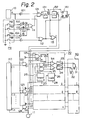
- Fig.2 shows one embodiment of the detailed construction of the weft inserting system shown in Fig.1.
- the control box 10 issues a two-value signal A which assumes a H-level during normal running and a L-level at stoppage of the loom.
- This control box 10 is connected on one hand to one input terminal of an AND-gate 121 via an inverter 101 and on the other hand to one input terminal of an OR-gate 112.
- the manual weft selector PB includes n sets of push buttons PB1 to PBn and a reset push button PBR, n corresponding to the number of the main nozzles N1 to Nn, i.e. the number of the different wefts W1 to Wn.
- a signal of L-level is issued on its corresponding line.
- the push buttons PB1 to PBn are connected one hand to the input terminal of an OR-gate 111 via respective inverters 102 to 104 and, on the other hand, to the input side of the driver circuit 20 in series therewith.
- the reset push button PBR is connected to the other terminal of the OR-gate 112.
- the AND-gate 121 is connected to a one-shot circuit 131 which issues an output signal D.
- the one-shot circuit 131 is connected to the S-terminal of a flip-flop circuit 141 and to a one-shot circuit 132 which issues an output signal E.
- the one-shot circuit 131 is further connected to one input terminal of an OR-gate 113 which issues an output signal J.
- the one-shot circuit 132 is connected to the driver circuit 20 as later described in more detail.
- the OR-gate 112 is connected on one hand to the R-terminal of the flip-flap circuit 141 and, on the other hand, to the other input terminal of the OR-gate 113.
- the OR-gate 113 is also connected to the driver circuit 20.
- the flip-flop circuit 141 is connected to the driver circuit 20 and issues an output signal F.
- the automatic weft selector 40 which issues output signals (colour signals) C1 to Cn, includes n sets of weft selections.
- the automatic weft selector 40 is connected, in parallel, to the driver circuit 20 via AND-gates 122 to 124 which issue output signals G1 to Gn.
- the above-described flip-flop circuit 141 is also connected to the AND-gates 122 to 124.
- the driver circuit 20 includes n sets of similar drive units for the wefts W1 to Wn, only the drive unit I being illustrated in Fig.2.
- the drive unit I includes an AND-gate 125 whose input terminal is connected to the one-shot circuit 132 and the push button PB1.
- the AND-gate 125 is connected to the S-terminal of a flip-flop circuit 142 which issues an output signal K.
- the R-terminal of this flip-flop circuit 142 is connected to the OR-gate 113.
- the AND-gate 122 is connected, in parallel, to one input terminals of AND-gates 21 and 22 whose other input terminals are connected, respectively, to setters 27 and 28 via comparators 25 and 26.
- An encoder 11 on the main shaft of the loom is connected to the comparator 25 and 26 for detection of angle of shaft rotation. The angle of shaft rotation is compared with the weft inserting period set by the setters 27 and 28 for issue of H-level signals from the comparators 25 and 26 during weft insertion.
- the Q-terminal of the flip-flop circuit 142 is connected to one input terminals of OR-gate 14 and 115.
- the other input terminals of the OR-gates 114 and 115 are connected to the AND-gates 21 and 22.
- the weft inserting unit 30 includes n sets of similar sub-units for the wefts W1 to Wn, only the sub-unit I being illustrated in Fig.2.
- the sub-unit I includes a gripper 31 connected to the OR-gate 114 via an amplifier 23 and an electromagnetic valve 32 connected to the OR-gate 115 via an amplifier 24.
- the weft W1 is to be inserted following a command given by the automatic weft selector 40 during normal running of the loom.
- the colour signal C1 assumes a H-level
- the output signal F from the flip-flop circuit 141 assumes a H-level
- the output signal G1 from the AND-gate 122 assumes a H-level. Since a weft is to be inserted, the output signals from the comparators 25 and 26 both assume H-levels.
- the OR-gate 114 and 115 both issue output signals of H-level to activate the sub-unit I of the weft inserting unit 30.
- the colour signals C2 to Cn all assume L-levels and the output signals G2 to Gn all assume L-levels so that the sub-units II to n should not operate.
- the output signal A from the control box 10 assumes a L-level.
- the output signal F assumes a H-level whereas the output signal J assumes a L-level.
- the output signal G2 from the AND-gate 123 assumes a H-level.
- the output signal B1 from the manual weft selector PB assumes a H-level and the output signal F from the flip-flop 141 assumes a L-level.
- the output signal G2 from the AND-gate 123 is made to assume a L-level and only the output signal K from the flip-flop circuit 142 of the drive unit I assumes a H-level.
- only the sub-unit I of the weft inserting unit 30 is put under an operable condition and the weft W1 is passed to the main nozzle N1 by means of a proper manual operation such as depression of a foot pedal.
- the regular sequential weft selection pattern fixed by the commands from the automatic weft selector 40 is provisionally ignored and reserved at the signal reservation circuit 100.
- the reset push button PBR is depressed for example at a moment t4 and the output signal J assumes a H-level.
- the output signal F from the flip-flop circuit 141 assumes a H-level
- the output signal G2 from the AND-gate 123 assumes a H-level
- the output signal K from the flip-flop circuit 142 assumes a L-level.
- the sub-unit I is deactivated and the sub-unit II is activated in the weft inserting unit 30.
- the regular sequential weft selection pattern fixed by the commands from the automatic weft selector 40 is resumed for insertion of the weft W2.
- Fig.4 shows another embodiment of the detailed construction of the weft inserting system shown in Fig.1. Although basically same as the foregoing embodiment, this construction is different in the following points.
- Fig.5 The operation of this weft inserting system is shown in Fig.5 in which time is again taken on the abscissa.
- the loom runs normally during a period from t1 to t2 and is at stoppage during a period from t2 to t5.
- the push button PB1 is depressed during a period from t3 to t4.
- a lever L2 is pivoted to a shaft in connection with a foot pedal FP.
- the lever L2 is placed outside operative zone of a lever L1.
- the foot pedal FP When the foot pedal FP is depressed, the lever L2 lowers and a roller carried thereby pushes down one end of the lever Ll for suction by pumping.
- depression on the foot pedal FP is removed, the lever L2 resumes its initial position via spring force for ejection by pumping (ejection of water).
- controllers are similarly usable for a weft inserting system on an air jet loom too.
- Fig.8 shows the general construction of a weft inserting system on a fluid jet loom incorporating the insertion controller in accordance with the present invention.
- a signal reservation circuit 300 is interposed between an automatic weft selector 40 and a driver circuit 20' and a manual weft selector PB' is connected to the signal reservation circuit 300 and to the driver circuit 20'.
- the driver circuit 20' Is electrically connected to a weft inserting unit 30 and weft reservoirs RS1 to RSn.
- wefts W1 to Wn are sequentially delivered from the weft reservoirs for insertion via main nozzles N1 to Nn which are hydraulically connected to the weft inserting unit 30 in a known manner.
- Figs.9 and 10 show one embodiment of the detailed construction of the weft inserting system shown in Fig.8. In the following description, it is assumed that four types of different wefts are inserted in alternate sequence.
- relay contacts R1 to R4 in the driver circuit 20′ are controlled by a relay sequence circuit of the manual weft selector PB′ shown in Fig.10. Relays R1 to R4 in Fig.9 are activated by switches S1 to S4 in the manual weft selector PB′.
- the reset switch SR is manually closed so that the switch S1 should be made open.
- the connection to the constant voltage source +V is canceled and the relay contact R1 in the driver circuit 20′ resumes the condition shown in Fig.9, i.e. the condition during the normal running of the loom.
- relays are used for constructing the circuits.
- FIG.11 Another embodiment of the detailed construction of the weft inserting system is shown in Fig.11, in which logic elements are used for construction circuits.
- the signal reservation circuit 300 includes four sets of AND-gates and the driver circuit 20′ includes four sets of OR-gates.
- the manual weft selector PB′ includes five sets of switches S1 to SR and a NOR-gate connected, in parallel to these switches.
- the colour signals C1 to C4 are issued by the automatic weft selector 40 following a regular sequential weft selection pattern and each of them at a H-level is passed to the signal reservation circuit 300. Since the switches S1 to SR in the manual weft selector PB′ are all left open at this moment, a signal at a H-level is issued by the NOR-gate. As a consequence, signals at H-levels are passed to both input ternals of each AND-gate in the signal reservation circuit 300. On receipt of corresponding signals from the signal reservation circuit 300, the driver circuit 20′ issues the signals B1 to B4 in alternate sequence.
- adjustment of weft insertion can be performed at any time required regardless the running condition of the loom.
Landscapes
- Engineering & Computer Science (AREA)
- Textile Engineering (AREA)
- Looms (AREA)
Claims (4)
- Einsetzungssteuergerät für ein abwechselndes Weben mit verschiedenen Schüssen auf einer Düsenwebmaschine, die einen automatischen Schußfadenselektor zur Erzeugung von Farbsignalen (C1 bis Cn) als Befehl besitzt, einer Treiberschaltung (20), die die Folge eines Schußeintrages steuert, der einem regulären sequenziellen Schußselektionsmuster folgt, das durch die genannten Befehle von dem automatischen Schußfadenselektor (40) festgelegt ist, und einer manuell betätigten Einrichtung zum Ändern des Betriebes des Einsetzungssteuergerätes
dadurch gekennzeichnet, daß
eine Signalreservationsschaltung (100,300) zwischen dem automatischen Schußfadenselektor (40) und der Treiberschaltung (20) zwischengeschaltet ist, um die Übertragung der Befehle von dem automatischen Schußfadenselektor (40) zu steuern, daß die manuell betätigte Einrichtung einen manuellen Schußfadenselektor (PB) aufweist, der mit Druckknöpfen (PB1 bis PBn) in Verbindung mit der Signalreservationsschaltung versehen ist und daß auf eine manuelle Selektion einer der Druckknöpfe (PBi) der manuelle Schußfadenselektor einerseits ein Treibersignal an ein Eingangsterminal der Treiberschaltung (20) überträgt, das mit dem Druckknopf (PBi) korrespondiert und andererseits ein Signal (Gi) zu der Signalreservationsschaltung überträgt, um eine Übertragung der Befehle von dem automatischen Schußfadenselektor (40) zu hemmen. - Einsetzungssteuergerät nach Anspruch 1,
dadurch gekennzeichnet, daß
die Signalreservationsschaltung Relaisschalter (R5) beinhaltet. - Einsetzungssteuergerät nach Anspruch 1,
dadurch gekennzeichnet, daß
die Signalreservationschaltung UND-Gatter (G1 bis Gn) beinhaltet. - Einsetzungssteuergerät nach Anspruch 1,
dadurch gekennzeichnet, daß
der manuelle Schußfadenselektor (PB) auf Empfang eines Signales von einer Steuerbox (10) der Webmaschine seine Druckknöpfe (PB1 bis PBn) außer Funktion setzt.
Applications Claiming Priority (2)
| Application Number | Priority Date | Filing Date | Title |
|---|---|---|---|
| JP146526/87 | 1987-06-11 | ||
| JP62146526A JP2589488B2 (ja) | 1987-06-11 | 1987-06-11 | 流体噴射式織機の多色緯入れ制御装置 |
Publications (2)
| Publication Number | Publication Date |
|---|---|
| EP0295355A1 EP0295355A1 (de) | 1988-12-21 |
| EP0295355B1 true EP0295355B1 (de) | 1992-02-19 |
Family
ID=15409642
Family Applications (1)
| Application Number | Title | Priority Date | Filing Date |
|---|---|---|---|
| EP87810693A Expired - Lifetime EP0295355B1 (de) | 1987-06-11 | 1987-11-25 | Einsetzungssteuerungsgerät für abwechselndes Weben mit verschiedenen Schüssen an einem Fluidwebstuhl |
Country Status (5)
| Country | Link |
|---|---|
| US (1) | US4832086A (de) |
| EP (1) | EP0295355B1 (de) |
| JP (1) | JP2589488B2 (de) |
| KR (1) | KR940007102B1 (de) |
| DE (1) | DE3776790D1 (de) |
Families Citing this family (2)
| Publication number | Priority date | Publication date | Assignee | Title |
|---|---|---|---|---|
| BE1001538A3 (nl) * | 1988-03-16 | 1989-11-21 | Picanol Nv | Luchtweefmachine, met een verbeterde voeding voor de inslagdraden. |
| BE1001819A3 (nl) * | 1988-06-17 | 1990-03-13 | Picanol Nv | Inrichting en werkwijze voor de toevoer van inslagdraden bij weefmachines. |
Family Cites Families (8)
| Publication number | Priority date | Publication date | Assignee | Title |
|---|---|---|---|---|
| US3706072A (en) * | 1970-01-21 | 1972-12-12 | William E Craig | Digital command control sequencer and machine controlled thereby |
| US4366689A (en) * | 1979-03-05 | 1983-01-04 | Kabushiki Kaisha Komatsu Seisakusho | Numerical control method |
| JPS59125946A (ja) * | 1982-12-27 | 1984-07-20 | 津田駒工業株式会社 | 流体噴射式織機用多色自由交換型緯糸貯留装置 |
| US4646791A (en) * | 1983-01-13 | 1987-03-03 | Tsudakoma Corporation | Method and apparatus for inserting weft threads in multiple-color air jet looms |
| FR2556375B1 (fr) * | 1983-12-13 | 1986-06-20 | Saurer Diederichs Sa | Dispositif d'alimentation en air comprime pour machine a tisser avec insertion pneumatique d'au moins deux fils de trame |
| BE899671A (nl) * | 1984-05-16 | 1984-11-16 | Picanol Nv | Regelbare sturing van de inslagdraad van een weefgetouw. |
| JPH0639735B2 (ja) * | 1984-07-24 | 1994-05-25 | 日産自動車株式会社 | 流体噴射式織機の制御装置 |
| DE3518987A1 (de) * | 1985-05-25 | 1986-11-27 | Günne Webmaschinenfabrik GmbH & Co KG, 4773 Möhnesee | Schusseintragungsvorrichtung fuer webmaschinen mit schwenkbaren blasduesen und verfahren zum pneumatischen eintragen aufeinanderfolgender schusslaengen |
-
1987
- 1987-06-11 JP JP62146526A patent/JP2589488B2/ja not_active Expired - Lifetime
- 1987-11-25 US US07/125,157 patent/US4832086A/en not_active Expired - Fee Related
- 1987-11-25 DE DE8787810693T patent/DE3776790D1/de not_active Expired - Lifetime
- 1987-11-25 EP EP87810693A patent/EP0295355B1/de not_active Expired - Lifetime
- 1987-11-26 KR KR1019870013361A patent/KR940007102B1/ko not_active Expired - Fee Related
Also Published As
| Publication number | Publication date |
|---|---|
| KR940007102B1 (ko) | 1994-08-05 |
| JP2589488B2 (ja) | 1997-03-12 |
| JPS63309652A (ja) | 1988-12-16 |
| DE3776790D1 (de) | 1992-03-26 |
| KR890000713A (ko) | 1989-03-16 |
| US4832086A (en) | 1989-05-23 |
| EP0295355A1 (de) | 1988-12-21 |
Similar Documents
| Publication | Publication Date | Title |
|---|---|---|
| EP0164773B1 (de) | Verstellbare Steuerung des Schussfadens in Webmaschinen | |
| GB2065726A (en) | Jet looms and methods | |
| EP0114047A2 (de) | Verfahren und Vorrichtung zum Eintragen von Schussfäden bei Mehrfarben-Luftdüsenwebmaschinen | |
| EP0295355B1 (de) | Einsetzungssteuerungsgerät für abwechselndes Weben mit verschiedenen Schüssen an einem Fluidwebstuhl | |
| EP0456274B1 (de) | Kontrollvorrichtung für die Schussfadenspannung | |
| EP0004836B1 (de) | Schussfadenwächter für Düsenwebmaschinen | |
| EP0186597B1 (de) | Luftdüsenwebmaschine | |
| US4503891A (en) | Loom | |
| US4570681A (en) | Apparatus for stopping weaving machine at predetermined position | |
| US5056566A (en) | Control of weft insertion timing as a function of shed opening | |
| US6325111B2 (en) | Method and apparatus for driving selvedge forming device in weaving machine | |
| JP2673447B2 (ja) | 多色織物用織機の緯入れ制御装置 | |
| JP3170863B2 (ja) | ジェットルームにおける止段防止方法 | |
| US4917153A (en) | Standby weft yarn cutting preventing device for a multicolor fluid jet loom | |
| US3435854A (en) | Control apparatus for a loom | |
| EP1209269B1 (de) | Schussfadeneintragskontrollvorrichtung für Düsenwebmaschine | |
| JPS5818448A (ja) | 織機の緯糸選択装置 | |
| EP0950741B1 (de) | Verfahren zum Wiederstarten einer Webmaschine | |
| EP0445687B1 (de) | Verfahren und Steuerungsvorrichtung zum Eintragen eines Einzelschusses in einer Düsenwebmaschine | |
| JP2646352B2 (ja) | よこ入れ制御装置 | |
| JP2511678B2 (ja) | 織機のよこ入れ制御装置 | |
| CS267634B1 (en) | Connection for incorrectly connected weft's automatic removal checking with looms | |
| JPS62243853A (ja) | 織機の経緯組織同期確認方法 | |
| JPH06228843A (ja) | 絣織りの筬定位置停止法 | |
| JPH06192946A (ja) | 多色緯入れ用給糸カッタ駆動方法 |
Legal Events
| Date | Code | Title | Description |
|---|---|---|---|
| PUAI | Public reference made under article 153(3) epc to a published international application that has entered the european phase |
Free format text: ORIGINAL CODE: 0009012 |
|
| AK | Designated contracting states |
Kind code of ref document: A1 Designated state(s): BE CH DE FR GB IT LI |
|
| 17P | Request for examination filed |
Effective date: 19890422 |
|
| 17Q | First examination report despatched |
Effective date: 19901016 |
|
| GRAA | (expected) grant |
Free format text: ORIGINAL CODE: 0009210 |
|
| AK | Designated contracting states |
Kind code of ref document: B1 Designated state(s): BE CH DE FR GB IT LI |
|
| REF | Corresponds to: |
Ref document number: 3776790 Country of ref document: DE Date of ref document: 19920326 |
|
| ITF | It: translation for a ep patent filed | ||
| ET | Fr: translation filed | ||
| PLBE | No opposition filed within time limit |
Free format text: ORIGINAL CODE: 0009261 |
|
| STAA | Information on the status of an ep patent application or granted ep patent |
Free format text: STATUS: NO OPPOSITION FILED WITHIN TIME LIMIT |
|
| 26N | No opposition filed | ||
| PGFP | Annual fee paid to national office [announced via postgrant information from national office to epo] |
Ref country code: GB Payment date: 19931130 Year of fee payment: 7 |
|
| PG25 | Lapsed in a contracting state [announced via postgrant information from national office to epo] |
Ref country code: GB Effective date: 19941125 |
|
| GBPC | Gb: european patent ceased through non-payment of renewal fee |
Effective date: 19941125 |
|
| PGFP | Annual fee paid to national office [announced via postgrant information from national office to epo] |
Ref country code: BE Payment date: 19951120 Year of fee payment: 9 |
|
| PGFP | Annual fee paid to national office [announced via postgrant information from national office to epo] |
Ref country code: CH Payment date: 19951212 Year of fee payment: 9 |
|
| PGFP | Annual fee paid to national office [announced via postgrant information from national office to epo] |
Ref country code: DE Payment date: 19960123 Year of fee payment: 9 |
|
| PGFP | Annual fee paid to national office [announced via postgrant information from national office to epo] |
Ref country code: FR Payment date: 19961125 Year of fee payment: 10 |
|
| PG25 | Lapsed in a contracting state [announced via postgrant information from national office to epo] |
Ref country code: LI Effective date: 19961130 Ref country code: CH Effective date: 19961130 Ref country code: BE Effective date: 19961130 |
|
| BERE | Be: lapsed |
Owner name: TSUDAKOMA KOGYO K.K. Effective date: 19961130 |
|
| REG | Reference to a national code |
Ref country code: CH Ref legal event code: PL |
|
| PG25 | Lapsed in a contracting state [announced via postgrant information from national office to epo] |
Ref country code: DE Effective date: 19970801 |
|
| PG25 | Lapsed in a contracting state [announced via postgrant information from national office to epo] |
Ref country code: FR Free format text: THE PATENT HAS BEEN ANNULLED BY A DECISION OF A NATIONAL AUTHORITY Effective date: 19971130 |
|
| REG | Reference to a national code |
Ref country code: FR Ref legal event code: ST |
|
| PG25 | Lapsed in a contracting state [announced via postgrant information from national office to epo] |
Ref country code: IT Free format text: LAPSE BECAUSE OF NON-PAYMENT OF DUE FEES;WARNING: LAPSES OF ITALIAN PATENTS WITH EFFECTIVE DATE BEFORE 2007 MAY HAVE OCCURRED AT ANY TIME BEFORE 2007. THE CORRECT EFFECTIVE DATE MAY BE DIFFERENT FROM THE ONE RECORDED. Effective date: 20051125 |