EP0295754A2 - Surface technique that accelerates the mass grinding and polishing of metal articles in roto finish equipment - Google Patents
Surface technique that accelerates the mass grinding and polishing of metal articles in roto finish equipment Download PDFInfo
- Publication number
- EP0295754A2 EP0295754A2 EP88201234A EP88201234A EP0295754A2 EP 0295754 A2 EP0295754 A2 EP 0295754A2 EP 88201234 A EP88201234 A EP 88201234A EP 88201234 A EP88201234 A EP 88201234A EP 0295754 A2 EP0295754 A2 EP 0295754A2
- Authority
- EP
- European Patent Office
- Prior art keywords
- metal
- grinding
- polishing
- articles
- alloy
- Prior art date
- Legal status (The legal status is an assumption and is not a legal conclusion. Google has not performed a legal analysis and makes no representation as to the accuracy of the status listed.)
- Granted
Links
Images


Classifications
-
- B—PERFORMING OPERATIONS; TRANSPORTING
- B24—GRINDING; POLISHING
- B24B—MACHINES, DEVICES, OR PROCESSES FOR GRINDING OR POLISHING; DRESSING OR CONDITIONING OF ABRADING SURFACES; FEEDING OF GRINDING, POLISHING, OR LAPPING AGENTS
- B24B31/00—Machines or devices designed for polishing or abrading surfaces on work by means of tumbling apparatus or other apparatus in which the work and/or the abrasive material is loose; Accessories therefor
Definitions
- Rotofinish equipment is understood to refer to rotating and or vibrating units such as clock, drum and vibro equipment, spiratrons, centrifugal grinding equipment, etc. This equipment is used for the mass surface treatment of articles of various nature.
- chips is understood to mean pieces, grains, chunks etc. of materials of the most diverse nature, such as glass, basalt, marble, plastic, ceramics etc. that exert a scouring, grinding, polishing action on the surface to be treated by means of rotation and/or vibration.
- Bound grinding powders such as alundum, silicon carbide, quarts etc. are often used, bound in the form of porcelain grains, ceramic polyhedrons, plastic cones, balls, etc.
- the term compounds is understood to refer to additions (whether or not in the form of solids or liquids) to the rotofinish process that actually boost and/or accelerate the treatments such as grinding and polishing by means of their chemical and/or physico-chemical influences on the surface of the material to be treated.
- Metal articles are understood to be objects such as machine and tool parts, wrenches, decorative objects, etc. that e.g. are made of a metal alloy.
- Finely divided powdered material is understood to be a powdered material of which the particles have dimensions in the range of a few ⁇ m.
- a relatively far smaller loss of metal occurs with rotofinish processes. They combine the abrasive action of the chips with the action of a compound of relatively milder effect than the chemicals applied in pickling, etching, burnishing etc.
- a rotofinish apparatus that is often applied in surface treatment is the spiratron.
- a spiratron is a large kind of bowl with circularly rising bottom that is given a cicular and vibrating movement, and thus the chips in the bowl develop a vibrating, rotating motion, thus exerting a abrasing, grinding and polishing working on the metal articles that are to be treated.
- the present invention aims to provide an improved process for grinding and/or polishing metal articles.
- the present research involved the use of a 50 1 spiratron loaded with 50 kg chips of ceramically bound corundum powder.
- the grinding tests were conducted with articles of hardened steel that had a martensitic structure.
- the grinding results were followed up by a Surtronic 10 roughness meter.
- the residual roughnes RR was measured, and from this the residual roughness in terms of percentage (%RR) was calculated, i.e. the roughness of a metal surface after an grinding test in percentages of the roughness that said metal surface has prior to grinding. This implies: the lower the %RR value, the more favourable the grinding result,
- the influence of the temperature and the oxalic acid concentration on the grinding and polishing action were measured.
- the test re sults relating to the influence of oxalic acid concentration were all included in diagram I.
- the %RR value diminishes when the acid concentration is increased. However, it is surprising that a dip occurs in the curve at a concentration of about 4.5 weight % oxalic acid.
- the temperature is an important factor in the grinding proces (reduction of about 1 % RR per degree Celcius).
- the occurrence of pitting (and other corrosion defects) determines the limits of the temperature increase.
- the temperature restriction is different for every type of metal and/or alloy and can best be empirically determined for any chosen grinding condition.
- the reducing aspect of the acid medium was boosted by adding a metal powder.
- Any acid medium (pH 7) has a reducing effect by suspending a metal powder in said medium, if the oxidation potential of said metal is positive (and if no oxidating substances are present). If, moreover, the oxidation potential of the suspended metal powder is higher than that of the metal surface to be treated, positive contact potentials are an important factor in establishing the desired surface hydrogen brittleness.
- a finely divided metal powder can also be introduced into the grinding medium in another manner, e.g.:
- the diagram shows that the present metal-(zinc)containing compound yields better grinding results in a reducing environment than the oxidating compound claimed by Michaud.
- An acceleration of the grinding and polishing process can be obtained in a reducing environment.
Landscapes
- Engineering & Computer Science (AREA)
- Mechanical Engineering (AREA)
- Finish Polishing, Edge Sharpening, And Grinding By Specific Grinding Devices (AREA)
- Polishing Bodies And Polishing Tools (AREA)
- Grinding Of Cylindrical And Plane Surfaces (AREA)
- ing And Chemical Polishing (AREA)
- Materials For Medical Uses (AREA)
- Physical Vapour Deposition (AREA)
- Gates (AREA)
- Electroluminescent Light Sources (AREA)
- Heterocyclic Carbon Compounds Containing A Hetero Ring Having Nitrogen And Oxygen As The Only Ring Hetero Atoms (AREA)
Abstract
Description
- Rotofinish equipment is understood to refer to rotating and or vibrating units such as clock, drum and vibro equipment, spiratrons, centrifugal grinding equipment, etc. This equipment is used for the mass surface treatment of articles of various nature.
- These treatments (mainly grinding and polishing) are usually supported by chips and compounds.
- The term chips is understood to mean pieces, grains, chunks etc. of materials of the most diverse nature, such as glass, basalt, marble, plastic, ceramics etc. that exert a scouring, grinding, polishing action on the surface to be treated by means of rotation and/or vibration. Bound grinding powders such as alundum, silicon carbide, quarts etc. are often used, bound in the form of porcelain grains, ceramic polyhedrons, plastic cones, balls, etc.
- The term compounds is understood to refer to additions (whether or not in the form of solids or liquids) to the rotofinish process that actually boost and/or accelerate the treatments such as grinding and polishing by means of their chemical and/or physico-chemical influences on the surface of the material to be treated.
- Metal articles are understood to be objects such as machine and tool parts, wrenches, decorative objects, etc. that e.g. are made of a metal alloy.
- Finely divided powdered material is understood to be a powdered material of which the particles have dimensions in the range of a few µm.
- Chemicals (whether or not in solutions) have been used from time immemorial in order to obtain smooth metal surfaces. Numerous chemical compounds are to be found in literature for pickling, etching, burnishing etc. With electrolytical polishing a (whether or not pulsating) direct current is applied simultaneously to a chemical reaction, by which process shiny metal surfaces can be obtained.
- In all these methods a relatively great amount of metal from the articles dissolves into the solution.
- A relatively far smaller loss of metal occurs with rotofinish processes. They combine the abrasive action of the chips with the action of a compound of relatively milder effect than the chemicals applied in pickling, etching, burnishing etc.
- A rotofinish apparatus that is often applied in surface treatment is the spiratron.
- A spiratron is a large kind of bowl with circularly rising bottom that is given a cicular and vibrating movement, and thus the chips in the bowl develop a vibrating, rotating motion, thus exerting a abrasing, grinding and polishing working on the metal articles that are to be treated.
- In conventional processes, these treatments are highly time-consuming and often last as long as 10-24 h.
- Therefore it is essential to shorten the duration of the treatment or to accelerate the vibro grinding process with the aid of a chemical (physical) expedient. A lot of research has been done in this field:
- According to Safranek & Miller (Vibratory Finishing with chemical accelerators) bisulphates and bichromates considerably cut the grinding period. According to Semones (US patent 3,979,858) aqueous solutions of organic acids with a pH of about 1.5 are time-saving. Roesner (US patent 2,298,418) uses phosphates, Chang (US patent 3,932,243) advocates phosphate esters as compound for accelerating the grinding/polishing process. The best results were obtained by Michaud (US patent 4,491,500). Michaud uses oxalic acid with poly phosphate in a oxidating environment (e.g. H202) and attains a 25-80 % cut of the grinding period. Michaud emphasizes that chemical reactions at the metal surface and the oxidating environment result in the forming of a conversion layer that is easily scoured off.
- The present invention aims to provide an improved process for grinding and/or polishing metal articles.
- In the present case, research was conducted from another angle.
- If a metal is exposed to a medium that produces hydrogen in status nascendi at the surface of said metal, then the consequence may be that the hydrogen is resorbed by the metal. This considerably reduces the strength of the metal surface.
- Creating this superficial hydrogen hydrogen brittleness contributes towards the reduction of the duration of the grinding process.
- The chemical and physical reaction mechanisms involved are extremely complex:
- 1. Creating the hydrogen brittleness as a function of time is an important parameter; many factors influence the speed with which a surface hydrogen brittleness is established, e.g.:
- 2. The amplitude and the frequency of the vibrating chips and/or the rotational speed and dimensions of the roto-grinding equipment.
- 3. The chemical composition of the compound; the concentration, the process temperature etc. are relevant to the development of hydrogen in status nascendi and the resorption thereof.
- All these factors, and the nature and composition of the material to be ground, influence the extent of hydrogen brittleness.
- Boundary phenomena between chips, medium and metal surface, such as micro elements, contact potentials, redox potentials, over-voltages, local elastic and plastic deformations in the surface, etc., are quite relevant.
- Starting from the inventive idea, a number of tests were conducted.
- The present research involved the use of a 50 1 spiratron loaded with 50 kg chips of ceramically bound corundum powder. The grinding tests were conducted with articles of hardened steel that had a martensitic structure.
- The grinding results were followed up by a Surtronic 10 roughness meter.
- The residual roughnes RR was measured, and from this the residual roughness in terms of percentage (%RR) was calculated, i.e. the roughness of a metal surface after an grinding test in percentages of the roughness that said metal surface has prior to grinding. This implies: the lower the %RR value, the more favourable the grinding result,
- The results of the tests described hereafter are shown in diagrams.
- Fig. 1 represents the percentage of residual roughness (%RR) as a function of the oxalic acid concentration. The various tests were all conducted during an equally long period of time.
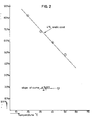
- Fig. 2 represents the percentage of residual roughness as a function of the temperature while using 4% oxalic acid.
- Fig. 3 represents the percentage of residual roughness as a function of the concentration of zinc powder.
- Fig. 4 represents the percentage of residual roughness as a function of the grinding period for several compounds.
- Elaborating on the work of Semenek et al, tests were conducted with aqueous solutions of oxalic acid (the organic acid mostly applied in metal treatment, since it is a strong acid and hardly leads to corrosion problems) as the compound.
- The influence of the temperature and the oxalic acid concentration on the grinding and polishing action were measured. The test re sults relating to the influence of oxalic acid concentration were all included in diagram I. The %RR value diminishes when the acid concentration is increased. However, it is surprising that a dip occurs in the curve at a concentration of about 4.5 weight % oxalic acid.
- This implies that in the given conditions, the best grinding results are to be expected at lower acid concentrations with a solution of about 4.5 weigth % oxalic acid.
- Similar results were obtained with other acids mentioned by Semenek et al, at the same pH. Particularly citric acid is an excellent alternative.
- The test results relating to the influence of temperature on the grinding process have been combined in diagram II.
- It appears from the diagram that the temperature is an important factor in the grinding proces (reduction of about 1 % RR per degree Celcius). The occurrence of pitting (and other corrosion defects) determines the limits of the temperature increase. The temperature restriction is different for every type of metal and/or alloy and can best be empirically determined for any chosen grinding condition.
- In the present research, the reducing aspect of the acid medium was boosted by adding a metal powder.
- Any acid medium (pH 7) has a reducing effect by suspending a metal powder in said medium, if the oxidation potential of said metal is positive (and if no oxidating substances are present). If, moreover, the oxidation potential of the suspended metal powder is higher than that of the metal surface to be treated, positive contact potentials are an important factor in establishing the desired surface hydrogen brittleness.
- It has appeared from many tests, that zirconium and zinc powder (with oxidation potentials of 1.5V, 0.8V, respectively) when grinding steel (oxidation potential of about 0.4V) produced % RR values that are far lower than those obtained by molybdenum, tin and tungsten (with oxidation potentials of 0.2, 0.14 and 0.1V, respectively).
- Apparently these results coincide with the above-stated hypothesis.
- In these experiment, the conditions as used in the experiments after the influence of oxalic acid concentration and temperature, (b), were extended by the addition of extremely finely divided zinc (Zincoli 600 and 620). Zinc powder was chosen for the experiments because this has a favourable oxidation potential, is readily available and inexpensive, but other metals with a higher oxidation potential than the metal to be ground, such as ziconium and aluminum, have similar results.
- The influence of the concentration of this zinc powder in the optimum oxalic acid medium on the grinding process was tested (oxalic acid conc. 4.5 %, temperature 35° C).
- The results were combined in fig. 3.
- In view of this diagram, the use of a compound that is an organic acid or mixture of organic acids or solution of organic acids in a concentration suitable for grinding and/or polishing the metal articles, while also a finely divided metal or alloy with an oxidation potential greater than zero is present in the grinding/polishing environment, yields a clear improvement of the grinding and/or polishing action, which is attributed to the hydrogen brittleness.
- It is surprising that as with the concentration-related curve for oxalic acid, a dip occurs here too in the curve. It can be concluded that at about 0.25 weight % zinc powder the grinding and polishing results are optimal for hardened steel articles.
- It goes without saying that a finely divided metal powder can also be introduced into the grinding medium in another manner, e.g.:
- a. the metal powder can have been incorporated in adequate quantities in the chips that are to be used, so that by mutual scouring action this metal, e.g. zinc, zirconium, aluminum, is released finely divided so as to boost the aimed hydrogen brittleness.
- b. the metal, e.g. zinc, zirconium, aluminum can be added to the grinding process in adequate quantities as such, or as an alloy in the form of e.g. pellets. By mutual scouring action with articles and chips this metal, e.g. zinc, zirconium, aluminum is scoured off and participates in the brittling process as grinding dust.
- It appeared from grinding experiments with zinc powder, that the particle size of the metal is essential. The best results were obtained with extremely finely divided metal (zinc) powder of a particle size ranging from 0.1 to 10µm. The reason for this is probably to be found in the increased chemical reactivity of extremely small particle dimensions as shown clearly with nickel derived from nickel carbonyl, which is so finely divided that this nickel is pyrophorus when exposed to air.
- In diagram IV the results of the most favourable combination of the present grinding experiments are compared to the grinding results of Michaud as recapitulated in table II of his patent (US patent 4,491,500). Like the present invention, Michaud's grinding results relate to the grinding of hard metal articles at 35-40° C in a spiratron. As a compound, Michaud used poly phosphate, oxalic acid and, for the oxidating environment, hydrogen peroxide.
- The diagram shows that the present metal-(zinc)containing compound yields better grinding results in a reducing environment than the oxidating compound claimed by Michaud.
- As stated before, this research was started on the hypothesis that an acceleration of the grinding and polishing process can be obtained by boosting the development of hydrogen brittleness in the surface of the articles to be treated.
- This hydrogen brittleness (a physical factor) is apparently the bulk of the contribution towards improvement, i.e. the acceleration of the scourability of the rough metal surface. The oxidatively conditioned chemical conversion layer as claimed by Michaud (US patent 4,491,500) is of secondary relevance.
- An acceleration of the grinding and polishing process can be obtained in a reducing environment.
Claims (7)
are introduced to a rotofinish apparatus and rotated for some time with (b) an adequate quantity of chips suitable for grinding and/or polishing the metal articles to be treated and (c) a compound that promotes grinding and/or polishing comprising one or more organic acids, characterized in that the compound is an organic acid or mixture of organic acids or solutions of organic acids in a concentration suitable for grinding and/or polishing the metal articles, and in that the grinding environment also comprises a finely divided metal or alloy with an oxidation potential greater than zero.
Priority Applications (1)
| Application Number | Priority Date | Filing Date | Title |
|---|---|---|---|
| AT88201234T ATE99361T1 (en) | 1987-06-17 | 1988-06-16 | SURFACE TREATMENT PROCESS FOR SPEEDING UP THE MASS GRINDING AND POLISHING OF METALLIC WORKPIECES IN A DRUM FINISHING PLANT. |
Applications Claiming Priority (2)
| Application Number | Priority Date | Filing Date | Title |
|---|---|---|---|
| NL8701407 | 1987-06-17 | ||
| NL8701407A NL8701407A (en) | 1987-06-17 | 1987-06-17 | A SURFACE TECHNOLOGY THAT MAKES THE MASS GRINDING AND POLISHING OF METAL ARTICLES IN ROTOFINISH EQUIPMENT FASTER. |
Publications (3)
| Publication Number | Publication Date |
|---|---|
| EP0295754A2 true EP0295754A2 (en) | 1988-12-21 |
| EP0295754A3 EP0295754A3 (en) | 1990-03-28 |
| EP0295754B1 EP0295754B1 (en) | 1993-12-29 |
Family
ID=19850160
Family Applications (1)
| Application Number | Title | Priority Date | Filing Date |
|---|---|---|---|
| EP88201234A Expired - Lifetime EP0295754B1 (en) | 1987-06-17 | 1988-06-16 | Surface technique that accelerates the mass grinding and polishing of metal articles in roto finish equipment |
Country Status (10)
| Country | Link |
|---|---|
| US (1) | US4900409A (en) |
| EP (1) | EP0295754B1 (en) |
| JP (1) | JPH01135434A (en) |
| AT (1) | ATE99361T1 (en) |
| AU (1) | AU599242B2 (en) |
| DE (1) | DE3886591D1 (en) |
| DK (1) | DK331288A (en) |
| FI (1) | FI88408C (en) |
| NL (1) | NL8701407A (en) |
| NO (1) | NO171304C (en) |
Cited By (4)
| Publication number | Priority date | Publication date | Assignee | Title |
|---|---|---|---|---|
| DE3935535C1 (en) * | 1989-10-25 | 1991-02-07 | Carl Kurt Walther Gmbh & Co Kg, 5600 Wuppertal, De | Aq. compsn. for etching and polishing metal surfaces - comprises mixt. of tri:sodium citrate, citric acid and sodium di:hydrogen phosphate in water |
| EP0976496A1 (en) * | 1998-07-31 | 2000-02-02 | G. Baggioli Pressofusione Europe S.r.l. | Process for reducing friction coefficient and increasing corrosion strength in components for safety belt rewinding devices |
| EP1004635A3 (en) * | 1998-11-27 | 2000-06-14 | Garcia Asensio, Julian | Formulation and method for the restoration and/or recovery of non wooden surfaces |
| EP0871214B1 (en) * | 1997-03-24 | 2008-02-20 | Freescale Semiconductor, Inc. | Process for polishing dissimilar conductive layers in a semiconductor device |
Families Citing this family (5)
| Publication number | Priority date | Publication date | Assignee | Title |
|---|---|---|---|---|
| US5085747A (en) * | 1989-05-19 | 1992-02-04 | Akio Nikano | Ultrasonic machining method |
| NL9500302A (en) * | 1995-02-17 | 1996-10-01 | Hoogovens Staal Bv | Method for removing at least a coating from metal scrap parts coated with a coating. |
| JP3941284B2 (en) * | 1999-04-13 | 2007-07-04 | 株式会社日立製作所 | Polishing method |
| CN101184868A (en) * | 2005-04-06 | 2008-05-21 | 雷姆技术公司 | Super Polishing of High Density Carbide |
| CN102765013B (en) * | 2012-07-04 | 2014-12-31 | 高要市东颖石艺有限公司 | Polishing method for irregular marble surface |
Family Cites Families (9)
| Publication number | Priority date | Publication date | Assignee | Title |
|---|---|---|---|---|
| US2735232A (en) * | 1956-02-21 | simjian | ||
| US2735231A (en) * | 1953-05-22 | 1956-02-21 | Reflectone Corp | simjian |
| US3523834A (en) * | 1967-10-13 | 1970-08-11 | Ibm | Method of deburring |
| US3979858A (en) * | 1975-07-24 | 1976-09-14 | International Lead Zinc Research Organization, Inc. | Chemically accelerated metal finishing process |
| US4316752A (en) * | 1980-10-16 | 1982-02-23 | International Lead Zinc Research Organization, Inc. | Oxalic acid treatment of carbon steel, galvanized steel and aluminum surfaces |
| JPS58114857A (en) * | 1981-12-26 | 1983-07-08 | Inoue Japax Res Inc | Surface grinding method |
| BG39849A1 (en) * | 1982-01-18 | 1986-09-15 | Makedonski | Polishing composition for centrifugal- magnetic abrasive machines |
| US4491500A (en) * | 1984-02-17 | 1985-01-01 | Rem Chemicals, Inc. | Method for refinement of metal surfaces |
| US4724042A (en) * | 1986-11-24 | 1988-02-09 | Sherman Peter G | Dry granular composition for, and method of, polishing ferrous components |
-
1987
- 1987-06-17 NL NL8701407A patent/NL8701407A/en not_active Application Discontinuation
-
1988
- 1988-06-15 US US07/207,268 patent/US4900409A/en not_active Expired - Fee Related
- 1988-06-16 AT AT88201234T patent/ATE99361T1/en not_active IP Right Cessation
- 1988-06-16 NO NO882677A patent/NO171304C/en unknown
- 1988-06-16 FI FI882899A patent/FI88408C/en not_active IP Right Cessation
- 1988-06-16 EP EP88201234A patent/EP0295754B1/en not_active Expired - Lifetime
- 1988-06-16 DE DE88201234T patent/DE3886591D1/en not_active Expired - Lifetime
- 1988-06-16 DK DK331288A patent/DK331288A/en not_active Application Discontinuation
- 1988-06-17 JP JP63149913A patent/JPH01135434A/en active Pending
- 1988-06-17 AU AU17795/88A patent/AU599242B2/en not_active Ceased
Cited By (5)
| Publication number | Priority date | Publication date | Assignee | Title |
|---|---|---|---|---|
| DE3935535C1 (en) * | 1989-10-25 | 1991-02-07 | Carl Kurt Walther Gmbh & Co Kg, 5600 Wuppertal, De | Aq. compsn. for etching and polishing metal surfaces - comprises mixt. of tri:sodium citrate, citric acid and sodium di:hydrogen phosphate in water |
| EP0871214B1 (en) * | 1997-03-24 | 2008-02-20 | Freescale Semiconductor, Inc. | Process for polishing dissimilar conductive layers in a semiconductor device |
| EP0976496A1 (en) * | 1998-07-31 | 2000-02-02 | G. Baggioli Pressofusione Europe S.r.l. | Process for reducing friction coefficient and increasing corrosion strength in components for safety belt rewinding devices |
| EP1004635A3 (en) * | 1998-11-27 | 2000-06-14 | Garcia Asensio, Julian | Formulation and method for the restoration and/or recovery of non wooden surfaces |
| ES2147531A1 (en) * | 1998-11-27 | 2000-09-01 | Restacris S L | Formulation and method for the restoration and/or recovery of non wooden surfaces |
Also Published As
| Publication number | Publication date |
|---|---|
| DK331288D0 (en) | 1988-06-16 |
| NO882677L (en) | 1988-12-19 |
| ATE99361T1 (en) | 1994-01-15 |
| NO882677D0 (en) | 1988-06-16 |
| AU599242B2 (en) | 1990-07-12 |
| US4900409A (en) | 1990-02-13 |
| AU1779588A (en) | 1988-12-22 |
| DE3886591D1 (en) | 1994-02-10 |
| DK331288A (en) | 1988-12-18 |
| EP0295754B1 (en) | 1993-12-29 |
| FI88408C (en) | 1993-05-10 |
| NO171304B (en) | 1992-11-16 |
| FI88408B (en) | 1993-01-29 |
| EP0295754A3 (en) | 1990-03-28 |
| FI882899L (en) | 1988-12-18 |
| NO171304C (en) | 1993-02-24 |
| JPH01135434A (en) | 1989-05-29 |
| NL8701407A (en) | 1989-01-16 |
| FI882899A0 (en) | 1988-06-16 |
Similar Documents
| Publication | Publication Date | Title |
|---|---|---|
| CA1218584A (en) | Method for refinement of metal surfaces | |
| EP0268361B1 (en) | Solution, composition and process of refining metal surfaces | |
| CA1309644C (en) | Metal surface refinement using dense alumina-based media | |
| US5158629A (en) | Reducing surface roughness of metallic objects and burnishing liquid used | |
| US4563239A (en) | Chemical milling using an inert particulate and moving vessel | |
| US4900409A (en) | Mass grinding and polishing of metal articles in rotofinish equipment | |
| HUP0302638A2 (en) | Wear-resistant medium with accelerator chemistry | |
| US3979858A (en) | Chemically accelerated metal finishing process | |
| US5158623A (en) | Method for surface refinement of titanium and nickel | |
| EP0449646B1 (en) | Composition and method for surface refinement of titanium and nickel | |
| RU2012695C1 (en) | Composition for vibration-chemical abrasion and for polishing articles of ferrous metals and method of vibration-chemical abrasion and of polishing articles of ferrous metals | |
| US3543452A (en) | Finishing process for metallic surfaces | |
| JPS6047909B2 (en) | Barrel polishing method combined with chemical polishing | |
| CN1016520B (en) | Metal surface refining process using dense alumina-based media | |
| JPS63196369A (en) | Composition for polishing aluminum magnetic disc | |
| JPH0158024B2 (en) | ||
| KR20000059342A (en) | Method for treating surface of wheel for a vehicle by vibratory finishing process | |
| JPH0442135B2 (en) | ||
| CN1315897A (en) | Improvements in rolling elements bearings |
Legal Events
| Date | Code | Title | Description |
|---|---|---|---|
| PUAI | Public reference made under article 153(3) epc to a published international application that has entered the european phase |
Free format text: ORIGINAL CODE: 0009012 |
|
| AK | Designated contracting states |
Kind code of ref document: A2 Designated state(s): AT BE CH DE ES FR GB IT LI LU NL SE |
|
| RIN1 | Information on inventor provided before grant (corrected) |
Inventor name: VUNDERINK, ATE |
|
| RAP1 | Party data changed (applicant data changed or rights of an application transferred) |
Owner name: METALLGESELLSCHAFT AG |
|
| PUAL | Search report despatched |
Free format text: ORIGINAL CODE: 0009013 |
|
| RHK1 | Main classification (correction) |
Ipc: C23F 3/06 |
|
| AK | Designated contracting states |
Kind code of ref document: A3 Designated state(s): AT BE CH DE ES FR GB IT LI LU NL SE |
|
| 17P | Request for examination filed |
Effective date: 19900816 |
|
| 17Q | First examination report despatched |
Effective date: 19910812 |
|
| DIN1 | Information on inventor provided before grant (deleted) | ||
| RAP1 | Party data changed (applicant data changed or rights of an application transferred) |
Owner name: VUNDERINK, ATE |
|
| GRAA | (expected) grant |
Free format text: ORIGINAL CODE: 0009210 |
|
| AK | Designated contracting states |
Kind code of ref document: B1 Designated state(s): AT BE CH DE ES FR GB IT LI LU NL SE |
|
| PG25 | Lapsed in a contracting state [announced via postgrant information from national office to epo] |
Ref country code: IT Free format text: LAPSE BECAUSE OF FAILURE TO SUBMIT A TRANSLATION OF THE DESCRIPTION OR TO PAY THE FEE WITHIN THE PRESCRIBED TIME-LIMIT;WARNING: LAPSES OF ITALIAN PATENTS WITH EFFECTIVE DATE BEFORE 2007 MAY HAVE OCCURRED AT ANY TIME BEFORE 2007. THE CORRECT EFFECTIVE DATE MAY BE DIFFERENT FROM THE ONE RECORDED. Effective date: 19931229 Ref country code: CH Effective date: 19931229 Ref country code: ES Free format text: THE PATENT HAS BEEN ANNULLED BY A DECISION OF A NATIONAL AUTHORITY Effective date: 19931229 Ref country code: AT Effective date: 19931229 Ref country code: LI Effective date: 19931229 Ref country code: BE Effective date: 19931229 Ref country code: SE Effective date: 19931229 Ref country code: NL Effective date: 19931229 Ref country code: FR Effective date: 19931229 Ref country code: DE Effective date: 19931229 |
|
| REF | Corresponds to: |
Ref document number: 99361 Country of ref document: AT Date of ref document: 19940115 Kind code of ref document: T |
|
| REF | Corresponds to: |
Ref document number: 3886591 Country of ref document: DE Date of ref document: 19940210 |
|
| REG | Reference to a national code |
Ref country code: CH Ref legal event code: PL |
|
| EN | Fr: translation not filed | ||
| NLV1 | Nl: lapsed or annulled due to failure to fulfill the requirements of art. 29p and 29m of the patents act | ||
| PG25 | Lapsed in a contracting state [announced via postgrant information from national office to epo] |
Ref country code: GB Effective date: 19940616 |
|
| PG25 | Lapsed in a contracting state [announced via postgrant information from national office to epo] |
Ref country code: LU Free format text: LAPSE BECAUSE OF NON-PAYMENT OF DUE FEES Effective date: 19940630 |
|
| PLBE | No opposition filed within time limit |
Free format text: ORIGINAL CODE: 0009261 |
|
| STAA | Information on the status of an ep patent application or granted ep patent |
Free format text: STATUS: NO OPPOSITION FILED WITHIN TIME LIMIT |
|
| 26N | No opposition filed | ||
| GBPC | Gb: european patent ceased through non-payment of renewal fee |
Effective date: 19940616 |