EP0300253A2 - Procédé de fabrication d'articles tubulaires avec des parties tubulaires séparables et métier à tricoter circulaire pour sa mise en oeuvre - Google Patents
Procédé de fabrication d'articles tubulaires avec des parties tubulaires séparables et métier à tricoter circulaire pour sa mise en oeuvre Download PDFInfo
- Publication number
- EP0300253A2 EP0300253A2 EP88110606A EP88110606A EP0300253A2 EP 0300253 A2 EP0300253 A2 EP 0300253A2 EP 88110606 A EP88110606 A EP 88110606A EP 88110606 A EP88110606 A EP 88110606A EP 0300253 A2 EP0300253 A2 EP 0300253A2
- Authority
- EP
- European Patent Office
- Prior art keywords
- thread
- needles
- systems
- needle
- row
- Prior art date
- Legal status (The legal status is an assumption and is not a legal conclusion. Google has not performed a legal analysis and makes no representation as to the accuracy of the status listed.)
- Withdrawn
Links
Images

Classifications
-
- D—TEXTILES; PAPER
- D04—BRAIDING; LACE-MAKING; KNITTING; TRIMMINGS; NON-WOVEN FABRICS
- D04B—KNITTING
- D04B1/00—Weft knitting processes for the production of fabrics or articles not dependent on the use of particular machines; Fabrics or articles defined by such processes
- D04B1/06—Non-run fabrics or articles
-
- D—TEXTILES; PAPER
- D04—BRAIDING; LACE-MAKING; KNITTING; TRIMMINGS; NON-WOVEN FABRICS
- D04B—KNITTING
- D04B15/00—Details of, or auxiliary devices incorporated in, weft knitting machines, restricted to machines of this kind
- D04B15/66—Devices for determining or controlling patterns ; Program-control arrangements
- D04B15/80—Devices for determining or controlling patterns ; Program-control arrangements characterised by the thread guides used
Definitions
- the invention relates to a process for the production of tubular goods with separable, firm beginnings hose sections, which are each connected by a meltable or washable separating thread, on a multi-system circular knitting machine with lock switching devices, two needle carriers and thread changing devices.
- a finished knitted part here a tube section
- a finished knitted part is first provided with a few rows of top stitches at its end in order to form a safeguard against running stitches. Then at least one row of stitches is knitted and then the An beginning of the next knitted part to be produced. If the separating mesh rows are produced with a meltable or washable separating thread, after the goods hose consisting of several hose sections has been removed from the circular knitting machine, the separating thread is melted by the action of heat or dissolved by the action of moisture.
- the invention has for its object to design the method of the type mentioned in such a way that the individual hose sections of the goods hose do not remain coupled to one another at thread change points by connecting threads and are as smooth as possible and heel-free end edges and are not defaced by separating thread remnants after the hose sections have been detached from one another.
- the object is achieved with a method of the type mentioned in the invention in that the separating thread is processed over a machine revolution only with needles of one needle carrier to a right / left stitch row, the stitches of which are not subsequently thrown off, while the needles of the other needle carrier throw off your stitches with the exception of a changeover point limited to a few wales, and that the separating thread is then processed in the area of the changeover point by needles of the other needle carrier to right / left stitches.
- the tube sections can be separated quickly, easily and cleanly and that their edge is practically free of heels and does not have to be hemmed.
- a change point and thus edge point is formed, at which the separating thread occurs on both sides, while in the remaining area only very little separating thread and only on one side is required, which can be removed practically without residues without additional cleaning measures and has only coupled the hose sections to one another.
- the margin becomes paragraph-free, because systems are switched off and the beginning of the margin is worked with only a few systems.
- the goal of smooth knitted edge design can be further favored by the fact that several changing points are provided in a uniform distribution on the machine circumference, the separating thread being inserted and laid out only at one changing point, while the supply of additional threads for forming the knitted edge hose sections are first distributed to at least one exchange point and after one machine revolution to other exchange points.
- the systems are thus gradually switched on in groups. This keeps a row of stitches in the tube sections small.
- the separating thread is only inserted and processed in the needles of a needle carrier, and the separating thread stitches are not thrown off.
- the separating thread is worked in one after the other and separately in both rows of needles.
- the stitch dropping disadvantageously leads to long separating thread stitches.
- meltable threads separating thread residues cannot be avoided there.
- the known methods are only suitable for a manual separation of the hose sections, in which a fixed separating thread is used, which is subsequently pulled out by hand.
- the needles Because no separating thread stitches are thrown off in the area of the changeover point in the method according to the invention, the needles retain a controlled flap of the tongue and thus ensure reliable gripping of the thread to form a subsequent row of net stitches. There is no risk of edge holes in the knitted tube sections.
- the avoidance of marginal holes can be further favored in that the systems are provided with two separate thread guide openings which are arranged one behind the other in the direction of the needle passage, the first thread guide opening being each occupied with the thread to be inserted first. This ensures that when a system that was previously switched off is switched on, the needles, in particular the cylinder needles, receive thread immediately and safely.
- the system on which the separating thread is inserted is a normal system which, like the other systems of the circular knitting machine, is also used to knit the tube sections. At the points where additional edge threads are inserted, there are no pronounced edge shoulders, only imperceptible thickening points due to short two-thread knitting.
- the row of nets, the right / left edge stitch row and, if appropriate, the right / right edge stitch row should advantageously be produced over at least one full machine revolution before further systems of the circular knitting machine are switched on. If other systems are switched on at a changeover point before one turn, paragraphs and newly inserted threads can be seen on the edge.
- the method according to the invention can be carried out with a multi-system circular knitting machine with needle cylinder and dial, in which in each system both needle carriers switchable lock parts for the needles, a thread changing device and a switchable thread delivery device are provided.
- the machine is equipped with an automatically axially adjustable dial and suitably equipped with short and long needles in at least one needle carrier.
- the lock switches are also carried out at the changing points.
- One of the systems then has a thread changing device with a thread finger for the separating thread.
- the special thread guides ensure that the threads are gripped securely and that the threads are knitted cleanly at the thread change points.
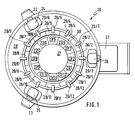
- FIG. 1 In the schematic plan view of FIG. 1 on a circular knitting machine 20 with twelve systems, a main foot 21 containing the machine drive and two further machine feet 22 and 23 and, from the upper machine structure, three support columns 24, 25 and 26 for a rib lock plate 27 and the rib washer located underneath can be seen .
- a cylinder lock support ring 28 rests on the machine feet 21 to 23.
- the working area 30 of the circular knitting machine 20 formed by the needle cylinder and the dial is represented by an annular gap which is located between the twelve cylinder lock segments 28/1 - 28/12 and the dial lock segments 27 / 1 - 27/12.
- the cylinder lock segment 28/1 and the rib lock segment 27/1 thus form the system 1 and the cylinder lock segment 28/12 and the rib lock segment 27/12 form the system 12 of the circular knitting machine.
- 1 also indicates thread changing devices 29/1 - 29/12, each system 1 - 12 of the circular knitting machine being provided with a thread changing device. Via the thread changing devices 29, a knitted thread 31, for example a cotton thread, which is used to produce the tube sections, and an edge thread 32, for example, a wound rubber thread, which is used to produce the tube section edges, can be fed to each system.
- the thread changing device 29/12 of the system 12 of the machine is also equipped with a fusible separating thread 33.
- each system 1 to 12 there are switchable lock parts in the rib lock segments 27/1 - 27/12 and in the cylinder lock segments 28/1 - 28/12 to bring the needles either in a concentric position, knitting position or catch position.
- the dial is height-adjustable by means of a motor. The height adjustment is automatically controlled in a manner not shown.
- the lock parts in systems 1 to 12 can be controlled by means of cams rotating with the needle carriers; also switching the thread changing devices 29. Electromagnetically controlled lock parts and thread changing devices can also be provided.
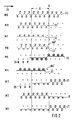
- the needles of the circular knitting machine are represented in a known manner by two rows of dots in each stitch row of the thread running representation, the upper row of dots representing the needles and the lower row of dots representing the cylindrical needles arranged in a gap with the needles.
- the exchange point X only extends over a few needles, here four cylinder needles, i.e.
- the upper arrow 34 indicates the direction of travel of the needles in the moving needle carriers
- the dial and needle cylinder The arrows 35 drawn in the stitch rows M3 and M5 symbolize the dropping of stitches from the cylindrical needles.
- the stitch row M1 shows a row of protective stitches made from the knitted thread 31 using only the cylinder needles.
- the courses M2 and M3 likewise show rows of top stitches formed from knitted thread 31, the cylinder loops of which are thrown off in the course M3.
- the stitch rows M4 and M5 show the right / left stitch row which is formed from the separating thread 33, all the needles forming separating stitches and the separating thread being processed from the cylinder needles to right / left stitches only in the area of the changeover point X.
- the cylindrical meshes in the area of the M5 stitch row are thrown off as in M3. No separating thread stitch is thrown off.
- the cylinder needles of the exchange point process the separating thread end. Then the cylinder meshes in the remaining area are thrown off.
- the row of stitches M6 shows a net row formed from edge thread 32 as the beginning of the edge of the next section of knitted tube. It is a right / right row of stitches with rib and cylinder stitches in the area of the changeover point X and rib stitches and cylinder hooks in the rest of the area. This is followed in the stitch row M7 by a right / left stitch row made of edge thread 32 made by the needles.
- the stitch rows M8 and M9 are right / right stitch rows formed from the edge thread 32.
- the knitted thread 31 is a continuous line with a normal line width shown, the separating thread as a thick continuous line and the edge thread 32 as a dashed line of normal line width.
- the knitted thread 31 is turned over half a turn on every second system, precisely on systems 1, 3, 5, 6, 7, 9, 11 and 12 designed and the needles of the dial and needle cylinder are switched into the concentric position.
- systems 2, 4, 8 and 10 process the remnant of the knitted thread of the previous system.
- the knitted thread 31 is also laid out on the other systems 2 and 8 over the next half of a machine revolution and the needles of the dial plate and needle cylinder are switched into the concentric position there.
- On systems 4 and 10 only the needles of a needle carrier, namely the dial, are brought into the concentric position.
- At least one right / left protective stitch row made of knitted thread 31 or another, preferably rougher thread is used on these two systems 4 and 10, and then after switching on the needles at the changeover point X, a right / right stitch stitch row M2 made of knitted thread 31 or the other thread formed.
- the knitted thread 31 is then laid out on the systems 4 and 10 and the needles at the change point X are switched off (see M3, FIG. 2), while the cylindrical needles process the remainder of the knitted thread into right / left stitches before the entire row of knitted stitches is thrown off ( M3, Fig. 2).
- the cylinder needles on systems 4 and 10 are also switched off, i.e.
- the needles and the cylinder needles are switched on at the system 1 at the changeover point and the edge thread 32 (M6 ', FIG. 2) is fed in, so that the network row M6 is formed from the edge thread 32 there.
- the needles are switched on and the edge thread 32 is inserted in order to form the right / left edge stitch row M7.
- the cylinder needles and the needles are switched on in order to knit a first right / right edge stitch row from the edge thread 32.
- the latter system 5 can also remain switched off here and only be switched on in the next revolution.
- the mesh strength and thus the thread consumption are expediently changed for the different areas (edge, upper part).
- the edge or beginning is usually worked a little tighter so that the edge does not appear wavy or wrinkled. He should be on properly lie.
- the strength of the upper part is determined by quality and wearing properties.
- the rib washer height and thus the mesh strength are changed according to these requirements. This is done with an automatically controlled dial height adjustment.
- the thread feed is positive, or the needle fetches the required amount of thread itself.
- the thread is fed without conveying during the edge formation and the switching operations.
- the thread delivery device assigned to each system switches to positive operation. It is also possible to switch the thread feeder on and off by always feeding the running thread while the thread feeding of the other threads is stopped.
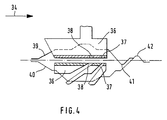
- FIG. 4 shows a thread guide 36 used on the systems of the circular knitting machine, which has two slit-like thread guide openings 37 and 38 arranged one behind the other.
- the thread guide is shown in a first and in the lower part of FIG. 4 again in a second sectional plane rotated by 90 °.
- the cylinder needle curve 39 and the rib needle curve 40 are shown in a relative position in the upper part of FIG. 4, which corresponds to a retraction curve.
- the points of intersection of the two needle curves are designated 41 (cylindrical needle) and 42 (rib needle).
- the thread In the first thread guide opening 38, the thread is always guided, which is the first to be fed to the needles and processed after a system has been switched off.
- the thread in the first opening 38 can be an edge thread 32 (systems 1, 3, 5, 7, 9, 11) or a knitted thread 31 (systems 2, 4, 6, 8, 10, 12).
- the thread to be inserted crosses the circumferential rib needles, and these pull the thread into the first slot-shaped thread guide opening inwards for the cylindrical needle contour. This ensures that the first activated cylinder needle reliably detects the thread. If the first cylindrical needle did not reach the thread, the needle tongue would close and a hole would be created in the knitted fabric. When changing the thread, the first cylinder needle still has the thread to be laid out. This ensures that stitches are formed.
Landscapes
- Engineering & Computer Science (AREA)
- Textile Engineering (AREA)
- Knitting Machines (AREA)
- Knitting Of Fabric (AREA)
Applications Claiming Priority (2)
| Application Number | Priority Date | Filing Date | Title |
|---|---|---|---|
| DE3724071 | 1987-07-21 | ||
| DE19873724071 DE3724071A1 (de) | 1987-07-21 | 1987-07-21 | Verfahren zur herstellung von schlauchware mit voneinander trennbaren schlauchabschnitten und rundstrickmaschine hierzu |
Publications (2)
| Publication Number | Publication Date |
|---|---|
| EP0300253A2 true EP0300253A2 (fr) | 1989-01-25 |
| EP0300253A3 EP0300253A3 (fr) | 1991-11-13 |
Family
ID=6332014
Family Applications (1)
| Application Number | Title | Priority Date | Filing Date |
|---|---|---|---|
| EP19880110606 Withdrawn EP0300253A3 (fr) | 1987-07-21 | 1988-07-02 | Procédé de fabrication d'articles tubulaires avec des parties tubulaires séparables et métier à tricoter circulaire pour sa mise en oeuvre |
Country Status (4)
| Country | Link |
|---|---|
| EP (1) | EP0300253A3 (fr) |
| JP (1) | JPS6440642A (fr) |
| DD (1) | DD285380A5 (fr) |
| DE (1) | DE3724071A1 (fr) |
Cited By (3)
| Publication number | Priority date | Publication date | Assignee | Title |
|---|---|---|---|---|
| EP0967314A3 (fr) * | 1998-06-17 | 2000-11-08 | Conti Complett S.p.A. | Bande tubulaire avec une portion séparable et procédé pour son montage au bord d'un tricot |
| ES2150316A1 (es) * | 1996-03-11 | 2000-11-16 | Castano Ignasi Claret | Procedimiento para fabricacion de un tejido de punto desmallable. |
| WO2025171910A1 (fr) * | 2024-02-13 | 2025-08-21 | Climatex Ag | Substrat textile à fils structurellement intégrés destructibles pour faciliter la séparation de matériaux |
Families Citing this family (1)
| Publication number | Priority date | Publication date | Assignee | Title |
|---|---|---|---|---|
| GB2214939B (en) * | 1988-02-19 | 1992-04-22 | Shima Seiki Mfg | Method of preventing the edge of knitted fabric from unravelling |
Family Cites Families (7)
| Publication number | Priority date | Publication date | Assignee | Title |
|---|---|---|---|---|
| US2437735A (en) * | 1945-07-25 | 1948-03-16 | James L Getaz | Method of and apparatus for separating knitted fabrics |
| GB773546A (en) * | 1954-09-01 | 1957-04-24 | William Alexander Zieve | Two by two rib knitted fabric with selvage |
| DE1169075B (de) * | 1959-09-07 | 1964-04-30 | Morat Gmbh Franz | Fadenzufuehrvorrichtung an Rundraender-strickmaschinen |
| DE2227508A1 (de) * | 1971-06-12 | 1973-01-04 | Billi Spa | Einrichtung an einer rundstrickmaschine, insbesondere fuer struempfe, zum schutz unvorschriftsmaessig angehobener nadel- oder stoesserfuesse |
| NL157671B (nl) * | 1975-06-26 | 1978-08-15 | Leonardus Hendrikus Stoever | Werkwijze voor het vervaardigen van gebreide produkten, zoals kousen of sokken, alsmede het produkt van deze werkwijze. |
| DE2607753A1 (de) * | 1976-02-26 | 1977-09-01 | Spaichingen Gmbh Maschf | Verfahren und rundstrickmaschine zur herstellung von durch trennfaeden verbundenen gestrickteilen |
| FR2343845A1 (fr) * | 1976-03-08 | 1977-10-07 | Asa Sa | Installation pour le changement des fils d'alimentation dans un metier a tricoter circulaire |
-
1987
- 1987-07-21 DE DE19873724071 patent/DE3724071A1/de not_active Withdrawn
-
1988
- 1988-07-02 EP EP19880110606 patent/EP0300253A3/fr not_active Withdrawn
- 1988-07-20 JP JP63179291A patent/JPS6440642A/ja active Granted
- 1988-07-20 DD DD88318120A patent/DD285380A5/de not_active IP Right Cessation
Cited By (3)
| Publication number | Priority date | Publication date | Assignee | Title |
|---|---|---|---|---|
| ES2150316A1 (es) * | 1996-03-11 | 2000-11-16 | Castano Ignasi Claret | Procedimiento para fabricacion de un tejido de punto desmallable. |
| EP0967314A3 (fr) * | 1998-06-17 | 2000-11-08 | Conti Complett S.p.A. | Bande tubulaire avec une portion séparable et procédé pour son montage au bord d'un tricot |
| WO2025171910A1 (fr) * | 2024-02-13 | 2025-08-21 | Climatex Ag | Substrat textile à fils structurellement intégrés destructibles pour faciliter la séparation de matériaux |
Also Published As
| Publication number | Publication date |
|---|---|
| DE3724071A1 (de) | 1989-02-02 |
| JPH032977B2 (fr) | 1991-01-17 |
| JPS6440642A (en) | 1989-02-10 |
| EP0300253A3 (fr) | 1991-11-13 |
| DD285380A5 (de) | 1990-12-12 |
Similar Documents
| Publication | Publication Date | Title |
|---|---|---|
| DE69221557T2 (de) | Schlauchartig gestrickter Stoff mit dreidimensionaler Form und Verfahren zum Stricken von diesem Stoff | |
| DE1900565B2 (de) | Beinkleid, insbesondere strumpfhose | |
| EP0584529B1 (fr) | Procédé pour la fabrication d'un article tricoté rectiligne d'une seule pièce façonnée pour un vêtement à manches | |
| DE60011707T2 (de) | Verfahren zur Herstellung von schlauchförmigen Waren, sowie Strumpfwaren und dergleichen, welche an einem axialen Ende geschlossen sind, unter Verwendung einer Einzelzylinder-Rundstrickmaschine | |
| DE2407736A1 (de) | Verfahren zur herstellung von doppelflaechiger strickware mit ein- oder beidseitig eingearbeiteten futterfaeden | |
| DE69111788T2 (de) | Verfahren zum stricken von rundstrickwaren und damit erhaltene strickwaren. | |
| DE2518508C2 (de) | Beinloser Slip | |
| DE2114558A1 (de) | Rohrprodukt für ein mit Ärmeln versehenes gestricktes Kleidungsstück und Verfahren zu seiner Herstellung | |
| DE69018002T2 (de) | Gestrickter Stoff mit eingelegtem Polfaden und Verfahren. | |
| EP3556921A1 (fr) | Machine à tricoter rectiligne et procédé de fabrication d'un tricot à motifs filigranes | |
| DE3319519C2 (fr) | ||
| DE3219860A1 (de) | Flachstrickmaschine | |
| DE2309349A1 (de) | Einschlauch-strumpfhose | |
| DE69008972T2 (de) | Maschine zur Herstellung fertiger Strickwaren, wie Strumpfhosen. | |
| CH615963A5 (en) | Process for the mechanical knitting of a one-piece garment blank | |
| DE8023724U1 (de) | Strickmaschine zur herstellung von rechts/links-gestrickten mit eingelegten futterfaeden | |
| DE2637645C2 (de) | Rundgestrickte Plüschware und Rundstrickmaschine zu deren Herstellung | |
| DD285380A5 (de) | Verfahren zur herstellung von schlauchware mit voneinander trennbaren schlauchabschnitten und rundstrickmaschinen hierzu | |
| DE2507815A1 (de) | Vorrichtung zur einspeisung des fadens bei rundstrickmaschinen mit ortsfestem nadelzylinder und rotierenden schlossmaenteln fuer die herstellung von offener strickware | |
| DE817340C (de) | Strickware und Maschine zu ihrer Herstellung | |
| DE1803443A1 (de) | Kettengewirkte Schlauchware,insbesondere Damenstrumpf,sowie Verfahren und Vorrichtung zum Herstellen derselben | |
| DE2803338C2 (fr) | ||
| EP1111109B1 (fr) | Procédé pour la formation de mailles nouveaux dans un métier à tricoter | |
| DE69001925T2 (de) | Verfahren zur Herstellung von Halbprodukten an Rundstrickmaschinen, insbesondere für Unterhemden, Hemdhosen, Unterhosen und dergleichen. | |
| DE640471C (de) | Verfahren und Rundstrickmaschinen zum Trennen einzelner Stuecke eines Strickstranges |
Legal Events
| Date | Code | Title | Description |
|---|---|---|---|
| PUAI | Public reference made under article 153(3) epc to a published international application that has entered the european phase |
Free format text: ORIGINAL CODE: 0009012 |
|
| AK | Designated contracting states |
Kind code of ref document: A2 Designated state(s): CH ES GB IT LI |
|
| PUAL | Search report despatched |
Free format text: ORIGINAL CODE: 0009013 |
|
| AK | Designated contracting states |
Kind code of ref document: A3 Designated state(s): CH ES GB IT LI |
|
| 17P | Request for examination filed |
Effective date: 19911203 |
|
| 17Q | First examination report despatched |
Effective date: 19930902 |
|
| STAA | Information on the status of an ep patent application or granted ep patent |
Free format text: STATUS: THE APPLICATION IS DEEMED TO BE WITHDRAWN |
|
| 18D | Application deemed to be withdrawn |
Effective date: 19940201 |