EP0300295A1 - Procédé pour laver du linge ou matériau similaire et machine pour exécuter ce procédé - Google Patents
Procédé pour laver du linge ou matériau similaire et machine pour exécuter ce procédé Download PDFInfo
- Publication number
- EP0300295A1 EP0300295A1 EP88110968A EP88110968A EP0300295A1 EP 0300295 A1 EP0300295 A1 EP 0300295A1 EP 88110968 A EP88110968 A EP 88110968A EP 88110968 A EP88110968 A EP 88110968A EP 0300295 A1 EP0300295 A1 EP 0300295A1
- Authority
- EP
- European Patent Office
- Prior art keywords
- washing
- water
- items
- liquid
- auxiliary tank
- Prior art date
- Legal status (The legal status is an assumption and is not a legal conclusion. Google has not performed a legal analysis and makes no representation as to the accuracy of the status listed.)
- Granted
Links
- 238000005406 washing Methods 0.000 title claims abstract description 85
- 238000000034 method Methods 0.000 title claims abstract description 36
- 239000004744 fabric Substances 0.000 title claims abstract description 8
- 239000000463 material Substances 0.000 title abstract description 4
- XLYOFNOQVPJJNP-UHFFFAOYSA-N water Substances O XLYOFNOQVPJJNP-UHFFFAOYSA-N 0.000 claims abstract description 71
- 239000007788 liquid Substances 0.000 claims abstract description 40
- 239000003599 detergent Substances 0.000 claims abstract description 23
- 239000000654 additive Substances 0.000 claims abstract description 17
- 238000005119 centrifugation Methods 0.000 claims abstract description 16
- 239000007844 bleaching agent Substances 0.000 claims description 3
- 238000007654 immersion Methods 0.000 claims description 2
- 230000008569 process Effects 0.000 description 13
- 238000010438 heat treatment Methods 0.000 description 6
- 238000001035 drying Methods 0.000 description 5
- 238000009987 spinning Methods 0.000 description 5
- 238000010412 laundry washing Methods 0.000 description 4
- 230000009471 action Effects 0.000 description 3
- 230000008901 benefit Effects 0.000 description 3
- 239000003795 chemical substances by application Substances 0.000 description 3
- 230000000694 effects Effects 0.000 description 3
- 230000004087 circulation Effects 0.000 description 2
- 230000004048 modification Effects 0.000 description 2
- 238000012986 modification Methods 0.000 description 2
- 230000005540 biological transmission Effects 0.000 description 1
- 230000015556 catabolic process Effects 0.000 description 1
- 238000007599 discharging Methods 0.000 description 1
- 238000004519 manufacturing process Methods 0.000 description 1
- 230000007246 mechanism Effects 0.000 description 1
- 239000000843 powder Substances 0.000 description 1
- 230000003134 recirculating effect Effects 0.000 description 1
- 230000009467 reduction Effects 0.000 description 1
- 238000005507 spraying Methods 0.000 description 1
Images

Classifications
-
- D—TEXTILES; PAPER
- D06—TREATMENT OF TEXTILES OR THE LIKE; LAUNDERING; FLEXIBLE MATERIALS NOT OTHERWISE PROVIDED FOR
- D06F—LAUNDERING, DRYING, IRONING, PRESSING OR FOLDING TEXTILE ARTICLES
- D06F35/00—Washing machines, apparatus, or methods not otherwise provided for
- D06F35/005—Methods for washing, rinsing or spin-drying
-
- D—TEXTILES; PAPER
- D06—TREATMENT OF TEXTILES OR THE LIKE; LAUNDERING; FLEXIBLE MATERIALS NOT OTHERWISE PROVIDED FOR
- D06F—LAUNDERING, DRYING, IRONING, PRESSING OR FOLDING TEXTILE ARTICLES
- D06F39/00—Details of washing machines not specific to a single type of machines covered by groups D06F9/00 - D06F27/00
- D06F39/08—Liquid supply or discharge arrangements
-
- Y—GENERAL TAGGING OF NEW TECHNOLOGICAL DEVELOPMENTS; GENERAL TAGGING OF CROSS-SECTIONAL TECHNOLOGIES SPANNING OVER SEVERAL SECTIONS OF THE IPC; TECHNICAL SUBJECTS COVERED BY FORMER USPC CROSS-REFERENCE ART COLLECTIONS [XRACs] AND DIGESTS
- Y02—TECHNOLOGIES OR APPLICATIONS FOR MITIGATION OR ADAPTATION AGAINST CLIMATE CHANGE
- Y02B—CLIMATE CHANGE MITIGATION TECHNOLOGIES RELATED TO BUILDINGS, e.g. HOUSING, HOUSE APPLIANCES OR RELATED END-USER APPLICATIONS
- Y02B40/00—Technologies aiming at improving the efficiency of home appliances, e.g. induction cooking or efficient technologies for refrigerators, freezers or dish washers
Definitions
- This patent refers to a procedure for washing clothes, fabrics and similar materials, and a machine to practice said procedure.
- the washing process for laundry executed in washing machines which are generally automatic, is well known. That process consists in a pre-washing stage, with the addition of water and the proper detergents or, if necessary, other additives. After this first stage, a discharge of the dirty liquid and then a washing phase take place. The following step is normally a rinsing of the items with water with an eventual addition of other additives such as softeners, etc. In this stage at least one discharge phase of the remaining water takes place, and finally drying by spinning the drum takes place. However this last step cannot be executed in case that the user of the machine is not present, so as to be able to take the items out of the washing machine.
- the spin-drying is not effected and the items remain inside the drum with a certain amount of clean water which prevents the laundry items from being wrinkled until the user proceeds to discharge the water and to remove the washed items.
- the final spin-drying cycle is not executed when washing delicate clothes which could suffer from eventual damage from the centrifugal forces created in this final spinning phase of the process.
- the procedure for washing clothes, fabrics and similar materials corresponds to the process which includes a pre-washing phase, with the addition of water and the proper detergents, a discharge phase of the used liquid and a washing phase, with addition of water and detergents, then a discharge phase of the used liquid, and thereafter another washing phase with the respective addition of other additives.
- the next steps are a rinsing cycle with water and eventually additives, like softeners, etc. in which at least one discharge phase of the used liquid and a final spin-drying cycle of the washed laundry items through a process of centrifugation.
- this process has a specific characteristic according to which the laundry items are subject to a centrifugal process in the pre-washing phase and of another centrifugation process in the rinsing phase.
- washing machine that is suitable for executing the process according to the invention, for which such a machine is provided, apart from the conventional electrovalve which is included in the branch, connected both to the water supply and to the compart ments temporarily containing the washing agents, with another electrovalve inserted into a conduit linked to the aforementioned compartments for the washing agents.
- This conduit terminates in a diffusor which opens into the machine drum.
- this machine has other conventional elements, such as a surrounding tub, which contains the aforementioned drum and has a door for loading and unloading the items to be washed; an outlet for the used liquids, generally activated by a pump, which pass through a filter; mechanical and electrical devices for driving the drum and means for rotating same; heaters for the washing liquids; programming mechanisms and other conventional elements of these kinds of machines.
- the drum's axis can be horizontal, having the door in the front or in the upper part of the machine (in this case another lid in the circular wall of the drum is provided), or vertical.
- the washing machine which is subject matter of this description can also be provided with a modification which does not affect the essence of the procedure des strictlycribed here.
- the modification consists of a pipe connected to the water supply and comprising another electrovalve which is connected to a diffusor, terminating inside the drum.
- such a machine correspondes to the recirculation type, with a filter, a collector or small reservoir disposed at the bottom of the surrounding tub and a pump, usually an electric pump, which can or cannot be the same that drains the treating liquids to the outside.
- the procedure starts with a pre-washing phase of the articles, for approximately 2 to 3 minutes, which articles are then subject to centrifugation; this is obtained by an appropriate spinning speed of the drum, by means of a transmission and an associated electromotor.
- this phase in which such centrifugation takes place, the articles are firmly stuck to the drum's perforate internal walls and at the same time water enters from the respective conduit and the aforementioned diffusor, inside the drum.
- Such water already contains the proper detergents, penetrates into the laundry items and leaves the drum through the perforation, being properly taken away and remaining out of the reach of the spinning drum, so that it is not soaked by the treating articles again.
- Such liquid may then be recirculated to the diffusor.
- centrifugation which takes place during the pre-washing phase effects an energetic and active initial washing of the laundry which gets soaked very much and very often, all that taking place in a very limited period of time, whereas a pre-washing phase in a conventional procedure lasts about 15 minutes.
- the treated laundry is then subject to a phase of conventional washing, but in a shorter time, which is from 20 to 40 minutes less than in a conventional washing process which lasts about 60 minutes or more. It is also possible, if necessary, to discharge the used liquid of the pre-washing phase, before the main washing-phase is started and, in this case, water, detergents and other additives can be added.
- the rinsing phase takes place, and the treated laundry is subject of a centrifugal process, in which the detergents and/or additives added previously are removed from the drum through the energetical action of the centrifugal force with a relatively high speed of the drum in this rinsing phase. Due to that centrifugation the laundry gets rid of the aforementioned liquid, detergents and the like and is completely clean.
- the rinsing phase can be subject of one or several discharge steps of the used liquid and, in this case, of one or more clean water intake steps from the water supply, which contributes to a perfect final rinsing.
- Such rinsing, according to the invention lasts about 3 to 4 minutes, whereas a conventional rinsing phase lasts about 15 minutes or more.
- Laundry washing machines which are generally automatic are well known. Those are composed of a stationary tub and a rotating drum where the laundry is submerged in the washing liquid. The water is supplied by a water intake, where detergents and other additives, such as bleaching agents and softeners, are added. Water usually is pre-heated by the machine itself during the washing process. After the washing phase a rinsing phase and a first drying phase by spinning the drum takes place. All these phases are carried out cyclically, controlled by a programmer which effects timing and operation of the drum driving motor, and of the automatic valves controlling the water and washing liquid flows.
- a programmer which effects timing and operation of the drum driving motor, and of the automatic valves controlling the water and washing liquid flows.
- the laundry washing machine of this invention is free of the above mentioned inconveniences and provides a practical solution for washing laundry and the like with a minimum energy and water consumption, and a maximum functional effectiveness.
- the amount of water used for the washing process is reduced to a minimum , due to the exact water levels which contain the laundry inside the drum. In its upper part, the water attains a level in which the laundry is completely submerged and exposed to the washing process, whereas in the lower portion of the drum a certain quantitiy of this water remains temporarily in an interior collector extending from the tub.
- the capacity of this collector is actually equivalent to that of a supplementary tank placed in the water intake piping to the drum.
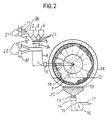
- Valves 1F and 1C via conduits 26 lead to compartments 2, 3 and 4 which are adapted to be provided with detergents in powder of liquid form, bleaching agents and softeners or other additives used in the washing process to improve and promote the properties of the items to be washed.
- an electrovalve 5 is provided, the outlet of which is connected to a tank 8 via a conduit 24.
- Said tank 8 is a characteristic element of the laundry washing machine of the present invention.
- Said tank 8 has a specific predetermined volume and is provided with intake electrovalves 6F and 6C for cold and hot water, respectively, said valves 6F, 6C being independent from the valves 1F, 1C mentioned above and being connected via conduits 22 to the water mains and a heating device (not shown).
- an electrovalve 9 is situated being connected to a pipe 10 extending into a drum 7 rotatably disposed within a stationary tub 25 of the washing machine.
- Pipe 10 terminates in a diffusor 11 disposed in the center part of the drum 7.
- a collector 20 is connected forming an extension of the tub 25.
- Said collector 20 has the shape of a truncated cone, the volume of which is equal to the volume of aforementioned tank 8.
- an outlet conduit 19 is connected in which an electrovalve 14 is disposed, the outlet of which is connected via a conduit 15 to a pump 16 in turn connected to a discharge conduit 17 for draining the tub 25 and, eventually, recirculating the washing liquid to the tank via a branch conduit and electrovalve means (not shown for simplicity).
- a predetermined upper liquid level is indicated at 12 in Fig. 1, showing a condition in which the rotating drum 7 is partially submerged in the washing liquid, so that upon rotation of the drum 7 the laundry intems 18 are repeatedly taken into and out of the washing liquid, as in a conventional main washing phase.
- a predetermined lower liquid level is indicated at 13 in Fig. 2 where the washing liquid occupies the space in the collector 20 only. In this condition, no portion of the drum 7 is submerged in the washing liquid so that a centrifugation phase for dewatering the laundry may be effected, eventually followed by another spraying cycle using the washing liquid recirculated from the collector 20 to the tank 8, as mentioned above, upon proper setting of the electrovalve means (not shown) disposed at the outlet of the pump 16.
- tank 8 provided with separate intake valves 6F and 6C, fresh cold and hot water, respectively, may be supplied independently of the supply of detergents, additives and the like, from compartments 2, 3 and 4. This enables the machine to be operated in a pre-washing phase using a minimum amount of water only, without affecting any detergents, additives and the like comprised in said compartment for being used in a subsequent main washing phase and any further phase following subsequently thereto.
Landscapes
- Engineering & Computer Science (AREA)
- Textile Engineering (AREA)
- Detail Structures Of Washing Machines And Dryers (AREA)
- Main Body Construction Of Washing Machines And Laundry Dryers (AREA)
Priority Applications (1)
| Application Number | Priority Date | Filing Date | Title |
|---|---|---|---|
| AT88110968T ATE71414T1 (de) | 1987-07-17 | 1988-07-08 | Verfahren zum waschen von waesche oder aehnlichem material und eine maschine zur durchfuehrung dieses verfahrens. |
Applications Claiming Priority (4)
| Application Number | Priority Date | Filing Date | Title |
|---|---|---|---|
| ES8702102 | 1987-07-17 | ||
| ES8702102A ES2004758A6 (es) | 1987-07-17 | 1987-07-17 | Procedimiento para el lavado de prendas tejidos y similares |
| ES8801493A ES2008491A6 (es) | 1988-05-13 | 1988-05-13 | Maquina lavadora de prendas, tejidos y similares. |
| ES8801493 | 1988-05-13 |
Publications (2)
| Publication Number | Publication Date |
|---|---|
| EP0300295A1 true EP0300295A1 (fr) | 1989-01-25 |
| EP0300295B1 EP0300295B1 (fr) | 1992-01-08 |
Family
ID=26154349
Family Applications (1)
| Application Number | Title | Priority Date | Filing Date |
|---|---|---|---|
| EP88110968A Expired - Lifetime EP0300295B1 (fr) | 1987-07-17 | 1988-07-08 | Procédé pour laver du linge ou matériau similaire et machine pour exécuter ce procédé |
Country Status (6)
| Country | Link |
|---|---|
| EP (1) | EP0300295B1 (fr) |
| JP (1) | JPH0221895A (fr) |
| DE (1) | DE3867555D1 (fr) |
| GR (1) | GR3003815T3 (fr) |
| MX (1) | MX163190B (fr) |
| NZ (1) | NZ225424A (fr) |
Cited By (3)
| Publication number | Priority date | Publication date | Assignee | Title |
|---|---|---|---|---|
| EP0551007A1 (fr) * | 1992-01-02 | 1993-07-14 | Whirlpool Corporation | Procédé de rinçage de tissus par centrifugation dans une machine à laver à axe horizontale |
| CN103696203A (zh) * | 2013-12-26 | 2014-04-02 | 南京乐金熊猫电器有限公司 | 一种洗衣机的洗衣方法 |
| US11168434B2 (en) | 2019-01-23 | 2021-11-09 | Haier Us Appliance Solutions, Inc. | Valve manifold with auxiliary inlet for a washing machine appliance |
Families Citing this family (3)
| Publication number | Priority date | Publication date | Assignee | Title |
|---|---|---|---|---|
| JP2006319595A (ja) * | 2005-05-12 | 2006-11-24 | Audio Technica Corp | リボンマイクロホンの製造方法 |
| CN103409960B (zh) * | 2013-09-02 | 2015-01-14 | 浙江华元纺织品有限公司 | 一种面料水洗烘干一体机 |
| CN104975447B (zh) * | 2015-06-25 | 2017-03-29 | 河南新野纺织股份有限公司 | 一种纺织物清洗烘干一体式处理装置 |
Citations (3)
| Publication number | Priority date | Publication date | Assignee | Title |
|---|---|---|---|---|
| US2432766A (en) * | 1942-04-23 | 1947-12-16 | Apex Electrical Mfg Co | Apparatus for washing clothes |
| FR1033025A (fr) * | 1951-02-22 | 1953-07-07 | Diebold & Cie | Dispositif de dosage des bains pour machine à laver |
| FR1364698A (fr) * | 1963-05-13 | 1964-06-26 | Procédé et appareil pour le traitement de tissus, notamment pour le lavage du linge |
-
1988
- 1988-07-08 DE DE8888110968T patent/DE3867555D1/de not_active Revoked
- 1988-07-08 EP EP88110968A patent/EP0300295B1/fr not_active Expired - Lifetime
- 1988-07-13 MX MX12238A patent/MX163190B/es unknown
- 1988-07-15 NZ NZ225424A patent/NZ225424A/xx unknown
- 1988-07-15 JP JP63176822A patent/JPH0221895A/ja active Pending
-
1992
- 1992-02-14 GR GR920400069T patent/GR3003815T3/el unknown
Patent Citations (3)
| Publication number | Priority date | Publication date | Assignee | Title |
|---|---|---|---|---|
| US2432766A (en) * | 1942-04-23 | 1947-12-16 | Apex Electrical Mfg Co | Apparatus for washing clothes |
| FR1033025A (fr) * | 1951-02-22 | 1953-07-07 | Diebold & Cie | Dispositif de dosage des bains pour machine à laver |
| FR1364698A (fr) * | 1963-05-13 | 1964-06-26 | Procédé et appareil pour le traitement de tissus, notamment pour le lavage du linge |
Cited By (4)
| Publication number | Priority date | Publication date | Assignee | Title |
|---|---|---|---|---|
| EP0551007A1 (fr) * | 1992-01-02 | 1993-07-14 | Whirlpool Corporation | Procédé de rinçage de tissus par centrifugation dans une machine à laver à axe horizontale |
| CN103696203A (zh) * | 2013-12-26 | 2014-04-02 | 南京乐金熊猫电器有限公司 | 一种洗衣机的洗衣方法 |
| CN103696203B (zh) * | 2013-12-26 | 2016-04-13 | 南京乐金熊猫电器有限公司 | 一种洗衣机的洗衣方法 |
| US11168434B2 (en) | 2019-01-23 | 2021-11-09 | Haier Us Appliance Solutions, Inc. | Valve manifold with auxiliary inlet for a washing machine appliance |
Also Published As
| Publication number | Publication date |
|---|---|
| DE3867555D1 (de) | 1992-02-20 |
| NZ225424A (en) | 1991-11-26 |
| MX163190B (es) | 1991-10-15 |
| GR3003815T3 (fr) | 1993-03-16 |
| EP0300295B1 (fr) | 1992-01-08 |
| JPH0221895A (ja) | 1990-01-24 |
Similar Documents
| Publication | Publication Date | Title |
|---|---|---|
| US4794661A (en) | Process for the treatment of laundry in a washing machine | |
| EP0146719B1 (fr) | Machine à laver le linge | |
| US5870905A (en) | Drum type washing machine and washing method thereof | |
| CN106048965B (zh) | 洗衣机和洗衣机的控制方法 | |
| US20140123403A1 (en) | Method for Washing Laundry in a Laundry Washing Machine and Laundry Washing Machine | |
| EP0726349A2 (fr) | Procédé de lavage pour machine à laver | |
| US3014358A (en) | Clothes washing machine | |
| US2990706A (en) | Combination washer and dryer | |
| EP1327018B1 (fr) | Appareil de buanderie | |
| US20080236206A1 (en) | Independently operable washing and treating routine clothes washing machine | |
| EP0300295B1 (fr) | Procédé pour laver du linge ou matériau similaire et machine pour exécuter ce procédé | |
| AU2001292026A1 (en) | Laundry appliance | |
| EP2578739B1 (fr) | Procédé de nettoyage du linge dans une machine à laver le linge | |
| US11603619B2 (en) | Detachable wash basket for a washer appliance | |
| US2887862A (en) | Material dispensing system for combination clothes washing and drying machines | |
| JP7532320B2 (ja) | 洗濯機 | |
| US3069887A (en) | Clothes washing machine having a suds water saver | |
| JP2019118764A (ja) | 洗濯機 | |
| JP3761662B2 (ja) | ドラム式洗濯機 | |
| US3359578A (en) | Washing cycle for permanently pressed fabrics | |
| EP2503046B1 (fr) | Procédé de lavage du linge dans une machine à laver le linge et machine à laver le linge | |
| AU616186B2 (en) | A procedure for washing clothes, fabrics and similar materials and a machine to practice said procedure | |
| US2787901A (en) | Domestic appliance | |
| KR0172883B1 (ko) | 전자동 세탁기의 섬유 유연제 투입 제어방법 | |
| JPS608867Y2 (ja) | ドライクリ−ニング機械 |
Legal Events
| Date | Code | Title | Description |
|---|---|---|---|
| PUAI | Public reference made under article 153(3) epc to a published international application that has entered the european phase |
Free format text: ORIGINAL CODE: 0009012 |
|
| AK | Designated contracting states |
Kind code of ref document: A1 Designated state(s): AT BE CH DE FR GB GR IT LI NL SE |
|
| 17P | Request for examination filed |
Effective date: 19890320 |
|
| 17Q | First examination report despatched |
Effective date: 19900911 |
|
| GRAA | (expected) grant |
Free format text: ORIGINAL CODE: 0009210 |
|
| AK | Designated contracting states |
Kind code of ref document: B1 Designated state(s): AT BE CH DE FR GB GR IT LI NL SE |
|
| REF | Corresponds to: |
Ref document number: 71414 Country of ref document: AT Date of ref document: 19920115 Kind code of ref document: T |
|
| ITF | It: translation for a ep patent filed | ||
| REF | Corresponds to: |
Ref document number: 3867555 Country of ref document: DE Date of ref document: 19920220 |
|
| ET | Fr: translation filed | ||
| PGFP | Annual fee paid to national office [announced via postgrant information from national office to epo] |
Ref country code: FR Payment date: 19920629 Year of fee payment: 5 |
|
| PGFP | Annual fee paid to national office [announced via postgrant information from national office to epo] |
Ref country code: AT Payment date: 19920630 Year of fee payment: 5 |
|
| PGFP | Annual fee paid to national office [announced via postgrant information from national office to epo] |
Ref country code: DE Payment date: 19920707 Year of fee payment: 5 |
|
| PGFP | Annual fee paid to national office [announced via postgrant information from national office to epo] |
Ref country code: GB Payment date: 19920708 Year of fee payment: 5 |
|
| PGFP | Annual fee paid to national office [announced via postgrant information from national office to epo] |
Ref country code: SE Payment date: 19920724 Year of fee payment: 5 |
|
| PGFP | Annual fee paid to national office [announced via postgrant information from national office to epo] |
Ref country code: GR Payment date: 19920730 Year of fee payment: 5 |
|
| PGFP | Annual fee paid to national office [announced via postgrant information from national office to epo] |
Ref country code: NL Payment date: 19920731 Year of fee payment: 5 Ref country code: BE Payment date: 19920731 Year of fee payment: 5 |
|
| PGFP | Annual fee paid to national office [announced via postgrant information from national office to epo] |
Ref country code: CH Payment date: 19920930 Year of fee payment: 5 |
|
| PLBI | Opposition filed |
Free format text: ORIGINAL CODE: 0009260 |
|
| 26 | Opposition filed |
Opponent name: BAUKNECHT HAUSGERAETE GMBH Effective date: 19920924 |
|
| NLR1 | Nl: opposition has been filed with the epo |
Opponent name: BAUKNECHT HAUSGERAETE GMBH |
|
| PLAB | Opposition data, opponent's data or that of the opponent's representative modified |
Free format text: ORIGINAL CODE: 0009299OPPO |
|
| R26 | Opposition filed (corrected) |
Opponent name: BAUKNECHT HAUSGERAETE GMBH Effective date: 19920924 |
|
| RDAG | Patent revoked |
Free format text: ORIGINAL CODE: 0009271 |
|
| STAA | Information on the status of an ep patent application or granted ep patent |
Free format text: STATUS: PATENT REVOKED |
|
| REG | Reference to a national code |
Ref country code: CH Ref legal event code: PL |
|
| 27W | Patent revoked |
Effective date: 19930326 |
|
| GBPR | Gb: patent revoked under art. 102 of the ep convention designating the uk as contracting state |
Free format text: 930326 |
|
| NLR2 | Nl: decision of opposition | ||
| REG | Reference to a national code |
Ref country code: GR Ref legal event code: MF4A Free format text: 3003815 |
|
| EUG | Se: european patent has lapsed |
Ref document number: 88110968.0 Effective date: 19930804 |