EP0300341A2 - Neue Benzodiazepin-Derivate, radioaktiv markierte Derivate davon sowie die Verwendung der letzteren in Immunverfahren zum Nachweis von Benzodiazepinen - Google Patents
Neue Benzodiazepin-Derivate, radioaktiv markierte Derivate davon sowie die Verwendung der letzteren in Immunverfahren zum Nachweis von Benzodiazepinen Download PDFInfo
- Publication number
- EP0300341A2 EP0300341A2 EP88111181A EP88111181A EP0300341A2 EP 0300341 A2 EP0300341 A2 EP 0300341A2 EP 88111181 A EP88111181 A EP 88111181A EP 88111181 A EP88111181 A EP 88111181A EP 0300341 A2 EP0300341 A2 EP 0300341A2
- Authority
- EP
- European Patent Office
- Prior art keywords
- formula
- benzodiazepines
- compound
- hydrogen
- compounds
- Prior art date
- Legal status (The legal status is an assumption and is not a legal conclusion. Google has not performed a legal analysis and makes no representation as to the accuracy of the status listed.)
- Withdrawn
Links
- 0 CC(C)C=CC=C(C*)/C(/c(cc(*)cc1)c1[I+](C)(*)C1=O)=I/I[C@@]1OC Chemical compound CC(C)C=CC=C(C*)/C(/c(cc(*)cc1)c1[I+](C)(*)C1=O)=I/I[C@@]1OC 0.000 description 2
Classifications
-
- C—CHEMISTRY; METALLURGY
- C07—ORGANIC CHEMISTRY
- C07D—HETEROCYCLIC COMPOUNDS
- C07D243/00—Heterocyclic compounds containing seven-membered rings having two nitrogen atoms as the only ring hetero atoms
- C07D243/06—Heterocyclic compounds containing seven-membered rings having two nitrogen atoms as the only ring hetero atoms having the nitrogen atoms in positions 1 and 4
- C07D243/10—Heterocyclic compounds containing seven-membered rings having two nitrogen atoms as the only ring hetero atoms having the nitrogen atoms in positions 1 and 4 condensed with carbocyclic rings or ring systems
- C07D243/14—1,4-Benzodiazepines; Hydrogenated 1,4-benzodiazepines
- C07D243/16—1,4-Benzodiazepines; Hydrogenated 1,4-benzodiazepines substituted in position 5 by aryl radicals
- C07D243/18—1,4-Benzodiazepines; Hydrogenated 1,4-benzodiazepines substituted in position 5 by aryl radicals substituted in position 2 by nitrogen, oxygen or sulfur atoms
- C07D243/24—Oxygen atoms
Definitions
- the present invention includes new benzodiazepine derivatives.
- the present invention also encompasses radiolabelled new benzodiazepine derivatives.
- the present invention encompasses the use of the compounds according to the present invention in immunoassays for the detection of the presence of benzodiazepine.
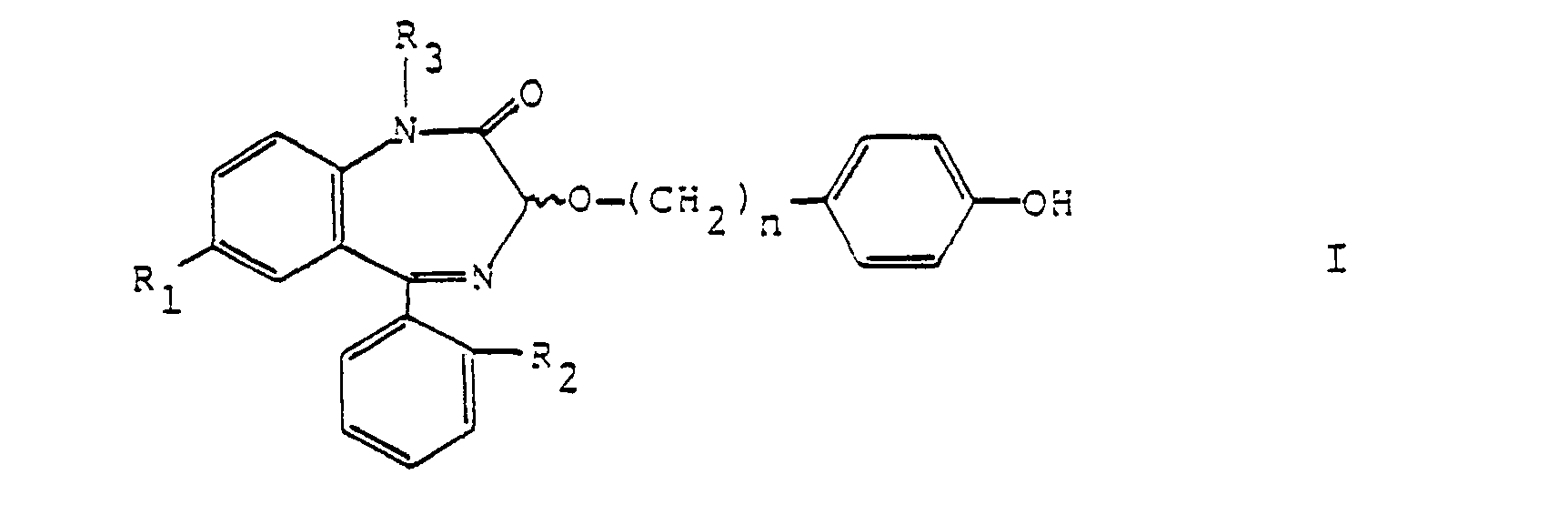
- the present invention includes compounds of the formula wherein R, halogen or nitro, R 2 is hydrogen or halogen and R 3 is hydrogen or lower alkyl and n is 2-6.
- the present invention also encompasses the compounds of the above formula which are radioactive.
- the compounds of the formula I can be radioactively labeled very easily.
- the radioactive molecule is bound either to the 3-position or the 3- and 5-position of the hydroxy phenyl radical of the compound of the formula I.
- the compounds are preferably marked with J '25 .
- a compound of formula 1 in which R, chlorine, R 2 is hydrogen is particularly preferred.
- R 3 is hydrogen and n 2, which compound has the formula having.
- a compound of the formula I (a) which is radioactively labeled is also particularly preferred.
- the radioactive molecule binds to the 3- or the 3- and 5-positions of the hydroxyphenyl radical of the compound of the formula I (a).
- a compound of the formula I (a) which is labeled with J 125 and which compound J 125 is -7-chloro-3- [2- (4-hydroxyphenyl) ethoxy] -5-phenyl-1,3-dihydro is particularly preferred -2H-1,4-benzodiazepin-2-one.
- lower alkyl means straight-chain or branched alkyl having up to 6 C atoms, preferably up to 3 C atoms.
- the compounds of formula I can be prepared by reacting a compound of formula II with a 4-hydroxyphen (CH 2 ) n alcohol in dry N, N-dimethylformamide. The solution is kept cold and stirred while hydrogen chloride gas is bubbled into the solution. The reaction mixture is then kept at room temperature and cooled again, whereupon the pH is adjusted to 7.1 to 7.9 with a base. The mixture is then filtered and the gum-like precipitate is blended with dichlorme than and stirred water and then filtered. The solid is crystallized from a mixture of dichloromethane and methanol and gives the compound of formula I.
- the invention further encompasses the use of the radioactively labeled compound of the formula I in an immunoassay to detect the presence of benzodiazepines.
- the compound of the formula I is particularly preferred if it is radioactively labeled with J 125 .
- a particularly preferred J 125 labeled compound of the formula I is J 125-7 -chloro-3- [2- (4-hydroxyphenyl) ethoxy] -5-phenyl-1,3-dihydro-2H-1,4-benzodiazepine 2-on.
- the preferred radioimmunoassay for determining benzodiazepines is based on the principle of competition.
- the compounds of the formula I are first radioactively labeled using known methods. It is preferred if the compounds of the formula I are radiolabelled with J 125 using the method described in US Pat. No. 4,083,948 in order to obtain J 125 labeled compounds. It is particularly preferred if the radiolabeled compound of the formula IJ 125 -7-chloro-3- [2- (4-hydroxyphenyl) ethoxy] -5-phenyl-1,3-dihydro-2H-1,4-benzodiazepine-2 -one is used in a radioimmunoassay for the determination of benzodiazepines.
- the radioactively labeled compounds of the formula I bind to antibodies against benzodiazepines.
- An unknown sample containing an unknown amount of benzodiazepines or their metabolites is used in the system. Any benzodiazepines present in the unknown sample compete with the iodinated compounds of the formula I for the antibodies and allow the amount of benzodiazepines in the unknown sample to be quantified.
- the radiolabelled compounds of formula I are then used in a radioimmunoassay to determine the presence of benzodiazepines.
- the methodology of these radioimmunoassays is well known and is described in U.S. Patent No. 4,083,948.
- the invention further encompasses the use of the radioactively labeled compound of the formula I in an immunoassay to detect the presence of benzodiazepines.
- the compound of the formula I is particularly preferred if it is radioactively labeled with J 125 .
- a particularly preferred J 125 labeled compound of the formula I is J 125-7 -chloro-3- [2- (4-hydroxyphenyl) ethoxy] -5-phenyl-1,3-dihydro-2H-1,4-benzodiazepine 2-on.
- the preferred radioimmunoassay for determining benzodiazepines is based on the principle of competition.
- the compounds of the formula I are first radioactively labeled using known methods. It is preferred if the compounds of the formula are radiolabeled with J '25 using the method described in US Pat. No. 4,083,948 to obtain J 125 labeled compounds. It is particularly preferred if the radiolabeled compound of the formula IJ 125 -7-chloro-3- [2- (4-hydroxyphenyl) ethoxy] -5-phenyl-1,3-dihydro-2H-1,4-benzodiazepine-2 -one is used in a radioimmunoassay for the determination of benzodiazepines.
- the radioactively labeled compounds of the formula I bind to antibodies against benzodiazepines.
- An unknown sample containing an unknown amount of benzodiazepines or their metabolites is used in the system. Any benzodiazepines present in the unknown sample compete with the iodinated compounds of the formula I for the antibodies and allow the amount of benzodiazepines in the unknown sample to be quantified.
- the radiolabelled compounds of formula I are then used in a radioimmunoassay to determine the presence of benzodiazepines.
- the methodology of these radioimmunoassays is well known and is described in U.S. Patent No. 4,083,948.
Landscapes
- Chemical & Material Sciences (AREA)
- Organic Chemistry (AREA)
- Investigating Or Analysing Biological Materials (AREA)
- Pharmaceuticals Containing Other Organic And Inorganic Compounds (AREA)
- Plural Heterocyclic Compounds (AREA)
- Organic Low-Molecular-Weight Compounds And Preparation Thereof (AREA)
- Steroid Compounds (AREA)
- Medicines Containing Antibodies Or Antigens For Use As Internal Diagnostic Agents (AREA)
Abstract
Description
- Publizierte Uebersichten zeigen, dass nicht weniger als einer von zehn Erwachsenen Amerikanern innerhalb von Jahresfrist einen Benzodiazepin-Tranquitizer oder ein Benzodiazepin-Hypnotikum zu sich nimmt. Diese Verbindungen werden bei zahlreichen Zuständen verschrieben, z.B. bei neurotischer Aengstlichkeit, Depressionen, Schlaflosigkeit und Muskelspasmen sowie bei zahllosen funktionellen Fehlzuständen, die von Kopfschmerzen bis zu Dyspareunien reichen (Benzodiazepins in Clinical Medicine, Greenblatt and Shader, Raven Press, 1974).
- Nach der Einnahme von therapeutischen Dosen von Benzodiazepinen sind, bedingt durch die extensive Biotransformation und die Gewebeverteilung, nur Spuren in Körperflüssigkeiten vorhanden. Aus diesem Grunde sind sehr sensitive Methoden für die Quantifizierung von Benzodiazepinen in Gewebe und Körperflüssigkeiten notwendig.
- Es existiert eine Vielzahl von Suchmethoden für die Detektion von Benzodiazepinen in Blut, Urin oder Körperflüssigkeiten. Hierzu wurden Dünnschichtchromatographie oder Gasflüssigchromatographie oder Spectrophotofluorometrie verwendet. In neuerer Zeit wurden immunologische Methoden entwickelt, um mit Hilfe von Antikörpern gegen Benzodiazepine kleine Mengen von Benzodiazepinen in Körperflüssigkeiten erfolgreich zu quantifizieren. Bei dieser Technologie ist es besonders notwendig, eine Verbindung zu haben, welche als Substrat wirkt und welche an den "Tracer" (welcher die Bestimmung und Quantifizierung des unbekannten Analyten erlaubt) binden kann. Zahlreiche Benzodiazepinderivate wurden für diesen Zweck verwendet. In diesem Zusammenhang sei auch die U.S.-Patentschrift Nr. 4,083,948 von Davis et al. hingewiesen, in welcher ein Benzodiazepin Radioimmunverfahren beschrieben ist, bei den J125 markierte Benzodiazepinderivate als Substrate verwendet werden.
- Die vorliegende Erfindung umfasst neue Benzodiazepinderivate. Die vorliegende Erfindung umfasst auch radioaktiv markierte neue Benzodiazepinderivate.
- Weiterhin umfasst die vorliegende Erfindung die Verwendung der Verbindungen gemäss vorliegender Erfindung in Immunassays zum Auffinden des Vorliegens von Benzodiazepin.
- Die vorliegende Erfindung umfasst Verbindungen der Formel

- Die vorliegende Erfindung umfasst ebenfalls die Verbindungen der obigen Formel, welche radioaktiv sind. Die Verbindungen der Formel I sind sehr leicht radioaktiv zu markieren. Das radioaktive Molekül wird entweder an die 3-Stellung oder die 3- und 5-Stellung des Hydroxy phenylrests der Verbindung der Formel I gebunden. Bevorzugt sind die Verbindungen mit J'25 markiert.
- Besonders bevorzugt ist eine Verbindung der Formel 1 worin R, Chlor, R2 Wasserstoff. R3 Wasserstoff und n 2 ist, wobei diese Verbindung die Formel

- Ebenfalls besonders bevorzugt ist eine Verbindung der Formal I(a), welche radioaktiv markiert ist. Das radioaktive Molekül bindet an die 3- oder die 3- und 5-Stellung des Hydroxyphenylrests der Verbindung der Formel I(a). Besonders bevorzugt ist eine Verbindung der Formel I(a), welche mit J125 markiert ist und welche Verbindung J125-7-Chlor-3-[2-(4-hydroxyphenyl)äthoxy]-5-phenyl-1,3-dihydro-2H-1,4-benzodiazepin-2-on ist.
- Die Zwischenprodukte die zur Herstellung der Verbindungen der Formel I verwendet werden, sind bekannt und entsprechen der allgemeinen Formel

- Der Begriff niederes Alkyl bedeutet geradkettiges oder verzweigtes Alkyl mit bis zu 6 C-Atomen, vorzugsweise bis zu 3 C-Atomen.
- Bevorzugt ist das Zwischenprodukt der Formel II, worin R1 Chlor, R2 Wasserstoff, R3 Wasserstoff und R4 Methyl ist, wobei die Verbindung die Formel

- Die Verbindungen der Formel I können hergestellt werden durch Reaktion einer Verbindung der Formel II mit einem 4-Hydroxyphen(CH2)n Alkohol in trockenem N,N-Dimethylformamid. Die Lösung wird kalt gehalten und gerührt, wobei Chlorwasserstoffgas in die Lösung geleitet wird. Das Reaktionsgemisch wird dann bei Raumtemperatur gehalten und erneut gekühlt, worauf der pH mit einer Base auf 7,1 bis 7,9 adjustiert wird. Das Gemisch wird dann filtriert und der gummi-ähnliche Niederschlag wird mit Dichlormethan und Wasser gerührt und dann filtriert. Der Feststoff wird aus einer Mischung von Dichlormethan und Methanol kristallisiert und liefert die Verbindung der Formel I.
- Die Erfindung umfasst weiterhin die Verwendung der radioaktiv markierten Verbindung der Formel I in einem Immunassay zum Auffinden der Gegenwart von Benzodiazepinen.
- Besonders bevorzugt ist die Verbindung der Formel I, wenn sie mit J125 radioaktiv markiert ist. Eine besonders bevorzugte J125 markierte Verbindung der Formel I ist J125-7-Chlor-3-[2-(4-hydroxyphenyl)-äthoxy]-5-phenyl-1,3-dihydro-2H-1,4-benzodiazepin-2-on.
- Das bevorzugte Radioimmunverfahren zur Bestimmung der Benzodiazepinen basiert auf dem Kompetitionsprinzip. Die Verbindungen der Formel I werden zuerst nach bekannten Methoden radioaktiv markiert. Bevorzugt ist, wenn die Verbindungen der Formel I mit J125 radioaktiv markiert werden, und zwar nach der in der U.S.-Patentschrift Nr. 4,083,948 beschriebenen Methode, um J125 markierte Verbindungen zu erhalten. Besonders bevorzugt ist, wenn die radioaktiv markierte Verbindung der Formel I J125-7-Chlor-3-[2-(4-hydroxyphenyl)äthoxy]-5-phenyl-1,3-dihydro-2H-1,4-benzodiazepin-2-on in einem Radioimmunverfahren zur Bestimmung von Benzodiazepinen verwendet wird.
- Die radioaktiv markierten Verbindungen der Formel I binden an Antikörper gegen Benzodiazepine. Eine unbekannte Probe enthaltend eine unbekannte Menge von Benzodiazepinen oder von deren Metaboliten wird in das System eingesetzt. Allfällige vorhandene Benzodiazepine in der unbekannten Probe konkurrieren mit den jodinierten Verbindungen der Formel I um die Antikörper und erlauben die Quantifizierung der Menge an Benzodiazepinen in der unbekannten Probe. Die radioaktiv markierten Verbindungen der Formel I werden dann in einem Radioimmunverfahren zur Bestimmung der Gegenwart von Benzodiazepinen verwendet. Die Methodik dieser Radioimmunverfahren ist bekannt und in der U.S.-Patentschrift Nr. 4,083,948 beschrieben.
- Die vorliegende Erfindung wird weiterhin im Zusammenhang mit den folgenden Beispielen beschrieben, welche jedoch lediglich zur Illustration dienen.
- Eine Lösung von 10.0 g (0,0309 mol) 3-Acetoxy-7-chlor-5-phenyl-1,3-dihydro-2H-1,4-benzodiazepin-2- on und 11,0 g (0,080 mol) 4-Hydroxyphenothylalkohol (Aldrich) in 50 ml trockenem N,N-Dimethylformamid wird in Eisbad gerührt, wobei während 5 bis 10 Min. Chlorwasserstoffgas in die Lösung eingeleitet wird. Nach Stehenlassen des Reaktionsgemisches während 18 Std. bei Raumtemperatur wird das Reaktionsgemisch auf Eis gegossen und der pH wird mit Ammoniumhydroxid auf 7,5 eingestellt. Die Mischung wird filtriert und der gummiähnliche Rückstand wird während 5 Min. mit 50 ml Dichlormethan und 50 ml Wasser gewaschen und dann filtriert. Der Feststoff wird aus einer Mischung von Dichlormethan und Methanol kristallisiert und liefert 9,6 g (77%) der Verbindung der Formel I(a) als weisse Stäbchen vom Schmelzpunkt 222-230 C.
- than und Wasser gerührt und dann filtriert. Der Feststoff wird aus einer Mischung von Dichlormethan und Methanol kristallisiert und liefert die Verbindung der Formel t.
- Die Erfindung umfasst weiterhin die Verwendung der radioaktiv markierten Verbindung der Formel I in einem Immunassay zum Auffinden der Gegenwart von Benzodiazepinen.
- Besonders bevorzugt ist die Verbindung der Formel I, wenn sie mit J125 radioaktiv markiert ist. Eine besonders bevorzugte J125 markierte Verbindung der Formel I ist J125-7-Chlor-3-[2-(4-hydroxyphenyl)-äthoxy]-5-phenyl-1,3-dihydro-2H-1,4-benzodiazepin-2-on.
- Das bevorzugte Radioimmunverfahren zur Bestimmung der Benzodiazepinen basiert auf dem Kompetitionsprinzip. Die Verbindungen der Formel I werden zuerst nach bekannten Methoden radioaktiv markiert. Bevorzugt ist, wenn die Verbindungen der Formel mit J'25 radioaktiv markiert werden, und zwar nach der in der U.S.-Patentschrift Nr. 4,083,948 beschriebenen Methode, um J125 markierte Verbindungen zu erhalten. Besonders bevorzugt ist, wenn die radioaktiv markierte Verbindung der Formel I J125-7-Chlor-3-[2-(4-hydroxyphenyl)äthoxy]-5-phenyl-1,3-dihydro-2H-1,4-benzodiazepin-2-on in einem Radioimmunverfahren zur Bestimmung von Benzodiazepinen verwendet wird.
- Die radioaktiv markierten Verbindungen der Formel I binden an Antikörper gegen Benzodiazepine. Eine unbekannte Probe enthaltend eine unbekannte Menge von Benzodiazepinen oder von deren Metaboliten wird in das System eingesetzt. Allfällige vorhandene Benzodiazepine in der unbekannten Probe konkurrieren mit den jodinierten Verbindungen der Formel I um die Antikörper und erlauben die Quantifizierung der Menge an Benzodiazepinen in der unbekannten Probe. Die radioaktiv markierten Verbindungen der Formel I werden dann in einem Radioimmunverfahren zur Bestimmung der Gegenwart von Benzodiazepinen verwendet. Die Methodik dieser Radioimmunverfahren ist bekannt und in der U.S.-Patentschrift Nr. 4,083,948 beschrieben.
- Die vorliegende Erfindung wird weiterhin im Zusammenhang mit den folgenden Beispielen beschrieben, welche jedoch lediglich zur Illustration dienen.
- Eine Lösung von 10,0 g (0,0309 mol) 3-Acetoxy-7-chlor-5-phenyl-1,3-dihydro-2H-1,4-benzodiazepin-2- on und 11,0 g (0,080 mol) 4-Hydroxyphenothylalkohol (Aldrich) in 50 ml trockenem N,N-Dimethylformamid wird in Eisbad gerührt, wobei während 5 bis 10 Min. Chlorwasserstoffgas in die Lösung eingeleitet wird. Nach Stehenlassen des Reaktionsgemisches während 18 Std. bei Raumtemperatur wird das Reaktionsgemisch auf Eis gegossen und der pH wird mit Ammoniumhydroxid auf 7,5 eingestellt. Die Mischung wird filtriert und der gummiähnliche Rückstand wird während 5 Min. mit 50 ml Dichlormethan und 50 ml Wasser gewaschen und dann filtriert. Der Feststoff wird aus einer Mischung von Dichlormethan und Methanol kristallisiert und liefert 9,6 g (77%) der Verbindung der Formel I(a) als weisse Stäbchen vom Schmelzpunkt 222-230 C.
Claims (11)


Applications Claiming Priority (4)
| Application Number | Priority Date | Filing Date | Title |
|---|---|---|---|
| US7747287A | 1987-07-24 | 1987-07-24 | |
| US77472 | 1987-07-24 | ||
| US07/117,599 US4777169A (en) | 1987-07-24 | 1987-11-06 | Benzodiazepine derivatives |
| US117599 | 1987-11-06 |
Publications (2)
| Publication Number | Publication Date |
|---|---|
| EP0300341A2 true EP0300341A2 (de) | 1989-01-25 |
| EP0300341A3 EP0300341A3 (de) | 1989-11-23 |
Family
ID=26759300
Family Applications (1)
| Application Number | Title | Priority Date | Filing Date |
|---|---|---|---|
| EP88111181A Withdrawn EP0300341A3 (de) | 1987-07-24 | 1988-07-13 | Neue Benzodiazepin-Derivate, radioaktiv markierte Derivate davon sowie die Verwendung der letzteren in Immunverfahren zum Nachweis von Benzodiazepinen |
Country Status (4)
| Country | Link |
|---|---|
| US (1) | US4777169A (de) |
| EP (1) | EP0300341A3 (de) |
| JP (1) | JPS6440472A (de) |
| AU (1) | AU1924288A (de) |
Cited By (3)
| Publication number | Priority date | Publication date | Assignee | Title |
|---|---|---|---|---|
| EP0353754A3 (en) * | 1988-08-05 | 1990-04-11 | F. Hoffmann-La Roche Ag | Radioactively marked benzodiazepin derivates |
| EP0445976A1 (de) * | 1990-03-05 | 1991-09-11 | Merck & Co. Inc. | Gammastrahlung aussendende CCK-A-Antagonisten zur Erzeugung von Abbildungen der Bauchspeicheldrüse |
| US5096695A (en) * | 1988-08-05 | 1992-03-17 | Hoffmann-Laroche Inc. | Radioiodine benzodiazepines as brain imaging agents |
Families Citing this family (2)
| Publication number | Priority date | Publication date | Assignee | Title |
|---|---|---|---|---|
| US6171578B1 (en) | 1999-04-14 | 2001-01-09 | Diatide, Inc. | Benzodiazepine derivatives for imaging thrombi |
| US7029918B2 (en) | 2002-01-25 | 2006-04-18 | Roche Diagnostics Operations, Inc. | Water-soluble derivatives of lipophilic drugs |
Family Cites Families (3)
| Publication number | Priority date | Publication date | Assignee | Title |
|---|---|---|---|---|
| US3176009A (en) * | 1965-03-30 | Hydrolysis of l-acylated-j-acyloxy benzodiazepines | ||
| US4043989A (en) * | 1975-09-11 | 1977-08-23 | Syva Company | Oxazepam derivatives for immunoassay reagents |
| US4083948A (en) * | 1977-04-04 | 1978-04-11 | Hoffmann-La Roche, Inc. | Benzodiazepine radioimmunoassay using I125-label |
-
1987
- 1987-11-06 US US07/117,599 patent/US4777169A/en not_active Expired - Lifetime
-
1988
- 1988-07-13 EP EP88111181A patent/EP0300341A3/de not_active Withdrawn
- 1988-07-21 AU AU19242/88A patent/AU1924288A/en not_active Abandoned
- 1988-07-22 JP JP63181993A patent/JPS6440472A/ja active Pending
Cited By (3)
| Publication number | Priority date | Publication date | Assignee | Title |
|---|---|---|---|---|
| EP0353754A3 (en) * | 1988-08-05 | 1990-04-11 | F. Hoffmann-La Roche Ag | Radioactively marked benzodiazepin derivates |
| US5096695A (en) * | 1988-08-05 | 1992-03-17 | Hoffmann-Laroche Inc. | Radioiodine benzodiazepines as brain imaging agents |
| EP0445976A1 (de) * | 1990-03-05 | 1991-09-11 | Merck & Co. Inc. | Gammastrahlung aussendende CCK-A-Antagonisten zur Erzeugung von Abbildungen der Bauchspeicheldrüse |
Also Published As
| Publication number | Publication date |
|---|---|
| US4777169A (en) | 1988-10-11 |
| JPS6440472A (en) | 1989-02-10 |
| AU1924288A (en) | 1989-01-27 |
| EP0300341A3 (de) | 1989-11-23 |
Similar Documents
| Publication | Publication Date | Title |
|---|---|---|
| Ehlert et al. | An allosteric model for benzodiazepine receptor function | |
| DE69231559T2 (de) | Reagenzien und verfahren zur quantifizierung des totalgehaltes an doxepinen in biologischen flüssigkeiten | |
| DE2754086A1 (de) | Spezifisches bindungsverfahren zum nachweis und zur bestimmung eines liganden in einem fluessigen medium | |
| Vizi et al. | Heterogeneity of presynaptic muscarinic receptors involved in modulation of transmitter release | |
| DE69610716T2 (de) | Topiramate-immunoassay, sowie analoge und antikörper | |
| DE2600465C3 (de) | Verfahren zur radioimmunologischen Bestimmung von Östrogenen | |
| DE2716276A1 (de) | Verfahren und vorrichtung zur immunologischen bestimmung von gentamycin | |
| DE69119120T2 (de) | Gammastrahlung aussendende CCK-A-Antagonisten zur Erzeugung von Abbildungen der Bauchspeicheldrüse | |
| EP0013910A1 (de) | Theophyllin-Antigene und -Antikörper, Verfahren zu deren Herstellung, ihre Verwendung zur Bestimmung von Theophyllin, Reagens-Set und Antiserum für diese Verwendung | |
| DE69106746T2 (de) | Imidazo[1,2-c]chinazolinderivate, Verfahren zu ihrer Herstellung und diese enthaltende pharmazeutische Zubereitungen. | |
| DE2539242A1 (de) | Radioimmunologisches analyseverfahren zur bestimmung von digoxin | |
| JPS6296460A (ja) | 診断用放射性化合物、その製法及びキツト | |
| DE2741677A1 (de) | Folsaeurederivate, verfahren zu deren herstellung und ihre verwendung | |
| EP0300341A2 (de) | Neue Benzodiazepin-Derivate, radioaktiv markierte Derivate davon sowie die Verwendung der letzteren in Immunverfahren zum Nachweis von Benzodiazepinen | |
| DE3205506C2 (de) | Carboxyfluorescein-Derivate und ihre Verwendung als Tracer zur Bestimmung von Liganden in biologischen Flüssigkeiten mittels einer Fluoreszenzpolarisationstechnik | |
| DE3129705A1 (de) | Mit dichlortriazinylaminofluorescein markierte verbindungen von biologischem interesse | |
| DE60133010T2 (de) | Radioliganden- und bindungs-assay | |
| DE2548196A1 (de) | Antigene auf basis von methaqualon- hapten sowie deren verwendung | |
| DE2914842A1 (de) | Reagenzien zur verwendung bei bindungsproben beim nachweis von diphenylhydantoin | |
| DE2724762C3 (de) | Cortisolderivate und radioimmunoilogisches Verfahrens | |
| Black et al. | Pharmacological analysis of muscarinic receptors coupled to oxyntic cell secretion in the mouse stomach | |
| Birdsall et al. | The binding of pirenzepine to digitonin‐solubilized muscarinic acetylcholine receptors from the rat myocardium | |
| Cantiello et al. | α2-Adrenergic receptors and the Na+/H+ exchanger in the intestinal epithelial cell line, HT-29 | |
| Agoston et al. | The fate of pancuronium bromide in the cat | |
| DE69210434T2 (de) | Ein kolorimetrisches Verfahren und Reagenz zum Nachweis von Lithium in einer Testprobe |
Legal Events
| Date | Code | Title | Description |
|---|---|---|---|
| PUAI | Public reference made under article 153(3) epc to a published international application that has entered the european phase |
Free format text: ORIGINAL CODE: 0009012 |
|
| 17P | Request for examination filed |
Effective date: 19880713 |
|
| AK | Designated contracting states |
Kind code of ref document: A2 Designated state(s): BE CH DE FR GB IT LI NL |
|
| RAP1 | Party data changed (applicant data changed or rights of an application transferred) |
Owner name: F. HOFFMANN-LA ROCHE AG |
|
| PUAL | Search report despatched |
Free format text: ORIGINAL CODE: 0009013 |
|
| AK | Designated contracting states |
Kind code of ref document: A3 Designated state(s): BE CH DE FR GB IT LI NL |
|
| 17Q | First examination report despatched |
Effective date: 19920511 |
|
| STAA | Information on the status of an ep patent application or granted ep patent |
Free format text: STATUS: THE APPLICATION IS DEEMED TO BE WITHDRAWN |
|
| 18D | Application deemed to be withdrawn |
Effective date: 19920922 |