EP0300398A2 - 3-Phenylpropionsäurederivate - Google Patents
3-Phenylpropionsäurederivate Download PDFInfo
- Publication number
- EP0300398A2 EP0300398A2 EP88111485A EP88111485A EP0300398A2 EP 0300398 A2 EP0300398 A2 EP 0300398A2 EP 88111485 A EP88111485 A EP 88111485A EP 88111485 A EP88111485 A EP 88111485A EP 0300398 A2 EP0300398 A2 EP 0300398A2
- Authority
- EP
- European Patent Office
- Prior art keywords
- halogen
- oder
- alkyl
- cycloalkyl
- substituted
- Prior art date
- Legal status (The legal status is an assumption and is not a legal conclusion. Google has not performed a legal analysis and makes no representation as to the accuracy of the status listed.)
- Withdrawn
Links
- 0 *CCC1=CC(*)=C(CC(*)*)CC1[N+]([O-])=O Chemical compound *CCC1=CC(*)=C(CC(*)*)CC1[N+]([O-])=O 0.000 description 4
Classifications
-
- C—CHEMISTRY; METALLURGY
- C07—ORGANIC CHEMISTRY
- C07D—HETEROCYCLIC COMPOUNDS
- C07D209/00—Heterocyclic compounds containing five-membered rings, condensed with other rings, with one nitrogen atom as the only ring hetero atom
- C07D209/02—Heterocyclic compounds containing five-membered rings, condensed with other rings, with one nitrogen atom as the only ring hetero atom condensed with one carbocyclic ring
- C07D209/44—Iso-indoles; Hydrogenated iso-indoles
- C07D209/48—Iso-indoles; Hydrogenated iso-indoles with oxygen atoms in positions 1 and 3, e.g. phthalimide
-
- A—HUMAN NECESSITIES
- A01—AGRICULTURE; FORESTRY; ANIMAL HUSBANDRY; HUNTING; TRAPPING; FISHING
- A01N—PRESERVATION OF BODIES OF HUMANS OR ANIMALS OR PLANTS OR PARTS THEREOF; BIOCIDES, e.g. AS DISINFECTANTS, AS PESTICIDES OR AS HERBICIDES; PEST REPELLANTS OR ATTRACTANTS; PLANT GROWTH REGULATORS
- A01N37/00—Biocides, pest repellants or attractants, or plant growth regulators containing organic compounds containing a carbon atom having three bonds to hetero atoms with at the most two bonds to halogen, e.g. carboxylic acids
- A01N37/18—Biocides, pest repellants or attractants, or plant growth regulators containing organic compounds containing a carbon atom having three bonds to hetero atoms with at the most two bonds to halogen, e.g. carboxylic acids containing the group —CO—N<, e.g. carboxylic acid amides or imides; Thio analogues thereof
- A01N37/32—Cyclic imides of polybasic carboxylic acids or thio analogues thereof
-
- A—HUMAN NECESSITIES
- A01—AGRICULTURE; FORESTRY; ANIMAL HUSBANDRY; HUNTING; TRAPPING; FISHING
- A01N—PRESERVATION OF BODIES OF HUMANS OR ANIMALS OR PLANTS OR PARTS THEREOF; BIOCIDES, e.g. AS DISINFECTANTS, AS PESTICIDES OR AS HERBICIDES; PEST REPELLANTS OR ATTRACTANTS; PLANT GROWTH REGULATORS
- A01N37/00—Biocides, pest repellants or attractants, or plant growth regulators containing organic compounds containing a carbon atom having three bonds to hetero atoms with at the most two bonds to halogen, e.g. carboxylic acids
- A01N37/36—Biocides, pest repellants or attractants, or plant growth regulators containing organic compounds containing a carbon atom having three bonds to hetero atoms with at the most two bonds to halogen, e.g. carboxylic acids containing at least one carboxylic group or a thio analogue, or a derivative thereof, and a singly bound oxygen or sulfur atom attached to the same carbon skeleton, this oxygen or sulfur atom not being a member of a carboxylic group or of a thio analogue, or of a derivative thereof, e.g. hydroxy-carboxylic acids
-
- A—HUMAN NECESSITIES
- A01—AGRICULTURE; FORESTRY; ANIMAL HUSBANDRY; HUNTING; TRAPPING; FISHING
- A01N—PRESERVATION OF BODIES OF HUMANS OR ANIMALS OR PLANTS OR PARTS THEREOF; BIOCIDES, e.g. AS DISINFECTANTS, AS PESTICIDES OR AS HERBICIDES; PEST REPELLANTS OR ATTRACTANTS; PLANT GROWTH REGULATORS
- A01N37/00—Biocides, pest repellants or attractants, or plant growth regulators containing organic compounds containing a carbon atom having three bonds to hetero atoms with at the most two bonds to halogen, e.g. carboxylic acids
- A01N37/42—Biocides, pest repellants or attractants, or plant growth regulators containing organic compounds containing a carbon atom having three bonds to hetero atoms with at the most two bonds to halogen, e.g. carboxylic acids containing within the same carbon skeleton a carboxylic group or a thio analogue, or a derivative thereof, and a carbon atom having only two bonds to hetero atoms with at the most one bond to halogen, e.g. keto-carboxylic acids
-
- A—HUMAN NECESSITIES
- A01—AGRICULTURE; FORESTRY; ANIMAL HUSBANDRY; HUNTING; TRAPPING; FISHING
- A01N—PRESERVATION OF BODIES OF HUMANS OR ANIMALS OR PLANTS OR PARTS THEREOF; BIOCIDES, e.g. AS DISINFECTANTS, AS PESTICIDES OR AS HERBICIDES; PEST REPELLANTS OR ATTRACTANTS; PLANT GROWTH REGULATORS
- A01N43/00—Biocides, pest repellants or attractants, or plant growth regulators containing heterocyclic compounds
- A01N43/02—Biocides, pest repellants or attractants, or plant growth regulators containing heterocyclic compounds having rings with one or more oxygen or sulfur atoms as the only ring hetero atoms
- A01N43/04—Biocides, pest repellants or attractants, or plant growth regulators containing heterocyclic compounds having rings with one or more oxygen or sulfur atoms as the only ring hetero atoms with one hetero atom
- A01N43/06—Biocides, pest repellants or attractants, or plant growth regulators containing heterocyclic compounds having rings with one or more oxygen or sulfur atoms as the only ring hetero atoms with one hetero atom five-membered rings
- A01N43/08—Biocides, pest repellants or attractants, or plant growth regulators containing heterocyclic compounds having rings with one or more oxygen or sulfur atoms as the only ring hetero atoms with one hetero atom five-membered rings with oxygen as the ring hetero atom
-
- A—HUMAN NECESSITIES
- A01—AGRICULTURE; FORESTRY; ANIMAL HUSBANDRY; HUNTING; TRAPPING; FISHING
- A01N—PRESERVATION OF BODIES OF HUMANS OR ANIMALS OR PLANTS OR PARTS THEREOF; BIOCIDES, e.g. AS DISINFECTANTS, AS PESTICIDES OR AS HERBICIDES; PEST REPELLANTS OR ATTRACTANTS; PLANT GROWTH REGULATORS
- A01N43/00—Biocides, pest repellants or attractants, or plant growth regulators containing heterocyclic compounds
- A01N43/02—Biocides, pest repellants or attractants, or plant growth regulators containing heterocyclic compounds having rings with one or more oxygen or sulfur atoms as the only ring hetero atoms
- A01N43/04—Biocides, pest repellants or attractants, or plant growth regulators containing heterocyclic compounds having rings with one or more oxygen or sulfur atoms as the only ring hetero atoms with one hetero atom
- A01N43/06—Biocides, pest repellants or attractants, or plant growth regulators containing heterocyclic compounds having rings with one or more oxygen or sulfur atoms as the only ring hetero atoms with one hetero atom five-membered rings
- A01N43/10—Biocides, pest repellants or attractants, or plant growth regulators containing heterocyclic compounds having rings with one or more oxygen or sulfur atoms as the only ring hetero atoms with one hetero atom five-membered rings with sulfur as the ring hetero atom
-
- A—HUMAN NECESSITIES
- A01—AGRICULTURE; FORESTRY; ANIMAL HUSBANDRY; HUNTING; TRAPPING; FISHING
- A01N—PRESERVATION OF BODIES OF HUMANS OR ANIMALS OR PLANTS OR PARTS THEREOF; BIOCIDES, e.g. AS DISINFECTANTS, AS PESTICIDES OR AS HERBICIDES; PEST REPELLANTS OR ATTRACTANTS; PLANT GROWTH REGULATORS
- A01N43/00—Biocides, pest repellants or attractants, or plant growth regulators containing heterocyclic compounds
- A01N43/02—Biocides, pest repellants or attractants, or plant growth regulators containing heterocyclic compounds having rings with one or more oxygen or sulfur atoms as the only ring hetero atoms
- A01N43/04—Biocides, pest repellants or attractants, or plant growth regulators containing heterocyclic compounds having rings with one or more oxygen or sulfur atoms as the only ring hetero atoms with one hetero atom
- A01N43/14—Biocides, pest repellants or attractants, or plant growth regulators containing heterocyclic compounds having rings with one or more oxygen or sulfur atoms as the only ring hetero atoms with one hetero atom six-membered rings
- A01N43/16—Biocides, pest repellants or attractants, or plant growth regulators containing heterocyclic compounds having rings with one or more oxygen or sulfur atoms as the only ring hetero atoms with one hetero atom six-membered rings with oxygen as the ring hetero atom
-
- A—HUMAN NECESSITIES
- A01—AGRICULTURE; FORESTRY; ANIMAL HUSBANDRY; HUNTING; TRAPPING; FISHING
- A01N—PRESERVATION OF BODIES OF HUMANS OR ANIMALS OR PLANTS OR PARTS THEREOF; BIOCIDES, e.g. AS DISINFECTANTS, AS PESTICIDES OR AS HERBICIDES; PEST REPELLANTS OR ATTRACTANTS; PLANT GROWTH REGULATORS
- A01N43/00—Biocides, pest repellants or attractants, or plant growth regulators containing heterocyclic compounds
- A01N43/02—Biocides, pest repellants or attractants, or plant growth regulators containing heterocyclic compounds having rings with one or more oxygen or sulfur atoms as the only ring hetero atoms
- A01N43/04—Biocides, pest repellants or attractants, or plant growth regulators containing heterocyclic compounds having rings with one or more oxygen or sulfur atoms as the only ring hetero atoms with one hetero atom
- A01N43/14—Biocides, pest repellants or attractants, or plant growth regulators containing heterocyclic compounds having rings with one or more oxygen or sulfur atoms as the only ring hetero atoms with one hetero atom six-membered rings
- A01N43/18—Biocides, pest repellants or attractants, or plant growth regulators containing heterocyclic compounds having rings with one or more oxygen or sulfur atoms as the only ring hetero atoms with one hetero atom six-membered rings with sulfur as the ring hetero atom
-
- A—HUMAN NECESSITIES
- A01—AGRICULTURE; FORESTRY; ANIMAL HUSBANDRY; HUNTING; TRAPPING; FISHING
- A01N—PRESERVATION OF BODIES OF HUMANS OR ANIMALS OR PLANTS OR PARTS THEREOF; BIOCIDES, e.g. AS DISINFECTANTS, AS PESTICIDES OR AS HERBICIDES; PEST REPELLANTS OR ATTRACTANTS; PLANT GROWTH REGULATORS
- A01N53/00—Biocides, pest repellants or attractants, or plant growth regulators containing cyclopropane carboxylic acids or derivatives thereof
Definitions
- halogen means fluorine, chlorine or bromine.
- R ' is halogen preferably fluorine and R 2 preferably chlorine or bromine.
- alkyl (alone or as part of a substituent) encompasses branched and straight-chain radicals. Examples are methyl, ethyl, n-propyl, isopropyl, n-butyl, sec.butyl, isobutyl and the higher homologues pentyl, hexyl etc. together with their isomers. Analogously, alkanoyle and cyanoalkyl contain an additional carbon atom.
- alkenyl and alkynyl radicals can also be branched or straight-chain.
- alkenyl residues in formula I are allyl, 2-propenyl, 2-butenyl, 3-butenyl, 2-isobutenyl.
- Alkynyl residues are usually propargyl. 2-butynyl, 3-butynyl and isomeric pentynyl radicals; however, the alkynyl radical is preferably a propargyl or 2- or 3-butynyl radical.
- alkoxy means: methoxy, ethoxy, n-propyloxy, i-propyloxy. the four isomeric butyloxy radicals, especially methoxy, ethoxy or i-propyloxy.
- alkylthio in formula I are methylthio, ethylthio, n-propylthio, i-propylthio or n-butylthio, especially methylthio and ethylthio
- cycloalkyl groups are cyclopropyl, cyclobutyl, cyclopentyl, cyclohexyl and cycloheptyl. Cycloaliphatic radicals correspond to these ring systems.
- alkylene chain is meant especially the propylene, butylene and pentylene chain. Apart from the methylene groups in them, each of them can be replaced by an oxygen or sulfur atom. Methyleneoxamethylene, methyleneoxaethylene, methyleneoxapropylene and ethyleneoxaethylene chains as examples of oxygen-containing groups and methylenethiamethylene, methylenethiaethylene, methylenethiapropylene and ethylenethiaethylene chains for the corresponding sulfur-containing substituents should preferably be mentioned.
- the phenylpropionic acid derivatives of the formula I can be regarded as N-tetrahydrophthalimides; they are accordingly composed of 3.4.5.6-tetrahydrophthalic anhydride and an aniline derivative of the formula VI, e.g. in a solvent at a temperature of 20 to 200 ° C. preferably 40 to 150 ° C, available.
- Suitable solvents are e.g. lower fatty acids such as glacial acetic acid or propionic acid or aprotic solvents. When working in an aprotic solvent, it is advisable to use a water separator.
- R ' is hydrogen or fluorine and R 2 is chlorine or bromine, where R 1 and R "cannot simultaneously have the meaning hydrogen if R 5 means cyano or carboxylic acid radical CO 2 R 7 owns.
- the aniline derivatives of the formula VI can be obtained, for example, by nitrating an appropriately substituted carboxylic ester derivative IV and then reducing the nitrobenzene V formed with tin (II) ions or with iron: The reduction can also be carried out by catalytic hydrogenation with a noble metal catalyst such as platinum or palladium under relatively mild conditions.
- This reaction is carried out in an aprotic solvent such as toluene, acetonitrile or dimethylformamide under two-phase conditions with an inorganic base such as sodium or potassium hydroxide in the presence of a phase transfer catalyst; crown ethers such as 15-crown-5 or 18-crown-6 or corresponding benzo-fused derivatives such as dibenzo-18-crown-6 are preferably used.
- a phase transfer catalyst crown ethers such as 15-crown-5 or 18-crown-6 or corresponding benzo-fused derivatives such as dibenzo-18-crown-6 are preferably used.
- R 5 is cyano, COR 6 or CO 2 R 7 : by a corresponding 3-phenylpropionic acid derivative of the formula VII obtainable, for example, from the underlying cinnamic acid in the presence of a base in a solvent according to those in Organic Reactions 9, 107 (1957) specified methods with a halide of the formula VIII, preferably an iodide or bromide.
- a halide of the formula VIII preferably an iodide or bromide.
- Compounds of type IV in which R 4 is halogen are preferably prepared in an organic solvent in a known manner by reaction with a sulfuryl halide. Suitable solvents are carboxylic acids such as. B. glacial acetic acid or propionic acid or hydrocarbons such as toluene. In this case, R 4 is preferably chlorine or bromine.
- a nitro compound XII are assumed, which leads directly to compounds of type V;
- Esterification provides the desired compounds IV:
- the conversion of II + IX to X proceeds in a two-phase system consisting of, for example, toluene or acetonitrile, and aqueous alkali metal hydroxide in the presence of a quaternary ammonium salt such as benzyltriethylammonium chloride, tetrabutyiammonium iodide, tetrabutylammonium hydroxide or tetrabutylammonium hydrogen sulfate.
- a quaternary ammonium salt such as benzyltriethylammonium chloride, tetrabutyiammonium iodide, tetrabutylammonium hydroxide or tetrabutylammonium hydrogen sulfate.
- the compounds of the formula I as stated at the outset, have a herbicidal action and are selective towards crop plants.
- the herbicidal compositions or the active compounds can be applied pre- or post-emergence. If the active ingredients are less compatible with certain crop plants, application techniques can be used in which the herbicidal compositions are sprayed with the aid of sprayers in such a way that the leaves of the sensitive crop plants are not hit wherever possible, while the active ingredients are applied to the leaves of undesirable plants growing below them or the uncovered floor area (post-directed, lay-by).
- target plants Depending on the control target, season, target plants and Stages of growth 0.01 to 5.0, preferably 0.03 to 0.5 kg, ha.
- the herbicidal activity of the compounds according to the invention on the growth of the test plants is shown by the following greenhouse tests.
- Plastic flower pots with a content of 300 cm 3 and loamy sand with about 3.0% humus serve as culture vessels. The seeds of the test plants are sown separately according to species.
- test plants are first grown to a height of 3 to 15 cm and then treated with the active ingredients which are suspended or emulsified in water as a distribution medium and are sprayed by means of finely distributing nozzles. Plants are sown directly and grown in the same containers, or they are first grown separately as seedlings.
- the application rate for post-emergence treatment is 0.5 kg a.S., ha. Cover is not provided for post-emergence treatment.
- test vessels are set up in a greenhouse experiment, with warmer areas (20 to 36 ° C.) being preferred for heat-loving species and 10 to 20 ° C. being preferred for such temperate climates.
- the trial period spans 2 to 4 weeks. During this time, the plants are cared for and their reaction to the individual treatments is evaluated.
- the evaluation is based on a scale from 0 to 100. 100 means that the seedlings do not sprout or that at least the aerial parts are completely destroyed.
- Tables A, B and D show that the example active ingredients 1,058, 1,046, 1,032. 1,035 and 1,020 have a very strong herbicidal effect against a large number of common broad-leaved plants.
- Compound 1,076 is also suitable for controlling grassy plants, e.g. Chicken millet (Tab. C).
- the compounds according to the invention or compositions containing them can also be used in a further number of crop plants for eliminating unwanted plants.
- crops can be considered:
- the new compounds can be mixed with numerous representatives of other herbicidal or growth-regulating active ingredient groups and applied together.
- diazines, 4H-3,1-benzoazine derivatives, benzothiadiazinones, 2,6-dinitroanilines, N-phenylcarbamates, thiolcarbamates, halocarboxylic acids, triazines, amides come as mixing partners.
Landscapes
- Life Sciences & Earth Sciences (AREA)
- Wood Science & Technology (AREA)
- Environmental Sciences (AREA)
- Plant Pathology (AREA)
- Health & Medical Sciences (AREA)
- Engineering & Computer Science (AREA)
- Dentistry (AREA)
- Pest Control & Pesticides (AREA)
- General Health & Medical Sciences (AREA)
- Zoology (AREA)
- Agronomy & Crop Science (AREA)
- Chemical & Material Sciences (AREA)
- Organic Chemistry (AREA)
- Agricultural Chemicals And Associated Chemicals (AREA)
- Organic Low-Molecular-Weight Compounds And Preparation Thereof (AREA)
- Plural Heterocyclic Compounds (AREA)
- Indole Compounds (AREA)
Abstract

- R1 Wasserstoff oder Halogen,
- R2 Halogen,
- R3 unsubstituiertes oder durch Halogen, C1-C4-Alkoxy oder C1-C4-Alkylthio substituiertes C2-C6-Alkyl, unsubstituiertes oder durch C5-C7-Cycloalkyl substituiertes C1-C6-Alkyl, ferner C7-C7-Cycloalkyl, C3-C6-Alkenyl oder C3-C6-Alkinyl oder mit R4 gemeinsam eine C2-C4-Alkylenkette,
- R4 Wasserstoff oder unsubstituiertes oder durch Halogen, C1-C4-Alkoxy oder C1-C4-Alkylthio substituiertes C2-C6-Alkyl, unsubstituiertes oder durch Cs-C7-Cycloalkyl substituiertes Ci-C6-Alkyl, C3-C7-Cycloalkyl, unsubstituiertes oder durch Halogen substituiertes C3-C6-Alkenyl oder C3-C6-Alkinyl oder Halogen oder in der R4 gemeinsam mit R5 und dem Kohlenstoffatom dieses Substituenten C3-C5-Cycloalkyl bildet, das durch ein Sauerstoffatom oder ein Schwefelatom unterbrochen sein kann.
- R5 unsubstituiertes oder durch Halogen, C1-C4-Alkoxy oder C1-C4-Alkylthio substituiertes C1-C6-Alkyl, Cyano oder Acyl (COR6) oder Alkoxycarbonyl (CO2R7), wobei bedeutet: R6 C1-C6 Alkyl oder gemeinsam mit R4 eine C3-Cs-Alkylenkette und
- R7 unsubstituiertes oder durch Halogen, C1-C4-Alkoxy oder C1-C4-Alkylthio substituiertes C2-C6-Alkyl oder unsubstituiertes oder durch C5-C7-Cycloalkyl substituiertes C1-C6-Alkyl, ferner C5-C7-Cycloalkyl, C3-C5-Alkenyl oder C3-C6-Alkinyl
- mit der Maßgabe, daß R1 und R4 nicht gleichzeitig die Bedeutung Wasserstoff haben können, wenn R5 Cyano oder CO2R7 ist,
- Verfahren zu ihrer Herstellung und ihre Verwendung als Herbizide.
Description
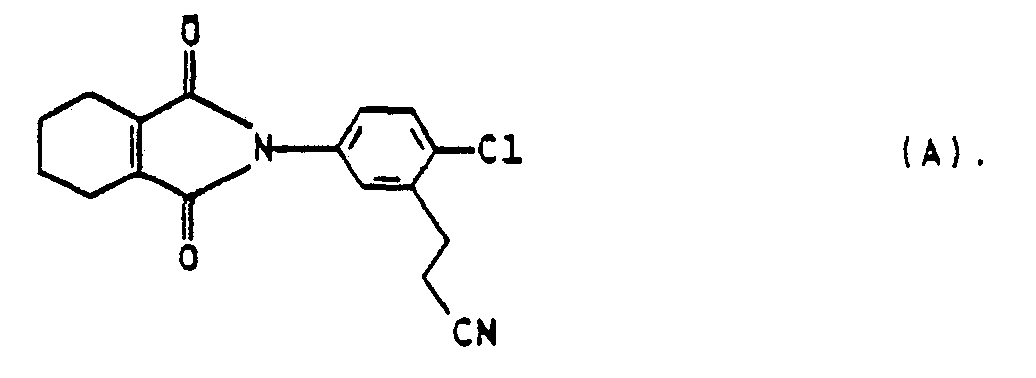
- Es ist aus der DE-A-15 42 777 bekannt, daß substituierte Phenylpropionsäuren herbizid wirksam sind. Ähnliche Verbindungen, z.B. die nachstehend wiedergegebene Verbindung A, sind in EP-A-68 822 beschrieben
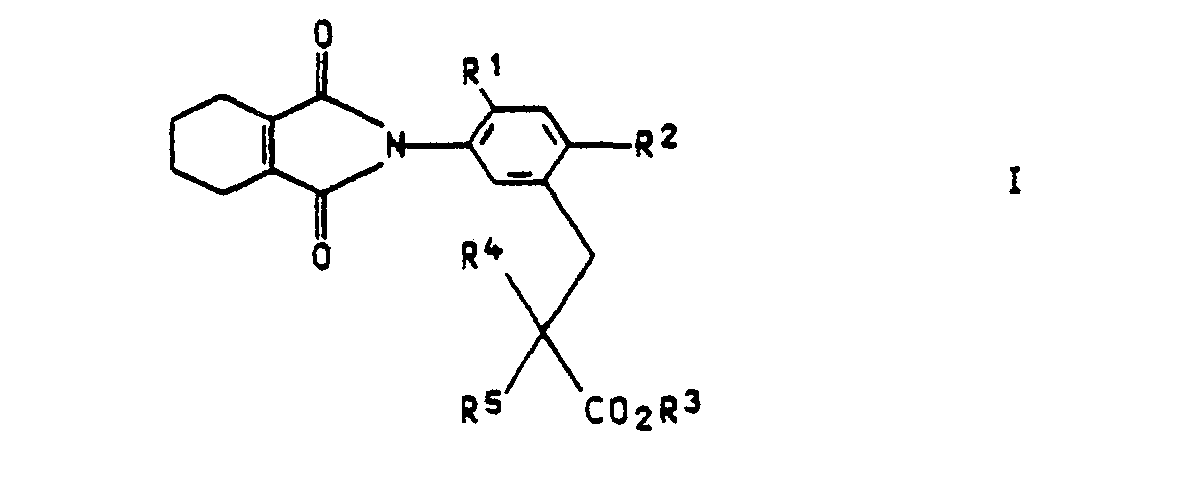
- R' Wasserstoff oder Halogen,
- R2 Halogen,
- R3 unsubstituiertes oder durch Halogen, C1-C4 Alkoxy oder C1-C4-Alkylthio substituiertes C2-C6-Alkyl, durch Cs-C7-Cycloalkyl substituiertes C1-C6-Alkyl, ferner C5-C7-Cycloalkyl, C3-C6-Alkenyl oder C3-C6-Alkinyl oder
- mit R4 gemeinsam eine C2-C4-Alkylenkette,
- R4 Wasserstoff oder unsubstituiertes oder durch Halogen, C1-C4-Alkoxy oder C1-C4-Alkylthio oder Cs-C7-Cycloalkyl substituiertes C1-C6-Alkyl; C3-C7-Cycloalkyl; unsubstituiertes oder durch Halogen substituiertes C3-C6-Alkenyl oder C3-C6-Alkinyl oder Halogen oder
- R4 gemeinsam mit R5 und dem Kohlenstoffatom dieses Substituenten C3-C6-Cycloalkyl, das durch ein Sauerstoffatom oder ein Schwefelatom unterbrochen sein kann,
- R5 unsubstituiertes Ci-Cs-Alkyl oder durch Halogen, C1-C4-Alkoxy oder C1-C4-Alkylthio substituiertes C2-Cs-Alkyl, Cyan oder Acyl (COR6) oder Alkoxycarbonyl (C02R7), wobei bedeutet:
- R6 C1-C6-Alkyl oder gemeinsam mit R4 eine C3-Cs-Alkylenkette und
- R7 unsubstituiertes oder durch Halogen, C1-C4-Alkoxy oder C1-C4-Alkylthio substituiertes C2-C6-Alkyl oder unsubstituiertes oder durch Cs-C7-Cycloalkyl substituiertes C1-C6-Alkyl, ferner Cs-C7-Cycloalkyl, C3-C6-Alkenyl oder C3-C6-Alkinyl,
- mit der Maßgabe, daß R' und R4 nicht gleichzeitig die Bedeutung Wasserstoff haben können, wenn R5
- Cyano oder CO2R7 ist,
- eine vorteilhafte herbizide Wirkung, besonders im Nachauflaufverfahren, haben und gegenüber einer Reihe
- von Kulturpflanzen selektiv sind.
- In der Formel I ist unter Halogen Fluor, Chlor oder Brom zu verstehen. wobei R' in der Bedeutung Halogen bevorzugt für Fluor und R2 bevorzugt für Chlor oder Brom stehen.
- Die Bezeichnung Alkyl (allein oder als Teil eines Substituenten) umfaßt verzweigte und geradkettige Reste. Beispiele sind Methyl, Ethyl, n-Propyl, Isopropyl, n-Butyl, sec. Butyl, Isobutyl sowie die höheren Homologen Pentyl, Hexyl etc. samt ihren Isomeren. Sinngemäß enthalten Alkanoyle und Cyanalkyle ein zusätzliches Kohlenstoffatom.
- Die Alkenyl- und Alkinylreste können ebenfalls verzweigt oder geradkettig sein. Beispiele für Alkenylreste in Formel I sind Allyl, 2-Propenyl, 2-Butenyl, 3-Butenyl, 2-lsobutenyl. 2-Pentenyl. 3-Pentenyl und 4-Pentenyl, insbesondere Allyl oder 2-Butenyl. Alkinylreste sind in der Regel Propargyl. 2-Butinyl, 3-Butinyl sowie isomere Pentinylreste; vorzugsweise ist der Alkinylrest jedoch ein Propargyl- oder 2- oder 3-Butinylrest.
- Als Substituent der allgemeinen Formel I bedeutet Alkoxy: Methoxy, Ethoxy, n-Propyloxy, i-Propyloxy. die vier isomeren Butyloxyreste, insbesondere Methoxy, Ethoxy oder i-Propyloxy. Beispiele für Alkylthio in der Formel I sind Methylthio, Ethylthio, n-Propylthio, i-Propylthio oder n-Butylthio, insbesondere Methylthio und Ethylthio, Cycloalkylgruppen sind Cyclopropyl, Cyclobutyl, Cyclopentyl, Cyclohexyl und Cycloheptyl. Cycloaliphatische Reste entsprechen diesen Ringsystemen.
- Mit "Alkylenkette" sind besonders die Propylen-, Butylen- und Pentylenkette gemeint. In ihnen kann - abgesehen von den entständigen Methylengruppen - jede durch ein Sauerstoff- oder Schwefelatom ersetzt sein. Vorzugsweise zu nennen sind Methylenoxamethylen-, Methylenoxaethylen-, Methylenoxapropylen -sowie Ethylenoxaethylenketten als Beispiele für Sauerstoff enthaltende Gruppierungen und Methylenthiamethylen-, Methylenthiaethylen-, Methylenthiapropylen- sowie Ethylenthiaethylenketten für die entsprechenden Schwefel enthaltenden Substituenten.
- Die Phenylpropionsäurederivate der Formel I können als N-Tetrahydrophthalimide aufgefaßt werden; sie sind demnach aus 3.4.5.6-Tetrahydrophthalsäureanhydrid und einem Anilin-Derivat der Formel VI, z.B. in einem Lösungsmittel bei einer Temperatur von 20 bis 200°C. vorzugsweise 40 bis 150°C, erhältlich. Als Lösungsmittel eignen sich z.B. niedere Fettsäuren wie Eisessig oder Propionsäure oder aprotische Lösungsmittel. Beim Arbeiten in einem aprotischen Lösungsmittel verwendet man zweckmäßigerweise einen Wasserabscheider.
- Unter den Verbindungen 1 sind diejenigen bevorzugt, in denen der Rest R' Wasserstoff oder Fluor und R2 Chlor oder Brom bedeutet, wobei R1 und R" nicht gleichzeitig die Bedeutung Wasserstoff haben können, wenn R5 die Bedeutung Cyano oder Carbonsäurerest CO2R7 besitzt.
- Die Anilin-Derivate der Formel VI können z.B. dadurch erhalten werden, daß man ein entsprechend substituiertes Carbonsäureesterderivat IV nitriert und das entstandene Nitrobenzol V anschließend mit Zinn-(II)ionen oder mit Eisen reduziert:

- Die benötigten kernsubstituierten Phenylpropionsäureester der Formel IV sind auf verschiedene Weise herstellbar, z.B.:
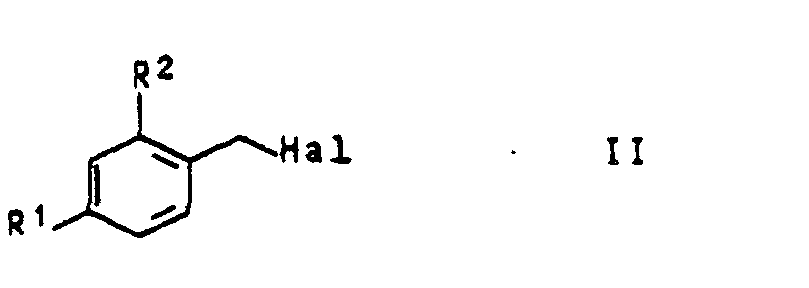
- a) wenn R5 Cyano, COR6 oder CO2R7 bedeutet: indem man ein entsprechendes Benzylhalogenid II, vorzugsweise ein Chlorid oder Bromid, in an sich bekannter Weise in Gegenwart einer Base gegebenenfalls unter Katalysatorzusatz in einem Zweiphasensystem nach der in Chem. Ind. 18, 731 (1978) angegebenen Methode mit einem Carbonsäure-Derivat der Formel III umsetzt.
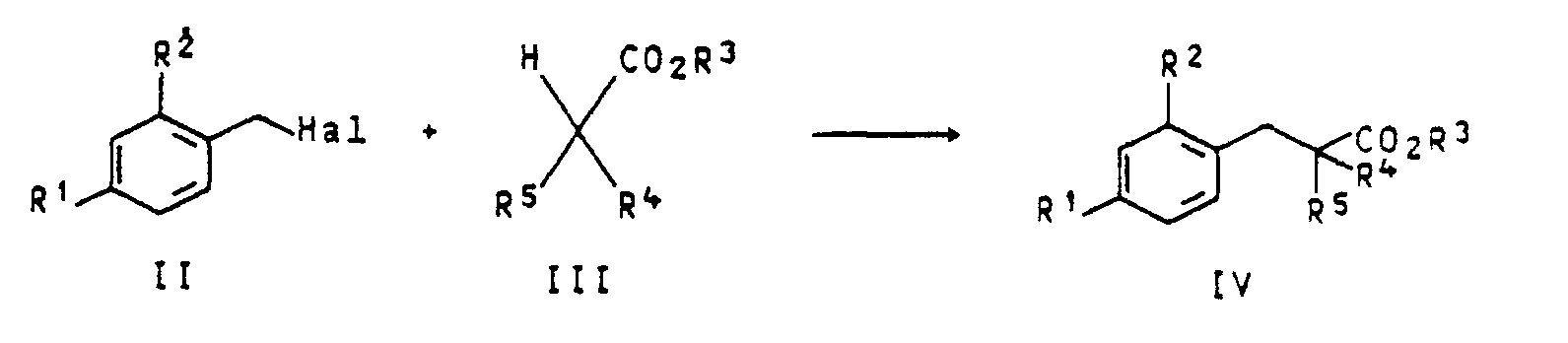
- Diese Umsetzung wird in einem aprotischen Lösungsmittel wie z.B. Toluol, Acetonitril oder Dimethylformamid unter Zweiphasenbedingungen mit einer anorganischen Base wie z.B. Natrium- oder Kaliumhydroxid in Gegenwart eines Phasentransferkatalysators vorgenommen; man verwendet vorzugsweise Kronenether wie 15-Krone-5 oder 18-Krone-6 bzw. entsprechende benzokondensierte Derivate wie z.B. Dibenzo-18-Krone-6. In manchen Fällen können auch Polyethylenglycoldialkylether des Typs

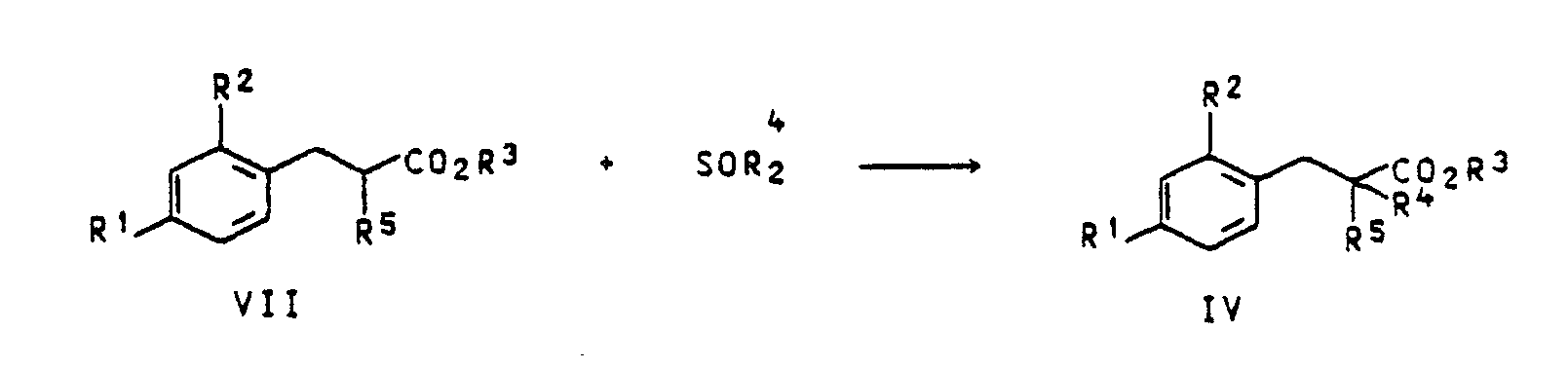
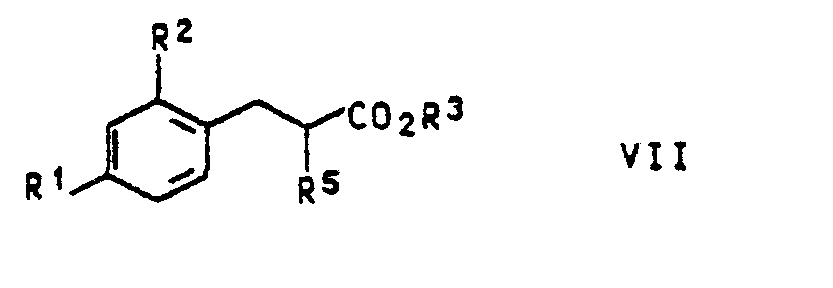
- b) wenn R5 Cyano, COR6 oder CO2R7 bedeutet: indem man ein, z.B. aus der zugrundeliegenden Zimtsäure erhältliches entsprechendes 3-Phenylpropionsäure-Derivat der Formel VII in Gegenwart einer Base in einem Lösungsmittel nach den in Organic Reactions 9, 107 (1957) angegebenen Methoden mit einem Halogenid der Formel VIII, vorzugsweise einem lodid oder Bromid, umsetzt.


- c) Für den Fall, daß R4 nicht Wasserstoff oder Halogen und R5 nicht Cyano, COR6 oder CO2R7 bedeutet: indem man ein entsprechendes Benzylhalogenid II, vorzugsweise ein Chlorid oder Bromid, in Gegenwart einer Base gegebenenfalls unter Katalysatorzusatz in einem aprotischen Lösungsmittel mit einem Aldehyd IX nach der in Lieb. Ann. Chem. 1979, 1585 angegebenen Methode zum Aldehyd X umsetzt und diesen zur Carbonsäure XI oxidiert. Veresterung liefert die gewünschten Verbindungen IV:

- Die in den nachstehenden Beispielen wiedergegebenen Arbeitsempfehlungen wurden unter entsprechender Abwandlung der Ausgangsverbindungen zur Gewinnung weiterer Verbindungen I benutzt; die erhaltenen Verbindungen sind mit physikalischen Angaben in den folgenden Tabellen aufgeführt; Verbindungen ohne solche Angaben lassen sich aus entsprechenden Stoffen in analoger Weise erhalten. Sie lassen aufgrund ihrer nahen strukturellen Beziehung zu den hergestellten und untersuchten Verbindungen eine gleichartige Wirkung erwarten.
-
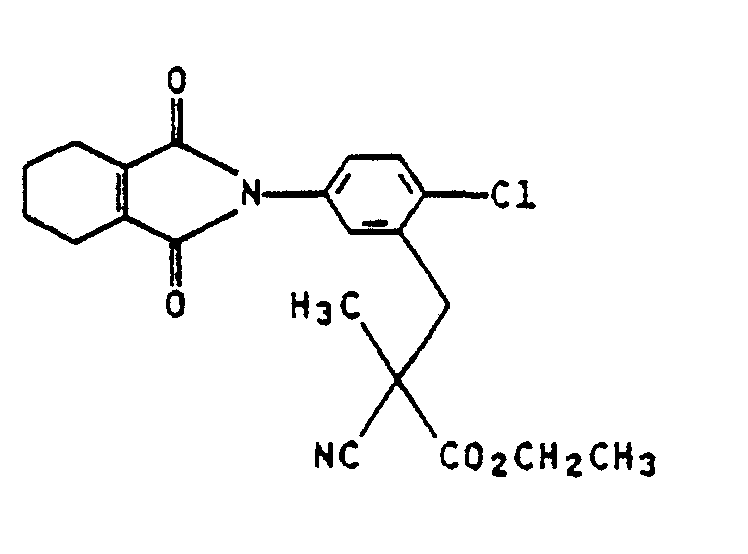
- a) 64,4 g 2-Chlorbenzylchlorid, 76,0 g 2-Cyanpropionsäure-ethylester, 58,0 g trockenes Kaiiumcarbonat und 0,1 g 18-Krone-6 werden unter Ausschluß von Feuchtigkeit 3 Stunden am Rückfluß erhitzt. Nach Abfiltrieren und Destillation des Rückstands erhält man 69,5 g 2-Chlorbenzyl-methylcyanessigsäure-ethylester (Kp0,1: 107-109 °C).
- b) Zu 25,2 g des Esters gibt man 41,7 ml konz. Salpetersäure (d = 1,51) bei 0 bis 5°C in 30 Minuten und rührt weitere 30 Minuten. Man rührt in 400 ml Eiswasser ein und extrahiert zweimal mit je 70 ml Toluol. Nach Waschen mit 10 %iger Natriumbicarbonat-Lösung und Wasser, Verdampfen des Lösungsmittels und Umkristallisation aus 50 ml Diisopropylether gewinnt man 18,9 g (2-Chlor-5-nitrobenzyl)-methylcyanessigsäure-ethylester (Fp.: 72-74' C).
- c) Zu einer Mischung von 10.6 g Eisenpuiver in 70 ml Methanol und 15 ml Eisessig tropft man bei Rückfluß in einer Stunde eine Lösung von 18.7 g der Nitroverbindung in 28 ml Methanol und 40 ml Eisessig. Nach weiteren 30 Minuten Sieden am Rückfluß wird abgesaugt und mit 50 ml Essigester nachgewaschen. Man rührt in 800 ml Wasser ein und extrahiert dreimal mit je 100 ml Essigester. Nach Trocknen und Verdampfen des Lösungsmittels i.V. isoliert man 15.5 g (2-Chlor-5-aminobenzyl)-methylcyanessigsäure-ethylester als Flüssigkeit (RT).
- d) 15.5 g der Aminoverbindung und 9.3 g Cyclohexen-1.2-dicarbonsäureanhydrid werden in 150 ml Eisessig 5 Stunden bei 50' C gerührt. Nach dem Verdampfen des Lösungsmittels i.V. isoliert man aus dem Rückstand (23,0 g) durch Umkristallisation aus 80 ml Methanol 14,4 g 2-Chlor-5-(N-3.4.5.6-tetrahydrophthal- säureimido)-benzyl-methylcyanessigsäure-ethylester (Fp.: 111-113°C; Wirkstoffbeispiel 2.020).
- Weitere Beispiele für Wirkstoffe die nach diesem Syntheseprinzip hergestellt werden können finden sich in den Tabellen 2, 3 und 4.
-

- a) Man legt unter Feuchtigkeitsausschluß bei Raumtemperatur 3 g Natriumhydrid (80 %ige Suspension in Leinöl) in 150 ml Dimethylformamid vor und tropft 25,7 g 2-Chlorbenzylmalonsäure-dimethylester (J.Am.Chem. Soc. 71, 2644 (1949)) in 50 ml Dimethylformamid zu. Nach beendeter Wasserstoffentwicklung versetzt man mit 14,2 g Methyliodid in 50 ml Dimethylformamid und läßt 16 Stunden nachrühren. Man gießt auf 300 ml Eiswasser und kristallisiert in der Kälte. Nach Absaugen und Trocknen erhält man 23,5 g 2-Chlorbenzyl-methylmalonsäure-dimethylester (Fp.: 52-53 C).
- b) 23,5 g des Diesters werden mit 36,1 ml konz. Salpetersäure (D = 1,51) bei 0-5° C nitriert. Aus der Toluolphase erhält man nach Waschen mit 10 %iger Natriumbicarbonat-Lösung und Wasser und Abziehen des Lösungsmittels i.V. 23,4 g (2-Chlor-5-nitrobenzyl)-methylmalonsäure-dimethylester als Flüssigkeit (RT).
- c) 23,4 g der Nitroverbindung werden mit 11,1 g Eisenpulver in insgesamt 55 ml Eisessig und 100 ml Methanol reduziert. Aus dem Rohprodukt (20,8 g) erhält man durch Extrahieren mit Ethylacetat 16,7 g (2-Chlor-5-aminobenzyl)-methylmalonsäure-dimethylester als Flüssigkeit (RT).
- d) Aus 16,7 g der Aminoverbindung und 10,2 g Cyclohexen-1,2-dicarbonsäureanhydrid in 250 ml Eisessig erhält man 26,8 g Rohprodukt, das nach Chromatographie an Kieselgel mit Toluol/1 % Aceton 13,7 g [2-Chlor-5-(N-3.4.5.6-tetrahydrophthalsäureamido)-benzyl]-methylmalonsäure-dimethylester (Fp.: 103-105°C (Wirkstoffbeispiel 3.010) liefert.
- Weitere Beispiele für Wirkstoffe, die nach diesem Syntheseprinzip hergestellt werden können, finden sich in Tabelle 3.
-

- a) Zu einer Lösung von 51,3 g 2-Chlorbenzylmalonsäure-dimethylester (J.Am.Chem.Soc. 71, 2644 (1949)) in 80 ml konz. Schwefelsäure wird unter Rühren bei 3 bis 5°C eine Mischung aus 9 ml konz. Salpetersäure (d = 1,51) und 20 ml konz. Schwefelsäure in 1 Stunde zugetropft und 2 Stunden bei gleicher Temperatur nachgerührt. Nach Einrühren in 1 I Eiswasser, Extraktion mit zweimal je 100 ml Toluol, Waschen mit 10 %iger Natriumbicarbonatlösung und Wasser isoliert man 58.3 g kristallines Rohprodukt, das nach Umkristallisieren aus 120 ml Diisopropylether 40,0 g (2-Chlor-5-nitrobenzyl)-malonsäure-dimethylester (Fp.: 72-74° C) liefert.
- b) Zu einer Lösung von 20,0 g der Nitroverbindung in 80 ml Eisessig tropft man bei 80 bis 85° C 9,5 g Sulfurylchlorid und erhitzt 2 Stunden am Rückfluß. Nach dem Verdampfen des Lösungsmittels wird mit 150 ml Wasser verrührt, abgesaugt und mit 70 ml 5 %iger Natriumbicarbonat-Lösung angeteigt. Aus dem Rohprodukt (19,4 g, Fp: 69-74° C)isoliert man durch Umkristallisation aus 50 ml Methanol 14.9 g (2-Chlor-5-nitrobenzyl)-chlormalonsäure-dimethylester (Fp: 75-78' C).
- c) 14,9 g der Nitroverbindung werden mit 7,5 g Eisenpulver in insgesamt 38 ml Eisessig und 70 ml Methanol reduziert. Aus dem Rohprodukt (13,8 g) erhält man durch Anteigen mit 50 ml Diisopropylether 10,2 g (2-Chlor-5-aminobenzyl)-chlormalonsäure-dimethylester (Fp: 107-109° C).
- d) Aus 10,0 g der Aminoverbindung und 5,2 g Cyclohexen-1,2-dicarbonsäureanhydrid in 130 ml Eisessig erhält man 15,0 g Rohprodukt, das nach Umkristallisation aus 200 ml Methanol 9,5 g [2-Chlor-5-(N-3.4.5.6-tetrahydrophthalsäureimido)-benzyl]-chlormalonsäure-dimethylester (Fp: 131-133°C; Wirkstoffbeispiel 3.002) liefert.
- Weitere Beispiele für Wirkstoffe, die nach diesem Syntheseprinzip hergestellt werden können, finden sich in Tabelle 2 und 3.
-

- a) Zu einer Mischung aus 1,9 g Tetrabutylammonium-iodid, 155 g 30 %iger Natronlauge und 115 ml Toluol tropft man unter intensiver Vermischung bei 80 ° C gleichzeitig, aber getrennt 65,0 g 2-Chlor-4-fluorbenzylchlorid in 90 ml Toluol und 28,8 g i-Butyraldehyd in 30 Minuten zu und rührt 3 Stunden bei 80 ° C nach. Die organische Phase wird abgetrennt, dreimal mit je 50 ml Wasser gewaschen, getrocknet und über Kurzwegdestillation (Kρ0,3 = 70-90°C) konzentriert (58,5 g). Destillation liefert 45,1 g (2-Chlor-4- fluorphenyl)-pivalaldehyd (Kρ0,1: 53-55 C).
- b) Zu einer Lösung von 90,0 g obigen Aldehyds in 200 ml Dioxan werden 54,5 g Amidosulfonsäure und eine Lösung von 100,1 g Dinatriumhydrogenphosphat in 200 ml Wasser gegeben, bei Raumtemperatur eine Lösung von 57,0 g 80 %igem Natriumchlorit in 200 ml Wasser in 45 Minuten unter Rühren bei pH = 4 zugetropft und 6 Stunden bei gleicher Temperatur nachgerührt. Nach dem Abziehen des Dioxans i.V. wird dreimal mit je 250 ml Ether extrahiert, einmal mit 100 ml Wasser und dreimal mit je 120 ml 2n Natronlauge extrahiert. Der Natronlauge-Extrakt wird einmal mit 100 ml Ether gewaschen und nach Ansäuern mit halbkonzentrierter Salzsäure auf pH = 3 dreimal mit je 250 ml Ether ausgeschüttelt. Man isoliert 74.8 g (2-Chlor-4-fluorphenyl)-pivalinsäure (Fp: 43-44°C).
- c) Aus 74,5 g der Säure in 140 ml konz. Schwefelsäure und 16,2 ml Salpetersäure (d = 1.51) in 30 ml konz. Schwefelsäure erhält man 86 g der rohen Nitroverbindung, die nach Umkristallisieren aus 450 ml Cyclohexan 70,8 g (2-Chlor-4-fluor-5-nitrophenyl)-pivalinsäure (Fp: 102-104 C) liefert.
- d) Zu 13.2 g der Nitroverbindung in 130 ml Toluol werden nach Zugabe von 1 Tropfen DMF bei 90-100°C 5.3 ml Thionylchlond getropft und bei 100-110°C nachgerührt bis die Gasentwicklung beendet ist (ca. 1 Stunde). Nach dem Verdampfen des Lösungsmittels i.V. wird der Rückstand dreimal mit je 30 ml Toluol aufgenommen und erneut i.V. eingeengt. Der Rückstand (15,0 g) wird bei 10°C in 50 ml Methanol aufgenommen und bei 5°C tropfenweise mit 6,5 ml α-Picolin versetzt. Nach 24 Stunden Rühren wird zur Trockene gebracht und mit 150 ml Ether und 30 ml 2n Salzsäure aufgenommen. Aus der Etherphase isoliert man nach Waschen mit Wasser, Trocknen und Verdampfen des Ethers 12,8 g (2-Chlor-4-fluor-5-nitrophenyl)-pivalinsäure-methylester (Flüssigkeit bei RT).
- e) Aus 12,7 g des nitrierten Esters und 16,7 g Eisenpulver in insgesamt 100 ml Methanol und 55 ml Eisessig erhält man 10,8 g (2-Chlor-4-fluor-5-aminophenyl)-pivalinsäure-methylester (Flüssigkeit bei RT).
- f) Aus 10,6 g der Aminoverbindung und 6,5 g Cyclohexen-1,2-dicarbonsäureanhydrid in 80 ml Eisessig erhält man 16.0 g Rohprodukt, nach Chromatographie an 60 g Kieselgel mit Toluol 12,3 g [2-Chlor-4-fluor-5-(N-3.4.5.6-tetrahydrophthalimido)-phenyl]-pivalinsäure-methylester (Fp: 68-70°C; Wirkstoffbeispiel 1.020).
- Weitere Beispiele für Wirkstoffe, die nach diesem Syntheseprinzip hergestellt werden können, finden sich in Tabelle 1.


- Die Verbindungen der Formel I haben, wie eingangs angegeben, eine herbizide Wirkrung und sind gegenüber Kulturpflanzen selektiv.
- Die Applikation der herbiziden Mittel bzw. der Wirkstoffe kann im Vorauflauf- oder im Nachauflaufverfahren erfolgen. Sind die Wirkstoffe für gewisse Kulturpflanzen weniger verträglich, so können Ausbringungstechniken angewandt werden, bei welchen die herbiziden Mittel mit Hilfe der Spritzgeräte so gespritzt werden, daß die Blätter der empfindlichen Kulturpflanzen nach Möglichkeit nicht getroffen werden, während die Wirkstoffe auf die Blätter darunter wachsender unerwünschter Pflanzen oder die unbedeckte Bodenfläche gelangen (post-directed, lay-by).
- Die Aufwandmengen an Wirkstoff betragen je nach Bekämpfungsziel, Jahreszeit, Zielpflanzen und Wachstumsstadien 0,01 bis 5,0, vorzugsweise 0.03 bis 0,5 kg,ha.
- Die herbizide Wirkung der erfindungsgemäßen Verbindungen auf das Wachstum der Testpflanzen wird durch folgende Gewächshausversuche gezeigt.
- Als Kulturgefäße dienen Plastikblumentöpfe mit 300 cm3 Inhalt und lehmigem Sand mit etwa 3.0 % Humus als Substrat. Die Samen der Testpflanzen werden nach Arten getrennt eingesät.
- Zum Zweck der Nachauflaufbehandlung zieht man die Testpflanzen je nach Wuchsform erst bis zu einer Wuchshöhe von 3 bis 15 cm an und behandelt sie dann mit den in Wasser als Verteilungsmittel suspendierten oder emulgierten Wirkstoffen, die mittels fein verteilender Düsen gespritzt werden. Es werden direkt gesäte und in den gleichen Gefäßen aufgewachsene Pflanzen ausgewählt, oder sie werden erst als Keimpflanzen getrennt angezogen. Die Aufwandmenge für die Nachauflaufbehandlung beträgt 0.5 kg a.S., ha. Eine Abdeckung unterbleibt bei der Nachauflaufbehandlung.
- Die Versuchsgefäße werden im Gewächshausversuch aufgestellt, wobei für wärmeliebende Arten wärmere Bereiche (20 bis 36 C) und für solche gemäßigter Klimate 10 bis 20°C bevorzugt werden. Die Versuchsperiode erstreckt sich über 2 bis 4 Wochen. Während dieser Zeit werden die Pflanzen gepflegt und ihre Reaktion auf die einzelnen Behandlungen wird ausgewertet.
- Bewertet wird nach einer Skala von 0 bis 100. Dabei bedeutet 100 kein Aufgehen der Sämlinge bzw. völlige Zerstörung zumindest der oberirdischen Teile.
- In den Gewächshausversuchen wurden folgende Arten verwendet:

- Die Tabellen A, B und D zeigen, daß die Beispielwirkstoffe 1,058, 1,046, 1.032. 1.035 und 1.020 im Nachauflaufverfahren gegen eine Vielzahl weit verbreiteter breitblättriger Pflanzen sehr starke herbizide Wirkung entfalten.
- Die Verbindung 1,076 eignet sich darüberhinaus auch zur Bekämpfung grasartiger Pflanzen, z.B. Hühnerhirse (Tab. C).
- In Anbetracht der Vielseitigkeit der Applikationsmethoden können die erfindungsgemäßen Verbindungen bzw. sie enthaltende Mittel noch in einer weiteren Zahl von Kulturpflanzen zur Beseitigung unerwünschter Pflanzen eingesetzt werden. In Betracht kommen beispielsweise folgende Kulturen:


- Zur Verbreiterung des Wirkungsspektrums und zur Erzielung synergistischer Effekte können die neuen Verbindungen mit zahlreichen Vertretern anderer herbizider oder wachstumsregulierender Wirkstoffgruppen gemischt und gemeinsam ausgebracht werden. Beispielsweise kommen als Mischungspartner Diazine, 4H-3,1-Benzoazinderivate, Benzothiadiazinone, 2,6-Dinitroaniline, N-Phenylcarbamate, Thiolcarbamate, Halogencarbonsäuren, Triazine, Amide. Harnstoffe. Diphenylether, Triazinone. Uracile, Benzofuranderivate, Chinolincarbonsäuren und andere in Betracht.
- Außerdem kann es von Nutzen sein, die neuen Verbindungen allein oder in Kombination mit anderen Herbiziden auch noch mit weiteren Pflanzenschutzmitteln gemischt gemeinsam auszubringen, beispielsweise mit Mitteln zur Bekämpfung von Schädlingen oder phytopathogenen Pilzen bzw. Bakterien. Von Interesse ist ferner die Mischbarkeit mit Mineralsalzlösungen, welche zur Behebung von Ernährungs- und Spurenelementmängeln eingesetzt werden. Es können auch nichtphytotoxische Öle und Ölkonzentrate zugesetzt werden.


Claims (6)





Applications Claiming Priority (2)
| Application Number | Priority Date | Filing Date | Title |
|---|---|---|---|
| DE19873724395 DE3724395A1 (de) | 1987-07-23 | 1987-07-23 | 3-phenylpropionsaeurederivate |
| DE3724395 | 1987-07-23 |
Publications (2)
| Publication Number | Publication Date |
|---|---|
| EP0300398A2 true EP0300398A2 (de) | 1989-01-25 |
| EP0300398A3 EP0300398A3 (de) | 1990-06-27 |
Family
ID=6332199
Family Applications (1)
| Application Number | Title | Priority Date | Filing Date |
|---|---|---|---|
| EP88111485A Withdrawn EP0300398A3 (de) | 1987-07-23 | 1988-07-16 | 3-Phenylpropionsäurederivate |
Country Status (4)
| Country | Link |
|---|---|
| US (1) | US5013354A (de) |
| EP (1) | EP0300398A3 (de) |
| CA (1) | CA1330345C (de) |
| DE (1) | DE3724395A1 (de) |
Cited By (6)
| Publication number | Priority date | Publication date | Assignee | Title |
|---|---|---|---|---|
| EP0385231A1 (de) * | 1989-02-25 | 1990-09-05 | BASF Aktiengesellschaft | Verwendung von Derivaten des N-Phenyl-3,4,5,6-tetrahydrophthalimids zur Desikkation und Abszission von Pflanzenorganen |
| US4959098A (en) * | 1988-06-08 | 1990-09-25 | Basf Aktiengesellschaft | N-substituted 3,4,5,6-tetrahydrophthalimide derivatives |
| US5035740A (en) * | 1989-05-16 | 1991-07-30 | Fmc Corporation | Herbicidal compounds |
| US5062884A (en) * | 1986-02-07 | 1991-11-05 | Basf Aktiengesellschaft | N-substituted 3,4,5,6-tetrahydrophthalimides and their intermediates |
| WO1994011344A1 (de) * | 1992-11-11 | 1994-05-26 | Basf Aktiengesellschaft | Substituierte 3,4,5,6-tetrahydrophthalimide als herbizide und/oder defoliant oder dessikant |
| LT3949B (en) | 1988-08-31 | 1996-05-27 | Fmc Corp | Herbicidal triazolinones, method for preparing thereof, herbicidal compositions and method for control of undesirable plants |
Families Citing this family (1)
| Publication number | Priority date | Publication date | Assignee | Title |
|---|---|---|---|---|
| CA2575733A1 (en) * | 2003-07-31 | 2005-02-03 | Nissim Einat | Ink jet printing method and apparatus |
Family Cites Families (6)
| Publication number | Priority date | Publication date | Assignee | Title |
|---|---|---|---|---|
| DE1542777C3 (de) * | 1965-04-17 | 1978-12-07 | Bayer Ag, 5090 Leverkusen | a-ChIor-ß-(4-chlorphenyl) propionsäruemethylester und Herbizide mit einem Gehalt an einem cx-Chlorß-phenylpropionsäruederivat |
| US3984435A (en) * | 1970-12-23 | 1976-10-05 | Mitsubishi Chemical Industries Ltd. | Herbicidal N-substituted-Δ1 -tetrahydrophthalimide |
| US4439229A (en) * | 1981-06-29 | 1984-03-27 | Rohm And Haas Company | Substituted phthalimides herbicides |
| JPS6054362A (ja) * | 1983-08-31 | 1985-03-28 | Sumitomo Chem Co Ltd | テトラヒドロフタルイミド誘導体,その製造法およびそれを有効成分とする除草剤 |
| DE3603789A1 (de) * | 1986-02-07 | 1987-08-13 | Basf Ag | N-substituierte 3,4,5,6-tetrahydrophthalimide |
| IL82657A0 (en) * | 1986-06-03 | 1987-11-30 | Rhone Poulenc Agrochimie | N-(5-substituted methylene)phenyl herbicides |
-
1987
- 1987-07-23 DE DE19873724395 patent/DE3724395A1/de not_active Withdrawn
-
1988
- 1988-07-07 CA CA000571394A patent/CA1330345C/en not_active Expired - Fee Related
- 1988-07-11 US US07/217,167 patent/US5013354A/en not_active Expired - Fee Related
- 1988-07-16 EP EP88111485A patent/EP0300398A3/de not_active Withdrawn
Cited By (6)
| Publication number | Priority date | Publication date | Assignee | Title |
|---|---|---|---|---|
| US5062884A (en) * | 1986-02-07 | 1991-11-05 | Basf Aktiengesellschaft | N-substituted 3,4,5,6-tetrahydrophthalimides and their intermediates |
| US4959098A (en) * | 1988-06-08 | 1990-09-25 | Basf Aktiengesellschaft | N-substituted 3,4,5,6-tetrahydrophthalimide derivatives |
| LT3949B (en) | 1988-08-31 | 1996-05-27 | Fmc Corp | Herbicidal triazolinones, method for preparing thereof, herbicidal compositions and method for control of undesirable plants |
| EP0385231A1 (de) * | 1989-02-25 | 1990-09-05 | BASF Aktiengesellschaft | Verwendung von Derivaten des N-Phenyl-3,4,5,6-tetrahydrophthalimids zur Desikkation und Abszission von Pflanzenorganen |
| US5035740A (en) * | 1989-05-16 | 1991-07-30 | Fmc Corporation | Herbicidal compounds |
| WO1994011344A1 (de) * | 1992-11-11 | 1994-05-26 | Basf Aktiengesellschaft | Substituierte 3,4,5,6-tetrahydrophthalimide als herbizide und/oder defoliant oder dessikant |
Also Published As
| Publication number | Publication date |
|---|---|
| EP0300398A3 (de) | 1990-06-27 |
| CA1330345C (en) | 1994-06-21 |
| DE3724395A1 (de) | 1989-02-02 |
| US5013354A (en) | 1991-05-07 |
Similar Documents
| Publication | Publication Date | Title |
|---|---|---|
| DE69324552T4 (de) | N'-substituierte-N,N'Diacylhydrazin-Insektizide | |
| EP0344232B1 (de) | 3-Aryluracile zur Unkrautbekämpfung | |
| DE2661042C2 (de) | ||
| EP0136615A2 (de) | 1-Methylamino-cyclopropan-1-carbonsäure-Derivate | |
| EP0077755B1 (de) | Optisch aktives N-(1'-Methyl-2'-methoxyäthyl)-N-chloracetyl-2-äthyl-6-methylanilin als Herbizid | |
| DE2406475C2 (de) | 5-Acetamido-2,4-dimethyltrifluormethansulfonanilid und dessen landwirtschaftlich geeignete Salze, Verfahren zur Herstellung dieser Verbindungen und diese Verbindungen enthaltende Mittel | |
| EP0084893A2 (de) | 4H-3,1-Benzoxazinderivate, Verfahren zu ihrer Herstellung und ihre Verwendung zur Bekämpfung unerwünschten Pflanzenwuchses | |
| EP0240659A2 (de) | N-substituierte 3,4,5,6-Tetrahydrophthalimide und deren Vorprodukte | |
| CH644371A5 (de) | In 2- und 4-stellung disubstituierte 5-thiazolcarbonsaeuren und deren funktionelle derivate. | |
| EP0011693A1 (de) | Neue N-(trifluormethansulfonylaminophenyl)-substituierte N-Heterocyclen, ihre Herstellung, sie enthaltende Mittel und ihre Verwendung zur Beeinflussung des Pflanzenwachstums | |
| DE3528583C2 (de) | ||
| EP0332009A1 (de) | N-Aryltetrahydrophthalimidverbindungen | |
| EP0165572A2 (de) | Neue herbizid wirksame Sulfonylharnstoffe | |
| EP0218233A2 (de) | Cyclohexenonderivate, Verfahren zu ihrer Herstellung und ihre Verwendung zur Bekämpfung unerwünschten Pflanzenwuchses | |
| EP0007089B1 (de) | Acylanilide mit herbicider und fungicider Wirkung, Verfahren zu ihrer Herstellung und ihre Verwendung | |
| DE3724395A1 (de) | 3-phenylpropionsaeurederivate | |
| EP0001271B1 (de) | Heterocyclische Norbornanderivate, Mittel zur Beeinflussung des Pflanzenwachstums die diese Verbindungen enthalten, und Verfahren zur Herstellung dieser Mittel | |
| EP0401582B1 (de) | Fünfring-heterocyclisch anellierte Chinolinderivate | |
| DE2856974C2 (de) | 1- [N-(4-Chlor-2- trifluormethylphenyl)phenylacetimidoyl] - imidazo! und seine Metallkomplexe, Verfahren zur Herstellung dieser Verbindungen sowie deren Verwendung in Fungiziden | |
| EP0320677B1 (de) | N-Phenyltetrahydrophthalimidverbindungen | |
| EP0098440B1 (de) | 3,7-Dichlor-chinolinderivate, Verfahren zu ihrer Herstellung und ihre Verwendung zur Bekämpfung unerwünschten Pflanzenwuchses | |
| EP0106949B1 (de) | 3,7-Dichlor-8-chinolinderivate, Verfahren zu ihrer Herstellung und ihre Verwendung zur Bekämpfung unerwünschten Pflanzenwuchses | |
| EP0249858B1 (de) | Fluoralkylsubstituierte Chinolinderivate. ihre Herstellung sowie Verwendung zur Bekämpfung unerwünschten Pflanzenwachstums | |
| DE2812367A1 (de) | Pestizide verbindungen, pestizide zusammensetzungen und verfahren zur bekaempfung von schaedlingen | |
| DE3784744T2 (de) | Herbizide Pyridinium innere Salze und Ylide. |
Legal Events
| Date | Code | Title | Description |
|---|---|---|---|
| PUAI | Public reference made under article 153(3) epc to a published international application that has entered the european phase |
Free format text: ORIGINAL CODE: 0009012 |
|
| AK | Designated contracting states |
Kind code of ref document: A2 Designated state(s): AT BE CH DE ES FR GB GR IT LI NL SE |
|
| PUAL | Search report despatched |
Free format text: ORIGINAL CODE: 0009013 |
|
| AK | Designated contracting states |
Kind code of ref document: A3 Designated state(s): AT BE CH DE ES FR GB GR IT LI NL SE |
|
| 17P | Request for examination filed |
Effective date: 19900518 |
|
| 17Q | First examination report despatched |
Effective date: 19920623 |
|
| STAA | Information on the status of an ep patent application or granted ep patent |
Free format text: STATUS: THE APPLICATION HAS BEEN WITHDRAWN |
|
| 18W | Application withdrawn |
Withdrawal date: 19930819 |