EP0300545A1 - Apparatus for identifying one or more sheet-form objects, for instance a magazine, an indentification method and recognition device - Google Patents
Apparatus for identifying one or more sheet-form objects, for instance a magazine, an indentification method and recognition device Download PDFInfo
- Publication number
- EP0300545A1 EP0300545A1 EP19880201434 EP88201434A EP0300545A1 EP 0300545 A1 EP0300545 A1 EP 0300545A1 EP 19880201434 EP19880201434 EP 19880201434 EP 88201434 A EP88201434 A EP 88201434A EP 0300545 A1 EP0300545 A1 EP 0300545A1
- Authority
- EP
- European Patent Office
- Prior art keywords
- elements
- magazine
- light sensitive
- anyone
- conveyor
- Prior art date
- Legal status (The legal status is an assumption and is not a legal conclusion. Google has not performed a legal analysis and makes no representation as to the accuracy of the status listed.)
- Withdrawn
Links
- 238000000034 method Methods 0.000 title claims description 7
- 238000005259 measurement Methods 0.000 claims description 10
- 238000005266 casting Methods 0.000 claims 1
- 230000001419 dependent effect Effects 0.000 claims 1
- 230000006378 damage Effects 0.000 description 2
- 230000000977 initiatory effect Effects 0.000 description 2
- 238000001514 detection method Methods 0.000 description 1
Images

Classifications
-
- B—PERFORMING OPERATIONS; TRANSPORTING
- B07—SEPARATING SOLIDS FROM SOLIDS; SORTING
- B07C—POSTAL SORTING; SORTING INDIVIDUAL ARTICLES, OR BULK MATERIAL FIT TO BE SORTED PIECE-MEAL, e.g. BY PICKING
- B07C5/00—Sorting according to a characteristic or feature of the articles or material being sorted, e.g. by control effected by devices which detect or measure such characteristic or feature; Sorting by manually actuated devices, e.g. switches
- B07C5/34—Sorting according to other particular properties
-
- B—PERFORMING OPERATIONS; TRANSPORTING
- B07—SEPARATING SOLIDS FROM SOLIDS; SORTING
- B07C—POSTAL SORTING; SORTING INDIVIDUAL ARTICLES, OR BULK MATERIAL FIT TO BE SORTED PIECE-MEAL, e.g. BY PICKING
- B07C3/00—Sorting according to destination
- B07C3/02—Apparatus characterised by the means used for distribution
- B07C3/08—Apparatus characterised by the means used for distribution using arrangements of conveyors
-
- B—PERFORMING OPERATIONS; TRANSPORTING
- B07—SEPARATING SOLIDS FROM SOLIDS; SORTING
- B07C—POSTAL SORTING; SORTING INDIVIDUAL ARTICLES, OR BULK MATERIAL FIT TO BE SORTED PIECE-MEAL, e.g. BY PICKING
- B07C5/00—Sorting according to a characteristic or feature of the articles or material being sorted, e.g. by control effected by devices which detect or measure such characteristic or feature; Sorting by manually actuated devices, e.g. switches
- B07C5/34—Sorting according to other particular properties
- B07C5/342—Sorting according to other particular properties according to optical properties, e.g. colour
Definitions
- the apparatus will mostly be used for identification of unsold magazines that are returned from kiosks and collected at a central collection depot and which have to be returned from there to the respective publishers or which can then be destroyed.
- the present invention has for its object to provide a reliable apparatus and method of identification of sheet-form objects, which is usable at high speeds, user-friendly, simple to construct and therefore relatively inexpensive.
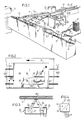
- a magazine 2 at a time from a stack of magazines 3 is placed, usually manually, via a feed table 1 (fig. 1) onto a rope conveyor 4 which is disposed sloping at an angle . Care is taken that the spine of each magazine 5 touches against a gutter edge 6.
- a magazine 2 is guided as according to arrow 7 into an recognition device 8 which is connected, in a manner not shown, to a control computer 9 which, subject to identification in device or station 8, despatches magazines to one of the conveyors 10, 11 or 12 by opening one of the respective flaps 14, 15.
- a conveyor 10 serves to discharge unidentified magazines which are guided past a terminal 16 connected in a manner not shown to control computer 9, where an operator can still identify the magazine with the naked eye and, via a simple input mechanism, for instance using a mouse or joystick, can enter such a magazine into the computer file in rapid manner, following which a conveyor 18 swivelling as according to arrow 17 can despatch the identified magazine to a conveyor 11 or 12; discharge conveyor 11 leads for example to a manual or automated sorting device for return despatch to a publisher; finally, conveyor 12 carries away magazines for destruction.
- FIG. 1 The disposition shown in figure 1 has already been found to be cost effective for roughly 50,000 magazines for processing per day (two per second), while more than 200 different titles have to be identified per day. If the numbers of magazines amount to an order greater that the above number it may become effective to employ a separate remotely controllable flap per title, so that the magazines are immediately sorted per title.
- identifying station 8 Arranged at identifying station 8 (fig. 2) between the ropes 121 the rope conveyor and at a short distance from the magazine 2 passing in the figure are two rows of four light sensitive or photo elements 20. Likewise arranged between two ropes 121 are two trigger elements 122 initiating the reading of the photo elements 20, which trigger elements can comprise a light beam to be interrupted by the magazine, an element similar to photo element 20 or an ultrasonic or mechanical detection element.
- Light sensitive element 20 (fig. 3) is preferably built up of a LED (light-emitting diode) 21 which is provided in a manner not shown with the correct supply voltage and of a photo sensitive transistor 22, both accommodated in a housing 23 provided with transparent windows 24 and 25.
- a quantity of light emitted by the LED 21 onto a surface portion 26 on the underside of a magazine 2, preferably on the cover page located on the underside of magazine 2, is for example three-quarters reflected, this depending on the so-called grey value of this surface portion 26.
- a light sensitive element comprises a photo diode enveloped by a radiant wire.
- a voltage is transmitted from phototransistor 22 via lines 27 to an AD converter (analog-digital converter) 28 which is further provided with twelve digital outputs 29 as well as two terminals 30 and 31 which are connected in a manner not shown to the trigger elements 122, so that reading of the phototransistor 22 is initiated by these trigger elements 122, after which the digital value thereof can be further processed via the lines 29.
- AD converter analog-digital converter
- a mean value of the amount of light received by the phototransistor 22 can be obtained over a greater area than the surface portion 26. It is also possible to take a mean value of two or more samples taken shortly after each other.
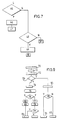
- the operation of the identification algorithm performed at 34 is substantially as follows (fig. 6A, 6B, 7, 8): included in a part of the memory of the control computer 9 are tables 40 for each photo element 20, in which are stored the recorded values of the reference recordings, such as for instance for 200 magazines taken at the beginning of the day.
- table 6A for each magazine during the initiating entering at the start of the day or week, there are stored sixteen 8-bits numbers or standard values, as is indicated using the squares 42.
- the above mentioned algorithm is preferably performed in machine language.
- control computer 9 indicated at 70 is the arrival of a crate of magazines returned from a kiosk, at 71 they are loaded on one by one and at 72 automatic identification is commenced;. if at 73 the automatic indentification has succeeded the administrative records of the relevant kiosk are updated at 74 and after it has been determined at 75, subject to the wishes of the publisher, which magazine may be destroyed, flap 15 is actuated at 76, while flap 14 is actuated at 77. If identification is not successive at 73, flap 13 is opened at 74 whereby at 75 the magazine may have to be turned over and identified by an operator sitting on seat 19 (fig.
- the magazine for identification is not included in the file of that day, as established at 76, this can be indicated as such at 82 with control station 16, administrative recording thereof can be carried out at 83 by control computer 9, and at 80 the magazine can be discharged to belt 12 for destruction. It is also conceivable that belt conveyor 18 has an additional third position, in which for example in this latter case the magazine drops into a collecting bin or crate next to control station 16.
- the apparatus according to preferred embodiments of this invention simple to use and construct, operates fast and reliable, is easily extendable and provides an on-line connection to the (small) computer which at the time automatically does the administration for the different accounts.
Landscapes
- Sorting Of Articles (AREA)
Abstract
Apparatus for identifying one or more sheet-form objects (2), c.q. a magazine, comprising:
a conveyor (4) for feeding the objects (2) with substantially constant speed. The apparatus further comprises a recognition device (8) provided with two or more discrete spaced apart light sensitive elements (20). These elements (20) sense two or more discrete surface areas (26) of the object (2). One or more triggering elements (121, 122) are positioned before the light sensitive elements (20) in the conveying direction, so as to trigger or start the sensing operation at a predetermined surface area (26) of the object (2).
a conveyor (4) for feeding the objects (2) with substantially constant speed. The apparatus further comprises a recognition device (8) provided with two or more discrete spaced apart light sensitive elements (20). These elements (20) sense two or more discrete surface areas (26) of the object (2). One or more triggering elements (121, 122) are positioned before the light sensitive elements (20) in the conveying direction, so as to trigger or start the sensing operation at a predetermined surface area (26) of the object (2).
Description
- It is known from DE-A-32 39 938 to identify sheet-form objects in the form of magazines with video cameras; reference recordings of cover pages using a video camera are stored in an image memory and the cover pages of various magazines to be distinguished from one another are led past the camera and scanned by this camera. Thereafter these recordings are compared by means of complex image processing to the reference recordings.
- In case of identification of magazines, the apparatus will mostly be used for identification of unsold magazines that are returned from kiosks and collected at a central collection depot and which have to be returned from there to the respective publishers or which can then be destroyed.
- The present invention has for its object to provide a reliable apparatus and method of identification of sheet-form objects, which is usable at high speeds, user-friendly, simple to construct and therefore relatively inexpensive.
- Therefore, an apparatus according to claim 1 is provided.
- Preferred embodiments of this apparatus are characterized in the subclaims.
- Tests made a prototype of the apparatus according to this invention, using two rows of four photocells and LEDs and two triggering elements behind one another have rendered satisfactory results. Substantially no fault recognition took place and approximately 95% correct recognition was achieved - if recognition values were seen as incorrect by the computer, correct recognition was manually performed. Those automatically obtained figures will offer an important further step towards increasing confidence between kiosk and depot and depot and publisher with respect to providing one another with information relating to accounts of abundantly delivered magazines, which could eventually lead to dispense with returning of the magazines.
- Further features, details and advantages of the method and device according to the current invention will become apparent in the light of a description of an embodiment of the invention, whereby reference will be made to the drawing, in which:
- Figure 1 shows a perspective, schematic view of a device performing the method according to the invention;
- Figure 2 shows
detail 2 from figure 1; - Figure 3 is a schematic sectional view of the detail 3 from figure 2;
- Figure 4 shows schematically an element for connecting to the element from figure 3;
- Figures 5-9 show examples of algorithms for application with the method and device as according to figures 1-5.
- One
magazine 2 at a time from a stack of magazines 3 is placed, usually manually, via a feed table 1 (fig. 1) onto a rope conveyor 4 which is disposed sloping at an angle . Care is taken that the spine of each magazine 5 touches against agutter edge 6. Amagazine 2 is guided as according to arrow 7 into an recognition device 8 which is connected, in a manner not shown, to a control computer 9 which, subject to identification in device or station 8, despatches magazines to one of theconveyors respective flaps 14, 15. Use is made in the embodiment shown of three discharge conveyors:
a conveyor 10 serves to discharge unidentified magazines which are guided past a terminal 16 connected in a manner not shown to control computer 9, where an operator can still identify the magazine with the naked eye and, via a simple input mechanism, for instance using a mouse or joystick, can enter such a magazine into the computer file in rapid manner, following which aconveyor 18 swivelling as according toarrow 17 can despatch the identified magazine to aconveyor
discharge conveyor 11 leads for example to a manual or automated sorting device for return despatch to a publisher; finally,conveyor 12 carries away magazines for destruction. - The disposition shown in figure 1 has already been found to be cost effective for roughly 50,000 magazines for processing per day (two per second), while more than 200 different titles have to be identified per day. If the numbers of magazines amount to an order greater that the above number it may become effective to employ a separate remotely controllable flap per title, so that the magazines are immediately sorted per title.
- Arranged at identifying station 8 (fig. 2) between the
ropes 121 the rope conveyor and at a short distance from themagazine 2 passing in the figure are two rows of four light sensitive orphoto elements 20. Likewise arranged between tworopes 121 are two trigger elements 122 initiating the reading of thephoto elements 20, which trigger elements can comprise a light beam to be interrupted by the magazine, an element similar tophoto element 20 or an ultrasonic or mechanical detection element. - Light sensitive element 20 (fig. 3) is preferably built up of a LED (light-emitting diode) 21 which is provided in a manner not shown with the correct supply voltage and of a photo
sensitive transistor 22, both accommodated in ahousing 23 provided withtransparent windows LED 21 onto asurface portion 26 on the underside of amagazine 2, preferably on the cover page located on the underside ofmagazine 2, is for example three-quarters reflected, this depending on the so-called grey value of thissurface portion 26. - In another embodiment a light sensitive element comprises a photo diode enveloped by a radiant wire.
- As is shown schematically (figures 3, 4) a voltage is transmitted from
phototransistor 22 vialines 27 to an AD converter (analog-digital converter) 28 which is further provided with twelvedigital outputs 29 as well as twoterminals 30 and 31 which are connected in a manner not shown to the trigger elements 122, so that reading of thephototransistor 22 is initiated by these trigger elements 122, after which the digital value thereof can be further processed via thelines 29. Through the setting of phototransistor 27 a mean value of the amount of light received by thephototransistor 22 can be obtained over a greater area than thesurface portion 26. It is also possible to take a mean value of two or more samples taken shortly after each other. - Entering of the digital values takes place during interrupt of the control computer 9 (fig. 5): 32 shows the interrupt label while at 33 is verified if the incoming digital values, that is, 8 x 8 bits, which cause the interrupt relating to the first or second trigger element 122, and should it be the second trigger element 122, the
identification algorithm 34 is set into operation, while at 35 is the exit to the main program. - The operation of the identification algorithm performed at 34 is substantially as follows (fig. 6A, 6B, 7, 8): included in a part of the memory of the control computer 9 are tables 40 for each
photo element 20, in which are stored the recorded values of the reference recordings, such as for instance for 200 magazines taken at the beginning of the day. In figure 6A for each magazine, during the initiating entering at the start of the day or week, there are stored sixteen 8-bits numbers or standard values, as is indicated using thesquares 42. The sixteen values measured per magazine for identification, as is shown schematically with 43 (fig. 6B), now define the sum of the absolute values of the difference between all values as stored in thesquares 42 and after the search through the entire table, as indicated schematically witharrow 44, the ranking number, viz. the title of that particular magazine, of smallest difference is stored in addition to the ranking number of the smallest difference but one. - For each
line 41 the sum S of the absolute values of the sixteen 8-bits numbers is compared with the smallest value obtained up until that moment as shown at 45 (fig. 7); when the old smallest value is substituted by the new smallest value at 46, the preceding smallest value becomes the smallest vlaue but one, following which there is a return at 47 to the search routine as according to arrow 44 (fig. 6B). If the sum is greater than the smallest value up to that moment, a check is made at 48 to see whether the sum is smaller than the smallest value but one, after which, if this be the case, the old smallest value but one, while at 50 and 51 a return is made to the comparing routine as according toarrow 44. - In order to achieve a speed of 50,000 magazines per day, roughly 10 magazines per second, the above mentioned algorithm is preferably performed in machine language.
- In order to enable more accurate comparison it is preferred that the different measurements done using the separate trigger elements be separated, whereby the above mentioned search process takes place independently for these two measurements. This is shown in schematic form in figure 8, whereby indicated with - - in the vertical column is the sequence number p,q,r,s,t or u of the magazine found in the table, whereby the smallest value of the aforementioned sum is found, while indicated with ** is the sequence number associated with the smallest sum but one.
Column 60 therefore relates here to the first result performed using thefirst trigger element 22, whilecolumn 61 shows the result that is subject in each case tothe first measurement and carried out using the second trigger element 122. Except in the case the smallest sum and the smallest sum but one coincide, it has been found in practice that also for the cases shown in figures 8A, B, C and D the magazine is identified: - A) the ranking number of the smallest sum at the first measurement coincides with the smallest sum from the second measurement while the smallest sums but one differ; the magazine passed through is deemed to be the magazine stored in line p in the tables;
- B) the ranking number of the smallest sum but one found at the second measurement coincides with the smallest sum of the first measurement, while the smallest sum but one of the first measurement and the smallest sum of the second measurement differ; the identified magazine is deemed to be that defined by line p from the table;
- C) the case corresponding to B, but reversed; the identified magazine is the one stored under q; and
- D) the ranking numbers smallest sums but one coincide, while the smallest sums differ from each other; the scanned magazine is the magazine is entered under r in the table.
- Continuation of the algorithm shown in figure 9 is carried out by control computer 9: indicated at 70 is the arrival of a crate of magazines returned from a kiosk, at 71 they are loaded on one by one and at 72 automatic identification is commenced;. if at 73 the automatic indentification has succeeded the administrative records of the relevant kiosk are updated at 74 and after it has been determined at 75, subject to the wishes of the publisher, which magazine may be destroyed,
flap 15 is actuated at 76, while flap 14 is actuated at 77. If identification is not succesful at 73,flap 13 is opened at 74 whereby at 75 the magazine may have to be turned over and identified by an operator sitting on seat 19 (fig. 1) who can then still enter the magazine into the file of computer 9 using a rapid search system, for example so-called scrolling with a mouse or joystick (not shown) at control station 16 on the screen thereof. If found at 76 that the magazine is present in the file, it is entered therein and accounted at 75. Depending on the fact if such a magazine is allowed to be destroyed it can be routed toconveyor 12 at 80, or e.g. if not, at 81vto conveyor 11. - If the magazine for identification is not included in the file of that day, as established at 76, this can be indicated as such at 82 with control station 16, administrative recording thereof can be carried out at 83 by control computer 9, and at 80 the magazine can be discharged to belt 12 for destruction. It is also conceivable that
belt conveyor 18 has an additional third position, in which for example in this latter case the magazine drops into a collecting bin or crate next to control station 16. - The apparatus according to preferred embodiments of this invention simple to use and construct, operates fast and reliable, is easily extendable and provides an on-line connection to the (small) computer which at the time automatically does the administration for the different accounts.
Claims (12)
1. Apparatus for identifying one or more sheet-form object, e.g. a magazine, comprising:
- a conveyor for feeding the object with substantiaaly constant speed; and
- a recognition device, provided with two or more discrete light sensitive elements spaced apart, for sensing two or more discrete surface area's of the object.
- a conveyor for feeding the object with substantiaaly constant speed; and
- a recognition device, provided with two or more discrete light sensitive elements spaced apart, for sensing two or more discrete surface area's of the object.
2. Apparatus for identifying one or more sheet-form object, e.g. a magazine, comprising:
- a conveyor for feeding the object with substantiaaly constant speed; and
- a recognition device, provided with two or more discrete light sensitive elements spaced apart, for sensing two or more discrete surface area's of the object and one or more trigering elements positioned before the light sensitive elements in the conveying direction, so as to trigger or start the sensing operation at a predetermined surface area of the object.
- a conveyor for feeding the object with substantiaaly constant speed; and
- a recognition device, provided with two or more discrete light sensitive elements spaced apart, for sensing two or more discrete surface area's of the object and one or more trigering elements positioned before the light sensitive elements in the conveying direction, so as to trigger or start the sensing operation at a predetermined surface area of the object.
3. Apparatus as claimed in claim 1 or 2, provided with a light emitting element for each light sensitive element, or one common for the light sensitive elements together for casting light onto said object.
4. Apparatus according to anyone of the claims 1-3, provided with two rows of four light sources and therewith associated light sensitive elements, said rows extending in the conveying direction.
5. Apparatus according to anyone of the foregoing claims, wherein two elements for triggering and recognition are disposed one after the other and subsequent to the light sensitive elements in the conveying direction.
6. Apparatus according to anyone of the foregoing claims, wherein the conveyor is a rope conveyor, the rope conveyor is disposed at a slope, that a stop or gutter for the spine of the magazine is disposed on the underside of the slope and the light receiving elements and triggering elements are disposed shortly underneath the rope conveyor and transversely spaced relative to the ropes or said conveyor.
7. Apparatus according to anyone of the foregoing claims, provided with an analog-digital converter for converting the signal of the light receiving elements into n-bits (n = 1,2 ... preferably 8) and a computer memory wherein the digital values are compared with pre-defined standard values stored therein.
8. Apparatus as claimed in claim 7, wherein the triggering elements trigger at least two independent measurements performed by the light sensitive elements, and two independent comparisons are made.
9. Apparatus according to claim 6, 7 or 8, wherein an algorithm is implemented in machine language.
10. Apparatus of anyone of the foregoing claims, provided with a manually operable identification station.
11. A method for identifying one or more sheet-form objects, using an apparatus according to anyone of the foregoing claims.
12. Recognition device for use with an apparatus according to anyone of the claims 1-10.
Applications Claiming Priority (2)
| Application Number | Priority Date | Filing Date | Title |
|---|---|---|---|
| NL8701622 | 1987-07-09 | ||
| NL8701622A NL8701622A (en) | 1987-07-09 | 1987-07-09 | METHOD AND APPARATUS FOR RECOGNIZING AT LEAST A PLATE-SHAPED ARTICLE TO BE SUPPLIED ON A CONVEYOR, e.g. A MAGAZINE. |
Publications (1)
| Publication Number | Publication Date |
|---|---|
| EP0300545A1 true EP0300545A1 (en) | 1989-01-25 |
Family
ID=19850285
Family Applications (1)
| Application Number | Title | Priority Date | Filing Date |
|---|---|---|---|
| EP19880201434 Withdrawn EP0300545A1 (en) | 1987-07-09 | 1988-07-06 | Apparatus for identifying one or more sheet-form objects, for instance a magazine, an indentification method and recognition device |
Country Status (2)
| Country | Link |
|---|---|
| EP (1) | EP0300545A1 (en) |
| NL (1) | NL8701622A (en) |
Cited By (6)
| Publication number | Priority date | Publication date | Assignee | Title |
|---|---|---|---|---|
| EP0497747A3 (en) * | 1991-01-31 | 1993-06-16 | Sib Siber S.R.L. | An electronic device for colour shade or colour difference detecting |
| FR2692841A1 (en) * | 1992-06-24 | 1993-12-31 | Adds Concept | Recognition and counting device for printed materials e.g. local newspaper - separate and arranges newspapers along conveyor belt, to present them to camera to identify codes printed on newspaper, to validate codes and reject and count newspapers with non-valid codes |
| EP0578859A1 (en) * | 1992-07-17 | 1994-01-19 | S.E. Servizi Editoriali s.r.l. | Method and device for sorting and classifying reviews to be returned |
| FR2697763A1 (en) * | 1992-11-12 | 1994-05-13 | Messageries Lyonnaises Presse | Line of recognition and processing for publishing products or printed matter. |
| ES2081244A2 (en) * | 1993-03-03 | 1996-02-16 | Control Vision Computer Sa | Improvements to machines for handling and sorting planar objects |
| ES2085202A1 (en) * | 1993-01-27 | 1996-05-16 | Control Vision Computer Sa | Device for processing the return of unsold articles |
Citations (8)
| Publication number | Priority date | Publication date | Assignee | Title |
|---|---|---|---|---|
| US1900633A (en) * | 1927-12-23 | 1933-03-07 | Papyrus A G | Apparatus for sorting transparent or translucent papers, film foils, and the like |
| DE1034685B (en) * | 1955-09-13 | 1958-07-24 | Werner Kluge Dr Ing | Photoelectric scanning device with a scanning head composed of a plurality of photoelectric cells arranged next to one another |
| GB1132483A (en) * | 1965-03-24 | 1968-11-06 | Nederlanden Staat | Device for scanning a code of parallel information and marking lines |
| US3538499A (en) * | 1967-07-07 | 1970-11-03 | Control Data Corp | Optical reading machine |
| US4134498A (en) * | 1976-07-12 | 1979-01-16 | Geosource Inc. | Multiplexed sorting apparatus |
| EP0067438A2 (en) * | 1981-06-15 | 1982-12-22 | Oxbridge, Inc. | Automatic optical inspection apparatus |
| DE3239938A1 (en) * | 1982-10-28 | 1984-05-03 | Licentia Patent-Verwaltungs-Gmbh, 6000 Frankfurt | Method for recognition, identification and/or quality control of objects |
| EP0119402A2 (en) * | 1983-02-23 | 1984-09-26 | Licentia Patent-Verwaltungs-GmbH | Object recognition and identification method |
-
1987
- 1987-07-09 NL NL8701622A patent/NL8701622A/en not_active Application Discontinuation
-
1988
- 1988-07-06 EP EP19880201434 patent/EP0300545A1/en not_active Withdrawn
Patent Citations (8)
| Publication number | Priority date | Publication date | Assignee | Title |
|---|---|---|---|---|
| US1900633A (en) * | 1927-12-23 | 1933-03-07 | Papyrus A G | Apparatus for sorting transparent or translucent papers, film foils, and the like |
| DE1034685B (en) * | 1955-09-13 | 1958-07-24 | Werner Kluge Dr Ing | Photoelectric scanning device with a scanning head composed of a plurality of photoelectric cells arranged next to one another |
| GB1132483A (en) * | 1965-03-24 | 1968-11-06 | Nederlanden Staat | Device for scanning a code of parallel information and marking lines |
| US3538499A (en) * | 1967-07-07 | 1970-11-03 | Control Data Corp | Optical reading machine |
| US4134498A (en) * | 1976-07-12 | 1979-01-16 | Geosource Inc. | Multiplexed sorting apparatus |
| EP0067438A2 (en) * | 1981-06-15 | 1982-12-22 | Oxbridge, Inc. | Automatic optical inspection apparatus |
| DE3239938A1 (en) * | 1982-10-28 | 1984-05-03 | Licentia Patent-Verwaltungs-Gmbh, 6000 Frankfurt | Method for recognition, identification and/or quality control of objects |
| EP0119402A2 (en) * | 1983-02-23 | 1984-09-26 | Licentia Patent-Verwaltungs-GmbH | Object recognition and identification method |
Cited By (7)
| Publication number | Priority date | Publication date | Assignee | Title |
|---|---|---|---|---|
| EP0497747A3 (en) * | 1991-01-31 | 1993-06-16 | Sib Siber S.R.L. | An electronic device for colour shade or colour difference detecting |
| FR2692841A1 (en) * | 1992-06-24 | 1993-12-31 | Adds Concept | Recognition and counting device for printed materials e.g. local newspaper - separate and arranges newspapers along conveyor belt, to present them to camera to identify codes printed on newspaper, to validate codes and reject and count newspapers with non-valid codes |
| EP0578859A1 (en) * | 1992-07-17 | 1994-01-19 | S.E. Servizi Editoriali s.r.l. | Method and device for sorting and classifying reviews to be returned |
| FR2697763A1 (en) * | 1992-11-12 | 1994-05-13 | Messageries Lyonnaises Presse | Line of recognition and processing for publishing products or printed matter. |
| EP0597784A1 (en) * | 1992-11-12 | 1994-05-18 | Messageries Lyonnaises De Presse | Recognition and processing line for publishing products or printed matter |
| ES2085202A1 (en) * | 1993-01-27 | 1996-05-16 | Control Vision Computer Sa | Device for processing the return of unsold articles |
| ES2081244A2 (en) * | 1993-03-03 | 1996-02-16 | Control Vision Computer Sa | Improvements to machines for handling and sorting planar objects |
Also Published As
| Publication number | Publication date |
|---|---|
| NL8701622A (en) | 1989-02-01 |
Similar Documents
| Publication | Publication Date | Title |
|---|---|---|
| US5655667A (en) | Method and apparatus for separating, feeding and sorting | |
| US5558232A (en) | Apparatus for sorting documents | |
| US6403908B2 (en) | Automated method and apparatus for playing card sequencing, with optional defect detection | |
| US6303889B1 (en) | Method and apparatus for sorting documents into a pre-defined sequence | |
| AU662922B2 (en) | Modular mail processing method and control system | |
| EP0296991B1 (en) | Installation for treating order envelopes for photographic prints | |
| JP3098420B2 (en) | Currency bill denomination identification apparatus and method | |
| US4681229A (en) | Note sorting and counting apparatus | |
| US3955179A (en) | Apparatus for automatic pattern recognition and registration of empty bottles | |
| US6640956B1 (en) | Method of coin detection and bag stopping for a coin sorter | |
| US3932272A (en) | Scan system | |
| EP1084770A2 (en) | Method for sorting mailpieces | |
| US4953841A (en) | Machine and process for separating signatures | |
| US4503977A (en) | Postal matter sorting apparatus | |
| US3938663A (en) | Circuit for sorting currency | |
| EP0300545A1 (en) | Apparatus for identifying one or more sheet-form objects, for instance a magazine, an indentification method and recognition device | |
| US6626298B2 (en) | High speed bill sorter with parallel data processors | |
| US5755336A (en) | Optical sorter, tracker and reader | |
| JPH1085676A (en) | Machine for sorting plastic bottle and execution method by this machine | |
| US7809158B2 (en) | Method and apparatus for detecting doubles in a singulated stream of flat articles | |
| CA3142298A1 (en) | Inspection apparatus and inspection program | |
| SE520989C2 (en) | Accessories for a coin-handling device | |
| JP7345776B2 (en) | Agricultural product sorting equipment | |
| JPH08273024A (en) | Counting processing device and article processing device including the same | |
| US20240109745A1 (en) | Trading card identification and inventory management systems, and related methods of use |
Legal Events
| Date | Code | Title | Description |
|---|---|---|---|
| PUAI | Public reference made under article 153(3) epc to a published international application that has entered the european phase |
Free format text: ORIGINAL CODE: 0009012 |
|
| AK | Designated contracting states |
Kind code of ref document: A1 Designated state(s): AT BE CH DE ES FR GB GR IT LI LU NL SE |
|
| 17P | Request for examination filed |
Effective date: 19890201 |
|
| 17Q | First examination report despatched |
Effective date: 19900807 |
|
| STAA | Information on the status of an ep patent application or granted ep patent |
Free format text: STATUS: THE APPLICATION IS DEEMED TO BE WITHDRAWN |
|
| 18D | Application deemed to be withdrawn |
Effective date: 19911001 |