EP0300678A2 - Verschleierung von analogen elektrischen Signalen - Google Patents
Verschleierung von analogen elektrischen Signalen Download PDFInfo
- Publication number
- EP0300678A2 EP0300678A2 EP88306401A EP88306401A EP0300678A2 EP 0300678 A2 EP0300678 A2 EP 0300678A2 EP 88306401 A EP88306401 A EP 88306401A EP 88306401 A EP88306401 A EP 88306401A EP 0300678 A2 EP0300678 A2 EP 0300678A2
- Authority
- EP
- European Patent Office
- Prior art keywords
- signal
- segments
- sequence
- analogue
- scrambling
- Prior art date
- Legal status (The legal status is an assumption and is not a legal conclusion. Google has not performed a legal analysis and makes no representation as to the accuracy of the status listed.)
- Withdrawn
Links
- 230000005236 sound signal Effects 0.000 claims abstract description 19
- 238000001228 spectrum Methods 0.000 claims abstract description 19
- 238000000034 method Methods 0.000 claims description 15
- 238000009432 framing Methods 0.000 abstract description 23
- 230000000694 effects Effects 0.000 description 8
- 239000003550 marker Substances 0.000 description 8
- 238000010586 diagram Methods 0.000 description 6
- 238000001914 filtration Methods 0.000 description 5
- 230000008569 process Effects 0.000 description 5
- 230000006870 function Effects 0.000 description 4
- 239000000463 material Substances 0.000 description 4
- 230000001360 synchronised effect Effects 0.000 description 3
- 230000005540 biological transmission Effects 0.000 description 2
- 230000006735 deficit Effects 0.000 description 2
- 230000001934 delay Effects 0.000 description 2
- 230000004044 response Effects 0.000 description 2
- 230000007704 transition Effects 0.000 description 2
- 238000005311 autocorrelation function Methods 0.000 description 1
- 230000008901 benefit Effects 0.000 description 1
- 230000006835 compression Effects 0.000 description 1
- 238000007906 compression Methods 0.000 description 1
- 238000001514 detection method Methods 0.000 description 1
- 238000003780 insertion Methods 0.000 description 1
- 230000037431 insertion Effects 0.000 description 1
- 230000001788 irregular Effects 0.000 description 1
- 239000000203 mixture Substances 0.000 description 1
- 238000009877 rendering Methods 0.000 description 1
- 238000005070 sampling Methods 0.000 description 1
- 230000003595 spectral effect Effects 0.000 description 1
- 230000007480 spreading Effects 0.000 description 1
- 230000001629 suppression Effects 0.000 description 1
Images



Classifications
-
- H—ELECTRICITY
- H04—ELECTRIC COMMUNICATION TECHNIQUE
- H04K—SECRET COMMUNICATION; JAMMING OF COMMUNICATION
- H04K1/00—Secret communication
- H04K1/06—Secret communication by transmitting the information or elements thereof at unnatural speeds or in jumbled order or backwards
Definitions
- the invention relates to a method and an apparatus for scrambling an analogue electrical input having a certain frequency spectrum in which the signal is divided into segments and the segments re-ordered to form a re-ordered signal.
- the invention will be described in the context of scrambling analogue sound signals forming part of a television signal such as in Pay Television or other so-called conditional-access television signals.
- the invention is particularly suitable for television signals which are recorded on a video tape recorder (or video cassette recorder - VCR) for subsequent replay.
- the sound signal is divided into short segments each of a fraction of a second long.
- the segments are grouped into blocks with a predetermined number of segments forming each block, typically four or more.
- Such a signal can then be scrambled by re-ordering the segments within each block.
- a pseudo-random or chain code sequence can be used. This sequence has to be synchronised at the receiver with the transmitter sequence, such as by using an enciphered and deciphered code word.
- the scrambled segments are put back into the correct order to form the descrambled output sound signal.
- Another known system locates the joints between segments by the insertion of a control signal in a redundant portion of the waveform between the end of one segment and the beginning of the next.
- the redundant portion is produced by time-compressing the waveform.
- the control signal thus acts as a time marker in the same way as the synchronising pulse in a television waveform.
- a sound signal will on average, over a period of time, have a substantially uniform spectrum over the frequency range transmitted, which may typically be approximated to the range 100 Hz to 3 kHz.
- the method and apparatus of the invention are characterised in that a defined binary sequence which has a frequency spectrum which is substantially similar to the spectrum of the input signal is added to the re-ordered signal in synchronism with the segments.
- a television sound signal is in analogue form and constitutes part of a conditional-access television signal.
- the signal is formed into segments, each typically 80ms long, with each group of four segments constituting a block.
- the signal is scrambled by re-ordering the blocks in an essentially random order as controlled by a pseudo-random sequence generator.
- the joints between segments are identified by super-imposing on the re-ordered signal a low-amplitude binary sequence, with a spectrum that is roughly uniform between the lower and upper parts of the sound spectrum, say from 100 Hz up to 3 kHz. That is to say the spectrum of the added binary sequence approximates (apart from overall amplitude) to that of the input audio signal.
- an essentially random signal will achieve this function with normal broadcast material.
- a pseudo-random binary sequence can be used as the added signal.
- One complete cycle of this sequence could, for example, correspond to the length of one segment.
- a correlator checks for this sequence and having decoded the correct phase of the sequence, the position of the joins between segments can be found.
- a signal having the waveform of a regenerated version of the same sequence is then subtracted from the scrambled signal so as to reduce the level of interference from the added sequence to the descrambled output signal.
- a binary sequence with the desired spectral characteristics can be generated.
- the sequence can be varied during transmission using a special key or part of the main decoding key. For example, a sequence with a bit rate of 2.5 kbit/s can be used, and if the segment length is 80 ms this gives 200 bit periods for each segment.
- the scrambling system to be described involves re-ordering segments of sound data in time. This is shown diagrammatically in Figure 1.
- the continuous input sound signal is first divided up into blocks, and each block is further divided into four segments of equal length. Scrambling is achieved by re-ordering these segments within their respective blocks. There are for example 24 possible arrangements of four segments within a block, the arrangement for a particular block being determined by a pseudo-random sequence.
- an identical sequence generator correctly phased to the incoming block structure, is needed to re-assemble the segments in the original order. This generator is synchronised with the transmitted sequence using encrypted digital codes included in the video data which are decrypted using the conditional access key.
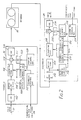
- Figure 2 shows a schematic block diagram illustrating the various functional blocks of the scrambler.
- the signal at the input 12 is taken to a store 106 via an analogue to digital converter 102 and a buffer 104 which holds 1 block of sound data.
- this comprised 8192 samples and corresponded to about 1/4 second of sound. This represents a reasonable compromise between opacity, which increases with increased block length, and transmission delay (equal to twice the block length).
- the store is filled using a sequential address generator 108 to control the writing operation. When full, the contents of the store are read using an addressing pattern determined by the required scrambled segment-order for that block. This is supplied by a scrambler address generator 110. In a fully implemented system the scrambled segment order could be changed from block to block under the control of a pseudo-random sequence. Thus the scrambled address generator 110 is controlled by a scrambling sequence generator 112 which receives synchronising data from the video signal 114. In the experimental system, however, a fixed scrambled segment order was used to simplify the descrambling operation.
- Timing information from the video signal cannot be used for this purpose, because the relative timing jitter between the replayed video and sound signals is too great. Timing information in the form of a framing signal must therefore be carried with the sound signal itself.
- the framing signal consisted of a repeated binary sequence added to the scrambled audio waveform at a low level (about -30dB).
- the framing sequence (FS) is chosen to have a frequency spectrum which is substantially similar to that of the analogue sound signal being simulated.
- the framing sequence was detected at the receiver using a correlation process. This framing technique gives an additional element of security to the system since the framing sequence must be known before the signal can be descrambled.
- a block diagram of this system is shown in Figure 3.
- the sequence consists of a 511-bit PRBS (pseudo-random binary sequence) with an extra bit added to give a 512-bit sequence with no dc content.
- PRBS has the desirable characteristic of an auto-correlation function which is close to zero for all out-of-phase values, with a narrow (one bit-cell wide) in-phase peak and a frequency spectrum which is noise-like: noise-like signals are those to which the ear is least sensitive and those which might best be masked by typical program material.
- the framing sequence was read from a framing sequence generator 122 in the form of a store as an 8 kbit/s serial bit stream with a fixed phase relationship with respect to the scrambled sound segments. During recording and replay, components in this signal above 8 kHz would probably be affected by the response limitations of the recorder so these components were removed by a low-pass filter 122.
- the filtered framing sequence was then added to the scrambled audio signal on an adder 124 and passed through a digital to analogue converter 126 to produce the final output for recording. To ensure reliable detection of the sequence under conditions of varying programme level, the level of the sequence was varied according to the mean programme level. This also reduced any interference from the framing signal during quiet passages.
- a correlator in the decoder was used to find the "phase" of this sequence with respect to the replayed sound data. Once found, the positions of the boundaries between segments were known and the signal could be decoded.
- pseudo-random signal is very suitable, but other signals with reasonably similar properties could be used.
- the descrambling operation is similar to scrambling ( Figure 1).
- the analogue sound signal, replayed from the VCR 30, is divided into the original segments which are then re-ordered under the control of a locally generated pseudo-random sequence to produce the original sound signal.
- This sequence generator is initialised by data included in the video signal.
- the descrambler 20 includes an analogue to digital converter 202 connected to the descrambler input and a buffer store 204 and a framing sequence detector circuit 206 both connected to the ADC output.
- a store 208 reverses the operation of the store 106 at the scrambler and receives the signal from the buffer store 204.
- Writing is controlled by a scrambled address generator 210 and reading by a sequential address generator 212.
- the scrambled address generator is controlled by a scrambling sequence generator 214 which receives synchronising data from the video signal. Both address generators are reset by the framing sequence detector.
- a correlator 220 Before the signal can be descrambled, the positions of the boundaries between segments must be found. This is achieved in a correlator 220 by correlating the incoming signal with a locally generated framing sequence for all 512 possible phases of the sequence. Since the relative bit-phase of the transmitted and locally generated sequence is not defined, each phase of the sequence is tested in four possible bit-phases. This involves performing the correlation for each sample-phase of the incoming data since each bit of the framing sequence is equivalent to four sample periods. This also increases the timing accuracy of the system to 1 sample. The output from the correlator is then taken to a high-pass transversal filter to remove the low-frequency correlation component between the signal and the sequence.
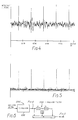
- Figure 4 shows the output from the correlator before filtering and Figure 5 shows the output after filtering.
- the filter is shown in Figure 6, and consists of two 2-sample delays 224 in cascade, a multiplier 226 connected to the centre junction between the delays, and an adder 228 connected to add the delay input and output signals and the multiplier output.
- the maximum output value from the filter is found for the 2048 different sample phases, equivalent to one segment length.
- the phase at which this occurs is stored and compared with the phase derived for the following segments. When three phase values within 4 samples have occurred consecutively the system changes to its "in lock" mode. Having found the phase of the sequence with respect to segment boundaries, the position of the segment boundaries is known and the signal can be descrambled.
- a framing sequence generator 230 synchronised by the framing sequence detector 206 supplies the sequence which is filtered by filter 232 similar to filter 122 at the scrambler and subtracted from the video signal in a subtractor 234.
- the subtractor output is applied to a digital to analogue converter 236.
- the correlator need not check for all possible phases of the framing sequence. Allowance must be made only for the timing instability of the medium. Typically for the analogue track of a VCR this is about 4 samples from segment to segment. To allow for the operation of the correlator filter, the correlation was carried out between -7 and + 7 samples of the sample-phase found previously.
- the system was tested with a conventional longitudinal VCR sound track and with a "HI-FI" sound machine.
- the sound is recorded as an FM signal via the normal rotary video head.
- This system has a superior noise performance to that of the normal sound track with the consequence that, with certain programme material, the framing sequence could be heard in the replayed signal. To reduce this effect, a regenerated version of the framing sequence was subtracted from the output signal.
- the system was effective in rendering speech unintelligible, though it was not sufficiently opaque to disguise the sex of the speaker or that English was the language spoken. With music, the system was less opaque because of the slower changes in the sound content. A longer segment length should increase the opacity for music signals. Although the interpolation processes significantly reduced the level of disturbance at the segment boundaries, effects were still audible on critical material. These were more disturbing with the HI-FI machine because of the absence of other impairments.
Landscapes
- Engineering & Computer Science (AREA)
- Computer Networks & Wireless Communication (AREA)
- Signal Processing (AREA)
- Signal Processing For Digital Recording And Reproducing (AREA)
Applications Claiming Priority (2)
| Application Number | Priority Date | Filing Date | Title |
|---|---|---|---|
| GB8717066 | 1987-07-20 | ||
| GB08717066A GB2207328A (en) | 1987-07-20 | 1987-07-20 | Scrambling of analogue electrical signals |
Publications (2)
| Publication Number | Publication Date |
|---|---|
| EP0300678A2 true EP0300678A2 (de) | 1989-01-25 |
| EP0300678A3 EP0300678A3 (de) | 1990-06-20 |
Family
ID=10620952
Family Applications (1)
| Application Number | Title | Priority Date | Filing Date |
|---|---|---|---|
| EP88306401A Withdrawn EP0300678A3 (de) | 1987-07-20 | 1988-07-13 | Verschleierung von analogen elektrischen Signalen |
Country Status (4)
| Country | Link |
|---|---|
| US (1) | US4905278A (de) |
| EP (1) | EP0300678A3 (de) |
| JP (1) | JPH01105682A (de) |
| GB (1) | GB2207328A (de) |
Cited By (1)
| Publication number | Priority date | Publication date | Assignee | Title |
|---|---|---|---|---|
| EP2326088A4 (de) * | 2008-08-12 | 2014-03-19 | Sk Planet Co Ltd | System und verfahren zur bildverschlüsselung/-entschlüsselung |
Families Citing this family (13)
| Publication number | Priority date | Publication date | Assignee | Title |
|---|---|---|---|---|
| US5253296A (en) * | 1991-11-26 | 1993-10-12 | Communication Electronics | System for resisting interception of information |
| EP0571753B1 (de) * | 1992-04-17 | 1999-03-31 | Matsushita Electric Industrial Co., Ltd. | Videorecorder |
| US6078666A (en) * | 1996-10-25 | 2000-06-20 | Matsushita Electric Industrial Co., Ltd. | Audio signal processing method and related device with block order switching |
| US6272226B1 (en) | 1997-04-02 | 2001-08-07 | Scientific-Atlanta, Inc. | Apparatus and method for masking audio signals in a signal distribution system |
| US6229897B1 (en) * | 1997-10-30 | 2001-05-08 | Transcrypt International, Inc. | Apparatus and method of secured analog voice communication |
| US6976265B1 (en) | 1998-10-08 | 2005-12-13 | Ati International Srl | Method and apparatus for controlling display of content signals |
| US6636607B1 (en) * | 1998-10-08 | 2003-10-21 | Ati International Srl | Method and apparatus for controlling display of content signals |
| GB2386041A (en) * | 2002-03-01 | 2003-09-03 | Sensaura Ltd | A method of modifying intermittent audio signals such as speech or musical notes in real time |
| US7143028B2 (en) | 2002-07-24 | 2006-11-28 | Applied Minds, Inc. | Method and system for masking speech |
| US7376557B2 (en) * | 2005-01-10 | 2008-05-20 | Herman Miller, Inc. | Method and apparatus of overlapping and summing speech for an output that disrupts speech |
| US7363227B2 (en) * | 2005-01-10 | 2008-04-22 | Herman Miller, Inc. | Disruption of speech understanding by adding a privacy sound thereto |
| KR100858283B1 (ko) | 2007-01-09 | 2008-09-17 | 최현준 | 대화 도청 방지를 위한 사운드 마스킹 방법과 이를 위한장치 |
| US10276177B2 (en) | 2016-10-01 | 2019-04-30 | Intel Corporation | Technologies for privately processing voice data using a repositioned reordered fragmentation of the voice data |
Family Cites Families (14)
| Publication number | Priority date | Publication date | Assignee | Title |
|---|---|---|---|---|
| NL6612935A (de) * | 1966-09-14 | 1968-03-15 | ||
| DE1928986B2 (de) * | 1968-06-29 | 1978-09-21 | N.V. Philips' Gloeilampenfabrieken, Eindhoven (Niederlande) | Übertragungssystem mit einer Sende- und einer Empfangsvorrichtung zur Übertragung von Informationen in einem vorgeschriebenen Frequenzband und dafür geeignete Sende- und Empfangsvorrichtungen |
| US3921151A (en) * | 1971-06-21 | 1975-11-18 | Patelhold Patentwerwertungs & | Apparatus for enciphering transmitted data by interchanging signal elements of the transmitted data without overlapping or omitting any elements within the transmitted signal train |
| US4443660A (en) * | 1980-02-04 | 1984-04-17 | Rockwell International Corporation | System and method for encrypting a voice signal |
| CA1188739A (en) * | 1981-07-08 | 1985-06-11 | Brian Bryden | Analog voice privacy device for a secure communications system |
| US4433211A (en) * | 1981-11-04 | 1984-02-21 | Technical Communications Corporation | Privacy communication system employing time/frequency transformation |
| FR2520955B1 (fr) * | 1982-01-29 | 1987-11-13 | Radiotechnique | Systeme electronique de transmission secrete de signaux audio |
| CA1253616A (en) * | 1982-07-29 | 1989-05-02 | Robert W. Field | Secure coding and decoding system and method for television program signals |
| US4551580A (en) * | 1982-11-22 | 1985-11-05 | At&T Bell Laboratories | Time-frequency scrambler |
| JPS59111441A (ja) * | 1982-12-17 | 1984-06-27 | Sony Corp | 音声信号の秘話方式 |
| JPS59127442A (ja) * | 1983-01-11 | 1984-07-23 | Sony Corp | 音声信号の秘話方式 |
| US4547802A (en) * | 1983-04-29 | 1985-10-15 | Westinghouse Electric Corp. | TV Scrambler/descrambler using serial memories |
| DE3343307A1 (de) * | 1983-11-30 | 1985-06-05 | Blaupunkt-Werke Gmbh, 3200 Hildesheim | Verfahren zum verschluesseln und entschluesseln von analogen signalen, sowie schaltungsanordnung zur durchfuehrung des verfahrens |
| BE901468A (fr) * | 1985-01-09 | 1985-05-02 | Belge Radio Television | Procede de codage et de decodage d'informations et appareil pour sa mise en oeuvre. |
-
1987
- 1987-07-20 GB GB08717066A patent/GB2207328A/en not_active Withdrawn
-
1988
- 1988-07-13 EP EP88306401A patent/EP0300678A3/de not_active Withdrawn
- 1988-07-20 US US07/221,901 patent/US4905278A/en not_active Expired - Fee Related
- 1988-07-20 JP JP63181446A patent/JPH01105682A/ja active Pending
Cited By (2)
| Publication number | Priority date | Publication date | Assignee | Title |
|---|---|---|---|---|
| EP2326088A4 (de) * | 2008-08-12 | 2014-03-19 | Sk Planet Co Ltd | System und verfahren zur bildverschlüsselung/-entschlüsselung |
| US8948384B2 (en) | 2008-08-12 | 2015-02-03 | Sk Planet Co., Ltd. | Image encrypting/decrypting system and method |
Also Published As
| Publication number | Publication date |
|---|---|
| GB2207328A (en) | 1989-01-25 |
| EP0300678A3 (de) | 1990-06-20 |
| GB8717066D0 (en) | 1987-08-26 |
| JPH01105682A (ja) | 1989-04-24 |
| US4905278A (en) | 1990-02-27 |
Similar Documents
| Publication | Publication Date | Title |
|---|---|---|
| KR100287536B1 (ko) | 신호합성방법및장치 | |
| US4905278A (en) | Scrambling of analogue electrical signals | |
| EP0810600B1 (de) | Verbesserungen in Systemen zum Erreichen von grösserer Amplitudenauflösung | |
| CA2195942C (en) | Method and apparatus for inserting source identification data into a video signal | |
| US5159631A (en) | Audio scrambling system using in-band carrier | |
| EP0018784B1 (de) | Übertragungssystem mit digitalen Audio-Verschlüssel- und -Entschlüssel-Subsystemen für die Übertragung von Audio-Information über ein Fernsehsystem | |
| JP4251378B2 (ja) | アナログ信号への情報の埋込みおよび抽出を分布信号特徴を用いて行なう装置および方法 | |
| US5058159A (en) | Method and system for scrambling and descrambling audio information signals | |
| JPH09501291A (ja) | 音声伝送における音声スクランブリングおよびアンスクランブリングのためのプロセスおよび装置 | |
| JP3690043B2 (ja) | 音声情報伝送装置及び方法並びに音声情報記録装置 | |
| US4825303A (en) | Compressed audio silencing | |
| US6389137B1 (en) | Video signal transmitting method, video signal output device, video signal receiver, video anti-duplication control system, additional information superimposing and extracting system and video signal recording medium | |
| JPS628861B2 (de) | ||
| US4651205A (en) | Television transmission system | |
| JPH0193275A (ja) | テレビジョン制御信号送受信方法 | |
| JPS59147552A (ja) | オ−デイオ信号のデスクランブラ | |
| JPS6041339A (ja) | 同期信号挿入方式 | |
| HK1008368B (en) | Improved signal encode/decode system |
Legal Events
| Date | Code | Title | Description |
|---|---|---|---|
| PUAI | Public reference made under article 153(3) epc to a published international application that has entered the european phase |
Free format text: ORIGINAL CODE: 0009012 |
|
| AK | Designated contracting states |
Kind code of ref document: A2 Designated state(s): DE FR NL |
|
| PUAL | Search report despatched |
Free format text: ORIGINAL CODE: 0009013 |
|
| AK | Designated contracting states |
Kind code of ref document: A3 Designated state(s): DE FR NL |
|
| STAA | Information on the status of an ep patent application or granted ep patent |
Free format text: STATUS: THE APPLICATION IS DEEMED TO BE WITHDRAWN |
|
| 18D | Application deemed to be withdrawn |
Effective date: 19901221 |