EP0300775A2 - Procédé et dispositif de codage et de décodage d'un signal - Google Patents
Procédé et dispositif de codage et de décodage d'un signal Download PDFInfo
- Publication number
- EP0300775A2 EP0300775A2 EP88306679A EP88306679A EP0300775A2 EP 0300775 A2 EP0300775 A2 EP 0300775A2 EP 88306679 A EP88306679 A EP 88306679A EP 88306679 A EP88306679 A EP 88306679A EP 0300775 A2 EP0300775 A2 EP 0300775A2
- Authority
- EP
- European Patent Office
- Prior art keywords
- value
- quantization
- initial value
- values
- representative
- Prior art date
- Legal status (The legal status is an assumption and is not a legal conclusion. Google has not performed a legal analysis and makes no representation as to the accuracy of the status listed.)
- Granted
Links
Images


Classifications
-
- H—ELECTRICITY
- H03—ELECTRONIC CIRCUITRY
- H03M—CODING; DECODING; CODE CONVERSION IN GENERAL
- H03M7/00—Conversion of a code where information is represented by a given sequence or number of digits to a code where the same, similar or subset of information is represented by a different sequence or number of digits
-
- H—ELECTRICITY
- H04—ELECTRIC COMMUNICATION TECHNIQUE
- H04N—PICTORIAL COMMUNICATION, e.g. TELEVISION
- H04N19/00—Methods or arrangements for coding, decoding, compressing or decompressing digital video signals
- H04N19/10—Methods or arrangements for coding, decoding, compressing or decompressing digital video signals using adaptive coding
Definitions
- the present invention relates to an encoding and decoding method and device for compression encoding, transmitting and decoding of information of an image signal or audio signal.
- a Fractal Based Approach to Image Compression ICASSP, 86, 11A.3 is known to the present inventors as a reference closely related to the present invention.
- This reference is to compress image data using the fractal concept.
- the basic concept is in that "yard stick" of certain fixed length is used as a unit to cover a signal, and a horizontal distance of the cross point at which "yard stick” intersects the signal, i.e., sampling interval and a positive or negative sign bit respectively indicative of increase or reduction in an amplitude value are both transmitted for restoration of the signal at the decoding side.
- the practically implementing method employs "trigger function" in place of "yard stick", the trigger function being compared with the signal to determine a sampling interval. This makes the sampling interval wider for signal including many flat parts, so that the signal may be compressed to a large extent.
- the present invention resides in a method of encoding and decoding image and audio signals, any of the signals being subjected to sampling and having a multiplicity of sampling points each represented by a quantized amplitude value.
- An encoding step comprises the steps of: transmitting an amplitude value of a given sampling point as an initial value; subtracting the initial value from each of amplitude values of n sampling points (where n is a predetermined integer) to calculate n difference values therebetween, and calculating positive or negative signs, which respectively indicate varying directions of the amplitudes imposed by the difference values with respect to the initial value and absolute values of the difference values ; previously preparing a quantization table which has threshold values and representative values expressed in terms of amplitude values, defines an ordered set of n quantization scales (where n is a predetermined integer) each comprising at least one threshold value and a repre sentative value, and also defines index values different from one another for all the representative values of said n quantization scales ; comparing a series of n difference absolute values with a series of n quantization scales included in the quantization table sequentially from the sampling point adjacent to the initial value until the maximum n-th sampling point, and selecting a representative value
- a decoding step comprises the steps of: receiving the amplitude value of the transmitted sampling point as an initial value ; previously preparing the same quantization table as used during the encoding step ; determining the number m and the representative value corresponding to the received index value and the sign by making use of the quantization table ; interpolating the amplitude value of each of (m-1) sampling points between the initial value and the sum of the initial value and the representative value of m-th sampling point ; and repeating the foregoing steps with the sum of the initial value and the representative value of m-th sampling point being set as a subsequent initial value.
- the foregoing method allows sampling to be finely carried out in the steeply changing part, but roughly carried out in the moderately changing part, so that image and audio signals can be encoded with high efficiency in better fitting for human visual and auditory characteristics.
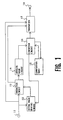
- Fig. 1 is a block diagram of one embodiment of an encoding device according to the present invention.
- the encoding device of Fig. 1 comprises an input terminal 11, an initial value updating circuit 12, a subtraction circuit 13, an absolute value circuit 14, a quantization table 15, a comparison circuit 16, a transmitter 17, and an output terminal 18.
- Applied to the input terminal 11 is a series of image or audio data after being subjected to sampling and quantizing.
- an initial value S i is held in the initial value updating circuit 12.
- the initial value S i is also supplied to the transmitter 17.
- the output ⁇ S1 of the subtraction circuit 13 is then supplied to the absolute value circuit 14, while F1 is held therein until receiving of an indication from the comparison circuit 16.
- the absolute value circuit 14 calculates an absolute value
- the quantization table 15 is a table having an ordered set of n quantization scales (where n is a positive integer).
- Each quantization scale has at least one quantization level, and each quantization level has a single representative value Rk.
- the quantization levels are partitioned from each other by respective threshold values.
- the quantization table 15 outputs the threshold value of first quantization scale and sends it to the comparison circuit 16.
- the comparison circuit 16 compares the threshold value of first quantization scale with the absolute value
- the comparison circuit 16 also resets the quantization table 15. Further, the comparison circuit 16 sends the representative value Rk of the selected index to the initial value updating circuit 12.
- the initial value updating circuit 12 holds the sum of the initial value S i originally held therein and the representative value Rk as a new initial value. The above process is effected when the matching quantization level is present.
- ⁇ S2 is processed in a like manner to ⁇ S1. More specifically, the quantization table 15 outputs the threshold value of second quantization scale, which is then compared with
- the transmitter 17 outputs a series of indices and signs from the output terminal 18.
- Fig. 2 is a more detailed block diagram of Fig. 1.
- the initial value updating circuit 12 comprises a selector 21, register 22 and full adder 23.
- the selector 21 makes switching action to select either the first initial value or the updated initial value.
- the initial value means, for example, an amplitude value of first pixel on one horizontal scanning line in connection with image.
- the register 22 holds the initial value selected by the selector 21.
- the full adder 23 adds the current initial value held in the register 21 and the representative value Rk of the index selected by the comparison circuit 16, and then outputs the sum therefrom.
- the subtraction circuit 13 comprises a two's complementer 24 and a full adder 25.
- the two's complementer 24 operates to determine the subtractive value of the data applied thereto for implementing the subtraction in the full adder 25.
- the full adder 25 adds the initial values held in the register 22 and the output of the two's complementer 24 to thereby obtain the resulting difference value ⁇ S1.
- the positive or negative sign F1 is also obtained.
- the absolute value circuit 14 functions to determine
- the quantization table 15 comprises a ROM (Read Only Memory) 27 for storing threshold values and a counter 28.
- the counter 28 is reset by the comparison circuit 16 upon updating of the initial value, and then counted up by sampling clocks applied thereto.
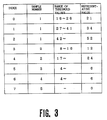
- Fig. 3 shows the relationship among the index, the sample number, the range of threshold values, and the representative value.
- the ROM 27 is designed to receive the output of the coun ter 28, i.e., the sample number, as an address input and responsively output the lowest value of each range of threshold values. Assuming for the sample S1 to be input, for example, the counter 28 outputs 1 as the sample number and supplies it to the ROM 27 as an address for accessing.
- the ROM 27 outputs three values, i.e., 16, 27 and 42 as seen from Fig. 3, and supplies the value 16 to a comparator 29, the value 27 to a comparator 30, and the value 42 to a comparator 31, respectively, the comparators 29-31 being constituent components of the comparison circuit 16.
- the output of the absolute value circuit 14 is supplied to each of the comparators 29, 30 and 31, and the resulting output values are used for selection of a matching quantization level. More specifically, when the output of the absolute value circuit 14 is equal to or greater than the output of the ROM 27, one or more of the corresponding comparators 29, 30 and 31 issue a logical "true" output. With the absolute value circuit 14 outputting 16- 26, only the comparator 29 issues a "true" output.
- a ROM 32 is designed to output an index, a representative value, and a reset signal for the counter 28 by making use of the true/false outputs of the comparators 29, 30, 31 and the count value of the counter 28 as respective address inputs.
- the ROM 32 delivers the index 1 and the representative value 21 as shown in Fig. 3.
- the ROM 32 outputs a reset signal and supplies it to the counter 28, when at least one of the comparators 29, 30 and 31 issues a "true” output.
- the counter 28 is reset in the above case. Supposing that the output of the absolute value circuit 14 is equal to or less than 15 in the foregoing example, all of the comparators 29, 30 and 31 issue "false" outputs. In this case, there exists no matching quantization level for the first sample, so the process proceeds to comparison of the subsequent sample.
- the initial value updating circuit 12, subtraction circuit 13 and absolute value circuit 14 operate in a like manner to the above, and the absolute value circuit 14 outputs
- the counter 28 is counted up and issues the output of 2. Accordingly, the ROM 27 now outputs 8 and 17 to the comparators 29 and 30 in the example of using the table of Fig. 3, respectively.
- the similar process will be repeated to find a matching quantization level for each of successivelysive sample numbers. If not found, it proceeds to processing of the subsequent sample.
- the ROM 32 outputs the index 7 and the representative value 0 irrespective of the output value of the absolute value circuit 14.
- the index in the output of the ROM 32 is supplied to a register 33 constituting the transmitter 17, and then delivered from the output terminal 18 together with the sign supplied from the full adder 25.
- the representative value in the output of the ROM 32 is supplied to the full adder 23.
- the quantization table is not limited to the illustrated one.
- the number of indices, the magnitude of sample numbers, the ranges of threshold values, and representative values may have optional values so long as they will not be contradictory to each other. Therefore, the number of comparators to be included in the comparison circuit 16 depends on the con figuration of each quantization table.
- the part of signal which has an amplitude value changing steeply is quantized at the first sample, but the sample number proceeds in order of 2, 3, 4 and 5 as the signal changes more moderately.
- the original sampling interval is widened and hence the amount of data is reduced.
- the present method makes it possible to increase the compression rate.
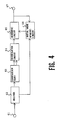
- Fig. 4 shows one embodiment of a decoding device according to the present invention.
- the decoding device of Fig. 4 comprises an input terminal 41, a receiver 42, a quantization table 43, an interpolation circuit 44, an arithmetic circuit 45, an initial value updating circuit 46, and an output terminal 47.
- a series of encoded data as inputted to the input terminal 41 and then supplied to the receiver 42.
- the receiver 42 separates the initial value S i from the index k and the sign F.
- the initial value is supplied to the initial value updating circuit 46, and the index and the sign are supplied to the quantization table 43.
- the quantization table 43 has the same quantization table as used in the encoding device, and outputs the sample number and the representative value upon receiving the index applied thereto.
- the representative value is added with the positive or negative sign and then supplied to the interporation circuit 44.
- the interpolation circuit 44 calculates one or more interpolation values from the sample number and the representative value.
- the case of sample number 1 does not require interpolation, but the case of sample number 2 or more requires interpolation.
- the interpolated data is in the form of series of difference values and supplied to the arithmetic circuit 45.
- the initial value held in the initial value updating circuit 46 and the series of difference values are sequentially added to give a series of decoded signals, which is then delivered from the output terminal 47.
- the final value in the data series from the arithmetic circuit 45 is supplied to the initial value updating circuit 46 for updating the previous initial value.
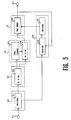
- Fig. 5 is a more detailed block diagram of Fig. 4.
- the receiver 42 comprises a register 51.
- the register 51 separates the initial value out of the data series encoded by the encoding device, followed by supplying it to the initial value updating circuit 46, while it supplies the index and the sign to the quantization table 43.
- the quantization table 43 comprises a ROM 52.
- the ROM 52 outputs the sample number and the representative value using the index and the sign as address inputs. If the encoding device employs the quantization table shown in Fig. 3, the decoding device has also to employ the same quantization table as shown in Fig. 3.
- the representative value output from the ROM 52 is given by the representative value shown in Fig. 3 added with the positive or negative sign.
- the interpolation circuit 44 comprises a down counter 53 and a ROM 54.
- the sample number outputted from the ROM 52 is loaded into the down counter 53.
- the representative value delivered from the ROM 54 and the output of the down counter 53 are supplied to a ROM 54 as addresses for accessing. Responsively, the ROM 54 outputs the interpolation value which is previously calculated and stored therein.
- the arithmetic circuit 45 comprises a full adder 55.
- the full adder 55 adds the output of the ROM 54 and the initial value stored in a register 57 of the initial value updating circuit 46, and then supplies the resulting sum to the output terminal 47.
- a selector 56 of the initial value updating circuit 46 makes switching action to selects either the initial value supplied from the register 51 or the final output value from the full adder 55. Only upon the register 51 detecting the initial value, the selector 56 is switched to the side of the register 51. The output of the selector 56 is supplied to the register 57. The new initial value is stored in the register 57 and, at the same time, the register 51 supplies the subsequent index and sign to the ROM 52 for repeating the above process.
- the index and the sign were employed as input addresses for the ROM storing the quantization table in the foregoing embodiment, it may be configured that only the index is employed as an input address for the ROM, and the sign is directly added to the output of the ROM for providing the representative value with the positive or negative sign.
- the interpolation circuit was consisted of the down counter and the ROM, it is not limited to such configuration and may comprise, for example, an up counter, a comparator and a ROM.
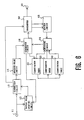
- Fig. 6 is a block diagram of another embodiment of an encoding device according to the present invention.
- the encoding device of Fig. 6 comprises an input terminal 11, an initial value updating circuit 12, a subtraction circuit 13, an absolute value circuit 14, three quantization tables 61, 62 and 63, a comparison circuit 16, a transmitter 66, a switching circuit 64, a monitor circuit 65, and an output terminal 18.
- Applied to the input terminal 11 is a series of image or audio data after being subjected to sampling and quantizing.
- an initial value Si is held in the initial value updating circuit 12.
- the initial value S i is also supplied to the transmitter 17.
- the absolute value circuit 14 calculates an absolute value
- the quantization tables 61, 62 and 63 output the respective threshold values of first quantization scales and supply them to the switching circuit 64.
- the switching circuit 64 selects and outputs a proper input dependent on the output of the monitor circuit 65.
- the comparison circuit 16 compares the threshold value of the selected quantization table with the absolute value
- ⁇ S2 is processed in a like manner to ⁇ S1 through the above-mentioned steps.
- the transmitter 66 supplies respective values of input rate and output rate to the monitor circuit 65.
- the monitor circuit 65 calculates the integrated value of differences between the input rate and the output rate, and converts it to a switching signal which is delivered to the switching circuit 64.
- This embodiment has a function to maintain constant the data output rate of the encoding device.
- the quantization tables 61, 62 and 63 have their quantization scales made up such that when those three quantization tables are used for the same input signal, the first quantization table 61 produces the largest amount of decoded data, the third quantization table 63 produces the least amount of decoded data, and the second quan tization table 62 produces the intermediate amount of decoded data.
- the monitor circuit 65 integrates the difference between the input rate and the output rate at all time, and converts the integrated value to the switching signal.
- the switching circuit 64 When the input rate exceeds the output rate in this stage, the switching circuit 64 outputs such a selection signal as by which the second quantization table 62 is selected. When the input rate still yet exceeds the output rate, another selection signal is output to select the third quantization table 63. To the contrary, when the input rate is below the output rate, the switching circuit 64 is controlled to sequentially select the third quantization table 63, second quantization table 62 and first quantization table 61 in this order. This prevents the encoding device from coming into crash, while keeping the output rate kept at constant.
- Fig. 7 is a more detailed block diagram of the quantization tables 61, 62 and 63, switching circuit 64, monitor circuit 65, and transmitter 66 of Fig. 6.
- the first quantization table 61 comprises a ROM 71 and a counter 72.
- the second quantization table 62 comprises a ROM 73, and the third quantization table 63 comprises a ROM 74.
- the counter 72 is counted up by signal sampling clocks, and reset by the comparison circuit 16 when it detects a matching quantization level.
- the ROM's 71, 73 and 74 are operated synchronously by virtue of the counter 72.
- the switching circuit 64 makes switching action to select any one of the threshold value outputs from the ROM's 71, 73 and 74, and then delivers the selected one to the comparison circuit 16.
- the transmitter 66 comprises a RAM (Random Access Memory) 75, an arbitration circuit 76, a write address counter 77,and a read address counter 78.
- the input data such as index is written into the RAM 75.
- write addresses are produced by the write address counter 77 and applied to the RAM 75 via the arbitration circuit 76.
- read addresses are produced by the read address counter 78 and applied to the RAM 75 via the arbitration circuit 76. Since the transmitter 66 is set to have the constant output rate, the arbitration circuit 76 passes the read addresses with higher priority, while keeping the write addresses queued.
- the monitor circuit 65 comprises a subtractor 79, an accumulator 80 and a converter 81.
- the subtractor 79 subtracts the count value of the read address counter 78 from the count value of the write address counter 77, and then supplies the resulting difference to the accumulator 80.
- the accumulator 80 accumulates the differences about a predetermined value. The increased input rate advances the write address, which reduces the output value of the subtractor 79 so that the output value of the accumulator 80 becomes small.
- the converter 81 produces switching signals by which the switching circuit 64 selects the ROM 74 when the accumulator 80 has a small value, it selects the ROM 73 when the accumulator 80 has a value exceeding a first predetermined threshold value, and it selects the ROM 71 when the accumulator 80 has a value exceeding a second predetermined threshold value. This implements to effect such control as reducing the amount of index and sign data produced when the data input to the RAM 75 is increased, but increasing the amount of index and sign data produced when the data input to the RAM 75 is reduced.
- the monitor circuit and the transmitter in this embodiment are not limited to the illustrated configurations.
- the RAM 75 in the transmitter 66 may comprise a FIFO (First In First Out) memory.
Landscapes
- Engineering & Computer Science (AREA)
- Multimedia (AREA)
- Signal Processing (AREA)
- Theoretical Computer Science (AREA)
- Compression, Expansion, Code Conversion, And Decoders (AREA)
- Compression Or Coding Systems Of Tv Signals (AREA)
Applications Claiming Priority (6)
| Application Number | Priority Date | Filing Date | Title |
|---|---|---|---|
| JP62181520A JPS6424687A (en) | 1987-07-21 | 1987-07-21 | Image encoder |
| JP181520/87 | 1987-07-21 | ||
| JP62236526A JPS6478589A (en) | 1987-09-21 | 1987-09-21 | Picture decoder |
| JP236526/87 | 1987-09-21 | ||
| JP62309922A JPH01151384A (ja) | 1987-12-08 | 1987-12-08 | 画像符号化装置 |
| JP309922/87 | 1987-12-08 |
Publications (3)
| Publication Number | Publication Date |
|---|---|
| EP0300775A2 true EP0300775A2 (fr) | 1989-01-25 |
| EP0300775A3 EP0300775A3 (fr) | 1991-01-16 |
| EP0300775B1 EP0300775B1 (fr) | 1995-05-31 |
Family
ID=27325021
Family Applications (1)
| Application Number | Title | Priority Date | Filing Date |
|---|---|---|---|
| EP88306679A Expired - Lifetime EP0300775B1 (fr) | 1987-07-21 | 1988-07-20 | Procédé et dispositif de codage et de décodage d'un signal |
Country Status (4)
| Country | Link |
|---|---|
| US (1) | US4953214A (fr) |
| EP (1) | EP0300775B1 (fr) |
| KR (1) | KR920003860B1 (fr) |
| DE (1) | DE3853899T2 (fr) |
Cited By (3)
| Publication number | Priority date | Publication date | Assignee | Title |
|---|---|---|---|---|
| EP0784312A3 (fr) * | 1996-01-10 | 1998-09-23 | Nec Corporation | Système de codage et décodage des signaux audio |
| WO2000041314A1 (fr) * | 1998-12-31 | 2000-07-13 | Samsung Electronics Co., Ltd. | Procede de quantification pour decodeur a iteration d'un systeme de telecommunications |
| US10467823B2 (en) | 2015-11-20 | 2019-11-05 | Samsung Electronics Co., Ltd. | Apparatus and method for transmitting and receiving data |
Families Citing this family (18)
| Publication number | Priority date | Publication date | Assignee | Title |
|---|---|---|---|---|
| USRE40280E1 (en) | 1988-12-30 | 2008-04-29 | Lucent Technologies Inc. | Rate loop processor for perceptual encoder/decoder |
| US5230038A (en) * | 1989-01-27 | 1993-07-20 | Fielder Louis D | Low bit rate transform coder, decoder, and encoder/decoder for high-quality audio |
| US5388181A (en) * | 1990-05-29 | 1995-02-07 | Anderson; David J. | Digital audio compression system |
| EP0469835B1 (fr) * | 1990-07-31 | 1998-09-30 | Canon Kabushiki Kaisha | Méthode et appareil de traitement d'images |
| US6915014B1 (en) | 1990-07-31 | 2005-07-05 | Canon Kabushiki Kaisha | Image processing apparatus and method |
| EP0559348A3 (fr) * | 1992-03-02 | 1993-11-03 | AT&T Corp. | Processeur ayant une boucle de réglage du débit pour un codeur/décodeur perceptuel |
| US6100933A (en) * | 1994-10-31 | 2000-08-08 | Intel Corporation | Process and apparatus for compressing and decompressing digital video signals using horizontally-based vector quantization |
| US5862263A (en) * | 1995-04-13 | 1999-01-19 | Samsung Electronics Co., Ltd. | Fractal image compression device and method using perceptual distortion measurement |
| KR0154739B1 (ko) * | 1995-04-19 | 1998-11-16 | 김광호 | 프랙탈 영상 압축 장치 및 방법 |
| US5822721A (en) * | 1995-12-22 | 1998-10-13 | Iterated Systems, Inc. | Method and apparatus for fractal-excited linear predictive coding of digital signals |
| US5831559A (en) * | 1996-01-24 | 1998-11-03 | Intel Corporation | Encoding/decoding video signals using multiple run-val mapping tables |
| US5913186A (en) * | 1996-03-25 | 1999-06-15 | Prometheus, Inc. | Discrete one dimensional signal processing apparatus and method using energy spreading coding |
| US6529631B1 (en) | 1996-03-29 | 2003-03-04 | Sarnoff Corporation | Apparatus and method for optimizing encoding and performing automated steerable image compression in an image coding system using a perceptual metric |
| US6295379B1 (en) * | 1997-09-29 | 2001-09-25 | Intel Corporation | DPCM image compression with plural quantization table levels |
| US6459392B1 (en) | 2001-01-19 | 2002-10-01 | International Business Machines Corporation | Technique for encoding a sequence of periodic byte values with vertical correlation |
| SE0402651D0 (sv) * | 2004-11-02 | 2004-11-02 | Coding Tech Ab | Advanced methods for interpolation and parameter signalling |
| GB2451828A (en) * | 2007-08-13 | 2009-02-18 | Snell & Wilcox Ltd | Digital audio processing method for identifying periods in which samples may be deleted or repeated unobtrusively |
| EP2372423B1 (fr) | 2008-12-26 | 2015-08-26 | Asahi Kasei Fibers Corporation | Câble de transmission de signaux optiques extensible |
Family Cites Families (4)
| Publication number | Priority date | Publication date | Assignee | Title |
|---|---|---|---|---|
| US4093962A (en) * | 1976-12-01 | 1978-06-06 | Nippon Electric Co., Ltd. | Adaptive predictive encoder |
| US4802222A (en) * | 1983-12-12 | 1989-01-31 | Sri International | Data compression system and method for audio signals |
| US4670851A (en) * | 1984-01-09 | 1987-06-02 | Mitsubishi Denki Kabushiki Kaisha | Vector quantizer |
| SE465347B (sv) * | 1984-04-25 | 1991-08-26 | Matsushita Electric Works Ltd | Bildsaendningssystem foer sampling och komprimering av bilddata i ett tv-bildfaelt |
-
1988
- 1988-07-20 EP EP88306679A patent/EP0300775B1/fr not_active Expired - Lifetime
- 1988-07-20 DE DE3853899T patent/DE3853899T2/de not_active Expired - Fee Related
- 1988-07-21 US US07/222,171 patent/US4953214A/en not_active Expired - Fee Related
- 1988-07-21 KR KR1019880009095A patent/KR920003860B1/ko not_active Expired
Cited By (4)
| Publication number | Priority date | Publication date | Assignee | Title |
|---|---|---|---|---|
| EP0784312A3 (fr) * | 1996-01-10 | 1998-09-23 | Nec Corporation | Système de codage et décodage des signaux audio |
| WO2000041314A1 (fr) * | 1998-12-31 | 2000-07-13 | Samsung Electronics Co., Ltd. | Procede de quantification pour decodeur a iteration d'un systeme de telecommunications |
| US6876709B1 (en) | 1998-12-31 | 2005-04-05 | Samsung Electronics Co., Ltd. | Quantization method for iterative decoder in communication system |
| US10467823B2 (en) | 2015-11-20 | 2019-11-05 | Samsung Electronics Co., Ltd. | Apparatus and method for transmitting and receiving data |
Also Published As
| Publication number | Publication date |
|---|---|
| KR890003140A (ko) | 1989-04-13 |
| DE3853899T2 (de) | 1995-12-21 |
| US4953214A (en) | 1990-08-28 |
| EP0300775A3 (fr) | 1991-01-16 |
| EP0300775B1 (fr) | 1995-05-31 |
| KR920003860B1 (ko) | 1992-05-15 |
| DE3853899D1 (de) | 1995-07-06 |
Similar Documents
| Publication | Publication Date | Title |
|---|---|---|
| EP0300775A2 (fr) | Procédé et dispositif de codage et de décodage d'un signal | |
| JP3017380B2 (ja) | データ圧縮方法及び装置並びにデータ伸長方法及び装置 | |
| US5016010A (en) | System for controlling a number of bits required to represent coded output data | |
| US4694336A (en) | Digital data transmission method | |
| JPH0216075B2 (fr) | ||
| EP0084270A2 (fr) | Système pour la réduction de la largeur de bande d'un signal vidéo par la formation de la différence de trames et codage dans le domaine de transformation | |
| EP0249086A2 (fr) | Procédé et dispositif pour le codage/la transmission d'images | |
| HK1001184B (en) | System for controlling an amount of coded output data | |
| EP0402149B1 (fr) | Dispositif de codage | |
| US5107519A (en) | Coding device and a decoding device | |
| EP0535272A1 (fr) | Codeur hybride pour un système de traitement d'images | |
| JP2911682B2 (ja) | ブロック整合のための基準としてモーションブロック毎に最少のビット数を用いるモーション補償 | |
| EP0221743A2 (fr) | Procédé et système de compression de signaux vidéo | |
| US6611559B1 (en) | Apparatus and method of detecting motion vectors by calculating a correlation degree between each candidate block | |
| US4853969A (en) | Quantized digital filter | |
| EP0427108B1 (fr) | Dispositif de codage d'images | |
| US5905578A (en) | Coding apparatus | |
| US4979187A (en) | Predictive coding device | |
| EP1613092A2 (fr) | Compression de budget fixe d'un tampon d'images utilisant de tremblement spatio-temporal dispersé adaptatif de blocs | |
| EP0599653B1 (fr) | Commande de niveau d'un signal audio digital dans un système téléphonique | |
| JP2929591B2 (ja) | 画像符号化装置 | |
| KR910009092B1 (ko) | 프레임간의 벡터 양자화 부호화 및 복호화 장치 | |
| EP0859519A2 (fr) | Codeur vidéo utilisant une prédiction implicite ou explicite pour le codage d'image | |
| EP0609835B1 (fr) | Circuit de génération d'adresse pour une table de codage à deux dimensions pour un code de Huffman | |
| JPH06217297A (ja) | 適応型dpcmコーダー |
Legal Events
| Date | Code | Title | Description |
|---|---|---|---|
| PUAI | Public reference made under article 153(3) epc to a published international application that has entered the european phase |
Free format text: ORIGINAL CODE: 0009012 |
|
| AK | Designated contracting states |
Kind code of ref document: A2 Designated state(s): DE FR GB |
|
| PUAL | Search report despatched |
Free format text: ORIGINAL CODE: 0009013 |
|
| AK | Designated contracting states |
Kind code of ref document: A3 Designated state(s): DE FR GB |
|
| 17P | Request for examination filed |
Effective date: 19910709 |
|
| 17Q | First examination report despatched |
Effective date: 19930526 |
|
| GRAA | (expected) grant |
Free format text: ORIGINAL CODE: 0009210 |
|
| AK | Designated contracting states |
Kind code of ref document: B1 Designated state(s): DE FR GB |
|
| REF | Corresponds to: |
Ref document number: 3853899 Country of ref document: DE Date of ref document: 19950706 |
|
| PGFP | Annual fee paid to national office [announced via postgrant information from national office to epo] |
Ref country code: GB Payment date: 19950710 Year of fee payment: 8 |
|
| PGFP | Annual fee paid to national office [announced via postgrant information from national office to epo] |
Ref country code: FR Payment date: 19950711 Year of fee payment: 8 |
|
| PGFP | Annual fee paid to national office [announced via postgrant information from national office to epo] |
Ref country code: DE Payment date: 19950725 Year of fee payment: 8 |
|
| ET | Fr: translation filed | ||
| PLBE | No opposition filed within time limit |
Free format text: ORIGINAL CODE: 0009261 |
|
| STAA | Information on the status of an ep patent application or granted ep patent |
Free format text: STATUS: NO OPPOSITION FILED WITHIN TIME LIMIT |
|
| 26N | No opposition filed | ||
| PG25 | Lapsed in a contracting state [announced via postgrant information from national office to epo] |
Ref country code: GB Effective date: 19960720 |
|
| GBPC | Gb: european patent ceased through non-payment of renewal fee |
Effective date: 19960720 |
|
| PG25 | Lapsed in a contracting state [announced via postgrant information from national office to epo] |
Ref country code: FR Effective date: 19970328 |
|
| PG25 | Lapsed in a contracting state [announced via postgrant information from national office to epo] |
Ref country code: DE Effective date: 19970402 |
|
| REG | Reference to a national code |
Ref country code: FR Ref legal event code: ST |