EP0300847A1 - Zweikomponenten Klebstoff und diesen verwendendes Verbindungsverfahren - Google Patents
Zweikomponenten Klebstoff und diesen verwendendes Verbindungsverfahren Download PDFInfo
- Publication number
- EP0300847A1 EP0300847A1 EP88401559A EP88401559A EP0300847A1 EP 0300847 A1 EP0300847 A1 EP 0300847A1 EP 88401559 A EP88401559 A EP 88401559A EP 88401559 A EP88401559 A EP 88401559A EP 0300847 A1 EP0300847 A1 EP 0300847A1
- Authority
- EP
- European Patent Office
- Prior art keywords
- adhesive
- components
- adhesive according
- component
- type
- Prior art date
- Legal status (The legal status is an assumption and is not a legal conclusion. Google has not performed a legal analysis and makes no representation as to the accuracy of the status listed.)
- Withdrawn
Links
- 239000000853 adhesive Substances 0.000 title claims abstract description 59
- 230000001070 adhesive effect Effects 0.000 title claims abstract description 56
- 238000000034 method Methods 0.000 title claims description 5
- 229920006037 cross link polymer Polymers 0.000 claims abstract description 6
- 239000000178 monomer Substances 0.000 claims description 37
- 238000006116 polymerization reaction Methods 0.000 claims description 16
- 239000003054 catalyst Substances 0.000 claims description 15
- 239000004820 Pressure-sensitive adhesive Substances 0.000 claims description 11
- 229920005570 flexible polymer Polymers 0.000 claims description 10
- 239000011347 resin Substances 0.000 claims description 10
- 229920005989 resin Polymers 0.000 claims description 10
- 239000003153 chemical reaction reagent Substances 0.000 claims description 9
- MHAJPDPJQMAIIY-UHFFFAOYSA-N Hydrogen peroxide Chemical compound OO MHAJPDPJQMAIIY-UHFFFAOYSA-N 0.000 claims description 7
- 229910052751 metal Inorganic materials 0.000 claims description 6
- 239000002184 metal Substances 0.000 claims description 6
- 150000001412 amines Chemical class 0.000 claims description 5
- 150000002978 peroxides Chemical class 0.000 claims description 5
- 150000003839 salts Chemical class 0.000 claims description 5
- 150000001875 compounds Chemical class 0.000 claims description 4
- 239000000945 filler Substances 0.000 claims description 4
- 239000011159 matrix material Substances 0.000 claims description 4
- 239000004014 plasticizer Substances 0.000 claims description 4
- NIXOWILDQLNWCW-UHFFFAOYSA-N acrylic acid group Chemical group C(C=C)(=O)O NIXOWILDQLNWCW-UHFFFAOYSA-N 0.000 claims description 2
- 150000001993 dienes Chemical class 0.000 claims description 2
- 125000005395 methacrylic acid group Chemical group 0.000 claims description 2
- 125000000391 vinyl group Chemical group [H]C([*])=C([H])[H] 0.000 claims description 2
- 229920002554 vinyl polymer Polymers 0.000 claims description 2
- 239000000654 additive Substances 0.000 claims 1
- 230000015572 biosynthetic process Effects 0.000 abstract description 3
- 229920000642 polymer Polymers 0.000 description 14
- 239000000203 mixture Substances 0.000 description 9
- LTHJXDSHSVNJKG-UHFFFAOYSA-N 2-[2-[2-[2-(2-methylprop-2-enoyloxy)ethoxy]ethoxy]ethoxy]ethyl 2-methylprop-2-enoate Chemical compound CC(=C)C(=O)OCCOCCOCCOCCOC(=O)C(C)=C LTHJXDSHSVNJKG-UHFFFAOYSA-N 0.000 description 7
- 229920013646 Hycar Polymers 0.000 description 7
- 239000000470 constituent Substances 0.000 description 7
- 229910052720 vanadium Inorganic materials 0.000 description 7
- XEKOWRVHYACXOJ-UHFFFAOYSA-N Ethyl acetate Chemical compound CCOC(C)=O XEKOWRVHYACXOJ-UHFFFAOYSA-N 0.000 description 6
- 229920000058 polyacrylate Polymers 0.000 description 6
- 239000002904 solvent Substances 0.000 description 6
- LEONUFNNVUYDNQ-UHFFFAOYSA-N vanadium atom Chemical compound [V] LEONUFNNVUYDNQ-UHFFFAOYSA-N 0.000 description 6
- 238000000429 assembly Methods 0.000 description 5
- 239000010410 layer Substances 0.000 description 5
- HCLJOFJIQIJXHS-UHFFFAOYSA-N 2-[2-[2-(2-prop-2-enoyloxyethoxy)ethoxy]ethoxy]ethyl prop-2-enoate Chemical compound C=CC(=O)OCCOCCOCCOCCOC(=O)C=C HCLJOFJIQIJXHS-UHFFFAOYSA-N 0.000 description 4
- 230000000712 assembly Effects 0.000 description 4
- ZWEHNKRNPOVVGH-UHFFFAOYSA-N 2-Butanone Chemical compound CCC(C)=O ZWEHNKRNPOVVGH-UHFFFAOYSA-N 0.000 description 3
- FRIBMENBGGCKPD-UHFFFAOYSA-N 3-(2,3-dimethoxyphenyl)prop-2-enal Chemical compound COC1=CC=CC(C=CC=O)=C1OC FRIBMENBGGCKPD-UHFFFAOYSA-N 0.000 description 3
- IRIAEXORFWYRCZ-UHFFFAOYSA-N Butylbenzyl phthalate Chemical compound CCCCOC(=O)C1=CC=CC=C1C(=O)OCC1=CC=CC=C1 IRIAEXORFWYRCZ-UHFFFAOYSA-N 0.000 description 3
- 238000001035 drying Methods 0.000 description 3
- -1 polyethylene Polymers 0.000 description 3
- 230000001681 protective effect Effects 0.000 description 3
- 238000003860 storage Methods 0.000 description 3
- UMGDCJDMYOKAJW-UHFFFAOYSA-N thiourea Chemical compound NC(N)=S UMGDCJDMYOKAJW-UHFFFAOYSA-N 0.000 description 3
- 239000004342 Benzoyl peroxide Substances 0.000 description 2
- KAKZBPTYRLMSJV-UHFFFAOYSA-N Butadiene Chemical compound C=CC=C KAKZBPTYRLMSJV-UHFFFAOYSA-N 0.000 description 2
- ZHNUHDYFZUAESO-UHFFFAOYSA-N Formamide Chemical compound NC=O ZHNUHDYFZUAESO-UHFFFAOYSA-N 0.000 description 2
- RRHGJUQNOFWUDK-UHFFFAOYSA-N Isoprene Chemical compound CC(=C)C=C RRHGJUQNOFWUDK-UHFFFAOYSA-N 0.000 description 2
- JLTDJTHDQAWBAV-UHFFFAOYSA-N N,N-dimethylaniline Chemical compound CN(C)C1=CC=CC=C1 JLTDJTHDQAWBAV-UHFFFAOYSA-N 0.000 description 2
- DAKWPKUUDNSNPN-UHFFFAOYSA-N Trimethylolpropane triacrylate Chemical compound C=CC(=O)OCC(CC)(COC(=O)C=C)COC(=O)C=C DAKWPKUUDNSNPN-UHFFFAOYSA-N 0.000 description 2
- XSQUKJJJFZCRTK-UHFFFAOYSA-N Urea Natural products NC(N)=O XSQUKJJJFZCRTK-UHFFFAOYSA-N 0.000 description 2
- HVVWZTWDBSEWIH-UHFFFAOYSA-N [2-(hydroxymethyl)-3-prop-2-enoyloxy-2-(prop-2-enoyloxymethyl)propyl] prop-2-enoate Chemical compound C=CC(=O)OCC(CO)(COC(=O)C=C)COC(=O)C=C HVVWZTWDBSEWIH-UHFFFAOYSA-N 0.000 description 2
- 239000003963 antioxidant agent Substances 0.000 description 2
- 230000003078 antioxidant effect Effects 0.000 description 2
- 235000019400 benzoyl peroxide Nutrition 0.000 description 2
- 229920001577 copolymer Polymers 0.000 description 2
- 238000004132 cross linking Methods 0.000 description 2
- 238000011065 in-situ storage Methods 0.000 description 2
- 239000007788 liquid Substances 0.000 description 2
- 238000004519 manufacturing process Methods 0.000 description 2
- 239000000463 material Substances 0.000 description 2
- 230000005012 migration Effects 0.000 description 2
- 238000013508 migration Methods 0.000 description 2
- RZXMPPFPUUCRFN-UHFFFAOYSA-N p-toluidine Chemical compound CC1=CC=C(N)C=C1 RZXMPPFPUUCRFN-UHFFFAOYSA-N 0.000 description 2
- 229920000728 polyester Polymers 0.000 description 2
- 229920001296 polysiloxane Polymers 0.000 description 2
- CVHZOJJKTDOEJC-UHFFFAOYSA-N saccharin Chemical compound C1=CC=C2C(=O)NS(=O)(=O)C2=C1 CVHZOJJKTDOEJC-UHFFFAOYSA-N 0.000 description 2
- 235000019204 saccharin Nutrition 0.000 description 2
- 239000003381 stabilizer Substances 0.000 description 2
- KZNICNPSHKQLFF-UHFFFAOYSA-N succinimide Chemical compound O=C1CCC(=O)N1 KZNICNPSHKQLFF-UHFFFAOYSA-N 0.000 description 2
- BOOBDAVNHSOIDB-UHFFFAOYSA-N (2,3-dichlorobenzoyl) 2,3-dichlorobenzenecarboperoxoate Chemical compound ClC1=CC=CC(C(=O)OOC(=O)C=2C(=C(Cl)C=CC=2)Cl)=C1Cl BOOBDAVNHSOIDB-UHFFFAOYSA-N 0.000 description 1
- UOCLXMDMGBRAIB-UHFFFAOYSA-N 1,1,1-trichloroethane Chemical compound CC(Cl)(Cl)Cl UOCLXMDMGBRAIB-UHFFFAOYSA-N 0.000 description 1
- RSWGJHLUYNHPMX-UHFFFAOYSA-N Abietic-Saeure Natural products C12CCC(C(C)C)=CC2=CCC2C1(C)CCCC2(C)C(O)=O RSWGJHLUYNHPMX-UHFFFAOYSA-N 0.000 description 1
- OMPJBNCRMGITSC-UHFFFAOYSA-N Benzoylperoxide Chemical compound C=1C=CC=CC=1C(=O)OOC(=O)C1=CC=CC=C1 OMPJBNCRMGITSC-UHFFFAOYSA-N 0.000 description 1
- FTTWBXJTCJBXFW-UHFFFAOYSA-N CCC(C)=C.OO Chemical compound CCC(C)=C.OO FTTWBXJTCJBXFW-UHFFFAOYSA-N 0.000 description 1
- 229920000742 Cotton Polymers 0.000 description 1
- MQIUGAXCHLFZKX-UHFFFAOYSA-N Di-n-octyl phthalate Natural products CCCCCCCCOC(=O)C1=CC=CC=C1C(=O)OCCCCCCCC MQIUGAXCHLFZKX-UHFFFAOYSA-N 0.000 description 1
- 229920000459 Nitrile rubber Polymers 0.000 description 1
- 239000004698 Polyethylene Substances 0.000 description 1
- KHPCPRHQVVSZAH-HUOMCSJISA-N Rosin Natural products O(C/C=C/c1ccccc1)[C@H]1[C@H](O)[C@@H](O)[C@@H](O)[C@@H](CO)O1 KHPCPRHQVVSZAH-HUOMCSJISA-N 0.000 description 1
- 229920002472 Starch Polymers 0.000 description 1
- 229910000831 Steel Inorganic materials 0.000 description 1
- 150000001242 acetic acid derivatives Chemical class 0.000 description 1
- 125000005595 acetylacetonate group Chemical group 0.000 description 1
- 239000002998 adhesive polymer Substances 0.000 description 1
- 239000002390 adhesive tape Substances 0.000 description 1
- 239000000443 aerosol Substances 0.000 description 1
- 150000001299 aldehydes Chemical class 0.000 description 1
- 238000005452 bending Methods 0.000 description 1
- BJQHLKABXJIVAM-UHFFFAOYSA-N bis(2-ethylhexyl) phthalate Chemical compound CCCCC(CC)COC(=O)C1=CC=CC=C1C(=O)OCC(CC)CCCC BJQHLKABXJIVAM-UHFFFAOYSA-N 0.000 description 1
- QUDWYFHPNIMBFC-UHFFFAOYSA-N bis(prop-2-enyl) benzene-1,2-dicarboxylate Chemical compound C=CCOC(=O)C1=CC=CC=C1C(=O)OCC=C QUDWYFHPNIMBFC-UHFFFAOYSA-N 0.000 description 1
- 238000009835 boiling Methods 0.000 description 1
- CQEYYJKEWSMYFG-UHFFFAOYSA-N butyl acrylate Chemical compound CCCCOC(=O)C=C CQEYYJKEWSMYFG-UHFFFAOYSA-N 0.000 description 1
- 238000006555 catalytic reaction Methods 0.000 description 1
- 229920002678 cellulose Polymers 0.000 description 1
- 239000001913 cellulose Substances 0.000 description 1
- 238000006243 chemical reaction Methods 0.000 description 1
- 239000011248 coating agent Substances 0.000 description 1
- 238000000576 coating method Methods 0.000 description 1
- 229910017052 cobalt Inorganic materials 0.000 description 1
- 239000010941 cobalt Substances 0.000 description 1
- 229940011182 cobalt acetate Drugs 0.000 description 1
- GUTLYIVDDKVIGB-UHFFFAOYSA-N cobalt atom Chemical compound [Co] GUTLYIVDDKVIGB-UHFFFAOYSA-N 0.000 description 1
- IFSWBZCGMGEHLE-UHFFFAOYSA-L cobalt(2+);naphthalene-2-carboxylate Chemical compound [Co+2].C1=CC=CC2=CC(C(=O)[O-])=CC=C21.C1=CC=CC2=CC(C(=O)[O-])=CC=C21 IFSWBZCGMGEHLE-UHFFFAOYSA-L 0.000 description 1
- QAHREYKOYSIQPH-UHFFFAOYSA-L cobalt(II) acetate Chemical compound [Co+2].CC([O-])=O.CC([O-])=O QAHREYKOYSIQPH-UHFFFAOYSA-L 0.000 description 1
- 238000000151 deposition Methods 0.000 description 1
- GGSUCNLOZRCGPQ-UHFFFAOYSA-N diethylaniline Chemical compound CCN(CC)C1=CC=CC=C1 GGSUCNLOZRCGPQ-UHFFFAOYSA-N 0.000 description 1
- 238000006253 efflorescence Methods 0.000 description 1
- 238000001704 evaporation Methods 0.000 description 1
- 230000008020 evaporation Effects 0.000 description 1
- 239000011152 fibreglass Substances 0.000 description 1
- 239000003292 glue Substances 0.000 description 1
- 150000002432 hydroperoxides Chemical class 0.000 description 1
- 229920002681 hypalon Polymers 0.000 description 1
- 150000003949 imides Chemical class 0.000 description 1
- 239000004615 ingredient Substances 0.000 description 1
- 239000006193 liquid solution Substances 0.000 description 1
- WPBNNNQJVZRUHP-UHFFFAOYSA-L manganese(2+);methyl n-[[2-(methoxycarbonylcarbamothioylamino)phenyl]carbamothioyl]carbamate;n-[2-(sulfidocarbothioylamino)ethyl]carbamodithioate Chemical compound [Mn+2].[S-]C(=S)NCCNC([S-])=S.COC(=O)NC(=S)NC1=CC=CC=C1NC(=S)NC(=O)OC WPBNNNQJVZRUHP-UHFFFAOYSA-L 0.000 description 1
- 150000002736 metal compounds Chemical class 0.000 description 1
- 125000005609 naphthenate group Chemical group 0.000 description 1
- IJRVDOPVQJSPRP-UHFFFAOYSA-N octan-4-yl prop-2-enoate Chemical compound CCCCC(CCC)OC(=O)C=C IJRVDOPVQJSPRP-UHFFFAOYSA-N 0.000 description 1
- 125000005474 octanoate group Chemical group 0.000 description 1
- VLTOSDJJTWPWLS-UHFFFAOYSA-N pent-2-ynal Chemical compound CCC#CC=O VLTOSDJJTWPWLS-UHFFFAOYSA-N 0.000 description 1
- PNJWIWWMYCMZRO-UHFFFAOYSA-N pent‐4‐en‐2‐one Natural products CC(=O)CC=C PNJWIWWMYCMZRO-UHFFFAOYSA-N 0.000 description 1
- XKJCHHZQLQNZHY-UHFFFAOYSA-N phthalimide Chemical compound C1=CC=C2C(=O)NC(=O)C2=C1 XKJCHHZQLQNZHY-UHFFFAOYSA-N 0.000 description 1
- 239000002798 polar solvent Substances 0.000 description 1
- 229920001084 poly(chloroprene) Polymers 0.000 description 1
- 229920002857 polybutadiene Polymers 0.000 description 1
- 229920006149 polyester-amide block copolymer Polymers 0.000 description 1
- 229920000573 polyethylene Polymers 0.000 description 1
- 229920001195 polyisoprene Polymers 0.000 description 1
- 150000003097 polyterpenes Chemical class 0.000 description 1
- 229920002635 polyurethane Polymers 0.000 description 1
- 239000004814 polyurethane Substances 0.000 description 1
- 206010037844 rash Diseases 0.000 description 1
- 229940081974 saccharin Drugs 0.000 description 1
- 239000000901 saccharin and its Na,K and Ca salt Substances 0.000 description 1
- 239000002356 single layer Substances 0.000 description 1
- 239000012205 single-component adhesive Substances 0.000 description 1
- 238000003892 spreading Methods 0.000 description 1
- 239000008107 starch Substances 0.000 description 1
- 235000019698 starch Nutrition 0.000 description 1
- 239000010959 steel Substances 0.000 description 1
- 229960002317 succinimide Drugs 0.000 description 1
- 238000010998 test method Methods 0.000 description 1
- KHPCPRHQVVSZAH-UHFFFAOYSA-N trans-cinnamyl beta-D-glucopyranoside Natural products OC1C(O)C(O)C(CO)OC1OCC=CC1=CC=CC=C1 KHPCPRHQVVSZAH-UHFFFAOYSA-N 0.000 description 1
- 150000003681 vanadium Chemical class 0.000 description 1
Images
Classifications
-
- C—CHEMISTRY; METALLURGY
- C09—DYES; PAINTS; POLISHES; NATURAL RESINS; ADHESIVES; COMPOSITIONS NOT OTHERWISE PROVIDED FOR; APPLICATIONS OF MATERIALS NOT OTHERWISE PROVIDED FOR
- C09J—ADHESIVES; NON-MECHANICAL ASPECTS OF ADHESIVE PROCESSES IN GENERAL; ADHESIVE PROCESSES NOT PROVIDED FOR ELSEWHERE; USE OF MATERIALS AS ADHESIVES
- C09J5/00—Adhesive processes in general; Adhesive processes not provided for elsewhere, e.g. relating to primers
-
- C—CHEMISTRY; METALLURGY
- C09—DYES; PAINTS; POLISHES; NATURAL RESINS; ADHESIVES; COMPOSITIONS NOT OTHERWISE PROVIDED FOR; APPLICATIONS OF MATERIALS NOT OTHERWISE PROVIDED FOR
- C09J—ADHESIVES; NON-MECHANICAL ASPECTS OF ADHESIVE PROCESSES IN GENERAL; ADHESIVE PROCESSES NOT PROVIDED FOR ELSEWHERE; USE OF MATERIALS AS ADHESIVES
- C09J5/00—Adhesive processes in general; Adhesive processes not provided for elsewhere, e.g. relating to primers
- C09J5/04—Adhesive processes in general; Adhesive processes not provided for elsewhere, e.g. relating to primers involving separate application of adhesive ingredients to the different surfaces to be joined
Definitions
- the invention relates to a two-component adhesive and to a bonding method using such an adhesive.
- Two-component adhesives are well known.
- the two components are usually viscous liquids or pastes.
- One of them contains at least one monomer or prepolymer (that is to say a polymer with a low degree of polymerization which is itself polymerizable) and the other contains a reagent which, when the materials are brought into contact.
- two components reacts with the monomer or prepolymer to form a crosslinked polymer with adhesive properties.
- the two components can be mixed before application, or applied respectively to two elements to be assembled by bonding, contacting then taking place at the time of assembly. The formation of the polymer in situ gives these adhesives qualities that do not have single component adhesives.
- Adhesives with two known components have multiple drawbacks. Their application requires brushes, squeegees or other instruments which are quickly dirty. It's hard to avoid smudging. The workplace gets dirty quickly. If you do not clean before hardening the container in which you have prepared the may diaper, it is often difficult or even impossible to recover it. Finally, these adhesives often contain solvents with an unpleasant odor which are harmful from the point of view of health and safety.
- the object of the invention is to remedy these drawbacks.
- a two-component adhesive a first component containing at least one monomer or a prepolymer and the other component containing a reagent which, when the two components are brought into contact, reacts with the monomer or prepolymer to form a crosslinked polymer having adhesive properties, at least one of the two components being in the form of a thin adhesive sheet, in particular an adhesive tape, sensitive to pressure.
- Thin adhesive sheets especially pressure-sensitive adhesive tapes are also well known. They adhere to most materials at the touch of a button. They are generally kept on a non-stick support from which they must be detached at the time of use.
- the non-stick support may in particular be a sheet of paper, of polyester or of polyethylene covered with silicone.
- the two components of the adhesive according to the invention are in the form of thin pressure-sensitive adhesive sheets.
- a solution will be used for example when one of the surfaces to be bonded has non-stick properties excluding the adhesion of a pressure-sensitive adhesive sheet, or when one of the constituents of the mixture to be produced cannot be incorporated into a pressure-sensitive adhesive sheet.
- the thickness of the pressure-sensitive adhesive sheets is limited to a few hundredths of a millimeter, preferably less than a tenth of a millimeter.
- the thin sheet of the adhesive according to the invention comprises a matrix based on a flexible polymer. It is in this matrix that the monomer or the polymerization reagent is dispersed.
- the flexible polymer is chosen so as to be able to be dissolved, for the purpose of manufacturing the sheet, in solvents compatible with the other ingredients of the latter, the sheet being produced by depositing the solution on a temporary support, for example silicone paper, and drying.
- the sheet obtained after drying must be stable, and not show exudation or efflorescence which may result from a reciprocal insolubility of the polymer and of the monomers or other products introduced into the composition.
- the flexible polymer can be self-adhesive by itself to give the sheet the adhesive character. It could be for example of a self-adhesive acrylic polymer such as those sold by National Starch under the name Durotak or by UCB under the name Solucryl.
- a tacky resin for example a resin based on rosin modified such as those marketed by Hercules under the names Hercolyn, Pentalyn, Staybelite and Floral or a polyterpene resin such as that marketed by DRT under the name Dercolyte.
- the flexible polymer is advantageously a copolymer of butadiene or isoprene with acrylic nitrile (nitrile rubber), comprising carboxylic groups, such as those sold by Goodrich under the name Hycar, which gives the sheet good cohesion.
- polystyrene resin polystyrene resin
- polystyrene copolymers polystyrene copolymers
- polychloroprenes polychloroprenes
- chlorinated or chlorosulfonated polyethylenes as well as soluble grades of flexible polymers of the polyester, polyester-amide and polyurethane type.
- Two molecular structures may be suitable for the flexible polymer: an amorphous structure associated with a high molecular weight (for example Hycar 4021 or 4051), and a three-dimensional network structure obtained by formation of the polymer in situ or by crosslinking after drying (for example Hycar 1072).
- amorphous structure associated with a high molecular weight for example Hycar 4021 or 4051
- a three-dimensional network structure obtained by formation of the polymer in situ or by crosslinking after drying for example Hycar 1072.
- the cohesion in the matrix can be further reinforced by coating with the constituents a porous support such as a nonwoven based on cellulose for example.
- the monomer intended for the polymerization can be a compound comprising at least one double bond, for example a com acrylic, methacrylic, vinyl or diene conjugate.
- these compounds include tetraethylene glycol diacrylate (TEGDA), tetraethylene glycol dimethacrylate (TEGDM), trimethylolpropane triacrylate (TMPTA), pentaerythritol triacrylate (PETA), butyl acrylate, ethyl-2-hexyl acrylate and allyl phthalate. It is also possible to use a prepolymer such as the product sold by Ancomer under the name Actocryl 401.
- catalysts of the peroxide type or of the hydroperoxide type for example benzoyl peroxide, dichlorobenzoyl peroxide, cumene hydroperoxide, 2-methylbutene hydroperoxide, hydroperoxide, can be used as polymerization reagent.
- tertiobutyle which provide a satisfactory compromise between storage stability and rapid polymerization.
- Amine accelerators including dimethylaniline, NN′-dimethylparatoluidine and diethylaniline, can be used with the two types of catalysts mentioned.
- Accelerators based on metal salts in particular vanadium, cobalt, manganese, can also be used with hydroperoxides.
- metal salts are naphthenates, octoates, acetates, acetylacetonates.
- Accelerators of the ⁇ -amino alcohol type obtained by addition of aldehydes and amines can also cause polymerization in the absence of peroxide or hydroperoxide. Such an accelerator is then present in the second component of the adhesive.
- polymerization aids which further improve the speed of the reaction, in particular saccharin (benzoic sulfimide), fluorinated sulfonanilides and various other imides: phthalimide, succinimide, as well as formamide, thiourea and 1' ⁇ ′ dipyridyle.
- plasticizers and / or fillers for example fiberglass, to adjust the mechanical properties of one and / or the other of the components and / or of the seal. glue to make.
- the first sheet form component contains 35 to 90 parts of flexible polymers and 65 to 10 parts of monomer res and / or prepolymers. A lower proportion of polymers would not provide the band with sufficient cohesion, and a lower proportion of monomers than that indicated would not ensure effective bonding.
- the quantity of polymers must not be greater than 65 parts per 35 parts of monomers.
- fillers can be added within the limit of 40 parts per 100 parts of polymers, the whole of fillers + plasticizers + sticky resins not exceeding 50 parts per 100 parts of polymers.
- the peroxide type or hydroperoxide type catalyst is used in an amount of 2 to 20 parts, and preferably 4 to 10 parts, per 100 parts of monomers.
- Amine-type accelerator doses are 0.1 to 2 parts per 100 parts of monomers.
- the dose varies from 0.02 to 2 parts per 100 parts of monomers, the highest doses being used for metal compounds which migrate with difficulty in the thickness of the sheet.
- the polymerization aids can be introduced in an amount of 10 ⁇ 4 to 10 parts per 100 parts of monomers.
- the monomer When the two components are in sheet form, the monomer must migrate from the first component to the second component so that the three-dimensional network is formed throughout the thickness of the bonded joint, and it seems that this monomer serves as a support for the migration of the catalyst. .
- the monomer must therefore have sufficient mobility to pass through the sheet of the second component before the polymerization is too advanced. This mobility must therefore be at least so much greater that the catalyst and accelerator system is more active.
- the monomer In the case of slow catalysis, corresponding to hardening in more than 24 hours at room temperature, the monomer must consist of at least 50% of molecules whose molecular weight is less than 1000.
- This condition is not necessary when a catalyst and an accelerator are present in each of the components, or when one of the components is in the form of a solution.
- the constituents of this component are dissolved in an appropriate solvent, the solution is spread on a non-stick support and the product is evaporated. solvent to obtain a thin sheet.
- the support used for spreading the solution can serve as a protective film for the storage of the pressure-sensitive adhesive sheet.
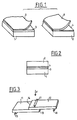
- FIGS. 1 and 2 illustrate the use of a two-component adhesive in the form of sheets for the assembly by bonding of two parts 1 and 2.
- the two components of the adhesive are in the form of tapes thin 3 and 4 of the same width as parts 1 and 2, and protected by non-stick supports 5 and 6 respectively.
- the tape 3 containing the monomer is applied to the face to be bonded to the piece 1, the face of the tape opposite the piece being covered with its protective film 5.
- the tape 3 is pressed through of the film 5 to obtain immediate adhesion to the part thanks to the self-adhesive properties of the tape.
- the strip 4 containing no monomers is applied to the face to be bonded to the part 2. This application is easy, precise and clean. It can be performed by simple machines or robots in automatic operation cycles.
- the protective films 5 and 6 are then peeled off to expose the free surfaces of the tapes 3 and 4, and the two sub-assemblies are superimposed by applying these free surfaces against each other, producing a compound stack, in order , of part 1, of ribbon 3, of ribbon 4 and of part 2.
- This stack is pressed so that the two sheets adhere to one another as they adhere to the two parts respectively.
- the polymerization then occurs and leads, as explained above, to crosslinking throughout the thickness of the joint formed by the two tapes and to a final bonding of the two parts.
- the polymer matrices of the tapes contribute to the flexibility of the crosslinked joint.
- FIG. 3 illustrates in perspective a test tube used to test the adhesives described in the examples below.
- This test piece comprises two degreased steel plates 11 and 12 having the dimensions 100 x 30 x 6 mm.
- one of the components is applied to one of the faces of the plate 11 and the other to one of the faces. of the plate 12, the plate 11 being covered over its entire width and over a length of at least 34 mm from one of its ends 13 and the plate 12 being covered over its entire width and over at least one length equal to 34 mm from one of its ends 14.
- the application is carried out under a clamping force of 4.1 daN maintained for a determined time at a determined temperature. After polymerization, an adhesive joint with a surface of 10 cm2 is thus obtained.
- the two plates are rested respectively on two knives 15 and 16 whose contact edges, oriented along the width of the plates, are spaced 155 mm apart and located at equal distance facing surfaces of the two plates.
- a bending force is exerted on them in the direction of the arrow F1, perpendicular to the faces of the plates 11 and 12, by means of a knife 17, the contact edge of which is also oriented along the width of the plates. and is at equal distance from that of the knives 15 and 16.
- the direction of this force is such that it tends to press the plates against the knives 15 and 16.
- the knife 17 is advanced at a speed of 1 mm / min and the force corresponding to the takeoff of the two plates is measured, this force being an increasing function of the strength of the bonding. This test is carried out at a temperature of 23 ° C and a relative humidity of 50%.
- the first component of the adhesive which contains at least one polymerizable monomer and is in the form of a thin sheet
- the second component which may or may not contain a monomer, is designated by the letter B when it is in the form of a thin sheet, or by the letter S when that it is in the form of a solution, followed by a number.
- Sheets are produced having the compositions indicated in Table I.
- the sheets A are obtained from solutions of the constituents in a polar solvent such as methyl ethyl ketone or ethyl acetate.
- a polar solvent such as methyl ethyl ketone or ethyl acetate.
- Durotak 2287 is delivered in solution in ethyl acetate, and it is enough to add the catalyst and the plasticizer to this solution.
- the adhesive formed by components A1 and B1 is tested according to the procedure described above in relation to FIG. 3. Resistances of 50, 75 and 80 daN are obtained respectively after stays of 2 hours, 4 hours and 12 hours in an oven at 60 ° C.
- the adhesives A1-B1, A2-B1 and A3-B1 are tested after a stay of 4 hours in the oven at 60 ° C.
- the assembly resistances are respectively 75, 53 and 10 daN.
- Bonded specimens are produced using sheets A1 and B2, which are made to stay at three different temperatures for different times. The results are as follows: 29, 56 and 75 daN respectively after one day, two days and three days at 23 ° C; 53, 73, 90 and 98 daN respectively after three hours, four hours, six hours and twenty-four hours at 60 ° C; 33, 43, 90 and more than 100 daN respectively after 15 minutes, 30 minutes, 1 hour and 24 hours at 80 ° C.
- the vanadium accelerator sold by Akzo Chemie under the reference VN2, is based on an organic vanadium salt and contains 0.2% of vanadium metal.
- test specimens bonded using sheets A4 and B3 have a resistance of 10, 33, 43 and 63 daN respectively after three hours, four hours, five hours and six hours of stay in the oven at 60 ° C.
- Resistances of 78, 85 and 90 daN are obtained after one hour, four hours and 24 hours at 23 ° C.
- the resistances obtained are 27, 45, 70 and 70 daN respectively after one hour, two hours, four hours and twenty-four hours at 23 ° C.
- cross compositions are used in which each component contains a monomer, a catalyst and an accelerator, each accelerator being active only in combination with the accelerator contained in the other component.
- the compositions are given in Table IV.
- This adhesive provides assemblies whose resistance is 30, 65, 95 and 110 daN respectively after four hours, eight hours, sixteen hours and two days of stay at 40 ° C.
- This example illustrates adhesives comprising a first component in sheet form and a second component in the form of a solution in a volatile solvent.
- components S1, S2 and S3 the monomers are liquid and at the same time serve as a solvent for the solution.
- test procedure is the same as for the previous examples, one of the plates being coated with the solution, using hydrophilic cotton, instead of being coated with a pressure-sensitive sheet.
- a stack is generally produced comprising a single layer of each of the two components.
- Such an arrangement is useful for example if one wishes to make a relatively thick joint to compensate for surface inequalities of the parts to be assembled, the thickness of each sheet being limited, as indicated above, to allow the migration of the constituents.
Landscapes
- Chemical & Material Sciences (AREA)
- Organic Chemistry (AREA)
- Adhesives Or Adhesive Processes (AREA)
- Adhesive Tapes (AREA)
Applications Claiming Priority (2)
| Application Number | Priority Date | Filing Date | Title |
|---|---|---|---|
| FR8709564 | 1987-07-06 | ||
| FR8709564A FR2617859B1 (fr) | 1987-07-06 | 1987-07-06 | Adhesif a deux composants et procede d'assemblage utilisant un tel adhesif |
Publications (1)
| Publication Number | Publication Date |
|---|---|
| EP0300847A1 true EP0300847A1 (de) | 1989-01-25 |
Family
ID=9352912
Family Applications (1)
| Application Number | Title | Priority Date | Filing Date |
|---|---|---|---|
| EP88401559A Withdrawn EP0300847A1 (de) | 1987-07-06 | 1988-06-21 | Zweikomponenten Klebstoff und diesen verwendendes Verbindungsverfahren |
Country Status (2)
| Country | Link |
|---|---|
| EP (1) | EP0300847A1 (de) |
| FR (1) | FR2617859B1 (de) |
Cited By (13)
| Publication number | Priority date | Publication date | Assignee | Title |
|---|---|---|---|---|
| EP0818520A3 (de) * | 1996-06-06 | 1998-10-07 | Dow Corning Toray Silicone Co., Ltd. | Verfahren zur Herstellung einer verbundenen Struktur |
| FR2795084A1 (fr) * | 1999-06-18 | 2000-12-22 | Holdipro Finance | Film adhesif reticulable et procede d'assemblage utilisant un tel film |
| WO2006018246A1 (de) * | 2004-08-16 | 2006-02-23 | Isocoll Chemie Gmbh | Befestigen einer kühlschlange an der platine eines kühlgerätes |
| EP2759578A1 (de) * | 2013-01-24 | 2014-07-30 | Basf Se | Reaktive Haftklebstoffprodukte |
| WO2014202402A1 (de) * | 2013-06-17 | 2014-12-24 | Tesa Se | Reaktives 2-komponentenklebesystem in filmform |
| DE102015225854A1 (de) | 2015-12-18 | 2017-06-22 | Tesa Se | Reaktives 2-Komponentenklebesystem in Filmform und Verfahren zur Verklebung |
| DE102017220861A1 (de) | 2017-11-22 | 2019-05-23 | Tesa Se | Reaktiver Klebstofffilm mit verbesserter Verklebungsfestigkeit |
| DE102019200736A1 (de) | 2019-01-22 | 2020-07-23 | Tesa Se | Reaktives 2-Komponentenklebesystem in Filmform auf Basis von geruchsneutralen Acrylmonomeren |
| EP3757183A1 (de) | 2019-06-28 | 2020-12-30 | tesa SE | Uv-härtender reaktiver klebstoff |
| WO2021073959A1 (de) | 2019-10-14 | 2021-04-22 | Tesa Se | Reaktiver klebstofffilm mit guter feuchtwärmebeständigkeit, insbesondere zum verkleben von polyamid |
| DE102021125429A1 (de) | 2021-09-30 | 2023-03-30 | Tesa Se | Lichthärtender reaktiver Klebstofffilm |
| US11898067B2 (en) | 2016-12-05 | 2024-02-13 | Tesa Se | Reactive 2-component adhesive system in film form having improved heat-and-humidity resistance |
| EP4455241A1 (de) | 2023-04-28 | 2024-10-30 | Tesa Se | Chemikalienbeständiges, reaktives haftklebeband |
Citations (6)
| Publication number | Priority date | Publication date | Assignee | Title |
|---|---|---|---|---|
| FR1057663A (fr) * | 1951-06-05 | 1954-03-10 | British Resin Prod Ltd | Procédé pour réunir au moyen d'adhésifs à base de résine synthétique des surfaces telles que celles des bois de placage |
| FR1415073A (fr) * | 1963-11-02 | 1965-10-22 | Procédé pour l'assemblage, par collage, de pièces façonnées par moulage ou de feuilles, au moyen de mélanges à deux constituants durcissant à la température ambinte, et adhésifs convenant à cet effet | |
| US3907623A (en) * | 1973-04-04 | 1975-09-23 | Ppg Industries Inc | Polymer curing system |
| FR2433563A1 (fr) * | 1978-08-19 | 1980-03-14 | Bostik Sa | Procede de collage de deux substrats au moyen d'une composition adhesive a composants multiples |
| GB2078763A (en) * | 1980-06-04 | 1982-01-13 | Takiron Co | A Bonding Method Using an alpha - cyanoacrylate Adhesive |
| US4358329A (en) * | 1980-08-25 | 1982-11-09 | Sekisui Kagaku Kogyo Kabushiki Kaisha | Safety laminate and process for production thereof |
-
1987
- 1987-07-06 FR FR8709564A patent/FR2617859B1/fr not_active Expired
-
1988
- 1988-06-21 EP EP88401559A patent/EP0300847A1/de not_active Withdrawn
Patent Citations (6)
| Publication number | Priority date | Publication date | Assignee | Title |
|---|---|---|---|---|
| FR1057663A (fr) * | 1951-06-05 | 1954-03-10 | British Resin Prod Ltd | Procédé pour réunir au moyen d'adhésifs à base de résine synthétique des surfaces telles que celles des bois de placage |
| FR1415073A (fr) * | 1963-11-02 | 1965-10-22 | Procédé pour l'assemblage, par collage, de pièces façonnées par moulage ou de feuilles, au moyen de mélanges à deux constituants durcissant à la température ambinte, et adhésifs convenant à cet effet | |
| US3907623A (en) * | 1973-04-04 | 1975-09-23 | Ppg Industries Inc | Polymer curing system |
| FR2433563A1 (fr) * | 1978-08-19 | 1980-03-14 | Bostik Sa | Procede de collage de deux substrats au moyen d'une composition adhesive a composants multiples |
| GB2078763A (en) * | 1980-06-04 | 1982-01-13 | Takiron Co | A Bonding Method Using an alpha - cyanoacrylate Adhesive |
| US4358329A (en) * | 1980-08-25 | 1982-11-09 | Sekisui Kagaku Kogyo Kabushiki Kaisha | Safety laminate and process for production thereof |
Cited By (29)
| Publication number | Priority date | Publication date | Assignee | Title |
|---|---|---|---|---|
| EP0818520A3 (de) * | 1996-06-06 | 1998-10-07 | Dow Corning Toray Silicone Co., Ltd. | Verfahren zur Herstellung einer verbundenen Struktur |
| FR2795084A1 (fr) * | 1999-06-18 | 2000-12-22 | Holdipro Finance | Film adhesif reticulable et procede d'assemblage utilisant un tel film |
| WO2000078882A3 (fr) * | 1999-06-18 | 2002-07-11 | Prochimir | Film adhesif reticulable et procede d'assemblage utilisant un tel film |
| WO2006018246A1 (de) * | 2004-08-16 | 2006-02-23 | Isocoll Chemie Gmbh | Befestigen einer kühlschlange an der platine eines kühlgerätes |
| EP1630514A1 (de) * | 2004-08-16 | 2006-03-01 | Isocoll Chemie GmbH | Verfahren zum Befestigung eines Rohrs an einer Platte |
| EP2759578A1 (de) * | 2013-01-24 | 2014-07-30 | Basf Se | Reaktive Haftklebstoffprodukte |
| WO2014202402A1 (de) * | 2013-06-17 | 2014-12-24 | Tesa Se | Reaktives 2-komponentenklebesystem in filmform |
| CN105324450A (zh) * | 2013-06-17 | 2016-02-10 | 德莎欧洲公司 | 反应性双组分胶粘膜体系 |
| KR20160021828A (ko) * | 2013-06-17 | 2016-02-26 | 테사 소시에타스 유로파에아 | 반응성 2-성분 접착제 필름 시스템 |
| US20160108287A1 (en) * | 2013-06-17 | 2016-04-21 | Tesa Se | Reactive 2-component adhesive film system |
| JP2016526586A (ja) * | 2013-06-17 | 2016-09-05 | テーザ・ソシエタス・ヨーロピア | 反応性2成分接着フィルム系 |
| US10400140B2 (en) | 2013-06-17 | 2019-09-03 | Tesa Se | Reactive 2-component adhesive film system |
| US10711163B2 (en) | 2013-06-17 | 2020-07-14 | Tesa Se | Reactive 2-component adhesive film system |
| CN105324450B (zh) * | 2013-06-17 | 2019-03-08 | 德莎欧洲股份公司 | 反应性双组分胶粘膜体系 |
| US10907076B2 (en) | 2015-12-18 | 2021-02-02 | Tesa Se | Reactive two-component adhesive system in the form of a film and bonding method |
| DE102015225854A1 (de) | 2015-12-18 | 2017-06-22 | Tesa Se | Reaktives 2-Komponentenklebesystem in Filmform und Verfahren zur Verklebung |
| WO2017102282A1 (de) | 2015-12-18 | 2017-06-22 | Tesa Se | Reaktives 2-komponentenklebesystem in filmform und verfahren zu verklebung |
| US11898067B2 (en) | 2016-12-05 | 2024-02-13 | Tesa Se | Reactive 2-component adhesive system in film form having improved heat-and-humidity resistance |
| DE102017220861A1 (de) | 2017-11-22 | 2019-05-23 | Tesa Se | Reaktiver Klebstofffilm mit verbesserter Verklebungsfestigkeit |
| WO2019101728A1 (de) | 2017-11-22 | 2019-05-31 | Tesa Se | Reaktiver klebstofffilm mit verbesserter verklebungsfestigkeit |
| DE102019200736A1 (de) | 2019-01-22 | 2020-07-23 | Tesa Se | Reaktives 2-Komponentenklebesystem in Filmform auf Basis von geruchsneutralen Acrylmonomeren |
| WO2020152147A1 (de) | 2019-01-22 | 2020-07-30 | Tesa Se | Reaktives 2-komponentenklebesystem in filmform auf basis von geruchsneutralen acrylmonomeren |
| EP3757183A1 (de) | 2019-06-28 | 2020-12-30 | tesa SE | Uv-härtender reaktiver klebstoff |
| WO2021073959A1 (de) | 2019-10-14 | 2021-04-22 | Tesa Se | Reaktiver klebstofffilm mit guter feuchtwärmebeständigkeit, insbesondere zum verkleben von polyamid |
| US12269972B2 (en) | 2019-10-14 | 2025-04-08 | Tesa Se | Reactive adhesive film with good heat-and-humidity resistance, in particular for bonding polyamide |
| DE102021125429A1 (de) | 2021-09-30 | 2023-03-30 | Tesa Se | Lichthärtender reaktiver Klebstofffilm |
| EP4159775A1 (de) | 2021-09-30 | 2023-04-05 | tesa SE | Lichthärtender reaktiver klebstofffilm |
| EP4455241A1 (de) | 2023-04-28 | 2024-10-30 | Tesa Se | Chemikalienbeständiges, reaktives haftklebeband |
| DE102023111057A1 (de) | 2023-04-28 | 2024-10-31 | Tesa Se | Chemikalienbeständiges, reaktives Haftklebeband |
Also Published As
| Publication number | Publication date |
|---|---|
| FR2617859B1 (fr) | 1989-11-17 |
| FR2617859A1 (fr) | 1989-01-13 |
Similar Documents
| Publication | Publication Date | Title |
|---|---|---|
| FR2617859A1 (fr) | Adhesif a deux composants et procede d'assemblage utilisant un tel adhesif | |
| CA2725000C (fr) | Composition adhesive reticulable par chauffage | |
| FR2896508A1 (fr) | Promoteur d'adhesion destine a etre applique sur un substrat en polymere thermoplastique elastomere et procedes de traitement de surface et d'assemblage par collage correspondant | |
| EP0057421A1 (de) | Wasserlösliche, druckempfindliche Heissschmelzklebstoffe | |
| CH649572A5 (fr) | Composition adhesive d'emulsion aqueuse contenant une emulsion de copolymere ethylene-acetate de vinyle et son procede de fabrication. | |
| EP0852613B1 (de) | Selbsthaftender schmelzklebstoff für klebebänder | |
| FR2586216A1 (fr) | Feuille adhesive de protection contre les croissances aquatiques et procede pour la coller | |
| FR2497457A1 (fr) | Composition pharmaceutique permettant l'absorption percutanee de medicaments contre l'angine de poitrine | |
| FR2460984A1 (fr) | Composition adhesive sensible a la pression et ruban adhesif prepare avec cette composition | |
| FR2695311A1 (fr) | Support orthodontique plastique avec couche primaire adhésive et procédés de fabrication. | |
| CN110655887B (zh) | 一种用于反复贴的湿巾盒盖封口胶带的热熔压敏胶 | |
| EP0055765B1 (de) | Druckempfindliche Klebstoffe | |
| EP0447855A2 (de) | Weichmacherbeständiges druckempfindliches Klebemittel | |
| DE3111464A1 (de) | "uebertragungsklebersystem" | |
| EP0252795B1 (de) | Vernetzbare Schmelzkleber, deren Herstellung und deren Anwendung | |
| FR2479841A2 (fr) | Composition utile comme adhesif sensible a la pression et adhesif la contenant | |
| EP0032539B1 (de) | Anhebekorrekturelement für Druckzeichen | |
| JPS6121174A (ja) | 表面保護用粘着テ−プもしくはシ−ト | |
| FR2472599A1 (fr) | Composition adhesive thermo-fusible et sensible a la pression | |
| JP3040261B2 (ja) | クラフト粘着テープ及びその製造方法 | |
| FR2486453A1 (fr) | Elements detachables a base de resine adhesive polyamide et d'acide oleique | |
| US8043699B2 (en) | Compositions and methods for maintaining or restoring adhesive properties of a selectively-resealable adhesive | |
| FR2998792A1 (fr) | Composition adhesive pour le maquillage des ongles | |
| FR2617494A1 (fr) | Composition pour coller un revetement textile sur des pieces en matiere plastique | |
| BE574381A (de) |
Legal Events
| Date | Code | Title | Description |
|---|---|---|---|
| PUAI | Public reference made under article 153(3) epc to a published international application that has entered the european phase |
Free format text: ORIGINAL CODE: 0009012 |
|
| AK | Designated contracting states |
Kind code of ref document: A1 Designated state(s): AT BE CH DE ES FR GB GR IT LI LU NL SE |
|
| 17P | Request for examination filed |
Effective date: 19890213 |
|
| 17Q | First examination report despatched |
Effective date: 19901109 |
|
| STAA | Information on the status of an ep patent application or granted ep patent |
Free format text: STATUS: THE APPLICATION IS DEEMED TO BE WITHDRAWN |
|
| 18D | Application deemed to be withdrawn |
Effective date: 19910722 |