EP0301089B1 - Verfahren und gerät zur detektierung eines sich ausserhalb der strahlungskeule befindlichen zustandes in einem monopulsradar-empfänger - Google Patents
Verfahren und gerät zur detektierung eines sich ausserhalb der strahlungskeule befindlichen zustandes in einem monopulsradar-empfänger Download PDFInfo
- Publication number
- EP0301089B1 EP0301089B1 EP88903002A EP88903002A EP0301089B1 EP 0301089 B1 EP0301089 B1 EP 0301089B1 EP 88903002 A EP88903002 A EP 88903002A EP 88903002 A EP88903002 A EP 88903002A EP 0301089 B1 EP0301089 B1 EP 0301089B1
- Authority
- EP
- European Patent Office
- Prior art keywords
- difference
- phase difference
- phase
- signal
- signals
- Prior art date
- Legal status (The legal status is an assumption and is not a legal conclusion. Google has not performed a legal analysis and makes no representation as to the accuracy of the status listed.)
- Expired
Links
- 238000000034 method Methods 0.000 title claims description 20
- 238000012544 monitoring process Methods 0.000 claims 1
- 238000006073 displacement reaction Methods 0.000 abstract description 4
- 238000010586 diagram Methods 0.000 description 7
- 238000001514 detection method Methods 0.000 description 3
- 230000005855 radiation Effects 0.000 description 2
- 239000000654 additive Substances 0.000 description 1
- 230000000996 additive effect Effects 0.000 description 1
- 238000013459 approach Methods 0.000 description 1
- 238000006243 chemical reaction Methods 0.000 description 1
- 238000004590 computer program Methods 0.000 description 1
- 230000003247 decreasing effect Effects 0.000 description 1
- 238000011156 evaluation Methods 0.000 description 1
- 238000001914 filtration Methods 0.000 description 1
- 230000010363 phase shift Effects 0.000 description 1
- 230000001360 synchronised effect Effects 0.000 description 1
Images


Classifications
-
- G—PHYSICS
- G01—MEASURING; TESTING
- G01S—RADIO DIRECTION-FINDING; RADIO NAVIGATION; DETERMINING DISTANCE OR VELOCITY BY USE OF RADIO WAVES; LOCATING OR PRESENCE-DETECTING BY USE OF THE REFLECTION OR RERADIATION OF RADIO WAVES; ANALOGOUS ARRANGEMENTS USING OTHER WAVES
- G01S13/00—Systems using the reflection or reradiation of radio waves, e.g. radar systems; Analogous systems using reflection or reradiation of waves whose nature or wavelength is irrelevant or unspecified
- G01S13/02—Systems using reflection of radio waves, e.g. primary radar systems; Analogous systems
- G01S13/06—Systems determining position data of a target
- G01S13/42—Simultaneous measurement of distance and other co-ordinates
- G01S13/44—Monopulse radar, i.e. simultaneous lobing
- G01S13/4445—Monopulse radar, i.e. simultaneous lobing amplitude comparisons monopulse, i.e. comparing the echo signals received by an antenna arrangement with overlapping squinted beams
-
- G—PHYSICS
- G01—MEASURING; TESTING
- G01S—RADIO DIRECTION-FINDING; RADIO NAVIGATION; DETERMINING DISTANCE OR VELOCITY BY USE OF RADIO WAVES; LOCATING OR PRESENCE-DETECTING BY USE OF THE REFLECTION OR RERADIATION OF RADIO WAVES; ANALOGOUS ARRANGEMENTS USING OTHER WAVES
- G01S13/00—Systems using the reflection or reradiation of radio waves, e.g. radar systems; Analogous systems using reflection or reradiation of waves whose nature or wavelength is irrelevant or unspecified
- G01S13/66—Radar-tracking systems; Analogous systems
- G01S13/68—Radar-tracking systems; Analogous systems for angle tracking only
- G01S13/685—Radar-tracking systems; Analogous systems for angle tracking only using simultaneous lobing techniques
Definitions
- This invention relates generally to radar systems, and more particularly to the detection of an out of beam condition in a monopulse radar receiver.
- sum and difference signals are formed from plural antenna beams.
- the difference signal is representative of the tracking error, i.e., the angle that the target being tracked is off the boresight line of the antenna and is therefore used for automatic tracking.
- a search scan operation precedes the automatic tracking mode. After target acquisition, the search scan mode is stopped and the antenna is trained on the target by the automatic tracking equipment.
- Other radar systems employ a "track while scan" mode of operation, in which the position of one or more targets is continually tracked on the basis of the data received while the antenna is also performing a search scan.
- the equipment be able to detect when a target being tracked is out of the beam of the antenna, so that the track can be deleted, in a track while scan system, or the target reacquired by switching to the scanning mode, in a search and track radar.
- Signal to noise ratio is an ambiguous indicator of an out of beam condition.
- the signal to noise ratio may drop due to other factors such as ground clutter, noise, jamming or changes in atmospheric condition.
- the signal to noise ratio must be monitored for a long time before a reliable out of beam determination can be made.
- FR-A-1 354 852 there is described a method for evaluating the signals of a monopulse radar in which sum and difference signals are formed from a target return signal and in which said sum and difference signals are combined in phase quadrature to form a first and a second vector signature signal in such a way, that a phase difference to be detected between said vector signature signals varies with the amplitude of said difference signal, said sum and difference signals of said first vector signature signal being in phase with said difference and sum signals, respectively, of said second vector signature signal.
- FR-A-1 354 852 however, the above measures are proposed in order to obtain intermediate frequency signals the phase difference of which is not affected by the electronic circuits. The detection of an out of beam condition is not disclosed in this document.
- the present invention it is possible to detect very precisely whether a target to be observed is out of beam. Moreover, it is possible to easily decide in which direction the target has left the beam.
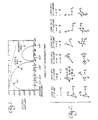
- the solid line depicts the absolute value of a sum signal, ⁇ , as a function of angle-off-boresight in milliradians (MR) and the dashed line represents the absolute value of a difference signal, ⁇ , as a function of angle-off-boresight in milliradians (MR).
- the solid line also represents the relative gain characteristic of the antenna.
- the absolute value of the difference signal is greater than the absolute value of the sum signal in the antenna sidelobes associated with the cardinal plane
- FIG. 2 illustrates vector signatures T1 and T2 for six cases.
- Case 1 is at the antenna boresight, the difference signal approaches zero and the vector signatures which are each comprised solely of the sum signal, are -90° apart.
- Case 2 illustrates how the vector signatures are constructed from the sum and difference signals by vector addition.
- Cases 2, 3 and 4 illustrate the vector signatures within the main beam of the antenna.
- Cases 4, 5 and 6 illustrate the vector signatures outside the center of the main beam; in these cases, the phase difference between the vector signatures is close to 90° because the difference signal is larger than the sum signal (much larger in cases 5 and 6).
- both phase differences swing about +90° outside the center of the main beam on opposite sides of the +90° line in symmetrical fashion. Within the center of the main beam, both phase differences vary from 0° to -180°.
- An antenna 10 which is segmented for reception purposes into two halves for each plane, i.e., azimuth and elevation, intercepts a target return signal.
- Antenna 10 is preferably a two dimensional array having slotted elements and a tapered radiation pattern. For simplicity, the following description only treats one plane, i.e., azimuth. The same procedure is followed with respect to the other plane, i.e., elevation.
- the signal intercepted by antenna 10 is processed by identical radar receivers 12 and 14.
- Receiver 12 is designed to process a sum signal, ⁇ , and a difference signal, - ⁇ , received from a conventional monopulse comparator 16.
- Receiver 14 is designed to process a sum signal, ⁇ , and a difference signal, - ⁇ , received from a conventional monopulse comparator 18.
- Monopulse comparator 18 rotates the difference signal 180°. (In practice, a single radar receiver would be used in time multiplexed fashion to process the outputs of both comparators 16 and 18.)
- Receiver 12 has an RF section comprising preamplifiers 20 and 22, mixers 24 and 26, a local oscillator 28 and a variable phase shifter 30 and an IF section comprising postamplifiers 32 and 34 and a 180° hybrid combiner 36.
- the difference signal from monopulse comparator 16 is amplified by preamplifier 20 and beat down to IF in mixer 24 by the phase shifted output of local oscillator 28.
- the IF output from mixer 24 is amplified by postamplifier 32 and applied to hybrid combiner 36.
- the sum signal is amplified by preamplifier 22 and beat down to IF in mixer 26 by the unphase-shifted output of local oscillator 28.
- variable phase shifter 30 is preferably electronically controllable and programmed by means of a plurality of inputs which control the phase of the output signals provided thereby.
- the initial phase provided by phase shifter 30 matches the differential phase delay associated with the sum and difference signals from monopulse comparator 16. Hence, the phase difference between channels is zero degrees.
- the remaining input of phase shifter 30 is chosen to apply a 90° phase shift to the output of local oscillator 28 used to beat down the difference signal, thereby phase shifting the difference signal relative to the sum signal.
- the hybrid combiner produces as one output signal, the additive combination of the signals applied thereto, which is coupled to an analog filtering and analog-to-digital conversion section 38.
- Hybrid combiner 36 produces as the other output signal, a subtractive combination of the signals applied thereto, which is coupled through a 90° phase shifter 40 to section 38.
- Radar receiver 14 is identical to receiver 12 and uses a local oscillator synchronized to oscillator 28. (For further details about the apparatus of FIG. 4, reference is made to US-A-4,568,940, the disclosure of which is incorporated herein by reference.) Because of the phase rotation of the difference signal produced by monopulse comparator 18, radar receiver 14 produces output signals representing the analog commutated vector signatures T1' and T2', which are also coupled to section 38.
- the filtered, digital signature representative signals produced by section 38 are coupled to a digital computer 42.
- computer 42 is configured to function as phase comparators 44 and 46 and an out of beam detector 48.
- Phase comparator 44 produces a signal representative of the phase difference ⁇ between vector signatures T1 and T2.
- Phase comparator 46 produces a signal representative of the phase difference ⁇ ' between the commutated vector signatures T1' and T2'.
- out of beam detector 48 uses three criteria described below to determine when the target is out of beam, and the direction of displacement from boresight.
- a point 50 represents the antenna
- a solid line 52 represents the boresight of the antenna main beam
- a dashed line 54 represents the point where ⁇ and ⁇ signals are equal in magnitude.
- a dashed line 56 represents the null between the main lobe and the first sidelobe
- a dashed line 58 represents the null between the first sidelobe and the second sidelobe
- a solid line 60 represents a target path relative to the antenna radiation pattern as a function of time.
- the solid line represents the phase difference ⁇ , between signatures T1 and T2 as a function of time and the dashed line represents the phase difference ⁇ ' between commutated signatures T1' and T2' as a function of time for the target path illustrated in FIG. 5A.
- the phase differences ⁇ , and ⁇ ' also swing back and forth about -90°.
- phase difference ⁇ passes through zero degrees on the way to +90°, and swings about this value.
- phase difference ⁇ ' passes through +180° on the way to +90° and then swings about this value.
- the target continues to move away from the boresight, crossing into the sidelobe at points 62 and 63. Points 62 and 63 are also represented in FIG. 5B.
- phase differences ⁇ , ⁇ ' should meet the following criteria:
- the phase differences meet all three criteria between points 61 and 62, between points 62 and 63, and between points 63 and 64, thus the target is out of beam.
- the phase differences fail the first criterion, namely that they lie close to the constant angle, i.e. +90°.
- the phase differences fail the second criterion, namely that they lie on opposite sides of the constant angle, i.e. +90°.
- the phase differences fail the third criterion, namely that they be symmetrical about the constant angle, i.e. +90°. In the latter two cases, the signal is too weak to provide a valid indication of the target position relative to the beam.
- First and second counters, not shown, in detector 48 are incremented and decremented in response to the phase difference signals. Specifically, while the above criteria are being met, either the first counter or the second counter, but not both, is incremented depending upon which phase difference signal is larger. The first counter is incremented when difference signal ⁇ is larger, and the second counter is incremented when difference signal ⁇ ' is larger; both counters are decremented when any one of the criteria is not met. As illustrated, the second counter begins to count before the first counter because phase difference ⁇ ' is larger than phase difference ⁇ between points 61 and 62.
- FIG. 6A represents the antenna pattern and the target moving out of beam in the opposite direction.
- FIG. 6B in this case the situation is reversed when the target moves out of the center of the main beam as represented at point 66.
- phase difference signal ⁇ ' passes through zero degrees on the way to +90° and phase difference ⁇ passes through -180° on the way to +90°.
- FIG. 6C in this case the first counter begins to count before the second counter, because phase difference ⁇ is larger than phase difference ⁇ ' between points 66 and 67, and the second counter counts between points 67 and 68.
- FIGS. 5 and 6 illustrates how detector 48 determines when a valid out of beam condition has been indicated and the direction of the target vis-a-vis the boresight.
- An increasing total count in the first and second counters indicates that the target is out of beam; a decreasing total count indicates either that the target is in the center of the main beam or the returned signal strength is too weak to give a reliable indication of the target location vis-a-vis the main beam. If the target is out of beam, as indicated by an increasing total count, the target is on one side of the boresight when the first counter starts incrementing before the second counter and is on the other side of the boresight when the second counter begins incrementing before the first counter.
- FIG. 7 is a flow diagram of the algorithm for controlling the first and second counters.
- This algorithm can be implemented by a computer program in a straightforward manner by one of ordinary skill using well known programming techniques.
- Block 70 represents the phase differences.
- Block 72 represents the first criterion -- whether or not both phase differences are close to the constant angle, i.e. +90°.
- K1 is the value of a predetermined threshold within which the criterion is deemed to be met, preferably of the order of 10°. If this criterion is not met, both counters are decremented as represented by a block 84. If this criterion is met, then the phase differences are tested for the second criterion.
- phase differences from +90° are examined to determine if the signs are equal. If they are equal, the second criterion, phase differences lying on opposite sides of +90° is not met and both counters are again decremented. If the phase differences have opposite signs, then they are examined for the third criterion. As represented by block 76, the third criterion is met if the sum of the phase differences varies from 180° by less than the value of a predetermined threshold K2. This means that the phase differences are symmetrical about +90° to within the threshold. If the phase differences fail this test, both counters are decremented. Otherwise, these phase differences are compared to determine which is larger as represented by block 78. If phase difference ⁇ is larger than phase difference ⁇ ' , then the first counter is incremented as represented by block 80; if the opposite, then the second counter is incremented as represented by block 82.
- the invention permits a quick and reliable determination of when a target being tracked is out of beam and the direction of the target vis-a-vis the boresight.
- phase difference between signatures also varies with the amplitude of the difference signal, vis-a-vis the sum signal, being close to 0° in the main beam and close to 180° outside the main beam.
- the phase differences could be evaluated by a human operator observing a display of the phase differences, which is driven by phase comparators 44 and 46. In such case, the patterns, depicted in FIGS. 5B and 6B would in essence appear on the display for evaluation by the operator.
Landscapes
- Engineering & Computer Science (AREA)
- Radar, Positioning & Navigation (AREA)
- Remote Sensing (AREA)
- Computer Networks & Wireless Communication (AREA)
- Physics & Mathematics (AREA)
- General Physics & Mathematics (AREA)
- Radar Systems Or Details Thereof (AREA)
Claims (14)
- Verfahren zum Erfassen eines Zustands, bei dem ein Strahl von einem Einzelimpuls-Radarempfänger nicht empfangen wird (Strahl-Außerhalb-Zustand), bei dem aus einem von einem Ziel zurückkehrenden Signal Summen-(Σ) und Differenzsignale (Δ) gebildet werden und bei dem die Summen- und Differenzsignale in einer 90°-Phasenverschiebung kombiniert werden, um ein erstes (T1) und ein zweites Vektorsignatursignal (T2) derart zu bilden, daß sich eine zwischen den Vektorsignatursignalen (T1, T2) zu erfassende Phasendifferenz mit der Amplitude des Differenzsignals ändert, wobei die Summen- und Differenzsignale des ersten Vektorsignatursignals (T1) in Phase mit den Differenz- bzw. Summensignalen des zweiten Vektorsignatursignals (T2) sind, gekennzeichnet durch folgende Schritte:[a] Kombinieren der Summen-(Σ) und Differenzsignale (Δ) in einer 90°-Phasenverschiebung, um ein drittes (T'1) und ein viertes Vektorsignatursignal (T'2) zu bilden, wobei das Differenzsignal des dritten bzw. vierten Vektorsignatursignals bezüglich des Differenzsignals des ersten bzw. zweiten Vektorsignatursignals eine entgegengesetzte Phase aufweist und wobei die Phasendifferenz zwischen dem dritten und vierten Vektorsignatursignal sich mit der Amplitude des Differenzsignals ändert,[b] Erfassen einer ersten (ϑ) und einer zweiten Phasendifferenz (ϑ') zwischen dem ersten und zweiten bzw. dem dritten und vierten Vektorsignatursignal (T1, T2 bzw. T'1, T'2), und[c] Anzeigen des Strahl-Außerhalb-Zustands, falls die erste und zweite Phasendifferenz (ϑ, ϑ')[c1] sich beide innerhalb eines vorbestimmten ersten Schwellenwerts eines konstanten Winkels befinden,[c2] auf gegenüberliegenden Seiten des konstanten Winkels liegen und[c3] eine Symmetrie um den konstanten Winkel aufweisen.
- Verfahren nach Anspruch 1, dadurch gekennzeichnet, daß im Schritt [c] ermittelt wird, ob die erste Phasendifferenz (ϑ) abzüglich des konstanten Winkels gleich der zweiten Phasendifferenz (ϑ') abzüglich des konstanten Winkels ist oder nicht.
- Verfahren nach Anspruch 1 oder 2, dadurch gekennzeichnet, daß im Schritt [c] ermittelt wird, ob die Summe der ersten und zweiten Phasendifferenz (ϑ, ϑ') innerhalb eines vorbestimmten zweiten Schwellenwerts des Zweifachen des konstanten Winkels liegt.
- Verfahren nach einem der Ansprüche 1 bis 3, dadurch gekennzeichnet, daß im Schritt [c] ermittelt wird, ob die erste Phasendifferenz (ϑ) größer als die zweite Phasendifferenz (ϑ') ist.
- Verfahren nach einem der Ansprüche 1 bis 4, gekennzeichnet durch folgende Schritte:[a] periodisches Inkrementieren eines ersten Zählers (Schritt 80), während die erste Phasendifferenz (ϑ) größer als die zweite Phasendifferenz (ϑ') ist, und[b] periodisches Inkrementieren eines zweiten Zählers (Schritt 82), während die erste Phasendifferenz (ϑ) nicht großer als die zweite Phasendifferenz (ϑ') ist.
- Verfahren nach Anspruch 5, dadurch gekennzeichnet, daß beide Zähler dekrementiert werden (Schritt 84), falls:[a] die erste Phasendifferenz (ϑ) oder die zweite Phasendifferenz (ϑ') sich nicht zwischen dem ersten Schwellenwert befindet,[b] die erste Phasendifferenz (ϑ) abzüglich des konstanten Winkels gleich der zweiten Phasendifferenz (ϑ') abzüglich des konstanten Winkels ist, oder[c] die Summe der ersten (ϑ) und der zweiten Phasendifferenz (ϑ') abzüglich des Zweifachen des konstanten Winkels nicht innerhalb des zweiten Schwellenwerts liegt.
- Verfahren nach Anspruch 5 oder 6, dadurch gekennzeichnet, daß durch Beobachten, welcher Zähler zuerst inkrementiert wird, die Richtung des Herausbewegens eines Ziels bestimmt wird.
- Verfahren nach einem der Ansprüche 1 bis 7, dadurch gekennzeichnet, daß der konstante Winkel +90° beträgt.
- Verfahren nach einem der Ansprüche 1 bis 8, dadurch gekennzeichnet, daß der erste Schwellenwert in der Größenordnung von 10° liegt.
- Einzelimpuls-Radarempfänger, mittels dem ein Zustand erfaßbar ist, bei dem ein Strahl außerhalb des Empfangsbereichs liegt (Strahl-Außerhalb-Zustand), wobei der Empfänger eine Einrichtung (16, 18) zum Bilden von Summen-(Σ) und Differenzsignalen (Δ) aus einem von einem Ziel zurückkehrenden Signal sowie eine Einrichtung (12) aufweist, in der die Summen- und Differenzsignale in einer 90°-Phasenverschiebung kombiniert werden, um ein erstes (T1) und ein zweites Vektorsignatursignal (T2) in der Weise zu bilden, daß sich eine zwischen den Vektorsignatursignalen (T1, T2) zu erfassende Phasendifferenz mit der Amplitude des Differenzsignals ändert, wobei die Summen- und Differenzsignale des ersten Vektorsignatursignals (T1) in Phase mit den Differenz- bzw. den Summensignalen des zweiten Vektorsignatursignals (T2) sind, gekennzeichnet durch[a] eine Einrichtung (14) zum Kombinieren der Summen-(Σ) und Differenzsignale (Δ) in einer 90°-Phasenverschiebung zur Bildung eines dritten (T'1) und eines vierten Vektorsignatursignals (T'2), wobei das Differenzsignal des dritten bzw. vierten Vektorsignatursignals in Bezug zum Differenzsignal des ersten bzw. zweiten Vektorsignatursignals eine entgegengesetzte Phase aufweist und wobei sich die Phasendifferenz zwischen dem dritten und vierten Vektorsignatursignal mit der Amplitude des Differenzsignals ändert,[b] eine Einrichtung (44, 46) zum Erfassen einer ersten (ϑ) und einer zweiten Phasendifferenz (ϑ') zwischen dem ersten und zweiten bzw. dem dritten und vierten Vektorsignatursignal (T1, T2 bzw. T'1, T'2), und[c] eine Einrichtung (48) zum Anzeigen des Strahl-Außerhalb-Zustands, falls die erste und zweite Phasendifferenz (ϑ, ϑ')[c1] sich beide innerhalb eines vorbestimmten ersten Schwellenwerts eines konstanten Winkels befinden,[c2] auf gegenüberliegenden Seiten des konstanten Winkels liegen und[c3] eine Symmetrie um den konstanten Winkel aufweisen.
- Einzelimpuls-Radarempfänger nach Anspruch 10, gekennzeichnet durch[a] einen ersten und zweiten Zähler,[b] eine Einrichtung zum periodischen Inkrementieren des ersten Zählers, solange die erste Phasendifferenz (ϑ) größer als die zweite Phasendifferenz (ϑ') ist, und[c] eine Einrichtung zum periodischen Inkrementieren des zweiten Zählers, solange die erste Phasendifferenz (ϑ) nicht größer als die zweite Phasendifferenz (ϑ') ist.
- Einzelimpuls-Radarempfänger nach Anspruch 11, gekennzeichnet durch eine Einrichtung, welche die Zähler dekrementiert, falls[a] die erste Phasendifferenz (ϑ) oder die zweite Phasendifferenz (ϑ') nicht zwischen dem ersten Schwellenwert liegt,[b] die erste Phasendifferenz (ϑ) abzüglich des konstanten Winkels gleich der zweiten Phasendifferenz (ϑ') abzüglich des konstanten Winkels ist, oder[c] die Summe der ersten (ϑ) und der zweiten Phasendifferenz (ϑ') abzüglich des Zweifachen des konstanten Winkels nicht innerhalb des zweiten Schwellenwerts liegt.
- Einzelimpuls-Radarempfänger nach einem der Ansprüche 10 bis 12, dadurch gekennzeichnet, daß der konstante Winkel +90° beträgt.
- Einzelimpuls-Radarempfänger nach einem der Ansprüche 10 bis 13, dadurch gekennzeichnet, daß der erste Schwellenwert in der Größenordnung von 10° liegt.
Applications Claiming Priority (2)
| Application Number | Priority Date | Filing Date | Title |
|---|---|---|---|
| US07/012,412 US4789861A (en) | 1987-02-09 | 1987-02-09 | Method and apparatus for detecting an out of beam condition in a monopulse radar receiver |
| US12412 | 1993-02-16 |
Publications (2)
| Publication Number | Publication Date |
|---|---|
| EP0301089A1 EP0301089A1 (de) | 1989-02-01 |
| EP0301089B1 true EP0301089B1 (de) | 1992-12-16 |
Family
ID=21754845
Family Applications (1)
| Application Number | Title | Priority Date | Filing Date |
|---|---|---|---|
| EP88903002A Expired EP0301089B1 (de) | 1987-02-09 | 1988-02-05 | Verfahren und gerät zur detektierung eines sich ausserhalb der strahlungskeule befindlichen zustandes in einem monopulsradar-empfänger |
Country Status (9)
| Country | Link |
|---|---|
| US (1) | US4789861A (de) |
| EP (1) | EP0301089B1 (de) |
| JP (1) | JPH01502532A (de) |
| AU (1) | AU603656B2 (de) |
| CA (1) | CA1329839C (de) |
| DE (1) | DE3876710T2 (de) |
| ES (1) | ES2012825A6 (de) |
| IL (1) | IL84972A (de) |
| WO (1) | WO1988005921A1 (de) |
Families Citing this family (33)
| Publication number | Priority date | Publication date | Assignee | Title |
|---|---|---|---|---|
| US4983977A (en) * | 1990-02-16 | 1991-01-08 | Westinghouse Electric Corp. | Architecture for monopulse active aperture arrays |
| US5059968A (en) * | 1990-12-11 | 1991-10-22 | Raytheon Company | Radar system and method of operating such system |
| SE468263B (sv) * | 1991-04-12 | 1992-11-30 | Ericsson Telefon Ab L M | Metod att detektera vapenfaellning fraan en farkost, t ex ett flygplan |
| JPH07104408B2 (ja) * | 1991-11-13 | 1995-11-13 | 宇宙開発事業団 | アンテナパターンの処理装置 |
| SE469495B (sv) * | 1992-01-16 | 1993-07-12 | Nobeltech Electronics Ab | Foerfarande foer foeljning av radarmaal |
| WO1996008849A2 (en) * | 1994-09-14 | 1996-03-21 | Philips Electronics N.V. | A radio transmission system and a radio apparatus for use in such a system |
| US5694131A (en) * | 1996-03-01 | 1997-12-02 | Hughes Electronics | Method and apparatus for detecting multipath interference in a radar receiver |
| ATE281136T1 (de) | 1998-03-13 | 2004-11-15 | Procter & Gamble | Absorbierende strukturen mit flüssigkeitsspeichern mit verbesserter fähigkeit, verteilerelemente zu entwässern |
| US6713661B1 (en) | 1998-04-28 | 2004-03-30 | The Procter & Gamble Company | Absorbent articles providing improved fit when wet |
| US6391451B1 (en) | 1999-09-07 | 2002-05-21 | Basf Aktiengesellschaft | Surface-treated superabsorbent polymer particles |
| US6803107B2 (en) * | 1999-09-07 | 2004-10-12 | Basf Aktiengesellschaft | Surface-treated superabsorbent polymer particles |
| US6239230B1 (en) | 1999-09-07 | 2001-05-29 | Bask Aktiengesellschaft | Surface-treated superabsorbent polymer particles |
| US6376618B1 (en) | 1999-09-07 | 2002-04-23 | Basf Aktiengesellschaft | Surface-treated superabsorbent polymer particles |
| US6710224B2 (en) * | 1999-10-25 | 2004-03-23 | Paragon Trade Brands | Superabsorbent polymers providing long-term generation of free volume in partially hydrated absorbent cores |
| RU2192654C2 (ru) * | 2000-04-25 | 2002-11-10 | Открытое акционерное общество "Корпорация "Фазотрон - научно-исследовательский институт радиостроения" | Угловой селектор для обзорного моноимпульсного радиолокатора |
| EP1430912A1 (de) * | 2002-08-26 | 2004-06-23 | The Procter & Gamble Company | Superabsorbierendes Polymer enthaltende absorbierende Kerne für Windeln mit verringerter Dicke und verbesserter Leistungsfähigkeit bei Flüssigkeitsaufnahme und -rückhalt |
| ATE492301T1 (de) | 2003-06-30 | 2011-01-15 | Procter & Gamble | Absorbierende artikel enthaltend beschichtete superabsorbierende partikel |
| US7311968B2 (en) * | 2004-06-30 | 2007-12-25 | The Procter & Gamble Company | Absorbent structures comprising coated super-absorbent polymer particles |
| US7396585B2 (en) * | 2003-08-06 | 2008-07-08 | The Procter & Gamble Company | Absorbent article comprising coated water-swellable material |
| EP1518567B1 (de) | 2003-09-25 | 2017-06-28 | The Procter & Gamble Company | Absorbierende artikel mit flüssigkeitsaufnahmezone und darin beschichteten superabsorbierenden partikeln |
| ATE391518T1 (de) * | 2003-09-25 | 2008-04-15 | Procter & Gamble | Absorbierende artikel enthaltend superabsorbierende polymerpartikeln, mit einer nicht-kovalent gebundenen beschichtung |
| EP1732974A1 (de) * | 2004-03-30 | 2006-12-20 | Basf Aktiengesellschaft | Verbessertes verfahren zur herstellung von superabsorbierenden polymeren |
| US20070219521A1 (en) | 2006-03-17 | 2007-09-20 | The Procter & Gamble Company | Absorbent article comprising a synthetic polymer derived from a renewable resource and methods of producing said article |
| ATE554799T1 (de) * | 2006-08-07 | 2012-05-15 | Procter & Gamble | Absorbierende artikel, die superabsorbierende polymere und ein strahleninduziert hydrophiles material enthalten |
| JP5352959B2 (ja) * | 2007-03-16 | 2013-11-27 | 富士通株式会社 | 直接シーケンススペクトル拡散方式のレーダー、レーダーで使用される方法及びコンピュータプログラム |
| US8739677B1 (en) | 2011-12-05 | 2014-06-03 | The United States Of America As Represented By The Secretary Of The Navy | Boresight verification device |
| US9709359B1 (en) * | 2011-12-05 | 2017-07-18 | James Travis Robbins | Fixed optic for boresight |
| RU2611434C1 (ru) * | 2016-04-26 | 2017-02-22 | Акционерное общество "Федеральный научно-производственный центр "Нижегородский научно-исследовательский институт радиотехники" | Способ радиолокационного обзора пространства |
| RU2637817C1 (ru) * | 2017-02-20 | 2017-12-07 | Российская Федерация, от имени которой выступает Государственная корпорация по атомной энергии "Росатом" | Способ определения дальности до поверхности земли |
| US11169254B2 (en) * | 2017-10-06 | 2021-11-09 | National Chung-Shan Institute Of Science And Technology | Operation mode control method and radar system |
| RU2682661C1 (ru) * | 2018-06-05 | 2019-03-20 | Федеральное государственное унитарное предприятие "Ростовский-на-Дону научно-исследовательский институт радиосвязи" (ФГУП "РНИИРС") | Способ активной обзорной моноимпульсной радиолокации с инверсным синтезированием апертуры антенны |
| CN110596692B (zh) * | 2019-08-19 | 2022-10-14 | 电子科技大学 | 基于联合约束的自适应单脉冲测向方法 |
| EP4228577B1 (de) | 2020-10-16 | 2024-12-04 | The Procter & Gamble Company | Verfahren zur herstellung eines absorbierenden hygieneprodukts mit einem teilweise aus einer recycelten ressource abgeleiteten superabsorbierenden polymer |
Family Cites Families (11)
| Publication number | Priority date | Publication date | Assignee | Title |
|---|---|---|---|---|
| GB894618A (en) * | 1959-08-25 | 1962-04-26 | Cie Francais Thomson Houston | Radar receiver |
| FR1354852A (fr) * | 1962-12-07 | 1964-03-13 | Thomson Houston Comp Francaise | Perfectionnements aux récepteurs de radiodétection |
| FR1422950A (fr) * | 1964-11-09 | 1966-01-03 | Csf | Perfectionnements aux radars à impulsion unique |
| FR2032117A5 (de) * | 1969-02-19 | 1970-11-20 | Thomson Csf | |
| US3969726A (en) * | 1975-02-27 | 1976-07-13 | Texas Instruments Incorporated | Two channel monopulse receiver |
| FR2365131A1 (fr) * | 1976-09-17 | 1978-04-14 | Thomson Csf | Dispositif de detection de presence d'echos radar, et systeme radar a impulsions comportant un tel dispositif |
| FR2452717A1 (fr) * | 1979-03-30 | 1980-10-24 | Thomson Csf | Dispositif de traitement de signaux d'ecartometrie angulaire d'un radar monopulse et radar comportant un tel dispositif |
| JPS56155875A (en) * | 1980-05-06 | 1981-12-02 | Nec Corp | Receiver for monopulse measuring angle |
| US4568940A (en) * | 1981-12-22 | 1986-02-04 | Hughes Aircraft Company | Dual-mode radar receiver |
| JPS61108984A (ja) * | 1984-11-01 | 1986-05-27 | Toshiba Corp | モノパルス測角レ−ダ装置 |
| US4689623A (en) * | 1986-03-07 | 1987-08-25 | Isc Cardion Electronics Corporation | Monopulse processing systems |
-
1987
- 1987-02-09 US US07/012,412 patent/US4789861A/en not_active Expired - Fee Related
- 1987-12-29 IL IL84972A patent/IL84972A/xx not_active IP Right Cessation
-
1988
- 1988-02-01 ES ES8800274A patent/ES2012825A6/es not_active Expired - Fee Related
- 1988-02-05 EP EP88903002A patent/EP0301089B1/de not_active Expired
- 1988-02-05 JP JP63502776A patent/JPH01502532A/ja active Pending
- 1988-02-05 AU AU14957/88A patent/AU603656B2/en not_active Ceased
- 1988-02-05 DE DE8888903002T patent/DE3876710T2/de not_active Expired - Fee Related
- 1988-02-05 WO PCT/US1988/000345 patent/WO1988005921A1/en not_active Ceased
- 1988-02-08 CA CA000558356A patent/CA1329839C/en not_active Expired - Fee Related
Also Published As
| Publication number | Publication date |
|---|---|
| CA1329839C (en) | 1994-05-24 |
| AU603656B2 (en) | 1990-11-22 |
| AU1495788A (en) | 1988-08-24 |
| DE3876710T2 (de) | 1993-07-01 |
| IL84972A (en) | 1992-06-21 |
| ES2012825A6 (es) | 1990-04-16 |
| DE3876710D1 (de) | 1993-01-28 |
| JPH01502532A (ja) | 1989-08-31 |
| WO1988005921A1 (en) | 1988-08-11 |
| US4789861A (en) | 1988-12-06 |
| EP0301089A1 (de) | 1989-02-01 |
Similar Documents
| Publication | Publication Date | Title |
|---|---|---|
| EP0301089B1 (de) | Verfahren und gerät zur detektierung eines sich ausserhalb der strahlungskeule befindlichen zustandes in einem monopulsradar-empfänger | |
| US5448248A (en) | Adaptive radio direction finding system | |
| US5017929A (en) | Angle of arrival measuring technique | |
| US4449127A (en) | System and method for tracking targets in a multipath environment | |
| EP0116183B1 (de) | Impulsradargerät | |
| US7626538B2 (en) | Augmented passive tracking of moving emitter | |
| US6255991B1 (en) | Low cost angle of arrival measurement system | |
| US7295150B2 (en) | Methods and systems for identifying high-quality phase angle measurements in an interferometric radar system | |
| US5748140A (en) | System for tracking radar targets in background clutter | |
| EP0093603A1 (de) | Feuerleiteinrichtung für bewegliche Ziele | |
| EP0241992B1 (de) | Funkpeiler | |
| EP3752848B1 (de) | Radarsystem und verfahren zur bestimmung der richtung zu einem objekt | |
| US7053815B1 (en) | Radar tracking system | |
| US4012740A (en) | Radio-frequency direction-finding arrangement | |
| US3943512A (en) | Sidelobe lock-on discriminating method for search-track monopulse radar | |
| EP0660133B1 (de) | Falschradarspurenunterscheidung in Nebenzipfeln von Monopulsantennen | |
| US4891648A (en) | Aircraft radar arrangement | |
| US5731783A (en) | Method and apparatus for estimating radar signal polarisation | |
| US4257047A (en) | Method and apparatus for electrically scanning an antenna array in a monopulse DF radar system | |
| US5371503A (en) | Radar system and method of operating same | |
| Asseo | Effect of monopulse signal thresholding on tracking multiple targets | |
| US5247311A (en) | Loro antenna and pulse pattern detection system | |
| JP2591482B2 (ja) | 目標検出回路 | |
| Barany et al. | Global optimalization in CFAR system and data fusion to merge detection of extractors of the 2.5 D surveillance radar | |
| JPS6019469B2 (ja) | 角度情報検出装置 |
Legal Events
| Date | Code | Title | Description |
|---|---|---|---|
| PUAI | Public reference made under article 153(3) epc to a published international application that has entered the european phase |
Free format text: ORIGINAL CODE: 0009012 |
|
| 17P | Request for examination filed |
Effective date: 19881005 |
|
| AK | Designated contracting states |
Kind code of ref document: A1 Designated state(s): DE GB IT NL SE |
|
| 17Q | First examination report despatched |
Effective date: 19901204 |
|
| GRAA | (expected) grant |
Free format text: ORIGINAL CODE: 0009210 |
|
| AK | Designated contracting states |
Kind code of ref document: B1 Designated state(s): DE GB IT NL SE |
|
| REF | Corresponds to: |
Ref document number: 3876710 Country of ref document: DE Date of ref document: 19930128 |
|
| ITF | It: translation for a ep patent filed | ||
| PLBE | No opposition filed within time limit |
Free format text: ORIGINAL CODE: 0009261 |
|
| STAA | Information on the status of an ep patent application or granted ep patent |
Free format text: STATUS: NO OPPOSITION FILED WITHIN TIME LIMIT |
|
| 26N | No opposition filed | ||
| PGFP | Annual fee paid to national office [announced via postgrant information from national office to epo] |
Ref country code: SE Payment date: 19950116 Year of fee payment: 8 |
|
| PGFP | Annual fee paid to national office [announced via postgrant information from national office to epo] |
Ref country code: GB Payment date: 19950119 Year of fee payment: 8 Ref country code: DE Payment date: 19950119 Year of fee payment: 8 |
|
| EAL | Se: european patent in force in sweden |
Ref document number: 88903002.9 |
|
| PGFP | Annual fee paid to national office [announced via postgrant information from national office to epo] |
Ref country code: NL Payment date: 19950228 Year of fee payment: 8 |
|
| PG25 | Lapsed in a contracting state [announced via postgrant information from national office to epo] |
Ref country code: GB Effective date: 19960205 |
|
| PG25 | Lapsed in a contracting state [announced via postgrant information from national office to epo] |
Ref country code: SE Effective date: 19960206 |
|
| PG25 | Lapsed in a contracting state [announced via postgrant information from national office to epo] |
Ref country code: NL Effective date: 19960901 |
|
| GBPC | Gb: european patent ceased through non-payment of renewal fee |
Effective date: 19960205 |
|
| NLV4 | Nl: lapsed or anulled due to non-payment of the annual fee |
Effective date: 19960901 |
|
| PG25 | Lapsed in a contracting state [announced via postgrant information from national office to epo] |
Ref country code: DE Effective date: 19961101 |
|
| PG25 | Lapsed in a contracting state [announced via postgrant information from national office to epo] |
Ref country code: IT Free format text: LAPSE BECAUSE OF NON-PAYMENT OF DUE FEES;WARNING: LAPSES OF ITALIAN PATENTS WITH EFFECTIVE DATE BEFORE 2007 MAY HAVE OCCURRED AT ANY TIME BEFORE 2007. THE CORRECT EFFECTIVE DATE MAY BE DIFFERENT FROM THE ONE RECORDED. Effective date: 20050205 |