EP0301187A2 - Chaussure de sport, procédé de sa fabrication et semelle utilisée - Google Patents
Chaussure de sport, procédé de sa fabrication et semelle utilisée Download PDFInfo
- Publication number
- EP0301187A2 EP0301187A2 EP88107838A EP88107838A EP0301187A2 EP 0301187 A2 EP0301187 A2 EP 0301187A2 EP 88107838 A EP88107838 A EP 88107838A EP 88107838 A EP88107838 A EP 88107838A EP 0301187 A2 EP0301187 A2 EP 0301187A2
- Authority
- EP
- European Patent Office
- Prior art keywords
- shoe
- sole
- edge
- cuplike
- outer layer
- Prior art date
- Legal status (The legal status is an assumption and is not a legal conclusion. Google has not performed a legal analysis and makes no representation as to the accuracy of the status listed.)
- Ceased
Links
Images




Classifications
-
- A—HUMAN NECESSITIES
- A43—FOOTWEAR
- A43B—CHARACTERISTIC FEATURES OF FOOTWEAR; PARTS OF FOOTWEAR
- A43B5/00—Footwear for sporting purposes
-
- A—HUMAN NECESSITIES
- A43—FOOTWEAR
- A43B—CHARACTERISTIC FEATURES OF FOOTWEAR; PARTS OF FOOTWEAR
- A43B13/00—Soles; Sole-and-heel integral units
- A43B13/14—Soles; Sole-and-heel integral units characterised by the constructive form
-
- A—HUMAN NECESSITIES
- A43—FOOTWEAR
- A43B—CHARACTERISTIC FEATURES OF FOOTWEAR; PARTS OF FOOTWEAR
- A43B9/00—Footwear characterised by the assembling of the individual parts
Definitions
- the invention relates to a shoe, especially one meant for ball-games, consisting of the sole structure, which includes the insole, flexible midsole and outer sole forming the surface exposed to wear and which, at least at the toe of the shoe, is moulded into a cuplike form, and the upper which, at least in the toe region of the shoe, is constructed to form a doubled structure having an inner layer and outer layer.
- the invention also relates to a method for manufacturing the shoe according to which method the shoe is constructed using a sole structure, a part of which is called the outer sole and is moulded into a cuplike form, at least in the toe region of the shoe, and an upper which, at least in the toe region of the shoe, is constructed as a doubled upper consisting of an inner layer and outer layer.
- the invention relates to a sole blank intended to be used in applying the method.
- the sole (20) of the shoe is constructed to be cuplike in form by having its edge rise up; this edge is indicated in figure A1 at the front end of the shoe by index number 22 and at the rear end of the shoe by index number 23.
- the upper 21 is glued onto the sole 20 and to the edges (22,23) of the sole; and adhesion is further secured by stitchings which in figure A1 are indicated by index numbers 24 and 25.
- the weakest part of the shoe is the zone where the edge of the sole meets the upper.
- FIG. 1 A shoe of this type has, as the outermost layer of the sole, a highly wear-resistant elastomere layer indicated by index number 30 in figure A2.
- the sole proper is moulded out of foamy, flexible polyurethane indicated by index number 32 in figure A2.
- the upper (31) of the shoe is attached to the sole 32 by gluing it.
- the elastomere layer 31, which serves as the wearing surface cannot be made to extend to the upper edge of the toe of the shoe; instead, a strip of flexible sole material 32 remains between it and the upper 31.
- the weakest part of the structure is the toe. As soon as the material of the sole proper 32 at the toe of the shoe, between the upper 31 and the outermost layer 30, has worn away the edge of the elastomere layer 30, functioning as the wearing surface, commences to peel off, following which the shoe is soon in a state of disrepair.
- Steps have been taken recently to reinforce the front edge of the aforementioned shoes with polyurethane soles.
- One such solution is shown in the form of a schematic cross-sectional drawing in figure A3 showing the toe part of a shoe.
- the structure of this type of shoe corresponds in principle to that shown in figure A2; thus, there is a wear-resistant layer of elastomere 40 as the outermost layer surrounding the sole, within it the sole proper 42 made of foamy, flexible polyurethane to which the shoe's upper 41 is attached by gluing.
- the toe of the shoe is provided with a reinforcement 43 which is usually of split leather. This reinforcement layer 43 improves the durability of the sole in the area covered by the reinforcement, but it does not eliminate the criticality of the zone where the edge of the sole meets the upper.
- the purpose of the present invention is to bring about a shoe suitable for ball games which said shoe will make it possible to avoid the shortcomings associated with the State of the Art and attain a significant improvement when compared to Prior Art footwear intended for ball games.
- the principal characteristic feature of the shoe in accordance with the invention is that the outer layer of the upper and the outer sole of the shoe are attached to the shoe in such a way that the the upward rising cuplike edge of the outer sole is situated between the inner and outer layers of the upper.
- the principal characteristic feature of the method in accordance with the invention is that an outward facing extra flange is made into the upward rising, cuplike edge of the outer sole starting form this cuplike edge and that the outerlayer of the upper is stretched and attached to the shoe, positioned over a last, in such manner that at least the lower edge of the outer layer covers the cuplike edge of the outer sole and the aforementioned extra flange.
- the principal characteristic feature of the sole blank intended to be used in implementing the method is that the cuplike edge of the sole blank is provided with an outward facing extra flange for the purpose of improving adhesion between the outer layer of the upper and the cuplike edge of the outer sole.
- the shoe structure and method of manufacturing the shoe in accordance with the invention possess certain advantages over Prior Art solutions; the following are among these.
- the weakest part of the shoe which is the zone where the sole of the shoe meets the upper.
- the sturdiness and durability of the toe part have been significantly improved because of the double-layered upper used in the front part of the shoe.
- the durability of the front edge of the sole has also been significantly improved because of the pro tected zone where the sole meets the upper. Due to the above matters, it is possible to manufacture these shoes to be considerably lighter than before as there is no need to use extra reinforcements in the front edge of the shoe.
- the outer sole blank in accordance with the invention makes it possible to manufacture the shoes mechanically.
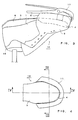
- Shoe 10 consists of the outer sole 3 functioning as the wearing surface, flexible midsole 9, insole 2 above it, and the upper attached to the shoe's sole structure.
- the upper is doubled in the toe region of the shoe in such a manner as to consist of the inner layer 1 and outer layer 5.
- the inner layer 1 of the upper is attached to the insole 2 in the conventional manner either by stitching or gluing.
- the midsole 9 and outer sole 3 are attached onto the insole 2 by gluing, for example.
- the outer sole 3 is made of rubber, polyurethane or some other suitable material.
- the outer sole 3 is made cuplike, at least in the toe region of shoe 10, in such a manner as to have an upward pointing cuplike edge 4 in the outer sole.
- the outer layer 5 of the upper is glued onto the inner layer 1 of the upper at the toe part of shoe 10; the edge of outer layer 5 extends, at least in the toe region of the shoe, over the edge 4 of the outer sole 3.
- the edge part 6 of the outer layer of the upper is also glued to the edge 4 of the sole.
- the recess 7 has been constructed into the outer sole 3; the depth of the recess 7 corresponds to the thickness of the outer layer 5 of the upper.
- Fig. 1 shows that the attachment of the outer layer 5 and the inner layer 1 of the upper may be secured by stitchings 8.
- Fig. 1 shows that the outer layer 5 of the upper has been made so long that it covers in one piece the perforated reinforcement for the shoe laces. This, of course, is not absolutely necessary as the main function of the outer layer 5 of the upper is simply to protect the toe part of the shoes and especially the zone where the upper meets the sole.
- the outer layer 5 of the upper is stretched using tongs 17 , e.g. the stretching tongs shown in Fig. 3, and then fastened onto the cuplike edge 4 of the sole by using a hammer.
- the stretching and fastening is commenced from the middle of the toe of shoe 10 continuing step by step along either side towards the rear part of the shoe.
- that part 6′ of the outer layer 5 of the upper which extends over the outer sole 3 is cut off along the edge of the outer sole using, for example, a conventional shoemaker's knife following which the cut fringe is smoothed.
- the above method is, however, slow, it requires good craftsmanship and is suitable, as such, only for the purpose of producing prototypes of shoes.
- the above method is not suitable for industrial mass production.
- the manufacturing method in accordance with the invention is intended for the purpose of manufacturing the shoe industrially and the manufacturing method has made it possible to eliminate the negative aspects of manual production; the problems associated with the zone where the outer layer 5 of the shoe's upper meets the cuplike edge 4 of the outer sole have also been solved by this method of manufacturing.
- a new type of sole blank 18, shown in Fig. 4-6B, has been developed for the purpose of implementing the above method.
- Fig. 4 shows a schematic view looking from above of the toe part of the outer sole blank 18 in accordance with the invention.
- the outer sole blank 18 includes in the conventional manner the outer sole 3 whose toe part also includes a conventional upward rising cuplike edge 4.
- the special feature of the blank 18 is the extra flange 11 arising from the outer surface of the cuplike edge 4 of the blank and pointing outward from the cuplike edge 4; the extra flange 11 is, however, cut off from the cuplike edge at the final stage of manufacturing the shoe.
- Fig. 5A shows a cross-sectional drawing along the line III-III of the outer sole blank 18 as shown in Fig. 4; similarly, Fig. 5B shows a cross-sectional drawing along the line IV-IV of the blank 18 as shown in Fig. 4.
- the extra flange 11 is constructed to lie mainly parallel with the outer sole 3 and positioned slightly above the plane of the outer sole 3.
- the region of the cuplike edge 4 of the blank 18 has been shaped in such a manner that the outer surface of the upward rising part of the outer sole 3 lying below the extra flange 11 is situated a certain distance a further out than the outer surface of the cuplike edge 4 lying above the extra flange 11.
- This distance a has been suitably selected to correspond in the main to the thickness of the outer layer 5 of the shoe's upper. Due to this arrangement, the recess 7 shown in Fig. 2A and 2B is formed into the cuplike edge 4; thus, the depth of the recess 7 is equal to the distance a. Due to this arrangement, the outer layer 5 of the upper and the outer sole 3 meet one another in a common plane. This arrangement is illustrated especially in Fig. 5B.
- Fig. 6A and 6B show another manner of executing the outer sole blank 18. This execution corresponds to the solution shown in Fig. 5A and 5B with the exception that the extra flange 11a does not in this execution lie entirely parallel with the outer sole 3 and pointing out from the cuplike edge 4; instead, for reasons of manufacturing technology, it is for a small distance made to point out from the cuplike edge 4 and is then distinctly bent downwards. This arrangement improves the method of manufacturing according to the invention and which method is illustrated in Fig. 7 and 8.
- Fig. 7 and 8 the manufacturing of the shoe and especially the attaching of the outer layer 5 of the upper to the shoe is carried out using a machine converted from a conventional toe stretching machine.
- the stages of work are as follows.Glue readily activated by heat and requiring a certain temperature to bring about adhesion is spread onto the underside of the outer layer 5 of the upper and onto the outside surface of the cuplike edge 4, including the upper surface of the extra flange 11,11a.
- the shoe which is positioned over the last 16 is positioned in the toe stretching machine whose jaws 12 grip onto the edges 6′ of the outer layer 5 of the upper and stretch the outer layer 5 of the upper over the last 16.
- the pull direction of the jaws 12 is shown in Fig. 7 by arrows A.
- the extra flange 11 needs to be bent down in such a manner that the extra flange 11 does not come into contact with the underside of the outer layer 5 of the upper. Consequently, the sole blank 18 shown in Fig. 6A and 6B is more advantageous because the extra flange 11 is already directed downwards.
- a blow pipe 13 has been installed into a conventional toe stretching machine; the said blow pipe is curved in such a manner as to correspond in the main with the shape of the toe of the shoe.
- the blow pipe 13 is connected onto a hot air blower from which hot air is blown into the blow pipe as shown by arrow N.
- the blow pipe 13 is provided with several apertures to enable hot air to be discharged into the space between the outer layer 5 of the upper and the cuplike edge 4 of the outer sole.
- the machine is provided with a flexible pressure band 14 for this purpose; the said band follows the shape of the toe of the shoe positioned over the last 16.
- the pressure band 14 has been constructed to be of such a length as to extend around along the sides of the shoe at least as far as the outer layer 5 of the upper.
- the pressure direction of the pressure band 14 is illustrated in Fig. 7 by the arrow C.
- the pressure band 14 is flexible in order to be better able to follow the shape of the toe of the shoe.
- the extra flange 11,11a on the cuplike edge 4 of the outer sole together with the outer layer 5 of the upper, with the said outer layer 5 being at least partly glued to the extra flange 11,11a are turned into a horizontal position to be cut.
- the extra flange 11,11a and the surplus part 6′ of the upper are cut off following the shape of the toe of the shoe.
- the cutting operation may be carried out using a machine such as the cutter 15 shown in Fig. 8.
- the invention relates to a shoe, especially a shoe intended for ball games, comprising the sole structure which consists of the insole, flexible midsole (9) and outer sole (3) forming the wearing surface.
- the outer sole (3) is constructed, at least in the toe region of the shoe (10), to be cuplike in form.
- the shoe's upper (1,5) is constructed, at least in the toe region of the shoe (10), doubled in such a manner that it consists of the inner layer (1) and outer layer (5).
- the main characteristic feature of the shoe is that the outer layer (5) of the upper and the outer sole (3) are attached to the shoe (10) in such a manner that the upward rising cuplike edge (4) of the outer sole (3) lies between the inner layer (1) and outer layer (5) of the upper.
- the invention also relates to a method for manufacturing the shoe and a sole blank intended for implementing the method.
Landscapes
- Health & Medical Sciences (AREA)
- General Health & Medical Sciences (AREA)
- Physical Education & Sports Medicine (AREA)
- Footwear And Its Accessory, Manufacturing Method And Apparatuses (AREA)
Applications Claiming Priority (2)
| Application Number | Priority Date | Filing Date | Title |
|---|---|---|---|
| FI872898A FI76479C (fi) | 1987-07-01 | 1987-07-01 | Skodon, i synnerhet ett bollspelsskodon, foerfarande foer framstaellning av skodonet och sulaaemne foer skodonet avsett foer foerverkligande av foerfarandet. |
| FI872898 | 1987-07-01 |
Publications (2)
| Publication Number | Publication Date |
|---|---|
| EP0301187A2 true EP0301187A2 (fr) | 1989-02-01 |
| EP0301187A3 EP0301187A3 (fr) | 1990-04-18 |
Family
ID=8524749
Family Applications (1)
| Application Number | Title | Priority Date | Filing Date |
|---|---|---|---|
| EP88107838A Ceased EP0301187A3 (fr) | 1987-07-01 | 1988-05-16 | Chaussure de sport, procédé de sa fabrication et semelle utilisée |
Country Status (5)
| Country | Link |
|---|---|
| US (1) | US4876807A (fr) |
| EP (1) | EP0301187A3 (fr) |
| JP (1) | JPH01195803A (fr) |
| KR (1) | KR890001487A (fr) |
| FI (1) | FI76479C (fr) |
Cited By (4)
| Publication number | Priority date | Publication date | Assignee | Title |
|---|---|---|---|---|
| US7287342B2 (en) | 2005-07-15 | 2007-10-30 | The Timberland Company | Shoe with lacing |
| US7320189B2 (en) | 2005-07-15 | 2008-01-22 | The Timberland Company | Shoe with lacing |
| US7347012B2 (en) | 2005-07-15 | 2008-03-25 | The Timberland Company | Shoe with lacing |
| US7631440B2 (en) | 2005-07-15 | 2009-12-15 | The Timberland Company | Shoe with anatomical protection |
Families Citing this family (29)
| Publication number | Priority date | Publication date | Assignee | Title |
|---|---|---|---|---|
| US6708424B1 (en) | 1988-07-15 | 2004-03-23 | Anatomic Research, Inc. | Shoe with naturally contoured sole |
| US5317819A (en) | 1988-09-02 | 1994-06-07 | Ellis Iii Frampton E | Shoe with naturally contoured sole |
| US6810606B1 (en) | 1988-07-15 | 2004-11-02 | Anatomic Research, Inc. | Shoe sole structures incorporating a contoured side |
| US6675498B1 (en) | 1988-07-15 | 2004-01-13 | Anatomic Research, Inc. | Shoe sole structures |
| US6668470B2 (en) | 1988-09-02 | 2003-12-30 | Anatomic Research, Inc. | Shoe sole with rounded inner and outer side surfaces |
| US6314662B1 (en) | 1988-09-02 | 2001-11-13 | Anatomic Research, Inc. | Shoe sole with rounded inner and outer side surfaces |
| US6662470B2 (en) | 1989-08-30 | 2003-12-16 | Anatomic Research, Inc. | Shoes sole structures |
| US6163982A (en) | 1989-08-30 | 2000-12-26 | Anatomic Research, Inc. | Shoe sole structures |
| US6789331B1 (en) * | 1989-10-03 | 2004-09-14 | Anatomic Research, Inc. | Shoes sole structures |
| DE69033683T2 (de) | 1989-10-03 | 2001-11-29 | Anatomic Research, Inc. | Korrigierende schuhsohlenstrukturen unter verwendung eines über die theoretisch ideale stabilitätsebene hinausgehenden profils |
| ES2155820T3 (es) | 1990-01-10 | 2001-06-01 | Anatomic Res Inc | Suela para calzado. |
| WO1991011924A1 (fr) * | 1990-02-08 | 1991-08-22 | Ellis Frampton E Iii | Semelles de chaussures a lamelles de deformation |
| AU8057891A (en) | 1990-06-18 | 1992-01-07 | Frampton E. Ellis Iii | Shoe sole structures |
| US7546699B2 (en) | 1992-08-10 | 2009-06-16 | Anatomic Research, Inc. | Shoe sole structures |
| US5477577A (en) * | 1994-05-25 | 1995-12-26 | The Florsheim Shoe Company | Method of constructing footwear having a composite sole with a molded midsole and an outsole adhered thereto |
| US7634529B2 (en) | 1996-11-29 | 2009-12-15 | Ellis Iii Frampton E | Personal and server computers having microchips with multiple processing units and internal firewalls |
| WO2003034857A1 (fr) * | 2001-10-25 | 2003-05-01 | Jeff Silverman | Article chaussant a semelle exterieure souple |
| AT413626B (de) * | 2002-11-05 | 2006-04-15 | Fischer Gmbh | Sportschuh |
| US7096602B2 (en) * | 2003-07-31 | 2006-08-29 | Wolverine World Wide, Inc. | Integrated footwear construction and related method of manufacture |
| GB0329813D0 (en) * | 2003-12-23 | 2004-01-28 | Terra Plana Internat Ltd | Footwear |
| US20050172514A1 (en) * | 2004-02-09 | 2005-08-11 | Chia-Shan Wu | Waterproof footwear construction |
| US20060101669A1 (en) * | 2004-11-12 | 2006-05-18 | Santos Kenneth D | Reinforced toe |
| US8256147B2 (en) | 2004-11-22 | 2012-09-04 | Frampton E. Eliis | Devices with internal flexibility sipes, including siped chambers for footwear |
| US12290134B2 (en) | 2004-11-22 | 2025-05-06 | Frampton E. Ellis | Footwear or orthotic sole with microprocessor control of a structural or support element with magnetorheological fluid |
| CA2630817C (fr) | 2004-11-22 | 2016-10-18 | Frampton E. Ellis | Dispositifs a lamelles a flexibilite interne comprenant des chambres lamelisees pour chaussures |
| US8291618B2 (en) | 2004-11-22 | 2012-10-23 | Frampton E. Ellis | Devices with internal flexibility sipes, including siped chambers for footwear |
| US8125796B2 (en) | 2007-11-21 | 2012-02-28 | Frampton E. Ellis | Devices with faraday cages and internal flexibility sipes |
| KR102648379B1 (ko) | 2020-09-28 | 2024-03-14 | 강성일 | 기능성 운동화 제조 장치 |
| CN114801034B (zh) * | 2022-04-13 | 2023-01-24 | 沭阳东鸿鞋业有限公司 | 一种高弹力的塑料拖鞋生产注塑方法 |
Family Cites Families (8)
| Publication number | Priority date | Publication date | Assignee | Title |
|---|---|---|---|---|
| FR751318A (fr) * | 1933-02-24 | 1933-08-31 | Procédé pour la confection de chaussures de tous genres | |
| FR1046203A (fr) * | 1951-12-07 | 1953-12-04 | Carcabal Freres Et Cie | Sandales mixtes: corde, jute ou autre et caoutchouc |
| FR1086185A (fr) * | 1953-10-27 | 1955-02-10 | Procédé de fabrication d'un brodequin étanche | |
| GB845422A (en) * | 1955-10-06 | 1960-08-24 | Hellmuth Lemm | Improvements in and relating to shoes |
| US3149355A (en) * | 1960-09-20 | 1964-09-22 | Ideal Toy Corp | Method of manufacturing a shoe using a heat-sealing die |
| DE1685733A1 (de) * | 1966-02-09 | 1971-06-09 | Phoenix Icas Gmbh | Schuh,insbesondere Pantoffel,und Verfahren zu seiner Herstellung |
| US3922800A (en) * | 1974-07-01 | 1975-12-02 | K 2 Corp | Size adjustable ski boot |
| IT1157900B (it) * | 1982-10-15 | 1987-02-18 | Caber Italia | Procedimento per la realizzazione di calzature sportive e calzatura ottenuta con tale procedimento |
-
1987
- 1987-07-01 FI FI872898A patent/FI76479C/fi not_active IP Right Cessation
-
1988
- 1988-05-16 EP EP88107838A patent/EP0301187A3/fr not_active Ceased
- 1988-07-01 US US07/214,608 patent/US4876807A/en not_active Expired - Fee Related
- 1988-07-01 JP JP63164805A patent/JPH01195803A/ja active Pending
- 1988-07-01 KR KR1019880008255A patent/KR890001487A/ko not_active Withdrawn
Cited By (5)
| Publication number | Priority date | Publication date | Assignee | Title |
|---|---|---|---|---|
| US7287342B2 (en) | 2005-07-15 | 2007-10-30 | The Timberland Company | Shoe with lacing |
| US7320189B2 (en) | 2005-07-15 | 2008-01-22 | The Timberland Company | Shoe with lacing |
| US7347012B2 (en) | 2005-07-15 | 2008-03-25 | The Timberland Company | Shoe with lacing |
| US7562470B2 (en) | 2005-07-15 | 2009-07-21 | The Timberland Company | Shoe with wraparound lacing |
| US7631440B2 (en) | 2005-07-15 | 2009-12-15 | The Timberland Company | Shoe with anatomical protection |
Also Published As
| Publication number | Publication date |
|---|---|
| FI872898A0 (fi) | 1987-07-01 |
| US4876807A (en) | 1989-10-31 |
| EP0301187A3 (fr) | 1990-04-18 |
| FI76479B (fi) | 1988-07-29 |
| KR890001487A (ko) | 1989-03-27 |
| JPH01195803A (ja) | 1989-08-07 |
| FI76479C (fi) | 1988-11-10 |
Similar Documents
| Publication | Publication Date | Title |
|---|---|---|
| EP0301187A2 (fr) | Chaussure de sport, procédé de sa fabrication et semelle utilisée | |
| AU784929B2 (en) | Process for manufacturing a shoe and shoe manufactured using said process | |
| US8834770B2 (en) | Sole component for an article of footwear and method for making same | |
| US4447967A (en) | Shoe with its vamp zonally covered with injected plastics material securely bonded to the fabric | |
| JP3137340B2 (ja) | 靴底及びこの靴底を備えた靴 | |
| US20100281715A1 (en) | Pointe shoe for practicing classical dance | |
| KR19990082378A (ko) | 웰트식 신발에 안락감을 제공하기 위한 시스템 | |
| JPS5929241B2 (ja) | スケ−ト靴用中底 | |
| US6145220A (en) | Cushioned footwear and apparatus for making the same | |
| US4266314A (en) | Method of manufacture of sports shoes, and shoes manufactured by said method | |
| US20030131499A1 (en) | Footwear having a flexible outsole | |
| US2420466A (en) | Welted moccasin and method of making it | |
| TW202037301A (zh) | 具有中足可撓性的鞋類物件 | |
| US6192605B1 (en) | Welted shoe construction and method | |
| US3942206A (en) | Method of making shoes | |
| EP1773150A1 (fr) | Structure de semelle d'usure pour une chaussure, procede d'assemblage de la semelle d'usure et d'une premiere et chaussure obtenue suivant ledit procede | |
| US2199853A (en) | Shoe construction | |
| US4839971A (en) | Front piece for shoes | |
| US2495590A (en) | Shoe construction | |
| MX2012000891A (es) | Proceso operativo para la produccion de una plantilla para calzado y la plantilla asi obtenida. | |
| JP4462417B2 (ja) | 履物製品、履物構造および履物製品の製造方法 | |
| US2257343A (en) | Manufacture of shoes | |
| US2391789A (en) | Shoemaking | |
| US2845724A (en) | Turned slipper having vamp portions free of outsole | |
| US2946070A (en) | Method of making turned slippers |
Legal Events
| Date | Code | Title | Description |
|---|---|---|---|
| PUAI | Public reference made under article 153(3) epc to a published international application that has entered the european phase |
Free format text: ORIGINAL CODE: 0009012 |
|
| AK | Designated contracting states |
Kind code of ref document: A2 Designated state(s): AT BE CH DE ES FR GB GR IT LI LU NL SE |
|
| PUAL | Search report despatched |
Free format text: ORIGINAL CODE: 0009013 |
|
| AK | Designated contracting states |
Kind code of ref document: A3 Designated state(s): AT BE CH DE ES FR GB GR IT LI LU NL SE |
|
| 17P | Request for examination filed |
Effective date: 19900925 |
|
| 17Q | First examination report despatched |
Effective date: 19911217 |
|
| STAA | Information on the status of an ep patent application or granted ep patent |
Free format text: STATUS: THE APPLICATION HAS BEEN REFUSED |
|
| 18R | Application refused |
Effective date: 19920408 |